Psychiatric Billing Services: The Complete Guide for Psychiatry Practices
November 16, 2026 · 20 min read
Psychiatric billing services are specialized revenue cycle management (RCM) solutions designed for the unique coding, payer routing, and prior authorization demands of psychiatry. Unlike general medical billing, psychiatric billing requires expertise in add-on psychotherapy codes, behavioral health carve-outs, Spravato and TMS prior authorization workflows, and the interaction between Medicare Parts A and B for mental health. Practices that try to run psychiatric billing through a generic biller or an undertrained in-house team typically see higher denial rates, slower collections, and revenue left on the table.
This guide covers everything a psychiatry practice or psychiatric group needs to understand about billing, including the codes, the payer-specific rules, the benchmarks that signal healthy revenue, and how to evaluate a billing partner.
Why Psychiatric Billing Is Different
Psychiatry occupies an unusual position in medical billing. A psychiatrist (MD or DO) can bill both evaluation and management (E/M) codes and psychotherapy codes, often on the same date of service. That flexibility creates a set of coding decisions that general billers routinely get wrong.
The core complexity: psychiatry has standalone psychotherapy codes and add-on psychotherapy codes that can only be paired with an E/M code. Choosing the wrong set, or failing to document the time correctly, turns a correctly delivered service into a denial.
Psychiatric CPT Code Reference
| Code | Service | Key Rule |
|---|---|---|
| 90791 | Psychiatric diagnostic evaluation (no medical services) | No E/M same day |
| 90792 | Psychiatric diagnostic evaluation with medical services | Can include medication decisions |
| 90832 | Psychotherapy, 16-37 min (standalone) | Cannot be billed on same day as E/M |
| 90834 | Psychotherapy, 38-52 min (standalone) | Cannot be billed on same day as E/M |
| 90837 | Psychotherapy, 53+ min (standalone) | Cannot be billed on same day as E/M |
| 90833 | Add-on psychotherapy, 16-37 min | Must be billed with 99212-99215 |
| 90836 | Add-on psychotherapy, 38-52 min | Must be billed with 99212-99215 |
| 90838 | Add-on psychotherapy, 53+ min | Must be billed with 99212-99215 |
| 99213-99215 | E/M codes for medication management | Level based on complexity, not time alone |
| 90853 | Group psychotherapy | Not time-based; typically 45-90 min; one unit per patient per session; attendance documentation required |
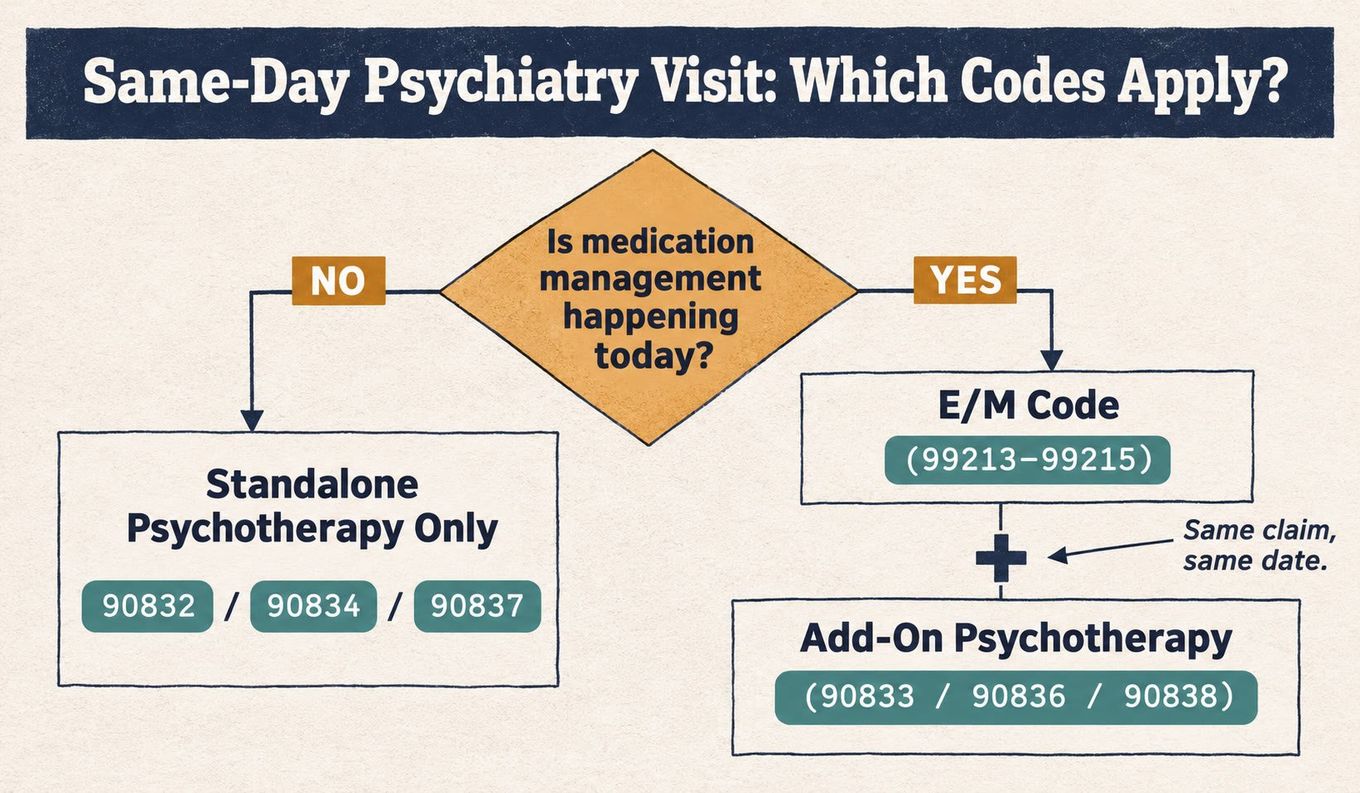
The add-on codes (90833, 90836, 90838) are what trips up most practices billing without specialty experience. These codes represent therapy provided on the same day as a medication management visit. They increase revenue per encounter significantly, but they require exact time documentation and correct pairing with the appropriate E/M level. Under-document the time and the add-on gets denied. Pair the wrong E/M level and you face a bundling edit.
For psychiatric group practices with behavioral health billing services, this is a core competency, not an edge case.
The Carve-Out Problem: Why Payer Routing Matters
Behavioral health carve-outs are one of the least understood revenue risks in psychiatry. Major commercial insurers, including Cigna/Evernorth and UnitedHealthcare/Optum, route mental health and substance use benefits through a separate behavioral health organization (BHO) rather than the medical plan.
That means your psychiatric practice may be credentialed with Cigna for primary care services but not with Evernorth for behavioral health, and vice versa. Claims routed to the wrong entity get denied as not credentialed, even when you have a valid contract with the parent company.
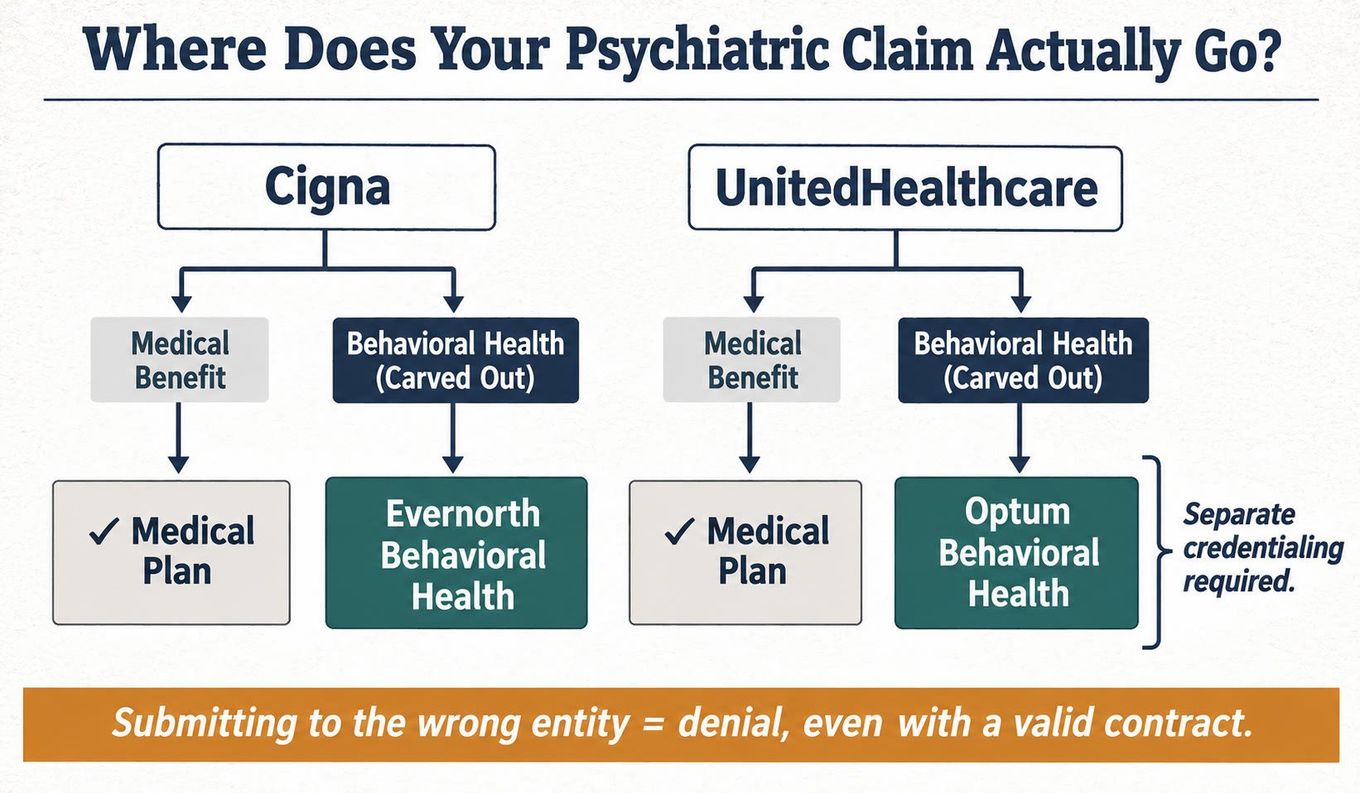
The fix requires understanding exactly how each payer splits its behavioral health benefit for each employer group. The routing rules are not publicly listed, and they can differ plan by plan. This is a credentialing and payer enrollment issue before it is a billing issue. See our in-depth breakdown of behavioral health carve-outs for a full walkthrough of the credentialing traps by payer.
Practices that work with a behavioral health credentialing partner experienced with carve-out structures typically catch these gaps before the first claim goes out.
Prior Authorization in Psychiatry
Prior auth is heavier in psychiatry than in most outpatient specialties. The specific pressure points:
Medication management: Some commercial payers require prior auth for ongoing medication management after a defined number of visits, even for established diagnoses. The trigger is not always obvious from the plan materials, and the first sign is a denial.
Step therapy: Commercial payers increasingly require documentation that a patient has tried and failed lower-cost medications before they will authorize branded medications or higher-cost treatments. This documentation requirement feeds into billing for Spravato and other advanced treatments.
Inpatient psychiatric admissions: Virtually all commercial and managed Medicaid plans require admission notification within 24 hours and concurrent review during the stay. Missing the notification deadline doesn't just risk a denial; it can trigger a full retro-authorization process that takes months.
Re-authorizations: Commercial payers typically authorize 6-10 visits at a time for outpatient therapy. Each re-authorization is a documentation event. A busy practice without a dedicated authorization coordinator routinely lets authorizations expire, leading to a pile of technically-valid claims that payers will not pay retroactively.
Billing for Advanced Psychiatric Treatments: Spravato and TMS
Spravato (esketamine) and transcranial magnetic stimulation (TMS) are two of the highest-revenue services a psychiatry practice can offer, and two of the most denial-prone. They require prior authorization from virtually every payer, careful code selection, and documentation that goes well beyond a session note.
Spravato (Esketamine) Billing
Spravato is FDA-approved for treatment-resistant depression (TRD) and major depressive disorder with acute suicidal ideation (MDSI). It is administered in-office as a nasal spray, requires a mandatory 2-hour post-administration observation period, and is subject to a FDA REMS (Risk Evaluation and Mitigation Strategy) program. Only REMS-certified providers and pharmacies can prescribe and dispense it.
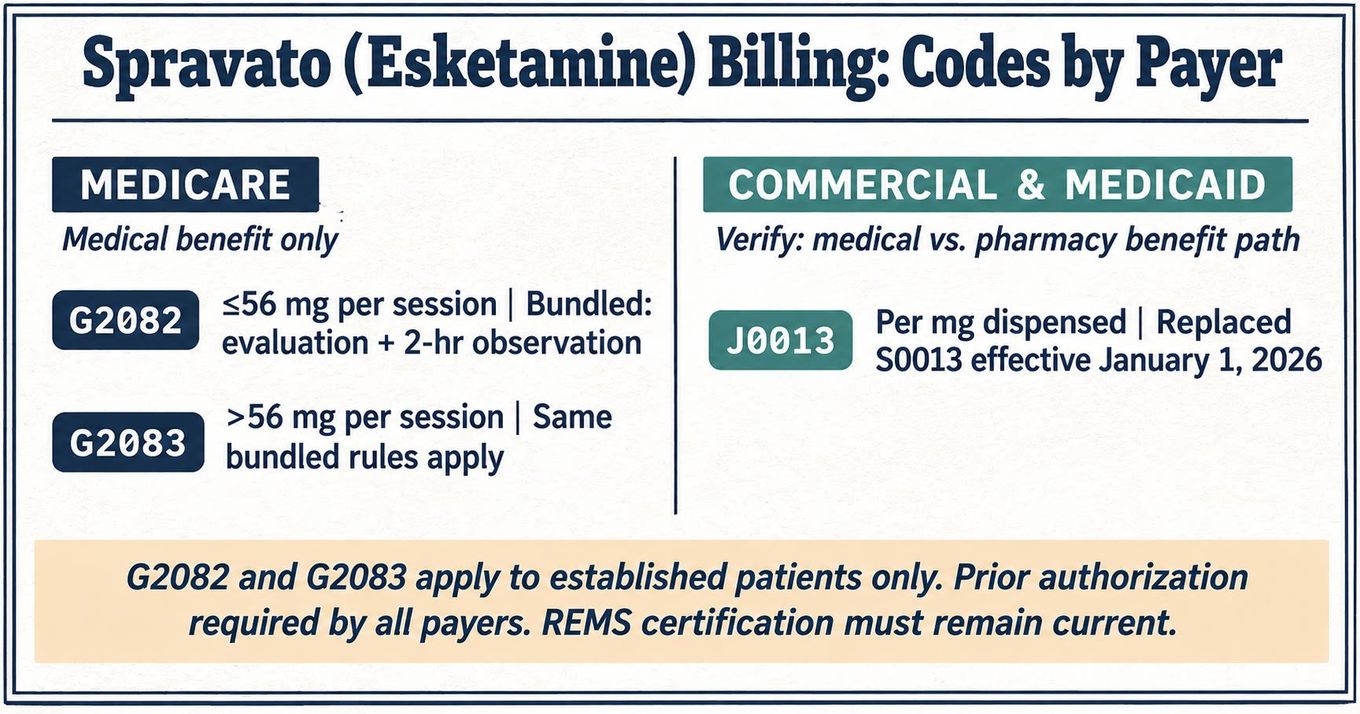
The HCPCS codes that govern Spravato billing differ by payer type and patient dose:
| Code | Use | Dose/Unit | Payer |
|---|---|---|---|
| G2082 | Bundled session + 2-hr observation | 56 mg or less per session | Medicare only (established patients) |
| G2083 | Bundled session + 2-hr observation | More than 56 mg per session | Medicare only (established patients) |
| J0013 | Drug billing, per mg (replaced S0013 January 1, 2026) | Per mg | Commercial and Medicaid |
| S0013 | Drug billing, per mg (discontinued January 1, 2026) | Per mg | No longer accepted |
Key rules:
- G2082 and G2083 apply to established patients only. New patient visits require a separate E/M code.
- G2082 and G2083 bundle the evaluation, supervision, and 2-hour observation into one per-session charge. Do not add a separate E/M or prolonged service code on top.
- Prior authorization is required by virtually all payers. Documentation requirements commonly include two or more failed antidepressant trials and a documented TRD diagnosis.
- UnitedHealthcare routes Spravato through the medical benefit for most commercial plans. Cigna uses a pharmacy benefit model for many groups. Verifying the benefit path before the first session is essential; the drug code differs depending on which benefit applies.
- REMS certification for the practice must remain current. Lapsed REMS enrollment creates a billing wall that is not solvable at the claims level.
- Commercial payer Spravato PA criteria and benefit routing change frequently; confirm specific requirements directly with each payer before scheduling a patient's first session.
Transcranial Magnetic Stimulation (TMS) Billing
TMS is a non-invasive neuromodulation treatment for treatment-resistant major depression, now also covered by some payers for OCD. A standard TMS course runs 30-36 treatment sessions plus an initial mapping session.
| Code | Service |
|---|---|
| 90867 | Initial TMS: cortical mapping, motor threshold determination, delivery, management (once per course) |
| 90868 | Subsequent TMS delivery and management, per session |
| 90869 | Subsequent motor threshold redetermination with delivery and management |
Billing realities for TMS:
- Prior authorization is required before the first session, without exception. Starting treatment before auth is confirmed results in an unbillable initial session.
- CPT codes for other psychiatry services (psychoanalysis 90845, family psychotherapy 90846) have bundling edits with TMS codes. Check the CCI edits before billing same-day services.
- 90867 is reported once per course of treatment, not per session.
- Medicare covers TMS under an LCD (Local Coverage Determination) for treatment-resistant MDD in adults. Coverage criteria require documented failure of antidepressant therapy.
- Some Medicaid programs are adding TMS coverage incrementally, with prior auth required. New York Medicaid added coverage on a two-tier rollout: October 1, 2025 for fee-for-service Medicaid and November 1, 2025 for managed care plans. Coverage is not universal; verify before scheduling.
Medicare for Psychiatry: What Practitioners Often Get Wrong
Medicare is a significant payer for many psychiatry practices, particularly those serving older adults, patients with serious mental illness, or rural populations. The rules differ enough from commercial billing to create a distinct error category.
Part A vs. Part B for Psychiatric Services
Medicare Part B covers most outpatient psychiatric services: diagnostic evaluations, psychotherapy, medication management E/M codes, and community mental health center services. Part B pays 80% of the Medicare-allowed amount after the patient meets their annual deductible; the patient (or their supplemental plan) covers the remaining 20%. This 80/20 split now matches what Medicare applies to most other Part B medical services, following a phasedown of the older 50% coinsurance rate that completed in 2014.
Medicare Part A covers inpatient psychiatric care. Freestanding psychiatric hospitals have a 190-day lifetime cap under Medicare, a restriction that does not apply to psychiatric units within general hospitals. This distinction matters for inpatient facility billing in a way most general billers do not track.
2025 Rate Context
The Medicare rate for CPT 90791 (psychiatric diagnostic evaluation) has trended downward over recent years. The national non-facility rate was approximately $195 in 2022, fell to approximately $169 in 2024, and declined further to approximately $167 in 2025, representing a cumulative reduction of roughly 14% from 2022 to 2025. The year-over-year drop from 2024 to 2025 was approximately 1-2%, driven by a lower PFS conversion factor. Exact rates vary by geographic adjustment (GPCI); confirm current allowed amounts through the Medicare Physician Fee Schedule Look-Up Tool on CMS.gov before using specific dollar figures for revenue projections.
Provider Enrollment and LPC/LMFT Expansion
As of 2024, licensed professional counselors (LPCs) and licensed marriage and family therapists (LMFTs) became eligible to enroll in Medicare directly under the Consolidated Appropriations Act, 2023 (Section 4121 of Division FF, also known as the Mental Health Access Improvement Act). This matters for multi-disciplinary psychiatric practices that employ these provider types: they can now bill Medicare under their own NPI rather than relying on incident-to arrangements. Credential them separately and confirm their PECOS enrollment is active before submitting claims.
Medicare Advantage Complications
Medicare Advantage (MA) plans add a layer of complexity not present in traditional Medicare. MA plans can require prior authorization for outpatient psychiatric services that original Medicare does not. A 2023 Senate Finance Committee investigation found that more than 80% of providers listed as in-network with MA behavioral health networks were unreachable, not accepting new patients, or not actually in-network. This creates a parallel credentialing problem: being enrolled in traditional Medicare is not the same as being contracted with any given MA plan. Each MA plan is a separate contracting and credentialing event.
Billing for Nurse Practitioners and Physician Assistants in Psychiatry
Psychiatric NPs (PMHNPs) and physician assistants (PAs) are a growing part of the psychiatric workforce, particularly for medication management and follow-up care. How their services are billed has significant revenue and compliance implications.
Direct Billing vs. Incident-To
Direct billing (under the NP's or PA's own NPI): NPs and PAs with their own Medicare enrollment bill under their own National Provider Identifier at 85% of the Medicare Physician Fee Schedule rate. This is the lower-reimbursement but lower-risk option. It is the correct path for new patients and new problems.
Incident-to billing (under the supervising psychiatrist's NPI): When NP or PA services qualify as "incident to" the supervising physician's services, they can be billed under the physician's NPI at 100% of the physician fee schedule rate. The difference is meaningful: 15 percentage points per claim across a high-volume medication management practice.
However, incident-to has specific requirements that many practices do not fully understand:
- The physician must have initiated treatment for the patient's current problem. Incident-to cannot be used for new patients or new problems, even if the patient is established with the practice.
- The supervising physician must be physically present in the office suite (not just reachable by phone or on another floor) at the time the NP or PA sees the patient.
- The physician must remain actively involved in the patient's care, documented at a clinically appropriate frequency.
Billing incident-to when these conditions aren't met is a compliance risk. CMS audits for it. If it comes up during a review, the difference between the physician rate (100%) and what should have been billed at the NP rate (85%) can be treated as an overpayment.
Commercial plans: Incident-to rules vary. Some commercial payers follow Medicare's model; others require NPs and PAs to bill under their own credentials regardless. Each plan's credentialing and billing requirements should be verified before submitting incident-to claims on commercial contracts.
Telehealth Psychiatric Billing
Telehealth is now a permanent part of psychiatric care delivery, particularly for outpatient therapy and medication management. For a full breakdown of telehealth rules by payer, see our telehealth mental health billing guide. The billing rules are payer-specific enough to generate a steady stream of avoidable denials.
The POS Code Problem
The most common telehealth billing error in psychiatry is using the wrong place of service (POS) code or mismatching the POS to the modifier. For Medicare in 2025 and 2026:
| Session Type | Where Patient Was | POS Code | Modifier |
|---|---|---|---|
| Video session, patient at home | Patient's home | 10 | 95 |
| Video session, patient not at home | Work, school, another clinic | 02 | 95 |
| Audio-only session, patient at home | Patient's home | 10 | 93 |
| In-person session | Your office | 11 | None |
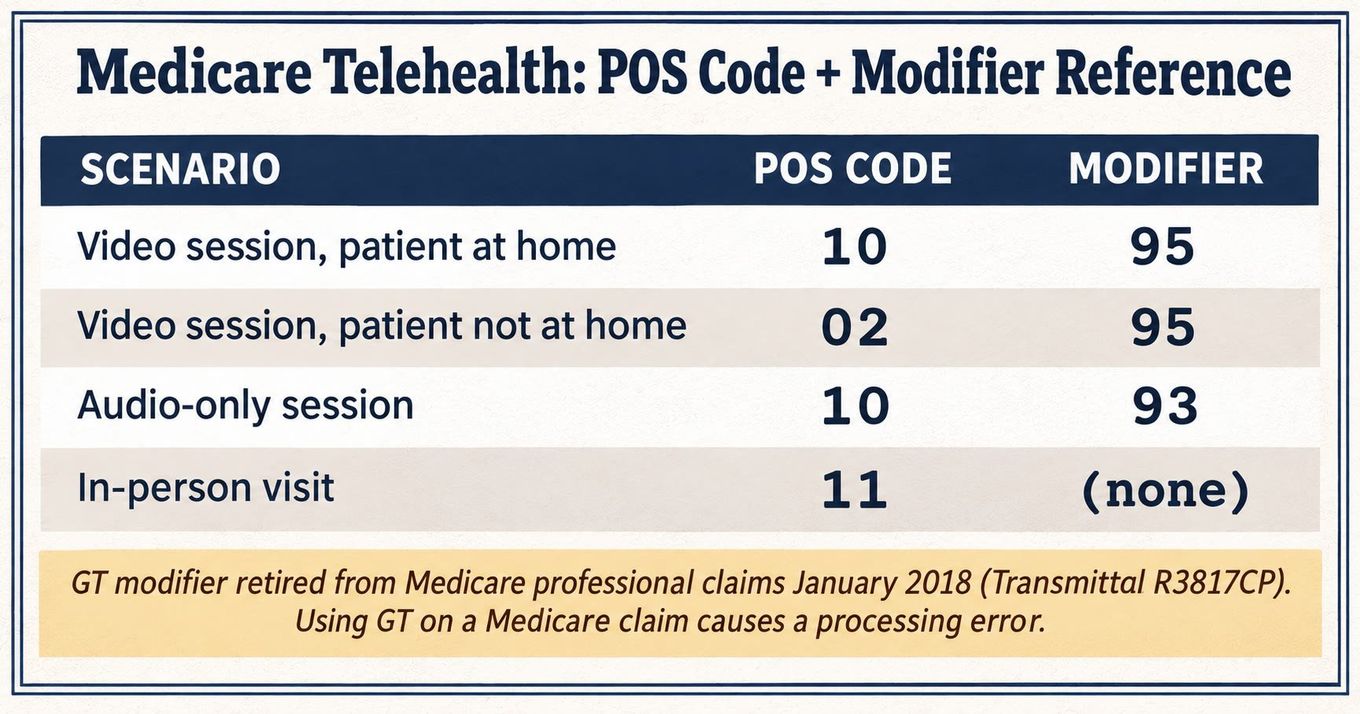
The GT modifier was retired from Medicare professional claims in January 2018 (Transmittal R3817CP, CR 10152). POS 02 and POS 10, paired with modifier 95 or 93, are the correct convention for Medicare professional telehealth claims. These POS code rules were formalized further effective January 1, 2024, including POS 10 specifically for services delivered to a patient at their home. GT still appears in some Medicaid and commercial plan billing guides; using it on a Medicare professional claim will cause a processing error.
Commercial payer variation: Optum (UHC's behavioral health administrator) requires POS 02 or POS 10 on all behavioral health telehealth claims and will not reimburse if only a telehealth modifier is submitted without the correct POS. Some regional plans still want POS 11 (in-office) with modifier 95 attached. Each major payer has its own published telehealth billing guidance; a biller without behavioral health experience may not know to check.
Audio-Only Rules
Medicare permanently covers audio-only psychiatric services using modifier 93. The patient must decline video or lack the technology for it, and the reason should be documented. Some commercial payers cover audio-only for behavioral health; others don't. Confirm coverage before the session rather than after the claim.
What Your RCM Metrics Should Look Like
One of the most useful things a psychiatric practice can do is benchmark its revenue cycle health. If your current biller or in-house team can't report these numbers, that's already a yellow flag.
| Metric | Target | Red Flag |
|---|---|---|
| Net collection rate | \>95% | <90% |
| Days in accounts receivable (AR) | <45 days | \>60 days |
| First-pass claim acceptance rate | \>90% | <80% |
| Denial rate | <4% | \>8% |
| Prior auth turnaround | <3 business days | \>5 days |
| AR over 90 days | <15% of total AR | \>25% |
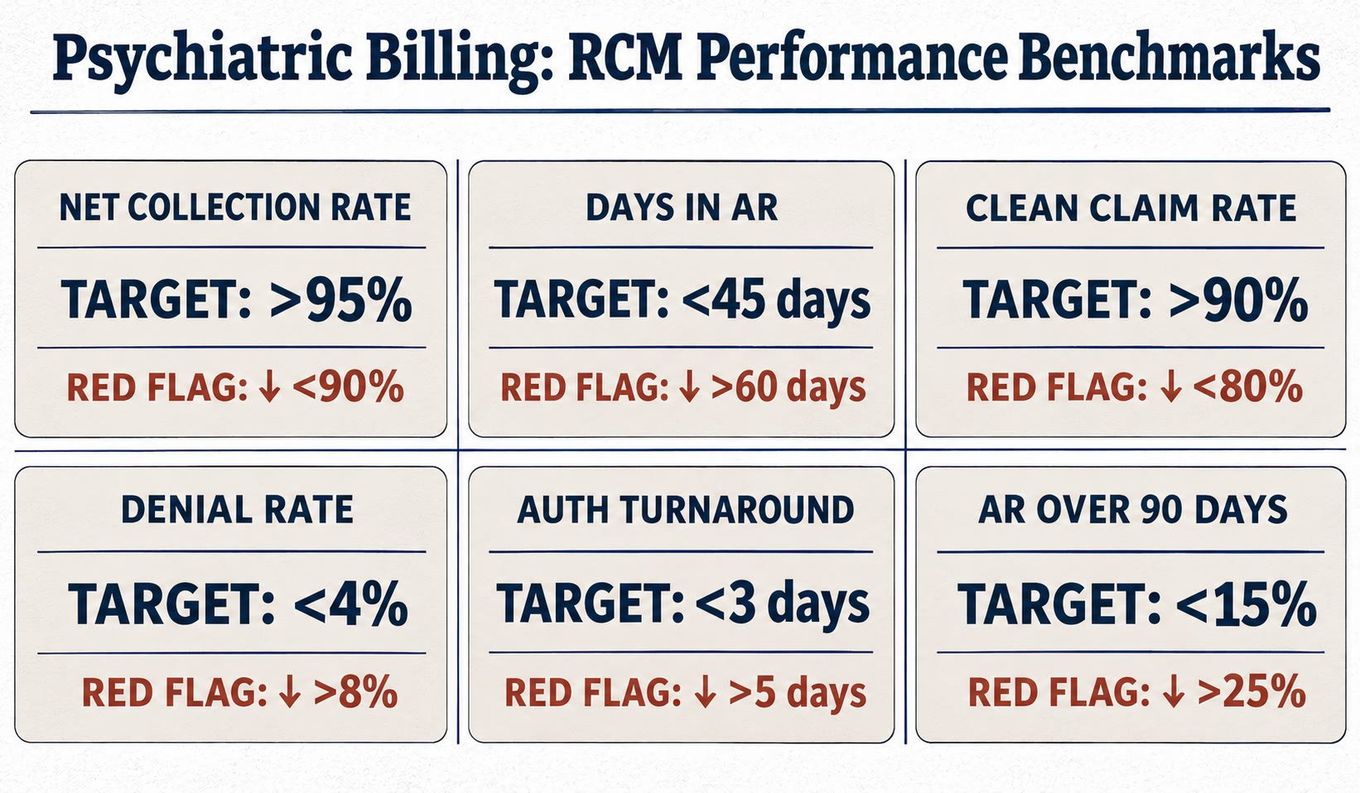
Psychiatric practices tend to run slightly higher denial rates than primary care because of the add-on code complexity and behavioral health carve-out routing errors. A denial rate consistently above 8% is a signal that something systematic is wrong, not just a run of bad luck.
Days in AR is the most direct indicator of cash flow health. When days climb above 60, the culprits are usually one or more of the following: a backlog of unworked denials, prior auth failures creating claims on hold, or credentialing gaps keeping claims from submitting.
Warning Signs Your Current Billing Is Failing
Practices often accept declining revenue performance as normal without recognizing it as a billing problem. These are the patterns worth watching:
- Denial rate above 5-10%: Some rejections are unavoidable, but a persistent denial rate in this range usually reflects a systemic coding or credentialing issue, not random payer behavior. Our breakdown of why mental health claims get denied covers the most common root causes.
- Payments consistently taking 45+ days: Commercial clean claims should pay in 30 days or less. Delays past 45 days typically mean claims are being pended for clinical review, prior auth isn't attached, or they're routing to the wrong payer entity.
- Staff spending significant time on billing: When clinical or administrative staff are regularly pulled into appeals, auth requests, and claim follow-up, the practice is paying practice-rate labor costs for billing work. This rarely shows up in a billing cost analysis but is real overhead.
- Constant appeals backlog: A healthy denial management workflow resolves most denials within 30 days. If your appeals log has items older than 60 days, revenue is aging out of collectability.
- No visibility into metrics: If your biller can't tell you your denial rate, days in AR, or clean claim rate on request, you don't have revenue cycle management. You have claims submission.
- Spravato or TMS revenue that's inconsistent: Given the documentation and auth requirements for these services, inconsistent revenue is usually a sign of documentation failures or auth lapses rather than payer behavior.
What Good Psychiatric Billing Services Actually Include
A psychiatric billing service does more than submit claims. The full workflow touches every phase of the revenue cycle:
Before the visit:
- Insurance eligibility verification and benefit checks (including carve-out routing verification)
- Prior authorization initiation and tracking for applicable services
- Credentialing status confirmation before the first claim goes out
At and after the visit:
- Code selection review against documentation (time documented? E/M vs. add-on code pathway correct? Telehealth POS and modifier matched?)
- Clean claim submission within 24-48 hours of service
- Real-time rejection monitoring
Post-submission:
- Payment posting and reconciliation (ERA and manual)
- Underpayment identification against contracted rates
- Denial management: identifying the root cause, correcting, and resubmitting within the timely filing window
Ongoing:
- Prior auth renewals before they lapse
- Credentialing renewals and re-credentialing
- Performance reporting with the metrics listed above
Advanced services (Spravato, TMS):
- REMS compliance monitoring for Spravato
- Pre-treatment PA with documentation of failed prior treatment trials
- TMS course management across the 30-36 session authorization window
Comparing Your Billing Options
Most psychiatric practices reach a point where they need to evaluate whether their current approach is working. Here's how the main options compare:
| Factor | In-House Billing | Generic Billing Company | Specialty Psychiatric RCM |
|---|---|---|---|
| Add-on code expertise | Varies (training-dependent) | Usually low | High |
| Carve-out routing knowledge | Low unless trained | Usually low | High |
| Spravato/TMS workflow | Rarely available | Rarely available | Available |
| Prior auth management | Reactive | Varies | Proactive |
| Medicare psychiatric rules | Varies | Varies | High |
| NP/PA incident-to compliance | Varies | Usually low | High |
| Telehealth code accuracy | Varies | Varies | High |
| Denial management speed | Depends on staffing | Varies | Dedicated workflow |
| Staff turnover impact | High risk | Medium | Low risk |
| Cost structure | Fixed (salary + benefits) | Percentage of collections | Percentage of collections |
| Visibility into metrics | Depends on software | Varies | Typically strong |
The case for in-house billing is strongest when the practice has experienced, fully trained billing staff, low turnover, and leadership that actively monitors the KPIs above. When any of those conditions break down, in-house becomes the most expensive option, not the least.
For practices evaluating outsourcing, the question is whether the billing company they're considering actually understands psychiatric coding, or whether they're a general-purpose medical billing shop that will apply their standard workflow to a specialty that breaks all the standard rules. Our full in-house vs. outsourced medical billing comparison walks through the full decision framework.
Why Trust This Article
Clarity Health RCM was built out of Quality Medical Billing, founded in 1988. Our team brings more than 40 years of combined revenue cycle experience, with specific depth in behavioral health, psychiatry, and physician billing across inpatient and outpatient settings.
The clinical and coding information in this article reflects our day-to-day work managing claims, denials, credentialing, and prior authorizations for psychiatric practices. Where specific rates or payer policy details are cited, they're drawn from primary sources (CMS.gov, payer coverage policies, AMA CPT guidelines) or flagged where they may change between publications.
The CPT code information reflects 2025-2026 coding guidance. Spravato billing codes changed effective January 1, 2026: J0013 replaced S0013 for commercial and Medicaid payers. Medicare continues to use G2082 and G2083 for Spravato. Always confirm current code applicability with your billing team and primary source documentation before submitting.
How Clarity Can Help
Psychiatric billing is not a secondary specialty for us. It's one of the areas we've invested most deeply in, specifically because we see how often psychiatric practices leave revenue on the table or absorb compliance risk through billing approaches that weren't designed for this specialty.
We handle credentialing and enrollment, including carve-out routing verification and re-credentialing for Cigna/Evernorth, Optum, and other BHOs. We manage prior authorizations proactively, including Spravato REMS coordination and TMS course management. We catch add-on code and telehealth errors before claims submit, not after they deny.
If you're evaluating psychiatric RCM services or trying to understand why your current billing isn't hitting the benchmarks above, we're glad to look at your numbers directly.
Frequently Asked Questions
What CPT codes do psychiatrists typically use for medication management visits?
Psychiatrists billing medication management visits use the standard E/M codes: 99212 through 99215 for established patients, based on medical decision-making complexity or time. If the visit also includes psychotherapy, the appropriate add-on psychotherapy code (90833, 90836, or 90838) is billed alongside the E/M on the same claim. The add-on code captures the time spent on therapy and must be supported by time documentation in the note.
Why are psychiatric claims denied more often than other specialties?
Psychiatric claims deny at higher rates than most other specialties for several structural reasons: the add-on code complexity (wrong pairing or insufficient time documentation), behavioral health carve-out routing errors (claim goes to the medical plan when it belongs to the BHO), prior authorization lapses, and telehealth POS or modifier errors. Practices without psychiatric billing expertise absorb these denials as part of the cost of doing business rather than recognizing them as solvable operational problems.
Is Spravato billing covered by insurance?
Most major commercial payers cover Spravato for treatment-resistant depression, but coverage is not guaranteed and prior authorization is required universally. Payers typically require documentation of two or more failed antidepressant trials and a confirmed TRD diagnosis before approving. Medicare covers Spravato under the medical benefit with specific LCD guidelines. Some state Medicaid programs have approved coverage; others have not. Benefit path verification (medical vs. pharmacy benefit) is essential before the first treatment session because it determines which HCPCS code is used for the drug itself.
What is the difference between POS 02 and POS 10 for telehealth?
POS 10 (Telehealth Provided in Patient's Home) applies when the patient received the telehealth service from their own home. POS 02 (Telehealth Provided Other than in Patient's Home) applies when the patient was at any other location, such as a workplace, school, or another healthcare facility. For Medicare, the correct POS must be paired with modifier 95 (synchronous audio-video) or modifier 93 (audio-only). Some commercial plans still require different modifier conventions; always check the payer's current telehealth billing guidance.
Can a psychiatric NP bill at 100% of the physician fee schedule?
An NP billing independently under their own NPI receives 85% of the Medicare Physician Fee Schedule rate. The 100% rate is only available through incident-to billing, where the service is billed under a supervising physician's NPI and meets all Medicare incident-to requirements: the physician initiated treatment for the current problem, the patient is established for that problem, and the physician is physically present in the office suite at the time of service. Incident-to does not apply to new patients or new problems, and commercial payer rules differ from Medicare.
How do I know if my psychiatric billing is performing well?
The key metrics to track: net collection rate above 95%, days in AR below 45, first-pass claim acceptance above 90%, and denial rate below 4%. If your biller can't report these numbers on request, you're missing the operational visibility needed to manage revenue cycle health. Practices with days in AR above 60 or denial rates above 8% are almost always dealing with a systemic problem in coding accuracy, payer credentialing, or prior authorization management, not just random claim noise.
What is a behavioral health carve-out and why does it matter for psychiatric billing?
A behavioral health carve-out is an arrangement where a commercial insurer routes mental health and substance use benefits through a separate behavioral health organization (BHO) rather than the main medical plan. Cigna routes through Evernorth; UnitedHealthcare through Optum Behavioral Health. A psychiatrist may be contracted with the medical plan but not the BHO, or vice versa. Claims submitted to the wrong entity deny as not credentialed. Correctly identifying the BHO for each patient's specific plan, and verifying credentialing with each separately, is a prerequisite for clean psychiatric claim submission with these payers.