In-House vs Outsourced Medical Billing: The Honest Test
August 17, 2026 · 53 min read
The comparison almost never starts with curiosity. It starts with a resignation letter, or an aging report somebody finally opened, or a monthly invoice that has quietly grown faster than the practice did. By the time a physician-owner or a CFO types in-house vs outsourced medical billing into a search bar, something has already broken, and the pressure to fix it fast is the single biggest threat to making a good decision.

We should say the obvious thing before we say anything else: we are an outsourced revenue cycle company. We sell the thing on one side of this comparison. That is precisely why this page has to be the version you can check - every figure sourced and clickable, every assumption stated, and an honest account of the conditions under which the right answer is to keep your billing exactly where it is. A comparison published by a vendor that concludes "hire a vendor" is worth nothing, and you would know it before you finished this paragraph.
Here is what you will have by the end: a method for comparing the two models on the same scope, the same cash denominator, the same period, and the same performance assumptions - plus a worked break-even you can rebuild with your own numbers in about an hour. What you will not find is a claim that outsourcing collects more money. No controlled study we could locate isolates the staffing model and proves that outsourced teams achieve lower denial rates or higher net collection rates once you account for specialty, practice size, baseline performance, and contract scope. We are not going to assume it in your favor or ours.
Which brings us to the problem with the comparison you were probably about to run.
Cost per month is the wrong question - compare cost to collect
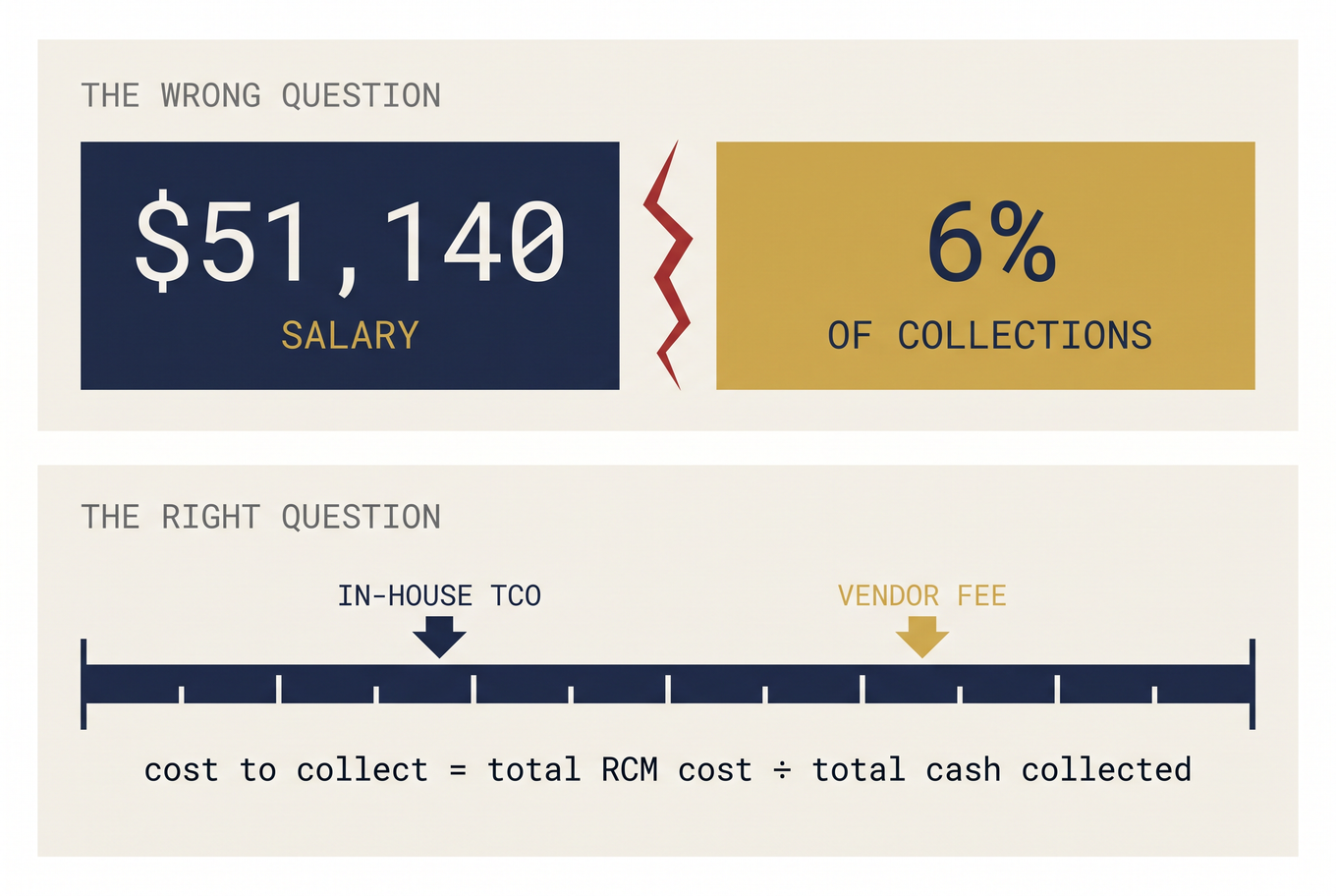
The instinct is to put a salary on one side and a percentage on the other. One biller at $55,000 versus 6% of collections. That comparison feels like arithmetic, but it is comparing a person to a service, a fixed cost to a variable one, and - nearly always - a narrow scope to a broad one. It is the reason two practices with almost identical financials reach opposite conclusions and both believe they did the math.
The question underneath the question is not which line item looks cheaper. It is this: which operating model delivers the collection performance, continuity, expertise, visibility, and management bandwidth this practice needs, at the lowest total cost and risk? That is six variables, and cost is only the first of them.
- Economics - fixed internal cost against variable external cost, at your actual volume.
- Performance - what actually gets collected, how fast, and with how much rework and write-off.
- Continuity - what happens during illness, leave, resignation, growth, or a denial surge.
- Expertise - whether your claims need specialty, payer, coding, authorization, or appeals knowledge that a generalist does not have.
- Governance - whether leadership can see, measure, audit, and correct the work.
- Strategic attention - whether running a billing operation is a defensible use of scarce management capacity.
No provider count answers all six. No revenue threshold does either. A high-volume group with a deep, redundant billing department can rationally keep everything in-house. A five-clinician practice with a difficult payer mix and one overwhelmed generalist can rationally outsource. A practice with an excellent front desk and terrible denial follow-up should probably do neither.
The financial frame that does hold across all six is cost to collect. HFMA defines it as total revenue-cycle cost divided by total patient-service cash collected, and its August 2025 definition is deliberately broad on the numerator: salaries and fringe benefits, management vendors, subscriptions, outsourced arrangements, purchased services, software and hardware maintenance, RCM IT expense, contingency and transaction fees, legal costs, office overhead, and automation workflows (HFMA MAP Keys). The denominator is cash actually collected - insurance and patient payments, net of refunds.
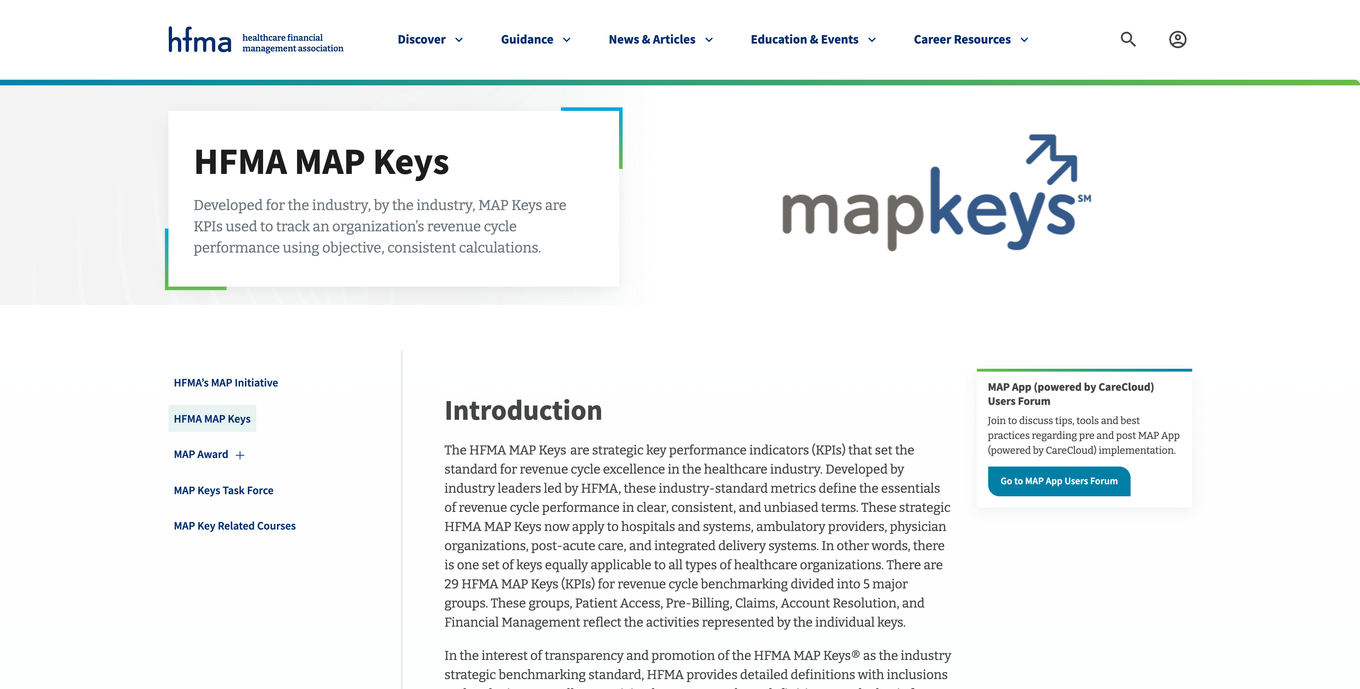
HFMA publishes 29 MAP Keys across five groups - Patient Access, Pre-Billing, Claims, Account Resolution and Financial Management - with defined inclusions and exclusions for each.
That formula does not decide anything on its own. What it does is force both models onto the same ruler. A monthly fee tells you what you paid. Cost to collect tells you what you paid for every dollar you actually banked - and that is the only number that lets a 4% quote and a two-person billing department appear in the same sentence honestly.
One more piece of vocabulary before the arithmetic, because it decides more money than anything else on this page: net collections means cash actually received after contractual adjustments and refunds, while gross charges are what you billed before any payer ever looked at it. A percentage charged against gross charges is a fundamentally different price from the same percentage charged against net collections, and the gap between them is your entire contractual adjustment rate.
Before either column can be filled in, six accounting rules have to hold. Most published comparisons - including several currently ranking for this query - break at least three of them.
Six accounting rules that make the comparison fair
Rule 1: Compare the same twelve months. Use the most recent trailing twelve months on both sides, not a strong quarter and not the month that triggered the search. If the practice is new or growing quickly, build low, base, and high volume cases instead of pretending a single number exists. A model built on one bad month will recommend change every time, because that is what one bad month looks like.
Rule 2: Compare the same work scope. Write every revenue-cycle function down the left side of a page and assign an owner under each model:
- Before the claim - scheduling and demographics · eligibility and benefits · prior authorization · credentialing and enrollment · documentation queries · coding
- Producing the claim - charge entry · claim scrubbing · submission · rejection correction · payment posting · contractual-adjustment validation · denial classification · corrected claims · appeals
- Chasing the money - payer calls and portal work · underpayment review · A/R follow-up · patient statements · patient calls and payment plans · bad-debt handoff · refunds and recoupments
- Running the function - reporting · compliance audit · process improvement · payer escalation · old A/R · transition-out
Twenty-eight rows. A fee is neither cheap nor expensive until you can see which of those rows it covers. A submission-only vendor and a full internal department are not substitutes for one another, and neither are a full-service vendor and one employee whose real job ends at payment posting.
Rule 3: Define the fee base. For any percentage quote, the rate is half the price. The other half is the fee base - the specific pool of cash the percentage is charged against. Ask, in writing, whether it includes insurance payments, patient payments posted after adjudication, copays collected at the front desk, deposits taken before the vendor touched the account, payments on claims submitted before the start date, old A/R, cash received after termination, capitation, secondary payer payments, collection-agency recoveries, and payments your own staff posted manually - and whether refunds and recoupments are netted out.
The cleanest buyer-aligned definition is cash actually collected on accounts within the vendor's contracted scope, net of refunds and recoupments, with explicit treatment of old A/R and patient payments. Two quotes at the same headline rate can differ by a fifth of the real price on this paragraph alone. We work through the full denominator question, along with minimums and add-on fees, in our guide to what medical billing services actually cost - this page assumes you will define the base and moves on.
Rule 4: Separate exclusive, retained, and shared costs. Three buckets, and mixing them is the most common way a model gets rigged without anyone intending to:
- Exclusive to in-house - employee payroll, billing-specific recruiting, coverage during absence, billing-only tools, internal training, and the office and IT allocation genuinely caused by billing.
- Retained after outsourcing - front-desk work, documentation correction, internal oversight, patient service, payer contracting, compliance governance, and often a share of the practice management system.
- Shared under either model - anything the practice needs regardless. The clinical EHR usually lives here. You do not save an EHR subscription by outsourcing billing if the EHR is still your system of record, and charging its full cost to the in-house column is one of the most common ways these comparisons quietly lie.
Rule 5: Separate four different economic effects. These behave nothing alike and are constantly mashed into one number:
- Operating expense - payroll, vendor fees, software, training.
- Working-capital timing - cash arriving earlier or later.
- Permanent revenue effect - write-offs, missed filing deadlines, unrecovered underpayments, denials nobody worked.
- Risk exposure - the probability and consequence of a vacancy, a vendor failure, a compliance problem, or a capacity ceiling.
Keeping them apart prevents the two most expensive errors in this category: treating an improvement in A/R days as though it were recurring revenue, and treating every delayed claim as though it were lost.
Rule 6: Give neither model a free performance advantage. Start the base case here:
collections under in-house = collections under outsourced
Then run sensitivities separately - outsourced collections 0.5%, 1%, and 2% higher, and the same three lower.
This rule cuts against our own commercial interest, so it is worth being precise about why it stands. MGMA's own reporting describes practices improving denial performance under both in-house and outsourced arrangements (MGMA on RCM improvements), and no strong public study isolates the staffing model and controls for specialty, size, baseline performance, and scope. That means a vendor's projected collection lift is a marketing assumption, not an input. Drop it into the model and the model will return the vendor's answer, because you told it to. The same discipline applies in reverse: an internal team does not earn a quality premium in the model because it sits down the hall.
With those six rules in place, the two cost stacks can finally be built - and the in-house one is considerably larger than a salary.
The real cost of in-house medical billing
Start with wages, and be careful about which number you use. O*NET, drawing on Bureau of Labor Statistics data, reports a 2025 median of $24.59 per hour, or $51,140 a year, for Medical Records Specialists, SOC 29-2072 (O*NET 29-2072.00). That occupation is broader than "medical biller" - it sweeps in coding and records work - so it is a reasonable national fallback and nothing more. Your local payroll and the actual job design should beat it every time. A rural practice in a low-wage market and a group competing with hospital systems for the same certified coder are not running the same model.
The benefits number nearly everyone gets wrong
Here is where most comparisons on this topic go off the rails, including ones that are otherwise careful.
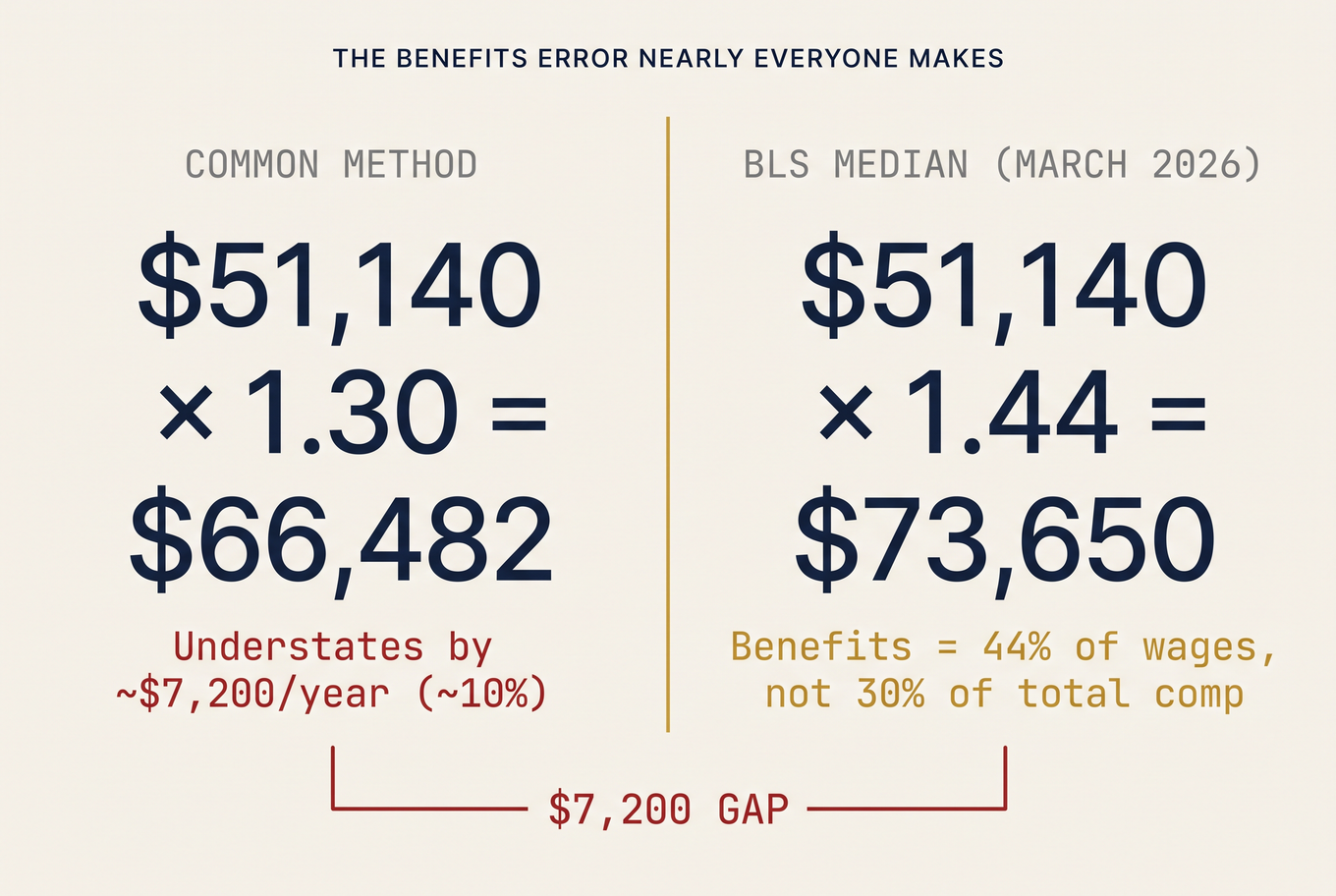
You have almost certainly seen "benefits add about 30%" applied as a multiplier: salary × 1.30. That number is real, and it is being used against the wrong denominator. The BLS Employer Costs for Employee Compensation release for March 2026 reports, at the median private-industry wage percentile, wages and salaries of $24.15 per hour, benefits of $10.63, and total compensation of $34.78 (BLS ECEC, March 2026).
Work it through:
benefits as a share of wages = 10.63 ÷ 24.15 = 44.02% loaded-payroll multiplier = 34.78 ÷ 24.15 = 1.4402 benefits as a share of total comp = 10.63 ÷ 34.78 = 30.56%
The widely quoted ~30% figure is the benefit share of total compensation. The markup on wages is about 44%. On a $51,140 salary, multiplying by 1.30 produces $66,482 where the BLS median implies $73,650 - an understatement of about $7,200 a year, roughly 10%, before the model has considered a single other cost.
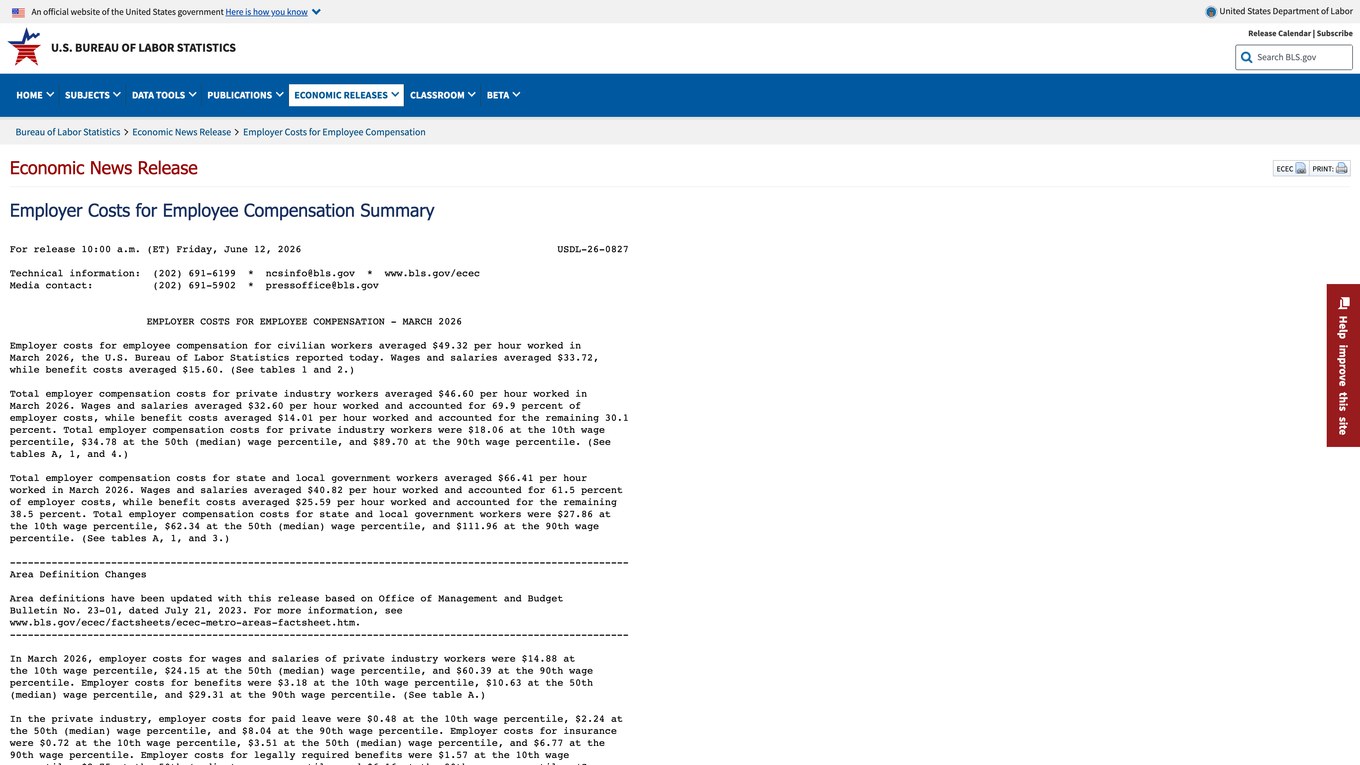
The source, so you can check it yourself: the BLS release reports $24.15 in wages, $10.63 in benefits and $34.78 in total compensation at the 50th (median) wage percentile - and separately reports the 30.1% figure as a share of total compensation, not of wages.
And then the mirror-image error. The BLS benefits figure already contains paid leave, supplemental pay, insurance, retirement and savings, and legally required benefits. If you apply the 1.4402 multiplier and then add PTO, employer payroll tax, and health insurance as separate lines, you have counted all three twice. Use itemized actual costs, or use one broad multiplier. Never both.
At the national wage proxy, the honest fallback looks like this:
base wage $51,140 employer burden $22,510 ($51,140 × 44.0166%) loaded payroll $73,650
That is a national private-industry fallback, not a healthcare-specific benefits quote. A small practice offering little insurance or retirement will land lower; an employer competing hard for experienced staff will land higher.
Recruiting, vacancy, and the number that does not exist
Recruiting belongs on its own line, and so does the vacancy it creates. SHRM's 2025 benchmarking report puts average nonexecutive cost per hire at $5,475 (SHRM 2025 benchmarking), and its 2026 recruiting benchmark reports a 39-calendar-day median time to fill for a nonexecutive role (SHRM recruiting benchmarking). Both are cross-industry figures, not medical-billing results, and should be labeled that way in your model.
You will find pages asserting that medical billing staff turn over at 30% or 40% a year. We could not locate a reliable current national turnover benchmark specific to medical billing staff, and we are not going to invent one to make the in-house column look worse. Use your own three-to-five-year vacancy history, or run the model at several probabilities and see whether the answer changes. If it does not change, the question was never load-bearing.
What a vacancy actually costs breaks into four lines that behave differently:
- overtime paid to existing staff;
- temporary or contract coverage;
- management and clinician time diverted into work queues;
- permanent write-off attributable to missed deadlines or unworked accounts.
The first three are operating or timing costs. Only the fourth is lost revenue, and it should be counted from actual claims rather than a blanket percentage. The mechanism that converts the first three into the fourth is timely filing - the deadline after which a payer will not consider a claim at all. Medicare generally requires claims for services on or after January 1, 2010 to be filed within one calendar year of the date of service, subject to regulatory exceptions (42 CFR §424.44). Commercial and Medicaid deadlines vary and are frequently much shorter. A six-week vacancy delays cash. A six-week vacancy that pushes a batch of claims past a 90-day commercial filing limit destroys it.
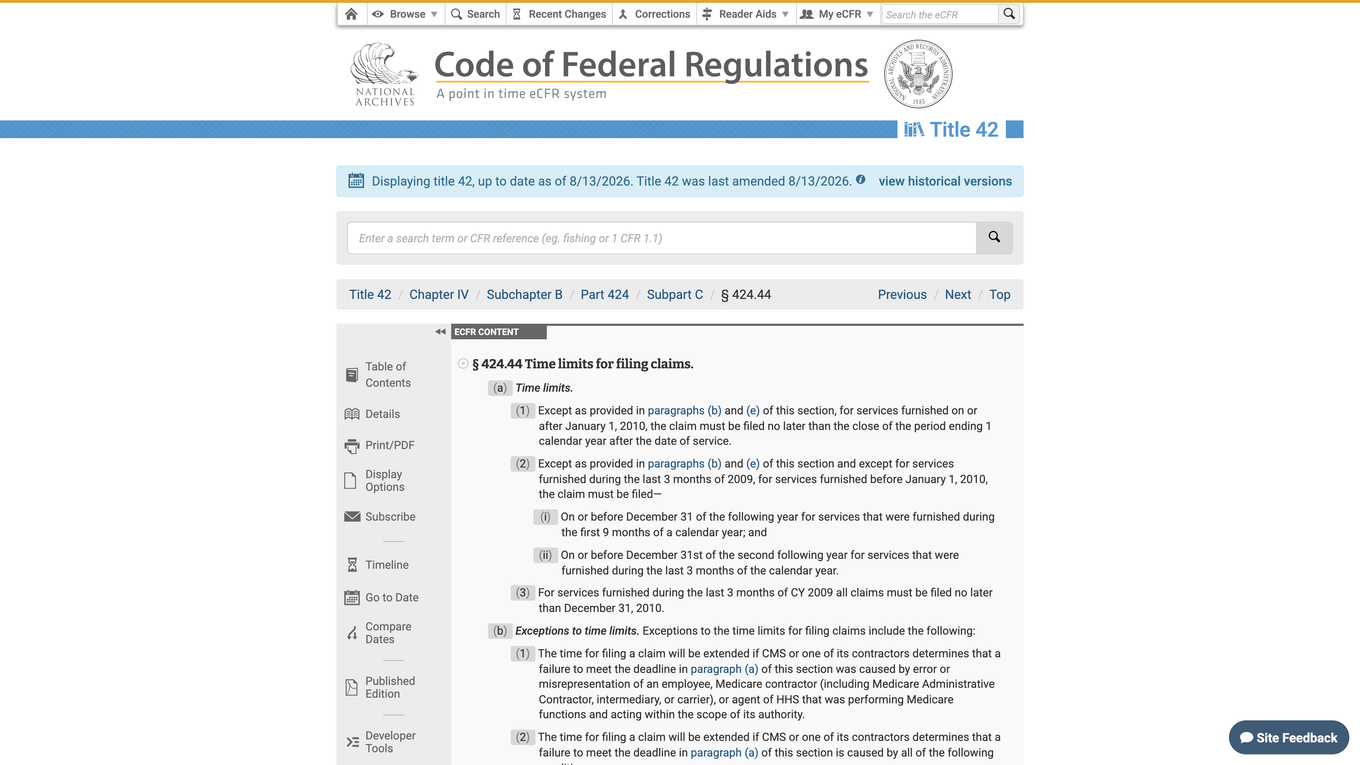
The rule itself: 42 CFR §424.44(a)(1) requires claims for services furnished on or after January 1, 2010 to be filed within one calendar year of the date of service, with the exceptions listed in paragraph (b).
What supervision, software, and upkeep actually cost
A biller's salary does not include the cost of managing a biller. Somebody reviews reports, coaches, resolves escalations, coordinates the front desk and clinicians, recruits, approves write-offs, handles payer contracting, audits, manages leave and capacity, and owns compliance. Price it directly:
supervision cost = hours per week × loaded hourly cost × 52
For physician-owner time, use the marginal value, not the sticker clinical rate. A clinical hourly rate is only appropriate where the billing work genuinely displaces a billable visit that could have been scheduled and collected. Otherwise use an administrator replacement cost or an explicit management-time value. Valuing every owner hour at full clinical rate inflates the in-house column dramatically; valuing it at zero pretends the owner's evenings are free.
On systems, count only what is genuinely incremental to internal billing. Clearinghouse pricing is public and modest - Claim.MD lists $30 a month for Basic, $60 for Small Volume, and $120 for Unlimited, with the Unlimited plan covering unlimited claims and ERA plus 1,000 monthly eligibility transactions (Claim.MD pricing). Practice management and EHR pricing runs much higher; AdvancedMD publicly lists medical-specialty software at $429–$1,070 per provider per month, mental-health plans at $130–$399, and billing subscriptions at $229–$1,070 (AdvancedMD pricing).
Those are examples, not market averages. And the useful question is not what software costs. It is: which software, transaction, support, and clearinghouse costs actually disappear under the vendor contract? Some vendors include core practice management and clearinghouse technology. Some require you to keep and pay for your own system. Some charge integration and transaction fees on top. Only the costs that genuinely vanish belong in the savings column.
Professional upkeep is real but should be counted as actually incurred, not as a full shopping list per employee per year. Current AAPC pricing shows individual annual membership at $229, a twelve-month webinar subscription at $270, and a Pro Fee Coder book bundle at $244.99 at the displayed offers (AAPC membership), with core certification exams at $425 for one attempt or $499 for two (AAPC exam pricing). Not every biller needs every product every year.
Errors, denials, and the cost of getting coding wrong
Resist the urge to assign the in-house column a generic error premium. "Unspecialized internal billers make more mistakes" is an assumption, not a measurement, and your own data is better than anyone's benchmark. Pull initial denial count and dollars, rejection count, denial reason and preventability, appeal rate, overturn rate, denial write-off dollars, timely-filing write-offs, underpayment adjustments, credit-balance errors, claims never submitted, charge lag, and A/R by payer and age.
For context around your own numbers - context, not substitutes: MGMA reported an 8% single-specialty aggregate first-submission denial rate in its 2023 data (MGMA denial benchmark) and describes first-submission denials holding at 7%–8% across the past four years, with rates below 5% achievable through targeted process fixes (MGMA, July 2026). A 2021 MGMA article put the average cost to rework a denied claim at $25.20 - useful, and now five years old (MGMA on denials). Experian Health's 2025 survey found 41% of responding provider organizations said at least 10% of their claims were denied, which is a distribution across survey respondents rather than a national claim-weighted denial rate (Experian State of Claims 2025, full report).
Coding accuracy carries its own exposure. CMS reports that incorrect coding accounted for 49.1% of improper payments for evaluation and management services in the 2024 reporting period, with documentation problems making up much of the remainder (CMS E/M compliance tips). That is Medicare improper-payment evidence - it says coding errors are expensive, not that either staffing model causes them.
The line item nobody writes down
Finally, capacity. A one-biller department should be able to answer eight questions: who submits claims during leave, who works denials, who posts payments, who understands the payer portals and contracts, who audits the biller, who can reconstruct open work after a resignation, whether coverage is documented by function, and how much backlog can accumulate before a filing deadline is threatened.
If several answers are "the biller," the model is cheaper than a redundant team because it is buying less. That is not automatically wrong - plenty of practices run it deliberately and well. But price it honestly:
key-person exposure = probability of outage × direct coverage cost + expected permanent loss
And note that outsourcing is not the only remedy. Cross-training, written SOPs, shared credentials, shared work queues, documented leave coverage, and a second capable person all reduce the same exposure without changing the operating model at all.
A fair number for in-house means an equally fair number for the alternative - and the outsourced side has a stack of its own that the headline percentage does not show.
The real cost of outsourced medical billing, beyond the percentage
The visible cost is straightforward:
vendor fee = contract rate × contract-defined eligible collections
For a public market anchor, AdvancedMD lists full RCM services at 4%–8% of collections on its price page (AdvancedMD pricing). That is one vendor's published price, checked this month - not an industry average, and not a substitute for reading a contract.
Around that rate sit the fees that decide whether a quote is what it appeared to be: monthly minimums, implementation and setup, per-provider or per-location or per-TIN charges, integration fees, clearinghouse and transaction charges, statement postage, card processing, credentialing, coding, prior authorization, old-A/R project fees, denial-recovery contingency rates, custom reporting, data export or termination fees, and minimum contract commitments. Annualize every one of them before comparing anything.
The scope ladder: what a percentage actually buys
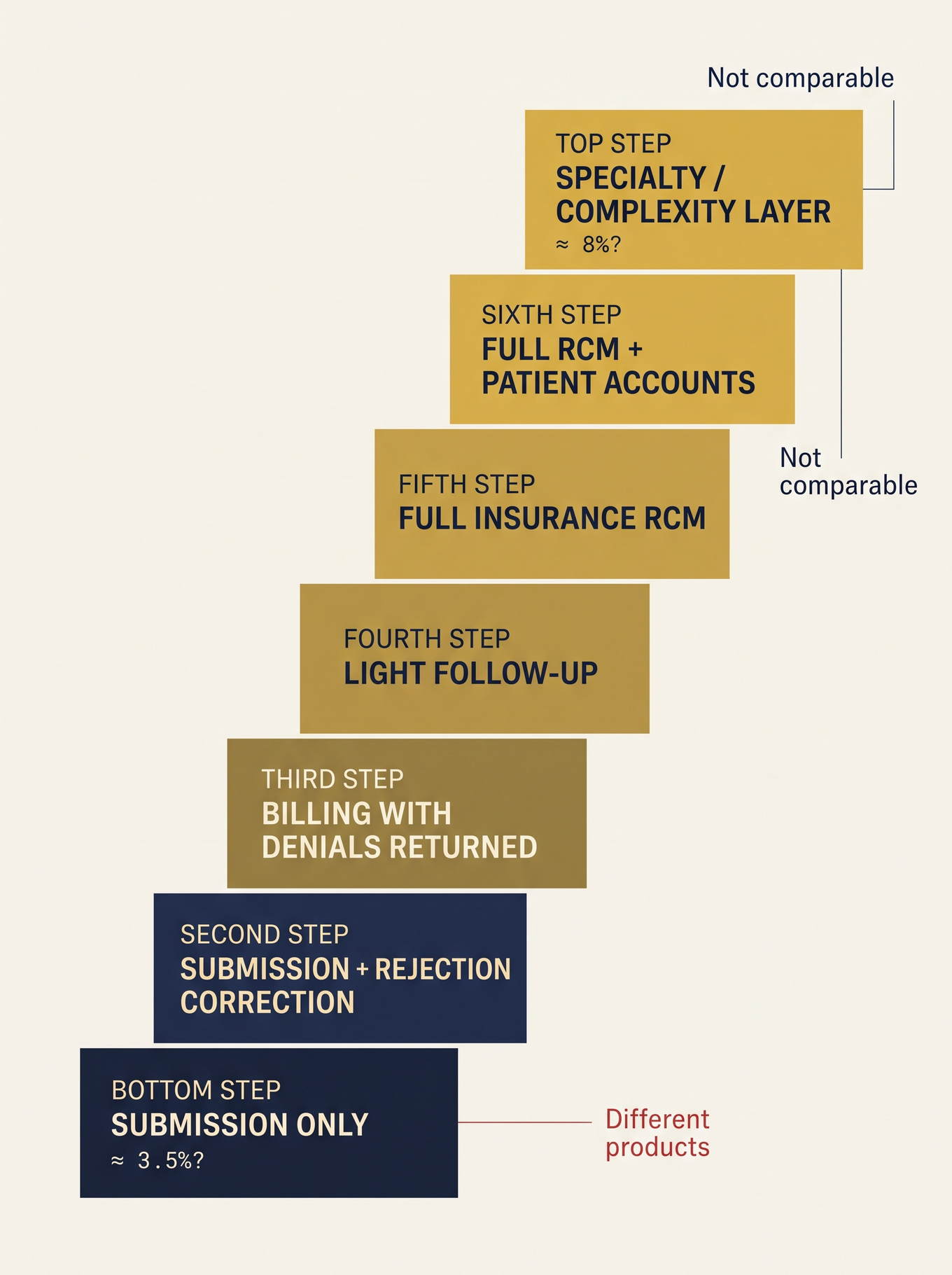
This is the part that matters most, and the part almost no comparison publishes. A percentage is uninterpretable next to another percentage. It is only interpretable next to scope - and "full service" is a marketing category, not a scope.
| Scope level | Who owns the work | The risk you are taking |
|---|---|---|
| Submission only | Vendor submits prepared claims. Practice keeps rejections, denials, A/R, and all patient work. | A cheap headline rate that leaves every expensive exception internal. |
| Submission + rejection correction | Vendor gets claims through the clearinghouse and payer front door. | "Accepted" is not "paid." Every downstream denial is still yours. |
| Billing with denials returned | Vendor submits and posts; denial queues come back to the practice. | You believe you bought RCM while retaining the hardest work in it. |
| Light follow-up | Vendor touches unpaid claims under defined rules or on a set frequency. | "Follow-up" can mean a status check rather than a resolution. |
| Full insurance RCM | Vendor owns claims through denial, appeal, and A/R resolution. | Still needs exclusions, touch frequency, aging standards, escalation paths, and write-off authority in writing. |
| Full RCM + patient accounts | Vendor also handles statements, patient balances, eligibility, authorization, or registration support. | Closest to a broad internal department. Higher fee, more integration, more dependency. |
| Specialty / complexity layer | Coding, authorization, clinical appeals, carve-out routing, underpayment recovery, old A/R, high-acuity workflows. | Judge the fee against loss avoided and dollars recovered, not against claim count. |
A 3.5% submission-only quote and an 8% full-cycle quote are not competing offers. They are different products, and the practice that treats them as comparable will pick the cheap one and then discover it still owns everything difficult. One practice owner described exactly that outcome after outsourcing:
"Cheap, but I still am handling a lot of reimbursement issues myself, the more challenging issues to resolve."
That is an anecdote, not a benchmark - but it is the single most common failure pattern in this category, and it is a scope failure, not a vendor failure.
A short digression on vocabulary, because this ladder turns on it: a rejection is a claim stopped at the clearinghouse or the payer's front door before adjudication, usually for a formatting or eligibility problem. A denial is a claim the payer adjudicated and declined to pay. They require different work, different deadlines, and different expertise - and a contract that covers one while sounding like it covers both is the most expensive ambiguity in outsourced billing.
The questions that force scope into the open are unglamorous and worth asking in writing:
- Who corrects clearinghouse rejections?
- Who works every denial, or which ones?
- How many follow-up attempts, at what intervals?
- Who writes and submits appeals?
- Who handles medical-records requests?
- Who works secondary claims and coordination of benefits?
- Who posts manual EOBs as well as ERAs?
- Who validates contractual adjustments and chases underpayments?
- Who owns patient statements, calls, refunds, and payment plans?
- Who owns claims at 30, 60, 90, and 120 days?
- Who owns A/R that predates the start date?
- Who owns cash received after termination?
- Who decides an account is uncollectible?
- Who performs coding and documentation queries?
- Who handles eligibility, authorization, and credentialing?
- Who reports root cause back to the front desk and the clinicians?
The last one separates a billing service from a billing department. A vendor that submits claims without telling you why they were denied leaves you generating the same denials forever.
What stays inside no matter what
"Outsourced" never means zero internal labor. A practice typically retains:
- At the front desk - accurate registration and demographics · insurance card capture · eligibility interpretation · prior authorization · referral orders · point-of-service collection · patient-facing explanations
- In the clinical workflow - documentation completion and correction · charge capture · clinician queries
- In the back office - payer-contract decisions · write-off approval · compliance oversight · vendor management · KPI review · data governance
That work has a cost, and it belongs in the outsourced column. As one practitioner put it plainly, "even with a billing company, someone internally usually keeps an eye on reports, denials, and collections" (r/PrivatePracticeDocs). Price that person's time.
Vendor governance is its own line:
governance cost = weekly review + escalation time + clinical and front-office coordination + monthly governance meeting + audit time
The AMA's guidance on engaging a third-party billing company recommends exactly this posture - regular meetings, confirmation that claims were received, routine A/R review, documented policies, emergency procedures, routine audits, and a contingency plan if the vendor fails or closes (AMA STEPS Forward, and its companion guidance on third-party billing vendors).
Then the exit terms, which nobody negotiates while they are happy: a business associate agreement - the HIPAA contract required when a vendor handles protected health information - plus subcontractor disclosure and flow-down obligations, security controls proportionate to the risk, breach notification, role-based access, system-of-record and data ownership, practice administrator access, claim-level audit trails, export format and cadence, retention, return or destruction of PHI, transition assistance, credential ownership, payer and clearinghouse enrollment control, termination rights, and a business-continuity plan (HHS sample BAA provisions).
Outsourcing may give a practice access to stronger security resources than it could fund alone, or it may add an attack surface and a subcontractor chain. It is not inherently safer or less safe. Assess the actual controls.
Where percentage pricing stops aligning
"We only get paid when you get paid" is the most repeated sentence in this industry, and it is directionally true and specifically incomplete. Percentage pricing aligns a vendor with collected cash in the aggregate. It does not align them claim by claim.
Low-dollar hard claims can be uneconomic to pursue. Denial work may sit outside scope. Patient balances may be excluded. Underpayment review may not happen at all. Old A/R may carry a separate rate. Documentation and front-end fixes require your cooperation and cannot be done to you. Cash the vendor never touched can still land inside the fee base. And a vendor benefits from your growth whether or not the marginal work grows with it - which is the exact mechanism behind a fee that felt reasonable at $800,000 and feels punitive at $3 million.
None of that makes percentage pricing wrong. It makes the contract, not the slogan, the thing that determines alignment.
With both stacks built honestly, the comparison finally becomes arithmetic.
How to run the break-even calculation
Three formulas, then a worked example with every input sourced.
In-house annual TCO = loaded payroll + billing-specific systems and transactions + training and professional upkeep + expected recruiting and onboarding cost + absence and vacancy coverage + management and supervision + office and IT allocation + measured denial rework + measured permanent process-related write-offs
Outsourced annual TCO = percentage fee on defined eligible collections + monthly minimums and fixed fees + setup, add-ons, and transaction charges + retained front-end and patient-account labor + vendor oversight and governance + retained technology + amortized transition cost + measured vendor-related rework or write-offs
Cost to collect = total revenue-cycle cost ÷ total patient-service cash collected
And the break-even itself, for the common case where internal cost is substantially fixed:
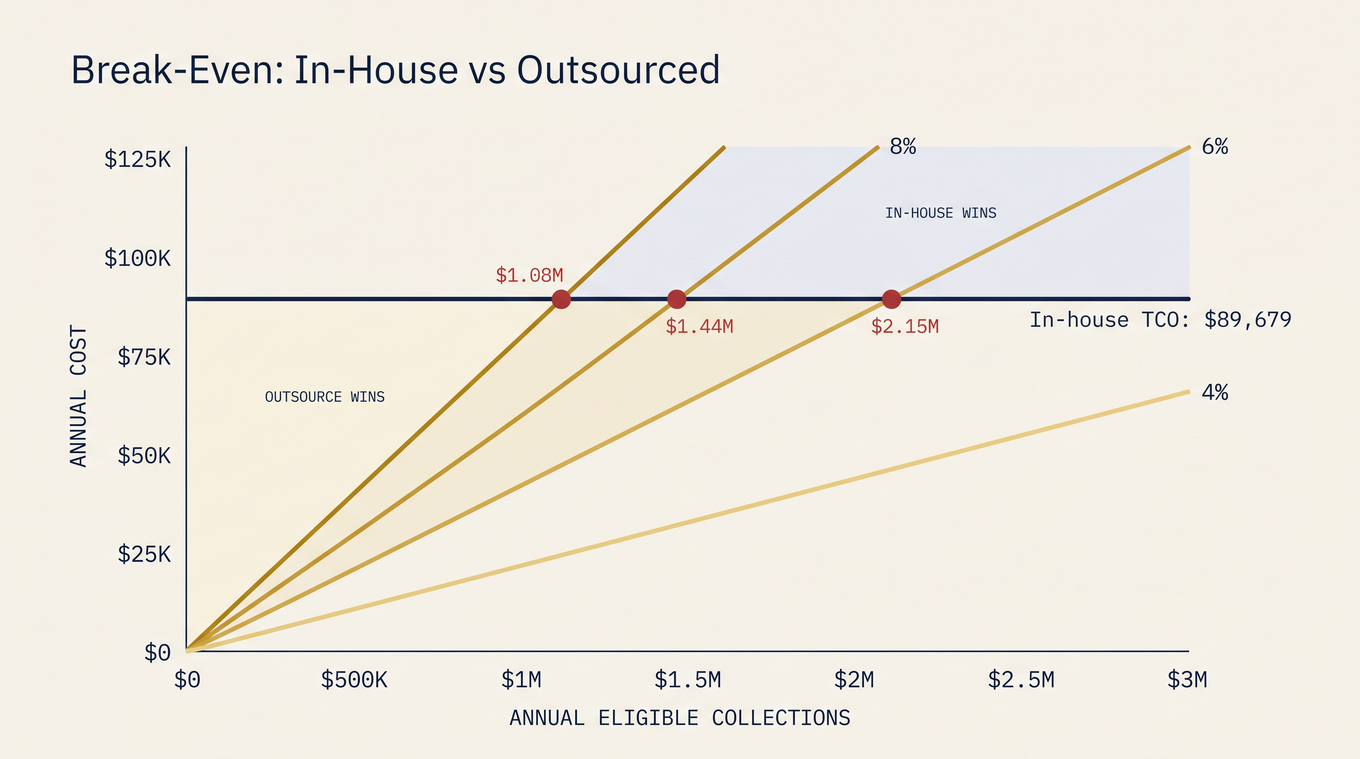
Break-even eligible collections = (in-house annual TCO − retained internal cost under outsourcing − vendor fixed fees) ÷ vendor percentage rate
A worked illustration, with every input sourced
This is a method demonstration, not a benchmark and not a recommendation. Every assumption is stated so you can replace it with your own number.
We assume one full-time billing and coding employee at the national wage proxy; the BLS median loaded multiplier; one replacement every three years at SHRM's average cost per hire; a modest professional-upkeep bundle; the Claim.MD Unlimited plan; three hours of management oversight a week at a $45 loaded hourly cost; a $5,000 annual coverage reserve; no EHR charge, because the practice keeps its clinical system under either model; no office or IT allocation; and - per Rule 6 - no assumed difference in collections or denials between the models.
| Line | Calculation | Annual |
|---|---|---|
| Base wage | O*NET/BLS 2025 national median | $51,140 |
| Employer burden | $51,140 × 44.0166% | $22,510 |
| Loaded payroll | base + burden | $73,650 |
| Expected recruiting reserve | $5,475 ÷ 3 years | $1,825 |
| Professional upkeep | $229 + $270 + $244.99 | $743.99 |
| Clearinghouse | $120 × 12 | $1,440 |
| Management oversight | 3 hrs × $45 × 52 | $7,020 |
| Coverage reserve | modeled assumption | $5,000 |
| Illustrative in-house TCO | $89,679 |
Note what this figure still excludes: billing-specific office and IT allocation, any second RCM role, a practice-management differential, and measured denial or write-off effects. It is a floor for this staffing design, not a ceiling.
Now the other side. Assume leadership still spends 1.5 hours a week on vendor governance at the same $45 loaded rate - $3,510 a year - and assume no fixed vendor add-ons in the first pass:
cost gap = $89,679 − $3,510 = $86,169
| Vendor rate | Break-even eligible annual collections |
|---|---|
| 4% | ≈ $2,154,000 |
| 6% | ≈ $1,436,000 |
| 8% | ≈ $1,077,000 |
Below the break-even, the percentage fee costs less than this modeled internal operation. Above it, the percentage costs more. (These are rounded to the nearest thousand deliberately - publishing them to the dollar would imply a precision the inputs do not have.)
Now add $12,000 a year of vendor minimums and add-ons, which is an ordinary amount, and watch the thresholds move:
| Vendor rate | Break-even with $12,000 in vendor fixed costs |
|---|---|
| 4% | ≈ $1,854,000 |
| 6% | ≈ $1,236,000 |
| 8% | ≈ $927,000 |
A single line of fixed fees moved the 6% threshold by $200,000 of collections. This is why the percentage alone cannot answer the question, and why a quote without its fixed fees annualized is not a quote.
For contrast, run the naive version - loaded payroll only, ignoring recruiting, coverage, supervision, systems, and upkeep. At the $51,140 wage proxy, loaded payroll of $73,650 implies a 6% break-even near $1.23 million instead of $1.44 million, a swing of more than $200,000 in the opposite direction. Salary-only comparison is not merely imprecise; it is wrong by amounts large enough to flip the decision.
The sensitivity that overturns everything
Cost is only half the model. Run collection performance separately, and the numbers get uncomfortable fast.
| Collection difference | At $1.5M collections | At $3M collections |
|---|---|---|
| 0.5% | $7,500 | $15,000 |
| 1.0% | $15,000 | $30,000 |
| 2.0% | $30,000 | $60,000 |
At $3 million, a one percent difference in collections is $30,000 a year - comparable to the entire cost gap in the illustration above. Which means a model that assumes any performance difference at all is not really a cost model; it is the assumption, wearing arithmetic. Combine both effects only at the end:
Net economic advantage of Model A = (annual TCO of Model B − annual TCO of Model A) + (collections under Model A − collections under Model B)
Use net collectible revenue and actual write-offs. Never gross charges.
The A/R days trap
One more correction, because it appears on nearly every page in this category and it is worth real money.
Reducing days in A/R releases cash. Approximate it as average daily cash multiplied by the reduction in A/R days. A practice collecting $250,000 a month has roughly $8,333 of average daily cash on a 30-day convention, so a 15-day reduction accelerates about $125,000.
That is genuinely valuable. It is also, in most cases, a one-time working-capital release, not $125,000 of new revenue every year. You pull a fixed amount of cash forward once. The recurring benefits afterward are a lower financing need, less cash volatility, and reduced aging risk - real, but not the same thing. A model that books $125,000 as an annual gain and compares it to an annual fee has manufactured a result.
The same logic governs delayed claims. Delay is a working-capital problem right up until a filing or appeal deadline expires, documentation can no longer be corrected, a patient balance becomes uncollectible, or somebody writes the account off. At that moment, and not before, it becomes permanent loss.
Two more metrics belong on the dashboard and are not interchangeable. Cost per claim - annual RCM cost divided by annual claims - measures production efficiency but ignores claim value and recovery quality; a low cost per claim can coexist with terrible collections. Cost to collect relates total cost to actual cash and is the better economic comparison, provided scope and denominator stay consistent. Track both, alongside net collection rate.
The break-even gives you a cost answer. Seven things can overturn it.
Seven things that overturn the cost answer
Specialty and claim complexity
Complexity pushes in both directions, and which way depends on where the expertise already sits.
It favors keeping work internal, or co-managing it, when clinicians and billers need constant documentation feedback, when local clinical context is hard to transmit, when the practice already has a proven specialty team, or when complex claim volume is high enough to justify dedicated internal experts.
It favors outsourcing when the internal biller is a generalist, when authorization rules, payer routing, coding depth, appeals, or underpayment analysis exceed current competence, when specialty volume is too small to support a dedicated internal expert, or when the practice needs depth across several payers and service types at once.
This is the terrain we work in - behavioral health, mental health, and inpatient physician billing - and it is exception-heavy in specific, describable ways. Behavioral benefits are frequently carved out to a managed behavioral health organization, so the payer on the insurance card is not always the payer you bill; level-of-care authorization and concurrent review turn delivered care into uncollectible care when a deadline slips; and inpatient physician billing lives or dies on whether documentation supports the level of service coded. But that argues for a specialist only where the specialist can show the workflows, the payer matrices, and the scope in writing. It is not an argument that a vendor is better. It is an argument that this work is a different job from routine claim submission, which is a claim you can verify by asking any candidate - internal or external - to walk you through one.
Volume, which cuts both ways
More volume can justify fixed internal infrastructure and make a percentage fee expensive. More volume can also exceed a small internal team's capacity and make external scale valuable. Both are true, and provider count will not tell you which applies to you.
Measure capacity instead: claims per FTE by work type, touches per denial, A/R accounts per collector, work-queue aging, overtime, backlog, leave coverage, and complexity mix. Ten low-volume therapists and ten high-intensity proceduralists do not generate the same revenue-cycle workload, and a model that treats them the same is measuring the wrong thing.
It is worth noting how much of this workload is structural rather than headcount-driven. CAQH's 2025 Index estimates the U.S. healthcare system avoided roughly $258 billion in administrative costs in 2024 through electronic transactions and improved data exchange (CAQH 2025 Index) - a system-wide modeled estimate, and evidence that transaction design moves administrative cost, not evidence that either staffing model is cheaper.
Payer mix and carve-outs
Complexity rises with Medicaid and managed-care variation, Medicare Advantage, behavioral-health carve-outs, workers' compensation, out-of-network claims, secondary claims and coordination of benefits, high patient responsibility, payer-specific authorization rules, and a long tail of regional plans.
A simple payer mix can make a lean internal model or even self-billing entirely reasonable. A fragmented one can justify specialist support - or a single-payer carve-out - even at modest volume.
The current denial state, and its actual cause
A high denial rate is not an argument for outsourcing. It is an argument for diagnosis.
Denials originate in registration data, eligibility, authorization, credentialing, documentation, coding, claim construction, payer adjudication behavior, posting and adjustment errors, follow-up failures, underpayments, or patient responsibility. A vendor cannot fix a clinical documentation problem or a front-desk workflow from the outside. An internal biller cannot fix payer behavior by sitting closer to it. Corrective authority has to sit where the denial is created.
That matters more than it sounds, because the front end is where a large share of the leak begins. An MGMA Stat poll conducted January 6, 2026 found 48% of 288 applicable respondents named denials and appeals as their practice's biggest revenue-cycle leak, with front-end issues second at 23% (MGMA on revenue-cycle leaks) - and Experian's survey work identifies inaccurate or incomplete intake data as a leading denial driver (Experian State of Claims 2025). Billing begins at registration. No back-end team, internal or external, can manufacture accurate source data.
Growth and volatility
External capacity absorbs surges well: rapid provider additions, new locations, seasonal volume, acquisitions, new payers, a new level of care, or a backlog. Recruiting and training ahead of a surge is slow, and SHRM's 39-day median time to fill is a floor, not a ceiling, for a specialized role.
In-house wins when volume is stable enough to keep roles well utilized and leadership can hire ahead of demand rather than behind it.
Management competence
A strong internal billing department needs somebody who can define KPIs, audit, read payer contracts, distinguish a rejection from a denial, review adjustments, investigate underpayments, manage people and capacity, coordinate clinical corrections, and plan continuity.
Where nobody can supervise billing, hiring one junior biller is not a solution - it is an unsupervised single point of failure. But note the symmetry, because it is the part vendors leave out: outsourcing also fails under absent supervision. The AMA's guidance is explicit that internal monitoring continues after you hire a vendor. If leadership has no capacity to govern, neither model works, and that is the real finding.
Key-person risk, on both sides
Internally, the red flag is that one person holds the payer credentials, the work lists, or the process knowledge. Externally, the red flag is that the practice cannot name the team working its claims, does not know whether work is subcontracted, and does not know how to retrieve its own data.
The remedy is identical in both cases: documented, testable continuity. Not proximity.
So when is each model actually right? Start with the answer we have the least commercial reason to give you.
When keeping billing in-house is the right call
We are an outsourced billing company, and we will tell you plainly: for a meaningful share of the practices that find this page, the correct decision is to keep billing in-house and spend the money on making the internal operation better. Here is when.
When you already have a stable, experienced, specialty-capable team. A team that knows your payers, your documentation patterns, and your clinicians is an asset that took years to build and cannot be bought back. Replacing it to save a modeled few thousand dollars is usually a bad trade, and the transition risk alone can exceed the projected saving in year one.
When there is enough scale to fund redundancy, supervision, and leave coverage. The economics of a billing department improve with scale in a way a percentage fee does not. Fixed internal cost divided by a growing collections base falls; a percentage of a growing base rises. Past a certain volume that crossover is decisive - which is exactly what one practice owner described:
"I brought it internally once it financially made sense. I used to pay 6%."
Anecdote, not benchmark - but the arithmetic behind it is the arithmetic on this page.
The same logic scales further than most vendor content admits. In one practitioner discussion, a large community behavioral-health operator running 55 licensed counselors plus a much larger support workforce reported that outsourcing had been a poor experience and that at their volume an internal team simply made more sense (r/CodingandBilling). "Outsourcing scales better" is not a law. Often it is the opposite.

When your measured cost to collect is already competitive and denial write-offs, submission lag, and A/R aging are controlled. If you have the numbers and the numbers are good, a vendor is selling you a solution to a problem you do not have.
When leadership can manage and audit the function. Direct operational control is legitimate to want, and it is real when somebody competent is exercising it.
When the payer mix and claim types are genuinely manageable, when the practice's workflows and data are documented, and when a vendor would not actually remove meaningful work or systems from your plate.
When a percentage fee would materially exceed true fixed internal cost at your expected volume. Run the break-even. If your collections sit well above the threshold and your internal operation is performing, the model has already answered.
The solo-clinician version of this deserves saying directly, because a lot of pages tiptoe around it: a solo therapist or physician with low volume, a simple payer mix, reliable EHR and clearinghouse workflows, and the discipline to track exceptions can reasonably do their own billing. A monthly minimum or a percentage fee can easily exceed the value of routine claim submission at that scale. What to watch is not the claim submission - it is the exception load. Clawbacks, coordination of benefits, appeals, and growth are what turn a manageable admin task into an evening job.
And the honest counterweight, from a biller describing practices that brought work back in-house after a bad outsourcing experience:
"We discovered so many missed billed claims, so many claims billed wrongly, denied claims that were never looked into, EOBs that aren't entered."
Outsourcing is not a guarantee of competence. It is a transfer of work, and the transfer is only as good as the scope, the people, and the governance behind it.
The mirror obligation applies with the same rigour.
When outsourcing is the right call
When you have one-biller key-person risk you cannot resolve internally. If one resignation would leave nobody who knows the payer portals, the appeal status, the posting conventions, or which claims are near their filing deadline, that is not a staffing preference - it is an unhedged operational risk sitting on top of your entire cash flow.
When vacancies and absences repeatedly disrupt cash. Not once. Repeatedly. A pattern is a structural problem; a single event is an event.
When leadership cannot recruit or train the expertise the claims require. Some markets do not have available certified coders. Some specialties need payer knowledge that takes years to build and that a single hire will not carry.
When denial, A/R, or underpayment backlogs already exceed internal capacity. A team that cannot get through today's work will not get through today's work plus the backlog, and every week that passes moves more of it toward a filing deadline.
When specialty or payer complexity is beyond the current team. This is the trigger we see described most often in practitioners' own words. One therapist preparing to grow put it as: "I hired [a company] to do my billing and am wholly underwhelmed… I do not want to self-manage complications, denials, clawbacks, etc." (r/therapists). Another solo clinician: "I'm losing money because of delays and denials I don't fully understand… I just don't have the bandwidth" (r/therapists). Note that the first quote is about a disappointing vendor - which is an argument for scope and diligence, not against outsourcing.
When growth is rapid or volatile, and hiring cannot keep pace with the revenue cycle the growth creates. The five-clinician behavioral group adding Medicaid and a new location is the canonical case:
"We've been growing and the amount of work involved with the revenue cycle is getting overwhelming."
When the owner or administrator is consumed by billing work that has no realistic path back to clinical or executive time.
When the percentage fee sits below your fully loaded internal alternative at expected volume - and the contract genuinely covers the problem, including the hard claims - while the practice retains data access, oversight, and a workable exit.
Two situations deserve their own treatment because they are frequently misdiagnosed. If your only biller just resigned, the urgent problem is business continuity, not operating philosophy - inventory the open claims, denials, credentials, and deadlines first, cover the gap, and decide the permanent structure afterward, when you are not deciding under duress. And if you are paying 6% after rapid growth, run the actual break-even before you do anything else; the answer may be a renegotiated rate, a volume cap, a tiered schedule, a retainer, or a partial move rather than a wholesale change.
Which points at something both of those cases have in common, and that most comparisons never mention: for a lot of practices, the right answer is neither pole.
Hybrid and co-managed billing: the option most comparisons skip
The binary is false. Real practices routinely run a split - and the split is often better than either extreme, because it puts each piece of work where the capability actually is.
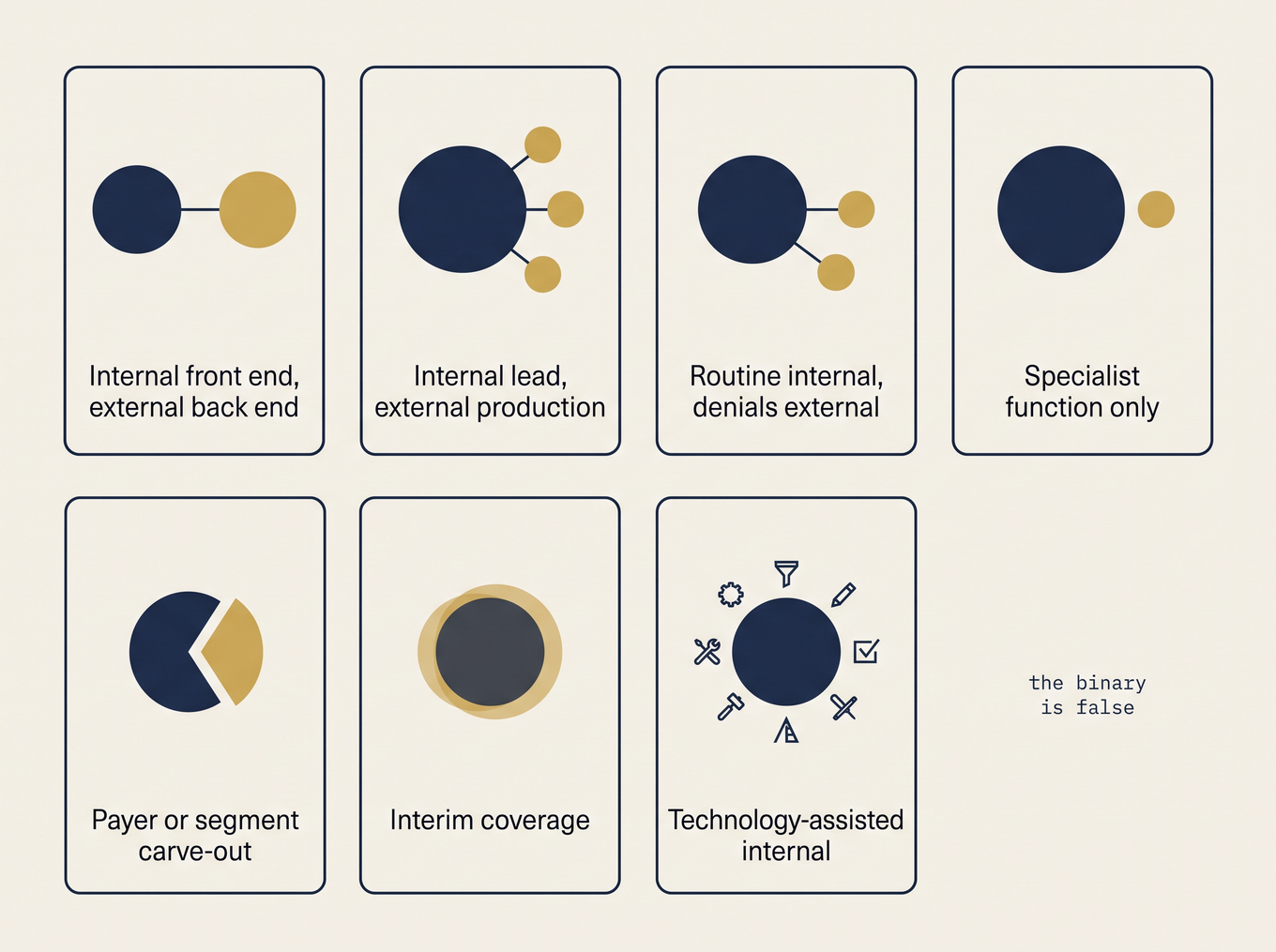
| Design | What it looks like | Best when | The specific risk |
|---|---|---|---|
| Internal front end, external back end | Practice owns scheduling, demographics, eligibility, authorization, charge capture, documentation. Vendor owns scrubbing, submission, posting, denials, appeals, A/R. | Local patient and clinical context matters, but payer follow-up needs scale. | Mutual blame - vendor faults the front-end data, practice faults the claim handling. Fix with denial-root-cause ownership and correction deadlines. |
| Internal RCM lead, external production | One capable internal leader owns policy, data, reporting, payer strategy, clinical feedback. Vendor supplies transaction capacity and coverage. | Leadership wants control and institutional knowledge without staffing every queue. | The lead becomes a bottleneck, or the vendor becomes invisible labor. Fix with shared work queues and role-specific KPIs. |
| Routine claims internal, denials and appeals external | Clean claims stay in-house; exceptions go out. | Submission is clean and cheap, but exceptions consume disproportionate time or expertise. | The external team sees problems too late to prevent recurrence. Require feedback by denial reason, payer, code, provider, and front-end source. |
| Specialist function only | Coding, auditing, or a defined old-A/R and denial-recovery project - the department stays yours. | Operations are stable but coding depth, compliance assurance, or backlog capacity is thin. | Audits identify errors and nobody owns the correction; contingency recovery masks root cause. Report old and current work separately. |
| Payer or segment carve-out | Outsource Medicaid, workers' comp, behavioral carve-outs, out-of-network, a new service line - or separate patient accounts from insurance billing entirely. | Most of the book is simple and one segment drives the friction. | Fragmented patient and payment records, duplicate statements, inconsistent balances. Define routing and reconciliation exactly. |
| Interim coverage | A vendor or contractor temporarily covers claims and payer queues during a vacancy or redesign. | The problem is immediate continuity, not long-term strategy. | Temporary processes quietly become permanent. Set the end state in writing at the start. |
| Technology-assisted internal team | Keep the staff, add claim rules, automation, work queues, analytics, or a better PM and clearinghouse stack. | Internal expertise is strong and the constraint is tooling, not headcount. | Buying software without redesigning work simply automates a bad queue. |
Every one of these lives or dies on the same thing: explicit ownership. Work assignments, handoff deadlines, data access, and error attribution have to be written down. Where they are not, hybrid becomes two teams and no owner, and the gap between them is where claims go to age.
There is also a legitimate answer that is not any of the above: do not change the model yet. That is the right call when the practice has not measured baseline performance, when the problem is a single fixable front-end workflow, when vendor quotes cover different scopes and cannot be compared, when leadership does not yet know which cash enters the fee base, when data cannot be exported or reconciled, when the practice is reacting to one bad month, when there is no transition or continuity plan, or when the current team has never been given clear KPIs or the capacity to hit them. Changing operating models to escape a measurement problem just relocates it.
All of which raises the question the cost model cannot answer: if the work moves outside, what happens to control?
How to keep control of your revenue cycle under either model
The most common sentence in this debate is that in-house means control and outsourcing means losing it. It is intuitive and mostly wrong, because it treats control as a property of geography rather than a property of design.
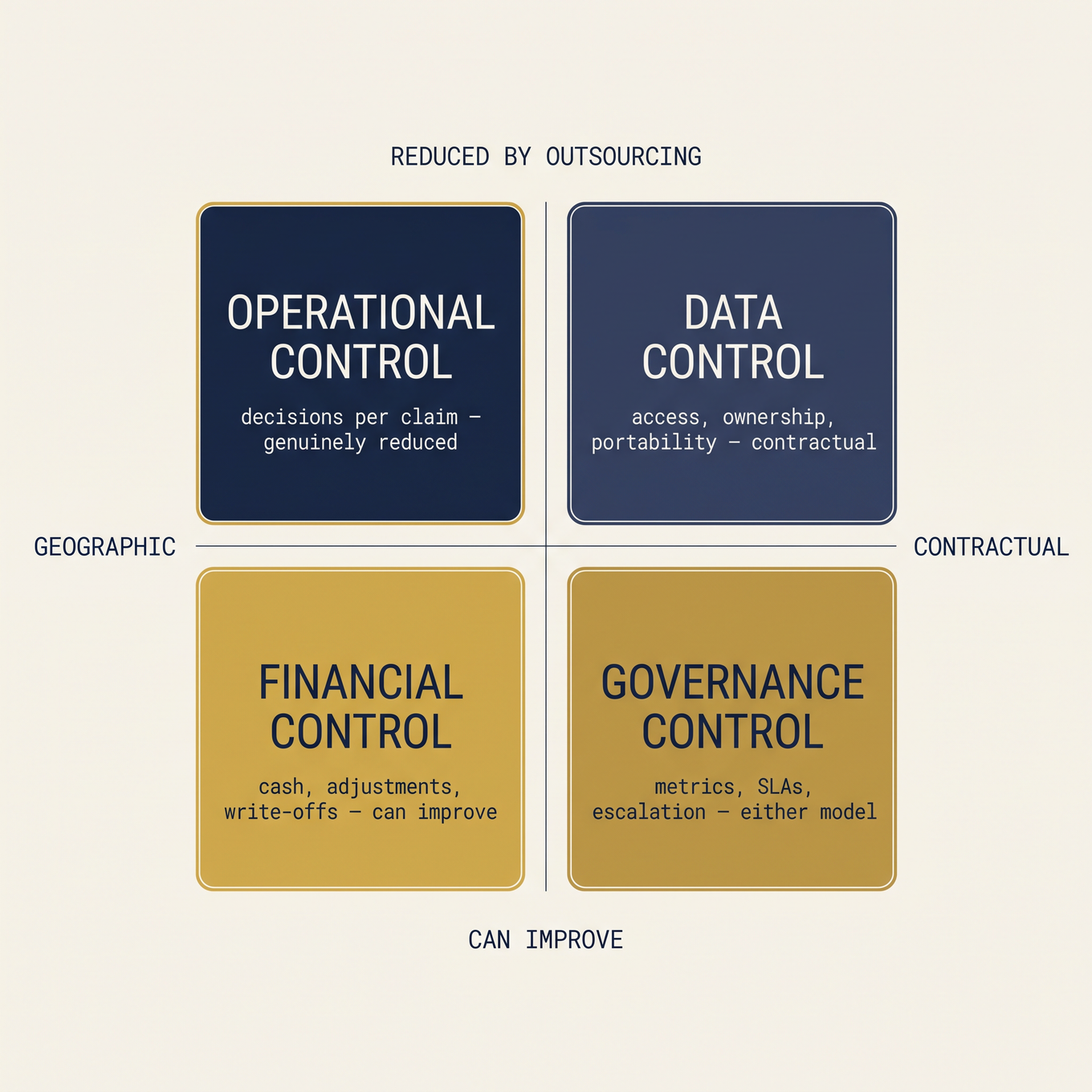
Control has four distinct components, and outsourcing affects them differently:
- Operational control - deciding how each individual claim gets worked. Outsourcing genuinely reduces this.
- Financial control - seeing cash, adjustments, and write-offs. A well-instrumented vendor often improves this over an internal department nobody audits.
- Data control - access, ownership, portability. This is contractual, not physical.
- Governance control - setting metrics, service levels, escalation, and correction. Also contractual, and available under either model.
A practice with an unaudited internal biller, no written KPI definitions, and no independent review of adjustments has less real control than a practice with a governed vendor, admin system access, and a monthly review. The physician who wrote "no matter who does your billing, no one cares more about your money than you do" (r/medicine) was right - and the conclusion is not "keep it inside." It is "govern it, wherever it lives."
The minimum controls under either model:
- Documented SOPs, and role and queue ownership
- Individual system access - never shared logins
- A claim-level audit trail
- Daily submission reconciliation
- Clearinghouse and payer acceptance confirmation
- Denial categorization
- Write-off approval by someone who did not create the write-off
- Payer-portal credential control held by the practice
- A monthly KPI pack and a regular governance meeting
- Periodic sampling and audit
- A continuity plan and a working data export
- An incident escalation path
Additional controls specific to an outsourced contract:
- Exact services and exclusions
- The fee base and every fixed fee
- Named account leadership
- Staffing and subcontractor disclosure
- Service levels and response times
- A claim-submission deadline and a denial-touch frequency
- An A/R aging work standard, and appeal ownership
- Written reporting definitions
- Data ownership and access
- Security terms and the BAA, plus incident response
- Audit rights
- Termination assistance
- Old-A/R and post-termination cash rules
- A prohibition on unilateral write-offs
- A business-continuity plan
And one thing outsourcing never transfers. You will see it claimed that a billing company "handles compliance so you don't have to." That is not how the obligation works. Business associates carry direct HIPAA duties, but the practice retains responsibility for its own conduct, documentation, authorizations, data governance, and vendor oversight (HHS BAA guidance). OIG's compliance program guidance for third-party medical billing companies has long framed this as a coordinated responsibility between the billing company and its provider clients - written policies, training, communication, monitoring and auditing, and corrective action on both sides (OIG compliance guidance, original guidance document).
While we are on compliance: at least one page currently ranking for this query states that 2026 HIPAA updates "now mandate" multi-factor authentication. As of August 17, 2026, HHS still labels that action a notice of proposed rulemaking, not a final rule (HHS HIPAA Security Rule NPRM), and a separate April 2026 federal rulemaking refers to it as the "HIPAA Cybersecurity proposed rule" (Federal Register). Proposed is not final. Regulatory status does change, so check it yourself before acting on anything you read about it - including this.

HHS's own fact sheet, still headed "Notice of Proposed Rulemaking" - the December 27, 2024 NPRM has not been published as a final rule.
Measure both models the same way
Whatever you choose, compare it against its own baseline using identical definitions.
| Daily | Weekly | Monthly |
|---|---|---|
| Charge lag | Initial denials by payer and reason | Total patient-service cash |
| Unbilled encounters | Unresolved rejections | Cost to collect |
| Claims submitted | Claims with no follow-up | Net collection rate |
| Clearinghouse rejections | A/R queue aging | Initial denial rate |
| Payer acceptance confirmation | Open documentation queries | Denial dollars |
| Unposted ERA and EOB | Cash versus expected | Preventable denial rate |
| Authorization expirations | Patient-statement exceptions | Denial write-off rate |
| Accounts approaching timely filing | Top blocked accounts | Appeal rate and overturn rate |
| Backlog by owner | First-pass resolution rate, against a written definition | |
| Days in A/R | ||
| A/R over 90 and 120 days | ||
| Submission lag | ||
| Underpayments identified and recovered | ||
| Patient collections | ||
| Credit balances and refunds | ||
| Payer-specific trends |
HFMA maintains standardized MAP Key definitions across claims, account resolution, and financial management, and recommends auditable source data (HFMA MAP Keys).
And know the traps, because a metric with an undefined denominator can be made to say anything:
- Clearinghouse acceptance is not payer acceptance, and payer acceptance is not payment.
- Clean-claim rate is defined differently by nearly every vendor.
- Initial denial rate can be counted by claim or by dollar - two very different numbers.
- Net collection rate depends entirely on the accuracy of your contractual adjustments.
- Days in A/R can improve because charges fell.
- Cash can rise because volume grew, not because billing improved.
- Write-offs can fall because staff stopped classifying accounts, not because recovery got better.
The clean-claim example is worth dwelling on, because it shows how slippery a shared metric can be: MGMA's own material has described 90% as a practical benchmark in one 2024 discussion (MGMA on outsourcing and automation) and "ideally around 95%" in a 2025 one (MGMA on outsourcing RCM). The lesson is not to pick whichever number suits the argument; it is to define the metric and compare the same thing over time.
Which brings us to the shortest useful summary of this entire article: the list of things not to do.
15 comparison mistakes that produce the wrong answer
| The mistake | The correction |
|---|---|
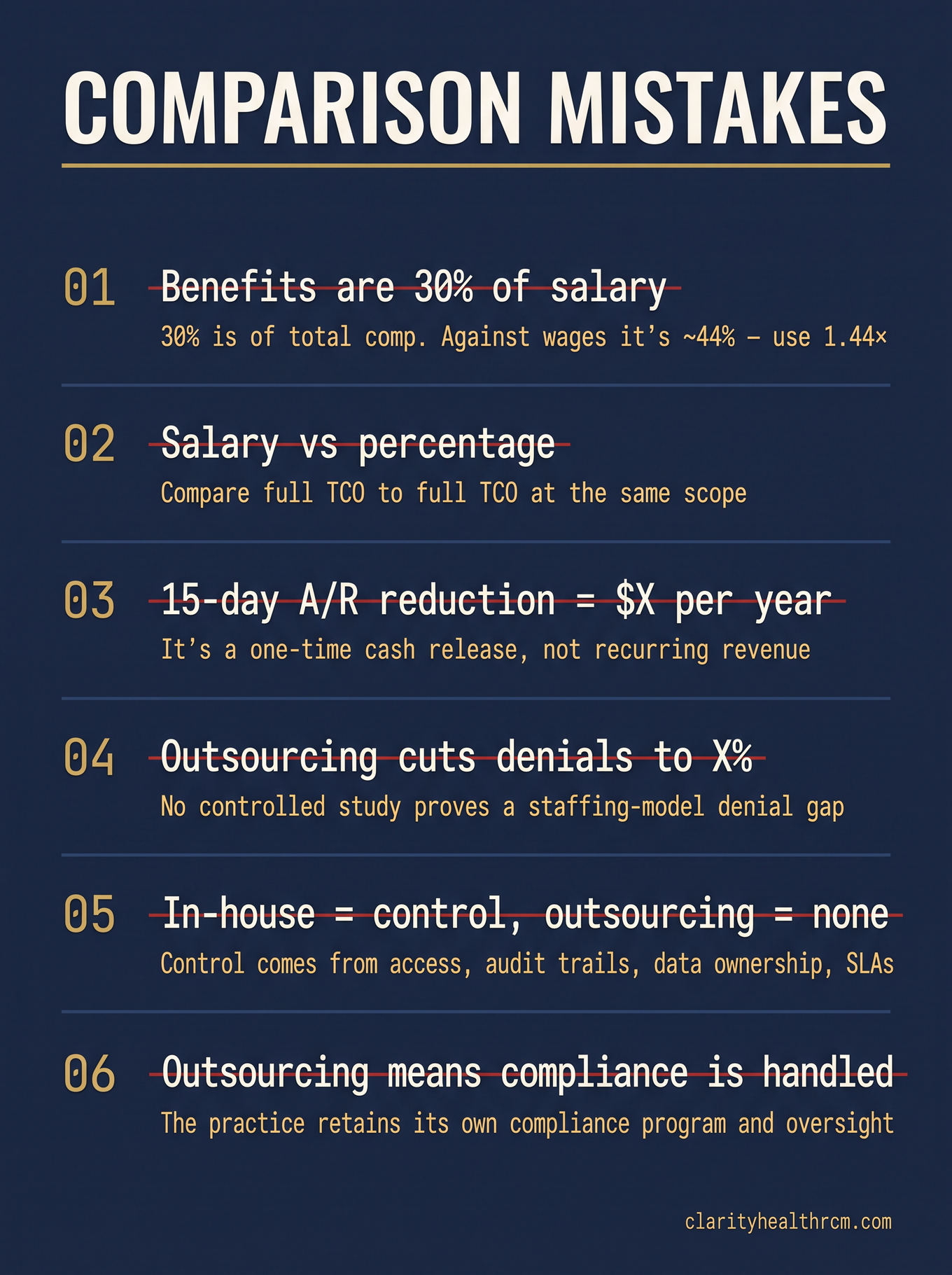
| Comparing one salary to one percentage | Compare full in-house TCO to full outsourced TCO at the same scope and period. |
| "Benefits are 30% of salary" | 30% is the benefit share of total compensation. Against wages it is about 44% at the BLS median wage percentile - a 1.4402 multiplier (BLS). |
| Applying a benefits multiplier and adding PTO, payroll tax, and insurance | That double-counts. Use itemized actual costs or one broad multiplier, never both. |
| Assuming the full EHR cost disappears when you outsource | Charge only technology that genuinely goes away. The clinical system of record usually stays. |
| "Outsourcing cuts denials to X%" | No strong public controlled comparison establishes a universal staffing-model denial gap. Use a zero-change base case and require actual vendor evidence. |
| "A 15-day A/R reduction creates $X every year" | It generally accelerates a one-time amount of cash. The recurring benefit is financing, volatility, and aging risk. |
| "Delayed revenue is lost revenue" | Delay is a working-capital problem until a filing or appeal deadline, a write-off, or an irrecoverable failure makes it permanent (42 CFR §424.44). |
| "We only get paid when you get paid, so incentives are aligned" | The fee base can include cash the vendor never worked, and hard claims or underpayments may be excluded or deprioritized. The contract decides alignment. |
| "In-house means control, outsourcing means none" | Control comes from access, audit trails, data ownership, SOPs, KPI definitions, SLAs, escalation, and exit rights. |
| "Outsourcing means compliance is handled" | Vendors carry duties; the practice retains its own compliance program and vendor oversight (HHS). |
| "One biller replaces a full-service vendor" | Map every function. One person rarely delivers coding, posting, denials, appeals, patient accounts, reporting, management, and coverage. |
| "There is a universal practice-size cutoff" | Use actual fixed cost, capacity, complexity, contract rate, fee base, and measured performance. |
| "Offshore is bad, onshore is good" | Evaluate qualifications, supervision, error controls, communication, access, subcontractors, security, and results. Geography alone proves nothing. |
| "Every owner hour is worth the clinical rate" | Use marginal opportunity cost - revenue actually displaced, or an administrator replacement cost. |
| "All denials are lost revenue" | Denials create rework and delay. Permanent loss is the denial write-off or the unrecovered underpayment. Track both separately. |
Run through that list against whatever comparison you have already built. If it survives all fifteen, the checklist below is mostly a formality.
Your in-house vs outsourced decision checklist
- [ ] We know our annual patient-service cash and the exact cash that would enter a vendor fee base.
- [ ] We know loaded payroll by role, using actual employer costs or one clearly labeled multiplier.
- [ ] We separated shared EHR cost from billing-only cost.
- [ ] We did not double-count leave, payroll taxes, or insurance.
- [ ] We know our denial rate and our denial write-off dollars - separately.
- [ ] We know A/R over 90 and 120 days, and our claim-submission lag.
- [ ] We know who covers each revenue-cycle function during leave, by name.
- [ ] We priced internal management time under both models.
- [ ] Every vendor quote we are comparing covers the same scope.
- [ ] We ran a zero-collection-improvement base case.
- [ ] We tested ±0.5%, ±1%, and ±2% collection sensitivity.
- [ ] We reviewed hybrid, carve-out, and temporary options, not just the two poles.
- [ ] We know who owns the data, the portals, and the credentials.
- [ ] We have an SLA, a BAA, audit rights, and a written exit plan.
- [ ] We can state in one sentence why the chosen model fits this practice.
If several of those are blank, the honest next step is not a decision - it is a baseline. Pull the trailing twelve months:
- Cash and charges - patient-service cash by payer and patient · gross charges and contractual adjustments · refunds and recoupments · claim and encounter counts
- What the function costs - payroll and employer costs by revenue-cycle role · overtime and contractor spend · software and clearinghouse invoices · training and certification · recruiting expense · management hours
- How the work is performing - charge lag · rejections · initial denials by count, dollars, payer and reason · denial write-offs · timely-filing write-offs · appeals and overturns · A/R by age and payer · days in A/R · unposted remits · underpayments · patient balances
- Capacity and continuity - vacancies and backlog · open work by owner · current SOPs and coverage plan
Without that, a practice is not comparing operating models. It is choosing between two stories.
Where we fit - and where we don't
We said at the top that we sell outsourced billing, so here is the narrow version of our claim, with the boundaries included.
Specialist revenue-cycle help earns its fee where a practice cannot reliably staff, cover, supervise, or resolve the work - payer follow-up, denials and appeals, specialty rules, authorization and carve-out routing, patient accounts, or a backlog and transition - and where the contract makes that ownership measurable. Our own focus is on the exception-heavy end of that spectrum: behavioral health, mental health, and inpatient physician billing, where revenue tends to be lost before or beneath the claim rather than at submission. We can also run all or part of a cycle rather than forcing the binary, which matters because - as this article has argued at length - the binary is frequently the wrong frame.
Where a different answer fits better:
- If you have a mature, redundant, specialty-capable billing department and a competitive cost to collect, keep it. A change would cost you more than it returns.
- If you are a solo or small practice with simple claims, a manageable payer mix, reliable software, low denial and write-off rates, documented processes, and enough management time, self-billing or a part-time contractor is a reasonable answer, and a percentage fee or monthly minimum may cost more than the work is worth.
- If your only real problem is one payer, an old-A/R inventory, credentialing, or a denial project, you need targeted support, not a full outsourcing decision.
And one thing we will not do, which you should hold every candidate to: we will not quote a rate against your gross charges, and we will not tell you a percentage without telling you exactly which cash it applies to and which functions it buys. If a quote you are holding does not specify both, it is not yet a price.
None of that is us stepping back from the work. We take on practices of every size, from a single clinician to a multi-state group, and the a-la-carte route exists precisely so a practice can buy the one piece of the cycle it needs rather than the whole of it.
If a change of model is where you land, the transition itself is a separate discipline with its own failure modes - open-A/R inventory, payer and EDI and ERA and EFT cutover, claim-hold rules, and timely-filing protection during the handoff. We covered that end to end in our guide to switching medical billing companies without losing money, and it is worth reading before you sign anything, not after.
One necessary note: this article is educational. It is not legal, coding, tax, accounting, or payer-contract advice, and the regulatory and pricing figures in it were current as of August 2026 - check them against their sources, which is why every one of them is linked.
The reason most practices get this decision wrong is not that they lack financial sophistication. It is that they compare a person to a service and call it arithmetic. Fix the accounting - same period, same scope, same defined cash base, same performance assumptions - and the answer usually stops being a matter of opinion. Sometimes it says outsource. Often it says keep it, and fix the supervision instead. Frequently it says split the work and put each piece where the capability actually is.
So build the comparison first. Then make every candidate - your own internal team included - answer the same four questions in writing: who owns each step, what cash the fee applies to, what work stays with your practice, and how performance will be measured. Anyone who can answer all four is worth talking to. Anyone who cannot has told you something useful anyway.
Frequently asked questions
Is it cheaper to do medical billing in-house or to outsource it?
Neither is universally cheaper. Calculate loaded internal payroll, systems, management time, recruiting, coverage, and measured write-offs, then compare that against the vendor's rate on a clearly defined fee base plus fixed fees plus the internal work you keep. In the illustration on this page, an $89,679 internal operation breaks even against a 6% fee at roughly $1.44 million in eligible collections - but that threshold moves with local wages, team size, vendor minimums, and retained work.
What percentage do outsourced medical billing companies charge?
A current first-party example is AdvancedMD, which publicly lists full RCM at 4%–8% of collections (AdvancedMD pricing). Scope, specialty, volume, minimums, and - most of all - the definition of "collections" change the real price substantially. Our breakdown of medical billing service costs works through the pricing models and hidden fees in full.
Is the percentage based on gross charges or net collections?
It should be net collections, and you must confirm it in writing. Gross charges include amounts no payer will ever pay, so a percentage of gross charges is a much higher effective price than the same percentage of collections. Also confirm whether refunds and recoupments are netted out and whether front-desk copays, old A/R, and post-termination cash are included.
At what revenue should a practice bring billing in-house?
There is no universal cutoff, and any page that gives you one is guessing. The cost-only threshold is (in-house TCO − retained outsourced costs − vendor fixed fees) ÷ vendor rate. Then adjust for actual collection performance and risk, because a 1% collections difference at $3 million is $30,000 a year and can reverse the cost answer entirely.
Does outsourcing mean losing control?
It reduces operational control over how individual claims are worked. It does not automatically reduce financial, data, or governance control - those come from admin access, data ownership, claim-level audit trails, written KPI definitions, an SLA, escalation paths, and exit terms. A well-governed vendor can give a practice more visibility than an internal department nobody audits.
Can a practice outsource only denials, or only old A/R?
Yes, and it is frequently the better move. Denial management, old-A/R recovery, coding, credentialing, patient accounts, a single payer segment, or temporary vacancy coverage can all be carved out while everything else stays internal. The requirement is explicit handoffs, defined deadlines, and root-cause feedback so the same denials stop recurring.
Is outsourced billing more compliant?
Not inherently. A qualified vendor may add expertise and controls, but your practice still needs a business associate agreement, vendor due diligence, ongoing monitoring, and its own compliance program (HHS guidance). Treat any claim that outsourcing makes compliance someone else's problem as a reason for more diligence, not less.
What does it actually cost when an in-house biller leaves?
Four separate things: recruiting (SHRM's cross-industry average is $5,475 per nonexecutive hire, with a 39-day median time to fill), temporary coverage or overtime, diverted management time, and delayed cash. Only the fourth becomes permanent loss, and only when a timely-filing or appeal deadline expires or an account is written off. Inventory the open work before assuming the worst.
Should a solo therapist or physician do their own billing?
It can be entirely reasonable with low volume, a simple payer mix, good EHR and clearinghouse workflows, and the time to track exceptions. The thing to watch is not routine claim submission - it is the exception load. When denials, clawbacks, coordination of benefits, or growth start consuming clinical evenings, part-time specialist help or a targeted carve-out usually costs less than the revenue the bandwidth problem is quietly losing.