What Insurance Credentialing Services Are Actually Selling You (And What to Ask Before You Buy)
September 28, 2026 · 13 min read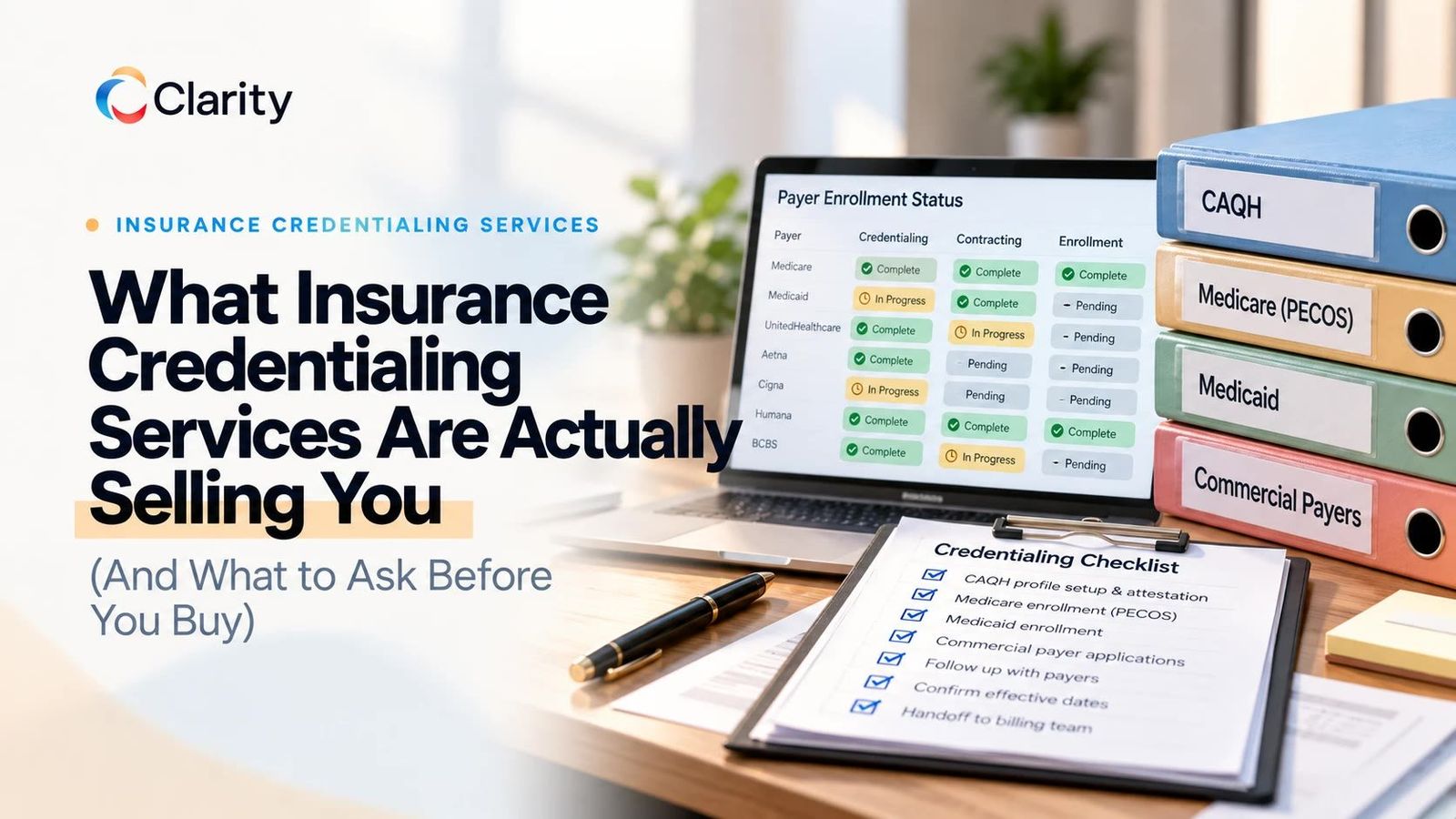
Insurance credentialing services handle the process of enrolling providers with insurance companies so those providers can bill and get paid in-network. A competent one submits clean applications, follows up with payers until approved, confirms effective dates, and keeps enrollments current. What most don't tell you upfront is that the application is the easy part, and the work that matters most happens after it goes out the door.
If you're evaluating insurance credentialing services right now, this is the read you need before signing anything.
A practice manager we know spent three months going back and forth with a credentialing vendor. The vendor kept saying the applications were submitted. The payers kept saying they had no record of them. When she finally got a second opinion, she found out the vendor had submitted to the wrong group NPI, the CAQH profile was never fully attested, and two of the payers required a specific cover sheet her vendor didn't know about.
She's not unusual. She's representative.
Insurance credentialing services range from highly competent specialists who know the nuances of individual payer portals to generic document-submission shops that treat every application the same. The price difference between the two is often smaller than the revenue difference when things go wrong.

What insurance credentialing services actually do
At a minimum, an insurance credentialing service should handle all of the following:
- CAQH ProView setup and attestation. Most commercial payers pull verification data from CAQH, the Council for Affordable Quality Healthcare's provider database. A profile that's incomplete or improperly attested stalls applications across every payer simultaneously.
- Medicare enrollment through PECOS. The Provider Enrollment, Chain, and Ownership System is CMS's enrollment platform. Errors here, including taxonomy mismatches or outdated practice addresses, are the single most common reason Medicare enrollment gets kicked back.
- Medicaid and managed Medicaid enrollment. Separate from Medicare, state Medicaid programs and the managed care organizations they contract with each run their own credentialing process. In most states, these are the slowest timelines in the entire enrollment landscape.
- Commercial payer applications. UnitedHealthcare, Aetna, Cigna/Evernorth, Humana, BCBS plans, and regional payers all have distinct application processes, required documents, and portal requirements. What works for one doesn't necessarily work for the next.
- Application follow-up. Submitting and waiting is not a service. Active follow-up, at defined intervals, with documentation of every touchpoint, is the difference between a 90-day approval and a 180-day one.
- Effective date confirmation and billing handoff. Getting an approval letter is not the same as being billable. A service that hands you an approval letter and calls the job done has left out the step that actually matters.
Beyond the baseline, better services also manage CAQH re-attestation (required every 120 days), recredentialing cycles (typically every three years per payer under NCQA standards, though some payers operate on a 24-month cycle), and ongoing roster updates when providers change locations or add sites.
If a service you're evaluating doesn't cover all of those baseline items explicitly, ask which ones it treats as out of scope before you sign.
The three layers most practices don't separate
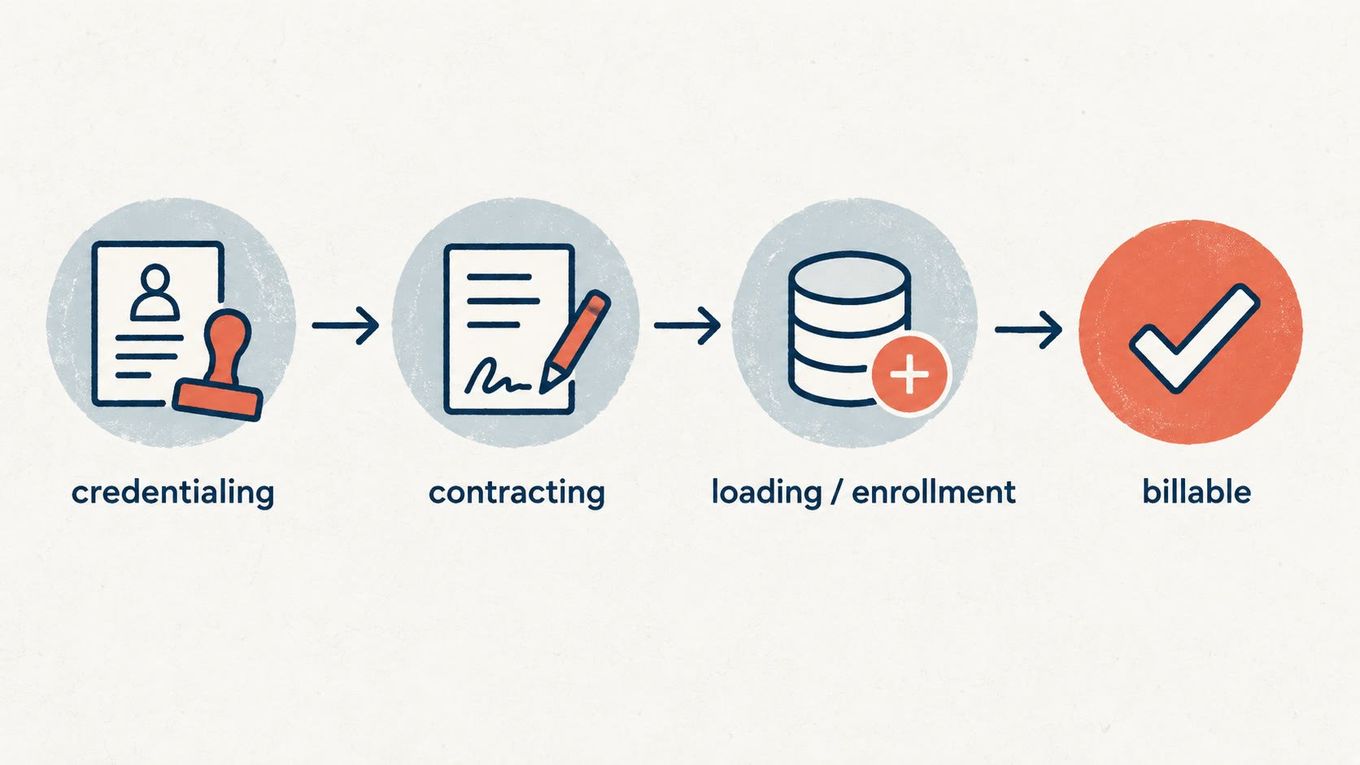
One of the most persistent problems in insurance credentialing is the confusion between three distinct steps that vendors, practices, and even payers sometimes use interchangeably.
| Step | What it means | Who controls the timeline |
|---|---|---|
| Credentialing | The payer's committee reviews and verifies the provider's qualifications | The payer's credentialing committee |
| Contracting / network participation | Practice and payer agree on participation terms and fee schedule | The payer's network management department |
| Loading / enrollment | Provider is linked to the group's Tax ID, NPI, and specific locations in the payer's system | The payer's provider data team |
A provider who has been credentialed and contracted is not necessarily billable. They won't be until loading is complete and the correct provider data is in the payer's claims system. A letter saying "your provider has been approved to join our network" is not the same as a confirmed billing effective date. The gap between those two events is where a significant amount of revenue quietly disappears.
Good insurance credentialing services close that gap. They call the payer to confirm the effective date, verify the correct NPI and Tax ID are loaded, and make sure that information reaches the billing system before a single claim goes out. Services that don't do this leave you exposed to denials that will come back weeks later labeled "provider not eligible on date of service" with no obvious connection to a credentialing problem.
Our guide to insurance credentialing for therapists covers this three-layer distinction in detail for behavioral health providers. The mechanics apply across every specialty.
The closed panel problem
Here's the piece most insurance credentialing service pages skip entirely.
Some commercial payers close their panels. That means they aren't accepting new providers in a given specialty and region, regardless of credentials. A closed panel doesn't appear on any public list, and many payers won't volunteer the information until a provider is mid-application.
What you should know about closed panels:
- Closures are regional, not national. A payer might be closed to primary care in Atlanta but open in rural Georgia. The same application submitted in different zip codes gets a different answer.
- Closed panels can sometimes be opened with a network adequacy argument. If a payer is failing their state's required provider-to-member ratios in a specialty, a well-documented request, sometimes paired with a complaint through the state insurance commissioner, can get a panel opened.
- Behavioral health is particularly affected. Insurance companies have faced widespread scrutiny for failing parity requirements on mental health coverage. In many states, that has translated to mandated panel openings. An insurance credentialing service working in behavioral health should know which payers are under pressure in your state.
- Temporary authorization isn't the same as credentialing. Some payers offer temporary participation while an application is pending. Billing under a temporary authorization when that authorization has quietly lapsed is a compliance problem.
Ask any credentialing service you're considering: how do you handle closed panels? If the answer is "we note it and move on," that's a gap worth weighing.

Comparing what's actually on the market
Most insurance credentialing services position themselves similarly: fast turnarounds, dedicated specialists, payer expertise. The differentiation is usually in what they include versus what costs extra.
| Service element | What better vendors include | What cheaper vendors often exclude |
|---|---|---|
| CAQH setup and re-attestation | Included | Billed separately or skipped |
| Application follow-up with payer | Proactive, documented | Reactive or minimal |
| Effective date confirmation | Confirmed and documented | Left to practice to track |
| Billing system handoff | Coordinates with billing team | Not in scope |
| Recredentialing / revalidation | Tracked and handled | Separate fee or ignored |
| Closed panel navigation | Active strategy | "We'll note it in your file" |
| Roster updates (new locations) | Included | Separate engagement |
| Status reporting | Regular updates via portal or report | "We'll call you when approved" |
The table above isn't a comprehensive vendor comparison. It's a checklist for the conversations you need to have before you commit. Put these questions directly to any vendor you're evaluating.
For a broader sense of what RCM services cost, including how credentialing fees fit into the overall picture, see our breakdown of medical billing services costs.
What insurance credentialing services cost, and what's worth paying for
Published 2026 pricing across the credentialing vendor market generally falls into three models:
| Pricing model | Typical range | Best fit for |
|---|---|---|
| Per payer application | $100–$600 per application | Single provider, limited payers |
| Per provider package | $1,500–$3,500 (multi-payer) | New hires joining a group |
| Monthly retainer | $75–$400 per provider/month | Groups with ongoing hiring and maintenance |
Ask what "per payer application" actually covers. In some models, that fee gets you the submission and nothing else. Follow-up, re-attestation, effective date confirmation, and billing handoff are each a separate line item.
The math worth doing is the opportunity cost one. If a provider would collect $40,000 to $60,000 per month once in-network, every month of avoidable delay represents real, unrecoverable revenue. A $2,500 credentialing package that gets an approval three weeks faster than a $1,200 one has already paid for itself twice over. Don't optimize the wrong number.
Red flags worth walking away from
We've seen enough vendor pitches to know what the warning signs look like. Here's what gives us pause:
- Guaranteed timelines. No credentialing service can control a payer's processing queue. A vendor promising "60-day approval" is making a commitment they can't keep and signaling that they'll paper over problems rather than surface them.
- No discussion of effective dates. If a vendor talks about credentialing but not billing effective dates, they're defining "done" as approval letter, not billable provider. Those are different finish lines.
- Vague payer expertise. "We credential with all major insurers" is not an answer. Ask specifically about their experience with your top three payers, in your state, in your specialty. Specificity is a signal of real expertise.
- No handoff to billing. If you have a separate billing team or service, ask explicitly how the credentialing vendor coordinates effective dates and provider data with them. "We send you the approval" is not a handoff.
- Limited specialty knowledge. Insurance credentialing for a behavioral health group has different payer requirements, different panel dynamics, and different denial patterns than credentialing for a surgical practice. A vendor who doesn't know the difference will treat your applications the same way they treat everyone else's.
More vendor evaluation questions, including ones that apply across RCM vendors generally, are in our questions to ask before hiring a medical billing company. Most translate directly to credentialing vendor selection.

Signs your current insurance credentialing service is underdelivering
Not everyone reading this is starting from scratch. Some practices already have a credentialing vendor and are wondering whether the problems they're seeing are normal.
They usually aren't.
Here's what underperformance looks like in practice:
- Claims denying as "provider not eligible on date of service" weeks after an approval. This almost always means the effective date never got loaded into your billing system, or the payer's provider data team never completed the enrollment step. The service should have caught this.
- No proactive CAQH re-attestation. CAQH requires attestation every 120 days. If your vendor isn't tracking this and prompting you, payer applications are quietly stalling because your profile is showing as unattested.
- Approvals with no confirmed billing dates. If you get letters saying "approved" but nobody is telling you the specific effective date and verifying it's loaded, you don't have a complete credentialing outcome.
- No status updates unless you ask. A credentialing service that only reports when you chase them is not following up with payers, either.
- Recredentialing lapses. Commercial payers typically require recredentialing every three years, per NCQA standards, though some run on a 24-month cycle. If your current service doesn't have a system for tracking those cycles across your payer panel, something will lapse, and the first sign will be a denial.
- Surprises about closed panels. If a panel closure only came up after an application was already in progress and time was lost, your service didn't do the pre-screening a good one does before submitting.
If two or more of these are familiar, the issue isn't the payers. It's the service.

How we know what we know
Clarity's work is led by President and CEO Estelle Sandoval, who has led revenue cycle operations since the late 1980s and built her career tracing denial patterns back to the enrollment problems that caused them.
The most common credentialing-related denials we see come from the billing-credentialing gap: effective dates that didn't get loaded into the billing system, group NPI linkages that weren't completed, locations that weren't updated when providers changed sites. These are the failures that most credentialing services don't acknowledge because they define their job as ending at the approval letter.
To build this piece, we reviewed the top-ranking insurance credentialing services pages, the competitive landscape across vendors advertising in 2026, and primary sources including CMS enrollment guidance and NCQA standards for recredentialing. Pricing ranges are drawn from published 2026 vendor pricing and are planning benchmarks, not quotes.
How Clarity Handles Insurance Credentialing
Insurance credentialing services are part of our revenue cycle services. We run credentialing and enrollment alongside billing, denial management, and coding on purpose.
When a provider gets approved and that effective date doesn't reach the billing system, something breaks. When the same team owns both sides, that handoff is internal and it doesn't break.
We handle commercial payer enrollment, Medicare and Medicaid credentialing, CAQH management, recredentialing, and revalidation across behavioral and mental health practices, physician groups, hospitals, and facilities. We work in specialties where payer relationships are complicated and panels aren't always open, including behavioral health practices dealing with parity enforcement and mental health billing issues.
If you're adding providers, opening a new location, or suspecting that credentialing problems are behind some of your current denials, talk to our team. We'll tell you what we see, even if the answer doesn't require our services.
Frequently Asked Questions
What are insurance credentialing services?
Insurance credentialing services are third-party companies that manage the process of enrolling healthcare providers with insurance payers so those providers can bill and receive in-network reimbursement. Services typically include CAQH profile setup and attestation, Medicare and Medicaid enrollment, commercial payer applications, follow-up until approval, effective date confirmation, and ongoing maintenance such as recredentialing and revalidation.
How long does insurance credentialing take?
Commercial payer credentialing typically takes 60 to 120 days from a complete, clean application. Medicaid and managed Medicaid plans often take 90 to 180 days or longer, though timelines vary significantly by state. Some state programs process applications in 45 to 90 days while others run considerably longer. Medicare enrollment through PECOS can be faster when no site visit is required, though development requests from CMS restart the processing clock. Practices should begin insurance credentialing 90 to 120 days before a provider's first patient appointment.
What is the difference between insurance credentialing and provider enrollment?
Insurance credentialing is the payer's process of verifying a provider's qualifications and approving their participation in the network. Provider enrollment, sometimes called loading, is the separate step that links the approved provider to the practice's Tax ID, NPI, and specific locations in the payer's billing system so claims can actually be paid. A provider can receive a credentialing approval letter and still not be billable if the enrollment and loading steps haven't completed.
How much do insurance credentialing services cost?
Insurance credentialing services typically charge $100 to $600 per payer application, or $1,500 to $3,500 for a multi-payer package covering a new provider. Monthly per-provider retainers generally run $75 to $400 and cover ongoing maintenance, with rates varying based on scope of service and number of providers managed. Confirm whether CAQH re-attestation, recredentialing, revalidation, effective date confirmation, and billing coordination are included before comparing quotes, since these are commonly scoped out by lower-cost vendors.
Can a credentialing service get me into a closed insurance panel?
Not always, but the better ones try. Closed panels can sometimes be opened through a network adequacy argument, particularly if a payer is failing state-mandated provider-to-member ratios in your specialty. Behavioral health has seen this play out in states under parity enforcement pressure. A credentialing service with real payer relationships and specialty knowledge will tell you which panels are worth pursuing and which aren't, rather than just noting a closure and moving on.
What should I ask an insurance credentialing service before hiring them?
Ask specifically: what is your process after the application goes out; how do you handle closed panels; what does "done" mean to you, approval letter or confirmed billing effective date; what's included versus billed separately; how do you coordinate with billing; and who does the actual work for my file. Red flags include guaranteed timelines, vague payer expertise, and any definition of done that stops at the approval letter rather than the loaded effective date.
What happens if insurance credentialing lapses?
When CAQH attestation, Medicare revalidation, or a commercial payer's recredentialing cycle lapses without renewal, the provider's active participation status can be suspended or terminated without prior notice. Claims submitted after a lapse deny as "provider not eligible," and retroactive billing once status is restored is typically not permitted by commercial payers. The most effective way to prevent lapses is through a tracking system that flags every renewal date across every payer, which is part of what a well-run credentialing maintenance service should handle.