Insurance Credentialing for Therapists: The Real Process
July 21, 2026 · 35 min read
The most expensive sentence in a therapy practice is "we're just waiting on credentialing."

Not because the wait is long, though 60 to 180 days is common, but because in most cases, what's actually stalling isn't credentialing at all. It might be any of the following:
- A closed panel you didn't know was closed
- A CAQH attestation that expired while the application was being reviewed
- A contract that was approved but never countersigned
- A provider loaded under the wrong Tax ID
- An effective date that hasn't arrived yet, while a new therapist's sessions pile up unbilled
"Credentialing" has become the catch-all word for a process that is actually three distinct processes. Understanding the difference between them is the first step to stopping revenue gaps before they happen.
We work with behavioral health practices, mental health groups, and facilities navigating payer enrollment every day. The confusion we see most consistently isn't laziness or inattention. It's a vocabulary problem. Practices use one word for three things, and payers exploit that imprecision. This guide is designed to close the gap.
By the end, you'll understand what each stage of the approval process actually involves, what the realistic timelines look like, how the major behavioral health payers work, where most applications stall, and what it means to be genuinely ready to bill, not just approved.
The Three Processes Behind Insurance Credentialing
When a therapist says they want to "get credentialed with insurance," they're actually describing a three-stage sequence that payers treat as three separate questions.
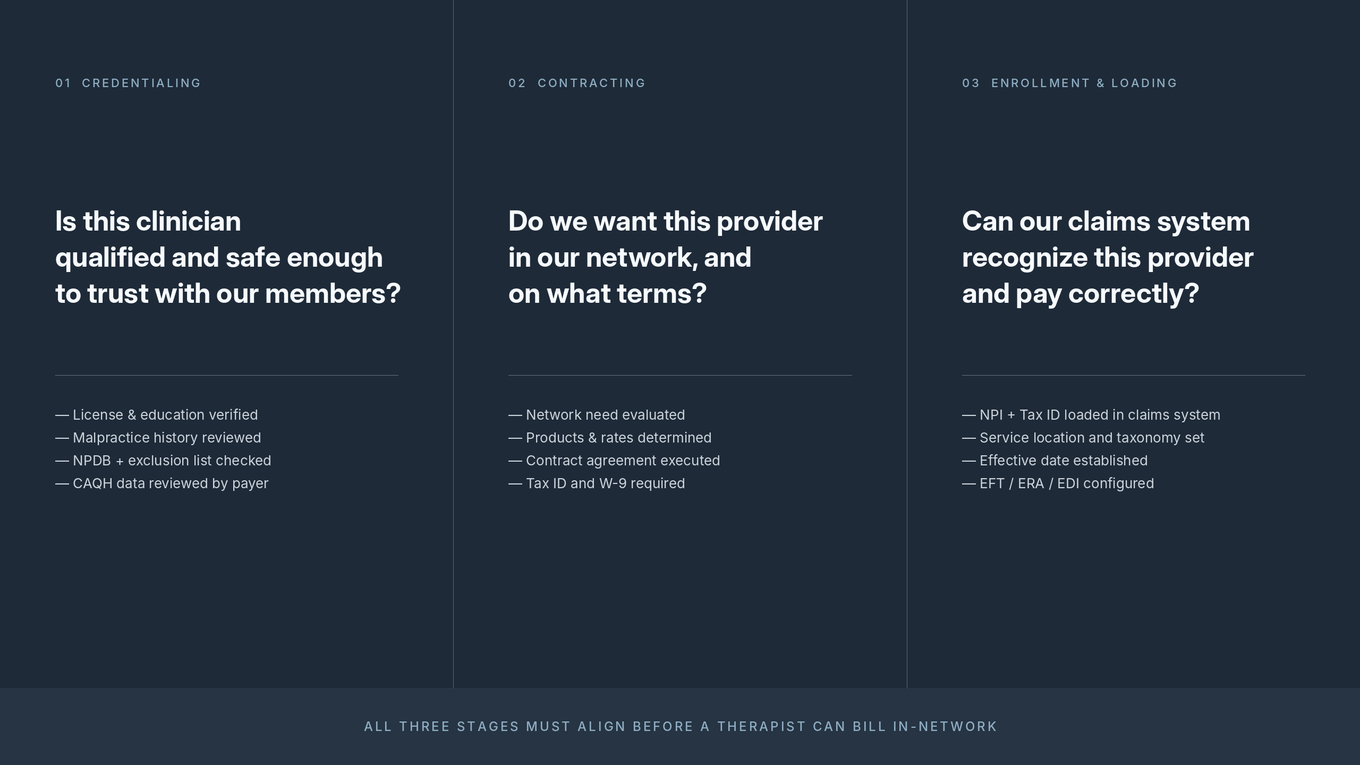
Credentialing is the payer's verification that a clinician is qualified, licensed, and safe to join the network. The payer, or a credentialing verification organization acting on its behalf - checks the license with the state board, confirms education and training, reviews malpractice history, queries the National Practitioner Data Bank, and checks federal and state exclusion lists. NCQA defines credentialing as a detailed review and verification of a practitioner's qualifications and experience, including licensure, education, sanctions, and malpractice history; it also requires accredited health plans to recredential providers every three years.
Credentialing answers: "Is this clinician qualified and safe enough for us to trust with our members?"
Contracting is the legal and business agreement between the payer and the provider or group. It determines whether the provider is actually participating, which products or networks are included, what the reimbursement rates are, what documentation and prior authorization rules apply, and what timely-filing deadlines govern. A provider can be credentialed and not yet contracted. A group can be contracted while a new therapist inside that group hasn't been individually approved.
Contracting answers: "Do we want this provider in our network, and under what terms?"
Enrollment and loading is the payer's internal setup of the provider record so that claims can actually be processed. It ties together the rendering provider's NPI, the billing NPI, the Tax ID, the group affiliation, service location, product or network, taxonomy code, effective date, and payment routing (EFT/ERA/EDI). This is where many practices get burned. They receive an approval email, start scheduling patients as in-network, and then claims deny, because the provider hasn't been loaded, or was loaded under the wrong location, or was set up for one product but not another.
Enrollment and loading answers: "Can the payer's claims system recognize this provider and pay correctly?"
The table below shows how these three stages relate, and where the most common misconceptions are.
| Stage | The payer's question | What it involves | Where people go wrong |
|---|---|---|---|
| Credentialing | Is this clinician qualified and safe? | License, education, malpractice, sanctions, NPDB, work history, CAQH data review | "My CAQH is complete, so I'm credentialed." False, CAQH stores data; the payer still reviews and decides. |
| Contracting | Do we want this provider, and on what terms? | Network need, products included, rates, agreement terms, Tax ID, W-9 | "My group has a contract, so my new therapist is automatically in-network." Usually false. Each clinician typically still needs individual approval. |
| Enrollment / Loading | Can our claims system pay this provider? | NPI, Tax ID, service location, taxonomy, product, effective date, EFT/ERA/EDI setup | "The approval email means I can bill." Risky, the effective date and claims-system loading control payment, not the approval notice. |
about the three stages: they often happen in parallel, they can stall independently, and a problem in any one of them blocks the whole chain. Knowing where a specific application is actually stuck is the difference between a targeted fix and three more months of waiting.
What Every Therapist Needs Before Applying to a Payer
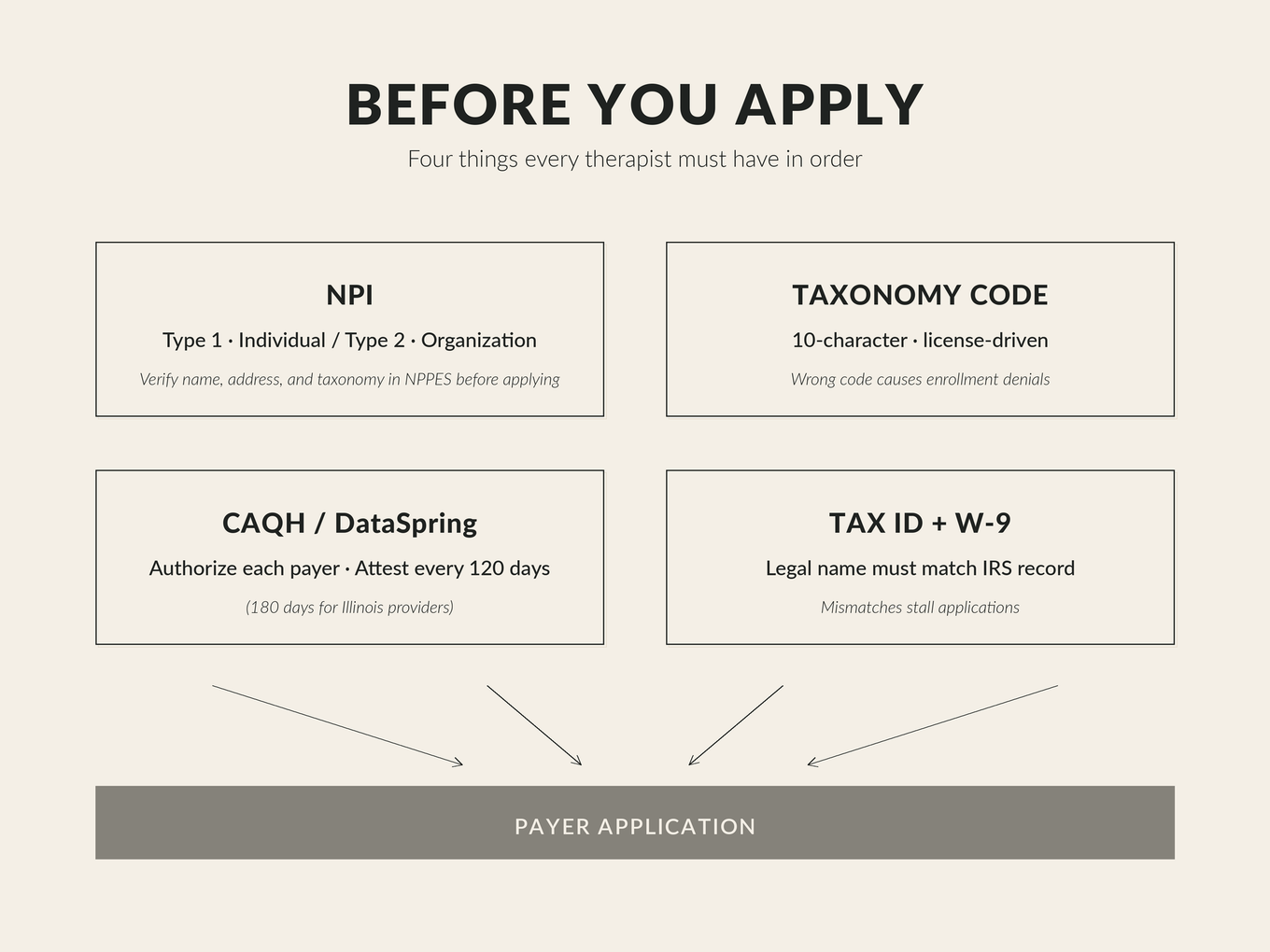
Before submitting a single participation request, there are foundational building blocks every therapist or practice needs in order. The most common reason applications stall early isn't a hostile payer. It's an incomplete or inconsistent pre-application file. Here's what to get right before anything else.
NPI for Therapists: What It Is and What It Isn't
A National Provider Identifier, or NPI, is a unique 10-digit identifier that CMS assigns to covered healthcare providers for use in HIPAA standard transactions. It stays with the provider across job and location changes.
What an NPI is NOT: it is not a license, not a credentialing approval, and not a payer enrollment. NPPES, the system used to apply for and update NPIs, states clearly that issuing an NPI does not ensure or validate that a provider is licensed or credentialed.
There are two NPI types that matter for behavioral health:
| NPI type | Who uses it | Behavioral health examples |
|---|---|---|
| Type 1 NPI | Individual human providers | LCSW, LMFT, LPC, psychologist, psychiatrist, psychiatric nurse practitioner |
| Type 2 NPI | Organizations | Group practice, behavioral health clinic, SUD facility, PHP/IOP program, hospital |
CMS and NPPES distinguish individual Type 1 providers from organizational Type 2 providers. Solo therapists billing under a personal Tax ID usually need only a Type 1 NPI. Solo therapists billing under an LLC or corporation, and any group practice or facility, will generally need both.
Before applying to any payer, verify that the information in NPPES is current and accurate: legal name, practice address, mailing address, taxonomy code, and any group affiliations. Payers compare NPPES data against CAQH data and payer application data. Mismatches between those three sources create stalls.
Why Taxonomy Codes Cause Credentialing Denials
A taxonomy code is a 10-character code that identifies the type and specialization of a provider. CMS describes taxonomy codes as used in NPI applications to designate provider classification and specialization.
Wrong taxonomy can cause enrollment problems and claim denials. For behavioral health, the right code depends on the provider's license type, not on what the provider treats.
Some common examples:
| Provider type | Common taxonomy | Note |
|---|---|---|
| Mental health counselor (LMHC/LCMHC) | 101YM0800X | Check by state license title |
| Professional counselor (LPC/LPCC) | 101YP2500X | Check by state license title |
| Marriage and family therapist | 106H00000X | Used for LMFTs |
| Clinical social worker | 1041C0700X | Common for LCSWs/LICSWs |
| Clinical psychologist | 103TC0700X | Doctoral-level |
| Psychiatric/mental health nurse practitioner | 363LP0808X | For psychiatric NPs |
| Behavioral health agency | 251S00000X | Organizational |
| Mental health clinic/center | 261QM0801X | Organizational |
Verify against the current NUCC taxonomy set before submitting applications. Payer systems can be sensitive to taxonomy mismatches, and correcting a wrong code after an application has been submitted can delay the process significantly.
What CAQH Is and Why It's Not the Same as Credentialing
CAQH (which now operates under the DataSpring brand, though payer materials and industry usage still widely use "CAQH") is a centralized credentialing data portal that most commercial payers use for behavioral health credentialing. DataSpring describes the Provider Data Portal as a system that lets clinicians enter information once, verify it on a predictable schedule, and share it with authorized health plans.
CAQH stores licenses, education records, training, work history, malpractice insurance, practice locations, disclosure questions, and uploaded documents. It identifies errors, sends reminders, and is accepted in all 50 states.
Two operational rules that providers regularly get wrong:
Rule 1: You must authorize each payer to access your CAQH profile. If a payer is not authorized in CAQH, it cannot pull your data, and the application stalls, even if your profile is otherwise complete and up to date.
Rule 2: CAQH attestation has an expiration. DataSpring states that providers who are not following the 90-day directory update schedule must still attest every 120 days for credentialing purposes, or 180 days for Illinois providers, or the profile status becomes expired. An expired CAQH profile during an active application is one of the most common causes of silent stalls.
Completing CAQH is also NOT the same as submitting a participation request to a payer. A complete CAQH profile gives the payer data to review; it does not notify the payer that you want to join their network.
Tax ID, W-9, and Why Mismatches Stall Applications
A Tax Identification Number (EIN for a business, Social Security Number for sole proprietors) is what payers use to contract and pay. The W-9 tells the payer the legal name and Tax ID of the person or entity being paid.
A mismatch between these is one of the most reliable ways to stall an application. Common scenarios:
- The therapist applies under a personal name, but the contract gets routed to an LLC with a different name.
- The W-9 uses a DBA name instead of the IRS legal name.
- The practice applied under one Tax ID but the group contract reflects another.
- Claims submit with one Tax ID but the payer's system has the provider loaded under a different one.
For group practices, payers typically need two distinct identifiers on claims: the rendering provider's Type 1 NPI (the individual therapist who performed the service) and the billing provider's Type 2 NPI and Tax ID (the group or entity being paid). Getting these two confused, submitting the individual NPI as the billing NPI, or loading the group NPI as the rendering NPI, will cause claim denials that look mysterious until you trace them to the mismatch.
How Behavioral Health Payer Enrollment Actually Works
With your building blocks in order, the next challenge unique to behavioral health is knowing which payers to actually apply to, because the name on the patient's insurance card is often not the entity that handles behavioral health credentialing.
Step 1: Identify the Right Behavioral Health Network
In behavioral health, payers frequently "carve out" mental health and substance use benefits to a separate managed behavioral health organization. The front desk may verify insurance through the medical plan, but the behavioral health benefits are administered, authorized, and credentialed through a different entity entirely. Submitting an application to the wrong network can mean months of waiting on a process that was never going to result in behavioral health claims paying.
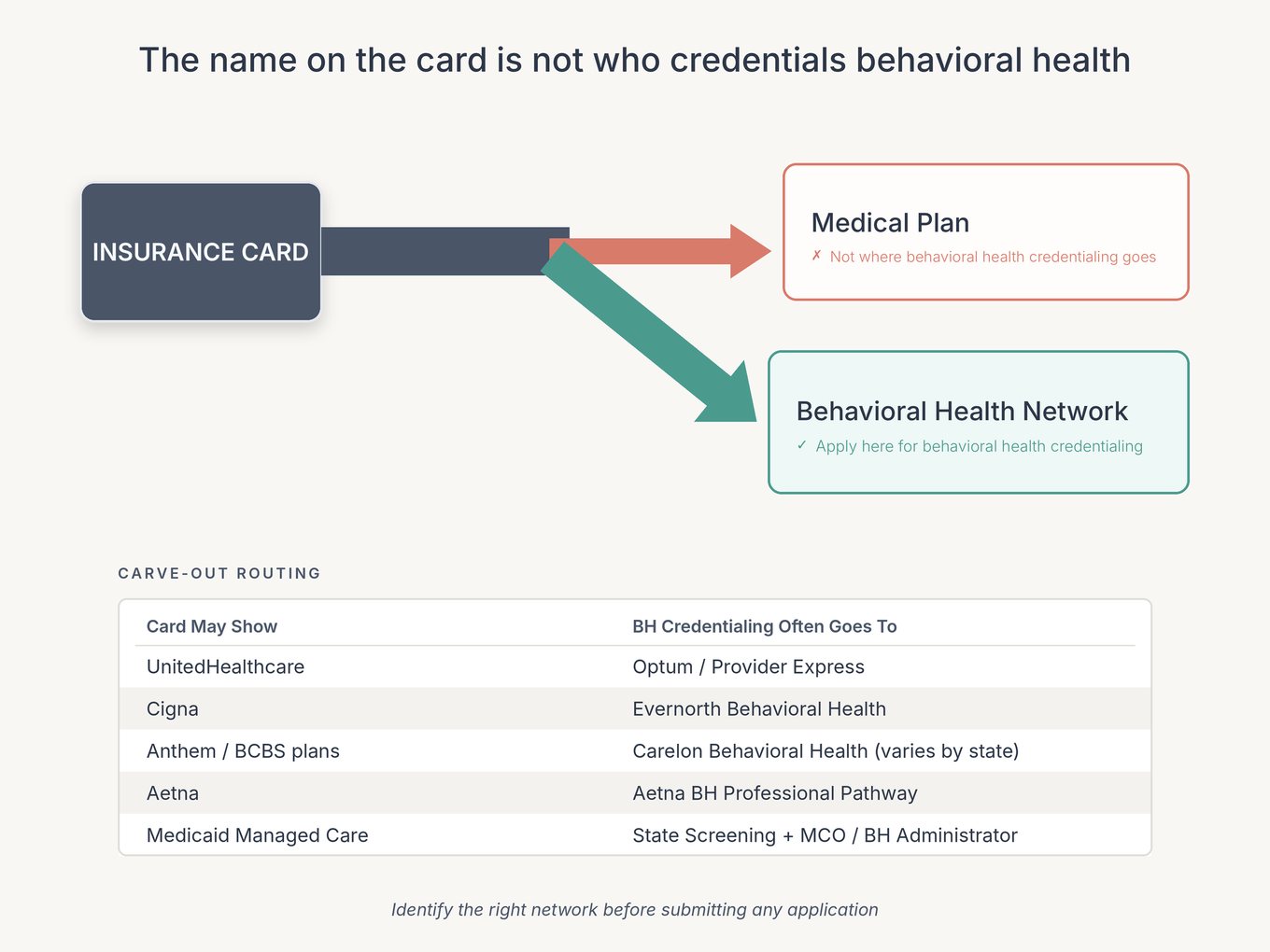
| Insurance card may say | Behavioral health often runs through |
|---|---|
| UnitedHealthcare | Optum / United Behavioral Health / Provider Express |
| Cigna | Evernorth Behavioral Health |
| Anthem / some BCBS plans | Carelon Behavioral Health or Anthem's own process, depending on state and product |
| Aetna | Aetna's behavioral health professional application pathway |
| Medicaid managed care | State Medicaid screening plus the MCO's or behavioral health administrator's network |
The name on the card is not always the network that credentials behavioral health. Before submitting any application, identify whether behavioral health is administered through the medical plan or through a carve-out, and make sure you're applying to the right organization.
Networks like Optum/Provider Express, Carelon Behavioral Health, Evernorth Behavioral Health, and Lucet each have their own application portals, requirements, and timelines. Lucet, for example, has separate application tracks for individuals, groups, facilities, and EAP providers.
Step 2: Submit Your Participation Request
Most payers require an online "join our network" request or participation request before full credentialing begins. This is also where closed panels surface. A payer can decline a participation request before credentialing ever starts if it determines there's no current network need for that provider type, specialty, or geography.
Aetna's process illustrates this well: the provider submits an online request, Aetna evaluates whether there is current need in the service area, and Aetna will notify the provider within 45 days whether the provider is eligible to participate and begin contracting. Note the sequence: network-need evaluation comes before credentialing, not after.
Step 3: What Payers Verify During Credentialing
If the payer accepts the participation request, it pulls the CAQH profile and begins verification. NCQA credentialing standards include credential verification, primary source or recognized-source verification, credentialing committee review, sanction monitoring, and ongoing quality monitoring between recredentialing cycles.
The payer or its credentialing verification organization will typically verify the state license (with the licensing board directly), education, training, work history, malpractice insurance, malpractice claims history, sanctions and exclusions, and federal exclusion list status.
Step 4: How Payer Contracting Works
Contracting may happen before, during, or after credentialing, depending on the payer. For a new clinician joining a group that already has a payer agreement, Carelon describes the typical outcome this way: a provider joining a group with an existing participation agreement does not receive a direct contract and is instead added to the group's existing agreement once credentialing is approved. The practice must be approved through credentialing and obtain that countersigned contract before seeing patients as an approved network provider.
For a solo therapist or a new group, contracting means a direct provider agreement, which requires a signed W-9, finalized Tax ID and business name, rate attachment, and the countersignature from the payer.
Step 5: Enrollment, Loading, and the Go-Live Checklist
After credentialing approval and contracting, the payer must load the provider into its claims system before any claims can pay in-network. Cigna provides a concrete example of what this looks like: after a provider is approved and credentialed, Cigna uploads provider information into directories and claims systems, typically within 10 business days. Ten business days after an approval letter is still two full calendar weeks, during which claims can still deny if submitted prematurely.
Before seeing patients as in-network under the new enrollment, verify:
- Written effective date received from the payer
- Correct Tax ID confirmed in the payer system
- Correct rendering NPI and billing NPI loaded
- Correct service location (office and/or telehealth) loaded
- Correct product or network confirmed
- EFT active for direct payment
- ERA active for electronic remittance
- First test claim accepted at the clearinghouse and by the payer
- First payment posts at the contracted rate
Blue Shield of California's behavioral health page describes the consequences clearly: services rendered before the effective date are processed as out-of-network. Capital Blue Cross warns that credentialing completion alone does not finalize network participation, providers receive a second notice confirming effective dates and should not schedule services until that notice arrives.
The effective date is not a formality. It is the date that controls whether every session you billed was in-network.
How Long Insurance Credentialing Takes for Therapists
Payer-published timelines and real-world timelines are two different things, and a practice that plans its new therapist's schedule around the payer's published estimate is setting up a revenue problem.
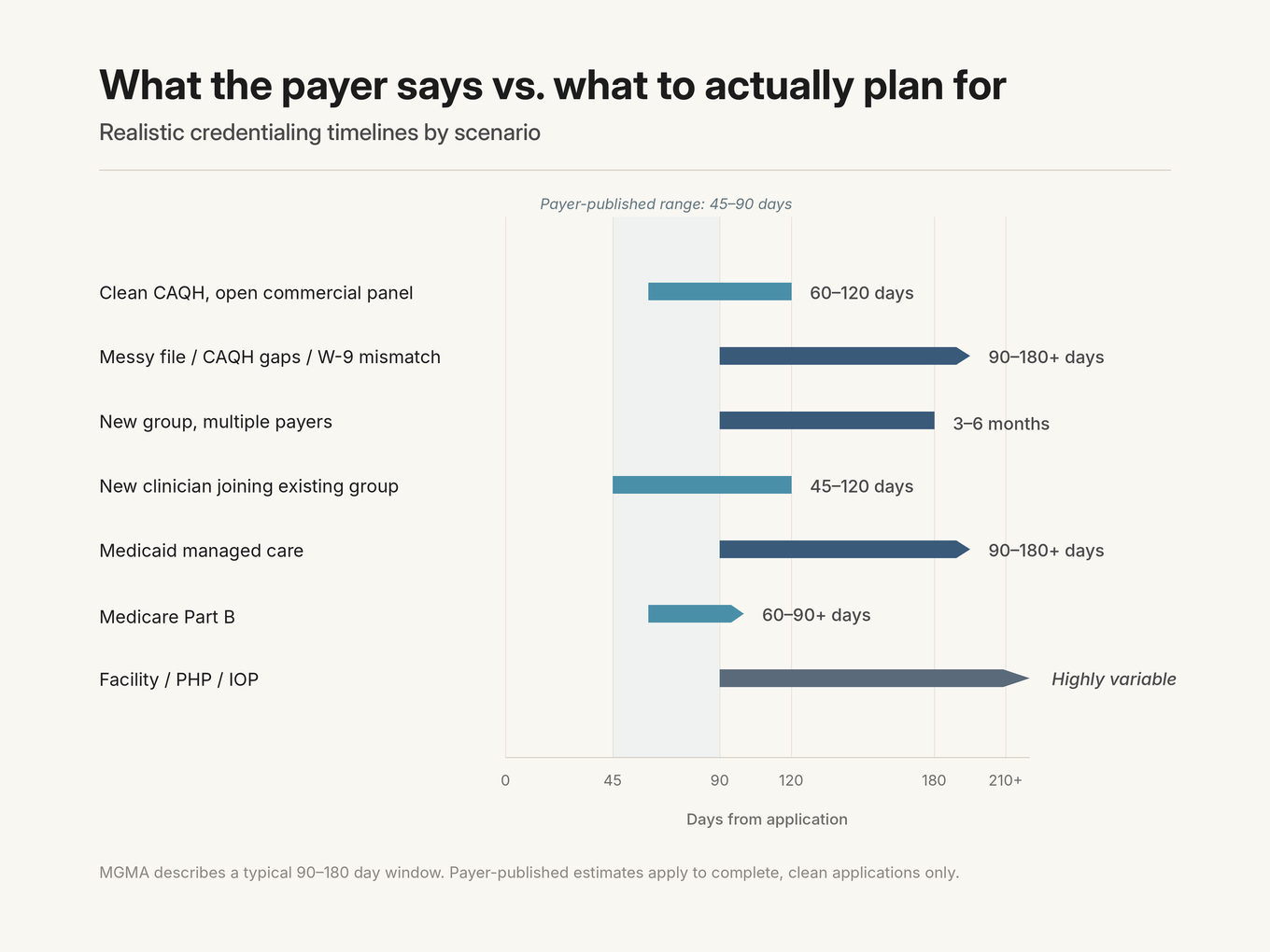
MGMA describes a typical window of 90 to 180 days from provider application submission to credential verification and approval. It also notes that credentialing denials increased for many practices because of long payer delays, inconsistent requirements, closed panels, and application discrepancies.
| Scenario | Realistic planning range | Notes |
|---|---|---|
| Clean CAQH + open commercial behavioral health panel | 60-120 days | Some payers quote 45-90 days after a complete file; budget longer |
| Messy CAQH, missing documents, W-9/TIN mismatch, or work-history gaps | 90-180+ days | Every correction can restart review queues |
| New group applying to multiple commercial payers | 3-6 months | Group contract, clinician credentialing, EFT/ERA/EDI, and claims loading all have to align |
| New clinician joining an existing group | 45-120 days | Faster only if the group agreement is active and the payer accepts roster add workflows |
| Medicaid managed care | 90-180+ days | Often requires state Medicaid screening plus managed care plan network approval, two separate processes |
| Medicare Part B enrollment | 60-90+ days | Depends on PECOS completeness, MAC processing, and any development requests |
| Facility / PHP / IOP / SUD program | Highly variable; often longer than individual therapist credentialing | Facility licensure, accreditation, site review, payer facility contracting, and level-of-care review can add substantial time, confirm the timeline directly with each payer before launch |
The payer-published timelines are worth knowing for benchmarking, but they apply to complete, clean applications:
- Aetna says it will notify providers within 45 days whether they are eligible to participate and begin contracting, but that's the network-need evaluation, not the end of the process
- Evernorth's current page says facility applications can take up to 90 days, as of June 1, 2026, new individual and clinic behavioral health applications are paused (see note below)
- Anthem says the credentialing process typically takes 45 days from the time the credentialing department receives a completed CAQH application
- Blue Shield of California says standard turnaround for behavioral health providers is 45-60 days after required materials are complete
- BCBS Texas states that if a provider does not finalize CAQH within 45 days, credentialing is discontinued and the provider must restart from the beginning
The practical guideline: plan for 60-120 days for clean commercial applications, and 90-180+ days when closed panels, Medicaid, group setup, facility contracts, or payer loading complications are involved.
A note on Evernorth as of June 2026: Evernorth Behavioral Health paused accepting applications from new individual and clinic behavioral health providers as of June 1, 2026. Facility providers may still apply. Individual and clinic providers are encouraged to complete an interest form or revisit after September 1, 2026. Applications submitted before June 1, 2026 are unaffected. This is date-sensitive, verify directly with Evernorth before relying on it.
Credentialing for Solo Therapists, Groups, and New Hires
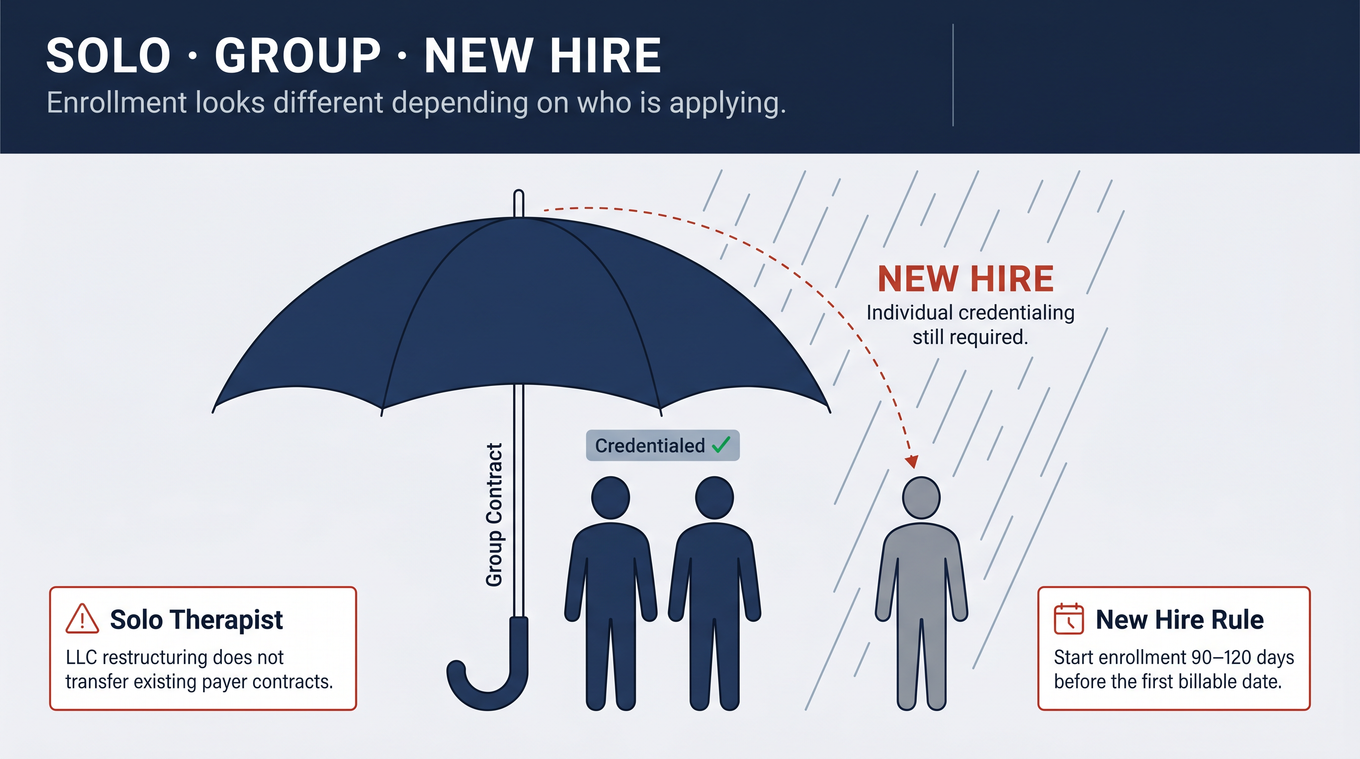
The enrollment process looks meaningfully different depending on who is applying and in what capacity. Using the wrong route can waste months.
What Solo Therapists Need for Payer Enrollment
A solo therapist may bill under a personal Tax ID (SSN), an LLC's or corporation's EIN, or, in some cases, a Type 2 organizational NPI if billing as a business entity.
The important thing most solo therapists don't realize: forming an LLC does not automatically create payer contracts. If you've been billing under your personal name and Tax ID and then restructure under an LLC, most payers will require new contracts, a new W-9, new EFT routing, and a re-loading of the provider record under the new business entity. The old enrollment doesn't transfer.
A solo therapist typically needs:
- An individual Type 1 NPI
- Possibly a Type 2 NPI if billing as an organization
- A CAQH profile
- Malpractice certificate
- W-9
- Practice address
- Payer contracts
- EFT/ERA/EDI setup
Group Practice Enrollment: Why the Contract Isn't Enough
A group practice typically has a legal entity with an EIN, a Type 2 NPI, a group contract with each payer, and multiple clinicians each with their own Type 1 NPI credentialed or enrolled under the group.
On claims, the group bills with the billing provider (group Type 2 NPI and Tax ID) and the rendering provider (individual clinician's Type 1 NPI). These are not interchangeable.
The "magic umbrella" misconception is extremely common and expensive: a group contract does not automatically cover every therapist in the group. Most payers require each rendering clinician to be individually credentialed or enrolled under that group before that therapist's claims pay in-network. Carelon describes this explicitly: a provider joining a group with an existing participation agreement does not receive a direct contract. They are added to the group's existing agreement once credentialing is approved. The key phrase is "once credentialing is approved", not when they are hired.
Enrolling a New Therapist: The 90-Day Head Start Rule
This scenario is high-stakes because the revenue gap between a therapist's first session and their first in-network claim payment is directly tied to how early the enrollment process started.
The operating standard: start enrollment 90-120 days before the clinician's first planned billable date, wherever possible. The practical steps:
- Verify license and NPI before the hire date
- Confirm CAQH access and add the group practice location
- Authorize target payers in CAQH
- Submit add-provider requests or roster updates with each payer
- Track payer-specific application status actively
- Obtain written effective dates for each payer
- Confirm provider loading in the payer system
- Configure the clinician in the EHR
- Submit test claims for the first few sessions
- Monitor the first 10-20 claims per payer for denials
Critical compliance warning: Do not bill a new therapist's services under another therapist's NPI while waiting for credentialing. Unless a payer-specific, state-specific, and properly documented supervision or incident-to rule explicitly allows it, this is a serious compliance and repayment risk. Most commercial plans require the actual rendering clinician to be credentialed before their claims pay in-network. If you're ever uncertain, get the answer in writing from the specific payer before billing.
Similarly, a prelicensed or associate-level therapist being legally allowed to provide therapy under supervision in your state is not the same thing as being billable to every insurance plan. The practice must verify payer-specific and state-specific rules before scheduling insured patients.
How to Get Into a Closed Insurance Panel as a Therapist
At some point in the credentialing process for behavioral health, most practices hit a closed panel. Understanding what that actually means, and what it doesn't mean, shapes how you respond.
A closed panel means the payer is not currently accepting new providers of that type, specialty, location, or product. It does not mean the therapist is unqualified. It does not mean all products are closed. It does not mean all locations are closed. It usually means the payer believes its network is already adequate for that provider type in that geography.
The frustrating reality of behavioral health is that closed panels exist even when patients can't find care. A 2025 HHS OIG report found that many Medicare Advantage and Medicaid managed care plans had limited behavioral health provider networks and that access was further limited by "ghost providers", listed providers who were not actually available to serve patients; OIG noted that these providers cited administrative burden and low payment rates as reasons they were unwilling to work with managed care plans. A separate 2025 OIG report found that 45% of surveyed behavioral health providers were not available to treat new patients in traditional Medicare, Medicare Advantage, and Medicaid managed care, and that among available providers, about one in four reported appointment wait times longer than 30 days.
A payer knowing that access is strained doesn't automatically open a panel, but it does mean that demonstrating a specific access gap strengthens a reconsideration case.
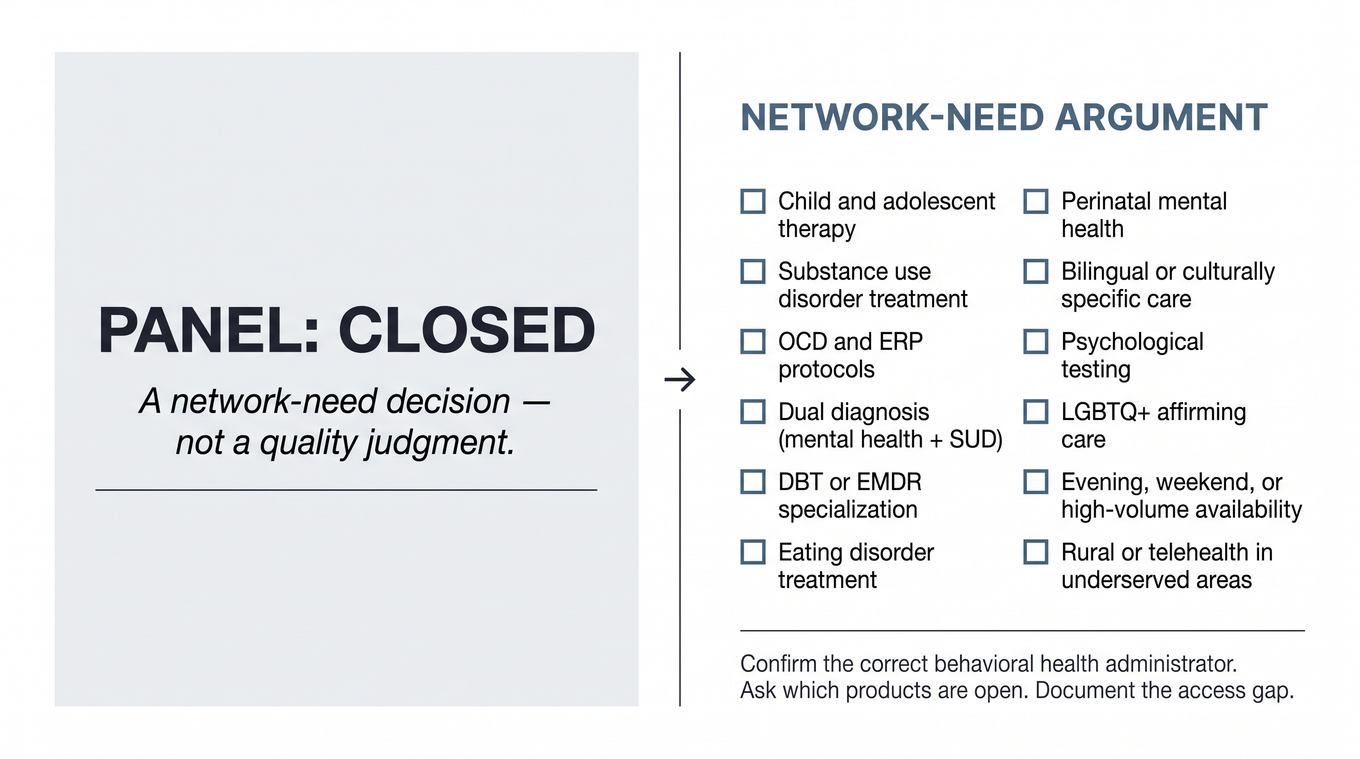
How to improve the odds of getting into a closed or limited panel:
The most effective approach is building a network-need argument that goes beyond "I'm a therapist." Specialties and capabilities that often carry weight with payers include:
- Child and adolescent therapy
- Substance use disorder treatment
- OCD and ERP protocols
- Dual diagnosis (mental health + SUD)
- DBT or EMDR specialization
- Eating disorder treatment
- Perinatal mental health
- Bilingual or culturally specific care
- Psychological testing
- LGBTQ+ affirming care
- Evening, weekend, or high-volume availability for new patients
- Rural or telehealth coverage in underserved areas
Practical tactics:
- Confirm you're applying to the correct behavioral health administrator, not just the medical carrier
- Ask whether the denial is for all products or only one (commercial products may be closed while Medicare Advantage is open, for instance)
- Ask when the panel might reopen and whether there's an interest list
- Reapply every 3-6 months if the payer allows
- Request a network adequacy exception if access gaps in your area can be documented. BCBS of New Mexico, for example, references a Network Adequacy Exception Request pathway in its credentialing materials, similar options exist with other payers
- Join a contracted group if the relationship is real and the group's existing contract genuinely includes the relevant products and locations
- Submit a concise, documentation-backed access-gap letter
The key discipline is this: don't confuse a closed-panel rejection with a quality judgment. It's a network-need decision. Address the network-need question directly, and keep the CAQH profile current so the application can move quickly when a panel opens.
Why Effective Dates Matter More Than Your Approval Letter
Getting a written effective date is not the finish line. It's the proof that you've actually crossed it.
The hard rule: do not treat services as in-network until the payer has given a written effective date and the provider record is loaded and confirmed.
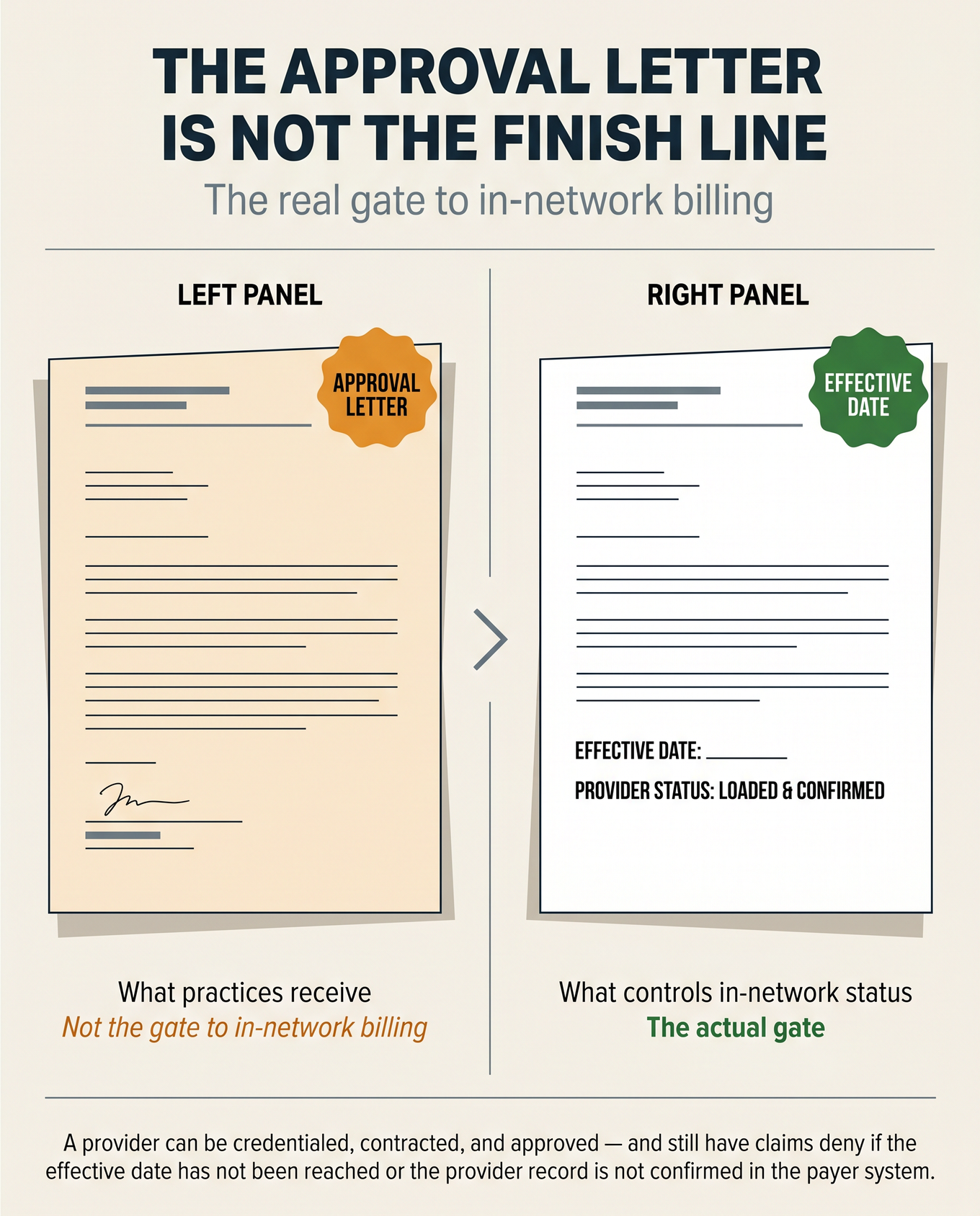
A therapist can be licensed, credentialed, contracted, and still have claims deny because:
- The provider hasn't been loaded in the claims system yet
- The provider is loaded for one product but not another
- The provider is loaded at one service location but not the telehealth location
- The provider is loaded under the wrong Tax ID
- The effective date hasn't been reached
Blue Shield of California's behavioral health page states directly: after credentialing committee approval, contracting sends a welcome letter with the contract effective date, and services rendered before the effective date are processed as out-of-network. Capital Blue Cross goes further, warning that credentialing completion does not finalize network participation; providers receive a second notice confirming effective dates and should not schedule services until that notice is in hand.
Effective dates can be tied to different trigger events depending on the payer: credentialing committee approval date, contract countersignature date, group roster effective date, payer loading date, first day of the month after approval, or product-specific network enrollment date. Assume nothing. Ask the payer in writing.
Medicare effective dates are governed by federal regulation. Under 42 CFR § 424.520, the effective date for physicians, non-physician practitioners, and their organizations is generally the later of the date the Medicare contractor received an approved enrollment application or the date the provider first began furnishing services at a new practice location.
Medicare retroactive billing is limited and rule-bound. Under 42 CFR § 424.521, eligible providers may retrospectively bill up to 30 days before the effective date when all program requirements were met and circumstances prevented enrollment before services were furnished; this window can extend to 90 days during certain presidentially declared disasters. Situations involving reassignment of benefits have their own effective date rules under 42 CFR § 424.522. Retroactive Medicare billing is not "bill as far back as you want". It is narrow, conditional, and requires documentation.
For commercial payers, retroactive billing rules vary by contract and payer. Before holding claims or submitting services dated before an approval, get the specific answers in writing from each payer: what is the effective date, which products and Tax IDs does it cover, and does it allow retroactive submission?
For Medicaid, confirm both the state Medicaid effective date and the MCO effective date separately before treating Medicaid members as in-network, and monitor timely-filing deadlines while enrollment is pending.
How Therapists Fall Out of Network, and How to Stay In
Getting credentialed is the first step. Staying credentialed is the ongoing work that practices often underestimate, until claims start denying for a reason no one can initially explain.
Commercial payers generally recredential providers every three years. NCQA requires accredited health plans to recredential every three years. Carelon recredentials every three years or on the schedule required by law. BCBS Illinois recredentials under Illinois's own three-year requirement. Capital Blue Cross recredentials at least every three years.
But recredentialing is not the only maintenance clock. CAQH attestation expires. DataSpring states that providers must attest every 120 days for credentialing purposes if they are not on the 90-day directory update schedule, with a 180-day rule for Illinois providers. An expired CAQH profile doesn't just affect new applications. It can jeopardize existing network participation. Cigna states this bluntly: failure to log into CAQH to verify and sign during recredentialing can result in termination from the Cigna network.
Medicare enrollment has its own revalidation cycle. CMS requires most providers and suppliers to revalidate Medicare enrollment every five years; failure to revalidate can lead to a payment hold or deactivation.
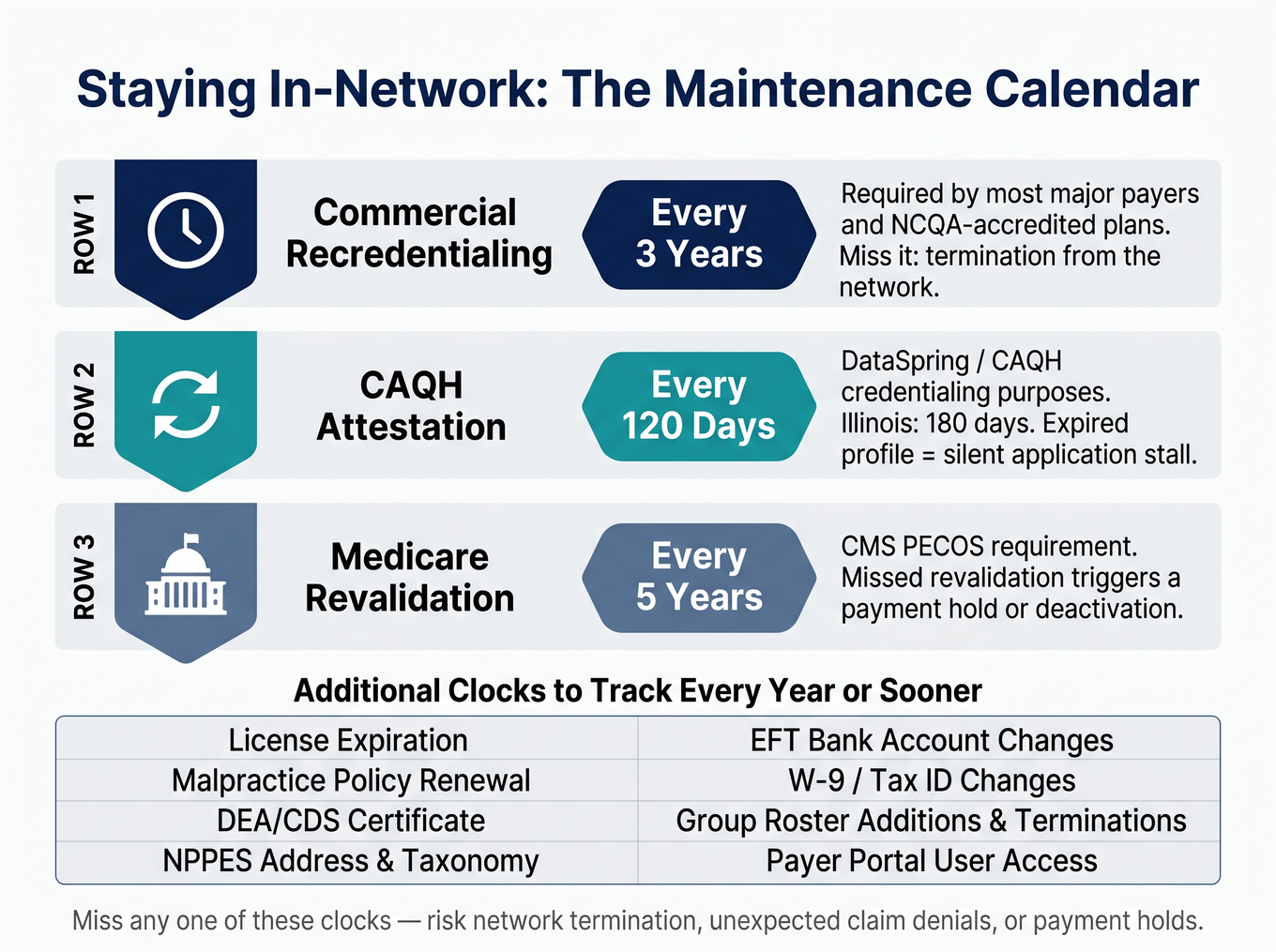
The things that must be tracked on an ongoing basis, beyond the recredentialing calendar, include:
- License expiration dates for every clinician
- Malpractice policy renewal dates
- CAQH attestation calendar
- DEA/CDS certificate expiration (where applicable)
- NPPES address and taxonomy accuracy
- Practice address and telehealth service location updates
- W-9 and Tax ID changes (ownership changes, entity restructuring)
- EFT bank account changes
- Group roster additions and terminations
- Payer portal user access
- Medicare revalidation notices
- Medicaid revalidation requirements
Consequences of missing any of these: termination from the network, claim denials, claims processing out-of-network at much lower rates, payment holds, or deactivation that requires a full re-enrollment. Revenue that already reached the effective date can still be lost retroactively if a recredentialing failure triggers a termination backdated to the expiration.
Recredentialing is not optional maintenance. Payers may send reminders or notices, but missed or misrouted communications can still turn into surprise terminations, discovered weeks later through unexpected claim denials.
The Most Common Reasons Insurance Credentialing Stalls
Most credentialing delays are predictable. In our experience working with behavioral health practices and groups, the failure points cluster into the same categories across payers.
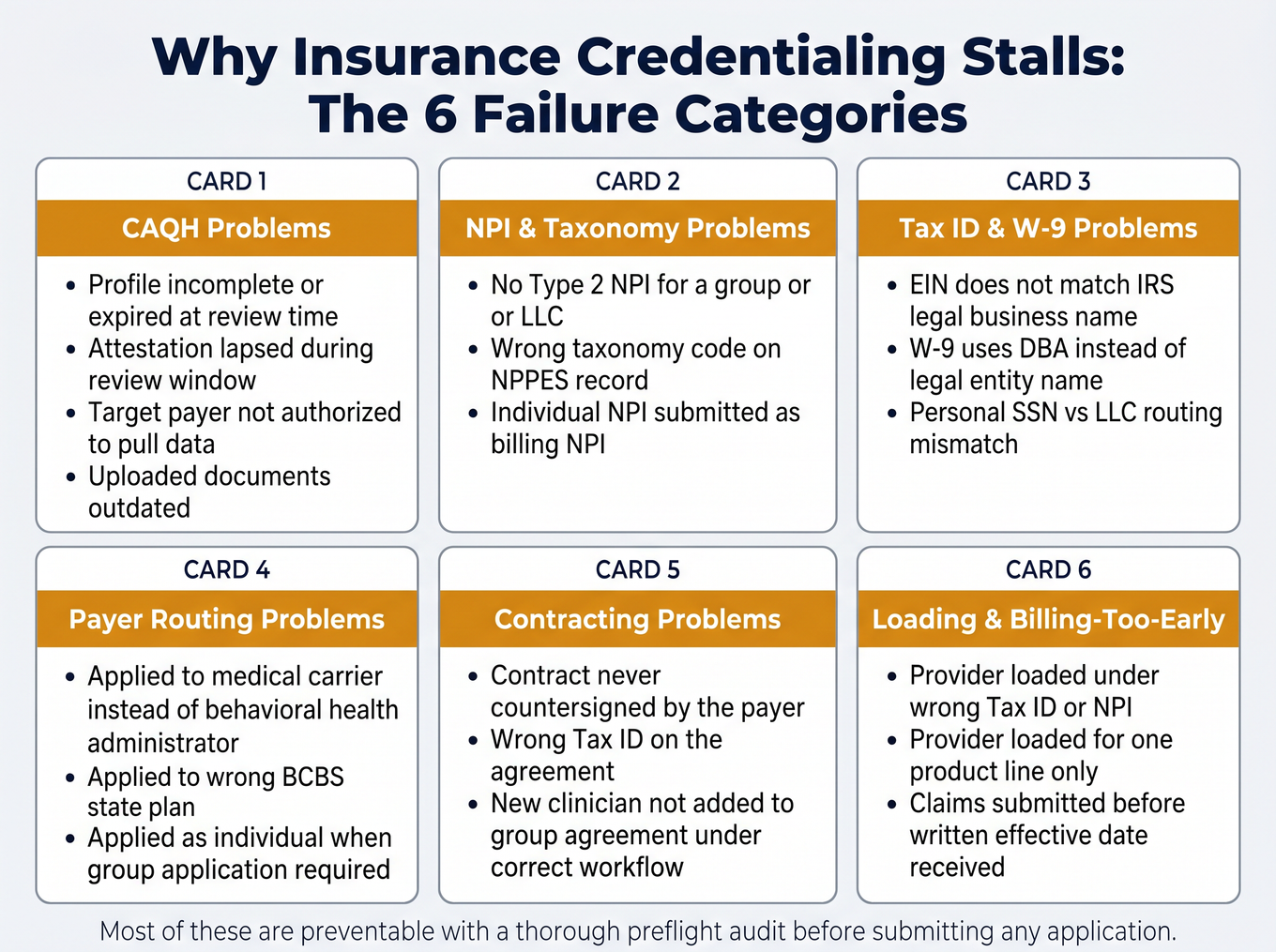
CAQH problems are the most common category:
- Profile incomplete or expired at the time the payer reviews it
- CAQH attestation lapsed during the review window
- Target payer not authorized to access the profile
- Uploaded documents outdated (expired malpractice certificate, expired license)
- Work-history gaps unexplained
- Practice locations missing or wrong
- CAQH data doesn't match what was entered on the payer's application form
NPI and taxonomy problems:
- No Type 2 NPI for a group or LLC where the payer requires one
- Wrong taxonomy on the NPPES record
- NPPES address doesn't match the payer application
- Individual NPI submitted as the billing NPI instead of the group's Type 2 NPI
Tax ID and W-9 problems:
- EIN doesn't match IRS legal business name
- W-9 unsigned or uses a DBA instead of the legal entity name
- Provider applied under personal SSN but wants payment routed to an LLC
- Payer contract has one Tax ID while the clearinghouse submits claims under another
Payer routing problems:
- Applied to the medical carrier instead of the behavioral health administrator
- Applied to a national BCBS brand instead of the applicable state Blue plan (each state plan operates independently)
- Applied to the commercial network when the patient's coverage runs through Medicaid managed care
- Applied as an individual when the payer required a group application
Contracting problems:
- Contract never countersigned by the payer
- Wrong Tax ID on the agreement
- Product or network excluded from the contract
- Service location not included
- New clinician not added to the group agreement under the correct workflow
Loading problems:
- Credentialing approval issued but provider record not yet loaded
- Provider loaded under incorrect Tax ID or NPI
- Provider loaded for one service location but not the telehealth location
- Provider loaded for one product line but not the one the patient has
- Directory shows the provider's name but claims still deny because the claims system hasn't been updated
- EFT/ERA/EDI not configured, causing payment delays
Billing-too-early problems:
- Practice starts seeing patients after receiving an "approval" notice but before the effective date
- Claims submitted under a different clinician's NPI without a payer-approved billing arrangement
- Claims held too long waiting for enrollment and then submitted after timely-filing deadlines have passed
These failure points share a common downstream consequence: they don't usually surface immediately. Credentialing errors most often show up later as billing denials, sometimes weeks or months after a therapist started seeing patients, long after the window to catch and fix the underlying problem without revenue impact has closed.
Medicare and Medicaid Enrollment for Therapists
Medicare enrollment runs through PECOS, not CAQH. State Medicaid enrollment follows state-specific systems that are separate from commercial payer participation requests, but Medicaid managed care organizations often still require or accept CAQH as part of their plan-level credentialing file. That means the accurate rule is: confirm both the state enrollment route and the MCO's credentialing requirements separately. Behavioral health providers need to understand all of these as distinct from how commercial plans work.
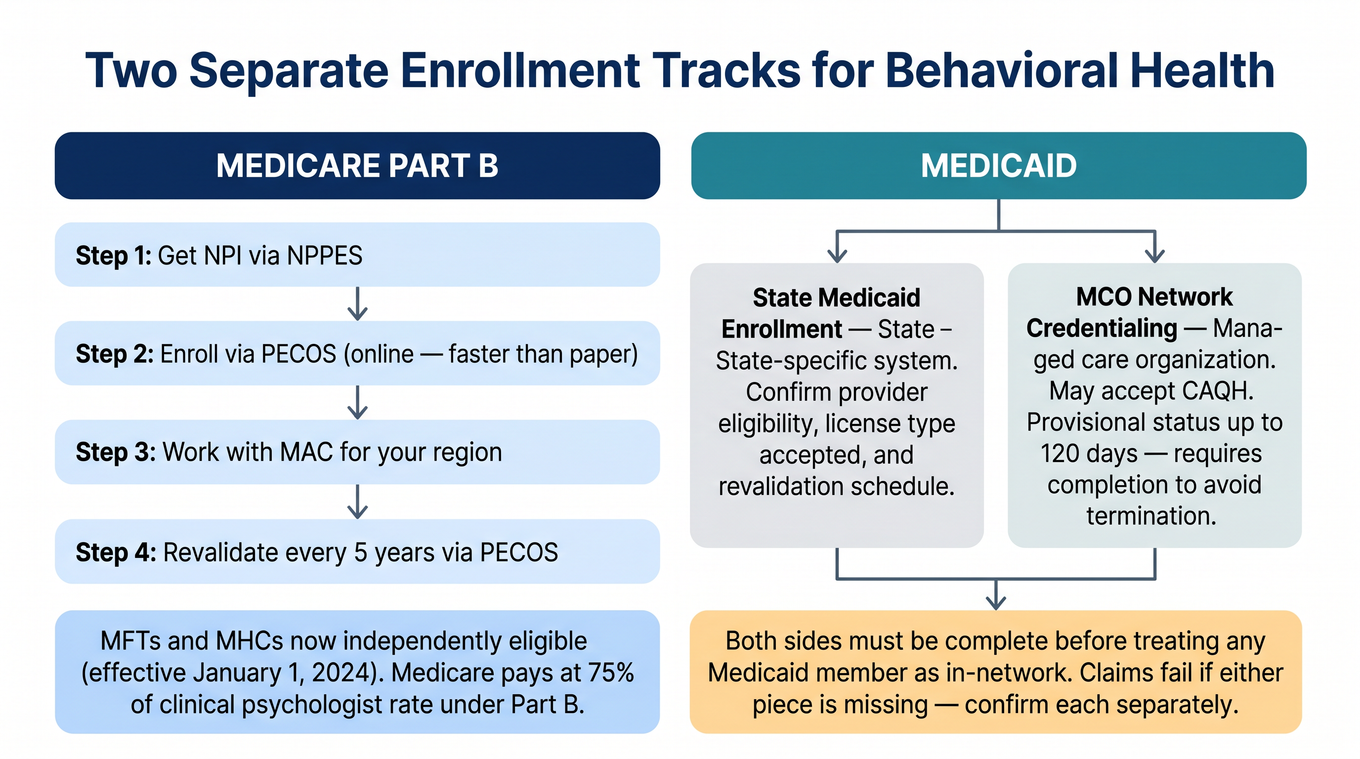
Medicare Enrollment for Therapists
Medicare enrollment for providers runs through CMS's online Provider Enrollment, Chain, and Ownership System (PECOS). CMS describes the basic enrollment sequence as: get an NPI through NPPES, complete Medicare enrollment through PECOS, pay the application fee if applicable, and work with the Medicare Administrative Contractor (MAC) for your region. PECOS allows providers to enroll, revalidate, withdraw, report changes, and electronically sign applications, and CMS notes that PECOS applications process faster than paper.
A significant Medicare change took effect recently for certain behavioral health license types. Effective January 1, 2024, marriage and family therapists (MFTs) and mental health counselors (MHCs) can independently bill Medicare for the diagnosis and treatment of mental illnesses. Prior to that date, these providers were not independently eligible to bill Medicare. Addiction, alcohol, and drug counselors who meet the mental health counselor requirements may also enroll as mental health counselors under this rule.
CMS states that Medicare Part B pays MFTs and MHCs at 75% of the clinical psychologist rate. That payment differential is a factor in deciding whether Medicare enrollment makes sense for a given practice's payer mix.
Medicaid Enrollment: State Programs vs. Managed Care
Medicaid is state-specific. Healthcare.gov notes that Medicaid coverage and costs differ by state even though federal guidelines exist. What qualifies as an enrolled provider, which license types are eligible, and what the enrollment process looks like can vary significantly from one state to the next.
Many Medicaid members receive care through managed care organizations rather than fee-for-service Medicaid. Medicaid.gov describes Medicaid managed care as delivering Medicaid benefits through contracted arrangements between state Medicaid agencies and managed care organizations that accept a set per-member-per-month payment.
The critical point for behavioral health providers: getting into a Medicaid MCO's network and getting enrolled with the state Medicaid program are related but not always the same step.
In plain terms: an MCO can provisionally bring a provider into network while state screening is processing, but that provisional status expires if state enrollment isn't completed. Claims can fail if either piece is incomplete, state enrollment or MCO credentialing.
For Medicaid behavioral health, confirm both sides of the enrollment before treating any member as in-network.
Why Credentialing Errors Show Up as Billing Denials
Credentialing is not a separate administrative function from billing. It's the first step in the billing chain, and errors in credentialing become billing denials later.
Every claim submission depends on the payer's provider record being correct. If the rendering NPI doesn't match what the payer loaded, the claim denies. If the Tax ID doesn't match the contract, the claim denies. If the service location wasn't included in the enrollment, the claim denies. If the effective date hadn't been reached when services were rendered, the claim denies.
MGMA notes that credentialing-related denials affect days in accounts receivable, aging claims, clean-claim rate, and the time from claim submission to close. A credentialing error doesn't just slow one claim. It creates a systematic pattern of denials that pile up before anyone notices the root cause.
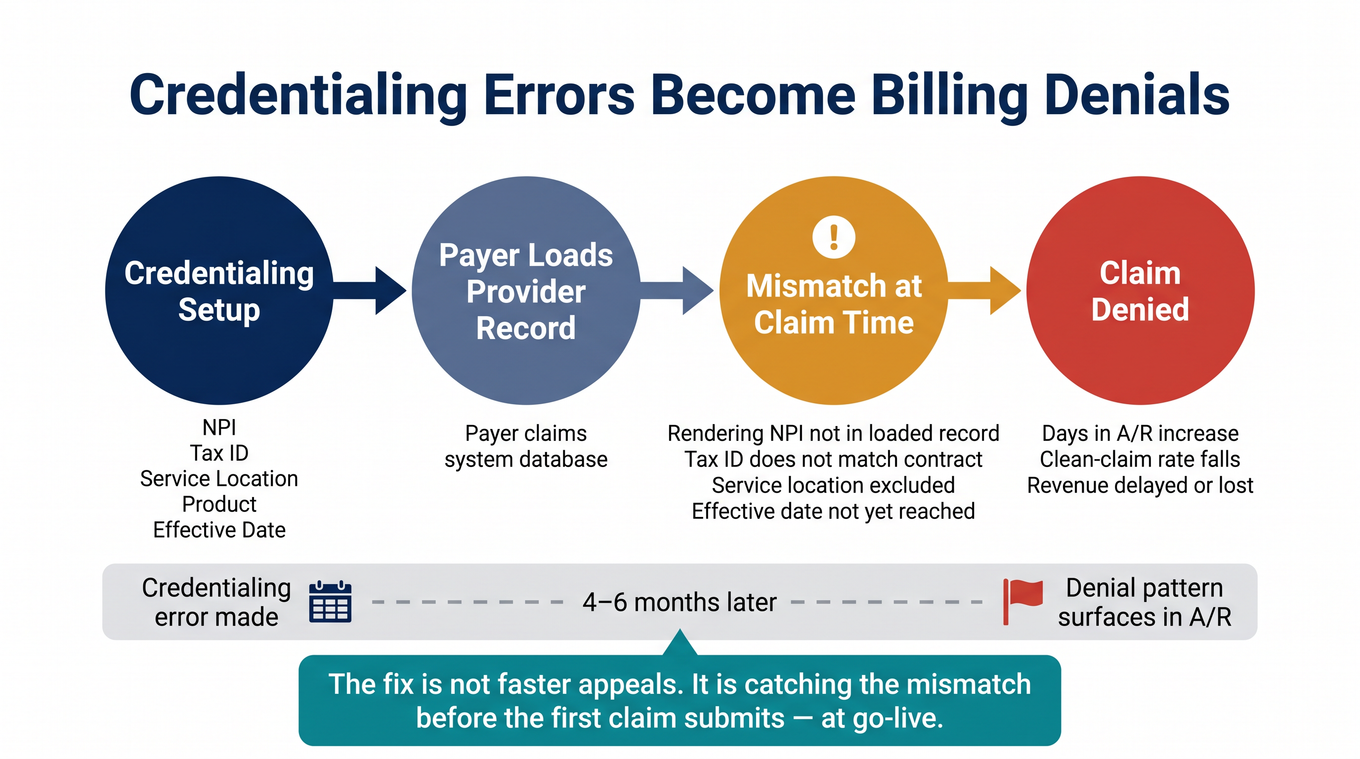
In EHR like Tebra, the claim-facing setup - rendering NPI, billing NPI, Tax ID, payer IDs, service location, taxonomy when required, and telehealth place-of-service settings, must match the payer's loaded record exactly, or clean claims cannot submit. EFT/ERA and contracted fee schedules still have to be configured correctly, but they affect payment routing, remittance, and expected reimbursement, not the basic question of whether the claim identifiers match the payer's enrollment record. The clinical work is complete. The coding is correct. But a mismatch between what's loaded in the system and what's loaded in the payer's database will deny the claim as if it were never submitted properly.
This is why the practices that treat credentialing as part of revenue-cycle management consistently outperform those that treat it as a one-time paperwork event. Getting the provider into the system is the beginning, not the end. The work includes monitoring the first claims after go-live, catching denial patterns by payer and by provider, and connecting the dots between a credentialing decision made six months ago and a denial pattern showing up in the A/R today.
When to Outsource Insurance Credentialing for Your Practice
For a solo therapist setting up one or two payer contracts, the credentialing process is manageable with careful attention and a good checklist. For a group practice adding multiple clinicians per quarter, a facility navigating payer contracts at multiple levels of care, or a practice dealing with Medicare, Medicaid managed care, and multiple commercial plans simultaneously, the volume and complexity make in-house management much harder.
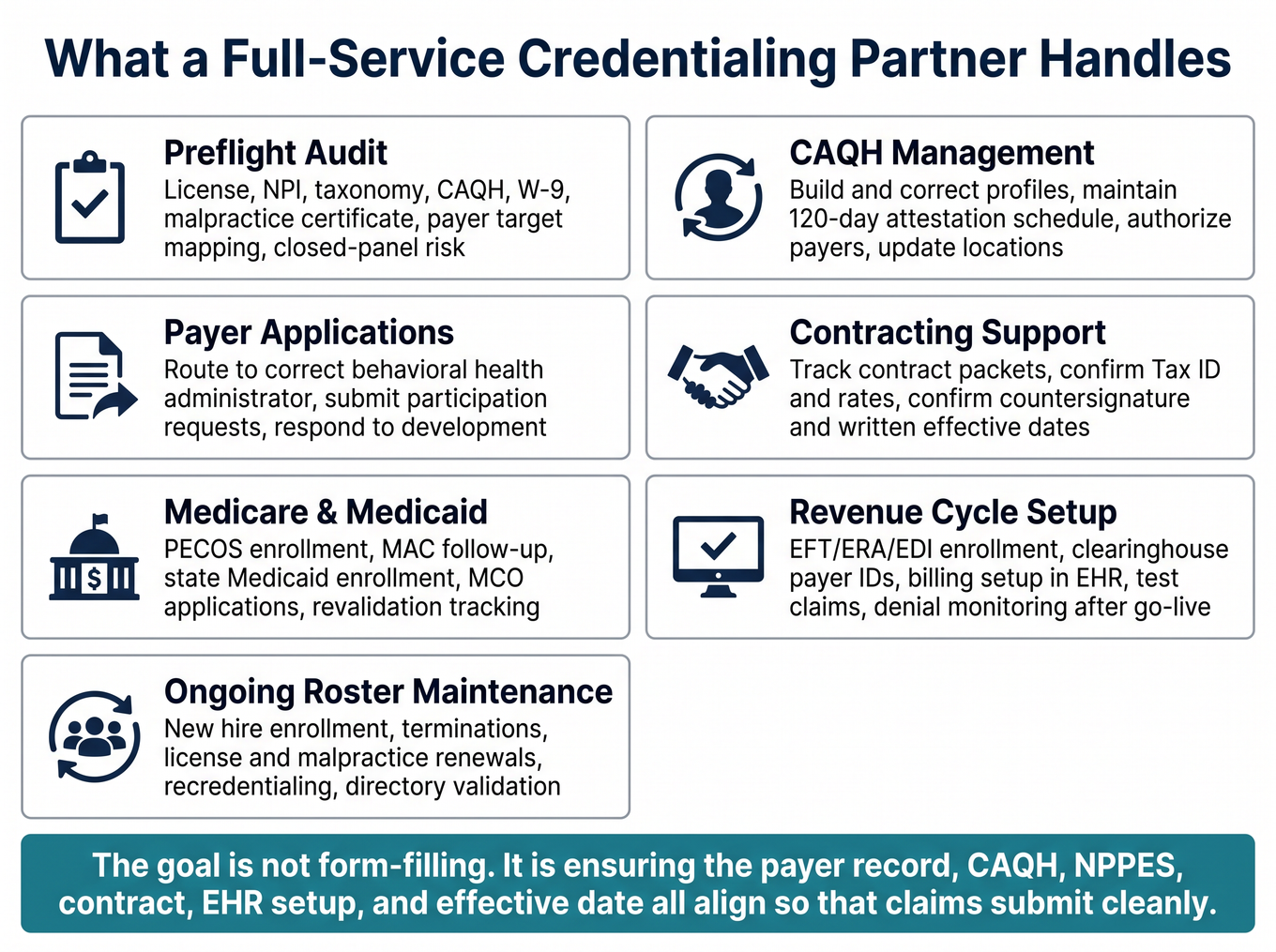
A good outsourced credentialing or enrollment service typically handles:
- Preflight audit: license check, NPI/NPPES review, taxonomy verification, CAQH audit, W-9/TIN review, malpractice certificate check, payer target mapping, closed-panel risk assessment
- CAQH management: building and correcting profiles, uploading documents, maintaining attestation schedule, authorizing payers, keeping locations current
- Payer applications: routing to the correct behavioral health administrator, submitting participation requests, completing payer-specific forms, submitting group roster additions, responding to development requests, escalating stalled applications
- Contracting support: tracking contract packets, confirming Tax ID and rate attachments, confirming countersignature and effective dates
- Medicare and Medicaid enrollment: PECOS setup and applications, I&A role management, MAC follow-up, state Medicaid enrollment, MCO applications, revalidation tracking
- Revenue cycle setup: EFT/ERA/EDI enrollment, clearinghouse payer IDs, billing and rendering provider setup in the EHR, test claims, denial monitoring after go-live
- Ongoing roster maintenance: new hire enrollment, terminated clinician removal, location additions, license and malpractice renewals, recredentialing tracking, directory validation
In our work with behavioral health practices, the value of this kind of support is most clear when a group is growing, when payer enrollment delays are causing real revenue gaps, or when a new facility is trying to get contracted at multiple levels of care simultaneously.
But there are honest limits to what an outsourced credentialing service can do:
- It cannot force a closed panel to open
- It cannot make a payer approve a provider who doesn't meet their qualifications
- It cannot override state scope-of-practice requirements
- It cannot legally backdate every claim to before the effective date
- It cannot guarantee that every payer will contract with every therapist
- It cannot prevent revenue loss from claims that were billed before the effective date when the payer's rules don't allow retroactive billing
The best framing for what good credentialing support delivers is this: it's not form-filling. It's making sure the payer record, CAQH, NPPES, contract, Tax ID, EHR setup, clearinghouse configuration, and effective date all align, so that claims submit cleanly and the work done in the credentialing process doesn't create denials in the billing cycle months later.
What Credentialing Actually Takes - and Where Practices Get Stuck
Getting a therapist approved with insurance is slow because payers aren't simply checking a license. They are verifying credentials, evaluating whether they need the provider in the network, executing or attaching a contract, loading a precise provider/group/location/product combination into their claims systems, and eventually recredentialing the whole thing every three years.

The practices that manage this process well treat credentialing as an ongoing revenue-cycle function, not a one-time paperwork task they hand off and forget. They know their effective dates. They monitor their first claims. They keep CAQH current. They plan new-hire enrollment 90-120 days in advance. And when a stall happens, they know which of the three stages to look at first.
If you're working through a credentialing challenge, whether it's getting a new therapist in-network, navigating a closed panel, managing a Medicare or Medicaid enrollment, or troubleshooting why approved claims are still denying. We'd be glad to take a look at what's actually happening. Reach out to our team to talk through the specifics.
Insurance Credentialing for Therapists: FAQ
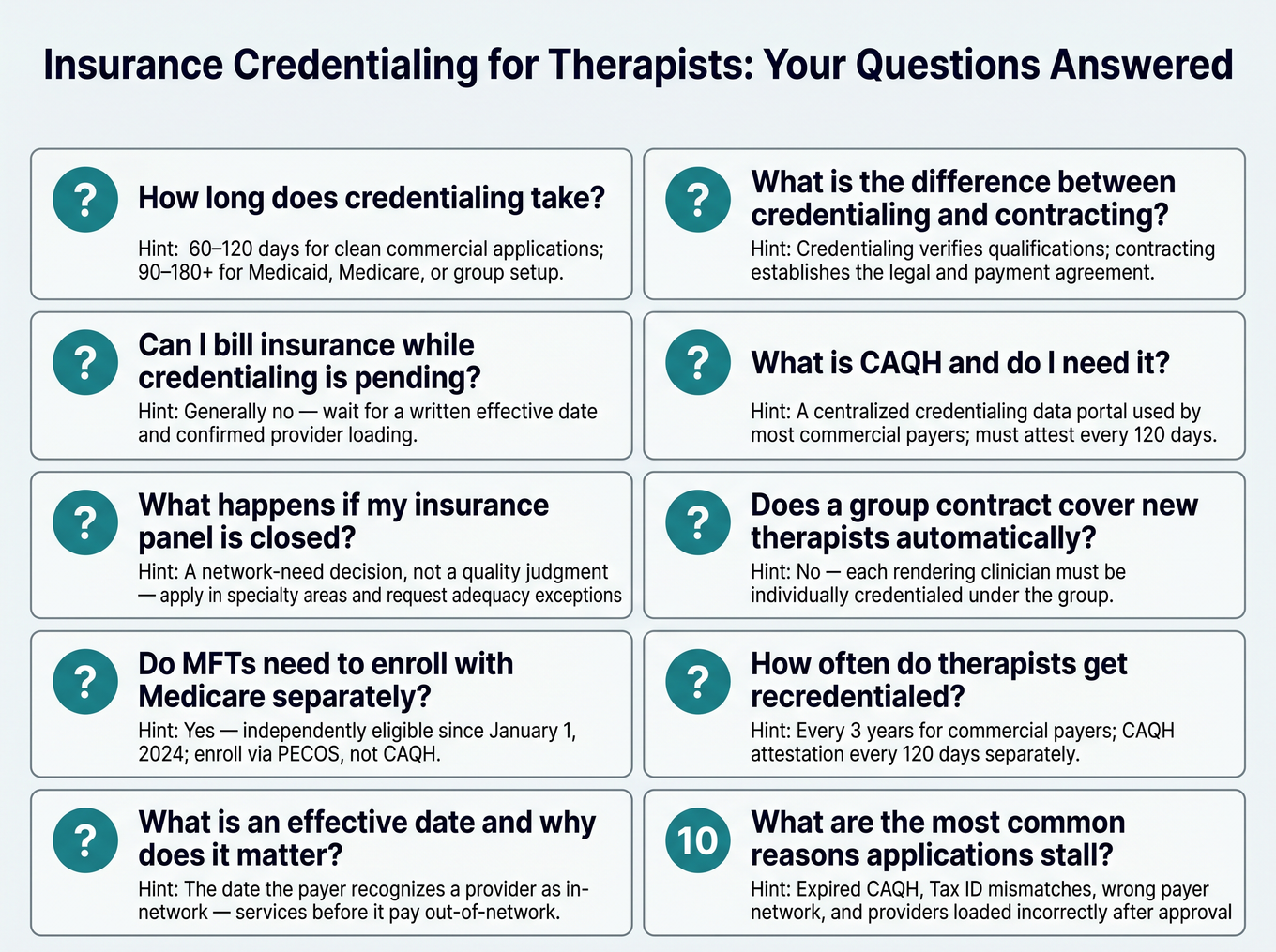
How long does insurance credentialing take for a therapist?
For a clean application with an active CAQH profile and an open commercial behavioral health panel, therapists should plan for 60-120 days. MGMA describes a typical 90-180 day window from application submission to credential verification. Applications involving closed panels, Medicaid managed care, Medicare Part B, new group setup, or facility contracting often take 90-180 days or longer. Payer-published timelines - Anthem's 45 days, Evernorth's 90-day facility pathway (individual and clinic applications paused as of June 2026), Blue Shield CA's 45-60 days, apply to complete applications; most practices should budget more time to account for back-and-forth.
What is the difference between credentialing and contracting?
Credentialing is the payer's verification that a clinician is qualified, licensed, and safe to be in the network. Contracting is the legal and business agreement that determines whether the provider is actually participating, which products are included, and what the reimbursement rates are. A provider can be credentialed but not yet contracted. A group can be contracted while a new clinician inside the group is not yet enrolled.
Can I bill insurance while my credentialing is pending?
Generally, no, billing in-network while credentialing or enrollment is still pending risks claim denials and potential compliance issues. There are narrow exceptions (certain Medicaid situations, Medicare's limited retroactive billing window), but these vary by payer and circumstance. The correct rule: don't bill as in-network until you have a written effective date and have confirmed the provider is loaded correctly in the payer's system.
What is CAQH and do I need it for insurance credentialing?
CAQH (now operating under the DataSpring brand) is a centralized credentialing data portal used by most commercial health plans. It lets providers enter professional information once and share it with authorized payers. Most commercial payers for behavioral health require a CAQH profile. Completing CAQH is not the same as being credentialed. It's a data source the payer uses to conduct its own review. CAQH profiles must also be attested regularly (every 120 days for credentialing purposes) or they expire.
What happens if my insurance panel is closed?
A closed panel means the payer isn't currently accepting new providers of that type, specialty, or geography. It's a network-need decision, not a quality judgment. Options include:
- Ask whether only one product is closed while others are open
- Request a network adequacy exception if you can document an access gap
- Apply in a specialty or with a population the payer is actively recruiting for
- Reapply every 3-6 months
- Join an existing contracted group if the contract genuinely covers the relevant products and locations
Does a group practice contract automatically cover new therapists?
No. Most payers require each rendering clinician to be individually credentialed or enrolled under the group before their claims pay in-network. A group contract establishes the framework, but individual approval is still required. Carelon describes this directly: providers joining a group's existing agreement are added to it once their credentialing is approved, not when they are hired.
Do marriage and family therapists need to enroll with Medicare separately?
Yes, and they can now do so independently. Effective January 1, 2024, marriage and family therapists and mental health counselors can independently bill Medicare for the diagnosis and treatment of mental illnesses. Prior to that date, these provider types were not independently eligible to enroll and bill Medicare. Medicare enrollment runs through PECOS (not CAQH), and Medicare pays MFTs and MHCs at 75% of the clinical psychologist rate under Part B.
How often do therapists need to be recredentialed?
Most commercial payers recredential every three years, consistent with NCQA standards for accredited health plans. Medicare enrollment revalidation generally occurs every five years. CAQH attestation is separate and must be renewed every 120 days for credentialing purposes (180 days for Illinois providers). Failing to complete recredentialing can result in termination from the network, payment holds, or deactivation. Payers typically send reminders, but missed or misrouted notices can still turn into surprise denials, which is why tracking these deadlines internally matters.
What is an effective date and why does it matter?
An effective date is the date the payer recognizes a provider as in-network for a specific product, Tax ID, and service location. Services rendered before the effective date are typically processed as out-of-network, even if the provider has been credentialed, contracted, and approved. The effective date comes from the payer, in writing, after the provider record is loaded. Don't start billing as in-network until you have it.
What are the most common reasons insurance credentialing applications stall?
The most frequent causes include:
- An expired or incomplete CAQH profile
- Missing payer authorization inside CAQH
- CAQH data that doesn't match the payer application
- Missing or expired malpractice certificate
- Tax ID/W-9 mismatches
- Applying to the wrong network (especially when behavioral health is carved out from the medical plan)
- Work-history gaps left unexplained
- Contracts that were never countersigned
- Providers loaded incorrectly in the payer's claims system after approval
Most of these are preventable with a thorough preflight audit before submitting any application.