Family Therapy Billing: 90847 vs 90846 and Who Pays
August 28, 2026 · 60 min read
Patient in the room, bill 90847. Patient not in the room, bill 90846. That is true, and it is the least consequential of the three decisions standing between a family session and a paid claim.
The two decisions that follow are where practices lose money, and occasionally where they take on risk they did not know they were taking. Who is the patient, when three people were in the room and only one of them has a diagnosis? And does this particular plan - not this insurer, this plan - pay for the work that was actually done? Get the first question right and the second two wrong, and you have a perfectly coded claim that denies, or one that pays and then gets recouped eighteen months later.
Eight records have to agree before a family psychotherapy claim survives: the schedule, the signed note, the identified patient, the benefit product, the authorization, the rendering provider's enrollment, the telehealth setup, and the claim itself. In our experience a denied family-therapy claim is almost never a mystery. It is two of those records disagreeing, and nobody noticing until the remittance arrives.
Everything below is United States professional billing as it stood in August 2026, and every dated policy is dated in place. CPT changes, Medicare policy changes, state Medicaid programs change, and employer benefit products change every plan year. A payer's logo on a card is not a benefit determination - the member's exact product and your provider contract control.
Where the honest answer is no national rule settles this, we say so and tell you who to ask. There are four such places in this topic.
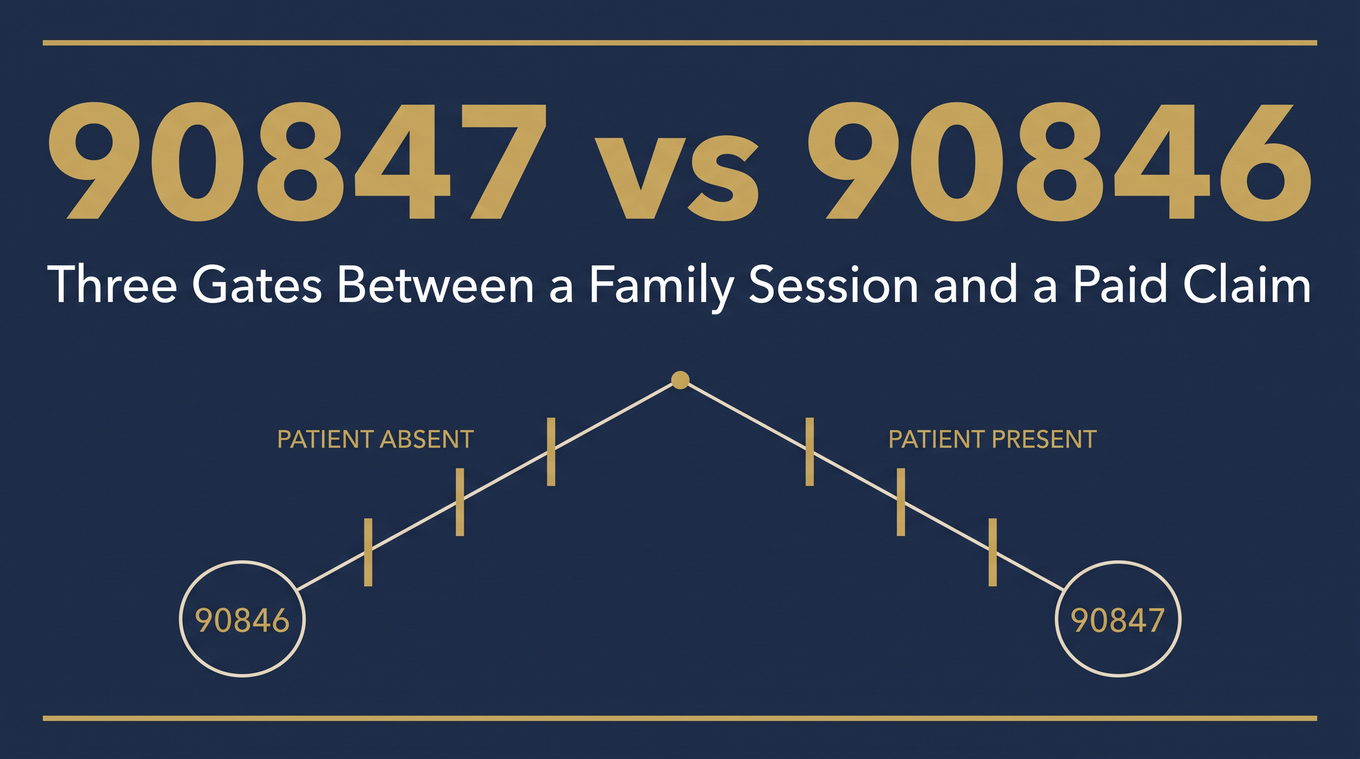
The three gates that decide a family therapy claim
Use 90846 for medically necessary family psychotherapy when the identified patient does not participate, and 90847 when the identified patient does. Under current CMS billing guidance, neither code is reported for a service under 26 minutes. The claim belongs to one identified patient and must treat that patient's diagnosed condition - which means the code itself does not make general relationship counseling covered. An individual psychotherapy session and a family session on the same date are reportable together only as separate, distinct services furnished in separate time intervals. (CMS A56937; NCD 70.1; 2026 Medicare NCCI Policy Manual, Chapter XI)
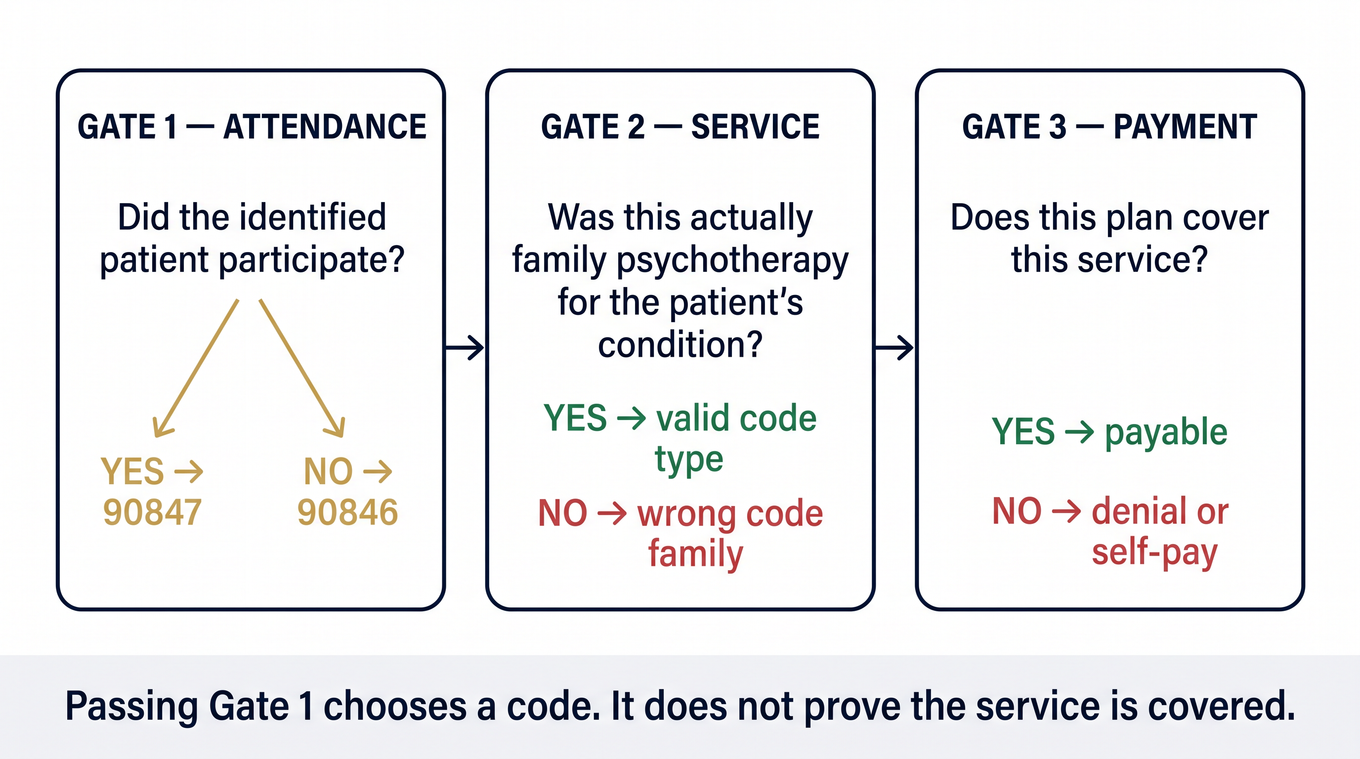
Underneath that paragraph are three separate gates:
Gate one - attendance. Did the identified patient participate in this family encounter? No leans 90846; yes leans 90847. This gate chooses a code.
Gate two - service. Was this actually family psychotherapy directed at the identified patient's treatment? Or was it individual therapy with a family informant, a diagnostic evaluation, crisis work, a staff consultation, or non-medical relationship counseling? This gate decides whether a family code is the right kind of code at all.
Gate three - payment. Does this patient's exact plan cover this service, from this provider, in this setting and modality, at this frequency, with whatever authorization it requires? This gate decides whether anyone pays.
Passing gate one chooses a code; it does not prove the service is covered. Most of the frustration in this corner of behavioral health billing comes from treating a coding decision as if it were a coverage decision. They are different questions, answered by different documents, and they fail in different ways.
Where the rest of this page answers what you came for:
| If you are trying to… | Go to |
|---|---|
| Choose a code before today's claim goes out | The attendance gate, below |
| Work out whether a couples session can be billed at all | Does insurance cover couples therapy? |
| Settle an argument about session length | How long a family session has to be |
| Bill an individual and a family session on one date | Same day as an individual session |
| Fix a claim that already denied | Why 90847 claims deny |
| Write a policy so five clinicians stop answering differently | The checklist, and the note section before it |
Telehealth is what complicated this gate.
What the patient's attendance decides: 90846 or 90847
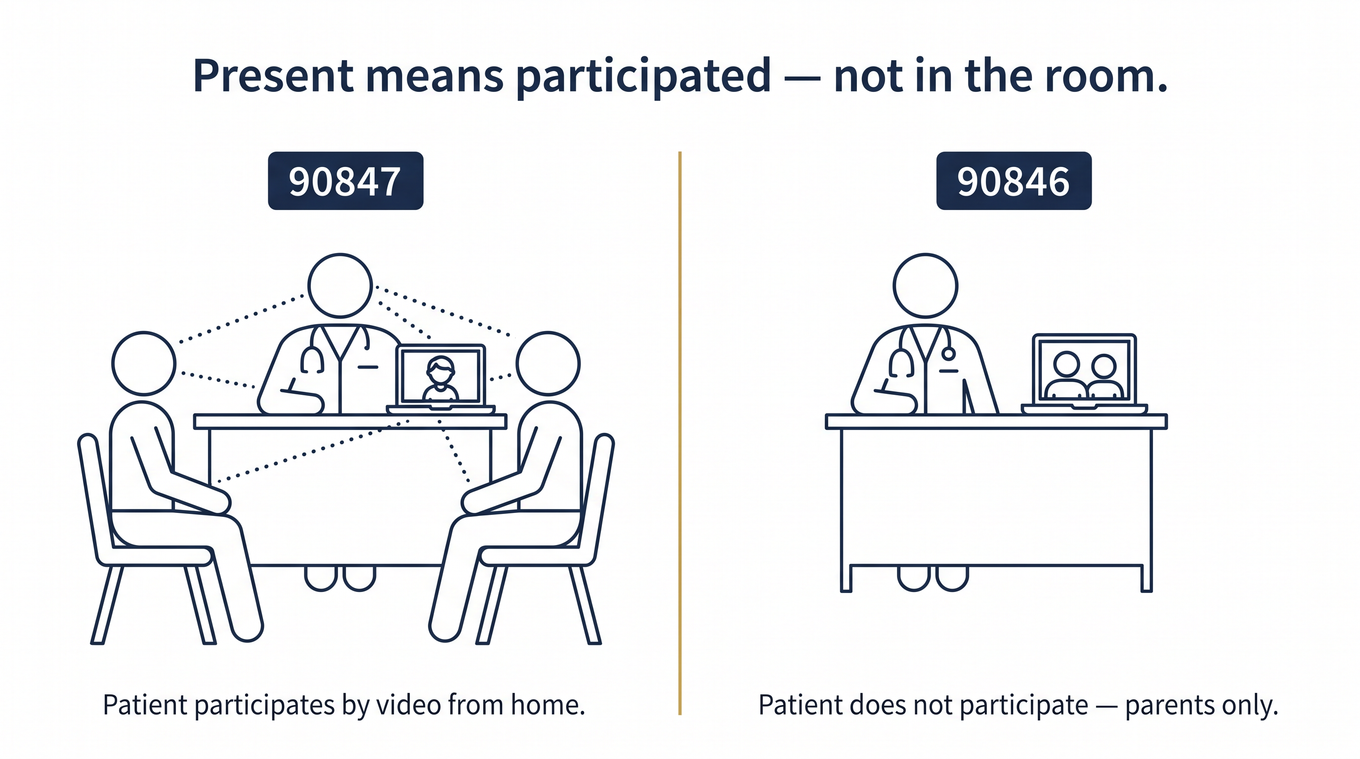
The two codes differ on exactly one variable.
90846 is family psychotherapy in which the identified patient does not participate. 90847 is family psychotherapy in which the identified patient participates. Everything else about the two codes - the 26-minute floor, the 50-minute reference duration, the requirement that the work treat one identified patient's condition - is the same. (CMS A56937)
"Present" means participated, not "was in the room"
The shorthand everyone uses - physically in the room - was a good proxy for a traditional office visit. It stopped being reliable the moment any participant joined by video.
The defensible question is not where anyone's body was. It is whether the identified patient participated in the family psychotherapy service. Medicare permits both family codes by telehealth, and its current place-of-service rules classify the patient's location rather than asking whether patient and clinician shared a room. (HHS telebehavioral billing guide; CMS List of Telehealth Services; CMS Place of Service Code Set)
A child patient on video from home while both parents sit in your office is a 90847 situation, not a 90846 one. Two parents on video while the child patient is at school and not on the call is a 90846 situation, even though the clinician and the family were never in the same building. "Absent" refers to the patient's non-participation in the service, not to anybody's geography.
Six patterns and where each one lands
| What happened | Coding direction | What the note has to establish |
|---|---|---|
| A parent and the clinician work on managing a child patient's symptoms; the child does not join | 90846, if the work is psychotherapy for the child's treatment and everything else is met | Name the child as identified patient; identify attendees; show how the caregiver intervention advances the child's treatment; record time |
| A patient and spouse participate in conjoint treatment of the patient's depressive disorder | 90847, if medically necessary and covered | The patient's diagnosis and function, the spouse's role in the intervention, the patient's participation, the treatment goal, and the response |
| The clinician runs an individual session; the spouse joins briefly to give history | Usually still the individual code, not an automatic 90847 | That the service remained individual psychotherapy with the family member acting as informant, plus the actual individual-therapy time |
| The patient is on video from home; parents join from a second location | 90847, if the plan allows telehealth and the patient participates | All locations and participants, modality, consent where required, start and stop time, and POS 10 for Medicare when the patient is at home |
| Parents meet by video; the child patient does not participate | 90846, if telehealth is covered and the work treats the child's condition | Same as row one, plus modality and locations |
| One partner holds the insurance, but the other partner is the diagnosed patient | Do not make the insured partner the identified patient for payment convenience | The clinical basis for who the patient is - subscriber status is an administrative fact, not a clinical one |
Sources for the coding directions above: CMS A56937, NCD 70.1, LCD L35101, LCD L33632, and the 2026 NCCI manual.
What these codes are not
A surprising share of family-code denials are misidentified services. Four neighbors are worth naming.
Individual psychotherapy with a family member present is still individual psychotherapy. Medicare's NCCI manual states that the individual psychotherapy codes already contemplate sessions in which family informants participate. A parent joining for eight minutes to report school behavior does not convert the hour into family psychotherapy. For the individual time bands, our guide to billing a 60-minute session covers the time structure and our 90834 versus 90837 breakdown covers choosing between them. Do not import those time bands into family psychotherapy. They belong to a different code family. (2026 NCCI manual)
A diagnostic evaluation is not a family session. If the encounter was primarily an assessment, the psychiatric diagnostic evaluation codes describe it - and Medicare NCCI does not permit a diagnostic evaluation and family psychotherapy on the same date at all. Our CPT 90791 guide handles the intake side of that boundary.
Multiple-family group psychotherapy is a different service from a single family's session, and it is not ordinary group psychotherapy either. A couple is not automatically a psychotherapy "group."
A meeting with residential or facility staff is not family psychotherapy. One current Medicare LCD is explicit that facility staff do not become "family" for these codes simply because they care for the patient, and CMS distinguishes 90846 from routine staff consultation and supervision. That meeting may be clinically essential. It is not billable as a family code without a policy basis that fits. (LCD L33632; CMS A56937)
Two absent-patient situations fit 90846 cleanly, and clinicians frequently under-bill them out of caution.
If the patient refuses to attend but caregivers need treatment guidance, family-only work can be legitimate 90846 when it is medically necessary treatment of the patient's condition. The note has to show psychotherapy advancing that patient's treatment, not a case-coordination call and not treatment of the caregivers' own distress.
If the patient is deliberately excluded because the discussion would be destabilizing, that can be a sound clinical reason for the family-only format, provided the note shows active psychotherapy expected to help the patient rather than a conversation about the patient. (CMS A56937; NCD 70.1; LCD L35101)
The identified patient: whose claim a family session is
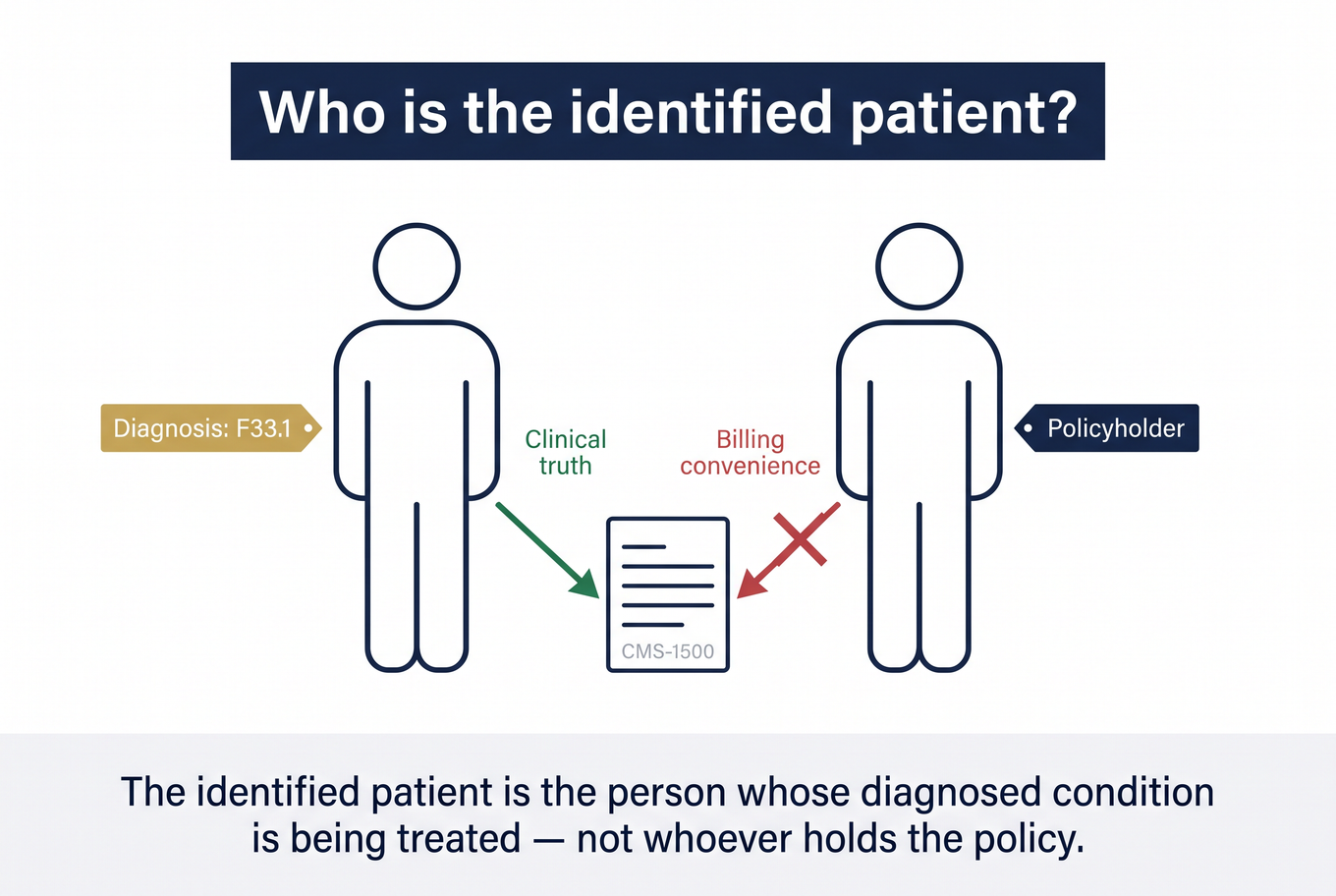
For billing purposes, the identified patient is the person whose health condition is being assessed or treated and whose member record carries the claim. Their name and member identifier, their diagnosis, the procedure line, the rendering provider, the dates, the place of service, and any authorization all have to reconcile to that one person. Medicare's claims processing instructions are built around a single patient per professional claim, and its national coverage rule for family counseling is tied to treatment of that beneficiary's condition. (Medicare Claims Processing Manual, Ch. 26; NCD 70.1)
Several people in a family session receive therapeutic benefit. That does not turn all of them into claim patients. For one 90847 service:
- there is one identified patient;
- the claim is filed under that patient;
- the diagnosis on the claim belongs to that patient;
- the treatment plan explains why a family-format intervention is medically necessary for that patient;
- the note records everyone who attended and how their participation affected treatment;
- and one conjoint encounter is not billed once under each partner.
The subscriber is not automatically the patient
Guidance in circulation sometimes suggests the primary insurance holder can be selected as the identified patient. That confuses who owns the policy with who is being treated.
A subscriber is the person who holds the insurance policy. A dependent can be the patient. A subscriber can attend purely as a spouse or caregiver. Selecting the identified patient on the basis of who owns the policy, who has met a deductible, who has the more generous network, or whose plan produces a higher allowed amount is not a clinical rationale, and it creates a contradiction inside your own records. The assessment diagnoses one partner; the treatment plan and the claim suddenly present the other as the patient. That mismatch is what produces diagnosis-versus-procedure denials, patient-identification denials, eligibility denials, and medical-necessity denials. (NCD 70.1; LCD L35101; X12 Claim Adjustment Reason Codes)
The identified patient is not whoever has the better insurance. It is the person whose diagnosed condition the clinician is treating and documenting.
What attaches to the claim
The diagnosis you report should be the one that best describes the identified patient's condition, and Medicare's family-counseling coverage is limited to treatment of that patient's condition. Medicare Administrative Contractors publish jurisdiction-specific covered-diagnosis lists that differ by region and revision, so "covered diagnosis" is not a single national answer. (CMS A56937; MAC article A57130)
Three practical consequences follow.
A relationship-problem Z code can be clinically useful context, but a relationship code alone often will not establish a covered mental disorder or medical necessity for a medical benefit. We are not telling you that any particular Z code "is always denied" - that is not true as a universal rule, because diagnosis lists and plan policies vary. Check the policy that applies to your patient.
Do not assign a mental-health diagnosis in order to make relationship counseling reimbursable. The diagnosis has to follow a genuine assessment and sit within your scope and documentation obligations.
And if both partners have their own diagnoses and their own treatment needs, each may need a separate assessment, record, consent structure, and treatment plan. That still does not make one shared fifty-minute encounter into two billable services.
How broadly "family" is defined
Medicare contractor guidance is broader than a traditional legal family. One current LCD describes family as including a traditional family unit, a live-in companion, or a significant other, where that person's participation is necessary and expected to improve or stabilize the patient's condition. (LCD L33632)
That supports a spouse, an unmarried partner, a parent, a guardian, an adult child, a sibling, and other clinically relevant household or support participants, when the policy and the treatment facts fit. It does not mean that any meeting with any support person is automatically billable family psychotherapy. The test is the same: is this intervention treating the identified patient's condition?
Does insurance cover couples therapy?
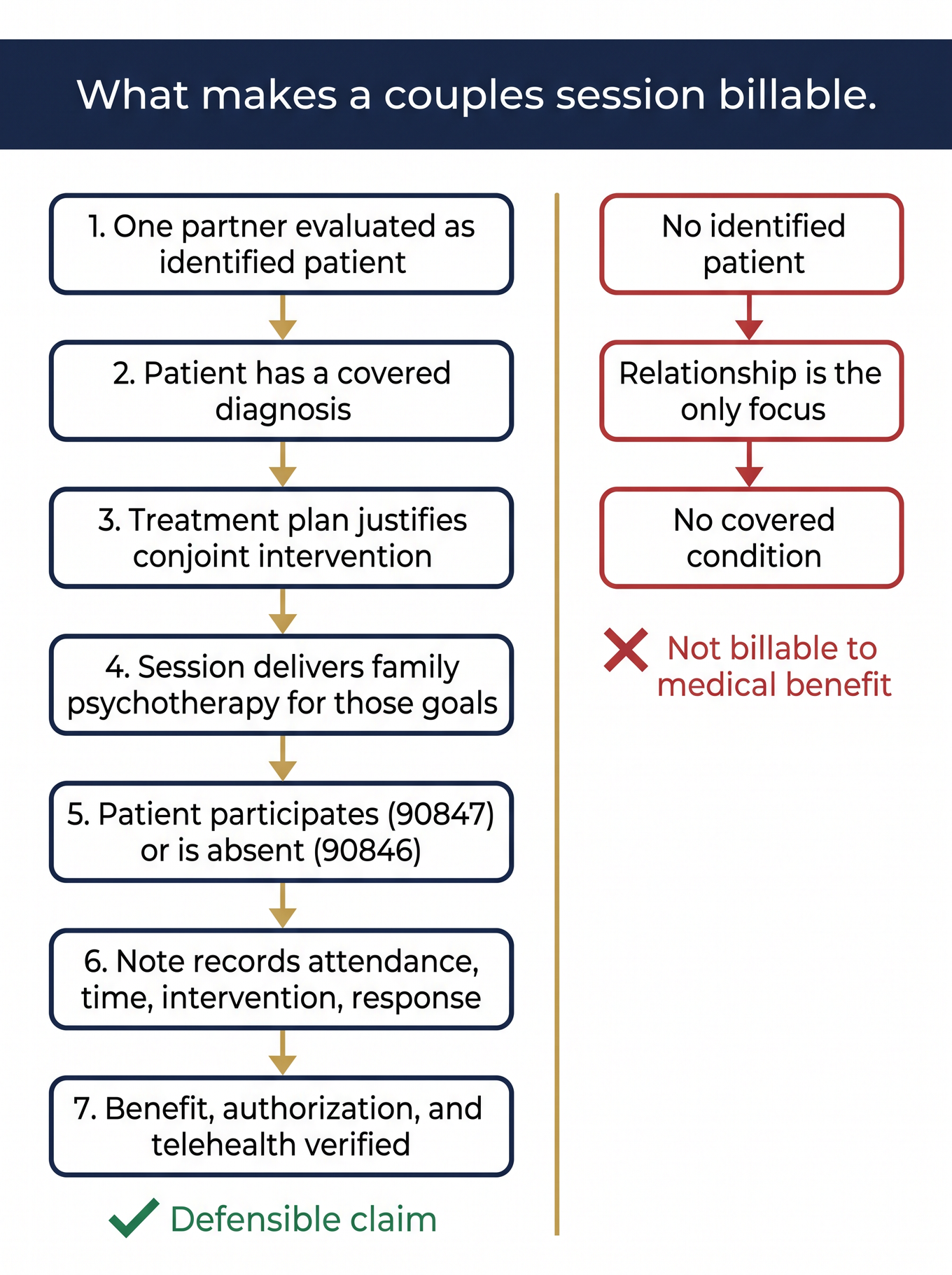
There is no medical-benefit code whose meaning is simply "relationship counseling." 90847 is a family psychotherapy procedure code, not a promise that an insurer will fund work on a relationship. Under Medicare's national policy, coverage turns on whether the primary purpose of the family counseling is treatment of the identified patient's condition - observing family interaction that bears on that treatment, or helping relatives learn to manage the patient's illness. It expressly does not cover the clinician treating relatives' separate problems. (NCD 70.1)
Two statements you will find on the internet are both wrong: "insurance never covers couples therapy" and "90847 is the couples therapy code, so insurance covers couples therapy." Each collapses a coding question and a coverage question into one sentence, and each sends practices in a different unproductive direction.
What legitimately works
A defensible insured couples-format case has a specific chain.
- A clinician appropriately evaluates one partner as the identified patient.
- That patient has a diagnosis, and symptoms or functional impairment the plan can cover.
- The treatment plan makes a clinical case for conjoint intervention specifically - for example, that partner interaction is worsening symptoms, that partner participation is needed for relapse prevention or safety planning, or that the partner has to learn responses that support the treatment.
- The session actually delivers family psychotherapy directed at those goals.
- The patient participates, if 90847 is billed. If the patient does not participate, 90846 is the code under consideration instead.
- The note records attendance, time, intervention, response, progress, and why the family format remained necessary.
- The exact benefit product, provider eligibility, authorization, frequency, and telehealth rules have been verified in advance.
That chain synthesizes Medicare's coverage test and its documentation requirements. It is not a guarantee that any given commercial plan will pay, but it is what a payable claim looks like. (CMS A56937; NCD 70.1; LCD L35101; LCD L33632; CMS A59723)
What does not hold up
The following are frequently valuable clinical services and weak candidates for medical-plan family-psychotherapy billing, because no identified patient with a covered condition is being treated:
- premarital counseling;
- general relationship enrichment;
- communication coaching where neither partner is being treated for a covered condition;
- divorce mediation, custody negotiation, or court-focused work;
- treating "the relationship" as the only patient;
- helping one partner with that partner's separate problems while billing under the other partner;
- a collateral conversation that is principally convenience, case administration, staff supervision, or another professional's consultation rather than psychotherapy.
Medicare's national rule excludes family counseling directed at relatives' separate problems and distinguishes 90846 from staff consultation and supervision. Plan-level exclusions exist and are sometimes explicit: TRICARE's current excluded-services page lists marital therapy among excluded counseling services. (NCD 70.1; CMS A56937; TRICARE, Mental Health Care Services Excluded, updated 5 August 2026)
A meaningful amount of what practices currently do in this space sits on that second list rather than the first. In our experience that is honest confusion rather than intent. The guidance is contradictory, most clinicians were never taught claims architecture, and the pattern usually starts with someone being told "family therapy is covered" by a representative on the phone. The fix is a workflow, not a confession.
The grey zone practices actually inhabit
Real clinical work does not divide neatly into "relationship" and "patient condition." Couples arrive because of conflict. Assessment then reveals that the conflict is maintaining one partner's depression, PTSD symptoms, compulsive behavior, substance-use relapse risk, or another covered condition. That is not a loophole; it is one of the most common presentations in outpatient practice.
The question is not whether relationship themes came up in the session. Of course they did, it is conjoint treatment. The question is whether you can truthfully show that the conjoint intervention is treating the identified patient's condition and functional impairment. If you can, and the note says so, the claim is coherent. If the honest answer is that the work is about the relationship and no one is being treated for a covered condition, then the plan is probably not the right payer for it. (NCD 70.1; LCD L35101; LCD L33632)
When both partners have diagnoses
There are at least four different situations here, and the billing should not pretend they are the same one.
| The clinical reality | Safer handling | What not to do |
|---|---|---|
| One partner is clearly the patient; the other participates to support that treatment | One record and one claim under the identified patient; verify 90847 coverage for that patient's product | Bill both partners for the same encounter |
| Each partner has an independent condition and separate individual treatment, plus occasional conjoint work for one of them | Separate individual records and claims; designate whose treatment the conjoint service advances; document separate intervals if same-day services occur | Keep one undifferentiated "couples" note covering all of it |
| The conjoint intervention is genuinely intended to treat both partners' conditions at once | Get payer and coding guidance; a single encounter still ordinarily cannot be duplicated under both members | Submit identical 90847 lines under each person |
| Treatment focus genuinely shifts from one partner to the other in a later episode | Perform and document a real reassessment and transition; update consents, plan, benefits, authorization, and record ownership | Alternate identified patients visit by visit to chase benefits |
The bottom two rows are the ones we would flag for a specific conversation with the plan. Our research on this pass did not find a national payer rule that resolves either arrangement. Treat them as questions requiring plan-specific guidance rather than as coding permissions.
Couples ask for the rotation in that last row directly. Switching the identified patient from visit to visit so you can use whichever partner's benefits are available is high risk. A legitimate transition can happen, because clinical episodes really do change focus, but it requires assessment, consent, documentation, and administrative re-verification. It is a clinical event that happens to have billing consequences, not a coding toggle.
What this means for how you talk to clients
The worst outcome here is not a denial. It is a couple who believed their therapy was covered, kept coming for four months, and then received a bill that damages both their finances and their trust in you.
A client can reasonably hear "we take your insurance" as "this couples work is covered." The safest workflow makes the difference explicit before care starts. Cover:
- who the identified patient will be, and why;
- whether the planned service is medical family psychotherapy, an EAP service, or self-pay relationship counseling;
- the code and product you expect to use;
- whether authorization, a referral, or a visit limit applies;
- that benefit verification is not a payment guarantee;
- the expected copay, deductible, or coinsurance, and what happens if an EAP allocation runs out;
- whether your provider contract permits billing the client after a particular kind of denial;
- and what happens if the clinical focus turns out not to meet medical-necessity criteria.
Language a practice can actually use at intake:
"Insurance does not cover a session simply because two partners or family members attend. Medical benefits generally require one identified patient and a family intervention that is medically necessary for that patient's diagnosed condition. Some plans exclude relationship or marital counseling, and some employer assistance programs cover it under a separate benefit with different rules. We will verify your exact product and tell you in writing what we find. Verification is not a guarantee of payment, and we will not change the identified patient or the diagnosis in order to obtain payment."
Stated up front, that last clause converts an awkward refusal later into a policy the client already agreed to.
Two liability instruments get over-claimed in this context, and both are narrower than practices assume.
An Advance Beneficiary Notice (Form CMS-R-131) applies to Original Medicare fee-for-service, and only where the provider believes Medicare may not pay for an item or service that could otherwise be covered, and only when its legal requirements are met. It is not a general "your insurance might deny this" waiver, and it does not apply to Medicare Advantage or to commercial plans.
A Good Faith Estimate is principally for patients who are uninsured or who choose not to use their insurance, and a bill at least $400 above the estimate can qualify for the federal patient–provider dispute resolution process. That makes it genuinely relevant when you recommend self-pay couples counseling because the work does not meet the medical-benefit test - and not a substitute for benefit verification on an insured claim. (CMS, Fee-for-Service ABN, modified 17 July 2026; CMS Medical Bill Rights, updated 5 November 2024)
None of this makes insured family work impractical. It makes it decidable.
How long a family session has to be: the 26-minute floor
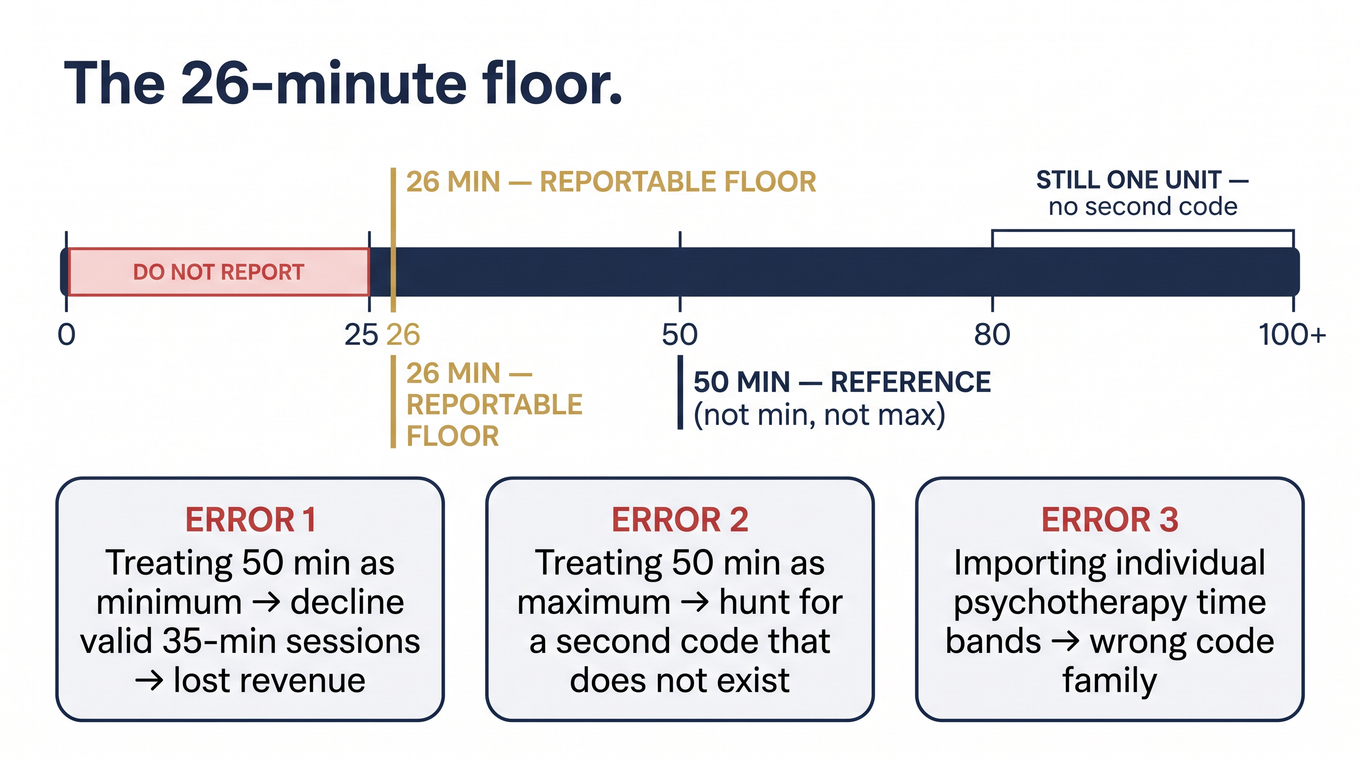
Current CMS billing guidance says not to report 90846 or 90847 for a service of less than 26 minutes. CMS's NCCI manual and current commercial policy describe both codes at the 50-minute level. (CMS A56937; 2026 NCCI manual; BCBSIL CPCP051, effective 22 December 2025)
That produces three precise statements:
- 25 minutes or less: do not report 90846 or 90847 under the cited Medicare guidance.
- 26 minutes: reaches Medicare's reportable floor, if every other element is met.
- 50 minutes: the reference duration. Not a universal maximum, and not a minimum.
Two errors follow from getting this wrong. A practice that believes 50 minutes is the minimum will decline to bill legitimate 35-minute family sessions and lose that revenue. A practice that believes 50 minutes is the maximum will start looking for a second code or an add-on the moment a session runs long, and find one that no longer exists.
The individual psychotherapy time bands do not travel
Do not import the individual psychotherapy time bands into family psychotherapy. Those bands belong to the individual codes and their evaluation-and-management add-on counterparts. Family psychotherapy has a different code structure with a different floor and a different reference duration. (CMS A56937; 2026 NCCI manual)
We have written about the individual time structure separately - see how to bill a 60-minute session and choosing between 90834 and 90837. If a clinician in your practice can recite the individual bands from memory, that is the person most likely to apply them to a family session by reflex.
Long sessions do not create extra units
A family session that runs 80 or 100 minutes does not automatically generate a second unit or a prolonged-service add-on. The operational rule is short:
- Bill one unit of the family code that accurately represents the service, unless the payer has a written, current instruction to the contrary.
- Do not submit two units because a session ran long.
- Do not split one continuous encounter into 90846 and 90847 because the patient walked in or out partway through.
- If a genuinely separate service occurred, analyze it under the same-day rules in the next section and check the payer's edits.
Articles that recommend attaching prolonged-service codes to a long family session are working from logic that CPT retired. Those prolonged service codes were deleted for dates of service on or after 1 January 2023, with no direct replacement created for this situation. Verify against your current CPT resource before acting on any page that still recommends them, including this one.
What the floor is actually worth
Some numbers, carefully labeled.
Secondary 2026 fee references reproduce national non-facility Medicare reference amounts of roughly $105.88 for 90846 and $109.55 for 90847. Those are secondary references, not official CMS figures. CMS has posted its July 2026 national payment file, but the official values were not extracted directly in our research pass, so treat these as provisional and verify the figure for your locality and provider type in the CMS Physician Fee Schedule lookup before you rely on it. Actual payment varies by locality, provider type, facility versus non-facility status, participation status, sequestration, and your contract. (CMS July 2026 National Payment Amount File)
Using $109.55 as an illustrative benchmark: ten unpaid 90847 claims represent about $1,095.50 in gross allowed-amount exposure before patient cost sharing and other adjustments. One incorrect same-day pattern repeated weekly becomes a four-figure problem inside a quarter. And in our experience the face value of the claim is often the smaller loss, because the appeal labor and the timely-filing risk cost more.
One more fee note, because it changes who can bill these codes at all. Medicare began allowing independently practicing marriage and family therapists and mental health counselors to enrol and bill directly on 1 January 2024, and pays them at 75% of the clinical psychologist Physician Fee Schedule amount. Applying that 75% to the provisional references above produces illustrative figures of roughly $79.41 and $82.16 - arithmetic models, not guaranteed claim payments. (CMS, Marriage and Family Therapists & Mental Health Counselors, modified 20 July 2026)
The incentive problem is worth naming. The family codes can reimburse less than the longest individual psychotherapy code, which creates a real financial pull toward coding conjoint work as individual therapy. That pull is why the documentation standards below exist, and why a practice benefits from deciding its policy once, in writing, rather than leaving each clinician to resolve the tension alone at the end of a long day.
Can you bill 90847 and an individual session the same day?
The 2026 Medicare NCCI manual gives the clearest primary answer available:
- psychiatric diagnostic evaluations are not reported on the same date as individual, group, family, crisis, or certain other psychiatric services;
- the individual psychotherapy codes already include sessions in which family informants participate;
- 90846 or 90847 may be separately reported on the same date as individual psychotherapy only when the services are separate and distinct and are furnished in separate time intervals. (2026 NCCI manual, revision date 1 January 2026)
Commercial policy corroborates the framework independently. Blue Cross and Blue Shield of Illinois's current professional psychotherapy policy states that individual psychotherapy may be reported on the same day as family psychotherapy when the services are separate and distinct, and extends the same logic to the evaluation-and-management-linked psychotherapy add-ons. Its opening disclaimer is instructive: the member's plan document and the provider contract govern where they conflict with the policy. (BCBSIL CPCP051, effective 22 December 2025)
What "separate and distinct" has to look like
A defensible same-day pair has all seven of these features:
- Different clinical work. The individual service addresses the patient directly; the family service uses a family intervention to advance a separately articulated treatment objective.
- Non-overlapping time. Minutes counted toward the individual code are not reused for the family code.
- Clear attendance. The record shows who was present in each interval.
- Each service independently clears its own time floor. A 55-minute total cannot become 30 minutes of individual psychotherapy plus 30 minutes of family psychotherapy.
- Each service is medically necessary. "We had extra time" is not a reason for a second code.
- The payer's edit permits the combination. NCCI creates a national framework; commercial products and Medicaid programs can be stricter.
- Any distinct-service modifier is payer-directed and documentation-supported.
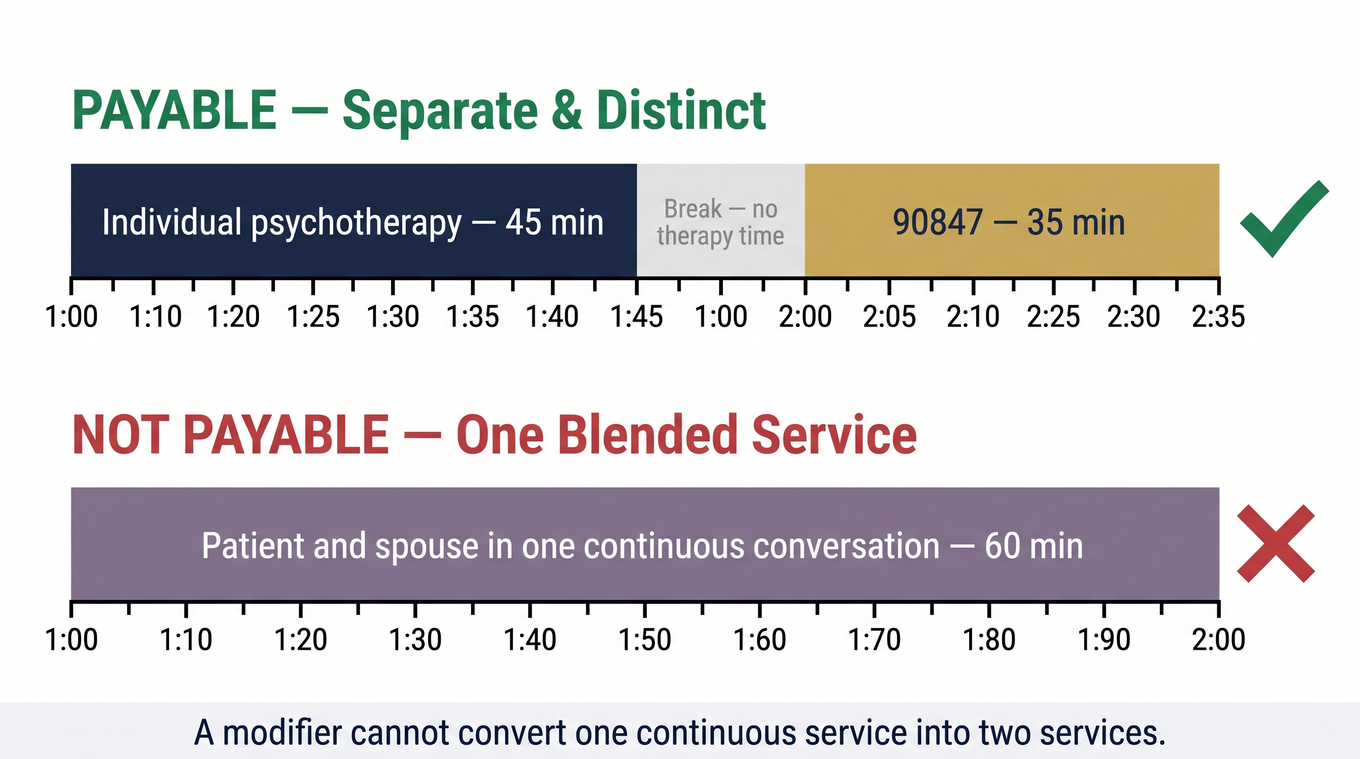
A modifier cannot convert one continuous service into two services. Modifiers describe what happened. They do not change what happened.
Four worked examples
Looks payable. 1:00–1:45, forty-five minutes of individual psychotherapy with the patient - symptom review, cognitive restructuring, relapse-prevention work. 1:45–2:00, a break and administrative transition, with no psychotherapy time counted. 2:00–2:35, thirty-five minutes of family psychotherapy with the patient and spouse, practicing a response plan for symptom escalation directed at the patient's treatment goal. Each interval clears its own floor and the treatment focus is genuinely distinct. Coding direction: an individual code plus 90847, subject to the payer's rules.
Does not look payable. 1:00–2:00, one hour in which patient and spouse move in and out of a single conversation while the clinician alternates between addressing the patient and discussing relationship patterns. Splitting that into an individual code plus 90847 is risky, because the same hour cannot support both. The clinician has to characterize the service that actually occurred rather than divide it after the fact.
Individual therapy with a brief collateral contribution. 2:00–2:55, individual psychotherapy; a parent joins for eight minutes to report school behavior and hear the safety plan; the patient remains the focus. Likely direction: the applicable individual code, not an automatic 90847. Family-informant participation is already contemplated within individual psychotherapy - and eight minutes would not clear the family code's floor in any event.
The genuinely open question. 3:00–3:30, parents only. 3:30–4:00, the child patient joins and participates. Both segments reach thirty minutes, which makes a 90846 plus 90847 pair look tempting. Our research pass did not locate a primary nationwide rule guaranteeing that pair on one date. Treat it as a payer-edit question, not a permission. If it was really one continuous family encounter, one code may better represent the service. If they were genuinely two distinct services, get plan guidance and document the separation carefully.
Combinations that should trigger an edit check
| Combination on one date | Current direction | What to do |
|---|---|---|
| Diagnostic evaluation + 90846/90847 | Not reportable under Medicare NCCI | Report the service that actually occurred, or schedule separately. Do not force both. |
| Individual psychotherapy + 90846/90847 | Reportable only as separate and distinct services in separate intervals | Keep exact non-overlapping times and separate clinical purposes; verify the payer's edit |
| E/M with a psychotherapy add-on + 90846/90847 | BCBSIL permits the same-date family code only when separate and distinct | Separate the E/M, individual, and family intervals; verify the specific product |
| Crisis psychotherapy + 90846/90847 | BCBSIL lists these as not reportable together | Do not relabel an emotionally difficult family session as crisis work; apply the crisis criteria |
| Interactive complexity add-on + 90846/90847 | BCBSIL expressly lists the add-on as not reportable with the family codes | Do not add it because relatives attended or conflict occurred |
| Two clinicians, same group, same patient, same date | Payer edits can aggregate same-group services | Verify the payer, the taxonomy and specialty rules, and whether the services were truly distinct |
Sources: 2026 NCCI manual and BCBSIL CPCP051.
Three services on one date - say, separate individual sessions for each partner plus a conjoint session - can in principle be payable if each is distinct, medically necessary, independently timed, correctly attributed, and permitted by the payer. It also creates heightened edit and audit risk and warrants a specific conversation with the plan before it becomes a pattern.
For documentation, we recommend either two notes, or one note with unmistakably separated headings, start and stop times, attendees, interventions, and responses. The source rules require separate intervals. The two-notes preference is an operational control we recommend because it survives review cleanly, not a statutory requirement.
Billing 90847 by telehealth: place of service and modifiers
The code logic does not change. Ask the same attendance question you would ask in an office:
- the identified patient participates synchronously in the covered family service → 90847 direction;
- the identified patient does not participate, but eligible family members receive medically necessary family psychotherapy for that patient → 90846 direction.
The internet connection does not change whose condition is being treated, whose claim is filed, or whether the intervention meets coverage criteria. What it changes is the claim's place of service, possibly its modifier, and - critically - whether the product covers the modality at all. (NCD 70.1; HHS telebehavioral billing guide)
The most common gap we see on virtual family claims is a note that says "telehealth family therapy" without naming who joined. A reviewer has to be able to reconstruct whether the patient participated and whether the billed code matches the attendance. If your note does not answer that, the code is unsupported no matter how correct it was.
Where Medicare stands, and the expiry date on that answer
HHS's telebehavioral billing guide lists both 90846 and 90847 among the permanently available Medicare telehealth behavioral-health services, and repeats the 26-minute minimum. CMS's February 2026 telehealth FAQ states that beneficiaries can receive Medicare telehealth anywhere in the United States and its territories through 31 December 2027. From 1 January 2028, general geographic and originating-site restrictions return for many services - though behavioral health retains a broader statutory pathway. (HHS telebehavioral billing guide, updated 29 July 2025; CMS List of Telehealth Services, modified 4 March 2026; CMS Telehealth FAQ, updated 26 February 2026)
The in-person requirement is date-sensitive in a way that is easy to get wrong:
- through 31 December 2027, the delayed in-person requirement does not yet apply in the manner described for 2028;
- for a patient beginning home mental-health telehealth on or after 1 January 2028, the statute requires an in-person, non-telehealth service within the six months before that first home mental-health telehealth service;
- established patients who began home mental-health telehealth on or before 31 December 2027 are treated differently and, under the FAQ, move to an in-person visit at least every 12 months after that date, subject to limited exceptions.
These are future-facing rules and vulnerable to legislative extension. This exact set of dates has moved more than once already. Recheck them before you build a scheduling policy around them, and recheck them again before any 2027 or 2028 update.
Place of service follows the patient
CMS's current codes are straightforward. POS 02 is telehealth provided somewhere other than the patient's home. POS 10 is telehealth provided in the patient's home, meaning a private residence rather than a hospital or facility. Since 1 January 2024, Medicare telehealth claims for patients at home using POS 10 are paid at the non-facility rate. (CMS Telehealth FAQ; CMS Place of Service Code Set, modified 17 February 2026)
The place of service follows the identified patient's location. Not the clinician's office, and not wherever most of the participants happened to be.
That has an immediate consequence for the session with participants in three different places. Record all of the locations internally, because you may need them for licensure and privacy purposes, and construct the claim around the patient's service location and the payer's instructions. Separated parents joining from two different homes does not change the code.
Where participants sit in different states, the patient's location is usually central for licensure purposes, but other participants' locations and their states' laws can matter too. That is a clinical-legal question rather than a coding one, and it is worth a review with counsel rather than a rule of thumb.
Audio-only family sessions
CMS's February 2026 FAQ says Medicare beneficiaries may continue receiving audio-only telehealth in their homes through 31 December 2027. Beginning 1 January 2028, two-way real-time audio-only may remain available for behavioral health services furnished to a patient at home when the practitioner is capable of audio-video and the beneficiary is either not capable of it or does not consent to it. (CMS Telehealth FAQ)
That is Medicare. It does not mean every commercial or Medicaid product covers audio-only family psychotherapy. Before the session, verify: whether the code is on that product's audio-only list; whether the patient and family locations have to be in-state; which modifier is required; whether telephone-only consent or a technology rationale has to be documented; and whether your licensure and scope permit the encounter where the patient is physically located.
If the video fails mid-session and you finish by phone, document the modality change and the times it happened. Whether it gets paid depends on that specific product's audio-only rules, not on the fact that you started on video.
Modifiers are product instructions, not universal truths
A recurring error in search results is the confident instruction to "always append modifier 95" or "use GT." Current product documentation disproves any universal rule, and three live examples show why:
- One employer-funded wellbeing program's provider instructions use 90846-HJ and 90847-HJ and tell providers to add GT for virtual service in that program. (Optum Emotional Wellbeing Solutions)
- One major EAP does not use 90846 or 90847 at all for the cited benefit; it instructs participating providers to bill 99404 for EAP services after verifying authorization. (Evernorth EAP provider information, updated 16 April 2025)
- Medicare uses POS 02 and 10 and has its own current telehealth modifier instructions, which can differ by service and modality. (CMS Telehealth FAQ; CMS Place of Service Code Set)
Verify the modifier in the payer's current telehealth policy and the member's exact product. Never let a legacy commercial modifier get repeated until it sounds like a CPT rule.
What a defensible family therapy note has to prove
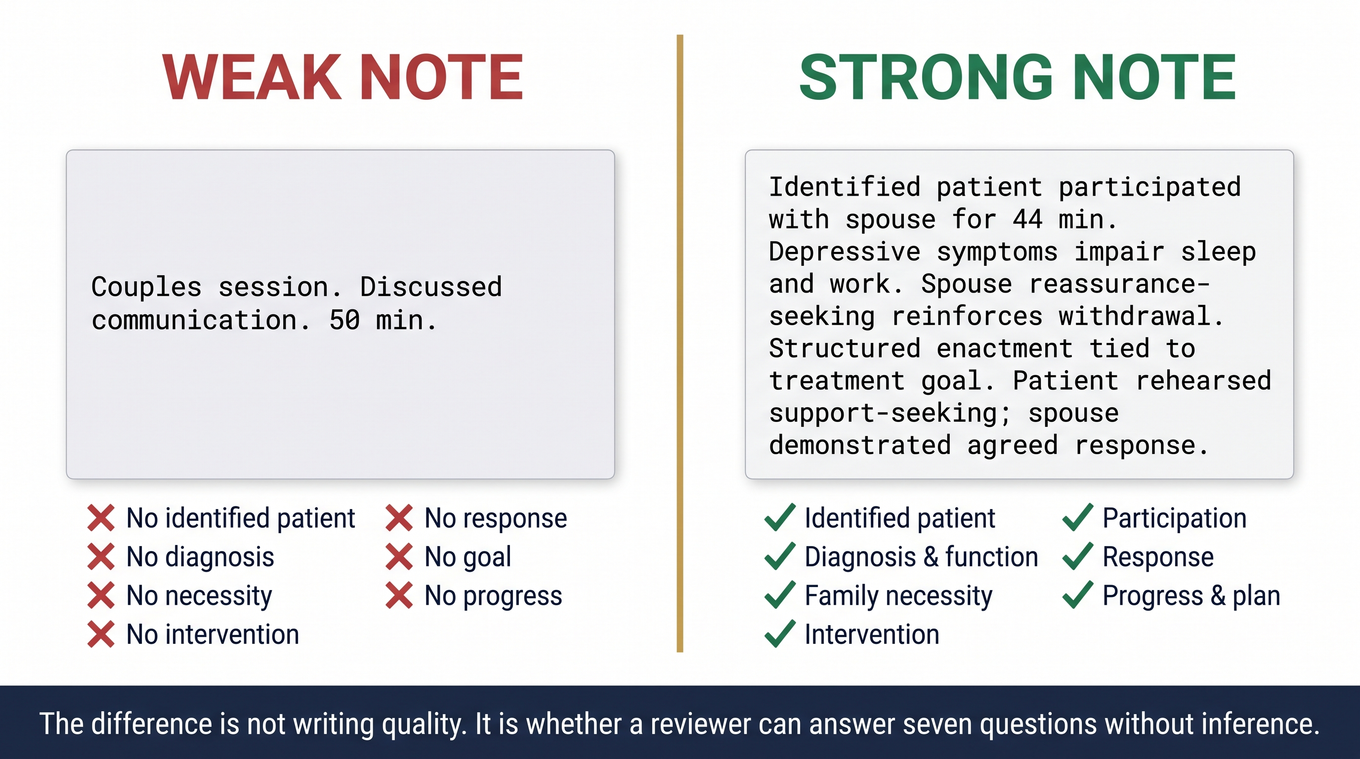
The test is not length and it is not eloquence. It is whether a reviewer can answer seven questions without inference:
- Who is the identified patient?
- Who attended, and for how long?
- Was the patient present or absent?
- What diagnosed symptoms or functional problems were being treated?
- Why was a family-format intervention clinically necessary?
- What did the clinician do, and how did participants respond?
- How did the service advance the treatment plan?
CMS's current articles require the record to identify the patient, the service date and type, the time, the treatment modality and frequency, the clinician's credentials, the interventions, the goals, and the progress - with a clinical note supporting the service. One current article specifically calls for a detailed session summary, participation, outcome, and progression toward treatment goals. Medicare contractor guidance adds that the family interaction must be expected to improve or stabilize the patient's condition, and that total timed minutes support timed codes. (CMS A56937, revision effective 1 April 2026; CMS A59723, effective 1 January 2026; LCD L35101; LCD L33632)
State Medicaid programs can be more explicit still. Minnesota's psychotherapy policy requires medical necessity, an individual treatment plan, start and stop times, the intervention, the response, the progress, and documentation of the member's absence or of excluded participants where applicable. (Minnesota DHS, Psychotherapy, revised 25 April 2025)
The ten elements, and the question each one answers
| Element | What to capture | The question it answers under review |
|---|---|---|
| Patient identity | Full linkage to one patient record - never a "couple" as the claim patient | Whose benefit and diagnosis is this? |
| Date and precise time | Start, stop, total psychotherapy minutes, separate same-day intervals | Did the service meet 26 minutes, and was time reused? |
| Attendance | Names and roles; patient present or absent; join and leave times; remote locations | Does 90846 or 90847 match? |
| Modality and place of service | Office or telehealth; video or audio-only; patient location; consent where required | Is the POS and modifier valid? |
| Patient condition | Current symptoms, severity, function, risk or impairment relevant to treatment | Was this medical psychotherapy or general counseling? |
| Family necessity | The specific mechanism by which family dynamics or support affect this patient's condition | Why did the family format matter? |
| Intervention | The family-therapy techniques actually delivered, tied to the patient's goal | What covered professional service occurred? |
| Participation and response | What the patient and family did; barriers; learning; behavior change | Was this active treatment, not a collateral update? |
| Progress and plan | Progress toward the goal; next step; rationale for continued frequency and duration | Why continue, especially at this frequency? |
| Clinician authentication | Name, credential, signature and date per policy | Was an eligible provider responsible? |
On time specifically, we recommend a standard stricter than the minimum wording in some policies: record start and stop, total psychotherapy minutes, attendance by interval if participants join or leave, modality and patient location for telehealth, and any separately timed individual, E/M, or family service on the same date. Keep scheduling, ordinary administrative work, and undocumented breaks outside psychotherapy time. One standard survives every payer, so nobody has to remember which plan wanted what.
What a supportable note reads like
A 90847 that would survive review:
The identified patient participated with spouse for 44 minutes. Current depressive symptoms continue to impair sleep, work attendance, and completion of the safety plan. Spouse's repeated reassurance-seeking has been reinforcing the patient's withdrawal and interfering with use of the behavioral-activation plan. The clinician used structured enactment and coaching to help both participants practice a symptom-escalation response tied to the patient's treatment goal. Patient identified two early warning signs and rehearsed requesting support without withdrawing; spouse accurately demonstrated the agreed response. Continue family intervention because the interaction pattern remains a barrier to stabilization.
Compare that to "couples therapy, discussed communication, 50 min." The stronger note identifies one patient, that patient's condition and function, the specific mechanism making the family format necessary, the intervention, the participation, the response, and the continued need. Every one of the seven reviewer questions is answered without inference.
A 90846 that would survive review:
The identified child patient did not participate. Both parents attended for 38 minutes. The child's avoidance and school refusal have worsened, and inconsistent parental responses are undermining the exposure plan. The clinician trained both parents in the treatment-plan response sequence, rehearsed limit-setting, and corrected reassurance behaviors that reinforce avoidance. Each parent demonstrated the sequence and agreed to record adherence before the next visit. Family-only work was necessary to implement the child's treatment plan; the session did not address either parent's separate mental-health needs.
That final clause distinguishes family psychotherapy from parent consultation and from treatment of the parents' own conditions, which is the distinction Medicare's national rule turns on.
Seven weak notes and what each one is missing
| What the note says | What is missing | Better direction |
|---|---|---|
| "Couples session. Discussed communication. 50 min." | Identified patient, diagnosis and function, necessity, intervention, response, goal | Tie the conjoint work to one patient's condition and treatment objective |
| "Met with mom." | Patient identity, patient-absent status, nature of the service, time, why the mother's involvement treats the patient | Name the role, attendance, time, and the patient-centered intervention and response |
| "Family conflict made session difficult; bill the interactive complexity add-on." | Any qualifying communication factor, and payer compatibility | The add-on is not a difficulty premium, and current policy lists it as not reportable with the family codes |
| "Patient present." | Degree and timing of participation, and the patient's therapeutic role | Record join and leave times and what the patient actually did |
| "90847, 60 minutes" with no times recorded | Evidence for the 26-minute floor and for non-overlap | Record start and stop, or total time; separate same-day intervals |
| The same copy-forward paragraph, repeated weekly | Individualized progress and continued necessity | State current symptoms, the intervention, the response, and why the family format is still needed |
| A relationship code and nothing else | A supported covered patient condition | Verify the plan's diagnosis policy and report diagnoses that truthfully describe the patient |
Two adjacent situations are documentation problems rather than coding problems.
When one parent attends and another is deliberately excluded, record who attended, who did not, and the clinical reason where the exclusion matters to treatment or safety. Minnesota's policy expressly expects this, and it is good practice everywhere.
When parents of a minor attend without the child, the child remains the identified patient. Under the cited Minnesota policy the parents do not need to be separately covered members, and Medicare's national logic likewise focuses on the beneficiary's condition rather than making every participant a patient. Document why the parent work is expected to improve or stabilize the child. (Minnesota DHS, Psychotherapy; NCD 70.1)
Psychotherapy notes are not the billing record
CMS's current billing article distinguishes protected psychotherapy notes from the ordinary clinical documentation needed to support payment, and says privileged psychotherapy notes should not be submitted merely as routine billing documentation. The progress record still has to support the code, the time, the medical necessity, the treatment, and the progress. (CMS A56937)
Practices tend to fail in one of two opposite directions here: keeping so little in the progress record that no reviewer can validate the claim, or disclosing separate private process notes unnecessarily when a compliant progress record would have answered the payment question on its own. The privacy analysis belongs with your compliance counsel; the billing point is that a strong progress note makes the question moot.
If a 90847 is challenged, be able to assemble all twelve of these:
- The assessment establishing the identified patient and diagnosis
- The active treatment plan naming family-format objectives
- The progress note with exact attendance, time, necessity, intervention, response, and progress
- The eligibility and benefit-verification record
- The authorization, with matching CPT, provider, and date range
- The payer and telehealth policy in effect on the date of service
- The claim and the clearinghouse acceptance report
- The remittance, with its codes and policy reference
- Provider enrollment evidence
- Same-day notes and interval proof, if another psychotherapy service was billed
- The patient financial disclosure, ABN, or Good Faith Estimate where applicable
- The appeal or corrected-claim log, with deadlines
Why 90847 claims deny, and what each denial actually means
First: was it rejected, or was it denied?
A rejection usually means the claim failed front-end or clearinghouse validation and never entered adjudication. A denial means a payer adjudicated the claim and assigned a payment or adjustment result. A claim sitting unnoticed in a rejection queue can quietly become a timely-filing loss while everyone believes it was submitted. That is worth a standing daily check rather than a monthly one.
For an adjudicated claim, read all of it - not just the headline code:
- the claim adjustment group code (CO, PR, OA, or PI), which indicates the responsibility category;
- the CARC, which says why payment differed;
- the RARC, which supplies the detail the CARC omits;
- the 835 policy-identification segment, if present;
- the payer-specific EOB text;
- and the provider portal's claim image and edit trail. (X12 Claim Adjustment Reason Codes)
One warning that costs practices money and goodwill in equal measure: do not automatically transfer a CO contractual adjustment to the patient. X12 defines CO as a contractual obligation and PR as patient responsibility, and plan documents, provider contracts, and advance-notice rules still govern final liability on top of that.
The eighth axis: attendance and time
We have written before about the seven rights of a mental health claim - right patient, right payer, right benefit, right provider, right code, right authorization, right documentation. Family therapy needs an eighth, and it is the one that makes these codes distinctive:
Right attendance and time. It chooses between 90846 and 90847, and it controls the 26-minute floor. Adding it as an explicit axis rather than folding it into "right code" is the difference between a triage process that finds the actual failure and one that keeps landing on "coding issue."
Where the claim actually breaks
| Claim element | What it should represent | The family-therapy failure mode |
|---|---|---|
| Patient / member | The identified patient - not automatically the policy subscriber | The partner with better benefits was chosen; eligibility and patient-identification mismatches follow |
| Diagnosis pointer | The identified patient's supported condition | A relationship-only or wrong-partner diagnosis |
| Procedure | 90846 if the patient was absent; 90847 if present | The attendance in the note contradicts the code billed |
| Units | Ordinarily one | A duplicate or multiple-unit edit on one long encounter |
| Place of service | The patient's actual service location under the payer's rules | Office POS on a telehealth claim, or the wrong home/non-home POS |
| Modifier | The exact product instruction, if any | A universal 95 or GT assumption |
| Rendering provider | The clinician who furnished the service, eligible and enrolled | The group is credentialed but the individual clinician is not loaded |
| Authorization | A number and episode matching patient, provider, code, dates, and visits | A valid number that applies to a different CPT, provider, or date range |
| Payer ID | The entity that actually owns the benefit | The card's medical payer was billed despite a behavioral carve-out |
(Medicare Claims Processing Manual, Ch. 26; X12 CARCs)
Decoding the remittance
The codes below are the ones we see most often on these two codes, with the family-therapy cause they usually indicate. A CARC alone is never a complete diagnosis - always read the RARC and the policy reference alongside it. The full X12 list is the authority.
| Code | What it means | Likely cause on 90846/90847 | First action |
|---|---|---|---|
| 4 | Procedure inconsistent with modifier | A wrong or absent telehealth or product modifier | Compare the exact product policy against the claim image; correct only if the submitted data were wrong |
| 5 | Procedure or type of bill inconsistent with place of service | Office POS on telehealth; POS 02 versus 10 confusion | Confirm the patient's location on the date of service |
| 11 | Diagnosis inconsistent with procedure | A relationship-only diagnosis, or a pointer belonging to the wrong partner | Compare the claim against the assessment and the payer's diagnosis policy |
| 18 | Exact duplicate | An unchanged resubmission, or two lines for one encounter | Find the original; use the void or replacement process; do not send a third |
| 22 / 109 | Another payer may be liable / wrong payer | A behavioral carve-out or EAP owns the benefit | Verify the product and payer ID; re-route and preserve timely-filing evidence |
| 29 | Filing limit expired | A clearinghouse rejection was never worked, or a wrong-payer loop consumed the deadline | Gather the original acceptance and rejection evidence; request an exception if policy allows |
| 31 | Patient cannot be identified as insured | The claim was filed under the wrong partner | Reconcile identified patient and member demographics |
| 50 | Not medically necessary | The note reads as generic couples counseling with no patient-centered necessity | Appeal only if the record already supports necessity - never rewrite a note to create facts |
| 96 / 204 | Non-covered under the current benefit | A marital-counseling exclusion, an exhausted EAP, or a product mismatch | Read the exclusion and group code; determine valid member liability rather than appealing reflexively |
| 97 | Included in another service | The payer bundled the family and individual services | Check separate intervals and the edit policy; appeal with both notes if permitted |
| 119 | Benefit maximum reached | An EAP or annual family-visit allocation is exhausted | Verify the count and reset period; challenge a miscount |
| 150 | Information does not support the level of service | Documentation does not establish the family service or the patient's participation | Compare attendance to clinical content; appeal only with contemporaneous support |
| 151 | Frequency not supported | A plan or program family-session threshold was exceeded | Verify the limit; submit necessity records or request more visits prospectively |
| 152 | Length not supported | Time missing, or a note under 26 minutes | Correct only if the claim data were wrong; appeal with contemporaneous start/stop time if it exists |
| 197 / 198 / 210 | Authorization absent / exceeded / not timely | No authorization attached, visits exhausted, or obtained after the deadline | Audit the authorization ledger; seek retrospective exception where available |
| 231 / 236 | Mutually exclusive or incompatible under NCCI or payer logic | A same-day family plus diagnostic or crisis code; one blended service split in two | Review the edit table; remove the inaccurate line, or appeal with separate-service evidence |
| 284 | Authorization valid but not for the billed service | The authorization is for 90847 and 90846 was billed, or the date or episode differs | Compare every authorization axis; ask the payer to correct the authorization or the claim |
| 296 | Authorization valid but not for this provider | A group or provider mismatch; a covering clinician was not named | Prove the provider linkage or obtain a corrected authorization - never swap NPIs inaccurately |
Corrected claim, appeal, or neither
Three situations, three responses, three deadlines.
Use a corrected claim when your submitted data were wrong and the payer has a correction mechanism - 90846 was submitted although the patient participated, the place of service was wrong, a required modifier or authorization number was omitted.
Use a reconsideration or appeal when the submitted claim was accurate and the payer's decision was wrong - the payer says the service lacked medical necessity even though the note and the policy support it, or it bundled two genuinely separate timed services despite a policy permitting them.
Do neither when the service was genuinely non-covered. Then the question is member liability and advance notice, not appeal.
Whatever you do, do not repeatedly resubmit an unchanged claim. It creates duplicate denials while the actual appeal deadline expires.
On deadlines: for Original Medicare fee-for-service, a first-level redetermination generally must be requested within 120 days of receiving the initial determination, and CMS says minor clerical errors should be handled through reopening and correction rather than appeal. Commercial and Medicaid deadlines vary and can be considerably shorter. (CMS, First Level of Appeal: Redetermination)
Calendar all of these separately, because they are not one deadline: the corrected-claim deadline; the first reconsideration deadline; the formal appeal deadline; the medical-record submission deadline; any authorization-extension or retro-authorization deadline; and timely filing to the correct carve-out after a wrong-payer denial.
A medical-necessity appeal should never be a generic "please reprocess." It should identify the plan and policy section; the identified patient and the covered diagnosis; the functional impairment and current symptoms; why family participation was expected to improve or stabilize the patient; the patient's presence or absence and the exact time; the intervention and the response; the treatment-plan goal and the progress; the authorization and provider eligibility; and the same-day separation if relevant.
And the hard limit on all of it: the appeal must use facts already supported by the contemporaneous record. It cannot add a diagnosis, a time, an attendance fact, or a clinical rationale that did not exist when the note was signed.
Before you bill the client for any of it, check the remittance group code, the contract language, whether the eligibility or authorization failure was the practice's own, whether required advance notice was given, whether a correction or appeal remains available, state law and plan rules, and ABN validity for Original Medicare where applicable.
Every denial should end in a workflow change
A denial you fix is worth the value of one claim. A denial whose upstream cause you fix is worth every future claim that would have failed the same way.
| The denial pattern | The upstream control that prevents it |
|---|---|
| 90846 and 90847 swapped | An attendance question in the scheduler, a note template that forces it, and a claim scrub that compares them |
| Wrong behavioral payer | A product and carve-out field in the record - not just a scan of the insurance card |
| Authorization mismatch | An authorization ledger keyed by patient, CPT, provider, dates, and visits |
| Under-26-minute denials | A hard stop when documented time is under 26 minutes or absent |
| Medical necessity | Note prompts for patient condition, the family mechanism, the intervention, and the response |
| Same-day bundling | A non-overlap timer and a separate-service review before claim release |
| Telehealth POS or modifier | A payer-by-product telehealth matrix with effective dates |
| Provider ineligible | A credentialing effective-date block at both scheduling and claim generation |
| Benefit maximum | A visit counter, plus a client warning before the final authorized or EAP visit |
Most of these denials are not really coding errors. They are the claim arriving at the wrong product - which is a problem you can only solve before the session, not after.
Why there is no universal "90847 coverage policy"
Stop treating the insurer as the unit of analysis. The product is the unit of analysis.
The same corporate insurer can simultaneously administer a medical behavioral-health benefit, a carved-out managed behavioral-health benefit, a self-funded employer plan with its own exclusions, an EAP or emotional-wellbeing product with limited sessions and its own codes, and Medicaid or Medicare Advantage lines under separate rules. "Is 90847 covered by [insurer]?" is not an answerable question. It is five questions wearing one logo.
The examples below are not a market average. They demonstrate materially different benefit architectures, and each is labeled by product and date.
Original Medicare - a national purpose test with local implementation. Family counseling is covered when its primary purpose is treatment of the beneficiary's condition, and not when the service treats relatives' separate problems. Current CMS billing articles add the present/absent distinction, the 26-minute floor, and the diagnosis and documentation requirements. Contractor LCDs elaborate medical necessity and publish jurisdiction-specific rules. One is explicit that maladaptive family behavior must be exacerbating the patient's illness or interfering with treatment, and defines family broadly enough to include a significant other or live-in companion.
No single national Medicare frequency limit for ordinary family sessions was identified in the cited sources. That is not the same as proof that no utilization review, medically unlikely edit, local policy, or necessity review can apply - it means the cited national documents are silent, and silence is not permission. Medicare Advantage is a separate product environment again, with its own authorization and network rules. (NCD 70.1; CMS A56937; LCD L33632; MAC article A57130)
A transparent commercial policy. BCBSIL's professional psychotherapy policy, effective 22 December 2025, is a detailed published commercial coding policy, not a nationwide Blue Cross rule. It recognizes the 26-minute minimum, permits same-day individual and family psychotherapy when separate and distinct, and requires modifiers to be supported by documentation. Even a policy this detailed opens by warning that the member's benefit document and the provider contract govern where they conflict with it. (BCBSIL CPCP051)
A plan with an express exclusion. TRICARE's Mental Health Care Services Excluded page, updated 5 August 2026, lists marital therapy among excluded counseling services, alongside services that are not medically or psychologically necessary. Do not extrapolate from that page to every family intervention in every TRICARE context without checking the complete covered-services policy. The narrower point is that a major plan can expressly exclude marital therapy even though CPT family-psychotherapy codes exist. (TRICARE)
An EAP that does not use these codes at all. Evernorth's EAP provider page describes EAP as a separate employer-purchased benefit with a predetermined number of visits that can vary by employer, issue, person, or plan year. Relationship and marital concerns are eligible EAP issues, but the provider has to verify authorization and eligibility, and the cited instructions direct providers to bill 99404 for EAP services rather than the family codes. The practical risk: billing a clinically identical session to the medical behavioral benefit under 90847 when the authorization actually belongs to the EAP, or the reverse. (Evernorth EAP, updated 16 April 2025)
An employer wellbeing product that uses them with a program modifier. Optum's Emotional Wellbeing Solutions is an employer-funded, short-term benefit with limited authorized sessions and no member cost for covered visits - and not every Optum member has it. For family sessions in that program the instructions use 90846-HJ and 90847-HJ, adding GT for virtual care, and call for a confirmed ICD diagnosis. Optum also warns that transitioning from the wellbeing product to the standard behavioral-health benefit may create member cost. (Optum Emotional Wellbeing Solutions)
The same insurer can use different codes, different modifiers, different visit limits, and different cost-sharing rules for care that looks identical in the therapy room.
A state Medicaid program, and a program-specific threshold. Minnesota's psychotherapy policy recognizes the family codes at the 50-minute level with a 26-minute minimum, permits clinically necessary family members to participate even when they are not themselves covered members, and requires the documentation set described earlier. Separately, Minnesota's Children's Therapeutic Services and Supports instructions, a specific under-21 program, use program modifiers and require authorization to exceed 26 cumulative family-psychotherapy sessions per calendar year. That threshold is program-specific. It is not a general commercial or national Medicare limit, and it turns up misquoted as one. (Minnesota DHS, Psychotherapy; Minnesota DHS, CTSS)
| Product or policy | Couples and relationship reality | Code instruction highlighted | Visits and authorization | Virtual detail | The caveat |
|---|---|---|---|---|---|
| Original Medicare | Must primarily treat the beneficiary's condition, not relatives' separate problems | 90846 absent, 90847 present; 26+ minutes | No national ordinary-session cap identified in the cited sources; necessity and local rules apply | Both on the permanent telehealth list; POS 02 and 10 | Contractor and Advantage rules differ |
| BCBSIL CPCP051 | The benefit document still governs | 26+ minutes; same-day individual and family only when separate and distinct | Product-specific | Product-specific | An Illinois policy, not all Blue plans |
| TRICARE exclusions page | Marital therapy expressly excluded | Not a coding permission page | Product rules | Limited exceptions noted | Do not overgeneralize to every family intervention |
| Evernorth EAP | Relationship and marital concerns can be eligible EAP issues | 99404 in the cited EAP workflow | Predetermined, authorization-dependent | Product instructions | EAP is separate from the medical behavioral benefit |
| Optum Emotional Wellbeing | Brief employer-funded intervention | 90846-HJ / 90847-HJ | Limited authorized sessions | GT in the cited product | Not all Optum members have it |
| Minnesota MHCP | Family participation tied to the member's treatment | 90846 / 90847, 50-minute level, 26-minute floor | Program-specific | Check the program's telehealth policy | State program only |
| Minnesota CTSS | Under-21 rehabilitative framework | Family codes with a program modifier | Authorization above 26 cumulative family sessions per year | Program-specific | Never present as a universal 26-visit rule |
Verification that produces a usable answer
"Is family therapy covered?" is not a question that produces a usable answer. These are. Record the representative or portal, the date, the reference number, and the exact wording for every one:
- What is the exact plan or product name, the funding type if disclosed, and the payer ID for outpatient behavioral health?
- Are behavioral-health benefits carved out, and to whom?
- Is the proposed service under the medical benefit, an EAP, an employer wellbeing benefit, or another program?
- Are 90846 and 90847 covered for this member, this provider type, and this diagnosis?
- Does the plan exclude marital or relationship counseling even where family psychotherapy is otherwise covered?
- Is prior authorization, notification, a referral, or a treatment plan required - and must the authorization name each CPT, rendering provider, location, modality, and date range?
- What is the visit limit, and is it per calendar year, plan year, episode, issue, family, or patient? Are the family codes pooled with individual psychotherapy?
- Can individual and family psychotherapy be paid on the same date if separately timed, and which modifier, if any, is required?
- Are the family codes payable by telehealth? By video? Audio-only? What POS and modifier does this product require?
- Is the rendering clinician individually credentialed and enrolled for this code and modality?
- What are the corrected-claim, reconsideration, and appeal deadlines?
- If the service is non-covered, may a contracted provider bill the member, and what advance notice is required?
Verification is evidence, not a guarantee. A valid authorization can still fail because the claim used a different provider, code, date, place of service, or product; because coverage terminated; because the claim routed to the wrong entity; or because the documentation did not establish medical necessity. X12 maintains distinct reason codes for authorization that is absent, exceeded, late, mismatched to the service, and mismatched to the provider, which tells you how routinely each of those happens. (X12 CARCs)
If a representative says "yes, family therapy is covered," that answer is unusable until it is tied to the product, payer ID, code, diagnosis, provider, authorization, frequency, telehealth rule, same-day rule, and member liability. Get the reference number.
The family therapy billing checklist
At scheduling
- Who is the clinically identified patient? If the answer is no one, or the relationship is the only focus, do not assume medical-plan family billing - evaluate self-pay or an EAP.
- What covered condition and patient-centered goal make family intervention necessary? If nobody can articulate it, that is a coverage risk; get clinical review before billing.
- Will the identified patient participate? No leans 90846; yes leans 90847.
- Will direct family psychotherapy reach at least 26 minutes? If not, do not bill either family code under the cited Medicare rule.
- Is another psychotherapy, evaluation, or crisis service happening that day? If so, check the NCCI and payer edits and require separate, non-overlapping intervals.
- Is the benefit medical behavioral, a carve-out, an EAP, or employer wellbeing? If unknown, verify before the service.
- Are the provider, authorization, visit count, modality, POS, and modifier all valid? Any unknown or mismatch - resolve it prospectively rather than holding a claim later.
Before the 90847 claim goes out
- [ ] One identified patient is named consistently across assessment, plan, note, and claim
- [ ] The patient actually participated
- [ ] Total family psychotherapy time is at least 26 minutes
- [ ] The note records all attendees and any attendance changes
- [ ] The patient's condition and functional impact are current and specific
- [ ] The necessity of the family format is explicit
- [ ] Intervention, response, progress, and plan are documented
- [ ] The diagnosis belongs to the patient and meets the exact payer policy
- [ ] The rendering provider is eligible and enrolled on the date of service
- [ ] The correct behavioral payer, product, and payer ID are selected
- [ ] The authorization matches patient, code, provider, dates, and remaining visits
- [ ] POS and any telehealth modifier match the patient's location and the product
- [ ] Any same-day psychotherapy is separately timed and payer-permitted
- [ ] Units are not duplicated for one long encounter
- [ ] The patient cost disclosure is current
For 90846, use the same list with three substitutions: the patient did not participate; the family-only intervention was psychotherapy for the patient's condition; and the note does not read like a staff consultation, case coordination, or treatment of relatives' separate problems.
When a claim denies
Work the eight axes in order, with evidence for each: right patient · right payer and product · right benefit · right provider · right code and attendance · right time, POS, and modifier · right authorization · right documentation and necessity. Then record whether the claim data were wrong (corrected claim, with its deadline), the payer's decision was wrong (appeal level and deadline), or the service was genuinely non-covered (liability and notice review) - and name the person who owns the upstream fix, with a due date.
90846 and 90847: frequently asked questions
What is the difference between 90846 and 90847?
The identified patient's participation. 90846 is family psychotherapy in which the identified patient does not participate; 90847 is family psychotherapy in which they do. Everything else about the two codes - the time structure, the requirement that the work treat one patient's condition - is the same.
Is the minimum 26 minutes or 50 minutes?
Twenty-six. Current CMS guidance says not to report either family code for a service under 26 minutes, and describes the codes at a 50-minute reference duration. A 35-minute family session is billable.
Is 50 minutes the maximum?
No. No universal maximum was identified in the current sources, and a longer session does not automatically create a second unit or a prolonged-service add-on. Bill one unit of the code that accurately represents the service.
Does the patient have to be physically in the room for 90847?
No - they have to participate. Medicare permits both family codes by telehealth, and place-of-service rules classify the patient's location rather than asking whether the patient and clinician shared a room.
What if the patient joins late or leaves early?
Document join and leave times and the clinical structure of the session. If the patient genuinely participated in one continuous family psychotherapy encounter, 90847 may still best describe it - do not split one continuous encounter because attendance changed. Be aware that no primary nationwide source sets a minimum number of patient-present minutes inside a 90847. Any page giving you a specific percentage or a "majority of the session" rule has invented it.
Can couples therapy be billed to insurance?
Sometimes - when it is medically necessary treatment for one identified patient's diagnosed condition and that patient's plan covers it. It cannot be billed simply because two partners attended, and some plans expressly exclude marital or relationship counseling. The question is never "is couples therapy covered"; it is "is this family intervention treating this patient's covered condition, under this product."
Can I bill both partners for the same session?
No. One conjoint encounter is one service, filed under one identified patient. Two people attending does not create two claims, and two active insurance policies does not create two patients.
Who should be the identified patient?
The person whose diagnosed condition you are treating and documenting - established clinically, before the claim is built. Not the subscriber, not whoever has the better network, and not whoever has met their deductible. If your assessment diagnoses one partner and your claim names the other, you have a contradiction inside your own record that a reviewer will find.
Can I use a relationship problem Z code?
It can be useful clinical context, but a relationship code alone often will not establish a covered condition or medical necessity for a medical benefit. We are not going to tell you it is always denied - diagnosis lists vary by payer and by Medicare contractor. Check the policy that applies, and never invent a diagnosis to make a service reimbursable.
Can I bill an individual session and 90847 on the same day?
Only as separate, distinct services furnished in separate, non-overlapping time intervals, and only if the payer's edits permit it. Each service has to independently clear its own time floor and have its own clinical purpose. One blended hour cannot be divided into two codes after the fact.
Do I need modifier 59, 95, or GT?
Only where that specific payer's current policy for that specific product instructs it. There is no universal telehealth or distinct-service modifier for these codes - one employer product uses HJ plus GT, one EAP uses a different code entirely, and Medicare works from place of service. And no modifier can turn one continuous service into two.
A family member joined the session - does that mean interactive complexity?
No. Third-party attendance does not establish interactive complexity, and an emotionally difficult session does not either. At least one current commercial policy lists the interactive-complexity add-on as not reportable with the family codes at all. The add-on is not a difficulty premium.
What about an interpreter?
The interactive-complexity add-on is not intended merely to report translation or interpretation, and current policy lists it as not reportable with the family codes. Follow language-access law and your payer's rules - but do not use that add-on as an interpreter fee.
Does Medicare cover 90847 by telehealth?
Yes. Both family codes are currently on Medicare's permanent telehealth list for behavioral health, with the 26-minute minimum intact. Use POS 10 when the patient is at home and POS 02 when they are elsewhere, and note that the geographic and in-person rules change from 1 January 2028 - recheck them before relying on today's answer.
The video failed and we finished by phone. What now?
Document the modality change and the times. Whether it is payable depends on whether that exact product covers audio-only for these codes and what modifier and documentation it requires. Medicare's current audio-only pathway for behavioral health at home runs through 31 December 2027 and changes after that; commercial and Medicaid products vary.
Two therapists co-treated a couple. Can we both bill?
A second clinician's presence does not automatically create a second payable claim. Determine whether each practitioner furnished a separately payable service, whether the plan recognizes co-therapy at all, and whether same-group same-patient edits apply. No universal payment permission for co-therapy was found in current sources - this one needs payer guidance, not a rule of thumb.
The family wants a superbill for out-of-network reimbursement. Does that change anything?
No. A superbill does not change the clinical truth of the service. Identify one patient, use the code matching actual attendance, report truthful diagnosis information, and be clear that verifying reimbursement is the patient's responsibility. Do not issue two superbills for one encounter under two partners.
Why did my 90847 deny as non-covered, bundled, or unauthorized?
Read the group code, CARC, and RARC together rather than the CARC alone. Non-covered usually points to a product exclusion or an exhausted benefit; bundled points to a same-day edit or overlapping time; unauthorized points to an authorization that does not match the patient, code, provider, dates, or visit count. Then decide whether your claim data were wrong (correct it) or the payer's decision was wrong (appeal it).
When to outsource family therapy billing - and when not to
Revenue is lost when eight records disagree. The schedule's attendance. The clinical note. The identified patient. The benefit product. The authorization. The provider's enrollment. The telehealth setup. The claim. Any two of those drifting apart produces a denial, and the denial arrives months after the drift.
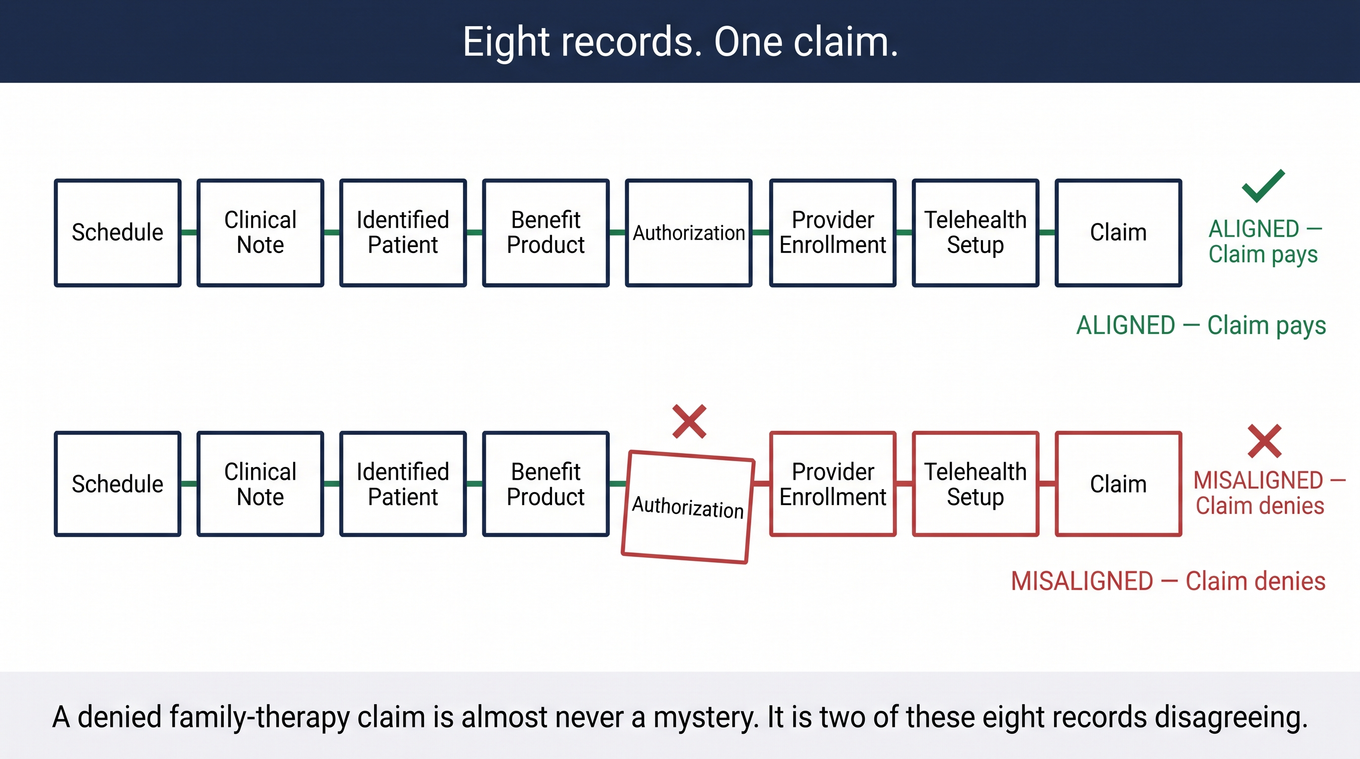
Keeping them aligned is what a specialist billing team can own: building and maintaining payer-by-product matrices; verifying medical versus EAP and wellbeing benefits and behavioral carve-outs; tracking authorizations by CPT, provider, date, and visit count; scrubbing attendance, time, POS, modifier, and same-day combinations before submission; catching credentialing and enrollment failures; reading CARCs, RARCs, and policy references properly; separating corrected claims from appeals; calendaring timely-filing and appeal deadlines; reporting recurring root causes back to schedulers and clinicians; and giving documentation feedback about missing billing support without inventing clinical facts.
It is equally important to say what a billing team cannot ethically do. A billing team cannot diagnose a patient. It cannot create medical necessity after the fact. It cannot decide who the clinical identified patient is for reimbursement convenience. And it cannot guarantee that a payer will cover relationship counseling. Anyone offering you those things is offering you a liability, not a service.
Handling this in-house is entirely reasonable when a practice has:
- a small, stable payer panel and few benefit products
- low family and couples volume
- staff trained to verify the actual behavioral product rather than the card
- a note template that forces attendance, time, necessity, intervention, and response
- a current telehealth and same-day matrix
- reliable credentialing and authorization controls
- daily rejection and denial work, with deadline tracking
- leadership willing to keep non-covered relationship counseling on a self-pay footing rather than forcing a medical claim
A competent small practice does not need to outsource anything merely because it bills 90847.
That picture usually changes for one of four reasons: the practice is growing, with new clinicians, new locations, or a new state; the payer or service mix has got more complex; nobody has the time the billing side needs; or collections have slipped and nobody can say why. None of those is about size. We work with practices of every size, from a single clinician to a multi-state group, and we take on a single piece of the cycle as readily as the whole of it.
Outside support becomes the rational choice when the complexity outgrows those controls:
- multi-state telehealth
- multiple self-funded employer products, EAPs, and behavioral carve-outs
- high family-code volume
- repeated wrong-payer, authorization, same-day, POS, or medical-necessity denials
- staff turnover, or no dedicated denial owner
- aging claims approaching timely filing
- inconsistent identified-patient and consent workflows
- a need to audit old claims before a payer does it for you
Family therapy billing is manageable when a practice has one clinical truth and carries it cleanly from intake through payment. The person the clinician assessed is the person on the claim, the minutes in the note are the minutes that were billed, and the product that authorized the service is the product that receives it. The hard part is not any single rule on this page. It is keeping every payer, product, authorization, note, and claim aligned while the rules underneath them keep moving.
Take your last twenty family-code claims and run them against the eight axes above - patient, payer and product, benefit, provider, code and attendance, time and POS and modifier, authorization, documentation. The pattern in your denials is usually already visible in the claims that paid. Finding it yourself is cheaper than having a payer find it for you, and if the pattern turns out to be bigger than your current controls, we are happy to look at it with you.
Presence chooses the code. The identified patient chooses the claim. Medical necessity and the plan choose payment.