Behavioral Health Revenue Cycle Management: Where the Money Leaks and How to Stop It
September 28, 2026 · 16 min read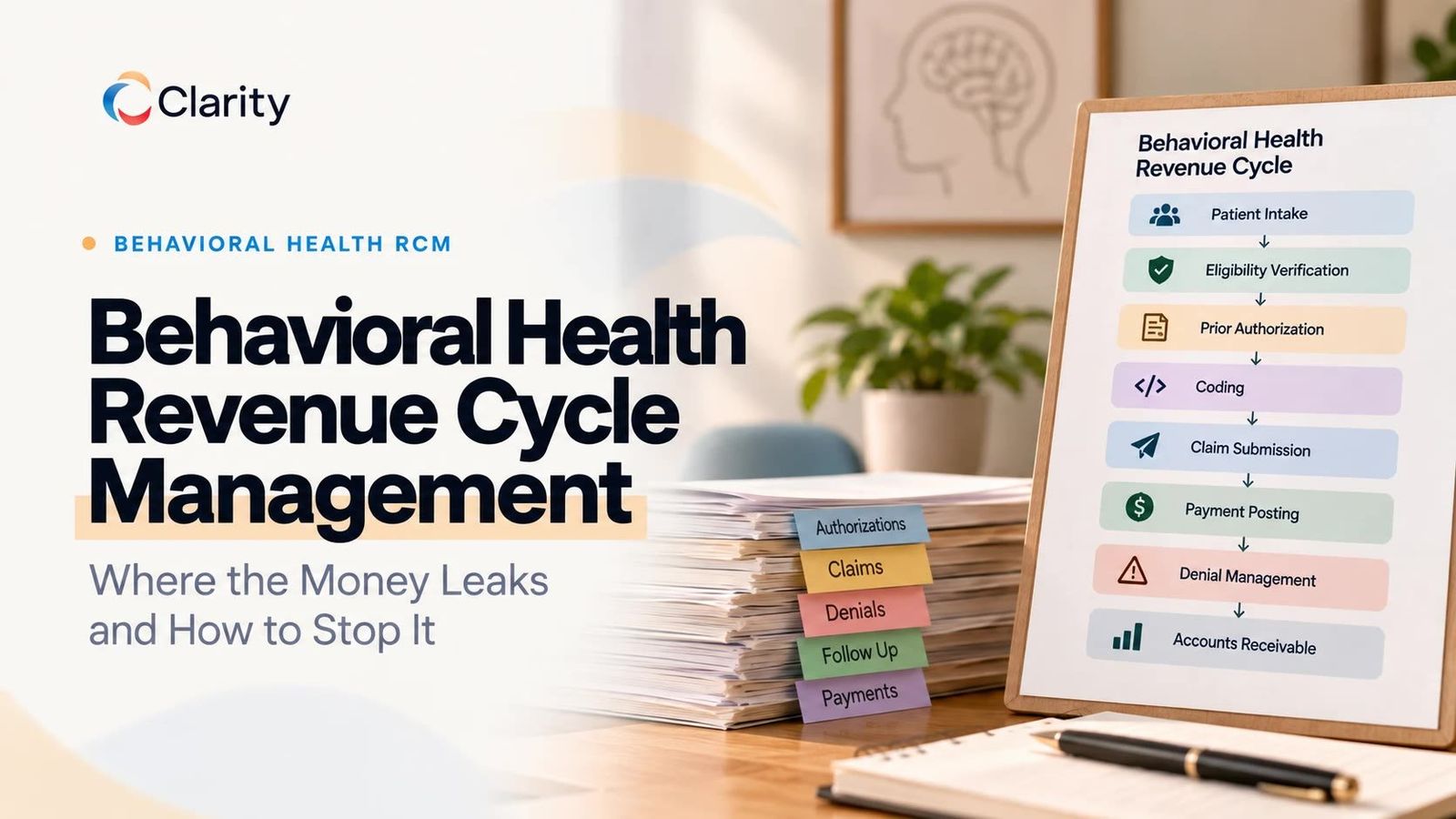
Behavioral health revenue cycle management (RCM) is the end-to-end process of converting clinical services into collected revenue: from patient intake through credentialing, authorization, coding, claim submission, denial management, and final payment reconciliation. What makes it structurally different from general medical RCM isn't complexity in the abstract; it's the specific ways behavioral health breaks at stages that general medicine handles cleanly.
That's the short answer. Here's the one worth reading.
A behavioral health group in the mid-Atlantic had been operating a PHP and IOP program for two years. Collections were solid. Their billing team filed claims promptly, denied claims were worked, and the practice owner considered the revenue cycle a non-issue.
Then a commercial payer conducted a post-payment audit.
Over three months, the payer reviewed a random sample of clinical records for 90 submitted claims. Their finding: the documentation didn't adequately support the medical necessity of continued PHP level of care for 34 of those claims. The practice had filed clean claims on all 34; the billing itself was technically correct. What failed was the upstream process. Utilization review notes weren't being written to the payer's specific criteria. Treatment plan updates didn't use the language the payer's clinical reviewers needed to see. The concurrent review requests were going in on time, but the clinical documentation supporting them was insufficient by the payer's standard.
The payer recouped $214,000.
The practice had a billing problem and a documentation problem, and they'd only been thinking about one of them.
Behavioral health revenue cycle management doesn't start at claim submission. It starts at intake, and everything upstream of the claim submission either protects or destroys the revenue the billing team tries to collect.
What Is Behavioral Health Revenue Cycle Management?
Behavioral health RCM is the integrated process that connects clinical care to payment across every stage of the patient encounter, from the moment a patient calls to schedule through the final resolution of their balance.
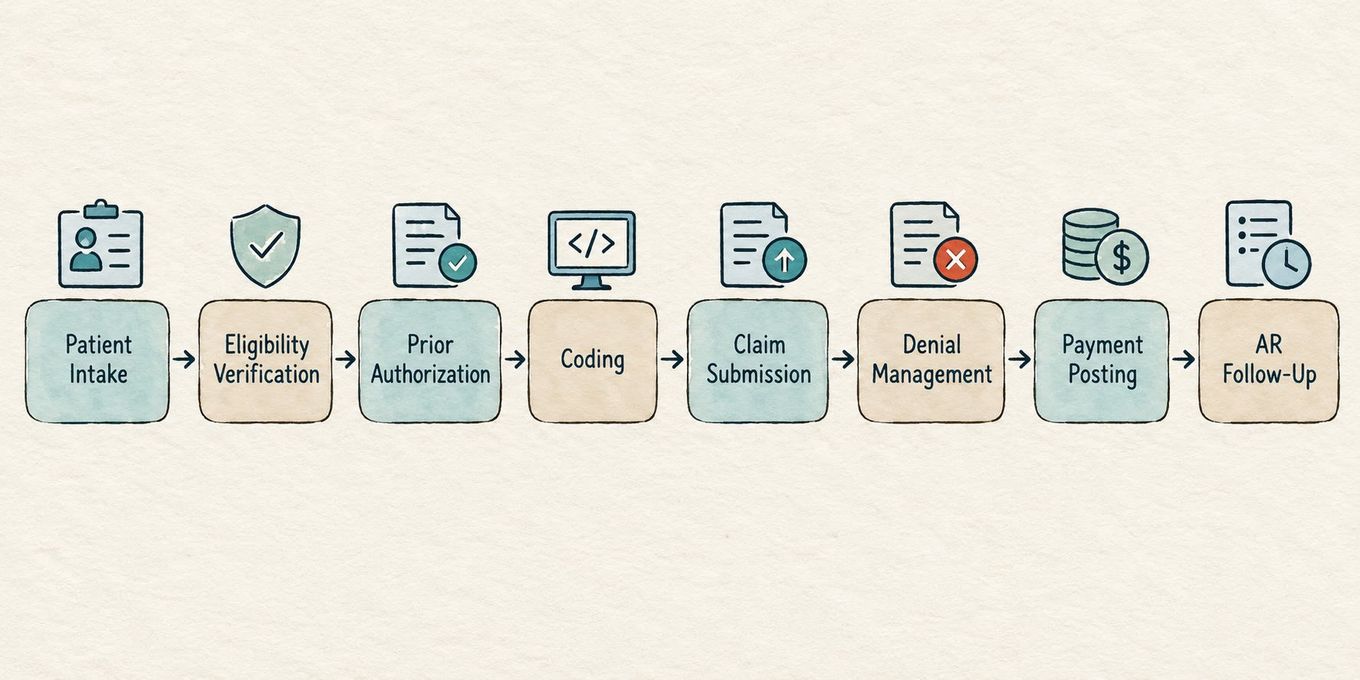
The stages look similar to general medical RCM on paper: scheduling and intake, eligibility verification, authorization, charge capture, coding, claim submission, payment posting, denial management, and accounts receivable follow-up. What differs is what happens inside each stage when applied to behavioral health services.
A useful baseline comparison:
| RCM Stage | General Medicine | Behavioral Health |
|---|---|---|
| Eligibility verification | Confirm coverage and copay | Confirm coverage, copay, and identify carve-out payer (MBHO vs. medical plan) |
| Prior authorization | Often not required for routine visits | Required for most levels of care; renews repeatedly during treatment |
| Coding | Procedure + diagnosis codes | Time-based coding (therapy); E&M + modifier combinations (psychiatry); level-of-care codes (IOP, PHP, residential) |
| Documentation standard | Supports the procedure performed | Must affirmatively establish medical necessity, treatment plan compliance, and continued level-of-care justification |
| Denial reasons | Clinical, demographic, coverage | All of the above, plus medical necessity, parity violations, carve-out routing errors, auth not obtained |
| Payer routing | One plan | Medical plan or MBHO, depending on the service type and payer |
| Post-payment audit risk | Relatively low for routine care | Elevated, especially for IOP, PHP, and residential |
That last row is the one most practices underestimate. Behavioral health claims survive initial adjudication more often than they survive audits. The documentation standard for retrospective review is higher than what gets a claim paid initially.
Why Behavioral Health RCM Breaks Differently
Every healthcare revenue cycle has failure points. Behavioral health has its own distinct set, and they tend to recur across practice types because they're structural, not accidental.
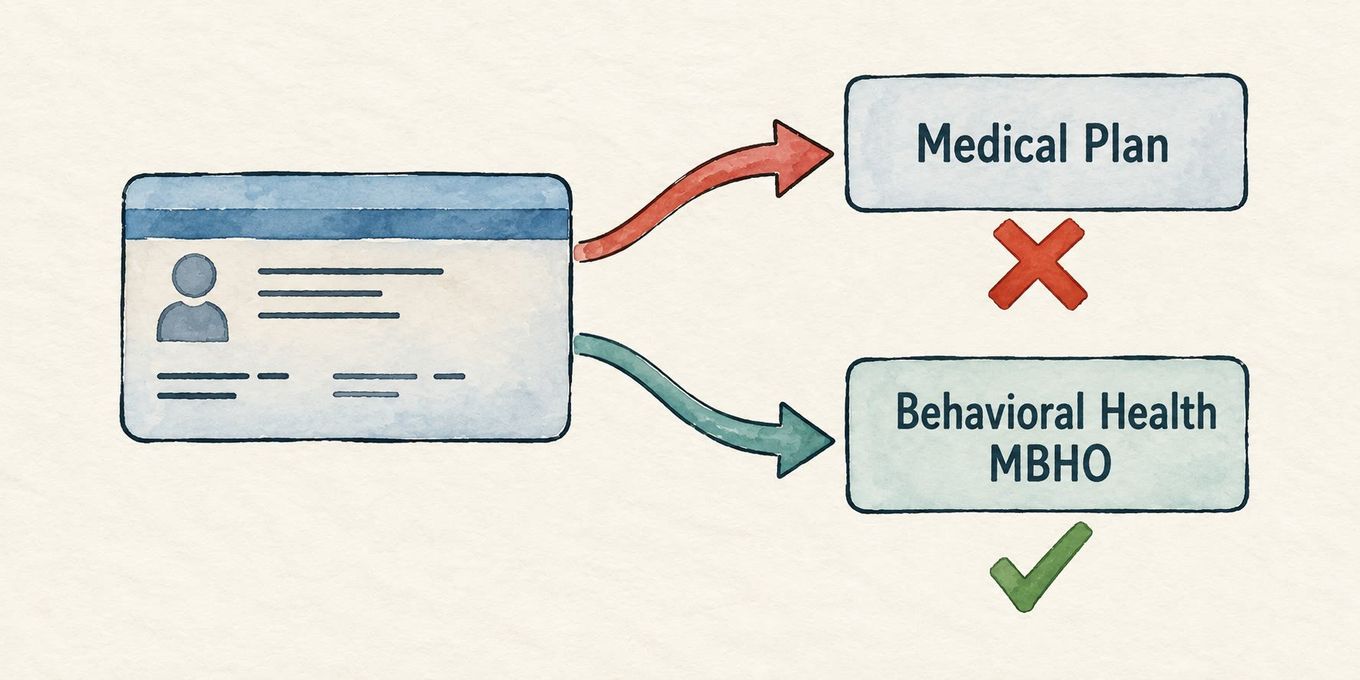
Managed behavioral health organizations (MBHOs). Many commercial health plans carve out behavioral health benefits entirely and administer them through a separate entity: Optum Behavioral Health, Evernorth (Cigna's behavioral carve-out), Carelon Behavioral Health (formerly Beacon Health Options, now part of Elevance Health), or similar organizations. Claims filed to the medical plan rather than the MBHO are denied as non-covered. The coverage structure varies not just by insurer but by employer group and specific plan tier, so eligibility verification needs to surface the carve-out status on every patient, every visit. Our detailed guide to behavioral health carve-outs explains how this routing works by payer.
Time-based CPT codes. Therapy codes (90837, 90834, 90832, 90847) bill by session duration, and the documentation has to substantiate the time logged. A 53-minute session billed as 90837 (the 53+ minute code) that's documented with a note saying "therapy session provided" is a compliance problem. Time documentation errors also create retroactive audit exposure.
Prior authorization at every level of care. Outpatient therapy often requires auth after a session threshold. IOP, PHP, and residential treatment require upfront auth, ongoing concurrent review, and active management of the renewal process throughout treatment. Authorization lapses are among the most expensive failure modes in behavioral health RCM because the claims are often already submitted by the time the lapse is discovered.
Medical necessity as an ongoing requirement. In general medicine, a procedure either was performed or wasn't. In behavioral health, payers require ongoing clinical justification that the level of care is still necessary, documented in a way that aligns with their specific criteria (ASAM for substance use disorder, LOCUS for mental health). Treatment plan updates that don't use the right language give post-payment auditors the opening they need.
The parity law compliance layer. The Mental Health Parity and Addiction Equity Act (MHPAEA) requires that payers apply the same coverage standards to behavioral health that they apply to medical benefits. In practice, many payers don't, and appeal rights exist when this happens. Identifying and appealing parity violations is a distinct skill set that most general billing teams don't have.
The Eight Stages: Where Behavioral Health Practices Lose Revenue
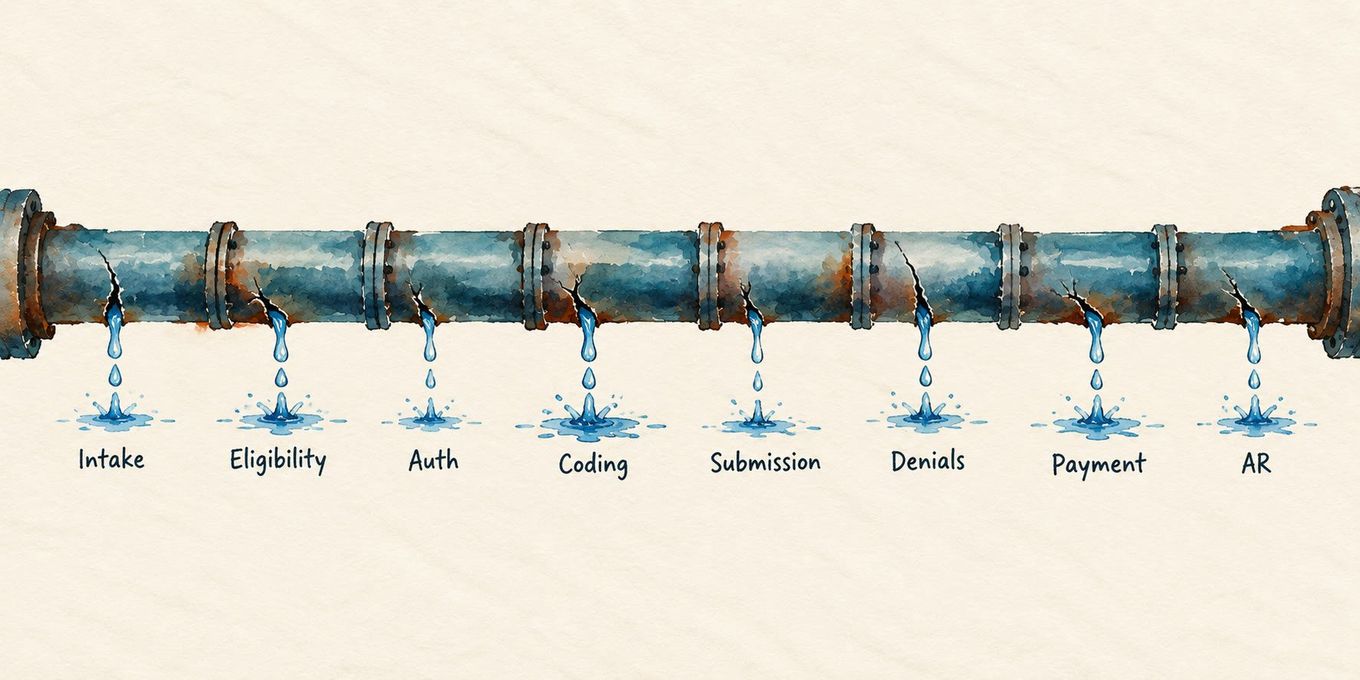
Working through the revenue cycle stage by stage reveals where the losses actually accumulate. Most practices that think they have a billing problem have several of these in play at once.
1. Patient Access and Intake
Revenue loss at this stage is invisible until it shows up in denial volume weeks later. Intake staff who don't verify behavioral health benefits correctly, especially carve-out identification and authorization requirements, create a billing problem before a single claim is filed.
What proper intake looks like: confirming the active insurance plan, identifying whether mental health benefits are carved out (and to which MBHO), verifying the patient's mental health benefit tier, confirming session limits, copay and deductible status, and identifying which services require prior authorization. For practices running IOP or PHP programs, this intake check also needs to establish whether the patient's commercial plan covers that level of care at all, since benefit exclusions are common.
2. Credentialing and Provider Enrollment
A provider can't bill a payer they're not credentialed with. More precisely: claims can be submitted and sometimes initially adjudicated, but payment can be clawed back if it's later established that the provider wasn't properly enrolled as of the service date. Behavioral health practices that are growing, adding providers, or onboarding group practice associates run this risk constantly.
The specific failure mode: a credentialed provider leaves, a new provider joins, claims are submitted under the new provider before enrollment is confirmed, and the payer pays initially and then recoups after audit. Or: a provider is credentialed but their effective date in the billing system is wrong, so claims go out before the payer-assigned start date.
For therapists, psychologists, and psychiatric NPs, the credentialing timeline varies by payer but typically runs 90 to 180 days from application to active enrollment. Managing that timeline across multiple payers is a full-time operational function for growing practices. Our guide to credentialing for therapists covers the enrollment process in detail.
3. Prior Authorization and Concurrent Review
Authorization management in behavioral health is an ongoing workflow, not a one-time task. For outpatient therapy, some payers don't require upfront auth but will deny after a session threshold if ongoing medical necessity hasn't been established. For IOP and PHP programs, the authorization cycle runs continuously throughout treatment.
Common failure modes:
- Auth obtained for initial admission, renewal not tracked, claims denied when original auth expires
- Auth obtained for one level of care, patient's level changes, new auth not requested for the transition
- Concurrent review submitted on time but clinical documentation doesn't meet the payer's criteria, resulting in a partial or full denial at the next review point
- Auth number not attached to the claim (technically a billing error, but the authorization workflow has to communicate to the billing team)
For IOP and PHP billing specifically, where the entire revenue cycle depends on authorization being maintained, this is typically the highest-value function to get right. Our IOP billing guide at IOP and PHP billing covers the authorization requirements by program type.
4. Coding and Charge Capture
Behavioral health coding errors cluster in predictable ways:
- Time mismatch: Billing 90837 when documented session time supports 90834, or vice versa
- Modifier -25 on same-day E&M and psychotherapy: When a psychiatrist provides medication management and psychotherapy on the same visit, both a psychiatric E&M code and a psychotherapy add-on code (90833, 90836, 90838) can be billed, but only with modifier -25 on the E&M to indicate a separate and distinct service. Missing this modifier means one service is denied as a duplicate.
- Unlisted procedure codes: Practices billing for services without a specific CPT code (certain group formats, peer support services, newer program structures) that use unlisted codes without adequate documentation explaining the service
- Wrong place of service: Telehealth services billed with place of service 02 when the payer requires 10, or vice versa, or on-site services billed as telehealth
5. Claim Submission
Clean claim rate, the percentage of claims that pass payer edits on first submission without requiring correction, is the first metric most practices look at. For behavioral health, a clean claim rate above 95% is achievable and worth targeting. Below 90% typically indicates systematic errors upstream.
What "clean" doesn't account to: a claim can pass technical edits and still be denied for medical necessity, authorization, or documentation reasons. Tracking clean claim rate in isolation gives an incomplete picture of submission quality.
6. Denial Management
Behavioral health denial patterns are specific enough to warrant their own tracking. Blending all denial reasons into a single denial rate hides which categories are actually driving the problem.
| Denial Category | Common Cause | Behavioral Health Specific? |
|---|---|---|
| Wrong payer | Claim sent to medical plan instead of MBHO | Yes |
| Authorization required / not obtained | Auth missed at intake or lapsed during treatment | Yes |
| Medical necessity not established | Clinical documentation insufficient for payer's criteria | Yes |
| Duplicate claim | Same-day E&M and therapy billed without modifier -25 | Yes |
| Timely filing exceeded | Claims not submitted within payer's window | No (general issue) |
| Provider not credentialed | Effective date not confirmed, or enrollment gap | Yes (acute in growing groups) |
| Parity law violation | Payer applying stricter criteria to BH than to medical equivalent | Yes |
| Non-covered service | Benefit exclusion, plan tier, or session limit exceeded | Yes |
The denial categories with a "Yes" in the last column are ones that require behavioral-health-specific expertise to work effectively. Parity law appeals in particular require understanding which payer is applying criteria that don't exist for analogous medical services and drafting an appeal that cites MHPAEA's non-quantitative treatment limitations (NQTL) provisions.
Understanding why claims deny is the starting point for reducing mental health claim denials.
7. Payment Posting and Underpayment Review
Payment posting sounds administrative, but it's where payer underpayment goes unchallenged. Behavioral health practices with carved-out commercial payers have contractual rates negotiated with each MBHO. When a payer pays below the contracted rate, the difference is a recoverable underpayment, not a write-off.
Practices that don't reconcile payments against contracted rates write off underpayments as ordinary adjustments. A payment posting process that flags discrepancies from contracted rates systematically recovers revenue that otherwise disappears quietly.
8. AR Aging and Patient Balances
Industry benchmarks for outpatient behavioral health billing run roughly 40 to 55 days net AR. Above 60 days is a signal that either denial management is falling behind or patient balance collection isn't structured. Behavioral health practices often have complex patient financial situations, and a patient billing process that includes clear communication, payment plans, and appropriate escalation thresholds recovers more than one that just sends statements.
The Metrics That Actually Matter
The numbers worth tracking in behavioral health RCM, in order of diagnostic value:
- Denial rate by payer and CPT code category. A blended denial rate obscures the real problem. A therapy group at 6% overall denial rate might be running 31% on one commercial payer's IOP claims.
- AR days by payer. Not blended. By payer. A payer running 85-day AR when others are at 40 days is either slow-paying or being underpursued.
- Appeal win rate. What percentage of denied claims are appealed, and what's the recovery rate on those appeals? This reveals whether the billing operation is working denials aggressively or writing them off.
- Clean claim rate by provider. Variation across providers in a group practice usually signals a documentation or coding training issue, not a systemic billing problem.
- Authorization lapse rate. Claims denied specifically because an authorization expired or wasn't obtained. This number should be close to zero with a functioning auth management workflow.
- Days to first submission. How quickly are claims being filed after the date of service? Most commercial payers have timely filing windows of 90 to 180 days from date of service; Medicare allows 12 months. Earlier submission means faster payment and earlier identification of problems regardless of the window.
In-House vs. Outsourced Behavioral Health RCM: The Real Decision
Most articles frame this as a cost comparison. That's a useful but incomplete frame.
The actual decision is whether your in-house team has the specific expertise that behavioral health RCM requires, and whether you can maintain it. The failure modes described above aren't solvable with general billing experience. Carve-out routing, parity law appeals, IOP/PHP authorization management, modifier -25 proficiency: these are skills that take time to develop and require staying current as payer policies change.

The questions worth asking:
- Does your billing team track authorization renewals as a defined workflow, or does renewal happen reactively when a claim gets denied?
- Can your team identify a parity law violation when it appears in a denial letter, and do they know how to appeal it?
- When your practice adds a new payer or a new service type, does the billing team proactively research that payer's specific requirements, or do they figure it out through trial and error?
- Is credentialing managed in the same operation as billing, or are there two separate vendors with a coordination gap between them?
If the answers reveal gaps, the question becomes whether to build the competency internally (training, hiring, process development) or partner with a service that already has it.
Our guide to in-house vs. outsourced medical billing provides a side-by-side evaluation framework that applies directly to behavioral health practices weighing this decision.
Where This Comes From
This was written from the operator's side of behavioral health revenue cycle management, not from a general review of the literature. Clarity Health RCM is led by President and CEO Estelle Sandoval, who has led billing operations since the late 1980s and built the firm's depth in behavioral health RCM from the ground up. Our team's behavioral health work covers outpatient therapy and psychiatry groups, community mental health centers, IOP and PHP programs, and practices navigating the carve-out structure for every major commercial payer.
The failure modes described above, carve-out misrouting, documentation that doesn't support concurrent review, auth lapses mid-treatment, effective-date credentialing gaps, are ones we've corrected in real practices. The denial patterns in the table, the AR benchmarks, the modifier failures: these come from working actual accounts, not from aggregated industry surveys.
In behavioral health IOP and PHP practices, our team has reduced denial rates from 22% to 6% and recovered $540K in previously written-off claims in a single client's first year. Firm-wide, Clarity has recovered more than $5 million in claims prior billers had abandoned. CPT code descriptions and billing rules reflect current AMA coding guidelines and CMS requirements; payer policies referenced are current as of this writing and should be confirmed against each payer's applicable provider manual before operational decisions are made.
How Clarity Handles Behavioral Health RCM
Behavioral health is one of Clarity's core specialty areas, and we work it as an integrated operation, not as a billing service bolted onto a general RCM platform.
That integration matters specifically because of the stages described above. Credentialing and billing run in the same team, which means effective dates flow into billing correctly and provider enrollment gaps don't create claim liability. Authorization management is a defined workflow, not an administrative afterthought. Carve-out verification runs at eligibility, not after a claim is denied. And when parity law violations appear in denial letters, our team identifies and appeals them, rather than rerouting or writing off the claim.
For practices evaluating their current RCM operation or considering a switch, we're direct about fit: we'll tell you honestly whether your billing situation matches what we do well, rather than just whether we can technically take on the account. Contact our team to talk through your specific situation.
For a deeper look at what a specialized behavioral health billing service actually handles, our guide to behavioral health billing services covers what to look for in a vendor and how to evaluate experience claims before you sign.
Frequently Asked Questions
What is behavioral health revenue cycle management?
Behavioral health revenue cycle management (RCM) is the end-to-end process of converting behavioral health services into collected revenue: from patient intake and eligibility verification through authorization, coding, claim submission, denial management, and payment reconciliation. It differs from general medical RCM primarily because of MBHO carve-outs, time-based coding, ongoing medical necessity documentation requirements, and prior authorization that must be actively maintained throughout treatment.
Why do behavioral health claims have higher denial rates than general medical claims?
The main drivers are carve-out routing errors (claims sent to the medical plan instead of the MBHO), prior authorization lapses mid-treatment, clinical documentation that doesn't meet payer-specific medical necessity criteria, and modifier errors on same-day E&M and psychotherapy visits. Many commercial payers also apply more restrictive criteria to behavioral health than to equivalent medical services, which is a MHPAEA parity violation that requires a specific appeals process to address.
What is a managed behavioral health organization and how does it affect billing?
A managed behavioral health organization (MBHO) is a third-party entity that administers a health plan's behavioral health benefits separately from its medical benefits. Major MBHOs include Optum Behavioral Health, Evernorth (Cigna's behavioral carve-out), and Carelon Behavioral Health. Claims must go to the MBHO, not the medical plan; a claim sent to the wrong entity is denied as non-covered, and identifying carve-out status at eligibility, before services are rendered, is a prerequisite for accurate behavioral health billing.
What KPIs should behavioral health practices track to measure RCM performance?
The most diagnostic metrics are denial rate by payer and CPT code category (not blended), AR days by payer, appeal win rate on denied claims, authorization lapse rate, and days to first claim submission. A blended denial rate consistently masks the specific payer and code combinations where revenue loss is actually concentrated.
What is the difference between behavioral health billing and behavioral health revenue cycle management?
Behavioral health billing refers to the claim submission and collection functions: charge entry, claim filing, payment posting, and denial follow-up. Behavioral health RCM is broader, encompassing the upstream functions that determine whether a claim succeeds before it's filed: eligibility verification, credentialing, prior authorization, and clinical documentation standards. A practice can have technically clean billing and still have a broken revenue cycle if the upstream process is generating claims that can't survive payer scrutiny.
When should a behavioral health practice consider outsourcing its revenue cycle?
Outsourcing becomes worth evaluating when denial rates are above 12 to 15% and span multiple root causes, when in-house staff lack expertise in carve-out routing, IOP/PHP authorization management, or parity law appeals, or when credentialing and billing sit with separate vendors and the coordination gap is creating claim liability. A specialized behavioral health RCM partner that reduces denials and catches underpayments typically generates more net revenue than a lower-cost generalist that misses the specialty-specific failure modes.
How does prior authorization work in behavioral health RCM?
Prior authorization in behavioral health is an ongoing process, not a one-time event. Outpatient therapy often requires auth after a session threshold; IOP and PHP programs require upfront authorization plus concurrent reviews at defined intervals (often every 7 to 14 days) where documentation is reviewed against the payer's level-of-care criteria. Managing this requires a tracking workflow that monitors renewal triggers, communicates documentation requirements to clinical staff, and responds when a concurrent review recommends a step-down in care.