Behavioral health carve-outs: catch them before denial
August 25, 2026 · 47 min read
A patient hands over a card from a familiar national insurer. Your portal confirms the plan is active. You verify the copay, start care, and the clearinghouse accepts every claim you send. Six weeks later, the medical plan tells you behavioral benefits sit somewhere else. The behavioral network confirms your clinician is credentialed, then adds that it doesn't receive claims for this employer group. The third-party administrator says the authorization belonged to a system nobody called. By then you have a stack of delivered sessions, no authorization record that binds the entity that matters, and a filing deadline that never stopped running.
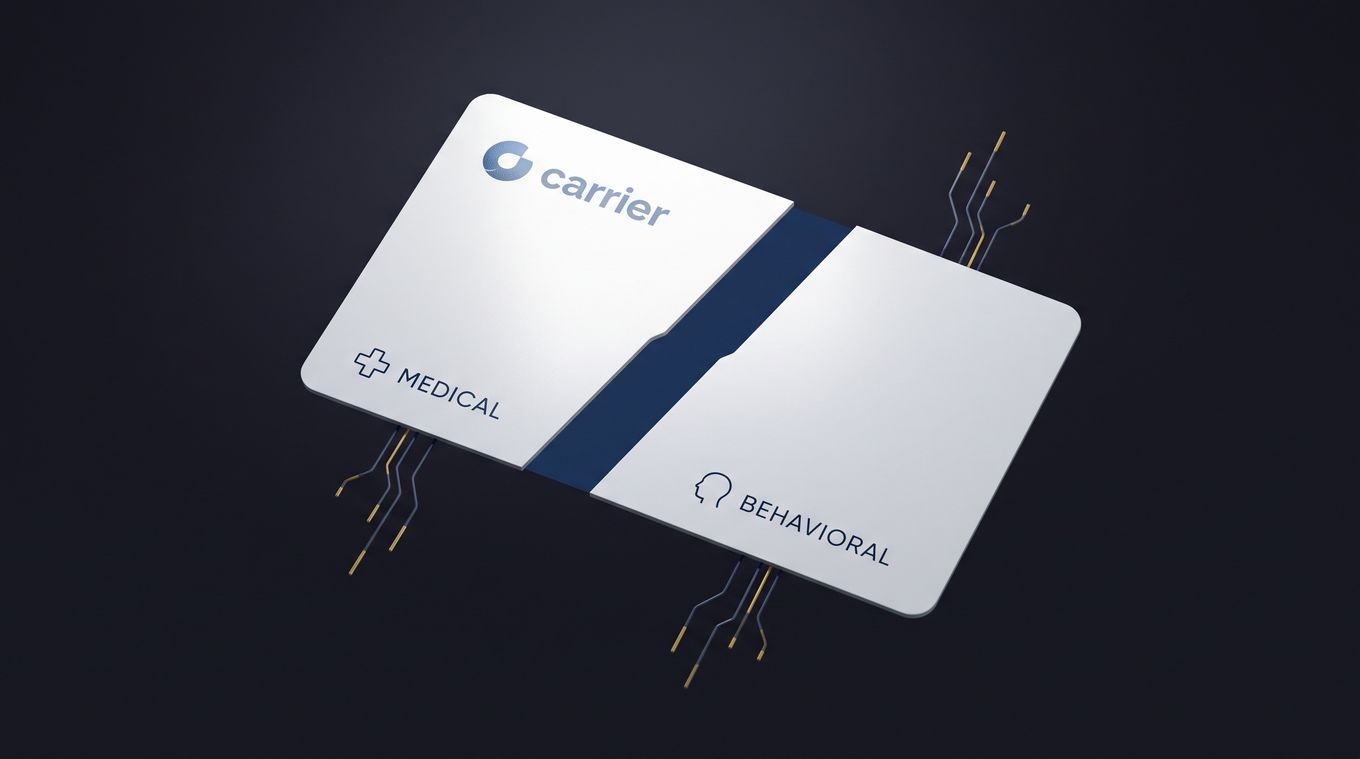
Nothing in that chain was solved by knowing the logo on the card. That is the practical shape of a behavioral health carve-out.
Every answer in that sequence was correct. The medical plan genuinely doesn't administer the benefit. The behavioral network genuinely has your clinician. The administrator genuinely doesn't own the authorization. Contradictory answers are the ordinary output of an arrangement in which seven separate administrative jobs sit in different buildings, and each representative can see only one of them. A therapist put it on r/therapists: "I've spoken to maybe 10 different people and have gotten 10 different answers."
In February 2026, Optum notified providers that New York City Employee PPO members had moved onto the Optum network, then drew a hard operational line: Optum supplies network access only. Benefits, authorization, claims and appeals all run through the NYCE portal, and claims must go to NYCE payer ID 26992 rather than Optum's standard 87726. Claims sent to the familiar Optum ID are denied and have to be resubmitted. (Optum Provider Express, February 2026) A practice could correctly identify the behavioral network in that arrangement and still misroute every single claim.
This guide covers how to name which organization owns each of the seven functions behind a behavioral claim, catch a split at verification instead of at denial, read what actually came back when a claim went wrong, and work out whether claims already sitting in the wrong place can be recovered. Behavioral health and mental health billing is what we specialize in, and the protocol below is the one we build our own verification around.
What a behavioral health carve-out actually is
A behavioral health carve-out is an arrangement in which some or all responsibility for mental health or substance use disorder benefits is administered outside the member's main medical-benefit pathway. The separated responsibility can include financing, network development, utilization management, claims administration, payment, quality oversight, or any combination. In Medicaid, CMS uses the term for structures in which a comprehensive managed care organization excludes behavioral services and those services move to a separate limited-benefit plan or a fee-for-service pathway. (CMS Behavioral Health Provider Network Adequacy Toolkit)
That definition is accurate and close to useless at the front desk, because the sentence everyone says - "behavioral is carved out to Company X" - collapses at least six different arrangements into one phrase. Company X might own the entire behavioral pathway. It might supply only the network. It might own authorization and clinical review while a different entity receives and pays the claims. It might price claims under its own contract and forward them to a self-funded employer for payment. It might be a public-facing brand while your contract and your remittances carry an older legal entity. Or the plan might look fully carved in to the member while behavioral operations are quietly subcontracted.
CMS names that last possibility explicitly: an MCO that includes behavioral health in its benefit package may manage the service itself or subcontract it. Financial integration at the member-facing level proves nothing about operational integration underneath. (CMS toolkit)
A carve-out is also not several things. It is not necessarily a total exclusion of behavioral benefits. It does not establish that the behavioral organization bears insurance risk, or that it issues payment. It does not prove that mental health, substance use, EAP, autism services, neuropsychological testing, residential care and pharmacy all travel the same route. It does not mean a provider contracted with the medical carrier is contracted for behavioral care. It does not apply uniformly to every employer group under a carrier. It is not permanent. And it is neither inherently compliant nor inherently noncompliant with mental health parity.
The related vocabulary gets used just as loosely:
| Term | What it usefully means | The limitation that matters |
|---|---|---|
| Carve-out | Behavioral services sit outside the main medical pathway, handled through a separate limited-benefit plan, an administrative-services organization, a fee-for-service program, or a delegated administrator. | The separate entity may not own every function. |
| Carve-in | Behavioral services sit inside the comprehensive benefit package or financial contract. | The plan can still subcontract network, utilization management, claims or payment. "Carved in" does not guarantee one portal or one operator. |
| Specialty plan | A plan built for a defined population or condition, often integrating medical and behavioral care for that group. | It coexists with other arrangements in the same state and doesn't describe every enrollee. |
| EAP | A limited employer-sponsored counseling and referral benefit sitting beside insured behavioral benefits. | Its sessions, network, authorization and billing route may all be separate. It is not a synonym for the insurance carve-out. |
*(Definitions drawn from the CMS Medicaid toolkit and 42 CFR 438.2. Member-specific plan documents govern in every case.)*
Why the name on the insurance card isn't the payer
Carve-outs exist because employers, unions, health plans and public purchasers buy specialized behavioral administration separately from general medical coverage. The attractions: a specialized behavioral network, dedicated level-of-care expertise, a separate behavioral budget or capitation arrangement, visibility into behavioral utilization, protection against adverse selection between competing plans, and the ability to replace a behavioral administrator without replacing the medical plan. Several arrangements also carry forward the historically separate funding systems for mental health and substance use treatment.
The research does not support a tidy verdict that carve-outs are bad. Older studies found spending and utilization effects in particular settings, but findings on access, outpatient care, continuity and quality are mixed and heavily design-dependent. More recent policy analysis also cautions that moving behavioral financing into a comprehensive plan doesn't automatically produce clinical integration, data integration, or a better provider experience. (peer-reviewed 2021 access study; JAMA Health Forum, 2023; Health Affairs Forefront, 2023)
We take no position on whether carve-outs are good policy, and a very firm one on how to operate against them. Four architectures cover most of what a behavioral practice encounters.
Fully insured with delegated behavioral administration. The insurer collects premium and bears claim risk, then contracts with a managed behavioral health organization - an MBHO, the specialist company that runs behavioral benefits on a plan's behalf - to handle some mix of network management, utilization review, claims processing and quality oversight. The member may see the insurer's card, the MBHO's number on the back, or both. Where it breaks: staff assume the medical network and the medical payer ID apply to behavioral services, or they obtain authorization from the medical utilization-management team rather than the delegated behavioral one.
Self-funded employer or union plan with an administrator and a behavioral vendor. The employer or health fund bears the claims cost directly. An insurer-branded administrator or third-party administrator - a TPA, the entity that runs eligibility and claims for a plan whose money belongs to someone else - handles administration, while a behavioral company supplies network and utilization management. Evernorth's 2026 provider guide describes this under shared administration: Evernorth or Cigna may apply the contracted rate and price the claim, while a TPA or employer system maintains eligibility and funds the payment. The provider may call one organization for authorization, a second for eligibility, and a third for payment status, and see multiple names on the same transaction trail. (Evernorth Behavioral Administrative Guide, 2026 edition) Where it breaks: the practice asks the network vendor for eligibility or payment status it genuinely cannot see, or asks the TPA for an authorization it doesn't issue.
Network access only. The plan rents or accesses an MBHO's provider network but keeps benefits, authorization, claims and appeals entirely elsewhere. This is the arrangement the NYCE notice describes: network access only, plan portal for everything else, plan-specific payer ID 26992 instead of Optum's standard 87726, wrong-ID claims denied and returned. (Optum Provider Express, February 2026) Where it breaks: a directory entry, a contract logo or a representative says "Optum network," and staff translate that into "send the claim to Optum."
Public program carve-out or specialty plan. A state may exclude behavioral services from its comprehensive Medicaid MCO and pay them through fee-for-service, a prepaid health plan, a county-based behavioral MCO, or an administrative-services organization. It may also build an integrated specialty plan for a defined population. (CMS toolkit; 42 CFR 438.2) Where it breaks: staff identify the Medicaid plan correctly but miss the county, region, eligibility category, service tier or specialty-plan enrollment that actually determines routing.
Across all four, "who is the payer?" has no single answer, because the word pay is doing at least five jobs at once: bearing the risk, calculating the allowed amount, adjudicating, transmitting the funds, and appearing on the remittance. Those can be five different organizations, which is why "who's the payer" reliably produces an answer that is true and unusable.
It also explains the conflicting representatives. "The member uses the Optum network" doesn't tell you where to send the claim. "Cigna processes the claim" may mean Cigna or Evernorth applies contracted pricing and hands it to an employer fund. "The medical plan shows active coverage" doesn't establish that the behavioral service is administered there. "The group is participating" doesn't establish that this clinician, this location, this product and this effective date are loaded. "No authorization is on file" may only mean the caller reached the wrong utilization-management system.
Each of those sentences is accurate inside the speaker's own boundary, which is why the useful question is not who the payer is but who owns which of the seven functions.
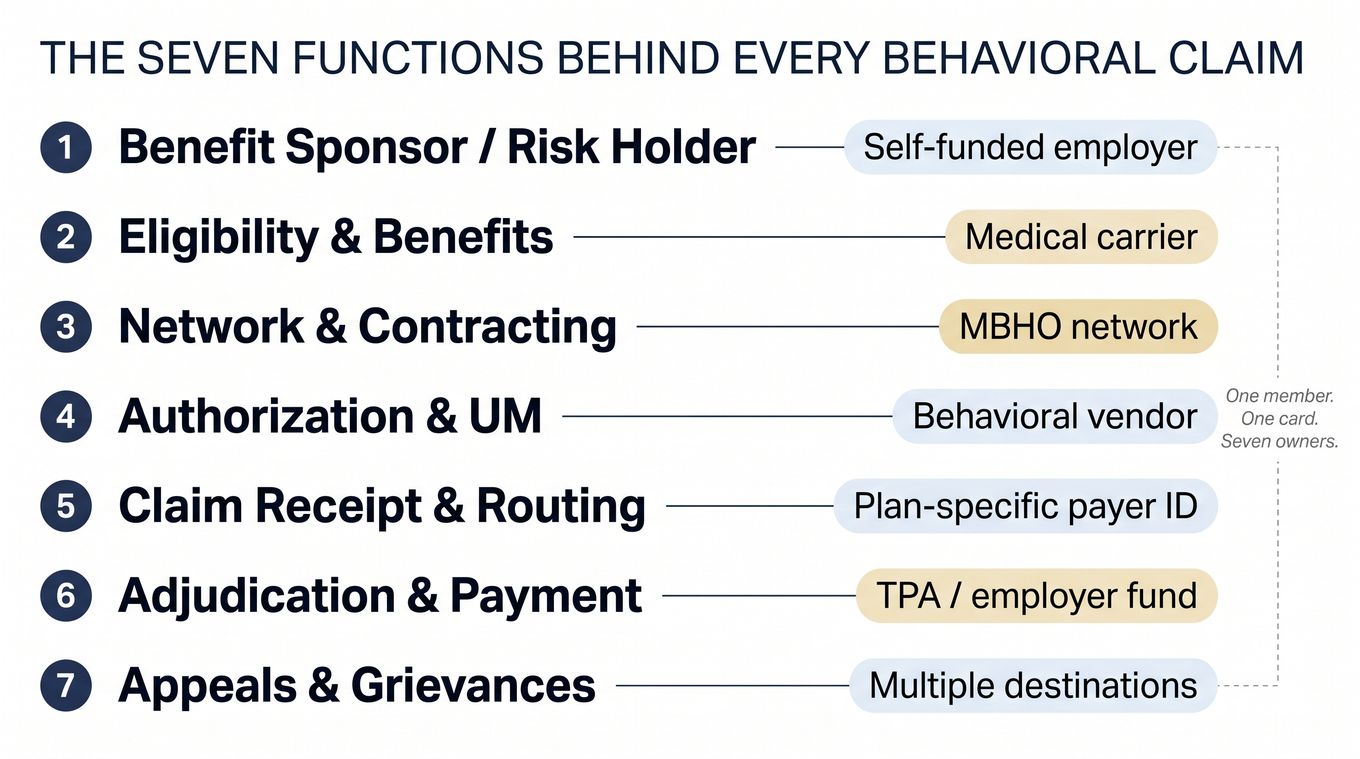
The seven functions behind every behavioral claim
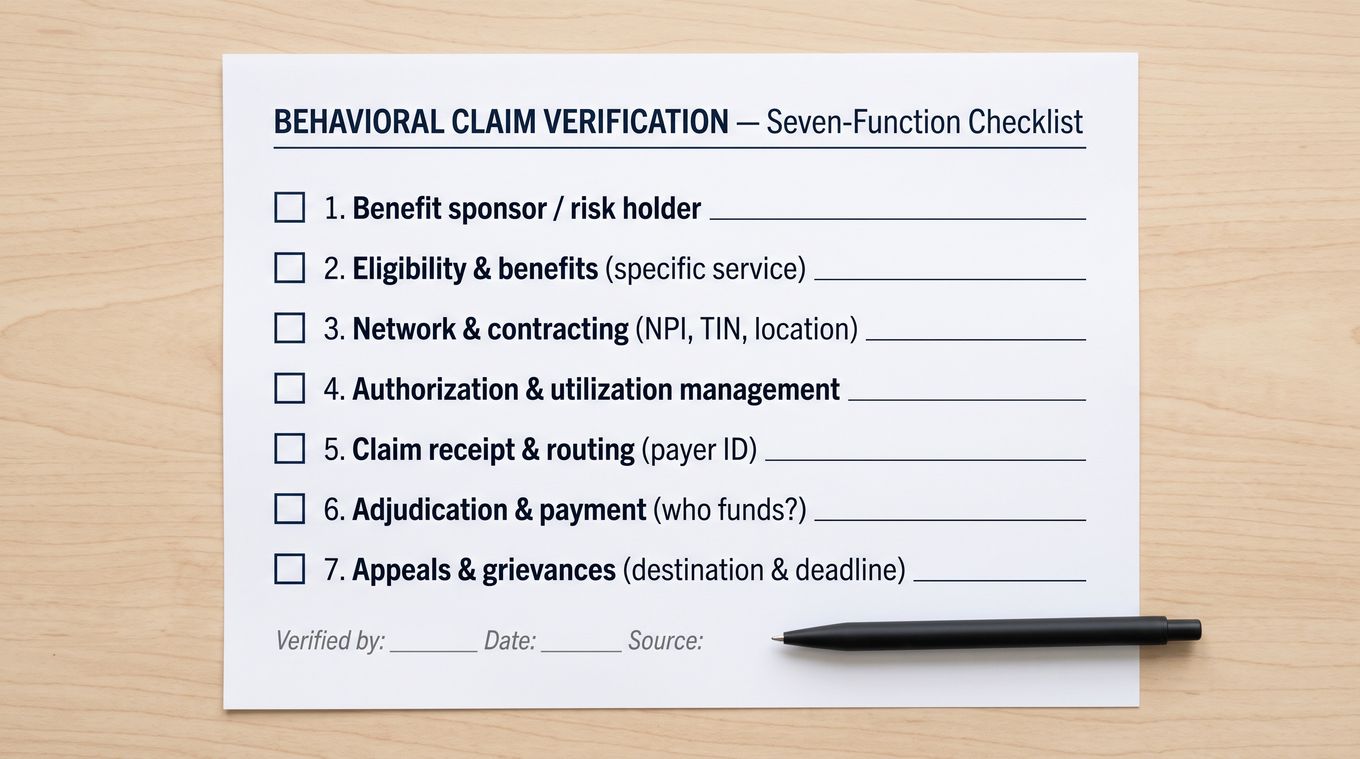
A verification is finished when you can name the owner of each row for a specific member, product, service, provider, location and date of service - not before.
| Function | What you need to establish | Where the evidence lives | The mistake that costs money |
|---|---|---|---|
| 1. Benefit sponsor / risk holder | Fully insured carrier, self-funded employer or trust, Medicaid agency, or capitated entity | Summary plan description, summary of benefits and coverage, portal funding field, employer or TPA documentation | Assuming the company that answers the phone is the company bearing the claim cost |
| 2. Eligibility and benefits | Active coverage, effective dates, the exact behavioral service and level of care, exclusions, cost share, visit or day limits, coordination of benefits | Current card, plan portal, the raw eligibility response, provider services, member plan documents | Verifying "mental health" generically instead of the actual level of care, code family and provider type |
| 3. Network and contracting | Which behavioral network applies, and whether the rendering NPI, billing TIN and NPI, location, taxonomy and product are all participating on the date of service | Contract or amendment, payer roster, network management confirmation - with the directory as supporting evidence only | Treating medical participation, group participation, or a directory hit as proof for every clinician, location and product |
| 4. Authorization and utilization management | Whether authorization, notification or concurrent review is required; the issuing entity; units and days; effective dates; provider and location binding; criteria; review cadence | Utilization-management portal, authorization letter and number, payer manual, documented call reference | Obtaining approval from the medical plan or a different behavioral vendor and assuming it transfers |
| 5. Claim receipt and routing | The correct receiver for the professional (837P) or institutional (837I) claim, trading partner, payer ID, paper address, attachment process, claim-frequency rules | Current payer manual, EDI companion guide, the card, clearinghouse payer list confirmed against the payer's own source | Reusing a national brand's default payer ID when a plan-specific ID applies |
| 6. Adjudication and payment | Who prices the claim, applies the fee schedule, assigns patient responsibility, funds payment, answers claim status, and sends the electronic remittance | Explanation of payment, the 835 remittance file, payer guide, TPA portal, ERA and EFT enrollment records | Calling the network vendor about a payment it doesn't fund, or missing a separate remittance enrollment |
| 7. Appeals and grievances | The destination and deadline for clinical appeals, payment reconsideration, contract disputes, eligibility disputes and member grievances | Denial notice, provider manual, the agreement itself, the card, plan documents | Sending every dispute to one generic appeal address, or filing a clinical appeal against an EDI rejection |
One caveat: no payer publishes a seven-part taxonomy. This is an analytical model, built from the way current plan documents describe their own divisions of labor - Evernorth's shared-administration workflows, Optum's network-only notice, Carelon's plan-specific portal structure, and CMS's Medicaid architecture definitions. (Evernorth guide; Optum notice; Carelon provider portals) It's a map, not a regulation, and it works because the underlying fragmentation is real.
One question turns the table into practice, and we ask it on every behavioral verification call: are you confirming eligibility, network status, authorization, claim receipt, pricing, payment, or appeals - and which of those are delegated somewhere else? It converts a vague "we handle behavioral health" into a specific, recordable fact, and exposes the delegation boundary in about fifteen seconds.
Who the behavioral health administrators are in 2026
Treat this as an identity map, not a routing table. The same organization plays different roles under different products, and there is no safe universal crosswalk from carrier to behavioral administrator.
Optum Behavioral Health / United Behavioral Health. Optum is the public behavioral brand across many employer, health-plan, Medicaid, Medicare Advantage and network arrangements. Provider documents may still use United Behavioral Health as the contracting or legal entity. The standard Optum payer ID and the standard Provider Express workflow are not universal - the NYCE arrangement is the live proof. (Optum Provider Express, February 2026) Never write "UnitedHealthcare behavioral claims go to Optum" as a carrier-wide rule.
Carelon Behavioral Health (formerly Beacon Health Options). ValueOptions and Beacon Health Strategies combined under the Beacon Health Options brand; Anthem completed its acquisition of Beacon in 2020; the business is now presented as Carelon Behavioral Health within the Elevance ecosystem. (Carelon; Anthem acquisition completion, 2020) Older Beacon and ValueOptions language still surfaces in portals, contracts, directory records and remittances, which is why practices meet three names for one company. Carelon's own portal page says the portal varies by health plan and market, and its network page requires completed credentialing and a countersigned contract before a provider is treated as approved in network. (Carelon provider portals; Carelon join our network)
Evernorth Behavioral Health (formerly Cigna Behavioral Health). The name change took effect 1 September 2021. Evernorth's own FAQ is unusually helpful about what didn't change: claim addresses and EDI payer ID 62308 stayed the same, Cigna ID cards continued, and providers could expect to see both Cigna and Evernorth references. The FAQ also states that the change applied to the behavioral network and did not merge medical and behavioral contracts. (Evernorth name-change FAQ) Don't treat Cigna, Evernorth and 62308 as three separate payers - and don't assume 62308 is right for every Cigna-branded card, particularly under shared administration.
Lucet (formed from New Directions Behavioral Health and Tridiuum). The combined brand launched on 19 January 2023. (Lucet launch announcement; Lucet provider resources) A health plan can use Lucet for behavioral network or clinical functions while keeping claim submission and status in the plan's existing portal, so guidance telling staff to look for "New Directions" is stale in both the name and the workflow.
Magellan Health. Magellan remains a behavioral and specialty-services name, but its corporate perimeter changed substantially. Centene acquired Magellan Health in January 2022 for approximately $2.6 billion, then divested Magellan Rx in December 2022 and Magellan Specialty Health in January 2023. (Centene 2021 results; Magellan Specialty Health divestiture; Centene 2022 results) "Magellan was sold" is the kind of imprecision that sends a claim to a business line that no longer sits where your notes say it does. Name the entity and the date.
Regional, public-program and adjacent names. You'll also meet MHN in Health Net arrangements, the Massachusetts Behavioral Health Partnership in specified MassHealth delivery systems, county- or region-assigned Medicaid behavioral MCOs and prepaid plans, state behavioral administrative-services organizations, employer-specific administrators, Taft-Hartley health funds, and EAP administrators such as ComPsych that may manage a limited workplace benefit rather than the insured behavioral pathway. These belong on a "watch for these categories" list, never on a "bill these companies" list.
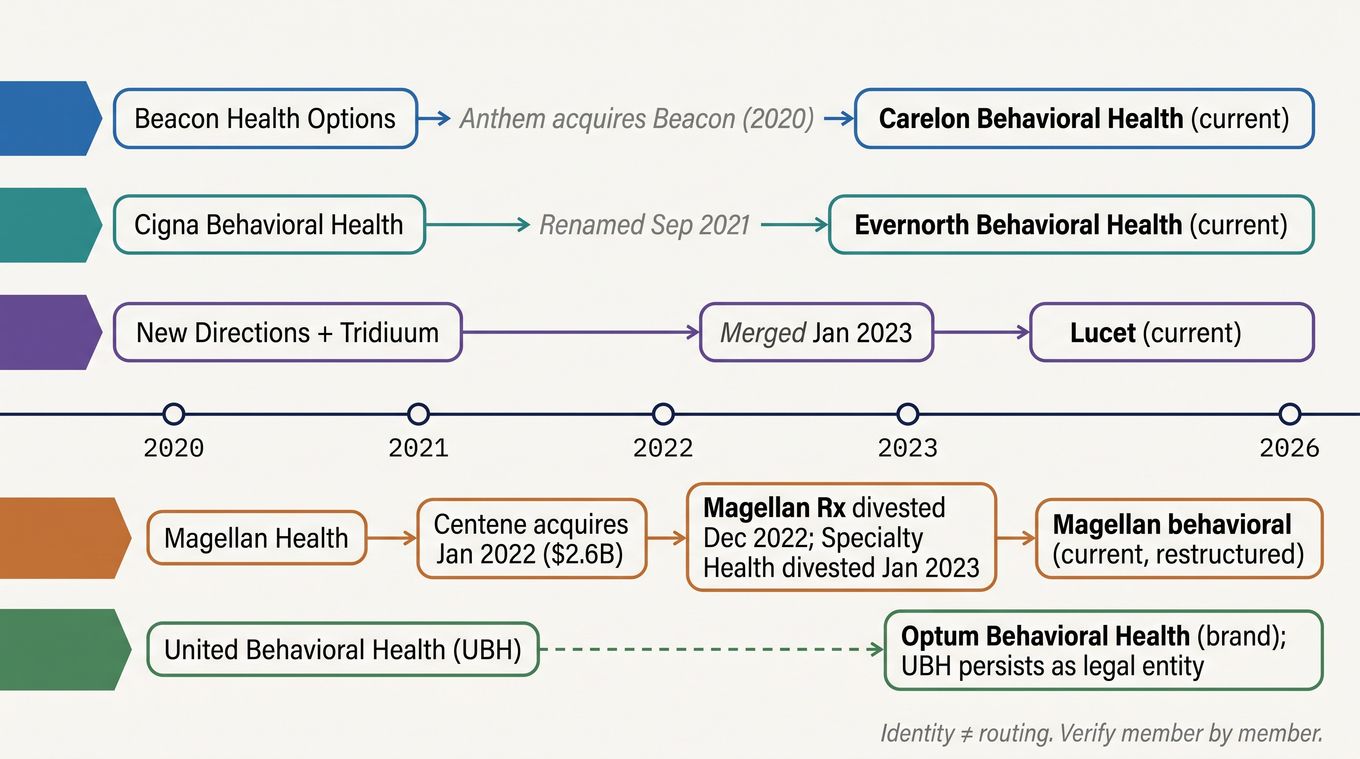
| Name you may see | Current framing | Historical name worth knowing | What still has to be verified |
|---|---|---|---|
| Optum Behavioral Health / United Behavioral Health | National behavioral organization; role varies by plan | UBH persists as a legal and contracting name | Network-only vs full administration; plan-specific payer ID; portal; authorization owner |
| Carelon Behavioral Health | Current brand, explicitly "formerly Beacon Health Options" | Beacon Health Options; ValueOptions | Plan and market portal, contract, payer ID, appeal route |
| Evernorth Behavioral Health | Current behavioral legal name within the Cigna ecosystem | Cigna Behavioral Health | Whether Evernorth, a TPA, an employer or a fund owns each function |
| Lucet | Current brand | New Directions; Tridiuum | Portal split, authorization system, claim receiver |
| Magellan | Current behavioral-services name after major corporate change | Older Magellan Health, Rx and Specialty references | The exact business line, current plan contract, transition date |
| State or county behavioral MCO, prepaid plan, or ASO | Public-program administrator | State-specific prior contractor | County, region, eligibility group, service tier, effective date |
There is no national carrier-to-administrator table on this page because no honest one exists: the relationship changes by employer group, product, state, service line and effective date, and a table that looks authoritative would cause more misrouted claims than it prevented. The same goes for a national prevalence figure for carved-out commercial lives and for a market-share ranking of behavioral organizations. We looked, and no current public data set cleanly separates network access from administrative-services lives from delegated claims.
How to catch a carve-out before the first session
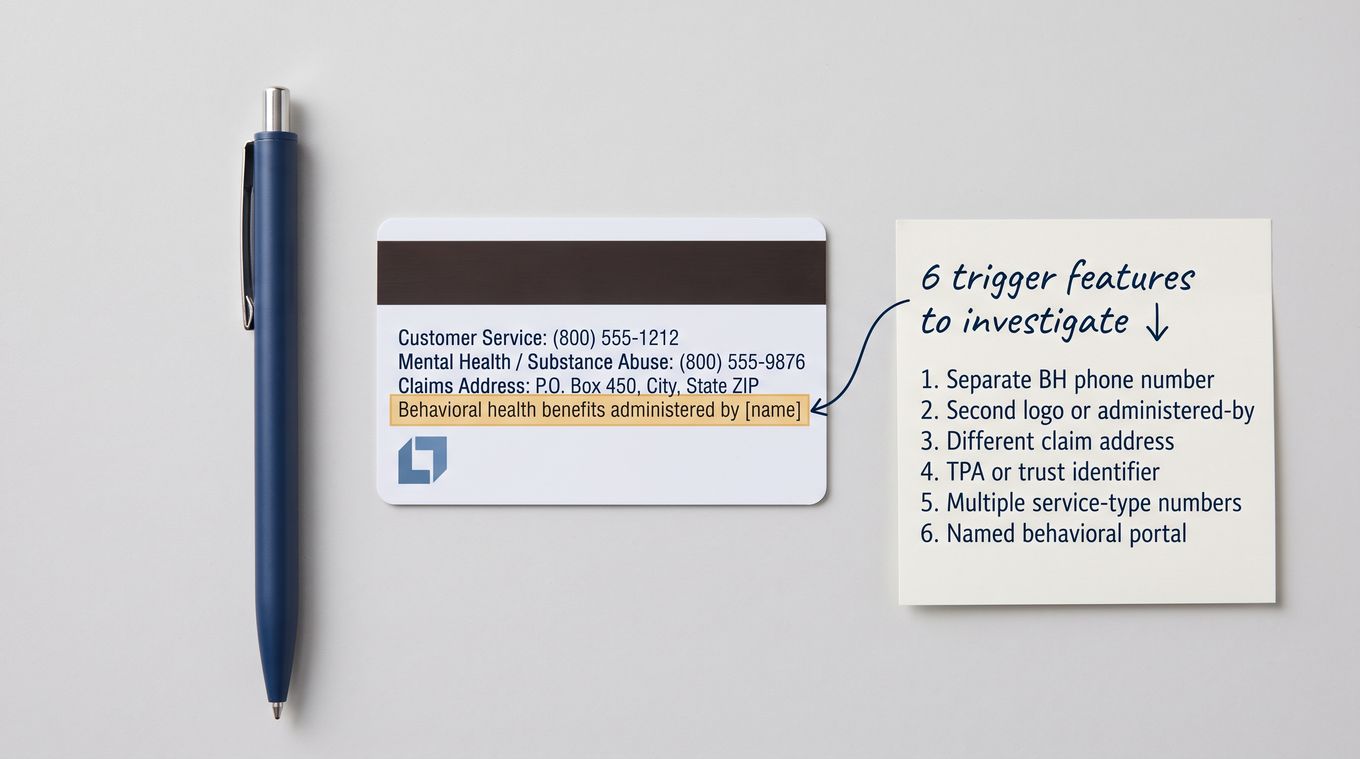
The goal is not to "find the behavioral payer" but to produce a documented routing record that another staff member could reproduce next week.
Capture the right details at intake
Verification fails at intake more often than on the phone. Before anyone calls, you need:
- Clear images of the front and back of the current card, plus the digital card where the plan offers one. Behavioral routing, authorization numbers and claim addresses usually live on the back, and a front-only image is not sufficient evidence for behavioral billing.
- Member name and ID, subscriber name and relationship, group number, employer or plan sponsor, and the plan or product name.
- Plan effective date and, where you can get it, funding type.
- The precise service being considered - outpatient psychotherapy, psychiatry, psychological testing, ABA, EAP, crisis services, intensive outpatient, partial hospitalization, residential, withdrawal management, inpatient, or medication services for substance use - plus the likely code family.
- Rendering clinician NPI, billing NPI and TIN, taxonomy, service location and facility type.
- The intended first date of service or admission date, and any other active coverage.
That specificity isn't bureaucratic. A plan can route outpatient and facility services differently, primary and specialty behavioral services differently, and mental health and substance use differently, and network participation can attach to a clinician, a group, a location, a product or a line of business rather than the brand generally.
Certain card features should trigger a full investigation:
- A separate mental health, behavioral health, substance use, EAP or authorizations phone number
- A second logo, or "administered by" / "network through" language
- A claim address or payer ID that differs from the medical brand's usual route
- A TPA, employer trust, union fund or shared-administration identifier
- Multiple provider-services numbers by service type
- Instructions to use a named behavioral portal
The absence of those signals proves nothing. Self-funded and delegated arrangements frequently show only the medical carrier, and a carrier's transition to a new behavioral vendor often appears in the online card before the member receives a replacement card in the mail.
Rank your evidence, and know what each source can't tell you
Use evidence in this order, with a second source wherever the route is high-risk or new:
- Current member-specific evidence - the card, the plan portal, the raw eligibility response, an authorization record, the summary plan description or member handbook.
- Current plan and provider documentation - provider manual, EDI companion guide, transition notice, network amendment, state Medicaid page.
- A documented live confirmation - representative name or identifier, department, date and time, call reference number, and the exact question and answer.
- The provider directory - useful corroboration, never sufficient on its own to establish contracting for a precise NPI, TIN, location, product and date.
- Clearinghouse payer lists, internal crosswalks, vendor databases and staff memory - leads to be confirmed, never proof for a new or changed route.
Eligibility transactions are the most over-trusted source in the building. A 270 is the eligibility inquiry; the 271 is the response. It becomes far more useful when the inquiry names the behavioral service rather than asking a general health-benefit question. X12's public code source includes behavioral service-type values: A4 psychiatric, A6 psychotherapy, A7 psychiatric inpatient, A8 psychiatric outpatient, AI substance abuse, MH mental health, and RT residential psychiatric treatment - though some values are marked response-only rather than sendable, and your trading-partner implementation and adopted guide control what you can actually use. (X12 Service Type Codes) Don't paste public code-list values into a 270 without checking with your clearinghouse or EDI guide first.
Even a detailed response has limits. A 271 cannot establish:
- Signed network participation for your exact provider, TIN, location and product
- A valid authorization
- Medical necessity
- Correct coding
- The final allowed amount
- The absence of coordination of benefits or plan exclusions
- Payment
The 271 tells you where to keep asking. It cannot sign the contract or authorize the care.
Portal summary screens hide things too. A portal may collapse a rich response into "active" or "mental health covered," so inspect the benefit detail rather than the eligibility banner, and look for the payer or contact entities in the response, service-specific notes, network and product fields, the authorization contact, the limitation and disclaimer text, and the response timestamp. Evernorth's guide tells providers to use the card, the portal, the 270/271, the interactive voice response system and telephone verification rather than relying on any one of them - advice worth generalizing to every behavioral payer. (Evernorth guide)
Work the calls in sequence
Call one goes to the number on the current member card - the member-specific number, not a national provider-services line found by search. Open with the member, product, date and specific service, then refuse the word "administers" until the representative separates the functions.
Call two goes to the named behavioral organization with one job: establish what role it actually performs. "I was referred to you for behavioral health - are you the network, the utilization manager, the claim receiver, or all three for this member?"
Call three goes to whoever holds what the behavioral organization disclaimed - the medical plan, TPA, employer fund or state program. Use it for eligibility, payment status, claim route, remittance enrollment or appeal ownership. For a self-funded plan, the summary plan description or the plan administrator may be the only way to identify the controlling terms and the party responsible for benefits. CMS advises members to ask the employer's plan administrator whether coverage is insured or self-funded, which also determines which regulator has jurisdiction later. (CMS MHPAEA overview)
Call four goes to network management or contracting. Provider services will tell you a provider is "showing active." That is not the same as a loaded contract, and this is where practices most often accept a soft answer.
Ask the questions that actually resolve a route
Grouped by function, as a working script:
Member and benefit.
- Is the member active on this date under this plan, product and group?
- Who administers this specific service and level of care for this member on that date?
- Is the plan fully insured or self-funded, and who is the plan administrator or TPA?
- Are mental health, substance use, EAP, autism services, psychological testing and higher levels of care all administered through the same pathway, or are any separate?
Network.
- Which behavioral network applies to this product?
- Is rendering NPI [X], under billing TIN and NPI [Y], at [address], participating in that exact network and product on [date]?
- Is that answer based on a loaded contract with an effective date, or only on a directory record?
- Does participation change by clinician, group, location, provider type or level of care?
Authorization and clinical review.
- Who issues authorization or receives notification for this service?
- Is authorization required before the first session or admission, and is concurrent review required after?
- What dates, units, visits, days, codes, provider, TIN and location does the authorization cover?
- Which medical-necessity criteria or level-of-care guideline applies, and where can we obtain it?
- Would an authorization issued by the medical plan or a previous behavioral administrator remain valid after a transition?
Claim and payment route.
- Which entity must receive the 837P or 837I?
- What EDI payer ID and trading-partner route apply to this exact product, and is it plan-specific rather than the administrator's standard ID?
- What is the paper-claim address, and does it match the current card?
- Who prices the claim, who funds payment, and where do we check status?
- Does electronic remittance and funds transfer require separate enrollment with the plan, TPA or payment vendor?
- Which fee schedule or behavioral contract applies?
Deadlines and disputes.
- What is the original-claim timely-filing limit?
- What are the corrected-claim, reconsideration, clinical-appeal, payment-appeal and member-grievance deadlines?
- If a claim was first sent to the medical plan or a prior administrator, what documented exception or transition process applies?
- Where does each type of appeal go?
- Every time: the call reference number and the source document or portal location supporting these answers.
Know what "verified" has to mean
A verification is incomplete unless the record contains:
- The exact member, product, service and date-of-service context
- The seven-function map
- Network status for the specific NPI, TIN, location and product
- The authorization owner and requirement
- The claim payer ID, trading partner and claim type
- The payment and remittance route
- Filing and appeal deadlines
- The evidence itself - screenshots or saved responses, with document versions and call references
- The verifier's name and a timestamp
- A note that benefits are not a guarantee of payment
Then reverify when anything moves:
- A new plan year or employer renewal
- A new card, group number or product
- An employer or fund change
- A change in Medicaid eligibility category
- A behavioral administrator or network transition
- A new clinician, group TIN, service location or taxonomy
- A change in level of care or code family
- An admission after a lapse or reinstatement
- A new authorization period or concurrent-review cycle
- A clearinghouse or payer-ID update
Treat every payer transition as a dated event, not an instant global replacement. Claims before and after a transition can legitimately require different networks, portals, payer IDs and appeal paths - which is precisely the trap that catches practices in January.
What changes after you identify the carve-out
Knowing the administrator changes far more than a mailing address.
Contracting and credentialing come first, because they're the slowest to fix. Establish whether the behavioral administrator or network has separately contracted and credentialed each rendering clinician, the billing entity and TIN, each service location, the relevant taxonomy or provider type, the specific plan or product, the facility level of care, and the date participation became effective. A medical contract proves none of it. Evernorth's name-change FAQ says the change concerned the behavioral network and explicitly distinguishes providers who also hold medical contracts; Carelon requires credentialing approval and a countersigned contract before a new provider treats members as an approved network provider. (Evernorth FAQ; Carelon join our network)
The edge cases are where the money goes. A group can be contracted while a newly hired clinician isn't loaded. One location can participate while another doesn't. A provider can participate in a broad network but not in the member's narrower product. Professional and facility contracts can differ. A contract can be signed but not effective on the date of service. And a behavioral network rented by another plan may require an amendment or line-of-business acceptance before it covers that plan's members.
Authorization ownership has to be re-established, not assumed. Confirm which organization issues authorization; whether the service requires prior authorization, notification, or neither; whether approval is tied to specific codes, diagnosis, level of care, provider, TIN, facility and location; the approved dates, visits, units or days; concurrent-review due dates and submission channel; the medical-necessity criteria and appeal rights; transition-of-care rules after a vendor change; and whether retrospective authorization exists at all, and under what narrow conditions.
An authorization number from the wrong organization is not inherently transferable. Get written confirmation from the entity that owns utilization management for this member and service.
The fee schedule may not be the one you expected. The behavioral administrator can apply a distinct contract and fee schedule even when the card displays the medical carrier, and under shared administration one entity may apply the contracted rate while another funds payment. Identify the governing contract and legal entity, the product and network, the effective fee-schedule version, provider-type and site-of-service rules, any multiple-procedure, modifier, telehealth or per-diem provisions, whether the administrator can alter the repriced amount or only transmit it, and the contract-dispute path for underpayment. Parity does not require identical medical and behavioral dollar rates. It requires comparable and no-more-stringent processes for things like network admission and reimbursement methodology. (DOL FAQ Part 39)
Claim submission needs a full record, not a payer ID: the claim type (837P or 837I), the trading partner and clearinghouse route, the plan-specific electronic payer ID, the paper address and attachment process, taxonomy and billing or rendering requirements, the claim-frequency and corrected-claim convention, the claim-status method, and remittance and funds-transfer enrollment.
Never use a generic national payer ID simply because the network organization is national; the NYCE arrangement is the cleanest available proof of why. (Optum notice, February 2026)
Appeals are carved into functions too. You may need separate destinations for a clinical appeal (medical necessity, authorization, level of care, concurrent review), a claim or payment reconsideration (processing error, coding edit, timely filing, duplicate, modifier, claim data), a contract dispute (fee schedule, repricing, network status, underpayment), an eligibility or benefit dispute, and a member grievance or external review. Evernorth's shared-administration examples divide clinical and contract work from the administrator's payment functions, and Carelon publishes different provider resources with filing periods that vary by agreement and law. (Evernorth guide; Carelon provider contact) Sending everything to one generic appeal address is how a legitimate dispute expires.
And you now have several filing deadlines, not one: original claims, rejected claims, corrected claims, reconsiderations, clinical appeals, payment and contract appeals, and external review where it applies.
A routing or authorization failure should not be converted automatically into patient responsibility. Before billing the patient, review the explanation of payment and the contractual adjustment, in-network hold-harmless terms, federal and state surprise-billing protections where they apply, the benefit and authorization notices, whether the denial is provider-liability or member-liability, and any Medicaid prohibition on billing the member. A wrong-payer denial is your problem to solve, not the patient's bill to receive.
Rejected, denied, or forwarded: reading CARC 300 and 301
Before choosing an action, establish the transaction state. These are different events with different remedies.
A 999 is a transaction acknowledgment. It reports whether the submitted X12 transaction set passed implementation and syntax checks - accepted, accepted with errors, or rejected at the transaction-set level. It does not prove that any individual claim reached the adjudication system of the payer you intended. (CMS Version 5010 provider outreach)
A 277CA is a claim-level acknowledgment. An accepted claim receives a claim number; a rejected one requires correction and resubmission. X12's claim-status categories include A1 received but not accepted into adjudication, A2 accepted into the adjudication system, and A3 rejected and not entered into adjudication. (CMS 5010 outreach; X12 Claim Status Category Codes)
The consequence is large: an A3 rejection is not an adverse benefit determination. A clinical appeal against it is the wrong instrument. The claim never entered adjudication; it needs to be corrected and routed, not argued.
An 835 or written explanation is adjudication - the point at which claim adjustment reason codes, often supplemented by remark codes, tell you what the adjudicator decided. The codes that matter most in carve-out situations:
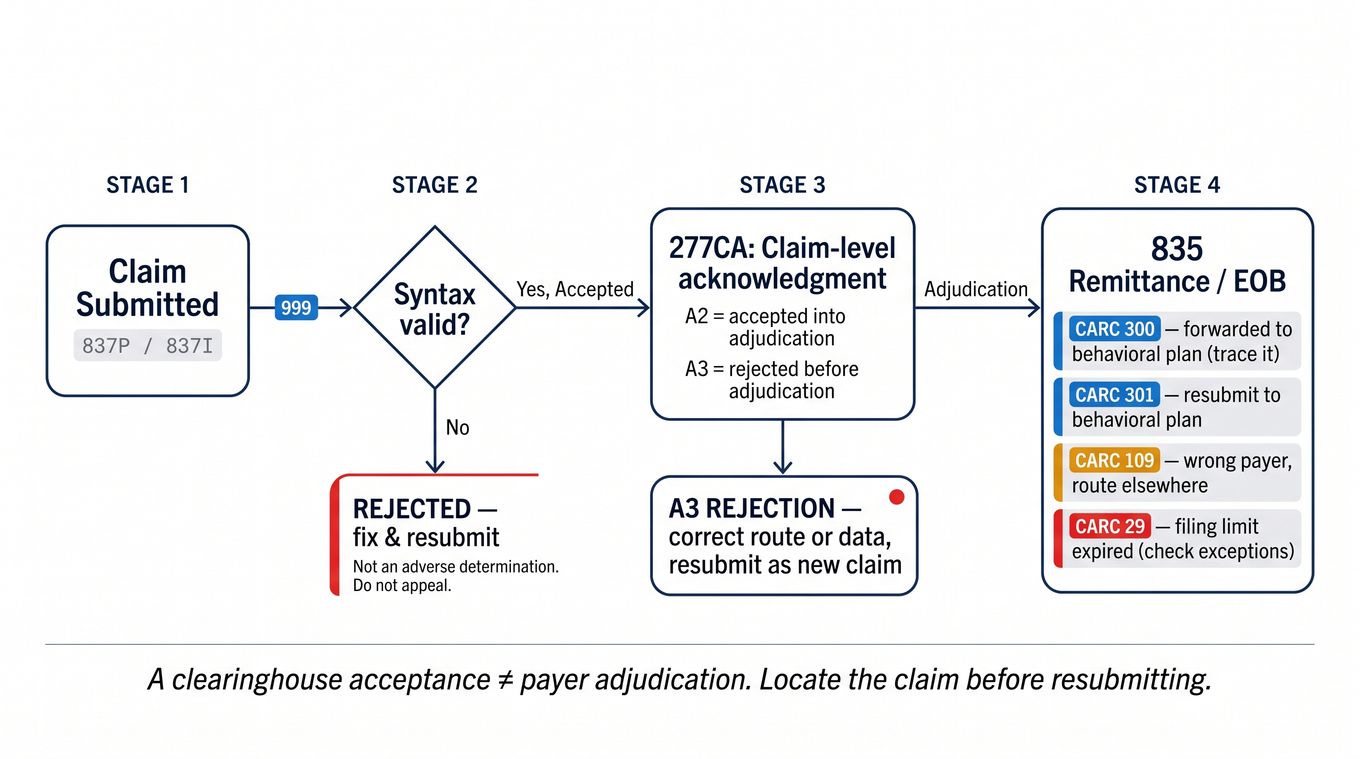
| Code | What it means | What it proves | What it does not prove |
|---|---|---|---|
| CARC 300 | The medical plan received the claim, behavioral benefits weren't available under that plan, and it forwarded the claim to the behavioral plan. | The medical plan says it forwarded it. | Which entity now holds it, the new claim number, network status, valid authorization, eventual payment, or a preserved filing date. |
| CARC 301 | The medical plan received the claim, behavioral benefits weren't available, and the provider must submit to the behavioral plan. | You have to route it elsewhere. | The identity, payer ID, contract or deadline for the correct route. |
| CARC 109 | The service isn't covered by this payer or contractor and should go to the correct one. | Wrong payer is a likely root cause. | That the cause is specifically a behavioral carve-out. |
| CARC 29 | The filing limit expired. | The adjudicator applied a filing-limit denial. | Whether an exception, transition rule, state-law protection or appeal is available. |
| CARC 302 | The authorization time limit expired. | A timing rule tied to authorization was applied. | Whether retroauthorization or an exception is permitted. |
| CARC 24 | Charges are covered under a capitation agreement or managed-care arrangement. | A capitation or managed-care issue may exist. | A behavioral carve-out. This is not a carve-out code. |
*(Definitions from the current X12 Claim Adjustment Reason Codes and Remittance Advice Remark Codes, retrieved 17 August 2026.)*
Two corrections, both common. First, CARC 300 and 301 are routing signals, not a workflow - they tell you how the medical plan handled this claim, and nothing about whether you're contracted, authorized, or still inside a deadline. Second, a clearinghouse acceptance is not a payer adjudication: use the 999, the 277CA, the payer's own claim number, and a claim-status transaction to establish where the claim actually entered. A 276/277 check earns its keep after a CARC 300, because the job is to locate a claim someone else moved, not to create a blind duplicate. (X12 Claim Status Category Codes)
How to recover a claim sent to the wrong payer
Stop making the problem bigger first. Pause automatic rebilling and patient statements for the affected accounts. Preserve everything - the original claim file, clearinghouse reports, the 999 and 277CA, the 835 or explanation of benefits, card images, portal screenshots, call records, authorization records and plan notices. Then identify the exact population by member, employer group, product, state and county, service, provider, location and dates.
Classify the transaction state using the previous section: rejected before adjudication, accepted by the wrong receiver, adjudicated and denied, forwarded under CARC 300, returned for resubmission under CARC 301 or 109, paid or capitated elsewhere, or pending inside a TPA or employer system. Pull the original claim number and any new claim number, and confirm whether the correct entity already has a record before you create a duplicate.
Rebuild the seven-function map for the actual dates of service - not for today. Reverify eligibility and the specific behavioral service on each date, confirm the behavioral network and contract for the rendering NPI, billing TIN and NPI, location, product and effective date, establish who owned authorization and whether any existing approval can be transferred, recognized or reviewed retrospectively under written policy, and confirm the correct receiver, payer ID, claim type and paper address along with the applicable filing limits and dispute routes.
Then act according to state:
- A3 rejection: correct the route or the data and submit as the payer or clearinghouse instructs. Don't assume a corrected-claim frequency code is required - the claim never entered adjudication in the first place.
- CARC 300 forwarding: trace the forwarded claim and its status before resubmitting anything. Get the destination, received date and claim number where you can.
- CARC 301 or 109: submit to the confirmed behavioral receiver, and include proof of the original submission if a filing issue is even possible.
- Authorization denial: request transfer, retroauthorization or administrative review only where the plan permits it. Attach the wrong-entity authorization and the verification record, but don't promise it will be honored.
- Network denial: separate true nonparticipation from a roster, effective-date, location, taxonomy or product-loading error. A loading error goes to network management or contracting, not through a clinical appeal.
- Timely-filing denial: use the plan's exception or reconsideration route with a full evidence packet.
Build that packet properly. It decides whether months of care get paid, and it includes:
- The original submission date and clearinghouse acknowledgment
- The 277CA or payer claim number
- The CARC 300, 301 or 109 remittance
- Proof of the date the wrong payer forwarded or returned the claim
- Current and historical card images
- Any payer transition notice
- Portal screenshots and the raw eligibility response
- Authorization and reference numbers
- Call logs naming the representatives and departments that supplied the routing information
- Contract or manual language supporting an exception
- A concise chronology showing continuous good-faith follow-up
- Whatever corrected-claim or reconsideration form that payer requires
Keep the argument factual: the practice submitted timely based on the member and plan information available, the claim was misrouted or forwarded, the correct administrator was identified later, and the practice acted promptly. Don't assert that filing was legally tolled unless the contract, plan rule or law actually supports it - a wrong-payer submission may support a documented exception, but it does not automatically stop the correct plan's contractual deadline. Evernorth's own guide lists multiple possible exception categories around state law, coordination of benefits, Medicare and Medicaid, timely resubmission and extenuating circumstances, which is itself evidence that there is no single universal deadline or appeal rule. (Evernorth guide)
Then find the rest of them. This is the first thing we do when a single behavioral denial looks structural rather than clerical: search for every other account sharing the employer or group number, the alpha prefix or product, the county or region, the behavioral administrator, the payer ID, the denial code, the service or level of care, the provider or location, or a date range around a payer transition. A carve-out defect is almost always a cohort error rather than an isolated claim, and the money is in finding the pattern before each account reaches its own deadline.
Finally, close the root cause. Update the payer matrix, retrain intake, change the EDI route, add a verification hard stop, and monitor the first small batch after the correction. A write-off or a successful appeal without a workflow change leaves the next patient exposed to the same failure.
Medicaid behavioral health carve-outs vary by state
CMS describes four structures, and a state can use several at once:
- Fee-for-service - the state pays enrolled providers directly.
- Comprehensive MCO carve-in - behavioral services sit inside the MCO benefit, though the MCO may deliver them or subcontract them.
- Carve-out - the comprehensive MCO excludes some or all behavioral services, which move to a separate limited-benefit plan or fee-for-service pathway.
- Specialty plan - a plan serves a defined population or condition and may combine medical and behavioral care for that group.
Federal regulation defines a prepaid inpatient health plan as a risk-bearing entity that isn't a comprehensive MCO but includes responsibility for inpatient or institutional services, and a prepaid ambulatory health plan as a limited-benefit risk arrangement without them. (CMS toolkit; 42 CFR 438.2)
CMS also warns that transitions between designs create provider confusion, denials and administrative burden, especially for small practices. That warning is more useful than any count of "carve-out states."
Six states show how different the routing key can be:
Pennsylvania - the county decides. Behavioral HealthChoices separates mental health and drug and alcohol services from the physical-health component, each county contracts with a behavioral MCO, and each enrollee is assigned the behavioral MCO serving their county of residence. (Pennsylvania Behavioral HealthChoices; county BH-MCO list) The question to ask is which behavioral MCO serves this member's county on this date of service - not which plan is on the record.
Maryland - the service intensity decides. Specialty behavioral care has been carved out of the HealthChoice managed-care program since 2015. MCOs remain responsible for primary behavioral services delivered in primary care, while specialty mental health and substance use services are paid fee-for-service and managed through the public behavioral system, with Carelon serving as the behavioral health administrative-services organization. (Maryland Department of Health, December 2025) The same member can have one pathway for primary behavioral treatment and another for specialty treatment, so "does this plan have a carve-out?" isn't a granular enough question. Name the service.
California - the county decides, and the architecture is mid-change. Specialty Mental Health Services run through county Mental Health Plans, and substance use services run through county structures including Drug Medi-Cal Organized Delivery System counties. The state has said counties must combine administration of specialty mental health and substance use services into one integrated specialty behavioral health program by 1 January 2027. (DHCS county Mental Health Plan information; CalAIM Behavioral Health Initiative) The state's posted plan-level rates are not automatically what county plans must pay each individual network provider, because county plans negotiate provider reimbursement. A public fee schedule is not necessarily your contract rate. (FY 2026–27 behavioral health fee schedules)
North Carolina - the population decides. Behavioral Health and I/DD Tailored Plans launched on 1 July 2024 for members with serious mental illness, serious emotional disturbance, severe substance use conditions, intellectual and developmental disabilities, or traumatic brain injury needs. They integrate physical health, pharmacy and behavioral services for the enrolled population rather than routing every Medicaid member through one universal carve-out. (NC Tailored Plans; launch announcement; transition flexibilities) The question is whether this member is enrolled in a Tailored Plan, not whether they have North Carolina Medicaid.
Washington - the enrollment arrangement decides. Apple Health uses integrated managed care for many members while also offering Behavioral Health Services Only plans and maintaining regional behavioral-health administrative functions. (Apple Health managed care; model managed-care contracts; SUD billing guide effective 1 January 2026) A statewide label of "integrated" doesn't settle an individual member's route.
Ohio - the program decides. OhioRISE is a statewide specialized managed-care program for young people with complex behavioral and multisystem needs. It launched on 1 July 2022 and coexists with Ohio's broader managed-care program, so responsibility is divided between OhioRISE and the member's other Medicaid plan. (OhioRISE; launch release)
And Michigan is the live warning about dates. The state's current Mental Health Framework page says coverage-responsibility changes that had been scheduled for 1 October 2026 are temporarily delayed while the system is prepared. (Michigan MDHHS) Never build a workflow from an announced future effective date without rechecking the implementation page. Proposed transfers of responsibility get postponed after training materials and draft documents are already circulating.
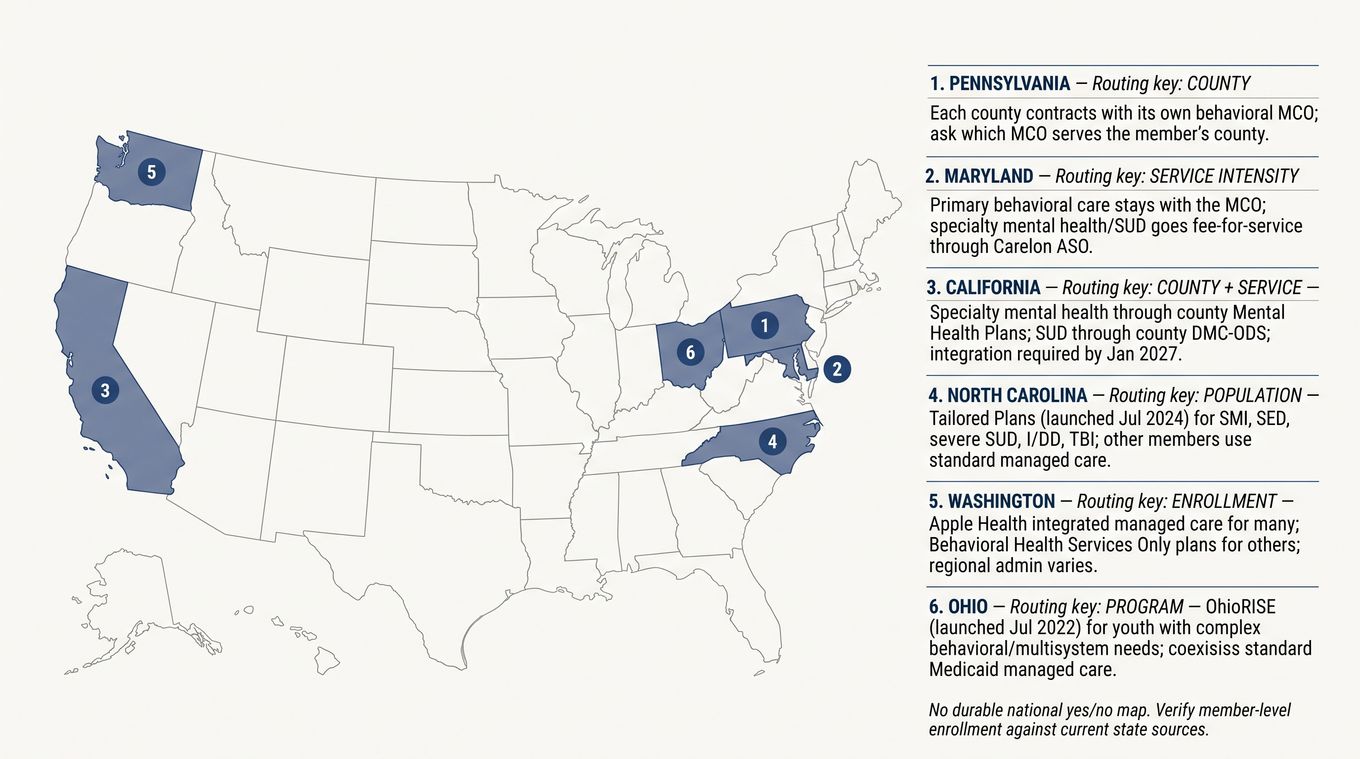
For Medicaid, add these to the commercial script:
- What eligibility category and managed-care program is the member in?
- Which county, region or catchment area controls the behavioral plan?
- Is the service primary, specialty, crisis, inpatient, residential, substance use, waiver or state-funded?
- Is the claim a fee-for-service, MCO, prepaid plan, behavioral MCO, ASO or specialty-plan responsibility?
- Does the rendering provider need separate enrollment with the state, the plan and the behavioral network?
- Which entity authorizes, which fiscal agent receives the claim, and which decides the appeal?
- Are there state-required modifiers, taxonomy, place-of-service or rendering-provider fields?
- Does the member have Medicare or commercial coverage that must be billed first?
- Is the state inside a transition or continuity-of-care period?
- Can the member be billed at all under that program's rules?
There is no fifty-state carve-out map here either: a yes/no table would age badly and erase exactly the distinctions that determine payment. What travels well is the architecture - population, service category, plan type, county dependency, administrator, authorization route, claim route, transition date, official state source, and the date you last verified it.
Where mental health parity helps, and where it doesn't
Start with what it can't do. Parity does not tell you which payer ID to use, convert medical-network participation into behavioral-network participation, make an excluded service covered where no other law requires coverage, make an out-of-network provider in network, validate an authorization obtained from the wrong organization, excuse missing clinical documentation, erase an original-claim filing limit, dictate a specific provider fee, guarantee that any given denial is unlawful, or replace the plan's internal appeal process. CMS states plainly that MHPAEA itself does not require a plan to cover mental health or substance use benefits at all, though other laws - including essential-health-benefit rules in specified market segments - may. (CMS MHPAEA overview)
MHPAEA generally prevents covered mental health and substance use benefits from carrying financial requirements or treatment limitations less favorable than the predominant requirements applied to substantially all medical and surgical benefits in the same classification. It also reaches nonquantitative treatment limitations - the process-level rules: prior authorization, concurrent review, medical-necessity standards, network-admission standards, reimbursement methodologies, fail-first requirements and facility-type restrictions. (CMS overview; DOL FAQ Part 39)
The 2021 Consolidated Appropriations Act additionally requires plans imposing such limitations to perform and document comparative analyses and produce them to federal or applicable state authorities on request. (DOL FAQ Part 45)
The enforcement posture needs a date attached. The 2024 final rule became effective in November 2024 with phased applicability. On 15 May 2025, the Departments of Labor, Health and Human Services and the Treasury announced they would not enforce the provisions newly added by that 2024 rule until a final decision in the pending litigation plus eighteen months, while they reconsider the rule. That relief is expressly limited to provisions new relative to the 2013 rule - the underlying statute, the 2013 rule, and the 2021 comparative-analysis duty all remain in force. (joint enforcement statement, 15 May 2025) Federal agencies paused enforcement of the newly added provisions while litigation and reconsideration continue; the 2024 rule did not simply take effect.
Within those limits, a carve-out can expose a comparison problem when the behavioral administrator applies a process more stringently than the medical side. The comparisons worth examining:
- Prior authorization required for behavioral outpatient care where comparable medical outpatient care isn't
- Shorter behavioral authorization periods, or more frequent concurrent review
- Fail-first requirements before behavioral inpatient or residential care
- Network-admission standards or reimbursement methodologies that systematically disfavor behavioral providers
- Materially different approaches to network adequacy
- Exclusion of nonhospital residential treatment where analogous nonhospital medical settings are covered under less restrictive standards
- Medical-necessity criteria or exception processes applied more stringently to behavioral care
Enforcement sometimes changes payment. The 2025 MHPAEA Report to Congress, published 20 February 2026, describes corrections affecting more than 18 million participants across more than 39,000 group health plans in the reporting period, covering prior authorization, concurrent review, network admission, reimbursement, and residential and partial-hospitalization exclusions among other limitations; in one case a national service provider paid more than $3 million in claims plus $540,000 in interest after removing noncompliant legacy limitations. (DOL 2025 MHPAEA Report to Congress) Read those as federal enforcement outcomes, not an expected recovery rate for an individual practice's appeal.
Use parity after the routing facts are stable, not instead of them.
- Identify the exact adverse limitation.
- Identify the benefit classification and a plausible medical or surgical comparison.
- Request the denial rationale and the medical-necessity criteria - DOL guidance says criteria for mental health and substance use benefits must be made available to current or potential participants, beneficiaries or contracting providers on request. (DOL FAQ Part 39)
- Request the relevant plan documents and, where available to the participant, authorized representative or regulator, the comparative analysis.
- Document how the process operates in practice rather than how the plan language reads.
- Complete the internal appeal and external review where applicable.
- Escalate to the right regulator - generally the Department of Labor for private self-funded employer plans, the state insurance department for fully insured policies, HHS and CMS for nonfederal governmental plans, and the Medicaid and CHIP parity framework for those programs.
Which is another reason to establish early whether a plan is insured or self-funded. (CMS overview)
How to build a payer-routing matrix that stays current
Most practices already keep payer notes. They keep failing because the notes are a two-column list - medical carrier on the left, behavioral payer on the right - and that shape cannot hold the facts that determine payment. A useful payer matrix is a versioned operational database.
Start with the row key:
carrier + product + employer/group + state/county + service category + provider/TIN/location + effective-date range
It looks unwieldy because the benefit is unwieldy, and every field you remove reintroduces the ambiguity that caused the denial.
Then the fields, grouped:
| Field group | What it holds |
|---|---|
| Member and product key | Medical brand; exact plan or product; employer, group or fund; funding type; line of business; state; county or region; Medicaid eligibility category; effective-date range |
| Service scope | Mental health vs substance use; outpatient vs inpatient; EAP; testing; ABA; facility vs professional; IOP, PHP and residential; code or level-of-care exceptions |
| Behavioral identity | Current brand; legal or contracting entity; historical name; the administrator's actual role |
| Network | Network owner; contract name; rendering NPI; billing NPI and TIN; location; taxonomy; product; effective date; credentialing and roster status; verification source |
| Authorization | Owner; phone and portal; requirement; criteria; notification; units and days; concurrent-review cadence; transition and retro rules |
| Claims | 837P or 837I; trading partner; payer ID; paper address; attachments; claim-frequency rules; status route |
| Payment | Adjudicator; repricer; funding source; remittance route; funds-transfer enrollment; fee schedule and contract |
| Disputes | Clinical appeal; payment reconsideration; contract dispute; eligibility appeal; member grievance; external review - each with its deadline |
| Filing | Original, corrected, reconsideration and appeal limits; documented exceptions |
| Evidence and governance | Source URL or document; version and publication date; screenshot or reference; call reference; verifier; verified date; next review date; transition notice; superseded record |
The governance rules matter as much as the fields:
- No payer-ID or network-status entry without a source and an effective date.
- Member and product evidence overrides a carrier-level default, always.
- A new plan year does not silently inherit last year's behavioral route.
- Keep superseded records rather than overwriting them - you'll need the old route for old dates of service.
- Require a second reviewer for payer-ID, contract and transition changes.
- Test a small claim batch after any EDI route change, and confirm 277CA acceptance plus payer claim numbers before releasing the rest.
- Review high-volume rows quarterly, and every row at renewal, transition, contract, location or provider change.
- Feed denial analytics back in - a new cluster of CARC 109, 300 or 301 on one product should trigger revalidation automatically, not a note in someone's inbox.
Keeping it current is its own job:
- Payer provider-news pages and newsletters
- Member-card changes
- EDI payer-list updates, confirmed against payer documentation
- Provider manual revisions and network contract amendments
- State Medicaid bulletins and county maps
- Authorization portal notices
- Denial and rejection trend reports
- Remittance and funds-transfer notices
- Employer plan renewal documents
Metrics that show whether the system is working:
- Wrong-payer rejection and denial counts, and dollars
- Days from first response to correct routing
- CARC 109, 300 and 301 volume by product
- The percentage of verifications with all seven functions documented
- Matrix rows past their review date
- Claims accepted into adjudication after a route change
- Authorization denials caused by the wrong administrator
- Filing-limit denials that had prior wrong-payer evidence
- Network-loading defects by clinician, location and product
- Recovered dollars against preventable write-offs, by root cause
When a practice can manage carve-out routing in-house
Plenty of practices should. Self-management works when you have:
- A narrow and stable payer mix
- One or a few locations and TINs
- Mostly routine outpatient services, with limited authorization burden
- A trained staff member who genuinely owns verification, contracting and follow-up
- Disciplined evidence capture and a versioned matrix
- Low staff turnover
- Time to monitor payer bulletins and transitions
- Claim analytics that surface routing patterns quickly
Everything in this article can be implemented internally by a practice that meets that description.
That picture usually changes for one of four reasons: the practice is growing - new clinicians, new locations, a new state; the payer or service mix has genuinely got more complex; nobody has the time the billing side actually needs; or collections have slipped and nobody can say precisely why. We work with practices of every size, from a single clinician to a multi-state group, and we take on a single piece of the cycle as readily as the whole of it. The question is not whether a practice is big enough to be worth helping, but which part of the cycle needs owning.
Specialist support becomes rational when:
- You're operating across multiple states, counties, products, TINs, locations or provider types
- You deliver intensive outpatient, partial hospitalization, residential, inpatient, substance use, testing or ABA services, where authorization failures cost days rather than sessions
- Clinician onboarding and roster changes are frequent
- Your payer mix spans commercial, Medicaid, Medicare Advantage, EAP and self-funded plans
- You're absorbing repeated payer transitions or network-rental arrangements
- You already carry aged A/R and filing-limit exposure
- Nobody owns the handoff between intake and billing
- Portal, contract and representative answers routinely conflict
- A denial pattern needs cohort analysis and root-cause correction rather than account-by-account work
It's worth being precise about what a specialist billing team adds, because it isn't claim submission. The hard work sits before and around submission: maintaining the routing matrix, reconciling cards, portals, eligibility responses, manuals, contracts and calls against each other, separating network from claim administration, validating clinician, TIN, location and product participation, monitoring administrator transitions, preserving timely-filing evidence, tracing forwarded claims, assigning each denial to the correct clinical, payment, contract or eligibility path, and spotting payer-wide patterns instead of working each account in isolation. That's the layer a carve-out disrupts, and it's the layer we own for the practices we bill for.
Outsourcing guarantees nothing. No billing team can promise to recover every misrouted claim, secure retroauthorization where the plan doesn't permit it, or overturn a filing limit. What a specialist changes is how often the failure happens in the first place, and how fast the cohort gets found when it does.
The bottom line: the logo is not the route
Stop treating the name on the card as an answer. Treat it as the first clue in a seven-part question, asked for this member, this product, this service, this provider, this location, on this date.
A concrete next step: take your three highest-volume behavioral plans and try to fill in all seven functions from documentation you already have. Most practices can't complete even one. Every row you can't fill is a live exposure, and the cheapest moment to resolve it is now, while nothing has been denied yet.
Our take: the practices that lose money to carve-outs are almost never the ones that don't understand what a carve-out is. They're the ones who verified something real, wrote down the wrong level of detail, and had no way to notice when the arrangement changed underneath them. The definition is easy; the discipline - member-level, service-level, date-level, written down with its source - is what gets claims paid.
Common questions about carve-outs
Are behavioral health carve-outs legal?
Yes. Separating the administration or financing of behavioral benefits is not inherently unlawful. The arrangement still has to comply with the plan, the contracts, applicable state and federal requirements, and parity rules where they apply, but a carve-out is not itself a parity violation. (CMS MHPAEA overview)
Is the company on the insurance card always the behavioral payer?
No. It may be the medical carrier or plan administrator while another organization owns the behavioral network, authorization or claims processing. It can also work the other way: a plan may retain claims and payment while renting a behavioral network. (Optum notice, February 2026; Evernorth guide, 2026)
Does the back of the card always show the carve-out?
No. The back of the card is usually the best member-specific clue and should always be captured, but delegated and self-funded arrangements may require the portal, the eligibility response, the plan documents or a documented call to reveal the actual split.
If we're in network with the medical plan, are we in network for behavioral health?
Not necessarily, and this assumption is one of the most expensive in behavioral billing. Confirm the behavioral contract for the exact rendering NPI, billing TIN and NPI, service location, product and effective date. Carelon requires completed credentialing and a countersigned contract before a provider is treated as approved in network, and Evernorth's own FAQ distinguishes behavioral contracts from medical ones. (Carelon; Evernorth FAQ)
Is there one payer ID for Optum, Carelon, Evernorth, or Lucet?
There is no safe universal answer: the correct receiver can be plan-specific. A 2026 Optum arrangement directs providers to the plan's payer ID 26992 and warns against Optum's standard 87726. Confirm the payer ID for the exact product every time it changes. (Optum notice, February 2026)
What do CARC 300 and CARC 301 mean?
CARC 300 means the medical plan received the claim, behavioral benefits weren't available under that plan, and it forwarded the claim to the behavioral plan. CARC 301 means the same, except the provider must submit to the behavioral plan. Neither identifies the correct payer ID, confirms network status or authorization, or preserves your filing date. After a 300, locate the forwarded claim and its new claim number before submitting anything else. (X12 Claim Adjustment Reason Codes)
Does sending a claim to the wrong payer preserve timely filing?
Not automatically. The original submission may support a documented exception or reconsideration, but whether it does depends on the contract, the plan, state law, any transition rules, and the evidence you can produce. Build the evidence packet and request the plan's exception route; don't assume the deadline stopped.
Which Medicaid states carve behavioral health out?
There's no durable national yes/no answer. States combine fee-for-service, comprehensive MCOs, limited-benefit plans, county programs, administrative-services organizations and specialty plans by population and service, and the designs change - Pennsylvania routes by county, Maryland by service intensity, North Carolina and Ohio by population. Use current state sources and the member's actual enrollment. (CMS Medicaid toolkit)
Does parity force the plan to pay a denied claim?
Not by itself. Parity can challenge a limitation or process applied more stringently to behavioral care than to comparable medical care, and federal enforcement has produced re-adjudicated claims. But the claim still has to satisfy coverage, routing, network, authorization, documentation, coding and filing requirements - parity doesn't repair a claim that went to the wrong entity. (CMS overview; joint enforcement statement, 15 May 2025)