Behavioral Health Billing Services That Protect Revenue
August 11, 2026 · 26 min read
If you've watched your accounts receivable age past 90 days without anyone working it, or hired a billing company that went quiet after the first month, the problem usually wasn't your staff or your software. The problem was that behavioral health billing requires a fundamentally different kind of expertise, and most billing companies don't have it.
Behavioral health billing services protect revenue before a claim is ever submitted. The money in behavioral health is won or lost in benefits verification, payer routing, authorization management, concurrent review tracking, documentation auditing, credentialing, denial follow-up, and A/R discipline, the parts of the revenue cycle that general medical billers underweight or skip. Claim submission is the easy part. Everything upstream is where behavioral health practices consistently lose.
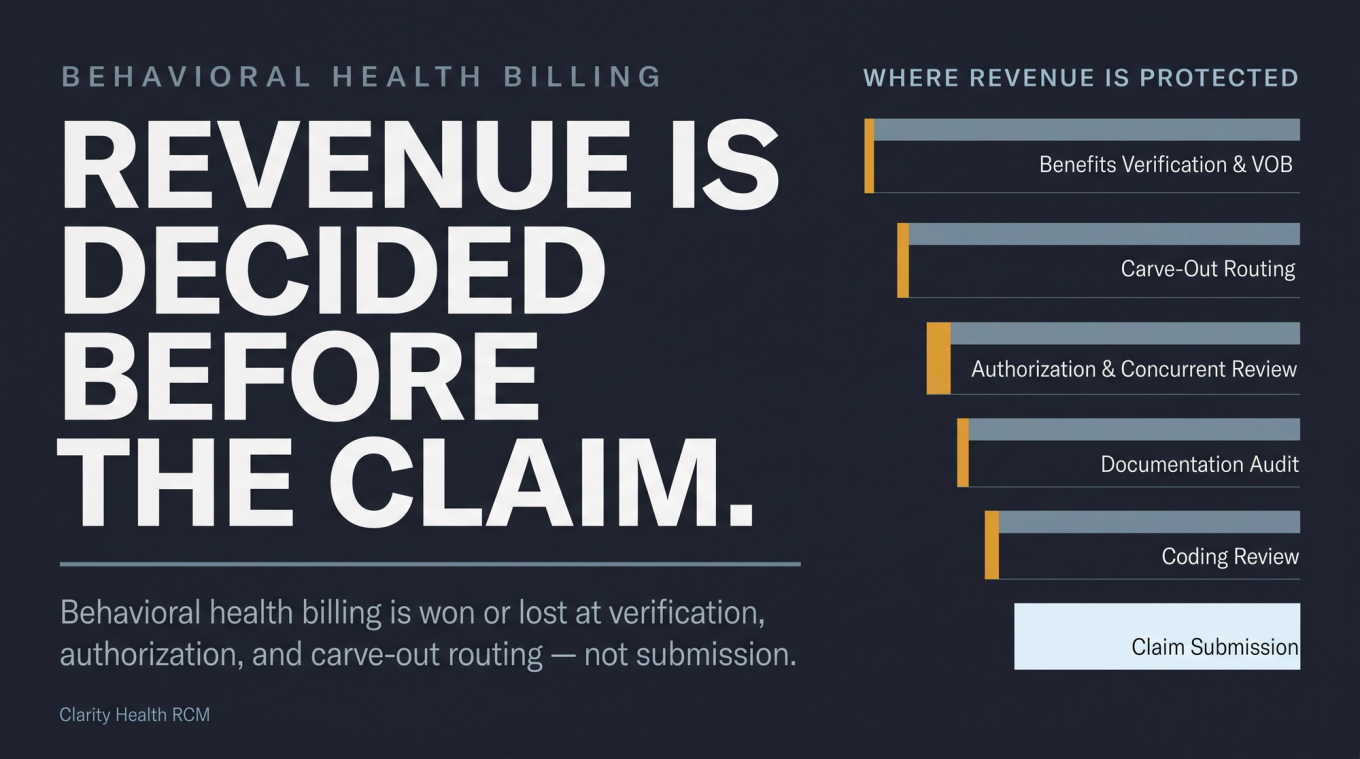
At Clarity Health RCM, our revenue-cycle work is built around behavioral health, mental health, and hospital settings, including both hospital facility billing and hospital physician billing, which are not the same work. These are areas where protecting revenue requires more than claim submission. Whenever possible, we work inside whatever EHR you already use, so billing support does not automatically mean a software migration. This page explains what a real behavioral health billing partnership looks like, what it costs, and how to take over from your current billing setup without disrupting cash flow.
What Full-Service Behavioral Health Billing Includes
Behavioral health billing services are outsourced revenue-cycle services for mental health practices, substance use disorder treatment programs, group practices, and hospital behavioral health departments. The AMA describes behavioral health as covering mental health and substance use disorders, life stressors and crises, and stress-related physical symptoms; AHRQ's integrated behavioral health definition also includes health behaviors. (American Medical Association)
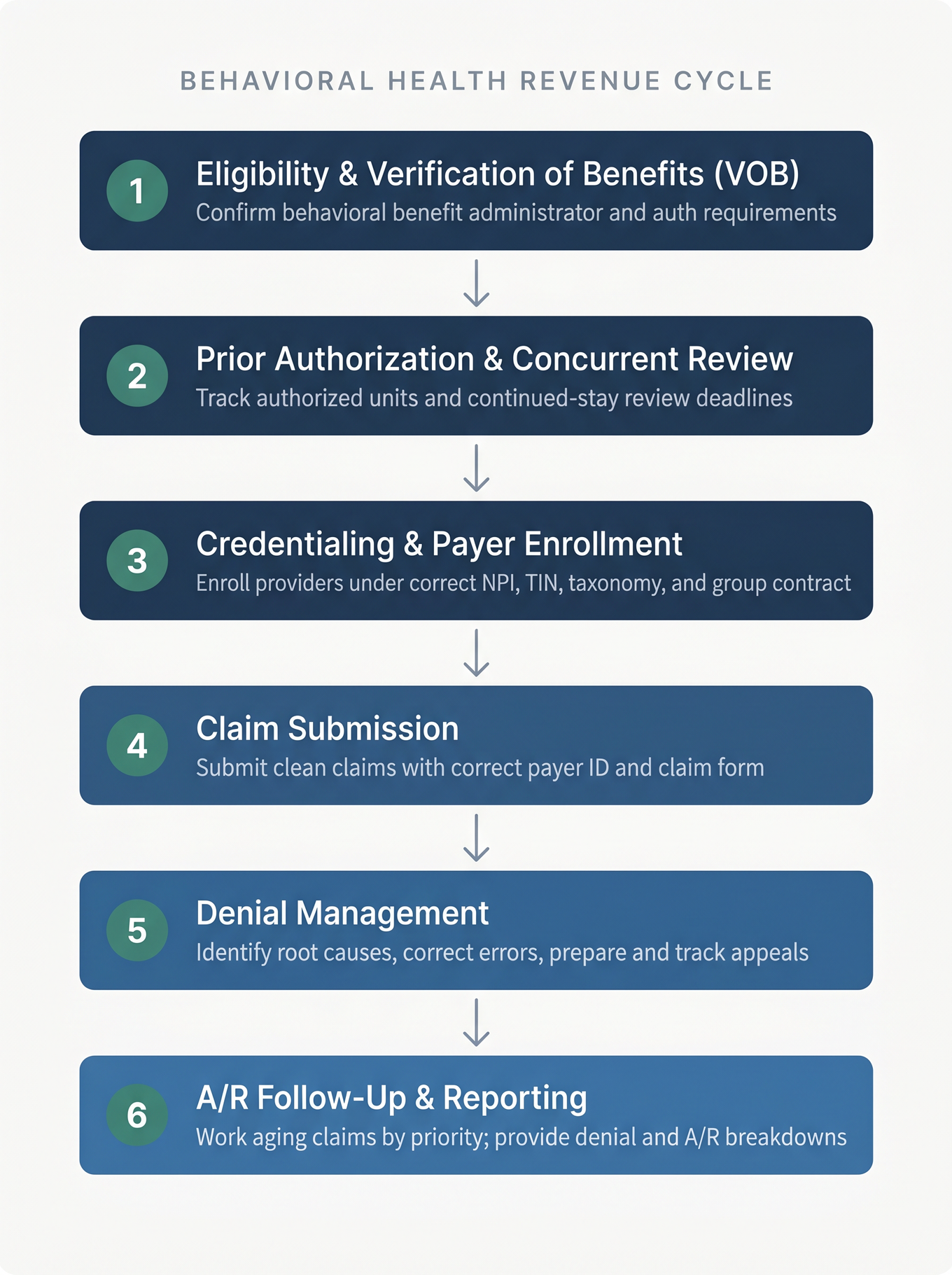
In practice, a full-service behavioral health billing operation covers:
| Service | What it involves |
|---|---|
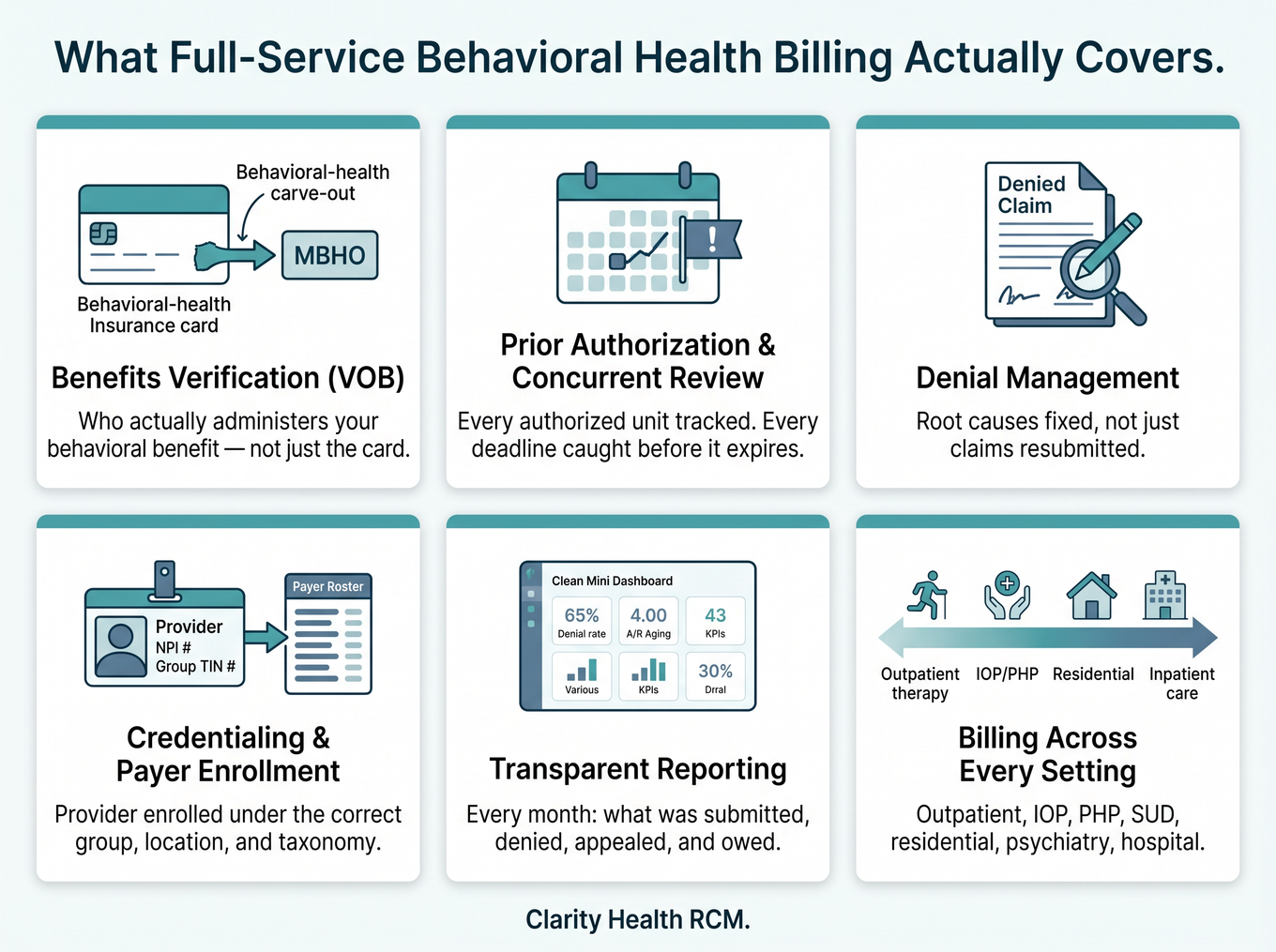
| Eligibility and verification of benefits (VOB) | Confirm active coverage, identify the behavioral health benefit administrator (not just the medical payer), confirm auth requirements, visit/unit limits, telehealth coverage, and patient responsibility before care begins |
| Prior authorization and concurrent review | Obtain payer approval before care starts, track authorized units and date spans, submit continued-stay documentation before review deadlines expire |
| Credentialing and payer enrollment | Enroll providers under the correct NPI, tax ID, location, taxonomy, and group contract; track effective dates and payer roster status |
| Coding and charge review | Review charges against payer-specific rules, time documentation requirements, level-of-care code sets, and place-of-service requirements before submission |
| Claim submission | Submit clean claims through your existing EHR workflow and clearinghouse; use CMS-1500/837P for professional claims and CMS-1450/UB-04/837I for institutional claims, with the correct form depending on provider type, enrollment, setting, and payer rules |
| Payment posting | Post ERAs and EOBs accurately; separate patient responsibility from payer responsibility; detect underpayments and contractual variances |
| Denial management | Identify denial root causes, correct errors, prepare and submit appeals, track appeal outcomes, and prevent repeat denials by payer and code |
| A/R follow-up | Work unpaid, rejected, and aging claims by payer priority; address timely-filing risk before deadlines close |
| Patient billing | Send clear patient balance statements; support patient-friendly collections while protecting sensitive diagnoses and clinical relationships |
| Reporting | Provide denial breakdowns by payer and reason, A/R aging, claims submitted and paid, appeals pending, auth issues, and action items requiring clinical team input |
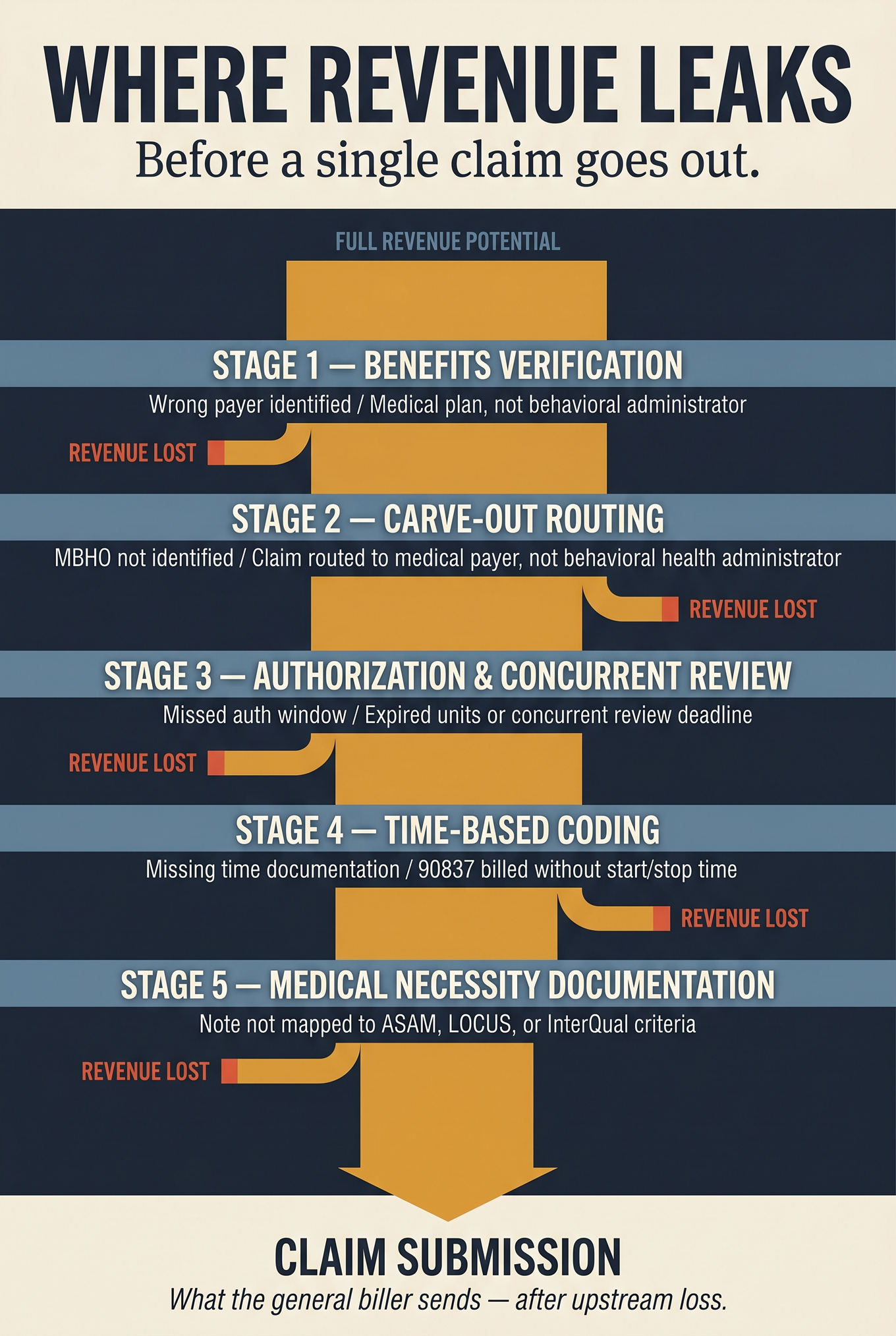
The service list is one thing. To understand why behavioral health billing demands a specialist, and why general billers consistently leave money on the table. You need to understand where revenue actually leaks in this specialty.
Where Behavioral Health Revenue Leaks Before Claims Go Out
SAMHSA's 2024 National Survey on Drug Use and Health found that 61.5 million US adults had any mental illness, 14.6 million had serious mental illness, and 48.4 million people age 12 or older had a past-year substance use disorder. (SAMHSA) The demand for behavioral health services is substantial. The billing environment that surrounds those services is unusually hostile.
KFF's 2024 analysis of HealthCare.gov marketplace plans found that insurers denied 19% of in-network claims and 37% of out-of-network claims, and fewer than 1% of denied claims were appealed. (KFF) Experian Health's 2025 State of Claims survey of 250 healthcare billing and claims professionals found that 41% of respondents reported denial rates of 10% or higher. (Health Leaders Media) A January 2026 MGMA Stat poll of 288 applicable responses found that 48% of medical group leaders put denials and appeals at the top of their revenue-cycle leak list - ahead of front-end issues, billing/collections, coding, and charge posting. (MGMA)
Behavioral health sits at the intersection of all those problems, with several complications that don't exist in other specialties.
Why Your Medical Payer Isn't Your Behavioral Health Payer
In most medical billing, the insurance card tells you where to send the claim. In behavioral health, the card can be actively misleading.
Behavioral-health benefits are frequently carved out to a separate managed behavioral health organization (MBHO) - an entity distinct from the medical payer that administers its own network, authorizations, claims, and utilization review. The major carve-out relationships your billing team must know:
- A patient with a Cigna card may have behavioral health benefits administered by Evernorth Behavioral Health. Cigna states that behavioral health benefits are administered by Evernorth and that employer plans may require prior approval. (Cigna)
- For many UnitedHealthcare plans, behavioral health credentialing, authorization, benefit verification, and claims support may run through Optum Behavioral Health / Provider Express rather than through the medical workflow on the card. (Optum)
- Carelon Behavioral Health, part of Elevance Health's Carelon services business, supports more than 61 million members across all 50 states; Anthem materials also describe behavioral health networks expanding through added Carelon Behavioral Health providers. (Carelon)
- Magellan partners with several states and Pennsylvania local governments to manage behavioral health services for more than one million Medicaid beneficiaries. (Magellan Healthcare)
The operational consequence is significant: active eligibility with the medical payer does not mean the behavioral claim will be paid. The claim, the authorization, the payer ID, the portal, the network record, and the appeal address may belong to a completely different entity, one the general biller never contacted.
When we take over a behavioral health practice's billing, one of the first things we verify is not whether the patient is "covered," but who actually administers the behavioral benefit, what payer ID handles behavioral claims, and whether the provider is loaded under the group contract with the correct behavioral health administrator.
Authorization Is Revenue Management
For outpatient therapy, a missed authorization might cost one visit. For intensive outpatient programs (IOP), partial hospitalization programs (PHP), residential treatment, or inpatient psychiatric care, a missed authorization or concurrent review can cost multiple days or an entire episode of care.
Consider an IOP: a payer authorizes six sessions between June 1 and June 14. The patient attends nine sessions because the clinical team believes continued care is medically necessary. Nobody tracks the authorization window. The payer may deny sessions seven through nine as unauthorized, even if the clinical notes are excellent, and whether that revenue is recoverable depends on the plan's retro-authorization, appeal, and timely-filing rules. That is why authorized units and date spans have to be tracked before the sessions occur. (CMS, mental health guidance)
In the AMA's 2025 survey of 1,000 practicing physicians, 95% reported that prior authorization delays necessary care and 79% said PA issues at least sometimes lead patients to abandon recommended treatment. (AMA) We think about authorization differently than a general biller does. We run an authorization calendar, not just a claim workqueue - tracking every authorized unit and date span, alerting the clinical team before concurrent review deadlines, and triggering peer-to-peer requests immediately when a denial comes back.
Time-Based Coding Is an Audit Trap
Most psychotherapy codes are time-based, and the time documentation rules are specific. CMS guidance for psychiatric billing states that psychotherapy codes should be selected based on the code closest to actual time: 90832/90833 for 16-37 minutes, 90834/90836 for 38-52 minutes, and 90837/90838 for 53 minutes or more. Psychotherapy of less than 16 minutes should not be reported. Start/stop time or total time must be documented. (CMS, psychiatric coding)
A 90837 claim with no time in the note is not a documentation preference issue. It is audit and recoupment exposure. If a practice bills 90837 for 30 patients per week and the notes say "45 minutes" or omit time entirely, a payer audit can convert months of submitted claims into retroactive denials. We review charge documentation before claims go out to catch time-documentation gaps before they become recoupment demands.
Medical Necessity in the Payer's Language
Payers do not review clinical notes in clinical language. They review them against specific medical necessity frameworks:
- ASAM Criteria for substance use disorder level-of-care decisions - covering assessment dimensions, admission criteria, continued-stay standards, and transition. Major payers including Evernorth use ASAM 4th edition for adult SUD reviews. (Evernorth, ASAM) (ASAM)
- LOCUS/CALOCUS-CASII for adult and child/adolescent mental health level-of-care decisions. (AACP, LOCUS)
- InterQual and MCG for many non-SUD behavioral health continued-stay reviews. Evernorth uses MCG Behavioral Health Guidelines for mental health level-of-care reviews. (Evernorth, MCG) Optum offers InterQual behavioral health criteria for initial and continued-stay decisions. (Optum, InterQual)
- Aetna uses ASAM, LOCUS, CALOCUS-CASII, and MCG for behavioral health precertification depending on line of business. (Aetna) Carelon uses ASAM for SUD reviews and InterQual for many non-SUD behavioral health reviews. (Carelon criteria)
A bare attendance note is much easier for a payer to challenge. A note that ties the service to the payer's medical-necessity criteria - ASAM dimensions, relapse risk, failed lower levels of care, active goals, and step-down criteria, is much easier to defend. A specialist billing team does not just appeal denied claims for medical necessity. It works with the clinical team to build documentation frameworks before the payer asks.
| General biller approach | Specialist approach |
|---|---|
| Verifies active insurance only | Verifies behavioral administrator, LOC benefit, auth requirements, payer ID, and provider loading |
| Treats therapy billing as simple CPT entry | Audits time, modality, participants, medical necessity, and payer-specific edits |
| Sends claims to the payer on the card | Identifies MBHO, carve-out, EAP, or Medicaid behavioral vendor first |
| Assumes "in network" means "will be paid" | Verifies NPI, TIN, location, taxonomy, license type, and effective date |
| Appeals with generic "services were medically necessary" | Appeals using ASAM, LOCUS, InterQual, MCG, payer criteria, and parity arguments |
| Lets clinicians manage authorizations informally | Runs a centralized auth and concurrent-review calendar |
| Posts payments without contract review | Detects underpayments, bundling errors, and SCA variances |
Understanding where revenue leaks helps clarify what a real behavioral health billing operation actually manages at every stage.
What We Own at Every Stage of Your Revenue Cycle
Behavioral health revenue cycle management begins before the first appointment and runs through the last patient balance. Here is how we work each stage.
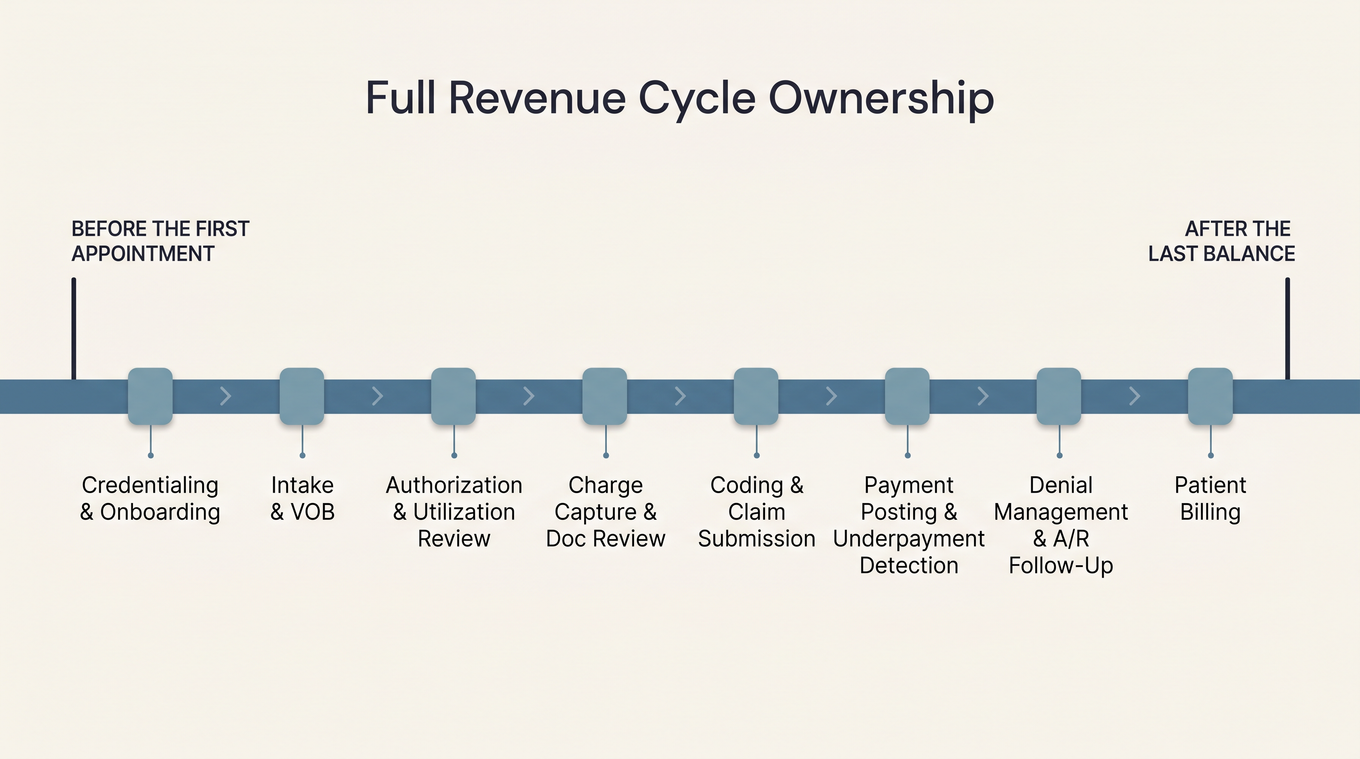
Onboarding and credentialing infrastructure. Before a single claim goes out, we build the revenue infrastructure: NPI, license, taxonomy, CAQH profile, malpractice documents, payer enrollment by TIN and location, group linkage, contracted fee schedules, telehealth status, and, inside your EHR, building the correct payer profiles with behavioral carve-out IDs separated from medical payer IDs.
Intake and VOB. A behavioral health VOB is not a simple eligibility check. It answers: who administers behavioral health for this specific plan? Is there a separate MBHO, EAP, or state carve-out? Is the provider credentialed under the exact group TIN at this service location? What is the payer ID for behavioral claims? Does this service require prior authorization? What are the visit limits, concurrent review requirements, and timely-filing deadlines? We document every VOB with the representative name and call reference number, because payers have been known to contradict prior benefit quotes, and CARC 197 denials happen when precertification or notification is documented as absent. (Medicare CARC)
Authorization and utilization review. For any level of care requiring prior authorization - IOP, PHP, residential, inpatient psychiatric hospitalization, psychological testing, OTP, or out-of-network care. We submit the initial authorization with clinical support, track authorized units and date spans, alert the clinical team before concurrent review due dates, and trigger peer-to-peer requests and appeals immediately when authorization is denied or truncated.
Charge capture and documentation review. We audit whether the note supports the code before the claim is submitted: date of service, provider identity and credentials, place of service, service modality, start/stop or total time for time-based services, diagnosis, participants, and documentation of medical necessity. (CMS, psychiatric coding)
Coding and claim submission. We select the correct claim form (CMS-1500/837P for individual professional services; UB-04/837I for facility-based IOP, PHP, residential, and hospital programs), apply the correct payer ID for behavioral versus medical claims, confirm required revenue codes for institutional billing, and scrub for payer-specific issues before submission.
Payment posting and underpayment detection. Payment posting is contract enforcement, not data entry. We compare allowed amounts against fee schedules and single-case agreements, detect bundling or downcoding, flag recoupments, and separate patient responsibility from payer responsibility accurately.
Denial management and A/R follow-up. Covered in detail below.
Patient billing. Behavioral health patient billing requires specific care: clear balances that do not unnecessarily expose sensitive diagnoses, compassionate collections escalation coordinated with clinical leadership, Good Faith Estimates for self-pay patients where required, (45 CFR 149.610) and for SUD programs, HIPAA- and 42 CFR Part 2-aware workflows that restrict use and disclosure of SUD patient records. The 2024 final rule updating Part 2 required compliance by February 16, 2026. (HHS, Part 2)
Behavioral Health Billing Across Every Setting
Behavioral health is not one service line. Outpatient therapy, psychiatry, IOP, PHP, residential SUD treatment, and hospital behavioral health departments operate under different claim forms, different code sets, different authorization logic, and different documentation standards. A billing team that can handle one may not understand the others.
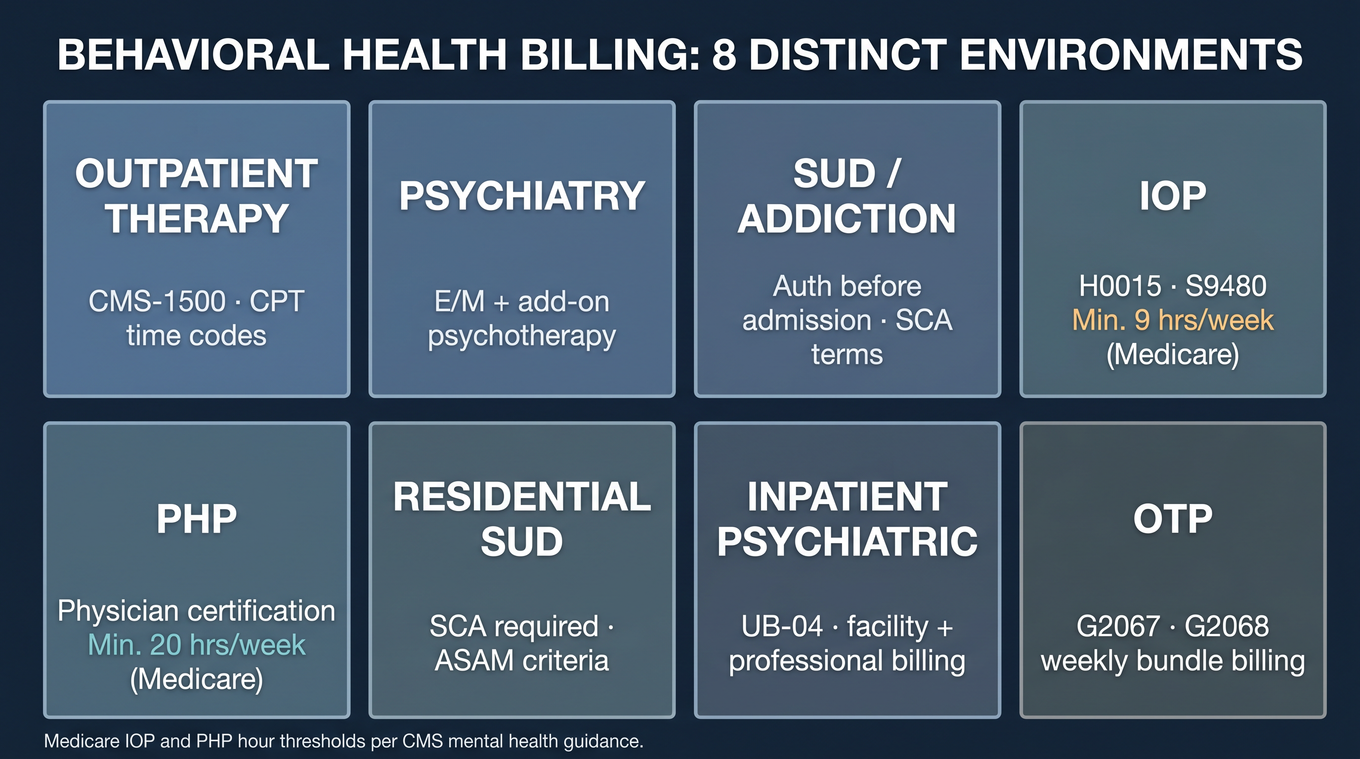
| Setting | What typically breaks | What we handle |
|---|---|---|
| Outpatient mental health / therapy | Eligibility not verified for behavioral carve-out; time not documented; provider not credentialed at group level; telehealth POS mismatch | Behavioral VOB, provider enrollment, CPT time compliance, telehealth grid by payer |
| Psychiatry and medication management | E/M codes and psychotherapy add-ons (90833, 90836, 90838) not separately documented; prescribing via telehealth without compliance review | Coding review, add-on documentation, E/M complexity audit |
| SUD / addiction treatment | VOB at wrong payer; authorization not obtained before admission; concurrent review missed; OON patients with no written SCA terms | Full VOB with behavioral administrator, auth tracking, concurrent-review calendar, SCA negotiation support |
| IOP | Authorization tied to fewer sessions than attendance; no concurrent-review calendar; IOP billed with outpatient codes instead of H0015 or S9480 | Auth/census matching, level-of-care-specific coding, facility vs professional determination. Medicare IOP: minimum 9 hours per week. (CMS, mental health guidance) |
| PHP | Billed as individual therapy visits instead of facility PHP; missing physician certification; wrong institutional condition codes; concurrent review failures | Correct PHP program billing setup, physician certification workflow, facility billing where applicable. Medicare PHP: physician certifies need for at least 20 hours per week of therapeutic services. (CMS, mental health guidance) |
| Residential SUD | No single-case agreement; payer denies continued stay as custodial; documentation shows attendance not active treatment need | SCA negotiation before admission, medical necessity documentation aligned to ASAM criteria, concurrent-review workflow |
| Inpatient psychiatric hospital | Authorization not aligned to admission date; professional and facility claims not coordinated; discharge planning not documented | Auth coordination, facility + professional split billing, continued-stay documentation support |
| Opioid treatment programs (OTP) | Duplicate weekly bundle billing; wrong take-home medication add-on; counseling add-on without time documentation | OTP calendar management, Medicare G-code billing - CMS's 2026 national rates, before locality adjustment, include $277.29 for the G2067 methadone weekly bundle and $296.57 for the G2068 oral buprenorphine weekly bundle. (CMS, OTP payment rates) |
For SUD programs specifically, we build 42 CFR Part 2-aware workflows into every layer of the billing process: payer communication, appeals packaging, documentation handling, and patient-identifying information in billing records. (HHS, Part 2)
Telehealth behavioral health billing adds another payer-specific layer: Medicare patients can permanently receive behavioral health services at home with no geographic restriction, and the in-person visit requirement for Medicare behavioral telehealth is waived through December 31, 2027. (HHS Telehealth) Commercial payers, Medicaid, and Medicare Advantage each apply different place-of-service codes (POS 02 for telehealth outside the home; POS 10 for telehealth in the patient's home), modifier requirements, and audio-only coverage rules. We maintain a payer-by-payer telehealth grid rather than assuming one rule applies across all plans.
We Work Inside Your Existing EHR

Switching billing support should not mean switching your EHR. Whenever possible, we work inside the system you already use. We are experienced across the major platforms independent practices, group practices, and hospitals run on, including Tebra (formerly Kareo, which merged with PatientPop in 2021 to form Tebra (Tebra)), as well as larger hospital and enterprise systems like Epic and NextGen. We are not limited to one piece of software. The work that protects your revenue, payer profile setup, behavioral carve-out routing, clearinghouse configuration, ERA posting, and claim scrubbing, is the same discipline regardless of the system it runs in.
We confirm compatibility with your specific setup during the initial revenue-cycle review before making any transition recommendations. We do not require software migration as a condition of taking over your billing.
This matters because the fear of EHR migration is often larger than the pain of bad billing, and it shouldn't be. Your providers know your system. Your staff knows your system. Changing billing companies should feel like gaining expertise, not losing infrastructure.
But even with no forced software change, the question we hear most often from practices evaluating a billing transition is this: "What happens to our cash flow during the switch?"
How to Switch Billing Companies Without Disrupting Cash Flow
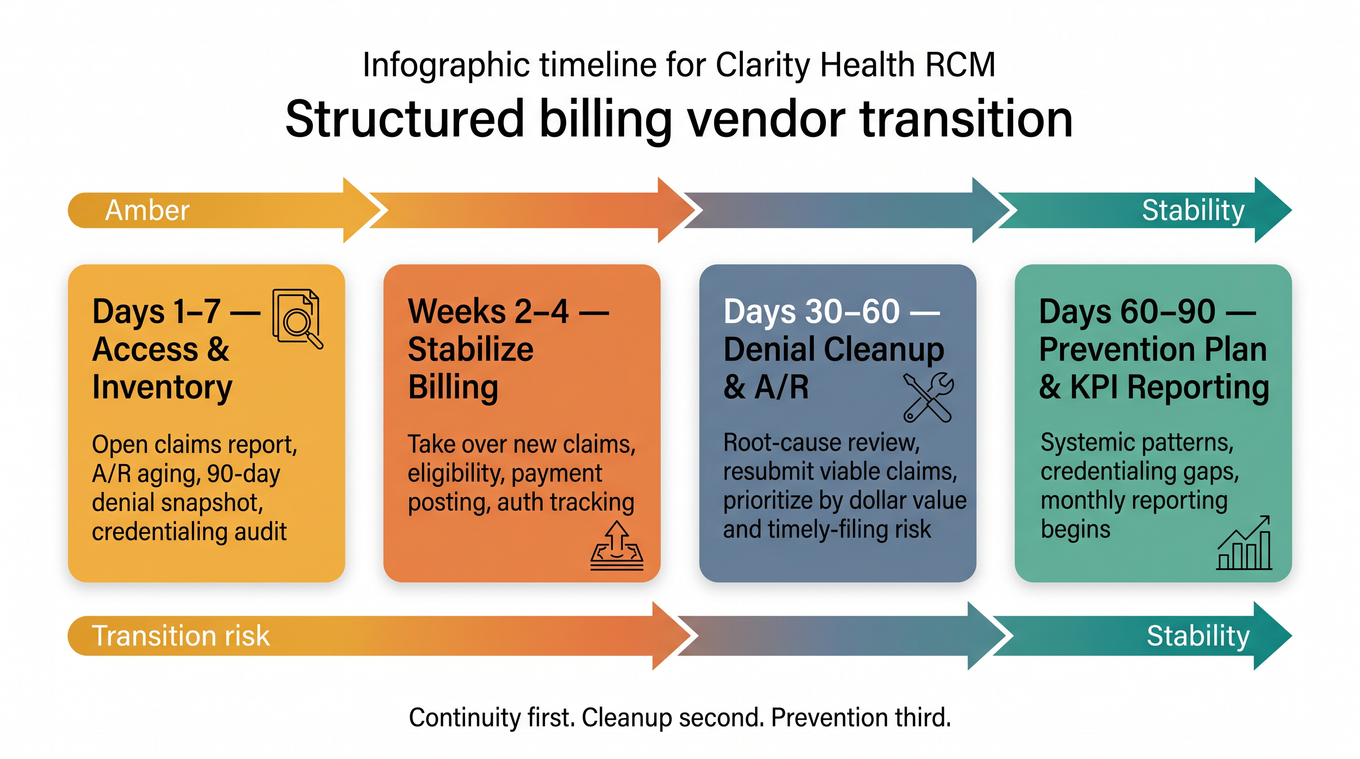
Switching billing vendors is a high-stakes transition. Claims can fall through gaps if open A/R is not transferred correctly. Timely-filing deadlines continue to run while the transition is underway. Payer logins, clearinghouse credentials, ERA setups, and credentialing records all need to be confirmed or rebuilt. And the previous biller may or may not cooperate.
We structure every behavioral health billing transition around one principle: continuity first, cleanup second, prevention third.
Days 1-7: Access and inventory. We obtain access to your EHR, clearinghouse, and payer portals. We pull an open-claims report, an A/R aging by payer and age bucket, a denial snapshot from the last 90 days, and a credentialing status audit for every active provider. Nothing is touched until we know exactly what exists.
Weeks 2-4: Stabilize current billing. We take over new claim submission, eligibility verification, payment posting, and active authorization tracking. The goal in the first month is not to fix everything. It is to keep revenue moving without gaps. Weekly calls with your team confirm what is working and what needs attention.
Days 30-60: Denial root-cause review and A/R cleanup. Once current billing is stable, we begin working the denial backlog: identifying root causes by payer, code, and level of care; correcting and resubmitting where viable; and prioritizing A/R by dollar value, payer, and timely-filing risk. Not every old claim is recoverable, filing limits and appeal deadlines are real constraints, but the audit identifies what is realistically worth pursuing and what should be written off with documentation rather than abandoned silently.
Days 60-90: Prevention plan, KPI baseline, and reporting cadence. By day 60, we have enough data to identify systemic patterns: which payer denies which code most frequently, which providers have credentialing gaps, which levels of care have authorization leakage. We build the prevention plan from that data, not from assumptions. Monthly KPI reporting begins at this stage, showing denial breakdown, A/R aging, clean claim rate, and action items requiring your team's input.
This structure gives your practice visibility into every phase of the transition, not a promise that nothing will go wrong, but a framework that catches problems early and resolves them before they affect cash flow.
Denial Management and A/R Follow-Up for Behavioral Health
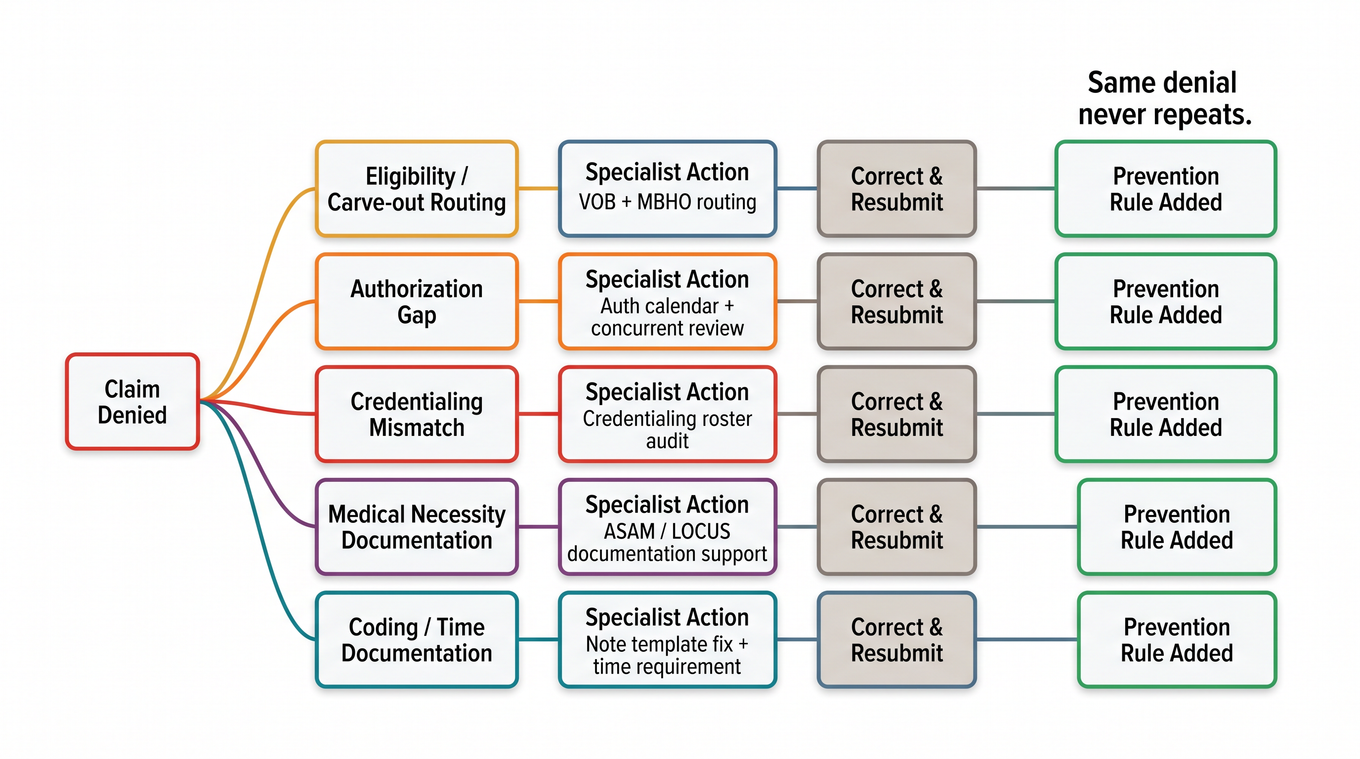
Denial management in behavioral health is not resubmitting the same claim. It is identifying why a denial happened, correcting the root cause, and preventing the same denial from recurring next month.
The most expensive behavioral health denials are rarely coding errors. They are eligibility failures, authorization gaps, payer-routing mistakes, credentialing mismatches, and documentation-versus-medical-necessity problems. Here are the patterns we see most often and what a specialist does differently:
| Denial pattern | Root cause | Specialist approach |
|---|---|---|
| Claim denied by medical payer, not covered | Behavioral benefit is carved out | VOB identifies MBHO and behavioral payer ID before the first visit |
| CARC 197 - no authorization | Authorization absent, wrong LOC, expired, or auth number omitted | Authorization matrix, auth calendar, claim scrub for auth number (Medicare CARC) |
| Medical necessity denial | Documentation does not map to ASAM, LOCUS, InterQual, or MCG criteria | Criteria-based documentation support, UR packets, peer-to-peer preparation |
| Denial after IOP/PHP/residential days | Concurrent review missed or continued stay denied | Concurrent-review calendar with daily tracking; immediate escalation on denials |
| Provider out of network | Credentialing effective date, TIN, location, or taxonomy mismatch | Credentialing roster audit and payer enrollment tracker before billing begins |
| 90837 downcoded or denied | Time missing or under 53 minutes documented | Note template review; require start/stop or total time documentation |
| 90833/90836/90838 denied | E/M and psychotherapy not separately documented | Separate E/M elements from psychotherapy time and intervention in note structure |
| Group therapy denied | Benefit exclusion or no group topic, attendance, or patient-specific documentation | Group note template and benefit validation by payer |
| Telehealth denied | POS 02 vs POS 10 error, missing modifier, or audio-only not covered | Payer-by-payer telehealth grid |
| PHP/IOP billed as outpatient therapy | Wrong claim type or code set | Level-of-care-specific claim map |
| Residential denied as custodial | Notes show housing and supervision, not active clinical treatment need | Medical necessity documentation aligned to ASAM criteria |
| Timely filing | Wrong payer chase, delayed credentialing, or auth dispute | Payer routing at intake and aging workqueues by filing deadline |
When denials raise parity concerns, for instance, a payer applying prior authorization or concurrent review more aggressively to behavioral health than to comparable medical or surgical care. We help organize the billing record and payer communication needed for review or appeal. We do not provide legal advice, but we recognize when a denial pattern needs escalation.
Federal agencies have noted that mental health parity obligations under the Mental Health Parity and Addiction Equity Act remain relevant, including comparative-analysis requirements added by the Consolidated Appropriations Act of 2021, even as federal departments announced they would not enforce certain new portions of the 2024 final rule during litigation and reconsideration. (DOL, MHPAEA enforcement) For behavioral health practices with ACA-plan patients, internal appeals and external review rights may be available when a claim denial is upheld internally. (CMS, appeals)
No Black-Box Billing, What Transparent Reporting Looks Like
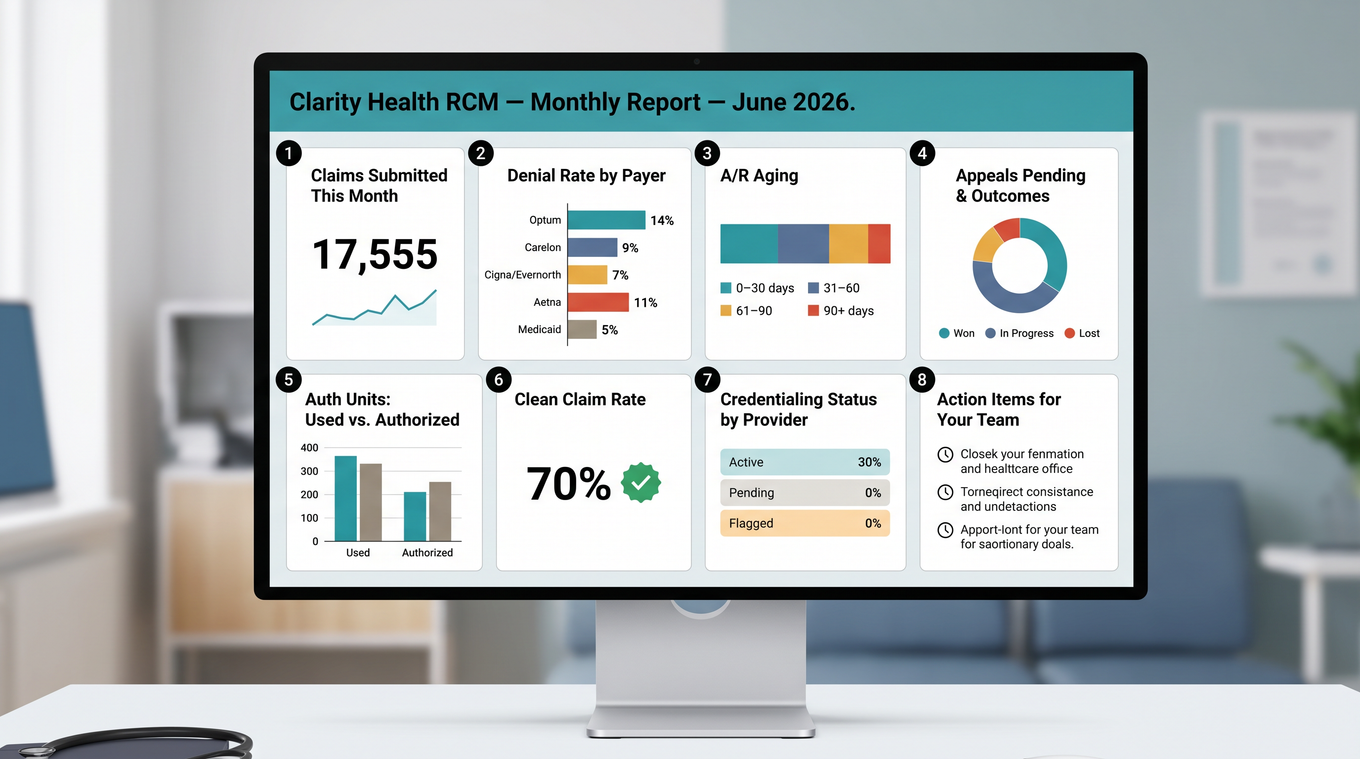
Many behavioral health practices have experienced a version of the same story: they hired a billing company, claims were submitted, the reports stopped coming, and by the time they noticed the problem, there was six months of aged A/R that nobody had worked. A black-box biller is one of the fastest ways a practice ends up in a billing crisis.
Transparent billing means you know what is being submitted, what has been paid, what has been denied, what is being appealed, and what requires action from your clinical or administrative team. Every month, without having to ask.
At minimum, a behavioral health billing partner should provide:
- Weekly open-claims summary during the transition period
- Denial report by payer and reason, not a blended number, but a breakdown that shows which payers deny which codes and at what rate
- A/R aging report segmented by 0-30, 31-60, 61-90, and 90+ days, by payer and level of care
- Claims submitted and paid for the period, with comparison to prior periods
- Appeals pending and appeal outcomes by denial type
- Authorization issues - authorized days versus used days, concurrent reviews due, upcoming expiration dates
- Patient balance aging and collection status
- Credentialing status - active, pending, expired, or flagged payer enrollments
- Action items requiring your team - clinical documentation requests, payer portals that need your login, patient information corrections
Reporting should be a two-way conversation. We use the monthly KPI review to show you where performance is improving, where it is not, and what the next 30 days of work should prioritize. If your denial rate for Optum/UHC behavioral claims is higher than other payers, that tells us something specific about documentation, credentialing, or claim routing, and we can act on it.
How to Choose a Behavioral Health Billing Partner
Choosing a behavioral health billing company is not an administrative decision. It directly affects your cash flow, your providers' ability to get paid for services already delivered, and the experience patients have when they receive billing statements from a practice they trust with their mental health or recovery.
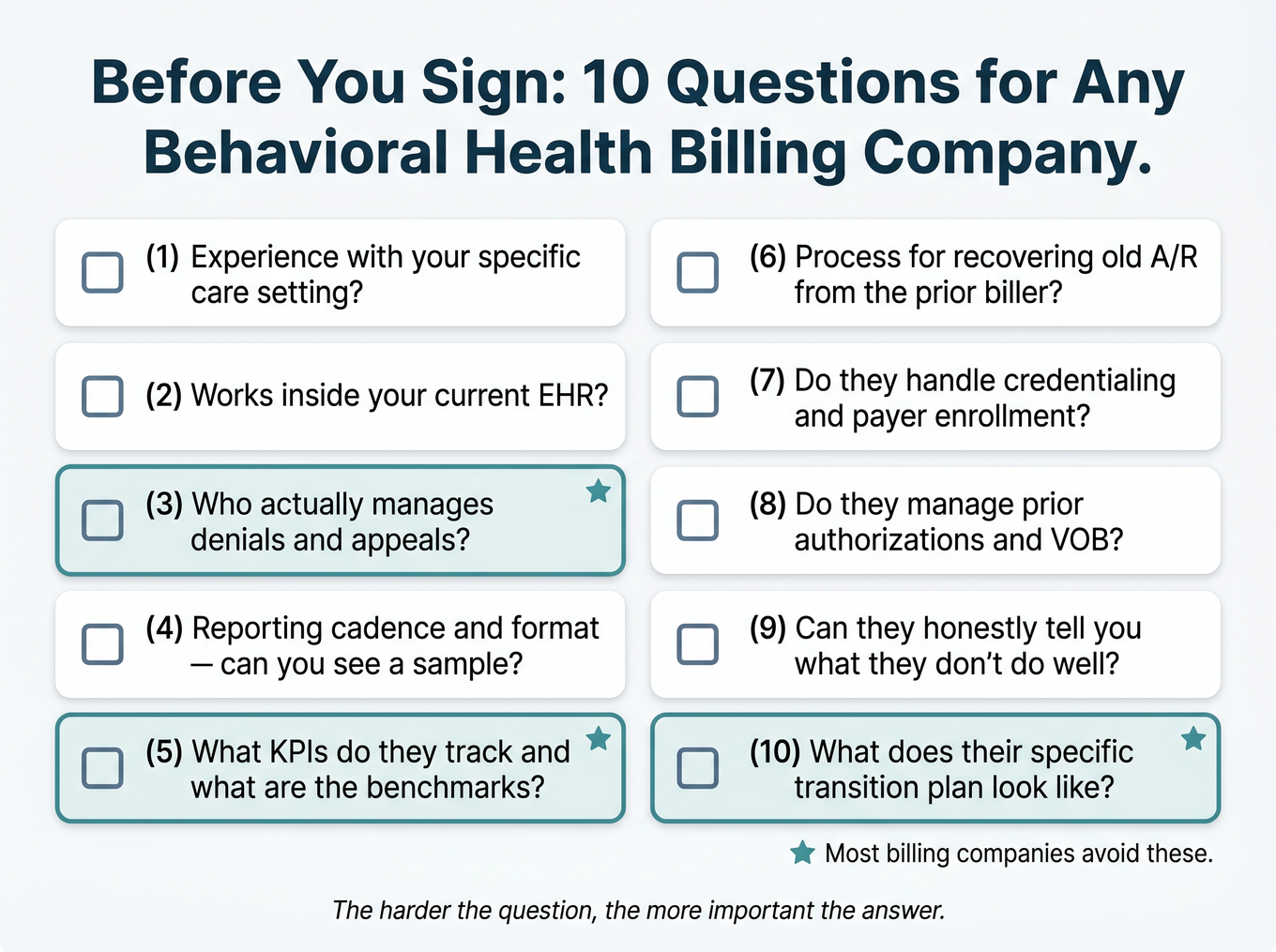
Before selecting a partner, ask these questions of any behavioral health billing company, including us:
- Have you billed for our exact setting? Outpatient therapy, psychiatry, SUD IOP/PHP, residential treatment, and hospital behavioral health are each different billing environments. Ask for specific experience, not general behavioral health claims.
- Can you work inside our current EHR? If the answer is "we prefer our own platform," understand what that migration involves before committing.
- Who manages denials and appeals? This is the question most billing company sales conversations avoid. The answer tells you whether denials will be worked or aged out.
- How often will we see reports, and what format? Ask to see a sample monthly report from an existing client. If they can't share a redacted example, that is information.
- What KPIs do you track, and what are your benchmarks? Clean claim rate, first-pass payment rate, denial rate by category, net collection rate, days in A/R, AR over 90 days, authorization capture rate, and concurrent review on-time rate are the core metrics for behavioral health billing. (Tebra, selecting a billing service)
- How do you handle old A/R from the current biller? Ask specifically about timely-filing deadlines, what can and cannot be recovered, and the process for writing off claims that are genuinely past recovery.
- Do you support credentialing and payer enrollment? Credentialing is a revenue gate. Provider enrollment delays directly create denials. Ask who handles it and what the timeline expectations are.
- Do you support prior authorization and VOB? For SUD, IOP, PHP, and residential programs, auth management is central, not an add-on service.
- What questions should we ask before hiring? A billing company that can give you an honest answer to this question, including what they don't do well, is demonstrating the kind of transparency you actually want in a billing partner. (Tebra, questions before hiring)
- What does your transition plan look like? Ask for the specific steps. If the answer is vague, the transition will be too.
What Behavioral Health Billing Services Cost
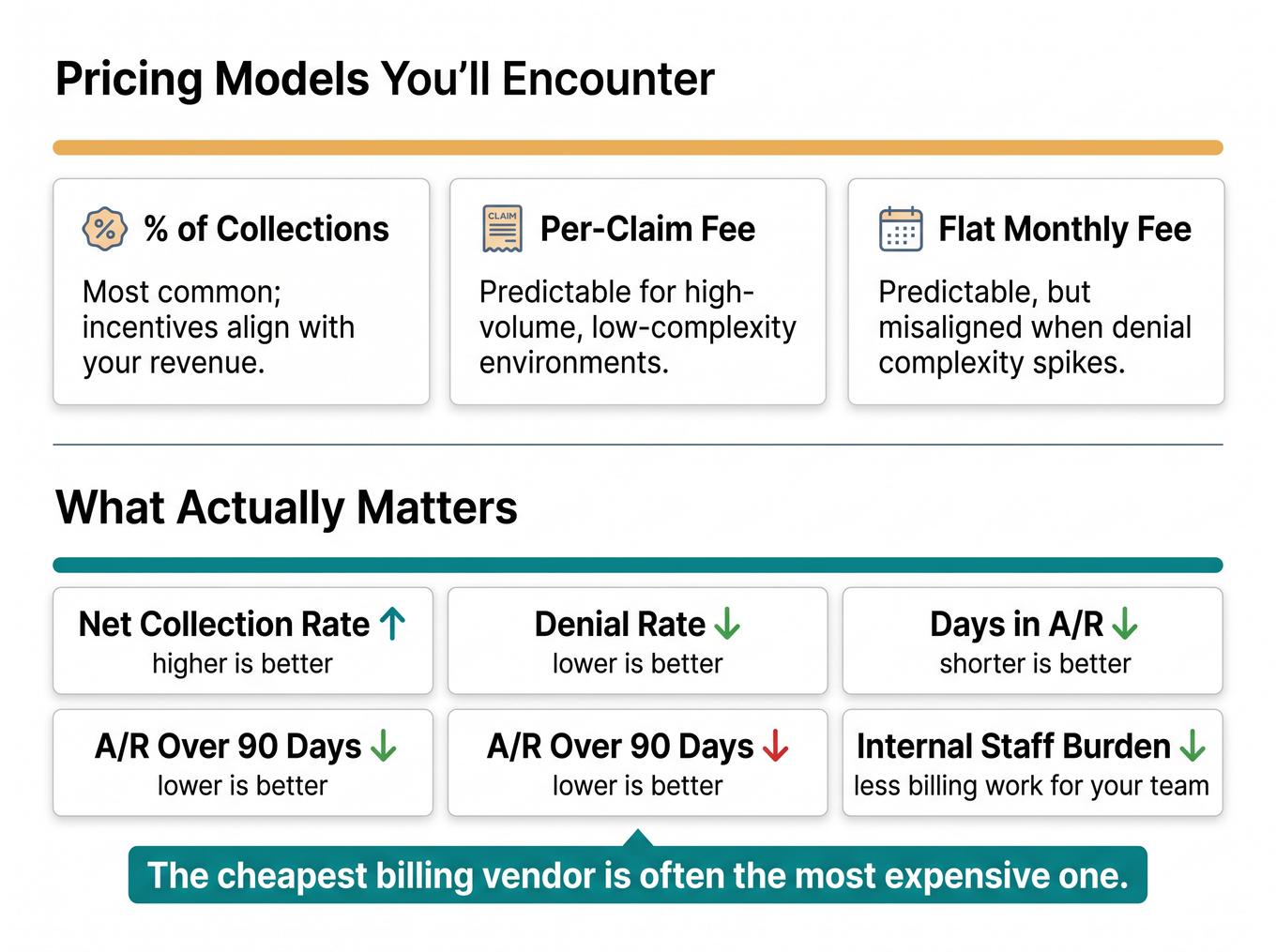
Behavioral health billing pricing should be evaluated against what you actually collect, not what you pay.
Most outsourced billing companies use a percentage-of-collections model. General medical billing buyer guides commonly put percentage-based fees in the single digits to under 10%, and for behavioral health the right rate depends on claim volume, payer mix, authorization work, credentialing, patient billing, old A/R, and whether the scope is full-service or co-managed. The rate alone is not the metric that matters. (Tebra, billing company questions)
The comparison that actually matters is:
- Net collection rate, what percentage of your collectible contracted revenue is being collected
- Denial rate, are denials declining or staying flat
- Days in A/R, is the cycle shortening over time
- A/R over 90 days, is old A/R being resolved or aging further
- Internal burden, how much of your staff's time is going to billing-related tasks that should be handled externally
The cheapest billing vendor is often the one that leaves the most money in aged A/R, unappealed denials, and unworked payer discrepancies. We can discuss pricing during an initial revenue cycle review, after we understand your claim volume, payer mix, current denial patterns, EHR system, and which services you want us to own.
Other pricing models you may encounter include per-claim pricing (more common for high-volume, lower-complexity environments), flat monthly fees (predictable but misaligned when denial complexity spikes), and hybrid/co-managed arrangements (useful when you want to keep internal billing staff but need specific support for denials, A/R, authorization, credentialing, or patient billing). We offer both full-service billing and co-managed options, depending on what your practice actually needs.
Frequently Asked Questions About Behavioral Health Billing Services
What are behavioral health billing services?
Behavioral health billing services are outsourced revenue-cycle services for mental health practices, substance use disorder treatment programs, psychiatry groups, group practices, and hospital behavioral health departments. Services can include eligibility verification, verification of benefits, prior authorization management, credentialing and payer enrollment, coding review, claim submission, payment posting, denial management, appeals, A/R follow-up, patient billing, and financial reporting.
Why is behavioral health billing harder than general medical billing?
Behavioral health billing is harder because payment depends on behavioral-specific benefit verification, payer carve-out routing, authorization and concurrent review management, provider credentialing under the correct group and location, time-based coding compliance, medical necessity documentation aligned to ASAM, LOCUS, InterQual, or MCG frameworks, and level-of-care-specific claim forms and code sets. Most of the ways a behavioral health practice loses revenue happen before the claim is submitted, not in the claim itself.
How much do behavioral health billing services cost?
Pricing varies based on claim volume, payer mix, specialty complexity, service scope, EHR system, old A/R, denial volume, credentialing needs, and whether you need full-service or co-managed billing. Most outsourced billing companies use a percentage-of-collections model. For behavioral health, the percentage alone is the wrong metric - net collection rate, denial rate, A/R days, and reporting quality are better comparisons. We discuss pricing after reviewing your current workflow and identifying the right scope.
Do we have to switch EHRs?
No. We work inside your existing EHR whenever possible. Billing support and software are separate. You should not have to rebuild your clinical infrastructure to fix your billing.
What EHRs do you work in?
We are experienced across the platforms practices and hospitals actually run on. That includes Tebra (formerly Kareo, which merged with PatientPop in 2021 to form Tebra (Tebra)) for independent and group practices, and larger systems like Epic and NextGen on the hospital side. We are not limited to one piece of software. If your team already works in a system, our goal is to operate inside it, not move you off it.
Can you take over from our current billing company?
Yes. Every billing transition starts with an access and inventory phase: we review open claims, A/R aging, active denials, credentialing status, payer enrollment records, and clearinghouse setup before a single new claim goes out. The goal is continuity first, cleanup second, and prevention third.
Can you help with old A/R?
Yes, but not every old claim is recoverable. We audit aged A/R by payer, claim value, denial reason, timely-filing deadline status, and appeal opportunity, then prioritize what is realistically pursuable. Timely-filing limits vary by payer and plan, and some old claims will have passed the point of recovery. We are honest about that from the start.
Do you handle denied behavioral health claims?
Yes. Denial management is one of the core services we provide. We identify denial root causes, correct issues, prepare and submit appeals, track outcomes, and work to prevent the same denials from recurring. Good denial management does not just chase individual claims. It identifies why the same pattern keeps appearing across a payer or provider.
Do you handle prior authorizations and concurrent reviews?
Yes, where applicable. Prior authorization requirements vary by payer, plan, level of care, provider type, and state. For IOP, PHP, residential treatment, inpatient psychiatric, psychological testing, and OTP services, authorization and concurrent review management is central to protecting revenue, not an administrative sidebar.
Can you bill for SUD, IOP, PHP, and residential treatment?
Yes. We support billing for behavioral-health and addiction-treatment programs, including VOB, authorization tracking, utilization-review support, denial appeals, A/R follow-up, and patient/family billing. For SUD programs, we align billing workflows with HIPAA and 42 CFR Part 2 requirements. (HHS, Part 2)
What reports should a behavioral health billing company provide?
At minimum: claims submitted and paid, denial breakdown by reason and payer, A/R aging (segmented by payer and age bucket), A/R over 90 days, appeals pending and outcomes, patient balance aging, credentialing status by provider, authorization issues, and action items that require input from your clinical or administrative team.
What should we ask before hiring a behavioral health billing company?
Ask about specific experience with your setting (not just "behavioral health" generally), EHR compatibility, who manages denials and appeals, reporting cadence and format, KPIs tracked, A/R recovery process, credentialing support, authorization and VOB capabilities, patient billing approach, pricing model and what is included, data ownership, and transition plan. (Tebra, questions before hiring)
Ready to Stop Managing Billing by Exception?

Behavioral health providers should not have to manage their billing through a constant cycle of chasing denied claims, wondering why A/R keeps growing, and hoping the numbers eventually stabilize. That cycle is the sign of a billing process that is reactive instead of managed.
Our team provides full-service or co-managed behavioral health billing for mental health practices, SUD and addiction treatment programs, psychiatry groups, group practices, and hospitals - built around the specific payer friction, authorization requirements, documentation standards, and denial patterns that make behavioral health billing different from every other specialty.
Whenever possible, we work inside your existing EHR, whatever system that is. We bring a structured transition plan that protects cash flow during the switch. We report on what is being worked, what is being appealed, and what needs action, not a black-box summary once a quarter.
Book a Behavioral Health Revenue Cycle Review. We'll review your current A/R aging, denial patterns, payer mix, credentialing status, and billing workflow, then recommend the right scope: full-service billing, co-managed RCM, denial and A/R cleanup, credentialing support, or a structured transition from your current vendor.