Cigna Evernorth Behavioral Billing: Two Names, One Claim
August 27, 2026 · 60 min read
The patient handed over a Cigna card. Your contract file and your practice management system both say Cigna. Then the paperwork comes back carrying a name nobody at your practice has ever signed anything with: Evernorth. Or nothing comes back at all - the clearinghouse reported the claim accepted, the portal you have always used shows no record of it, and the date of service is quietly getting older while you try to work out who to call.
Two readings of that are both wrong. The first is it's just a rebrand, ignore it - which sends you looking in a portal that structurally will not show your claim, and mailing appeals to an address that will delay them. The second is this must be a different insurer, we're probably not contracted - which sends you off to re-credential with a behavioral network you are already in, during a window when new applications are not being accepted anyway. The accurate reading: same contract, same electronic payer ID, a different portal, a different appeal destination, and - for some employer groups - a third party who is neither Cigna nor Evernorth.
Untangling a Cigna-branded claim that went somewhere Cigna-shaped but wrong is one of the more common things practices hand us. This page covers which entity owns the claim and which does not, when payer ID 62308 is the right route and when the card overrides it, which portal displays behavioral claims and remittances, why the Employee Assistance Program is a separate product rather than therapy with an extra code, what a wrong-entity denial looks like on the remittance, and where behavioral appeals go now that the instruction changed in June 2026. Every payer rule below was checked against Evernorth's and Cigna's own provider-facing material on August 17, 2026, and the things that were still moving on that date are named at the end.
Behavioral benefits are frequently administered by a company other than the one on the front of the card. This page is about the narrower case where the administrator has its own name, its own portal, and its own appeals unit, and where the practice can hold a Cigna card, bill a Cigna-looking route, and still be working with the wrong entity.
What Evernorth Behavioral Health is - and what the 2021 name change did not do
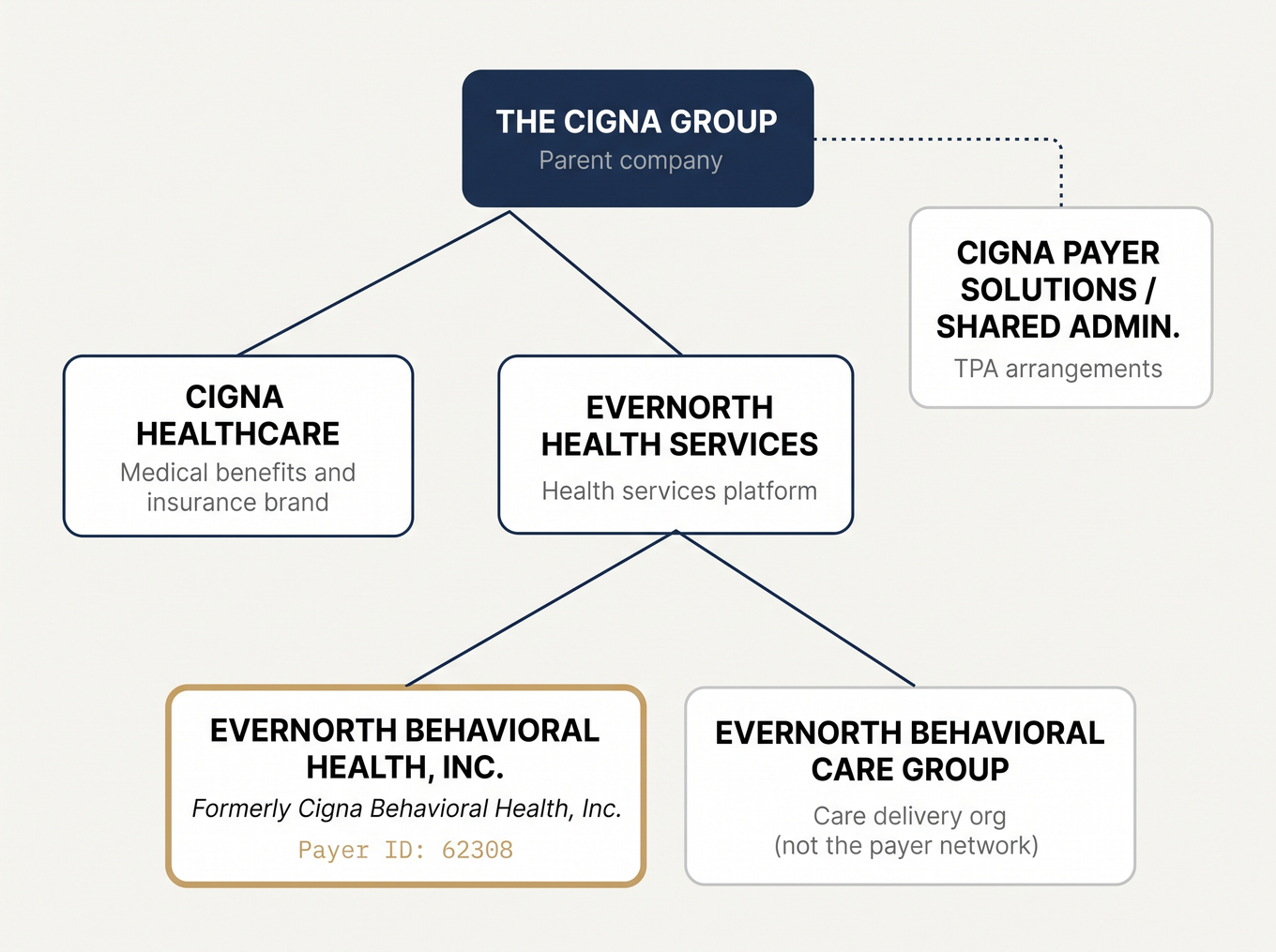
Cigna Behavioral Health, Inc. changed its name to Evernorth Behavioral Health, Inc., effective September 1, 2021. It was a name change to an existing company, not a migration to a new payer.
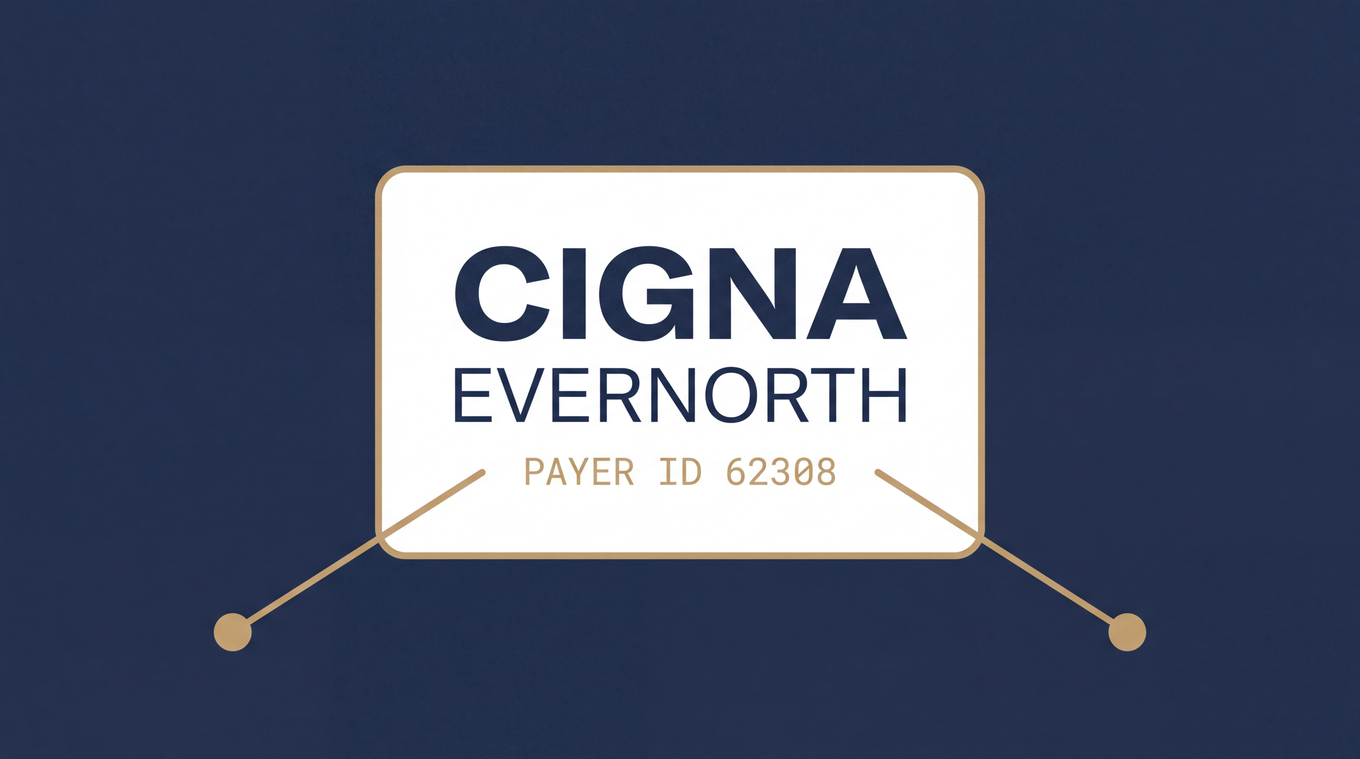
Evernorth's own provider FAQ is specific about what the change did not touch. It did not replace existing provider contracts. It did not change the electronic payer ID, which remained 62308. It did not change the claim mailing addresses, phone numbers, or fax numbers then in use. It did not alter the network status created by an existing behavioral agreement. And it did not invalidate the credentials used to access the provider sites (Evernorth provider FAQ). The change applied to the behavioral network - not to Cigna medical contracts.
None of that means operational details have stayed frozen since 2021. Portals, forms, authorization tables, claim policies, state rules, third-party administrators, and group-specific card instructions have all continued to change in the years since. The rename was not a fresh credentialing or payer-ID migration, but current claim handling still has to follow current instructions. Reading it as "nothing changed" is how a practice ends up working from a 2021-era workflow in 2026.
An explanation of payment can show either name, or both. Providers contract with the renamed behavioral entity, so an EOP naming Evernorth on a claim for a patient holding a Cigna card is the system working correctly, not evidence of a misrouted claim.
The entities you can actually meet
More than two names are in play, and they sit at different layers. Each one means something different for a claim.
| What you see on a card, portal, contract, EOP, or website | What it is operationally | What you should not assume |
|---|---|---|
| The Cigna Group | The parent company. Current corporate materials present Cigna Healthcare and Evernorth Health Services as its principal operating divisions (The Cigna Group) | It is not a claim-submission instruction |
| Cigna Healthcare | The benefits and insurance brand on many medical plan cards. It may administer a self-funded employer plan rather than insure the risk itself | A Cigna logo does not prove who pays the claim, where behavioral claims route, whether the product is fully insured, or whether you are in network for this member |
| Evernorth Health Services | The health-services platform within The Cigna Group, containing several businesses and capabilities (Evernorth launch materials) | It is broader than behavioral health, and is not a single universal payer ID or claim center |
| Evernorth Behavioral Health, Inc. | The company formerly named Cigna Behavioral Health, Inc. - the behavioral network and administrator addressed in the behavioral provider guide. It administers behavioral benefits for Cigna customers, and can also sell behavioral solutions to employer groups whose medical benefit sits elsewhere | It is not a marketing nickname with no operational consequences. Its portal, agreement, authorization processes, and remittance visibility all matter |
| Cigna Behavioral Health, Inc. | The former name, changed effective September 1, 2021. Old agreements, habits, web pages, EOPs, and payer master tables still carry it | Seeing the old name does not by itself mean the claim is stale or invalid |
| Cigna Payer Solutions / Shared Administration | Arrangements where a third-party administrator or another payer uses a Cigna or Evernorth network or services. The TPA may hold eligibility, administer benefits, issue cards, pay claims, and handle customer service (Payer Solutions) | The Cigna or Evernorth logo does not prove that Cigna or Evernorth is the financial payer, or that the standard claim address applies |
| Evernorth Behavioral Care Group | A care-delivery organization within the wider Evernorth ecosystem, with its own clinics, partnerships, and patient-billing arrangements (Evernorth behavioral care) | Do not conflate it with Evernorth Behavioral Health's national provider-network administration. The similar names produce a lot of irrelevant search results |
Evernorth Behavioral Health is the renamed Cigna Behavioral Health organization that administers the behavioral network and benefits for many Cigna members - and for some groups whose medical plan is not Cigna at all - which means the card brand, the benefit administrator, the claim receiver, and the claim payer are not always the same thing.
Why a Cigna card doesn't tell you where the claim goes
The card is where routing starts, not where it ends. Treating it as a complete instruction produces a large share of behavioral denials.
A member's card can disclose or imply the member and subscriber identifiers, the group or account number, the plan or product type, a behavioral health contact number, an electronic payer or claim-submission instruction, a paper claim address, a precertification or utilization-management contact, the presence of a third-party administrator or a "Shared Administration" arrangement, the network name or logo, and sometimes an employer-specific service number (Cigna ID card resources).
Evernorth states plainly that the ID card is not itself a guarantee of eligibility or payment. The same guidance flags a data-entry trap worth training staff on: the digit zero and the letter O are easy to confuse in member identifiers, and the result is an invalid-ID response that looks like an eligibility problem and is not one (Behavioral Administrative Guidelines, March 2026, pp. 50–51).
Shared Administration is why one-address lists are unsafe
The exception that breaks any single published claims address is the third-party arrangement. Cigna's current Shared Administration and Payer Solutions materials describe setups where a self-funded employer or another payer uses Cigna or Evernorth networks or services. The TPA can maintain eligibility and benefits, issue ID cards, administer the plan, pay claims, and provide customer service, while Cigna or Evernorth performs network access, utilization management, repricing, appeals, or contract-dispute functions. The card carries the electronic and paper submission information and the TPA contact, and turnaround can run through the TPA rather than an ordinary Cigna claim center (Shared Administration, January 2026; Payer Solutions, August 2026).
Never treat a single published behavioral claims address as though it covers every Cigna-logo card. Payer ID 62308 is the verified Evernorth behavioral electronic route. The card and the live eligibility response tell you when a group is administered somewhere else.
A fully insured plan is one where the carrier bears the risk. A self-funded plan is one where the employer does and the carrier or a TPA administers it. That difference decides whether many state insured-plan protections reach the member at all, and it governs filing deadlines.
A biller on a public coding forum: "On my Cigna days, my productivity is markedly lower." They attributed it to the number of third-party routes and how much of the detail is only obtainable by phone (r/CodingandBilling). That is one person's experience rather than a payer rule, but it describes what a missing routing matrix costs a practice in hours.
The record to keep for every recurring group
Stop re-deriving the answer per claim, and store it per group. For each employer group or product you see repeatedly, keep a dated routing record.
| Field | Why it earns its place |
|---|---|
| Card image, front and back, with plan year | Addresses and service numbers change at renewal |
| Employer, group, and account number | Two Cigna-branded members can have different administrators and different rules |
| Funding type: fully insured, self-funded, or unclear | Determines whether many state insured-plan protections apply |
| Behavioral administrator | Confirms the utilization-management path and which portal to use |
| Financial payer or TPA | Determines who pays, and which EOP and appeal path may govern |
| Electronic receiver and clearinghouse mapping | Prevents 999 and 277 failures and wrong-payer denials |
| Paper address | Needed when electronic submission is unavailable or the group directs paper |
| Portal used | Prevents "the claim disappeared" follow-up in the wrong site |
| Provider Services and authorization phone | A card-specific number can supersede the general one |
| Exact network and product | Participation can differ by product and tier |
| Timely-filing source and deadline | Store the contract, plan, or state basis - not just "Cigna, 90 days" |
| Last verification date, representative, and reference number | This is your appeal evidence and your re-verification trigger |
Evernorth's provider site issues a reference number for eligibility inquiries and states that it retains those for two years, and it offers a tool framed around the question am I in network for this patient (Administrative Guidelines, pp. 51–52). Capture that number every time. A dated verification record does not guarantee payment. It establishes what was represented to you and when, which is what a correction or an appeal turns on later.
Where the claim actually goes: payer ID 62308 and its exceptions
Payer ID 62308 is the verified electronic route for Evernorth Behavioral Health, and the 2021 name change did not alter it (Evernorth provider FAQ). The current administrative guide also directs electronic coordination-of-benefits claims to the same ID.
The same document adds the qualifier: claims can be processed by multiple claim centers or by third parties, and the current claim center and address appear on the member's card (Administrative Guidelines, pp. 20–21, 58–64). 62308 is the default for most contracted behavioral work. It is not a license to ignore what the card says for a group administered by someone else.
For paper, there is no national behavioral address. Use the address on the member's current card or the program-specific current instruction. Multiple claim centers and third parties exist, which is why a single published address would be wrong for some readers.
Professional or institutional - and sometimes both
The guide distinguishes two claim paths that behavioral organizations often need simultaneously (Administrative Guidelines, pp. 58–59):
- CMS-1500 / 837P for professional, practitioner, and clinic claims.
- UB-04 / 837I for institutional and facility claims, including per-diem and level-of-care billing where applicable.
A psychiatrist's professional service and a facility's program charge are not interchangeable. If your organization generates both, they are two workflows with two sets of identifiers, and an error in one does not predict the state of the other.
On the professional side, the high-risk fields to control are:
- Member and subscriber identifiers, copied exactly
- Patient relationship and date of birth
- Diagnosis coding supported by the record
- Date or dates of service
- The CPT or HCPCS code, with modifiers and units
- Place of service
- The rendering provider's name and Type 1 (individual) NPI
- The billing provider or group's legal name, its Type 2 (organizational) NPI where applicable, and its TIN
- The service facility location, when different
- The authorization or EAP verification in the appropriate field
- Prior payer information for coordination of benefits
- For a replacement or void: the original claim-control number with the correct frequency code
Source: Administrative Guidelines, pp. 58–64, 71, 79–80.
On the institutional side:
- Bill type and frequency
- Statement-from and statement-through dates
- Admission and discharge dates and status
- Revenue codes matched to the authorized level of care
- HCPCS or CPT where required
- Units and days, including covered and non-covered days
- Attending and rendering identifiers as applicable
- Diagnosis and condition, value, or occurrence codes as applicable
- The authorization and claim-control number
- The exact billing facility TIN, NPI, and location
There is no universal UB coding recipe here for inpatient, residential, PHP, or IOP. Contract and program requirements vary too much for that to be safe, and the examples in the payer's own authorization table are best treated as verification prompts rather than instructions.
The clearinghouse is not an authority on the receiver
No public payer source establishes a single mandatory clearinghouse, so the choice is yours. The vendor has to support the required Evernorth, Cigna, or TPA route and give you complete 999, 277CA, 835, attachment, and correction functionality. A clearinghouse payer table can be stale, and it can collapse several distinct receivers under one friendly "Cigna" entry. Confirm the route against the card and the payer, then validate it against the first accepted and adjudicated claim.
The routing sequence that never starts from the logo
Run this in order for a new group, a new member, or any claim that has already failed once.
- Capture both sides of the current card. Not an old scan from a prior plan year.
- Identify the exact employer, group, and product, and the behavioral contact. Record whether the card says Cigna Healthcare, Evernorth, Shared Administration, Payer Solutions, a TPA name, or another network or administrator.
- Run live eligibility and behavioral benefits - through the provider site, an EDI 270/271 transaction, the card's phone route, or Provider Services. Preserve the response and the reference number (Administrative Guidelines, pp. 50–52).
- Ask who administers behavioral health and who receives the claim. Do not stop at "active coverage."
- Confirm in-network status for the exact billing configuration - billing TIN, billing NPI, rendering NPI, service location, provider type, and the specific service or level of care (pp. 50–52, 58, 79–80).
- Confirm authorization by service, code, revenue code, level of care, and date span (pp. 53–55, and the current Authorization and Billing Resource).
- For EAP, obtain the verification before the first session and keep it separate from ordinary outpatient benefits (Evernorth EAP page).
- Submit electronically to the verified receiver - 62308 for core Evernorth behavioral work, or the card, eligibility, and clearinghouse route when the group is administered through a third party.
- Retain the 999 and 277CA acceptance or rejection. Acceptance evidences receipt. It does not evidence coverage, network status, authorization, or payment.
- Follow the claim in Provider.Evernorth.com under the billed TIN, and reconcile the EOP, 835, and EFT by trace number and claim-control number (pp. 58–64).
On step 4: "is the member active" is one of five questions a behavioral verification has to answer, and a yes to it tells you nothing about the other four. The full set is eligibility (active on the date of service), benefit (is this service or level of care covered, and what limits apply), administrator and receiver (who runs behavioral and who gets the claim), network (is this exact provider, facility, TIN, and location in network for this product), and authorization (is precertification, notification, or concurrent review required for this service and date span).
Which is also why "Dr. Smith is in network with Cigna" is not a billable fact. In network under which TIN, as an individual or through which group, at which location, for which provider type and specialty, in which network and product, effective on which date, for EAP as well as ordinary behavioral benefits, and for facility as well as professional claims? Portal routing and claim adjudication here are TIN-sensitive, and the guide explicitly warns against identifier combinations that are absent from the agreement.
For coordination of benefits, submit electronically through 62308 and carry the prior payer's adjudication information in the required 837 COB loops - not as an unexplained attached EOB. Retain the primary EOB or 835, the primary processing date, the patient responsibility and adjustments, the original acceptance evidence, the secondary submission acceptance, and any payer-requested additional information (pp. 62–64). The processing date is what the filing-deadline exception is measured from.
Before scheduling or admission, these conditions should stop the process rather than start it:
- No active coverage
- An unclear behavioral receiver
- A provider configuration you have not confirmed
- A required authorization you do not have
- A missing EAP verification
- A facility program that is not approved or contracted
- Unresolved coordination of benefits on an admission where the delay would threaten authorization
Routine outpatient intake can own most of this. Higher levels of care need intake, utilization review, and contracting involved together.
Provider.Evernorth.com or CignaforHCP? The portal split that hides claims
The current behavioral transaction home is Provider.Evernorth.com. Existing CignaforHCP credentials can be used to reach it, and some eligibility functions are shared between the two sites.
Evernorth describes the split as a line-of-business model tied to how the TIN is loaded:
| TIN / work type | Portal behavior |
|---|---|
| Behavioral-only TIN | Use Provider.Evernorth.com for claims and remittances |
| Medical-only TIN | Use CignaforHCP.com for claims and remittances |
| TIN with both medical and behavioral work | Eligibility can be available on both sites. All claims and remittances can be viewed through Provider.Evernorth.com, while CignaforHCP does not display claims and remittances for Evernorth Behavioral patients. Links allow movement between the sites |
Source: Evernorth provider FAQ.
A behavioral claim can be accepted, adjudicated, and paid, and still be entirely absent from CignaforHCP. If your staff search only the medical portal, "the claim is missing" is a portal-selection problem, not a payer-receipt problem, and the two have different fixes and different urgency.
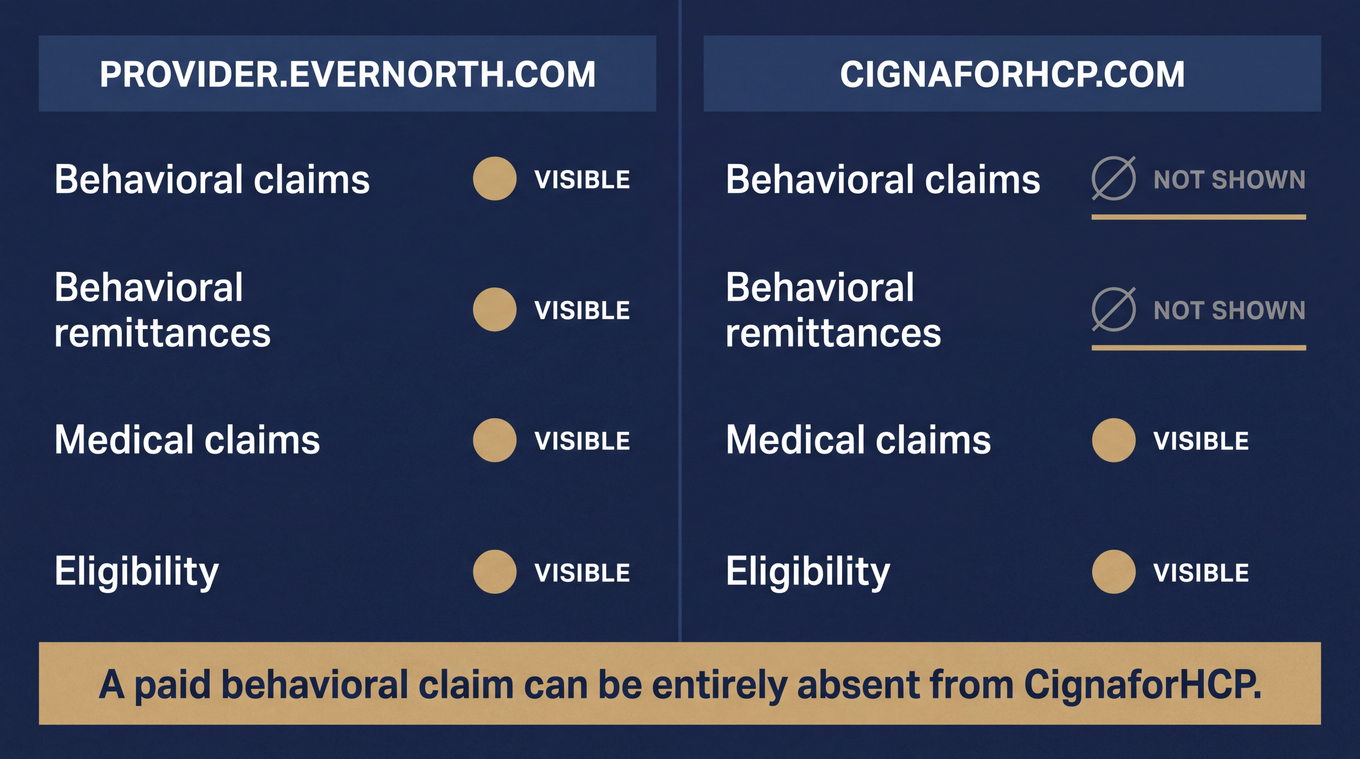
Some current third-party payer guides still point behavioral practices only to CignaforHCP and describe no separate Evernorth-branded portal for routine transactions. Evernorth's own FAQ says the opposite for behavioral claims and remittances. When a third-party summary and the payer's own provider material disagree, the payer's material is the one you can take to an appeal: behavioral claims and remittances are viewed in Provider.Evernorth.com; medical-only claims remain in CignaforHCP.
Four states that look alike and are not
Much of the confusion about missing claims comes from treating four different conditions as one. Each proves something narrower than staff assume.
| State | Evidence | What it proves | What it does not prove |
|---|---|---|---|
| EDI syntax accepted | 999 acknowledgment | The interchange or transaction passed the stated syntax stage | That the individual claim was accepted by the payer |
| Claim accepted by the receiver | 277CA accepted status | The receiver took the claim into processing | Coverage, network status, clean provider enrollment, or payment |
| Visible in the payer portal | Payer claim-control number and status | The payer or administrator has created a claim record | That the claim will pay correctly |
| Adjudicated | 835 / EOP | The payer made a payment or adjustment determination | That the determination is correct, or final after appeal |
A clearinghouse "submitted" screen proves nothing about payer receipt. The 277CA acceptance and the payer claim-control number let you distinguish never reached the payer from reached the wrong payer from reached the right payer and was denied - three problems with three remedies and three deadlines.
The money has its own three objects
The explanation of payment, the electronic remittance, and the deposit are three distinct things, and each fails in its own way.
| Object | Function | Where it goes wrong |
|---|---|---|
| EOP / EOB | The human-readable adjudication explanation | Staff read the dollar amount and miss the claim-level adjustment and remark text |
| ERA / 835 | Electronic remittance carrying claim and service adjustments and payment linkage | Enrolled under the wrong TIN or vendor, or never imported into the practice management system |
| EFT | The bank deposit | The deposit arrives and cannot be matched to the 835 or EOP, creating unidentified cash |
Evernorth's guide states that ERA enrollment is separate by TIN and describes remittance access through Provider.Evernorth.com (pp. 63–64; see also electronic remittance guidance). For reconciliation, match on the ACH trace and the payment identifiers - including the 835 TRN segment - rather than on the dollar amount. Matching on amount works right up until two payments are the same size, at which point it silently produces wrong postings.
Two clinicians described this in a public thread: "I needed to create a provider account on [Evernorth] to see it," and, separately, "I cannot tell which claim status … is associated with which payment" (r/therapists). The first is the portal split in plain English. The second is an ERA-to-EFT reconciliation failure, not a missing-claim problem, and treating it as the latter sends staff hunting for claims that were paid weeks ago.
Access is a control, not an IT chore
A related failure looks financial and is administrative. Evernorth uses website access managers and role-based entitlements (access manager information). A missing reports or remittance option can therefore be an entitlement problem rather than an absence of payment - in the thread above, support had to change backend access before remittance reports became visible at all.
That means: keep at least two authorized access administrators, remove departed staff promptly, separate roles to the minimum necessary, audit who can see remittances, EFT, claims, eligibility, and directory data, keep TIN access current, document two-step authentication recovery, and never let one person's email or phone become the only key to the account.
"Paid" is not the final check. For each paid claim, compare:
- The allowed amount against the contracted expectation
- The units and code level against what was submitted
- The member cost share against the verified benefit
- Authorization consumption against what was authorized
- Network status and fee schedule
- Any bundling or editing adjustments
- The coordination-of-benefits allocation
- The EFT amount against the 835
- Where it applies, the remaining balance against the EAP no-cost-share rule
Credentialing, enrollment, and NPI mismatch denials
At this payer, credentialing and claims are the same system, and Evernorth says so directly.
The guide instructs providers not to submit abbreviations, informal names or DBAs that are not loaded under the contract, another group's TIN, an uncontracted location, an unassociated Type 2 NPI, or a rendering provider who is not linked to the billing entity - because the result can be delayed or incorrect payment (Administrative Guidelines, pp. 58, 79–80). The 837 requires the billing provider's TIN and NPI, and the rendering or referring provider's name and NPI when reported. Use what is in the provider agreement, exactly as it appears there.
When that alignment breaks: EDI rejection, out-of-network adjudication, delayed or incorrect payment, requests for records, or an adjustment code pointing at provider identification. The standard X12 codes useful for triage are 206 (missing NPI), 207 (invalid NPI), and 208 (NPI not matched) (X12 claim adjustment reason codes). One qualifier applies to every code in this article: the exact combination is not guaranteed. A payer can express an enrollment or configuration failure in proprietary message text or a different code pairing entirely.
What has to align before you bill
- Licensed individual or provider type
- Individual Type 1 NPI
- Organizational Type 2 NPI where applicable
- Billing TIN and W-9 legal name
- Service location or locations
- Clinic or group affiliation
- Network and product participation
- Provider specialty
- Effective date
- Malpractice coverage
- Facility license or accreditation where applicable
Two asymmetries matter here. A directory listing is evidence that a provider is loaded somewhere - it is not a substitute for the executed agreement and effective date, or for a member-specific network check. And in the other direction, an executed group contract does not prove that every clinician, every location, and every TIN has been loaded correctly for every product. Enrollment failures are almost always partial, which is why they present as "some claims pay and some don't" rather than an obvious outage.
Credentialing status as of August 17, 2026
As checked on August 17, 2026, Evernorth's Join the Network page (updated May 19, 2026) states that:
- New individual and clinic applications were paused effective June 1, 2026.
- Providers who began the process before June 1 are not affected and should continue through processing.
- Facility applications remain open.
- Prospective individual and clinic applicants can submit an interest form, or revisit after September 1, 2026.
- Facility network entry can take up to 90 days, or the period required by law.
Source: Join the Network.
Two cautions. First, do not repeat "Evernorth is closed to new therapists" without the date and the qualification - facility applications are open, in-flight applications are unaffected, and the pause is stated as temporary. Second, this page is being published within weeks of the stated September revisit date. Check the current status directly before acting on it.
For facilities, the same page currently lists a valid state license, certificate, or permit for each applicable program; professional and general liability limits of $1 million per occurrence and $3 million aggregate for hospitals and residential settings; $1 million per occurrence and $1 million aggregate for PHP and IOP programs; and accreditation by an accepted organization where applicable, including the Joint Commission, CARF, AOA, CHAP, COA, DNV, or another accepted accreditor. The facility definition covers hospitals, residential settings, and programs providing PHP or IOP for mental health or substance use treatment.
On the individual side, the credentialing file described in the March 2026 guide can include:
- Current CAQH ProView information that is accurate, complete, and attested
- An application and release no older than the required period (the guide references completion within 180 days)
- Executed provider agreements and related data sheets
- A W-9 matching the billing entity
- CMS-1500 Box 33 billing identity information
- A five-year work history, with explanations for gaps longer than six months
- Active unrestricted professional licenses
- DEA information where applicable
- Professional liability coverage
- Education, training, board status, and adverse-event disclosures as applicable
Source: Administrative Guidelines, pp. 34–37. Recredentialing generally occurs every three years, and applicants have rights to review certain submitted information and to correct erroneous information - normally within 15 business days of notice (pp. 36–38).
Directory changes are claim-production changes
Evernorth routes common updates - address, NPI, license, directory information - through the provider portal, while certain changes such as a legal name, an affiliation, adding a provider or location, or changing a TIN can require direct support and contract or enrollment action (directory changes, updated October 1, 2024).
Treat these as claim-production changes, not marketing housekeeping. Before you bill from a new location or a new TIN, get the effective date and confirm that the exact provider-location-TIN combination appears correctly in live eligibility and network tools.
The pre-bill enrollment audit
Run this before the first claim for each new clinician, location, or TIN. It is an operational control we recommend, not a payer-published requirement.
- Compare the W-9 legal name and TIN to the contract and to the 837 billing loop.
- Confirm Type 1 and Type 2 NPIs in NPPES and in Evernorth's record.
- Confirm the service location and the correspondence and payment addresses separately.
- Confirm the rendering provider's affiliation to the billing entity.
- Confirm specialty, taxonomy, and license state.
- Confirm product and network participation, and the effective date.
- Submit a test eligibility transaction under the intended TIN.
- Save the directory or network result and the reference number.
- Verify ERA enrollment and the EFT destination for that TIN.
- Monitor the first claims at the 277CA, portal, 835, and EFT layers.
Which Evernorth services require prior authorization
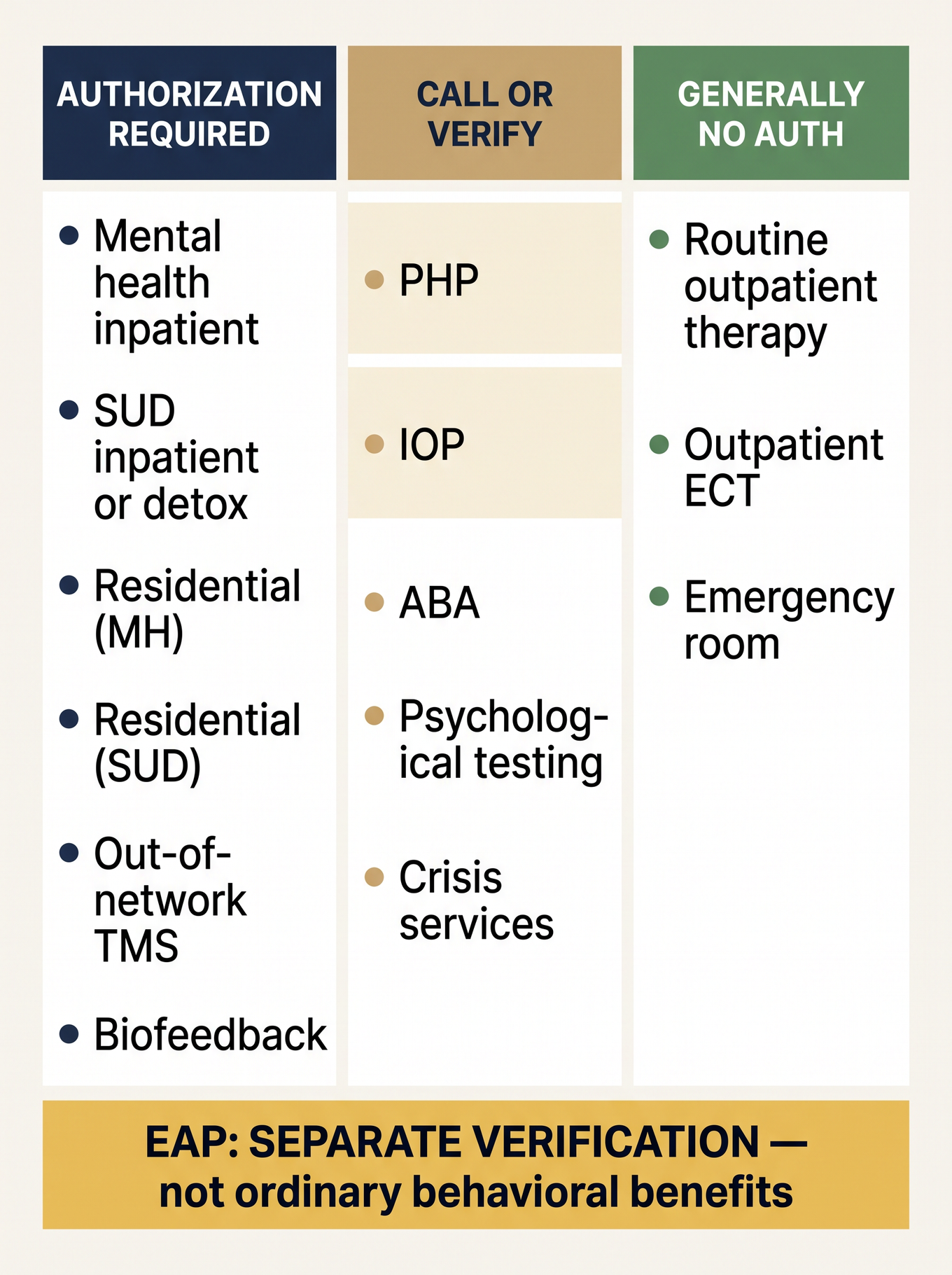
The current public source is Evernorth's Authorization and Billing Resource, dated March 23, 2026 (PDF). The document says of itself: it is a resource rather than a complete benefit guarantee; requirements vary by plan, state, network, and service; providers must verify member-specific benefits; the member's plan and the provider agreement control; and "authorization not required" does not eliminate other coverage, coding, network, or medical-necessity rules.
Every statement in this section answers the narrow question does this need prior authorization and nothing else.
The current pattern by level of care
| Service or level of care | Current national public indication | What it actually means for you |
|---|---|---|
| Mental health inpatient | Authorization required | Confirm admission notification, authorized dates, the concurrent-review schedule, and the level of care |
| Substance use inpatient or detox | Authorization required | Clinical criteria and plan-specific SUD program rules apply |
| Residential mental health | Authorization required | Match the authorized program, dates, revenue code, and facility identity |
| Residential SUD | Authorization required | ASAM-based review commonly applies, subject to contract and law |
| Dual-diagnosis inpatient or residential | Authorization required | Confirm which clinical track and billing configuration were approved |
| Eating-disorder inpatient or residential | Authorization required | Specialised clinical review and network availability can both matter |
| PHP | Call or verify - plan-dependent | Do not apply a universal yes or no |
| IOP | Call or verify - plan-dependent | Treat verification and review-calendar setup as mandatory operations even where prior authorization is waived |
| Routine outpatient psychotherapy and diagnostic services | Generally no prior authorization | Benefit, network, frequency, documentation, coding, and post-service review still apply |
| EAP | Separate verification and authorization | Bill 99404 under the EAP rules; ordinary therapy benefit verification is not enough |
| Out-of-network TMS | Authorization required in the current table | The in-network indication differs - verify the plan |
| Biofeedback, 90901 | Authorization required in the current table | Confirm benefit and provider eligibility |
| ABA | Call or verify - typically authorization-managed | State forms and program requirements vary |
| Psychological and neuropsychological testing families | Call or verify | Some services can route through medical rather than behavioral - verify codes, units, administrator, and benefit |
| Crisis and 23-hour services | Call or verify | State, product, and facility rules can change the workflow |
| Outpatient ECT | Current table indicates no prior authorization | Do not generalise to every setting and product |
| Emergency room behavioral services | Current table indicates no prior authorization | Emergency rules do not erase post-stabilisation, admission, network, or notification requirements |
The PHP and IOP trap. The current national guide says PHP and IOP may require it depending on the plan, and the current code table frequently says to call and verify. You can safely say that higher levels of care require an authorization workflow, and that inpatient and residential are universally listed as requiring authorization. You cannot safely say PHP and IOP are a national yes - and if your workflow assumes they are, you are building rework into every one of those admissions.
The routine outpatient codes, with the caveat attached
The March 23, 2026 resource lists these common outpatient codes as not requiring prior authorization in the national table:
- 90785 interactive complexity
- 90791 psychiatric diagnostic evaluation
- 90792 psychiatric diagnostic evaluation with medical services
- 90832 / 90833, 90834 / 90836, 90837 / 90838 psychotherapy and psychotherapy add-ons
- 90839 / 90840 crisis psychotherapy
- 90846 / 90847 / 90849 family psychotherapy variants
- 90853 group psychotherapy
That list does not say these codes are covered. It answers the prior-authorization question and nothing else. Any one of the other gates can produce a denial on a code that needed no authorization at all.
A routine outpatient service can still deny or reduce with no precertification requirement at all: inactive eligibility or a benefit exclusion; an out-of-network provider or configuration; a benefit maximum reached; a coding, modifier, or unit error; a provider-type or scope-of-practice restriction; unsupported time or service elements; a duplicate or bundled service; an incorrect place of service; coordination of benefits; a missing or invalid NPI-to-TIN linkage; post-service medical-necessity review; and timely filing.
Facility codes in the current table
The public table includes facility examples. Treat them as prompts for a verification conversation, not as a coding directive: the contract, program, and authorized configuration decide the answer.
| Level | Examples appearing in the current table | How to use it |
|---|---|---|
| Mental health IOP | Revenue code 0905; S9480; alternatives shown for certain configurations include H0004 and H2036 and, for specified arrangements, H2020 and H2035 | A verification checklist, not a universal directive |
| Mental health PHP | Revenue codes 0912 and 0913; H0035; alternatives include G0410, S0201, and H2012 in specified contexts | Confirm contract, program, daily structure, and authorized code |
| Mental health inpatient | Revenue code 0124 appears | Do not assume all inpatient claims use one revenue code |
| Mental health residential | Revenue code 1001 appears | Confirm payer mapping and program license |
| SUD IOP | Revenue code 0906; H0015; alternatives include H0005 and H2036 | Match to the authorized program and contract |
| SUD residential | Revenue code 1002 appears | Confirm level-of-care and per-diem rules |
An authorization number is not an authorization record
A usable authorization log needs more than a number, because most downstream disputes turn on a field the number does not carry:
- Member and plan
- Service, program, and diagnosis track
- Facility, billing TIN and NPI, and rendering provider identity
- The approved CPT, HCPCS, or revenue code, or level of care
- Admission or start date
- Authorized-through date
- Approved units, sessions, days, or hours
- The next review date and its time zone
- Reviewer, contact, fax, or portal route
- The authorization or reference number
- Conditions, exclusions, and step-down requirements
- The clinical criteria and version cited
- The decision letter and call notes
- Units or days used, and remaining
- Any discharge or transition notification requirement
Keep that record and four classic failure modes become diagnosable:
- No authorization obtained - often aligns with CARC 197.
- Authorization obtained for the wrong entity or configuration - right patient, wrong facility, TIN, NPI, location, or program.
- Service exceeds the approved amount, date, or level - often aligns with CARC 198.
- Request or review submitted late - can align with CARC 210, and can trigger retrospective-review standards.
There is a fifth, and it is the reason a lot of appeals get filed in the wrong lane: the authorization exists and is valid, but the claim does not match it. Wrong revenue code, wrong dates, wrong billing entity, wrong level of care. The remittance can read like "no authorization" while your authorization team is holding a perfectly good approval letter. The fix is a field-by-field comparison, not an appeal.
Authorization is not a payment guarantee, and it does not prevent later coding or medical-necessity review. An approval says a service was authorized. It does not say the claim will be paid.
Concurrent review and the MCG, ASAM, and LOCUS criteria
For an authorized inpatient, residential, PHP, or IOP episode, the first approval is not approval through discharge. Concurrent review determines whether continued days or sessions at the current level remain medically necessary, and whether a lower level has become appropriate. Miss a review and clinically delivered care can become contractually uncollectible.
There is no one "Cigna behavioral guideline"
Practices routinely ask for the criteria PDF. There isn't one. Evernorth's current medical-necessity page describes a hierarchy that varies by condition, age, state, and product (Medical Necessity Criteria, updated November 25, 2024):
| Population | Current published framework |
|---|---|
| Mental health level of care, general national business | MCG Behavioral Health Guidelines, unless contract or law requires another criterion (MCG page) |
| Mental health, ages 19 and over, commercial plans in California, Colorado, and New York | LOCUS, unless federal or state law requires another specified criterion (LOCUS page) |
| Mental health, ages 6 to 18, commercial plans in California, Colorado, and New York | CALOCUS-CASII, unless federal or state law requires another specified criterion (CALOCUS-CASII page) |
| Substance use disorder, age 18 and over | The ASAM Criteria, 4th Edition, from November 2024, unless contract or law requires another criterion (ASAM page) |
| Substance use disorder, age 17 and under | The ASAM Criteria, 3rd Edition, unless contract or law requires another criterion |
Evernorth also uses Cigna medical coverage policies for relevant medical services, its own Authorization and Billing Resource, and state regulations and licensing standards.
You need a criteria matrix keyed on condition, age, state, plan, product, and date - not a single downloaded file labelled "Cigna criteria." A California commercial adult and a Texas commercial adult with the same presentation can be reviewed against different frameworks. The full licensed criteria are often login- or member-gated, so identify the framework and the access path; do not expect to reproduce proprietary criteria and do not build an appeal on a summary of them.
What a concurrent review calendar tracks
A concurrent-review process that survives staff turnover tracks the admission or start date; the initial approved dates and units; first and subsequent review due dates; the payer's submission window and its time zone; the assigned utilization reviewer; the clinical criterion and version; current symptoms, risk, functioning, and withdrawal or intoxication status where applicable; treatment delivered and response; medication changes; barriers to discharge or step-down; family, support, and aftercare work; objective progress and unresolved need; the requested next level and duration; and the determination, rationale, peer-review right, and appeal deadline.
Evernorth's high-level-of-care resources ask for clinical information sufficient to evaluate diagnosis, presenting problem, current symptoms and risk, treatment history, services provided, response, medications, and discharge planning (high level of care resources).
The authorized day is a revenue inventory item
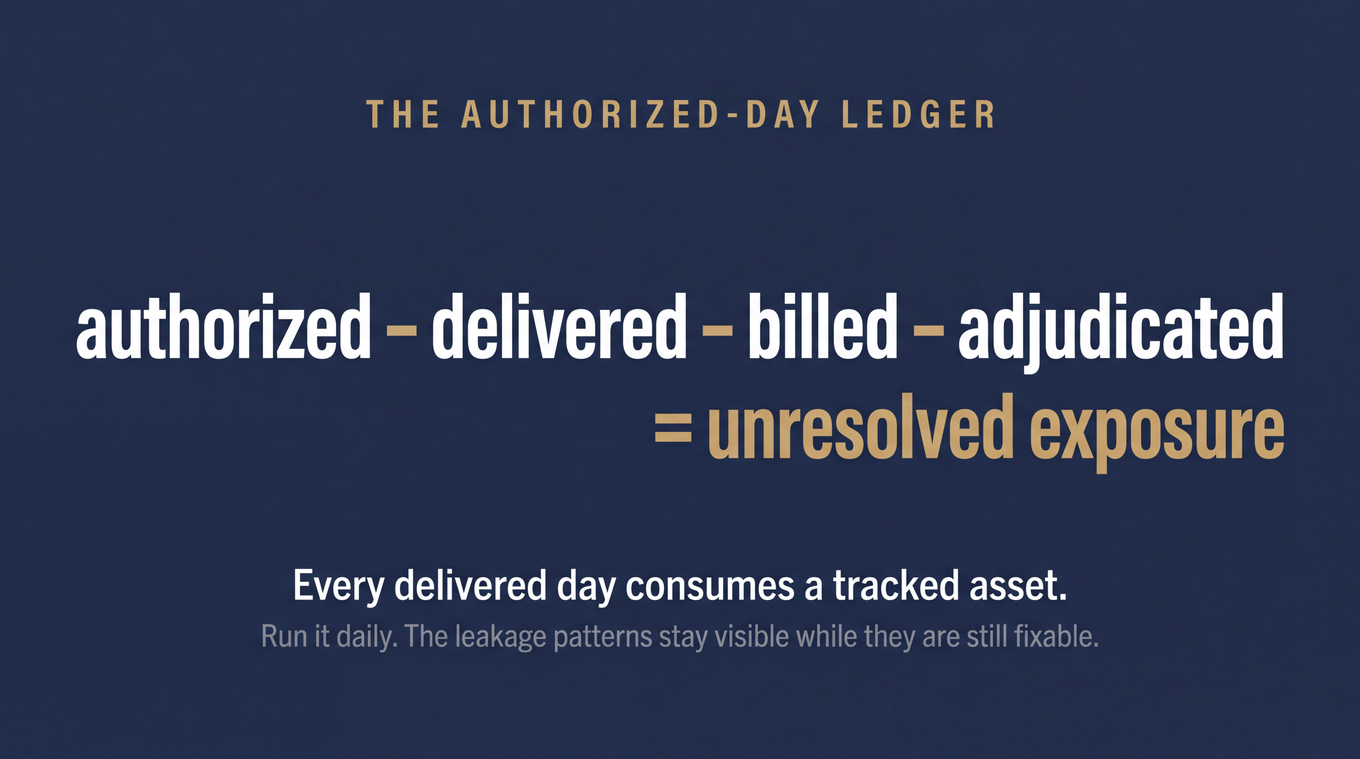
Once the payer grants a finite date span or unit count, every delivered day consumes a tracked asset. The billing and utilization-review ledgers should reconcile daily against one equation:
authorized amount − delivered amount − billed amount − adjudicated amount = unresolved exposure
The leakage patterns it makes visible while they are still fixable:
- Treatment continues past the through-date while a review is pending.
- A review is clinically completed but never transmitted, or transmitted without proof of timely receipt.
- The payer approves a step-down but the claim stays at the previous level.
- The payer approves one facility or TIN and the claim is billed under another.
- Attendance records do not support the billed program days or hours.
- The discharge date and the claim through-date disagree.
- Authorization units are consumed by duplicate or corrected claims.
- The payer's system holds a different authorization number or date span than the letter in your file.
That last one is not rare. Reconcile against the payer's record, not your own.
Retrospective authorization is narrow and evidence-heavy
Evernorth's March 2026 guide discusses retrospective authorization principally for inpatient services. It distinguishes requests made up to four calendar days after admission, or on the last covered day, which can sometimes be handled in a more current, real-time posture - from later requests, which receive a more detailed retrospective review (pp. 53–55).
Where the delay came from wrong insurance information, the request or appeal needs two things: complete clinical records supporting the level of care, and evidence of the insurance error and when it was discovered. That second element can be a copy of the card presented, a portal or 271 response, a registration note, a coordination-of-benefits record, or payer call documentation.
Medical records alone may leave the denial upheld, because medical necessity does not explain why the authorization was late. "The patient gave us the wrong insurance" is an assertion; a dated card image and a contemporaneous intake note are evidence.
A missing authorization is not automatically a patient balance
The guide warns that when a participating provider fails to follow applicable authorization requirements, the provider may not simply shift the resulting contractual denial to the patient. The exact member-liability treatment depends on the denial, the contract, the plan, applicable law, and the EOP group code.
So do not build a workflow that bills the patient on a missing-authorization denial. Read the group code, the member-liability language, the contract, and the applicable law first.
Peer review and appeal are different instruments
A peer review can address the clinical decision before or around an adverse determination. A formal appeal challenges a post-service or finalised adverse decision under a defined deadline. They are not interchangeable, and one does not preserve the other.
Log whether peer review was offered, the deadline and scheduling attempts, the reviewer's specialty, the issue discussed, the clinical criterion and the facts in dispute, the outcome and its written confirmation, and whether appeal rights remain along with the filing deadline. Do not let repeated calls consume the formal appeal window - that is the most common way a winnable clinical dispute becomes a write-off.
MHPAEA parity: what it does and does not do
The Mental Health Parity and Addiction Equity Act matters when a plan applies a nonquantitative treatment limitation - prior authorization, medical-management standards, network rules, out-of-network reimbursement methodology - more restrictively to mental health and substance use benefits than to comparable medical and surgical benefits. The 2024 federal final rule added detailed NQTL analysis and data requirements with staggered 2025–2026 applicability dates (DOL fact sheet, September 9, 2024).
Then, on May 15, 2025, the federal departments announced nonenforcement of the 2024 final rule while litigation and reconsideration proceed. The underlying statute, the prior regulations, and the comparative-analysis obligations from the Consolidated Appropriations Act, 2021 were not erased (enforcement statement; DOL parity resources). That posture is genuinely unsettled.
Parity is useful for evidence and disclosure: requesting the medical-necessity criterion applied, the reason and evidence for the adverse determination, plan documents and NQTL comparative analysis where the rights apply, and a comparison of authorization or network standards across behavioral and medical or surgical benefits.
What it does not do: it does not make an otherwise excluded service payable, it does not automatically extend a missed filing deadline, and it does not substitute for an authorization request. Parity is most useful when the dispute is about how a restriction was designed or applied - not as a sentence you add to a letter about a claim that was simply coded wrong.
How to bill Cigna and Evernorth EAP claims with 99404
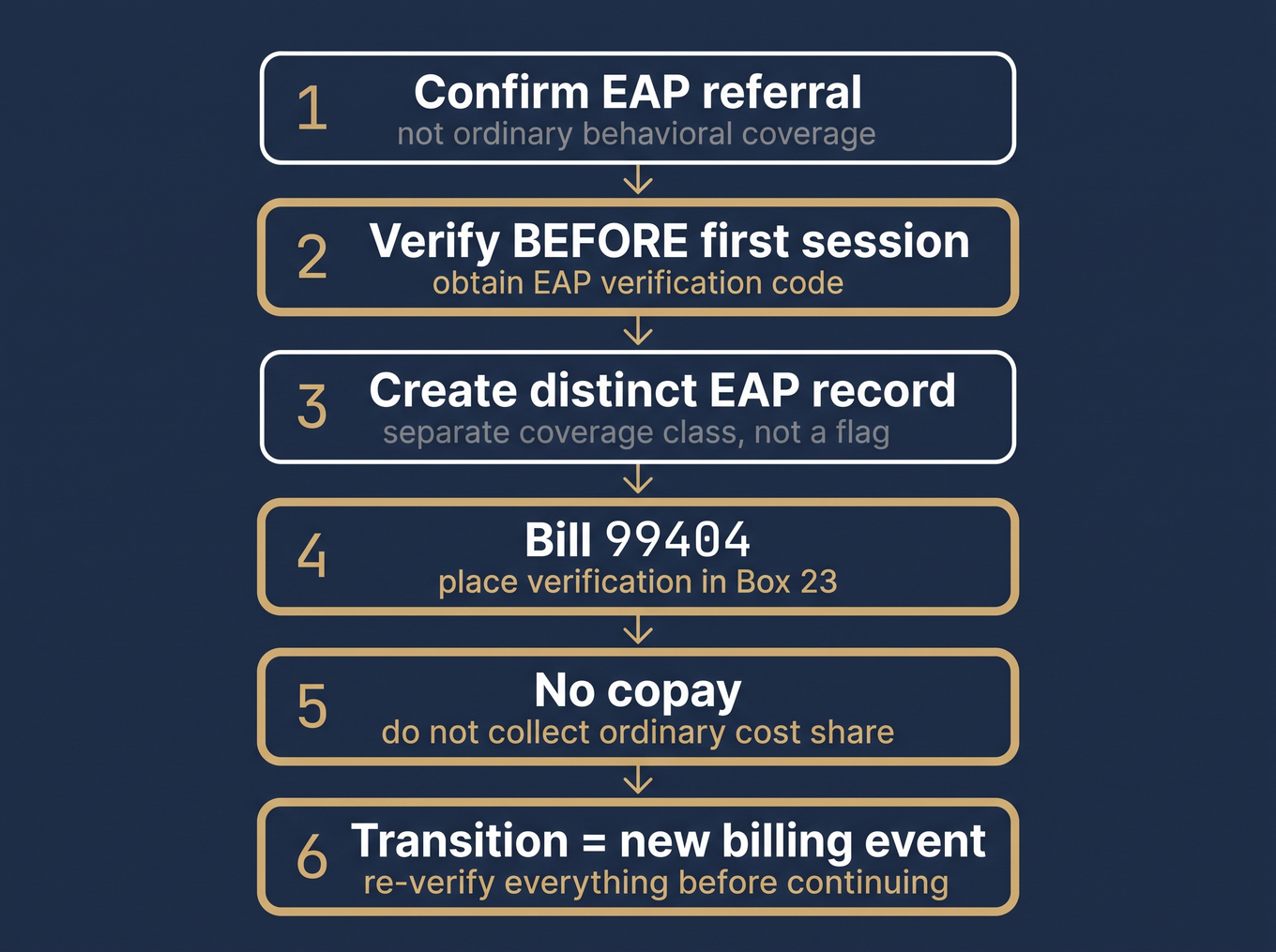
An Employee Assistance Program episode at this payer is not the behavioral benefit with a note attached. It is a different product, with its own verification, its own code, its own claim field, its own paper routing, and its own cost-share rule. A practice that treats it as ordinary psychotherapy gets a predictable, repeating pattern of denials and wrongly billed patients.
What Evernorth EAP actually is
Evernorth's provider page states that EAP visits are separate from the patient's behavioral health benefit, and that there is no copayment (Evernorth EAP page, page updated April 16, 2025). Each employer verification covers one issue, for one participant, in one plan year. The number of visits varies by employer, and the verification carries a start date and an end date.
EAP is a distinct encounter class in your practice management system, not a flag on an existing one. If your PM system cannot hold a separate EAP coverage record with its own visit counter and its own date span, that is the first thing to fix. Every failure below descends from trying to run an EAP episode through an ordinary insurance record.
The verification comes before the first session
Before providing EAP services, the practice should hold one of the currently published verification formats:
- An alphanumeric verification beginning with the two-digit issuance year and ending in
*Ofor outpatient. OPfollowed by ten digits.- "Disney" in place of an alphanumeric code - but only for Disney Worldwide Services, under the change effective May 5, 2025.
The authorization carries the issue, participant, and plan-year scope; the number of visits; and the start and end dates.
Two warnings. First: do not render EAP under an employer name other than the specifically published Disney exception. "Disney" is not a general shorthand for employer-named EAP verification; it is one named exception. Second: get the verification before the first session. A retroactive scramble to identify whether an episode was EAP or ordinary behavioral coverage usually surfaces only when the patient calls about a bill they should never have received.
The 99404 rule, Box 23, and two paper routes
Evernorth's current EAP page states that all EAP services must be billed with CPT 99404 to ensure appropriate payment. Alongside that:
- Place the alphanumeric verification, or "Disney," in CMS-1500 Box 23 (this is the page's recommendation).
- Electronic claims use payer ID 62308.
- Ordinary alphanumeric verifications use the published Evernorth EAP claim address.
- Disney claims use a different published address.
- The EAP page publishes fax 859-410-2422 with its claim table.
The current ordinary alphanumeric paper route, as published on August 17, 2026, is:
Evernorth Behavioral Health P.O. Box 188022 Chattanooga, TN 37422
The Disney paper route is listed separately on the EAP page and is not reproduced here. The two routes must not be collapsed into one, and a program-specific address should be read off the live payer page on the day you use it. Send a Disney claim down the ordinary route and it delays or disappears.
99404 is a preventive-medicine counseling code used here as the payer's designated EAP billing vehicle. It is not ordinary psychotherapy coding, and the reverse substitution - putting 90834 or 90837 on an EAP episode - is the most common EAP error.
A therapist in a public thread in March 2026 got the correction: "You are billing incorrectly. Cigna's EAP code is 99404" (r/therapists). That is an anecdote, not the authority - the payer's own EAP page is what establishes the rule.
A ten-step EAP workflow
- Confirm the referral is EAP rather than ordinary behavioral coverage.
- Obtain and validate the EAP verification before the first session.
- Store the issue, plan year, visit count, start and end dates, and any employer exception.
- Tell the patient the verified EAP lane has no copay - and do not automatically collect ordinary behavioral cost share.
- Create a distinct EAP authorization and coverage record.
- Bill 99404 under the current EAP instruction.
- Include the verification in Box 23 as recommended.
- Count visits after adjudication and reconcile the EOP.
- Before the final authorized visit, determine whether care ends, whether a new eligible issue exists, or whether treatment transitions to ordinary behavioral benefits.
- Re-verify network, benefits, authorization, cost share, and claim coding before that transition.
Step 4 runs against front-desk muscle memory. Collecting a copay at check-in is the default in almost every practice. On a verified EAP episode it is wrong, and the patient sees it.
Steps 9 and 10 are the ones most often skipped. The transition out of EAP is a new billing event, not a continuation. The EAP episode is short-term and issue-focused. When the patient needs care beyond that scope, the coverage underneath the therapy changes, and network status, benefits, authorization requirements, cost share, and the procedure code all have to be verified again.
The failure signatures, so you can name them on sight
| What happened | What staff see | Root cause to test |
|---|---|---|
| EAP visit billed with 90834 or 90837 | Ordinary deductible or copay applied, a denial, or a claim processed outside the EAP lane | Wrong procedure code for EAP - verify the 99404 rule |
| 99404 billed without a valid verification | Missing-authorization or not-processed denial | EAP verification absent, invalid, wrong dates, or already exhausted |
| Correct EAP code, wrong patient cost share | The patient receives a bill despite the EAP no-copay rule | Claim adjudicated under the ordinary behavioral benefit, or payment posting mapped incorrectly |
| Verification exhausted | Authorization-exceeded or benefit-limit message | More visits billed than the employer verification allows |
| Verification outside the date span | Missing or invalid authorization | The date of service falls outside the EAP episode |
| Disney claim sent through the ordinary paper route | Delayed or missing claim | Program-specific routing ignored |
| EAP completed, ordinary therapy continues unchanged | A later denial or unexpected patient cost share | The transition to the standard behavioral benefit was never separately verified |
The pattern across that table: five of the seven are invisible at the point of service and only surface at adjudication or when the patient complains. That is why EAP handling has to be controlled on the front end.
EAP forms and documentation
Evernorth publishes an EAP Clinical Assessment Form, a Statement of Understanding, and an opt-out form in its forms center (forms center, behavioral forms list updated July 10, 2026). Document the assessment, the EAP issue, visits used, progress and disposition, and the transition or referral when the patient needs care outside the EAP scope. The exact clinical content and confidentiality handling follow the provider agreement, professional standards, applicable law, and the payer's forms - not this page.
Telehealth billing: modifier 95, place of service 02
The March 2026 guide's national instruction for telehealth is compact. Providers should use modifier 95, report place of service 02 in the stated workflow, comply with applicable licensure, technology, privacy, and prescribing law, and meet the same medical-necessity expectations as in-person care. No separate credentialing is required solely for telehealth when the provider meets Evernorth's applicable telehealth specialty requirements. And the guide states that use of modifier 95 does not itself change reimbursement (Administrative Guidelines, pp. 45, 71).
The exact claim depends on the member's plan and network; whether the patient and clinician are at home or somewhere else; professional versus institutional billing; synchronous video versus audio-only; state licensure and prescribing rules; employer and TPA variation; the provider contract and current payer policy; and the current CPT and HCPCS code set. Medicare's place-of-service 10 framework and other payers' distinctions cannot be imported into an Evernorth commercial claim, and a general Evernorth instruction does not override a group-specific or state-specific rule. Verify current eligibility and policy for the member in front of you.
A payer document with a stale code in it
The March 23, 2026 Evernorth authorization table still lists CPT codes 99441–99443, the telephone evaluation and management family. The AMA deleted those codes from CPT for 2025 and introduced a newer telemedicine family (AMA telehealth CPT materials).
That does not prove what any Evernorth plan pays in 2026, and it is not a reason to bill a deleted code. It proves that a current, dated payer PDF can carry stale code references. The safe practice is to use Evernorth's authorization resource to understand the payer's workflow, while verifying the live CPT code set and the plan-specific telehealth billing rule separately. This page does not prescribe a replacement code: the right one depends on the exact service, payer adoption, provider contract, and current policy.
Facility telehealth and virtual PHP or IOP
Evernorth's public interim guidance says facilities delivering applicable services remotely should continue to report the proper revenue code and CPT or HCPCS and add modifier 95, while continuing to meet level-of-care medical necessity.
For PHP or IOP delivered virtually, also verify: whether the member's plan covers the program virtually at all; the minimum program-hour and attendance structure; the licensed site and the patient's location; the authorized setting and the code or revenue mapping; group versus individual components; state program and licensing restrictions; and the concurrent-review evidence.
Telehealth denial triage
| Denial pattern | First questions to ask |
|---|---|
| Noncovered service or place of service | Does the plan cover this modality and this patient location? Was the POS consistent with the current payer instruction? |
| Missing or invalid modifier | Was 95 required here? Did the claim carry a conflicting modifier? |
| Provider not eligible | Is the rendering provider licensed and loaded for the patient's state, product, and location? |
| Authorization | Was the underlying service or level of care authorized for telehealth, for these dates, and for this provider entity? |
| Coding | Is the code active for the date of service and adopted by this payer? |
| Medical necessity | Does the record show why telehealth was clinically appropriate, and satisfy the service elements? |
Evernorth timely filing limit: 90 days, with exceptions
The March 2026 Administrative Guidelines state a default filing limit of 90 days from the date of service, or from the last date of service for consecutive-day services, unless the agreement or applicable law provides otherwise (p. 62).
Ninety days is tight. A claim that rejects at the clearinghouse in week one and sits in an unworked rejection queue for six weeks is genuinely at risk, which is why the rejection queue, not the denial queue, is the daily control that matters most.
The eight published exceptions
| Situation | Current guide treatment |
|---|---|
| Applicable state law gives longer | Follow the longer legally required period |
| Coordination of benefits - another payer primary | Measured from the primary payer's EOB or EOP processing date |
| Medicare secondary payer | Three years |
| Medicaid | Three years, subject to program and contract rules |
| Evernorth requested new or additional information on a timely claim | A new 90-day period can run from the request |
| Third-party vendor or administrator | The applicable deadline may be shorter or longer - follow the arrangement and the card |
| Catastrophic circumstance | The guide recognizes an exception process |
| Provider agreement | Contractual filing language can control |
Note the third-party row: a TPA deadline can be shorter, not only longer.
State addenda are illustrations, not a national matrix
The guide contains state-specific provisions, but whether one reaches your claim depends on provider location, member or policy situs, fully insured versus self-funded status, the scope of the state law, the provider contract, the service type, and whether the payer is acting as insurer, administrator, or network contractor. The guide states that state addenda apply as required by law and may not apply to self-funded business (pp. 7, 93–286).
Three examples from the March 2026 addenda, not a lookup table for your state:
- New York: provisions for applicable insured business can use a 120-day filing framework with an unusual-occurrence review, with additional consequences at later stages; the addendum limits application to self-funded arrangements as stated.
- Tennessee: an applicable insured-plan addendum references 120 days and expressly distinguishes self-funded business.
- Texas: an applicable addendum includes a 95-day after-discharge provision for specified institutional circumstances.
Check your own state and the member's funding arrangement. Do not apply another state's number to your claim, and do not assume a state protection reaches a self-funded plan.
Do not import the general Cigna out-of-network rule
Cigna's general claim-submission page describes a 90-day participating-provider framework and a longer general out-of-network period (submit claims). That page is directionally right for its own scope and is the wrong scope for a contracted Evernorth behavioral provider.
The correct formulation is not "all Cigna behavioral claims have 180 days out of network." It is: use the applicable plan, contract, and card rule, with 90 days as the current Evernorth contracted-provider default. Mixing rules across medical, dental, individual, or another line of business is how a practice misses a deadline it believed it had months left on.
What actually proves timely filing
When you have to prove it, evidence quality decides the outcome. Strongest first:
- 277CA accepted response with the date and the receiving payer.
- Payer portal claim-control number and received date.
- Payer-generated acknowledgment.
- EOP or 835 showing the original claim.
- Certified or traceable mail delivery for a payer-required paper claim.
- Clearinghouse transmission plus downstream payer acceptance.
- Payer call reference confirming receipt.
- System audit logs.
A clearinghouse printout that says only "sent" proves transmission to your vendor. It does not prove receipt by the correct payer, and an appeal reviewer knows the difference.
If you are appealing a filing denial, the packet should carry:
- The Behavioral Appeals Cover Sheet
- The EOP or denial, and the claim-control number
- The original claim and its exact receiver
- The 999 and 277CA, with dates
- The clearinghouse trace
- A portal received-date screenshot
- The primary EOB and processing date, for coordination of benefits
- Any payer request for additional information that reset the period
- Correct card and routing evidence
- The contract, state, or TPA provision you are relying on
- A concise chronology: service, submission, acceptance, payer action, correction, appeal
A generic "please reconsider" letter without the receipt chain is a formality, not an appeal.
Five deadlines, not one
These run separately, and none of them pauses because you called:
- Timely filing - the deadline to get the original claim to the correct receiver.
- Corrected claim - the deadline and process to replace adjudicated data.
- Appeal - the deadline to challenge a determination.
- Second-level review - the deadline after the first-level decision.
- External review or arbitration - separate eligibility and separate timing.
Log every deadline at first notice. Repeated phone calls do not toll any of them.
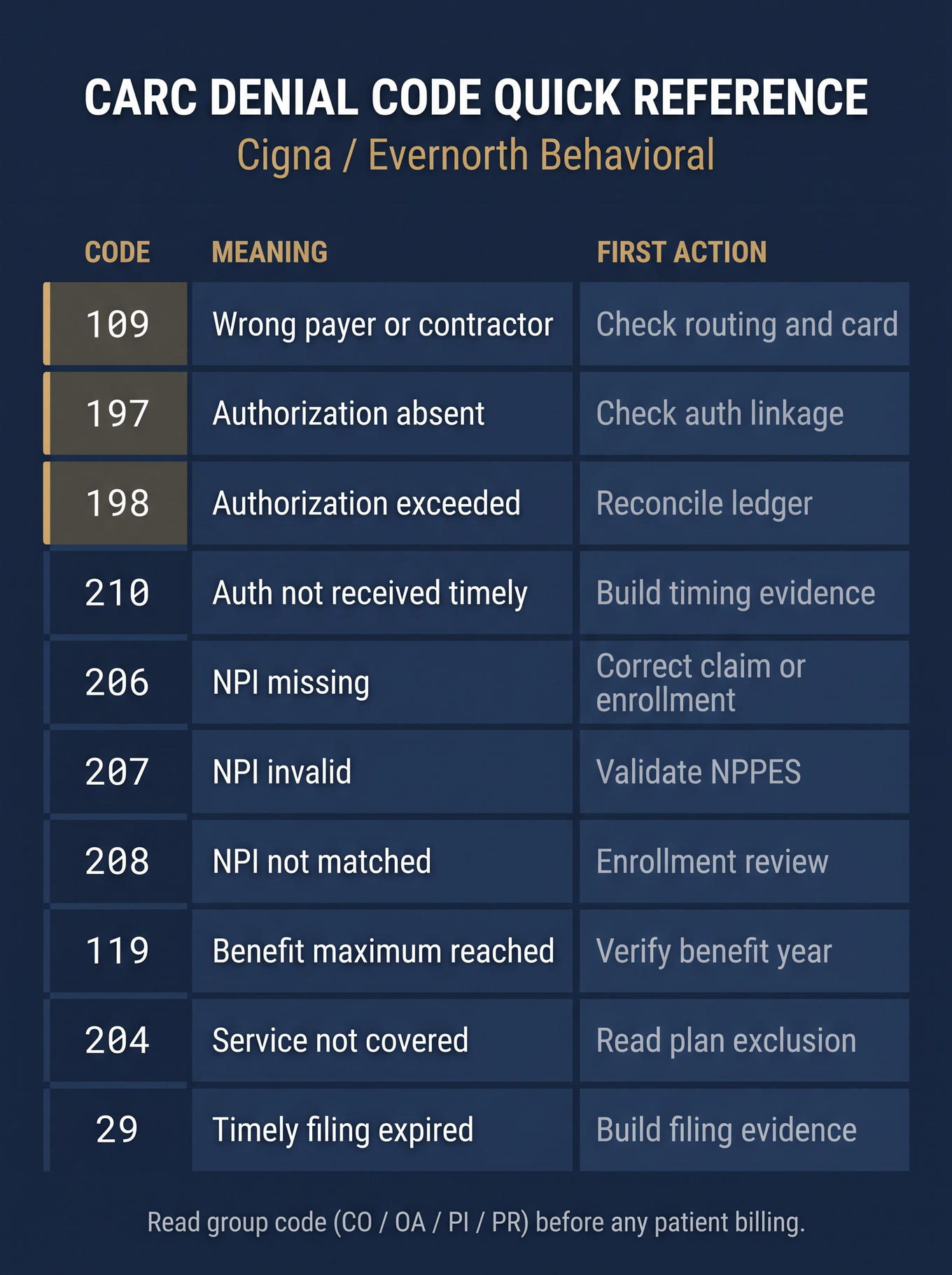
Denial codes: CARC 109, 197, 198, and what they mean
Read all four layers before you touch anything
- Transaction status. Was the 999 and the 277CA accepted or rejected?
- Claim status. Does a claim record exist in the payer portal, and what is its claim-control number?
- 835 group code. CO, OA, PI, or PR.
- CARC, RARC, and the payer's own narrative. The claim or service adjustment and the explanatory remark.
Layer three is the one most often skipped, and the one with the most direct patient consequence. The adjustment group code tells you whose money it is - whether the payer is assigning contractual obligation (CO), another adjustment (OA), a payer-initiated adjustment (PI), or patient responsibility (PR). A PR group code can indicate patient responsibility; a CO group code generally should not be treated as collectible from the patient absent a valid separate basis. Never move a balance to a patient on the strength of the CARC number alone (X12 CARC list; X12 RARC list).
Layer one carries a distinction that changes the entire remedy. A clearinghouse or 277CA rejection means the payer may never have accepted the claim at all - there is nothing to appeal, because there is nothing there. An adjudicated wrong-payer denial means the payer did receive it and decided another payer or contractor is responsible. One is a correction and a resubmission; the other is a routing investigation with a filing deadline attached.
CARC and RARC codes, and what each implies
| Signature | What it usually means | Operational hypothesis at this payer | First action | Evidence to preserve |
|---|---|---|---|---|
| 999 / 277CA rejection, no payer claim number | The claim was not accepted into adjudication | Invalid member data, receiver, syntax, NPI or TIN, code or date, or clearinghouse mapping | Correct the rejection and resubmit promptly. Do not appeal a claim that does not exist | Full acknowledgment, error segment, corrected transmission, acceptance date |
| CARC 109 | Not covered by this payer or contractor - send to the correct payer | Behavioral claim sent to the wrong Cigna receiver, entity, or TPA; wrong sequence; or another payer responsible | Re-run the card, eligibility, and COB. Identify the correct receiver, submit there, protect the filing date | Card, 271, payer call reference, receiver mapping, original acceptance or denial |
| RARC N418 | Misrouted claim - consult payer instructions | A strong wrong-route clue | Follow the card and claim instructions. Do not blindly rebill the same destination | EOP text, card, eligibility, payer instructions |
| CARC B11 | Claim transferred to the proper payer or processor | A payer or processor handoff | Confirm whether the transfer actually created a claim at the destination - do not assume | Both claim-control numbers, transfer notice, destination status |
| CARC 197 | Precertification, authorization, or notification absent | No authorization, authorization not linked, or wrong entity, code, or date | Locate the authorization and compare every field before appealing or correcting | Authorization letter, call and portal logs, the claim, the clinical file |
| CARC 198 | Authorization exceeded | Days, visits, units, or date span exhausted - or duplicate claims consumed the units | Reconcile the authorized-delivered-billed-adjudicated ledger | Authorization, attendance, prior claims and voids, review decisions |
| CARC 210 | Authorization not received timely | Late admission notice or late concurrent review | Build the retrospective-timing and clinical evidence packet | Submission timestamps, wrong-insurance evidence, medical records |
| CARC 206 | NPI missing | A required billing, rendering, or referring NPI is absent | Correct the claim or the enrollment, as applicable | Rejection or EOP, claim image, NPI records |
| CARC 207 | NPI invalid | Typo, inactive or incorrect NPI type, bad format | Validate against NPPES and the payer record, then correct | NPPES, W-9, contract, claim |
| CARC 208 | NPI not matched | The NPI is not linked to the TIN, location, group, or product | Enrollment and configuration review - not just resubmission | Contract and effective date, roster, payer confirmation |
| CARC 119 | Benefit maximum reached | A visit, session, or day limit - or EAP exhaustion | Verify the benefit-year maximum and the claim history | 271 or VOB, prior EOPs, EAP verification |
| CARC 204 | Service not covered under the current benefit plan | Exclusion, wrong benefit bucket, or provider-service mismatch | Read the plan-specific exclusion and the code category | Benefit response, plan clause, policy |
| CARC 29 | Timely filing expired | Wrong receiver, delayed rejection correction, or a missed TPA, state, or contract limit | Build the filing-evidence appeal and identify the controlling deadline | 277CA, portal receipt, card, contract or state rule |
Two standing caveats. Code descriptions should be read from the current X12 lists on the day you use them - X12 updates and deactivates codes over time, and some billing articles still cite adjustment codes that were retired years ago (legacy CARC 15 is the classic example). And Evernorth's actual remittance can carry payer-specific text, so these codes are diagnostic clues rather than a promise that every denial of a given type uses the same combination.
The wrong-entity signature, spelled out
The sequence to recognize:
A Cigna-branded card → the claim is submitted to a general Cigna destination → the clearinghouse reports acceptance, or the payer returns a denial → the behavioral claim is absent from CignaforHCP, or comes back with wrong-payer or misroute language → the card or the payer says Evernorth Behavioral, or a TPA route → and the resubmission deadline is now at risk.
The most relevant standard clues are CARC 109 and RARC N418, though the payer can use other language.
The fix is not changing the payer name in the practice management system and resending. Verify, in order: the receiver and payer ID; the portal you are searching; the billing TIN and NPI enrollment; the behavioral administrator; whether a TPA is involved; the primary and secondary sequence; the paper address if paper is required; the authorization entity; and your filing evidence and remaining deadline.
When the authorization exists and the claim still denies
Before treating this as a clinical dispute, do a field-by-field comparison. In our experience this resolves more "no authorization" denials than any appeal does.
| Authorization holds | Does the claim match? |
|---|---|
| Member ID | Same member and plan? |
| Provider or facility | Same billing and rendering entity? |
| TIN, NPI, location | Exact match? |
| Service or level of care | Same CPT, HCPCS, or revenue code, or authorized program? |
| Dates | Within the start and through dates? |
| Units, days, sessions | Is there a remaining balance? |
| Diagnosis or program track | Same track, where the authorization is diagnosis- or program-specific? |
| Authorization number | Transmitted in the expected field? |
| Status | Approved - not pending, voided, or modified? |
If every row matches, call Provider Services for a linkage or processing correction before treating it as a clinical appeal. A medical-necessity appeal against what is actually a data-linkage failure spends weeks, and can spend the appeal right along with them.
When the claim is invisible
The protocol for "Cigna has no claim," in order:
- Retrieve the 999 and the 277CA.
- Identify which receiver sent the acceptance or rejection.
- Search Provider.Evernorth.com under the exact billed TIN.
- Check CignaforHCP only for the appropriate medical line.
- Check the TPA route from the card.
- Verify the member ID character by character, including zero versus the letter O.
- Search by date, member, amount, and payer claim-control number.
- Call Provider Services with the acceptance trace in hand.
Step 3 before step 4 is the whole point. A provider in a public thread, unable to locate a route, asked whether there was a fax because the alternative seemed to be mailing it to Cigna (r/CodingandBilling). The lesson is not to hunt for an unofficial fax number. Resolve electronic receipt and the correct receiver first, because a claim that reached the right receiver and is simply invisible in the wrong portal needs no resubmission at all.
Before you bill the patient
The group code is the gate, and a misread here becomes a patient-facing error rather than an internal one. Before transferring any denial to a patient: read the 835 group code; read the EOP member-liability text; determine participating status for this exact configuration; determine whether the provider failed a contractual authorization or filing requirement; check EAP no-copay status; verify state and federal protections; correct any payer processing error first; and document the final contractual basis.
Billing a patient for a balance the contract absorbs is not a billing error. It is a compliance and reputation problem that arrives at the front desk.
Correct, reconsider, or appeal - and where behavioral appeals go now
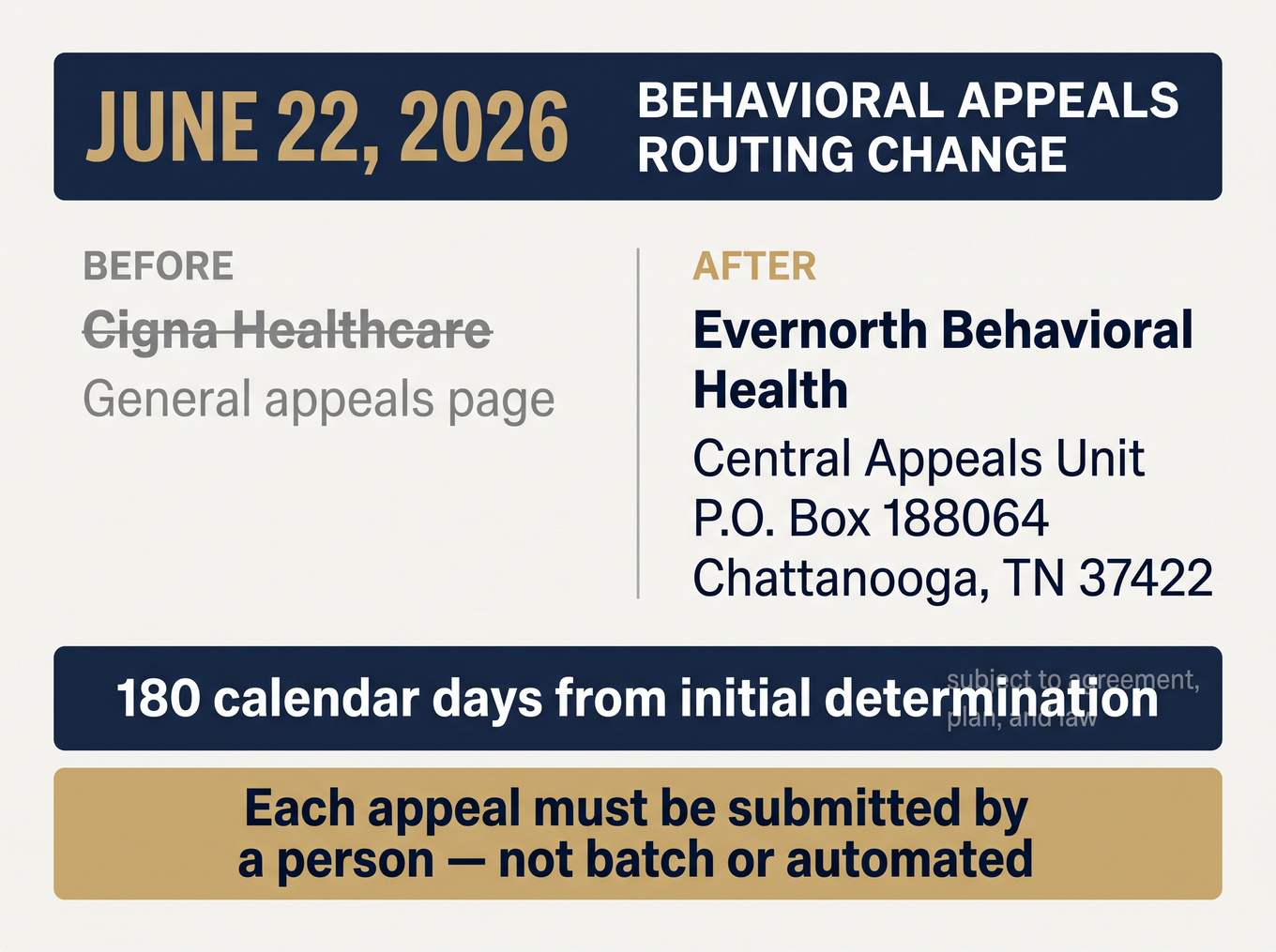
An appeal is the lane most practices know. It is frequently the wrong one and usually the slowest, and using it on a problem that wanted a corrected claim burns the appeal window on a formality.
Classify the problem before you file
| The problem | The correct first lane |
|---|---|
| 999 or 277CA rejection, no payer claim exists | Correct and resubmit electronically |
| The payer processed the claim differently from the data you submitted | Call Provider Services and request a processing correction; document the reference |
| The data you submitted was wrong | Corrected, replacement, or void claim |
| Fee schedule, repricing, or a reimbursement issue | Portal reconsideration, or the contract-dispute path where available |
| Administrative post-service denial | Formal behavioral appeal with evidence |
| Medical-necessity or level-of-care denial | Clinical appeal - complete record, response to the criterion and rationale, peer review where available |
| Second-level adverse decision | Second-level appeal within the applicable deadline |
| Eligible for external review | Follow the plan or state external-review instruction |
| Contractual dispute after the internal process | The agreement's arbitration or dispute process |
On corrections specifically, four situations take four different actions:
- EDI or payer rejection, before adjudication - correct the rejected data and resubmit as an original claim, unless the payer created a claim record requiring a different instruction.
- Adjudicated claim carrying incorrect submitted data - send a replacement claim using the original payer claim-control number and the required frequency indicator.
- A claim that should be canceled - send a void under the payer's instruction.
- The submitted data was correct and the payer processed it incorrectly. Do not alter true claim data to force payment. Use the processing-error, reconsideration, or appeal workflow.
Source: Administrative Guidelines, pp. 71–73. Standard 837 practice uses claim-frequency code 7 for a replacement and 8 for a void or cancel; follow the portal or clearinghouse instruction for your specific transaction.
Call before you file
Evernorth's guide advises contacting Provider Services before a formal appeal when the issue may be a payer processing error (pp. 71–73). Behavioral Provider Services is published as 800-926-2273 (provider service center) - though a card-specific number can supersede the general one, so check the card first. Script the call: an unscripted one produces "resubmit it" and nothing else.
Ask the representative to confirm: the claim-control number and received date; the billed and the loaded TIN, NPI, and location; network and product status; the authorization record and whether it is linked to the claim; the exact adjustment reason; whether the claim needs correction, reconsideration, or appeal; the submission address, fax, or portal path; the deadline; and the call reference and representative identifier.
Do not accept "resubmit" without asking two follow-ups: will resubmission create a duplicate, and is a replacement frequency code with the original claim number required? Resubmitting a claim the payer already has generates a duplicate denial and another two weeks of delay.
When a payer representative gives you a determination verbally, ask for it in writing. One biller's summary of what happens otherwise: "They refuse to give me anything in writing" (r/CodingandBilling). Work from the adverse determination, the criterion applied, the claim data, and the exact rationale. An appeal built on a phone recollection is an appeal built on nothing.
The June 2026 change most published guidance predates
Behavioral appeals go to Evernorth, not to Cigna Healthcare.
On June 22, 2026, Evernorth's Provider Newsroom stated that behavioral appeals should be submitted directly to Evernorth rather than to Cigna Healthcare, to prevent delay, directing providers to the Behavioral Appeals Cover Sheet and the Central Appeals Unit (guidance for submitting behavioral health appeals).
Current published mail route:
Evernorth Behavioral Health Central Appeals Unit P.O. Box 188064 Chattanooga, TN 37422
The Behavioral Appeals Cover Sheet in Evernorth's forms center is dated June 1, 2026 (forms center). The March 2026 national guide also publishes behavioral appeal fax 877-815-4827. Verify the cover sheet, address, and fax against the live form before you use them.
The change is recent and the obvious destination is wrong. Cigna's general appeals page (appeals and disputes) offers a plausible, official-looking route that, for a behavioral claim, runs against the current instruction. The 180-day deadline does not pause while an appeal sits in the wrong queue.
Deadlines, and the rule about people
The current guide gives a national default of 180 calendar days from the initial payment or denial determination, or from the last payment adjustment for an adjustment dispute, subject to agreement, plan, and law (pp. 72–73).
One procedural rule surprises billing companies: appeals cannot be submitted by an automated or batch process. Each individual appeal must be submitted by a person - including when a billing company is acting for the provider. If your appeal process assumes bulk submission, it does not work here.
One appeal, one identifiable claim or decision. Do not send a spreadsheet of unrelated denials under one generic letter unless Evernorth expressly permits that format. A clean appeal header identifies the patient and date of birth; the member ID and group; the provider or facility with TIN and NPI; the claim-control number; the dates of service; the billed code, revenue code, or level of care; the authorization number; the EOP date and denial code; the amount in dispute; the type of appeal; and the resolution you are requesting.
Three packets for three problems
Administrative - for eligibility, network, authorization-linkage, timely-filing, routing, or payment disputes:
- The cover sheet
- A concise issue statement and the correction requested
- The EOP or 835, and the claim-control number
- The exact submitted claim
- Card and eligibility evidence
- Contract, effective-date, or network evidence where relevant
- The authorization letter or log where relevant
- The 999, 277CA, or payer receipt
- Call references and correspondence
- The timely-filing chronology
- The primary EOB for coordination of benefits
- Any payer instruction you relied on
Clinical - for level of care, length of stay, delayed days, or medical necessity:
- The adverse determination, with its specific criterion and rationale
- The complete record for the disputed period, where Evernorth requires it
- Admission, assessment, and diagnosis
- Risk, symptoms, functioning, and withdrawal or intoxication status where applicable
- The treatment plan and services delivered
- Response, progress, and unresolved impairments
- Medication management
- Family, support, and aftercare work
- Barriers to safe discharge or step-down
- Daily or periodic notes, and attendance
- The authorization and concurrent-review chronology
- A criterion-by-criterion rebuttal
- The requested level and dates, with the reason a lower level was insufficient
Evernorth states that an adverse decision should explain the criterion used, the facts and evidence considered, and the clinical rationale - which is exactly what you rebut against (pp. 73–75).
Wrong-insurance retrospective - where late authorization arose from erroneous insurance information:
- A copy of the card presented at admission
- The registration or intake note showing what the patient represented
- The dated 270/271 or portal result
- The coordination-of-benefits discovery and new-card date
- Call logs to each payer
- Evidence of a prompt authorization request after discovery
- The full clinical record
- Proof that treatment met the applicable criterion
- The claim filing and acceptance chain
The key is proving both medical necessity and the cause and timing of the insurance error.
In every case, tie each attachment to a sentence. An unindexed 200-page packet makes the reviewer reconstruct your argument for you.
After the first decision
The national guide describes first-level appeal response frameworks of 60 or 75 days depending on dispute type and arrangement, with state and contract variations. A second-level appeal is generally due within 60 days of the first-level decision under the guide's clinical appeal pathway, and external review depends on the plan and the state (pp. 72–75).
Store the appeal sent and received dates; the expected response date; the actual decision date; the decision rationale; the second-level deadline; external-review eligibility and deadline; and any arbitration or contract notice deadline.
Two edge cases. For some out-of-network appeals, the provider may need an appointment or authorization-of-representative form from the patient, and the provider's contractual payment appeal stays distinct from the member's coverage appeal. After the internal process, some participating-provider disputes proceed under the provider agreement's dispute or arbitration terms. That is not a generic public "Cigna arbitration policy"; it lives in your executed agreement, its amendments, and the governing law, notice provision, venue, and deadline written there. Identify the lane, then take it to counsel.
What a strong appeal letter looks like
Short, because the evidence is organized:
- The decision challenged - claim, date, code, amount, denial.
- The resolution requested - the exact reprocessing or coverage action.
- The controlling fact - accepted timely, authorization matched, provider effective on the date, wrong payer instruction corrected, criterion met.
- A chronology - five to ten dated events.
- The rule or evidence - plan, agreement, payer instruction, clinical criterion, state rule.
- An attachment index.
- Contact information and a response request.
Avoid emotional language, generic accusations, and unrelated chart material. Where parity is genuinely relevant, ask precise process, comparison, and disclosure questions rather than asserting a violation you have not evidenced.
When a practice can handle Evernorth billing in-house
A meaningful share of practices can run this work in-house, and where that is true we would rather say so.
You can reasonably self-manage when
- You have one TIN and one stable location.
- You have a small number of enrolled clinicians.
- Your volume is mostly routine outpatient therapy and psychiatry.
- You have little or no PHP, IOP, residential, or inpatient volume.
- You see few EAP cases.
- You have reliable EDI and ERA tooling.
- Someone actually monitors rejections and filing deadlines - as a named job, not as a spare-time task.
- Your contract and enrollment records are current.
- Denial volume is low and cash reconciliation is clean.
Under those conditions the minimum viable set is small: one payer and card matrix, current portal access, a weekly rejection review, an EAP flag and code workflow, a 90-day filing countdown with a stricter internal target, monthly remittance and EFT reconciliation, and a current credentialing and directory record. Outsourcing is not automatically necessary because a card says Cigna.
It becomes rational to bring in specialist support when
- You have multiple TINs, locations, groups, or provider types.
- You enroll new providers or locations frequently.
- You produce both facility and professional claims.
- You carry inpatient, residential, PHP, or IOP authorization and concurrent review.
- You have high EAP volume, or repeated EAP and ordinary-benefit crossover errors.
- Your payer mix is TPA-heavy.
- You see persistent 109, 197, 198, 208, or 29 denials.
- You have accepted-but-invisible claims.
- You have unmatched EFT and ERA dollars sitting in unidentified cash.
- A/R is aging and follow-up is being missed.
- Staff turnover or portal-access concentration is a live risk.
- Clinical appeals need complete-record assembly that nobody has time to do.
- Nobody is accountable for root-cause correction, so the same denial recurs monthly.
The honest dividing line is not size. It is whether the number of independent configurations you maintain has outgrown the number of people watching them.
That picture usually changes for one of four reasons: the practice is growing - new clinicians, new locations, a new state; the payer or service mix has genuinely got more complex; nobody has the time the billing side actually needs; or collections have slipped and nobody can say precisely why. We work with practices of every size, from a single clinician to a multi-state group, and we take on a single piece of the cycle as readily as the whole of it. The question is not whether a practice is big enough to be worth helping, but which part of the cycle needs owning.
What the work actually consists of
So you can price it against your own staff time: maintaining the payer and card routing matrix; behavioral-benefit verification; exact provider, TIN, NPI, and location enrollment control; the authorization and concurrent-review calendar; CMS-1500/837P and UB-04/837I claim production; EAP separation and the 99404 workflow; EDI acceptance monitoring; claim and remittance follow-up in the behavioral portal; 835 and EFT reconciliation; denial classification and filing-evidence preservation; administrative and clinical appeal packet assembly; and recurrence prevention across the payer matrix.
Complexity scales the list. A multi-provider outpatient group adds a provider-TIN-location enrollment matrix, a rendering-provider claim edit, a roster and effective-date workflow, central benefit and reference storage, an authorization work queue, denial taxonomy by clinician and location, ERA and EFT by TIN, and cross-trained portal access managers. A facility adds admission payer-routing review, a utilization-review calendar with a backup owner, daily authorized-day reconciliation, a criteria and version library, a revenue-code and program matrix, attendance and clinical-record completeness checks, peer-review and appeal deadline tracking, discharge and step-down reconciliation, and high-dollar claim tracking by day and level.
What to measure, whoever does the work:
- First-pass payer acceptance rate, as distinct from clearinghouse transmission
- Claims visible in the payer portal within the expected intake window
- Initial denial rate
- Wrong-receiver rate
- Provider-enrollment and NPI mismatch rate
- Authorization-related denial rate, by 197, 198, and 210
- Concurrent reviews completed before deadline
- Authorized days and units lost
- EAP first-pass payment rate, and patient-cost-share error rate
- Timely-filing denials, and the percentage overturned
- Days from date of service to claim acceptance, to adjudication, and to cash
- Unmatched ERA and EFT dollars
- Underpayment rate against contract
- Appeal overturn rate by root cause
- Preventable denial rate
- A/R over 30, 60, and 90 days, split by Cigna, Evernorth, and TPA
Two caveats. Internal service-level targets - claims released within one to three business days of complete documentation, EDI rejections corrected within one business day, no original claim allowed to approach day 90 without payer receipt, concurrent reviews submitted at least one business day before the payer cutoff - are management choices, not payer-published turnaround guarantees. And nothing in this article, or in any billing arrangement, guarantees that a denial will be overturned, that an authorization will be granted, or that a claim will be paid. What disciplined work changes is how many of your denials were preventable, and how many of the preventable ones happen twice.
The seven objects behind one Cigna card
Cigna and Evernorth generate confusion not because the payer is uniquely difficult, but because it makes visible something true of behavioral billing everywhere: one of the pieces has its own name.
Behind a single card there are seven distinct objects, and a practice that collapses them into one will keep producing claims that are correct in every respect except where they went:
- The brand on the card.
- The behavioral administrator who runs the benefit.
- The claim receiver who takes the transaction.
- The financial payer or TPA whose money it is.
- The portal that will display the claim and the remittance.
- The contracted provider configuration the claim must match exactly.
- The authorization record the claim must reconcile against.
Cigna and Evernorth is the case where object two has its own letterhead.
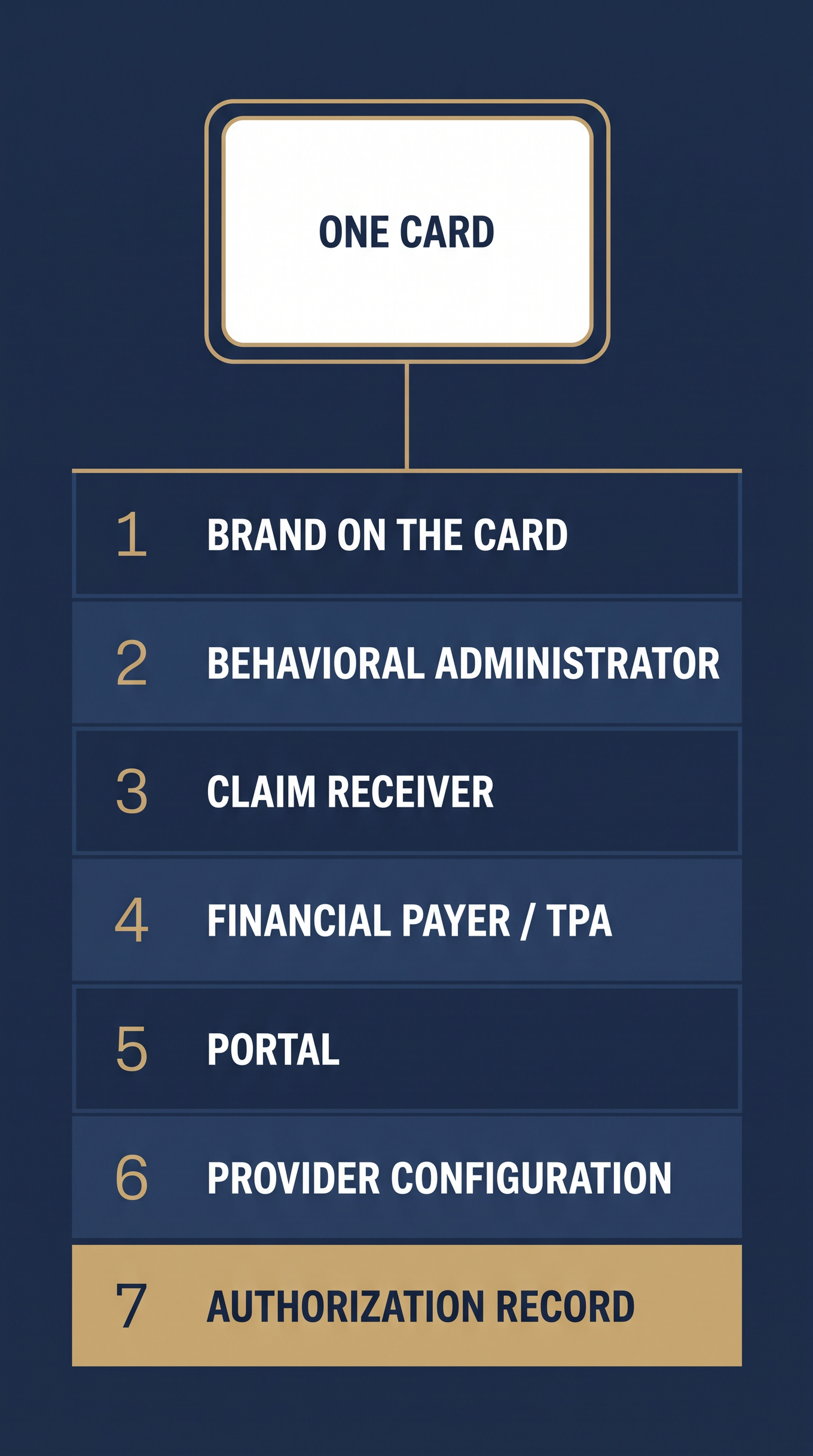
The story here is not "Cigna never pays." Providers describe claims that process quickly and EAP referrals that work as intended. The accurate description is high variance: when route, portal, enrollment, benefit, and authorization all align, the claim is unremarkable. When one layer is wrong, the brand architecture makes the defect genuinely hard to see - and that difficulty, not the payer's willingness to pay, is what turns a correctly delivered service into an unpaid one.
Our take, after doing this work across behavioral practices: the practices that struggle with this payer are almost never the ones with the worst clinicians or the worst documentation. They are the ones deriving the answer per claim instead of storing it per group. The highest-return thing you can do this week takes an afternoon: build the dated card and routing matrix for your recurring employer groups, with the funding type, the behavioral administrator, the receiver, the portal, and the filing basis in it. Build it before the next denial, not after. Every control in this article gets cheaper once that table exists, and almost every failure above gets caught at intake instead of at day 85.
Common questions about Cigna and Evernorth behavioral billing
Is Evernorth Behavioral Health the same as Cigna Behavioral Health?
Yes. Cigna Behavioral Health, Inc. changed its name to Evernorth Behavioral Health, Inc. effective September 1, 2021. The change did not replace existing provider contracts, alter network status created by an existing behavioral agreement, or change the electronic payer ID.
What payer ID does Evernorth Behavioral Health use?
62308 is the verified electronic payer ID for Evernorth Behavioral Health, unchanged by the 2021 name change, and the current guide also directs electronic coordination-of-benefits claims there. It is not a universal override: claims can be processed by multiple claim centers or third parties, and the current claim center appears on the member's card.
Should mental health claims be submitted through Cigna or Evernorth?
Behavioral claims for members whose behavioral benefits are administered by Evernorth Behavioral Health go through the Evernorth behavioral route, typically payer ID 62308 - not through a general Cigna medical destination. For groups administered through a third-party administrator under Shared Administration or Payer Solutions, follow the card and the live eligibility response instead.
Which portal shows Evernorth behavioral claims and remittances?
Provider.Evernorth.com. Under the current split, a behavioral-only TIN uses Provider.Evernorth.com for claims and remittances, a medical-only TIN uses CignaforHCP, and a TIN with both can see eligibility on both sites - but CignaforHCP does not display claims and remittances for Evernorth Behavioral patients. A claim that appears "missing" is often being searched for in the wrong portal.
Do routine psychotherapy claims require prior authorization?
The March 23, 2026 authorization resource lists common outpatient codes - including 90791, 90792, 90832–90840, 90846–90849, and 90853 - as not requiring prior authorization in the configurations listed. That answers the prior-authorization question only. Coverage, provider type, diagnosis, plan exclusions, frequency, network status, documentation, and post-service review remain separate gates, and the resource itself states it is not comprehensive.
Do PHP and IOP require authorization?
There is no safe national yes or no. The current national guide says PHP and IOP may require prior authorization depending on the plan, and the current code table frequently directs providers to call and verify. Inpatient and residential admissions are universally listed as requiring authorization; PHP and IOP must be verified per member and plan.
What is Evernorth's timely filing limit?
The March 2026 Administrative Guidelines use a default of 90 days from the date of service, or from the last date for consecutive-day services, unless the agreement or applicable law provides otherwise. Exceptions include longer state rules, coordination of benefits measured from the primary payer's processing date, three years for Medicare secondary payer and Medicaid, a reset when Evernorth requests additional information on a timely claim, third-party vendor limits that may be shorter or longer, and catastrophic circumstances.
How do providers bill Cigna and Evernorth EAP sessions?
Obtain the EAP verification before the first session, then bill CPT 99404 for all EAP services, with the alphanumeric verification (or "Disney," for Disney Worldwide Services only) recommended in CMS-1500 Box 23 and electronic claims to payer ID 62308. Verified EAP visits carry no member copayment, and the paper routing for ordinary alphanumeric verifications differs from the Disney route - do not combine them.
Where do behavioral health appeals go?
As of June 22, 2026, Evernorth directs providers to submit behavioral appeals directly to Evernorth rather than to Cigna Healthcare, using the Behavioral Appeals Cover Sheet and the Central Appeals Unit at P.O. Box 188064, Chattanooga, TN 37422. The national default appeal deadline is 180 calendar days from the initial payment or denial determination, subject to agreement, plan, and law - and each appeal must be submitted by a person rather than by an automated batch process.
What do CARC 109, 197, 198, 210, and 29 suggest?
109 points to a wrong payer or contractor - the claim should go elsewhere. 197 points to an absent precertification, authorization, or notification. 198 points to an authorization that has been exceeded. 210 points to an authorization not received timely. 29 points to an expired timely-filing period. Read them as diagnostic clues alongside the 835 group code and the payer's own narrative, not as proof of the underlying cause.
Why can an authorized service still deny?
Most often because the claim does not match the authorization on a field the authorization number does not carry - the billing or rendering entity, the TIN, NPI, or location, the level of care or revenue code, the dates, the remaining units, or the diagnosis track. Compare the authorization to the claim field by field before filing anything; if every field matches, call Provider Services for a linkage or processing correction rather than opening a clinical appeal.
How does a self-funded or TPA-administered Cigna plan change the workflow?
It can change who receives the claim, who pays it, which portal and EOP govern, the customer-service and appeal path, and the filing deadline - which may be shorter or longer than the 90-day default. It also affects whether state insured-plan protections and state addenda reach the member at all, since those apply as required by law and may not apply to self-funded business. Read the card, run live eligibility, and record the arrangement per group rather than per claim.
What we verified, and what was still moving
Everything above was checked against Evernorth's and Cigna's own provider-facing material, plus primary X12, AMA, and Department of Labor sources, on August 17, 2026. The load-bearing sources are the Evernorth Behavioral Administrative Guidelines (March 2026, with the landing page noting an April 17, 2026 update), the Authorization and Billing Resource (March 23, 2026), the Evernorth provider FAQ on the name change and portal, the Join the Network page (May 19, 2026), the EAP page (April 16, 2025, including the May 5, 2025 Disney change), the forms center (behavioral list updated July 10, 2026), and the Provider Newsroom appeals guidance (June 22, 2026).
Several things were unresolved or actively moving on that date:
- The individual and clinic application pause. It began June 1, 2026 and Evernorth advised revisiting after September 1, 2026. This page was verified two weeks before that date, so the pause may already have lifted by the time you read this. Check the Join the Network page directly.
- Document currency. The March 2026 guide edition and the March 23, 2026 authorization table were current on our verification date. Both are revised periodically, and the authorization resource states on its face that it is not comprehensive and is subject to change.
- The appeals cover sheet, address, and fax. The cover sheet was dated June 1, 2026 and the guidance was published June 22, 2026 - recent enough that the form and routing should be confirmed against the live forms center before use.
- EAP formats, addresses, and the Disney exception. Verify these on the EAP page on the day you bill. We have deliberately not reproduced the Disney paper route here.
- Portal-gated reimbursement and code-editing policy. Some claim-editing and modifier policies require authenticated access, and the public index does not expose every operative edit or fee-schedule rule. We could not read them, so we have not characterized them. Retrieve the current policy through your authenticated provider resources for any code-specific question (policy updates).
- The MHPAEA posture. The 2024 final rule is subject to the departments' May 15, 2025 nonenforcement announcement while litigation and reconsideration proceed. This may change.
- The telehealth code-set lag. The March 2026 authorization table still displayed telephone codes deleted from CPT for 2025. Verify the live code set and your plan-specific rule rather than reading a payer table as a coding instruction.
- Predetermination. Where a payer offers a voluntary predetermination or pre-service review, it may indicate likely coverage without being a guarantee or a final adverse benefit determination. The precise Evernorth predetermination workflow and its appealability should be confirmed in the authenticated portal or the plan documents; we could not verify it publicly.
Some things are not knowable in one universal answer:
- Every contract's fee schedule
- Whether a particular clinician, TIN, or location is loaded correctly
- Member-specific benefits and network tier
- Every employer's EAP visit count
- Every TPA's filing limit and claim receiver
- How a given state law applies to a self-funded plan
- Claim turnaround for a particular group
- Whether an authorization guarantees a particular code or payment
- Portal-gated modifier and edit logic
- External-review eligibility for a specific plan
- Arbitration rights under a specific provider agreement
For any real claim, the order of authority runs:
- Applicable federal or state law
- The patient's governing benefit-plan document and funding arrangement
- Your Evernorth Behavioral Health agreement, with its exhibits, amendments, and state addendum
- The patient's current ID card and live eligibility response
- A case-specific authorization or written payer determination
- The current Evernorth Behavioral Health Administrative Guidelines and portal policies
- General Cigna Healthcare pages
- And only then, any third-party summary - including this one
Evernorth itself states that the benefit plan determines the actual benefits payable, that applicable law controls, and that the provider agreement overrides inconsistent language in its administrative guide.
This article is operational guidance for revenue-cycle staff. It is not legal advice, clinical advice, coding advice, a substitute for the member's benefit plan, or a substitute for your provider agreement. Payer identifiers, addresses, filing periods, forms, and policies change - re-verify load-bearing details against current primary sources and the member's own plan, card, and eligibility response before relying on them.