Why Mental Health Claims Get Denied (And How to Stop It)
August 4, 2026 · 23 min read
You did the work. The patient was covered. You verified the insurance, you ran a clean session, you submitted the claim. And weeks later it came back denied with an explanation that told you almost nothing: not covered, missing information, authorization absent, provider not eligible. So you appealed, or you re-sent it, or you gave up and wrote it off, and then the next one denied the same way.
If that loop is familiar, here is the single most useful thing to understand about why mental health claims get denied: the denial code is the symptom, not the cause. By the time a payer rejects a claim, the real mistake has usually already happened - back at eligibility, payer routing, authorization, credentialing, coding, or documentation. The claim didn't fail because therapy is illegitimate or because "payers just don't pay for mental health."
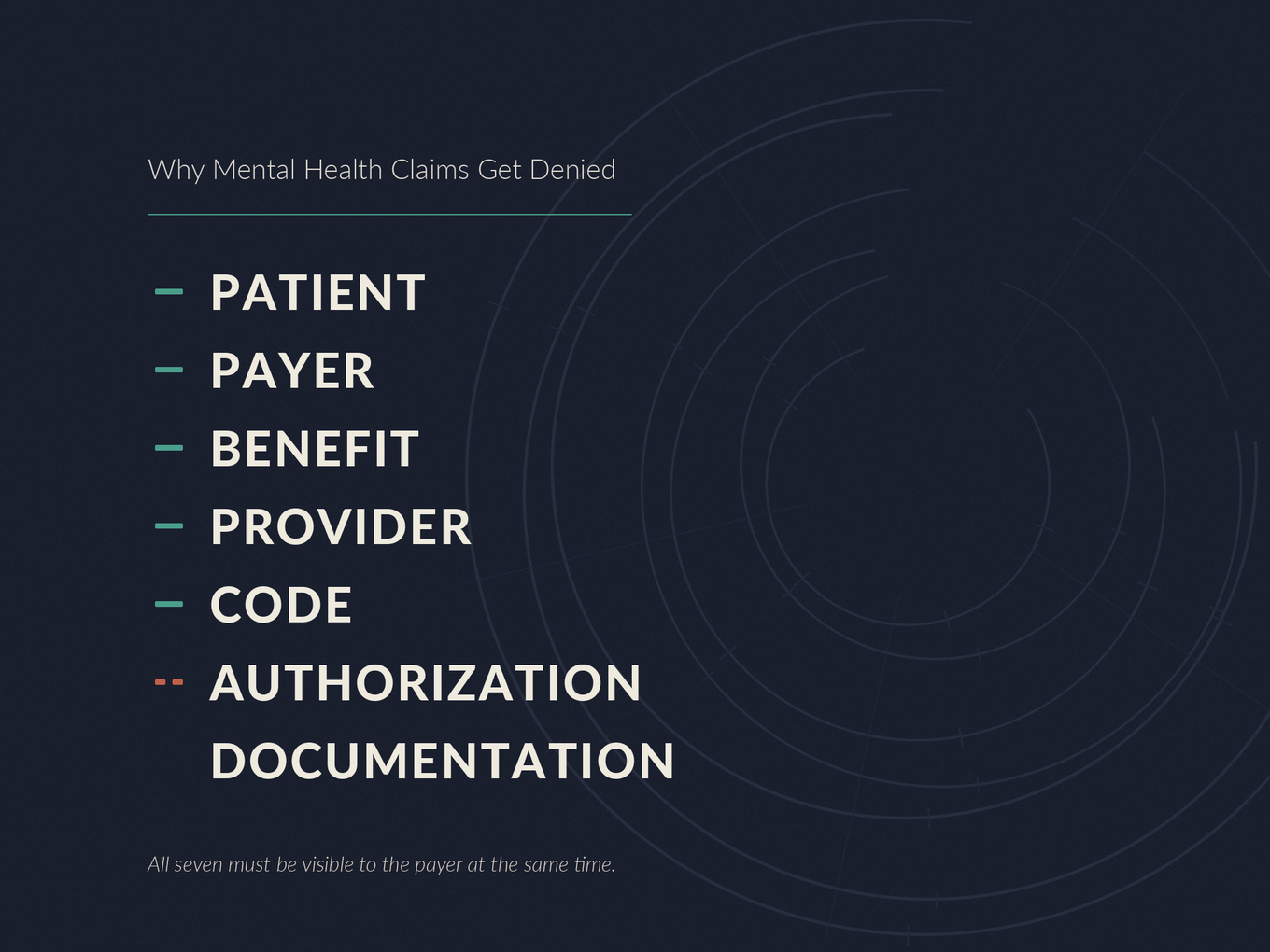
It failed because, on that specific claim, one of seven things didn't line up: the right patient, the right payer, the right benefit, the right provider, the right code, the right authorization, and the right documentation, all visible to the payer's system at the same time.
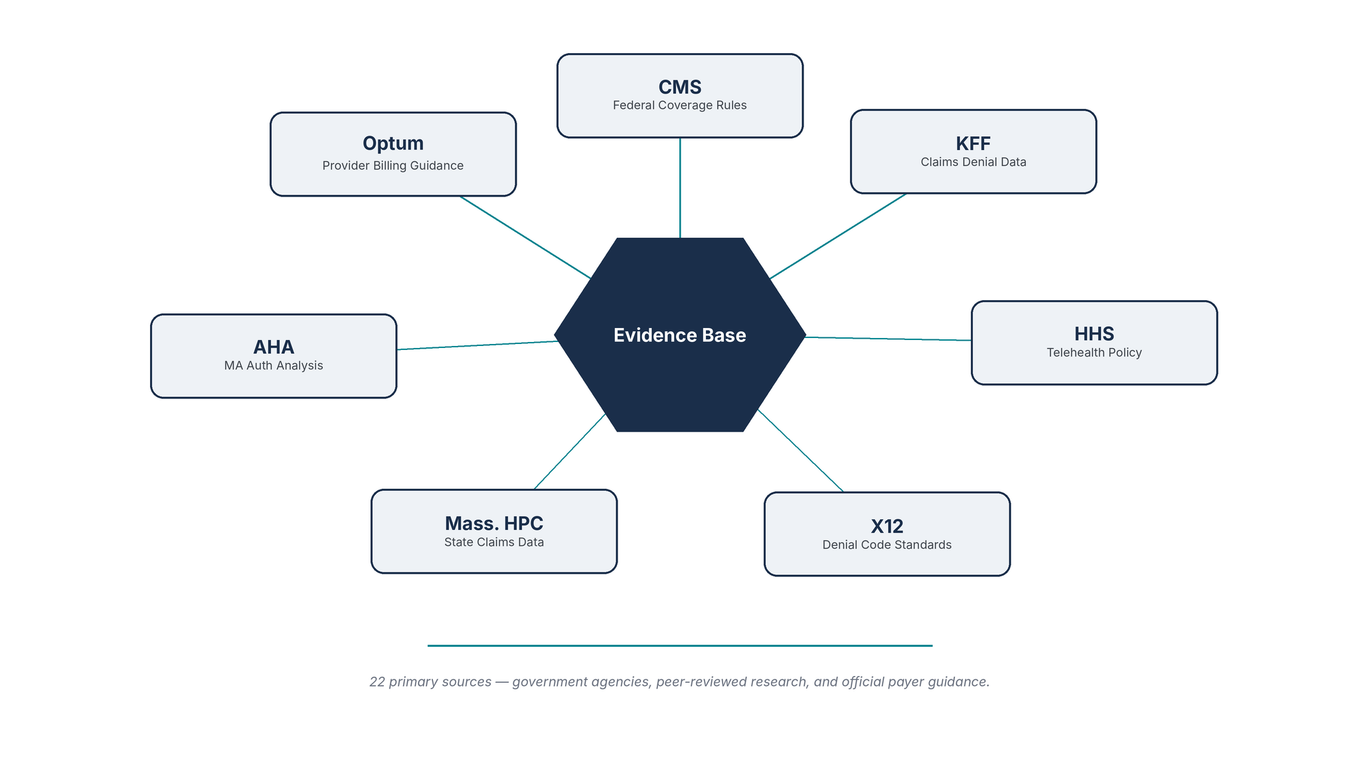
We run revenue cycles for behavioral health, mental health, and hospital practices, specialties where front-end billing details can be especially unforgiving. So this is the pattern we work in every day, and it's a pattern, not bad luck. By the end of this article you'll be able to read a mental health denial backwards to the front-end mistake that caused it, you'll know the traps that are specific to behavioral health and trip up general billers, and you'll know what actually stops the denials instead of just appealing them one at a time.
Mental Health Claim Denials vs. Rejections vs. Underpayments
Before anything else, it helps to separate three things that get lumped together as "denials," because they live in different parts of the cycle and they get fixed in different ways.
A rejection happens before the payer ever adjudicates the claim. The claim hit a clearinghouse or payer front-end edit - an invalid member ID, a missing NPI, a bad payer ID, a malformed diagnosis, and bounced before it became a real, payable claim. Rejections usually don't come back with formal denial codes, because the payer never processed the claim. They show up in your clearinghouse reports and your EHR's rejection queue, which is exactly why they're so easy to miss.
A denial happens after adjudication. The payer accepted the claim into its system, processed it, and decided not to pay all or part of it. That decision arrives on an electronic remittance - the ERA, the electronic version of the old paper Explanation of Benefits - carrying standardized adjustment codes that tell you, in payer shorthand, why.
An underpayment is sneakier: the payer paid something, just less than your contract says it should have. Underpayments hide inside contractual adjustments, bundling edits, the wrong fee schedule, or a provider who isn't correctly linked to the contract.
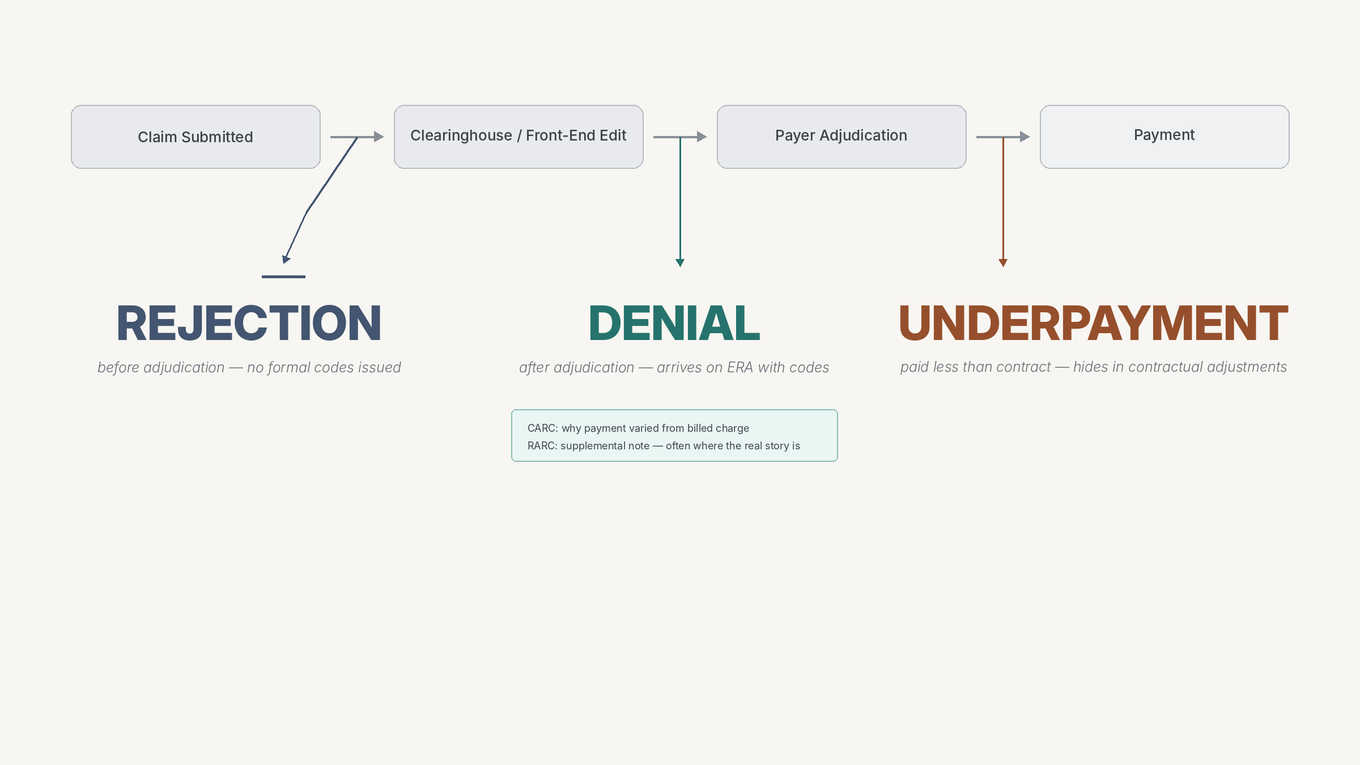
The codes on that remittance are the part most practices learn to dread, so they're worth a plain-English introduction. The CARC, Claim Adjustment Reason Code, explains why a claim or line was paid differently than you billed it. X12, the body that maintains the official list, defines CARCs as the standardized way payers communicate that payment varied from the submitted charge 1. The RARC, Remittance Advice Remark Code, is the supplemental note that adds detail to a CARC, or supplies an informational alert 2. When you see a CARC paired with a RARC, the RARC is often where the real story is.
Here's why that three-way distinction matters: a rejection, a denial, and an underpayment each point to a different upstream failure. A rejection means something broke at claim submission. A denial means the payer's rules weren't met somewhere in the cycle. An underpayment means the contract or the provider setup is wrong. The code is a fingerprint, and once you can read it, the question stops being "why is the payer doing this to us?" and becomes "where in our process did this claim go wrong?"
But before we trace any single code backwards, there's a finding most practices get wrong about where the bulk of the damage actually comes from.
Administrative vs. Clinical Denials in Mental Health Billing
Ask a clinician why their claims get denied and most will say the same thing: the payer questioned medical necessity. They decided the therapy wasn't justified. It's an understandable assumption. It's the version of events where the denial is a disagreement about care, which is the thing clinicians know best.
The public data tells a different story. When KFF analyzed 2024 claims in HealthCare.gov Marketplace plans, in-network insurers denied about 19% of claims, and among reported denial reasons, only 5% were attributed to medical necessity. The rest were administrative or opaque: 36% fell into an "other" bucket, 25% were explicitly administrative, 13% were plan exclusions, and 9% were lack of prior authorization or referral 3. (KFF notes that because a single claim can have more than one denial reason, these reason categories aren't a clean one-to-one breakdown of denied claims.)
The same dataset found that fewer than 1% of denied claims were ever appealed, and insurers upheld 66% of the appeals that were filed 3. That last number cuts both ways: most denied money is never challenged, and challenging blindly doesn't work either. But when denials are challenged in the right places, a striking share don't survive scrutiny, a 2025 Health Affairs study using 2019 Medicare Advantage claims data found 57% of initial denials were overturned, with provider revenue still dropping about 7% net after the whole denial-and-appeal cycle 20. That data is Medicare Advantage, not mental health, so treat it as a directional signal: a meaningful chunk of denials are wrong or fixable rather than final, and chasing them after the fact is still expensive.
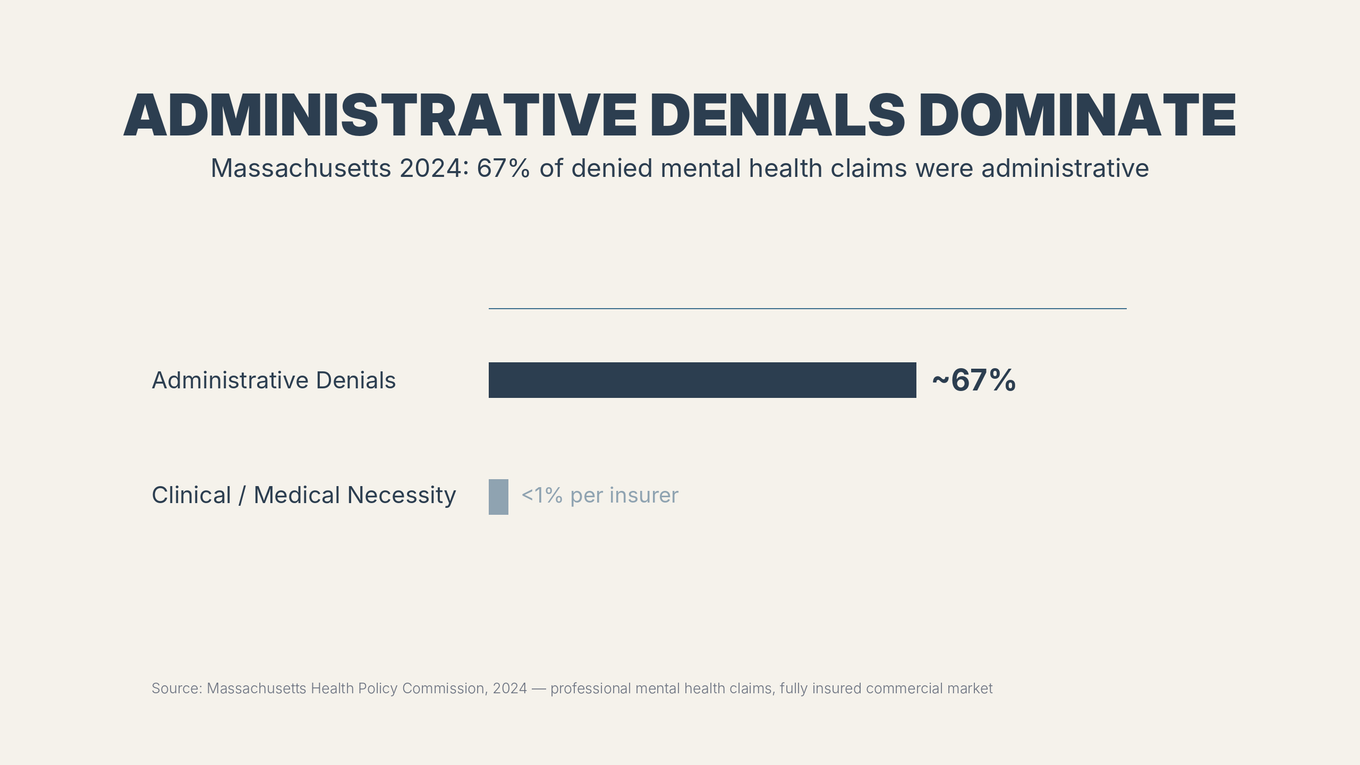
The KFF data isn't mental-health-specific, and it only covers Marketplace plans, so it's context rather than proof. But there's a closer signal. Massachusetts publishes claims data for its fully insured commercial market, and in 2024 the state found that professional mental health claims were denied at a rate of about 10% - roughly 377,000 denied claims, and that about 67% of those denied mental health claims were administrative rather than clinical 4.
Across all 45.9 million fully insured commercial claims in that dataset, the overall denial rate was around 20.4%, and strictly clinical denials never exceeded 1% for any single insurer 5. This is state-specific and limited to fully insured commercial plans, so it doesn't capture every self-funded employer plan in the country, but as one of the stronger public mental-health-specific benchmarks available, it points hard in one direction.
That direction lines up with what billers see across the industry. In Experian Health's 2025 survey of healthcare finance and billing professionals, 41% reported denial rates of 10% or higher, and the top drivers they named were missing or inaccurate data, authorization problems, and incomplete patient registration 6 - all front-end, all administrative, none of them a fight about whether the care was warranted.
None of this means medical necessity denials don't matter. They absolutely do, especially for higher levels of care, psychological testing, TMS, substance use treatment, and the routine 90837 review we'll get to. But if your mental health denials feel relentless, the math says the largest, most preventable share of them isn't a clinical disagreement at all. It's an administrative miss, and behavioral health has a specific set of administrative misses that general medical billing simply doesn't.
5 Behavioral Health Billing Traps That Create Preventable Denials
This is the part that explains why a perfectly competent biller, one who handles a primary-care or orthopedics practice flawlessly, can drown in your behavioral health claims. Mental health billing isn't medical billing with different codes. It has structural traps that don't exist in most other specialties, and each one is a front-end decision that surfaces, weeks later, as a back-end denial.
The payer on the card isn't always the payer you bill
Here is the trap that catches more behavioral health practices than any other. A patient hands you a UnitedHealthcare, Aetna, Cigna, or Blue Cross card. Your front desk verifies it, sees "active coverage," and bills that payer. The claim denies, and the denial says, in effect, we don't administer this benefit; send it somewhere else.
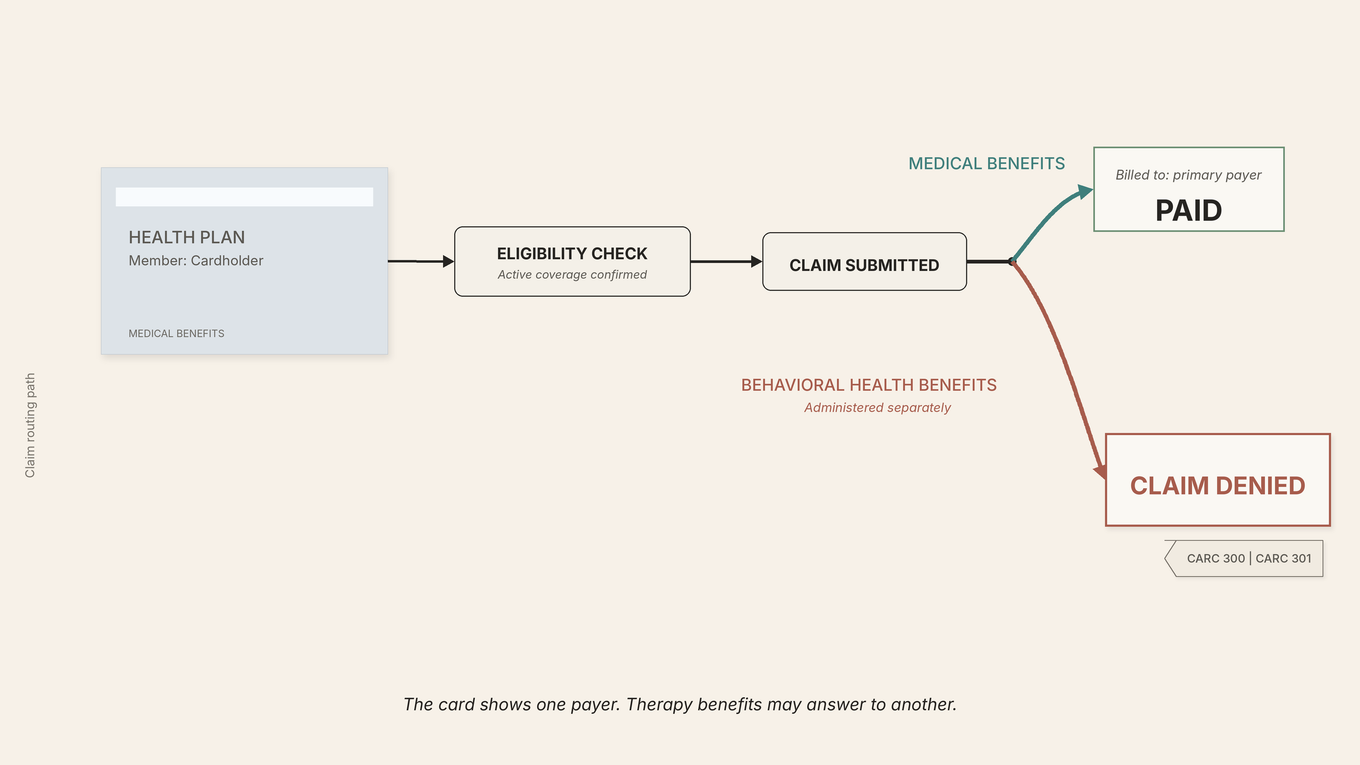
The reason is the carve-out: the company named on the insurance card administers the patient's medical benefits, but a separate company runs the behavioral health benefits underneath. A UnitedHealthcare member's therapy might be administered by Optum; an Anthem member's by Carelon; others by Magellan or a state Medicaid behavioral health organization. The medical card looks active because, for medical services, it is. Nobody checked who actually pays for the therapy.
This isn't a rare edge case. It's structural enough that the standardized code set has dedicated codes for it. X12 maintains CARCs 300 and 301 specifically for behavioral health routing: 300 tells you the medical plan received the claim but the benefit lives elsewhere and the claim has been forwarded to the behavioral health plan, and 301 instructs you to submit to the behavioral health plan directly 1. When a code set builds a code for your exact mistake, that's a sign the mistake is common.
Substance use benefits make it harder still, because they're frequently carved out separately from mental health. In a 2024 study of 70 comprehensive Medicaid managed care plans in 10 states, using plan documents active in 2018, 28.6% carved out at least some substance use treatment, 40% carved out all of it, and 77.1% carved out at least some of the SUD medications 7. So a practice can verify "behavioral health," feel confident, and still bill detox, residential, or medication-assisted treatment to an entity that was never going to pay it.
And the routing isn't static. Payers change behavioral health vendors. When Blue Cross and Blue Shield of Texas moved Blue Advantage HMO and MyBlue Health behavioral health administration off Magellan effective January 1, 2026 8, practices that didn't update their payer IDs and authorization workflows risked denials on claims that would have paid fine a month earlier, even though BCBSTX said it would honor existing Magellan authorizations during a 180-day transition window. The pattern we see again and again: the clinician was right, the service was appropriate, and the claim still failed, because the front-end routing was stale.
Your new clinician is licensed, but the payer hasn't loaded them yet
Behavioral health groups hire constantly, and they run many license types under one roof: LCSWs, LMFTs, LPCs, psychologists, psychiatrists, psychiatric nurse practitioners, and associate-level or supervised clinicians. Every one of them has to be more than licensed to get claims paid. They have to be credentialed with the payer, enrolled, linked to the group's tax ID, loaded to the right location and product, and shown in the payer's system as eligible for the specific service billed.
That gap, between "this clinician is licensed and seeing patients" and "this payer will pay claims for this clinician under our contract", is where a lot of quiet revenue dies. A new therapist starts seeing clients the week she signs her employment agreement, but the payer hasn't finished loading her under the group TIN. Her claims deny as provider-not-eligible, even though she's fully licensed and doing excellent work. Nothing is wrong with the care. The payer simply doesn't see her yet.
Medicare adds its own version of this. Providers have to revalidate their enrollment periodically, generally every five years, and CMS can deactivate billing privileges for things as mundane as failing to revalidate on time or going six consecutive months without submitting a claim 19. A deactivation stops payment cold until it's resolved. None of this is clinical. All of it is the unglamorous administrative plumbing that connects a credential to a paid claim, and when credentialing runs disconnected from billing, claims go out before the provider is billable and deny in batches.
90837: what the note has to prove about time and necessity
Psychotherapy codes are time-based, and that single fact generates a remarkable volume of denials. CMS is explicit: codes 90832 through 90838 are selected by time, and the medical record has to document the start-and-stop or total time. The bands are exact - 16 to 37 minutes for 90832, 38 to 52 minutes for 90834, and 53 minutes or more for 90837, and a service under 16 minutes isn't reportable at all 10.
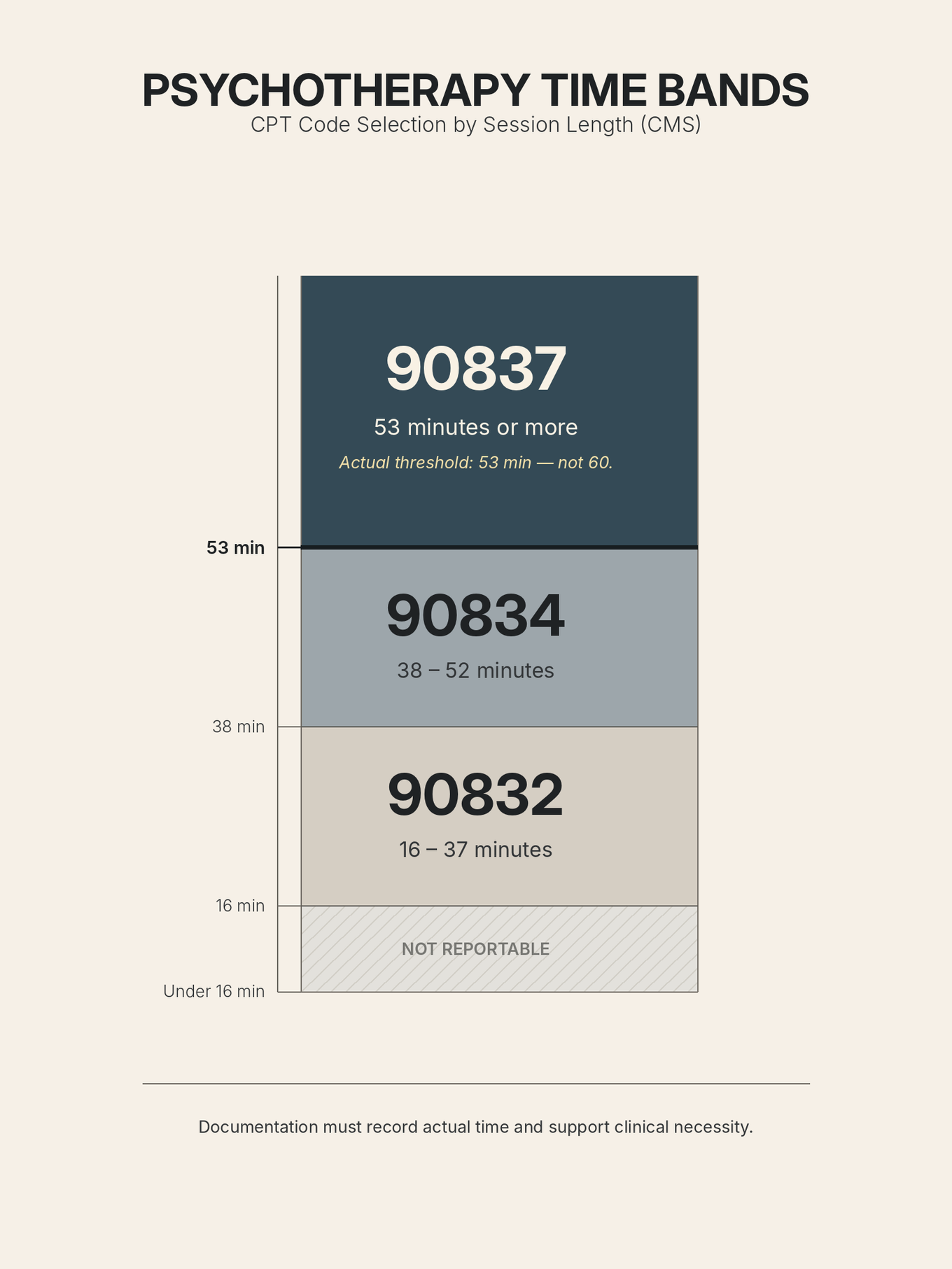
90837 gets special scrutiny because it pays more than 90834 and because some practices default to it for every session. It's often described as "the 60-minute code," but the actual threshold is 53 minutes, and the threshold is only half the requirement. The note has to prove it. Denials cluster when every session is coded 90837 regardless of acuity, when the note says "about an hour" with no recorded time, when the documented time reads 45 minutes but the claim says 90837, or when administrative time gets counted as therapy time. Optum's own provider guidance flags exactly these failures: missing signatures or credentials, missing start-stop times, and a mismatch between the session time documented and the procedure billed 11.
The fix isn't to stop billing 90837. It's to document it so it survives review: the actual time, the diagnosis and target symptoms, the clinical reason the extended session was necessary that day, and a clear tie to the treatment plan. The same discipline applies when a prescriber bills an evaluation-and-management service alongside a psychotherapy add-on like 90833 or 90836: CMS requires the psychotherapy time to be documented separately from the E/M work, and the two services to be separately identifiable 10. When the note blurs them together, the add-on denies.
EAP is not insurance, and billing it like insurance denies every time
An EAP, Employee Assistance Program, is a benefit a lot of practices misread as just another flavor of insurance. It isn't. It's an employer-paid program offering a small number of brief counseling sessions, separate from the patient's behavioral health insurance, with its own authorization, its own allowed codes, and its own rules. A patient can have both, and billing the EAP visit as if it were a regular insurance session denies reliably.
Optum's EAP rules are a concrete example of how specific these requirements get. EAP visits require authorization. Every EAP claim has to carry the HJ modifier, and virtual EAP visits have to carry GT. Optum's allowed EAP codes are a defined, limited set, and critically, extended therapy (90837) and the formal diagnostic assessment (90791) are not covered under Optum's EAP at all 12.
So a practice that runs its standard intake-and-90837 routine on an EAP patient generates two denials before the second visit. The right move is to verify the EAP rules before the first session: how many sessions, which codes, which modifier, what expiration date, and what happens when the EAP sessions run out and the patient transitions to insurance.
Telehealth bills three different ways depending on the payer
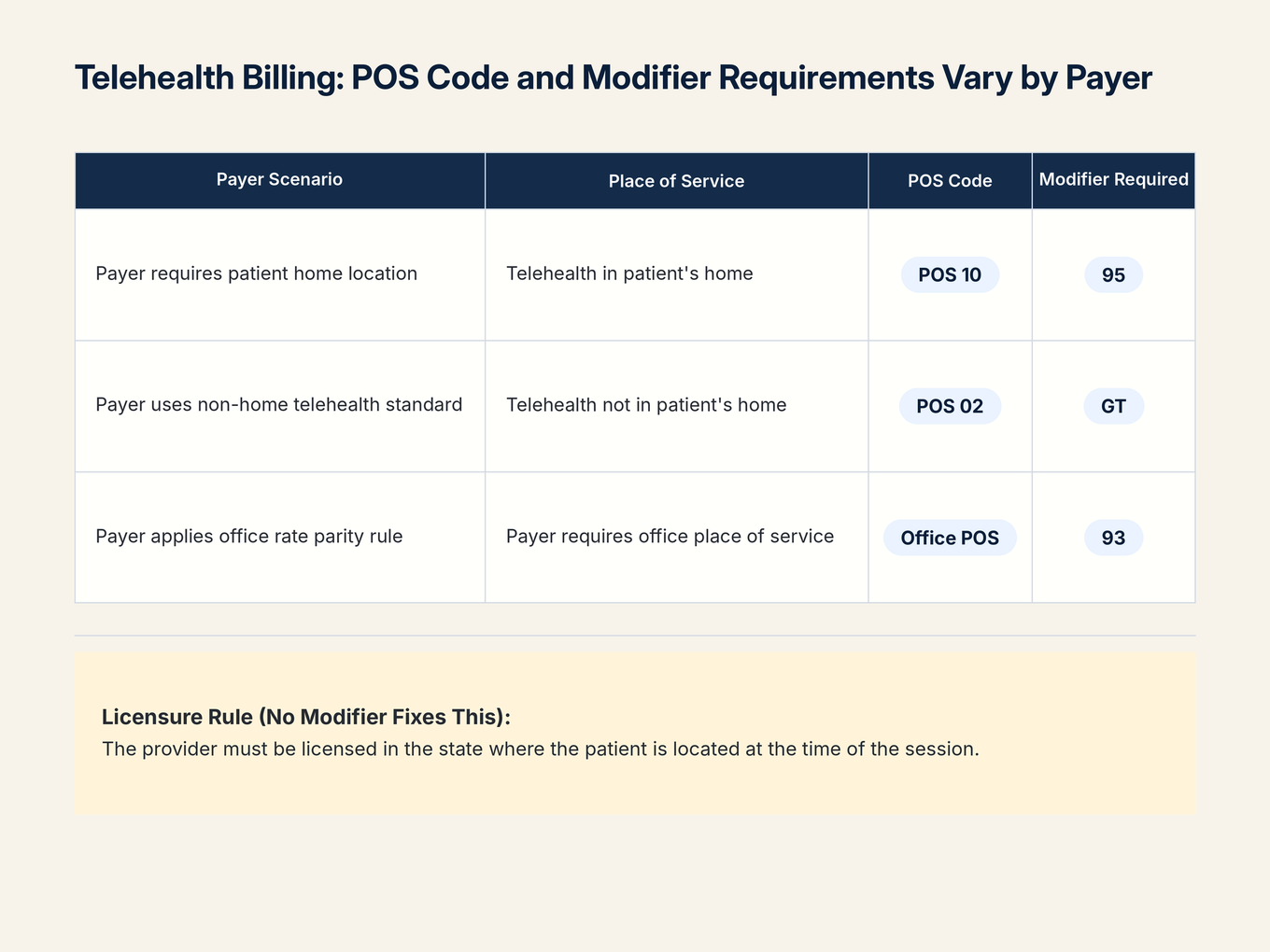
Telehealth made behavioral health more accessible and behavioral health billing more fragile, because the rules vary by payer, product, state, and modality. The place-of-service code alone is a minefield: CMS defines POS 02 as telehealth provided somewhere other than the patient's home and POS 10 as telehealth in the patient's home, and it explicitly tells providers to check each payer's own reimbursement policy 13. One payer wants POS 10, another prices only POS 02, a third wants the office POS for rate parity, and the modifier - 95, GT, or 93, shifts with them. Bill the wrong combination and the claim denies on a mismatch that has nothing to do with the care delivered.
The coverage rules vary too, and they're in motion. For Medicare, HHS has extended a number of behavioral health telehealth flexibilities through December 31, 2027, including waiving the in-person visit requirement for mental health telehealth and permanently allowing it in the patient's home 14. Commercial plans are far less uniform, and HHS advises verifying coverage with each payer 15.
And there's a hard limit that no modifier fixes: licensure. HHS guidance is clear that behavioral health providers generally have to be licensed or legally permitted in the state where the patient is located at the time of the session 16. A clinician licensed in one state who sees a patient who drove across a state line can deliver perfect care and still have an unbillable, uncollectible visit.
Authorization runs through all of these. Inpatient psych, PHP, IOP, residential, detox, testing, TMS, and out-of-network care commonly require prior authorization, and the authorization has to match the claim on every axis - the right provider, the right CPT, the right level of care, the right dates, and the right unit count. An authorization issued for an assessment doesn't cover ongoing therapy; one issued to the group doesn't always cover the individual rendering provider. (One bit of regulatory tailwind here: CMS's interoperability and prior-authorization rule, with operational provisions starting January 1, 2026, will require certain impacted payers to give specific reasons for prior-authorization denials 17, which makes the denial easier to trace, though it doesn't apply to every commercial plan.)
Every one of these traps is the same shape: a decision made before or during the visit that the payer's system won't see until the claim posts. Which is exactly why the denial codes, frustrating as they are, are actually readable.
How to Read Mental Health Denial Codes Back to the Source
Once you accept that the code is a symptom, the remittance turns into a diagnostic tool. Each CARC points back to a place in the cycle where something didn't line up, and a handful of them cover most of the mental health denial volume. Here's the translation, from the code on the page back to the front-end mistake that created it.
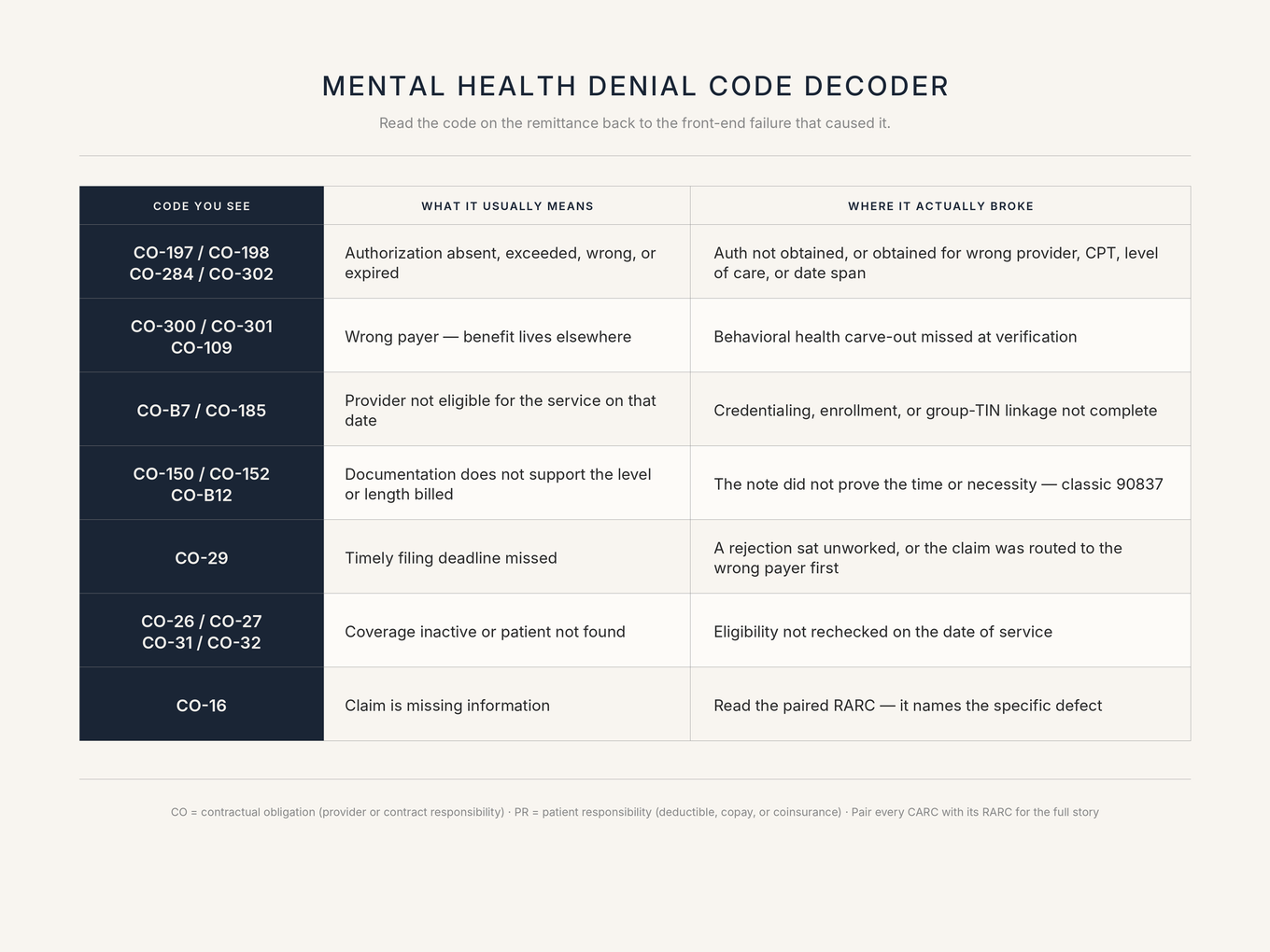
| The code you see | What it usually means | Where it actually broke |
|---|---|---|
| CO-197 / CO-198 / CO-284 / CO-302 | Authorization absent, exceeded, wrong, or expired | Auth wasn't obtained, or was obtained for the wrong provider, CPT, level of care, or date span |
| CO-300 / CO-301 / CO-109 | Wrong payer, benefit lives elsewhere | The behavioral health carve-out was missed at verification |
| CO-B7 / CO-185 | Provider not eligible for the service on that date | Credentialing, enrollment, or group-TIN linkage wasn't complete |
| CO-150 / CO-152 / CO-B12 | Documentation doesn't support the level or length billed | The note didn't prove the time or necessity (classic 90837) |
| CO-29 | Timely filing deadline missed | A rejection sat unworked, or the claim was routed to the wrong payer first |
| CO-26 / CO-27 / CO-31 / CO-32 | Coverage inactive or patient not found | Eligibility wasn't rechecked on the date of service |
| CO-16 | Claim is missing information | Read the paired RARC. It names the specific defect |
Two things make this readable rather than overwhelming. First, the group code in front of the number tells you who owes the money: CO is contractual obligation, pointing to provider or contract responsibility, while PR means the payer has assigned the balance to patient responsibility - a deductible, copay, or coinsurance 1. But read the paired CARC and RARC before treating a PR code as simply collectible: PR only tells you who the payer says is responsible, not whether the claim was handled correctly. Mistaking one for the other is its own source of lost revenue.
Second, the codes that appear most in behavioral health are a short, learnable list, not the entire X12 universe.
The honest caveat: payer wording varies, payers often combine a CARC with one or more RARCs, and medical-necessity criteria themselves differ by payer and plan - Carelon, for instance, states that its criteria vary by state, contract, customer, and line of business, applying ASAM criteria for substance use and InterQual for certain mental health levels of care 18. So the code tells you the category of failure; your payer's specific policy tells you the rest. But reading one denial back to its root cause is the easy part. The hard question, the one that actually decides whether your A/R keeps bleeding, is why the same denials keep coming back.
Why the Same Mental Health Claim Denials Keep Coming Back
A single denial is a mistake. The same denial, on the same payer, every month, is a system gap. When practices come to us drowning in repeat denials, the root cause is almost never a clinician making the same error over and over. It's that the front of the revenue cycle has a structural hole the denials keep falling through. They tend to come from the same seven places:
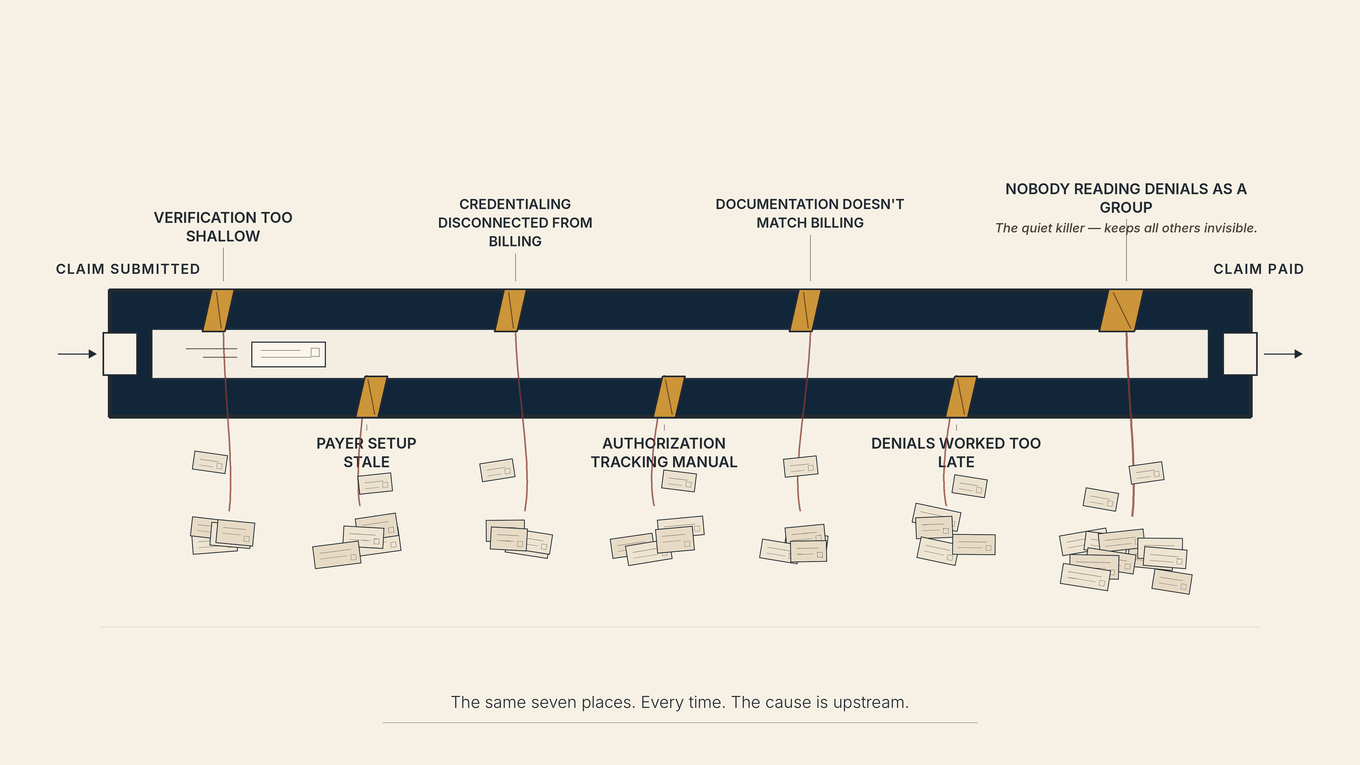
- Verification is too shallow. Staff confirm active coverage but not the behavioral health routing, the CPT-specific benefits, the telehealth rules, the EAP status, the substance use carve-out, or the authorization requirements. A pass/fail eligibility check can't catch a carve-out.
- Payer setup is stale. Payer IDs, claim addresses, behavioral health vendors, and telehealth requirements change, and the EHR keeps submitting the old way until the denials pile up.
- Credentialing is disconnected from billing. Providers start seeing patients before their payer effective dates, group linkage, and product enrollment are finished, so a wave of early claims denies as provider-not-eligible.
- Authorization tracking is manual. Visits quietly exceed the authorized units, dates expire, concurrent reviews get missed, and auths stay tied to the wrong provider or level of care.
- Documentation doesn't match the billing. The code, the time, the diagnosis, and the medical necessity in the note don't line up with what went out on the claim.
- Denials get worked too late. By the time someone opens the denial, the corrected-claim or appeal deadline is close or already gone.
- Nobody is reading the denials as a group. The practice posts denials one at a time and never steps back to sort them by payer, CPT, provider, and CARC to see the pattern.
That last one is the quiet killer, because it's what keeps all the others invisible. A practice working denials one by one can fix a hundred individual claims and never notice that sixty of them were the same carve-out routing error on the same payer, the one fix that would have prevented the next sixty. The denials look random because nobody is looking at them in aggregate. They aren't random. They're a pattern with a cause, and the cause is upstream.
How to Prevent Mental Health Claim Denials Before They Start
If the cause is upstream, so is the fix. Appeals matter, but an appeal is recovery after the loss; the real use is preventing the loss before the claim ever goes out. In practice, that's a handful of disciplines done consistently.
It starts with verification that's built for behavioral health, not borrowed from medical billing. A real mental health VOB doesn't just confirm coverage. It identifies who administers the behavioral health and substance use benefits, gets the correct payer ID, checks coverage for the specific CPT codes you'll bill, confirms the telehealth POS and modifier rules, flags EAP status and its limits, and captures the authorization requirements by service and level of care.
It connects credentialing to billing so claims don't go out before a provider is billable. It tracks authorizations against units and dates so nothing expires unnoticed. It builds documentation standards that match what's billed, so a 90837 note proves its time and necessity before the claim leaves the building. And it groups denials by root cause, so the pattern is visible and the upstream fix is obvious.
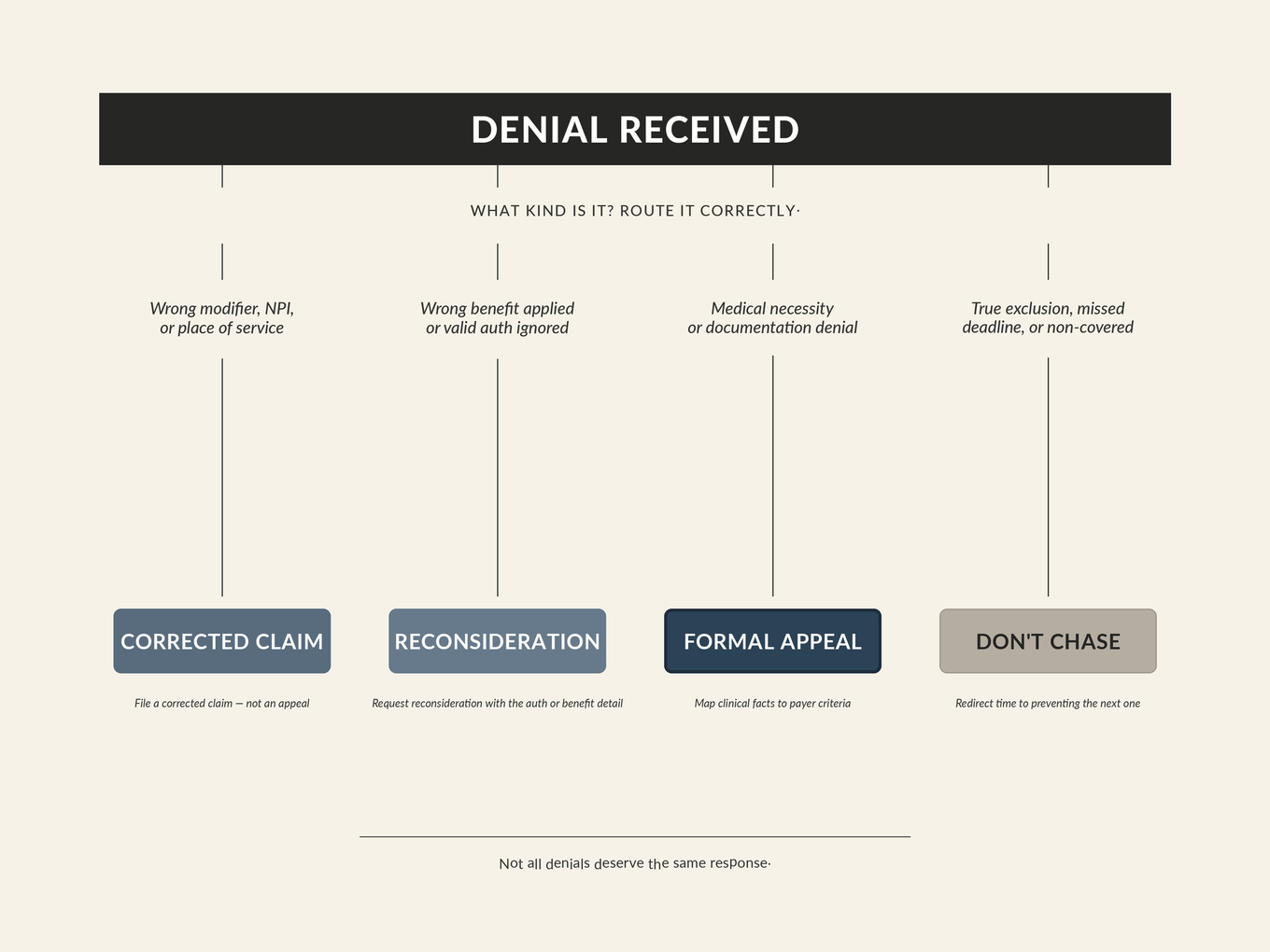
There's a strategic layer too, on the appeals you do file: not every denial should be appealed the same way, or appealed at all. A wrong modifier, NPI, or place of service is usually a corrected claim, not an appeal. A payer that processed with the wrong benefit or ignored a valid authorization needs a reconsideration. A medical-necessity or documentation denial needs a real appeal that maps the patient's clinical facts to the payer's criteria. And some denials - true exclusions, genuinely missed deadlines, non-covered services, aren't winnable, and chasing them just burns hours you could spend preventing the next batch.
This is honest, specialized work, and it's worth being clear-eyed about when it's bigger than an in-house setup can carry. If your denials are occasional and you can trace them, you may not need outside help. But when denials have become a pattern - when the same codes recur, when A/R is aging, when a stretched office manager is verifying benefits between patients and nobody is reading the denials in aggregate. That's when a billing partner that specializes in behavioral health earns its fee, by catching the carve-out, the credentialing gap, the EAP rule, and the authorization mismatch before they become denials. That's the work we do, and it's why we focus on the specialties where the front-end is hardest.
Mental Health Denial Management: From Chasing to Prevention
Mental health claim denials feel like the weather - random, external, something that happens to your practice. They aren't. Every denial is a pattern with a traceable cause, and that cause almost always sits at the front of the revenue cycle: eligibility, payer routing, authorization, credentialing, coding, documentation, or timely filing. The vague language on the remittance is hiding a very specific failure point, and once you can translate the code back to that point, the denial stops being a mystery and becomes a fixable operational problem.
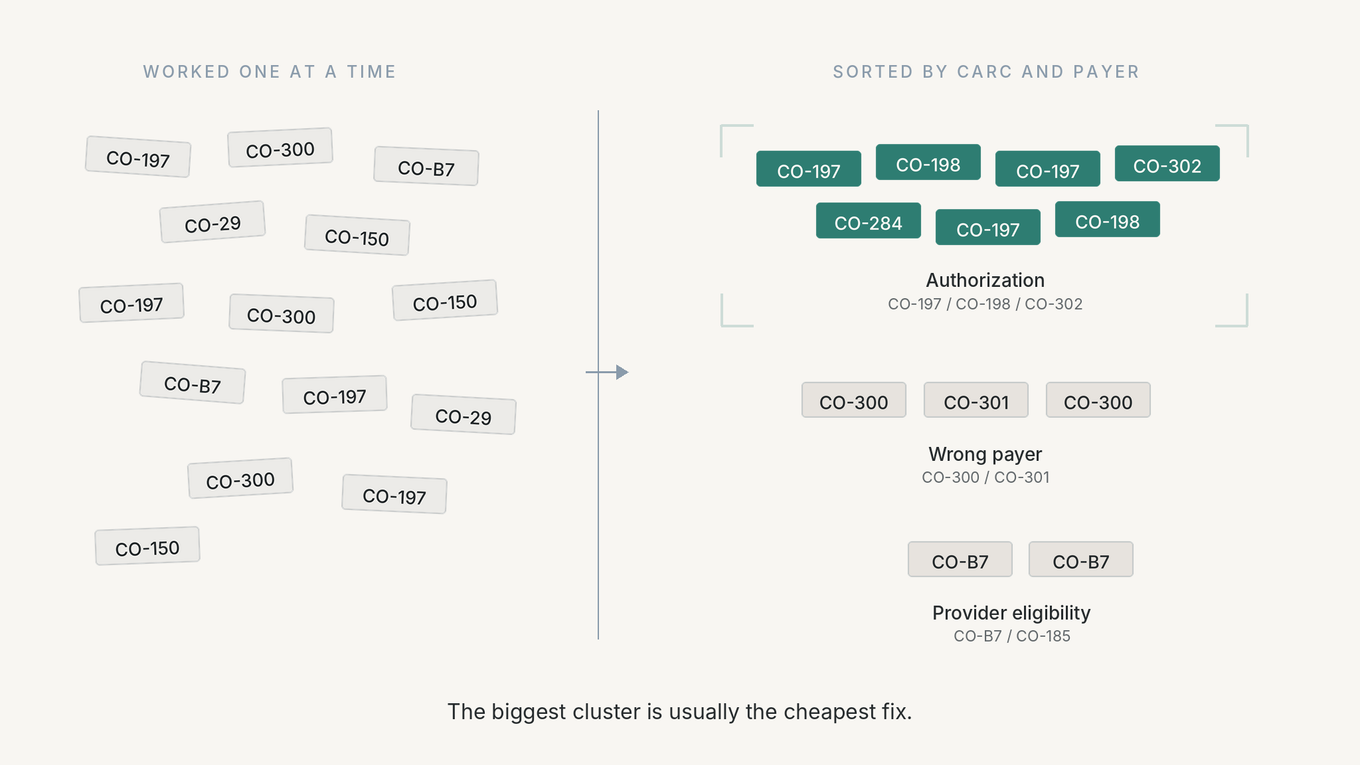
Here's the lever, and you can pull it this week: pull your last few months of denials and sort them by CARC and by payer. Don't work them one at a time, look at them as a group. The clusters will tell you where your front end is leaking, and the biggest cluster is almost always the cheapest thing to fix. From there, the question isn't "how do we appeal faster?" It's "how do we stop generating this denial at all?"
That shift, from chasing denials to preventing them, is the whole game in behavioral health revenue cycle management, and it's the work we do every day for mental health and behavioral health practices. If your denials have become a pattern you can't quite get ahead of, we're happy to take a look at them with you and tell you, plainly, where the front-end fix is.
Frequently Asked Questions About Mental Health Claim Denials
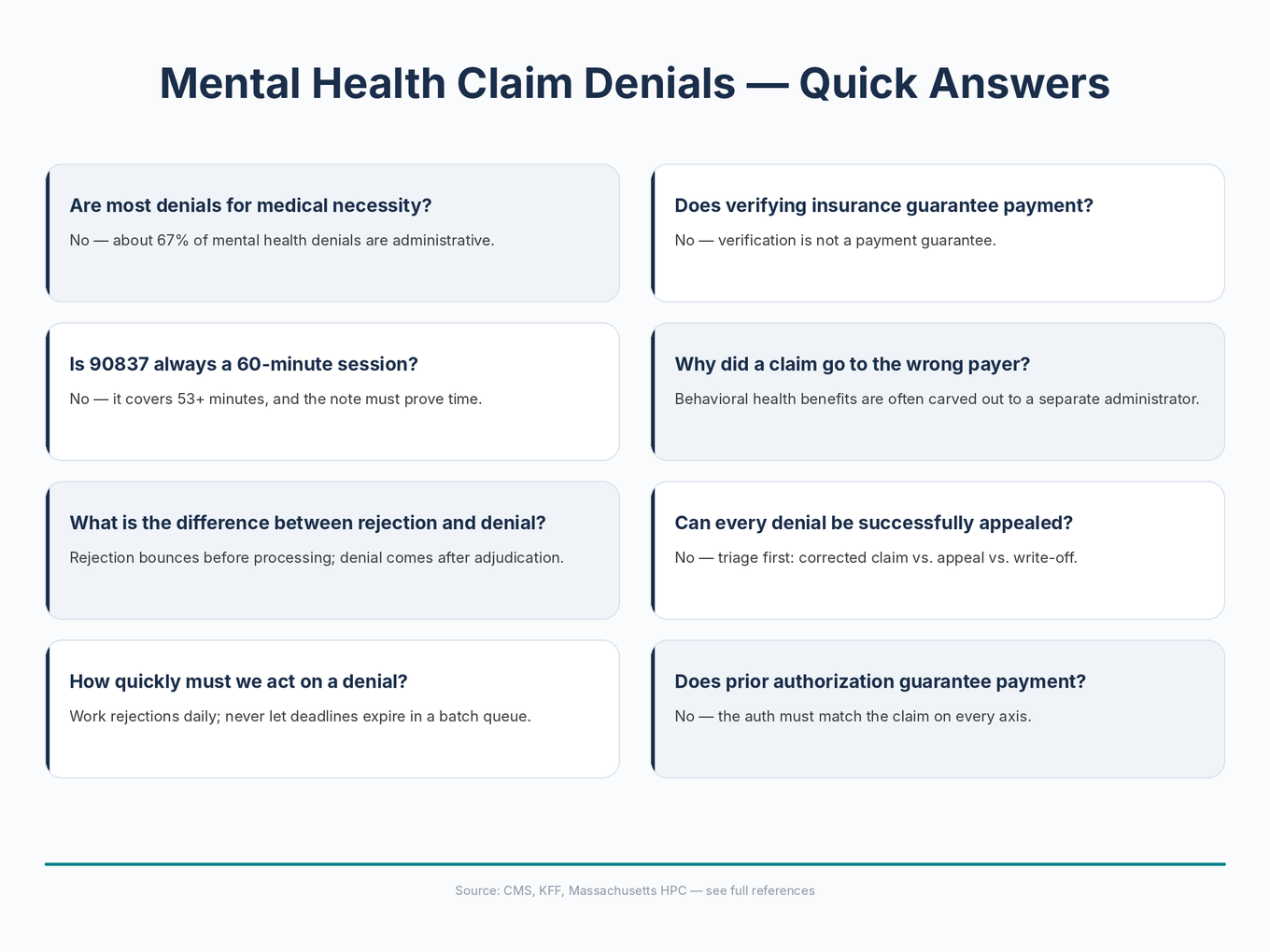
Are most mental health claims denied for medical necessity?
No, and this is the most common misconception. Public claims data shows administrative denials dominate. KFF found only about 5% of 2024 Marketplace denials were attributed to medical necessity 3, and Massachusetts found roughly 67% of denied professional mental health claims were administrative, not clinical 4. Medical necessity denials are real and matter for higher levels of care, but they're not where most of the volume is.
Does verifying a patient's insurance guarantee the claim will be paid?
No. An eligibility check confirms coverage and can return benefit details, but it isn't a payment guarantee, CMS itself describes these transactions as operational tools, not payment promises 9. A claim can still deny for the wrong payer, a missing authorization, a coding or documentation issue, or because coverage changed between verification and the date of service.
Is 90837 always a 60-minute session?
No. 90837 is billed for psychotherapy of 53 minutes or more, not exactly 60, and meeting the time threshold isn't enough on its own, the note has to document the actual time and support why the extended session was clinically necessary 10. Defaulting every session to 90837 without that documentation is a reliable way to draw audits and downcodes.
Why did my claim go to the wrong payer when the insurance card clearly says a major insurer?
Because behavioral health benefits are often "carved out" to a separate administrator. The card shows the company that runs the medical benefits, while the therapy benefits may be administered by a different entity entirely. The standardized code set even has dedicated codes (300 and 301) instructing providers to submit to the behavioral health plan 1. Verifying who administers the behavioral health benefit, separately from the medical card, prevents it.
What's the difference between a claim rejection and a claim denial?
A rejection happens before the payer processes the claim. It failed a front-end edit (like a bad ID or missing NPI) and bounced at the clearinghouse, so it never became a payable claim. A denial happens after the payer processed the claim and decided not to pay, and it arrives with formal adjustment codes. Rejections are easy to miss because they sit in a clearinghouse queue, not on a remittance.
Can every denial be appealed successfully?
No. Many denials are correctable and many are winnable, but some are true plan exclusions, genuinely missed filing deadlines, or non-covered services that no appeal will overturn. Effective denial management means triaging: send a corrected claim when the issue is a data error, file a formal appeal when there's a real medical-necessity case, and don't spend hours appealing denials that can't be won.
One specialized lever worth knowing about: when a plan applies prior authorization, medical-management, or network rules more restrictively to mental health and substance use than to comparable medical care, MHPAEA and the CAA 2021 parity-analysis requirements may support an appeal 22, but use careful language around the 2024 final rule specifically, because the Departments have said they will not enforce its new provisions while litigation and reconsideration are pending. Parity arguments are legal and regulatory, and should be built carefully rather than asserted casually.
How quickly do we need to act on a denial?
Faster than most practices think. Every payer sets its own deadlines for corrected claims, reconsiderations, and formal appeals, and a timely filing denial (CO-29) often follows a claim that simply sat too long in a rejection queue. The safest practice is to work rejections daily and denials by their deadline, not in a monthly batch, because a missed deadline turns a winnable denial into a permanent write-off.
Does prior authorization guarantee the claim gets paid?
No. Authorization reduces risk but doesn't eliminate it. A claim with a valid authorization can still deny for an eligibility lapse, a coding or modifier error, a documentation gap, a provider-network issue, or because the authorization was issued for a different CPT, provider, level of care, or date range than what was actually billed. The authorization has to match the claim on every axis to do its job.
It's also worth knowing that Medicare Advantage prior-authorization denials are frequently overturned when appealed: in 2024, MA insurers made nearly 53 million prior-authorization determinations, and of the denials that were appealed, about 80.7% were partially or fully overturned 21, a strong argument for appealing well-documented authorization denials rather than writing them off.
References