Why Outsourced RCM Services Fail When You Piece Them Together
September 28, 2026 · 13 min read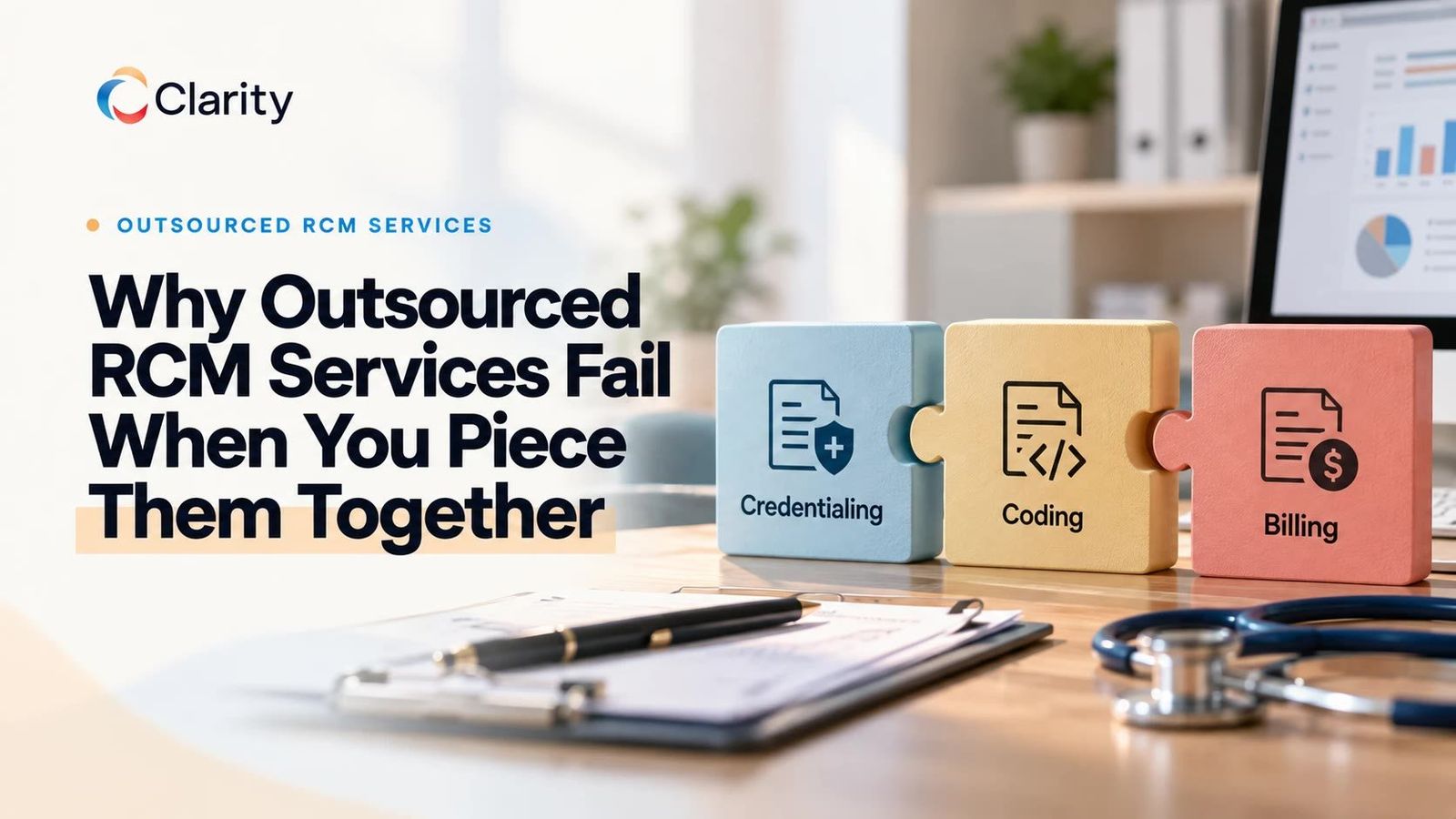
A psychiatric group practice in the Southeast made a decision that looked smart on paper.
They outsourced billing to a national medical billing company. They handled credentialing themselves, because they'd always done it that way and the office manager knew the process. And they relied on their EHR's built-in coding logic for the psychiatric codes they used every day.
Three functions. Three separate owners. Zero coordination between them.
Six months after bringing on two new psychiatrists, neither one was collecting from their two largest commercial payers. Not because the billing company was making errors. Because the enrollment paperwork had been submitted, but nobody had confirmed the effective dates before claims went out. The billing company assumed credentialing was done. The office manager assumed the billing company would hold claims until enrollment cleared. Nobody had defined the handoff.
At the same time, their partial hospitalization program billing had been running with an incorrect place-of-service code for eleven months. Their EHR's auto-coding defaulted to the wrong setting. The billing company caught some of the rejections and resubmitted. Others aged past the timely filing window. The coding issue, because coding wasn't part of what the billing company managed, never showed up in any report the practice received.
By the time someone traced the revenue problem to its sources, there were two separate root causes, three separate vendors with competing accountability explanations, and an AR recovery project that took four months to work through.
The outsourcing decision wasn't wrong. The fragmented model was.

What outsourced RCM services actually mean
Outsourced RCM services, at their broadest, refer to delegating the entire financial lifecycle of a healthcare practice or facility to an external company. That includes everything from the first eligibility check before a patient appointment through the final resolution of a claim, including denials, underpayments, and patient balance follow-up.
The key phrase is "entire financial lifecycle." Most practices don't buy that. They buy billing, which is one layer. Sometimes they add credentialing as an afterthought. Coding usually stays in-house, or gets absorbed into the EHR platform, which is not the same as having a coder.
A full-cycle outsourced RCM service covers:
| Function | What it means | What it connects to |
|---|---|---|
| Eligibility and benefits verification | Confirming coverage, copays, deductibles, and auth requirements before each visit | Scheduling, charge capture, prior auth |
| Provider credentialing and enrollment | Getting providers approved with payers and loading effective dates before billing activates | Claim submission, new provider onboarding |
| Coding and auditing | Assigning the right CPT/ICD-10/HCPCS codes to clinical documentation | Charge entry, denial root causes, compliance |
| Charge capture and claim submission | Building and submitting clean claims within timely filing windows | Coding, eligibility, authorization |
| Denial management | Categorizing denials, filing appeals, recovering revenue from claim-level decisions | Coding, credentialing, authorization |
| Payment posting and reconciliation | Applying payer remittances, identifying underpayments against contracted rates | AR follow-up, collections |
| AR follow-up | Active pursuit of unpaid and underpaid claims across aging buckets | Denial management, write-off decisions |
| Patient billing | Statements, balance follow-up, payment plans, escalation to collections | Payment posting, eligibility |
| Reporting and analytics | Denial patterns by payer and code, AR aging, net collection rate, KPI tracking | Decision-making, contract negotiations |
For a deeper look at what each of these components delivers and where things break down at the individual function level, our guide to healthcare revenue cycle management services covers the scope in detail.
The problem most practices encounter isn't a failure to understand what full RCM includes. It's assuming that a vendor covering one layer adequately covers the adjacent layers by default.
The fragmented outsourcing model: where revenue actually disappears
When practices piece together outsourced RCM from multiple vendors, or from a partial vendor and an in-house team, three handoff points break repeatedly.

Credentialing to billing. The most common and most expensive. A provider's credentialing application is complete. The approval letter arrives. Someone marks it done. Nobody notifies the billing company that claims can now go out for this provider with this payer. Claims submit, the payer rejects them as "provider not enrolled," and by the time the issue surfaces, some claims have aged past recovery windows. This failure happens because the credentialing workflow and the billing workflow live in separate systems, managed by separate people, with no defined trigger connecting approval to claim activation.
Coding to denial. Coding errors are the root cause behind a significant share of denials, particularly for behavioral health, surgical, and evaluation and management codes. When coding stays in-house and billing is outsourced, the billing company sees the denial but doesn't have access to the clinical logic that produced the wrong code. They may resubmit with the same error. They may escalate to the practice, which doesn't know why it happened either. Systematic coding problems that would show up immediately in an integrated operation keep recurring for months because nobody owns the root cause investigation across both sides of the handoff.
Authorization to billing. Prior authorization requirements vary by payer, code, and plan. When the authorization tracking function lives in one place and claim submission lives in another, authorization mismatches show up as denials rather than as upstream alerts. The billing company marks the claim as a prior auth denial. The practice follows up. By then, the authorization window may have expired or the service date may fall outside the authorized period.
The fragmented model doesn't produce these failures 100% of the time. It produces them consistently enough, at a rate that's hard to track precisely because the reporting is also fragmented, that the revenue impact becomes significant over time without being dramatic enough to trigger immediate investigation.
The integrated case: what changes when it's one operation
When billing, credentialing, coding, and denial management run inside the same outsourced RCM operation, the handoff failures above become internal coordination problems rather than cross-vendor accountability gaps.
The credentialing team can trigger a billing hold automatically when an enrollment application is pending, and release it when the effective date is confirmed. The coding team can respond to denial root cause data and audit the specific code patterns generating the highest rejection volume. When a denial comes back with a "not covered as billed" reason, the team working the denial and the team that coded the claim are in the same operation, which changes the speed and depth of root cause resolution.
| Factor | Fragmented outsourcing | Integrated outsourced RCM |
|---|---|---|
| Credentialing-to-billing handoff | Requires manual notification between vendors; often missed | Internal workflow trigger; automatic hold/release |
| Coding error root cause | Separate from billing; slow to identify systemic patterns | Coding team directly informed by denial data |
| Auth management | Split between EHR, billing vendor, and in-house staff | Tracked in one system; billing holds for missing auths |
| Denial accountability | Vendor says coding; internal team says billing | One team owns the full denial from code to appeal |
| Reporting | Three sets of data that don't reconcile easily | One set of KPIs covering the full cycle |
| Contract renegotiation leverage | Billing vendor has data; coding and credentialing data elsewhere | Denial patterns, underpayments, and payer behavior visible in one place |

This isn't a pitch for any particular vendor model. Some practices have strong in-house teams that manage specific functions well, and outsourcing those functions would create more disruption than value. Our comparison of in-house vs. outsourced medical billing looks at when each model makes sense by practice type and complexity.
But if a practice is outsourcing some RCM functions and keeping others in-house, the question to ask is whether the handoff points between the two environments are explicitly defined and owned. Not assumed.
How to evaluate an outsourced RCM service's integration depth
Most evaluation conversations focus on clean claim rates, turnaround times, and fee percentages. Those are worth checking. They don't tell you whether the functions you care about are actually integrated or just listed on the same brochure.

The questions that surface integration depth:
- "What triggers a billing hold when a new provider's enrollment is pending?" A company with a real integration between credentialing and billing will describe a specific workflow. A company that handles these separately will describe a notification process, which is a manual step that requires someone to remember.
- "When you see a denial for a code-related reason, who investigates the coding logic and how?" If the coding team is part of the same operation, they can describe how denial data flows back to coders. If coding isn't part of their service, they'll describe resubmission process, not root cause analysis.
- "What does your reporting show at the code-level denial breakdown?" A company with integrated coding and billing can show denial rates by CPT code category, not just by payer or overall. This is the granularity that catches systematic errors before they accumulate.
- "How does authorization tracking integrate with claim submission?" Can they hold a claim when an auth is missing or expired? Or does an authorization miss show up only after the denial arrives?
- "Can I see the reporting structure from a current client in my specialty?" The report, not a description of it. Integrated operations produce unified reporting. Fragmented ones produce multiple exports that someone has to consolidate.
For the full evaluation framework beyond integration-specific questions, our questions to ask before hiring a medical billing company covers denial management, transition risk, and contract structure in detail.
When outsourced RCM services make the clearest case
Full-cycle outsourced RCM services consistently outperform fragmented models in a few situations:
Multi-provider groups adding providers rapidly. Each new provider requires credentialing, enrollment, prior authorization setup, and billing activation in a defined sequence. The more providers being added simultaneously, the higher the fragmentation risk if these functions aren't integrated. Groups going from four to twelve providers in a year generate a significant credentialing and enrollment backlog; if billing doesn't have visibility into where each provider stands, revenue delays are almost guaranteed.
Specialty practices with complex payer mixes. Behavioral health billing operates under carve-out arrangements with separate payers for the behavioral benefit. Inpatient physician billing requires specific rendering, attending, and consulting provider coding. Surgical practices deal with modifier requirements and assistant surgeon billing rules that create systematic errors when coding isn't specialty-informed. In these settings, integrated coding and billing performs materially better than billing alone. For behavioral health specifically, our behavioral health specialty page outlines the billing complexity specific to that service line.
Practices recovering from a previous billing relationship. When a practice exits a billing relationship after accumulated AR problems, the recovery work requires coordination across coding review, denial appeals, credentialing status verification, and underpayment reconciliation. That's a cross-function investigation that works faster when all those functions live in one operation. Our guide to switching medical billing companies covers the transition mechanics in detail.
Hospitals and larger facilities. Hospital revenue cycle management adds facility coding, revenue code accuracy, charge description master management, and UB-04 claim logic on top of the professional billing layer. The integration requirements are more complex, and the cost of coordination failure is proportionally larger. For facility-level RCM, our hospital revenue cycle management guide covers the additional complexity.
What outsourced RCM services cost
The fee structure for full-cycle outsourced RCM services follows the same general model as medical billing alone: a percentage of net collections, typically in the 3 to 9% range. Services that include coding, credentialing, and analytics in the same fee tend to sit toward the higher end of that range for smaller practices, but the comparison shouldn't be against billing-only services at a lower percentage.
The meaningful comparison is total cost of outsourcing all functions versus what it actually costs to run them separately, including the internal staff time required to manage vendor coordination. A practice paying 5% for billing but also maintaining a half-time credentialing coordinator, relying on EHR coding logic, and spending 10 hours a month reconciling denial data from two sources is not paying 5%.
For a breakdown of what different RCM service scopes actually cost and how to compare quotes across service tiers, see our medical billing services cost guide.
How we know this
The story above is a composite, but the pattern is not. We've been brought in to clean up fragmented RCM arrangements more times than we'd like to count. The failure mode is almost always the same: not a bad billing company, but three functions that nobody ever connected.
Clarity is led by President and CEO Estelle Sandoval, who has worked in revenue cycle operations since the late 1980s. The integrated model described in this article isn't a recommendation we assembled from industry research. It's the architecture we built our own service delivery around, shaped by what keeps breaking when it isn't in place.
How Clarity structures outsourced RCM services
The story that opened this article is one we've cleaned up more than a few times. The credentialing-to-billing gap. The coding problem that lived between vendors. The AR that aged because each side assumed the other was covering it.
Clarity's revenue cycle management services run credentialing and enrollment, medical billing, coding and auditing, denial management, and payment analytics inside the same team. Not as separate service tiers that can be added on, but as one coordinated operation. When a provider's enrollment clears, billing knows. When a denial points to a coding pattern, coding knows. When a payer underpays, reconciliation happens against the contracted rate without requiring a separate request.

We work with behavioral health and psychiatry practices, multi-specialty outpatient groups, inpatient physician billing teams, and hospital and facility billing operations. The specialty mix matters because the integration points that fail most often are different in each setting, and we've built the workflows to reflect that.
If you're currently splitting RCM functions across vendors, or evaluating a full outsourcing arrangement for the first time, we're available to review your current structure and tell you directly where the risk points are. Reach out to our team.
Frequently Asked Questions
What are outsourced RCM services?
Outsourced RCM services are external revenue cycle management operations that take over some or all of a healthcare practice's billing, coding, credentialing, denial management, and AR functions. Full-cycle outsourced RCM handles the entire financial lifecycle from pre-service eligibility verification through final claim resolution, including provider enrollment, clinical coding, denial appeals, payment reconciliation against contracted rates, and reporting. Many practices outsource only portions of this, such as billing alone, which creates coordination risk at the handoff points between outsourced and internal functions.
How much do outsourced RCM services cost?
Full-cycle outsourced RCM services typically price at a percentage of net collections, ranging from 3% to 9% depending on specialty, practice size, and service scope. Services that include coding, credentialing, and analytics alongside billing tend toward the higher end of that range, but the comparison should be against the total cost of managing those functions separately, including internal staff time and the coordination overhead required to link multiple vendors. For a breakdown by specialty and scope, see the medical billing services cost guide.
What is the difference between medical billing services and outsourced RCM services?
Medical billing services handle the transactional layer: claim submission, payment posting, and patient statements. Outsourced RCM services encompass a broader scope including provider credentialing and enrollment, clinical coding, prior authorization management, denial appeals, underpayment reconciliation, AR follow-up strategy, and financial analytics. In practice, many companies use the terms interchangeably, which is why confirming specific service scope is more useful than evaluating what a vendor calls itself.
What are the risks of outsourcing RCM to multiple vendors?
The primary risks are handoff failures at the points where functions connect: credentialing approvals that don't trigger billing holds, coding errors that billing resubmits without root cause analysis, and authorization mismatches that only surface as denials rather than upstream holds. Each function may perform adequately in isolation, while the gaps between them allow revenue to leak in ways that are difficult to attribute to any single vendor. Integrated outsourced RCM services manage these coordination points internally rather than relying on cross-vendor notification processes.
How do I know if an RCM company's services are truly integrated?
Ask specifically how credentialing approvals connect to billing activation, whether the coding team reviews denial data and has authority to make code-level corrections, how authorization tracking integrates with claim submission, and whether the reporting package covers denial breakdown by CPT code category rather than only by payer. Companies with genuine integration can describe specific internal workflows for these handoffs. Companies where these functions are separate will describe notification processes or escalation steps, which are manual dependencies rather than integrated workflows.
When should a practice consider full-cycle outsourced RCM?
Full-cycle outsourced RCM makes the clearest case for multi-provider groups adding staff rapidly, specialty practices with complex payer mixes and prior authorization requirements, practices recovering from an underperforming billing relationship with accumulated AR damage, and hospital and facility billing operations where the claim complexity requires coordinated professional and facility billing. Practices with a stable single-specialty payer mix and a strong in-house billing team may not need full outsourcing; the decision depends on where the operational risk actually lives in your revenue cycle.
Can I outsource only part of my RCM and keep some functions in-house?
Yes, and many practices do. The key is defining the handoff points explicitly rather than assuming adjacent functions will coordinate automatically. If billing is outsourced and credentialing is in-house, someone needs to own the trigger that holds claims for new providers until enrollment effective dates are confirmed. If coding is in-house and billing is outsourced, the root cause investigation for code-related denials needs a defined owner and a clear escalation path. Hybrid models can work; they require more explicit workflow design than a fully integrated arrangement.