How to Switch Medical Billing Companies Without Losing Money
July 7, 2026 · 33 min read
You already know your billing is broken. The denials keep climbing, the accounts receivable keeps aging, and every time you ask a question you get a story about the payer instead of an answer about your money. So you've started thinking about switching billing companies. And then you stop, because a different fear takes over: what if changing vendors turns a bad billing situation into a cash-flow emergency? What if old claims vanish, deadlines get missed, payments route to the wrong place, and suddenly you're staring at a payroll you can't cover?
That fear is rational. Practices do lose money during billing transitions. But here is the part almost nobody tells you: the money is not lost because you switched. It's lost because the switch was run blind. Nobody inventoried the open A/R, nobody proved the claims were actually accepted by payers, the ERA and EFT routing got changed without a tracker, the old denials were abandoned, and the patient balances were left to drift.
The danger is not switching billing companies. The danger is switching without a claim-by-claim transition plan.
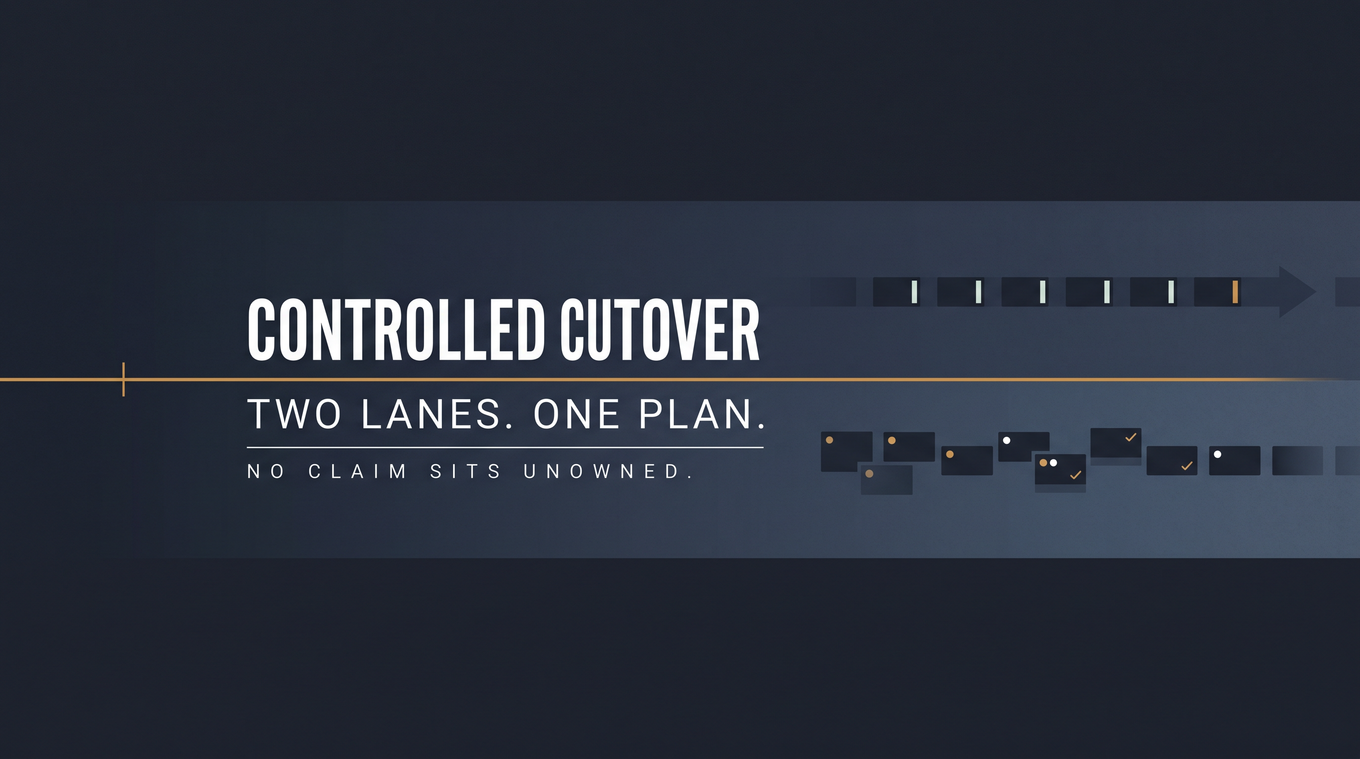
When you switch billing companies the right way, it isn't a leap of faith. It's a controlled revenue-cycle cutover, a project with two lanes running at once: your new claims keep moving forward, and your old A/R gets worked down under written ownership rules. By the end of this guide, you'll know exactly how to run that cutover: what to pull before you give notice, how to build the A/R inventory that protects your money, how to protect timely-filing deadlines that can kill a claim no matter how clean it is, how to keep the payer plumbing intact, and what to demand from any biller before you sign. This is the same operating discipline we bring when we take over a practice's revenue cycle, the plan exists before anyone touches a claim. Switching isn't about courage. It's about visibility, deadlines, ownership, and proof.
The first move surprises most leaders, because it's the opposite of what an angry practice wants to do.
The real risk isn't switching. It's unmanaged A/R.
Start with the reframe, because it changes every decision that follows: switching itself doesn't drain revenue. A short list of unmanaged failures does. Open A/R disappears into a vague "the prior biller is working it" bucket. A claim gets marked "sent" but was never accepted by the payer. A timely-filing deadline passes unnoticed. The electronic remittance gets re-routed while the money quietly goes somewhere else. Old denials sit because the outgoing vendor says "that's after termination" and the incoming vendor says "that's before our start date", and your claim dies in the gap.
None of those are caused by the act of changing vendors. They're caused by a transition with no controls. That's good news, because controls are something you can build.
You are not unusual for being here. In MGMA's November 2024 poll, 36% of medical practice leaders said they planned to outsource or automate some part of revenue cycle management in 2025, with billing, collections, and coding among the most common areas. The pressure that pushed you toward a switch is industry-wide, not a private failure: Experian's 2025 State of Claims survey found 41% of providers reported denial rates of 10% or higher, and a March 2024 MGMA poll found 60% of respondents said their denial rates had increased versus the prior year. The market is moving with you, not against you.
The clean way to think about the work is two lanes:
- New-claim continuity. New visits keep getting coded, billed, accepted, and followed up, without a multi-week "we paused billing while we switched" gap.
- A/R preservation. No old claim, denial, appeal, payment, or patient balance disappears. Every open item has a named owner and a next action.
Hold those two lanes in your head for the rest of this guide. Every control below exists to protect one of them.

One structural decision makes the whole thing dramatically safer: keep as much stable as you can. The lowest-risk version of a switch keeps the same EHR, the same bank account, the same payer contracts, the same tax ID and provider roster, and changes only the billing company. The new biller works inside your existing system and takes over on a defined date. The moment you also change your software, your clearinghouse, your bank account, your ownership structure, or your locations at the same time, you've turned a vendor swap into a migration project, and it needs a much heavier plan. It can still be done. Just don't let anyone sell it to you as a simple switch.
So you're ready to give notice and get started. Don't, not yet. The first thing to do is the opposite of firing your biller.
Before you give notice, read the contract and pull the reports
Here's where a lot of practices sabotage themselves. They get angry, fire off a termination letter, and only then discover the outgoing vendor controls the very information they need to leave safely. Once a termination clock is running, cooperation tends to drop. You do not want to be exporting critical data from a vendor who now sees you as a former client.
So before you give notice, do two things.
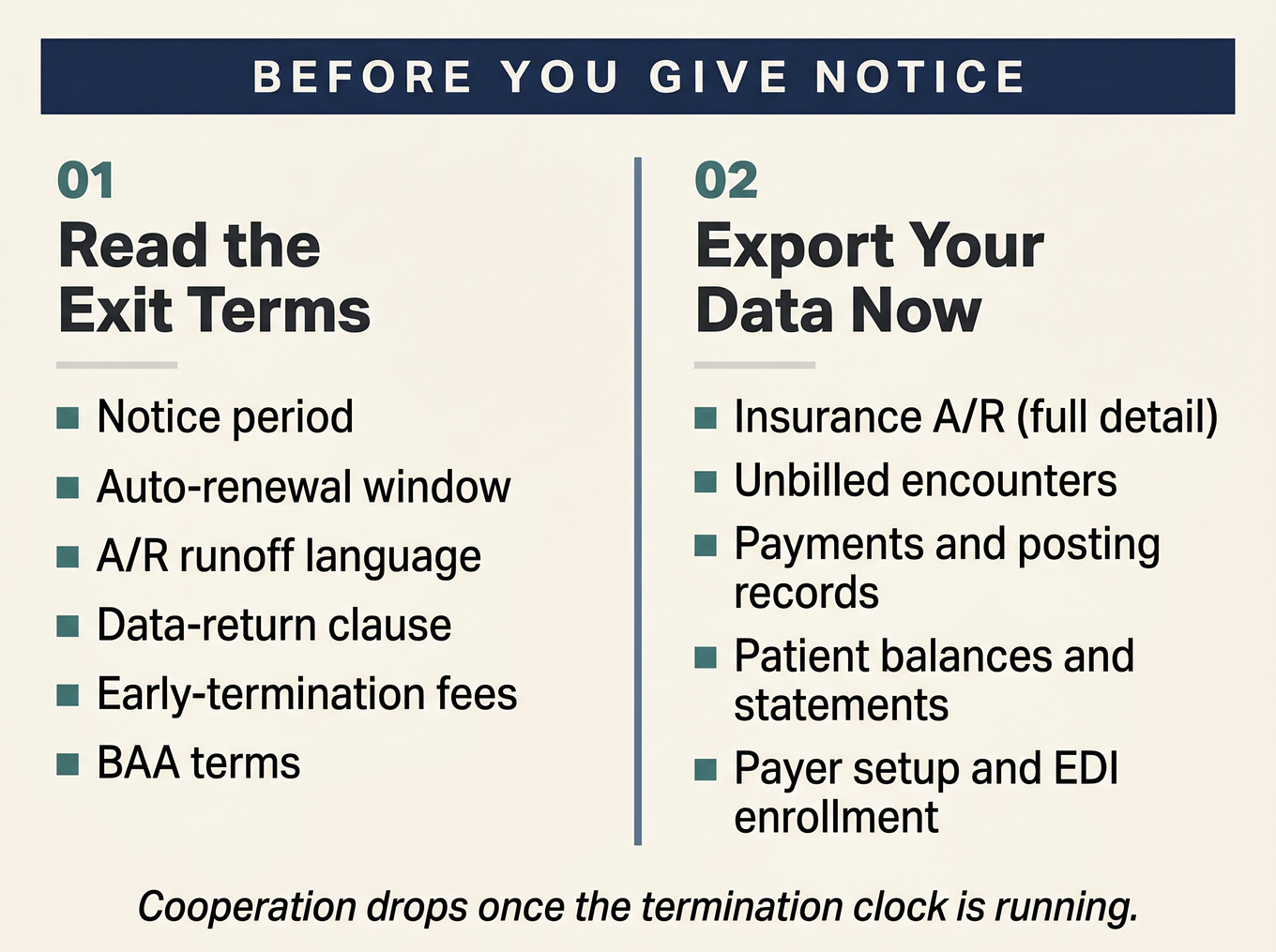
First, read your current contract, specifically the parts that govern leaving. Day Pitney's guidance on medical-billing contracts recommends checking whether termination without cause is allowed and whether notice periods are reasonable, such as 30 to 90 days. You're looking for the notice period, any auto-renewal window, the A/R runoff language, the data-return clause, early-termination fees, and your BAA terms. We'll go deeper on contract traps later, because this is where practices get blindsided, but at minimum, know your exit terms before you trigger them. A missed auto-renewal window can lock you in for another full term, which would be a worse problem than the billing itself.
Second, export your billing data while the relationship is still cooperative. A billing company is generally a business associate under HIPAA, and at termination a BAA should require the business associate to return or destroy protected health information where feasible. HHS has also been explicit that a business associate cannot block a covered entity's access to PHI, for example, by using an EHR "kill switch" over a payment dispute. But knowing your rights and being able to exercise them quickly are different things. Pull the data yourself, now, so you're never dependent on the outgoing vendor as your only source of truth.
If you're on Tebra, Tebra PM supports exports for patient demographics, charges, unpaid insurance claims, A/R aging, and fee schedules; Tebra separately supports clinical-data exports as XML Summary of Care files with patient documents, and as a Tebra-experienced billing team, we treat those exports as step one, not an afterthought. Whatever your system, pull these before you give notice:
- Insurance A/R, full detail by payer, patient, provider, location, date of service, claim number, status, and aging bucket - plus the dangerous subsets: rejected claims, denied claims, appealed claims, claims pending authorization or medical records, A/R over 90 and 120 days, and anything within 30 to 45 days of a timely-filing or appeal deadline.
- Unbilled work: encounters not yet billed, charges entered but not submitted, and any coding or documentation queues.
- Payments and posting: ERA files, EOB images, payment-posting batches, unposted payments, unapplied cash, credit balances, and pending refunds or recoupments.
- Patient balances: patient A/R aging, last statement date, statement history, payment plans, card-on-file arrangements, and any accounts already in collections.
- Payer setup: payer IDs, clearinghouse payer IDs, EDI/ERA/EFT enrollment status, payer-portal URLs and admin users, and your provider IDs, PTANs, taxonomies, and NPIs.
That export isn't paperwork. It's the raw material for the single most important control in the entire switch, turning a pile of reports into a claim-by-claim map of your money.
Build a claim-by-claim A/R inventory (and a red list)
When an incoming billing company says "just send us your aging report," that should worry you. An aging summary tells you how much money is outstanding in 30-day buckets. It does not tell you which claims are about to die, which were never actually filed, or which have been silently abandoned. To protect revenue during a switch, you need the inventory one level deeper: claim by claim.
For each open item, the transition file should carry enough detail to act, not just to total. That means the patient account, the rendering and billing provider, the location or place of service (critical for facilities, telehealth, and behavioral-health programs), the payer and member ID, the date of service, the codes and charge amount, the current balance, and - the fields most aging reports omit - the current status, the payer acceptance date or claim number, the last worked date, the next action, and the timely-filing and appeal deadlines. For behavioral health and SUD, add the authorization number, authorized units, and authorized dates. Those last fields are what separate a real inventory from a number on a page. "First submission date" tells you when someone hit send. A payer claim number tells you the claim actually exists in the payer's system.
With that detail, every open item sorts into a bucket, and each bucket has a different risk and a different action:
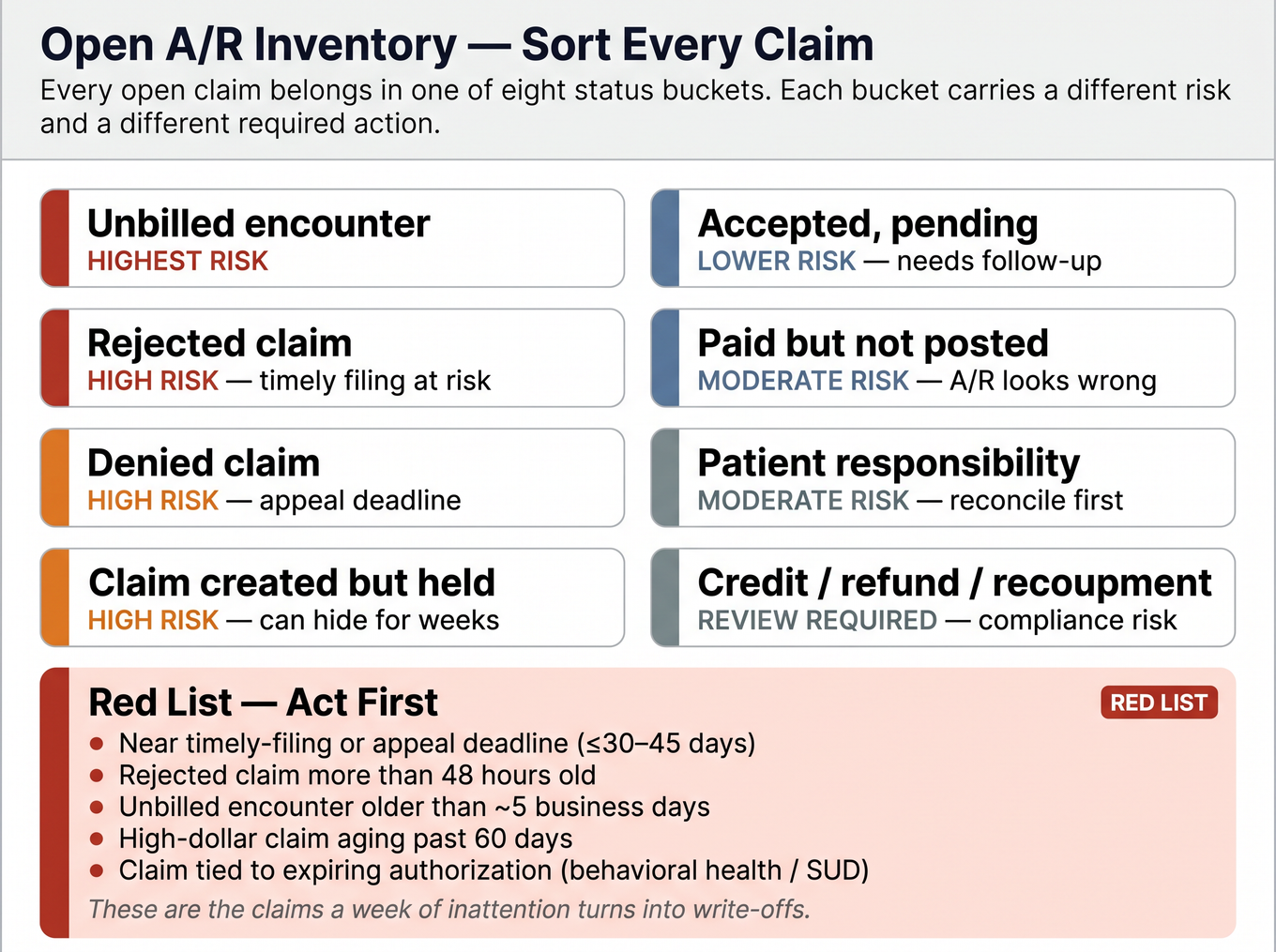
| Bucket | What it means | Transition risk | Action |
|---|---|---|---|
| Unbilled encounter | Service happened, no claim submitted | Highest if near timely filing | Code, fix missing data, submit now |
| Claim created but held | Claim exists, not sent | Can hide for weeks | Require reason, owner, release date |
| Rejected claim | Bounced before payer adjudication | Timely filing still at risk | Correct, resubmit, prove acceptance |
| Accepted, pending | Payer has the claim | Lower, but needs follow-up | Verify status and expected payment |
| Denied claim | Payer adjudicated and refused | Appeal/correction deadlines | Classify reason and deadline |
| Paid but not posted | Money arrived, not posted in PM | A/R and patient bills look wrong | Post and reconcile before statements |
| Patient responsibility | Insurance done, patient owes | Duplicate or wrong statements | Reconcile before billing the patient |
| Credit/refund/recoupment | Money may be owed back | Compliance and trust risk | Review before writing off or billing |
Out of that inventory, build a red list, the claims that can hurt you fast. When we take over a practice's A/R, this is the first artifact we produce, because it's the one that protects cash in the first 72 hours. The red list is short and specific: anything within 30 to 45 days of a timely-filing or appeal deadline, rejected claims more than 48 hours old, unbilled encounters older than about five business days, high-dollar claims aging past 60 days, and, for behavioral health and SUD, any claim tied to an expiring authorization. These are the items where a week of inattention turns recoverable money into a write-off.
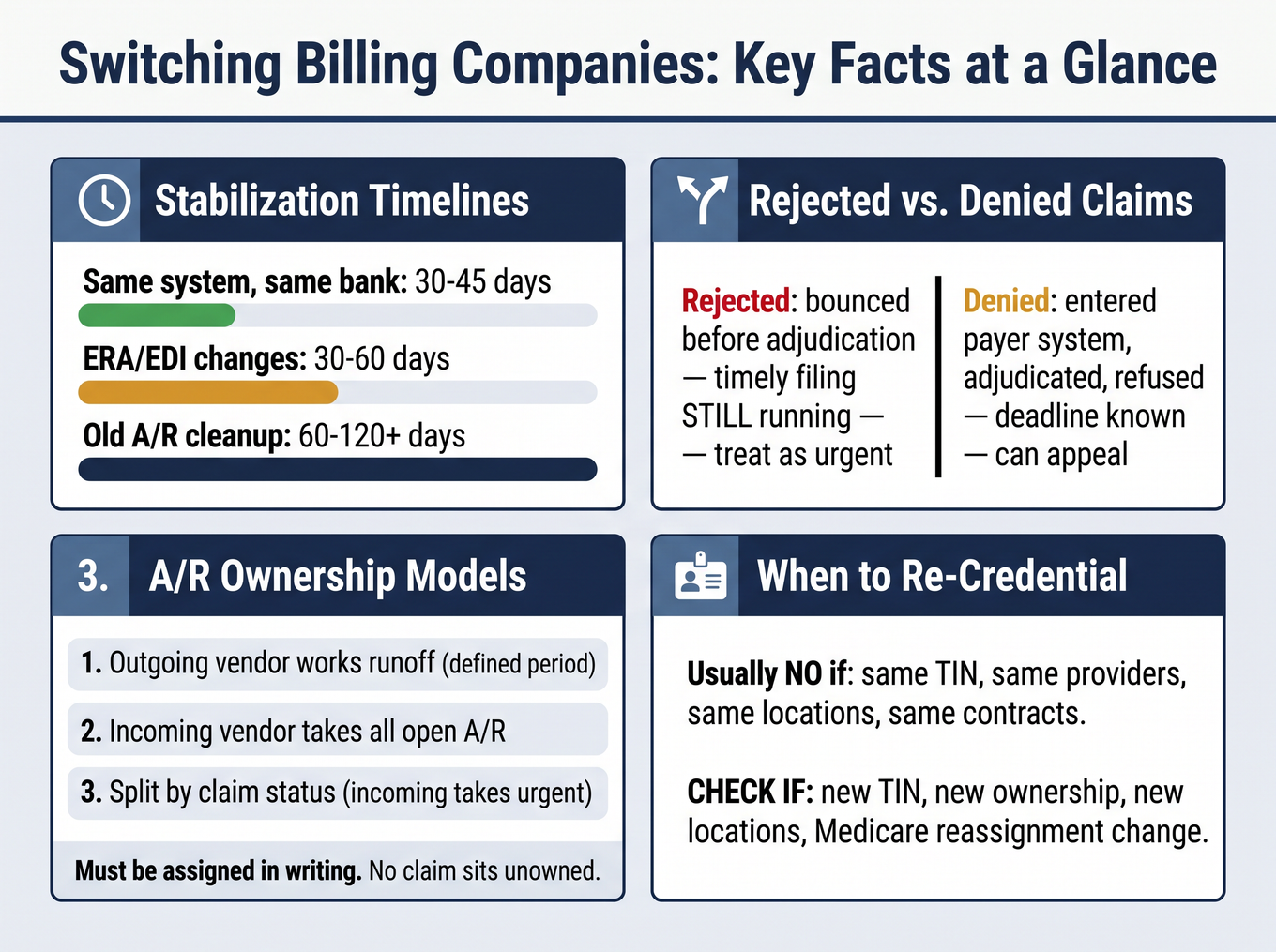
Then decide, in writing, who works the old A/R. There are three honest models. The outgoing vendor can keep working pre-termination claims for a defined runoff period - one public billing-services agreement, for example, required a 120-day wind-down for pre-termination A/R before the vendor stopped. The incoming vendor can take over all open A/R for a single point of accountability. Or you can split it, with the outgoing vendor finishing claims already accepted and the incoming vendor taking the unbilled, rejected, denied, high-dollar, and near-deadline claims. Each works; what doesn't work is leaving it unstated. The safest position, even when the outgoing vendor handles runoff, is this: the incoming vendor audits the full inventory, monitors the runoff, and takes ownership of any claim that is unbilled, rejected, denied, high-dollar, or near a deadline. Because the one rule that protects you above all others is simple, no claim sits unowned. "The old biller is handling it" is not a control. A name and a next-action date is.
And the single deadline that kills more transition revenue than any other deserves its own section, because it can void a claim that is otherwise perfect.
Protect timely filing: "sent" is not "filed"
Every payer sets a deadline for receiving a claim. Miss it, and the payer can deny payment even when the service was covered, documented, authorized, and medically necessary. This is the cruelest way to lose money during a switch, because the claim itself was fine. You just ran out of clock. Medicare's general rule is one calendar year from the date of service, and Medicare contractors warn that claims denied for late filing may not carry normal appeal rights. When the deadline is the reason for denial, there's often no second chance.
Here's the trap most teams fall into: assuming a single deadline applies everywhere. It does not. Timely-filing windows vary by payer, product, state, and claim type, and the spread is wide. Texas Medicaid generally requires claims within 95 days of the date of service. Louisiana Medicaid gives 12 months for straight Medicaid claims but only 60 days for KIDMED claims. Horizon NJ Health states claims must be submitted within 180 calendar days or they may deny for timely filing. And corrected-claim deadlines often differ from original-claim deadlines - Security Health Plan, for example, lists correction or adjustment claims as due within 365 days from the date of service or within 60 days from the payment, denial, or rejection of the original claim, whichever is later. These are examples, not universal rules. That's exactly the point: a transition plan should run on a payer-specific deadline matrix, not a guessed number.
Now the distinction that does the most damage during a switch, because it hides in plain sight: a rejected claim is not a filed claim. A claim can be "sent" by your biller and never accepted by the payer. A denied claim, at least, made it into the payer's system and got adjudicated. You know where it stands. A rejected claim bounced at the front end, may never have entered adjudication, and can sit in a queue looking handled while the timely-filing clock keeps running. During a transition, rejected claims are more dangerous than denied claims for exactly this reason. Texas Medicaid's claim-acknowledgment guidance is blunt about it: rejected claims need correction and resubmission, and rejected transactions may not be retained as claims.
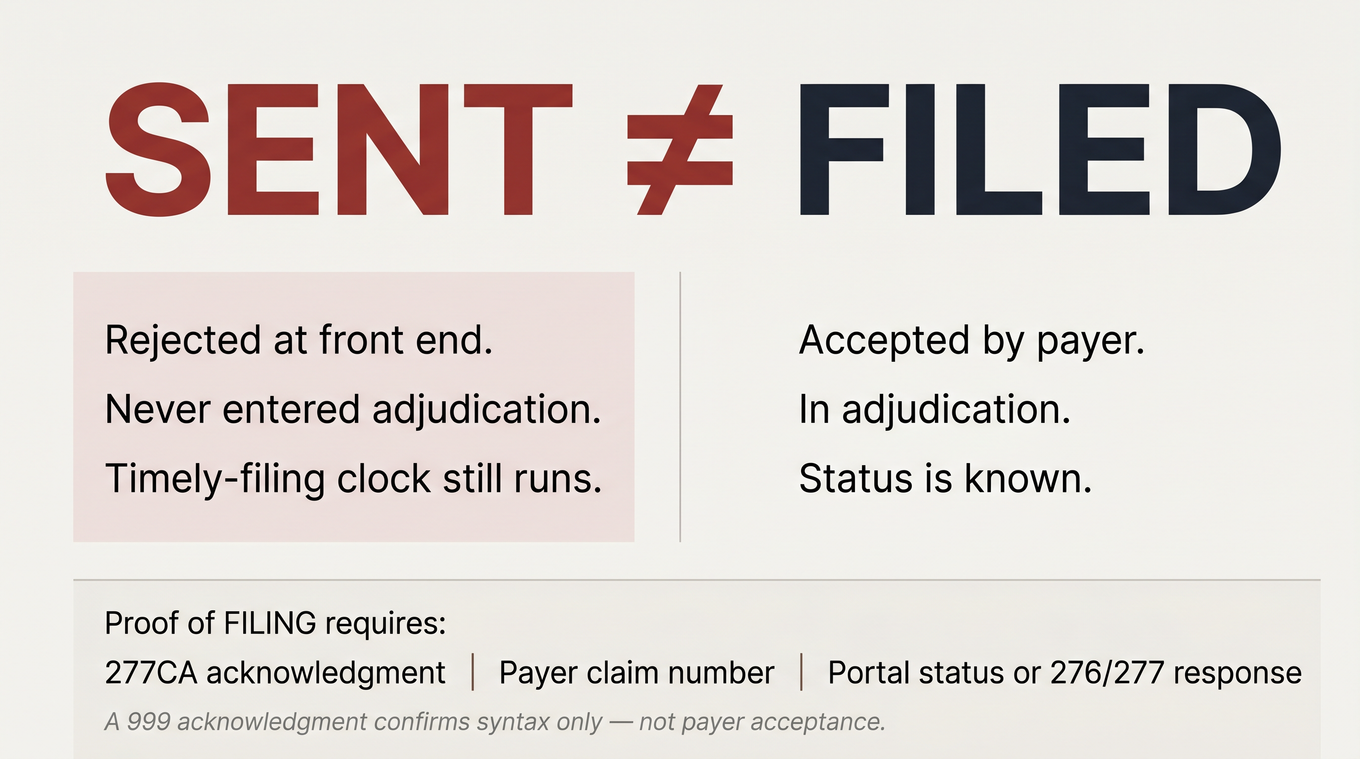
So your plan has to require proof of acceptance, not just proof of submission. Acceptable evidence includes a clearinghouse acceptance report, a 277CA claim-level acknowledgment, a payer claim number, payer-portal claim status, or a 276/277 claim-status response, the standard transaction UnitedHealthcare describes for requesting and receiving claim status in batch or real time, and which CMS identifies as the 276 inbound request and 277 outbound response. A 999 acknowledgment confirms the transaction passed syntax and implementation checks, but by itself it does not prove the payer accepted the claim for adjudication.
"Sent" is not the same as "filed." During a switch, prove the high-risk claims were accepted, don't take anyone's word that they went out.
Operationally, that means working the claims closest to their deadline first, reviewing rejections every single day rather than weekly, and escalating any claim within 30 days of a deadline straight to the practice owner or CFO. None of it requires heroics. It requires a deadline you can see and a person who owns it.
Protecting those deadlines does not mean freezing your billing while you sort everything out. The opposite, in fact, and getting the cutover right is how you keep the money moving while you work.
Plan the cutover so new claims never pause
A clean switch is not "stop billing until everything is perfect." That sentence sounds responsible and is actually one of the most expensive things a practice can do. Every week of paused billing is a week of cash you're not collecting and a week closer to timely-filing deadlines on claims you're holding. The goal is the opposite: keep the low-risk clean claims flowing, and hold only the specific claims that have a real routing, authorization, coding, or data problem.
Compare two claim holds. The bad one: "We're switching billers, so claims are paused for a few weeks." That's a vague, open-ended cash-flow and timely-filing risk affecting everything. The good one: "Claims for Payers A and B are held for three business days because EDI approval is pending. The hold log lists 47 claims, $38,500 in charges, with dates of service, timely-filing deadlines, and a named release owner. Everything else keeps submitting." Same word, "hold", completely different control. One is a pause; the other is a tracked, time-boxed exception.
The cutover itself should be defined by a rule, not a vibe. Pick one and write it down:
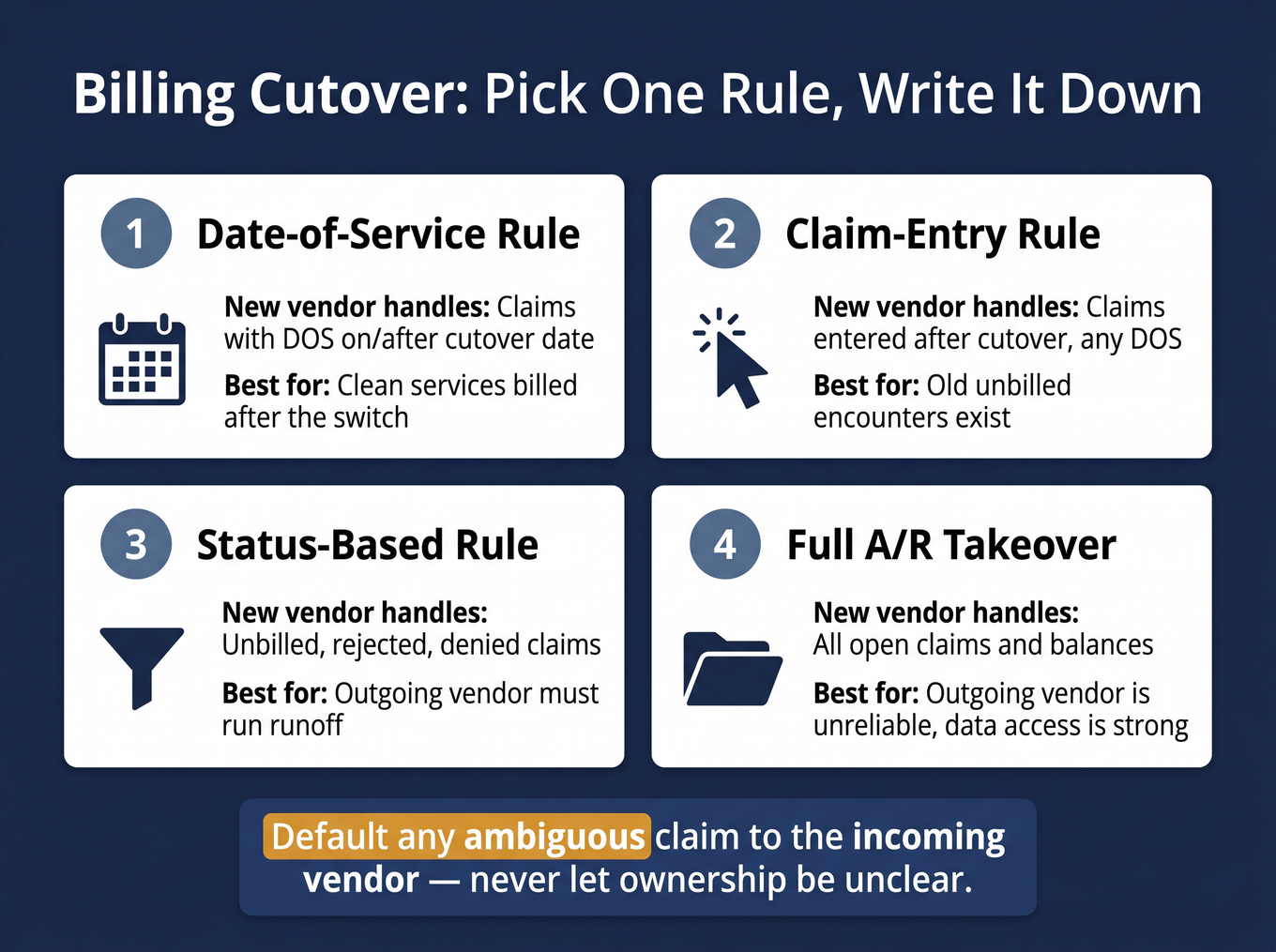
| Cutover rule | New vendor handles | Best when |
|---|---|---|
| Date-of-service | Claims with DOS on/after the cutover date | Cleanest for services billed after the switch |
| Claim-entry | Claims entered after cutover, regardless of DOS | Old unbilled encounters exist |
| Status-based | Unbilled/rejected/denied claims; outgoing keeps accepted-pending | Outgoing vendor must work runoff |
| Full A/R | All open claims and balances | Outgoing vendor is unreliable and your data access is strong |
Whatever rule you choose, default any ambiguous claim to the incoming vendor until you say otherwise, because the moment ownership is unclear, claims fall through the crack between two vendors. A reasonable sequence runs roughly like this: two to three weeks out, the incoming biller gets system access and starts building the payer matrix and enrollment tracker; one to two weeks out, EDI/ERA setup goes in where needed and the A/R inventory and red list get built; in the final days, the outgoing vendor clears its clean-claim and rejection queues, and only the specific queues that would create duplicate or misrouted claims get frozen. Then, on cutover day, the new vendor starts new charges by your written rule, and the first week runs on daily reconciliation: claims created, submitted, accepted, rejected, ERAs received, deposits matched, and held claims released. Daily, not weekly. The first week is where breakage shows up, and a daily dashboard catches it while it's still cheap to fix.
A perfect cutover still fails, though, if the plumbing underneath it breaks, and the plumbing is the part most buyers find genuinely confusing.
Don't break the payer plumbing
This is where the vocabulary trips people up, so let's separate the layers cleanly, because conflating them is exactly how money goes missing. There are five distinct systems, and they are related but not interchangeable:
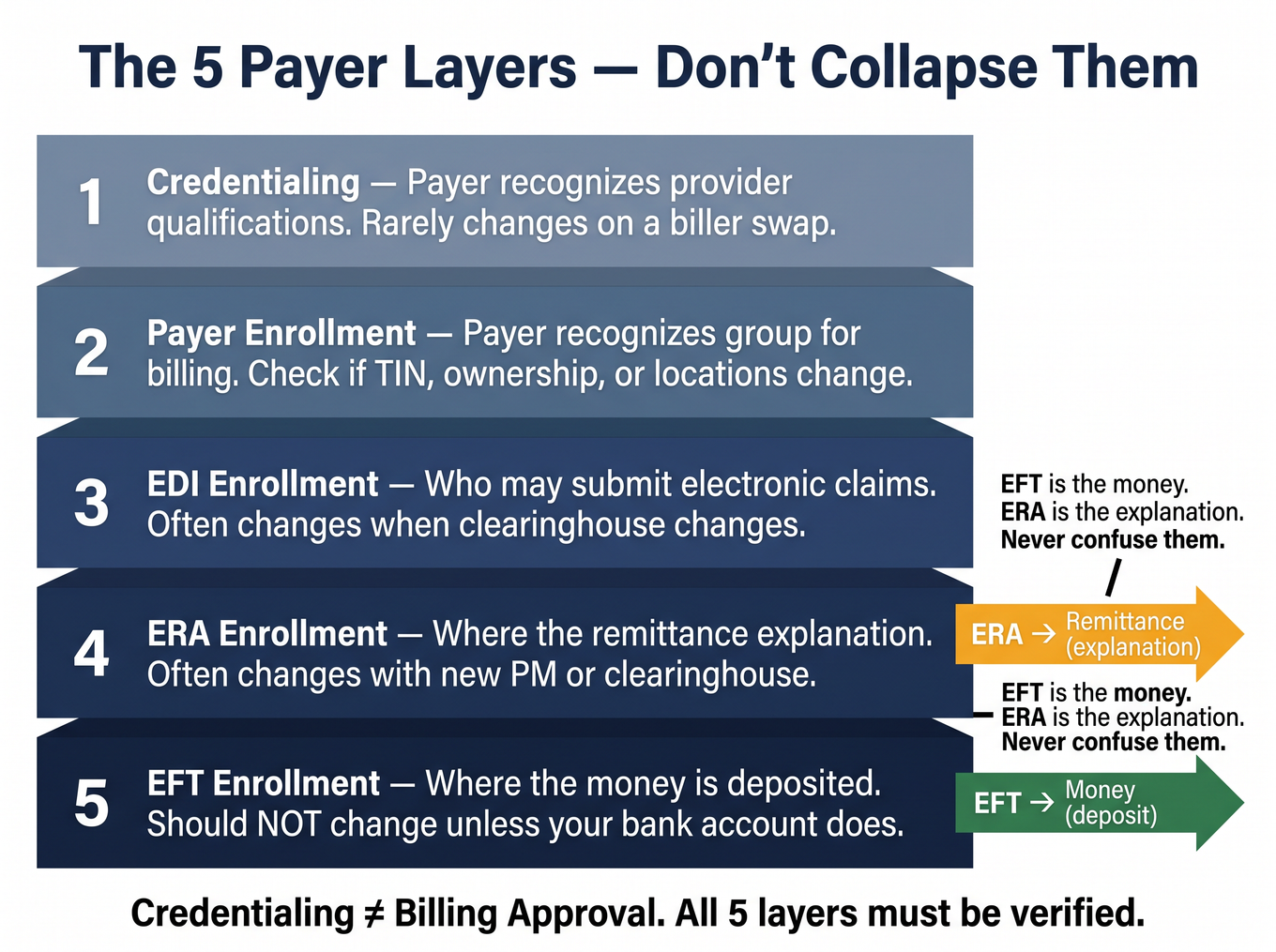
| Layer | What it controls | Usually changes on a biller swap? |
|---|---|---|
| Credentialing | Whether the payer recognizes the provider's qualifications | Usually no, if same provider/group/TIN/location |
| Payer enrollment | Whether the payer recognizes the group for billing and payment | Usually no for a simple swap; yes if TIN, ownership, roster, or location changes |
| EDI enrollment | Who may send electronic claims and transactions | Often yes, if the clearinghouse or submitter changes |
| ERA enrollment | Where electronic remittance (the explanation of payment) is sent | Often yes, if the PM, clearinghouse, or receiver changes |
| EFT enrollment | Where the money is deposited | Should not change unless your bank account does |
The trap to refuse: "Credentialing is done, so billing is fine." Credentialing is just the first layer. A provider can be fully credentialed and still unable to submit a single electronic claim through the new setup because EDI enrollment with that payer hasn't been approved. Don't let anyone collapse five layers into one reassurance.
The most expensive confusion of all is treating ERA and EFT as the same thing. They are not. EFT is the money; ERA is the explanation of the money. CMS describes the ERA as the health plan's explanation of a claim payment - the adjustments, the payer responsibility, the patient responsibility, while EFT is the electronic deposit itself. In a sloppy cutover you can re-route one and lose track of the other: the money lands in your account but the electronic remittance goes to the old receiver, so your team can't post payments and your A/R looks wrong even though you got paid.
Two rules keep this safe. Keep the money in your account. EFT should go to the practice's own bank account, and paper checks to a practice-controlled lockbox or address; the billing company can post payments, reconcile remittances, and chase underpayments, but should never own the funds flow. Public billing agreements model this, one required collected funds to be deposited directly into the client's bank account, and another stated plainly that all payments and collections are the client's property. If you're keeping the same bank account, don't casually change EFT at all, change the remittance routing if you must, but keep the deposits flowing to the account you already control. (For Medicare, EFT changes run through CMS-588, and Medicare requires EFT for providers enrolling, revalidating, or changing enrollment information.)
And don't shut off the old access on day one. Keep an overlap period - old clearinghouse reports, old ERAs and EOBs, old claim-status records, old A/R notes - until every old claim has acceptance evidence, the old remittances are exported, pending payments are posted, the new ERAs are arriving correctly, and your bank deposits reconcile to posted payments. One operational detail catches teams off guard: payers sometimes call or email to verify an ERA change, and Tebra notes that failing to respond can delay or deny the request. During a switch, someone at the practice has to be watching for those verification messages, enrollment in the new platform uses the billing tax ID and NPI, and even practices that previously used electronic services may need to re-enroll. A missed payer email can quietly break your payment posting for weeks.
One more piece of plumbing is worth a flag: don't assume payer-enrollment changes are retroactive. If a switch also moves your group enrollment or location, the new effective date is payer-specific, and services rendered in the gap can deny because the payer doesn't recognize the provider-location-group combination for those dates. Confirm effective dates in writing or through the payer portal, never assume.
There's one last routing system in your revenue cycle, and it doesn't run on transactions. It runs on trust: your patients.
Control patient statements, the quiet trust killer
You can run a flawless insurance cutover and still damage your practice through patient billing. When statements go wrong during a transition, patients get two bills from two companies, or pay an old statement that never gets posted in the new system, or receive a bill before their insurance even paid. They call the front desk, the staff can't explain what happened, and the practice looks disorganized, or worse, dishonest. That damage is harder to undo than a misrouted claim.
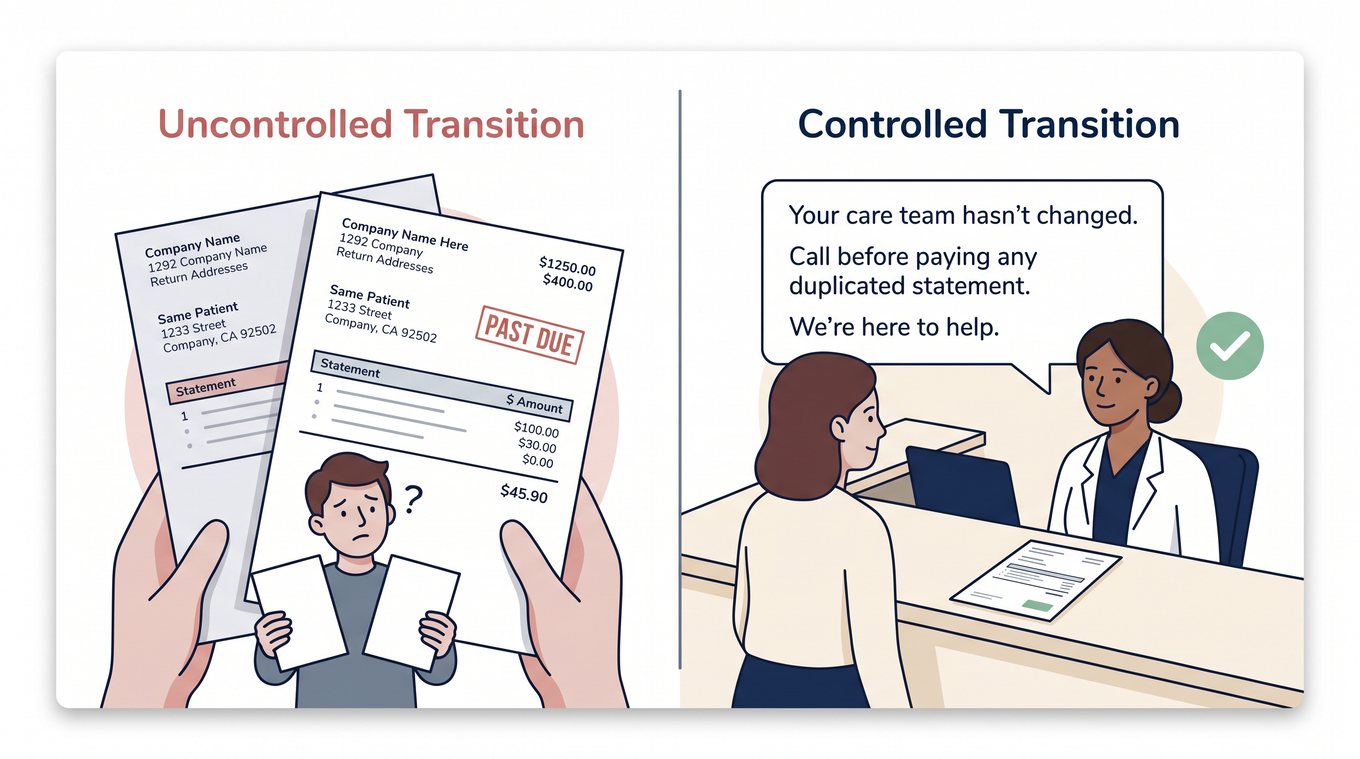
The single rule that prevents most of it: don't let statements run on autopilot during the switch. Patient statements should not be fully automated through a transition, because a wrong patient bill creates trust damage and a flood of confused phone calls that a misrouted insurance claim never would. Reconcile before you bill. That means posting insurance payments and denials before any statement goes out, exporting patient A/R with the last statement date so you know where each account stands, and capturing payment plans, card-on-file arrangements, and accounts already in collections so none of them get billed again from scratch. Decide a clean last-statement date for the outgoing process and a first-statement date for the incoming one, and hold statements only for the accounts genuinely affected by transition uncertainty, not all of them.
Give your front desk a simple script, too, so a patient question doesn't become a credibility problem: "We recently changed billing support. Your provider and care team haven't changed. During the transition you may see updated statement formatting or payment instructions, please call our billing line before paying any statement that looks duplicated or doesn't match your insurance explanation of benefits." Calm, honest, and it keeps a confused patient from either overpaying or losing faith.
Everything we've covered so far gets harder, and matters more, in the specialties where claims are hardest to begin with. That's where a generic billing handoff does the most damage.
Behavioral health, SUD, and hospitals: what the switch requires
The harder the specialty, the more dangerous a generic billing handoff becomes. In behavioral health, mental health, addiction treatment, and hospital billing, revenue is often lost before the claim is ever submitted - at verification, at carve-out routing, at authorization. A biller who treats these like primary care will hand you clean-looking claims that deny anyway. This is the part of a switch where specialty depth stops being a nice-to-have and becomes the difference between getting paid and writing it off.
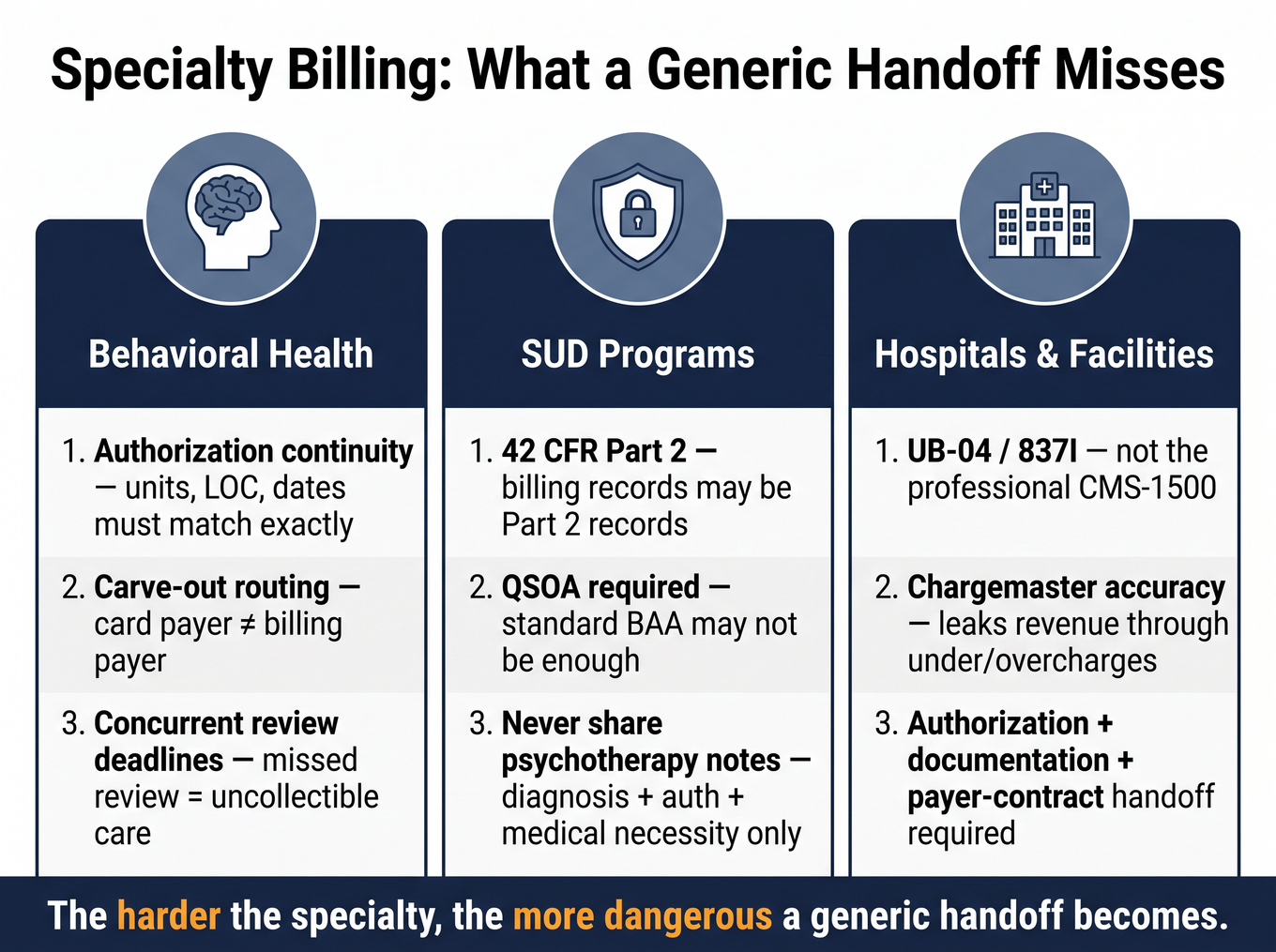
Authorization continuity is the first thing that breaks, and it's invisible until the denial arrives. A claim can be technically perfect - right codes, right modifiers, accepted by the payer, and still deny if the authorization units, level of care, or dates don't match what was delivered. Intermediate outpatient and partial-hospitalization programs run on level-of-care authorization and concurrent review with hard deadlines; a missed continued-stay review turns care you already delivered into revenue you can't collect. When authorization data doesn't transfer cleanly in a switch, those denials are the first to show up. It's no small matter for patients either, AMA survey coverage found 78% of physicians said prior authorization sometimes or often leads patients to abandon recommended treatment. For behavioral health and SUD, authorization continuity is revenue protection and care continuity at once.
The payer on the insurance card may not be the payer you bill. Behavioral benefits are frequently carved out to a separate managed behavioral-health organization, so the front desk verifies the medical plan while the behavioral claims need to route somewhere else entirely. Get that routing wrong in a transition and claims go to the wrong payer, the authorization is tied to the wrong entity, and timely-filing denials pile up. This is exactly why intake data must transfer cleanly, Experian found 68% of providers cite inaccurate or incomplete intake data as a top driver of denials. Carve-out routing intelligence is the kind of thing a specialty biller maps before cutover, not after the denials arrive.
For SUD programs, the data handoff itself carries a compliance layer that HIPAA alone doesn't cover. Under 42 CFR Part 2, billing records for a Part 2 program can themselves be Part 2 records, the rule defines "records" broadly to include billing and patient-identifying information. A billing vendor serving a Part 2 program often needs a Qualified Service Organization Agreement that binds it to Part 2 restrictions, not just a standard BAA. Part 2's 2024 final rule took effect April 16, 2024, and regulated entities have had to comply with the applicable updated requirements since February 16, 2026; the rule aligns certain Part 2 requirements more closely with HIPAA and HITECH. So when you export SUD billing data to a new vendor, the question isn't only "is this transfer HIPAA-secure". It's "is the new vendor bound to Part 2, and is the export handled accordingly." A biller who can't explain QSOA versus BAA is telling you something.
One related caution: a billing vendor does not need your psychotherapy notes. HHS treats psychotherapy notes as a separate category that excludes items like medication, diagnosis, treatment plans, symptoms, prognosis, and progress. Billing normally needs diagnosis, service, authorization, and medical-necessity support, not the private process notes of a session. If an incoming biller asks for psychotherapy notes by default, that's a red flag, not thoroughness.
Hospitals and facilities are a different universe again. Institutional claims run on the UB-04 / 837I rather than the professional CMS-1500 / 837P, and a single encounter can spawn both. For Medicare acute-care inpatient stays, payment is generally MS-DRG-based under IPPS rather than paid line by line, other facility types and commercial contracts can work differently, but coding and clinical documentation still drive reimbursement across all of them. The chargemaster is the billing engine, and an inaccurate one leaks revenue through under- and over-charges, rejections, and underpayments. In facility RCM, money is lost in the handoffs between patient access, utilization management, coding, charge capture, billing, and denials, which is precisely why a facility transition needs an authorization, documentation, and payer-contract handoff, not just claim submission. These are the claims a generic handoff can mishandle unless the biller has real behavioral-health, SUD, and facility RCM depth, which is why specialty experience matters before cutover, not after the denials arrive.
All the operational discipline in the world won't help, though, if the contract you signed traps you on the way out. That's the next thing to check, ideally before you ever needed this guide.
The contract traps that blindside practices
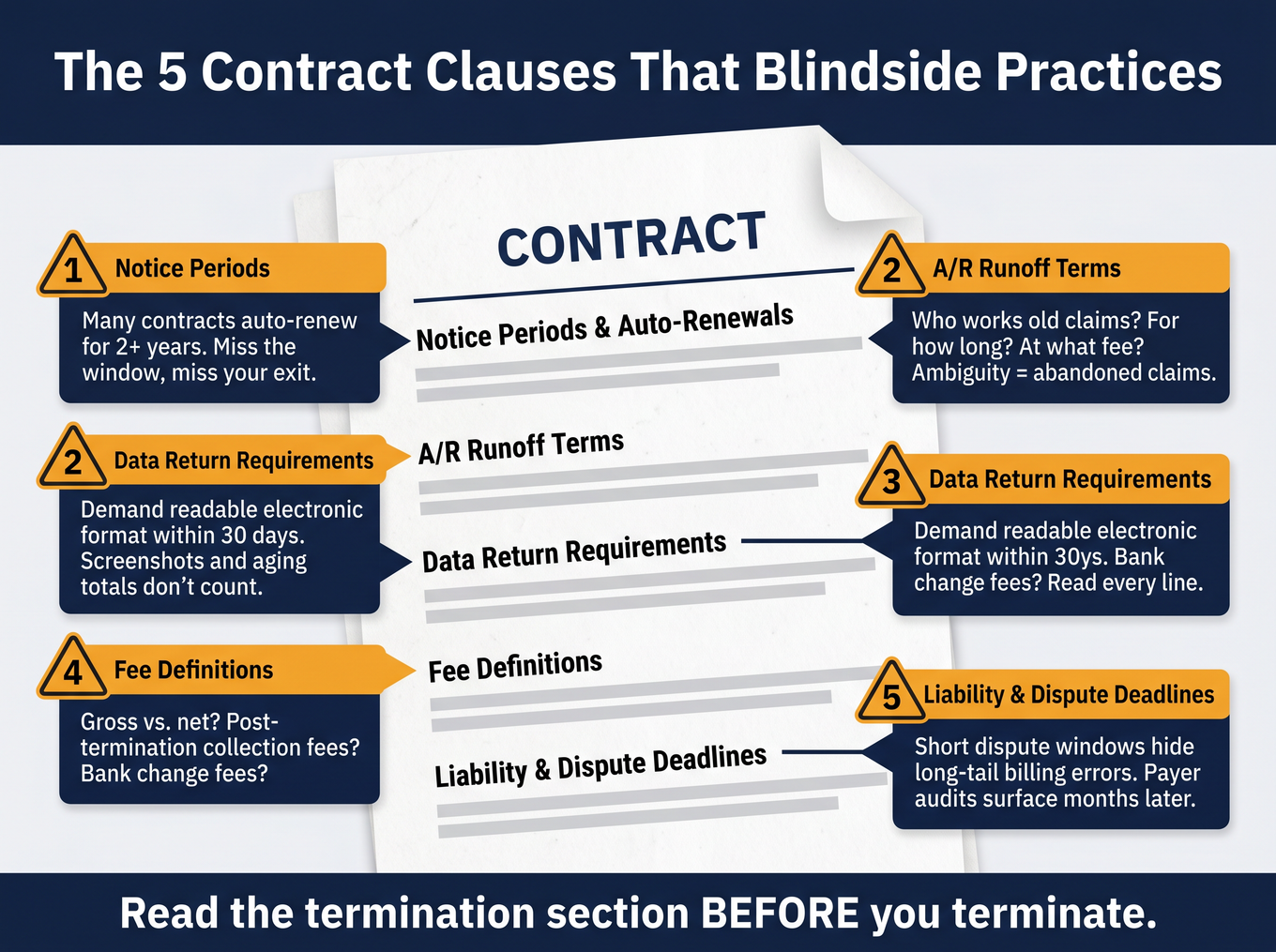
Before you complain about your billing, check the calendar. The contract terms that govern your exit can cost you more than the billing problem itself, and they're easy to miss because nobody reads the termination section until they want to terminate.
Notice periods and auto-renewals come first. Many contracts require written notice within a specific window, and some renew automatically if you miss it. One public billing agreement carried a three-year initial term with automatic two-year renewals unless either party gave written notice at least 90 days before the term ended. Miss that window and you're locked in for two more years. Know your dates before you make any decision.
A/R runoff is the next landmine. Find out whether the outgoing vendor keeps working pre-termination A/R, for how long, at what fee, what reports they owe you, whether you can move that A/R to the new vendor, and - critically, whether the outgoing vendor still gets paid on collections after termination, including money the new vendor collects. Ambiguity here is how old claims get abandoned by both sides.
Data return should be explicit. Day Pitney recommends requiring billing data and patient accounts to be transferred in a readable electronic format, final reports within a short period not exceeding 30 days, cooperation with the replacement vendor, and no excessive exit fees. Your billing records are part of your HIPAA designated record set, which includes billing, payment, and claims records used to make decisions about individuals, and again, a business associate cannot block your access to PHI over a dispute. Beware data delivered only as screenshots, or as a summary aging total with no claim detail, or "we'll send what you need later."
Fee definitions deserve a hard read. Is the fee on gross or net collections? Are refunds and recoupments deducted? Does the outgoing vendor charge on old-A/R collections after termination, or on payments from work your own staff did? Are there separate fees for bank changes, payer enrollments, statements, or data exports? The same public agreement above itemized separate fees for bank changes and payer-enrollment applications, including Medicare, Medicaid, and commercial work. These add up.
Liability and dispute deadlines close it out. Check whether the vendor is liable for missed timely filing or avoidable denials, whether damages are capped at something trivial, and how short the dispute window is. Day Pitney specifically warns that short contractual dispute deadlines are risky because billing errors and payer audits often surface long after the fact. None of this is legal advice, bring your counsel the clauses that matter, but knowing where the traps sit is what keeps an exit from becoming a dispute.
Now you have the controls. The next step is to put them on a calendar, which is what the transition plan is.
The 30-60-90 day transition plan
A transition plan is just every control above, assigned an owner and a date. Here's how it sequences.
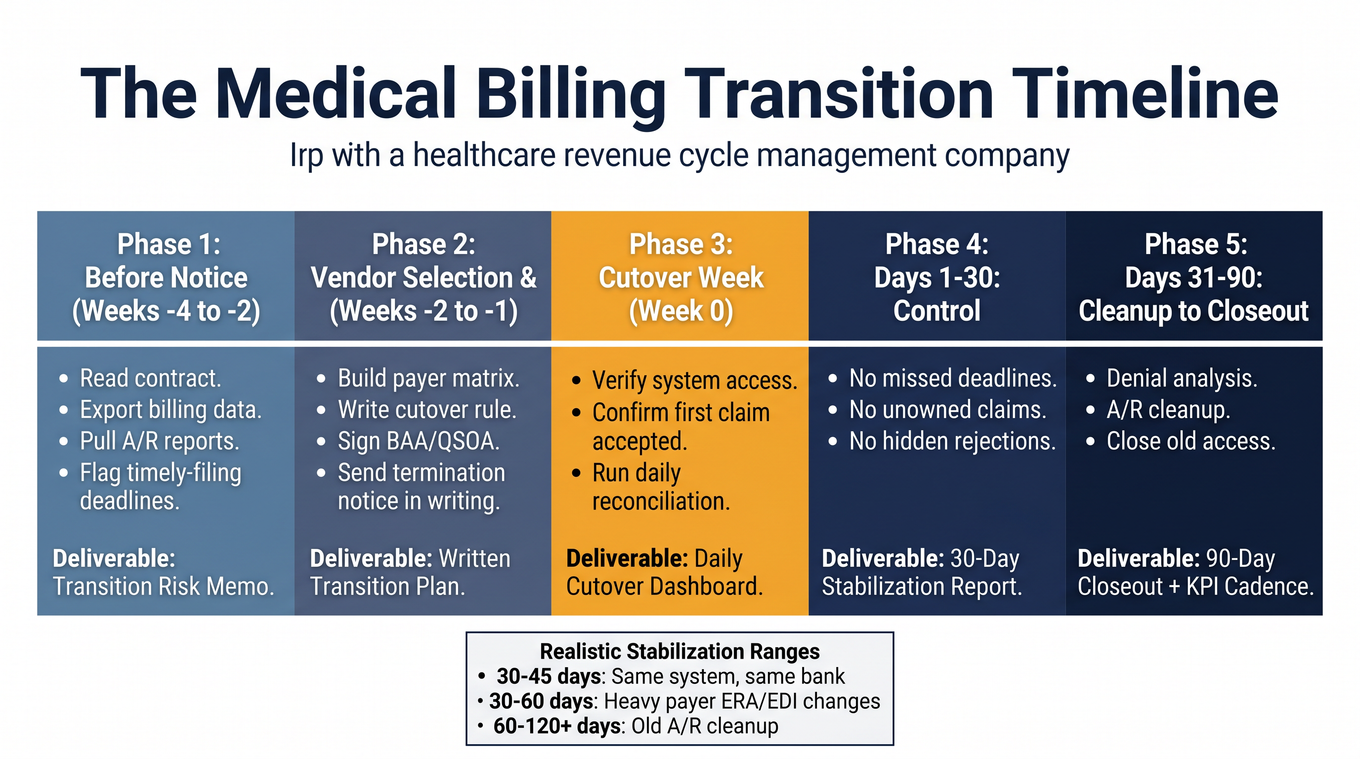
Before notice (weeks -4 to -2). Know what you're walking into before the outgoing vendor knows it's being replaced. Review the billing contract, the BAA, and, for SUD, any QSOA or Part 2 agreement. Identify the notice period, the auto-renewal date, the runoff language, and the exit fees. Confirm who actually owns your EHR admin access, your clearinghouse access, and your payer-portal admin logins. Export the reports. Pull baseline numbers and flag the high-dollar A/R, the unbilled encounters, and the claims near timely filing. The deliverable is a transition risk memo and a clean report inventory.
Vendor selection and notice (weeks -2 to -1). A serious incoming vendor should understand the mess before promising a cutover date - review an A/R sample, the payer mix, and the denial history with them first. Build the payer matrix, the timely-filing matrix, and the EDI/ERA/EFT tracker. Decide the old-A/R ownership model and write the cutover rule. Sign the BAA, and the QSOA if Part 2 applies. Then send termination notice per the contract, and put your data and report requests to the outgoing vendor in writing, with a confirmed final-service date and a guarantee that no records get deleted or access shut off before handoff. The deliverable is a written transition plan with named owners.
Cutover week (week 0). Keep money moving. Verify the new vendor's EHR, clearinghouse, and payer-portal access and EDI approvals. Confirm the first claim batch is accepted. Run daily reports on rejections, held claims, and unbilled encounters; track the old-A/R runoff and the ERAs and deposits coming in; hold only the patient statements that need reconciliation; and escalate anything near a deadline. The deliverable is a daily cutover dashboard.
Days 1 to 30, control, not perfection. The first month is not about optimization. The goals are narrow and absolute: no missed deadlines, no unowned claims, no hidden rejections, no broken payment posting. Reconcile daily, confirm the first ERAs are posting correctly, work down the rejection queue, resume statements only for reconciled balances, and watch the timely-filing red list and authorization expirations every day. The deliverable is a 30-day stabilization report.
Days 31 to 90, cleanup to optimization to closeout. Once new claims are stable, shift to performance: deep denial analysis, payer-by-payer A/R review, the appeal and underpayment backlog, credentialing and ERA/EFT exceptions, and patient-balance reconciliation. By day 90, decide whether any remaining old A/R fully moves to the incoming vendor, confirm the outgoing vendor's final data delivery and runoff report, reconcile the final fees, and close the old access safely. The deliverable is a 90-day transition closeout and a locked-in monthly KPI cadence.
How long until things feel normal? Be honest with yourself, and demand honesty from any vendor. These are realistic planning ranges, not guarantees:
- Same-system, same-bank, same-contracts switch: new-claim workflow stabilizes in 30 to 45 days
- Heavy payer ERA/EDI changes: stabilization stretches to 30 to 60 days, depending on payer approvals
- Old-A/R cleanup: runs 60 to 120-plus days, depending on age and denial mix
- Also changing EHR or enrollment at the same time: treat it as a major project, not a switch, plan accordingly
Any biller who promises instant, frictionless results is telling you they haven't run a real transition.
A plan is only as good as the people you hand it to. So before you sign anything, test them.
What to demand from any biller before you sign
This is where you convert everything above into a decision. You're not just hiring a biller. You're hiring the team that will run your transition, and the way they answer these questions tells you more than any collection-rate quote.
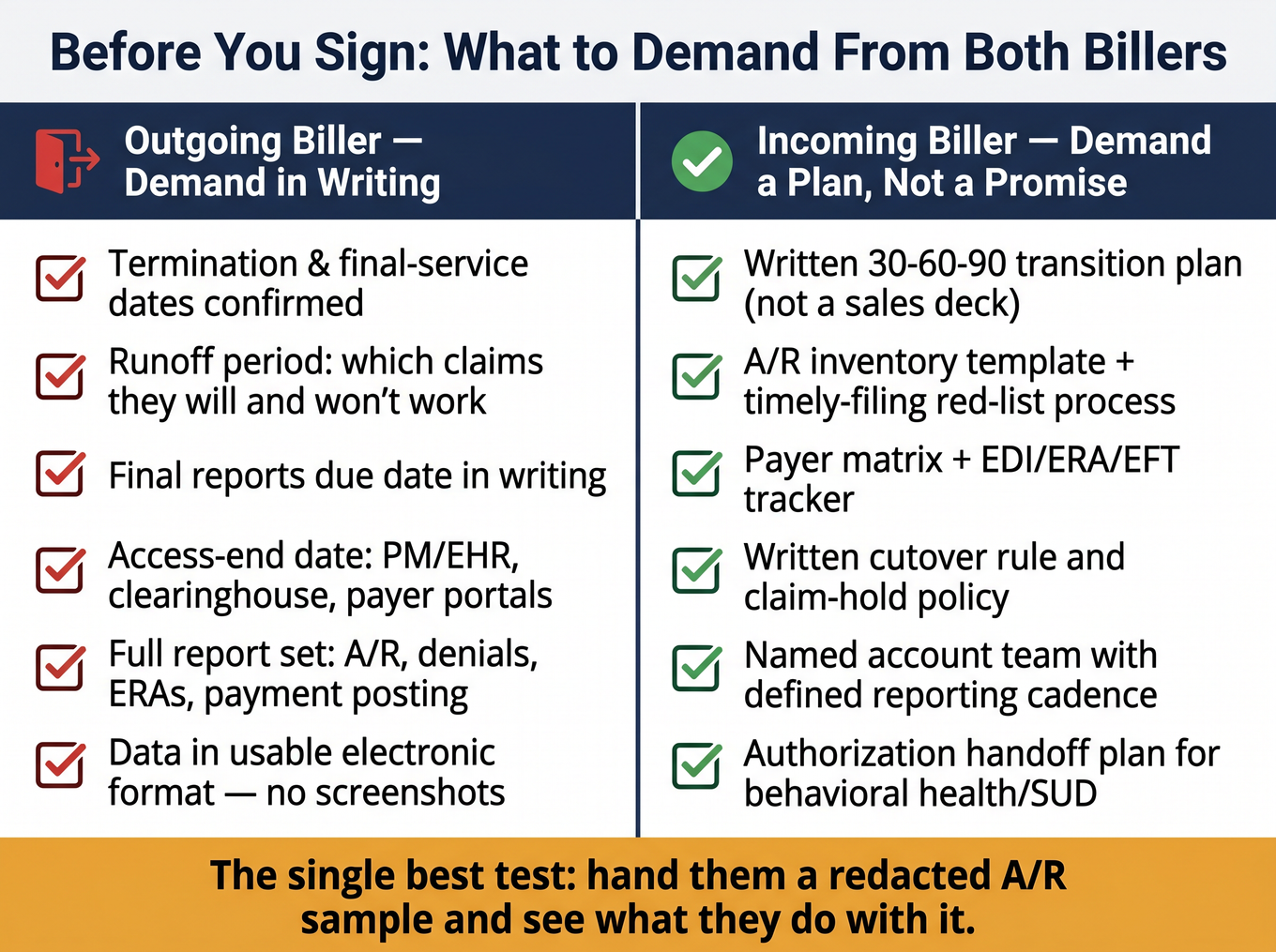
From your outgoing biller, demand in writing: the termination and final-service dates, the runoff period and exactly which claims they will and won't work, a final-reports due date, an access-end date, and confirmation that no records will be deleted and that data returns in a usable electronic format. Demand the full report set - insurance and patient A/R, unbilled encounters, rejected and denied claims, appeals, payment posting, unapplied cash, credit balances, statement history, clearinghouse acknowledgments, and the ERA/EOB archive. And demand a real access handoff: EHR and clearinghouse admin access, payer-portal admin users moved to practice-controlled emails, MFA moved to practice-controlled devices, and shared logins eliminated.
From your incoming biller, demand a plan, not a promise. A serious vendor produces a 30-60-90 plan, an A/R inventory template, a timely-filing red-list process, a payer matrix, an EDI/ERA/EFT tracker, a written cutover rule and claim-hold policy, a patient-statement plan, an authorization handoff plan, a named account team, and a defined reporting cadence. Ask which KPIs they'll report during the transition, and listen for the ones that matter under stress - claim acceptance rate (not just "claims sent"), rejection age, claims on the timely-filing red list, denial age, A/R over 90 days, payment-posting lag, and authorization expirations.
Then ask the questions that separate a transition manager from a claim processor:
- How do you inventory open A/R during a transition, claim by claim, or by aging summary?
- Will you work our old A/R, or only new claims, and how do you decide which old claims to prioritize?
- How do you prove a claim was actually accepted by the payer, not just sent?
- What happens to ERA routing if it breaks during cutover, and do you recommend changing our EFT or keeping payments in our bank account?
- How do you handle patient statements during the transition to prevent duplicate or premature bills?
- How do you handle authorizations, concurrent review, and behavioral-health carve-outs?
- Do you understand 42 CFR Part 2 and QSOA requirements, and will you sign our BAA and, if needed, a QSOA?
- Who exactly will work our account, and what does your written 30-60-90 plan look like?
- What do you need from our outgoing biller, and from our internal team?
- What happens if a transition error on your side causes a timely-filing denial?
And the single best test: hand a serious candidate a redacted sample of your A/R and watch what they do with it. A vendor who actually runs transitions will come back and tell you which claims are urgent, which are likely uncollectible, which need authorization or documentation, which payers are highest-risk, and what they'd do in the first 30 days. A vendor who only quotes a percentage and promises to "take care of everything" hasn't answered the question you're actually asking, which is the same question you started with.
A controlled handoff, not a gamble
Here's the truth underneath the fear. You don't stay with a billing company that's failing you because switching is genuinely safe. You stay because switching feels invisible, like a black box where your money goes in and you have no idea whether it comes out the other side. The fear isn't really about the new vendor. It's about losing sight of your own revenue cycle during the handoff.
So make the work visible. Inventory every open claim. Flag every timely-filing deadline.

Track every payer-routing change. Assign every old A/R balance a named owner. Control every patient statement. The moment the work is visible - claim by claim, deadline by deadline - the fear drops, because there's nothing left hidden to be afraid of. A billing-company switch is not a cash-flow gamble when you run it as a revenue-protection project.
Our take, after running these transitions in the hardest specialties: the right incoming biller should be able to show you the plan before they ever touch a claim. Not a sales deck - an actual transition plan, with your A/R inventory, your timely-filing red list, your payer and ERA/EFT tracker, your cutover rule, and a named team who will own it. If a vendor can't put that in front of you, they're asking you to make the leap of faith you were right to be afraid of.
If you'd like a second set of eyes on your current revenue cycle before you make a move, we offer a complimentary consultation - an honest read on your open A/R, your denial patterns, and what a controlled switch would actually look like for your practice. Either way, you now know what a safe switch requires. It was never courage. It was visibility, deadlines, ownership, and proof.
Switching medical billing companies: your questions answered
Will I lose money when I switch medical billing companies?
Not from the switch itself. Practices lose revenue during a transition when open A/R isn't inventoried, claims marked "sent" were never accepted by the payer, timely-filing deadlines pass unnoticed, ERA/EFT routing changes blindly, or old denials get abandoned. Every one of those is preventable with a claim-by-claim transition plan that keeps new claims moving while old A/R is worked down under written ownership. The danger is an unmanaged switch, not switching.
How long does it take to switch medical billing companies?
It depends on what changes. A switch that keeps the same system, bank account, payer contracts, and providers usually stabilizes new-claim workflow in 30 to 45 days. Heavy payer ERA/EDI changes can push that to 30 to 60 days depending on payer approvals, and old-A/R cleanup commonly runs 60 to 120-plus days depending on the age and denial mix. If you also change your EHR or your enrollment at the same time, treat it as a larger project. These are realistic planning ranges, not guarantees, be wary of anyone promising instant results.
Do I have to re-credential my providers when I change billers?
Usually not, as long as the same legal entity, providers, locations, payer contracts, tax ID, NPI structure, and bank account stay in place. But payer enrollment, EDI enrollment, ERA routing, EFT records, portal access, and provider rosters still need to be checked payer by payer. Credentialing risk rises only when the switch also involves a new TIN, new ownership, new locations, new providers, or a Medicare reassignment change. Don't assume any enrollment change is retroactive, confirm effective dates in writing.
Who works my old accounts receivable after I switch?
Whoever you assign in writing. That's the whole point. There are three common models: the outgoing vendor works a defined runoff period, the incoming vendor takes over all open A/R, or you split it. The safest position is that the incoming vendor audits the full inventory, monitors any runoff, and takes ownership of every claim that is unbilled, rejected, denied, high-dollar, or near a deadline. What you must avoid is leaving it unstated, because that's how old claims get abandoned by both sides. No claim should ever sit unowned.
What's the difference between a rejected claim and a denied claim, and why does it matter during a switch?
A denied claim made it into the payer's system, got adjudicated, and was refused. You know where it stands and what deadline applies. A rejected claim bounced at the front end and may never have entered adjudication at all, so it can sit in a queue looking handled while the timely-filing clock keeps running. During a transition, rejected claims are more dangerous than denied ones for exactly that reason. That's why a good plan requires proof of acceptance - a payer claim number, a 277CA acknowledgment, or portal status, not just proof that something was sent.
Can my old billing company hold my data hostage?
No. HHS has been explicit that a business associate cannot block a covered entity's access to its PHI, including over a payment dispute. That said, knowing your rights and exercising them quickly are different things, so export your billing data before you give notice rather than depending on a vendor whose termination clock is already running. Your contract should also require data return in a readable electronic format within a short, defined period.
Should I change my EHR system at the same time I switch billers?
Usually not, unless you have a clear reason. The lowest-risk switch keeps your EHR and bank account stable and changes only the billing company, so the new biller works inside your existing setup. The moment you also migrate your software, clearinghouse, or bank account, you've turned a vendor swap into a migration project that needs a much heavier plan and a longer timeline. If both genuinely need to change, sequence them, don't stack them.
What should a behavioral health or SUD practice check before switching billers?
More than a generic practice. Confirm the new biller understands authorization continuity (a clean claim still denies if units, level of care, or dates don't match), behavioral-health carve-out routing (the payer on the card may not be the payer you bill), and the levels of care from IOP and PHP through residential and detox. For SUD specifically, 42 CFR Part 2 can apply to billing records, so the data handoff may need a Qualified Service Organization Agreement, not just a BAA. And a biller who asks for psychotherapy notes by default, rather than the diagnosis, service, and medical-necessity support billing actually needs, is showing you they don't understand the specialty.