Medical Billing Services Cost: What Practices Actually Pay
July 14, 2026 · 34 min read
Public pricing guides and billing-company survey data put percentage-based outsourced medical billing in the neighborhood of 4% - 10% of net collections, with many small and midsize practices seeing quotes around 5% - 8%. That range is a starting point, not a verdict, and it is almost useless on its own.

A practice paying 6% might be getting a good deal, or it might be paying twice the market rate for a vendor that submits claims, ignores denials, and leaves the practice to chase its own A/R. A practice paying 8% might be overpaying, or it might have found the only vendor that actually understands how behavioral health payer carve-outs work, handles prior authorizations, and delivers monthly reporting its CFO can read.
The percentage tells you almost nothing without knowing what it's multiplied by and what it buys.
We work with practices in behavioral health, mental health, addiction treatment, and hospital settings, specialties where the gap between a vendor who understands the claim and a vendor who doesn't can mean tens of thousands of dollars in preventable write-offs. That experience is the lens through which this guide is written. What follows is a plain-language breakdown of what medical billing services cost, what drives the price up or down, and how to evaluate whether a quote is fair before you sign anything.
How Medical Billing Companies Charge: Four Common Pricing Models
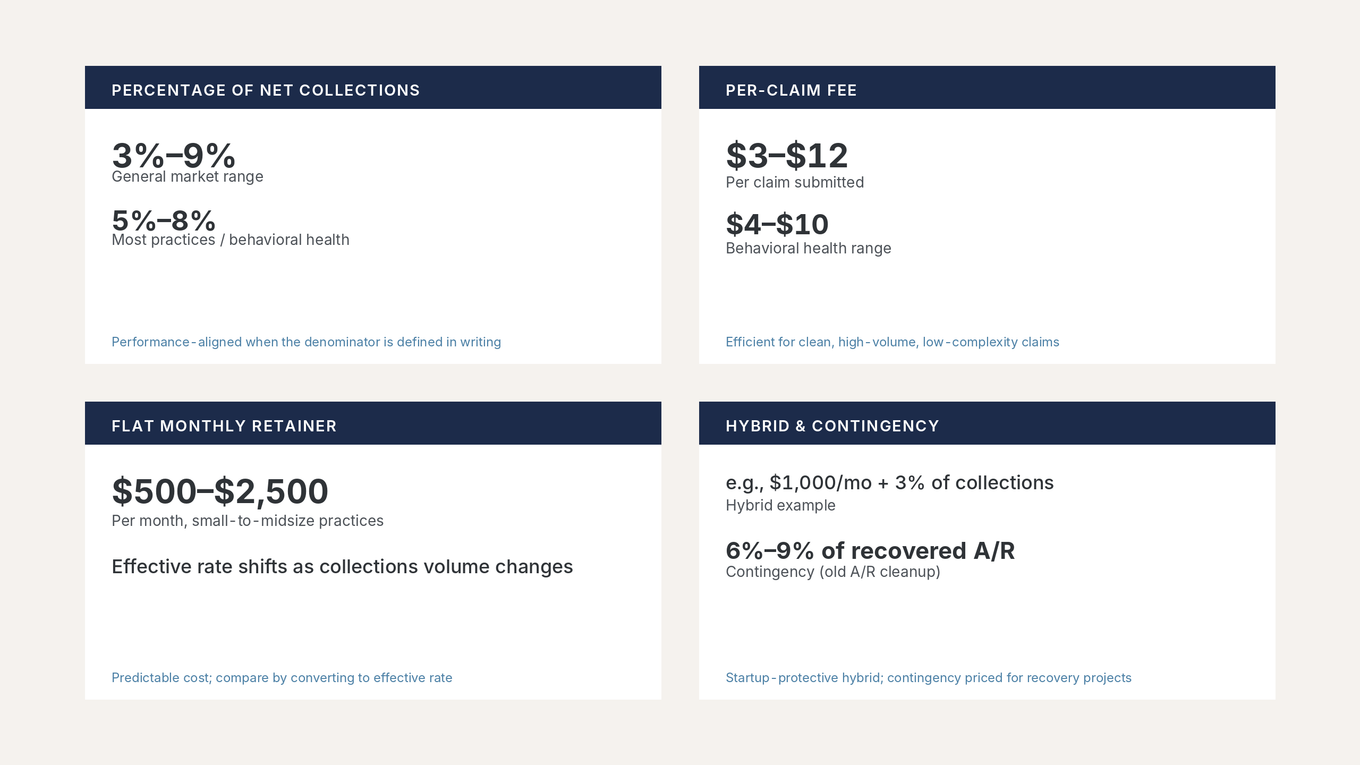
Percentage of Net Collections: The Most Common Billing Fee Structure
The most common pricing structure in outsourced medical billing is a percentage of net collections, the vendor takes a percentage of the money the practice actually collects after insurance payments are processed and patient responsibility is billed. This is also the most buyer-aligned model when the denominator is defined correctly (more on that shortly).
Current 2025-2026 market sources consistently place the range at:
- 3% - 9% of monthly collections for general outsourced billing services, with most small and midsize practices landing around 5% - 8% (businessnewsdaily.com)
- 4% - 10% across the broader market, with hidden fees capable of adding 10% - 30% to the effective rate (Neolytix)
- 5% - 8% for behavioral health practices specifically, rising to 7% - 9% for solo mental-health clinicians and smaller practices (PIMSY; EliteMedFinancials)
- 5% - 10%, sometimes up to 12%, for SUD, addiction treatment, PHP, IOP, residential, and detox billing where authorization, concurrent review, facility claims, and high denial exposure are part of the work (Aspen Ridge Medical)
What pushes a practice to the high end, or keeps it near the low end, is covered in detail below. For now, here are the main pricing models in the market.
Per-Claim Billing Fees: What Vendors Charge and When It Makes Sense
Some vendors charge a fixed fee per claim submitted or worked. General market rates commonly run $3 - $12 per claim, with behavioral-health-specific billing examples typically falling between $4 - $10 per claim (Neolytix).
To put that in context: a publicly listed behavioral-health billing plan from MBPros shows a "Platinum" tier at $3.99 per claim for 1-499 claims monthly, with a $199.95 monthly minimum - a plan that includes claim submission, A/R posting, follow-up of outstanding and denied claims, insurance verification, and authorization/benefit tracking. Its basic "claim submission only" plan runs $2.45 per claim with a $69.95 minimum (Medical Billing Professionals).
The gap between those two plans is instructive: the cheapest option does not include denial follow-up, A/R management, or benefits work. For a practice with clean, high-volume, low-complexity claims, per-claim pricing can be efficient. For a behavioral health group with Medicaid MCO claims, EAP authorizations, and telehealth modifier rules, per-claim pricing at the cheap end often leaves the hard work undone.
Flat Monthly Billing Retainers: How to Compare Them to Percentage Pricing
Flat monthly retainers give practices a fixed, budgetable cost. Public pricing guides put flat monthly medical billing fees around $500 - $2,500 per month for small-to-midsize practices, with higher or custom retainers possible when the scope is full-service, high-volume, or unusually complex (Neolytix).
The catch with flat-fee arrangements is that the vendor may cap the work included. When a practice collects only $30,000 per month, a $2,000 flat fee represents 6.67% of collections, a fair rate if it's truly full-service. When the same practice grows to $80,000 per month, the same fee represents 2.5% - a great deal for the practice, which is why vendors often cap claims, providers, denial follow-up rounds, or reporting levels at fixed-fee tiers.
To compare a flat retainer against a percentage quote, convert it: effective rate = monthly retainer ÷ monthly net collections. Run this at your current volume, at 25% lower, and at 25% higher, the effective rate shifts meaningfully as collections change.
Hybrid Pricing and Contingency Billing Fees: How They Work
Hybrid pricing combines a base monthly fee with a lower percentage - for example, $1,000/month plus 3% of net collections, or $500/month per provider plus 4% of collections (OmniMD). Hybrid models protect vendors from underpayment during startup or slow periods while keeping percentage-based incentives in place.
Contingency pricing applies to old A/R cleanup and underpayment recovery projects. Public examples include 6% - 9% of recovered A/R dollars (Simplify Medical Billing) and 20% of recovered denial revenue (ZenithMedCare). Contingency arrangements require careful contract language specifying which claims are in scope, what counts as a "recovery," and how to prevent the go-forward billing vendor and the cleanup vendor from both claiming credit for the same payment.
But the pricing model is only one dimension of the real cost question. The other, often more important, is what number the percentage gets applied to. That's where many billing proposals quietly overcharge the practices that don't know to look.
How Medical Billing Quotes Can Mislead: The Denominator, Minimums, and Hidden Fees
Net Collections vs Gross Charges: Why the Denominator Changes Everything
A medical billing percentage means almost nothing without knowing what number it's multiplied by. That number, the denominator, can be defined in several ways:
- Net collections: actual cash received on payer and patient payments attributable to claims the vendor worked, after contractual adjustments, refunds, recoupments, and write-offs. This is the buyer-aligned definition.
- Gross charges (billed charges): the amounts submitted to payers before contractual adjustments. These are often arbitrary - one practice may bill $200 for a therapy session and another may bill $350 for the same CPT code, same payer, same allowed amount.
- Allowed amount: the amount the payer contract recognizes for the service (which may then be split between payer and patient responsibility).
- Total practice receipts: all money flowing into the practice, including copays, self-pay, and payments collected at the front desk without any vendor involvement.
Some vendors quote percentage pricing without specifying which denominator applies. Neolytix and other market sources explicitly warn buyers to clarify whether the fee is based on gross charges or net collections, because the difference can materially change the actual cost (Neolytix).
The Gross-Charge Trap: How 5% of Gross Charges Can Cost More Than 6% of Net
Here is an example that makes this concrete:
A practice bills $200,000 in charges per month and collects $100,000 in actual cash.
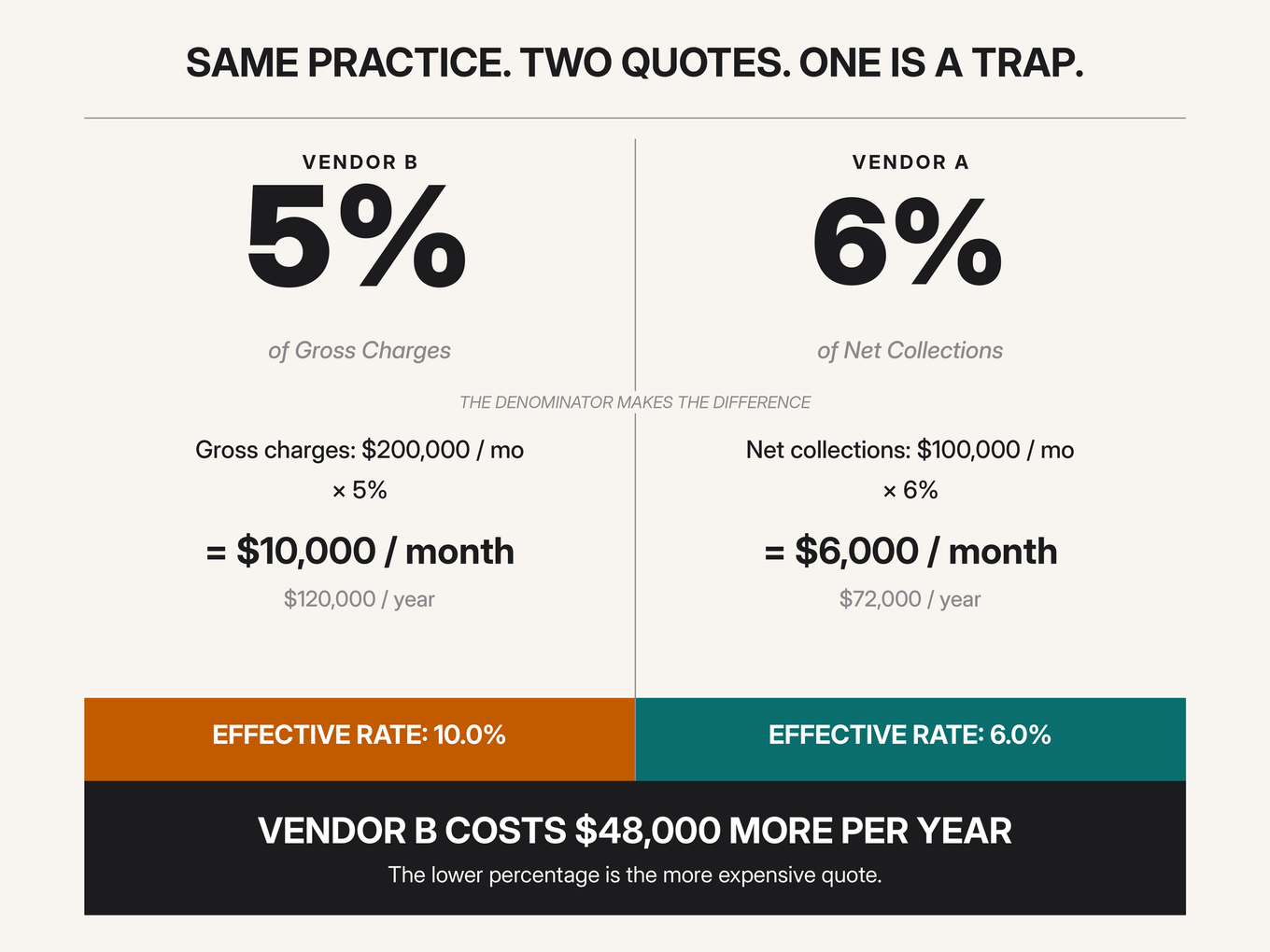
| Pricing method | Calculation | Monthly fee | Effective rate on collected cash |
|---|---|---|---|
| 6% of net collections | 6% × $100,000 | $6,000 | 6.0% |
| 5% of gross charges | 5% × $200,000 | $10,000 | 10.0% |
Vendor B's "5%" looks cheaper. It costs $4,000 more per month, $48,000 more per year. The practice paying Vendor B has been taken by a single sentence in a proposal that did not define the denominator.
A practice comparing vendors should demand, in writing: "Is the percentage applied to net cash collected on claims you worked, excluding contractual adjustments, refunds, and recoupments?" The acceptable answer is yes, with the definition confirmed in the contract.
Monthly Minimums: How They Raise Your Effective Billing Rate at Low Volume
Monthly minimums are standard in the market, and they're not inherently bad. They protect vendors from doing legitimate account management work for a practice that only collects a few thousand dollars per month. But minimums change the effective rate at low volume.
Consider a solo therapist collecting $3,000 per month whose vendor quotes 5.5% with a $199 monthly minimum:
- 5.5% of $3,000 = $165
- But the minimum applies: actual fee = $199
- Effective rate: 6.63%
Meridian Billing's publicly listed behavioral-health pricing tiers include minimums from $199 to $999 per month depending on the plan tier (Meridian Billing Services). This is typical market behavior. The buyer's responsibility is to model the minimum against their actual expected volume, not just the quoted percentage.
The contract should define whether the minimum applies during onboarding (before claims start flowing), during temporary low-volume periods, and whether it resets if the practice adds or loses providers.
With the denominator problem understood and the minimum trap in view, the next question is what the percentage actually covers, and what it doesn't.
What 'Full-Service' Medical Billing Actually Covers and What Costs Extra
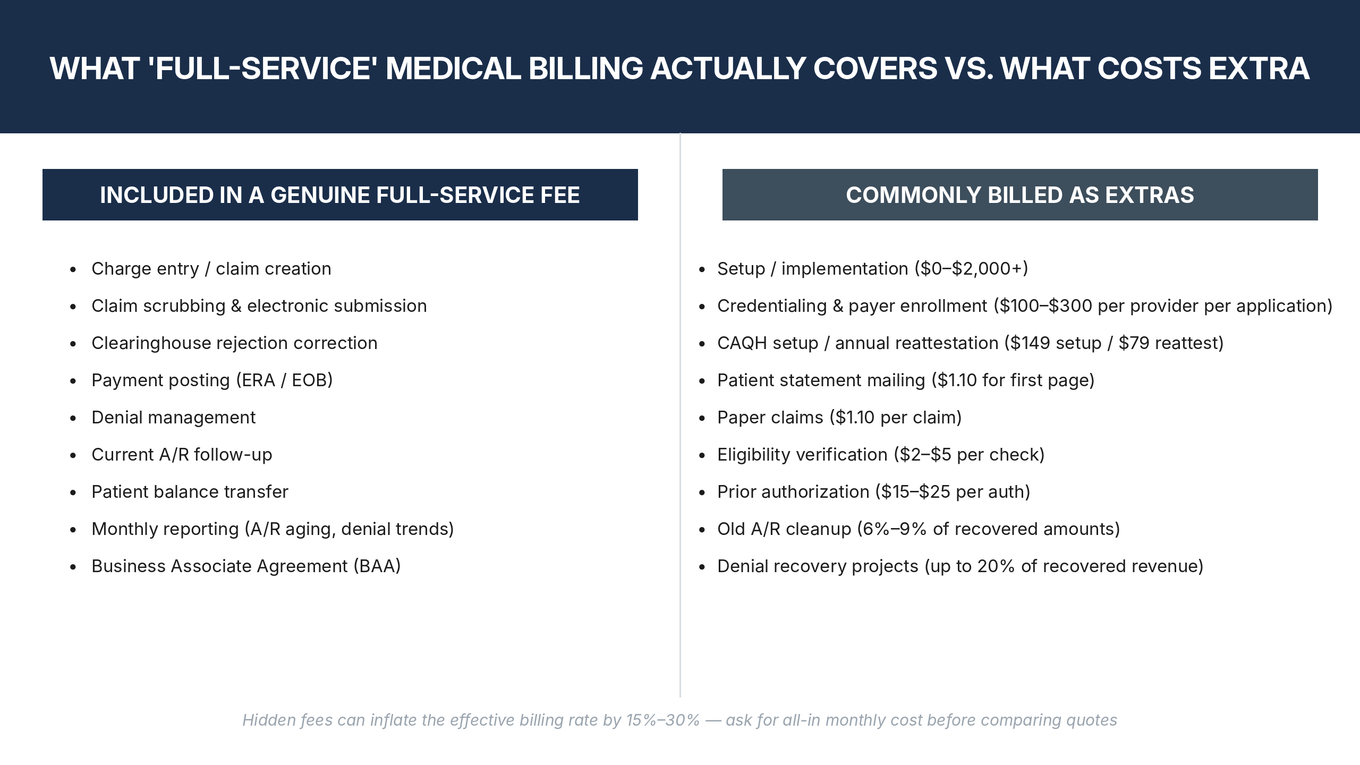
"Full-service" is the billing industry's most overloaded phrase. Two vendors can both describe themselves as "full-service" while offering vastly different scopes. A practice that does not read the scope carefully will be surprised when the billing vendor calls denial management "out of scope."
Core Functions Every Full-Service Medical Billing Fee Should Cover
A genuinely full-service billing fee typically includes these core functions:
| Function | Notes |
|---|---|
| Charge entry or claim creation | Sometimes the practice enters charges and the vendor reviews/submits |
| Claim scrubbing and submission | Core billing task, should include electronic 837P (professional) or 837I (institutional/facility) |
| Clearinghouse rejection correction | Watch for "first submission only" language that excludes correction work |
| Payment posting | Must include ERA/EOB posting and transfer of patient responsibility to patient billing |
| Denial management | Not just rejections - denial work means appeals, documentation requests, payer calls, and correction resubmissions |
| Current A/R follow-up | Outstanding claims being actively worked; pre-start-date A/R is typically separate |
| Patient balance transfer | Generating patient statements; actual mailing may be a separate transaction fee |
| Monthly reporting | Collections, charges, denial trends, A/R aging, days in A/R, top payer issues |
| Business Associate Agreement (BAA) | Any billing company handling PHI is a HIPAA business associate; the BAA must be executed before PHI access (HHS.gov) |
If a vendor's scope of work does not explicitly cover denial management, ask what happens after a claim is denied. "Full service" from some vendors means clean claim submission plus payment posting. The denials, which require human expertise, payer knowledge, and follow-up, are left entirely to the practice.
Common Add-On Fees That Medical Billing Vendors Price Separately
These items are commonly billed as extras, even when a vendor describes itself as full-service:
| Extra | Typical pricing signals |
|---|---|
| Setup / implementation | Often $0 - $2,000+; may include payer setup, EHR access, ERA/EFT enrollment, and reporting configuration |
| Monthly minimum | Ranges from under $200 to $1,000+ depending on plan tier |
| Credentialing and payer enrollment | Often $100 - $300 per provider per payer application; initial multi-payer projects typically $1,500 - $3,500 for one provider (Medwave) |
| CAQH setup / annual reattestation | Publicly listed examples: $149 for setup, $79 for annual reattestation (Meridian Billing Services) |
| Patient statements (mailing) | Tebra's pricing policy lists statements at $1.10 for the first page plus $0.24 per additional page (Tebra) |
| Paper claims | Tebra lists paper claims at $1.10 per first page/claim; Office Ally charges for printed claims separately (Tebra) |
| Claim attachments | Tebra: tiered electronic claim attachment fees of $0.99, $0.80, or $0.65 per document depending on monthly volume; Office Ally: $0.55 per attachment effective June 1, 2026 (Tebra; cms.officeally.com) |
| Eligibility verification | Add-on pricing examples range from transaction fees to $2 - $5 per verification (ZenithMedCare) |
| Prior authorization | Add-on pricing examples around $15 - $25 per authorization (ZenithMedCare) |
| Old-A/R cleanup | Most vendors treat pre-start-date A/R as a separate project, often at 6% - 9% of recovered amounts (Simplify Medical Billing) |
| Denial recovery projects | Some vendors charge 20% of recovered revenue for concentrated denial-recovery work (ZenithMedCare) |
| Additional providers, TINs, or locations | MBPros publicly lists $29.95 per month per additional tax ID (Medical Billing Professionals) |
| Payment processing fees | Card processing fees, credit card present and card not present, are usually not included in the billing percentage |
The important point here isn't that any of these extras are inherently unreasonable. It's that a vendor's headline percentage only represents its value if you know what it includes. Neolytix warns that hidden fees, including setup, credentialing, and statement costs, can inflate the true annual cost by 15% - 30% (Neolytix). RCMIntel similarly notes hidden fees can add 10% - 30% to the effective rate (RCMIntel).
The question to ask before comparing quotes: "Please give me your all-in monthly cost estimate for our practice, including every fee your proposal does not explicitly list as included."
Medical Billing Rates by Specialty: Why Behavioral Health and SUD Cost More
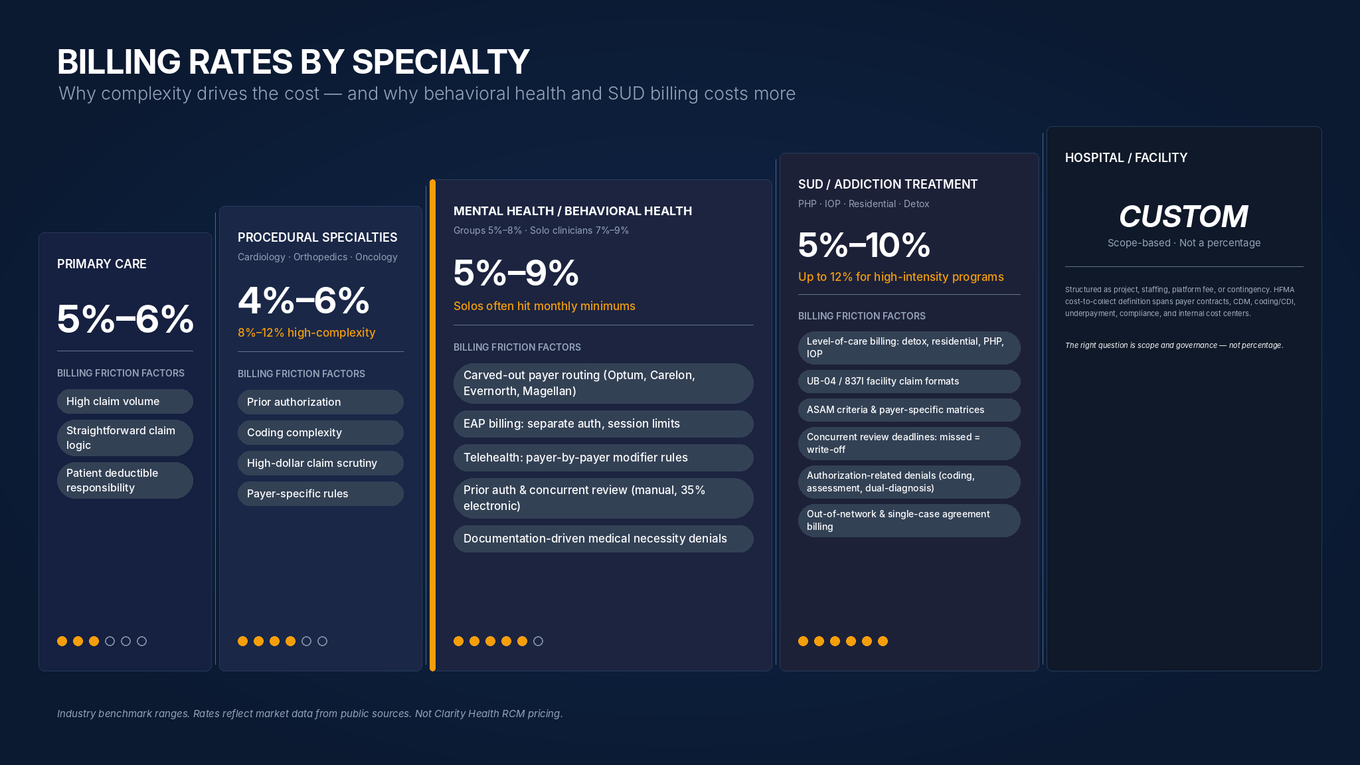
Not all medical billing is equally complex. The fee a practice pays for outsourced billing reflects, or should reflect, the actual complexity of the work required to collect cleanly for that specialty. Here is how pricing typically breaks out by practice type.
Primary Care and Procedural Specialty Billing Rates: What to Expect
Primary care and family medicine practices typically fall in the 5% - 6% range in public benchmark sources (GetPracticeHelp). High claim volume and moderate complexity allow vendors to price efficiently. The main billing risk in primary care is high patient responsibility under modern deductible structures, which increases statement and collection work, but the underlying claim is usually straightforward.
High-dollar procedural specialties (cardiology, orthopedics, oncology) sometimes negotiate lower percentage rates, 4% - 6% is common, because the average claim value is high enough that a lower percentage still produces adequate vendor revenue. But these specialties can have their own coding complexity, prior authorization requirements, and denial patterns that push pricing upward. Neolytix lists cardiology, orthopedic surgery, and oncology at 8% - 12%, with high-complexity work sometimes reaching the 10% - 12% end of that range (Neolytix).
Mental Health and Behavioral Health Billing Rates: Why They Run 5% - 9%
Outpatient mental health and behavioral health billing is typically priced at 5% - 8% for small-to-midsize groups, with solo clinicians often seeing 7% - 9% or hitting monthly minimums (PIMSY; EliteMedFinancials).
Why does outpatient therapy billing often cost more than primary care billing, even though many sessions use a small set of CPT codes (90832, 90834, 90837, 90791)?
Because the claim is rarely the hard part. The hard part is:
- Payer carve-outs: the patient's medical plan is often not the payer for behavioral benefits. Behavioral health benefits are frequently carved out to separate managed behavioral health organizations - Optum/UBH, Carelon, Evernorth, Magellan. A front desk that verifies the medical plan misses the behavioral plan entirely. The claim goes to the wrong payer. It denies. The practice assumes it's a coding error.
- EAP billing: Employee Assistance Programs have separate authorization numbers, session limits, and sometimes paper-only billing workflows. EAP claims that are submitted through the wrong channel or after the session limit can be irrecoverable.
- Telehealth rules: Medicare has made behavioral telehealth permanent for patients in their home with no geographic restrictions, and audio-only behavioral telehealth can be covered permanently when conditions are met, with certain in-person requirements suspended through December 31, 2027 (telehealth.hhs.gov). But commercial payers maintain their own telehealth rules - different place-of-service codes, different modifier requirements, different audio-only coverage policies. A billing team needs to maintain a payer-by-payer telehealth grid, not a single rule.
- Prior authorization and session management: behavioral health prior authorization is often manual. Across all medical specialties, only 35% of prior authorizations were conducted fully electronically through the X12 278 standard in the 2024 CAQH Index (CAQH). For behavioral health, where session-by-session authorization or concurrent review is common, the burden falls on the billing team to ensure sessions don't outrun the approved authorization window.
- Documentation-driven denials: commercial payers increasingly require medical necessity documentation to support mental health visits. A denial based on lack of medical necessity documentation is not a coding error. It's a documentation feedback problem, and it requires the billing team to communicate with clinical staff and flag patterns before they become recurring write-offs.
Meridian Billing's publicly listed behavioral health tiers illustrate this: its pricing runs from 5.5% for solo practices to 4.0% for enterprise practices, with monthly minimums from $199 to $999, and its tiers explicitly reference behavioral-health-specific scope items such as EAP billing, telehealth modifier compliance, monthly A/R reporting, denial management, and prior-auth tracking, while full prior-authorization submission and management is listed as an add-on (Meridian Billing Services).
Behavioral health and addiction medicine are areas Clarity Health RCM supports directly, and they are specialties where revenue is often at risk before the claim is ever submitted. Payer carve-out errors, missed authorization windows, and documentation gaps cost practices more than claim-submission errors. A billing team that doesn't understand this isn't equipped to protect behavioral health revenue, regardless of what percentage they quote.
Addiction Treatment and SUD Billing Rates: PHP, IOP, and Residential
Substance use disorder billing occupies its own tier of complexity, closer to facility billing than outpatient professional billing, and pricing reflects that. Public sources place the range at 5% - 10% for established facilities, with fees sometimes reaching 12% for smaller programs or those with high-intensity needs including complex residential detox, concurrent review, and UB-04/facility claim management (Aspen Ridge Medical).
The billing friction here is structural:
- Level-of-care billing: detox, residential, PHP, IOP, and outpatient have different billing patterns, different claim forms (UB-04/837I for residential and facility levels), and different authorization windows. A missed concurrent review deadline, where the payer doesn't receive documentation that a patient still meets medical necessity criteria, can turn an entire week of delivered care into a write-off.
- ASAM criteria and payer matrices: SUD payers base authorization and coverage decisions on clinical criteria (ASAM, LOCUS, InterQual, MCG). Different payers use different criteria systems. A billing team handling SUD claims needs a payer matrix, not a code book.
- Authorization-related denials: Cipher Billing's SUD billing guide notes that common SUD denial drivers include wrong coding, weak assessment notes, and dual-diagnosis bundling errors - categories that require feedback loops between billing, clinical documentation, and utilization review, not just claim resubmission (cipherbilling.com).
- Out-of-network billing: many SUD residential and dual-diagnosis programs have limited in-network contracts. Out-of-network and single-case agreement billing, negotiating per-case reimbursement from plans that don't have a contracted rate, is a specific skill set that generalist billing companies often lack.
For a practice in addiction treatment or higher-level behavioral health care, asking a vendor to demonstrate experience with UB-04 facility billing, concurrent review workflows, and OON/SCA negotiations is not a bonus question. It's a qualifying requirement.
Hospital and Facility Billing Costs: Why Pricing Works Differently
First, a distinction that matters: hospital facility billing and hospital physician billing are not the same work. Facility billing covers the institution's own claim for the stay or encounter (UB-04 / 837I), driven by the chargemaster, DRG or APC assignment, and clinical documentation. Physician (professional) billing covers the clinicians who treated the patient (CMS-1500 / 837P). A single hospital encounter routinely produces both, and they price, code, and deny differently. A vendor that says it "does hospital billing" should be able to tell you which one it means.
Hospital and facility billing pricing is typically custom, structured as a project, staffing arrangement, platform fee, or contingency, not a simple percentage of professional collections. HFMA's cost-to-collect definition for hospitals includes facility claims, payer contracts, underpayment detection, legal and compliance costs, and large internal cost centers that cannot be reduced to a single percentage (HFMA).
For hospital RCM, the right conversation is about scope (which components of the revenue cycle are being outsourced), metrics (DNFB, days in A/R, denial rate by DRG or APC, net collection rate), and governance (how reporting, escalation, and payer contract strategy are managed). A simple "what percentage do you charge" question does not produce a meaningful answer in this context. What does produce a meaningful answer is understanding the six things that actually push any practice's billing cost up or down.
What Drives Your Medical Billing Cost: Six Factors That Set Your Rate
The ranges above represent the market, not your specific price. What you actually pay will be shaped by these six factors.
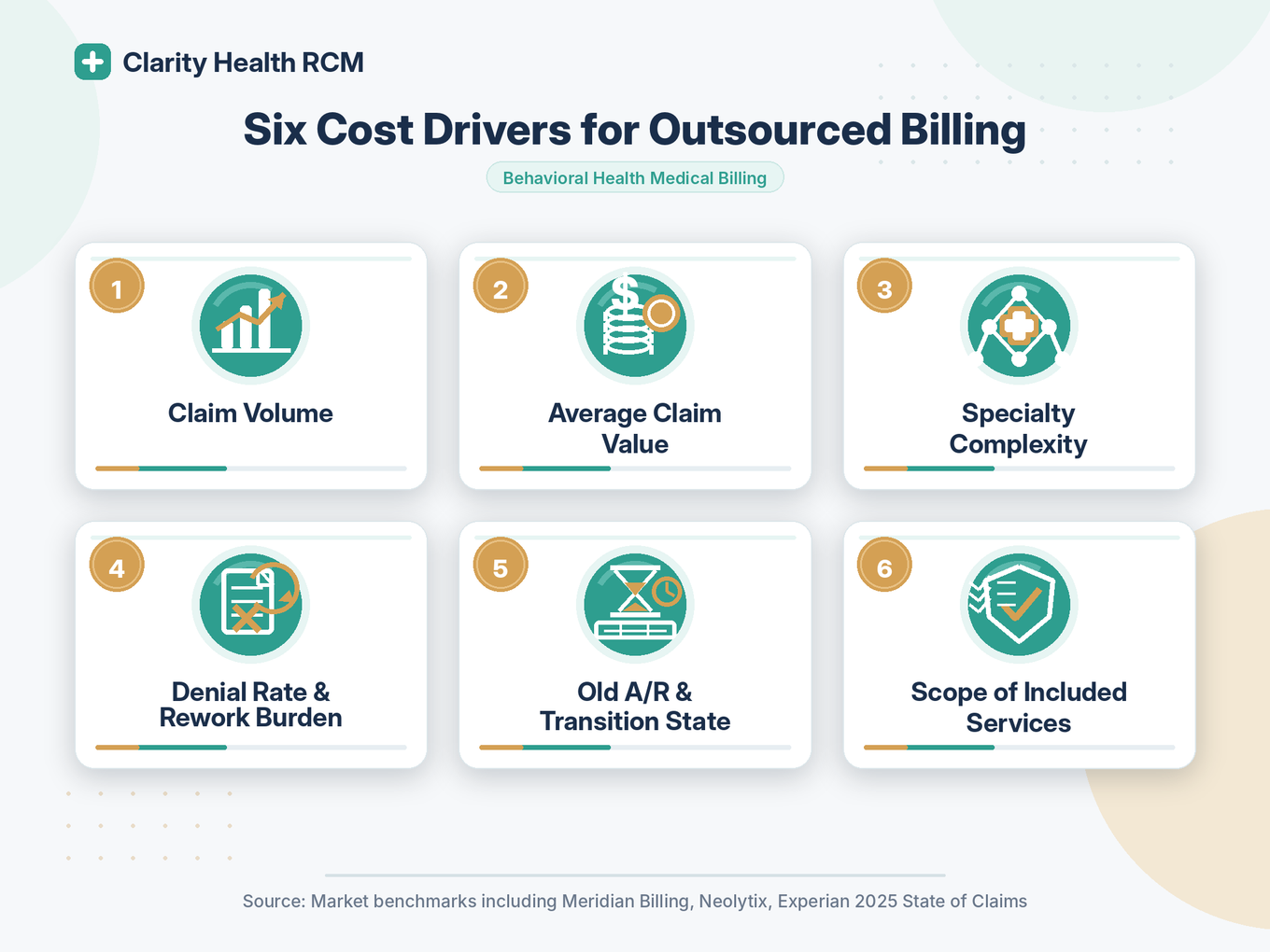
1. Claim volume. Higher claim volume generally pushes percentage rates lower because vendors spread fixed account-management and staffing costs across more claims. Low-volume practices often face higher effective rates or hit monthly minimums. Meridian Billing's public tier structure illustrates this: pricing steps from 5.5% at 75 or fewer claims per month down to 4.0% at 800+ claims per month (Meridian Billing Services).
2. Average claim value. A 6% fee on a $400 average reimbursement generates $24 per claim in vendor revenue. A 6% fee on a $100 average generates $6 per claim. The work required to submit, post, correct, and follow up on that claim is largely fixed, so higher-dollar specialties often negotiate lower percentage rates, while lower-dollar, high-touch claims (common in behavioral health) may justify higher rates.
3. Specialty complexity. Complex specialties cost more when they require coding expertise, authorization management, documentation review, appeal work, payer-specific billing rules, or facility claim formats. Neolytix lists cardiology, orthopedic surgery, and oncology at 8% - 12%, with high-complexity work sometimes reaching the 10% - 12% end of that range (Neolytix). Behavioral health is complex in a different direction: lower average claim values, high patient responsibility, carved-out payer routing, EAP workflows, and authority-concurrent review requirements.
4. Denial rate and rework burden. Denials are expensive because they require human intervention and expertise. Experian's 2025 State of Claims report found that 41% of providers are experiencing denial rates of 10% or higher, 54% say claim errors are increasing year over year, 68% say submitting clean claims is more challenging than the prior year, and 90% of denials still require at least some manual human review (Experian). A vendor inheriting a high-denial practice may charge more, add a cleanup fee, or carve out old denials as a separate project.
5. Old A/R and transition state. A practice changing billing vendors typically has outstanding claims, unposted payments, unresolved denials, missing ERA/EOB files, payer portal gaps, credentialing issues, and stale patient balances. Old-A/R cleanup is almost always priced separately from go-forward billing, commonly at 6% - 9% of recovered amounts on contingency (Simplify Medical Billing). Some vendors publicly claim aged-A/R recovery rates in the 15% - 25% range, but treat that as a vendor-reported outcome, not a guaranteed benchmark - the recoverable amount depends on claim age, payer timely-filing rules, documentation quality, denial type, and whether balances can still be shifted to patient responsibility. The practice should understand before signing which work is covered by the standard billing fee and which constitutes a separate recovery project.
6. Scope of included services. The single largest driver of price variation across comparable practices is not specialty or volume. It's what the billing fee actually covers. A fee that includes credentialing, eligibility verification, prior authorization, patient statements, denial management, reporting, and account management is not comparable to a fee that covers claim submission and payment posting. The next section addresses this in detail through the lens of all-in cost calculation.
Medical Billing Cost Examples: Real Dollar Figures by Practice Size
Abstract percentages can be misleading. Here are worked examples at real collections volumes to make the math tangible.
Billing Costs for a Solo Therapist at $8,000/Month in Collections
A solo mental health therapist collecting $8,000 per month might receive these quotes:
| Pricing model | Monthly cost | Effective rate |
|---|---|---|
| 7% of net collections | $560 | 7.0% |
| 8% of net collections | $640 | 8.0% |
| 5.5% with $199 minimum | $440 | 5.5% |
| $3.99/claim with $199.95 minimum | $299 | 3.74% |
The per-claim option looks cheapest on paper, but the scope still matters. MBPros' $3.99 Platinum tier includes follow-up, insurance verification for new or changed-insurance patients, and authorization/benefit tracking, while its cheaper $2.45 claim-submission tier is much narrower. A solo therapist who pays $299 per month for the bare-bones option and spends 2-3 hours per week chasing denials and verifying EAP authorizations is not spending $299 per month on billing; she's spending $299 plus her own time, which at an opportunity cost of $150/hour adds up quickly. Read the scope before assuming a low per-claim price covers the work your practice actually needs (Medical Billing Professionals).
The right question isn't which model has the lowest number. It's which model covers the work that actually needs to get done.
Small Mental Health Group Practice: Billing Costs at $75,000/Month
| Pricing model | Monthly cost | Annual cost |
|---|---|---|
| 5% of net collections | $3,750 | $45,000 |
| 6.5% of net collections | $4,875 | $58,500 |
| 8% of net collections | $6,000 | $72,000 |
| $7 per claim (450 claims) | $3,150 | $37,800 |
| $2,500 flat monthly | $2,500 | $30,000 |
| $1,000/month + 4% hybrid | $4,000 | $48,000 |
The flat and per-claim options show the lowest numbers. But for a six-clinician behavioral health group with Medicaid MCO patients, EAP clients, and moderate telehealth volume, a vendor that does not handle denial management, eligibility verification, patient statements, and A/R follow-up is not doing the job. The "savings" on the lower-priced models would likely show up as increased denial write-offs and uncollected patient balances within six months.
Mid-Size Behavioral Health Group: Billing Costs at $150,000/Month
PIMSY gives a similar example, a 10-therapist group collecting $150,000 per month, to illustrate how the percentage matters (PIMSY):
| Rate | Monthly fee | Annual fee |
|---|---|---|
| 5% | $7,500 | $90,000 |
| 6% | $9,000 | $108,000 |
| 8% | $12,000 | $144,000 |
The $12,000/month option is not automatically too expensive. If the vendor at 8% handles prior authorizations, works EAP billing, manages concurrent review for any PHP/IOP clients, works all denials, provides monthly reporting with denial trend analysis, and actively identifies documentation patterns driving write-offs - then $12,000 per month may represent better value than the vendor at $7,500 that submits claims and sends a spreadsheet.
The $12,000 option is too expensive if the vendor merely submits claims and posts payments.
Gross Charges vs Net Collections: How the Wrong Denominator Costs $48,000/Year
This example belongs in every billing contract negotiation.
A practice bills $200,000 in gross charges and collects $100,000 in actual cash.
| Vendor | Fee | Effective cost |
|---|---|---|
| Vendor A: 6% of net collections | $6,000 | 6% of actual cash |
| Vendor B: 5% of gross charges | $10,000 | 10% of actual cash |
Vendor B's "5%" costs $4,000 more per month and $48,000 more per year than Vendor A's "6%." This trap is not a hypothetical. It appears in real proposals, particularly in lower-priced offers that look attractive until the denominator is examined (Neolytix).
Why the Higher-Priced Billing Vendor Can Net You More Revenue
This example is the most important one for practices that evaluate billing vendors primarily on price.
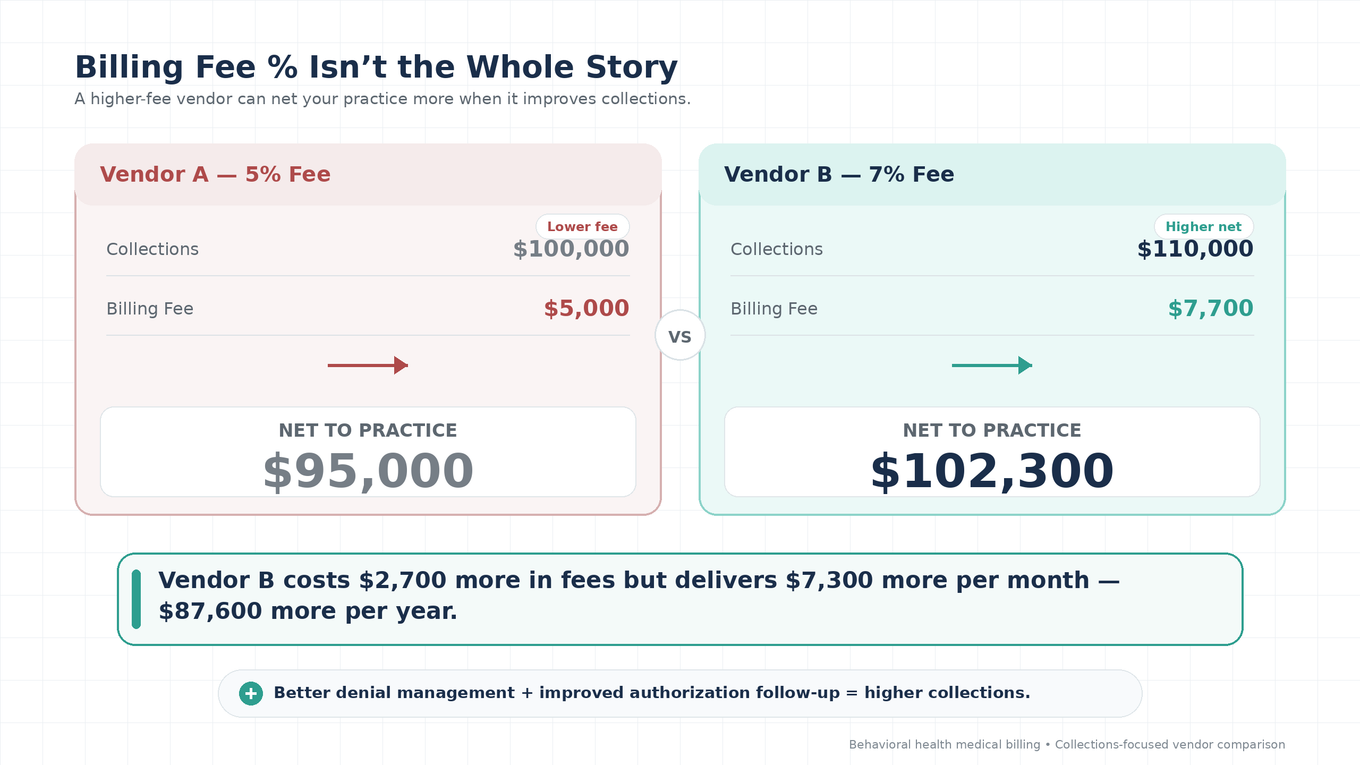
A practice currently uses Vendor A, collecting $100,000 per month at a 5% billing fee:
- Collections: $100,000
- Billing fee: $5,000
- Net after billing: $95,000
Vendor B charges 7%, but through better denial management, lower write-offs, and improved authorization follow-up, improves collections to $110,000 per month:
- Collections: $110,000
- Billing fee: $7,700
- Net after billing: $102,300
Vendor B costs $2,700 per month more in billing fees. The practice takes home $7,300 more per month. The "expensive" vendor is the better financial decision, by $87,600 per year.
This is the correct framework for evaluating billing cost: not "what percentage do they charge" but "what will I net after the billing fee, at what collections level will this vendor actually produce."
Cost to Collect: How to Calculate Your All-In Medical Billing Expenses
The right benchmark for evaluating billing cost is not the headline percentage. It is the cost to collect, a standard metric defined by the Healthcare Financial Management Association as total revenue cycle cost divided by total patient-service cash collected (HFMA).
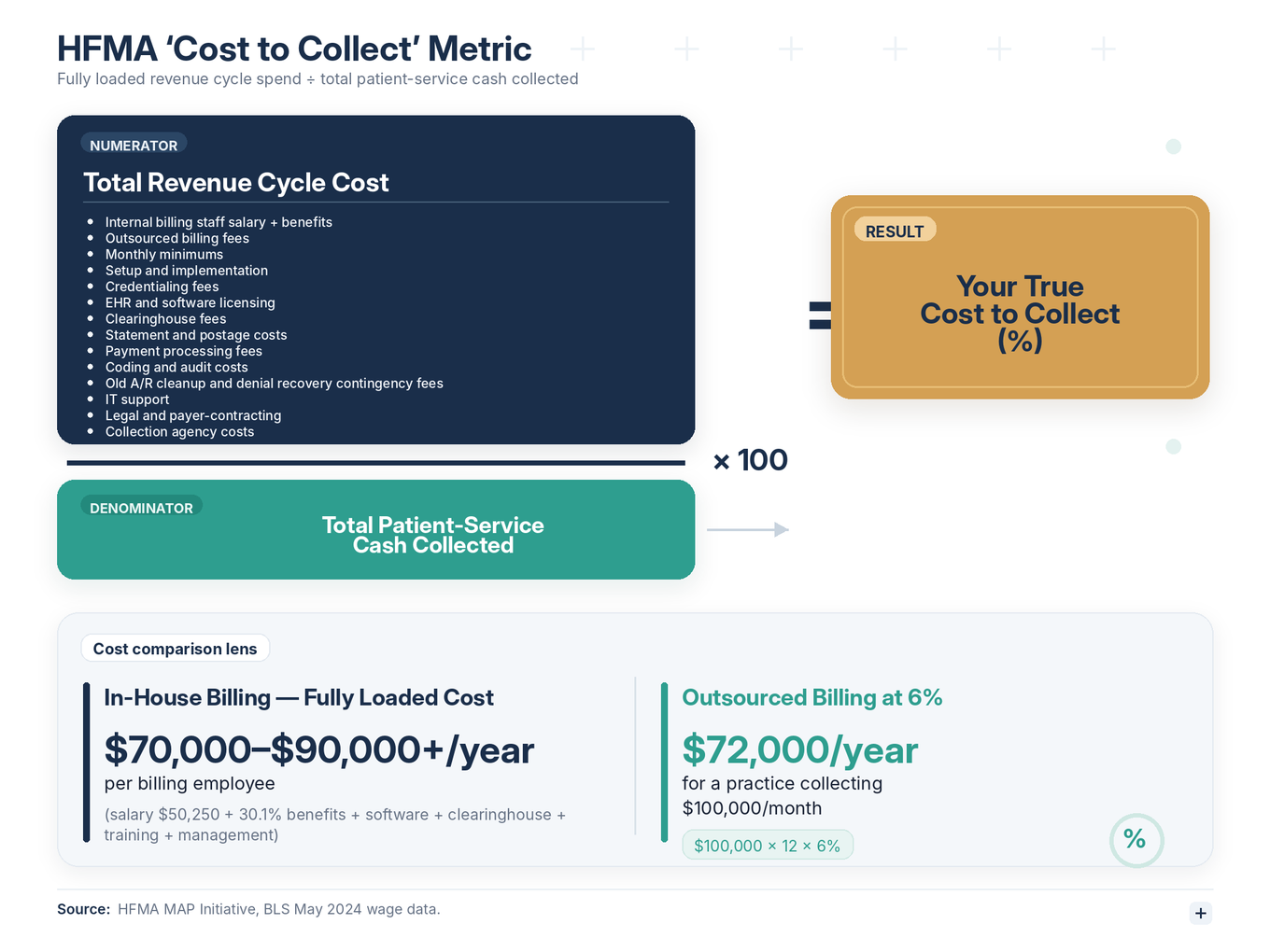
HFMA's definition of "total revenue cycle cost" is broad for a reason. It includes:
- Internal billing staff salary, benefits, and management
- Outsourced billing vendor fees
- Monthly minimums
- Setup and implementation costs
- Credentialing fees
- Software and EHR licensing
- Clearinghouse fees
- Statement and postage costs
- Payment processing fees
- Coding and audit costs
- Old-A/R cleanup and denial recovery contingency fees
- IT support
- Legal and payer-contracting support
- Collection agency costs
This total, divided by actual patient-service cash collected, produces a number that allows fair comparison between in-house billing, outsourced billing at different price points, and hybrid arrangements.
In-House Billing vs Outsourcing: What the All-In Cost Comparison Shows
Outsourcing is not automatically cheaper than maintaining an in-house billing function, and an article that claims otherwise is selling you something.
The Bureau of Labor Statistics reports the May 2024 median wage for medical records and health information specialists at $50,250 per year (BLS). That is the salary line. Private-industry employer benefit costs averaged 30.1% of total employer compensation in March 2026 (BLS), which adds roughly $15,000 - $21,000 per year in benefits alone. Add software, clearinghouse, statement vendor, coding resources, training, management time, and coverage during turnover, and a single fully loaded in-house billing employee can easily represent $70,000 - $90,000+ per year in total cost before accounting for missed revenue from a role that is not expert in your specialty's denial patterns.
For a behavioral health group collecting $100,000 per month, a 6% outsourced billing fee equals $72,000 per year, roughly comparable to one fully loaded employee. But the vendor, when properly qualified, is providing the expertise of a billing team rather than a single generalist employee, and the cost does not spike during turnover, training gaps, or vacancy periods.
For larger practices collecting $300,000 per month, the same 6% equals $216,000 per year, a number that warrants a more detailed comparison against a small internal team plus software and performance accountability.
A 2018 JAMA study at a large academic health care system found that billing and insurance-related costs ranged from about $20 for a primary-care visit to $215 for an inpatient surgical procedure, representing roughly 3% - 25% of professional revenue depending on care setting and service type (JAMA). That wide range reflects exactly what we see in practice: the actual cost of billing is a function of what the service requires, not just what a vendor quotes.
How to Compare Medical Billing Vendors: Scope, Scenarios, and Revenue Impact
Comparing billing vendors on headline percentage rate produces the same misleading results as comparing car insurance on monthly premium without reading the coverage terms. The right comparison looks like this.
How to Compare Medical Billing Scope Before You Compare Rates
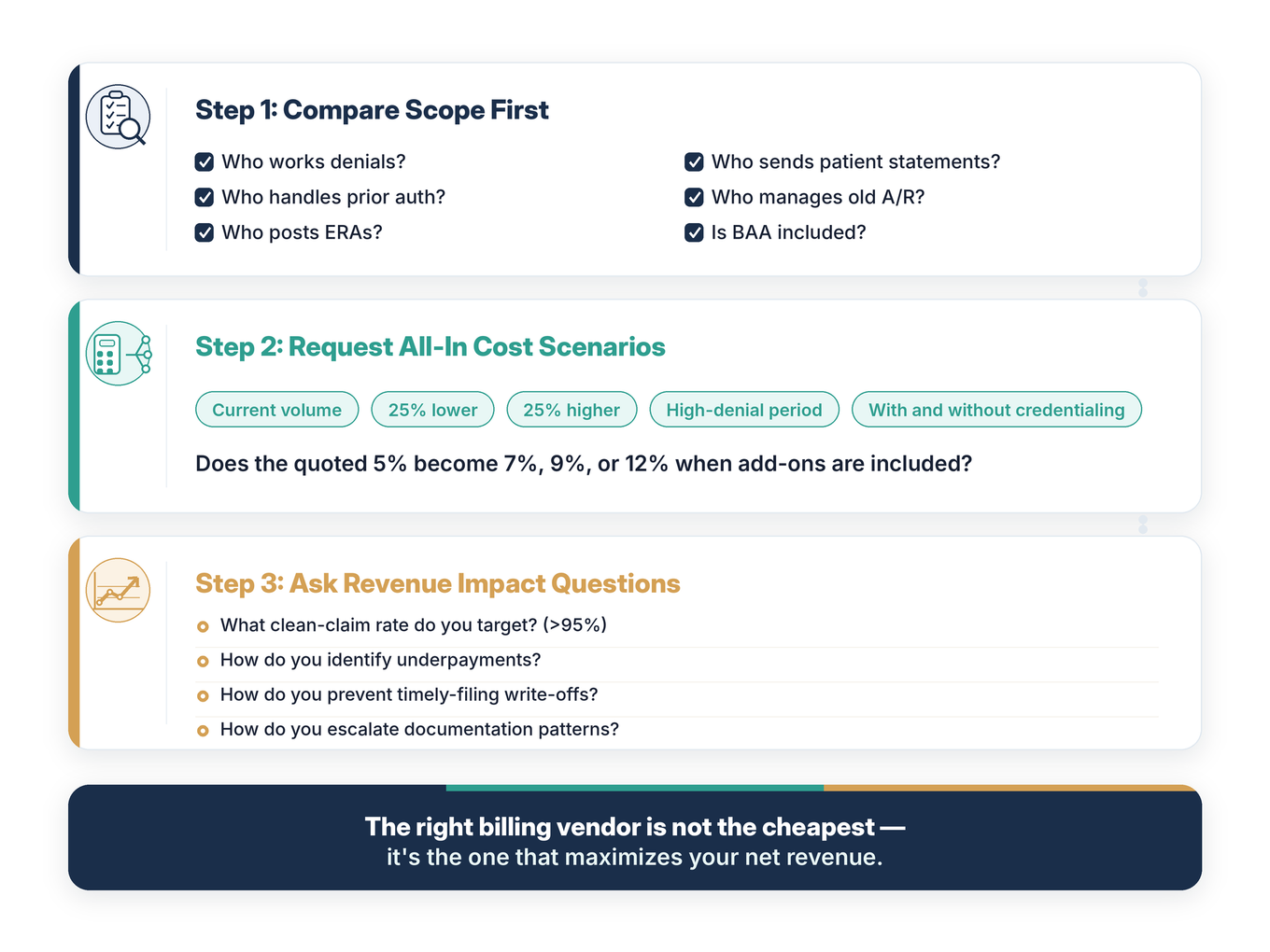
Before comparing prices, confirm what is and is not included in each vendor's fee. The questions that matter:
- Who enters charges?
- Who submits claims?
- Who corrects rejections?
- Who works denials, including authorization-related denials, timely-filing denials, and coordination-of-benefits denials?
- Who posts ERAs and paper EOBs?
- Who handles refunds and recoupments?
- Who sends patient statements?
- Who handles old A/R from before the start date?
- Who manages credentialing?
- Who monitors payer policy changes?
- Is the BAA included before PHI access?
Two vendors that both say "yes" to all of these can still have very different performance levels. But a vendor that says "no" to denial management, prior authorization, or old-A/R coverage is structurally less capable, not cheaper.
Ask Every Vendor for All-In Cost Scenarios at Multiple Collection Volumes
Request that each vendor calculate all-in monthly cost at:
- Your current collections volume
- 25% lower volume
- 25% higher volume
- A high-denial cleanup period
- With and without credentialing
- With patient statements included
- With clearinghouse and software pass-throughs included
This reveals whether the quoted 5% becomes 7%, 9%, or 12% once the real scope and add-ons are included (Neolytix).
Revenue Impact Questions to Ask Before Choosing a Medical Billing Company
The best billing vendor for your practice is not necessarily the cheapest. Ask each vendor:
- What clean-claim rate do you target for practices in our specialty? Business.com recommends looking for first-pass claim rates above 95% when evaluating billing services (business.com)
- What initial denial rate do you expect for our payer mix?
- How do you identify underpayments, claims paid below the contracted rate?
- How do you prevent timely-filing write-offs?
- How do you escalate documentation patterns to clinical staff when they're causing preventable denials?
HFMA's MAP Keys provide the standard industry definitions for the metrics that matter most: cost to collect, clean claim rate, remittance denial rate, net days in A/R, and A/R percentage over 90 days (HFMA).
10 Red Flags in a Medical Billing Vendor Proposal
These are signals in a vendor's proposal, proposal meeting, or contract that warrant serious questions before proceeding:
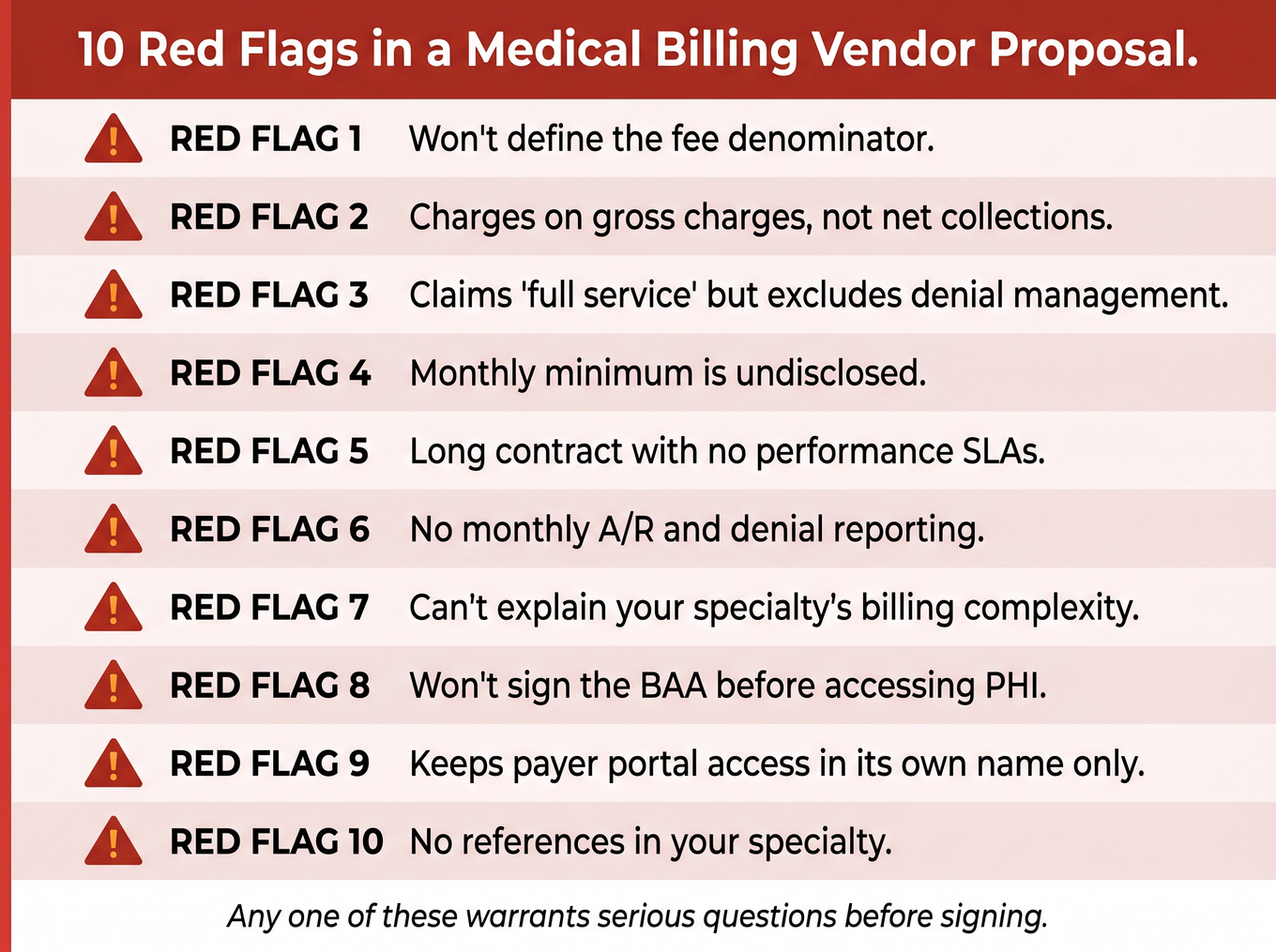
- Quotes a percentage but won't define the denominator. If a vendor cannot or will not state in writing whether the fee is based on net collected cash, gross charges, allowed amounts, or total practice receipts, the conversation should stop there.
- Charges on gross charges. As shown in the worked examples above, gross-charge pricing can cost significantly more than a nominally higher percentage on net collections. Gross-charge billing is not inherently fraudulent, but it is inherently buyer-unfavorable and requires very close scrutiny.
- Claims "full service" but excludes denial management. This is the most common version of "full service" that is not actually full service. Denial management, not just claim submission, is where billing expertise creates revenue. A vendor that submits claims and posts payments but leaves denials to the practice is providing claim-processing services, not revenue cycle management.
- Monthly minimum that inflates the quoted rate, undisclosed. A quoted percentage of 5.5% with a $999 monthly minimum represents a very different effective rate for a practice collecting $12,000 per month than one collecting $120,000. The minimum must be disclosed and modeled before signing.
- Long contract term with no performance SLAs. A vendor confident in its performance should accept accountability tied to the term. A two-year contract with no clean-claim rate, denial rate, or A/R benchmarks gives the vendor no incentive to perform and the practice no recourse.
- No monthly A/R and denial reporting. A billing company that cannot or will not provide monthly denial trend analysis, A/R aging, and days-in-A/R reporting is either not tracking these numbers or choosing not to share them. Neither is acceptable.
- Cannot explain your specialty's billing complexity. For a behavioral health practice: ask the vendor to explain how it handles payer carve-outs, EAP billing, and concurrent review for PHP/IOP levels of care. For SUD: ask about ASAM-based authorization and UB-04 facility claims. For a hospital: ask about DRG payment variance and CDM integrity. A vendor that cannot answer these questions without hesitation is not qualified for your specialty.
- Does not sign the BAA before accessing PHI. A medical billing company is a HIPAA business associate. HHS requires that covered entities maintain business associate contracts or arrangements before PHI is shared, and that the contract require the business associate to safeguard that PHI (HHS.gov). Any vendor that balks at the BAA before accessing your patient data is a compliance risk.
- Keeps payer portal credentials or clearinghouse access in its own name only. Your payer portal access, your clearinghouse account, and your ERA/EOB history are your data. A vendor that maintains exclusive access makes it difficult and sometimes impossible to transition if the relationship ends.
- No references in your specialty. A vendor can be excellent at primary care billing and ineffective at behavioral health billing. References from practices in the same specialty, similar payer mix, and similar volume tier are a legitimate qualifying requirement.
Key Medical Billing Contract Terms Every Practice Should Negotiate
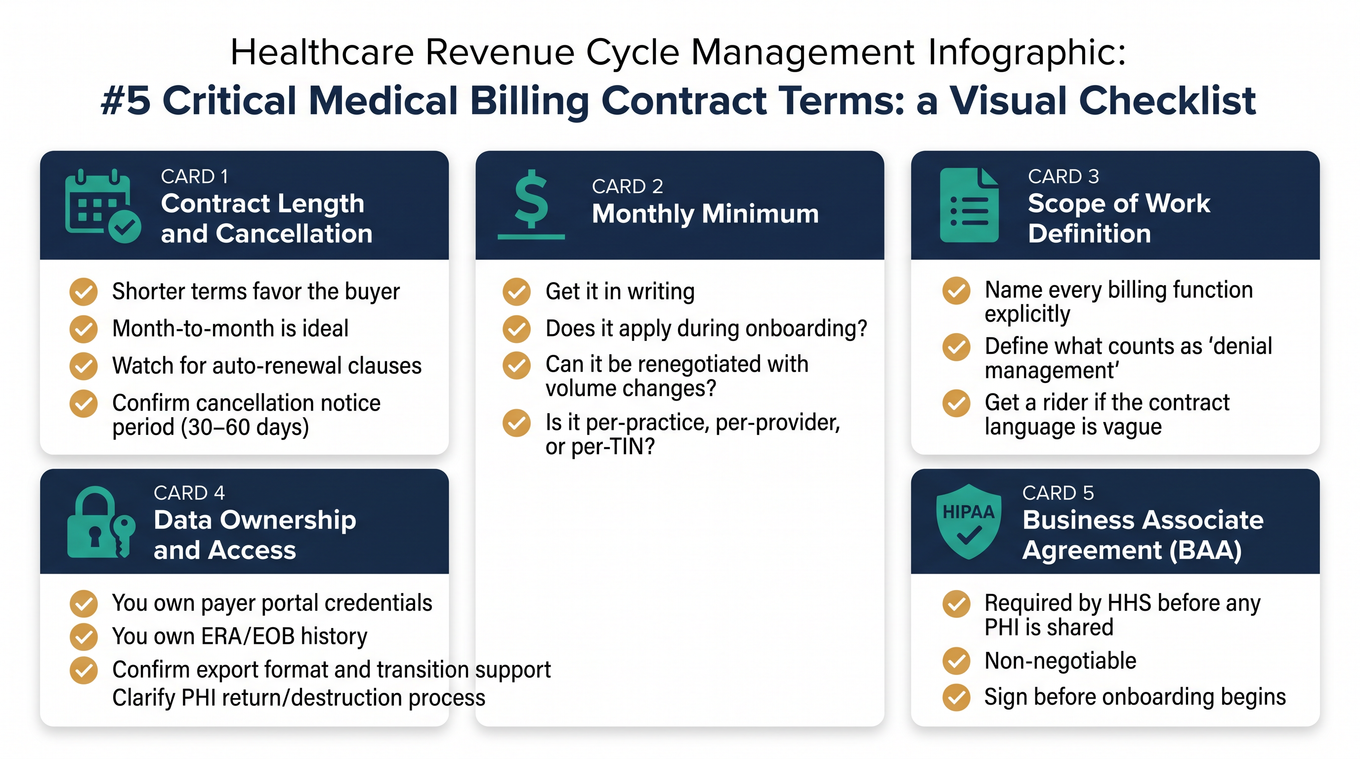
Contract Length, Cancellation Rights, and Auto-Renewal Clauses
Shorter contract terms are buyer-friendly. Meridian Billing publicly advertises month-to-month billing with a 30-day cancellation for behavioral-health practices (Meridian Billing Services). Business.com's vendor comparisons show other companies requiring one-, two-, or three-year minimum terms (business.com). ZenithMedCare lists a six-month minimum with 30-day written cancellation notice (ZenithMedCare).
A long contract term is not automatically problematic. It may be reasonable when a vendor is investing in onboarding, EHR integration, or clearing a messy transition. But a long term without performance obligations and without clear termination-for-cause language puts the practice in a difficult position if the vendor's performance is poor.
Tebra's terms also include auto-renewal provisions and customer responsibility for fees through the subscription term (Tebra). Any contract with auto-renewal should have a clear calendar reminder for the notice period, Tebra's billing service arrangements have required 60 days' notice for non-renewal (business.com).
Monthly Minimums: What Your Billing Contract Should Specify
The minimum should be in writing, with answers to: Does it apply during onboarding? Does it apply if the vendor is responsible for delays? Can it be renegotiated when volume changes significantly? Is it per practice, per provider, per location, or per TIN?
How to Define the Scope of Work in a Medical Billing Contract
The contract should name explicitly who is responsible for every major billing function: charge entry, claim submission, rejection correction, denial management, prior authorization, eligibility verification, payment posting, patient statements, old-A/R management, credentialing, payer portal monitoring, reporting, and refund/recoupment handling. If the contract says "denial management" without further definition, get a rider or addendum that defines what categories of denials are covered and what the expected turnaround is.
Data Ownership and Access Rights in Your Medical Billing Contract
You own your patient billing data, your claim history, your ERA/EOB files, and your payer portal access. Before signing, confirm:
- Who owns the payer portal credentials?
- Who owns the clearinghouse account?
- What does data export include, and in what format?
- How long after termination does the vendor provide transition support?
- What are the fees, if any, for claims submitted before termination but paid after?
- How is PHI returned or destroyed?
The Business Associate Agreement: Required Before Any PHI Is Shared
The BAA is not optional. Sign it before any PHI is shared. The HHS requires covered entities to have written business associate contracts or arrangements with all business associates that access, create, receive, maintain, or transmit PHI on their behalf (HHS.gov).
10 Questions to Ask Before Signing With a Medical Billing Company
These ten questions, asked and answered in writing, will reveal whether a billing vendor's quote is accurate and competitive:
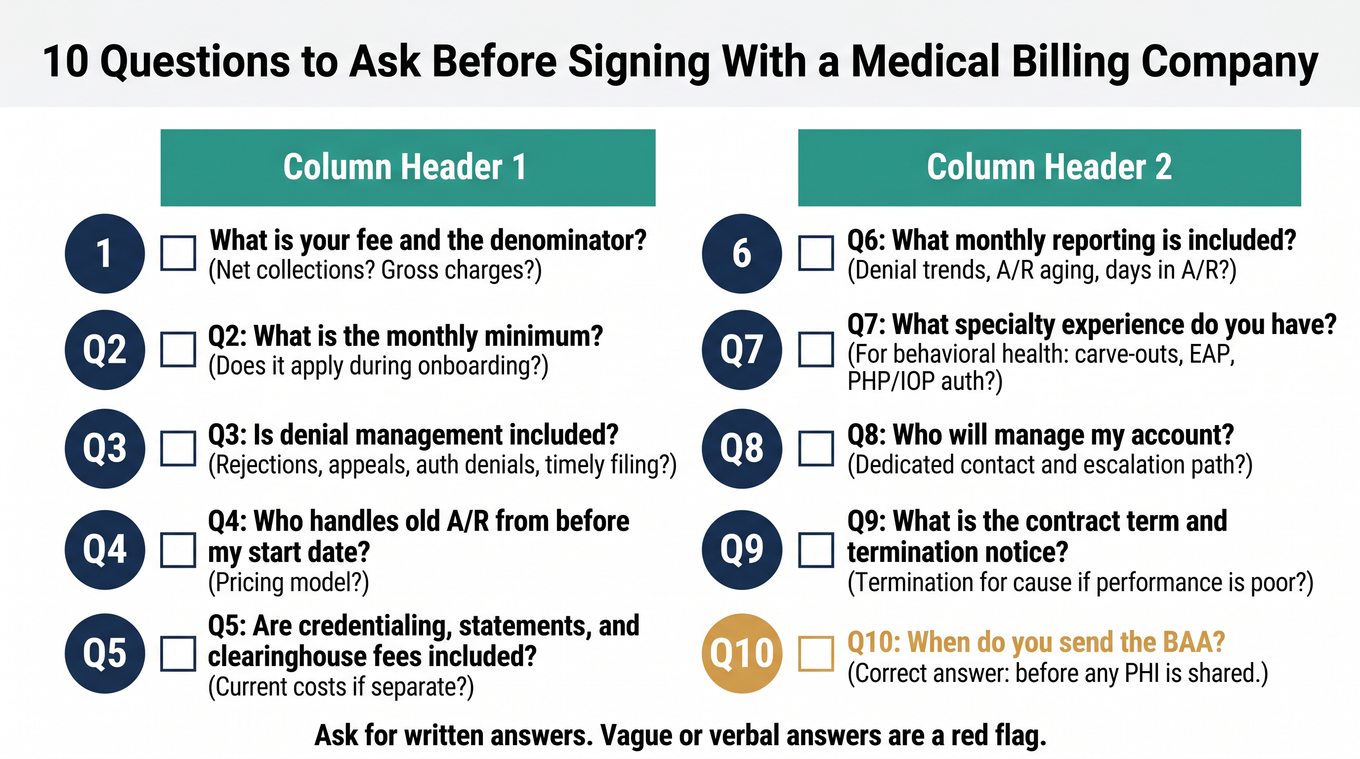
- What exactly is your fee, and what is the denominator? Net cash collected on claims you work, gross charges, allowed amounts, or total practice receipts?
- What is your monthly minimum? At what collection volume does it change the effective rate, and does it apply during onboarding?
- Is denial management included? Ask specifically: rejections, appeals, authorization-related denials, timely-filing denials, and coordination-of-benefits denials.
- Who handles old A/R from before my start date? What is the pricing model for that work?
- Are credentialing, patient statements, clearinghouse fees, and claim attachments included or separately priced? If separately priced, what are the current fees?
- What monthly reporting is included? Can you show a sample report? Does it include denial trend analysis, A/R aging by payer, days in A/R, and action items for the practice?
- What specific experience do you have with my specialty? For behavioral health: how do you handle payer carve-outs, EAP billing, and prior authorization for higher levels of care? For SUD: how do you manage UB-04 facility claims and concurrent review deadlines?
- Who specifically will manage my account? Is there a dedicated account manager, and how do we escalate when something is wrong?
- What is the contract term and the termination notice? What are the terms for termination for cause if performance is poor?
- When do you send the BAA? The correct answer is: before any PHI is shared.
What Fair Medical Billing Services Cost, and What You Should Get for It
The honest answer to "what should medical billing services cost" is this: a fair price is one where you can clearly answer eight questions.
What exactly are you paying? What number is the fee multiplied by? What work is included? What work is extra? What happens when claims deny? What happens to old A/R? What is your all-in cost to collect? And are you collecting more cash, faster, with fewer write-offs than you were before?
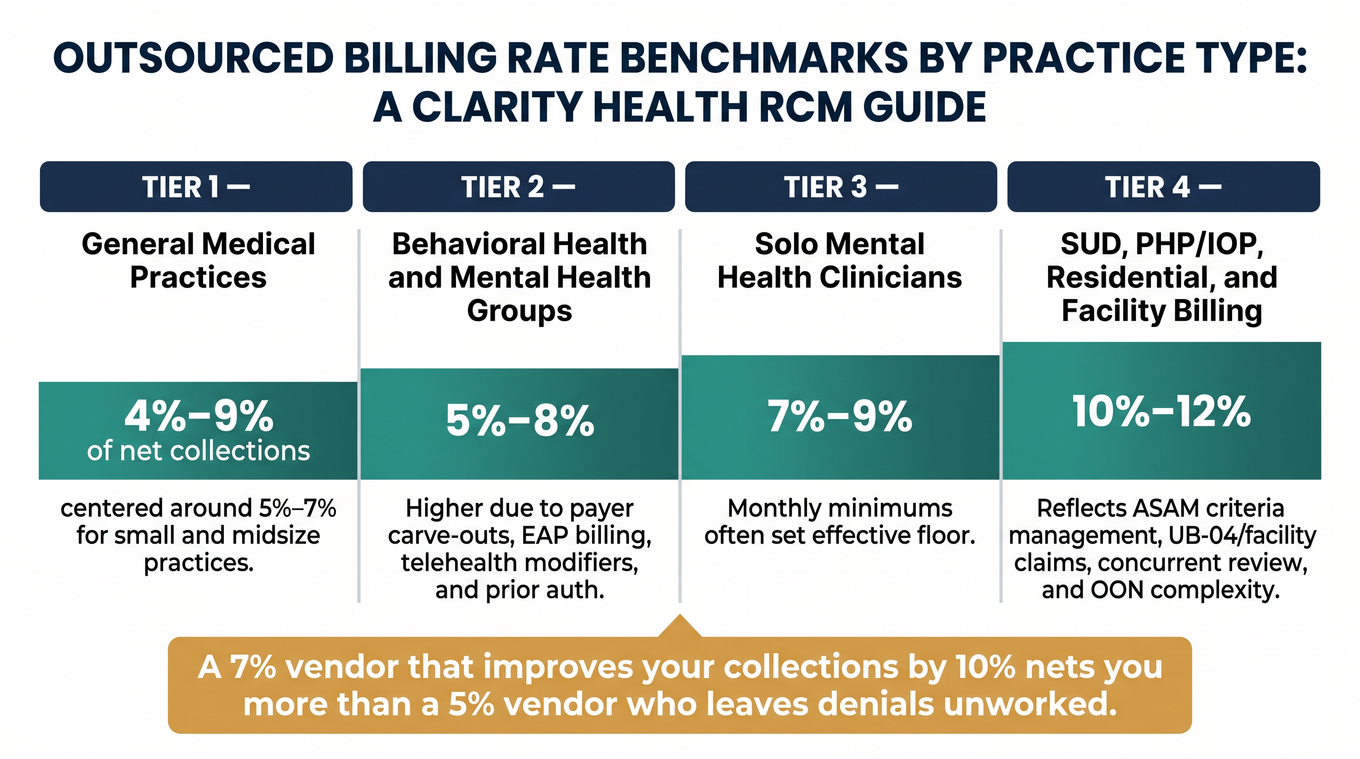
A billing fee in the 4% - 9% range is typical for most practices. Behavioral health, mental health, and addiction treatment billing tends to fall in the 5% - 8% range for outpatient groups, with solos or low-volume practices often near 7% - 9%, and complex SUD or facility billing sometimes reaching 10% - 12%, not because those billers are overcharging, but because the claims are genuinely harder and the revenue risk is higher when they're done wrong.
The practices that get the most from outsourced billing are the ones that evaluate vendors on revenue impact rather than headline rate. A vendor that costs 7% and improves your collections by 10% is not the expensive option. It's the right one.
At Clarity Health RCM, we start every new client relationship with a complimentary review of your current revenue cycle, not a sales pitch. We explain what we find and tailor the workflow and pricing around your systems, specialty, and scope. Behavioral health, mental health, addiction treatment, and hospital billing is the work we do hardest and know best.
If you want to understand what you're currently paying against what full-service billing for your specialty should cost, and whether you're getting the return the fee should produce, contact us for a complimentary revenue cycle consultation. We'll walk through the numbers together.
Frequently Asked Questions About Medical Billing Services Cost
What percentage do medical billing companies typically charge?
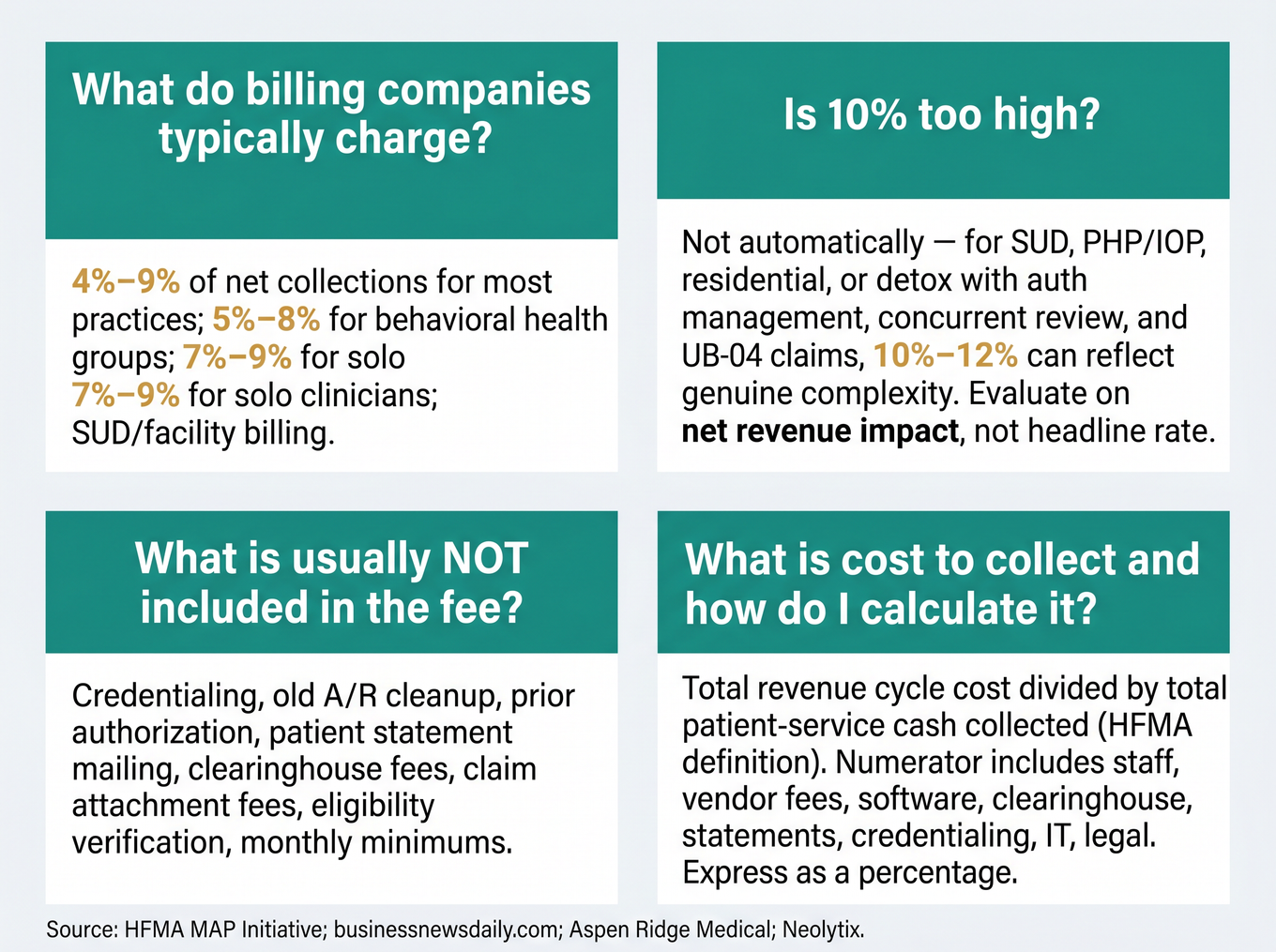
Most outsourced medical billing companies charge between 4% and 9% of net collections, with many small and midsize practices in the 5% - 8% range. Mental health and behavioral health practices often see 5% - 8% for groups and 7% - 9% for solo clinicians. The exact rate depends on claim volume, average claim value, specialty complexity, payer mix, the scope of services included, and whether the vendor handles denials, prior authorizations, and patient statements. (businessnewsdaily.com)
Is 10% too high for medical billing services?
Not automatically. For SUD, addiction treatment, PHP/IOP, residential, or detox billing that includes authorization management, concurrent review, UB-04 facility claim processing, and high-volume denial work, a 10% - 12% fee may reflect the actual complexity of the work (Aspen Ridge Medical). The question is not whether 10% is "too high" in the abstract. It's whether 10% of net collections for the scope being delivered produces better net revenue than a lower-cost alternative that leaves critical work uncovered.
What is typically NOT included in a medical billing fee?
The most commonly excluded items are: credentialing and payer enrollment; old A/R from before the billing relationship started; prior authorization management; patient statement mailing costs; clearinghouse fees and claim attachment fees; paper claim fees; eligibility verification; and monthly minimums (which are usually separate from the headline percentage). Always ask for an all-in cost estimate before comparing vendors (Neolytix).
How does behavioral health billing differ in cost from standard medical billing?
Behavioral health billing tends to run higher than primary care billing because of several specific complexity factors: carved-out payer routing (behavioral benefits often billed to a separate managed behavioral health organization, not the medical plan), EAP authorization and session-limit management, telehealth modifier compliance across payer-specific rules, prior authorization and concurrent review, and documentation-driven denial patterns that require clinical feedback loops. These factors make behavioral health billing genuinely more labor-intensive per claim (PIMSY; EliteMedFinancials).
What is cost to collect, and how do I calculate it?
Cost to collect is total revenue cycle cost divided by total patient-service cash collected. HFMA defines the numerator to include internal labor (salary, benefits, management), outsourced billing fees, software, clearinghouse, statements, payment processing, credentialing, coding, IT support, and any contingency or legal fees (HFMA). To calculate it: add all of those costs for a given period, divide by the cash collected in that same period, and express as a percentage. This number, rather than the headline billing percentage, gives an honest comparison across billing arrangements.
Can I bill in-house for less than outsourcing to a billing company?
Sometimes, but not always. A single fully loaded in-house billing employee (salary, benefits, software, clearinghouse, training, management) can cost $70,000 - $90,000+ per year before accounting for turnover and coverage gaps. For a practice collecting $100,000 per month, a 6% outsourced billing fee equals $72,000 per year, roughly equivalent. For a practice collecting significantly more or with simpler billing, in-house may cost less. For a practice in behavioral health or SUD where specialty expertise and denial management are critical, a qualified outsourced vendor may justify a premium over an in-house generalist. Outsourcing is not automatically cheaper or better; the right decision depends on the vendor's actual performance (BLS; BLS).