Hospital Revenue Cycle Management: A CFO's Control Map
August 22, 2026 · 54 min read
A hospital finance team reports a 97% clean-claim rate in the same week that cash lands below forecast and A/R over 90 days climbs again. Both numbers are accurate. Nobody is lying, and nobody has made an obvious mistake.
Both are true because a clean claim is a statement about paperwork, not money: it passed the edits and went out without a human touching it. It says nothing about whether the patient was in the right status, whether every supported service reached the account, whether the MS-DRG or APC was correct, or whether the payer applied the contract it signed. And nothing at all about the second claim, because that inpatient stay produced two.

That gap is what this guide is about. We run outsourced billing for behavioral health, mental health and inpatient physician groups, so we work inside one layer of the machine described below: the professional claim for admitted patients. The guide covers the whole machine anyway, because you cannot find a leak in a system you have only seen half of. Every rule here is cited to CMS, HFMA or the IRS with its effective date.
This guide covers the U.S. hospital revenue cycle. By the end you should be able to take any revenue leak and answer four questions: which of the two claim streams it belongs to, which handoff produced it, which control should have caught it, and which metric would have shown it.
What hospital revenue cycle management actually means
Hospital revenue cycle management is the system that converts a patient encounter into correctly classified, documented, coded, billed, adjudicated and collected revenue - and then tests whether the amount collected matches the amount contractually and legally due. That last clause is where the money is.
The familiar description - registration, coding, claim, payment - describes a conveyor belt rather than a set of controls, which is not a definition a CFO can use. A finance-grade version asks four questions of every encounter:
- Was the patient and payer relationship established correctly? Right person, right plan, right product, right network status, right authorisation.
- Was the encounter placed in the correct status, and is it represented by defensible documentation and codes? Inpatient or outpatient. Supported or unsupported.
- Was the correct claim produced, transmitted and adjudicated? Both of them, where two exist.
- Was the amount paid actually correct under the payment system and the contract?
A hospital can pass the first three and fail the fourth without anyone noticing for months.
HFMA's MAP framework divides the cycle into patient access, pre-billing, claims, account resolution, financial management and patient experience, and - more usefully - publishes standardised formulas so that two hospitals comparing a metric are comparing the same thing. Half the disagreements in a revenue cycle meeting are definitional rather than operational.
One hospital stay, two different claims
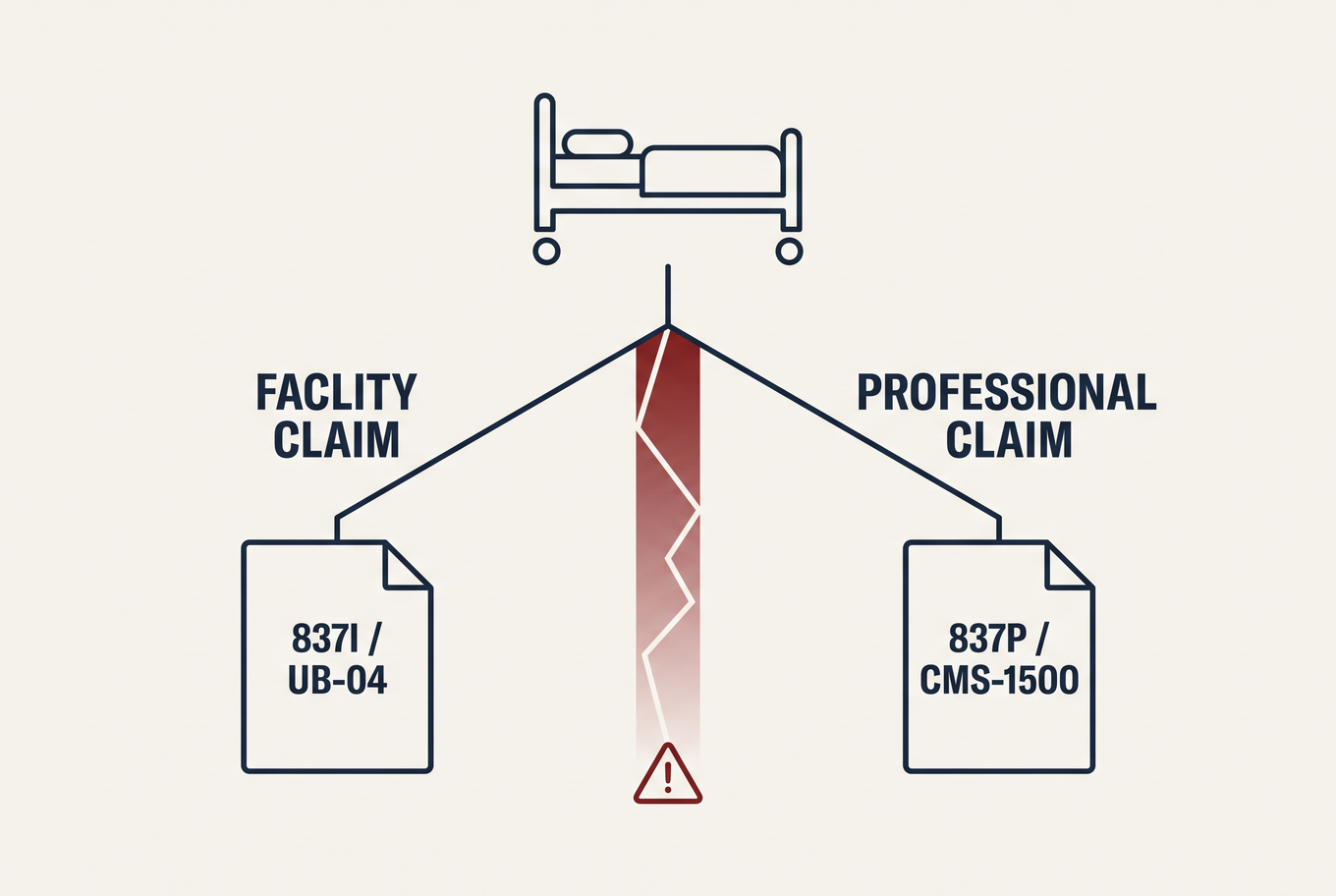
An admitted patient generates an institutional claim from the hospital and, separately, a professional claim from the physician or other billing practitioner who treated them. Same chart, same stay, two entirely different payment logics.
The institutional claim goes out as an 837I - the electronic transaction - with the CMS-1450, universally called the UB-04, as its paper counterpart. The professional claim goes out as an 837P, with the CMS-1500 as its paper form.
| Hospital facility stream | Physician professional stream | |
|---|---|---|
| Electronic claim | 837I | 837P |
| Paper counterpart | CMS-1450 / UB-04 | CMS-1500 |
| What is being paid for | Facility resources: bed, nursing, pharmacy, supplies, imaging, laboratory, operating room | The practitioner's evaluation, management, procedures and interpretation |
| Medicare inpatient logic | Generally a per-discharge IPPS payment driven by MS-DRG, with hospital- and case-specific adjustments | Medicare Physician Fee Schedule, generally per coded service |
| Main inpatient code systems | ICD-10-CM diagnoses, ICD-10-PCS procedures, revenue codes, MS-DRG logic | CPT/HCPCS, ICD-10-CM, modifiers, place of service |
| Status relevance | Determines inpatient Part A/IPPS versus outpatient/observation billing | The E/M family may be shared across settings, but place of service still differs: POS 21 inpatient, POS 22 on-campus outpatient |
| Who owns it | Hospital or health system revenue cycle | Employed medical group, faculty practice plan, hospitalist group or contracted specialty group |
Two consequences follow.
The first is technical. A frequent shortcut says hospitals use ICD-10 and physicians use CPT. The facility inpatient claim uses ICD-10-CM for diagnoses and ICD-10-PCS for inpatient procedures, plus institutional fields and revenue codes, plus HCPCS where applicable. The professional claim uses CPT/HCPCS plus ICD-10-CM plus modifiers and place of service. CPT is not a substitute for ICD-10-PCS on the acute inpatient facility record.
The second is organisational, and it costs more. The two streams usually have two different owners, and a defect that lives in the seam between them can be invisible to both. The hospital assumes the physician group owns the professional denial. The group assumes the hospital owns the status decision that caused it. Neither is wrong about their own scope, and the claim ages anyway.
The control map: fourteen handoffs where hospital revenue leaks
Each stage below is tied to a data object, a failure mode, a control and an owner.
| Stage | What is created or changed | Typical leak | Minimum control | Finance-grade output |
|---|---|---|---|---|
| 1. Scheduling / pre-registration | Encounter shell, patient identity, planned service, order data | Duplicate patient, wrong service, date or location, missing order | Identity matching, scheduling edits, order completeness | Scheduled volume, registration error trend |
| 2. Coverage / benefits / authorisation | Payer, plan, member, network status, authorisation | Wrong payer or product, inactive coverage, authorisation mismatch | Real-time eligibility plus a documented payer-specific authorisation workflow | Eligibility failure rate, authorisation-required inventory, auth denial trend |
| 3. Arrival / registration / financial communication | Verified demographics, guarantor, consents, estimated responsibility | Transposed data, coordination-of-benefits error, missing notice | Two-source identity check, card validation, estimate workflow | Registration accuracy, estimate delivery, point-of-service collection |
| 4. UM / admission status | Inpatient or outpatient status, admission order, medical-necessity record | Status unsupported, late conversion, wrong notice | Physician order plus UM review plus documentation plus an escalation clock | Short-stay review, status-change timeliness, notice compliance |
| 5. Clinical documentation / CDI | Diagnoses, procedures, severity, MDM, time, present-on-admission facts | Clinical truth not explicit enough for the coding or payment rule | Concurrent CDI, compliant query, provider education, audit trail | Query rate and response, validated CMI movement, clinical-denial trend |
| 6. Charge capture / chargemaster | Billable services, supplies, drugs, room and department charges | Omitted, duplicate, late, inactive or mismapped charge | Source-system-to-account reconciliation, late-charge review, CDM governance | Charge lag, late-charge rate, missing-charge recovery |
| 7. Coding / grouping | ICD-10-CM, ICD-10-PCS, CPT/HCPCS, modifiers, MS-DRG or APC | Wrong principal diagnosis, procedure, modifier, POA or group | Encoder and grouper edits, second-level review, clinical validation | Coding accuracy, DRG change rate, discharged-not-final-coded |
| 8. Claim production / edits | 837I or 837P and supporting data | Invalid combination, subscriber or provider error, bill-type or POS defect | Claim scrubber, payer-specific edit library, attachment workflow | Clean claim, rejection, first-pass acceptance |
| 9. Submission / acknowledgement | 999 and 277CA acknowledgements, payer receipt | Clearinghouse acceptance mistaken for payer acceptance | End-to-end acknowledgement reconciliation | Unacknowledged claims, rejection ageing |
| 10. Adjudication / remittance / posting | 835, CARC/RARC, allowed amount, contractual adjustment, patient responsibility | Wrong posting, hidden underpayment, misclassified adjustment | Automated posting with exception queues; expected-versus-actual testing | Payment accuracy, variance inventory, unapplied cash |
| 11. Denial / appeal / correction | Root cause, appeal package, corrected claim, deadline | Work queue follows the surface reason; deadline expires | Denial taxonomy, ownership, clock, evidence checklist, value-based prioritisation | Initial and final denial, overturn rate, days to resolve |
| 12. Patient billing / collections | Statement, payment plan, financial-assistance decision | Wrong balance, confusing duplicate bills, unlawful collection timing | Payer completion check, estimate-to-bill comparison, FAP controls | Patient collection, bad debt, complaints, plan performance |
| 13. Contracting / underpayment | Contract rate, fee schedule, grouper logic, carve-outs | A "paid" claim closed below its expected value | Contract model, variance threshold, payer escalation, interest claim | Net yield, underpayment recovery, payer accuracy |
| 14. Governance / learning loop | Policy library, control owner, root-cause action, forecast | The same defect repeats; KPIs get gamed; nobody owns the fix | Weekly operating review plus monthly finance governance plus closed-loop remediation | Cash bridge, root-cause trend, forecast accuracy |
The front-end, mid-cycle and back-end shorthand is fine as vocabulary, but treating the three as departments is how defects survive. A front-end eligibility error becomes a back-end denial. A back-end denial should become a front-end edit. A mid-cycle documentation gap can move the facility DRG and the professional E/M level from the same missing sentence. Credentialing, payer-policy management, master data, cybersecurity, analytics and governance run across all three and belong to none of them.

Revenue is lost in the handoffs at least as often as in the claims. And you cannot test a payment you cannot model.
How hospitals actually get paid
Acute inpatient care under IPPS and MS-DRGs
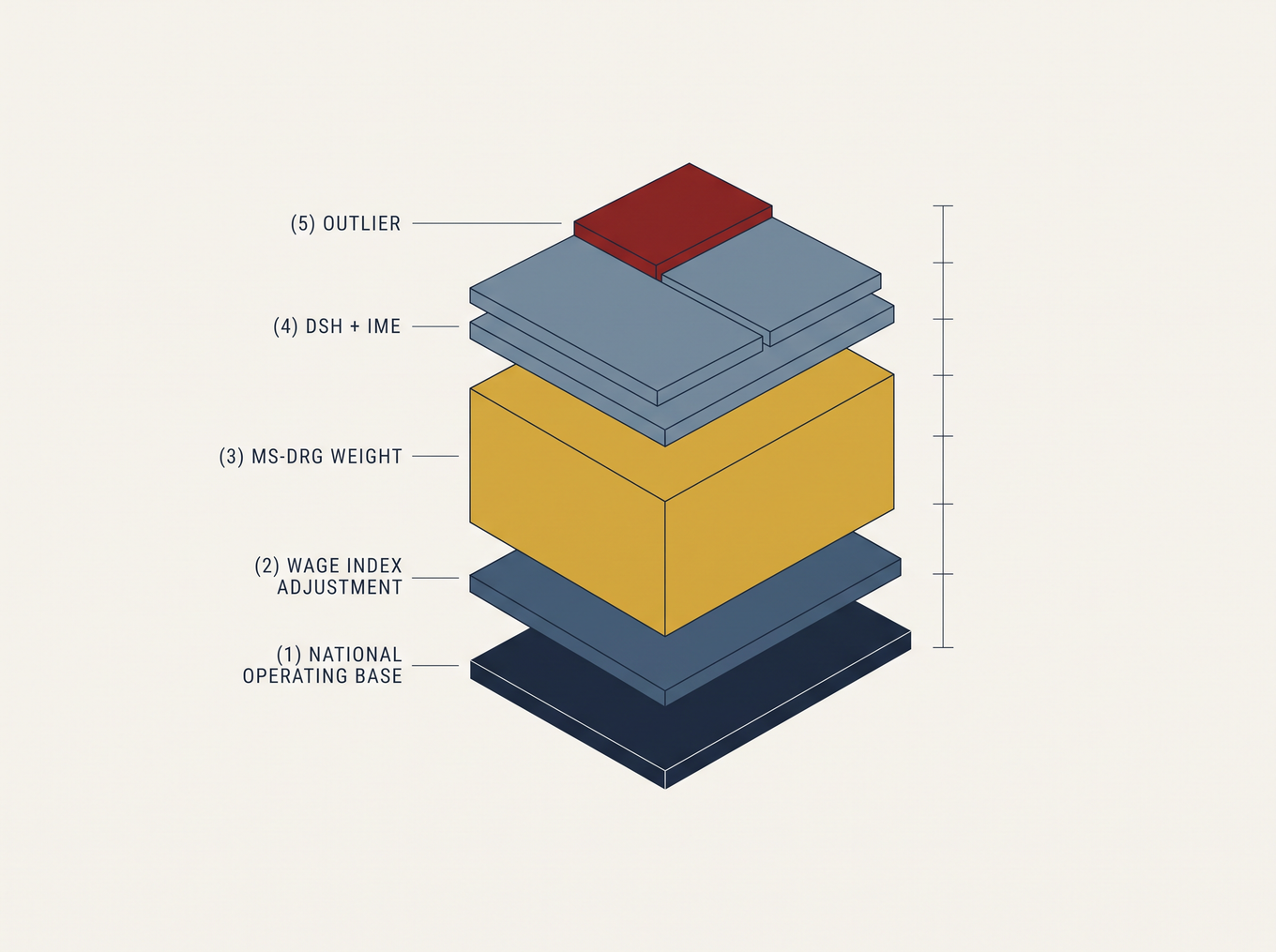
For most short-term acute-care hospitals, Medicare pays inpatient operating and capital services under the Inpatient Prospective Payment System. The hospital documents and codes the case; the grouper assigns an MS-DRG; that MS-DRG carries a relative weight for expected resource intensity; CMS applies the weight to wage-adjusted national base amounts; hospital-specific adjustments, case-specific add-ons or an outlier payment may apply; and quality-reporting status affects whether the hospital receives the full annual update.
Medicare pays a prospective amount per discharge rather than the total of the charges on the bill.
| Component | Plain meaning | The revenue-cycle control |
|---|---|---|
| National operating base | The starting amount before case and hospital adjustments | Correct fiscal-year tables and effective dates |
| Labor / non-labor split | The labor share is wage-index adjusted; the non-labor share is not adjusted the same way | Accurate wage-index data for the correct rule year |
| MS-DRG weight | The relative resource weight for the classified case | Complete, compliant documentation and coding; correct grouper version |
| DSH adjustment | Additional payment for qualifying hospitals serving disproportionate low-income populations | Eligibility and the underlying reporting |
| IME adjustment | Teaching-intensity adjustment for qualifying hospitals | Teaching data and cost-report integrity |
| New-technology add-on | Temporary add-on for qualifying technologies in eligible cases | Case identification, coding and policy match |
| Outlier | Additional payment for unusually costly cases | Complete covered charges, correct cost-to-charge ratios |
| Quality / EHR effects | The full update can depend on quality reporting and meaningful-EHR status | Reporting compliance |
| Transfer and other case policy | Certain discharges change the payment logic | Accurate discharge disposition |
Rate years matter, and they go stale first. As of the date at the bottom of this page, FY 2026 IPPS is in force through 30 September 2026, and FY 2027 IPPS has been finalised for discharges from 1 October 2026. CMS's 3 August 2026 summary puts the FY 2027 operating update at 2.3% for hospitals meeting the applicable quality-reporting and meaningful-EHR conditions, reflecting a 3.2% market basket less a 0.9 percentage-point productivity adjustment. That is a national update factor, not a promise that any individual hospital's payment rises 2.3% - hospital-specific and case-mix factors move independently.
What assigns the MS-DRG is not one variable. The grouper uses the principal diagnosis, secondary diagnoses, inpatient procedures, age, sex, discharge status and other logic. Secondary diagnoses can raise severity when they qualify as complications or major complications and comorbidities - but only when the clinical record and coding rules support them. The goal is not to capture every CC and MCC. It is to represent the patient's condition and care accurately. Defensible payment is the byproduct.
Acute inpatient claims also carry a present-on-admission indicator, which records whether a condition existed when the inpatient order occurred. It matters because selected hospital-acquired conditions can lose the higher payment they would otherwise attract when they were not present on admission. Not every condition that arises in a hospital creates a penalty - the payment provision applies to selected conditions under defined criteria, and the separate HAC Reduction Program applies a 1% reduction to hospitals in the worst-performing quartile under its own methodology.
And charges still matter, even under a prospective payment. CMS applies hospital-specific cost-to-charge ratios to covered charges to estimate a case's costs, and a case can attract an outlier payment when estimated costs exceed the applicable threshold. So missing charges can understate a genuinely expensive case, late charges can miss the first bill, and an inaccurate chargemaster can distort the whole calculation. None of which is a reason to inflate charges - outlier review is a completeness control, not a revenue tactic, and treating it as one invites an audit you cannot defend.
One more consolidation rule: the three-day payment window bundles certain outpatient services furnished before an inpatient admission into the inpatient claim. The window is one day for some hospitals, and relatedness and entity relationships both matter. It is a revenue-integrity control requiring you to identify services across settings and entities and prevent duplicate billing.
Hospital outpatient care under OPPS and APCs
Medicare generally pays covered hospital outpatient services under the Outpatient Prospective Payment System. Services are classified into ambulatory payment classifications with packaging and status-indicator rules. A comprehensive APC bundles a primary service with its integral and supporting services into a single payment; other services may be separately payable, packaged, conditionally packaged, subject to multiple-procedure reduction, or paid under a different system entirely.
In short: inpatient IPPS generally prices the stay through an MS-DRG, outpatient OPPS generally prices services through APC and packaging logic, and neither one is "the payer pays the chargemaster total."
For CY 2026, CMS finalised a 2.6% update for hospitals meeting the applicable quality-reporting requirements, removed 285 procedures from the inpatient-only list, and preserved the two-midnight medical-review exemption described in that rule for procedures removed from the list. The CY 2027 OPPS rule was still proposed as this guide was written, with comments due 31 August 2026. Proposed policy is not operational policy.
The hospitals that are not paid this way at all
"Inpatient hospital payment equals MS-DRG" is a good explanation of acute IPPS and a bad universal law. Payment differs for critical access hospitals, inpatient psychiatric facilities, inpatient rehabilitation facilities, long-term care hospitals, certain children's and cancer hospitals, Maryland's all-payer model, and any number of commercial arrangements that follow their own contract logic.
Why inpatient versus observation status is a billing control
For Medicare fee-for-service, the two-midnight framework remains central. An inpatient admission is generally appropriate when the admitting practitioner expects medically necessary hospital care to span at least two midnights and the record supports that expectation. Stays expected to be shorter can still qualify case by case when documented complex medical factors support the decision, and CMS review focuses heavily on short stays.
Two opposite errors are equally common and equally expensive. The first is treating two midnights as an automatic guarantee of inpatient payment - it does not eliminate medical-necessity or documentation review. The second is treating any stay under two midnights as necessarily observation - case-by-case inpatient exceptions exist and are legitimate.
Observation is outpatient status. It can happen in a hospital bed, overnight, for longer than some inpatient stays, and it is still outpatient for facility billing purposes. Physical location is not billing status, and a great deal of downstream confusion comes from conflating them.
A defensible status process has seven parts:
- An admission order authenticated by an authorised practitioner.
- Expected duration and clinical rationale supported in the record.
- Timely UM review.
- A defined escalation path for disagreement or missing documentation.
- The correct beneficiary notice at the correct time.
- Claim alignment - the facility bill type and the professional place of service both agree with the final supported status.
- A retrievable audit package containing the order, notes, results, UM decision and notice.
Status defects have a clock.
Condition Code 44 permits changing an inpatient admission to outpatient before discharge when the utilisation-review decision, physician concurrence and documentation requirements are met. It is not a retrospective repair tool after the patient has left. The later a status defect is found, the fewer compliant correction paths remain - which is why status belongs on a daily report rather than a monthly one.
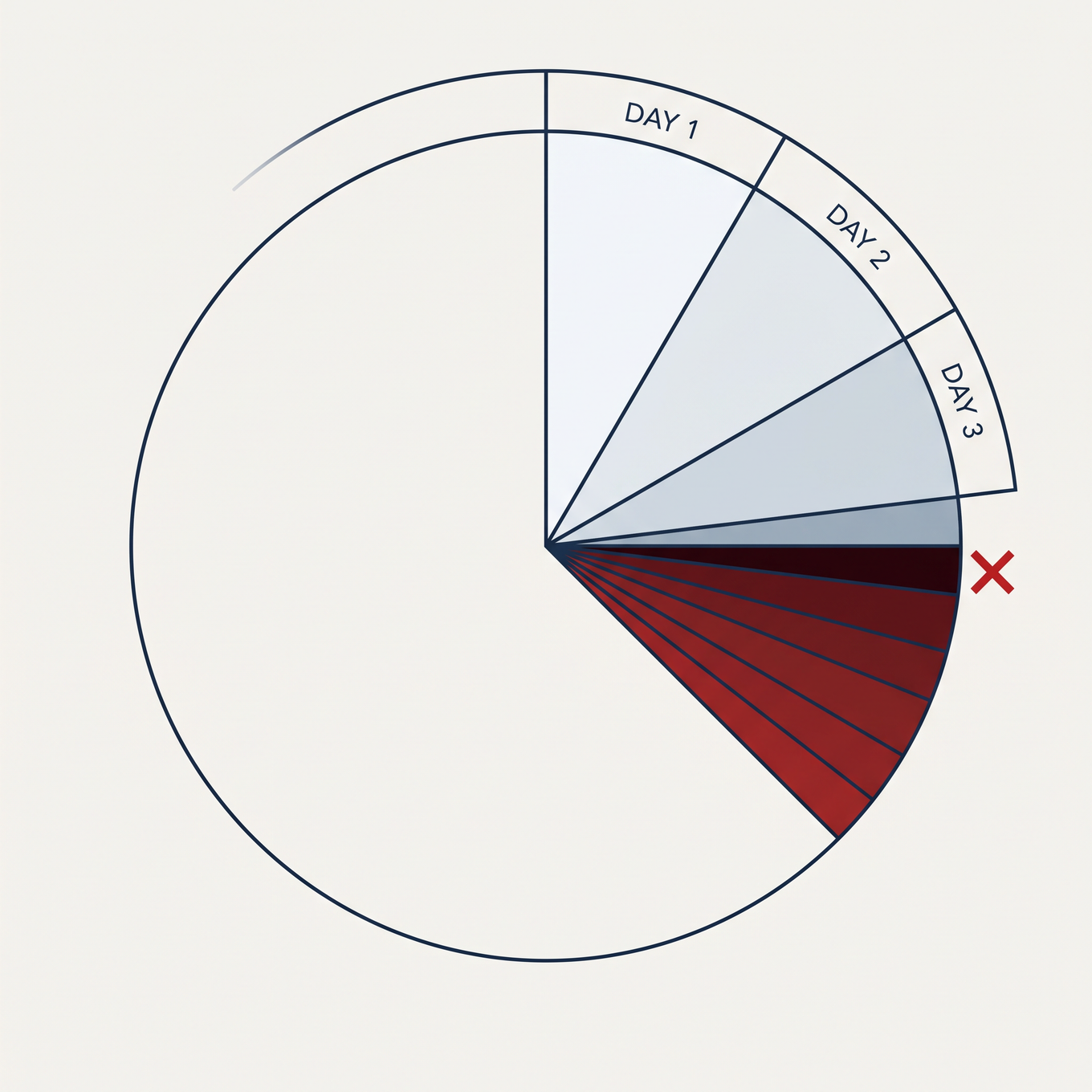
Notices carry their own timing. The Medicare Outpatient Observation Notice tells eligible beneficiaries they are outpatients receiving observation services and is generally delivered no later than 36 hours after observation begins, or sooner on release or transfer; CMS's updated form became required from 21 April 2026. A change-of-status notice applies in the relevant process when an inpatient is reclassified to outpatient observation. This area changed during 2026, so operational teams should work from the current CMS notice materials rather than an internal workflow document written before the change.
Medicare Advantage adds a parallel set of rules. Under the CMS interoperability and prior-authorisation requirements, impacted payers beginning in 2026 must issue expedited prior-authorisation decisions generally within 72 hours and standard decisions generally within 7 calendar days, and must give a specific reason for denial; the major API requirements generally begin in 2027. None of which makes authorisation lists or evidence requirements identical across plans. You still need a payer and product matrix.
Here is where the two streams touch, and it is the most preventable professional denial we see: the hospital's status decision sets the physician's place of service. POS 21 for inpatient, POS 22 for on-campus outpatient. The professional claim inherits a determination made in a different department, by different people, under a different set of rules - and when the status changes late, or changes correctly but never propagates, the physician claim goes out carrying a place of service the facility record no longer supports. The fix: an interface or exception report reconciling final status to professional POS, and a variance queue for the mismatches. Without it, a communication problem shows up as a coding denial.
Worth reporting monthly:
- Short-stay inpatient volume by service line
- Inpatient-to-outpatient changes before discharge
- Status changes discovered after the compliant correction window closed
- Physician-order defects
- Notice timeliness
- Payer overturn rate on status denials
- Dollars at risk and net recovery from status appeals
- Professional place-of-service mismatch rate against final hospital status
Publish those with denominators and peer context, not with arbitrary red-amber-green thresholds.
What documentation, coding and the chargemaster control
Clinical documentation integrity is not a polite name for coding more. Its job is to make the record accurately express the condition chiefly responsible for admission, the clinically supported secondary conditions, acuity and risk, procedure detail, present-on-admission facts, causal relationships, discharge disposition, the medical necessity and status expectation, and - on the professional side - the medical decision making or total time supporting the E/M service. The aim is clinical truth that survives payer review, not a maximised DRG or visit level.
The failures repeat across organisations:
| Failure | Why it matters | Control |
|---|---|---|
| Principal diagnosis unclear after study | Wrong sequencing or DRG | Discharge-summary review, coder and CDI escalation |
| A clinically meaningful condition appears only in an ancillary note | May not support a code under provider-documentation rules | Timely compliant query |
| Specificity absent | Less accurate coding, possible denial | Specialty templates and targeted education |
| Procedure details incomplete | Wrong or missing ICD-10-PCS code | Procedure-note completeness check |
| Present-on-admission status unclear | Payment and audit risk | Query before the bill drops |
| Discharge disposition wrong | DRG and transfer-policy consequences | Reconcile case management to the final claim |
| Status expectation not documented | Short-stay denial exposure | Admission-order and status checklist |
| Copy-forward contradiction | Clinical validation and credibility risk | Exception review and provider feedback |
Charge capture asks a narrower question: does the institutional account contain the services, supplies, drugs and resources that should be represented under the hospital's policies and payer rules?
The high-risk sources are predictable - operating rooms and procedure areas, pharmacy and high-cost drugs, implants and supplies, the emergency department, infusion, imaging and interventional radiology, laboratory and pathology, observation and bed status, therapy, device-dependent procedures, and anything relying on manual entry.
The controls are equally predictable, and frequently absent:
- Reconcile procedure logs, medication administration records, implant logs and departmental systems to the account
- Hold accounts for defined high-risk missing elements
- Track late charges by department and cause
- Maintain effective dates and mappings in the chargemaster
- Audit duplicate and mutually inconsistent charges
- Keep compliant recovery strictly separate from unsupported charging
CMS's price-transparency rules define the gross charge as the charge for an individual item or service reflected in the hospital's chargemaster before discounts. Operationally the CDM connects item description, internal code, gross charge, department, revenue code, HCPCS or CPT where applicable, units, effective dates, payer edit dependencies and links into order entry. When it is wrong it produces omitted revenue, rejections from bad revenue-code and HCPCS combinations, compliance exposure from duplicated or inconsistent charges, price-transparency mismatches, and noise in every underpayment analysis that depends on expected billing data.
But the chargemaster does not set the MS-DRG. The accurate formulation is that documentation and coding determine the clinical classification, charge capture determines whether the resources that should appear on the institutional account are present, and both must reconcile before billing. They are two different data streams that answer to each other.
Six objects get used interchangeably and are not interchangeable. Hospital price transparency data is public disclosure - and note that for 2026 CMS added allowed-amount percentile fields and related requirements, with an enforcement date later in the year for specified provisions. The chargemaster is an internal master. The payer contract defines negotiated payment logic. The 835 reports what the payer actually did. Expected reimbursement is your own model of the contract applied to the claim. And the paid amount is the money. These should reconcile. They are not the same object, and a variance between any two of them is a finding rather than a rounding error.
Coding years turn over too. On the date this guide was written, the April–September 2026 ICD-10-CM and PCS updates were in force where applicable, and FY 2027 files take effect 1 October 2026.
Claims, denials, appeals - and payments that are simply wrong
Why "submitted" is not the same as "received"
A hospital should be able to trace a single account through bill generation, internal edits, clearinghouse transmission, the 999 implementation acknowledgement where applicable, the 277CA claim acknowledgement, payer receipt, claim-status transaction or portal status, the 835 remittance, posting and reconciliation, and any subsequent correction, replacement, void, appeal or refund.
Most organisations can trace some of that. The gap is usually in the middle: a clearinghouse acceptance is not a payer acceptance, and a payer acceptance is not a payment. Claims can sit between "transmitted" and "acknowledged" indefinitely, invisible on a standard dashboard because they were never denied. The controls worth having are claims transmitted versus claims acknowledged, retained payer receipt dates as timely-filing proof, no-response and unacknowledged-claim queues, duplicate-submission prevention, provider enrolment and NPI/TIN validation, bill-type and frequency-code logic, attachment workflows, payer-specific edits versioned by effective date, and a reconciliation between claim count, 835 count, bank deposit and general ledger. The adopted HIPAA transaction standards define the vocabulary for all of it.
One risk here has nothing to do with coding accuracy. The Change Healthcare disruption made the point at national scale: an AHA survey published in March 2024 documented severe cash-flow and operational effects across hospitals, and the organisations that recovered fastest were the ones that already knew which clearinghouse carried which payer, could reroute, and had a cash forecast that survived contact with reality. Clearinghouse contingency, electronic remittance and funds-transfer resilience, and a documented manual fallback are revenue-cycle controls, not IT problems. A perfectly coded claim that cannot reach a payer is worth exactly as much as one that was never produced.
Rejection, denial, underpayment and recoupment are not the same
Using "denial" as shorthand for every revenue defect is a habit that hides money, because the six events below each have a different first question.
| Event | What happened | The correct first question |
|---|---|---|
| Rejection | The claim never entered adjudication, or failed front-end edits | What data, format or enrolment rule prevented acceptance? |
| Denial | The payer adjudicated and declined payment in whole or part | Is it correct, correctable, appealable, or preventable? |
| Underpayment | The payer paid less than expected, sometimes with no denial at all | What contract or payment rule produced the variance? |
| Patient responsibility | The payer assigned allowed responsibility to the patient | Is that assignment consistent with the benefit, the contract and the law? |
| Recoupment | The payer seeks or takes back a prior payment | What audit or contractual process applies, and what is the response deadline? |
| Credit balance | The hospital is holding money it does not own | Who must receive it, by when, and under what reporting rule? |
The 835 communicates adjustments at line, claim and provider level through standard Claim Adjustment Reason Codes and Remittance Advice Remark Codes, whose combinations are maintained through CAQH CORE. Those codes are designed to explain the adjudication, and payers should not substitute proprietary codes in the standard transaction.
The adjustment code tells you how the payer represented the outcome. It does not tell you the root cause. A claim denied for medical necessity may have failed because a status decision was never documented, or because an authorisation was obtained against the wrong entity, or because a diagnosis that justified the admission never made it out of a consult note. Three different processes must change, and all three arrive wearing the same reason code. A denial work queue organised by CARC is organised by symptom.
A usable denial record needs more than the code:
- Payer and product
- Claim and line
- The CARC/RARC combination
- The payer's stated explanation
- The internal root cause
- A preventable-versus-nonpreventable classification
- Whether it is a corrected claim or an appeal
- The documentation required
- The deadline
- The owner
- The amount at risk
- The resolution
- The recovered amount
- The upstream corrective action
And the root cause should name the process that has to change - patient identity, eligibility and coordination of benefits, authorisation, network and credentialing, status and medical necessity, documentation, coding and modifiers, charge and units, claim format, duplicate and bundling, timely filing, payer processing, contract variance, patient benefit, or audit and recoupment - rather than repeating the denial reason back to itself.
Initial denial versus final loss
There is no universal hospital denial rate. Kodiak's benchmark reported an 11.8% initial denial rate and a 2.8% final denial rate for 2024. That is proprietary data measured within a monitored population - directional evidence, not a national average.
The gap between those two numbers shows why a single denial rate is inadequate as a management metric: some denials are overturned, some corrected, some written off, some never pursued at all, and some payments are wrong without ever being denied. A complete denial dashboard tracks:
- Initial claim-level denial rate
- Dollar denial rate
- Final denial and write-off rate
- Overturn rate and overturn dollars
- Appeal success by root cause and payer
- Time to first action
- Days to resolution
- Effort or touches per denial
- Loss to timely-filing and appeal expiry
- Avoidable denial recurrence
- Denial-adjusted yield
Deadlines, and the Medicare appeal ladder
Medicare fee-for-service claims generally must be filed no later than 12 months after the date of service, with limited exceptions. An untimely-filing denial cannot be argued away on medical necessity; the filing rule is a separate gate. Commercial, Medicaid and managed-care contracts frequently use much shorter windows, with their own separate deadlines for corrected claims, reconsiderations and appeals.
The Medicare fee-for-service ladder, as an operational summary - always verify the current notice and form for the specific claim:
| Level | General filing period | Typical decision target | 2026 amount in controversy |
|---|---|---|---|
| 1. MAC redetermination | 120 days from the initial determination | 60 days | None stated for access |
| 2. QIC reconsideration | 180 days from redetermination | 60 days | None stated for access |
| 3. OMHA / ALJ hearing | 60 days from reconsideration | Statutory framework; backlog and escalation rules can apply | $200 |
| 4. Medicare Appeals Council | 60 days from the ALJ decision | Generally 90 days; different timing after escalation | No separate threshold beyond the access path |
| 5. Federal district court | 60 days from the Council decision | Court process; no CMS decision target | $1,960 |
Full detail is in CMS's Parts A & B appeals booklet. One evidence rule matters more than it looks: documentation omitted at reconsideration may be excluded at later levels absent good cause. That makes the level-two package a substantive control rather than clerical forwarding - the appeal you assemble at level two is, in practice, the case you are stuck with.
Deciding what to appeal is a prioritisation problem, not a moral one. Weigh:
- Amount at risk
- Probability of recovery
- Evidence completeness
- The deadline
- Precedent or recurrence
- Patient impact
- Contractual interest
- Audit and extrapolation risk
- Staff or vendor effort
- The value of fixing the upstream defect
A small denial repeated thousands of times can outrank one large idiosyncratic claim, and a low-dollar claim can be worth appealing purely to establish a payer policy pattern. Appealing everything indiscriminately is not diligence - it consumes the capacity you need for root-cause work and hides the failure that generated the volume.
Silent underpayments: when a paid claim is still wrong
For every paid claim, a hospital should be able to calculate or estimate the expected allowed amount under the applicable contract or payment rule, subtract the actual allowed amount, and get a payment variance.
Modelling that expectation may require the DRG, APC or fee-schedule base, the payer's grouper and version, per diems, percent-of-charge terms, case rates, stop-loss and outlier provisions, implant and drug carve-outs, multiple-procedure and packaging rules, lesser-of-billed-charges clauses, quality adjustments, statutory adjustments, network and product mapping, effective dates, modifiers, patient responsibility and prompt-pay interest.
A "paid" status should not automatically close a claim when the variance exceeds policy.
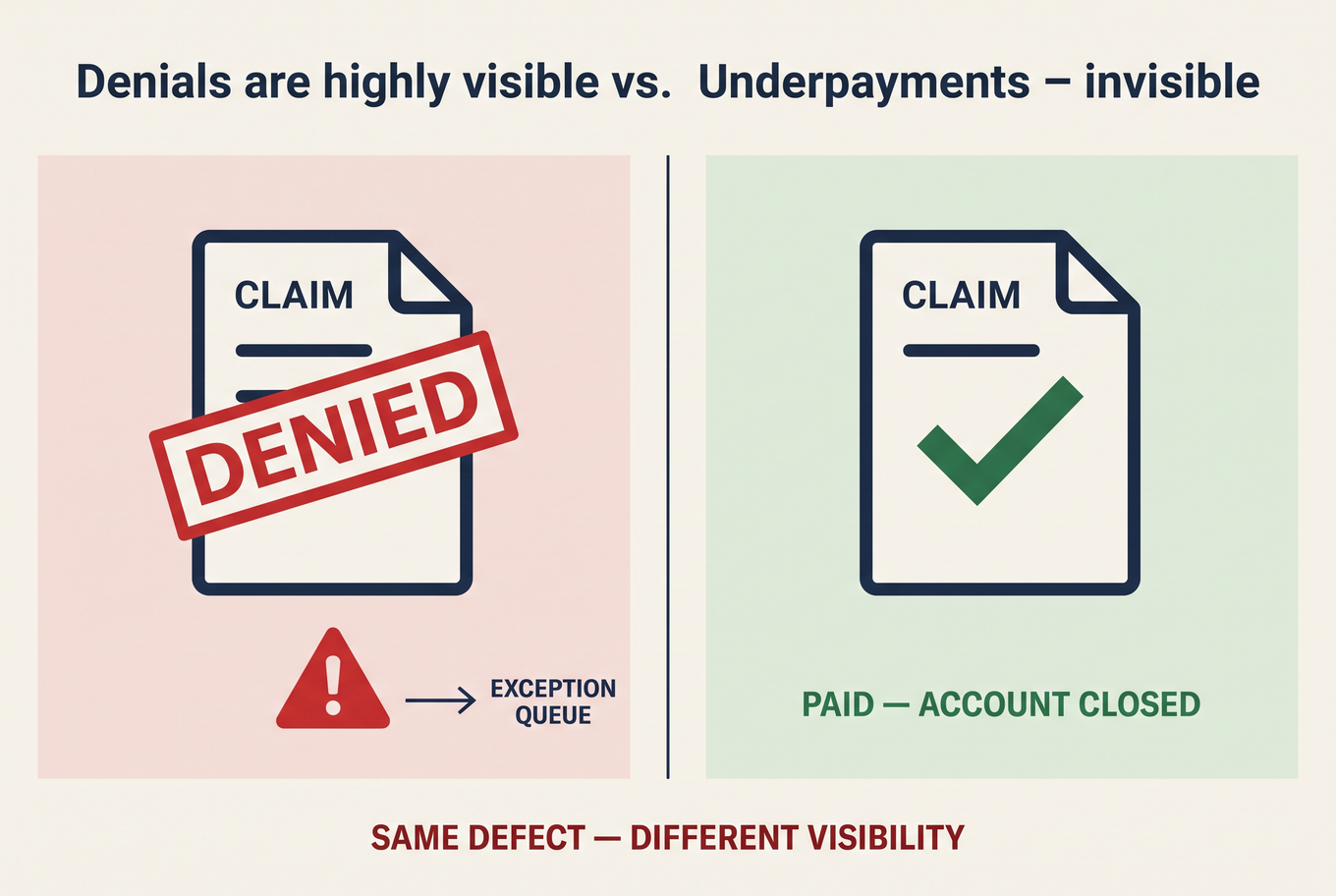
Underpayments are harder to catch than denials for a structural reason: a denial enters an obvious exception queue, and an underpayment posts automatically. Contract language is spread across amendments, exhibits and fee schedules; payer and product mapping can be wrong; the payer's grouper version may differ from yours; and your own expected-reimbursement model can be the thing that is wrong. Small variances need threshold logic, large ones need fast escalation, and the recovery team needs contract expertise and claim evidence in the same room. Track:
- Gross and net variance inventory
- Variance as a percentage of expected reimbursement
- Confirmed underpayment versus model exception
- Recovery dollars and recovery rate
- Days from remit to detection
- Days from detection to appeal
- Distribution by payer and root cause
- Prompt-pay interest due and recovered
- Repeat defects after payer acknowledgement
- Your model's false-positive rate
Prompt-pay obligations vary by state, product and plan. Illinois is an illustration, not a national rule: state law generally requires specified clean commercial claims to be paid within 30 days and provides interest for late payment, with additional guidance from the Department of Insurance, while Medicaid managed care has its own provisions and self-funded ERISA plans raise a different preemption analysis entirely. Build the rule into the payer matrix. Do not publish one universal deadline and expect it to hold.
A paid claim is not necessarily a correctly paid claim.
Patient bills, and the laws that sit underneath them
The last stretch of the revenue cycle is also a legal and trust process, and it is the one place where a technical error becomes a patient's problem rather than a spreadsheet's.
It starts before billing exists. A Medicare-participating hospital with an emergency department must provide the required medical screening examination and stabilising treatment or appropriate transfer under EMTALA, without delaying care to ask about payment or insurance in a way that interferes with that process. The accurate operational statement is not "you cannot ask about insurance in the emergency department" - registration activity may occur. It is that registration must not delay or discourage the required clinical process.
From there, a patient-facing control compares six things that should reconcile and often do not: what service and status were expected, what estimate was given, what the facility and the practitioners actually billed, what the payers allowed or denied, what contractual adjustments posted, and what balance is genuinely the patient's under the benefit, the contract and the law. It matters more in a hospital than anywhere else, because one encounter produces separate facility and professional bills: a patient told one number receives two envelopes and concludes, reasonably, that somebody is wrong.
Three federal frameworks shape what happens next, and each has its own deadline.
For uninsured and self-pay patients, providers and facilities generally must supply a good faith estimate when the statutory conditions apply. A patient-provider dispute resolution process may be available when the billed charge is at least $400 above the estimate, and the patient generally must initiate it within 120 calendar days of the initial bill. The broader No Surprises Act framework can also interact with more protective state law - network status, plan type, emergency versus non-emergency setting, consent and state jurisdiction all matter. Federal law is frequently a floor rather than a ceiling, so patient-balance controls need a plan, payer and state decision tree rather than a single script.
For tax-exempt hospitals, IRS section 501(r) imposes a written financial assistance policy, an emergency medical care policy, limits on amounts charged to eligible patients, and reasonable efforts to determine financial-assistance eligibility before extraordinary collection actions. IRS guidance describes a 120-day notification period and an overall 240-day application period in the applicable process. That is a separate deadline from commercial timely filing, and collapsing the two into one generic "collections timeline" is how hospitals end up taking an action they were not yet permitted to take.
State law adds another layer. Because we are based in the Chicago area, Illinois is the example we know best: the Fair Patient Billing Act establishes requirements around hospital billing, collection and assistance for uninsured patients. It governs Illinois hospitals and nobody else, and it is offered as an illustration of the kind of statute that exists in many states, not as a rule anyone outside Illinois should apply.
Worth tracking on this side of the cycle:
- Estimate accuracy, and estimate delivery timeliness
- Insurance discovery rate
- Point-of-service collection, segmented by expected amount
- Payment-plan performance
- Financial-assistance screening and approval rates
- Statement return and error rates
- Patient calls per account
- Complaints classified by cause
- Bad-debt placement and recovery
- Balance corrections made after a complaint
- How often patients report confusion between the facility and professional bills
One caution: never publish a "patient collection rate" without defining the amount that was actually eligible for collection and the window it was measured over. Without a denominator it is not a metric, it is a mood.
The metrics hospital finance leaders actually need
A ratio can be improved by changing its denominator, writing off accounts, excluding claim types, or moving work between queues. None of those improve revenue. This is why HFMA's MAP Keys are valuable - they standardise numerator, denominator and scope, so a number means the same thing in two organisations and in two quarters.
The metrics below are worth publishing with a third column: what each one can hide.
| Metric | Simplified definition | What it reveals | What it can hide |
|---|---|---|---|
| DNFB days | Gross discharged-not-final-billed ÷ average daily gross patient service revenue | Accounts stuck before final bill | Gross-charge inflation, case mix |
| Charge lag | Average posting date minus service date | Speed of charge capture | Charges never posted at all |
| Late-charge rate | Gross charges posted beyond a defined threshold ÷ gross charges | Departmental late capture | Services never captured |
| Clean-claim rate | Claims passing edits without manual intervention ÷ claims accepted into the scrubber | Front-end edit quality | Underbilling and incorrect payment |
| Remittance denial rate | Actionable denied claims ÷ remitted claims | Initial payer denial burden | Dollar severity and underpayments |
| Denial write-offs | Denial-related write-offs ÷ average monthly net patient service revenue | Permanent denial loss | Recoverable denials still open |
| Net days in A/R | Net A/R ÷ average daily net patient service revenue | Overall receivable speed | Payer, product and service-line variation |
| Cash collection | Patient-service cash ÷ average monthly net patient service revenue | Realisation of expected revenue | Timing and prior-period collections |
| Cost to collect | Total revenue-cycle cost ÷ patient-service cash | Administrative efficiency | Quality, leakage, and work shifted elsewhere |
| Case mix index | Sum of MS-DRG weights ÷ applicable discharges | Relative coded complexity | Clinical validity, payer mix, outliers |
Every headline metric has a partner that exposes it when it is being gamed:
| Headline metric | Pair it with |
|---|---|
| Clean-claim rate | Expected-payment accuracy and late or missing charges |
| Denial rate | Final write-off and underpayment variance |
| Days in A/R | Cash-to-net-patient-service-revenue and write-off rate |
| Cost to collect | Net yield, patient experience, and control backlog |
| Case mix index | Coding and clinical validation, denial and recoupment |
| Coder productivity | Audit accuracy, discharged-not-final-coded, and rework |
| Automation rate | Exception accuracy and false-negative audit |
| Patient collection | Estimate accuracy, complaints, and financial-assistance screening |
| Appeal success rate | Appeal volume, net recovered dollars, and recurrence |
| Share of visits billed at the highest level | Audit support, payer downcoding, and clinical mix |
A balanced scorecard should cover access, mid-cycle, claims, denials, yield, patient experience, and cost and capacity. And it should carry a professional-side block: place-of-service mismatch rate, risk-adjusted code-level distribution by specialty and provider, discharge-day documentation defects, split/shared compliance, same-day and concurrent-care denials, teaching-physician audit results, and a bridge from work RVUs to allowed revenue.
When cash misses plan, finance should bridge the variance into named components rather than attributing it to "revenue cycle performance":
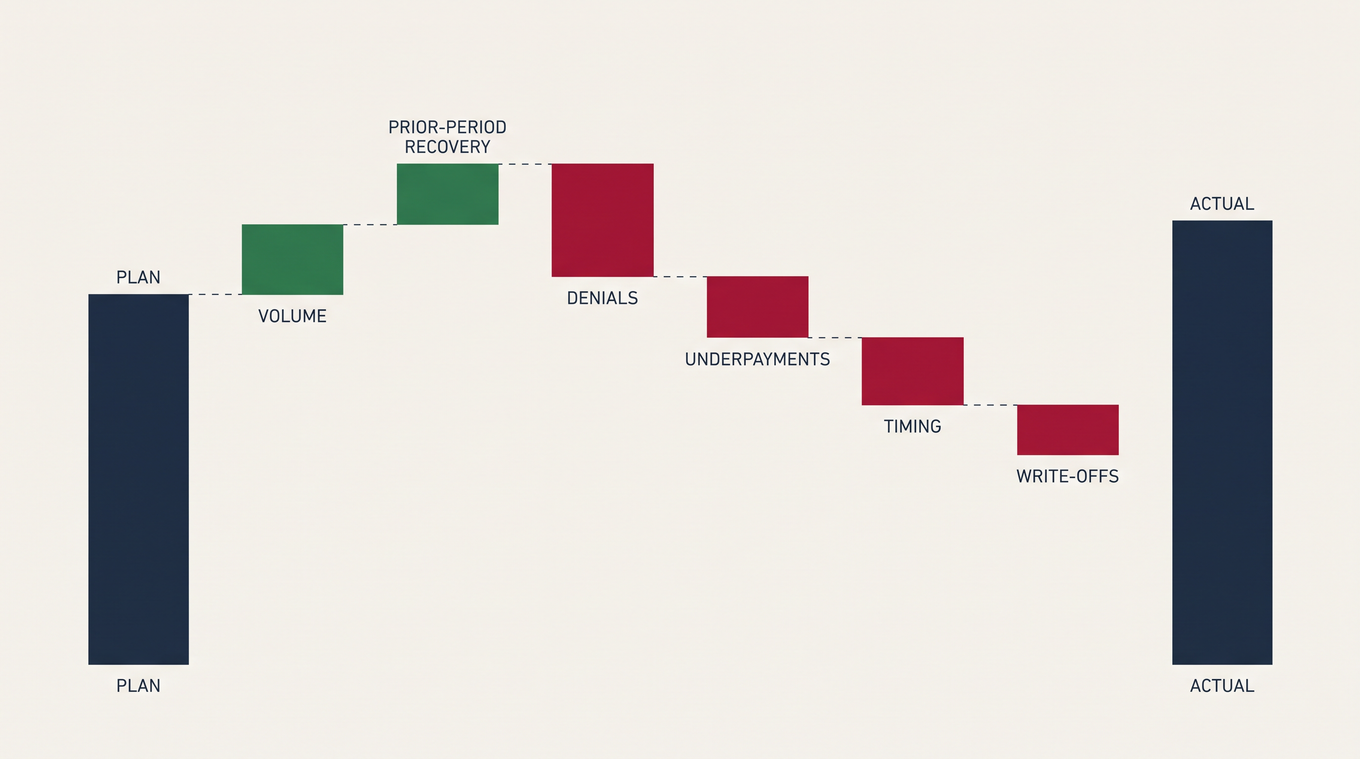
- Volume
- Gross charge and case mix
- Contractual allowance
- Payer mix
- Timing and lag
- Rejections
- Denials
- Underpayments
- Patient responsibility and collection
- Prior-period recovery
- Write-offs, refunds and recoupments
- Any one-time operational disruption
A cash bridge turns an argument into an inventory.
Inpatient physician billing: where the second claim leaks
This is the second stream. The professional work of treating an admitted patient is billed separately from the facility claim as an 837P, with the CMS-1500 as its paper counterpart and place of service 21 for inpatient hospital or 22 for on-campus outpatient. The same chart drives the facility DRG or APC logic and the professional E/M service, and neither mechanically determines the other.
It is a different discipline: different form, different code set, different payer policies, different denial patterns, different audit exposure. It is also where our own work sits.
The hospital E/M code families, and what they require
Initial hospital inpatient or observation care
| Code | Selection basis | Minimum total time when time is used |
|---|---|---|
| 99221 | Low medical decision making, or time | 40 minutes |
| 99222 | Moderate medical decision making, or time | 55 minutes |
| 99223 | High medical decision making, or time | 75 minutes |
Subsequent hospital inpatient or observation care - the daily rounding visits, and the bulk of a hospitalist's volume
| Code | Selection basis | Minimum total time when time is used |
|---|---|---|
| 99231 | Low medical decision making, or time | 25 minutes |
| 99232 | Moderate medical decision making, or time | 35 minutes |
| 99233 | High medical decision making, or time | 50 minutes |
Same-date admission and discharge
| Code | Selection basis | Minimum total time when time is used |
|---|---|---|
| 99234 | Low medical decision making, or time | 45 minutes |
| 99235 | Moderate medical decision making, or time | 70 minutes |
| 99236 | High medical decision making, or time | 85 minutes |
Discharge day management: 99238 for 30 minutes or less, 99239 for more than 30 minutes. Critical care: 99291 for the first 30–74 minutes of qualifying critical care, 99292 for additional time under the applicable timing rules.
Two things changed on 1 January 2023 and they are still producing denials. First, the separate observation E/M families were deleted and merged into the hospital inpatient and observation families - one code family now serves either setting, though you still need facility status to choose POS 21 or 22. Second: the visit level is now selected by medical decision making or total time. History and examination must still be medically appropriate, but they no longer determine the level. AMA's implementation guidance and the CPT E/M descriptors set the framework; CMS Chapter 12 of the Claims Processing Manual carries the Medicare specifics.
There is no shortcut. "Three problems equals 99233" is not a rule; medical decision making depends on the CPT framework's combination of problems addressed, data reviewed and analysed, and risk of patient management. Emergency-department E/M is selected by medical decision making, not time. Critical care is time-based. When time is used, the whole threshold must be met and the note should state the total time and support the qualifying work. And medical necessity remains the overarching criterion regardless of which selection method the documentation uses.
What the federal data actually says about these exact codes
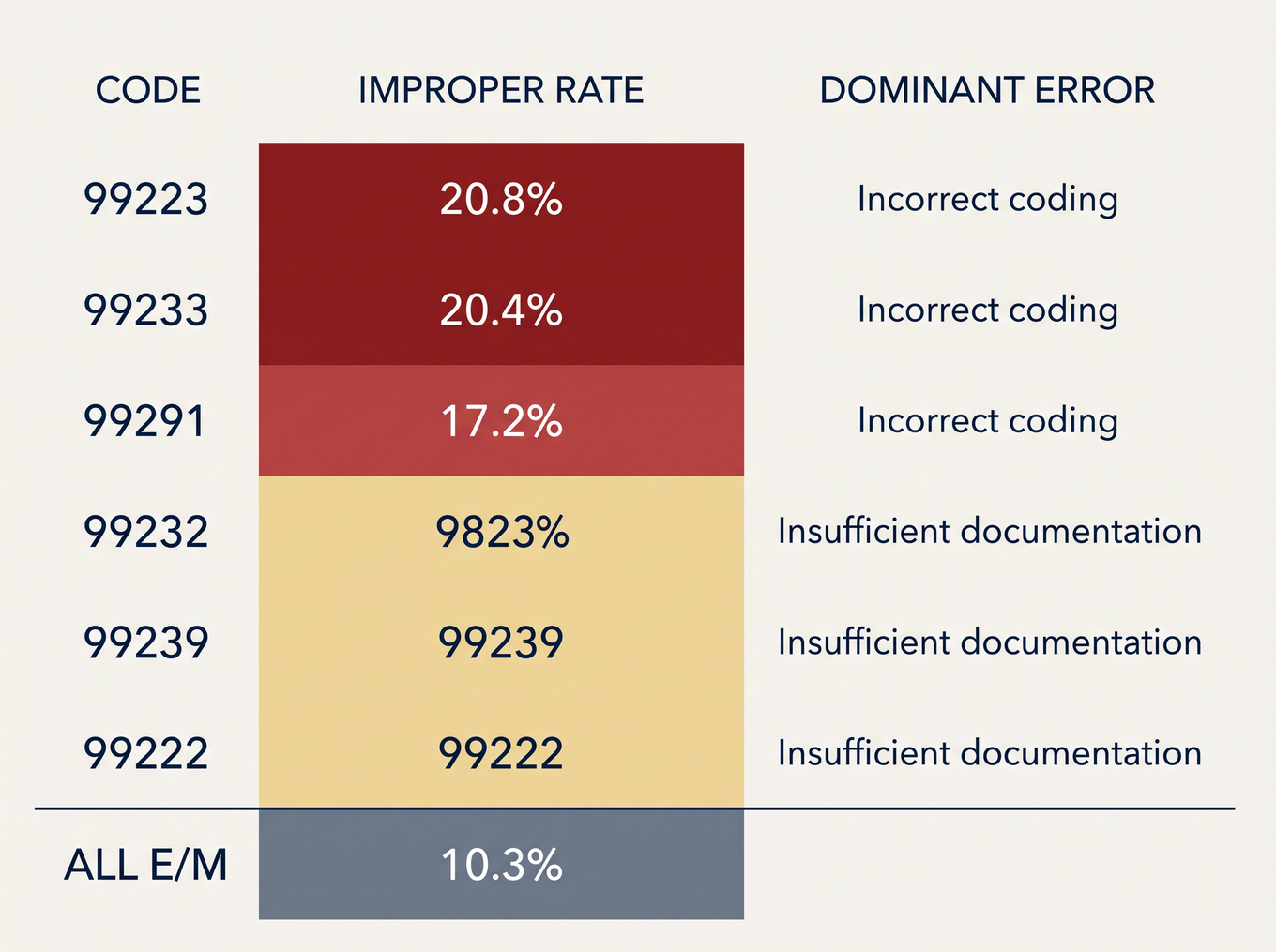
CMS publishes service-level improper-payment results through the Comprehensive Error Rate Testing programme. In the FY 2024 Medicare Fee-for-Service Supplemental Improper Payment Data, Appendix K breaks E/M improper payments out by code. Across all E/M codes, the projected improper payments were $3.92 billion at a 10.3% improper payment rate (95% confidence interval 9.4%–11.2%), composed of 49.1% incorrect coding, 34.1% insufficient documentation, 13.1% no documentation and 3.7% other.
The necessary caveat: an improper payment is not fraud, and it is not a measure of revenue that providers failed to collect. "Incorrect coding" runs in both directions - it includes services coded above and below what the record supported. Anyone converting $3.92 billion into "money physician groups are leaving on the table" is misreading the dataset.
What makes the table useful is the code-level detail underneath the average:
| Code | Projected improper payments | Improper payment rate (95% CI) | Dominant error type |
|---|---|---|---|
| 99223 - initial hospital, high | $324,835,303 | 20.8% (18.0–23.7) | Incorrect coding, 60.4% |
| 99233 - subsequent hospital, high | $481,702,364 | 20.4% (17.3–23.5) | Incorrect coding, 65.8% |
| 99291 - critical care, first hour | $207,306,411 | 17.2% (12.4–22.0) | Incorrect coding, 66.6% |
| 99222 - initial hospital, moderate | $56,667,958 | 8.6% (4.5–12.7) | Insufficient documentation, 47.1% |
| 99232 - subsequent hospital, moderate | $195,731,555 | 8.3% (2.3–14.3) | Insufficient documentation, 46.2% |
| 99239 - discharge management, >30 min | $33,303,822 | 7.9% (4.7–11.1) | Incorrect coding, 61.2% |
| All E/M codes, for comparison | $3,920,991,531 | 10.3% (9.4–11.2) | Incorrect coding, 49.1% |
Two patterns fall out of that table.
The high-level hospital inpatient codes carry improper payment rates around double the E/M average, and their dominant failure is coding rather than missing paperwork. The moderate-level codes invert: 99232 and 99222 are dominated by insufficient documentation. Those are different problems requiring different fixes. A documentation-education programme aimed at 99233 is solving the wrong half of the issue, and a coding audit aimed at 99232 is doing the same in reverse.
The same report's Table K2 isolates claims found in error specifically because of a one-level E/M coding difference. Across all E/M codes that rate is 1.3%. For 99233 it is 12.6% - roughly ten times higher, and the largest inpatient line in the table. The daily rounding visit is, measurably, the single most contested level-selection decision in the professional inpatient stream.
One note on currency: CMS has published the FY 2025 national Medicare fee-for-service improper payment rate (6.55%, or $28.83 billion, against 7.66% and $31.70 billion in FY 2024) on its CERT data page, but FY 2024 remains the most recent year with published service- and code-level breakouts. The code-level figures above are FY 2024 and are labelled as such.
Same-day rules, discharge day, and prolonged care
CMS's Chapter 12 sets out the duration logic, and it trips people up in both directions. If admission and discharge fall on the same date and the stay is less than eight hours, report initial hospital care from 99221–99223 and do not additionally report discharge. If the stay spans different calendar dates, report initial care and then 99238 or 99239 on the discharge date where supported. For a same-calendar-date stay of at least eight but fewer than 24 hours, report 99234–99236 where the requirements are met. And a physician should not bill subsequent hospital care and discharge-day management for the same patient on the same date.
Discharge day management is generally reported only by the physician responsible for the discharge; other physicians providing medically necessary final-day services report subsequent hospital care where supported. For 99239, the record must establish more than 30 minutes of discharge-day management - and a discharge summary by itself does not prove that. The predictable failures:
- 99239 billed with no total time recorded
- "Greater than 30 minutes" inserted as boilerplate without supporting detail
- Discharge and subsequent care billed by the same physician on the same day
- Multiple clinicians treating the discharge code as separately billable
- A discharge date that does not match the facility record
For prolonged hospital services, CMS created G0316, used when the primary service is selected by time and the CMS threshold is reached. The current Medicare thresholds place the first G0316 at 90 minutes with 99223, 65 minutes with 99233, and 110 minutes with 99236 - thresholds finalised in the CY 2023 Physician Fee Schedule rulemaking and still referenced in MAC guidance. CMS timing is not always the same as a straightforward reading of the CPT add-on, and commercial payers may follow CPT, CMS or their own policy. This needs to live in a payer matrix, not in an individual coder's memory.
A signature is not a substantive portion
When a physician and a non-physician practitioner in the same group both contribute to a facility visit, the billing practitioner must have performed the substantive portion. Since 1 January 2024, that means more than half of the total time or the substantive part of the medical decision making, where medical decision making can determine the service. Critical care and other time-only services remain time-based. Overlapping joint time is counted once. The record must identify the participants, the billing practitioner signs and dates it, and the FS modifier identifies the visit as split or shared.
The control question is therefore not "did the physician sign?" It is "what portion did the physician personally perform, and is that visible in the note?" Confusing the two is how a compliant clinical service becomes a non-compliant claim.
Teaching physicians, concurrent care, and consultation codes
For resident-involved services, Medicare payment depends on the teaching-physician requirements: the record must establish the teaching physician's presence for the key or critical portion where required, and their participation in the patient's management. A generic attestation - "seen and agree with the resident's note" - with no evidence of what the teaching physician personally did is a recoupment trigger. Macros are not automatically invalid, but the teaching physician must personally enter or confirm the required attestation and the record as a whole must support the service. For time-based services, resident-alone time generally cannot be counted toward the teaching physician's billable time, which matters most for critical care and discharge management.
Concurrent care is where a widespread simplification costs real money. CMS's Benefit Policy Manual defines concurrent care as more than one physician providing services more extensive than consultation during the same period, and each physician's service can be covered when the patient requires more than one active physician, each service is reasonable and necessary, the services are not duplicative, and the record makes each physician's role clear. Different specialties or subspecialties make that easier to establish. But same-specialty concurrent care is not categorically prohibited - CMS gives examples involving unusual specialisation within a specialty. "Two doctors in the same specialty can never both be paid" is a myth, and it is distinct from the same-group per-day billing rules, which do prevent a group from fragmenting one service across clinicians.
The failure pattern is consistent. Two physicians see the patient. The payer's edit treats the second claim as a duplicate or same-specialty service. The notes use generic language and never explain the distinct responsibility. Staff rebill repeatedly without a medical-necessity narrative. The claim ages past the best appeal window. The prevention is documentary rather than clerical: provider specialty and taxonomy governance, an explicit statement of each physician's problem and responsibility in each note, a distinct plan and contribution, payer-specific concurrent-care policy on file, an appeal template that explains nonduplication rather than asserting it, and a same-day encounter report that runs before timely filing expires.
Consultation codes need a payer matrix and not a rule of thumb. Medicare has not recognised CPT consultation codes 99241–99245 and 99251–99255 for payment since 1 January 2010; a consulting physician reports the appropriate initial or subsequent hospital service instead. Commercial policy is not uniform, so you have to check. As one current, dated example: UnitedHealthcare's commercial consultation services policy 2026R0129A, reviewed July 2026, does not reimburse 99242–99245 or 99252–99255 under the stated policy and directs the use of an appropriate E/M code. That is one payer, on one policy, on one date - which is exactly the point.
Critical care carries its own requirements:
- A critically ill or injured patient
- The practitioner's full attention during the reported time
- Qualifying high-complexity decision making
- Documented total time
- Exclusion of separately reportable procedure time
- Correct aggregation when same-specialty clinicians in a group provide the care
- The teaching-physician rules where residents participate
CMS timing for 99292 does not follow a casual "another 30 minutes" reading; sources commonly place the first 99292 unit at a total critical-care time of 104 minutes, and groups should work from current CMS and MAC tables and their payer policies - see ACEP's Medicare critical care FAQ for the practical treatment.
What a level of leakage is actually worth - modelled, not measured
There is no defensible primary-source national figure for annual inpatient physician undercoding leakage. Rather than borrow one from a vendor report, here is transparent arithmetic with stated assumptions you can substitute with your own.
The amounts below are modelled national non-QP amounts before geographic adjustment, calculated from the final CY 2026 Physician Fee Schedule by DecisionHealth using CMS's July 2026 RVU file. They are not local allowed amounts. Actual payment varies by geographic practice cost indices, MAC locality, conversion factor, modifiers and payer policy, and CMS's own lookup tool states that the definitive files and your MAC govern.
| Code | Modelled 2026 national non-QP amount before geographic adjustment |
|---|---|
| 99222 | $116.90 |
| 99223 | $156.32 |
| 99231 | $44.09 |
| 99232 | $70.48 |
| 99233 | $106.88 |
| 99236 | $189.72 |
| 99238 | $74.82 |
| 99239 | $106.55 |
| 99291 | $199.07 |
| 99292 | $100.20 |
Modelled scenario A - supported 99233 work billed as 99232. Assume the modelled amounts above, giving a difference of $36.40. Assume a physician performs 20 subsequent-care encounters per working day across 220 working days, and that an audit finds 10% were legitimately supported at 99233 but billed at 99232. Then 20 × 220 × 10% × $36.40 = $16,016 per physician per year, or $160,160 across a ten-physician group under identical assumptions.
Modelled scenario B - a 99239 service downcoded to 99238 for missing time. Difference of $31.73. Assume 300 discharge-day claims per physician per year and that 20% involved more than 30 minutes without the record establishing it. Then 300 × 20% × $31.73 ≈ $1,904 per physician per year. This one is primarily a prevention model: a later statement that the time was spent rarely cures inadequate contemporaneous documentation.
Both are illustrations of method, not measurements of anyone's performance. Before treating a number like this as recoverable revenue, all of the following must be true: the documentation supports high medical decision making or the time threshold; the payer allows the code under the contract; no bundling, global or same-day rule defeats payment; the claim remains within correction or appeal rules; and the model has been adjusted to your actual locality and payer mix. Skip any of those and the arithmetic is a fantasy with decimal places.
A third scenario needs stating precisely, because it can be misused. For eligible physician-assistant and advanced-practice-nurse services billed under the practitioner, Medicare's fee-schedule basis is generally 85% of the physician amount. On a $106.88 99233 the theoretical allowed-amount difference is about $16.03, which at 500 genuinely qualifying encounters is roughly $8,016. That is not a reason to relabel work performed by an advanced practitioner. The physician claim is appropriate only where the physician actually performed and documented the substantive portion under the split/shared rule. We include the figure because leaders should understand the incentive, and why the documentation control matters.
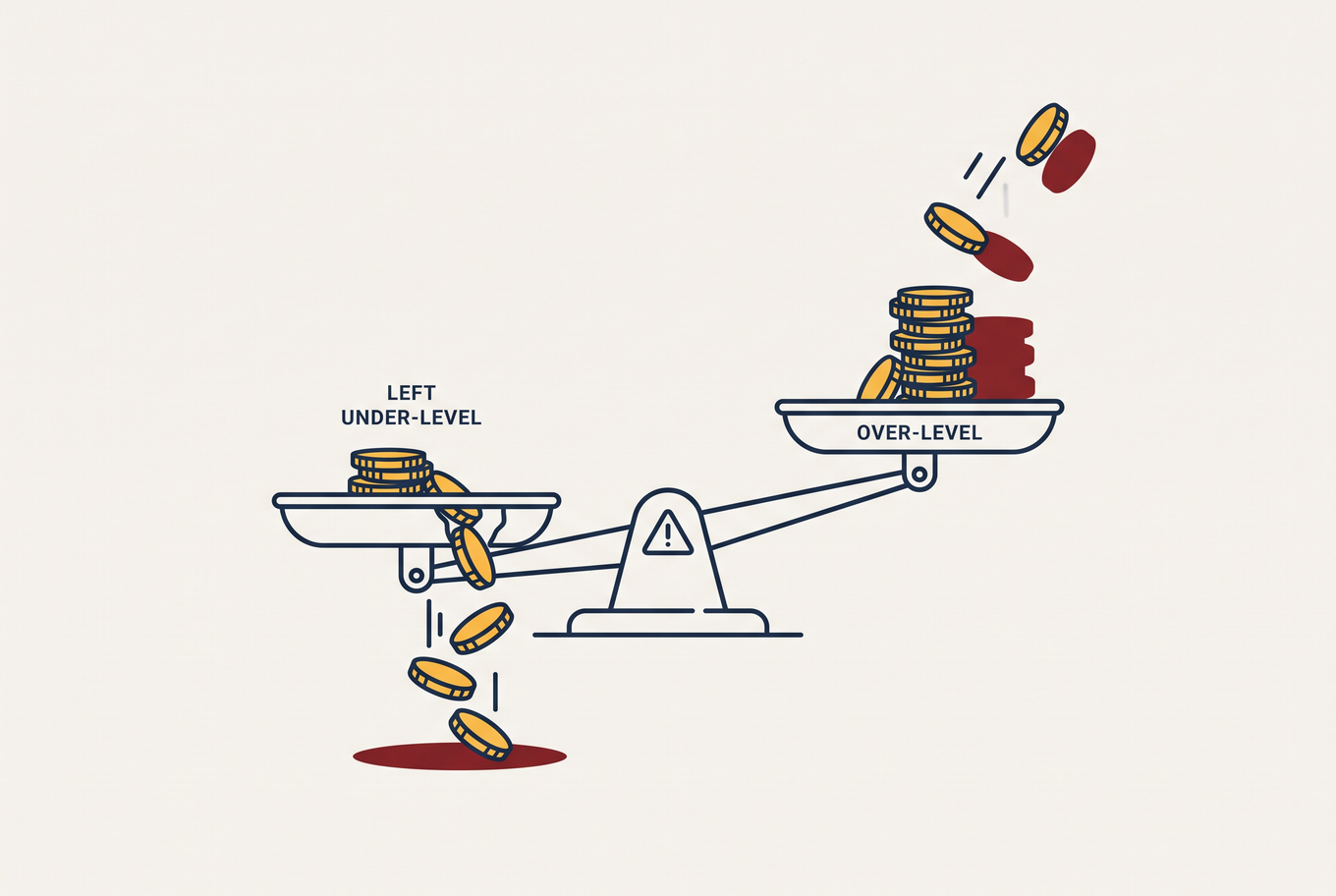
Under-levelling and over-levelling are both control failures. The question is never "can we bill higher?" It is "does the code match the service the documentation supports?" Under-levelling costs legitimate reimbursement, distorts physician productivity data, corrupts case-mix intelligence and hides the need for documentation education. Over-levelling produces denials, downcoding, recoupment, audit exposure, false productivity and compliance risk. A group that has fixed only one direction has not fixed its coding; it has moved its risk.
Should hospital revenue cycle work stay in-house?
Keeping the work in-house is often the right call. It holds up well when the organisation has:
- Enough volume to support dedicated specialists
- Stable, experienced staff with genuine backup coverage
- Current payer-policy and contract libraries
- Reliable coding and CDI audit capacity
- Expected-reimbursement and variance technology
- Clear ownership boundaries between hospital and professional billing
- Strong compliance and legal support
- Measurable service levels and quality
- Low dependency on any single employee
- Disciplined governance
And critically: no need for a vendor to compensate for a broken internal process, because outsourcing a broken process usually produces a broken process with an invoice attached. Outsourcing is not automatically more sophisticated.
That picture usually changes for one of four reasons: the group is growing, through new physicians, a new service line or an acquisition; the payer or case mix has got more complex; nobody has the time the professional claim actually needs; or collections have slipped and nobody can say why. None of those is about size. We work with groups of every size, from a small hospitalist service to a multi-site faculty practice plan, and we take on a single layer of the cycle as readily as the whole of it. The question is never whether a group is big enough to be worth helping - it is which part of the cycle needs owning.
Specialist support becomes defensible under a different set of conditions:
- Specialist vacancies that persist through a real recruiting effort
- Payer knowledge concentrated in one person's head and inbox
- Denial or A/R queues that exceed capacity, rather than exceeding effort
- Recurring code-level or documentation defects
- A group that lacks hospital E/M expertise specifically
- Repeated denials on same-day, concurrent, split/shared or teaching-physician claims
- Contract variance that nobody is working
- A system transition or acquisition that created a backlog
- Old A/R with no owner
- Leadership that cannot see account-level activity
- Internal cost accounting that omits management, quality assurance, vacancy and technology cost
- A desire for targeted capacity without outsourcing the entire cycle
If you evaluate a vendor, ask these - of us as much as anyone:
- Which exact claim types and payer products are in scope?
- Who owns facility versus professional billing?
- What work remains with the client?
- How are denials classified by root cause?
- Are paid claims tested against expected contract payment?
- Who maintains payer policies and effective dates?
- What is the timely-filing and appeal-deadline control?
- How are split/shared, teaching and concurrent-care claims audited?
- What reports show account-level activity rather than totals?
- How is old A/R separated from new claims?
- What happens at cutover, at termination, and on data return?
- What staffing is onshore or offshore, and what access and security controls apply?
- Which metrics have precise definitions?
- Which performance claims are independently evidenced?
- Can you review sample reports, an implementation plan, and references from the same specialty?
Question 14 is the one that filters hardest, and it should be applied to marketing material of every kind, including ours.

When specialist billing services actually fit
A health system can keep registration, utilisation management, facility coding, the chargemaster and institutional billing inside the organisation while using a separate specialist for the hospital-based physician claims. That professional stream has its own claim form, place-of-service rules, E/M code families, documentation requirements and payer edits - and for groups without sufficient inpatient billing depth, or with denials and A/R that internal staff cannot keep current, a specialist team can take over that defined layer without pretending to replace a hospital's revenue cycle.
That is the work we do, on the professional side:
- Claim production and submission
- Inpatient E/M coding review
- Medical-decision-making and time documentation feedback
- Discharge-day coding controls
- Split/shared and teaching-physician documentation review
- Concurrent-care denial handling
- A consultation-code payer matrix
- Credentialing and payer enrolment
- Payment posting
- Professional A/R and denials
- Payer follow-up and underpayment review
- Reporting with root-cause feedback
The entities this fits are hospitalist groups, employed inpatient physician groups, faculty practice plans, contracted specialty groups, inpatient behavioural-health and psychiatry professional groups, and multi-specialty groups whose physicians treat admitted patients.
And here is what we do not do, stated plainly. We do not run system-wide patient access. We do not operate utilisation management or admission-status determination. We do not provide enterprise CDI for facility DRGs, prepare IPPS cost reports, govern a hospital chargemaster, negotiate managed-care contracts for a health system, run hospital price-transparency operations, produce institutional 837I claims at facility scale, reconcile enterprise treasury and general ledger, or replace a hospital's patient financial services department. Those are real disciplines with real specialists, and several of them are the reason the facility half of this guide exists at all.
Where to start when cash misses plan
Hospital revenue cycle management is a control system, and the test of a control system is not whether claims go out clean. It is whether the money that comes back matches what the rules and the contract actually required - across both claims the encounter produced.
One concrete next step: take a single admitted patient from last month and follow the encounter end to end through both claims. The facility claim and the professional claim. At every handoff on the map above, ask three questions - who owns this, what is the deadline, and where is the evidence. You will find at least one handoff where the answer to all three is a shrug. That handoff is where your next cash variance is already forming.
Our take, after doing this work for a living: the organisations that recover the most are rarely the ones with the most aggressive appeal strategy. They are the ones that can name the process behind each denial reason code, and that check whether the payer paid correctly even when the payer did not say no. We take responsibility for one layer of that - the professional claim for admitted patients - and we would rather be precise about the boundary than impressive about the scope.
Common questions about hospital billing and RCM
What is hospital revenue cycle management?
It is the system that converts a patient encounter into correctly classified, documented, coded, billed, adjudicated and collected revenue, then verifies that the amount collected matches what the payment rules and the contract required. It spans patient access, utilisation management, clinical documentation, coding, charge capture, claims, denials, patient billing and payer contract management, and it covers two claims for an admitted patient: the hospital's facility claim and the physician's professional claim.
What are the stages of the hospital revenue cycle?
The commonly cited sequence runs from scheduling and registration through eligibility and authorisation, admission status, clinical documentation, charge capture, coding, claim production, submission, adjudication and posting, denials and appeals, patient billing, and contract variance recovery. A more useful framing treats each stage as a handoff with an owner, a control and a metric, because most losses occur between stages rather than within them.
What is the difference between hospital facility billing and professional billing?
Facility billing covers the hospital's institutional resources - bed, nursing, pharmacy, supplies, imaging, operating room - and is submitted on an 837I, generally paid per discharge through MS-DRGs under IPPS or through APCs under OPPS. Professional billing covers the practitioner's own evaluation, management and procedures, is submitted on an 837P, and is paid per coded service under the Physician Fee Schedule. One inpatient encounter typically produces both.
What is the difference between UB-04 and CMS-1500?
The UB-04, formally the CMS-1450, is the paper institutional claim form used by hospitals and other facilities; its electronic counterpart is the 837I. The CMS-1500 is the paper professional claim form used by physicians and other practitioners; its electronic counterpart is the 837P. In practice nearly all claims are submitted electronically, and the paper forms are best understood as the layout behind the data.
What is the difference between inpatient and observation billing?
Inpatient status is billed under Part A and, for most acute-care hospitals under Medicare, paid per discharge through an MS-DRG. Observation is outpatient status, billed under Part B and paid through outpatient rules, even when the patient occupies a bed overnight. The status decision also flows into the professional claim, which uses place of service 21 for inpatient and 22 for on-campus outpatient.
What does the chargemaster do?
The chargemaster is the hospital's internal master list of items and services with their gross charges, department mapping, revenue codes, HCPCS or CPT assignments, units and effective dates. It determines whether services are captured and billed correctly and it feeds price transparency and expected-reimbursement modelling. It does not determine the MS-DRG - that comes from coded diagnoses, procedures and patient attributes through the grouper.
What is a clean claim, and why isn't it enough?
A clean claim is one that passes edits and is submitted without manual intervention, which makes it a measure of process quality rather than of payment accuracy. It does not prove the admission status was correct, that all supported services were captured, that the DRG or APC was right, or that the payer applied the correct contract rate. A hospital can run a very high clean-claim rate while losing money to denials, underpayments and misclassification.
How do hospitals detect underpayments?
By modelling the expected allowed amount for each claim under the applicable contract or payment rule and comparing it to what the 835 actually reports, then routing variances above a defined threshold into a work queue with an owner and a deadline. This is harder than denial work because a denial creates an obvious exception while an underpayment posts automatically and closes the account. It requires accurate contract modelling, correct payer and product mapping, and the discipline not to treat "paid" as "resolved."
Which metrics should a hospital CFO track?
Pair speed with yield. Alongside clean-claim rate, days in A/R and cost to collect, track expected-versus-actual allowed amount, underpayment inventory and recovery, initial and final denial rates, overturn yield, denial write-offs, DNFB and charge lag, and patient-financial measures. Use standardised definitions such as HFMA's MAP Keys so the numbers are comparable, and pair every headline metric with one that would expose it if it were being managed rather than improved.
How do hospitalists bill for inpatient visits?
Hospitalists bill professional services on an 837P using the hospital E/M families: 99221–99223 for initial hospital inpatient or observation care, 99231–99233 for subsequent daily care, 99234–99236 where admission and discharge fall on the same date and the stay meets the duration requirement, and 99238 or 99239 for discharge day management. Since 2023 the level is selected by medical decision making or total time. The facility submits its own separate claim for the same stay.
What changed in hospital E/M coding in 2023?
From 1 January 2023 the separate observation E/M code families were deleted and merged into the hospital inpatient and observation families, so one set of codes now serves both settings. More significantly, the visit level became selectable by medical decision making or total time, and history and examination - while still required to be medically appropriate - no longer determine the level. Place of service still distinguishes inpatient from outpatient on the professional claim.
When should a hospital outsource part of its revenue cycle?
When a specific capability gap persists despite genuine effort to close it internally: unfilled specialist roles, payer knowledge concentrated in one person, denial or A/R queues beyond capacity, recurring code-level defects, or a backlog created by a system transition or acquisition. Outsourcing works best as targeted capacity for a defined layer with defined metrics, not as a remedy for a process nobody has diagnosed. If the internal process is broken, outsourcing it usually preserves the breakage and adds a handoff.
Sources, and when this guide was last reviewed
Last reviewed: 17 August 2026. This guide states policy that was in force on that date. Rate years turn over, so the following will need rechecking: FY 2027 IPPS takes effect for discharges from 1 October 2026; FY 2027 ICD-10 files take effect 1 October 2026; the CY 2027 OPPS rule was proposed rather than final when this was written, with comments due 31 August 2026.
Facility payment, claims and status: CMS Acute Inpatient PPS · FY 2026 IPPS final rule · FY 2027 IPPS summary, MLN Connects, 3 August 2026 · Medicare Payment Systems · Outlier payments · MS-DRG classifications and software · Hospital Outpatient PPS · CY 2026 OPPS final rule · CY 2027 OPPS proposed rule · CMS-1450 / UB-04 · 837I billing guide · HIPAA adopted standards · ICD-10 · Hospital-acquired conditions and POA · HAC Reduction Program · Patient status reviews · MOON · Beneficiary notices · Condition Code 44 guidance · Three-day payment window · Critical access hospitals · Inpatient psychiatric facility PPS · Inpatient rehabilitation facility PPS
Professional billing: 837P / CMS-1500 · Place of service code set · Claims Processing Manual, Chapter 12 · Benefit Policy Manual, Chapter 15 · AMA E/M implementation guidance · AMA E/M descriptors and guidelines · RVU26C, July 2026 release · Physician Fee Schedule lookup · Physician assistant payment · APRN payment · CY 2023 PFS rulemaking (G0316) · Noridian prolonged services guidance · ACEP critical care FAQ · UnitedHealthcare commercial consultation services policy 2026R0129A
Improper payment data: FY 2024 Medicare Fee-for-Service Supplemental Improper Payment Data · CERT improper payment rates and additional data
Appeals, remittance, prior authorisation and patient protections: Medicare Parts A & B appeals process · Third-level appeal and amount in controversy · Fifth-level appeal · Federal district court review and 2026 threshold · Timely filing · Health care payment and remittance advice · CAQH CORE CARC/RARC combinations · Prior authorisation FAQ · Electronic prior authorisation · EMTALA · No Surprises Act · Good faith estimate · Disputing a bill · IRS section 501(r) requirements
Price transparency, metrics and benchmarks: Hospital price transparency · Machine-readable file requirements · Price transparency enforcement · Price transparency FAQ · HFMA MAP initiative · HFMA revenue cycle management · Kodiak Solutions denial benchmark · AHA survey on the Change Healthcare cyberattack
State examples (Illinois, illustrative only): 215 ILCS 5/368a prompt payment · Illinois Department of Insurance claims guidance · Illinois Fair Patient Billing Act
This guide is general information about U.S. hospital revenue cycle operations and payment rules. It is not legal, compliance or tax advice, and payer, state and plan requirements vary. Verify current rules against the primary sources linked above before applying them to a specific claim.