Telehealth Mental Health Billing: What Actually Pays
August 24, 2026 · 47 min read
A payer that paid your video sessions all year starts denying them in March. Nothing in the practice changed: same clinicians, same codes, same platform, same patients, same fifty-three-minute sessions. Or the opposite happens and it is worse, because nothing looks wrong at all. The claims keep paying, the denial report stays clean, and the deposits are quietly smaller than they were before the EHR migration.
In both cases, the modifier is probably not the problem.
Telehealth mental health billing breaks in a specific way: a payer can cover a service and the claim for it can still be denied, underpaid, or paid out of network. "Covered" and "will pay correctly" are two different statements, and almost all of the money lives between them. The prerequisites are decided before anyone chooses a code: which product the member has, who administers the behavioral benefit, whether the clinician is enrolled as well as licensed, where the patient was physically sitting, and whether the payer's live claims system agrees with its own published policy.
If you have been given three different answers by three different people, you are not doing this wrong. The rules genuinely conflict. We work these claims for behavioral health practices, and the reason this is hard is structural, not a failure of attention.
Current as of August 17, 2026. Medicare's permanent behavioral-health telehealth rules are separated below from temporary provisions that currently run through December 31, 2027. Commercial, Medicare Advantage, Medicaid, and state licensure rules differ from Medicare and from each other. Verify the member's product and the patient's physical state for your date of service.
What goes on a telehealth therapy claim right now
There is no universal telehealth claim combination. There is a specific, knowable answer for Medicare right now, and a specific reason the other payers depart from it.
What is true today, August 17, 2026:
- Medicare's home-based behavioral and mental-health telehealth benefit is permanent. So is the removal of the geographic and originating-site restrictions for behavioral health, including substance use disorder services. These do not expire.
- The in-person visit condition attached to that benefit is suspended, not repealed. Under current law it is not required through December 31, 2027.
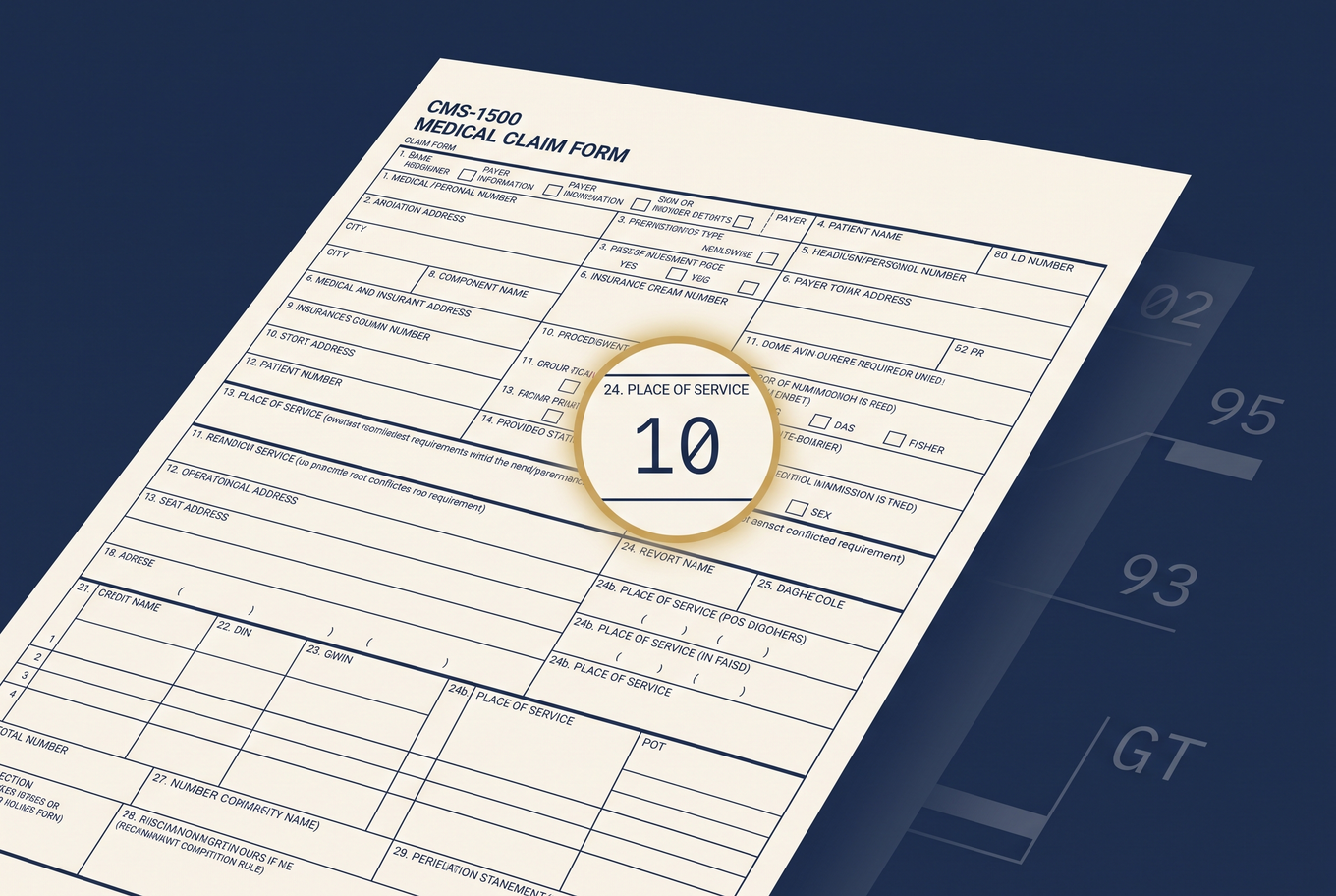
- For Medicare professional claims, the current pairing is place of service 02 or 10 with modifier 95 for audio-video, or modifier 93 for audio-only. POS 10 means the patient was at home; POS 02 means the patient was somewhere else.
- The POS - not the modifier - determines whether Medicare pays the facility or the non-facility rate. This is where silent underpayment comes from.
- Commercial payers diverge from Medicare and from each other. One major national payer says the common video modifiers are not required at all. Another currently instructs POS 02 for behavioral health even when the patient is at home.
- Medicaid is fifty-plus separate programs, each with its own manual, fee schedule, and managed-care layer on top.
Every one of those sentences is the output of a check that happens before a code gets chosen, and those checks decide whether the claim survives.
Seven gates every online therapy claim has to clear
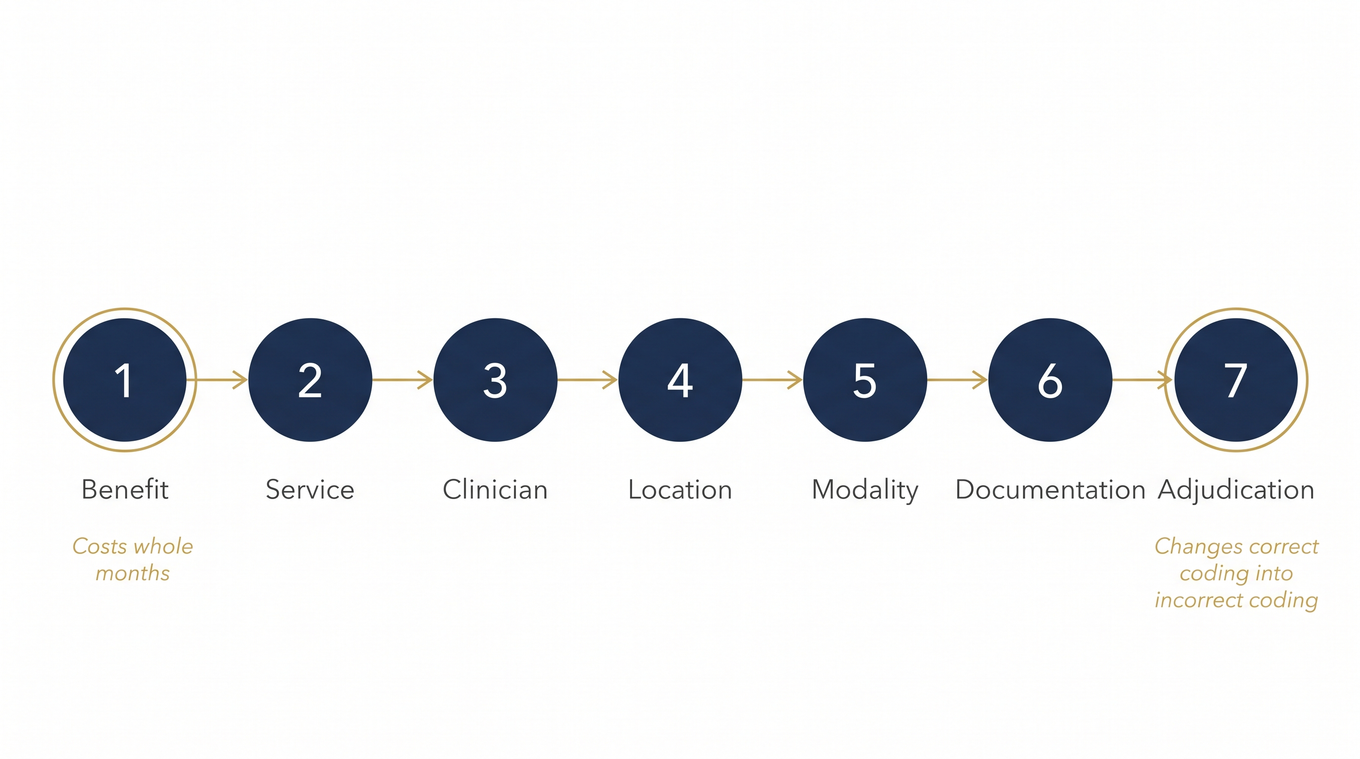
A telehealth claim is not a code plus a modifier. It is the end of a chain - benefit → service → clinician → location → modality → documentation → adjudication - and it fails at the weakest link. Working the chain in order beats working denials, because six of the seven gates can be cleared before the session happens.
| # | Gate | The question it answers | What it prevents |
|---|---|---|---|
| 1 | Benefit | Is behavioral health covered under this member's exact product, and is it carved out to another administrator? | Claims routed to the wrong payer entirely |
| 2 | Service | Is this CPT or HCPCS code eligible through the modality used - video, audio-only, or neither? | A covered service billed through an ineligible channel |
| 3 | Clinician | Is this professional type covered, licensed, enrolled, credentialed, contracted, and in scope for the patient's state? | Out-of-network processing and non-payable provider types |
| 4 | Location | Where was the patient physically sitting, and what POS does this payer require for that location? | Facility-rate underpayment and licensure exposure |
| 5 | Modality | Which modifier, if any, identifies audio-video or audio-only for this payer and product? | Rejections for a modifier that is required, absent, or invalid |
| 6 | Documentation | Does the record prove location, modality, time, medical necessity, consent, and participants? | Recoupment after a post-payment review |
| 7 | Adjudication | Does the payer's live claims system actually match its written policy? | Compliant coding being "fixed" into non-compliant coding |
Gate 1 is the one that costs whole months. Mental-health and substance-use benefits are frequently carved out to a separate behavioral organization with its own payer ID, portal, network, and authorization process. The front desk verifies the medical plan, sees that mental health is covered, and schedules. Nobody verifies who actually adjudicates the therapy claim - and by the time anyone does, it is usually because several sessions have already been delivered against the wrong payer.
Gate 7 is the one that makes people change correct coding into incorrect coding. A payer's published policy and its live adjudication behavior can disagree, and when they do, the denial is not evidence that your claim was wrong. Treating every denial as a coding error is how a temporary payer defect becomes a permanent compliance problem.
What Medicare made permanent, and what expires December 31, 2027
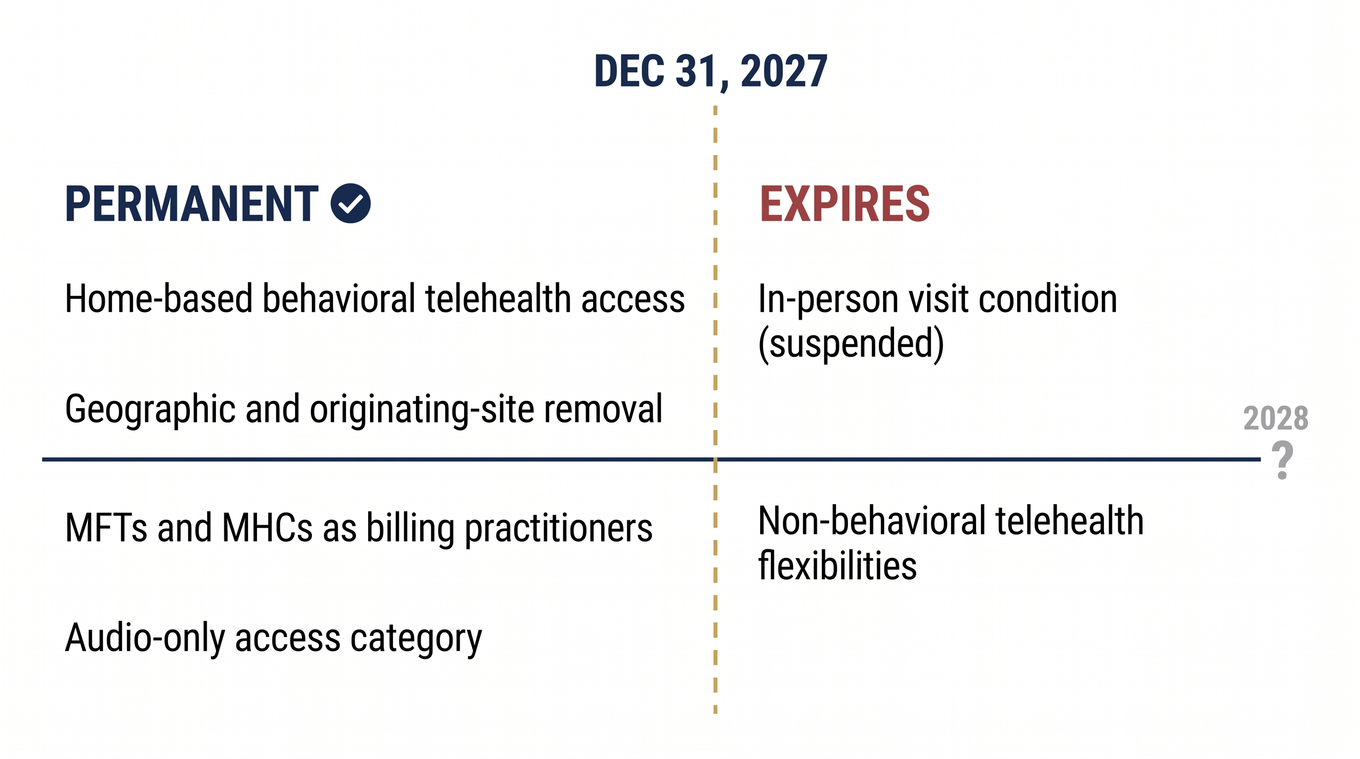
A common framing collapses two different things into one sentence: "Medicare telehealth was extended through 2027." For behavioral health, that is backwards. It implies the benefit itself expires. It does not.
Congress permanently removed the geographic and originating-site restrictions for Medicare behavioral-health telehealth, including substance use disorder services. A beneficiary in an urban or rural area can receive covered behavioral telehealth at home, and that is not scheduled to end. What is tied to December 31, 2027 is the waiver of an in-person visit condition attached to that benefit, plus broader flexibilities that apply to non-behavioral telehealth.
Medicare status as of August 17, 2026
| Rule | Status today | What happens next |
|---|---|---|
| Behavioral/mental-health telehealth at home | Permanent | No scheduled expiration |
| Geographic originating-site restriction for behavioral health, incl. SUD | Permanently removed | Urban and rural beneficiaries both eligible at home |
| Two-way real-time audio-only for behavioral health | Permanent category of access, with conditions | After 2027, available at home where the clinician is video-capable and the patient cannot use or does not consent to video |
| MFTs and MHCs as Medicare billing practitioners | Permanent, since January 1, 2024 | Continues where enrollment and service requirements are met |
| RHCs and FQHCs as distant sites for behavioral health | Permanent | Paid under the applicable AIR or PPS methodology |
| In-person visit within six months before the first home tele-mental-health service, and annually thereafter | Statutory, but suspended through Dec. 31, 2027 | Effective after that date unless Congress acts again |
| Home and originating-site flexibility for non-behavioral telehealth | Temporary through Dec. 31, 2027 | Reverts to narrower statutory rules in 2028 absent legislation |
| Broad eligible practitioner types for non-behavioral telehealth | Temporary through Dec. 31, 2027 | May narrow in 2028 |
| POS 10 (home) paid at the non-facility PFS rate | Current payment policy since January 1, 2024 | Recheck code-level values each annual PFS cycle |
| POS 02 (not home) paid at the facility PFS rate | Current payment policy | Recheck annually |
| Frequency limits on subsequent inpatient, nursing-facility, and critical-care telehealth consultations | Permanently removed, effective January 1, 2026 | No scheduled return |
*Sources: HHS telehealth policy updates, last updated February 5, 2026; HHS Medicare payment policies, February 5, 2026; CMS Telehealth FAQ, updated February 26, 2026; CMS Change Request 13749; CY 2026 PFS final rule fact sheet.*
Does Medicare require an in-person visit? Not until 2028
The distinction matters operationally, because the transition rules attach to dates you are creating right now.
Under CMS's February 2026 FAQ, once the condition takes effect: a new home tele-mental-health patient generally needs an in-person Medicare-paid service from the practitioner within the preceding six months; after the first home service, an in-person service is generally required at least once every twelve months, with limited exceptions; and a practitioner of the same specialty in the same group may perform that in-person service when the telehealth practitioner is unavailable.
The piece that changes what you should be recording today: a beneficiary who began receiving home mental-health telehealth on or before December 31, 2027 is treated as established and does not need the initial six-month lookback visit, though they would move into the annual requirement afterward under the current rule.
So capture the date a patient started home telehealth with your practice now, while it is easy, rather than reconstructing it in 2028. It does not make the condition currently operative. Through December 31, 2027, the rule in force is that the condition is not required, and building your workflow as though it already applies creates access problems for patients who do not need them.
Which practitioners Medicare will actually pay
A covered code and a valid modality do not make every clinician independently payable. Since January 1, 2024, qualifying marriage and family therapists and mental health counselors can enroll and bill Medicare Part B independently for the diagnosis and treatment of mental illness, and CMS pays them at 75% of the amount paid to a clinical psychologist under the Physician Fee Schedule. Qualifying addiction counselors may enroll as MHCs where they meet the federal criteria. (CMS, Marriage and Family Therapists & Mental Health Counselors, updated July 20, 2026.)
Do not collapse the practitioner types into "therapists." A psychiatrist billing an E/M with a psychotherapy add-on, a psychologist billing 90837, an LCSW, and an MFT can face different enrollment categories, payment percentages, supervision rules, and code eligibility even when the session looks identical to the patient.
And enrollment is its own gate. Medicare payment also requires active enrollment, correct reassignment where applicable, a valid service location, and claims submitted under the right billing and rendering relationship. A state license does not enroll anyone in Medicare, and neither does a compact privilege.
POS 02 vs POS 10: the field that quietly moves the money
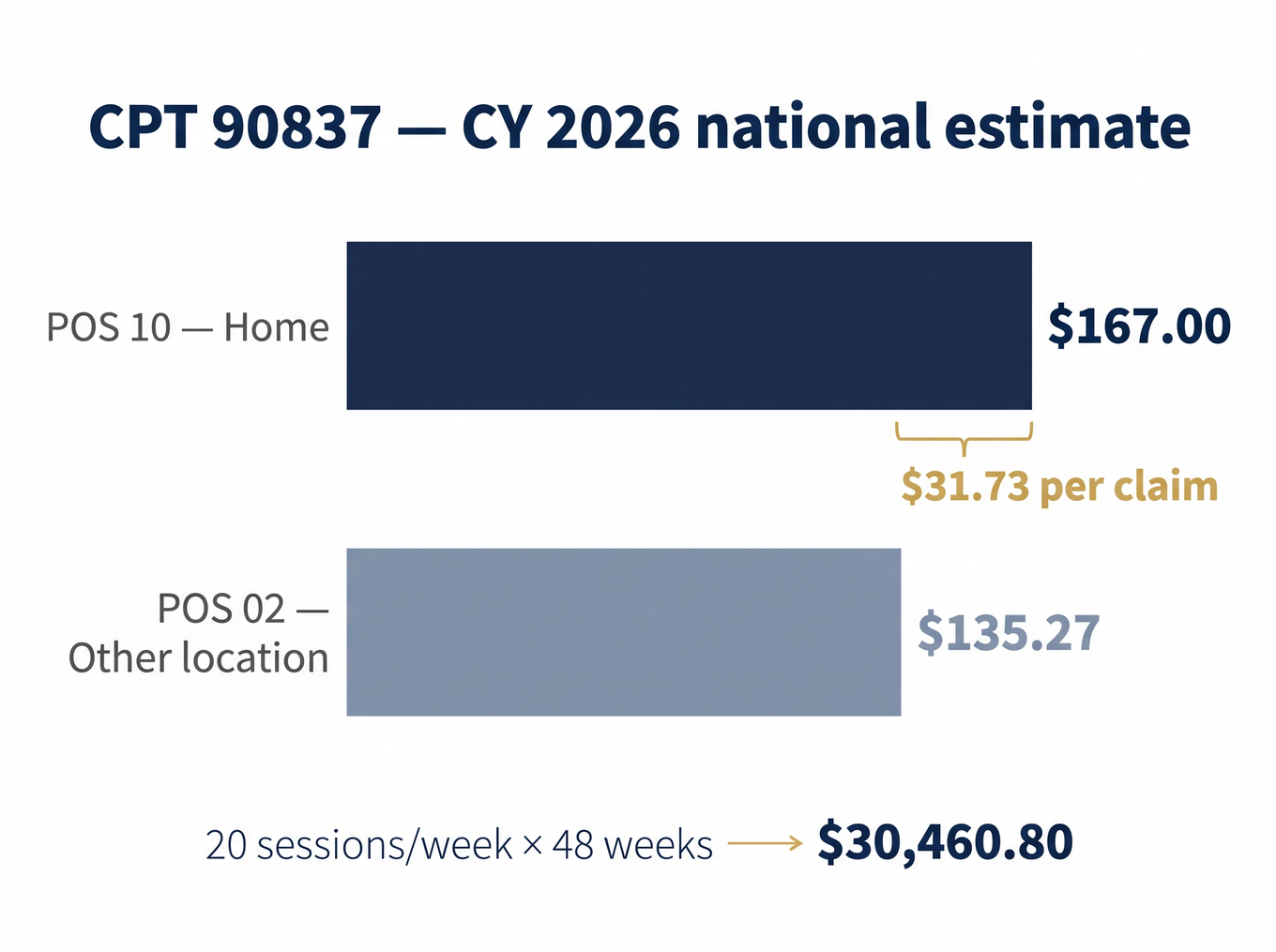
Place of service on a telehealth claim answers one question - where was the patient physically located - and Medicare attaches real money to the answer.
- POS 10 - the patient received telehealth in their home. Medicare pays the non-facility PFS rate.
- POS 02 - the patient received telehealth somewhere other than home. Medicare pays the facility PFS rate.
CMS finalized non-facility payment for home telehealth beginning January 1, 2024. Change Request 13749 is explicit about the mechanism: POS 02 or 10 must be paired with the appropriate modality modifier, 93 for audio-only or 95 for audio-video, and the modifier does not set the rate. The POS does.
POS says where the patient was. The modifier says how the service happened. For Medicare, the POS - not the modifier - drives facility versus non-facility payment.
Audio-only does not pay less because it carries modifier 93. Whether the code is covered through that modality is a separate question, and so is the rest of the fee schedule.
What POS 02 vs POS 10 costs per claim
Take 90837 as an illustration. APA Services' national estimate for CY 2026 lists $167.00 at the non-facility rate. A national facility-rate estimate for the same code runs approximately $135.27 - a difference of roughly $31.73 per claim before geographic adjustment and practitioner-specific reductions.
Modeled across a steady Medicare panel, twenty home sessions a week for forty-eight weeks:
20 sessions × 48 weeks × $31.73 = $30,460.80
Read that as a scenario, not a forecast. It is not recovered revenue, it is not a guaranteed loss, and it is not what any specific practice will see. Actual allowed amounts vary by locality, clinician type, sequestration, and other adjustments, and you should run your own numbers in the CMS Physician Fee Schedule lookup rather than trusting a national figure. (APA Services, Medicare changes coming in 2026, November 21, 2025.)
The model shows the shape of the risk. A claim can pay, clear every edit, appear on a clean denial report, and still be materially underpaid - every week, on every recurring session, for as long as the default survives.
What counts as the patient's home for POS 10
CMS defines POS 10 as telehealth in a private residence rather than a hospital or other facility. Capture the patient's actual location; do not infer it from the appointment type or the address in the demographic record.
The hard cases are the ones scheduling hits every week: a hotel, a temporary residence, a shelter, a college dorm, an assisted-living setting, a school, a parked car. These are resolved against the payer's own POS definition with a documented rationale, not guessed. Preserve the exact address and the reasoning, not just a state abbreviation. Under audit, the note either proves the location or it does not.
One related trap. A qualifying originating site may separately bill Q3014 when the statutory and program conditions are met, and CMS lists the CY 2026 national originating-site facility fee at $31.85, up from $31.01 in 2025 (CMS List of Telehealth Services, modified March 4, 2026). A patient's home is not automatically a separately payable facility, the distant practitioner does not add Q3014 simply because the patient sat somewhere institutional, and commercial payers may refuse it outright - UnitedHealthcare does not reimburse the originating-site fee for POS 10, and Cigna's policy states it does not reimburse Q3014, G2025, or T1014.
Modifier 95 vs modifier 93 - and when payers want neither
The reason billers get contradictory answers is that the answers really are contradictory. Three current, published, national policies want three different claims for the same fifty-three-minute video session with a patient at home.
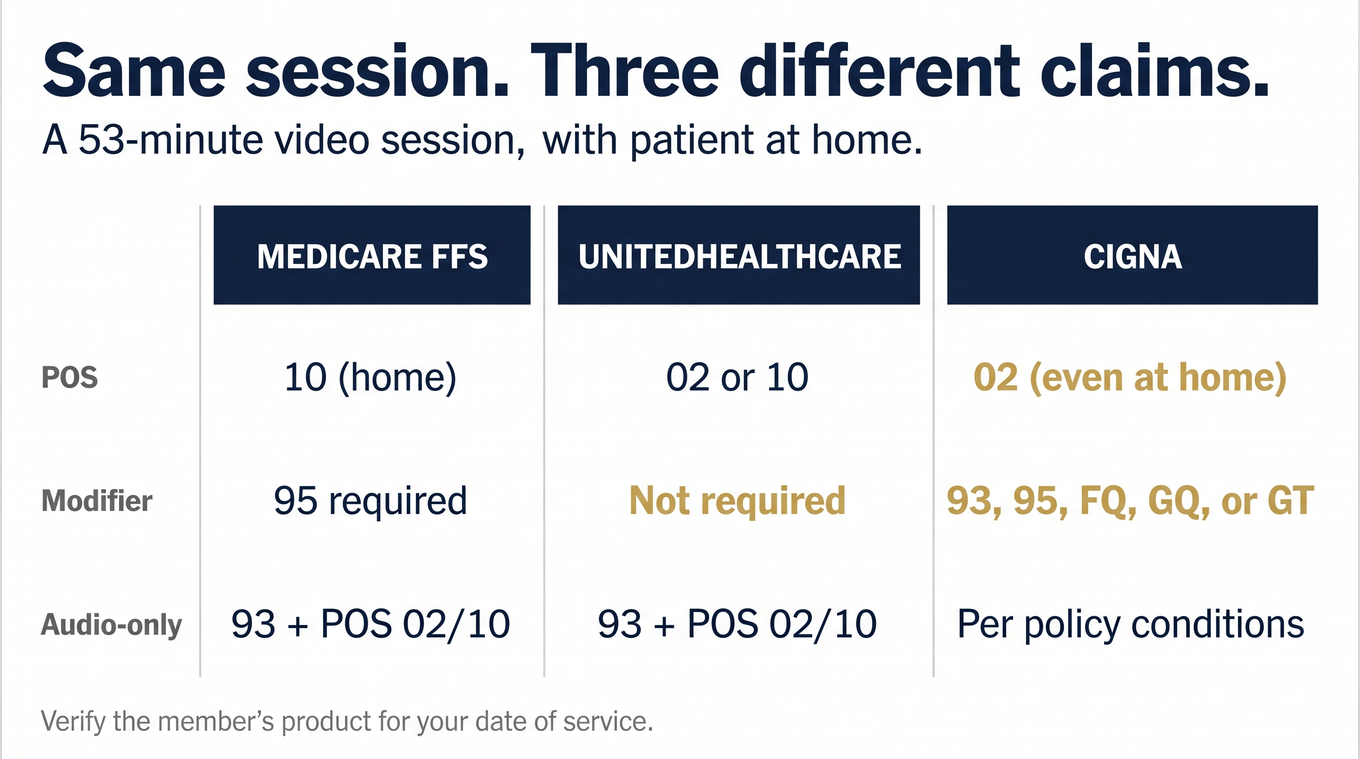
| Payer / policy | POS for audio-video | Audio-video modifier | Audio-only |
|---|---|---|---|
| Medicare FFS (professional claims, CR 13749) | 02 or 10, by patient location | 95 required | 93, paired with POS 02 or 10 |
| UnitedHealthcare Commercial & Individual Exchange, policy 2026R0046A | 02 or 10, by patient location | 95, GT, GQ, G0 not required; accepted informationally | Eligible listed services with modifier 93 and POS 02 or 10 |
| Cigna Commercial, R31 Virtual Care (retrieved Aug. 17, 2026) | POS 02 for behavioral health, including when the patient is home | One of 93, 95, FQ, GQ, GT | Synchronous audio and/or video for eligible behavioral services under policy conditions |
*Sources: CMS Change Request 13749 / Transmittal R12779CP; UnitedHealthcare Telehealth/Virtual Health Policy, Professional, policy version changed January 1, 2026 with updated code lists; Cigna R31 Virtual Care Reimbursement Policy.*
Cigna's position is the cleanest proof that "home means POS 10" is not a universal rule. Its policy history records that effective July 1, 2022 it directed providers to use POS 02 and not POS 10 until further notice, and its current behavioral-health guidance still calls for POS 02 plus one of its accepted modifiers, along with a permanent record identifying the delivery method, secure technology, medical necessity, and practice within licensure and scope.
Aetna is a third shape of the same problem. Its national provider manual confirms broad virtual-care participation across commercial fully insured and self-insured products unless a plan sponsor opts out, and directs providers to the applicable policy - while its Texas telemedicine policy is narrower, applying to in-network Texas providers and fully insured products governed by Texas law, using POS 02 and/or GT/95. (Aetna Office Manual for Health Care Professionals.) The lesson is not "Aetna requires GT." It is that Aetna cannot be reduced to one national claim recipe, and neither can any Blue plan.
Public payers add their own convention. Illinois Medicaid told enrolled behavioral-health providers that for dates of service beginning October 1, 2021, Community-Based Behavioral Services furnished by audio or video were to be reported with modifier GT and POS 02, for both fee-for-service and managed care, for tracking purposes rather than as a payment-methodology change (Illinois HFS provider notice, September 1, 2021). Illinois later used modifier 93 for audio-only.
So a practice running one 90837 claim template across Medicare, UnitedHealthcare, Cigna, and a Medicaid MCO can be wrong in four different ways while delivering an identical clinical service.
The sentence to operate on is not "telehealth requires modifier 95." It is: use the POS and modifier combination required by this member's payer, this product, this service, this modality, and this date of service.
How to bill audio-only and phone therapy sessions
The common failure is treating the telephone as a backup plan: the video will not connect, the session happens by phone, and the claim goes out as though the modality were interchangeable. It is not. Audio-only eligibility is its own verification, done before the appointment rather than after the connection fails.
For Medicare, audio-only is a permanent category of access for behavioral and mental health. CMS's current framework permits two-way real-time audio-only for home telehealth where the practitioner is technically capable of audio-video but the patient is not capable of using, or does not consent to, video. Broader temporary audio-only flexibilities also remain in effect through December 31, 2027. (HHS telehealth policy updates; HHS billing and coding Medicare fee-for-service claims.)
"Does this payer cover audio-only" is really six questions:
- Does the payer permit audio-only at all under this product?
- Is this specific code eligible by audio-only, or only some of the code list?
- Was the patient at home, if you are relying on the home audio-only pathway?
- Was the clinician technically capable of video?
- Was the patient unable to use, or did they decline to consent to, video?
- Which modality indicator and which documentation does this payer require?
The note has to make those answerable later, by someone who was not there: that the encounter was synchronous, two-way and real time; the patient's exact location; the clinician's video capability; the patient's inability or non-consent where that applies; that the modality was genuinely audio-only; and that psychotherapy time, medical-necessity and participant requirements were met. A line reading "telephone visit" establishes almost none of that.
The most expensive version of this is subtle: a session that starts on video, drops, finishes by phone, and stays coded as video because nobody documented the change. That claim is wrong in the record before it is ever wrong on the remittance.
Commercial and Medicaid rules diverge here more sharply than anywhere else. UnitedHealthcare limits audio-only reimbursement to services on its eligible list and requires modifier 93 with POS 02 or 10. Cigna permits synchronous audio and/or video for eligible behavioral services where its code, modifier, POS, plan, and documentation conditions are met. Aetna's Texas telemedicine policy says audio-only is not required to be covered. State Medicaid programs vary by service, practitioner, and setting even where the program reimburses audio-only generally.
Telehealth billing codes for mental health sessions
Medicare generally keeps the ordinary psychiatric and psychotherapy code families for telehealth rather than substituting a generic "teletherapy code." The frequently used telebehavioral services HHS lists are the ones you already bill:
| Service | Codes |
|---|---|
| Psychiatric diagnostic evaluation | 90791; 90792 for eligible medical practitioners |
| Individual psychotherapy | 90832, 90834, 90837 |
| Psychotherapy add-ons to eligible E/M | 90833, 90836, 90838 |
| Crisis psychotherapy | 90839, 90840 |
| Family psychotherapy | 90846, 90847 |
| Group psychotherapy | 90853 |
| Interactive complexity add-on | 90785, where its separate requirements are met |
| Prescribing practitioners | Eligible office and outpatient E/M |
*Source: HHS, Billing for telebehavioral health, updated July 29, 2025.*
The telehealth mechanics sit on top of those codes. They do not relax anything underneath. CMS coverage guidance sets the psychotherapy time bands at 16–37 minutes for 90832 and 90833, 38–52 minutes for 90834 and 90836, and 53 minutes or more for 90837 and 90838; psychotherapy under 16 minutes is not separately reportable under those families; start and stop times or total time must be documented; and psychotherapy time billed alongside an E/M service must be distinct from the E/M work. (CMS Medicare Coverage Database, Article A57520.)
A fifty-minute session billed as 90837 is a time-band problem whether it happened in an office or on a screen. Telehealth did not create that exposure, but a full virtual panel multiplies it across every recurring appointment.
Two things are easy to get wrong here.
Three code lists that are not the same list
- The CMS Medicare Telehealth Services List determines which otherwise face-to-face services Medicare will pay under the telehealth benefit.
- The AMA's CPT telemedicine structure identifies services and modality conventions for CPT reporting, which commercial payers may adopt differently.
- The payer's own eligible-code list controls the commercial or Medicaid claim, and may be narrower, broader, or configured differently from either of the above.
A service appearing in an AMA telemedicine appendix does not guarantee Medicare payment. A service on the CMS list does not guarantee a commercial payer accepts Medicare's POS and modifier combination.
Are the 98000-series codes used for psychotherapy?
The AMA introduced a family of synchronous audio-video and audio-only telemedicine E/M codes beginning in 2025, and the older CPT codes 99441–99443 for telephone evaluation and management were deleted. Medicare's treatment of the 98000 family does not simply mirror commercial use, and payer adoption is uneven - Cigna, for instance, added 98000–98015 to the medical section of its virtual care policy effective January 1, 2025, which does not convert them into a replacement for psychotherapy codes under a behavioral benefit.
Do not adopt a blanket "use 98000–98015 for virtual visits" rule. Verify each code's current status in the CMS PFS lookup and in the payer's own policy. For ordinary psychotherapy, the 908xx families remain the service codes - the session did not become a different service because it happened over video.
A few settings sit outside this framework entirely and should not be forced into it: Opioid Treatment Programs have their own HCPCS bundles and claims instructions, including POS 58 for specified services (CMS OTP billing); crisis services may fall under G0017 and G0018 in applicable non-facility settings rather than 90839 and 90840, and the choice is not decided by whether the service was virtual (CMS, Psychotherapy for Crisis, updated February 25, 2026); and hospital outpatient behavioral services furnished remotely by hospital staff run on an institutional pathway, not an independent practice's CMS-1500 workflow.
Commercial plans and Medicaid are separate rulebooks
Outside Medicare, there is no national answer to reason from - only a member's specific product, the law of the state that regulates it (if any state does), and whatever the plan document says. Four distinctions do most of the work in that territory, and getting any of them backwards produces confident, expensive errors.
Coverage parity vs payment parity: four different things
They are routinely collapsed, and they are not the same:
- Coverage parity - the plan must cover a telehealth-delivered service when it covers the comparable in-person service, within the statute's scope.
- Payment parity - the plan must reimburse telehealth on the same or a comparable basis as in-person care.
- Cost-sharing parity - the member cannot be charged more solely because the service was virtual.
- Mental-health parity - financial requirements and treatment limitations for MH/SUD benefits generally cannot be more restrictive than the comparable medical/surgical framework.
A state can have one and not the others. A statute may reach only certain services, providers, networks, plans, or modalities, and may explicitly permit a negotiated telehealth rate.
NCSL reported in 2026 that 44 states, Puerto Rico, and Washington, D.C. have private-payer laws governing telehealth reimbursement, and that 24 states include an explicit payment-parity requirement for at least one type of service - with some parity rules limited to selected specialties, behavioral health among them, or allowing negotiated rate differences. (NCSL, Telehealth Private Insurance Laws; NCSL, Connection for a Cure; see also NCSL State Telehealth Policies.) Treat those as a national survey, useful for orientation. The enacted statute, the insurance-department rule, or the plan document is what controls a specific claim.
Mental-health parity gets deployed as though it were a payment button. It is an appeal tool. It can be relevant when a plan imposes a financial requirement or treatment limitation on mental-health telehealth that is more restrictive than the comparable medical/surgical framework. It does not tell you whether the clinician is in network, whether the code is eligible through the modality, whether authorization was obtained, which POS or modifier the claim needs, or what the contracted rate is. (CMS, Mental Health Parity and Addiction Equity Act.)
Why self-funded plans can escape state telehealth mandates
State insurance mandates ordinarily regulate products issued under state authority. A private employer's self-funded group health plan is regulated primarily under federal ERISA structures instead, and the familiar insurer logo on the card may belong to a third-party administrator rather than the risk-bearing entity.
Ask the employer or plan administrator whether the plan is insured or self-funded before telling anyone that a state telehealth parity statute applies to their claim. It is a two-minute question that prevents a six-month appeal built on the wrong authority.
Medicaid is fifty-plus programs, not one rulebook
Federal Medicaid law gives states broad discretion to define telehealth coverage, eligible providers, modalities, locations, and payment methods. CMS notes that a state can reimburse telehealth the same way and in the same amount as in-person care without a separate reimbursement state-plan amendment, while a different payment methodology may require one. (Medicaid.gov, Telehealth; Reimbursement for Telehealth and Provider and Facility Guidelines.)
NCSL's 2026 reporting, citing CCHP, finds that every state plus Puerto Rico and D.C. reimburses some form of live-video telehealth in Medicaid; 40 programs reimburse some store-and-forward service; 41 reimburse some remote patient monitoring; and 46 states plus D.C. reimburse some audio-only care.
Those counts describe programs, not claims. "This state reimburses audio-only" does not establish that online psychotherapy by this clinician, under this code, in this setting, is payable. The limits usually sit at the code, provider type, patient location, program, managed-care contract, or medical-necessity level.
Managed care adds a further layer, and it has to be checked in order: state statute or regulation, then the state Medicaid provider manual and fee schedule, then managed-care contract requirements or state directives, then the MCO's own provider policy and code list, then the member's benefit and authorization, then the plan's actual live adjudication behavior. An MCO cannot be assumed to use the state fee-for-service payer ID, modifier convention, authorization process, or rate, even where the state has set a baseline.
Illinois: a valid rule that still failed in the claims system
Illinois published a clear behavioral-health telehealth instruction in 2021. It then disclosed, in a provider notice issued January 9, 2023, that duplicate-claim logic and add-on-code processing had caused telehealth-modifier claims to reject or underpay. HFS could not automatically reprocess all affected claims and instructed providers to rebill or submit replacement claims, with timely-filing overrides in the described circumstances.
The episode is worth more than its state: primary-source proof that correct published coding does not guarantee correct adjudication; that a payer can repair its own defect without automatically making providers whole; and that "the claim denied, so the code must be wrong" is a dangerous inference. Practices need denial surveillance, replacement-claim discipline, and awareness of timely-filing relief - not a reflex to change compliant coding until something pays.
Before relying on any of it, retrieve the current Illinois behavioral-health fee schedule, telehealth handbook, and each relevant MCO's 2026 instructions. (Illinois HFS Telehealth Services; HFS provider handbooks.) A 2021 notice explains history and lesson; it is not, by itself, today's billing rule.
Medicare Advantage deserves the same discipline. MA plans must cover basic Part A and Part B benefits and may furnish additional telehealth benefits under 42 CFR 422.135 - for which the plan must offer an in-person option, use contracted providers, comply with credentialing requirements, and ensure state licensing compliance where the enrollee receives the service (42 CFR 422.100). Plans layer their own network, authorization, claim, and cost-sharing rules on top. An MA card is not Original Medicare with different artwork, and submitting against Original Medicare's modifier table is a recurring, avoidable denial.
Behavioral health carve-outs: the card may not name the payer
This is the failure that costs whole months rather than single claims, and it runs the same way nearly every time:
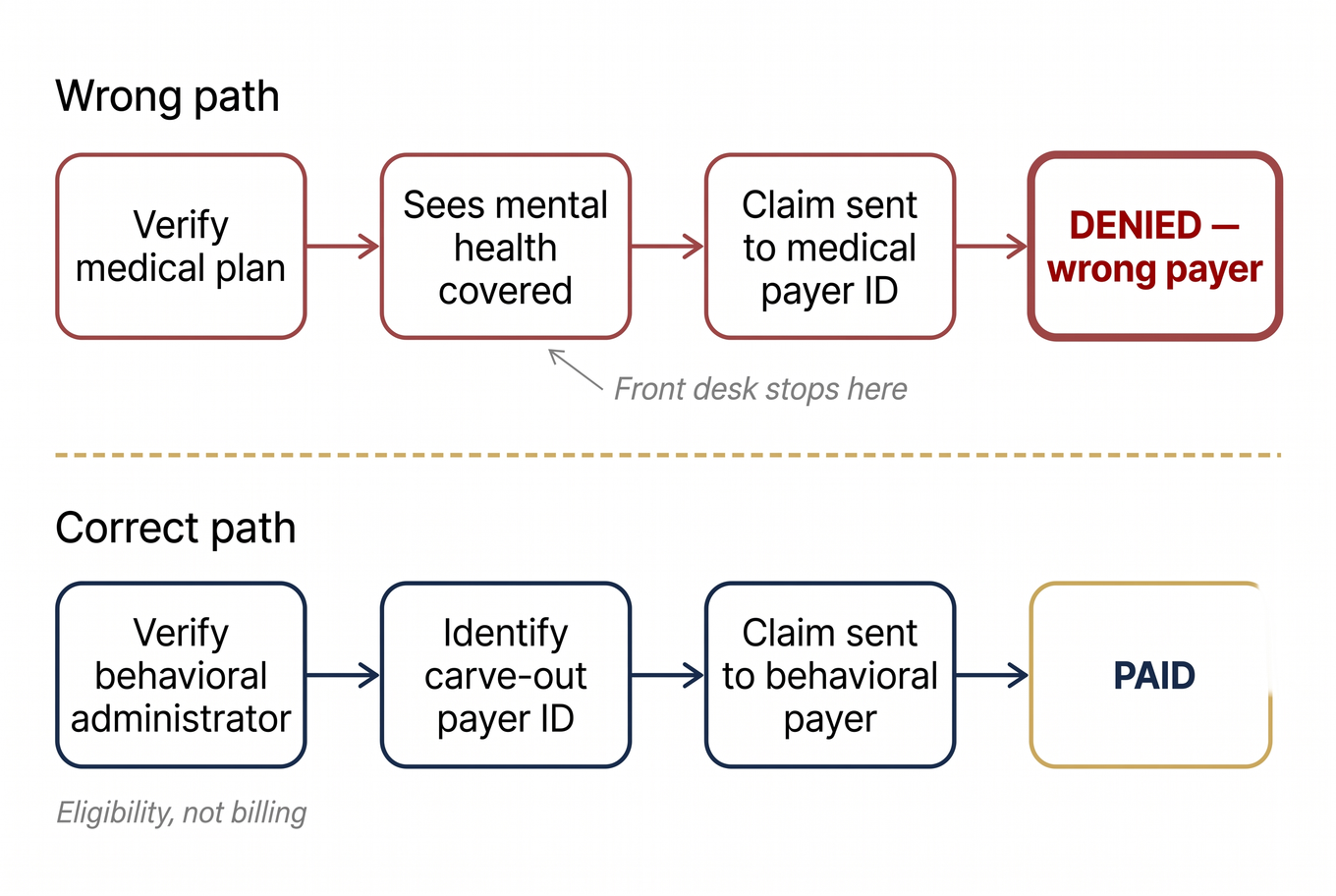
- The front desk verifies the patient's medical eligibility.
- It sees "mental health covered" and schedules.
- The clinician is in network with the medical product but not with the behavioral administrator, or is credentialed under a different TIN or service location.
- Claims go to the medical payer, deny for wrong payer or no authorization, or simply sit while the timely-filing window narrows.
- After several sessions, the practice discovers that an EAP authorization, a carve-out authorization, or a different payer ID was required all along.
The verification that prevents it is a short list, and it belongs to eligibility rather than to billing:
- Who administers outpatient mental-health benefits?
- What is the behavioral payer ID and claims address?
- Is this rendering NPI, TIN, and service location participating for the member's behavioral product?
- Is there a separate provider portal?
- Does the plan require a referral, prior authorization, EAP authorization, or session registration?
- Are telehealth and audio-only both covered under the behavioral administrator's policy?
- Which POS and modifier combination applies?
- Is the rate tied to the provider's state, the patient's state, the contract location, or a national agreement?
We call this payer-routing intelligence, and it is a more honest description of specialty billing work than "claim scrubbing." Scrubbing checks a claim against edits. Routing establishes, before the session, which entity is going to adjudicate it and under what rules.
Cross-state online therapy when the patient travels
This is the gate that fails quietly, because the patient rarely mentions it and the claim never shows it. A weekend away, a college term, a move in with family - and a session that was routine last Tuesday is now a practice event in a state where nobody has checked whether it is permitted.
The encounter happens where the patient is
The controlling fact for interstate telebehavioral practice is the patient's physical location at the time of the encounter, not their mailing address, not the state where they ordinarily live, and not where the clinician sits. HHS advises verifying patient location before the appointment and identifies the pathways that can make cross-state practice lawful: a full state license, a temporary-practice law, reciprocity or endorsement, a profession-specific compact, or an out-of-state telehealth registration. (HHS, Licensing across state lines, updated April 30, 2025.)
A patient who crosses a state line for a weekend, a college term, a family visit, a seasonal residence, a relocation, or a work trip can change the legal status of the next session. The claim will still carry their home address and member ID, which is exactly what makes it invisible to everyone downstream.
The workflow that holds, in order:
- Ask the patient's physical location at every encounter.
- Stop and check authority when the state differs from the expected one.
- Confirm whether that profession's board recognizes a temporary continuity-of-care exception, a registration, or a compact privilege - or requires full licensure.
- Confirm malpractice coverage and emergency procedures for that state.
- Separately confirm payer credentialing and claim routing.
- Document the conclusion and the source you relied on.
Temporary-practice exceptions are narrower than their reputation. They can be profession-specific, time-limited, capped by number of days or patients, or unavailable for ongoing treatment. "The patient is only traveling" is not itself an exception.
Does a compact privilege let a therapist bill insurance?
Compact headlines mislead because they compress four separate things:
- Enacted - the state passed the model law.
- Operational - the commission, rules, fees, background checks, and data systems are actually running.
- Clinician authorized - this individual holds the required home-state license and the remote-state privilege or multistate license.
- Payer payable - the insurer or platform accepts that authority for credentialing and billing under the patient's product.
A state can sit at stage one while no clinician can practice under it. A clinician can hold real legal authority at stage three while an insurer declines to credential or pay at stage four.
| Pathway | Practical status, August 17, 2026 | What it does not solve |
|---|---|---|
| PSYPACT (psychologists) | Operational in participating jurisdictions. Eligible psychologists obtain the E.Passport, which is a prerequisite to the Authority to Practice Interjurisdictional Telepsychology (APIT) - the E.Passport alone is not authority | Not available to non-psychologist therapists; payer credentialing, network participation, and receiving-state scope compliance all remain |
| Counseling Compact (professional counselors) | Privilege applications are live only for licensees whose home state is Arkansas, Arizona, Georgia, Indiana, Louisiana, Minnesota, or Ohio; 31 additional states plus D.C. are implementing | Enactment elsewhere is not operational authority; insurers and platforms may not accept the privilege for billing |
| Social Work Licensure Compact | Enacted in 35 states as of July 2026, but multistate licenses are not yet available; data system targeted for completion in spring 2027, then rollout | Enactment alone confers no present multistate practice authority |
| Interstate Medical Licensure Compact (physicians) | Operational expedited pathway in participating states | It is not one national license - the physician receives separate state licenses and remains subject to each state's law; it does not credential anyone with a payer |
| MFT interstate pathway | No operational nationwide compact equivalent was verified in our source research. State full licensure, endorsement, registration, or an exception may be available | Do not infer authority from the Counseling Compact; it covers qualifying counselors, not MFTs as a class |
*Check these on the day you rely on them, not from a static count: PSYPACT map and telepsychology process; Counseling Compact application information and map; Social Work Licensure Compact and its 35-state announcement, July 7, 2026; IMLC. Effective dates routinely lag enactment.*
The Counseling Compact says so on its own application page:
"Online platforms and insurance companies may not accept the privilege to practice for billing purposes."
A compact can make the session legal. It does not automatically make the clinician in network, enrolled, or payable under the patient's plan.
Licensure is not credentialing
A cross-state clinician can pass one gate and fail the next, and each gate has different evidence:
| Gate | The question | The evidence |
|---|---|---|
| State practice authority | May this professional treat a patient physically in this state? | License, compact privilege, registration, statutory or board exception |
| Scope | May this license type perform this service and use this code? | Practice act, board rule, supervision law |
| Malpractice | Does the policy cover this profession, state, modality, and setting? | Carrier confirmation or endorsement |
| Program enrollment | Is the clinician enrolled in Medicare or Medicaid under the right category, reassigned correctly? | PECOS or state enrollment record |
| Payer credentialing | Has the product accepted this clinician, state, specialty, address, NPI, TIN, and group relationship? | Effective-date letter or roster confirmation |
| Contracting | Is there a rate and network contract for the patient's product? | Executed agreement and fee schedule |
| Claim routing | Which payer ID, behavioral administrator, billing NPI/TIN, service location, POS, and modifier apply? | Payer policy, eligibility response, adjudicated test claim |
Two of those create retroactive exposure specifically.
Credentialing effective dates. A practice adds a state license or compact privilege and begins treating immediately, then discovers the payer's credentialing effective date is later, or that a second service location or TIN roster was required. The care was lawful; the claims process out of network or deny. Nothing about it was a clinical or coding error. It was a sequencing failure, and sequencing is the one part of this a practice fully controls. "Credentialing application submitted" is not "billable in network," and clinicians should never be left to interpret it that way.
Rosters that scheduling never sees. A group practice needs a live grid - license type, home state and physical work location, every license, registration, and compact privilege with expiration dates, every payer/product/state credentialing effective date, TIN and group assignments, eligible modalities and services, malpractice confirmation, renewal and revalidation dates. That grid is worthless if scheduling cannot consult it before offering a state to a patient.
Cross-state practice is not only a billing problem, either. Treating a patient in another state can pull in that state's mandated-reporting law, emergency detention process, local crisis resources, consent and minor-consent rules, record-retention requirements, prescribing law, and title restrictions. "I am licensed in both states" is where the workflow starts, not where it ends.
What a teletherapy note must document
There is no single federal teletherapy template that satisfies every practitioner and payer. The strongest structure separates the clinical record from the telehealth record, so that a post-payment reviewer can verify the mechanics without excavating the narrative.
| Field | Why it matters |
|---|---|
| Patient identity verified | Connects the encounter to the correct beneficiary |
| Patient's exact physical address and state at the time of service | Licensure, emergency response, POS, network, and state-law analysis |
| Provider's physical location | Scope, enrollment, service location, emergency context |
| Consent to telehealth, with method and date | State consent laws and payer policy may require it |
| Modality: live audio-video or live audio-only | Supports the modifier and service eligibility |
| Audio-only condition or reason, where applicable | Supports the Medicare and payer-specific audio-only pathway |
| Participants present and their roles | Family, caregiver, interpreter, interactive complexity, privacy |
| Start and stop times, or total psychotherapy time | Required to support the time-based code family |
| Separate E/M and psychotherapy time when an add-on is billed | Prevents overlap and bundling exposure |
| Diagnosis, symptoms, functional impact, interventions, response, plan | Supports medical necessity and the underlying service |
| Technology disruption and fallback | Explains a modality change and the actual delivered time |
| Emergency plan and current local contact | Clinically necessary, and tied to patient location |
| Code, POS, and modifier rationale as structured fields | Makes a later claim audit possible at all |
CMS's coverage guidance is specific about the psychotherapy portion: records should document time and the therapeutic work performed, time-based code selection must match actual time, and for add-on psychotherapy the E/M and psychotherapy must be separately identifiable, with psychotherapy time not counted as E/M time. (CMS Article A57520.)
Three details sit outside the billing lens and still belong in the workflow. Consent is state-specific - it may be written, electronic, or verbal where permitted, and the practice should preserve how and when it was obtained (HHS, Obtaining informed consent). The pandemic-era HIPAA enforcement discretion is not a standing permission to use any consumer video product; covered providers must comply with HIPAA and should use vendors that will enter a business associate agreement where required (HHS, HIPAA rules for telehealth technology). And patient location is an emergency-safety fact before it is a billing field - 911 and mobile-crisis routing depend on where the patient actually is right now (HHS, Creating an emergency plan for telebehavioral health).
Why correct claims deny, and why paid claims still lose money
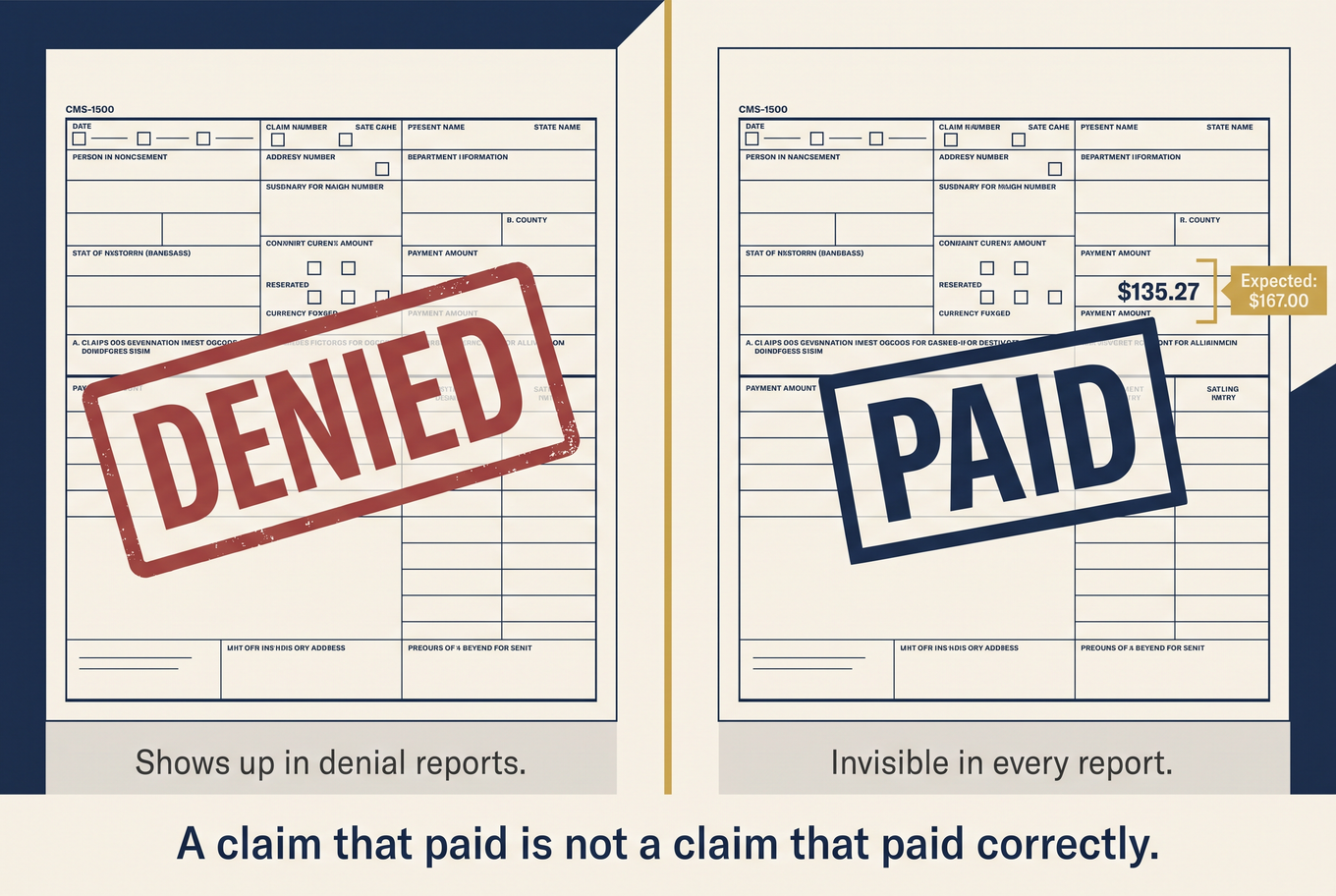
Telehealth revenue leaks in two directions, and most practices only have instrumentation pointed at one of them. Denials announce themselves. Underpayments do not, and the second category is usually the larger one because it compounds silently across a recurring panel.
Where telehealth revenue actually leaks
The highest-frequency failures, grouped by when they happen:
Before the visit
- The behavioral carve-out is missed entirely.
- The provider is contracted with the payer brand, but not with the member's product.
- Credentialing is not yet effective.
- The scheduler does not capture that the patient is traveling.
- Sessions occur outside an authorization or EAP approval date range.
- Audio-only is assumed rather than verified.
- The service is covered, but not for this license category.
During the visit
- The patient's location is never documented, so a POS 10 claim cannot prove "home."
- The note says "telehealth" while the claim carries 95 or 93.
- The session runs fifty minutes and goes out as 90837.
- Add-on psychotherapy time overlaps the E/M work.
- The video drops to phone, and the claim stays coded as video.
At claim creation
- A legacy POS 02 default sends every telehealth claim out at the facility rate, including Medicare home sessions.
- A universal modifier default appends 95 for every payer - including the one that wants none, and the one that wants GT.
- A deleted telephone code persists in a template.
- The claim goes to the medical payer ID instead of the behavioral administrator.
- Q3014 is added to a home claim with no qualifying facility.
After adjudication
- The claim pays at the facility allowance instead of the non-facility rate.
- It processes silently out of network, with unexpected patient liability.
- The allowed amount differs from the fee schedule, and nobody compares.
- A payer system defect is mistaken for provider error, and compliant coding gets changed to force payment.
- The timely-filing window expires while the payer investigates.
- A post-payment location audit triggers recoupment on claims paid a year ago.
A claim that paid is not necessarily a claim that paid correctly
Audit allowed amounts, network status, and patient liability - not only denials.
Most practices have no control for this failure mode, and the reason is structural: a denial work queue cannot surface an underpayment, because nothing denied. The claim closed. It appears in every report as a success. The only thing wrong with it is the number.
The pattern from the opening: a Medicare home session that used to pay at the non-facility rate suddenly allows less after an EHR migration, with no denial anywhere. The template migrated with POS 02 baked in. Denial rates look normal, first-pass acceptance looks normal, and the practice loses roughly thirty dollars a session, every session, until somebody compares the remittance to what the claim should have paid.
Catching it requires a different control than denial management: an expected allowed amount by payer, code, POS, and provider type; a variance flag on claims that pay under expectation; and a monthly audit of POS 02 versus POS 10 distribution against documented patient location.
It also requires separating three numbers that get used interchangeably and are not the same - the published base allowance, the contracted allowed amount, and the actual remittance. A payer can accurately say telehealth is reimbursed "the same as in person" while a POS rule quietly routes the claim to a lower facility allowance. Both statements are true at once.
This is the part of the work that justifies specialist attention more than claim submission does. Submission is mechanical. Detecting the claims that paid incorrectly requires knowing what each one should have paid before it was submitted.
And sometimes the payer's system is simply wrong
When a written policy and live adjudication disagree, resist the urge to overwrite your rules with the denial. Preserve both, in the same record: what the published rule says; that claims following that rule denied under a specific edit across specific dates; what the payer acknowledged, disputed, or requested instead; and the corrective action and claim-replacement instructions.
That record builds the evidence base for an appeal, and it protects the practice from converting a temporary payer defect into a permanent, non-compliant workaround. Meanwhile, watch the filing deadlines: the most common way this ends badly is not the denial itself, but the timely-filing window closing while everyone is still researching.
What expires, and when to recheck each rule
With a topic this volatile, stop treating it as one undifferentiated risk. Most of what you have read here is stable. A specific and identifiable minority of it is not.
The volatility register
| Fact | Status at August 17, 2026 | Next predictable check | What forces an immediate update |
|---|---|---|---|
| Broad Medicare telehealth flexibilities (non-behavioral) | Through Dec. 31, 2027 | Federal legislation watch; late 2027 | New statute, CMS implementation FAQ, lapse or further extension |
| Behavioral-health in-person condition | Not required through Dec. 31, 2027; triggers after | CY 2028 planning, beginning in 2027 | Congress changes, removes, or delays it again |
| Established-patient transition | Patients begun on/before Dec. 31, 2027 skip the initial six-month lookback | 2027–2028 rulemaking | Revised CMS interpretation or legislation |
| CMS Medicare Telehealth Services List | CY 2026 list; changes take effect Jan. 1 | Proposed PFS in summer, final by Nov. 1, list page Jan./Mar. | Code addition, deletion, or status correction |
| PFS values and the POS payment difference | CY 2026; locality and provider dependent | Nov. 2026 final CY 2027 PFS; Jan. 2027 lookup | Conversion factor, RVU, GPCI, or practitioner-rate change |
| Q3014 originating-site fee | $31.85 for CY 2026 | Annual list and PFS release | CMS correction or program-specific policy |
| UnitedHealthcare commercial policy | 2026R0046A; POS 02/10; video modifiers informational; audio-only 93 | Monthly or quarterly policy-library check | New version, code-list attachment change, product or state exception |
| Cigna R31 Virtual Care | Behavioral POS 02 plus an accepted modifier; no POS 10 until further notice | Monthly or quarterly policy-library check | New effective date, state mandate, intermediary-vendor rule |
| Aetna and other commercial policies | Product and state specific | Quarterly, and at contract anniversary | New national or state policy, portal notice, fee-schedule amendment |
| State Medicaid FFS and MCO policy | State and plan specific | Annual manual cycle; at least quarterly for active states; monthly bulletins | Provider notice, emergency rule, system defect, MCO or vendor migration |
| State telehealth coverage and parity statutes | 44 states + PR + D.C. with coverage laws; 24 with payment parity for at least one service type | Each state legislative session | Enacted or repealed statute, regulation, agency interpretation |
| PSYPACT, Counseling Compact, Social Work Compact, IMLC | See the compact table above | Publication day, then monthly for multi-state practices | New live state, effective date, rule or process change |
| CPT telemedicine code family | Annual CPT effective Jan. 1; payer adoption differs | CPT release each autumn; payer updates by Jan. 1 | Code deletion or revision, or payer adoption/non-coverage |
*Timing sources: CMS telehealth landing page, which describes the annual PFS proposed-and-final cycle with list changes effective January 1; HHS telehealth policy updates; CMS Telehealth FAQ.*
The cadence that keeps it current
Every autumn: read the final next-year Medicare PFS fact sheet and its telehealth provisions, and pull the rule text itself for any disputed point rather than relying on association summaries. Compare the new CMS telehealth list against the prior year, code by code, for the codes you actually bill. Recalculate any dollar figure using the new PFS data, stating whether it is facility or non-facility, national or locality-adjusted, and which practitioner rate applies. Read the new CPT changes, then verify payer adoption separately - those are two different events.
Every January: confirm the CMS list page, the FAQ, the POS instructions, and the Q3014 amount. Refresh your payer comparison from the live policies rather than a saved PDF. Refresh Medicaid fee-for-service and MCO instructions for every state you actually operate in. Run denial-spike reports by payer, CPT, POS, and modifier. Check the compacts' application pages, not just legislative maps - those track different stages. Then update your as-of date and log what changed.
Every month, for an operating practice: review payer bulletins and portal notices; compare claims-system behavior against written policy; monitor telehealth denial and underpayment trends; update clinician license, privilege, and credentialing rosters; watch for behavioral administrator or payer-ID changes; and preserve reference numbers, policy versions, and screenshots for anything disputed.
Some things should not wait for the cycle at all: a payer or behavioral-vendor migration, a compact going live, an EHR or clearinghouse migration, a new clinician, state, or product, a contract amendment or fee-schedule notice, a sudden POS or modifier denial spike, federal legislation moving the 2027 date, or a payer known-issue bulletin.
Build the 2027 readiness file now, without operationalizing the condition
The in-person condition is delayed, not deleted, and December 2027 is a bad time to start identifying which patients and clinicians it will touch. A cautious readiness file captures:
- Original Medicare versus Medicare Advantage.
- Whether the service is home-based mental-health telehealth.
- The date the patient first began home mental-health telehealth with your practice. This is the field that decides established-patient status, and it is far easier to record now than to reconstruct later.
- Whether an in-person Medicare-paid service exists, and who performed it.
- Practitioner specialty and group relationships, for permitted substitute visits.
- Which patients' geography, mobility, or access would make an in-person visit genuinely difficult.
Two cautions. Build the data capability and watch the law, but do not operationalize the condition as though it applied today - through December 31, 2027, the rule in force is that it does not. And when you communicate with patients about it, do not tell them the benefit is ending. It is not, and frightening a behavioral-health panel about losing access is a harm in itself.
When to keep this in-house, and when it stops making sense
A practice can reasonably run teletherapy billing internally when it:
- operates in one state, or a small and stable set of states;
- contracts with a narrow payer and product set;
- sees patients who connect from predictable locations;
- has simple provider-type and TIN arrangements;
- has someone explicitly responsible for payer-policy maintenance;
- runs an EHR that can apply payer-specific rather than universal claim rules;
- verifies carve-outs, authorization, and audio-only eligibility before visits;
- captures location, modality, time, and consent consistently in the note;
- audits expected allowed amounts as well as denials;
- and controls its filing and appeal deadlines.
That is a demanding list, but it is achievable, and a solo therapist or small single-state group that meets it does not need to outsource anything. Where that describes a practice, we would rather say so than sell around it.
The calculation changes when the complexity multipliers start stacking:
- multiple states, or frequently traveling patients;
- Medicare fee-for-service alongside Medicare Advantage;
- Medicaid fee-for-service plus several MCOs;
- commercial families with genuinely differing rules;
- behavioral carve-outs and EAPs;
- a mixed roster of psychiatrists, psychologists, social workers, counselors, MFTs, nurse practitioners, and supervised clinicians;
- audio-only workflows;
- multiple TINs, service locations, EHRs, or clearinghouses;
- credentialing backlogs;
- recurring POS or modifier denials;
- claims paying under expectation;
- old A/R or recoupment exposure;
- no internal owner for policy version control.
None of those alone justifies outside help. Several of them together change the nature of the problem. At that point it stops being a question of knowing modifiers and becomes maintaining a live operating system across scheduling, documentation, claim edits, enrollment, and payment review - one that has to stay correct while payers, states, and federal programs all move independently.
That picture usually changes for one of four reasons: the practice is growing - new clinicians, new locations, a new state; the payer or service mix has got more complex; nobody has the time the billing side needs; or collections have slipped and nobody can say why. None of those is about size. We work with practices of every size, from a single clinician to a multi-state group, and we take on a single piece of the cycle as readily as the whole of it. The question is never whether a practice is big enough to be worth helping - it is which part of the cycle needs owning.
The value we would defend is not submission labor. It is preventing one incorrect default from replicating silently across hundreds of recurring weekly sessions, and detecting the claims that paid incorrectly rather than only the ones that denied.
Before deciding either way: for every telehealth claim, can your practice answer and audit six questions?
- Who actually adjudicates this member's behavioral benefit?
- Is this code eligible through the modality that was used?
- Is this clinician both legally authorized for the patient's state and loaded with this payer, under the right TIN and effective date?
- Where was the patient physically located, and can the note prove it?
- What does this payer want on the claim for this product and date of service?
- Does the remittance match what the contract says it should have paid?
A practice that can answer and audit all six may not need outside help. A practice that cannot is already carrying denial, underpayment, and recoupment risk - whether or not the claims currently appear to be paying.
Three distinctions that make the rest manageable
Everything on this page reduces to three separations.
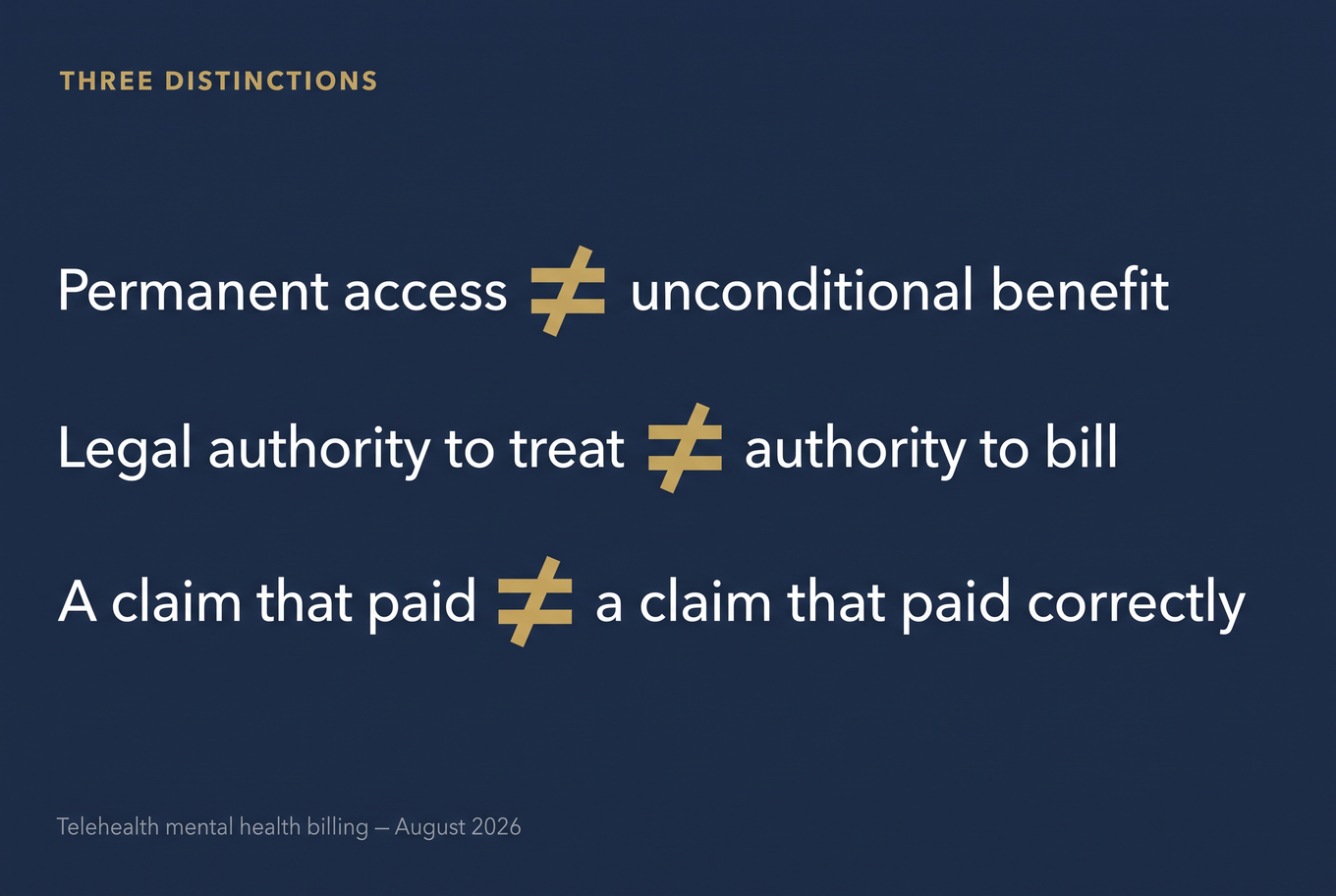
Permanent access is not an unconditional benefit. Medicare's home-based behavioral telehealth is permanent; the in-person condition attached to it is suspended through December 31, 2027. Those are different facts with different expiration dates, and conflating them produces both false alarm and false comfort.
Legal authority to treat is not authority to bill. A license, a compact privilege, and an enrolled, credentialed, contracted, correctly routed claim are four separate achievements. The compact commissions say so themselves.
A claim that paid is not a claim that paid correctly. Denial rates measure the failures loud enough to announce themselves. The quiet ones - facility allowances on home sessions, silent out-of-network processing, contract variance - need a control of their own.
Our take, after working these claims across payers that cannot agree with each other: the practices that stay ahead of this are not the ones with the best cheat sheet. They are the ones who accepted early that there is no cheat sheet, wrote down what each payer actually requires with the date they verified it, and checked the remittance against the contract instead of against zero.
If you do one thing with this page, make it this: pull your last month of telehealth claims, and check the POS distribution against what the notes actually say about where each patient was. It takes an afternoon. It is the fastest way to find out whether you have a problem that is currently invisible.
Frequently asked questions
Does Medicare cover online therapy in 2026?
Yes, when the service, practitioner, modality, and other Medicare requirements are met. Medicare's home-based behavioral and mental-health telehealth access and its removal of geographic barriers are permanent, not temporary. The in-person visit condition attached to that benefit is not required through December 31, 2027 under current law.
Should a therapist use POS 02 or POS 10?
For Medicare, use POS 10 when the patient is in their home and POS 02 when the patient is anywhere else. Commercial and Medicaid rules can differ - Cigna's current behavioral-health policy, for example, still instructs POS 02 even for a patient at home. Confirm the exact product before defaulting either way.
Does 90837 need modifier 95?
There is no all-payer answer. Current Medicare professional guidance pairs eligible audio-video telehealth with modifier 95 and POS 02 or 10. UnitedHealthcare's commercial policy says the common video modifiers are not required, while Cigna requires one of its accepted virtual-care modifiers. The time and medical-necessity rules for 90837 apply independently of any of this.
What modifier is used for phone therapy?
Modifier 93 commonly identifies a synchronous audio-only service, and FQ appears in certain federal and payer contexts. Payment still depends on whether the specific code and the patient's circumstances are eligible for audio-only under that payer's policy - the modifier describes the modality, it does not create coverage.
Does Medicare require an in-person visit for telehealth therapy?
Not through December 31, 2027. The requirement exists in statute but is currently suspended. When it takes effect, a new home tele-mental-health patient would generally need an in-person Medicare-paid service within the preceding six months, then at least one every twelve months, with limited exceptions - though patients who began home mental-health telehealth on or before December 31, 2027 are treated as established and skip the initial lookback.
Can POS 10 be used for a hotel, dorm, or assisted-living setting?
Not automatically. POS 10 describes telehealth in a private residence. Hotels, dorms, shelters, assisted-living settings, schools, and cars have to be resolved against the specific payer's POS definition, with the rationale documented in the record. Preserve the actual location rather than the mailing address, because the note is what an auditor will read.
Can a therapist see a patient who is visiting another state?
Only with a valid practice pathway under the law of the state where the patient is physically located - a full license, an operational compact privilege, a registration, or an applicable exception - while meeting that state's scope and other requirements. Insurance credentialing and network participation are a separate check. Private pay does not remove the licensure question.
Does a compact privilege let a therapist bill insurance?
Not automatically. The Counseling Compact explicitly warns that online platforms and insurance companies may not accept a privilege to practice for billing purposes. Confirm payer credentialing, product participation, TIN and group loading, and effective dates separately from the legal authority to treat.
Is teletherapy paid at the same rate as in-person therapy?
Sometimes, but coverage parity and payment parity are different things. Medicare pays home telehealth under POS 10 at the non-facility rate and non-home telehealth under POS 02 at the facility rate, which is a real difference on the same service. State parity statutes, plan funding, contract terms, and payer policy can each change the answer.
What should a teletherapy note document?
At minimum: patient identity and exact physical location; the clinician's location; whether the session was audio-video or audio-only; consent where required; participants; start and stop or total psychotherapy time; the service and its medical necessity; any technology disruption; the emergency plan where relevant; and any payer-specific audio-only condition. Structured fields hold up better under review than narrative mentions.
Reviewed and current as of August 17, 2026. This page separates Medicare's permanent behavioral-health telehealth rules from provisions that currently run through December 31, 2027. It is general information about billing and coding practice, not legal, licensure, or reimbursement advice for a specific claim or encounter - verify the member's product, the patient's physical state, and the payer's current policy for your date of service.
Update log: when this page is revised, we record the date, the source or policy that changed, the previous statement, and the new one. The date above is not refreshed without rechecking every linked policy.