Payer Enrollment Services: What They Cover, How Long They Take, and When to Outsource
November 16, 2026 · 11 min read
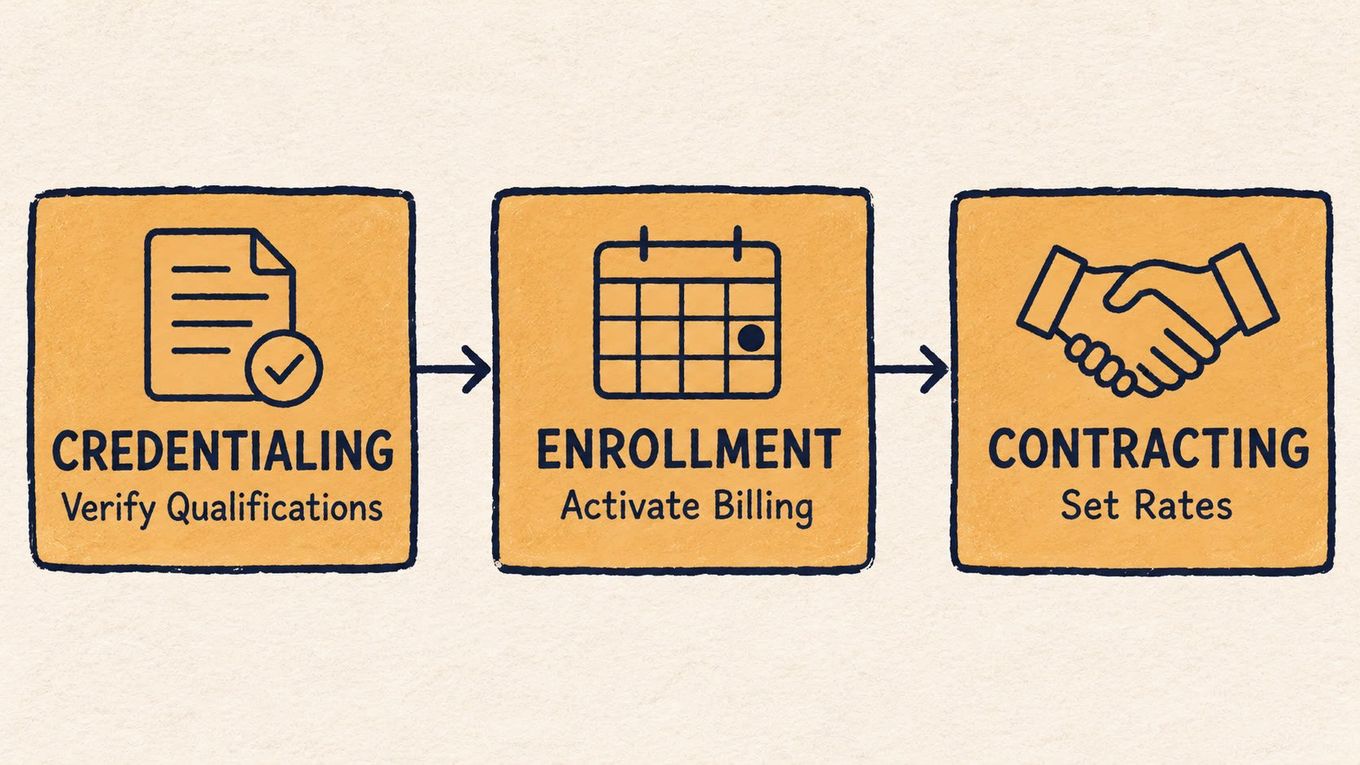
Payer enrollment services handle the administrative work of registering a healthcare provider with insurance networks so that provider can submit claims and collect in-network reimbursements. The process is distinct from credentialing: credentialing verifies a provider's qualifications, while enrollment activates their ability to bill a specific payer. Both steps are required before a single in-network dollar can be collected, and both run on independent timelines.
Every day a provider sees patients without active enrollment is revenue at risk. Some commercial payers offer retroactive effective dates; Medicare and Medicaid generally do not.
Payer Enrollment Timelines: Quick Reference
| Payer type | Typical timeline | Key system or portal |
|---|---|---|
| Commercial (Aetna, BCBS, Cigna, UHC) | 60 to 150 days | CAQH ProView |
| Medicare | 60 to 90 days | PECOS (CMS-855I or 855B) |
| Medicaid, state fee-for-service | 90 to 180 days | State Medicaid portal |
| Medicaid MCO | 60 to 120 days per MCO | MCO-specific portal |
| Behavioral health carve-out plans | 90 to 180 days | Optum BH, Beacon/Carelon, Magellan |
| ERA and EFT setup | 10 to 30 days | Clearinghouse or payer portal |
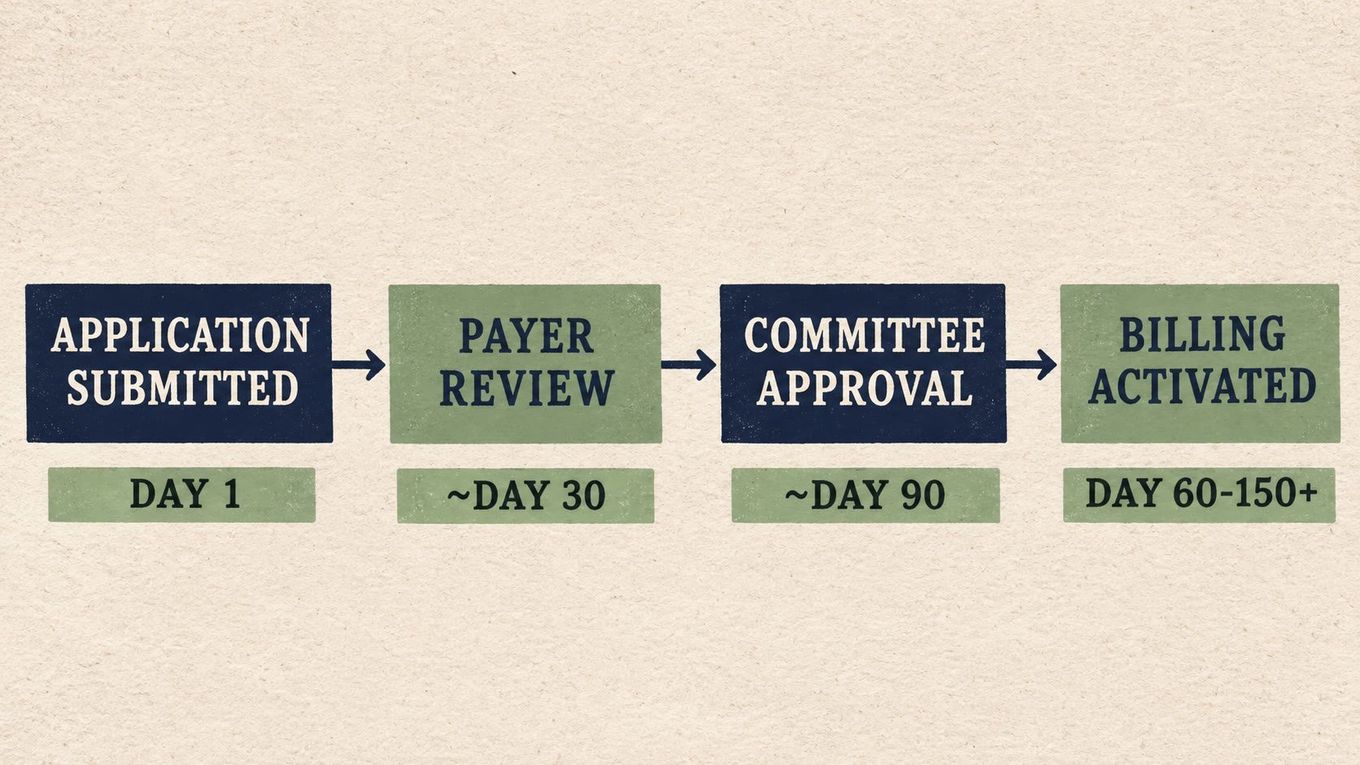
Payer Enrollment vs. Credentialing: The Distinction That Affects Your Revenue
These two terms appear together so often that practices sometimes treat them as interchangeable. They are not, and conflating them is one of the more common sources of billing delays.
Credentialing is the verification of a provider's qualifications: medical education, training, board certifications, malpractice history, and licensure. The payer's credentialing committee, or a delegated entity, reviews this record and decides whether the provider meets their participation standards.
Payer enrollment comes next. Once a provider is credentialed, enrollment registers their NPI, group TIN, and billing information within the payer's claims processing system. It is the enrollment record, not the credentialing approval, that determines whether a claim pays.
A third step, payer contracting, sets the reimbursement rates. Enrollment can proceed under a standard fee schedule without active contract negotiation, but contracting determines what actually gets paid once claims flow.
For a full breakdown of the credentialing side, see our guide to provider credentialing services.
What Payer Enrollment Services Actually Cover
Payer enrollment is not a single form submission. A complete enrollment workflow spans several systems and requires ongoing maintenance work after initial approval.
Commercial Payer Enrollment
Commercial enrollment means joining the network of a private insurance company: Aetna, Cigna/Evernorth, UnitedHealthcare, Blue Cross Blue Shield plans, and regional carriers. Each payer has its own application, its own portal, and its own processing timeline. Requirements vary by state, by specialty, and by whether the provider is enrolling as an individual or under a group TIN.
Most commercial applications require:
- NPI (Type 1 for individual providers, Type 2 for the group or organization)
- Current state licensure
- CAQH ProView profile (most major commercial payers pull provider data directly from CAQH)
- Malpractice insurance certificate
- Group and individual W-9
CAQH ProView is the central repository most commercial payers use to retrieve provider data. Keeping the CAQH profile current and re-attesting every 120 days is an ongoing requirement. A lapsed attestation can hold up applications from multiple payers simultaneously, since they all draw from the same profile.
Medicare Enrollment: PECOS and the CMS-855 Forms
Medicare enrollment runs through CMS's Provider Enrollment, Chain and Ownership System (PECOS). Providers submit either a CMS-855I for individual physicians and non-physician practitioners, a CMS-855B for clinics and group practices, or a CMS-855S for DMEPOS suppliers. An active PECOS account and an I&A System login are required before any application can be submitted. These setup steps can add one to two weeks before the application clock starts.
Medicare also requires revalidation every five years. Missing the revalidation window results in deactivation of billing privileges, which stops reimbursement for all services billed under that NPI until the enrollment is restored.
Medicaid and MCO Enrollment
Medicaid enrollment is state-administered, which means requirements, timelines, and portals differ across all 50 states. Many states now route Medicaid billing through managed care organizations (MCOs) rather than directly through the state agency, so a provider may need to enroll separately with each MCO operating in their state, in addition to the state fee-for-service Medicaid program.
Group practices expanding across state lines face enrollment in multiple state Medicaid programs simultaneously, each with its own timeline and documentation requirements.
ERA and EFT Enrollment
This step is easy to overlook, and it is what actually enables electronic billing and payment.
ERA (Electronic Remittance Advice) enrollment sets up how the payer sends explanation-of-benefits data back to the practice's billing system. EFT (Electronic Funds Transfer) enrollment sets up direct deposit of claim payments. Without active ERA and EFT, practices receive paper remittances and paper checks, which slows payment posting and creates reconciliation problems.
Some payers process ERA and EFT enrollment separately from the participation application, adding additional lead time before billing can run smoothly. A practice that completes participation enrollment but misses ERA setup can find itself approved to bill but unable to process electronic payments.
Revalidation and Ongoing Maintenance
Active enrollment management includes:
- CAQH re-attestation every 120 days (required or the profile lapses, putting all payer applications on hold)
- Medicare revalidation every five years (missed revalidation triggers deactivation)
- NCQA recredentialing every three years for providers in NCQA-accredited plans
- State Medicaid revalidation on varying cycles by state
- Address, TIN, and licensure updates whenever a provider moves, adds a location, or renews state licensure
Missed revalidation deadlines are one of the more preventable causes of billing interruptions. The problem is that they typically surface months after the lapse, when a denial pattern triggers an audit of the enrollment record. For more on how enrollment lapses feed into denial pipelines, see our denial management overview.
Behavioral Health Enrollment: Why It Takes Longer
Behavioral health practices face a layer of enrollment complexity that most general guidance skips.
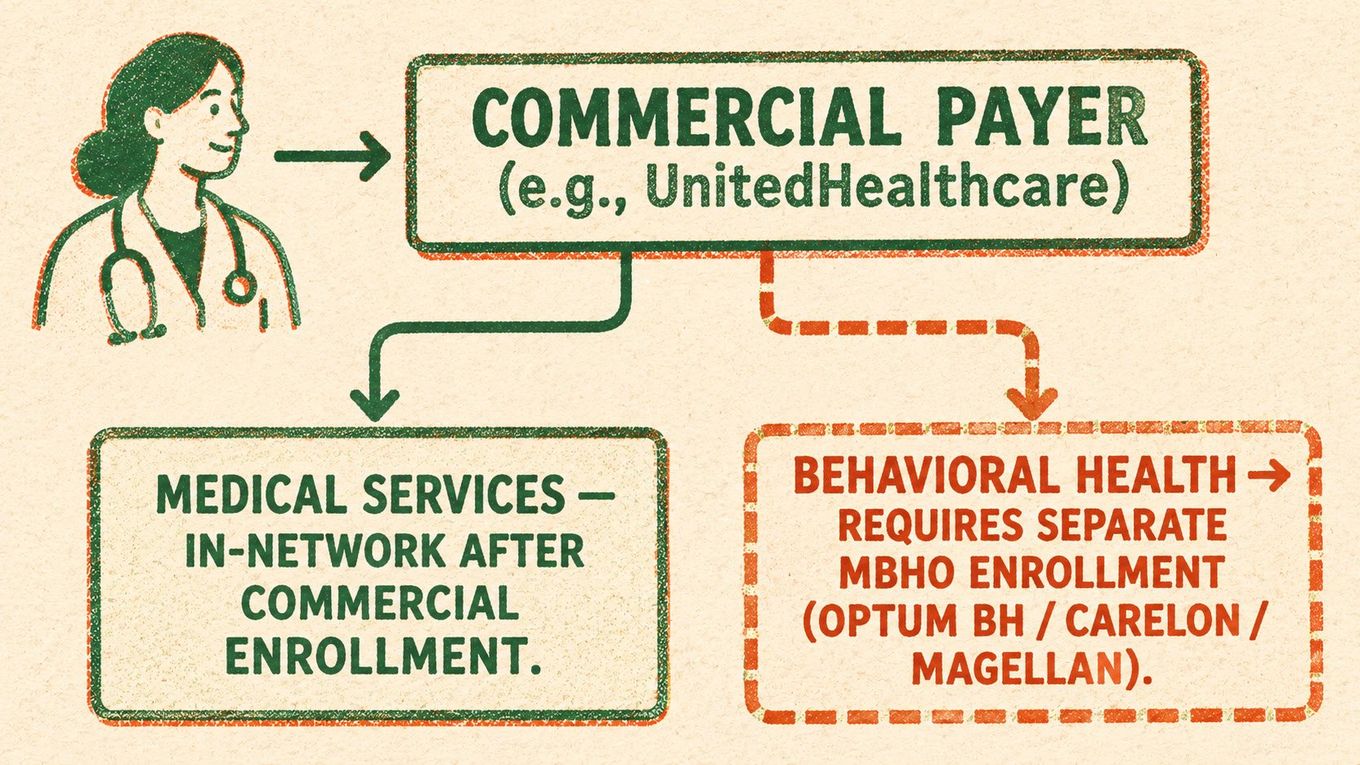
The reason: many commercial health plans have carved out their behavioral health benefits to separate managed behavioral health organizations (MBHOs). That means a provider credentialed and enrolled with UnitedHealthcare's commercial medical plan may still need to enroll separately with Optum Behavioral Health, which operates its own network. The same structure applies to Cigna/Evernorth behavioral health, Beacon Health Options (now Carelon Behavioral Health under Elevance Health), and Magellan Health.
This creates two distinct enrollment tracks per payer: the commercial/medical track and the behavioral carve-out track. Each has its own provider relations contact, portal, credentialing committee, and processing timeline. A practice that completes commercial enrollment but misses the carve-out application ends up out of network for behavioral health claims even though the provider is contracted with the parent company.
Practices billing intensive outpatient (IOP), partial hospitalization (PHP), or crisis services face an additional layer: program-level or facility enrollment with certain payers and MCOs, on top of individual provider enrollment.
For specialty-specific enrollment guidance, see our behavioral health credentialing guide and the insurance credentialing guide for therapists, which covers individual enrollment under carve-out plans in detail.
What Enrollment Delays Actually Cost
The revenue math is straightforward. A provider billing $400,000 per year through a single commercial payer is generating roughly $100,000 in claims every 90 days from that payer alone. During a 90-day enrollment delay, those claims either deny outright or pay at out-of-network rates. For many commercial plans, out-of-network reimbursement is 60 to 70 percent of the contracted in-network rate, or nothing at all if the plan has no out-of-network benefit.
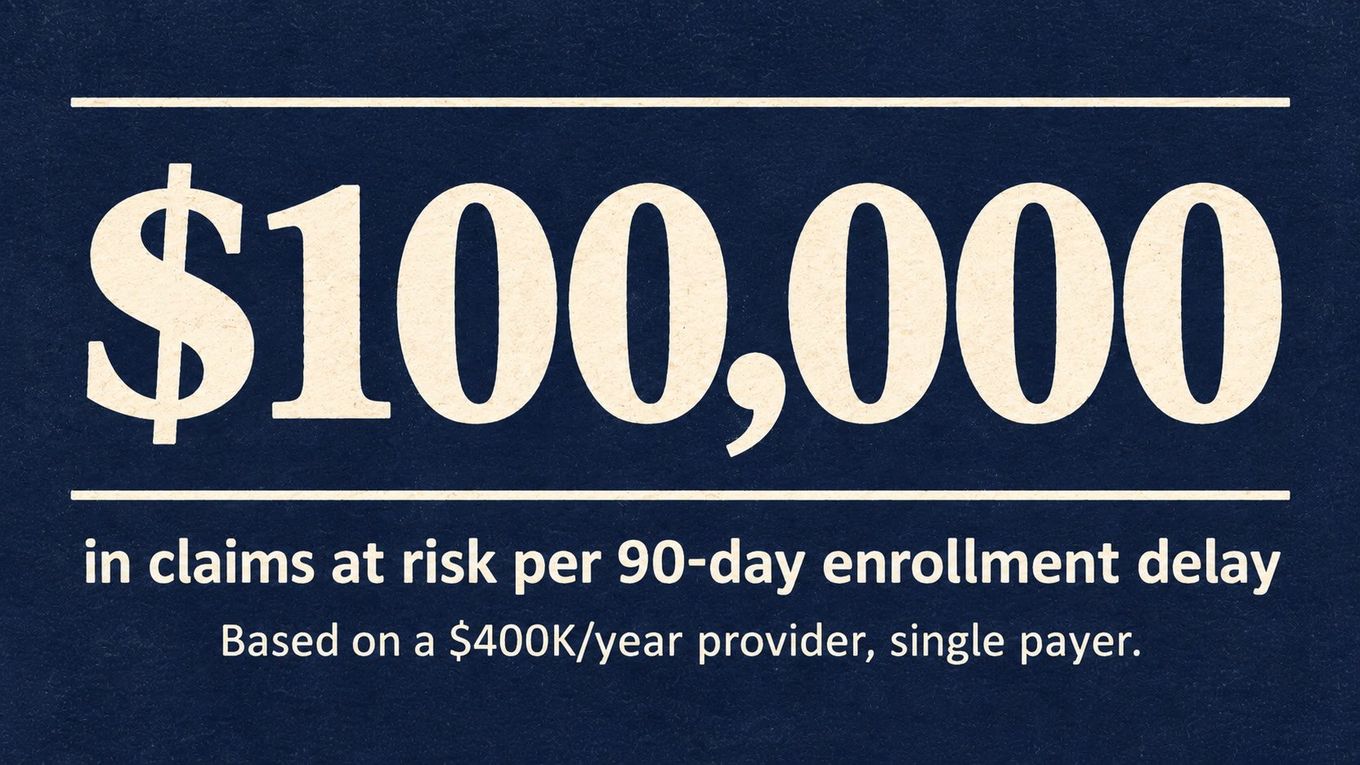
If the payer does not offer a retroactive effective date, that revenue is not recoverable. It is simply lost to the gap between the provider's start date and their enrollment effective date.
The revenue case for outsourcing payer enrollment services is not primarily about the cost of the service. It is about compressing those enrollment timelines, tracking the right CAQH attestation cycles and revalidation calendars, and ensuring ERA and EFT are activated before the first claim drops.
Why Enrollment Applications Stall: The Most Common Causes of Delay
Most enrollment delays are not caused by slow payers. They are caused by application errors, missing documents, or process gaps that sit unnoticed until a payer sends a deficiency notice weeks after submission.
| Cause | Where it shows up | How to prevent it |
|---|---|---|
| Lapsed CAQH profile | Commercial payers pause or reject the application | Re-attest every 120 days; set a reminder two weeks before expiry |
| NPI mismatch between CAQH and application | Application rejected; delay while correcting | Confirm NPI Type 1 and Type 2 entries before any submission |
| Expired malpractice certificate | Application flagged; payer waits for updated certificate | Confirm policy dates before each submission and after renewal |
| Applying to commercial plan instead of carve-out | Claim denials even after apparent enrollment | Identify whether the payer uses a carve-out MBHO and apply to both tracks |
| ERA/EFT not submitted concurrently | Approved to bill but paper checks arrive; payment posting delayed | Submit ERA/EFT applications alongside the participation application |
| No follow-up cadence with provider relations | Application sits unprocessed for weeks with no alert | Check status every 10 to 14 business days; escalate at 30 days |
| Group roster not updated | New provider not added to the existing group contract | Submit a group roster update separately from the individual NPI enrollment |
The behavioral health carve-out row is worth calling out specifically. It is the single most common enrollment gap we see in practices that handle credentialing in-house: the provider gets enrolled with the commercial plan, claims start flowing for medical services, and then behavioral health claims deny because the carve-out application never went in. The parent plan and the carve-out MBHO are separate enrollment relationships that have to be managed independently.
Why Trust This Article
This content is written by the team at Clarity Health RCM, a revenue cycle management firm with roots in Quality Medical Billing, founded in 1988. Under President and CEO Estelle Sandoval, our team brings over 40 years of combined revenue cycle experience spanning credentialing, enrollment, denial management, and billing across behavioral health practices, inpatient and outpatient physician groups, and facility-based organizations.
Payer enrollment is one of the areas where generic RCM advice causes real damage. Behavioral health carve-out plans and state Medicaid MCO structures are genuinely different from general medical enrollment, and treating them the same way is a common cause of delayed billing activation that practices often don't diagnose for months.
How Clarity Handles Payer Enrollment
Clarity's credentialing and enrollment team manages the full enrollment workflow for physician groups, behavioral health practices, and facility-based organizations. That includes:
- Commercial enrollment with all major carriers, including carve-out behavioral health plans
- Medicare PECOS enrollment and ongoing revalidation monitoring
- Medicaid and MCO enrollment across states
- ERA and EFT enrollment to ensure billing activation runs in parallel with payer approval
- CAQH profile setup and 120-day re-attestation management
- Revalidation calendar management with advance notice so practices are not caught off guard
We don't stop at application submission. We track payer responses, escalate delayed applications, and maintain enrollment records so the practice knows its status at every stage.
For more on our services, visit the Clarity solutions page and our outsourced RCM services overview.
Frequently Asked Questions
What are payer enrollment services in healthcare?
Payer enrollment services manage the process of registering a healthcare provider with insurance plans so that provider can submit claims and collect in-network reimbursements. The work includes commercial enrollment, Medicare PECOS enrollment, Medicaid and MCO enrollment, ERA and EFT setup, and ongoing maintenance such as CAQH re-attestation and revalidation monitoring. Without active enrollment, claims either deny or pay at out-of-network rates.
How long does payer enrollment take?
Timelines vary by payer type. Medicare PECOS enrollment typically takes 60 to 90 days once the application is submitted; initial PECOS account setup adds one to two weeks before that clock starts. Commercial payers typically take 60 to 150 days, with BCBS affiliates often at the slower end. Medicaid varies by state and can take 90 to 180 days. Behavioral health carve-out plans (Optum Behavioral Health, Carelon Behavioral Health, Magellan) typically run 90 to 180 days on their own track, separate from commercial enrollment with the same parent company.
Can a provider bill while payer enrollment is pending?
A provider can see patients while enrollment is pending, but claims submitted before the enrollment effective date generally will not pay at in-network rates. Some commercial payers offer retroactive effective dates, usually 30 to 90 days back from the approval date, if the practice requests it in writing at the time of approval. Medicare and most Medicaid programs do not offer retroactive reimbursement for services delivered before the enrollment effective date.
What is the difference between payer enrollment and credentialing?
Credentialing verifies that a provider meets the payer's clinical and professional standards: education, training, licensure, board certification, and malpractice history. Payer enrollment uses the results of that verification to register the provider's billing information in the payer's claims system. Credentialing must be approved before enrollment can be completed. The two processes often run concurrently for new providers, with enrollment completing after credentialing approval comes through.
What are ERA and EFT enrollment, and why do they matter?
ERA (Electronic Remittance Advice) and EFT (Electronic Funds Transfer) enrollment are required before a practice can receive electronic payments and explanation-of-benefits data from a payer. Without active ERA and EFT, practices receive paper checks and paper remittances, which slow payment posting and create reconciliation problems in the billing system. ERA and EFT enrollment is often submitted alongside the participation application but processed separately, so it needs to be tracked as a distinct step in the enrollment workflow.
What happens if CAQH ProView lapses?
CAQH ProView requires re-attestation every 120 days. If a provider's profile lapses, payers that draw from CAQH may put applications on hold or flag the provider's enrollment record for review. Because most major commercial payers use CAQH as their primary source of provider data, a lapsed profile can simultaneously affect multiple payer relationships. Keeping CAQH current is a low-effort ongoing maintenance task with disproportionate consequences when it falls through the cracks.