Denial Management in Medical Billing: Stop Reacting, Start Recovering
September 25, 2026 · 12 min read
Denial management is the process of identifying, appealing, and resolving insurance claim denials to recover revenue owed to your practice. Done well, it reduces your denial rate below the 5% industry benchmark, shortens your accounts receivable cycle, and turns payer rejection patterns into prevention intelligence.
Done poorly (and most practices do it poorly), it becomes a pile of remittance reports nobody has time to work.
The Number That Should Bother Every Billing Manager
Here it is: 65% of denied claims are never reworked or resubmitted.
That's not a myth. That's a widely cited industry figure, and if you've been in billing long enough, it probably doesn't surprise you. It just stings.

Claims get denied. Staff are stretched thin. The denial sits in the queue. Thirty days pass. Then sixty. The timely filing window closes. The revenue is gone: not because the payer was right, but because the practice ran out of bandwidth to fight it.
This is the actual denial management problem. Not the complexity of payer rules. Not the intricacy of modifier combinations. The problem is volume, triage, and follow-through.
Every dollar that leaves your AR unchallenged is a dollar your practice earned and never collected. For a mid-size behavioral health group, even a modest denial backlog left unworked can translate to tens of thousands of dollars in lost revenue every month.
So before we get into workflows and best practices, understand this: denial management is a capacity problem as much as it's a knowledge problem.
What Denial Management Actually Is
Denial management in medical billing is the systematic process of reviewing, appealing, and resolving claim denials issued by payers, while simultaneously analyzing patterns to prevent future denials at the source.
Most definitions stop at "appealing denials." The better definition includes the prevention side, because that's where the compounding value lives. Appealing a denial recovers one claim. Fixing the root cause upstream prevents fifty.
A mature denial management program has two distinct functions running in parallel:
- Recovery: Working denied claims through the appeals process to recapture revenue
- Prevention: Using denial data to identify coding errors, eligibility gaps, authorization failures, and documentation weaknesses before claims go out the door
Practices that only do the first function are always playing catch-up.
Claim Denial vs. Claim Rejection: They're Not the Same Thing
This distinction matters because the response is different.
| Claim Rejection | Claim Denial | |
|---|---|---|
| When it happens | Before adjudication | After adjudication |
| Why it happens | Technical/formatting errors (missing fields, invalid codes, duplicate) | Payer decided not to pay after reviewing the claim |
| Fixable by | Correcting and resubmitting the same claim | Filing a formal appeal with clinical documentation |
| Timely filing clock | Usually resets on correction | Often continues from original submission |
| Payer response | Electronic clearinghouse edit | Explanation of benefits (EOB) with remark/reason codes |
Rejections are cleaner to fix. Denials take real work.
The Types of Denials Worth Knowing
Not all denials have the same recovery path. Treating them the same is how practices waste time on claims that were never going to pay and miss the ones that would.
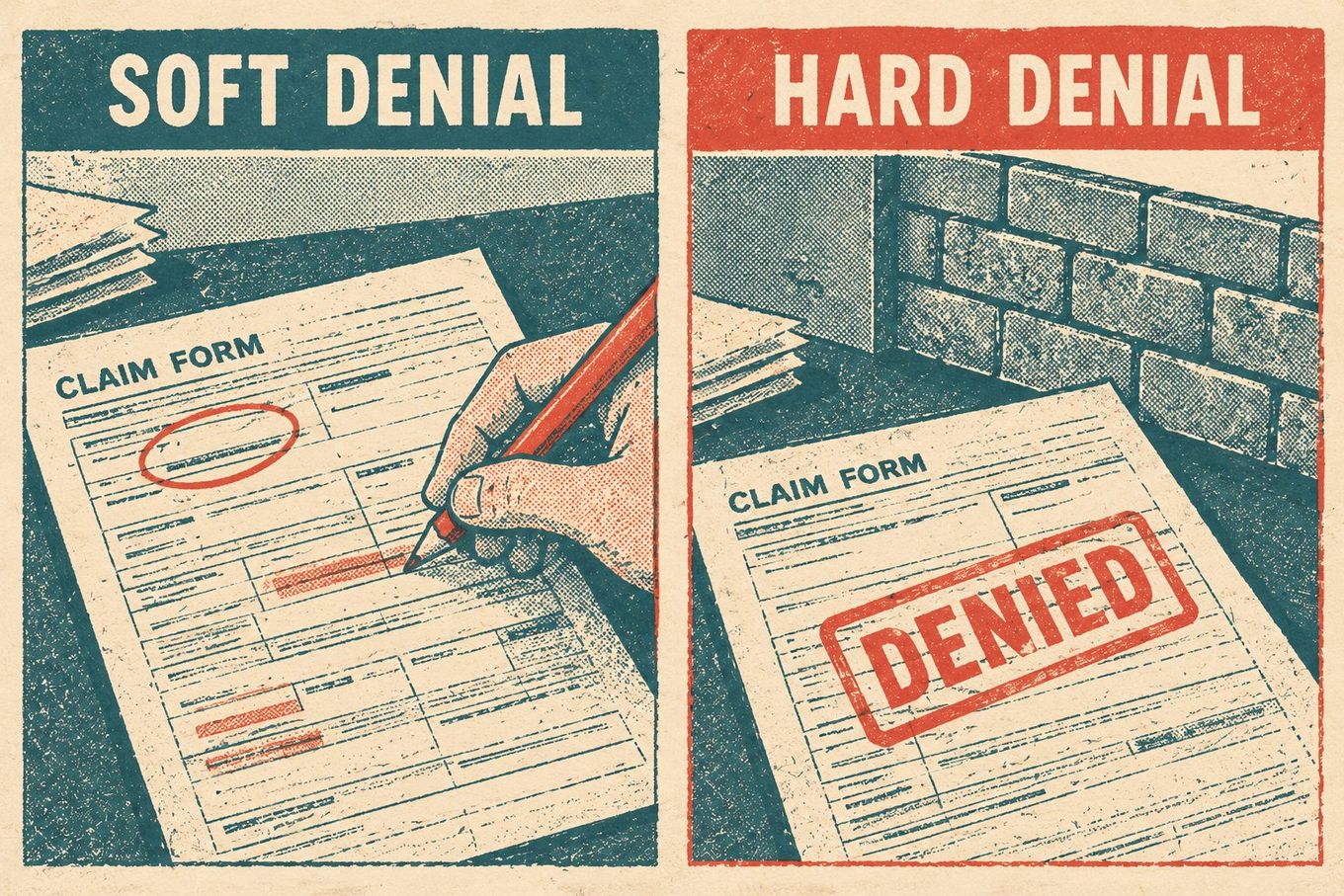
Hard Denials vs. Soft Denials
A hard denial is final. The payer has adjudicated the claim and won't reconsider without a formal appeal. Examples: service not covered under the patient's plan, provider not in-network, benefit maximum exceeded.
A soft denial is technically reversible without a formal appeal; it often just requires a corrected claim, additional documentation, or a reauthorization. Examples: missing prior authorization, incomplete clinical notes, coordination of benefits pending.
The triage question is: Is this a hard denial or a soft one? That answer determines whether you're filing an appeal or just correcting a claim.
Preventable vs. Clinical Denials
Preventable denials stem from front-end failures: eligibility errors, authorization gaps, demographic mismatches, coding inaccuracies. These account for roughly 50–75% of all denials, depending on the practice type. They are, by definition, fixable upstream.
Clinical denials cover medical necessity rejections, level-of-care disputes, and experimental treatment flags. They require clinical documentation, physician attestation, or peer-to-peer reviews to overturn. These are harder, slower, and more resource-intensive to appeal.
The distribution of denial types at your practice tells you where to invest. Heavy clinical denials usually mean a documentation problem or a payer with a pattern of aggressive medical necessity criteria (behavioral health practices dealing with Cigna/Evernorth, for instance, know this well; for a detailed breakdown, see our guide on why mental health claims get denied).
Where Denials Actually Come From
Every denial has a code. Every code points to a cause. Here's where the volume actually lives:
| Root Cause | Common Reason Codes | % of Denials (Est.) |
|---|---|---|
| Prior authorization missing or invalid | CO-15, CO-197 | 23–30% |
| Eligibility / coverage issues | CO-27, CO-96 | 18–25% |
| Coding errors (unbundling, modifier, wrong code) | CO-4, CO-11, CO-97 | 15–20% |
| Medical necessity not established | CO-50, CO-57 | 10–15% |
| Duplicate claim submission | CO-18 | 5–10% |
| Timely filing exceeded | CO-29 | 5–8% |
| Coordination of benefits pending | CO-22 | 5–8% |
Note: Percentage ranges are industry estimates; your practice mix will vary. Track your own payer ERAs to build an accurate root cause breakdown.
The takeaway: authorization failures and eligibility issues together account for roughly 40–55% of preventable denials. Both are solvable at the front end, before the claim ever goes out.
The Denial Management Workflow: What It Actually Looks Like in Practice
Here's the honest version, not the textbook version.
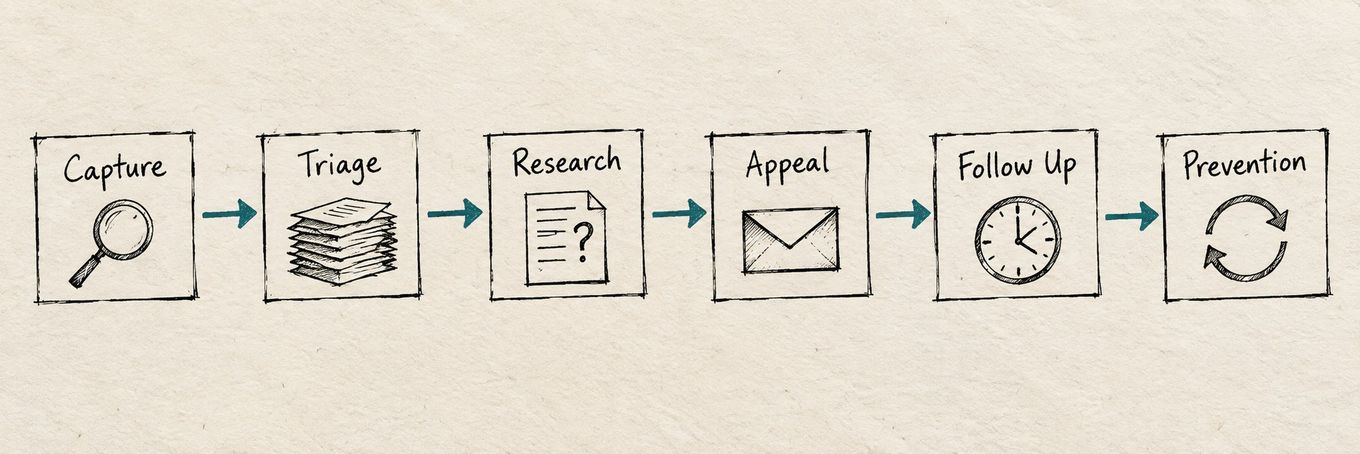
1. Identify and capture denials in real time. Your practice management system or billing software should flag denials the same day ERAs post. If your team is manually scanning EOBs at the end of the week, you're already behind. Automation here isn't optional anymore.
2. Sort by denial type and financial priority. Not every denied claim deserves the same urgency. Triage by dollar amount first, then by timely filing deadline, then by denial type. A $2,000 inpatient claim with 15 days left on the appeal window goes to the top of the stack. A $45 lab claim that missed authorization gets a different workflow.
3. Research the denial before touching the appeal. Pull the payer's specific coverage policy. Check the patient's benefit summary. Read the remark codes, not just the reason code. A CO-50 denial (medical necessity) from Aetna requires a different appeal strategy than the same code from Medicare. Payer-by-payer policy variation is real and significant.
4. Build the appeal with documentation that speaks the payer's language. A good appeal letter does two things: it restates the clinical facts in the payer's own policy language, and it attaches every piece of documentation the payer asked for (and often a few they didn't). The common mistake is a generic dispute letter. Payers have seen those. They're easy to deny again.
5. Track and follow up. Most commercial payers have 30–60 day response windows on appeals. If you file and forget, you'll miss the follow-up window. Build a tickler system: a spreadsheet, a workflow tool, or a feature inside your billing platform, set up to surface unresolved appeals before the window closes.
6. Feed the data back upstream. Every denial that resolves should generate a note on why it happened and what changed. That data is only useful if someone sees it. A monthly denial root-cause review, even 30 minutes with your billing lead, catches patterns before they become systemic.
The Metrics That Actually Matter (Beyond Denial Rate)
Everyone tracks denial rate. The best billing teams track three more things:
Appeal overturn rate. Of the denials you appeal, what percentage do you win? Industry averages for first-level appeals typically fall in the 45–55% range. If your overturn rate is significantly below that, something is wrong with the appeals you're building: documentation quality, appeal letter content, or payer-specific strategy.
Days to denial resolution. How long does it take from denial receipt to either recovery or write-off? Long resolution cycles indicate a capacity or prioritization problem in your billing team.
Denial rate by payer. Your overall denial rate is interesting. Your denial rate segmented by payer is actionable. If one payer accounts for 40% of your total denials, that's where you investigate first: coverage criteria, authorization requirements, coding preferences.
Prevention rate over time. If your denial management program is working, your denial rate should trend down quarter over quarter. If it's flat or rising while you're actively appealing claims, your recovery function is real but your prevention function isn't working yet.
A Word on Payer-Specific Patterns
No payer behaves the same way, and the practices that manage denials best know the playbook for their top five payers by heart.

A few patterns worth knowing:
- Medicare denies heavily on medical necessity and timely filing. The Comprehensive Error Rate Testing (CERT) program audits claims retroactively, so documentation standards matter even after a claim pays.
- Cigna/Evernorth has historically applied aggressive medical necessity criteria in behavioral health, particularly for higher-level-of-care services (IOP, PHP). Prior auth for outpatient psychiatric services has become more scrutinized since 2022.
- Aetna denies frequently on coordination of benefits when secondary coverage exists. Verification workflows need to catch COB triggers at the front end.
- UnitedHealthcare uses its own proprietary prior auth and medical policies that can differ substantially from CMS guidelines. Checking UHC's coverage determination policies directly, not just CMS, matters.
For practices heavily contracted with behavioral health carve-out plans (Optum Behavioral Health, Beacon Health Options/Carelon), the authorization and medical necessity documentation requirements carry even more weight. We've covered the mechanics of behavioral health billing in depth separately.
Why Trust This Article
Denial management is one of the areas where generic advice fails practices most visibly. The workflow that works for a high-volume urgent care group looks nothing like what a 10-provider behavioral health practice needs. The payer patterns that matter in one state don't always translate to another. Cookie-cutter checklists don't move the needle.

Clarity Health RCM was founded specifically to serve the specialties that most generalist billing firms avoid: behavioral health, mental health, inpatient and outpatient physician billing, and complex multi-location groups. Our team brings over 40 years of combined revenue cycle experience, working daily inside the denial workflows of practices across these settings.
President and CEO Estelle Sandoval has been in revenue cycle management since the late 1980s, when she began managing billing operations for physician practices in Chicago. Three-plus decades in this field means she has seen payer policies tighten, denial tactics evolve, and the documentation bar for medical necessity shift in real time. The perspective our team brings to denial management comes from that operational history: working real denial queues, building targeted appeals, and recovering revenue on claims that other billers had already written off.
That last point is worth making concrete. Practices that come to us after a billing transition typically see us recover roughly 65% of the funds their previous biller had written off entirely. On ongoing claims, our clients generally see revenue improvement in the range of 0–30% on existing claim volume. The specifics vary by practice size, specialty, and payer mix, but the pattern is consistent: denial management done with real operational discipline recovers money that most practices assume is gone.
The industry statistics in this article, the 11.8% average initial denial rate and the 65% of denied claims never reworked, come from widely cited third-party research. We've included them as benchmarks, not gospel. Your own payer data, segmented by payer and denial reason code, will always be more instructive than any industry average. If you're not already tracking denial rate by payer, that's the first thing to fix.
How Clarity Can Help
If you're staring at a denial backlog and don't have the bandwidth to work it down while also keeping current claims clean, that's the core problem our team solves.
Our denial management services include:
- Real-time denial identification and triage from your payer ERAs
- Payer-specific appeal building with clinical documentation review
- Root cause analysis to identify upstream prevention opportunities
- Ongoing denial rate monitoring with reporting your team can actually act on
We work across specialties: behavioral health, inpatient and outpatient physician billing, hospital and facility RCM, and more. If you're evaluating whether to keep denial management in-house or move it to a specialized partner, our in-house vs. outsourced billing comparison lays out the honest trade-offs.
For practices ready to talk specifics, our solutions page covers the full scope of what we manage.
Frequently Asked Questions
What is the difference between denial management and rejection management?
Rejection management addresses claims that were returned before payer adjudication, usually due to technical errors like missing fields, invalid codes, or formatting issues. These are fixed and resubmitted. Denial management handles claims that were adjudicated and not paid, which requires a formal appeals process. The workflows, timelines, and documentation standards are different for each.
What is a good denial rate in medical billing?
Industry benchmarks put a strong denial rate below 5%. The average across all practice types currently sits around 11–12%, meaning most practices are leaving significant revenue on the table relative to best-in-class performance. For behavioral health and psychiatric practices, denial rates can run higher due to medical necessity scrutiny and authorization complexity.
How long do I have to appeal a denied claim?
Timelines vary by payer. Most commercial payers require appeals within 30–180 days of the denial date. Medicare has a tiered appeals process with specific timeframes at each level (redetermination requests must be filed within 120 days of receiving the initial determination). State Medicaid programs each set their own windows. Missing an appeal deadline typically results in a write-off with no further recourse, so tracking deadlines is non-negotiable.
What percentage of denied claims can be successfully appealed?
Industry data suggests approximately 45–55% of appealed claims are overturned at the first level. That number is highly dependent on appeal quality: specifically, how well the clinical documentation matches the payer's own coverage criteria language. A generic dispute letter gets denied again. A targeted appeal that speaks directly to the payer's policy standards has a much higher success rate.
What are the most common reasons claims get denied?
Authorization issues (missing, expired, or invalid prior auth) and eligibility failures account for roughly 40–55% of preventable denials across most practice types. Coding errors, timely filing violations, medical necessity disputes, and coordination of benefits issues make up most of the remainder. The mix varies significantly by specialty and payer mix.
Is denial management different for behavioral health practices?
Yes, in meaningful ways. Behavioral health billing operates under carve-out arrangements with payers like Optum Behavioral Health and Carelon that apply their own medical necessity criteria, often stricter than commercial coverage for medical/surgical services. Higher-level-of-care services (IOP, PHP, inpatient psych) face the most authorization scrutiny. Documentation of medical necessity must be specific to the patient's current acuity, not just diagnosis-based. For a deeper look, see our guide on why mental health claims get denied.
Should I handle denial management in-house or outsource it?
The honest answer depends on your volume, team capacity, and specialty complexity. In-house denial management works well when you have a dedicated, experienced billing team with the bandwidth to work denied claims within 48 hours and run root cause analysis monthly. Outsourcing to a specialty RCM partner typically makes sense when denial rates are climbing, appeals are being filed past deadline, or the team is stretched between keeping current claims clean and working the backlog. See our detailed breakdown of the in-house vs. outsourced billing decision.