What Mental Health Billing Services Actually Handle (And Where They Quietly Stop)
September 25, 2026 · 14 min read
Mental health billing services manage the full revenue cycle for outpatient therapy, psychiatry, and counseling practices: claim submission, denial management, payer follow-up, eligibility verification, and payment posting. A competent one reduces your denial rate, shortens your AR cycle, and handles the payer-specific quirks that trip up in-house staff. What they can't do is hide a mismatch between their actual specialty depth and your practice's billing complexity.
That's the short answer. Here's the one worth reading.
A six-therapist group practice in the Southwest had been with the same billing company for three years. Denial rates were around 8%, which they considered acceptable. Collections were solid. Then they hired a psychiatrist to add medication management.
The psychiatrist started in January. By March, her denial rate was at 37%.
E&M claims were going out without modifier -25 on days she also provided therapy, meaning the second service was being denied as a duplicate. Prior authorization was being missed on medication management visits for certain managed care payers. One commercial plan required a separate clinical review for initial psychiatric evaluations, and nobody on the billing team knew to initiate it.
When the practice owner called the billing company, the account manager said: "We don't really specialize in psychiatric billing. Most of our clients are therapy groups."
Nobody had mentioned that at the start.
The practice spent six months unraveling the denied claims, appealing what could be appealed, and writing off what couldn't. They switched billing companies. The new company had a psychiatry track record. Denial rates on the psychiatrist's claims dropped to 9% within two billing cycles.
If you're researching mental health billing services right now, this is what we'd want you to read before you sign with anyone, including us.
Why mental health billing is its own category
General medical billing and mental health billing overlap on the administrative basics: charge entry, claim submission, ERA processing, patient statements. They diverge on almost everything else.
Mental health billing operates under a set of structural complications that don't show up in primary care or surgical billing:
- Behavioral health carve-outs. Many commercial plans separate mental health benefits from medical benefits and administer them through a managed behavioral health organization (MBHO) like Optum Behavioral Health, Evernorth (Cigna's behavioral carve-out), or Carelon Behavioral Health (formerly Beacon Health Options, now part of Elevance Health). A claim submitted to the medical payer instead of the MBHO is paid nothing, or paid wrong, and the billing team needs to know which payers carve out, which don't, and for which specific plans. Our guide to behavioral health carve-outs covers this in detail.
- Time-based CPT codes. Therapy codes like 90837 and 90834 bill by time, and the documentation has to substantiate the time claimed. A billing team that doesn't audit for time documentation gaps will file clean claims that come back on audit.
- Medical necessity documentation requirements. Unlike many medical procedures, mental health services require ongoing medical necessity documentation tied to diagnosis, treatment plan, and progress notes. Payers can retroactively deny claims if documentation doesn't support continued treatment.
- Parity law complexity. The Mental Health Parity and Addiction Equity Act (MHPAEA) requires payers to apply the same coverage criteria to mental health benefits as they apply to medical benefits. In practice, many payers violate this, and an experienced billing team knows how to identify and appeal parity violations, not just refile the claim.
This is before you get into psychiatry's additional layer: E&M codes, modifier combinations, prior authorizations for certain medication classes, and the interaction between medication management and psychotherapy on the same day.
A service that bills general medicine, cardiology, or orthopedics every day and handles a few therapy practices on the side is not the same thing as a service built around mental health billing. The difference shows up in your denial rate within 60 days.
The practice type question nobody asks at the start
"Mental health billing services" covers a wide range of practice complexity, and the right service depends heavily on what you actually do.
| Practice type | Billing complexity | What to look for in a service |
|---|---|---|
| Solo therapist, outpatient only | Low-to-moderate | Accurate time-based coding, carve-out management, telehealth modifier experience |
| Group therapy practice, multiple therapists | Moderate | Provider roster management, individual vs. group code differentiation, payer panel breadth |
| Psychiatry or psychiatric NP practice | High | E&M coding depth, modifier -25 proficiency, prior auth tracking, medication management payer rules |
| Mixed practice (therapy + psychiatry + testing) | High | All of the above plus psychological testing codes (96130, 96131, 96136, 96137), dual billing tracks |
| Community mental health center or FQHC | Very high | Prospective payment system (PPS) billing, UB-04 claim forms, cost reporting, sliding fee documentation |

Before you evaluate any service on price, features, or client testimonials, establish which row you're in. A service that excels at group therapy billing may have never touched a psychological testing claim. A service experienced in community mental health FQHC billing may be structurally set up for facility billing and underequipped for solo private-pay therapists filing occasional insurance claims.
When you reach the vendor evaluation stage, our questions to ask before hiring a medical billing company has a framework that applies directly here, and asking specifically about your practice type's billing experience should be your first filter, not your last.
The metrics that actually matter
The mental health billing services market is full of big numbers. "98% clean claim rate." "97% net collection ratio." "Recovered $2.4 million for clients."
Some of these are accurate. Some are cherry-picked. All of them need context before they tell you anything useful.
Here are the metrics worth asking about, and what they actually mean:
Denial rate by payer and code type. A blended denial rate of 8% sounds clean. But if your psychiatrist's medication management claims are at 35% while your therapy claims are at 4%, the blended number is hiding the real problem. Ask for denial rates broken out by rendering provider, code category, and payer. If a vendor can't produce that breakdown, they're not tracking closely enough.
AR days by payer. Mental health and behavioral health practices run higher AR days than general medicine due to the additional documentation requirements, concurrent review cycles, and payer scrutiny on behavioral health claims. Industry benchmarks for outpatient mental health billing run roughly 40 to 55 days net AR. Above 60 days typically signals a systemic problem, whether slow follow-up, a claim submission backlog, or unworked denials aging past their appeal window. Ask what the current average AR days are for practices similar to yours, and ask what they were at onboarding.
Appeal win rate. Denials are inevitable. What separates competent billing services is how aggressively and successfully they work denials on appeal. A service that writes off denied claims rather than appealing them is leaving recoverable revenue behind. Ask specifically what percentage of denied claims are appealed versus written off, and what the recovery rate is on appeals.
Reimbursement rates vs. allowable. Are you being paid what your contracts entitle you to? Payer underpayments are common and often go uncontested. A billing service that reconciles payments against your contracted rates, not just your billed charges, is doing substantially more work than one that just posts what arrives.
Our mental health billing guide goes deeper on the coding and documentation side that drives these numbers.
What the denial pattern tells you
A practice that switches billing services often doesn't realize how many denial categories were quietly accumulating until someone builds a proper report. Mental health denial patterns tend to cluster around a few consistent sources:

| Denial category | Common cause | Billing service failure mode |
|---|---|---|
| Non-covered service | Wrong payer used (MBHO carve-out missed) | Service didn't map the payer correctly at onboarding |
| Duplicate claim | Same-day services billed without proper modifier | No -25 modifier on E&M when therapy also provided |
| Prior authorization required | Auth not obtained before claim submission | No auth tracking process for new payer or code |
| Medical necessity not established | Documentation doesn't support continued treatment | No documentation audit before claim is filed |
| Timely filing exceeded | Claim submitted outside payer's window | Claims not submitted promptly or refile backlog |
| Provider not credentialed | Effective date not confirmed before billing | Credentialing and billing teams not coordinated |
If you're already seeing any of these in your current AR and wondering whether it's a billing execution problem or a billing strategy problem, our breakdown of why mental health claims get denied lays out the root causes by category.
The credentialing row in that table deserves its own moment. Mental health billing services and credentialing are often handled by separate vendors, and the gap between them is where claims fail silently: a provider is approved, nobody loads the effective date into billing, and claims go out before the payer recognizes the provider as billable. A billing service that handles credentialing coordination, or actively requests effective dates and confirms them before billing, is doing substantially more than one that files claims and hopes the credentialing is handled elsewhere.
What good mental health billing services actually do
Strip away the marketing language, and a competent mental health billing service runs this workflow without you having to manage it:
- Eligibility and benefits verification before every appointment, including mental health benefit carve-out identification, visit limits, copay and deductible status, and authorization requirements.
- Charge entry with code review, not just data entry, which means catching time documentation mismatches before a claim is filed.
- Prior authorization tracking tied to specific CPT codes and payers, with proactive renewal before auth expires mid-treatment.
- Clean claim submission within 24 to 48 hours of service date, with payer-specific edit logic applied before the claim leaves the system.
- Denial management with genuine appeals work, not just a resubmission queue, including parity law appeals when coverage criteria are being applied inconsistently.
- Payment posting and underpayment review, meaning payments are reconciled against your contracted rates, not just deposited.
- Patient balance follow-up that includes statements, payment plans, and collection escalation thresholds you set.
- Reporting you can actually use: denial reason breakdown by payer, AR aging by provider and payer, monthly collection trend, and an appeal resolution report.

The difference between a serviceable billing company and an excellent one is usually in items 5 through 8. Anyone can submit a claim. Not everyone works the back end aggressively and keeps you informed on what's happening.
A note on pricing
Mental health billing services almost universally price on a percentage of collections, ranging from roughly 5% to 10% depending on practice size, volume, complexity, and whether additional services like credentialing or patient billing are included. Most practices pay between 6% and 8%; solo providers and smaller groups tend toward the higher end, while larger multi-provider groups can negotiate toward the lower end. Some services offer flat-fee-per-claim models, which can favor very high-volume practices. For context on what the broader market charges and how to evaluate what you're paying, see our breakdown of medical billing services cost.
What to confirm before comparing quotes:
- Is the percentage applied to billed charges or collections? (Collections is the correct structure; billed charges is a different calculation.)
- Are patient statement fees, collection escalation fees, and add-on charges included or separate?
- Is credentialing or re-credentialing included, or billed additionally?
- What's the contract term and what are the exit provisions?
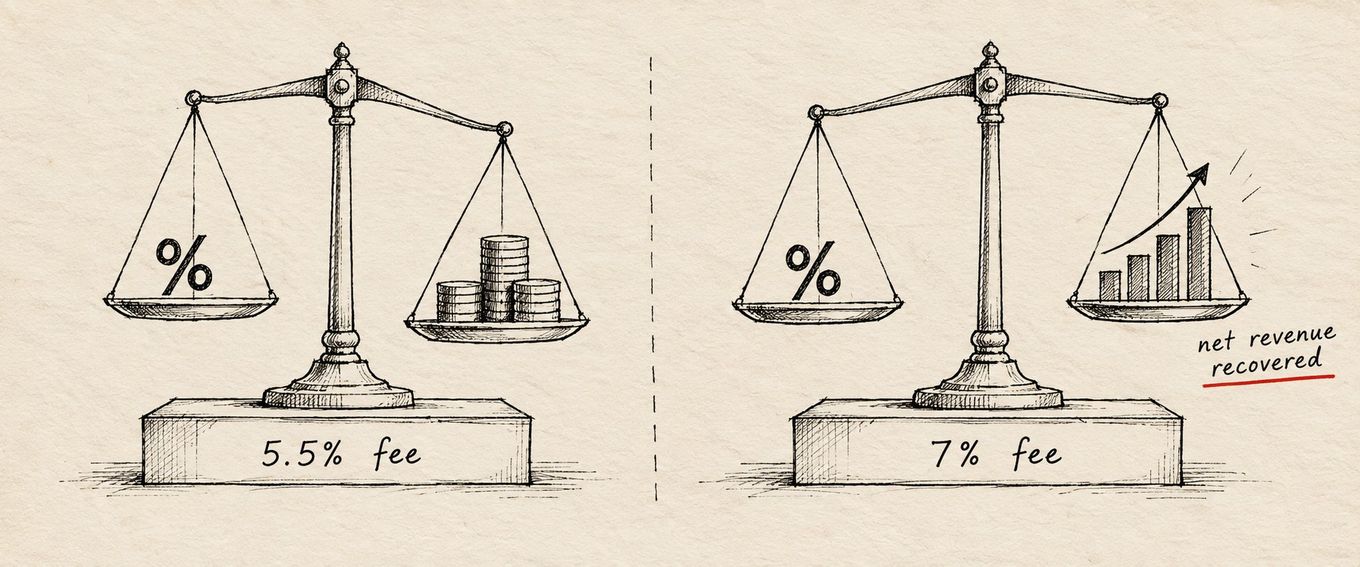
The percentage itself is often less important than what you're getting for it. A service charging 7% that actually works your denials, maintains your credentialing, and catches underpayments is generating more net revenue than a 5.5% service that files claims and posts payments.
Why Trust This Article
We wrote this from the operator's side of mental health billing, not the vendor pitch side. Clarity's work is led by President and CEO Estelle Sandoval, who has led billing operations since the late 1980s and built her career tracing denials back to the upstream processes that caused them. Our team's experience covers outpatient therapy groups, psychiatry and psychiatric NP practices, group practices with mixed caseloads, and community mental health organizations.
That experience shows up in results from real client engagements. We've reduced denial rates from 22% to 6% in behavioral health IOP and PHP practices, and recovered more than $5 million in claims prior billers had written off. The upstream factors that created those denial rates, carve-out misrouting, modifier gaps, missed authorizations, lapsed credentialing, are the same ones this article covers.
The benchmarks, denial patterns, and practice-type nuances in this article come from working mental health billing accounts across every configuration described above, not from aggregated surveys or vendor materials. The denial categories in the table, the AR days ranges, the modifier failure modes: these are things we've corrected in real practices. Where figures are drawn from published industry data, they are cross-referenced against multiple sources. CPT code descriptions reflect current AMA coding guidelines and CMS billing rules. Pricing ranges are derived from market data across billing vendors, not from any regulatory body, since commercial billing service fees are set by the market.
How We Handle Mental Health Billing at Clarity

Mental health billing is one of Clarity's core specialty areas, and we work it differently than a generalist RCM firm would.
Our team understands behavioral health carve-outs, time-based coding requirements, parity law appeals, and the documentation standards that distinguish a defensible claim from one that comes back on audit. We handle psychiatry billing alongside therapy billing, which means we know how modifier -25 works on same-day E&M and psychotherapy visits, when prior auth is required by which plan and code, and how to build an authorization tracking system that doesn't let approvals expire mid-treatment.
We also coordinate credentialing and billing in the same operation. The effective-date-in-billing problem described above doesn't happen when credentialing and billing share the same team and the same system.
If you're evaluating whether to switch, or comparing vendors for the first time, our team is available to talk through your specific situation. We'll tell you honestly whether we're the right fit for your practice type, not just whether we want your business.
Frequently Asked Questions
What do mental health billing services do?
Mental health billing services manage the revenue cycle for outpatient therapy, psychiatry, and counseling practices. This includes eligibility verification, charge entry, claim submission, denial management, payment posting, and patient balance follow-up. Specialized mental health billing services also handle behavioral health carve-out routing, prior authorization tracking, time-based coding review, and parity law appeals, which general medical billing services typically do not.
How much do mental health billing services cost?
Most mental health billing services charge between 5% and 10% of collections, with most practices paying 6% to 8% depending on practice size, claim volume, and service scope. Solo providers and smaller groups tend toward the higher end of that range; larger multi-provider groups can often negotiate lower. Confirm whether the quoted percentage applies to billed charges or collections, and whether patient statement services, credentialing, and denial appeals are included or billed separately. For a fuller breakdown, see our guide to medical billing services cost.
What is a behavioral health carve-out and why does it matter for billing?
A behavioral health carve-out is an arrangement where a health plan separates its mental health benefits from its medical benefits and routes them through a managed behavioral health organization (MBHO) like Optum Behavioral Health, Evernorth (Cigna's behavioral carve-out), or Carelon Behavioral Health (formerly Beacon Health Options). Claims submitted to the wrong payer are denied, and the carve-out structure varies by plan, employer group, and product line. A mental health billing service that doesn't routinely verify carve-out status at eligibility will consistently file claims to the wrong entity.
What denial rate should I expect from a mental health billing service?
Industry benchmarks for outpatient mental health billing typically run between 5% and 12% denial rates, though this varies significantly by payer mix, practice type, and documentation quality. Psychiatry practices with medication management tend to see higher initial denial rates due to prior authorization complexity and modifier requirements. Ask any prospective service for denial rates by payer and CPT code category for practices similar to yours, not a single blended number.
What's the difference between mental health billing services and behavioral health billing services?
The terms are often used interchangeably, but behavioral health billing typically covers a broader scope: outpatient therapy, psychiatry, and also substance use disorder treatment, intensive outpatient programs (IOP), partial hospitalization (PHP), and residential treatment. Mental health billing services more specifically address outpatient therapy and psychiatry practices. If your practice includes SUD treatment or level-of-care transitions, confirm that a vendor's experience extends into that territory. Our guide to behavioral health billing services covers the broader picture.
How long does it take to transition to a new mental health billing service?
A full transition, from contract signing to complete operational handoff, typically takes eight to twelve weeks. The process runs in phases: setup and data export in the first two weeks, parallel processing where the old service continues working existing claims while the new service handles all new submissions, and a wind-down period where legacy AR is resolved. A rushed transition increases the risk of claim submission gaps and missed timely filing windows. Ask any prospective service for a detailed go-live timeline and confirm what happens to claims submitted by the outgoing company during the handoff period. Our guide to switching medical billing companies covers the transition process in detail.
Can a mental health billing service handle both therapy and psychiatry in the same practice?
Yes, but confirm this explicitly, not just in general terms. Ask whether the service has active psychiatry clients, how they handle modifier -25 on same-day E&M and therapy visits, and whether they manage prior authorizations for medication management. Some services handle therapy billing well and have limited psychiatry experience, which creates the scenario described at the top of this article. Your billing service should be able to describe the specific differences in how they handle each service type.