Mental Health Billing Guide: Where Claims Actually Fail
August 26, 2026 · 59 min read
Reviewed August 17, 2026
The schedule was full. Every claim in the system says "submitted." And the money that landed this week doesn't come close to matching the work that left the building.
If you've been there, the hardest part usually isn't the shortfall. It's not being able to say why. The notes are signed. The codes look right. The payer's portal shows the patient is active. Somewhere between a completed session and a deposit, something failed silently, and nothing in your software is willing to tell you what.
The failure is usually outside the note. A claim can die before the patient is ever scheduled, because the rendering provider was never linked to the billing group. It can die at intake, because the behavioral benefit was carved out to a company whose name isn't on the insurance card. It can die in transit, because the file was accepted and the individual claim inside it was not. It can die after the payer says it paid, because the allowed amount was wrong and nobody compared it to the contract. Clinical excellence protects none of that.
We run revenue cycles for behavioral health and mental health practices, and the pattern we see most is not bad coding. It's a practice doing careful clinical work while money leaks from a part of the system nobody ever showed them.
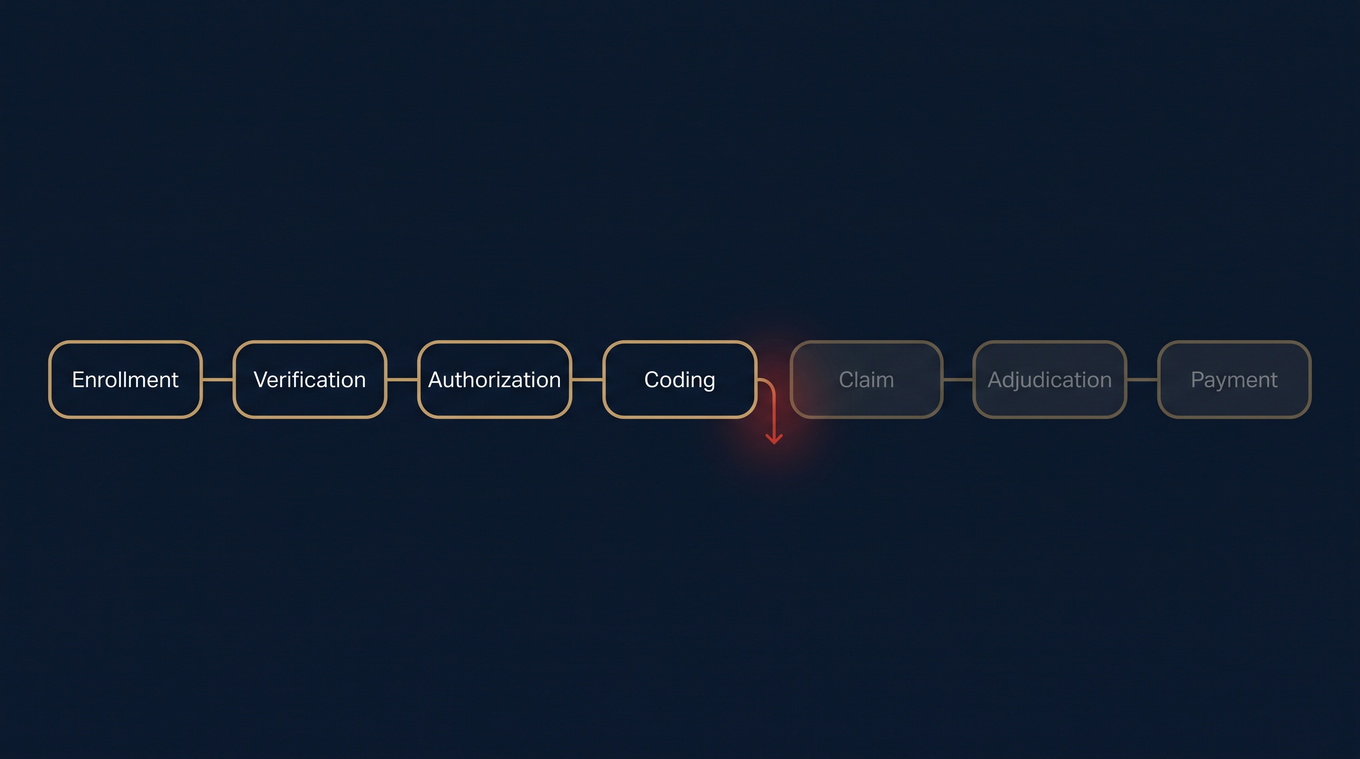
This page is not a list of CPT codes. It's the full chain a session travels to become revenue, stage by stage, with the failure each stage produces and the evidence that proves it. By the end you should be able to look at an unpaid claim and say this broke at enrollment, or this broke at routing, or this never reached adjudication at all, and know what to do next.
Where a topic deserves its own treatment - the 53-minute threshold, denial appeals, credentialing timelines - you get the principle and the decisive detail here, then a link to the page that goes all the way down.
And a standing caveat that applies to every rule below: CPT identifies a service; it does not guarantee coverage or payment. Coverage, network status, prior authorization, telehealth rules, documentation requirements, filing deadlines and fee amounts change by payer, product, employer group, state, provider type and date of service. Every payer named on this page is an example, not a universal instruction. Verify the member's plan and your own contract before you act.
The mental health revenue cycle, stage by stage
Revenue cycle management is a chain of dependencies. Each stage produces an artifact - a signed contract, an enrollment confirmation, a benefits reference number, a signed note, an acknowledgment file, a remittance - and the next stage depends on that artifact being correct. When money stops arriving, the useful instinct is not to call the payer. It's to walk backwards and find the last artifact you actually trust.
Mental health work stresses this chain harder than most specialties:
- The services are recurring and time-based. A surgical claim is an event. A therapy caseload is dozens of small, similar claims per week, so a single misconfiguration costs you every claim of that type until someone notices.
- The benefit is often administered by someone else. Behavioral health benefits are frequently carved out to a separate managed behavioral health organization with its own network, its own authorization rules and its own claims destination.
- Provider type governs payment. The same service code is not payable to every license under every plan, and the rules differ by payer and by state.
- Authorization is dense, especially above routine outpatient care, and approvals expire while episodes continue.
- Modality changes the rules. Where the patient physically sat during the session can change the place of service, the modifier, the network status and the rate.
- The records carry extra legal weight. Psychotherapy notes and substance use disorder records have protections ordinary medical documentation doesn't.
Every stage below produces something the next stage needs, and every stage has a signature way of failing:
| Stage | What it produces | How it fails |
|---|---|---|
| Provider identity | Legal name, TIN, Type 1 and Type 2 NPIs, taxonomy, licenses, locations | Name, TIN or address mismatch; wrong taxonomy; lapsed license |
| Credentialing and contracting | Approved qualifications, signed agreement, rates, effective date | "Credentialed" with no countersigned contract, or a future effective date |
| Enrollment and linkage | Provider loaded under the right group, TIN and location | Rendering NPI not linked to the group; location never loaded |
| Registration | Exact demographic and subscriber data | Name, date of birth or member ID mismatch; wrong subscriber |
| Benefit routing | The correct administrator and payer ID | Claim sent to the medical carrier instead of the behavioral carve-out |
| Network and benefits | Network status for the exact product, plus cost-share facts | In network at brand level but not for this product, group or provider |
| Authorization | Approved service, dates, units, level of care | Missing, expired, exhausted, or tied to the wrong entity |
| Documentation | Signed record supporting diagnosis, service, time and necessity | Appointment duration substituted for service time; vague interventions |
| Coding | Correct current-year diagnosis and procedure codes | Wrong time band; provider not eligible for the code; retired code |
| Claim construction | Accurate professional claim data | Wrong place of service, modifier, NPI, TIN, diagnosis pointer or payer ID |
| Transmission | Claim accepted at both file and claim level | Staff mistake "sent" for "accepted" |
| Remittance and payment | Posted remittance matched to actual cash | Cash received but unposted; adjustment code ignored; underpayment invisible |
Credentialing vs contracting vs enrollment: why claims still deny
Credentialing is the payer verifying professional qualifications: licensure, education, training, certifications, work history, sanctions. Aetna describes it explicitly as a process separate from network contracting, which is the correct mental model. Passing credentialing means the payer believes you are who you say you are and are qualified to do the work.
Contracting creates the participation agreement - the products you're in, the reimbursement terms, the claim rules, the termination terms, and the effective date. Carelon Behavioral Health tells providers they must be credentialed and have a countersigned contract before seeing members as an approved network provider, and that formal communication from the plan is what supplies the effective date, not the approval email or the recruiter's phone call.
Enrollment is the payer loading you into the systems that pay claims. It answers a different set of questions:
- Is this individual (Type 1) rendering NPI linked to the group's (Type 2) NPI?
- Is the provider associated with this tax ID and this pay-to record?
- Is the service location loaded?
- Is the taxonomy accepted?
- Is participation active for this product on this date?
And running alongside all of that are three separate operational rails that people routinely assume are one thing: EDI enrollment authorizes electronic claim submission through your clearinghouse, ERA enrollment delivers the electronic remittance data that explains what the payer did, and EFT enrollment directs the actual funds. Medicare handles EFT authorization through form CMS-588, and each rail is enrolled separately.
A clinician can pass credentialing, sign a contract, and still be unpayable because the linkage is incomplete. That is the mechanism behind the familiar complaint - the payer says I'm credentialed, so why are my claims processing out of network? Nothing about the credential is wrong. The payer's provider file doesn't connect the person who rendered the service to the entity submitting the claim.
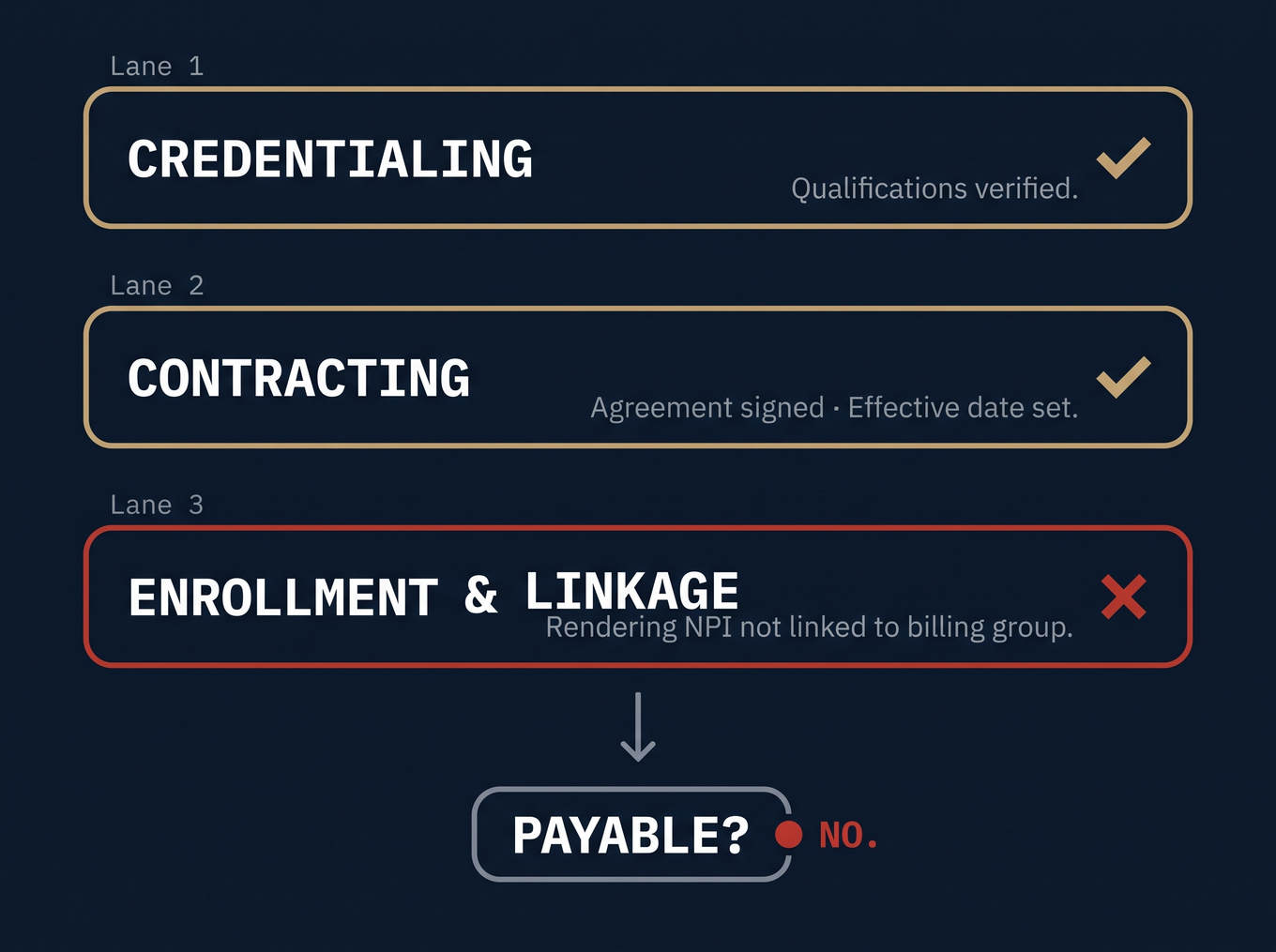
"We're not getting paid" is never a single diagnostic category. It could be a claim problem, an ERA delivery problem, an EFT problem, or a posting problem - four different failures that look identical from the bank statement.
The National Provider Identifier is a ten-digit, intelligence-free number: it encodes nothing about your state or specialty, which is why the payer's own file has to carry that context. A solo clinician may bill under a Type 1 NPI. A solo owner with an entity bills under the Type 2 and renders under the Type 1. A group bills under the Type 2 and TIN with each clinician rendering under their own Type 1. None of those structures is more correct than the others - what matters is that the claim matches the payer's enrollment record.
The practical control here is a single maintained provider record:
- Identity - legal name and DBA, TIN, both NPIs, taxonomies, license numbers and expiry dates
- Locations - service and pay-to addresses, and rendering-to-group linkages
- Payer status - payer and product participation, credentialing approval date, contract signature and effective date, claim payer ID
- Rails and renewals - EDI, ERA and EFT enrollment status, and recredentialing dates
It's the document you produce when a payer says it can't find your contract, when one location pays and another doesn't, or when a routine address update moves you out of network.
Treat any change to name, TIN, ownership, NPI, taxonomy, group affiliation, license, banking or address as a revenue cycle project, not a profile edit. Identify every payer and system that consumes the field, find out whether the change needs advance notice or a new enrollment, preserve both the old and new effective dates, submit through each required channel, get written confirmation, test a small batch of claims, and watch the remittances. Practices lose months of revenue to address changes that felt like paperwork.
One dated update worth knowing: eligible marriage and family therapists and mental health counselors have been able to enroll in Medicare and bill independently for services furnished on or after January 1, 2024, subject to CMS's qualification and enrollment requirements. If a resource tells you those clinician types can't participate in Medicare at all, it predates the change.
The control that prevents most of this: don't release claims for a new payer, provider or location until you have a tested effective date and at least one successfully adjudicated claim.
If you're setting up panels now, our guide to insurance credentialing for therapists covers the application workflow, CAQH and realistic timelines in detail. Don't schedule in-network care on the strength of the phrase "credentialing approved." Ask for the countersigned contract, the specific network and product, the effective date, and written confirmation that the individual is loaded under the correct group, TIN and location.
Why the payer on the card may not be the payer you bill
A carve-out is what happens when an employer group or health plan assigns behavioral health and substance use benefits to a separate organization that administers them independently. Point32Health's utilization management manual documents exactly this arrangement - some employer groups carve out behavioral health, and the carve-out entity maintains its own network and its own administration.
The operational consequences are invisible from the front desk:
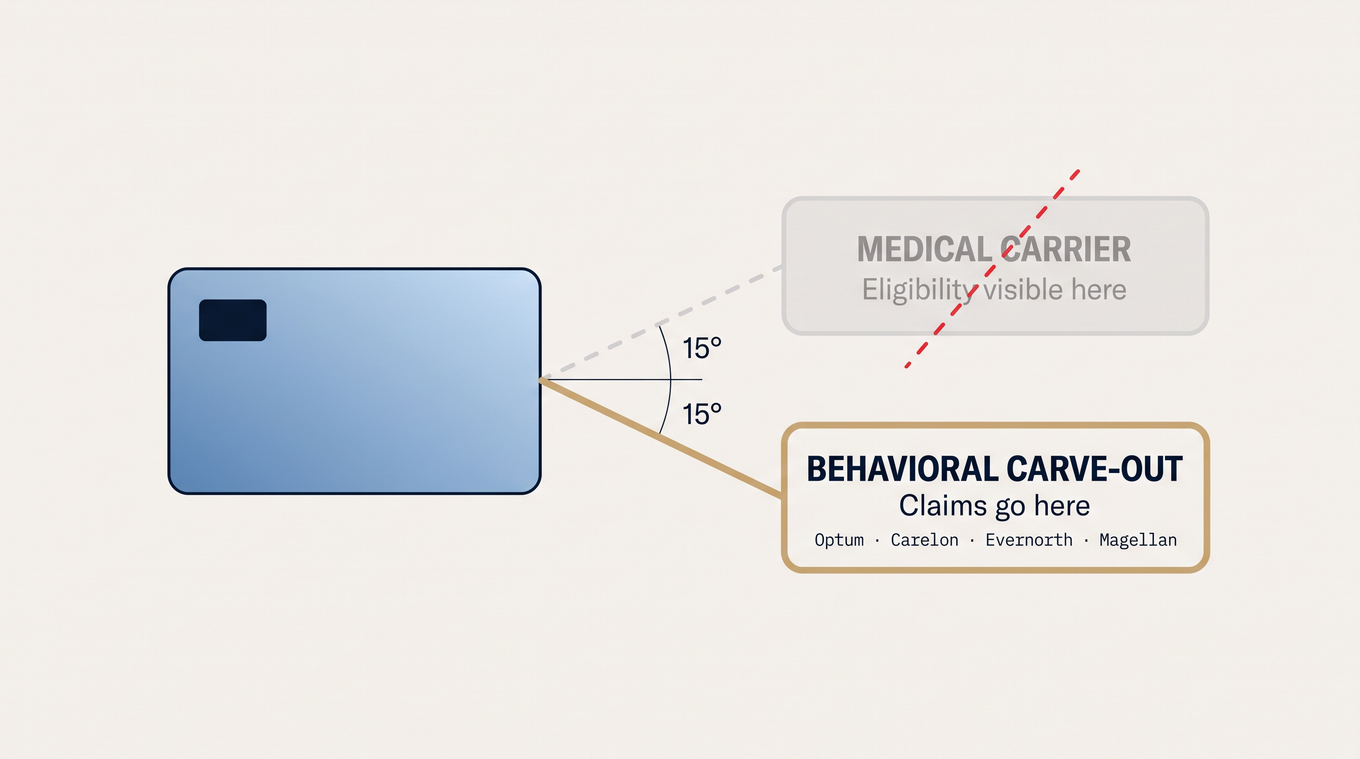
- The logo on the front of the card may not be the entity that receives behavioral claims.
- The medical carrier's provider directory may not tell you whether the clinician is in the behavioral network.
- Authorization may belong to the carve-out even when medical eligibility is perfectly visible in the carrier's portal.
- The payer ID and claims address can differ by product and administrator.
- The same patient with "the same insurance" can route somewhere new after an employer changes plans.
This is why "call the insurance company and verify benefits" is not sufficient instruction. Verification has to identify the benefit administrator and the claim destination for the specific product, not the brand on the card.
Five different questions get collapsed into one word, verified, and they establish different things:
| The question | What it establishes | What it does not establish |
|---|---|---|
| Is the member eligible? | Coverage is active for this date and plan | That mental health services are covered, that you're in network, or that the claim will pay |
| What are the benefits? | Cost share, limits, exclusions for the service category | That you've identified the correct administrator and payer ID, or obtained authorization |
| Is this provider in network? | Participation for a particular product, entity and effective date | That every code, modality, location or frequency is covered |
| Is authorization required and approved? | Utilization review status for defined services, dates and units | Payment, if claim data, eligibility, coding, contract or documentation requirements fail |
| Is the claim payable? | Final adjudication, after all conditions are applied | Nothing, until the payer actually adjudicates |
Aetna's provider manual is unusually direct about the fourth row: prior authorization is a utilization review process applying coverage criteria, and it does not universally represent payment. That's a payer telling you in writing that its own approval isn't a promise.
A verification worth doing captures the things that change outcomes:
- The behavioral health administrator and the payer ID for professional behavioral claims - the single most valuable field on the form.
- Network status for the exact product, not the carrier brand, with the effective date and service location.
- Whether the rendering clinician is linked to the billing group.
- Benefits asked by actual code and circumstance - diagnostic evaluation, individual psychotherapy at the length you actually provide, family or group work, testing, in-person versus audio-video versus audio-only - rather than the word "therapy" in the abstract.
- Cost share, remaining deductible, visit or session limits, frequency edits, and whether extended psychotherapy carries special review.
- Whether the plan is an EAP benefit rather than ordinary health coverage.
And then the evidence: representative name, date and time, reference number, the exact question you asked and the exact answer you got, and the date you'll recheck. Payer representatives can and do give incomplete or wrong information. Your protection isn't a promise to the patient - it's a documented, repeatable process and a reference number to escalate with.
A payer rule without a date is a future denial. Record the product, the effective date, the source and the day you verified it, and never overwrite the old value - you'll need it to explain a historical date of service.
Employee assistance programs look like ordinary behavioral coverage and bill nothing like it. Evernorth's published EAP instructions are a useful concrete example: EAP verification has its own authorization format, the number of covered visits varies by employer, service dates run inside a defined period, claims use a specific EAP code, the authorization goes in a designated claim field, and the electronic payer ID differs from the medical one. That is an Evernorth-specific example, not a universal EAP rule - but the lesson generalizes: never assume the same patient's EAP sessions and health-plan sessions use the same code, authorization or claim route.
Prior authorization: what the approval number does not cover
A tracking or reference number proves you asked. An approval proves they said yes. And even an approval isn't a payment guarantee - it's a utilization review decision that can still be undone by eligibility, coding, contract or documentation problems downstream.
Requirements vary by payer and product. Optum states that authorization or notification is required for specialty outpatient services and most inpatient services across the plans it administers, while instructing providers to select the plan type and check benefits for each visit. That's evidence for maintaining a payer-and-product matrix, not evidence that every routine psychotherapy visit requires an authorization. The only way to know is per plan, per product, per date.
Treat authorization as a ledger with expiry dates, not a number stored in a chart. The fields that change outcomes:
- The payer, product and administrator that issued it - approvals belong to a legal entity, and the entity has to match the one you're billing.
- The specific codes or level of care approved, and the modality if it was specified.
- The date range, and the units, visits or hours approved against the units consumed.
- The servicing provider and location, which must match the clinician who actually delivers the care.
- Whether what you have is a notification or an authorization - they are not the same status.
- Concurrent review dates for anything above routine outpatient, with an alert before the deadline rather than after.
- The claim field where that payer expects the number to appear.
The failure modes are consistent: the authorization belongs to the wrong entity; the approval covers one code and a different one gets billed; dates or units run out mid-episode; the provider or location differs from the approval; a request tracking number gets recorded as an approval; or a corrected claim gets resubmitted in a way that breaks the authorization linkage entirely.
Whatever you tell the patient at intake about their cost is an estimate. Final responsibility depends on adjudication, the allowed amount, accumulators, coordination with other coverage and a few legal protections. Quoting a benefit as though it were a bill is how practices end up refunding money and losing trust simultaneously.
Mental health CPT codes and what each one is for
First, the hierarchy. Most coding arguments are disagreements about which source wins.
Current CPT and AMA guidance govern CPT rules. Current HCPCS files and CMS guidance govern Medicare-specific codes. Current-year ICD-10-CM files govern diagnosis coding. Then applicable Medicare local coverage articles or payer medical policy, then your contract and the state Medicaid manual. Your practice management software's code labels sit at the bottom - they're a convenience, not an authority, and they are frequently out of date.
One corollary: CMS's Medicare Coverage Database articles are excellent, and they are not the law for every payer. Many are tied to a specific Medicare Administrative Contractor. Cite them as Medicare guidance, not as universal commercial policy.
The working map, grouped by what each code is for rather than by number. Descriptions are paraphrased - CPT is copyrighted by the AMA, and there's no substitute for the current codebook.
| Code or family | What it's for | The distinction that matters | The common error |
|---|---|---|---|
| 90791 | Psychiatric diagnostic evaluation without medical services | An assessment service, not routine psychotherapy | Using it as an automatic "first visit" code regardless of what was done or the payer's frequency rules |
| 90792 | Psychiatric diagnostic evaluation including medical services | Requires a clinician qualified to perform the medical component | Treating it as interchangeable with 90791 for any clinician |
| 90832 | Individual psychotherapy, shortest reportable band | 16–37 minutes under the cited Medicare guidance | Billing it when under 16 minutes was actually delivered |
| 90834 | Individual psychotherapy, middle band | 38–52 minutes | Using the scheduled 45- or 50-minute slot instead of actual service time |
| 90837 | Individual psychotherapy, longest common band | 53 minutes or more; payers may scrutinize necessity and frequency | Defaulting every "hour appointment" to it without time and necessity support |
| 90833 / 90836 / 90838 | Psychotherapy add-on to an E/M service | Psychotherapy time is separate from E/M work and time | Reporting them standalone, or counting the same minutes twice |
| 90785 | Interactive complexity add-on | Only with eligible primary services, and only when qualifying communication complications are documented | Billing it because a session was difficult - or confusing it with 90836 |
| 90846 | Family psychotherapy without the patient present | Family-focused treatment tied to the identified patient's care | Using it for ordinary collateral history or administrative family contact |
| 90847 | Family psychotherapy with the patient present | The patient participates in the service as defined | Confusing it with couples counseling without establishing the identified patient and medical necessity |
| 90853 | Group psychotherapy | A therapeutic group service, not a class or support group by default | Relying on one cloned group note instead of participant-specific documentation |
| 90839 / 90840 | Crisis psychotherapy, initial and additional time | Time-based, crisis-focused, with special same-day combination restrictions | Substituting it for routine psychotherapy because a session felt intense |
| 99202–99215 | Office and outpatient E/M for qualified prescribers | Level selected by medical decision making or total time under current rules | Letting note length drive the level |
| 96130–96133 | Psychological and neuropsychological test evaluation | The evaluation, integration and reporting work | Mixing evaluation time with administration and scoring |
| 96136–96139 | Test administration and scoring | Who performs the work determines the family | Billing technician and qualified-professional work interchangeably |
| 96146 | Automated testing with automated result generation | A specific automated function | Treating every digital questionnaire as separately payable testing |
90836 is not interactive complexity. It's a psychotherapy add-on reported alongside an E/M service. 90785 is the interactive-complexity add-on, and CMS describes it as reportable with specified diagnostic, psychotherapy or group services when qualifying communication complexity is present - not as a surcharge for a challenging patient. It isn't reported when the patient can't communicate by any means, and it never stands alone.
90791 versus 90792 is not "the therapist code versus the psychiatrist code." The actual line is whether the diagnostic evaluation includes medical services, and whether the clinician is legally and contractually qualified to report that service. CMS notes that a psychiatric diagnostic evaluation with medical assessment may be reported with 90792 or with an appropriate E/M code by a physician or non-physician practitioner. Report what was actually done, by someone permitted to do it.
Testing isn't a code. It's a workflow with four separable components: the evaluation work (record review, test selection, interpretation, integration, report, feedback), administration and scoring by a qualified health professional, administration and scoring by a technician, and automated testing. CMS's testing article requires that the testing affect diagnosis, prognosis or treatment planning to be medically necessary, and that the performing practitioner be appropriately licensed and enrolled. If a resource you're using still lists pre-2019 testing codes, stop using it.
For orientation beyond this map, the AMA's behavioral health coding guide and APA Services' psychotherapy code resource are both solid starting points. Neither replaces the current licensed CPT codebook for final code-level review, and neither tells you what a specific payer will actually pay.
For any encounter, the selection logic runs in roughly this order: what service was actually performed, who performed it and are they permitted to by law and contract, who was present, was there a separate medical component, what reportable time was delivered and which time rule applies, what was the modality and where was the patient, does any add-on have a valid primary service, does the diagnosis support the service under the applicable policy, and does the documentation support every element you're about to report.
Psychotherapy time bands and how to pick the right code
The CMS article on psychiatric diagnostic evaluation and psychotherapy services sets out the time bands directly:
| Psychotherapy service | Reportable time |
|---|---|
| 90832 / 90833 | 16–37 minutes |
| 90834 / 90836 | 38–52 minutes |
| 90837 / 90838 | 53 minutes or more |
| Under 16 minutes | Not reported under this family |
The same guidance requires start and stop times or total time documented where time determines the code, and requires that psychotherapy time exclude E/M time when both services are reported.
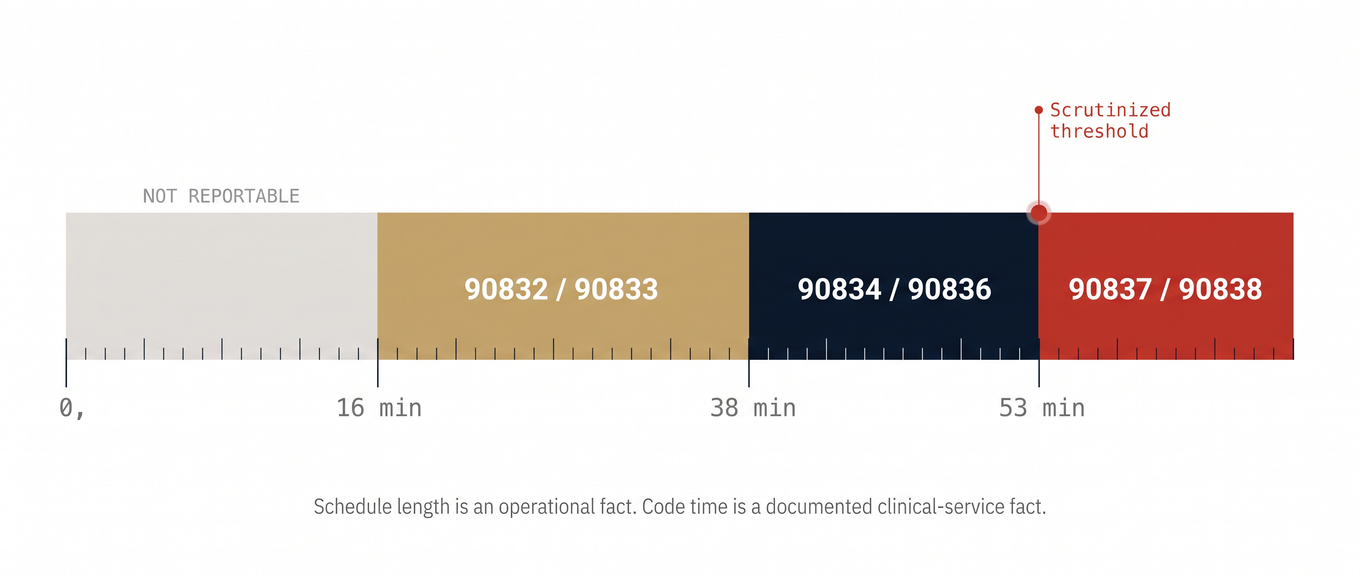
Schedule length is an operational fact. Code time is a documented clinical-service fact. They are not interchangeable, and a 60-minute calendar block routinely contains late arrivals, scheduling conversations and administrative work that aren't reportable psychotherapy time.
Crossing 53 minutes is necessary for 90837. It is not sufficient. The time band establishes which code is available; medical necessity, documentation, authorization and payer policy still govern whether it gets paid and whether it survives review. A note that says "60-minute session" and nothing about what made the longer service clinically appropriate is thin evidence, and canned language that only asserts "extended time medically necessary" is barely better. The need should be visible from the presentation, the interventions and the plan.
Downcoding out of fear is its own defect. Reporting 90834 for a documented 55-minute psychotherapy service doesn't make you safer. It makes the claim inconsistent with the record, which is the condition an audit is looking for. Neither "90837 is never standard" nor "90837 is always fine at 53 minutes" is defensible. What is: accurate time, supported necessity, and that specific payer's rules.
For prescribers running medication management alongside psychotherapy, establish that a significant, separately identifiable E/M service occurred. Select the E/M level under current rules - CMS's E/M guidance places most families on medical decision making or total practitioner time, with history and exam no longer selecting the level. Then identify the psychotherapy time separately, choose the add-on whose band it meets, and document the two components distinctly enough that a reviewer can see both. The same minutes never count twice.
If 90837 is where your denials or record requests are concentrated, our guide to billing 90837 goes deeper on documentation, payer scrutiny and how to respond when the request arrives.
Documentation and diagnosis rules that survive an audit
Documentation here does two jobs. It's the clinical record, and it's the evidence someone who wasn't in the room will read years later, looking for a reason not to pay.
Use the code set that was effective on the date of service
Diagnosis codes change by federal fiscal year. CMS publishes the ICD-10-CM files by year, and the FY2027 files and guidelines are already published - they apply to encounters from October 1, 2026. That transition is a genuine trap: a claim coded correctly in September can be wrong in October for the same clinical picture. The durable habit is to think in terms of the code set effective for the date of service, never a static list.
Don't code uncertainty in the outpatient setting
Under the current official guidelines, for outpatient services you do not code a diagnosis documented only as probable, suspected, questionable, rule-out or working. Code to the highest degree of certainty known for that encounter - the established condition, or the signs and symptoms.
That prevents two opposite billing errors: selecting a more specific code because someone believes the payer "likes" it, and defaulting to an unspecified code when the record supports more specificity.
A diagnosis code also doesn't make a service medically necessary by itself. The record needs to show the condition or symptoms being addressed, the functional impact, why this service at this intensity and frequency is appropriate, what interventions were actually provided, how the patient responded, and the ongoing plan.
What a defensible progress note has to contain
A strong routine note generally carries:
- Patient identity and date of service
- The rendering clinician and credential
- The service type and who participated
- The patient's location and modality, where relevant
- Start and stop or total psychotherapy time, when time determines the code
- Clinically relevant symptoms, status and functional impact
- The diagnosis or diagnostic rationale
- The medical necessity for the service - and for longer duration or higher frequency where that applies
- The specific interventions performed
- The patient's response and progress
- The plan, and its connection to the treatment plan
- Separate E/M and psychotherapy components when both are reported
- A legible or electronic signature with date
CMS's psychotherapy article requires a legible record, patient identification, the responsible practitioner's signature, support for both the diagnosis and procedure code selections, and time documentation where time is relevant.
For group work, one cloned narrative applied to every participant is weak evidence. Each participant needs a record showing attendance, individual relevance, response and plan.
Psychotherapy notes are a legal term of art, not a synonym for progress note
HHS gives "psychotherapy notes" a narrow definition: notes recorded by a mental health professional that analyze the contents of a counseling conversation and are maintained separately from the rest of the medical record. The definition expressly excludes medication monitoring, session start and stop times, treatment modality and frequency, test results, diagnosis, functional status, treatment plan, symptoms, prognosis and progress.
Nearly everything a payer legitimately needs to adjudicate a claim is not a psychotherapy note. It belongs in the designated record set. So your appeal workflow should never default to sending separately protected psychotherapy notes, and staff should stop using the two terms interchangeably.
The extra layer on substance use disorder records
If your practice or program is subject to 42 CFR Part 2, those records carry protections beyond HIPAA. The 2024 final rule aligned several provisions with HIPAA and set a compliance date of February 16, 2026 - a date that has now passed. It permits a single consent covering future treatment, payment and health care operations uses; permits covered entities and business associates receiving records under that consent to redisclose under HIPAA; and creates separately protected SUD counseling notes analogous to psychotherapy notes.
For revenue cycle purposes that means: determine whether Part 2 applies to you, make sure business associate agreements, access controls and appeal workflows account for it, use minimum-necessary and role-based access, preserve consent and disclosure evidence, and don't hand record handling to a vendor without confirming their obligations. This is a compliance question, not a billing question, and it deserves qualified advice rather than a blog's summary.
Parity is an appeal framework, not a payment button
Parity matters where mental health and substance use benefits face financial requirements or treatment limitations more restrictive than comparable medical and surgical benefits - including non-quantitative limits like prior authorization practices, network design and reimbursement methodologies. CMS's parity page explains the framework.
The enforcement posture is nuanced. A May 2025 joint federal statement said the departments would not enforce the new portions of the 2024 final rule during the relevant litigation period and for 18 months after a final decision. The underlying statute, the Consolidated Appropriations Act requirements and the earlier rules all remain in force.
Practically: parity can be a real escalation and appeal framework. It is not an entitlement that forces every plan to cover every mental health service, and it doesn't convert a coverage exclusion into a payable claim. Distinguish plan exclusions, medical necessity disputes and potentially discriminatory limits - and get qualified legal advice for systemic parity concerns rather than arguing it from a blog post.
Telehealth rules: place of service, modifiers and dates
The cleanest mental model for virtual care: you're billing the ordinary service code, plus an overlay of conditions. Was the clinician licensed or authorized where the patient was located? Is the service permitted by that payer for that provider type? Was it audio-video or audio-only, and is that modality allowed? Where was the patient, and which place of service applies? Which modifier does this payer and product require? Does the contract pay telehealth at the same rate? Does authorization or network status change with the modality? And does the note document the location and modality?
There is no safe universal sentence here. Not "always use modifier 95." Not "POS 10 for telehealth."
Medicare is the useful federal baseline, precisely because it's published and dated. CMS's telehealth FAQ, updated February 26, 2026, states that through December 31, 2027 beneficiaries can generally receive telehealth services anywhere in the United States and its territories; that behavioral health geographic and site restrictions are permanently removed under the cited statute; that the in-person requirement for mental health telehealth takes effect after December 31, 2027; that audio-only in the home remains available through December 31, 2027, with a continuing behavioral health pathway from 2028 under specified conditions; and that you use POS 02 when telehealth is furnished somewhere other than the patient's home and POS 10 when the patient is in their home. HHS's billing guidance additionally identifies modifier 93 and/or FQ for applicable audio-only scenarios.
Place of service follows the patient's location, not yours. A clinician working from a home office does not make POS 10 correct. The question is where the patient physically was.
One distinction explains a lot of confusing telehealth denials, and it applies beyond telehealth:
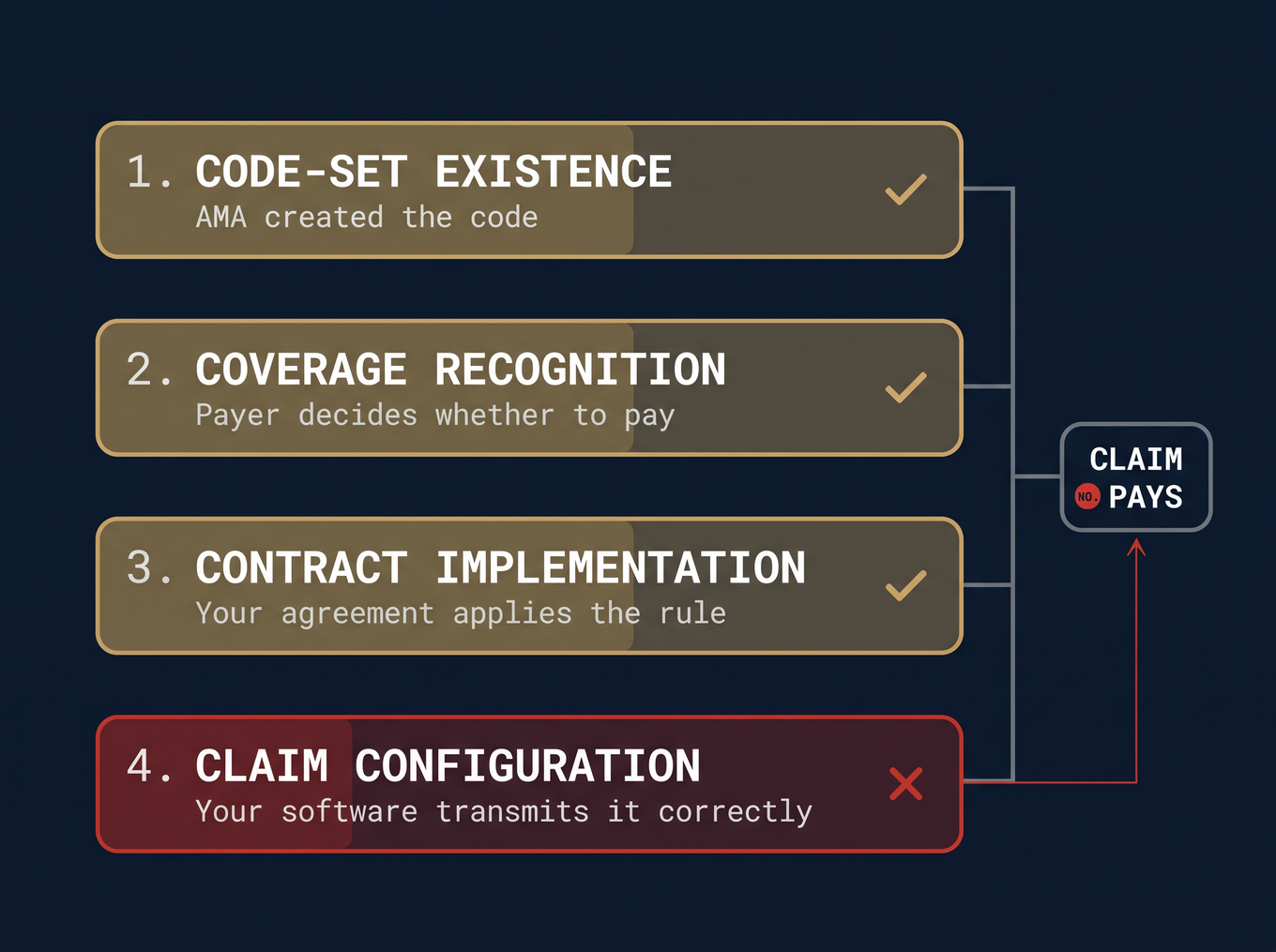
- Code-set existence - the AMA created a code.
- Coverage recognition - a payer decides whether and how it will pay for it.
- Contract implementation - your specific agreement applies the rule.
- Claim configuration - your software and clearinghouse actually transmit it correctly.
All four have to line up. New CPT telemedicine E/M families existing does not mean every payer, including Medicare, pays them, and it doesn't mean they replaced office and outpatient codes for all payers.
Beyond Medicare, the variation is wide. Commercial plans may require 95, GT, 93 or something else; some have retired older modifiers while others still expect them. HHS states plainly that each state sets its own Medicaid billing and reimbursement rules, covering provider types, modality, POS, modifiers, consent and documentation. Employer products under the same brand can differ from each other. Audio-only coverage often differs from audio-video. And interstate practice depends on professional licensure and compacts, not on whether a payer covers the service - a plan paying the claim does not make you licensed to have delivered it.
A fifty-state table would be wrong within a quarter. What holds up is knowing where to look: the state licensing board, the state Medicaid provider manual and fee schedule, the managed care plan manual, the state department of insurance, and your own contract and product policy.
When a telehealth claim fails, the symptom usually points at one place to look first:
| Symptom | First evidence to inspect |
|---|---|
| Service not covered | The current telehealth list and the product's benefit exclusions |
| Invalid modifier or POS | The payer's billing instruction for that date of service |
| Provider not eligible | License, provider type, enrollment and network record |
| Authorization missing | The authorization ledger, and whether it matched the service and modality |
| Place-of-service conflict | Documentation of where the patient was, against the claim data |
| Duplicate or incompatible service | Same-day claim history and coding edits |
| Audio-only denied | Modality eligibility and the required modifier |
| Paid at an unexpected rate | POS, the contract's telehealth clause and the fee schedule |
A note for whoever reads this after 2027: the Medicare flexibilities above run through December 31, 2027, and CMS describes behavioral health in-person and audio-only rules that change beginning January 1, 2028. Recheck CMS's telehealth policy pages before relying on any date in this section.
How a mental health claim is built, sent and acknowledged
Almost every "my claims disappeared" story lives here.
The 837P comes first; the CMS-1500 is the map
Your professional claims go to payers electronically as an X12 837P transaction. The CMS-1500 is the paper form, and for practical purposes it's a human-readable map of the same data. Nobody in a modern practice is filling in forms - your EHR or practice management system builds the 837P out of registration data, provider records, charges and claim rules.
When a claim fails on data, the defect usually isn't a typo someone made on a form. It's a configuration - a provider record, a location, a payer ID, a default modifier - that will keep producing the same failure on every claim until someone finds it.
The fields that actually fail
For mental health specifically, a small number of fields cause a large share of the damage:
| Field | What it carries | The mental health failure pattern |
|---|---|---|
| 1a | Member ID | Old member ID, wrong product, or the medical carrier used instead of the behavioral administrator |
| 21 | Diagnosis codes | Wrong code year, unsupported specificity, or a diagnosis omitted entirely |
| 23 | Prior authorization or referral number | Missing, wrong, or an EAP authorization not entered where the payer instructs |
| 24B | Place of service | Telehealth home versus non-home mismatch; office and POS conflict |
| 24D | Procedure code and modifiers | Wrong time band, wrong modifier, or an invalid code combination |
| 24E | Diagnosis pointer | The service line points at the wrong diagnosis, or none |
| 24G | Units | Time and unit mismatch, or incorrect quantity |
| 24J | Rendering provider NPI | Missing or wrong clinician - or a clinician who isn't linked to the group |
| 25 | Federal tax ID | TIN mismatch against the contract, W-9 or enrollment record |
| 32 | Service facility and NPI | Wrong location, or a site that was never enrolled |
| 33 | Billing provider and NPI | Wrong entity, wrong pay-to relationship, or the wrong Type 2 NPI |
The one to watch hardest is 24J. On a group claim, the organization is normally the billing provider and the individual clinician is the rendering provider. If the rendering NPI doesn't reach that field, or the clinician isn't associated with the submitter, the claim can be structurally perfect and still fail a business edit. It's the claim-level expression of the enrollment problem from earlier in the chain, and why a claim can pass every internal check and still never adjudicate.
So after any new provider, payer, location or software change, pull the actual generated claim and read it against the record. Confirm the billing NPI and TIN, the rendering NPI, the taxonomy, the service facility, the payer ID and the authorization. Submit a small test batch. Then go look at the acknowledgments rather than waiting to see whether money shows up.
What a scrubber can and cannot prove
Claim scrubbers are useful. They catch missing or invalid data, formatting problems and whatever payer rules have been configured into them.
They cannot prove that the provider is loaded correctly in the payer's enrollment system, that the benefit hasn't been carved out to another administrator, that an authorization is approved and unexhausted, that the note supports the service, that the payer's own provider file is accurate, or that the allowed amount will match your contract.
"Passed the scrubber" means the configured edits passed. It does not mean the claim is payable, and treating those as the same thing is how practices end up with hundreds of clean-looking claims that nobody is going to pay.
The acknowledgment ladder
After you transmit, a series of files comes back. Most practices never look at any of them, which is why claims vanish. These are all standardized transactions - CMS maintains the framework covering claims, eligibility, claim status, and payment and remittance - so your clearinghouse has them whether or not it puts them in front of you. Ask for them by name.
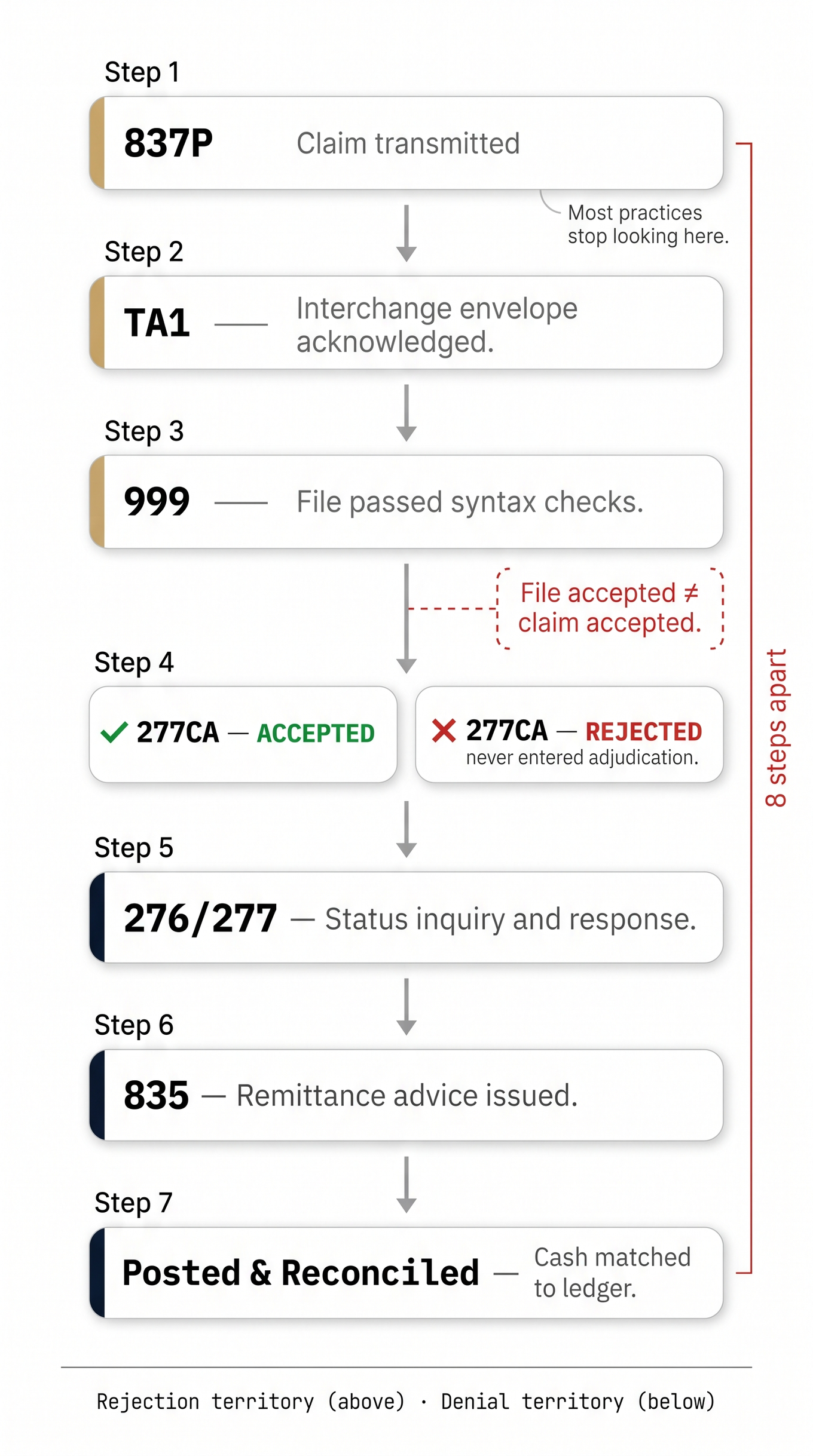
- 837P - the claim transaction you sent.
- TA1 - the interchange acknowledgment, dealing with the outer envelope. CMS's implementation material shows that something as basic as a bad sender identifier can cause an entire interchange to be rejected - every claim inside it, gone, before anyone looked at a single one.
- 999 - the implementation acknowledgment, telling you whether the file passed syntax and implementation-guide checks.
- 277CA - the claim acknowledgment, reporting acceptance or rejection of individual claims against the payer's front-end business edits. This is the rung that matters most. A claim rejected here never entered adjudication.
- 276/277 - claim status inquiry and response, used after acceptance to ask where a claim stands. A different transaction from the 277CA, despite the similar name.
- 835 - the remittance advice explaining final adjudication, payment and adjustments, with the EFT moving the actual funds.
A 999 can accept your file while the 277CA rejects the claim inside it. "The batch went through" and "the payer accepted my claim" are different statements about different transactions, and most software shows you the first one.
A status dictionary is worth agreeing on internally:
- Created - the claim exists in the system.
- Queued - awaiting transmission.
- Sent - transmitted to the next trading partner.
- Clearinghouse accepted - your clearinghouse didn't reject it. The payer hasn't seen it yet.
- Payer accepted - the payer's acknowledgment accepted it for adjudication. This is the first status that means anything.
- Pending - the payer is processing or requesting information.
- Finalized - adjudicated; a remittance exists.
- Paid - payment assigned, which may still need EFT and remittance matching.
- Posted - payment and adjustments reached the patient ledger.
- Reconciled - ledger, remittance and bank deposit agree.
Practices routinely treat "sent" as though it were "reconciled." Those are eight steps apart.
The daily control that catches this: reconcile every transmitted batch. How many claims and dollars were created, how many were sent, what the TA1 and 999 said, how many the 277CA accepted and rejected, what's in the unresolved rejection queue and who owns it, which claims have no acknowledgment after the expected interval, and what happened to the resubmissions. We run that reconciliation daily for the practices we bill for, and it's the difference between finding a rendering-NPI defect tomorrow and finding it after seventy-five unpaid claims.
Timely filing limits vary by payer and contract - Medicare generally requires claims within 12 months of the date of service, and CMS notes that late filing is generally not an appealable claim-payment decision. Do not trust any source that publishes "90 days" or "180 days" as an industry-wide deadline; keep a payer and product matrix, track the earliest relevant deadline across initial claims, corrected claims, reconsiderations and appeals, and preserve your acceptance evidence. "We sent it" is a much weaker position than a payer-level acknowledgment with a date and a control number.
Rejection vs denial: which one are you actually looking at
These four words get used interchangeably in most practices, which sends the wrong response to the wrong problem - usually an appeal letter for something that just needed a corrected data field.
Read the whole remittance message
An adjustment on an 835 normally has three layers, and reading one without the others is how people reach wrong conclusions:
- The group code says who bears financial responsibility.
- The CARC (claim adjustment reason code) gives the broad reason.
- The RARC (remittance advice remark code) adds the explanatory detail or the required action.
CMS is explicit that group code CO assigns contractual responsibility to the provider and PR assigns patient responsibility, and that Medicare beneficiaries may be billed only where PR was used for the adjustment. X12 maintains the current adjustment reason codes, the group codes and the remark codes, and they are updated over time.
The same CARC can demand a completely different action depending on its group code, its companion RARC, the payer's policy, the claim history and your contract.
Rejection versus denial
| Outcome | Where it happened | Adjudicated? | Usual next move |
|---|---|---|---|
| TA1 rejection | The interchange envelope | No | Fix the trading-partner or envelope issue, resend the batch |
| 999 rejection | Syntax or implementation | No | Fix the file or transaction issue, resend |
| 277CA rejection | The payer's front-end business edits | No | Correct the specific claim and resubmit |
| 835 denial | Adjudication | Yes | Decide between a corrected claim and an appeal |
| Paid below contract | Adjudication and payment | Yes | Contract variance or payment dispute - not a duplicate claim |
| Recoupment | Post-payment review | Prior payment reversed | Review the notice, records, appeal rights and deadline |
HFMA's revenue cycle definitions distinguish rejected claims from remittance denials, which is why a single blended "denial rate" misleads - a number that mixes the first three rows with the fourth describes nothing in particular.
Corrected claim, appeal, or payment dispute
Three different instruments for three different problems:
Use a corrected claim when the payer needs different claim data - wrong member information, a wrong code, modifier or place of service that contradicts the actual record, a missing rendering provider or authorization number, wrong units or charges, or a clerical defect. Preserve the original claim control number and follow that payer's frequency and resubmission rules. Aetna's manual, for example, describes corrected and voided electronic workflows through its portal - an example of a method, not the universal method.
Use an appeal or reconsideration when you're disputing an adjudicated decision - medical necessity, coverage interpretation, an authorization denial where you have evidence of compliance or an exception, a network status or effective-date dispute, timely filing where you have acceptance evidence and a recognized exception, or a recoupment result. Medicare's first-level redetermination generally must be filed within 120 days of receipt of the initial determination, and CMS routes minor errors and omissions through correction and reopening pathways instead of appeals.
Use a payment dispute when the claim paid but the allowed amount, fee schedule, bundling or contractual calculation looks wrong. The evidence there is your contract and fee schedule, not the clinical note.
The decision tree
Order matters:
- Was the claim accepted at the payer level? If not, work the TA1, 999 or 277CA rejection. Stop. Do not appeal.
- Is there a final remittance? If not, get a status. Do not resubmit blindly - that's how duplicates start.
- Read the group code, CARC, RARC and payer message together.
- Compare against the original claim, eligibility, authorization, enrollment, contract and note.
- Classify the root cause: registration, eligibility, enrollment, routing, authorization, coding, documentation, duplicate, coordination of benefits, timely filing, coverage, medical necessity, bundling, or contract and payment.
- Choose the route: corrected claim, reopening, records response, reconsideration, formal appeal, contract dispute, secondary claim, or valid patient responsibility.
- Calendar the deadline and list the evidence.
- Confirm receipt and outcome.
- Feed the root cause upstream so the fix lands in intake, the provider record, the authorization process, documentation or claim configuration.
A working decoder for the codes you'll actually see
Always check the current X12 description, the group code, the companion RARC and the payer's own message. With that caveat:
| CARC | The signal | First question | Likely route |
|---|---|---|---|
| 16 | Claim or service lacks information, or has a submission error | Which RARC names the missing or invalid data? | Correct the data - don't appeal a blank field |
| 18 | Exact duplicate | Was the original accepted, or did someone resend while status was unknown? | Find the original; void or correct only under payer rules |
| 22 | Another payer may be responsible | Is coordination of benefits correct, and has the primary adjudicated? | Update COB; bill in the correct sequence |
| 29 | Timely filing exceeded | What was the deadline, and what acceptance evidence exists? | Appeal only with a recognized exception and proof; otherwise classify the loss |
| 45 | Charge exceeds the fee schedule or contracted amount | Is this an ordinary contractual adjustment, or an underpayment? | Compare group code, allowed amount and contract. Never bill a CO amount to the patient |
| 50 | Not medically necessary in the payer's view | Which policy and criteria were applied, and what does the record show? | Appeal with targeted clinical and policy evidence |
| 96 | Non-covered charge | Which RARC explains why? | Determine exclusion, provider issue or other cause before acting |
| 97 | Included or bundled into another service | Which same-day service triggered the edit? | Check the combination and payer policy; appeal only with a basis |
| 109 | Not covered by this payer or contractor | Was the behavioral benefit carved out, or the routing wrong? | Identify the correct administrator and payer ID, and file within the deadline |
| 197 | Required authorization absent | Was it required, obtained, linked and valid for this service? | Fix linkage if allowed; appeal with approval or exception evidence |
| 198 | Authorization exceeded | Did visits, units, dates or frequency exceed the approval? | Reconcile the ledger; seek retro review only if policy permits |
| 204 | Not covered under the current benefit plan | Exclusion, exhausted benefit, wrong product, or a coding issue? | Verify the plan document and date; appeal only with a coverage basis |
| 242 | Network or primary care arrangement issue | In network for this exact product and location? Was a referral required? | Enrollment, network and referral evidence |
| 252 | Supporting documentation required | Which record, channel and deadline does the payer specify? | Send only relevant records securely; track receipt |
Three cautions that prevent expensive mistakes:
- CO-45 is frequently not a denial at all. It often represents the ordinary contractual difference between your charge and the allowed amount.
- PR does not automatically make a balance collectible. Secondary coverage and legal protections still apply - more on that shortly.
- CARC 16 and 96 are deliberately broad. The actionable detail is almost always in the RARC.
One structural warning: when a correction gets resubmitted without the payer's replacement indicators or the original claim control number, it can look identical to the claim already on file and come back as a duplicate. Then someone resubmits again. Require the original control number and an explicit action type before any correction goes out, or you'll build a loop that ages claims straight into the timely filing wall.
Root cause, not "denials worked"
The monthly number that matters isn't "we appealed 42 claims." It's the distribution:
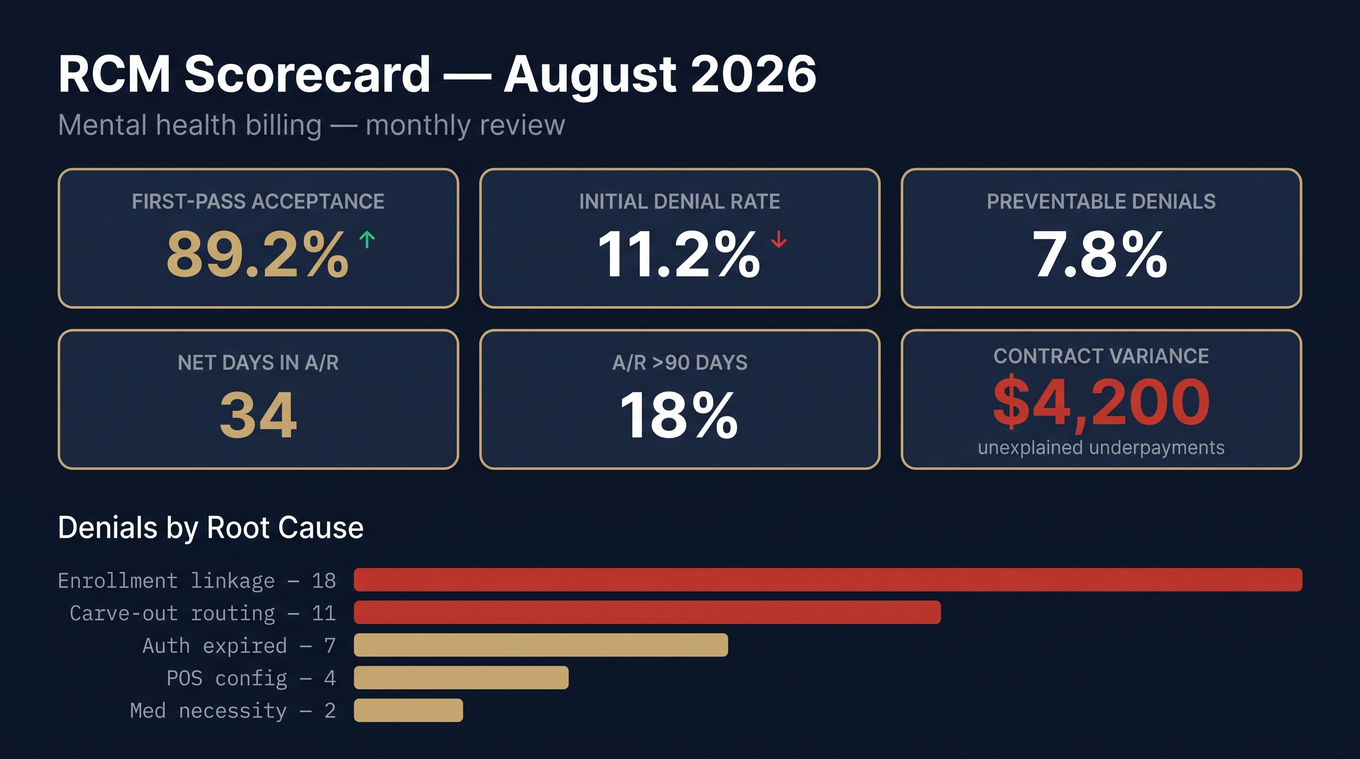
18 claims denied because a new clinician wasn't linked to the group. 11 because one employer product carved behavioral benefits to a different payer. 7 because authorization units expired mid-episode. 4 because a telehealth place-of-service rule was configured wrong. 2 genuine medical necessity decisions.
The first version describes activity. The second tells leadership exactly which four things to fix - and three of those five causes are configuration problems that will keep producing denials until someone changes a setting.
Our guide to why mental health claims get denied covers the reasons and how to build the appeal.
Why a paid claim can still be an underpaid claim
The revenue cycle doesn't end when money hits the bank. Four records have to agree, and most practices only ever look at one of them:
- The charge record - what you say you delivered and billed.
- The remittance - what the payer adjudicated, and how it explained each adjustment.
- The contract or fee schedule - what the payer should have allowed.
- The cash record - what actually reached the bank and got posted to the right accounts.
Payment posting answers "what did the payer do?" Contract variance review asks the separate question "was the payer right?" Most practices do the first and never do the second.
Posting itself has an order, and skipping steps creates problems that surface months later:
- Match the remittance to the deposit using payer, amount, date and the reassociation trace number that CMS's EFT and remittance operating rules carry in both streams.
- Match the claim to the right patient, date, provider and original control number.
- Post the payment.
- Post the contractual adjustment only where the agreement supports it.
- Post patient responsibility only where the remittance, benefit design and law support it.
- Separate denials, recoupments, interest and other provider-level adjustments.
- Determine whether a secondary claim is needed.
- Compare the allowed amount to what you expected.
- Route exceptions to a queue instead of forcing the balance to zero.
- Reconcile posted cash to the actual deposit.
"Auto-posted" is not "correctly posted." An automated posting engine can apply the payer's math perfectly while mapping the wrong adjustment reason, assigning payment to the wrong account, missing an underpayment entirely, or converting a payer's liability into a patient balance.
How to spot an underpayment on a paid claim
A claim can be paid and still leak money - through an outdated fee schedule, the wrong network or product contract, out-of-network rates applied despite in-network status, an incorrect specialty or taxonomy on file, a wrong place-of-service rate, an unrecognized add-on, an inappropriate bundling edit, a missing contractual increase, a downcoded service, or an offset that was never explained.
Expected allowed amount minus actual allowed amount equals variance. The discipline is in which number you use:
Allowed amount, not the payer's check amount, is the first number to compare against your contract. Deductible and coinsurance reduce what the payer pays without reducing what it allowed - so comparing check amounts will hide real underpayments and invent imaginary ones.
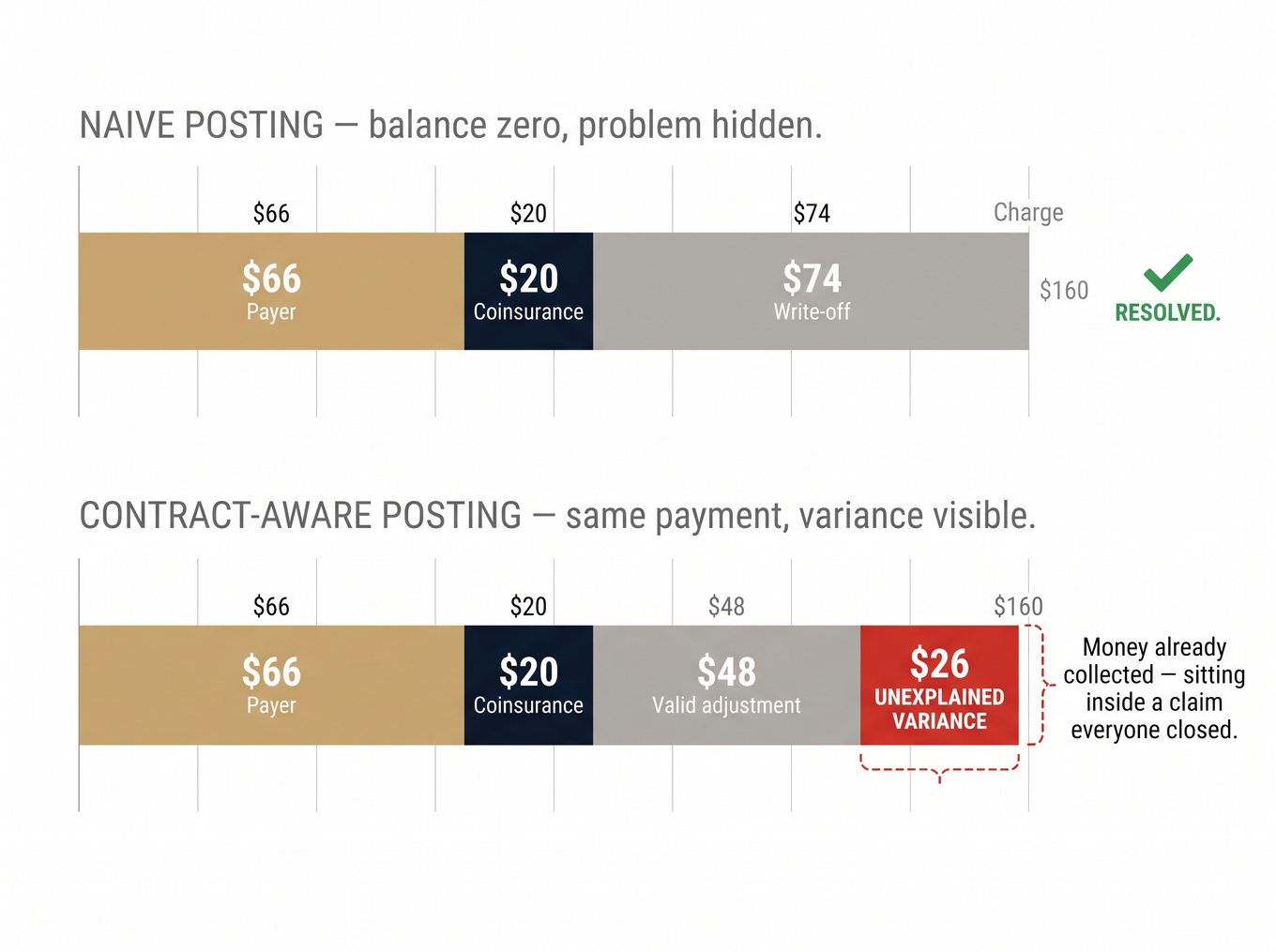
Here's a modelled example - not a market rate, and not any specific payer's schedule. Charge $160. Contract expects an allowed amount of $112. The payer allows $86, pays $66 and assigns $20 to coinsurance.
A naive posting closes that account: $66 payment, $20 patient responsibility, $74 written off, balance zero, done. A contract-aware posting sees something different - the valid contractual adjustment against the expected allowance is $48, the patient owes $20 only if it's otherwise valid, and $26 is an unexplained variance that nobody is going to raise unless you built the comparison. Multiply that by a full psychotherapy caseload across a year.
Once you can see the variance, classify it before acting:
| What the variance is | What to do |
|---|---|
| Correct patient cost sharing | Post patient responsibility, after the checks below |
| Correctly applied contractual reduction | Post the contractual adjustment |
| Wrong rate, network or product | Payment reconsideration or contract dispute |
| Claim data defect | Corrected claim, if the payer permits |
| Coverage or medical necessity decision | Appeal or reconsideration |
| Unexplained reduction | Get the full remittance explanation before writing anything off |
A control worth building: suppress automatic contractual write-offs above a dollar or percentage threshold until the expected allowance has actually been compared.
Cash, remittance and posting are three separate things
One question comes first: are you actually not getting paid, or are you just not receiving remittances? They produce identical symptoms and require different fixes. The exception types are worth naming separately:
- Payment without remittance - cash arrived, but there's no usable adjudication file, so the deposit can't be safely allocated.
- Remittance without payment - the payer issued the explanation, but the money may be pending, sent by check, offset, recouped, or routed to a different account.
- Mismatch - amount, payer or trace number doesn't reconcile.
- Unapplied cash - the money is in the system but not attached to the right account or service line.
- Unposted remittance - adjudication exists but never reached the patient ledger.
Each needs its own dated exception queue. A practice can look like it has a slow-paying payer when the real failure is an incomplete remittance enrollment, a bank reassociation problem, or software that isn't posting.
Before a statement goes out
Converting an unpaid balance into a patient balance is the highest-risk routine action in the revenue cycle, because the mistakes are visible, upsetting and sometimes unlawful.
First, coordination of benefits: is another plan primary or secondary for this date, did the primary's remittance carry what a crossover needs, did the crossover happen automatically or do you need to submit, and has the secondary payer's filing deadline already started to run? A statement issued before coordination completes creates duplicate billing, patient distress and avoidable refunds.
Then a check that ordinary posting logic will get wrong on its own. For patients in the Qualified Medicare Beneficiary program, federal law prohibits Medicare providers from billing the beneficiary for Medicare Part A and Part B deductibles, coinsurance and copayments, even when state Medicaid doesn't pay the full cost sharing. CMS tells providers to verify QMB status and not to collect those amounts.
A remittance can display cost sharing that automated posting would move to patient responsibility. The QMB flag has to sit upstream of your statement run - in the system, not in a staff member's memory.
Three numbers get conflated, and separating them prevents most patient billing complaints: an estimate is a pre-service projection; remittance patient responsibility is the payer's adjudicated allocation, still subject to secondary coverage and legal protections; and the ledger balance is what remains after everything. A benefits quote can be accurate when you obtain it and still differ from the final result because the deductible moved, another claim processed first, coverage changed, or coordination was incomplete. So avoid "you will owe" language before adjudication. "Based on the information available today, your estimated responsibility is X. Your plan makes the final determination after the claim is processed" is both more accurate and easier to defend.
For uninsured and self-pay patients, the federal Good Faith Estimate framework sets timing you can plan around. CMS's guidance states that when care is scheduled 3–9 business days ahead you provide the estimate within 1 business day of scheduling; when it's scheduled 10 or more business days ahead, within 3 business days; and when someone requests an estimate before scheduling, within 3 business days. The federal timing right doesn't apply when a service is scheduled only 0–2 business days out. CMS also describes a patient-provider dispute resolution process available when billed charges are at least $400 more than the estimate, generally initiated within 120 calendar days of the original bill, with a $25 administrative fee. That's the federal baseline; state estimate, disclosure and surprise-billing rules can add more.
And a boundary that's easy to cross without noticing: the Consumer Financial Protection Bureau has warned that health care providers and revenue cycle contractors can violate federal debt collection law by pursuing amounts that are inaccurate, invalid, already paid or not actually owed. Which is a legal way of saying what good practices do anyway: wait for adjudication, validate the group code against the contract, subtract what the patient already paid, suppress protected or disputed balances, issue a statement a human can actually understand, staff a phone line with someone who can explain the account, and pause collection when a balance is credibly disputed.
We do contract variance review as part of the cycle for the practices we bill for, and it's consistently the least expected finding - money that was already "collected," sitting inside claims everyone had closed.
The billing KPIs worth tracking, and their denominators
Every stage above can be watched instead of discovered.
Define the denominator, or the number means nothing
"Denial rate" can mean at least six different things: denied claims over claims submitted, denied service lines over adjudicated lines, denied dollars over billed charges, denied dollars over expected allowed dollars, first-pass denials only, or first-pass plus appeal denials. It can also quietly include front-end rejections that never reached adjudication at all - which, as we covered, aren't denials.
Those values are not comparable. Two of them can move in opposite directions on the same book of business in the same month.
HFMA's MAP Keys are useful precisely because each KPI comes with a defined equation, stated inclusions and exclusions, and a named source system - and because HFMA tells organizations to pull from the same source month after month. Any metric you report should state its numerator and denominator, whether it's claim-level or line-level, claims or dollars, which date it's anchored to, initial or final disposition, the population and exclusions, the source system, and whether it's a snapshot or a matured cohort.
The scorecard worth running
| Metric | What it actually tells you |
|---|---|
| Verification rate | Verified encounters over encounters requiring verification - where "verified" means the behavioral administrator, network status, benefits, limits and authorization, not just active coverage |
| Authorization completion | Encounters or units authorized before claim release. For recurring treatment, authorized units remaining is more useful than a monthly percentage |
| Charge lag | Days from service to charge posting. Report the median and the 90th percentile - a small old tail hides behind a healthy average |
| Internal clean claim rate | Claims passing edits without manual intervention. Measures your data quality, and proves nothing about payer acceptance |
| First-pass payer acceptance | Claims accepted by the payer's acknowledgment process over claims transmitted. Use 277CA evidence, not "left the EHR." Its inverse is your front-end rejection rate |
| Initial denial rate | Claims first adjudicated with an actionable denial over claims first adjudicated. Filter out later appeal dispositions if you want a true initial number |
| Preventable denial rate | Denials assigned to internal root causes over adjudicated claims - against a governed taxonomy, not a guess |
| Denial aging and deadline risk | Denied balances by days to the corrected-claim and appeal deadlines. The executive version is recoverable dollars inside the final 30 days of action time |
| Appeal overturn rate | Favorably resolved over appealed and matured. Use a matured cohort; don't divide this month's recoveries by this month's submissions |
| Net days in A/R and A/R over 90 | Outcome measures. A/R days can improve because balances were written off rather than collected |
| Adjusted collection rate | Payments net of credits over charges net of approved contractual adjustments. Keep approved adjustments separate from avoidable write-offs, or the denominator becomes manipulable |
| Expected-versus-actual allowed variance | The underpayment work from the previous section, made visible and trackable to recovery |
| Posting integrity | Deposits unmatched to remittance, remittance unmatched to cash, unapplied cash, unposted dollars, posting lag |
| Credentialing and enrollment leakage | Providers pending, contracts awaiting effective dates, claims held or denied on provider setup, dollars at risk against filing deadlines |
Two more worth knowing about but not over-trusting: gross collection rate is driven mostly by how you set your charges relative to contracted rates, so it's useful for trend context and weak as a standalone quality measure. And cost to collect - revenue cycle expense over cash collected - is only meaningful if you define what's included, because a low figure achieved by abandoning denials and underpayments isn't efficiency.
Benchmarks are context, not targets
MGMA reported an 8% aggregate first-submission denial rate in its 2023 single-specialty Practice Operations dataset. In a separate March 2024 MGMA Stat poll, 60% of responding medical group leaders said denial rates had increased versus the same period in 2023, 29% said about the same and 11% said they had decreased - a poll, not a census. And Experian Health's September 2025 vendor survey of 250 health care professionals responsible for financial, billing or claims decisions found 41% reporting denial rates of at least 10%, with respondents most often citing missing or inaccurate data, authorization and incomplete registration data as causes.
Do not average those. They come from different years, different respondent populations and almost certainly different definitions of "denial," and none of them is mental-health-specific. They tell you the direction of the industry, not what your number should be. The same caution applies to the AAFP's general 95–99% guidance for adjusted collection rate - that's broad practice-management guidance, not a mental health target, and payer mix, service mix, patient responsibility and measurement method all move it.
Your own trend, measured the same way every month, is worth more than any published benchmark.
The monthly dashboard leadership actually needs
The monthly summary answers ten questions. Did we bill every completed service? Did the payer accept every initial claim? What percentage and dollars denied on first adjudication? Why, by root cause rather than by code? Which deadlines or authorizations put revenue at immediate risk right now? Did paid claims match the contract? Did every payment and remittance post and reconcile? What's genuinely collectible from patients, and what's protected or disputed? What changed by payer, provider, code and location? And - the one that separates reporting from management - which upstream process are we changing this month?
Should your practice handle billing in-house?
A disciplined small practice can absolutely run its own billing. In-house works when most of these are true: one clinician or a few; a small, stable payer mix; mostly straightforward individual psychotherapy; few provider or location changes; little or no testing, prescriber E/M, crisis, group, family, EAP or higher levels of care; a light authorization burden; a simple telehealth footprint; reliable reports out of your EHR and clearinghouse; protected weekly time to do the work; somebody who understands payer portals, acknowledgments, remittances and deadlines; and an owner who reviews A/R, denials and deposits rather than only claim submission.
If that describes you, the highest-value thing you can do is build the daily acknowledgment habit and start comparing allowed amounts to your contract. Not hire anyone.
Co-management fits more practices than either extreme. The front desk keeps scheduling and demographics while a specialist handles complex verification and authorization. Clinicians code and sign notes while a specialist runs pre-bill edits and submission. Internal staff post routine payments while a specialist works denials and underpayments. The practice owns patient communication while a specialist validates balances. It works only with explicit ownership, shared work queues and a named escalation path - without those, both sides assume the other has the claim, and nobody has it.
That picture usually changes for one of four reasons: the practice is growing - new clinicians, new locations, a new state; the payer or service mix has got more complex; nobody has the time the billing side needs; or collections have slipped and nobody can say why. None of those is about size. We work with practices of every size, from a single clinician to a multi-state group, and we take on a single piece of the cycle as readily as the whole of it. The question is never whether a practice is big enough to be worth helping - it is which part of the cycle needs owning.
Outsourcing the full cycle becomes reasonable when the complexity outruns what one accountable person can hold: several providers, locations, tax IDs or states; regular clinician onboarding and offboarding; prescribers billing E/M with psychotherapy; testing, crisis, family, group, EAP or out-of-network work; multiple behavioral carve-outs; recurring authorization and visit-limit problems; a denial or A/R backlog; unworked acknowledgment and remittance exceptions; unexplained underpayments; staff turnover with no accountable billing owner; patient statements that don't reconcile to explanations of benefits; leadership that can't get root-cause reporting; or cash collection that depends on one person's undocumented knowledge.
The questions that separate a billing partner from a claim transmitter
This applies to us as much as to anyone else you talk to. "Billing service" can mean anything from transmitting claims to owning the entire revenue cycle, and the price difference between those reflects a genuine difference in what gets done. Ask directly:
- Do you work only submitted claims, or the whole cycle?
- Who verifies behavioral carve-outs and authorizations?
- Who owns credentialing, payer rosters and effective-date disputes?
- Will you reconcile claim-level acceptance, or just mark claims submitted?
- How do you classify denials by root cause?
- Do you appeal and correct denials, or return them to us to work?
- Do you compare paid claims against contracted rates?
- How do you validate patient responsibility and secondary coverage?
- What are the reports, and what exactly are their denominators?
- Who is the named account owner, and what's the escalation path?
- What access and data does the practice retain?
- How is old A/R handled during transition?
- What are the contract term, fee denominator, minimums, exclusions and exit obligations?
- Can you show a de-identified sample report and same-specialty references?
If a prospective partner can't answer 4, 6 and 7 crisply, you're buying claim transmission. That may be all you need - just know which one you're paying for.
A transition is a revenue event, not an IT task
If you do switch, the plan matters more than the vendor. Before cutover: inventory open A/R by payer, status and deadline; export claims, remittances, notes, payer control numbers and patient ledgers; document payer IDs, enrollments and clearinghouse routes; confirm provider, group and location effective records; define explicitly which party owns pre-cutover dates of service; freeze unauthorized write-offs; reconcile deposits and credit balances; test sample claims; and tell patients before their statements change.
In the first 30 days: daily acknowledgment reconciliation, payment and remittance monitoring, validation of the first paid claim for each payer, provider and product, denial spike monitoring, preserved access to the old system, and a weekly cash and deadline report. Nobody quietly abandons the old A/R.
Days 31 through 90: the denial root-cause report, a contract variance sample audit, authorization and provider-record exceptions, A/R migration reconciliation, patient balance validation, and a KPI baseline with an improvement plan attached.
Our behavioral health billing services page covers scope and how engagements are structured.
Where to start when claims stop paying
When money doesn't arrive, the question is never "why won't they pay?" It's which link broke, and what evidence proves it. Was the provider enrolled and linked on that date? Did the behavioral benefit belong to somebody else? Was the authorization live for that code, those dates and that clinician? Does the note support the service and the time? Did the claim carry the right identities? Did the payer actually accept it, or just receive the file? Does the adjustment code say the provider owes it or the patient does? And does the allowed amount match the contract you signed?
Every one of those questions has a document that answers it. The revenue cycle looks opaque because most practices only ever see the first artifact and the last one, and the failures live in between.

Take one unpaid claim that's been bothering you and walk it backwards to the last artifact you actually trust. Most of the time you'll find the break within two stages, and it'll turn out to be a configuration that's been quietly doing the same thing to every similar claim for months. Fixing it once fixes the rest.
Our take, after running these cycles for a while: the practices that get paid reliably aren't the ones with the best coders. They're the ones who treat billing as a controlled chain with owners, evidence and deadlines at every handoff - and who look at the acknowledgments.
If you'd rather not build that yourself, that's the work we do. A revenue cycle review with us starts by finding where claims are actually failing, not by promising a percentage improvement - because until someone traces the chain, nobody honestly knows which number is available to improve.
A closing note on dates. This page was reviewed August 17, 2026. Several rules above are time-sensitive: the ICD-10-CM code year turns over October 1, 2026; Medicare telehealth flexibilities run through December 31, 2027 with changes from January 1, 2028; the 42 CFR Part 2 compliance date was February 16, 2026; parity enforcement posture depends on ongoing litigation; and X12 maintains the adjustment code sets on a rolling basis. Verify anything dated against the primary source before you rely on it - and always confirm the member's specific plan, product and your own contract for the date of service.
Mental health billing FAQ
What is mental health billing, and how is it different from general medical billing?
It's the process of converting mental health services into paid claims - provider enrollment, benefit verification, authorization, coding, claim submission, remittance handling and follow-up. What makes it different isn't the difficulty of any one step; it's that the services are recurring and time-based, the behavioral benefit is often administered by a separate company than the one on the insurance card, provider type governs what's payable, and the records carry additional legal protections.
Which CPT codes do therapists use most?
For most outpatient practices: 90791 for the diagnostic evaluation, and 90832, 90834 and 90837 for individual psychotherapy at increasing time bands. Family work uses 90846 and 90847, group work uses 90853, and crisis work uses 90839 and 90840. Prescribers add E/M codes with psychotherapy add-ons. The right code is always the one the documented service supports - not the one that matches the calendar slot.
What's the difference between 90791 and 90792?
Whether the diagnostic evaluation includes medical services, and whether the clinician is qualified and contractually permitted to report it. It isn't "the therapist code versus the psychiatrist code," though that shorthand is often roughly right. Report what was actually performed by someone permitted to perform it.
What's the difference between 90834 and 90837?
Reportable psychotherapy time. Under the CMS guidance cited on this page, 90834 covers 38–52 minutes and 90837 covers 53 minutes or more. The band determines which code is available; documentation, medical necessity and payer policy still determine whether it's paid.
Does a 60-minute appointment always support 90837?
No. The appointment length is an operational fact; the reportable service time is a documented clinical fact. A 60-minute block can include late arrival, scheduling talk, administrative work or a separate E/M component, none of which counts as psychotherapy time. Report the code the documented service supports - and don't downcode defensively either, because that makes the claim inconsistent with the record.
Can a psychiatrist bill an E/M visit and psychotherapy on the same day?
Yes, when both services are provided and separately identifiable. Select the E/M level under the current rules, identify the psychotherapy time separately, report the add-on matching that band, and document the two components distinctly enough that a reviewer can see both. The same minutes can never count toward both. Payer-specific modifier rules apply.
Which telehealth place of service and modifier should I use?
That depends on the payer, the product and the date of service - there's no universal answer. For Medicare, POS 02 applies when the patient is somewhere other than their home and POS 10 when the patient is at home, with modifiers 93 or FQ applying to certain audio-only scenarios. Place of service follows where the patient was, not where you were. Commercial and Medicaid rules vary and must be verified per plan.
Why would an active insurance plan still deny therapy claims?
Because "active coverage" answers only one of five separate questions. The behavioral benefit may be carved out to a different administrator, you may not be in network for that specific product, the rendering provider may not be linked to the billing group, an authorization may be required or expired, or the claim may have been rejected before adjudication ever started. Eligibility is not a payment guarantee, and payer manuals say so themselves.
What's the difference between a rejected claim and a denied claim?
A rejection happens before adjudication - at the interchange, file or claim-acknowledgment level - and means the payer never processed the claim at all. A denial is an adjudicated decision that appears on a remittance. Rejections need a correction and resubmission. Denials need either a corrected claim or an appeal, depending on whether the problem is data or judgment. Sending an appeal letter for a rejection accomplishes nothing.
How long do I have to appeal?
It depends on the payer and your contract. For Medicare, a first-level redetermination generally must be filed within 120 days of receiving the initial determination. Commercial deadlines vary widely, and corrected claims, reconsiderations, formal appeals and records submissions often carry different deadlines. Track the earliest applicable deadline per payer rather than assuming a standard number.
Can marriage and family therapists and mental health counselors bill Medicare?
Yes. Eligible MFTs and mental health counselors have been able to enroll in Medicare and bill independently for services furnished on or after January 1, 2024, subject to CMS's qualification and enrollment requirements. Any guide telling you these clinician types can't participate in Medicare predates that change.
When should a practice outsource mental health billing?
When the complexity exceeds what one accountable person can reliably hold - multiple providers, locations or states; prescriber and testing services; several behavioral carve-outs; a denial or A/R backlog; unworked acknowledgment exceptions; or reporting leadership can't get. A small practice with a stable payer mix and disciplined weekly billing time often shouldn't outsource at all. The real question isn't in-house versus outsourced; it's whether someone is accountable for every stage of the chain.