Behavioral Health Credentialing Services: What to Look For, What to Avoid, and What Nobody Tells You
September 23, 2026 · 10 min read
Behavioral health credentialing services handle the provider enrollment and payer contracting process on your behalf, getting your therapists, psychiatrists, and counselors in-network with insurance companies so you can bill and collect. The process is slower, more document-intensive, and more payer-specific than most practices expect, which is why many outsource it to a specialist firm. When it works, you're billing within 90 to 120 days. When it doesn't, you're sitting on providers who can't generate revenue for six months or longer.
Here's a scenario that plays out constantly in behavioral health practices: you hire a new therapist, you're excited about the capacity, and then someone remembers that you still need to get her credentialed with Aetna, UnitedHealthcare, and Medicaid. You submit the applications. Weeks pass. Then months. Nobody at the payer seems to know where the file is. Your therapist is seeing clients, but you can't bill. You're either writing off sessions or waiting to collect thousands of dollars in held claims.
That's not bad luck. It's a systems problem. And it's exactly what a good behavioral health credentialing service is supposed to solve.
But not all credentialing services are built the same, and behavioral health has specific quirks that a generalist credentialing vendor may not know how to navigate. This is what you need to understand before you hire anyone.
What Behavioral Health Credentialing Services Actually Do
A behavioral health credentialing service manages the full provider enrollment lifecycle on your behalf. That includes:
- Gathering and verifying provider documentation (NPI, license, DEA registration, malpractice coverage, work history, education, CAQH profile)
- Submitting applications to individual payers and following up on their status
- Tracking primary source verifications and expiration dates
- Coordinating re-credentialing when panel contracts come up for renewal
- Managing enrollment for telehealth-specific payer requirements
What separates a credentialing service from a credentialing checklist is the follow-up. Applications don't move themselves. The payers that take 90+ days aren't sitting on paperwork because they're slow; they're sitting on it because nobody pushed. A credentialing service with dedicated follow-up contacts makes the difference between 90 days and 200 days.
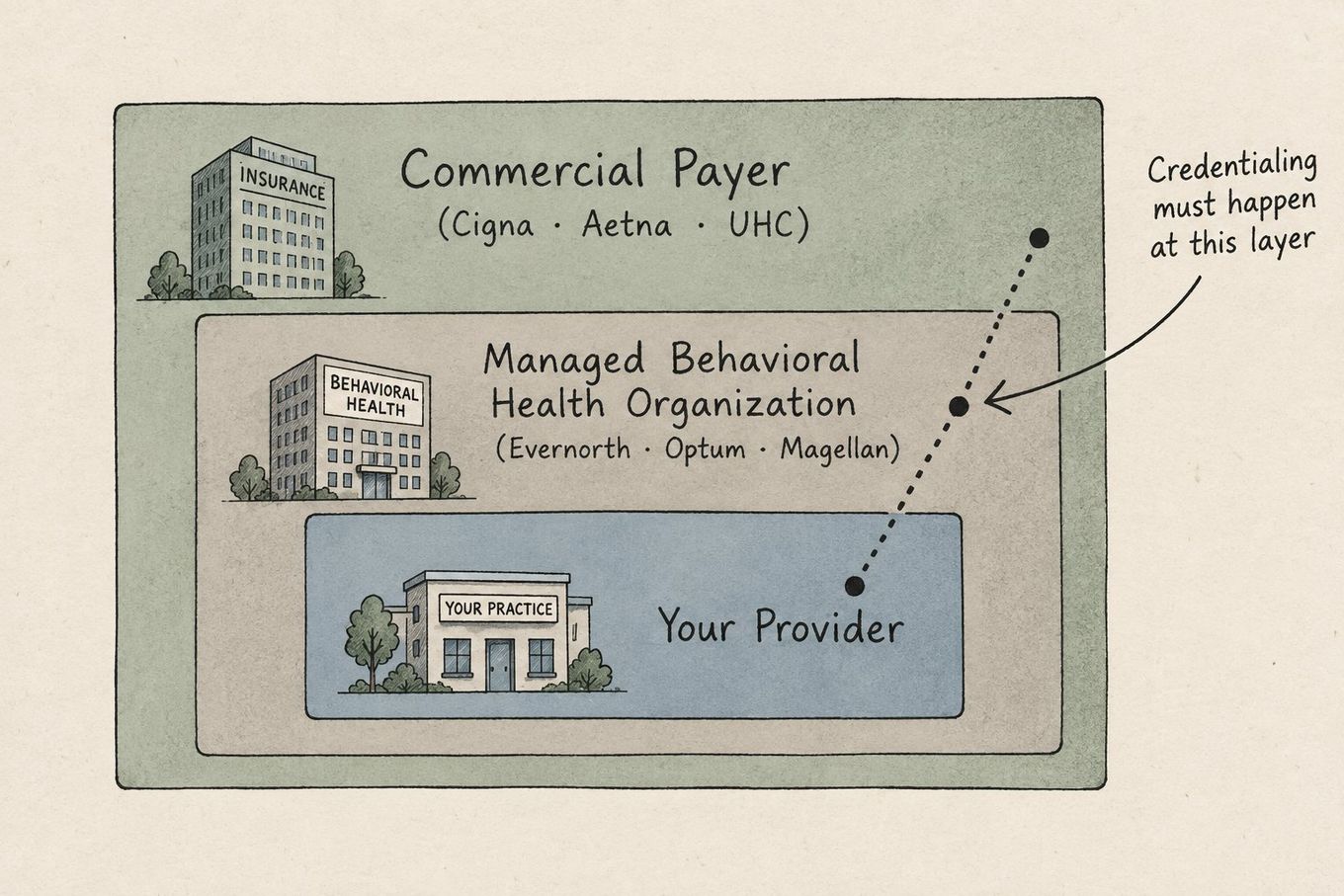
For behavioral health specifically, this also means navigating managed behavioral health organizations (MBHOs), which are separate entities from the medical payer but manage behavioral health benefits on their behalf. Credentialing with Cigna/Evernorth, for example, often routes through an MBHO network rather than the commercial plan directly. A generalist credentialing vendor who doesn't know this will submit to the wrong entity and wonder why the application went nowhere.
Why Behavioral Health Credentialing Is Harder Than General Medical Credentialing
If you've worked in another specialty before, or if your billing team has, you may have noticed that behavioral health credentialing tends to take longer and require more follow-up. That's not your imagination. There are structural reasons for it.
Carve-Out Networks Create an Extra Layer
Many commercial payers carve behavioral health benefits out to separate managed care entities: Magellan, Beacon Health Options, Evernorth, Optum Behavioral Health. Your providers need to be credentialed with the carve-out network, not just the base commercial plan. If you're billing for behavioral health services under a plan that's carved out and your provider isn't enrolled with the MBHO, those claims will deny every time, regardless of whether the patient has active coverage.
(For a deeper look at how carve-outs affect billing and reimbursement, see our article on behavioral health carve-outs)
Provider Type Adds Complexity
In behavioral health, credentialing requirements vary significantly by license type. A psychiatrist (MD/DO) credentials differently than a licensed clinical social worker (LCSW), who credentials differently than a licensed professional counselor (LPC) or a licensed marriage and family therapist (LMFT). Some payers don't credential certain license types at all. Others credential LCSWs but not LPCs, or credential LMFTs only in certain states.
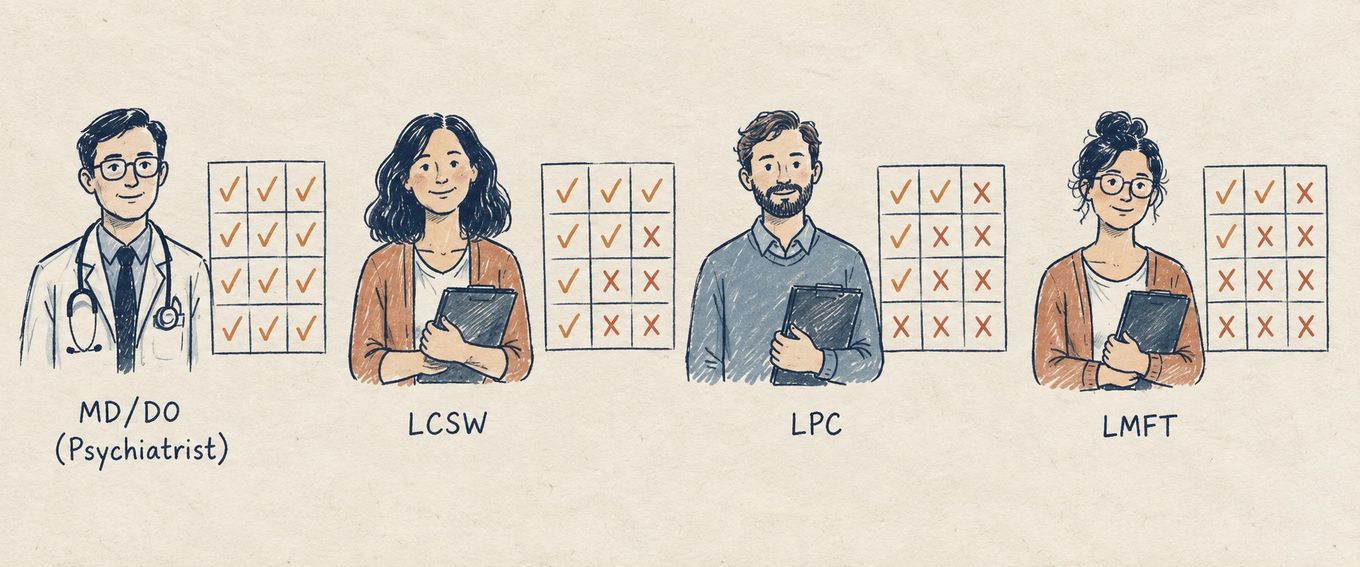
A credentialing service that doesn't know payer network policies by license type is going to submit applications that have no chance of being accepted and not know why.
SUD Programs Have Their Own Enrollment Requirements
If your practice includes substance use disorder treatment, especially at higher levels of care like IOP or residential, you're dealing with program-level credentialing in addition to individual provider enrollment. SAMHSA certification, ASAM level-of-care documentation, and state behavioral health authority licensing may all factor into payer enrollment for SUD services. This is a distinct process from standard individual provider credentialing, and many generalist vendors aren't set up for it.
What to Look For When Evaluating Behavioral Health Credentialing Services
Here's a practical framework for comparing vendors. Ask every service you're considering these questions before signing anything.
| Evaluation Criterion | What a Strong Answer Looks Like | Red Flag |
|---|---|---|
| Behavioral health specialization | Direct experience with MBHOs, carve-out networks, BH license types | "We handle all specialties" with no BH-specific examples |
| Follow-up cadence | Defined outreach schedule (e.g., weekly payer follow-up, tracked in a system) | "We follow up as needed" |
| Timeline expectations | Payer-specific estimates with variance ranges | A single blanket promise ("45 days for all payers") |
| Held claims / retro billing | Proactive tracking, retro billing support when delays occur | No mention of held claims process |
| Re-credentialing management | Calendar-based re-enrollment prompts, not reactive | You find out your credentialing lapsed when a claim denies |
| Reporting transparency | Regular status updates with payer names, dates, and next steps | Status reports only on request |
| CAQH management | Active profile maintenance and attestation support | Assumes providers manage their own CAQH |
| Telehealth enrollment | State-specific telehealth panel experience | "Telehealth works the same as in-person" |
The follow-up question matters most
Of everything on this list, follow-up cadence is the one that most separates good credentialing services from mediocre ones. The majority of credentialing delays aren't because something is missing from the application. They're because nobody called the payer to find out it was sitting in a queue for three weeks waiting to be assigned.
Ask your prospective vendor: how often do you contact payers after submission, what does that outreach look like, and can you show me a sample status report from an active client?
Real Credentialing Timelines by Payer Type
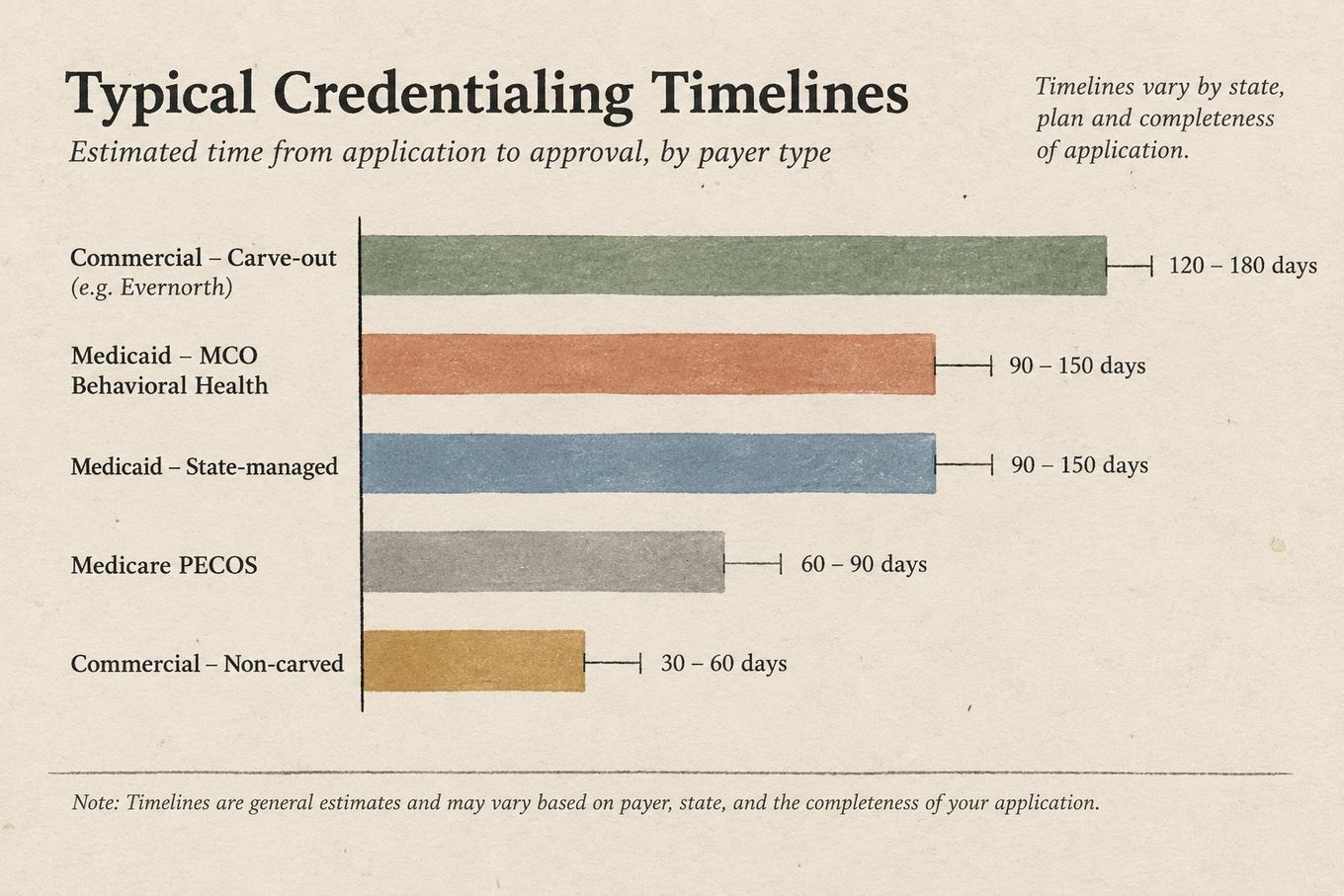
One thing you won't find in most credentialing vendor brochures is an honest conversation about how long this actually takes. Here's a more realistic picture.
| Payer Type | Typical Range | Notes |
|---|---|---|
| Commercial payer (behavioral health carve-out, e.g., Evernorth) | 90–150 days | MBHO routing adds steps; carve-out networks often have closed panels that require specific requests |
| Medicare (PECOS enrollment) | 60–90 days | Faster with complete submissions; re-enrollment after location change adds time |
| Medicaid (state-managed) | 60–180 days | Highly variable by state; MCO coordination adds a second layer |
| Medicaid (MCO behavioral health plans) | 90–150 days | Separate credentialing from base Medicaid; often overlooked |
| Commercial payer (non-carved) | 45–90 days | Generally faster, but "panel closed" notices are common in BH |
These are ranges, not guarantees. A clean, complete application with an experienced vendor following up weekly moves faster. An incomplete application that sits because nobody noticed a missing document moves slower, sometimes indefinitely.
The Revenue Math Nobody Mentions

Here's the number that should make credentialing a business priority, not just an administrative task.
A full-time therapist seeing 25 clients per week at an average reimbursement of $120 per session generates roughly $156,000 per year. Every month that therapist is seeing insured clients before credentialing is complete is a month you're either writing off revenue or deferring collection. At 90 days of delay, that's $36,000 to $40,000 in revenue that needs retro billing, held claims management, or is lost entirely.
Good behavioral health credentialing services start the process before your provider's first day. They submit applications during the offer-acceptance window, track CAQH profile completion before the provider even starts, and manage held claims so nothing falls through when enrollment finally comes through.
If your current process starts after hire and submits everything at once, you're leaving money on the table by design.
Our take, and why it matters
Credentialing behavioral health providers is different from credentialing any other specialty, and it's what we do every day. Navigating MBHO networks, getting carve-out routing right, paneling across license types, managing SUD program enrollment: this is the work Clarity was built for, under President and CEO Estelle Sandoval. The perspectives in this article come from working these systems directly, not from summarizing what others have written about them.
How Clarity Handles Behavioral Health Credentialing
Our credentialing and enrollment services are built specifically for the complexity behavioral health practices run into: MBHO routing, carve-out network credentialing, multi-license-type paneling, and proactive re-credentialing before expirations affect your billing.
We start the process before providers see their first patients, we manage CAQH profiles actively, and we provide regular status reports so you're never wondering where an application is.
If you're adding providers, opening a new location, or dealing with a credentialing backlog from a previous vendor, we can step in at any stage. See how we work with behavioral health practices or contact us directly.
For practices managing credentialing in-house and wondering whether it's time to outsource, our in-house vs. outsourced billing comparison covers how to think through that decision.
Frequently Asked Questions
What does a behavioral health credentialing service actually do? A behavioral health credentialing service manages provider enrollment with insurance payers on your behalf, from gathering documentation and completing CAQH profiles to submitting applications, following up with payers, and managing re-credentialing cycles. For behavioral health practices specifically, this includes navigating managed behavioral health organization (MBHO) networks, carve-out plan routing, and the license-type requirements that vary by payer.
How long does behavioral health credentialing take? Most commercial behavioral health credentialing takes 90 to 150 days when routed through an MBHO or carve-out network. Medicare enrollment via PECOS generally runs 60 to 90 days. Medicaid timelines vary significantly by state and can run 60 to 180 days, with additional time if MCO credentialing is required. Clean, complete applications with consistent follow-up move faster; incomplete submissions or no follow-up can extend timelines significantly beyond these ranges.
Why is behavioral health credentialing harder than other specialties? Behavioral health credentialing involves an additional layer that other specialties often don't face: managed behavioral health organizations (MBHOs) that administer behavioral health benefits separately from the base commercial plan. Payers like Cigna/Evernorth and UnitedHealthcare/Optum route behavioral health credentialing through these carve-out entities. A provider credentialed with the commercial plan but not the MBHO will see behavioral health claims denied. Additionally, behavioral health has more provider license-type complexity, with payer panels varying by state licensure (LCSW vs. LPC vs. LMFT) in ways that medical specialties don't.
What should I ask a behavioral health credentialing service before hiring them? Ask about their specific experience with behavioral health MBHO networks, how they handle carve-out plan credentialing, what their follow-up cadence looks like after application submission, and what their process is for held claims and retro billing during enrollment delays. Request a sample status report. Ask for behavioral health client references specifically, not just general medical billing clients. A credentialing service that can't answer the MBHO question fluently is probably not specialized in behavioral health.
Can a credentialing service help with held claims while enrollment is pending? Yes, a good behavioral health credentialing service should have a held-claims process, meaning they track sessions that were provided during the credentialing window and support retro billing once enrollment is approved. Most commercial payers allow claims submission for up to 90 to 180 days retroactively from the date of service. Ask about this upfront, because some vendors credential the provider and consider the engagement done, without tracking what happened to the claims that accumulated during the wait.
What's the difference between credentialing, contracting, and enrollment? These terms are often used interchangeably but refer to distinct processes. Credentialing is the payer's verification of a provider's qualifications (licenses, training, history). Contracting is the negotiation and execution of the fee schedule and participation agreement with the payer. Enrollment is the operational setup of the provider in the payer's billing system so that claims can be processed. A full-service behavioral health credentialing service typically handles all three, but it's worth confirming scope because some vendors handle credentialing only and leave contracting and enrollment to you.
How much does behavioral health credentialing outsourcing cost? Pricing varies by vendor and scope. Some charge per provider per payer application. Others charge a monthly retainer that covers an agreed number of providers. Flat-fee and percentage-of-revenue models also exist. For most practices, the cost of outsourcing is well under the revenue cost of a single month's credentialing delay on a full-time therapist, making the ROI straightforward. See our medical billing services cost breakdown for additional context on how RCM vendor pricing typically works.