CPT 90791 Billing: Whose Rules Apply to Your Claim
August 23, 2026 · 56 min read
You are probably reading this because something already happened. A ninety-minute intake came back paid as a single unit. A second evaluation denied as a duplicate. A therapist billed 90791 and a prescriber billed 90792 for the same patient on the same day, and only one of those claims survived. Or you read three pages about how often 90791 can be billed and found three different answers: once a year, three times a year, once every six months.
Those three answers were all correct. They just belonged to three different payers.
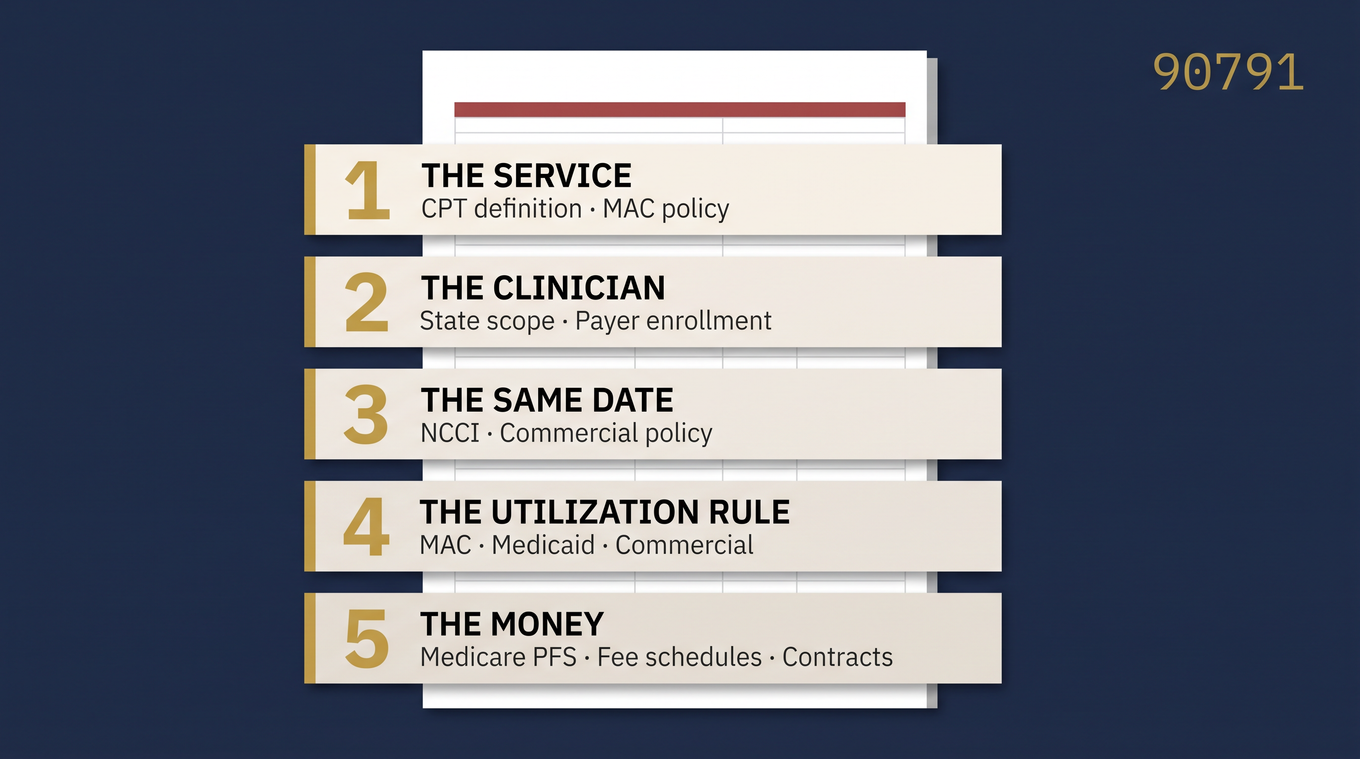
A first behavioral health visit does not pass or fail one test. It has to clear five separate layers of rules, and each layer is governed by a different authority: what service actually happened in the room, whether this particular clinician is permitted to report it, what else was billed on that date, whether this specific plan will pay for another evaluation right now, and what the contract says the service is worth. Collapse those five into one tidy rule and the tidy rule is where the denial comes from.
We manage revenue cycle work for behavioral health and mental health practices, and the pattern we see with intake claims is consistent: they rarely fail because someone chose the wrong five-digit code. They fail because a layer nobody checked before the appointment decided the outcome - a plan that counts prior evaluations at the group level, a behavioral benefit administered by a company that isn't on the insurance card, a same-day psychotherapy line that made both services unpayable.
Your own plan's counting rule is the one thing no page can give you. That answer does not exist nationally. What follows is where it lives and how to get it.
The short answer on billing CPT 90791
CPT 90791 is reported for a medically necessary psychiatric diagnostic evaluation that does not include the medical service component represented by 90792. It is an untimed code. Before it is billed, four things need to be true: the clinician is permitted by state scope and enrolled by the payer to report it, the plan will cover an evaluation for this member right now, no prohibited same-day psychotherapy or office-visit line is on the claim, and the note actually documents a diagnostic evaluation with a formulation and a plan. Frequency rules, telehealth instructions, and same-day policy differ by Medicare contractor, by state Medicaid program, and by commercial plan - so a rule you read without a named owner is not yet a rule you can bill on.
Why CPT 90791 billing guidelines contradict each other
Search this topic for ten minutes and you will collect a set of rules that contradict each other. Most of those rules are real. They are the rules of one payer, one Medicare contractor, or one state program, repeated without the label that would tell you whose they were.
There is no single set of CPT 90791 billing guidelines. There are national rules about what the service is, and then there are as many utilization and payment rules as there are payer products, and the two are constantly mistaken for each other.
Every rule about this code has an owner. When you read one, identify which of these it is:
- CPT / service definition - how the code family itself is defined. National, and it governs what the service is, not whether a plan will pay for it.
- Medicare NCCI - the national code-pair rules for Medicare. Explicit, published annually, and stronger than most people assume.
- Medicare MAC policy - the local coverage policy of one Medicare Administrative Contractor. Binding in that contractor's jurisdiction and nowhere else.
- State Medicaid - one state's program, with its own provider mapping, frequency counting, and modifier instructions. Never transferable to another state.
- Commercial payer - one plan's reimbursement policy, effective on a specific date, applicable to specific products.
- Workflow recommendation - operational advice, including ours. Useful, but it is not a payment rule and should never be read as one.
We use those labels throughout. Treat a rule with no owner named as unverified, no matter how confidently it was written, including anywhere here.
That distinction is also why five layers is the right way to think about the code rather than one:
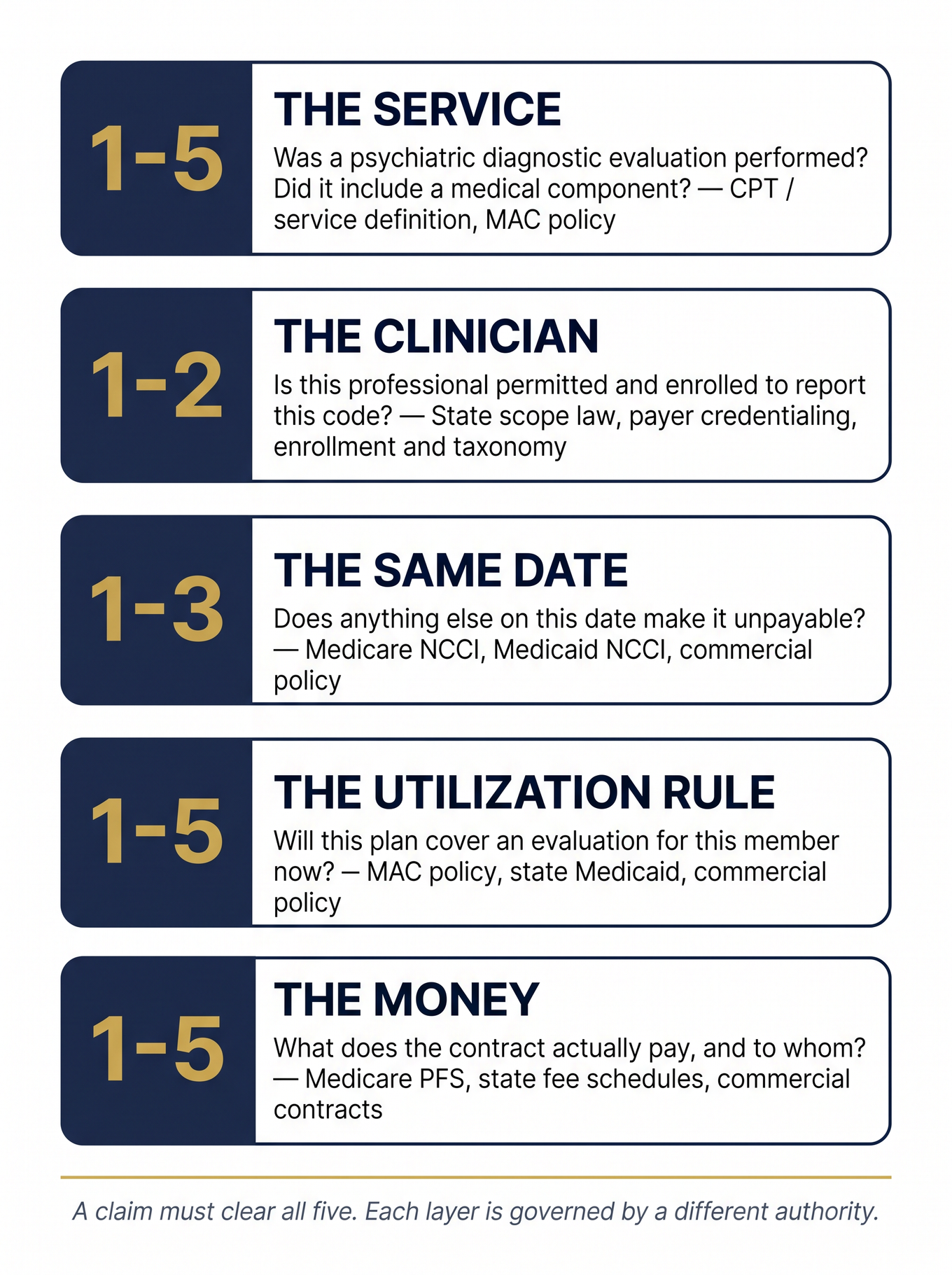
| Layer | The question it answers | Who governs it |
|---|---|---|
| 1. The service | Was a psychiatric diagnostic evaluation actually performed, and did it include a medical component? | CPT / service definition, MAC policy |
| 2. The clinician | Is this professional permitted and enrolled to report this code? | State scope law, payer credentialing, enrollment and taxonomy |
| 3. The same date | Does anything else on this date make it unpayable? | Medicare NCCI, Medicaid NCCI, commercial policy |
| 4. The utilization rule | Will this plan cover an evaluation for this member now? | MAC policy, state Medicaid, commercial policy |
| 5. The money | What does the contract actually pay, and to whom? | Medicare PFS, state fee schedules, commercial contracts |
A sixth thing is not a rule layer but sits underneath all of them, and it causes denials that look like coverage problems and are not: the payer you bill may not be the payer on the card. Behavioral health benefits are frequently carved out to a separate administrator - Optum and United Behavioral Health, Carelon, Evernorth, Magellan, and others. The front desk verifies the medical plan, nobody verifies the behavioral carve-out, and the claim goes to a company that never had the benefit. It comes back looking like a coverage denial. It was a routing error. Verifying the behavioral health administrator, payer ID, authorization portal, network status, and claim address is a different task from verifying eligibility, and it is the most commonly skipped step in a behavioral health intake.
What actually counts as a psychiatric diagnostic evaluation
CMS describes the psychiatric diagnostic evaluation as an integrated biopsychosocial assessment. In its contractors' language, the evaluation typically elicits psychiatric, medical, family, and social history, includes a mental status examination, arrives at a tentative diagnostic formulation, evaluates the patient's ability and willingness to participate in treatment, and produces an initial plan or set of recommendations. Information can come from the patient and, when clinically appropriate, from family, other clinicians, physicians, or community sources (First Coast LCD L33252).
The operative word is formulation. Collecting demographics, administering a screening questionnaire, and carrying the referral diagnosis forward is intake paperwork, not the service this code describes. What separates a defensible 90791 from a vulnerable one is whether the note shows a clinician synthesizing the information into a diagnostic assessment and a treatment direction, rather than gathering it.
A strong record ordinarily makes seven things visible: why the evaluation is happening now, the relevant psychiatric and medical history, the current clinical picture including mental status findings, the diagnostic synthesis with differential considerations where appropriate, the plan and recommendations, who participated and what came from collateral sources, and the rendering professional's identity, credentials, date of service, and signature. One Medicare contractor's billing article sets out its own explicit list - reason for the service, referral source, present illness, psychiatric history, relevant medical history and medication, social and family history, mental status examination, strengths and liabilities, diagnostic impression, and treatment plan (First Coast Article A57480). State Medicaid (Texas) publishes its own required elements separately (Texas Medicaid Behavioral Health handbook). Those lists overlap heavily but are not identical. There is no single national documentation checklist for this code.
Patient presence and collateral interviews
A number of pages state flatly that the patient must be present for the entire evaluation. CMS guidance permits information from family and other sources, and recognizes that some children, some older adults, and some patients with communication barriers may require collateral participation or more than one visit before an evaluation can be completed (L33252, Novitas LCD L35101).
So a parent-only intake or a collateral-only segment is neither automatically billable nor automatically unbillable. Four questions control it: does the service meet the payer's definition of the evaluation, is the patient the beneficiary of the work, did the clinician complete medically necessary diagnostic work, and does this payer permit this particular structure. The record should explain the patient's role, who the collateral source was, why that information was needed, and how it contributed to the diagnostic work.
90791 vs 90792: the work decides, not the credential
These two codes describe two different amounts of work. Both cover the same diagnostic foundation: the integrated biopsychosocial assessment, the history, the mental status examination, the diagnostic formulation, the assessment of capacity and willingness to participate, and the recommendations. 90792 is that same evaluation plus a genuine medical service component. 90791 is that same evaluation without it. What determines which code describes the encounter is what the clinician actually did and documented (2026 Medicare NCCI Policy Manual, Chapter XI; L33252).
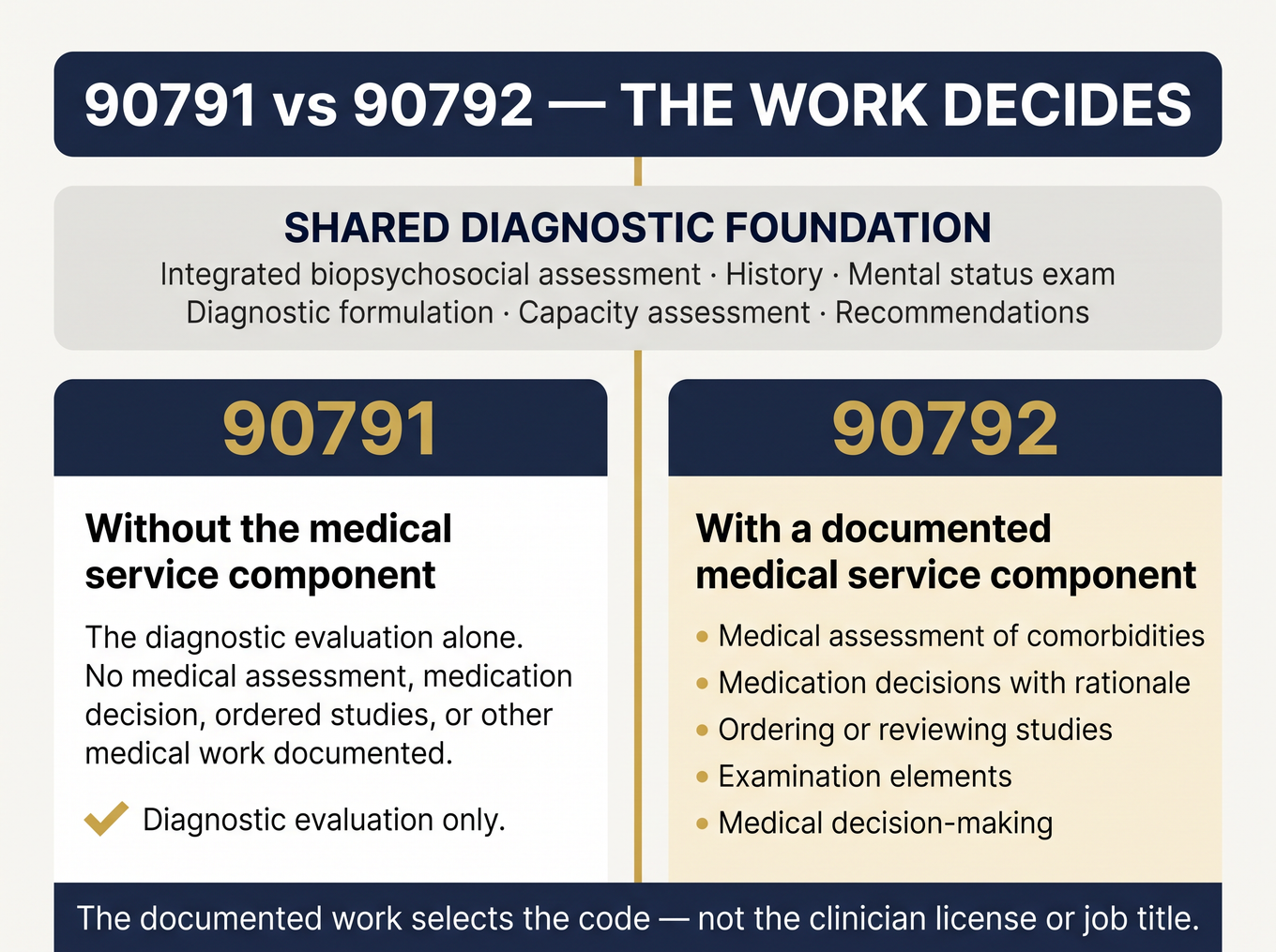
| 90791 | 90792 | |
|---|---|---|
| Core service | Psychiatric diagnostic evaluation without the added medical service component | Psychiatric diagnostic evaluation that includes medical assessment and services |
| Shared diagnostic work | Integrated biopsychosocial assessment, history, mental status examination, diagnostic formulation, capacity and willingness for treatment, recommendations | Identical diagnostic foundation |
| The difference | - | A documented medical component: medical assessment, indicated examination elements, evaluation of comorbidity or medication interaction, medication decisions, ordering or interpreting studies, or other medical work within scope |
| Who may report it | A clinician permitted by state scope and enrolled or credentialed by the payer for this service. Medicare has included qualifying MFTs and MHCs as independent billing practitioners since 2024 | Generally limited by payers to professionals whose scope includes the medical component. State Medicaid (Texas) names physicians, APRNs, and PAs specifically |
| Is prescribing authority enough? | A prescriber may still report 90791 if no medical component occurred and payer policy permits | No. Authority to prescribe does not establish that medical services happened during this encounter |
| Does a medication list establish it? | A medication list is relevant history | Usually not by itself. The record needs medical assessment or management, not copied medications |
What "with medical services" actually means
A defensible 90792 note makes the additional medical work unmistakable. Depending on the encounter, that can include:
- assessment of significant medical conditions affecting the psychiatric presentation or treatment choice;
- review of medication exposure, effectiveness, adverse effects, interactions, adherence, or contraindications;
- indicated physical examination elements or other medically oriented observations;
- prescribing, changing, continuing, or declining medication with a documented medical rationale;
- ordering, reviewing, or interpreting laboratory tests or other diagnostic studies;
- medical decision-making about the relationship between psychiatric symptoms and another medical condition;
- or coordination of medically necessary follow-up arising from the evaluation (L33252, Texas Medicaid).
That list does not say "90792 means medication was prescribed." CMS guidance says prescribing and diagnostic studies may be included. A prescriber can perform a genuine medical assessment and decide, for good clinical reasons, not to prescribe anything, and still have performed the medical component. Conversely, a templated medication list dropped into a note without any assessment does not establish it. The presence of a drug name is not medical decision-making.
Three specific habits produce most of the miscoding here:
Defaulting by job title. Some organizations route every psychiatrist and PMHNP intake to 90792 and every therapist intake to 90791 as a matter of template. That will be right much of the time and wrong some of the time, and the wrong times are the ones that get audited. A psychiatrist who conducts a diagnostic assessment without performing a medically oriented assessment, without a medication decision, without ordering or reviewing studies, and without documenting other medical work has, on that encounter, described the service 90791 covers.
Treating the credential as the selector rather than as a separate gate. Provider type matters - it is layer 2 - but it answers a different question. Scope and enrollment determine whether you may report a code. The documented work determines which code describes the encounter. Satisfying one does not satisfy the other.
Reaching for 90792 on an established patient. If the encounter is medication management for a patient already in treatment, with no new diagnostic evaluation, an appropriate evaluation and management service is usually the more accurate description than repeating a diagnostic evaluation code.
A decision tree you can actually run
- Was a psychiatric diagnostic evaluation performed? If no, neither code applies. Look at the psychotherapy, crisis, or E/M families instead.
- Did the encounter include a genuine medical assessment or service component? If no, consider 90791. If yes, continue.
- Is that medical work within this clinician's state scope and payer credentialing? If no, do not report 90792 under this clinician merely because a colleague could have performed it.
- Does the note separately demonstrate the diagnostic evaluation and the medical component? If not, the documentation is vulnerable even if the coding is defensible.
- Does the payer permit this code for this provider, setting, date, and frequency? This is layers 2 through 4, and it is verification work, not coding work.
- Is another code family simply more accurate? Ask it honestly before you bill.
Who is allowed to report it: four questions, not one
The service definition does not override professional scope-of-practice law, Medicare enrollment category, Medicaid program rules, or a commercial payer's credentialing contract. A clinician can be fully licensed to perform an assessment and still not be enrolled to bill it under a particular product, location, group, or taxonomy. When a claim denies for provider eligibility, one of these four is almost always the reason:
- Clinical scope. Does state law permit this professional to perform the underlying service?
- Payer-recognized provider type. Does this plan recognize and reimburse this credential for this specific code?
- Enrollment and taxonomy. Is the rendering NPI enrolled under the correct specialty and taxonomy, and linked to the billing entity and the service location? Taxonomy is the specialty code on the claim, and it has to match what the payer actually enrolled.
- Supervision arrangements. Is the service personally billable by this clinician, or does a specific supervision structure apply - and does this payer recognize that structure?
Medicare offers the clearest recent example of how these move independently. Since January 1, 2024, qualifying marriage and family therapists and mental health counselors may enroll and bill Medicare independently for covered diagnosis and treatment services, and CMS states that Medicare Part B pays those practitioners at 75% of the clinical psychologist amount under the Physician Fee Schedule. State licensure and CMS enrollment criteria still apply (CMS: Marriage and Family Therapists & Mental Health Counselors). Other Medicare-recognized mental health practitioner categories include physicians, clinical psychologists, clinical social workers, clinical nurse specialists, nurse practitioners, and physician assistants, when the service is within scope and Medicare's rules are met - with payment percentages that differ by category (CMS PFS quick reference).
What does not follow is that every Medicare-recognized mental health professional can report 90792. The medical component has to be within that practitioner's scope, and the payer has to recognize that provider type for that code.
State Medicaid (Texas) is a useful example precisely because it publishes the mapping explicitly. Texas Medicaid's behavioral health handbook states that 90791 may be reimbursed to physicians, psychologists, APRNs, PAs, LCSWs, LPCs, LMFTs, provisionally licensed psychologists, psychology interns, and postdoctoral fellows - and that 90792 may be reimbursed to physicians, APRNs, and PAs (Texas Medicaid). That is a Texas Medicaid rule. It is not a national provider list, and copying it into a workflow in another state is how a compliant clinician ends up with a non-covered claim.
Provider eligibility problems tend to arrive in a recognizable set: a rendering NPI not enrolled for the date of service, a taxonomy that doesn't match payer enrollment, a credential excluded from that member's product, incomplete group or location linkage, a service performed outside state scope, a supervised trainee billed as independently rendering where the payer requires another structure, 90792 submitted by a provider category the payer doesn't recognize for a medical psychiatric evaluation, or a telehealth licensure conflict. These usually surface as CARC 8, 170, 171, or 185, or a payer-specific remark code (X12 Claim Adjustment Reason Codes) - but the same root cause gets expressed differently across payers, which is why the remark code matters more than the reason code.
90791 has no time minimum and no maximum
90791 is not a time-based code. There is no CPT minimum and no CPT maximum that selects it. It is reported for the completed psychiatric diagnostic evaluation, not for crossing a 16-, 45-, 60-, or 90-minute threshold. A current Medicare contractor policy states the diagnostic evaluation codes are untimed, and coding guidance from AAPC likewise describes 90791 and 90792 as not time-bound and reported once per day regardless of how many sessions occur on that date (Novitas LCD L35101; AAPC coding alert).
This matters because a number of currently ranking pages state that CMS requires at least 16 minutes, or caps the code at 90 minutes, and some attribute both to CMS directly. That claim does not trace to a sound primary source. It appears to have been copied across the search results, and at least one page contradicts itself by calling the service untimed on one line and attributing a 16-to-90-minute rule to CMS on another.
The likely origin explains why the number looks credible. Payer systems, scheduling templates, and telehealth workflows do sometimes assign an administrative duration to this code, for appointment length, utilization accounting, or platform configuration. Those are operational values. When an operational value gets quoted as a coding requirement, it becomes a rule that nobody actually wrote.
The same Novitas policy that calls the codes untimed also asks the record to include session length, and notes a usual range of roughly 45 to 60 minutes. Time is not the CPT selection criterion for 90791, but a payer or documentation policy may still require you to record it.
So record it. Not to choose the code, but because:
- a Medicare contractor, Medicaid program, facility, or payer contract may require it;
- it helps establish that two services occurred at distinct times, in the rare cases where separate reporting is permitted;
- it supports a telehealth audit trail;
- it helps explain why an evaluation extended across two dates; and
- its absence, or its suspicious uniformity across every intake, is exactly what a reviewer notices.
What if the intake ran ninety minutes or more?
A longer visit does not, by itself, create a second billable unit or a prolonged-service add-on. Before assuming there is more to bill, establish whether the encounter was one service, whether a genuinely separate reportable service also occurred, and whether the payer has a specific policy for extended or multi-date evaluations.
Do not follow the pages still recommending prolonged-service codes 99354 and 99355 for a long intake. Those codes were deleted from CPT in 2023 (AMA 2023 E/M code and guideline changes).
What if the evaluation needs two appointments?
CMS contractor guidance acknowledges that some children and some older adults may need more than one visit before an initial evaluation can be completed, and coding guidance describes more than one unit across different dates when medical necessity supports an extended evaluation - while holding the line at one unit per day (L35101; AAPC). Payment still depends on the contractor's or plan's frequency policy and on your documentation.
If you do bill a second date, the second note cannot be a copy of the first. It needs to state why the evaluation could not be completed on the first date, what distinct diagnostic work happened on the second, how the second encounter completed or materially advanced the formulation, who participated, and why a psychotherapy code would not have described it better.
Get payer confirmation before making "two intakes" a routine practice. This is exactly the territory where informal habit substitutes for policy - one clinician in a practitioner discussion described two sessions as "industry standard" while acknowledging they could not find formal Medicare or Medicaid guidance for it. Industry standard is not a payment rule, and the gap between the two is where recoupment lives.
How often it pays depends on how your plan counts
There is no universal frequency rule for 90791. There is no national once-per-year limit. There is no national every-six-months allowance. What exists is a collection of payer-specific utilization rules that count prior use in different ways, and the reason "once a year" feels authoritative is that it is true somewhere.
A frequency edit can differ on four dimensions at once:
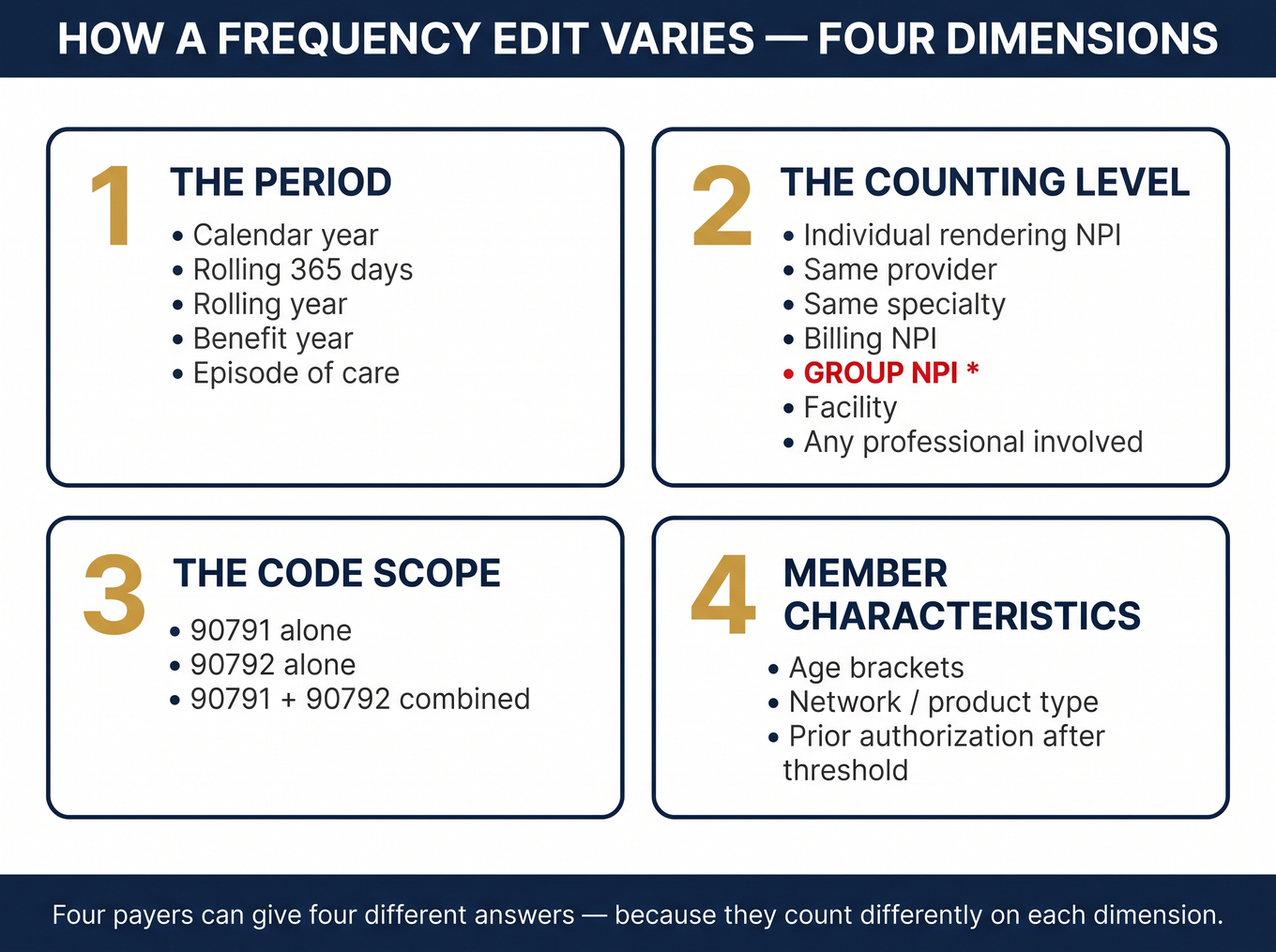
- The period. Calendar year, rolling 365 days, rolling year, benefit year, or episode of care.
- The counting level. Individual rendering NPI, same provider, same specialty, billing NPI, group NPI, facility, or any professional involved in the service. Group-level counting is the one that surprises people: it means the plan counts the practice's prior use, not just the individual clinician's, so a colleague's evaluation months ago can block yours today.
- The code scope. 90791 alone, 90792 alone, or the two combined into a single allowance.
- Member characteristics. Age brackets, network and product type, and whether prior authorization kicks in after a threshold.
The question most practices ask - is 90791 covered? - is not verification. It is the opening of verification. The question that produces a usable answer is: how does this plan count prior use?
What four real policies say, each with its owner attached:
| Policy | What it says | Whose rule | What it means operationally |
|---|---|---|---|
| First Coast Article A57480 | Initial diagnostic evaluation at the onset of illness or suspected illness. The same provider may repeat it after an extended break in treatment, an inpatient admission, a significant change in mental status, a second opinion, or diagnostic clarification. The contractor describes an extended break as approximately six months | Medicare MAC policy (First Coast) | This is where the "six-month rule" people quote comes from. It is one contractor's guidance, not a national Medicare benefit. Confirm your patient's MAC |
| Novitas LCD L35101 | No more than three combined 90791/90792 evaluations per year, per beneficiary, by the same provider - and the same limit applies at group-NPI level. Each service still requires medical necessity | Medicare MAC policy (Novitas) | A maximum is not permission to bill three routinely. Group-level counting means a second clinician's claim can deny because of the first clinician's work |
| Texas Medicaid behavioral health handbook | 90791 and 90792 combined are limited to once per person, per rolling year, same provider, regardless of the number of professionals involved in the interview. Additional evaluations require prior authorization | State Medicaid (Texas) | Verify prior use before the visit, and submit exception documentation before the extra service where required |
| Blue Cross NC maximum units of service | 90791 and 90792, alone or combined, limited to no more than three units per year | Commercial payer (BCBS NC, current) | A published unit ceiling does not establish that all three are medically necessary. Check the member's product, the policy's effective date, medical policy, and authorization rules too |
Sources: A57480, L35101, Texas Medicaid, BCBS NC.
Four policies. Four different periods, three different counting levels, and no agreement on the number. That is an argument for verification.
One more example, offered carefully because it is out of date: a commercial frequency policy published in 2020 counted one service per 365 days for members over 21, and two per 365 days for members under 21, at the member and provider-NPI level (Empire BlueCross BlueShield frequency editing, published September 2020). Treat that as historical. It is not current policy for that carrier or any other, and it should not be relied on for a claim. It is documented proof that a commercial plan can count differently by patient age. If your verification process has no field for "does this limit vary by member age," it has a hole in it.
What "a new episode of care" means, and what it does not
There is no single national definition of a new episode of care for this code. One behavioral health administrator's provider materials describe a former client returning several months later as potentially beginning a new episode of care, commonly opened with 90791 or 90792 (Optum Provider Express). That is useful, and it is one administrator's framing.
Across the policies reviewed here, a defensible new episode generally involves one or more of the following:
- a clinically meaningful break in treatment followed by return to care;
- admission or readmission to an inpatient or structured setting;
- a significant change in symptoms, mental status, functioning, diagnosis, or treatment need;
- a new referral question or genuine diagnostic uncertainty;
- a second opinion or diagnostic clarification;
- transition to a genuinely new treating entity where the payer counts by provider or group and a new assessment is medically necessary;
- or a court or agency requirement the payer recognizes.
That is a synthesis of several policies, not a rule from any one of them - which is exactly why it belongs in your payer matrix rather than in your assumptions.
A new tax ID, a new office, a new therapist, or a new calendar year may all be relevant to a payer's edit, but none of them automatically proves that another diagnostic evaluation is medically necessary and payable. Medical necessity and the plan's counting rule both have to be satisfied. When the note says only "annual intake update," neither one is.
The record should not simply assert "new episode." It should identify what changed, why the previous information is insufficient, and how the new evaluation will change diagnosis, treatment, level of care, or coordination.
The verification script that gets a usable answer
Most benefit checks fail because they ask a question with a comfortable answer. These ten get you something you can bill against. Ask the payer representative or work through the provider portal:
- Is 90791 covered for this member and this rendering provider at the planned place of service?
- Is prior authorization required for the first evaluation, or only after a threshold?
- How many combined units of 90791 and 90792 are allowed?
- Is the period a calendar year, rolling 365 days, benefit year, or episode of care?
- Is the limit counted by rendering NPI, billing NPI, group NPI, facility, specialty, or all providers?
- Has this member already used any units, and on what dates and under which provider identifiers?
- What qualifies as a new episode or a medically necessary exception under this plan?
- What documentation and submission route are required for an exception?
- Are telehealth, audio-only, and same-day services subject to separate rules?
- What is the reference number for this call or portal response?
Question six is the one that prevents the denial entirely.
Benefit quotations routinely disclaim that payment depends on eligibility, coding, medical necessity, authorization, and claim adjudication. A reference number is evidence of diligence, not a guarantee of payment. It is worth having anyway, particularly when you later need to argue timely-filing relief or an authorization dispute.
Can you bill 90791 and therapy on the same day?
Medicare NCCI: the 2026 Medicare NCCI Policy Manual states that because psychotherapy includes continuing psychiatric evaluation, 90791 and 90792 are not separately reportable with individual, group, family, crisis, or other psychotherapy codes for the same date of service. It also states that office and outpatient E/M codes 99202 through 99215 are not reportable with either diagnostic psychiatric code (2026 NCCI Policy Manual, Chapter XI, effective January 1, 2026; NCCI manual landing page).
That is an explicit national coding rule for Medicare, published in a manual, with an effective date.
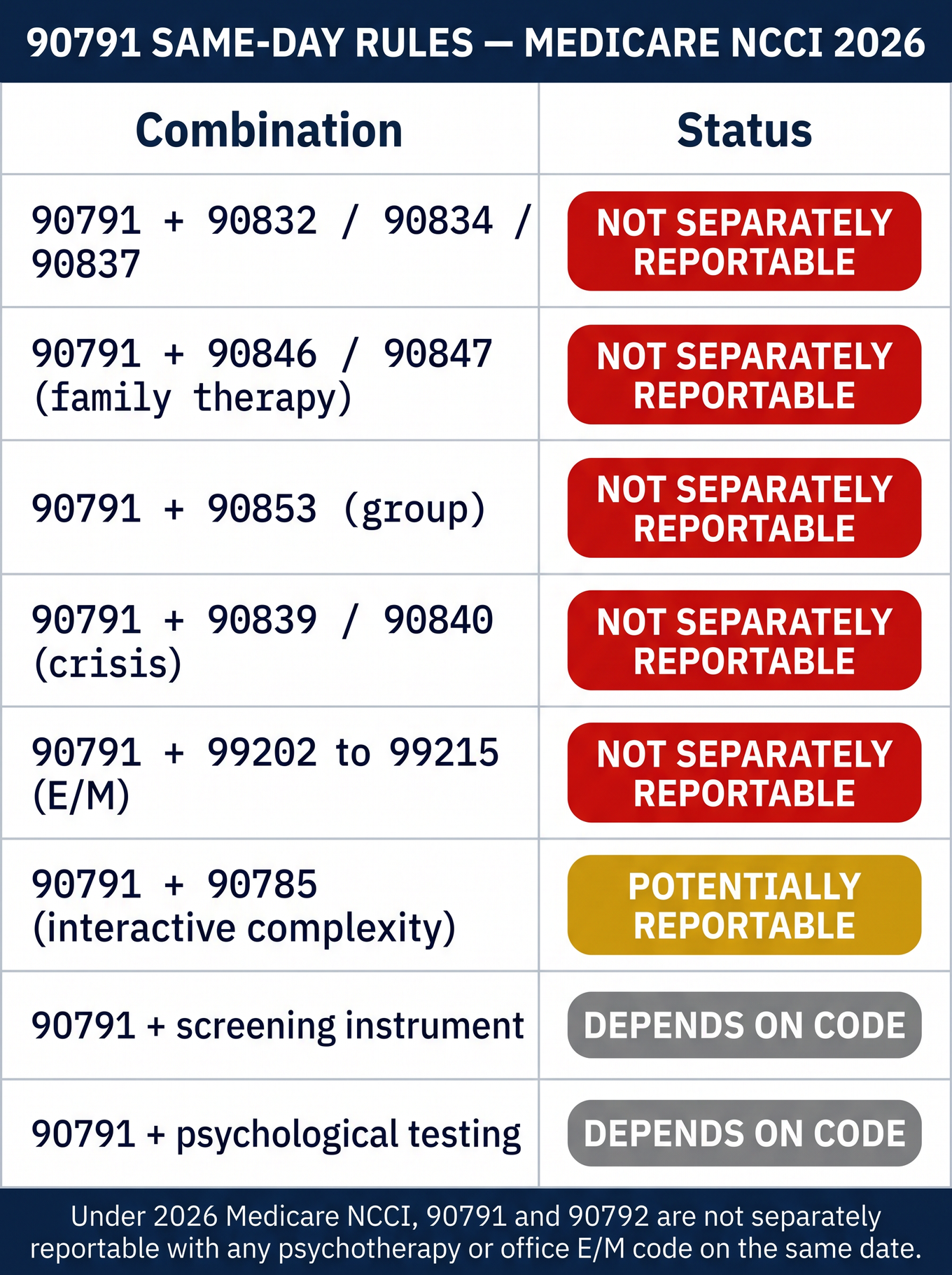
| Combination | Medicare / NCCI position | What that means in practice |
|---|---|---|
| 90791 + 90832 / 90834 / 90837 | Not separately reportable on the same date | Do not split a first visit into "intake" plus individual psychotherapy because both assessment and supportive intervention occurred. The evaluation already includes the work needed to conduct the evaluation |
| 90791 + 90846 / 90847 | Not separately reportable with family psychotherapy on the same date | Family participation in an intake is not automatically a separate family therapy service |
| 90791 + 90853 | Not separately reportable with group psychotherapy on the same date | Under Medicare's rules, an intake and a group service may need separate dates |
| 90791 + 90839 / 90840 | Crisis psychotherapy is reported without the diagnostic evaluation codes; CMS expressly lists prohibited pairings | Code the service actually furnished. Do not add an intake code to crisis psychotherapy for the same encounter |
| 90791 or 90792 + 99202–99215 | Not reportable with either diagnostic code | 90791 is not an add-on to a new-patient office visit, and for 90792 the extra E/M line generally duplicates the medical work already inside the code |
| 90791 or 90792 + 90785 | Potentially reportable when a qualifying interactive complexity factor is present and documented | 90785 is add-on only, and "communication was difficult" is not the standard. See the next section |
| 90791 + a screening instrument code | Depends on the specific code, the payer, the current code-pair edit, and whether the instrument is separately billable rather than integral to the evaluation | Do not assume every questionnaire produces a separately payable line |
| 90791 + psychological or neuropsychological testing codes | Potentially distinct only if actual testing - not routine intake questionnaires - was separately medically necessary and all testing rules are met. Payer edits vary | Do not relabel ordinary intake assessment as testing |
Sources: 2026 NCCI Chapter XI, A57480, CMS Psychotherapy for Crisis.
If the diagnostic evaluation and psychotherapy cannot share a date, the therapy moves to its own date, and the code then turns on the documented session length, which carries its own audit exposure. We work through that call in our comparison of 90834 and 90837.
Two important boundaries on all of this. Medicaid NCCI runs a parallel program using NCCI methodologies, but state implementation, state-specific edits, provider manuals, and managed care plan rules still apply - do not assume every Medicaid product adjudicates an edit identically (Medicaid NCCI). And commercial payers may adopt NCCI wholesale, adopt a modified edit set, or publish their own reimbursement policy. The Medicare rule tells you what Medicare does. It tells you what to check everywhere else.
Why modifier 25 or 59 is not a rescue strategy
When a same-day pair denies, the reflex is to reach for a modifier. A modifier is a statement of fact about the circumstances of a service. It is not a permission slip, and it does not create a separately payable service where policy says none exists.
Modifier 25 belongs on a significant, separately identifiable E/M service - in situations where that E/M can lawfully be reported alongside another service in the first place. Modifier 59 and the X{EPSU} set describe distinct procedural circumstances, for use when an edit permits a modifier override and the underlying facts support it. Neither is appropriate simply to defeat a frequency or bundling denial. Appending one to force an edit that policy treats as mutually exclusive is not aggressive coding; it is a misstatement on a claim.
NCCI does permit certain psychotherapy and family psychotherapy combinations when they are separate and distinct and furnished during separate time intervals. That exception does not convert 90791 plus psychotherapy into a permitted pair. Read the actual code-pair rule rather than generalizing "separate time means bill both."
When two clinicians both evaluate the same patient
There is no safe universal answer.
Clinically, the two services can be genuinely different. A therapist can perform a psychosocial diagnostic evaluation while a psychiatrist or other medical clinician separately performs a medically oriented psychiatric evaluation, with different purposes, different findings, and different plans. That is real clinical work, not duplication.
On the claim, whether both get paid depends entirely on how the payer's edit counts - and as the frequency section showed, that counting can happen at member and date level, by specialty, by group NPI, by facility, by provider, on combined units, or explicitly regardless of how many professionals were involved. Two of the policies quoted earlier make the point sharply. Novitas applies its annual maximum at both individual-provider and group-NPI level. Texas Medicaid states its one-per-rolling-year limit applies for the same provider regardless of the number of professionals involved in the interview. Different NPIs guarantee nothing.
A workable way to think about the risk:
- Highest denial risk: same date, same group, same specialty, overlapping notes, the same referral question, or both clinicians documenting substantially the same history and plan.
- Still risky: different specialties or provider types on the same date, but the payer applies a member-per-day or combined-code edit.
- More defensible, though not guaranteed: separate dates, distinct clinical questions, separate records, separate medical necessity, payer verification obtained in advance, and no conflict with the frequency cap.
If a practice does pursue both, the documentation has to carry it: each clinician's distinct referral question and reason for involvement, non-duplicative history and examination focus, distinct diagnostic or medical conclusions, separate treatment decisions and follow-up responsibilities, exact provider identity with NPI, taxonomy and group, separate dates and times where applicable, and payer confirmation or authorization where policy is unclear.
Our workflow recommendation: ask before the visit, not after the denial. For a planned multidisciplinary intake, ask the payer whether it will reimburse both 90791 and 90792 when furnished by different clinicians in the same group, whether the dates must differ, how the frequency edit counts, and whether one of the services would be more accurately reported as an E/M or another code. Get a reference number or a written portal response. And if the plan will only pay for one diagnostic evaluation, design the workflow around one billable evaluation with non-duplicative internal collaboration rather than generating two claims and hoping a modifier carries them. The second approach costs the clinical time either way and adds an appeal.
90785: what actually qualifies as interactive complexity
90785 is an add-on code for specific communication complications occurring during an eligible psychiatric service. It is never billed alone.
CMS examples of qualifying circumstances include managing maladaptive communication among participants that complicates delivery of care; caregiver emotions or behavior that interfere with implementing the treatment plan; a sentinel event requiring mandated third-party reporting and the related discussion; and the use of play equipment, physical devices, an interpreter, or a translator to overcome a significant communication barrier (A57480).
What it is not is where most of the money is lost:
- not "the patient was complex";
- not "the diagnosis was severe";
- not "a parent attended";
- not "an interpreter was present," absent a significant barrier and a qualifying complexity;
- not payment for ordinary family-history gathering;
- not a standalone code;
- not billable with crisis psychotherapy; and
- not reportable alongside an E/M service alone, with no eligible psychiatric or psychotherapy service to support it (L33252, A57480, Psychotherapy for Crisis).
The distinction that matters: a participant's presence is a fact about the room; interactive complexity is a fact about the work. An interpreter attending does not qualify the add-on. An interpreter being necessary to overcome a significant communication barrier, in a way that complicated the delivery of the psychiatric service, may.
A note that supports 90785 answers three questions:
- What was the qualifying communication complication?
- How did it interfere with or complicate delivery of the diagnostic service?
- What did the clinician have to do differently to complete the evaluation?
Weak: "Interactive complexity due to family present."
Stronger: "During the evaluation, conflicting and highly reactive communication between the patient and caregiver repeatedly prevented accurate history-taking and agreement on the initial plan. The clinician used structured turn-taking, separate clarification, and repeated reframing to obtain reliable information and complete the plan."
The second version is a documentation model, not a payment promise. The facts have to be true, the base code has to be eligible, and the payer has to cover the add-on.
Both underuse and overuse of this code are common, and the cause is the same in both directions: staff cannot locate authoritative guidance, so habit fills the vacuum. In practitioner discussions, clinicians describe struggling to recognize qualifying cases, others report abandoning the code entirely after repeated auditor challenges, and billing staff describe providers continuing to submit it through repeated denials because nothing they could find felt official enough to settle the question. The fix is a short decision rule, a note template, and payer-specific coverage tracking.
How to bill 90791 by telehealth in 2026
Medicare. CMS's 2026 telehealth materials list psychiatric diagnostic evaluation services as Medicare telehealth services, and for behavioral health care the beneficiary's home can serve as an originating site without the older geographic restriction. CMS's February 2026 telehealth FAQ states that broad telehealth flexibilities and the delayed behavioral health in-person requirements continue through December 31, 2027 (CMS Telehealth; CMS Medicare Telehealth FAQ).
Those dates are statutory and they have moved before. Recheck them before you rely on them - this is the one area of this page most likely to be out of date by the time you read it.
Place of service. POS 10 is telehealth provided in the patient's home. POS 02 is telehealth provided somewhere other than the patient's home (CMS Place of Service Code Set). CMS's 2026 FAQ states that POS 10 is paid at the nonfacility rate under the Physician Fee Schedule, though the actual amount still depends on locality, provider category, and other fee schedule factors.
Audio-video versus audio-only. For Medicare in 2026, behavioral health services may be furnished by audio-only technology when the current statutory and CMS conditions are met, and CMS identifies modifier 93 for audio-only services, with FQHCs and RHCs using their applicable reporting structure. The clinician must be capable of audio-video delivery and use audio-only under the conditions in effect for that date of service (HHS: billing and coding Medicare fee-for-service claims).
Do not convert that into a universal modifier rule. State Medicaid (Texas) permits 90791 and 90792 through synchronous audiovisual technology when clinically appropriate and agreed to by the patient, and instructs providers to use modifier 95 - while using FQ for audio-only services under its own rules, which carry relationship and periodic in-person conditions (Texas Medicaid). One federal instruction, one state instruction, two different modifiers, both current. "Always use modifier 95 for telehealth" is wrong.
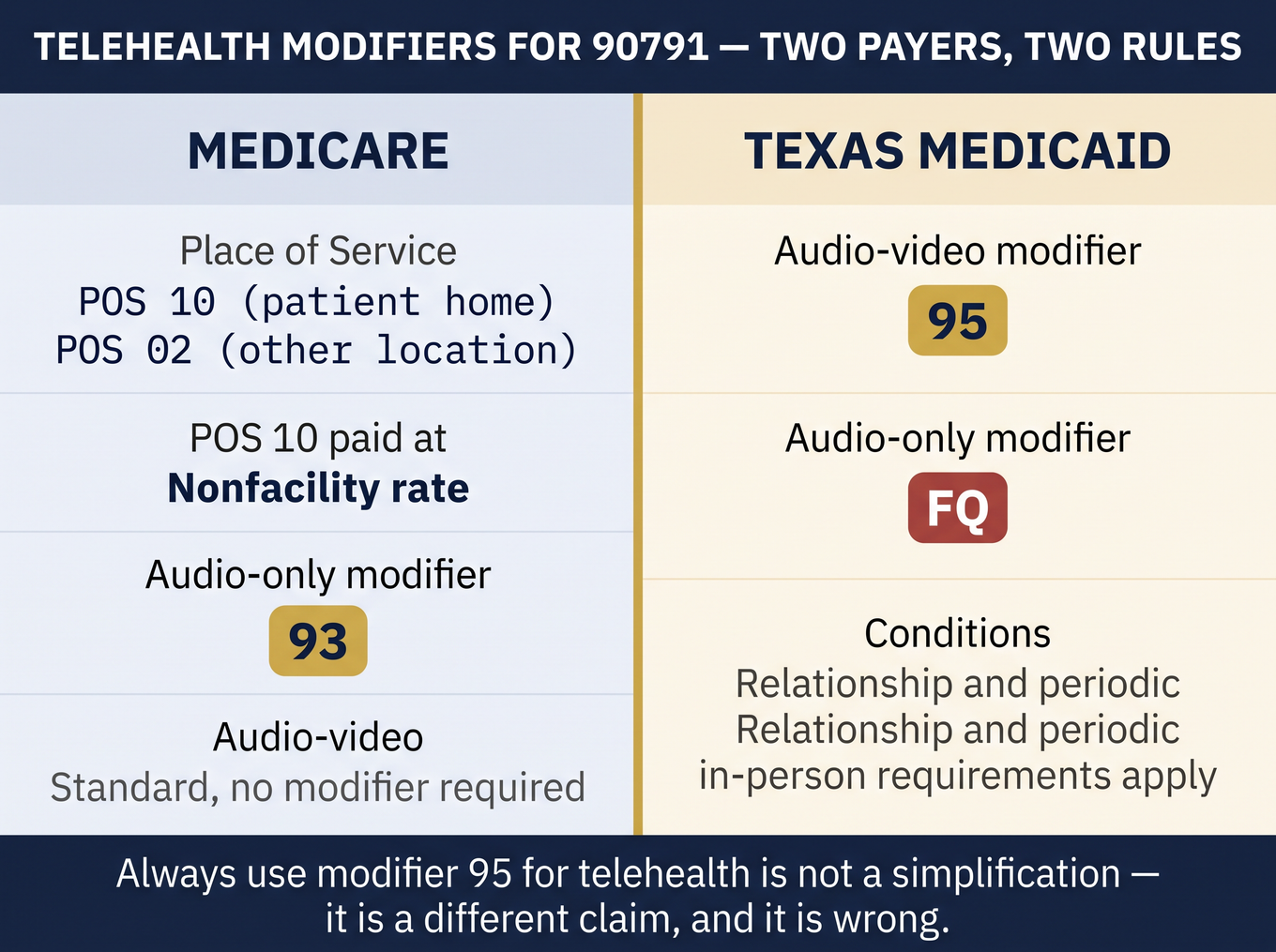
Before a telehealth evaluation goes out the door, verify and document:
- patient identity;
- the patient's physical location and the clinician's location;
- the technology used, audio-video or audio-only;
- consent where law or payer requires it;
- state licensure authority for the patient's location;
- payer telehealth eligibility for this code, provider, and product;
- POS 10 versus POS 02 or the payer's alternative instruction;
- the required modifier;
- whether the payer requires a prior in-person relationship, a periodic in-person visit, or an audio-only attestation;
- any technical interruptions that affected the evaluation;
- and all the same clinical elements an in-person diagnostic evaluation would require.
When telehealth claims for this code deny, it is usually one of nine things:
- POS 11 used where the payer expected 10 or 02;
- a modifier missing, wrong, or unrecognized by that payer;
- a rendering provider not licensed or enrolled for the patient's location;
- audio-only billed under a product that excludes it;
- patient location not documented;
- the code covered for telehealth but the provider type not covered;
- an unmet authorization or relationship condition;
- a mismatch between the claim's POS, the EHR's recorded modality, and the note;
- or the payer's facility/nonfacility logic applying a different rate than expected.
Documentation: what the note has to establish
The claim is a summary. The note is the evidence. When a payer asks whether this service happened and whether it was necessary, the note answers alone.
A workable architecture for a 90791 evaluation note:
Reason for the evaluation. Referral source and question; presenting concerns and functional impact; why a diagnostic evaluation is medically necessary now; prior evaluation and treatment dates, and why this is a new or repeat episode.
Information sources and participants. Patient participation; family, guardian, or other informants; records reviewed; reliability or limits of the information; why collateral information was required.
Relevant history. Current symptoms and course; prior diagnoses, treatment, and response, including hospital or structured-care history where relevant; significant medical history; medications and relevant effects or interactions; family, developmental, social, educational, occupational, and legal context as clinically pertinent; substance use history where pertinent.
Mental status and clinical findings. Appearance, behavior, and engagement; speech, mood and affect, thought process and content, perception, cognition, insight and judgment as clinically relevant; functional strengths and impairments; risk and safety assessment at an appropriate clinical level; barriers to participation.
Diagnostic formulation. The supported diagnosis or working formulation; differential considerations; relationship to medical conditions or medication where relevant; the degree of diagnostic certainty; why the findings support the planned type and level of treatment.
Plan. Treatment recommendations and goals; referrals, coordination, or testing; follow-up timing; expected course where the payer requires it; the patient's ability and willingness to participate.
The 90792 medical component, where applicable. Medical assessment and indicated examination elements; the medication decision and its rationale; orders, review, or interpretation of tests; medical comorbidities and interactions; follow-up and monitoring.
90785, where applicable. The exact qualifying communication complication; how it interfered with the service; the adaptations used.
Telehealth, where applicable. Patient and clinician locations; modality; consent and identity verification where required; limitations or interruptions; any payer-required attestation.
Authentication. Date, duration where the payer requires it, rendering identity, credentials, signature, and a compliant addendum history (L33252, A57480, L35101, Texas Medicaid).
The diagnosis problem nobody wants to talk about
The claim needs a valid ICD-10-CM diagnosis code supported by the record. The evaluation, by definition, is the thing that produces the diagnosis. That tension is real, and it has a correct resolution.
Outpatient diagnosis coding follows the ICD-10-CM Official Guidelines, and those guidelines are explicit: do not code diagnoses documented as probable, suspected, questionable, or rule out. Code to the highest degree of certainty supported by the record, which may mean coding symptoms, signs, abnormal findings, or the reason for the encounter (ICD-10-CM Official Guidelines, April 1 2026 update).
So when the disorder is not yet established, the clinician selects the most accurate supported symptom, condition, or encounter code the payer permits, and documents the diagnostic uncertainty. What the clinician does not do is reach for whichever diagnosis is most likely to pay. In coding discussions, you will see suggestions to use a screening Z code when an evaluation finds no disorder - which may or may not match the actual purpose of the encounter and the payer's policy, and a routine screening service can be non-covered in situations where a medically necessary diagnostic evaluation would have been covered. Code the documented reason and the documented findings. A diagnosis selected to make a claim pay is a different kind of problem from a denial.
What 90791 pays, and why that number isn't your number
A reimbursement figure is meaningless without saying which number it is. There are four, and they are not interchangeable:
- Charge - what the practice puts on the claim.
- Allowed amount - what the payer recognizes under its fee schedule or your contract, before patient responsibility and other adjustments.
- Payer payment - the allowed amount minus deductible, coinsurance or copay, any prior payer's payment, and other applicable adjustments.
- Net collection - payer payment plus collectible patient responsibility, minus refunds, write-offs, and uncollectible balances.
A practice can charge $300 and be allowed considerably less. Less intuitively, a low charge can cap payment below the contracted allowance, because many payers pay the lesser of the charge or the fee schedule. That is a real and recoverable loss, and it is invisible unless someone compares allowed amounts against the contract.
Medicare methodology. CMS calculates Physician Fee Schedule payment from work, practice expense, and malpractice RVUs, adjusted for locality, then multiplied by a conversion factor. Facility and nonfacility amounts can differ because the professional bears different practice expense. Beginning in 2026, CMS uses separate conversion factors for qualifying Advanced APM participants and non-qualifying participants: the final rule fact sheet gives $33.57 for QPs and $33.40 for non-QPs (CY 2026 Medicare Physician Fee Schedule final rule fact sheet).
A conversion factor is not a payment. For the actual number, the authoritative sources are CMS's current national payment amount file - PFREV26C, posted June 30, 2026, with separate QP and non-QP files - or the live Physician Fee Schedule lookup, queried with your code, locality, setting, and status (PFREV26C; PFS Look-Up Tool).
Published 2026 summaries converge on national nonfacility Medicare estimates of roughly $173 for 90791 and $202 for 90792. Use those as orientation only. They are secondary estimates, and your actual Medicare allowed amount varies by locality, facility status, QP status, practitioner category, and the circumstances of the claim. Verify it in the current CMS fee schedule tool before you quote it to anyone, including a patient.
Provider type changes the answer. The fee schedule amount for a code is not the amount paid for every clinician who reports it. CMS states that qualifying MFTs and MHCs are paid at 75% of the clinical psychologist amount; clinical social workers are generally paid at 75% of the clinical psychologist amount; nurse practitioners, clinical nurse specialists, and physician assistants are generally paid under an 85% framework relative to the physician fee schedule amount; and clinical psychologists use the applicable psychologist amount (MFT/MHC; PFS quick reference; physician assistants; APRNs). Two clinicians in the same office, reporting the same code for the same patient population, can be paid different amounts entirely legitimately.
Medicaid is state-specific, and only the current schedule counts. State agencies update practitioner fee schedules on their own cycles, and a state fee for this code can sit well below the Medicare amount. Pull the current schedule from the state agency directly rather than from a billing article - including ours (Illinois HFS practitioner fee schedule is an example of the kind of page to check, and it is updated during the year). For Texas Medicaid, pull the fee from the current fee lookup for the exact provider type and date of service rather than inferring payment from the manual's coverage language.
Commercial payment is contractual. Allowed amounts are negotiated and vary materially by plan, provider, market, tax ID, credential, and site of service. Vendor analyses of public machine-readable files show averages for this code ranging from roughly $160 to $205 across major national carriers, and wide distributions inside a single carrier in a single state. Those figures are useful for one purpose: explaining why variance is enormous. They do not predict your contract, and they are not a substitute for reading it.
There is no single reimbursement rate for 90791. Medicare payment is calculated from the current Physician Fee Schedule and changes with locality, setting, QP status, and practitioner category. Medicaid rates are state-specific. Commercial payment is contractual. Check the payer's current fee schedule or your own remittance history rather than relying on a charge amount or a national average.
Average payment is the wrong headline metric anyway. What tells you whether intake billing is healthy:
- allowed amount by payer, product, provider, and place of service;
- contractual adjustment;
- patient responsibility;
- zero-pay and denial rate;
- days from service to first submission;
- first-pass acceptance;
- frequency and authorization denial rate;
- taxonomy and enrollment denial rate;
- telehealth POS and modifier denial rate;
- duplicate and bundling denial rate;
- overturn rate and appeal yield;
- and underpayment against the contracted allowance.
Why 90791 claims get denied, and what the codes mean
An electronic remittance advice is not one message. It is a stack of them, and reading only the top layer is why the same denial keeps coming back.
A remittance typically combines a group code - CO for contractual obligation, PR for patient responsibility, OA for other adjustment - with a CARC describing the broad adjustment reason, one or more RARCs adding the specific detail, and sometimes a payer policy identifier, claim status message, or portal explanation (CMS Health Care Payment and Remittance Advice; X12 CARCs; X12 RARCs).
The CARC is a category, not a root-cause diagnosis. The clearest proof is CARC 16, which explicitly requires an accompanying remark code - because "missing information or billing error" could mean an absent modifier, an invalid provider identifier, a missing authorization, or a diagnosis pointer that points nowhere. A team that works CARC 16 without reading the RARC is guessing, and it will resubmit the same claim with the same defect.
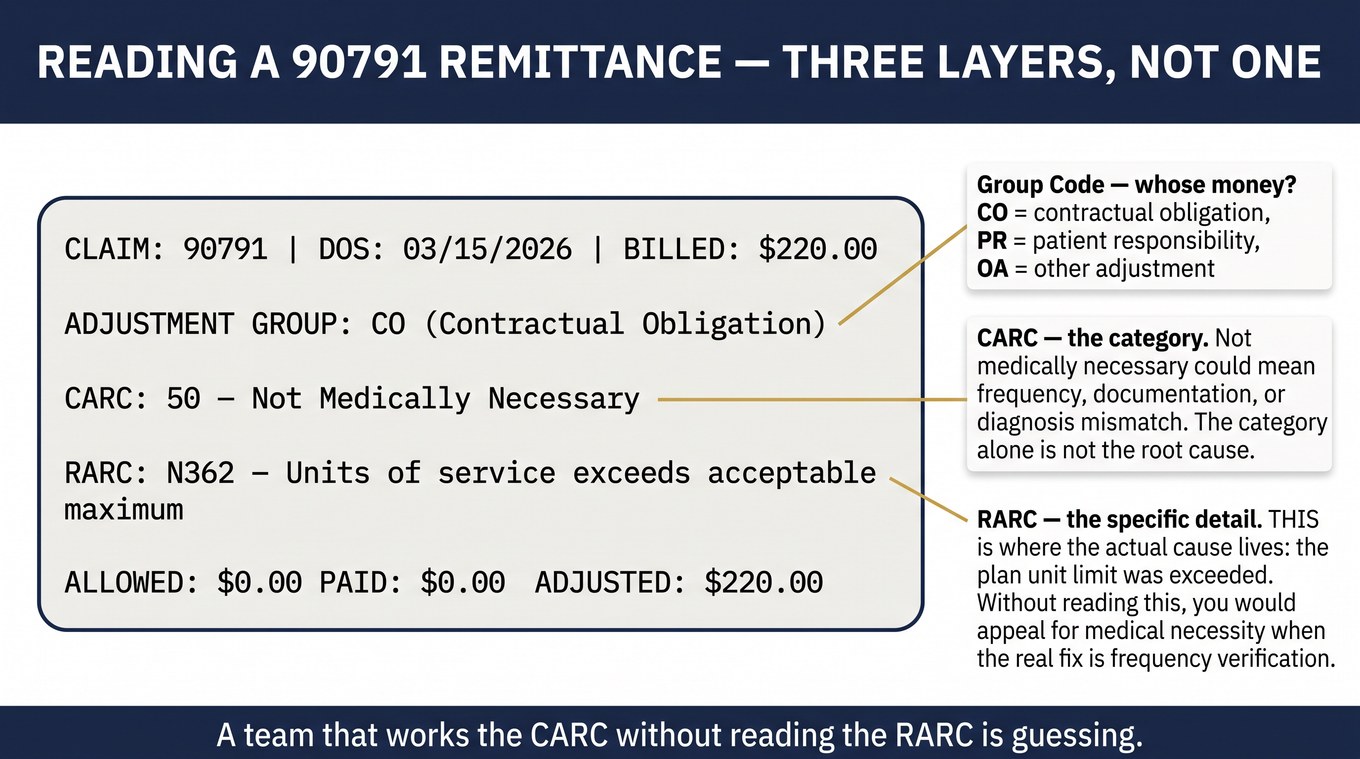
What the reason codes on these claims usually mean underneath:
| Remittance code | Common causes on a 90791 claim | Check first | Best next action |
|---|---|---|---|
| CARC 4 - procedure inconsistent with modifier | Telehealth modifier not recognized by that payer; modifier on the wrong code; 90785 base-code problem; a modifier used to force an edit | Payer modifier table, date of service, product, POS, telehealth modality, NCCI edit | Correct and resubmit if clerical. Appeal only where the modifier and the distinct-service facts genuinely support it |
| CARC 5 - procedure or type of bill inconsistent with place of service | POS 11 used where the payer expected 10 or 02; facility versus professional mismatch; payer-specific telehealth instruction | Locations in the note, claim POS, payer telehealth policy, enrollment location | Correct the POS only if the original was wrong. Never adjust the note to match the claim |
| CARC 8 / 170 / 171 / 185 - provider type, specialty, or rendering eligibility | Clinician not recognized for this code; wrong taxonomy; enrollment or group linkage missing; 90792 outside scope | Rendering NPI, taxonomy, credential, effective date, location, group affiliation, state scope | Fix enrollment or the claim where possible; appeal with enrollment evidence where the payer's data is wrong. Do not rebill under another clinician who did not perform the service |
| CARC 11 - diagnosis inconsistent with procedure | Diagnosis not covered by payer policy; screening or encounter code used where the plan expects disorder or symptom support; wrong diagnosis pointer | Note, ICD-10 code, pointer, payer medical policy, code specificity | Correct a true coding error. Otherwise appeal with medical necessity rationale and policy support |
| CARC 16 - missing information or billing error | Missing NPI, taxonomy, modifier, authorization, diagnosis pointer, required attachment, or invalid data. Requires a RARC | Every RARC and portal message; compare the 837P segments against the payer's companion guide | Repair the exact missing data and resubmit or reopen. Do not guess |
| CARC 18 - exact duplicate | Resubmitted without a corrected-claim indicator; two clinicians or groups submitting the same member, code, and date; clearinghouse retransmission | Original claim number and status, rendering NPI, group NPI, dates, replacement indicator | Void or replace, or file a corrected claim. Appeal only if the second service was genuinely distinct and payable |
| CARC 22 - another payer may be responsible | Behavioral carve-out; primary and secondary order; Medicare or Medicaid crossover; employer plan data mismatch | Eligibility, COB file, behavioral administrator, prior payer EOB | Bill the correct primary or update coordination of benefits, then submit secondary with prior-payer data |
| CARC 29 - timely filing expired | Intake held while credentialing, authorization, or routing was unresolved; a claim rejected but never corrected; the wrong payer billed first | Contract window, original acceptance and rejection reports, clearinghouse proof, eligibility history | Appeal with proof where an exception applies. Otherwise write off per contract and compliance policy rather than improperly balance-billing |
| CARC 45 - exceeds fee schedule or contracted amount | Ordinary contractual adjustment, not necessarily a denial | Allowed amount, charge, contract, provider type, POS | Post the contractual adjustment correctly. Investigate only if the allowed amount is below contract |
| CARC 50 - not medically necessary | Repeat evaluation with no new-episode rationale; a note that reads like routine therapy or screening; diagnosis and policy mismatch; an evaluation that was not completed | Payer medical policy, prior 90791/90792 dates, the complete note, documented change in condition or referral question | Appeal with targeted clinical and policy evidence where supported. Do not send a generic note dump |
| CARC 54 - multiple physicians or assistants not covered | Two clinicians submitting evaluations or overlapping services; a same-group, same-day edit | Rendering NPIs, specialty and group, distinct purposes, payer concurrent-service rule | Correct if duplicative. Appeal only with genuinely distinct services and policy support |
| CARC 96 - non-covered charges | Benefit exclusion; provider or product exclusion; code not covered in that setting; missing RARC detail | RARC, plan document, benefit category, network, telehealth and product restrictions | Determine whether the issue is coverage, coding, or eligibility before assigning patient responsibility |
| CARC 97 - included in another service | Billed with psychotherapy, crisis, E/M, or another bundled service; the payer applied NCCI or a proprietary edit | Same-date lines, NCCI edit, modifier indicator, encounter documentation | Remove or correct the bundled line where policy applies. Appeal only if the payer permits distinct reporting and the facts support it |
| CARC 109 - wrong payer or contractor | Behavioral carve-out or wrong payer ID; member's product administered elsewhere | Card, eligibility response, behavioral administrator, payer ID, claim address | Submit to the correct payer quickly and preserve proof for timely-filing relief |
| CARC 197 - precertification or authorization absent | Plan requires authorization for the first evaluation or after a limit; authorization tied to the wrong provider, code, date, or location | Authorization number, approved code and units, effective dates, rendering NPI, POS | Correct the claim if the authorization was omitted. Seek retroactive authorization only where policy permits |
| CARC 204 - not covered under the current benefit plan | Product excludes the service, provider, or setting; benefits exhausted | Plan benefit, behavioral carve-out, member eligibility, RARC | Verify before transferring liability to the patient, and follow notice and contract rules |
| CARC 210 - authorization not received timely | Retroactive request submitted outside the payer's window | Authorization submission timestamp, emergency or exception policy, portal outage proof | Appeal only with a recognized exception and evidence |
| CARC 222 - exceeds contracted maximum units | Payer or group limit reached; combined code count; a system limit rather than a member-specific clinical cap | Contract, unit history, provider and group counting method, authorization | Establish whether the limit is a provider-contract term or a member benefit, then correct or appeal accordingly |
Every one of those has an underlying cause that belongs to one of ten families, and naming the family is what stops the denial recurring: eligibility and routing; provider eligibility; code selection; frequency; authorization; same-day edits; medical necessity and documentation; telehealth; data quality; and contract or payment terms.
Correct the claim, reopen it, or appeal it?
A rejection usually means the claim never entered adjudication, because required data or format failed. You fix it and resubmit within the filing window. A denial is an adjudicated decision, and it may require a corrected claim, a reopening, a reconsideration, or a formal appeal. Treating a rejection as a denial wastes appeal effort on a claim nobody has decided yet. Treating a denial as a rejection burns the appeal deadline while you resubmit into a wall.
The workflow:
- Determine whether the claim was accepted. Check clearinghouse and payer acknowledgements. An unaccepted claim needs repair and resubmission, not a medical necessity appeal.
- Identify whether the problem is clerical or substantive. A wrong member ID, an omitted authorization number, an incorrect POS, a missing modifier, or a replacement indicator may simply be corrected. Frequency, coverage, provider eligibility, bundling, and medical necessity usually require payer review.
- Preserve the original claim and the evidence. Save the 837P, the acceptance reports, the ERA or EOB, the portal message, the benefit verification, the authorization, the note as signed, and the payer policy that was effective on the date of service. That last item is the one people forget, and it is often the one that wins.
- Use the payer's required channel. Corrected claim, reconsideration, reopening, provider dispute, and appeal are not interchangeable, and filing in the wrong lane can consume the window.
- Track the deadline from the correct trigger. Contractual correction and appeal windows vary considerably.
Medicare draws a specific line here. CMS treats clerical corrections as reopenings rather than appeals; certain claim corrections may be reopened within one year, with broader reopening available further out where good cause applies. A substantive disagreement with the initial determination goes down the appeal route, where the first-level redetermination request is generally due within 120 days of receiving the initial determination (CMS: first level of appeal, redetermination; CMS Transmittal R3203CP). Commercial and Medicaid appeal periods differ, and a provider agreement can impose a much shorter limit than Medicare's.
A strong appeal packet for this code is short and specific:
- a concise cover letter naming the claim, the denial code, and the exact action requested;
- the payer policy effective on the date of service;
- proof of eligibility, network status, enrollment, and authorization where relevant;
- the full signed evaluation note;
- a brief chronology of prior treatment and evaluation dates;
- an explicit explanation of the new episode, status change, new referral question, or distinct provider role;
- code-pair rationale and edit information where bundling is disputed;
- telehealth location and modality evidence where relevant;
- clearinghouse acceptance and timely-filing proof;
- and corrected claim data where a data error also needs repair.
Weak appeals are recognizable at a glance. They resend the same note with no explanation. They argue that the practice has always billed this code this way. They cite a blog instead of the payer's policy. They attach modifier 59 after a denial without establishing a distinct service. They claim the patient was new without addressing prior use or group-level counting. They alter a diagnosis or a note retrospectively without a compliant addendum. Or they miss the deadline entirely while staff repeatedly call customer service.
The part most practices skip
An appeal that gets paid is not the end of the work. It is the start of the only part that reduces next month's denials.
When a claim is overturned, tag the corrected root cause and push it upstream: update the payer matrix, add an EHR or claim-scrubber edit, brief the scheduler or the clinician, correct the enrollment record, add an authorization reminder, revise the note template, update the telehealth defaults, or flag prior 90791 and 90792 history at intake. This is the difference between a billing operation that recovers revenue and one that re-wins the same avoidable denial every quarter.
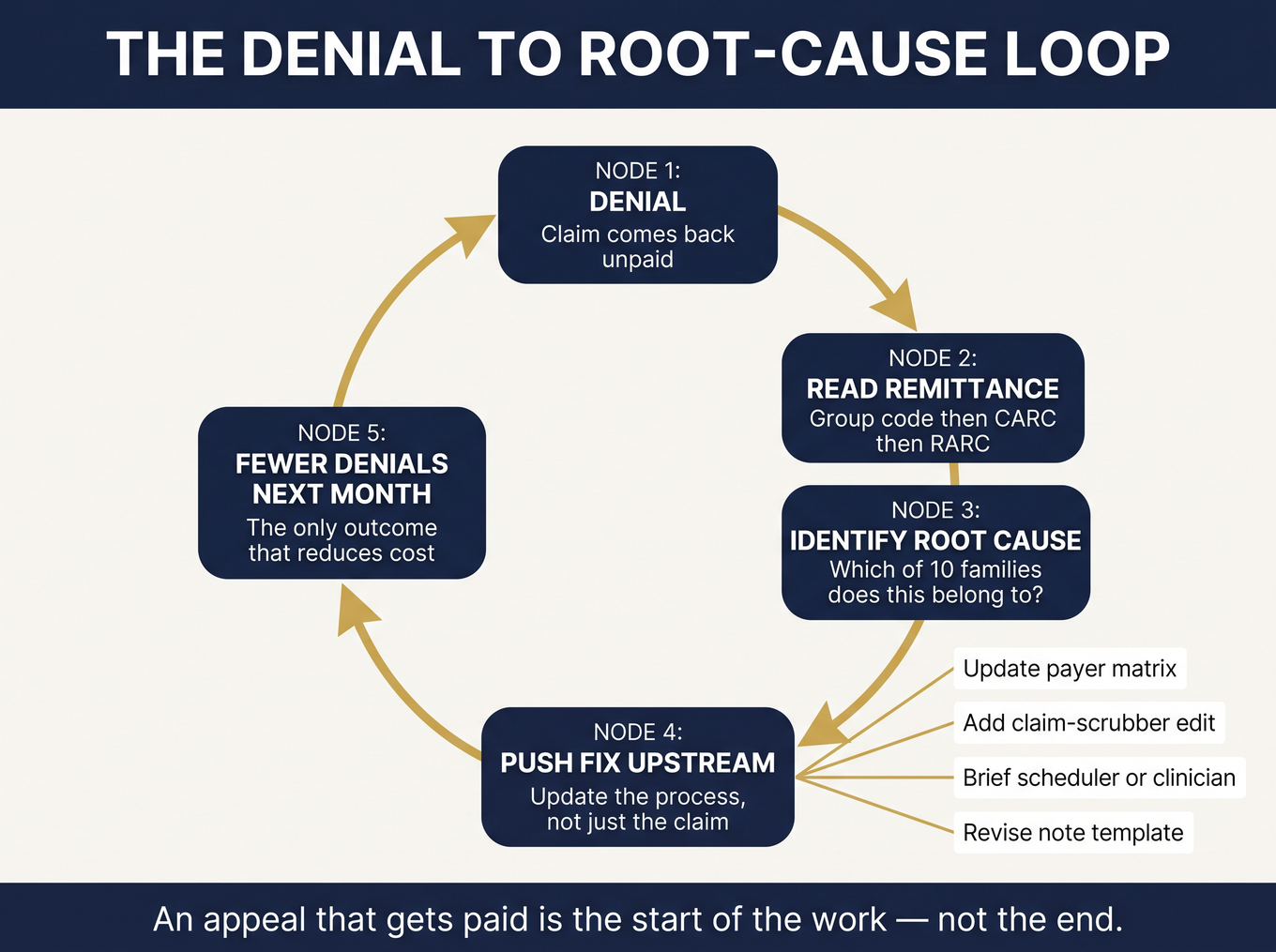
The ten checks before an intake claim goes out
Most professional outpatient claims for this service go out on the electronic 837P, whose paper analogue is the CMS-1500 (NUCC 1500 reference instruction manual, version 13.0). By the time it transmits, every one of the five layers has already been decided, so run these checks before it goes.
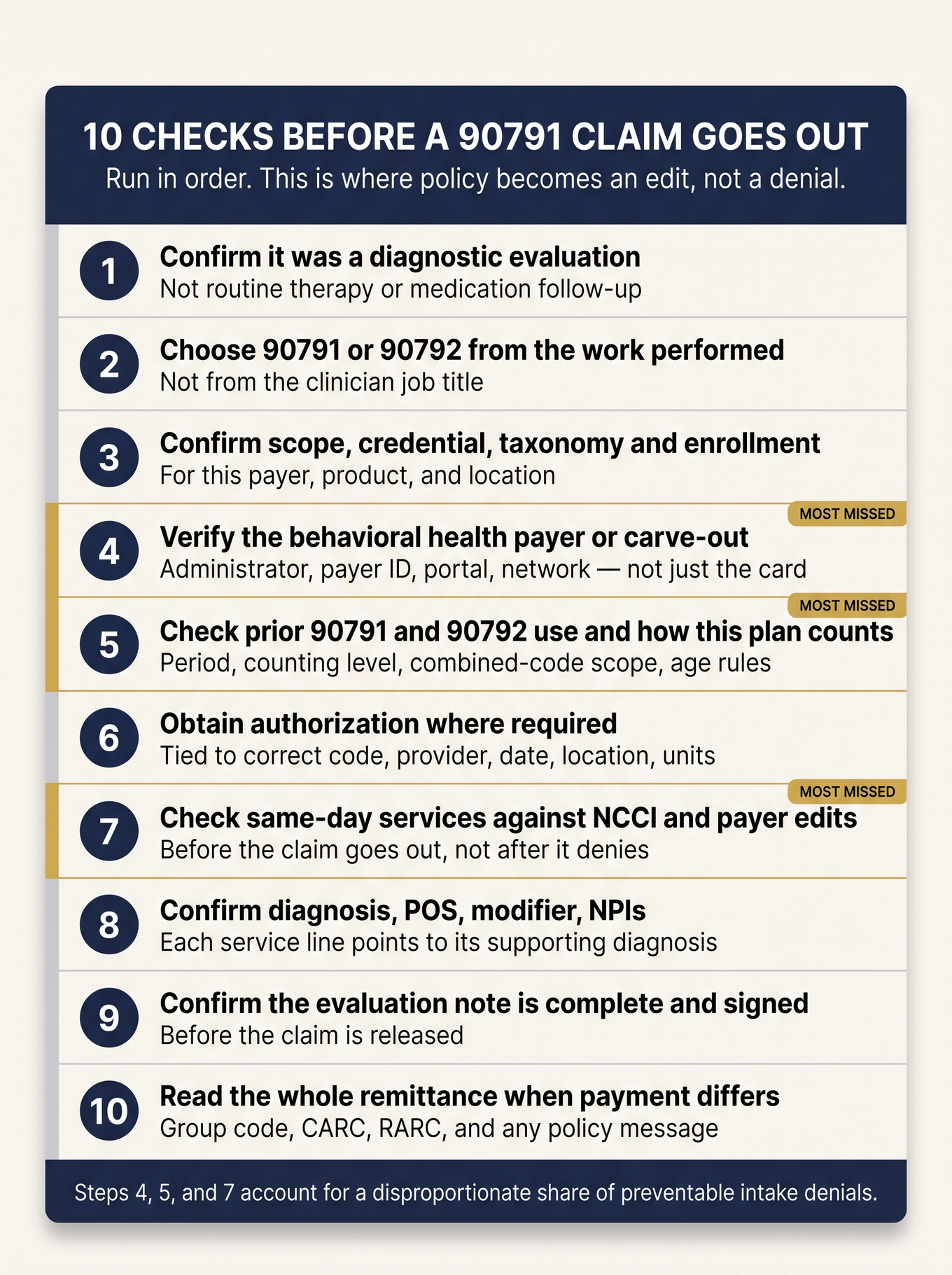
- Confirm the visit was a diagnostic evaluation - not routine therapy, not medication follow-up.
- Choose 90791 or 90792 from the work performed, not from the clinician's job title.
- Confirm clinician scope, credential, taxonomy, and enrollment for this payer, product, and location.
- Verify the behavioral health payer or carve-out and eligibility - the administrator, payer ID, authorization portal, network status, and claim address, not just the card.
- Check prior 90791 and 90792 use, and how this plan counts it - period, counting level, combined-code scope, and age rules.
- Obtain authorization where required, tied to the correct code, provider, date, location, and unit count.
- Check same-day services against the current NCCI and payer edits before the claim goes out, not after it denies.
- Confirm the diagnosis, POS, modifier, rendering NPI, and billing NPI - and that each service line points to the diagnosis that supports it.
- Confirm the evaluation note is complete and signed before the claim is released.
- Read the whole remittance when payment differs from expectation - group code, CARC, RARC, and any policy message.
Steps 4, 5, and 7 are the three that most in-house workflows do not own, and they account for a disproportionate share of preventable intake denials.
Build a payer matrix, one row per product
This is unmanageable as institutional memory and manageable as a document. Build a payer matrix with one row per payer product, not one row per insurance company - because a carrier's PPO, its HMO, its Medicaid MCO, its Medicare Advantage plan, and an employer carve-out can each answer these questions differently.
Each row should carry:
- the payer and the behavioral health administrator;
- the product;
- network and contract status with rendering credentials and effective dates;
- accepted provider types for 90791;
- accepted provider types for 90792;
- the frequency count, period, combined-code rule, and any age rule;
- the counting level;
- the plan's new-episode definition;
- prior authorization rules including the exception route;
- same-day edits;
- 90785 coverage and documentation requirements;
- telehealth POS, modifier, audio-only and relationship requirements;
- diagnosis policy;
- timely filing windows for initial, corrected, and appealed claims;
- the contracted allowed amount by POS and provider type;
- the source, with policy URL, version, and effective date;
- and the date last verified, by whom, with the call or portal reference.
A rule without a verification date is a rumor with a table cell.
When to handle 90791 billing in-house, and when not to
A small practice can bill 90791 well in-house. A solo clinician with three or four well-understood commercial contracts, a current payer matrix, a clean note template, and someone who owns denials with real time to do it does not need an outsourced revenue cycle team. In-house management is reasonable when you have low or moderate claim volume, a small and stable payer mix, one or two credential types, a trained biller with protected time, reliable eligibility and authorization workflows, current payer manuals and contract access, working claim-scrubber edits, clear denial ownership with deadlines and appeal skill, and a monthly review of payment, denial, and underpayment trends.
That picture usually changes for one of four reasons: the practice is growing, with new clinicians, new locations, or a new state; the payer or service mix has got more complex; nobody has the time the billing side needs; or collections have slipped and nobody can say why. None of those is about size. We work with practices of every size, from a single clinician to a multi-state group, and we take on a single piece of the cycle as readily as the whole of it.
The workload stops being containable at fairly predictable thresholds. Co-management or outsourcing starts to make sense when the practice has:
- multi-state telehealth;
- a mixed Medicare, Medicaid MCO, and commercial book;
- therapist plus prescriber or fully multidisciplinary intakes;
- multiple tax IDs, locations, or provider types;
- frequent behavioral carve-outs;
- repeated frequency, authorization, taxonomy, or bundling denials;
- unexplained variation in allowed amounts or suspected underpayments;
- staffing turnover in the billing function;
- aged denials approaching filing or appeal limits;
- nobody who actually owns payer-policy updates;
- or leadership that cannot see denial root causes broken out by payer, code, and provider.
Every rule on this page is knowable. The question is not whether your team can learn them. It is whether anyone in your practice owns the job of noticing when Medicare's telehealth dates move, when a Medicaid MCO changes its counting level, or when three intake denials in a quarter share a single upstream cause. That role is usually unassigned.
Where a specialist team legitimately earns its fee is narrow and concrete:
- building and maintaining the payer and product matrix;
- checking prior use and authorization at intake;
- mapping provider credentials and taxonomy to allowable codes;
- configuring claim edits for same-day combinations and frequency;
- checking telehealth POS and modifier rules per payer;
- auditing notes for missing billing support without touching clinical judgment;
- routing claims to the correct behavioral health administrator;
- reading CARC and RARC combinations and correcting the actual root cause;
- protecting timely filing;
- appealing supportable frequency, medical necessity, enrollment, and underpayment decisions;
- and reporting repeat causes back to clinicians and intake staff so they stop recurring.
That is the honest version of what gets taken off your plate. It does not require a promise that outsourcing lifts collections by any particular percentage, and you should be wary of anyone who offers you one.
The code was never the hard part
Five digits are easy. What makes a first behavioral health visit hard to get paid is that it requires clinical documentation, clinician credentials, payer utilization rules, authorization, same-day edits, telehealth instructions, claim data, and remittance follow-up to all be correct and current at the same moment - for a specific member, on a specific product, under a specific contract, on one specific date. Miss any one of them and a correctly performed, correctly coded evaluation still does not pay.
If you take one action from this page, make it this one: pull your last ten 90791 and 90792 claims and run them against the five layers. Was the code chosen from the documented work or from the clinician's title? Was prior use checked, and at what counting level? Was anything else billed on those dates? Did the telehealth claims carry the right POS and modifier for that specific payer? And for anything that denied, does anyone know which of the ten root-cause families it belonged to? That exercise costs an afternoon, requires nothing from us, and usually finds a pattern.
The practices that stay clean on intake claims are not the ones with the best coders. They are the ones that decided verification happens before the appointment, and that a denial is information about a process rather than an unlucky outcome. The code is not the hard part. Keeping eight moving parts synchronized is the hard part.
If you want a second set of eyes on where your intake claims are actually leaking, that is the kind of review we do: your payer matrix, your intake and verification workflow, your denial root causes by payer and code, and your aged A/R. No revenue promises, just a look at where the layers are unguarded.
Frequently asked questions about 90791 billing
Is 90791 only for new patients?
No. It is most often used at the outset of care, but a repeat evaluation can be medically necessary for a new episode of care, an admission or readmission, a major change in status, a new referral question, a second opinion, or diagnostic clarification. Whether it will be paid is a separate question governed by the plan's utilization rule, which is why prior use should be checked before the visit.
How many times a year can 90791 be billed?
There is no universal answer. One Medicare contractor allows up to three combined 90791/90792 evaluations per year and applies that limit at group-NPI level. Texas Medicaid allows one per person per rolling year for the same provider, regardless of how many professionals participated. One commercial plan publishes a three-unit annual ceiling. You have to ask your specific plan how it counts.
Does 90791 require 60 minutes?
No. 90791 is not a time-based code - there is no CPT minimum and no maximum. Several ranking pages state a 16-minute minimum or a 90-minute cap and attribute it to CMS; no primary source supports that. Some payers do still ask you to record session length in the note, which is a documentation requirement rather than a code-selection rule.
Can 90791 and 90837 be billed on the same day?
Under the 2026 Medicare NCCI rules, no. Because psychotherapy includes continuing psychiatric evaluation, 90791 and 90792 are not separately reportable with individual, group, family, crisis, or other psychotherapy on the same date. Commercial payers may adopt NCCI, modify it, or apply their own policy, so verify - but do not plan on splitting a first visit into an intake plus a therapy session. For how the psychotherapy time bands themselves work, see our guide to billing 90837.
Can a psychiatrist bill 90791?
Yes, where payer policy permits. Provider title does not select the code - the documented work does. A psychiatrist who performs a diagnostic evaluation without a medical assessment, medication decision, ordered or reviewed studies, or other documented medical work has performed the service 90791 describes. Defaulting every prescriber intake to 90792 by template is a common and auditable habit.
Can an LCSW, LPC, LMFT, or psychologist bill 90791?
Generally yes, subject to state scope, payer recognition, and enrollment. Medicare has recognized qualifying marriage and family therapists and mental health counselors as independent billing practitioners since January 1, 2024, paid at 75% of the clinical psychologist amount. Medicaid programs publish their own provider mappings, and a credential accepted by one plan can be excluded by another member's product.
What is the difference between 90791 and 90792?
Both describe the same psychiatric diagnostic evaluation: history, mental status examination, diagnostic formulation, and a plan. 90792 additionally includes a documented medical service component - medical assessment, examination elements, medication decisions with rationale, ordering or interpreting studies, or comparable medical work within the clinician's scope. The distinction is what happened and was documented, not who was in the room.
Can 90785 be billed with 90791?
Sometimes, when a genuine interactive complexity factor is present and documented. Presence alone does not qualify it - a parent attending or an interpreter being in the room is not, by itself, interactive complexity. The note has to identify the specific communication complication, explain how it complicated delivery of the service, and describe what the clinician did differently. It is an add-on code and is never billed alone.
Can two providers bill 90791 and 90792 for the same patient?
There is no universal yes or no. Clinically the two evaluations can be genuinely distinct. On the claim, payers may count by member and date, by specialty, by group NPI, by facility, on combined units, or explicitly regardless of how many professionals were involved - so different NPIs guarantee nothing. Get plan-specific confirmation before the visit, and if only one evaluation will pay, design the workflow around one billable evaluation.
What place of service and modifier apply to telehealth?
For Medicare, POS 10 is telehealth in the patient's home and POS 02 is telehealth elsewhere, with POS 10 paid at the nonfacility rate, and modifier 93 identifies audio-only where the conditions are met. That is not universal: Texas Medicaid instructs modifier 95 for synchronous audiovisual behavioral health services and FQ for audio-only. Check the specific payer, and recheck the federal telehealth dates, which are statutory and have shifted before.
What diagnosis do you use when the evaluation isn't conclusive?
Code to the highest degree of certainty the record supports. The ICD-10-CM guidelines prohibit coding probable, suspected, questionable, or rule-out diagnoses in the outpatient setting, so where the disorder is not yet established you select the most accurate supported symptom, condition, or encounter code the payer permits and document the diagnostic uncertainty. Do not select a diagnosis because it is more likely to pay.
What does Medicare pay for 90791 in 2026?
It depends on locality, facility status, QP status, and practitioner category, so there is no single figure. Published 2026 summaries put the national nonfacility estimate at roughly $173 for 90791 and $202 for 90792, but those are secondary estimates. Pull the actual amount from the CMS Physician Fee Schedule lookup or the current national payment amount file for your code, locality, and setting - and remember that MFTs, MHCs, and clinical social workers are paid at 75% of the clinical psychologist amount, and NPs, CNSs, and PAs under an 85% framework.
Why did the claim deny as a duplicate?
Usually one of three things: the claim was resubmitted as an original instead of a corrected or replacement claim; two clinicians or two groups submitted the same member, code, and date; or the clearinghouse retransmitted it. Check the original claim's number and status before resubmitting anything. If the second service was genuinely distinct and payable, that is an appeal - but a true duplicate is a correction, not a dispute.