Physical Therapy Billing Services: What They Include, What to Pay, and How to Choose the Right Partner
November 27, 2026 · 13 min read
Physical therapy billing services manage the full revenue cycle for PT clinics: insurance eligibility verification, CPT coding, claim submission, denial appeals, and patient collections. The specialization matters because PT billing carries unique complexity that most general billing teams handle poorly, including time-based units, the eight-minute rule, Medicare therapy thresholds, GP and KX modifiers, and payer-by-payer prior authorization workflows that differ by plan, diagnosis, and procedure type.
If your clean claim rate is slipping below 95%, your days in A/R are creeping past 35, or denied claims are aging out without follow-up, this guide explains what a good PT billing service actually covers, what you should be paying, and what benchmarks to hold your billing partner to.
Why PT Billing Is Harder Than General Medical Billing
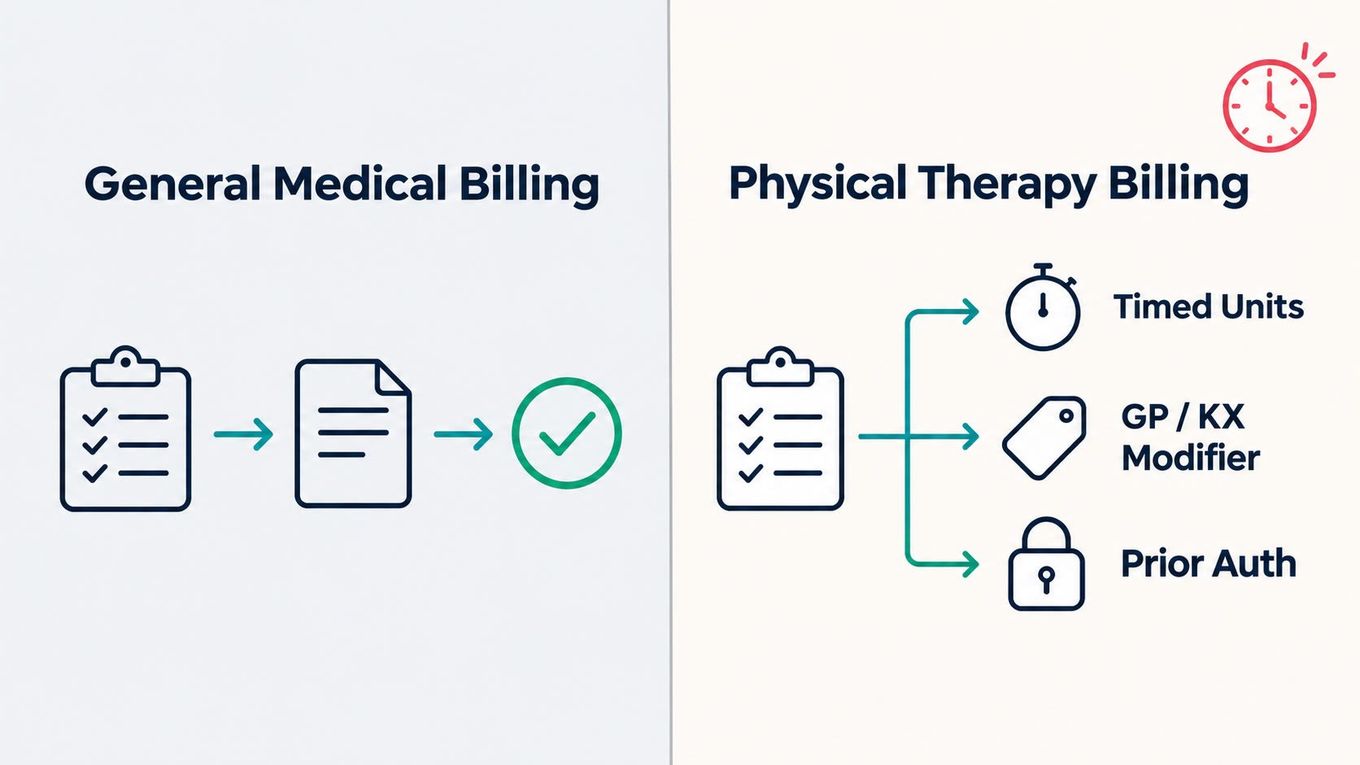
Most medical billing is relatively straightforward: a provider renders a service, a coder assigns a CPT code, the claim goes out. Physical therapy doesn't work that way.
PT services are billed by timed units, not by encounter. The number of units billed for a 97110 (therapeutic exercise) or 97140 (manual therapy) depends on the total minutes of skilled hands-on time, and the accuracy of that calculation depends on the eight-minute rule, which trips up in-house billers and generalist billing teams regularly.
Medicare adds its own layer. PT claims to Medicare require all three of the following:
- The GP modifier on every line item, indicating services delivered under a physical therapy plan of care
- The KX modifier once therapy services approach Medicare's annual financial limitation threshold ($2,480 for PT and SLP combined in 2026, per CMS), attesting that treatment remains medically necessary
- A signed plan of care from the referring or treating provider, certified at least every 90 days
Miss any of these and the claim either rejects on submission or denies on audit weeks later. And unlike a simple coding error, modifier omissions often aren't caught until the EOB comes back, by which point the timely filing window may be closing.
Commercial payers pile on further. A clinic seeing a mix of Aetna, Cigna/Evernorth, UnitedHealthcare, and Medicare patients is simultaneously managing:
- Different prior auth thresholds by plan and procedure
- Varying visit limits by diagnosis
- Payer-specific documentation requirements for medical necessity
- Separate auth tracking workflows for each payer
This is why PT-specific billing services exist. And it's why handing PT revenue cycle work to a generalist billing team is a consistent, invisible revenue leak.
What Physical Therapy Billing Services Actually Include
Before comparing vendors, get clear on what's standard, what gets billed as an add-on, and what should be non-negotiable.
| Service | Standard inclusion | Often an add-on | Red flag if missing |
|---|---|---|---|
| Eligibility and benefits verification | Yes | Yes | |
| Prior authorization management | Sometimes | Often | Watch carefully |
| CPT coding (timed and service-based) | Yes | Yes | |
| Claim submission and tracking | Yes | Yes | |
| Denial management and appeals | Yes | Sometimes limited | Yes |
| Payment posting | Yes | Yes | |
| Patient statements and collections | Yes | ||
| A/R follow-up on aging claims | Yes | Often limited | Watch carefully |
| Coding audits and compliance review | Rarely | Often | Useful add-on |
| Credentialing and payer enrollment | Rarely | Often | Useful add-on |
| Monthly performance reporting | Yes | Yes |
Three things to press any prospective billing partner on
1. Prior authorization scope
- Does their fee include prior auth submission and tracking, or does that bounce back to your front desk?
- Aetna and Cigna/Evernorth require authorization for many commercial plans after the initial evaluation
- Failed or expired auths are one of the leading causes of write-offs in PT; clarify this before signing anything
2. Denial appeal depth
- Do they actually write and submit appeals, or just flag denials and hand them back to you?
- Appealing a medical necessity denial requires clinical documentation review and payer-specific language
- If the billing service waits for your instructions after a denial, you're doing half the work yourself
3. A/R follow-up cadence
- Ask exactly what triggers follow-up at 30, 60, and 90 days unpaid
- Who contacts the payer? What's the escalation process? How is it documented?
- Vague answers here almost always signal a service that lets aging A/R sit untouched
The PT Denial Problem, Explained
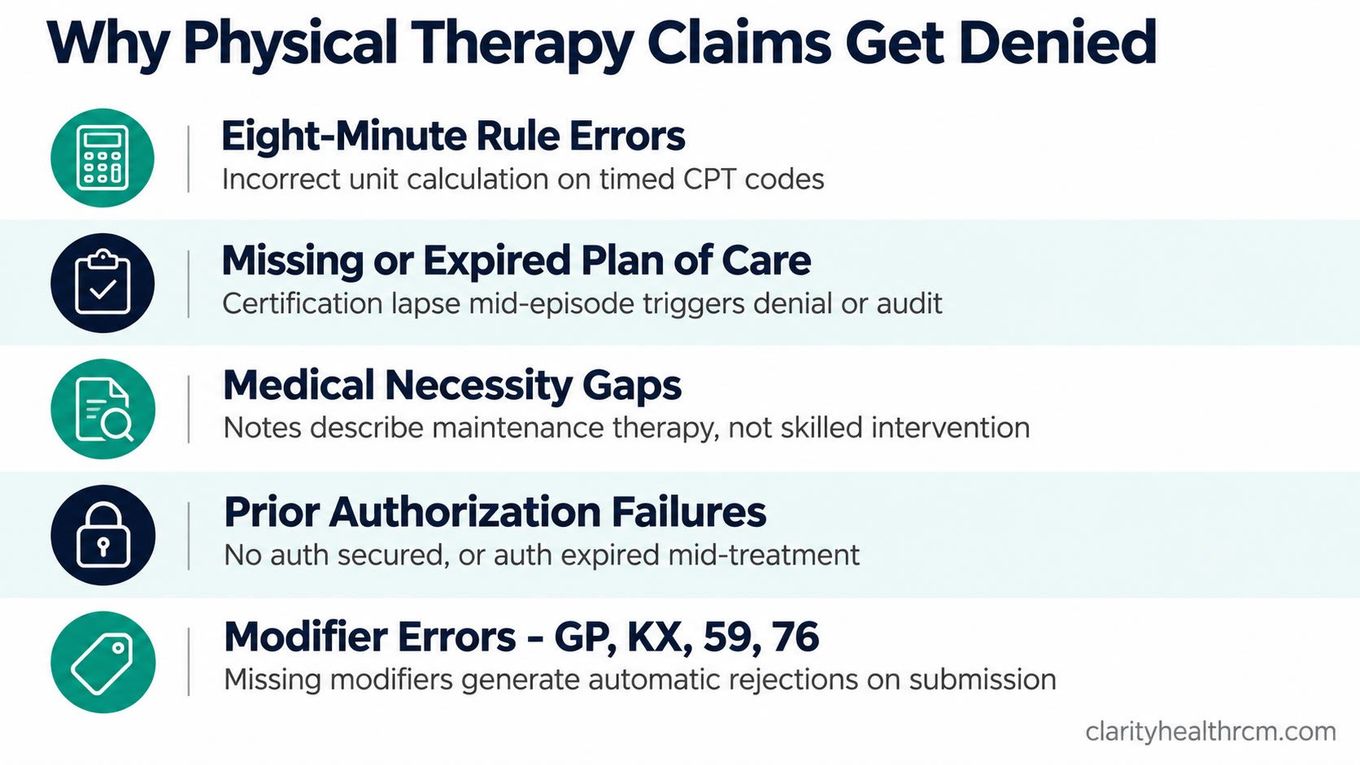
PT practices face some of the most specific and avoidable denial patterns in outpatient billing. Here's where revenue typically leaks and why.
Eight-Minute Rule Errors
For time-based CPT codes, including 97110, 97140, 97530, 97116, and others, billing one unit requires at least 8 minutes of skilled time for that service. With multiple timed codes in a single session, total billable units depend on cumulative minutes across all timed procedures and a specific calculation method, not simple division.
What goes wrong:
- Billers divide total session time by 15 instead of applying the correct formula
- Units are overcounted (audit risk) or undercounted (direct revenue loss)
- The error happens on every session, not occasionally
This is the single most common PT billing error and entirely preventable with a biller trained specifically in PT coding.
Missing or Expired Plan of Care
Medicare and most commercial payers require an active, signed plan of care from the referring or treating provider. If the certification period expires and billing continues without recertification:
- Every claim submitted in that window is at risk
- Claims may be denied upfront or recovered on a post-payment audit
- It's one of the most common PT compliance findings, not a rare edge case
Medical Necessity Documentation
Medicare requires that PT treatment involves a skilled service and that the patient's condition warrants skilled intervention. Claims get denied when:
- Documentation describes maintenance therapy rather than skilled PT
- Notes don't clearly establish why a physical therapist's skills are required
- OIG audit targets in this area have increased in recent years
Prior Authorization Failures
If a patient's plan requires prior auth and your front desk didn't secure it, or the auth ran out mid-episode:
- Every claim after that point is at risk
- Many payers will not issue retroactive authorization
- The result is a pure write-off, not a recoverable denial
Modifier Errors
Getting modifiers wrong generates rejections that require manual rework, and rework is where unbilled clinician time disappears:
| Modifier | When it's required |
|---|---|
| GP | All Medicare PT claims; indicates services under a PT plan of care |
| KX | Once therapy approaches the annual Medicare financial threshold |
| 59 | Distinct procedural services billed on the same date |
| 76 | Repeated procedures by the same provider on the same date |
For a deeper look at denial patterns and what systematic follow-up looks like, see our guide to denial management.
How to Evaluate a PT Billing Service: What Actually Matters
Most vendor comparison guides tell you to look for "experience and transparency." That's not useful when you're sitting across from a sales call. Here's what to actually ask.
Specialty depth
- Do they bill primarily for PT and rehab, or are they a generalist shop that takes on PT clients?
- Ask for their current PT client roster size and average client tenure
- Ask what percentage of their total billing volume is PT-specific
- High client churn is a signal worth taking seriously; ask directly
Medicare fluency
- Ask them to walk you through how they handle the KX modifier threshold
- Ask what their process is when a patient's therapy approaches the annual limit
- If they can't answer fluently and specifically, they don't specialize in PT; full stop
Prior authorization process
The answer should cover all of the following specifically:
- What system they use to track auth status
- How they flag auths approaching expiration
- Who is responsible when an auth lapses
- How they handle payers like Aetna and Cigna that require auth after the initial eval
Generic reassurances ("we handle all auths") are not an answer. For more on what prior authorization management should look like in a fully outsourced RCM relationship, see prior authorization services.
Reporting standards
The minimum you should receive monthly:
- Denial reason report broken down by payer and code
- A/R aging report (30/60/90/120+ day buckets)
- Collections summary with net collection rate
Also ask: do you have real-time access to claim status, or do you have to email to find out what's happening?
Contract terms to scrutinize
Before signing, get clear answers on:
- A/R on cancellation: Do outstanding claims get followed through, or abandoned?
- Data ownership: Can you access your claim history, ERA files, and patient billing records at any time?
- Setup fees: Are they disclosed upfront, and what do they cover?
- Exit terms: What notice period is required? What's the offboarding process?
Before you sign anything, our guide on questions to ask before hiring a medical billing company has a full checklist worth running through.
KPI Benchmarks: What Good PT Billing Performance Looks Like
If you're currently using a billing service, here's how to evaluate whether it's actually performing.
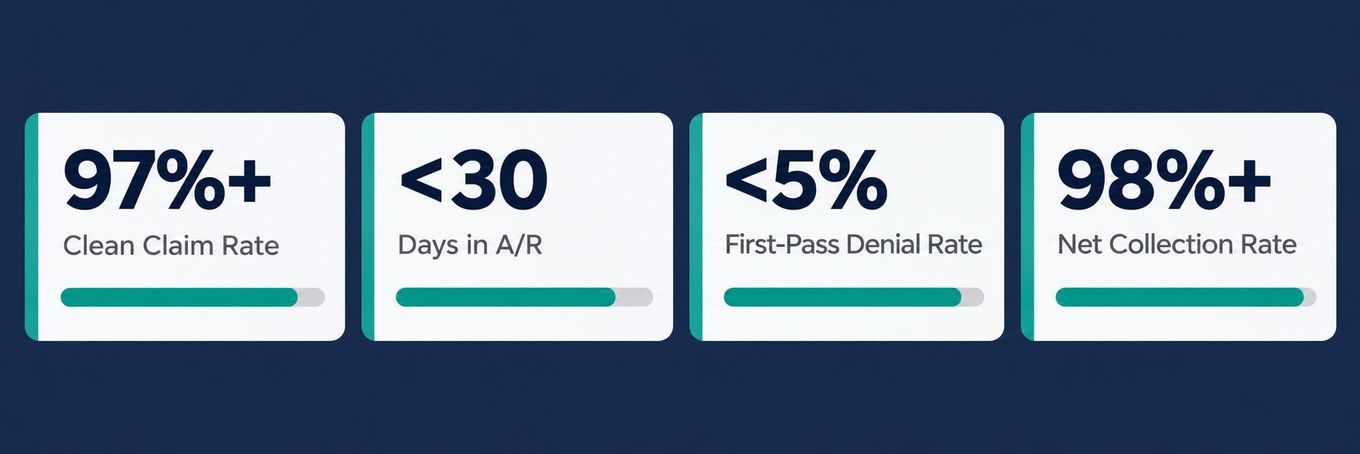
| KPI | Strong | Acceptable | Investigate |
|---|---|---|---|
| Clean claim rate | 97%+ | 94–96% | Below 94% |
| Days in A/R | Under 30 | 30–40 | Over 40 |
| Denial rate (first-pass) | Under 5% | 5–10% | Over 10% |
| Denial resolution rate | Over 90% | 75–90% | Under 75% |
| Net collection rate | Over 98% | 95–98% | Under 95% |
| A/R over 90 days (% of total) | Under 10% | 10–15% | Over 15% |
If your billing partner can't give you these numbers on request, that's the first problem to solve. You can't hold anyone to a standard you're not measuring.
Two numbers to watch most closely:
- Denial resolution rate: this tells you whether denied claims are actually being worked, not just flagged
- A/R over 90 days: a growing percentage here is almost always a sign of inadequate follow-up
For a fuller breakdown of which billing KPIs to track and how to read them, see KPI metrics for medical billing.
In-House vs. Outsourced PT Billing: A Decision Framework

| Factor | Favors in-house | Favors outsourced |
|---|---|---|
| Monthly collections | Above $150K with stable volume | Below $150K or growing |
| Billing staff | Dedicated, PT-trained biller on staff | Front desk or cross-trained staff doing billing |
| Denial rate | Consistently under 7% | Above 7% or rising |
| Practice growth | Single location, stable | Adding providers or locations |
| Credentialing needs | In-house capacity | Need payer enrollment support |
| A/R aging | Under control | A/R over 90 days is growing |
The economics, plainly:
- A dedicated in-house biller costs roughly $45,000–$65,000/year in salary and benefits, plus software, training, and coverage during turnover
- An outsourced billing service at 6% of collections becomes more expensive than in-house once you're collecting above roughly $900,000–$1,000,000 annually
- That math assumes the in-house biller performs at an equivalent level, and that assumption is the one that most often breaks in practice
- At lower collection volumes, outsourcing almost always wins on cost
- At higher volumes, the question becomes performance: a 2% improvement in net collection rate on a million-dollar practice is $20,000 per year
For a full breakdown of this decision, see our in-house vs. outsourced medical billing guide.
Why Trust This Article
Clarity Health RCM is built on the foundation of Quality Medical Billing, established in 1988. Our leadership brings more than 40 years of combined revenue cycle experience across outpatient and inpatient physician billing, behavioral health, and specialty practices. The specifics in this article, from modifier requirements and denial patterns to vendor evaluation criteria and KPI benchmarks, reflect what we see working and failing in real billing engagements, not generic industry generalizations.
How Clarity Approaches Physical Therapy Billing
PT billing isn't something a generalist billing team figures out on the fly. The specifics, including the eight-minute rule, modifier requirements, Medicare plan-of-care certification, and payer-specific prior auth workflows, require operational depth that most general RCM vendors don't have.

Our team handles the full PT revenue cycle:
- Eligibility and benefits verification before each episode of care
- Prior authorization management and renewal tracking
- CPT coding and timed-unit calculations (97110, 97140, 97530, and the full PT code set)
- Claim submission, tracking, and payment posting
- Denial management, appeal writing, and resubmission
- Ongoing A/R follow-up with monthly performance reporting
We provide monthly reporting against the KPI benchmarks above so you're never guessing how your revenue cycle is performing.
If your clinic is managing prior auth backlogs, watching denials age without follow-up, or running billing through staff who weren't trained for time-based coding, contact our team to talk through what this looks like for your practice.
Frequently Asked Questions
What do physical therapy billing services typically cost?
Most PT billing services charge between 4% and 9% of monthly collections. At the lower end (4–5%), you're typically getting claim submission and payment posting only. Mid-range rates (6–7%) usually include denial management and A/R follow-up. Higher rates (7–9%) typically add prior authorization support, coding review, and full A/R management. Avoid vendors who quote a flat percentage without specifying exactly what's included; the price difference between a 5% and 7% rate is irrelevant if the 5% option leaves you managing all prior auths and denial appeals yourself.
What CPT codes are used in physical therapy billing?
PT CPT codes fall into two categories: timed therapeutic procedure codes (billed in units based on minutes) and service-based codes (billed per session). The main timed codes are 97110 (therapeutic exercise), 97140 (manual therapy), 97530 (therapeutic activities), and 97116 (gait training). Service-based codes include 97161–97163 (PT evaluations, billed by complexity level), 97164 (re-evaluation), and 97012 (mechanical traction). Billing for timed codes requires accurate unit calculations based on the eight-minute rule, which is a common source of error for billers without PT-specific training.
Why do physical therapy claims get denied so often?
The most common PT denial triggers are eight-minute rule calculation errors on timed codes, missing or expired plan of care certifications, medical necessity documentation gaps (especially for Medicare), missing GP or KX modifiers on Medicare claims, and prior authorization failures on commercial plans. Most of these are preventable with a biller who understands PT-specific requirements. If you're seeing a denial rate above 10%, a billing audit is usually worth doing before anything else.
What is the KX modifier and when is it required?
The KX modifier is added to Medicare PT claims when a beneficiary's services exceed Medicare's annual financial limitation threshold ($2,480 for PT and SLP combined in 2026, per CMS). By appending the KX modifier, the provider attests that continued treatment is medically necessary and that the medical record supports that determination. Billing past the threshold without the KX modifier results in automatic denial. This is one of the first things to confirm when evaluating a billing service's Medicare competency.
How do I know if my current billing service is underperforming?
Track four metrics monthly: clean claim rate (should be 95% or above), days in A/R (should be under 35), first-pass denial rate (should be under 10%), and net collection rate (should be 96% or above). If your billing service can't provide these on request, that's the first problem to solve. Persistent A/R aging above 90 days and denied claims with no documented follow-up are the two clearest signs that a billing relationship needs to change.
Can a PT clinic bill Medicare without a physician-signed plan of care?
No. Medicare requires a certified plan of care signed by the referring or treating physician, recertified at least every 90 days. Billing without a valid, signed plan of care is a compliance violation, grounds for claim denial, and subject to recovery on a post-payment audit. This is one of the most consistently cited issues in OIG audit findings for outpatient therapy providers.
When should a PT clinic switch billing companies?
Consider switching if your clean claim rate has been below 94% for two or more quarters, your A/R aging over 90 days is growing rather than shrinking, denied claims aren't being followed up within 30 days, you're receiving no meaningful monthly reporting, or your billing team can't tell you your top denial reasons by payer. Switching billing companies has a transition cost, but staying with an underperforming partner has a larger ongoing cost. Our guide on how to switch medical billing companies covers how to manage the handoff without losing A/R.