Medical Billing Audit Services: What Gets Reviewed, What It Costs, and When to Hire One
November 27, 2026 · 12 min read
Most practices that need a billing audit don't know it yet. The revenue is draining quietly: through undercoded E/M visits, missed charge capture, underpaid payer contracts, and denials nobody appealed. A medical billing audit service finds those leaks with a structured, claim-by-claim review of your entire revenue cycle, from patient registration through final payment posting.
Internal vs. External Billing Audit: Quick Reference
| Factor | Internal Audit | External Audit Service |
|---|---|---|
| Cost | Staff time only | Varies by scope (see cost section below) |
| Independence | Low; staff normalize patterns over time | High; fresh eyes, no institutional blind spots |
| Depth | Limited to staff expertise | Certified coders and RCM analysts |
| Best frequency | Ongoing monthly spot checks | Quarterly, annual, or triggered by a problem |
| Catches well | Day-to-day submission errors | Systemic revenue leaks, underpayments, unbundling |
| Misses | Normalized errors, payer contract drift | Nothing; that's the point |
What Is a Medical Billing Audit Service?
A medical billing audit service is an external, structured review of your revenue cycle conducted by certified coders and RCM analysts. They pull a sample of claims (random, targeted, or both), compare each one against the clinical documentation behind it, and assess whether what was billed matches what was delivered, documented, and allowed under your payer contracts.
The output is a written report: where your billing is accurate, where it isn't, what it's costing you, and what to fix first.
This is not a payer-initiated audit. It's something you commission proactively, before a payer or a Recovery Audit Contractor finds the problems on their terms.
Billing Audit vs. Coding Audit: They Are Not the Same Thing
This distinction matters, and most content in this space blurs it.
A coding audit focuses on one question: do the CPT, ICD-10, and HCPCS codes on each claim accurately reflect the clinical documentation? Right level of service, right diagnosis, right modifiers. It's valuable, but it's one pillar of a larger structure.
A medical billing audit covers the full revenue cycle. Coding accuracy is part of it, but so is:
- Registration and eligibility data at the front end
- Prior authorization compliance
- Charge capture completeness
- Claim submission timing and integrity
- Payer contract adherence and underpayment recovery
- AR aging patterns and denial root causes
If you've had a coding audit and consider that box checked, you may still have systematic underpayments, missed charges, and AR problems that only a full billing audit will surface. The two serve different purposes; they're not interchangeable.
For more on coding-specific reviews, see our Medical Coding Audit guide.
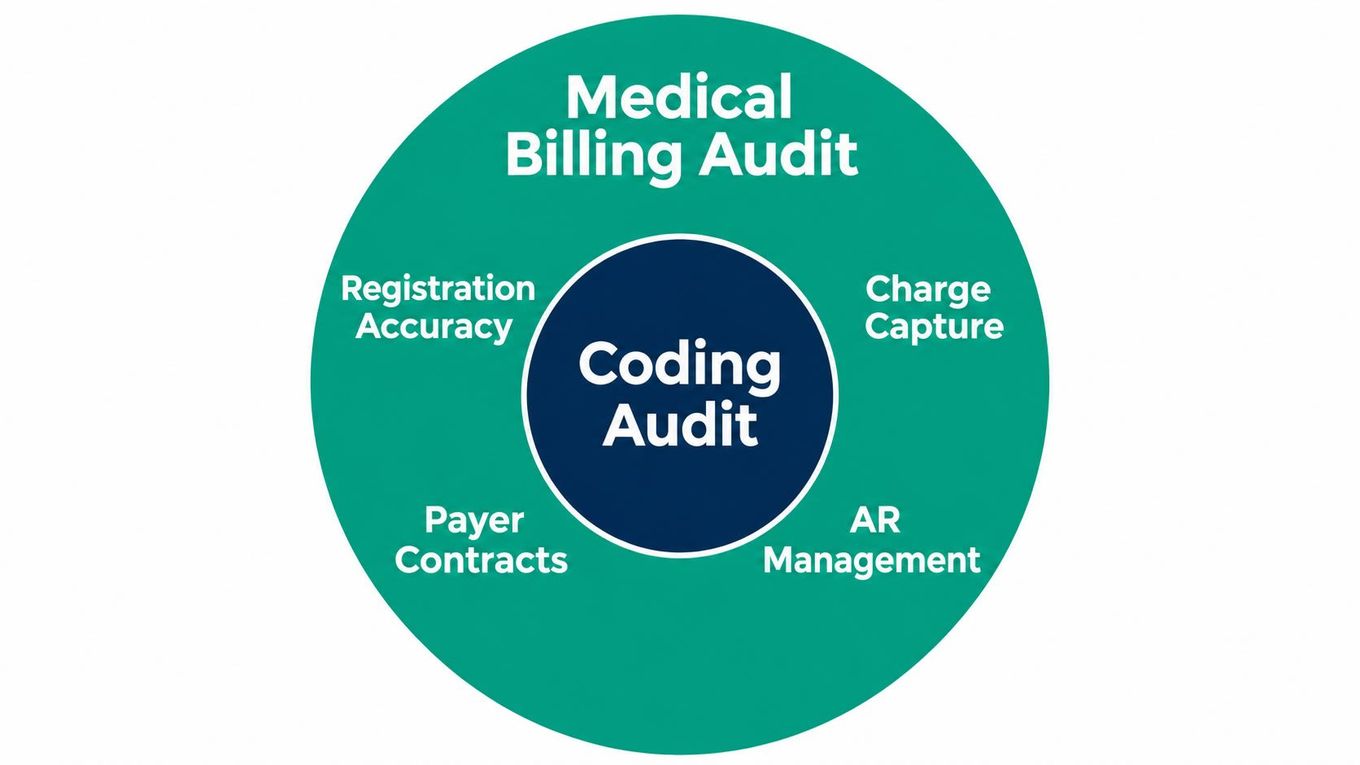
Medical billing audit covers coding accuracy as one component — not the whole picture.
What a Billing Audit Actually Reviews
Here's what a thorough audit covers, working in the same direction a claim moves through your revenue cycle.
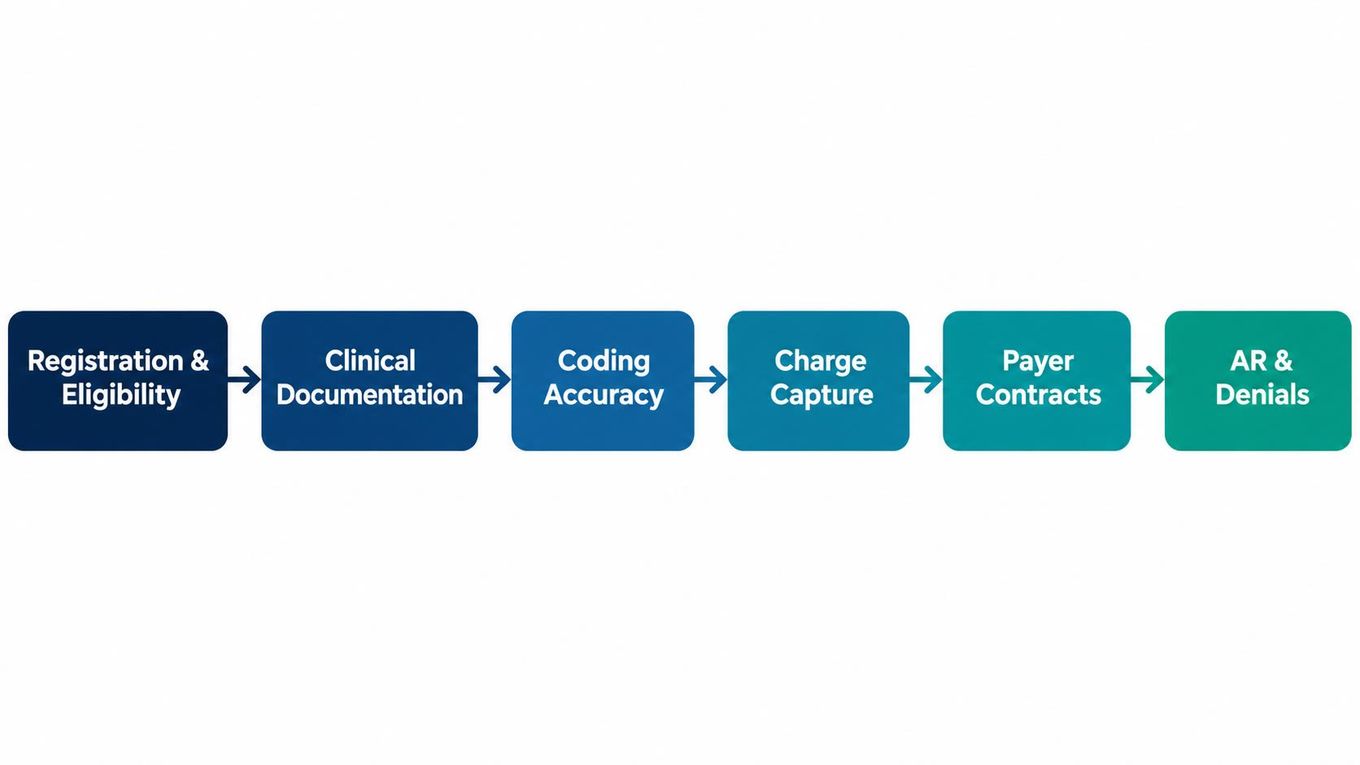
A complete billing audit follows the full claim lifecycle — from front-end registration through final payment and denial resolution.
Patient Registration and Eligibility
Wrong demographic data and lapsed insurance coverage are claim-killers that often don't get traced back to the front end where they originated. An audit checks whether:
- Patient name, date of birth, and insurance ID match across the medical record and the submitted claim
- Eligibility was verified before the encounter, not after the denial
- Coordination of benefits is documented when secondary coverage exists
- Authorization requirements were confirmed before service, not assumed
One missed eligibility check on a high-cost procedure is a denial. A pattern of missed checks is an AR problem that compounds every month.
Clinical Documentation and Medical Necessity
The clinical note justifies the bill. If the note doesn't support the level of service or the medical necessity for the codes billed, every claim it backs is at risk: either underpaid (if your providers are being conservative) or a compliance exposure (if billing above what the documentation supports).
Auditors check whether:
- E/M codes (99213–99215 and above) are supported by documented complexity of medical decision-making or time
- Medical necessity is stated explicitly, not implied
- Procedure notes include required elements for the specific CPT code billed
- Modifier usage is documented and consistent
Coding Accuracy (CPT, ICD-10, HCPCS)
This is where the coding audit lives within the broader billing audit. Auditors compare every billed code to the clinical documentation and flag:
- Upcoding or downcoding on E/M services
- Unbundling: billing separate codes for services that should be billed together under one bundled code
- Missing secondary diagnosis codes that affect reimbursement
- Modifier misuse: Modifier 25, Modifier 59, and Modifier 95 are frequent problem areas
- Behavioral health-specific issues: session length documentation for CPT 90837 vs. 90834, and intake assessment coding under CPT 90791 vs. 90792
For practices billing behavioral health services, coding errors compound fast because session-volume is high and payer rules vary significantly by carrier and by whether behavioral health benefits are carved out.
Charge Capture and Claim Submission
Charges that never make it onto a claim are revenue that simply doesn't exist. An audit reviews whether:
- All services rendered are captured in the charge entry process
- Ancillary services (labs, injections, procedures performed during the same visit) are consistently billed
- Charge lag (the gap between service date and claim submission) is within acceptable ranges
- Claims are being submitted within each payer's timely filing window
Missed charges are especially common in inpatient settings and in practices where providers document and billing staff enter charges separately, with no reconciliation step between them.
Payer Contracts and Underpayment Recovery
This is where most billing audits leave money on the table, because they simply don't go here.
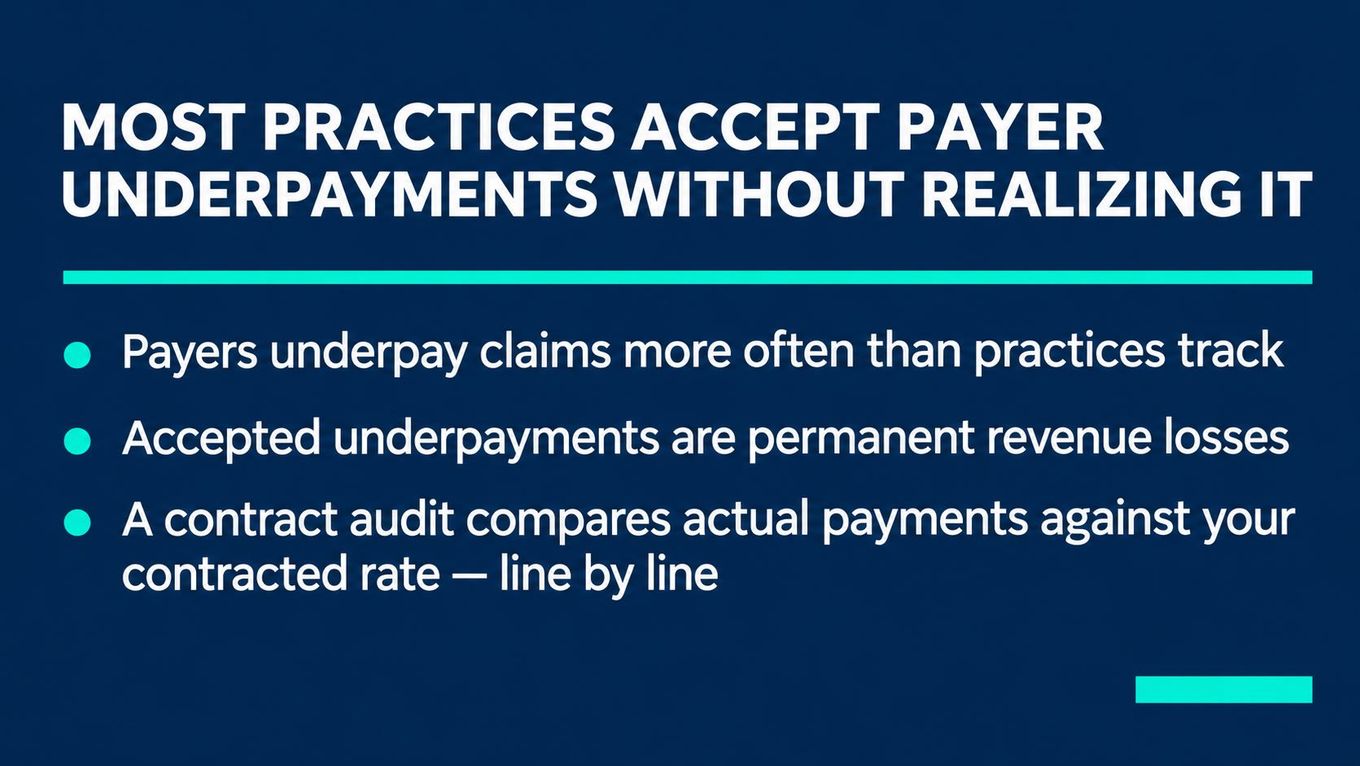
A payer contract audit checks whether the reimbursement you're actually receiving matches what your contract says you should receive. Payers underpay claims more often than practices realize. Without a systematic review, those underpayments get accepted as final, and the revenue is gone.
The review should include:
- Comparing contracted fee schedules against actual ERA payments, line by line
- Flagging claims where payment is below contracted rate
- Identifying which payers have the highest underpayment frequency
- Confirming which underpayments are still within your timely appeal window
For practices managing high claim volumes across multiple payers, underpayment recovery from a single audit cycle can exceed the cost of the audit several times over.
See our Accounts Receivable Management Services guide for how underpayment recovery fits into broader AR strategy.
AR Aging and Denial Patterns
A billing audit isn't just about individual claims. It's about patterns across claims. The AR aging report and denial data tell you whether your revenue cycle has systemic problems, not just one-off errors.
Auditors review:
- AR aging buckets: what percentage of receivables is 90-plus days old, and what's driving it
- Denial rate by payer, by CPT code, and by denial reason code
- Whether denials are being appealed or written off without review
- Resubmission rates and outcomes after correction
Our denial management team tracks these patterns on an ongoing basis for practices we serve, but a billing audit is often what surfaces the patterns in the first place.
Types of Medical Billing Audits
| Audit Type | What It Covers | Best For |
|---|---|---|
| Comprehensive | All billing functions, all payers, random claim sample | Baseline; practices never audited externally |
| Targeted / risk-based | Specific provider, payer, or CPT with known problems | Investigating a denial spike or payer dispute |
| Prospective | Reviews claims before submission | Preventing errors in high-risk specialties |
| Retrospective | Reviews claims already submitted and paid | Underpayment recovery; identifying refund liability |
| Payer contract audit | Compares payments received vs. contract rates | Underpayment recovery; contract renegotiation prep |
Most practices benefit from starting with a comprehensive audit to establish a baseline, then running targeted audits wherever the comprehensive review flags problems. Prospective audits work well for high-volume or high-complexity billing environments where the cost of post-submission corrections is high.
When Your Practice Actually Needs an External Audit
Internal staff can spot day-to-day errors. What they usually can't do is identify patterns that have been normalized: billing habits and workflow gaps that have existed long enough that nobody questions them anymore. External billing audit services catch what internal teams have stopped seeing.
Hire an external billing audit service when:
- Your denial rate has increased without a clear explanation
- You've switched billing staff, billing companies, or EHR systems in the past 12–18 months
- You've never had an external audit and your practice has been billing for more than two years
- A payer has requested records or documentation for a claims review
- You're bringing on new providers and want to verify their billing patterns before they scale
- Your AR aging shows growing 90-plus-day receivables without a corresponding volume increase
- You're preparing for a payer contract renegotiation and need clean data to negotiate from
For behavioral health and psychiatry practices, the complexity of payer-specific carve-out rules, prior authorization requirements, and CPT code documentation standards makes external audits especially valuable. See our behavioral health billing services page for the specific compliance landscape in that specialty.
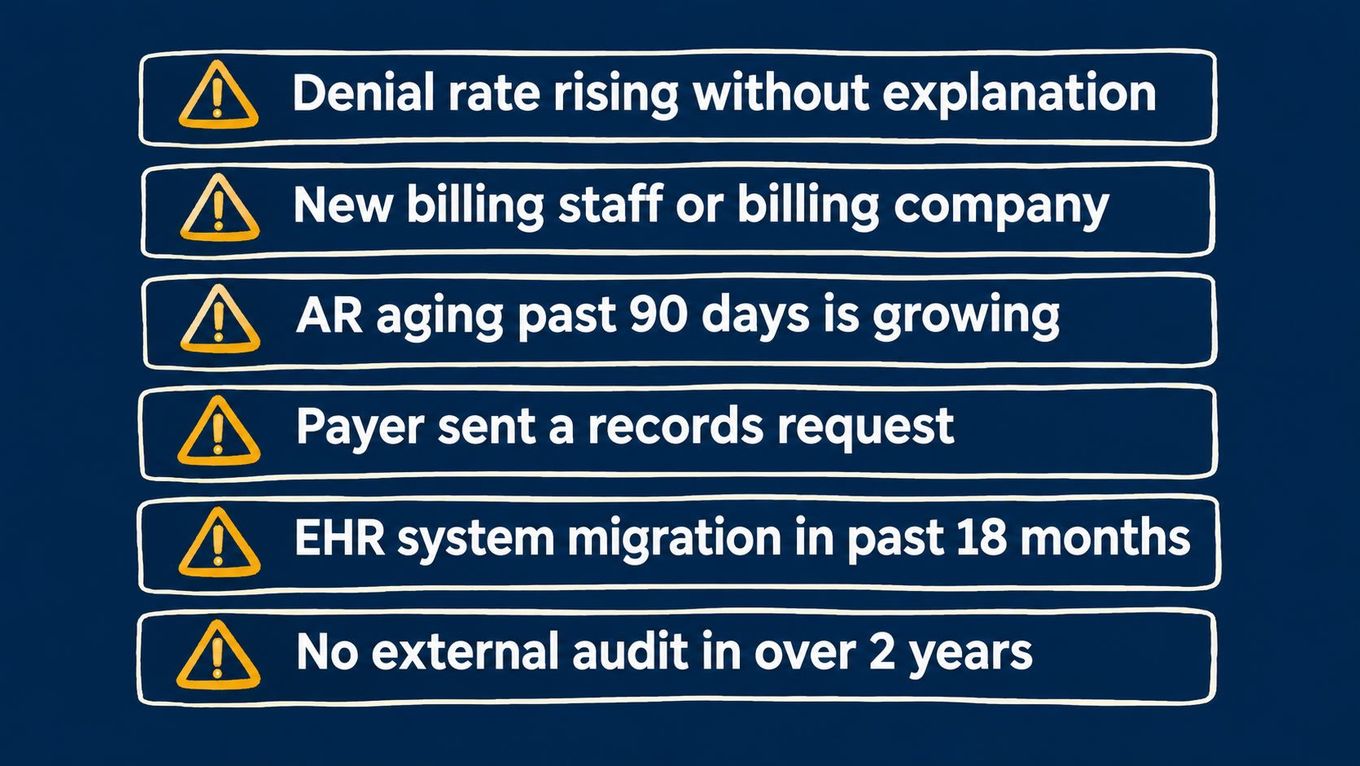
If two or more of these apply to your practice, a billing audit should be on your calendar this quarter.
What a Good Audit Report Delivers
Not all audit reports are created equal. A vague compliance score doesn't help anyone run a revenue cycle. When you hire a billing audit service, the final report should include:
- A claim-level error log with every finding documented by claim, service date, and error type, not aggregated summaries that obscure where the problem actually is
- Error rates by category: coding, documentation, charge capture, submission timing
- Dollar impact estimates where calculable: revenue lost to undercoding, underpayments, or missed charges
- Priority remediation steps ranked by revenue impact or compliance risk, not alphabetically or generically
- Payer-specific findings where your contracts or payer rules are being misapplied
- Staff training recommendations tied to specific error patterns found in your data, not generic billing hygiene tips
If an audit report ends with a summary score and a list of "best practices for billing compliance," you didn't get a billing audit. You got a checklist dressed up as one.
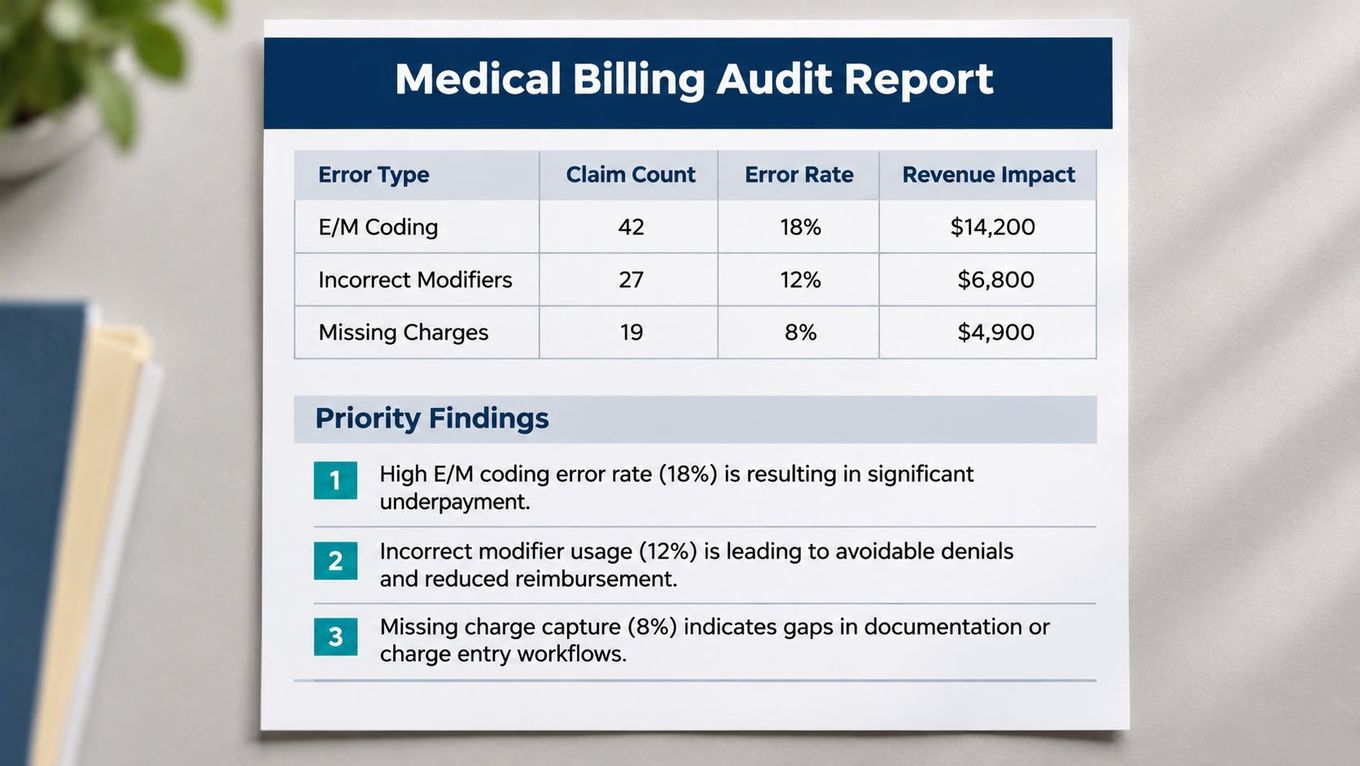
A usable audit report shows claim-level errors, revenue impact, and prioritized remediation — not a summary score.
What Medical Billing Audit Services Cost
Pricing varies by scope, claim volume, and specialty complexity. Rough ranges to benchmark against:
- Targeted audit (single provider, single payer, or single code range): $500–$2,500
- Comprehensive practice audit (all payers, random sample across providers): $2,500–$10,000-plus depending on practice size
- Ongoing audit retainers (quarterly or monthly spot-check reviews): $500–$2,000 per month
For most practices, the cost of a comprehensive audit is offset by what it surfaces: appealed underpayments, corrected claim resubmissions, and reduced denial rates going forward. The compliance protection against payer-initiated audits and Recovery Audit Contractor reviews is a separate category of value that doesn't show up on a simple ROI calculation but matters considerably.
See our medical billing services cost guide for context on how billing audit costs fit into broader RCM spending.
Why Trust This Article
Clarity Health RCM's roots go back to Quality Medical Billing, founded in 1988. Under President and CEO Estelle Sandoval, our team brings more than 40 years of combined revenue cycle experience across behavioral health, psychiatry, inpatient and outpatient physician billing, hospital RCM, and a broad range of medical specialties.
The billing audit guidance here comes from that work directly: identifying charge capture gaps practices didn't know existed, recovering underpayments that had been sitting uncontested for months, and rebuilding billing workflows after audits uncovered the systemic errors behind climbing denial rates.
How Clarity Approaches Medical Billing Audits
Our coding and auditing services go beyond a one-time review. We conduct structured billing audits covering the full revenue cycle, from front-end registration accuracy through AR recovery, with claim-level documentation, priority remediation steps, and the option for ongoing monitoring to prevent errors from resurfacing.
For behavioral health and psychiatry practices, we bring specialty-specific expertise: payer carve-out rules, CPT documentation standards for therapy services, the specific denial patterns that follow from getting those details wrong, and the underpayment patterns that are common with Optum, Cigna/Evernorth, and Aetna behavioral health claims.
If your AR is aging, your denial rate is climbing, or you've simply never had an external review of your billing, a billing audit is the right starting point. Contact our team to scope an audit for your practice.
Frequently Asked Questions
What is a medical billing audit service?
A medical billing audit service is an external, structured review of a practice's revenue cycle, conducted by certified coders and RCM analysts. It covers claim accuracy, coding compliance, clinical documentation support, charge capture completeness, payer contract adherence, and AR patterns. The output is a written report with claim-level findings, estimated dollar impact, and prioritized remediation steps.
How is a billing audit different from a coding audit?
A coding audit focuses specifically on whether CPT, ICD-10, and HCPCS codes are accurate and supported by documentation. A billing audit is broader: it covers the full revenue cycle from registration through payment posting, including charge capture, claim submission timing, payer contract compliance, underpayment recovery, and AR management. A coding audit is one component of a complete billing audit, not a substitute for it.
How often should a practice get a medical billing audit?
Most practices benefit from a comprehensive external audit at least once per year, with targeted audits whenever a specific problem area emerges: a denial spike, a new provider, an EHR migration, or a payer contract change. High-volume practices or those operating in complex payer environments, particularly behavioral health, may benefit from quarterly reviews or an ongoing monitoring retainer.
What triggers a payer-initiated billing audit?
Payers typically initiate audits when they detect statistical outliers: unusually high rates of a specific CPT code, excessive high-level E/M billing, duplicate claim submissions, or high-dollar claims without supporting prior authorization. Recovery Audit Contractors (RACs) audit Medicare claims specifically, targeting improper payments at scale. A proactive external audit is one of the most effective ways to identify and correct those patterns before a payer does.
What should a billing audit report include?
A thorough billing audit report should include a claim-level error log, error rates by category (coding, documentation, charge capture, submission timing), estimated dollar impact, priority remediation steps ranked by revenue or compliance risk, payer-specific findings, and staff training recommendations tied to actual error patterns. A summary compliance score with no claim-level detail is not an actionable audit report.
Can a billing audit recover money already paid out at the wrong amount?
Yes, in two ways. First, a retrospective audit can identify payer underpayments (claims where you were paid less than your contracted rate) that are still within your appeal window. Second, claims submitted with errors that resulted in partial payment or denial can often be corrected and resubmitted within timely filing limits. Recovery potential depends on how recently the claims were processed and each payer's specific appeal and resubmission rules.
Are billing audit services worth it for smaller practices?
Yes, particularly for practices billing to insurance. Even a single-provider practice submitting claims to Medicare, Medicaid, or commercial payers has exposure to underpayments, coding drift, and denial patterns that compound over time. The cost of a targeted audit is typically recovered through identified underpayments and corrected claims within the first billing cycle after remediation, and the compliance protection matters regardless of practice size.