Cardiology Billing Services: Why Your Practice Loses More Revenue Than It Should
November 27, 2026 · 14 min read
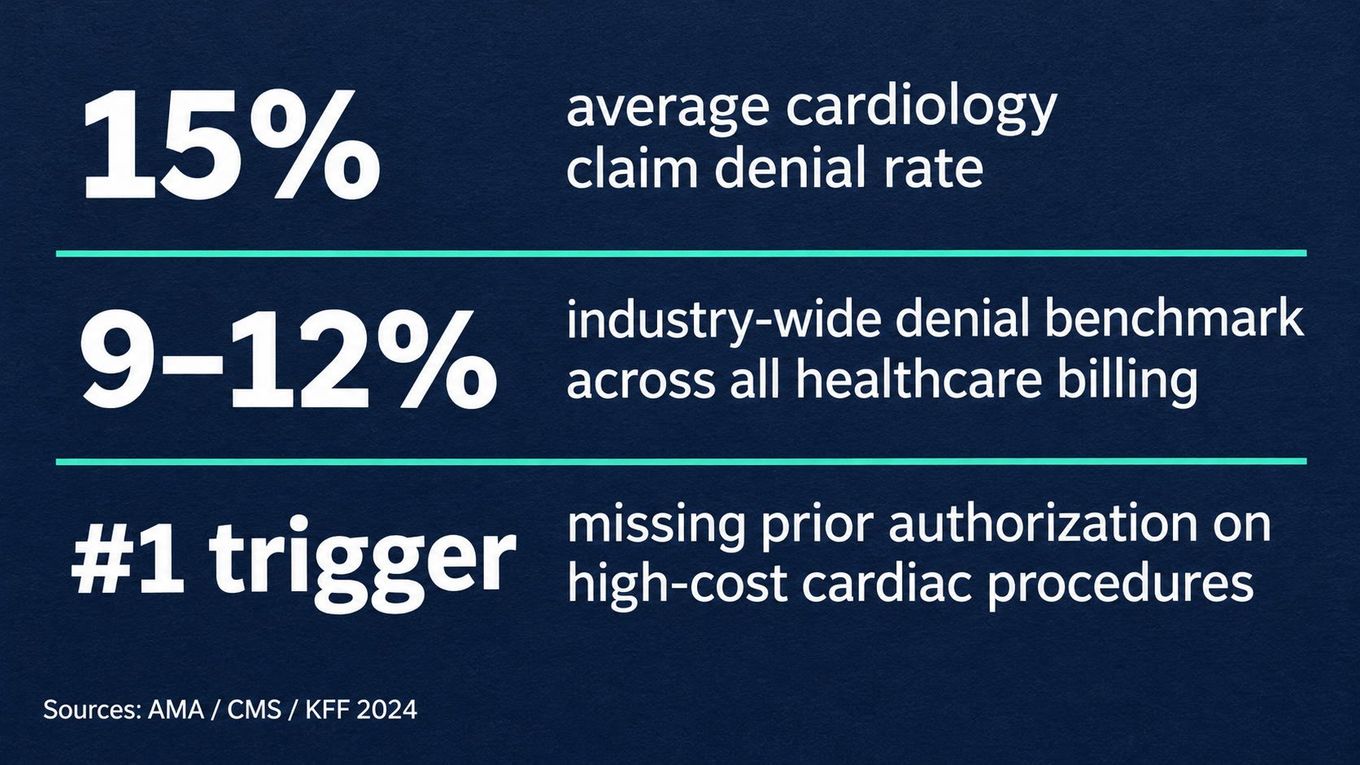
Cardiology practices lose more money to billing errors and denials than almost any other specialty in medicine. Denial rates in cardiology run around 15%, well above the 9% to 12% industry-wide average across healthcare billing. The reason isn't bad luck or lazy payers. It's complexity: component billing splits, prior authorization requirements that change by payer and plan, NCCI bundling edits that swallow interventional codes, and vessel-specific modifiers that most generalist billing teams get wrong.
Specialized cardiology billing services exist precisely because this specialty cannot be handled like internal medicine or family practice. A single modifier error on a cardiac catheterization claim can erase thousands of dollars in a single denial.
The Quick Reference: What Separates a Cardiology Billing Specialist from a Generalist
| Capability | Generalist Billing Company | Cardiology-Specific RCM |
|---|---|---|
| Component billing (26/TC splits) | Often misapplied or skipped | Correctly applied by default |
| Vessel modifiers (LD/LC/RC) | Frequently missed | Built into coding workflow |
| Payer-specific prior auth tracking | Generic auth checklist | Per-payer, per-code auth rules |
| NCCI bundling edits for cath/PCI | Reactive (appeals) | Proactive (scrubbing) |
| 2026 CPT code change awareness | Lagging | Immediate implementation |
| Cardiology denial appeal strategy | Generic appeal letters | Procedure-specific documentation |
If your current billing setup looks more like the left column, you are almost certainly leaving revenue on the table every month.
Why Cardiology Billing Is Genuinely Harder Than Most Specialties
Cardiology sits at the crossroads of three categories that payers scrutinize most heavily: high-cost imaging, complex procedural coding, and expensive interventional work. Each comes with its own layer of rules.

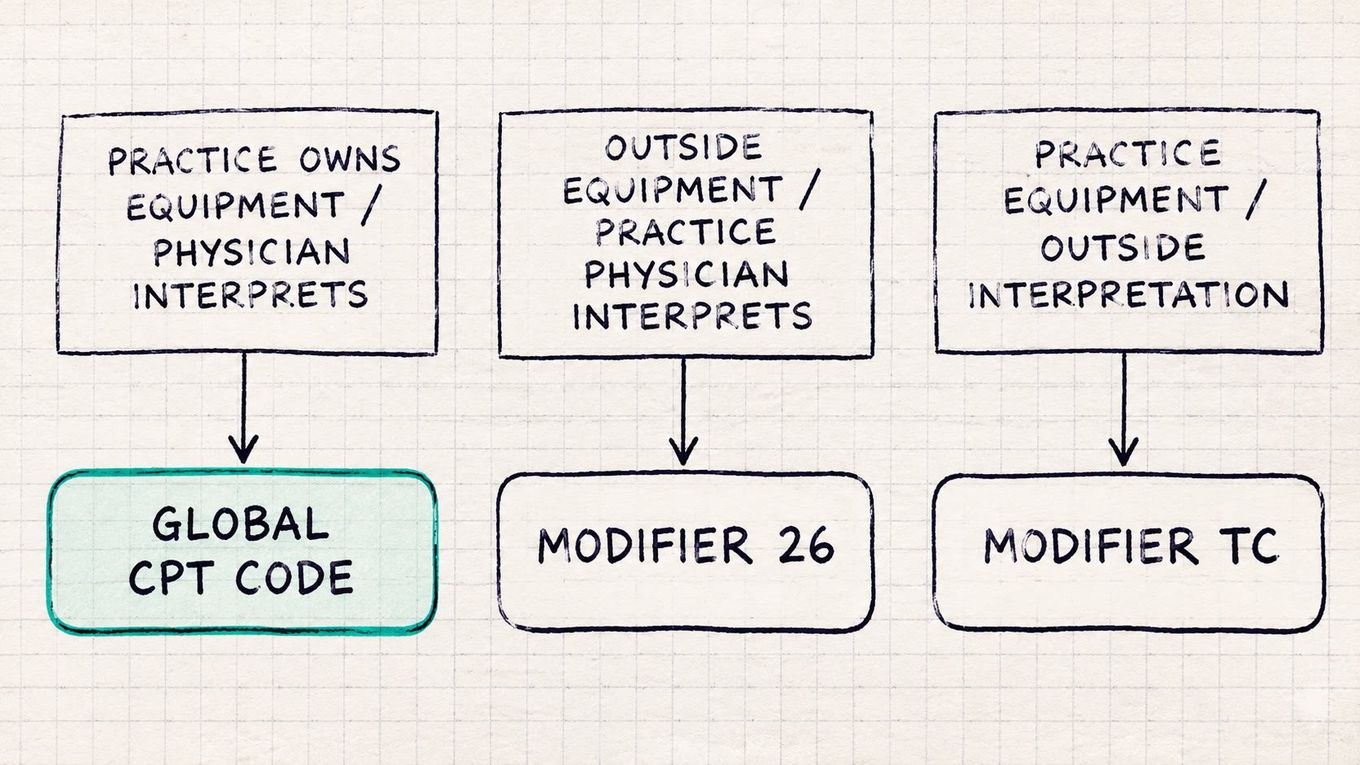
Diagnostic testing volume. A busy cardiology practice bills for EKGs, echocardiograms, stress tests, and Holter monitoring daily. Each service has a global code, a technical component (TC), and a professional component (modifier 26). Which version you bill depends entirely on who owns the equipment and who interprets the study:
- Bill the global code when your practice owns the equipment and your physician both performs and interprets the study
- Bill modifier 26 when a hospital or imaging center owns the equipment but your physician interprets
- Bill modifier TC when your practice owns the equipment but interpretation happens elsewhere
Bill the wrong version and you either underpay yourself or trigger a CO-234 bundling denial.
Interventional complexity. Cardiac catheterization and PCI coding spans CPT codes 93451 to 93461 for diagnostic work and codes like 92928 for stent placement. Getting these right requires:
- Vessel-specific modifiers: LD (left anterior descending), LC (left circumflex), RC (right coronary)
- Correct bundling treatment under NCCI edits for multi-vessel procedures
- Accurate distinction between diagnostic and interventional components when both occur in the same session
Missing those modifiers generates a CO-4 denial from Medicare and most commercial payers.
Prior authorization requirements that shift constantly. Most commercial payers require prior authorization for high-cost cardiac procedures, but the rules vary by payer, plan, region, and year:
- Medicare Advantage plans frequently require authorization that traditional Medicare does not
- Requirements change mid-year without direct notification to providers
- According to KFF analysis of 2024 data, Medicare Advantage plans denied an average of 7.7% of all prior authorization requests, with some plans exceeding 17%. For high-cost cardiac procedures like cardiac catheterization and PCI, prior auth denial risk runs higher than the overall average.
A denied prior auth on a cardiac catheterization or PCI is one of the few cardiology denials that often cannot be appealed retroactively. You needed the authorization before the procedure, not after.
The CPT Codes Where Cardiology Practices Lose the Most Money
The table below covers the highest-volume and highest-risk codes in cardiology billing, the primary denial trigger for each, and what a billing team needs to get right on the first submission.
| CPT Code | Service | Common Denial Trigger |
|---|---|---|
| 93000 | 12-lead EKG, global (tracing + interpretation) | Billed with 93005 on same claim (CO-234 bundling) |
| 93005 | EKG technical component (tracing only) | Billed when practice doesn't own equipment |
| 93010 | EKG interpretation only (modifier 26 equivalent) | Diagnosis mismatch (CO-50 with Z00.00) |
| 93306 | Echocardiogram with Doppler, global | Missing prior auth (UnitedHealthcare, most MA plans) |
| 93015 | Cardiovascular stress test, global | Wrong component code when supervising/interpreting physician differs |
| 93451 | Right heart catheterization | Missing prior auth (MA plans), place-of-service mismatch |
| 93458 | Left heart cath with coronary angiography | Missing prior auth, missing vessel modifier |
| 92928 | PCI with stent placement | Missing prior auth (required by virtually all commercial payers), missing LD/LC/RC modifier |
| 78451 | Myocardial perfusion SPECT, single study | Medical necessity documentation incomplete |
| 78452 | Myocardial perfusion SPECT, multiple studies | Medical necessity documentation incomplete, prior auth missing |
A coding team that doesn't specialize in cardiology will regularly miss the component billing decisions on 93306 and 93015, and will frequently misapply or omit vessel modifiers on PCI claims. Those aren't minor errors. A single missed modifier on a 92928 claim at Medicare reimbursement rates is a meaningful write-off, repeated across dozens of claims per month.
Prior Authorization: The Single Largest Denial Driver in Cardiology
Prior authorization failure is the root cause of more cardiology denials than any other issue. It is also the most preventable, provided your billing team tracks authorization requirements at the payer-plan-code level rather than relying on a static checklist.
Here is how the prior authorization landscape breaks down across major payers for the highest-risk cardiology procedures:
| Procedure | Traditional Medicare | Medicare Advantage | Major Commercial Payers |
|---|---|---|---|
| Echocardiogram (93306) | No prior auth required | Required by most plans | Required by UnitedHealthcare in most markets; varies by plan for Aetna, Cigna |
| Cardiac catheterization (93458) | No prior auth required | Required by most plans | Required by Aetna, Cigna/Evernorth, UnitedHealthcare, Anthem in most markets |
| Nuclear stress test (78451, 78452) | No prior auth required | Required by most plans | Required by most major commercial payers |
| PCI/stent (92928) | No prior auth required | Required by most plans | Required by virtually all commercial payers including Aetna, Cigna, UHC, Anthem |
| Elective device implant | No prior auth required | Required by most plans | Required by most major commercial payers |

The Medicare Advantage problem. Providers who have billed traditional Medicare for years without worrying about prior auth suddenly find themselves denied on the same procedure under a Medicare Advantage plan covering the same patient. If your billing team isn't tracking which of your patients are on MA plans versus traditional Medicare, you are absorbing preventable denials every month.
Key consequences to know:
- A denied prior auth on a cardiac cath or PCI is often unappealable retroactively
- MA plan prior auth rules change annually with plan renewals and can differ significantly from one market to the next
- Catching a missing auth before the procedure protects revenue; catching it after the denial is too late for high-cost procedures
For practices needing help with prior authorization workflows across payers, this is one of the core functions a specialized RCM partner should own end to end.
Component Billing and Modifiers: Where Generalist Teams Consistently Fail
Component billing is one of the most financially impactful decisions in cardiology billing, and one that most generalist billing teams handle inconsistently.
Modifier 26 (professional component) vs. modifier TC (technical component) vs. global billing comes up constantly in echocardiography, stress testing, and EKG billing:
- If the cardiology practice owns the equipment and the physician performs and interprets the study, bill the global code (no modifier)
- If a hospital or imaging center owns the equipment but your physician interprets, bill with modifier 26 only
- If the practice owns the equipment but the interpretation is performed elsewhere, bill with modifier TC only
The financial consequences of getting this wrong:
- Billing global when you should bill modifier 26 only results in an overpayment the payer will recoup
- Billing modifier 26 when you should bill global means the technical component revenue is left uncollected
Vessel modifiers on interventional claims are equally high-stakes. When billing PCI or stenting procedures, Medicare and most commercial payers require the modifier identifying which coronary vessel was treated:
- LD = left anterior descending artery
- LC = left circumflex artery
- RC = right coronary artery
Omitting these modifiers generates a CO-4 denial ("the procedure code is inconsistent with the modifier") and delays payment. A billing partner who doesn't build these modifiers into their cardiology coding workflow as a mandatory checkpoint is not a cardiology billing partner.
What to Actually Look for in a Cardiology Billing Service
Most cardiology billing companies will tell you they specialize in cardiology. Few can demonstrate it at the level of specificity that actually matters. Here is the evaluation framework that cuts through the marketing.
1. Ask how they handle component billing for echo and stress testing.
Walk them through a specific scenario: your practice owns the echo equipment, a cardiologist from a different group reads the study. What do they bill?
- Correct answer: modifier TC on 93306 for the technical work
- Red flag: any hesitation, a vague answer, or "it depends" without immediately explaining on what
2. Ask for their prior authorization tracking methodology by payer.
You want a written process, not a promise. Push on specifics:
- How do they know which codes require auth under each of your contracted payers?
- How is that list updated when payer policies change mid-year?
- How do they flag procedures that are scheduled without confirmed authorization?
3. Ask about their denial rate and first-pass acceptance rate on cardiology claims specifically.
A reputable cardiology billing company should be able to give you numbers:
- Industry benchmark for well-managed cardiology billing: 95%+ first-pass acceptance rate
- If they can't tell you their number, that's the answer
4. Ask how they handled the 2026 CPT code changes.
The 2026 AMA update deleted branch-specific PCI codes (92921, 92925, 92929, 92934, 92938, and 92944) and restructured revascularization coding, with changes effective January 1, 2026:
- A billing team actively managing cardiology accounts should have implemented those changes immediately upon publication
- A team that learns about code changes from their clients is a liability, not a partner
5. Ask about their credentialing support.
Cardiology groups frequently add new physicians: interventional cardiologists, electrophysiologists, imaging specialists. Each needs to be enrolled with every payer before they can generate revenue:
- Credentialing delays of 60 to 120 days are common and entirely expected
- Every claim that physician generates during that window is unbillable
- A billing partner with integrated credentialing and enrollment services can compress that timeline significantly
For a broader breakdown of what separates strong RCM partnerships from weak ones, the in-house vs. outsourced billing comparison covers the decision criteria in detail.
The Financial Case for Specialist Cardiology RCM
The math on outsourcing cardiology billing to a specialist firm is straightforward once you benchmark it against what a generalist setup typically costs in lost revenue.
Scenario: mid-size cardiology group, 500 claims/month
| Metric | Generalist billing (15% denial rate) | Specialist billing (5% denial rate) |
|---|---|---|
| Monthly claim volume | $200,000 | $200,000 |
| Claims denied monthly | $30,000 | $10,000 |
| Recovered via appeals (60%) | $18,000 | $6,000 |
| Written off monthly | $12,000 | $4,000 |
| Annual write-off | $144,000 | $48,000 |
Annual revenue improvement switching to specialist billing: $96,000 on the same claim volume.

Outsourced cardiology RCM is priced at roughly 3% to 9% of collections depending on group size and complexity:
- Larger groups doing higher volume typically negotiate in the 3% to 5% range
- Smaller practices or those with complex payer mixes typically fall in the 5% to 7% range
- At 5% of $200,000 monthly collections, the service fee is $10,000/month: the ROI on recaptured denials alone covers the cost
See what medical billing services cost for a full breakdown of pricing structures and what drives them.
How Clarity Health RCM Handles Cardiology Billing
Our team handles cardiology billing as part of a broader outpatient physician billing practice that includes physician groups across internal medicine, surgery, and specialty care. Cardiology accounts in our portfolio are managed by coders and billers who work cardiology claims every day, not rotated through the specialty on a volume-matching basis.
What that looks like in practice:
- Component billing: Modifier 26/TC decisions on every echo, stress test, and EKG claim, determined by equipment ownership and interpretation documentation
- Modifier management: Vessel modifier application (LD/LC/RC) as a mandatory claim-scrubbing checkpoint on all interventional codes
- Prior authorization tracking: Payer-specific authorization requirements updated when each payer publishes policy changes, not after the first denial comes back
- Denial management: Procedure-specific appeal letters built on documented clinical rationale, not generic templates; see our denial management approach
- AR follow-up: 30-, 60-, and 90-day follow-up cycles with payer-escalation protocols for high-value claims
Clarity Health RCM was founded by President and CEO Estelle Sandoval, who has led billing operations for physician groups and specialty practices since the late 1980s, beginning with Quality Medical Billing and building Clarity to serve specialties that generalist billers consistently underserve. The firm brings over 40 years of combined revenue-cycle experience across its team, with documented results including driving denial rates from 45% down to under 5% for physician groups within a single quarter and recovering more than $5 million on claims prior billers had written off.
If you're evaluating billing partners or considering a switch, the questions to ask before hiring a medical billing company is a useful starting point for structuring the conversation.
Why Trust This Article
Who wrote it:
- Published by Clarity Health RCM, founded by President & CEO Estelle Sandoval, who has led revenue-cycle operations since the late 1980s through Quality Medical Billing and subsequently Clarity
- Our team has worked with cardiology practices and physician groups on billing, credentialing, denial management, and AR recovery across fee-for-service and value-based care models
Research and sourcing:
- CPT code usage, modifier rules, and denial categories drawn from current AMA CPT guidelines and CMS documentation requirements
- Prior authorization data sourced from KFF analysis of 2024 Medicare Advantage prior authorization reporting and published payer coverage policies
- Payer-specific prior auth requirements reflect major commercial payer policies as of 2026; verify against current payer manuals before clinical decisions are based on them
Scope and limitations:
- This content is informational guidance for practice operations, not coding advice or legal advice for any specific claim or clinical situation
- Payer policies shift frequently; the information here should be treated as a starting framework, not a definitive compliance reference
Frequently Asked Questions
What makes cardiology billing more complex than other medical specialties?
Cardiology billing combines high-cost imaging, interventional procedures, and diagnostic testing, each with its own component billing rules, modifier requirements, and prior authorization protocols. Denial rates in cardiology run around 15%, well above the 9% to 12% industry-wide average across healthcare billing. The specialty also has one of the most volatile CPT code sets: the 2026 AMA update made significant changes to PCI and revascularization coding that affected active claim submissions immediately on January 1, 2026.
What CPT codes are most commonly denied in cardiology billing?
The highest-denial-risk codes in cardiology include 93306 (echocardiogram with Doppler), 92928 (PCI with stent), 93458 (left heart catheterization with coronary angiography), and 78451/78452 (nuclear stress testing). The most common denial triggers are missing prior authorization, incorrect or omitted modifiers (vessel modifiers LD/LC/RC for interventional codes, modifier 26/TC for component billing), and medical necessity documentation that doesn't support the diagnosis-code combination submitted.
Does cardiology billing require prior authorization from Medicare?
Traditional Medicare generally does not require prior authorization for most cardiology procedures, including cardiac catheterization and stress testing. Medicare Advantage plans are a different matter: most Medicare Advantage plans do require prior authorization for the same procedures, including cardiac cath, nuclear stress tests, and elective device implants. Patients enrolled in Medicare Advantage are frequently mistaken for traditional Medicare beneficiaries, leading to authorization gaps that result in unappealable denials.
What is component billing in cardiology and why does it matter?
Component billing refers to splitting a service into its professional component (the physician's interpretation, billed with modifier 26) and its technical component (the equipment and staff performing the test, billed with modifier TC). In cardiology, this applies to echocardiograms, stress tests, and EKGs. Whether you bill the global code, modifier 26 only, or modifier TC only depends on who owns the equipment and who performs the interpretation. Billing the wrong version results in either a CO-234 bundling denial or uncollected revenue on one component of the service.
How much do cardiology billing services cost?
Outsourced cardiology billing services are typically priced as a percentage of collections, ranging from 3% to 9% depending on practice size, claim volume, and service scope. Larger cardiology groups with higher monthly claim volume typically negotiate in the 3% to 5% range. Smaller practices or those with more complex payer mixes may fall in the 5% to 7% range. See the full medical billing services cost breakdown for more detail on what drives pricing across different billing models.
How do I evaluate whether a billing company actually specializes in cardiology?
Ask them to walk through the component billing decision for a specific scenario (practice-owned echo equipment, outside physician interpretation). Ask for their prior authorization tracking methodology by payer. Ask for their first-pass acceptance rate on cardiology claims. Ask how they handled the 2026 CPT code changes to PCI and revascularization coding. A company that genuinely specializes in cardiology should answer all of these questions without hesitation and with specifics.
Can I outsource only part of my cardiology billing, such as denials or AR?
Yes. Many cardiology practices outsource specific functions rather than their entire billing operation, particularly denial management and AR follow-up, which are the most resource-intensive parts of the revenue cycle. Partial outsourcing works well for practices that have solid front-end billing staff but lack the bandwidth or expertise to work aged claims and complex denials at the volume cardiology generates. Full-cycle outsourcing makes more sense when the practice is adding providers, expanding locations, or dealing with consistent underpayment that internal staff can't diagnose or fix.