Pain Management Billing Services: What the Specialty Actually Demands
November 25, 2026 · 16 min read
Pain management is one of the most procedure-dense, payer-scrutinized specialties in outpatient billing. A single interventional session can involve a spinal injection, fluoroscopic guidance, an E/M visit, and a drug screening, each with its own coding rules, modifier requirements, and payer-specific coverage criteria. Pain management billing services need to handle that complexity cleanly, every claim, every time. When they don't, the revenue losses compound fast.
TL;DR: What a Pain Management Billing Partner Should Cover
| Area | What You Need | Red Flag |
|---|---|---|
| Procedure coding | Accurate CPT selection by approach, spinal level, and imaging method | Coders who default to "without imaging" codes to avoid bundling issues |
| Modifier accuracy | LT/RT, 50, 25, 59/XS applied correctly to bilateral, staged, and E/M-on-procedure-day claims | Missing modifiers on bilateral injections or multi-site trigger points |
| Prior authorization | Pre-cert for injections, RFA, SCS, and WISeR compliance in applicable states | Generic PA workflows not built around pain-specific coverage criteria |
| Denial management | Root-cause analysis by CPT family and payer, not just resubmission | Appeals that copy-paste the original claim with no additional documentation |
| LCD compliance | Frequency tracking and medical necessity documentation that pre-empts denials | Billing without checking LCD thresholds for the treating region and payer |
| UDT billing | Presumptive and definitive drug testing coded and billed separately per payer rules | Missing revenue from UDT or blanket avoidance of UDT billing |
| Reporting | Denial rate by CPT family, days in A/R, and clean claim rate by procedure type | Generic dashboard with no pain-specific breakdowns |
Why Pain Management Is One of the Hardest Specialties to Bill
Most medical specialties have predictable billing patterns. A primary care practice bills E/M codes. A dermatologist bills excision and destruction codes. The claim volume is relatively uniform, and coders develop repeatable patterns quickly.
Pain management doesn't work that way.
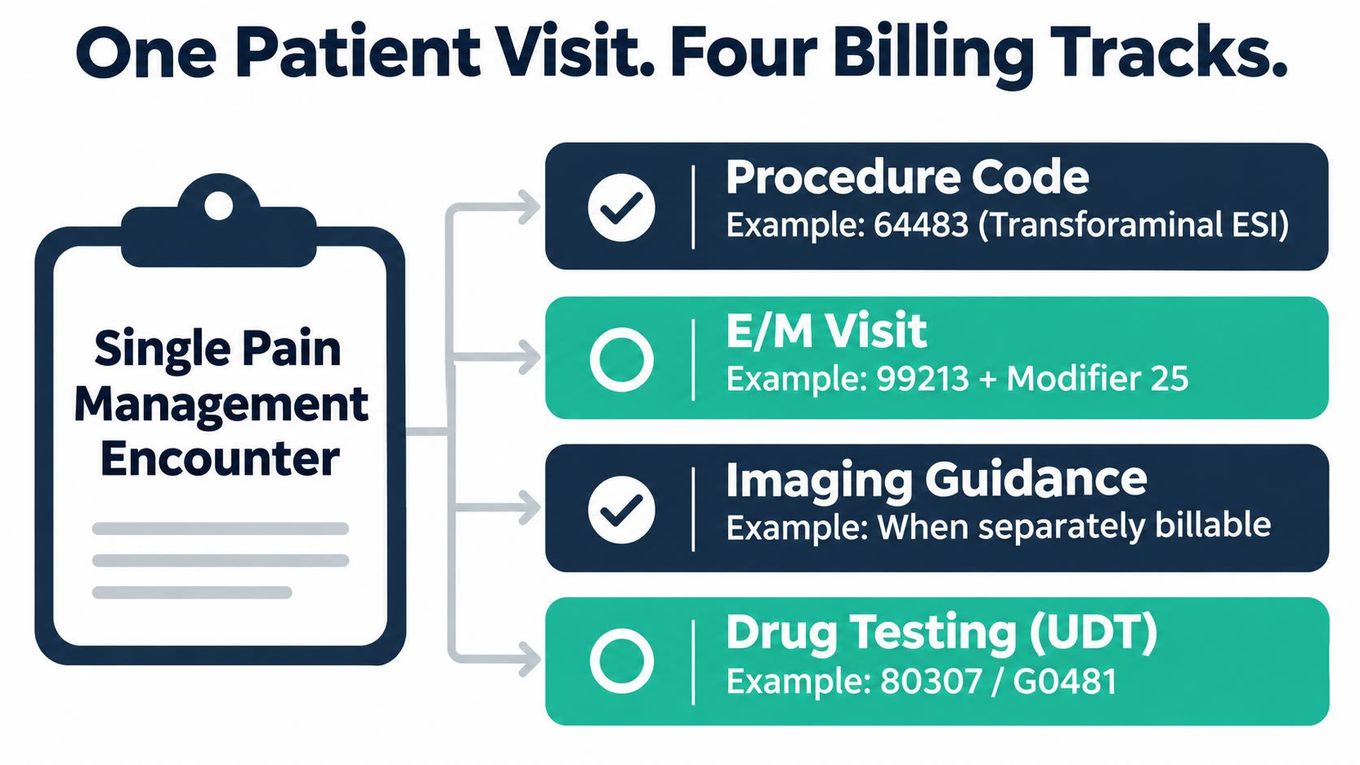
A single patient encounter can produce four or five billable procedure codes, an E/M code (with or without modifier 25), an imaging guidance code (which may or may not be separately billable depending on the CPT family), and a drug testing code, all subject to different payer rules, frequency limits, and documentation requirements. Add a bilateral procedure and the modifier calculus gets more complicated. Add a workers' compensation claim and you're in a different regulatory lane entirely.
The result: pain management practices have among the highest denial rates of any outpatient specialty. Practices without specialty-specific billing support routinely see denial rates above 20%, compared to the 5–10% range that well-managed outpatient specialties typically achieve.
Three things drive most of that revenue loss:
- CPT selection errors, especially around imaging guidance bundling
- Missing or incorrect modifiers on bilateral, staged, and multi-site procedures
- Prior authorization gaps, including failure to meet LCD-mandated criteria before billing
Each of these is solvable. But it requires a billing team that works pain management every day, not one that handles it as one specialty among twenty.
The CPT Code Families That Cause the Most Billing Problems
Pain management procedures cluster into a handful of CPT families. Each has its own coding logic, and errors within each family have different root causes and different financial consequences.
| CPT Family | Key Codes | Common Billing Error | Downstream Impact |
|---|---|---|---|
| Epidural steroid injections (interlaminar) | 62320, 62321, 62322, 62323 | Billing without imaging code when imaging was performed, or billing 77003 separately when it's bundled | Underpayment or CO-97 denial |
| Epidural steroid injections (transforaminal) | 64479, 64480, 64483, 64484 | Approach not documented (interlaminar vs. transforaminal determines the code family) | Full denial for incorrect code |
| Facet joint injections / medial branch blocks | 64490–64495 | Spinal level count not accurate; bilateral procedures not flagged with LT/RT or modifier 50 | Partial payment or denial |
| Radiofrequency ablation | 64633, 64634, 64635, 64636 | RFA billed without documented positive diagnostic blocks | Medical necessity denial (CO-50) |
| Spinal cord stimulation | 63650, 63685, 63688 | Trial and permanent implant coded in incorrect sequence or on the same date | Payer audit exposure |
| Trigger point injections | 20552, 20553 | Note doesn't name specific muscles injected; claim treated as unsupported | Denial for lack of medical necessity |
| Sacroiliac joint | 64451, 27096 | Procedure type confused: 64451 targets nerves innervating the joint (a nerve block); 27096 is an intra-articular joint injection; also, 27096 is not billed to Medicare in outpatient settings (G0260 replaces it) | Incorrect code selection, underpayment |
| Urine drug testing | 80305, 80306, 80307 (presumptive); G0480–G0483 (definitive) | Presumptive vs. definitive not distinguished; definitive billed without documented clinical trigger | Payer-specific denial or recoupment risk |
| Chronic pain management (bundled) | G3002, G3003 | Time documentation missing; overlap with other care management codes | Non-payment or clawback |
For current reimbursement rates, check the Medicare Physician Fee Schedule on CMS.gov directly. Rates shift with annual RVU updates, and 2026 included adjustments to several pain management procedure values that affect practice revenue planning.
The 77003 Trap: The Bundling Error That Still Costs Pain Practices Real Money
There is one billing error in pain management that shows up consistently across practices of all sizes, and it remains one of the most persistent: separately billing CPT 77003 (fluoroscopic guidance and localization) alongside codes that already include imaging guidance in the bundled payment.
Here is the rule, clearly stated.
CPT 77003 is bundled into the interlaminar epidural codes (62321, 62323), the transforaminal epidural codes (64479, 64480, 64483, 64484), and the facet joint injection and medial branch block codes (64490–64495). Billing 77003 as a separate line item alongside any of these codes triggers a CO-97 denial (bundling) or an NCCI edit. The revenue is not recoverable on appeal because the edit is correct.
77003 is separately billable only alongside codes that do not include imaging guidance by definition — certain trigger point procedures and others outside the bundled families above.
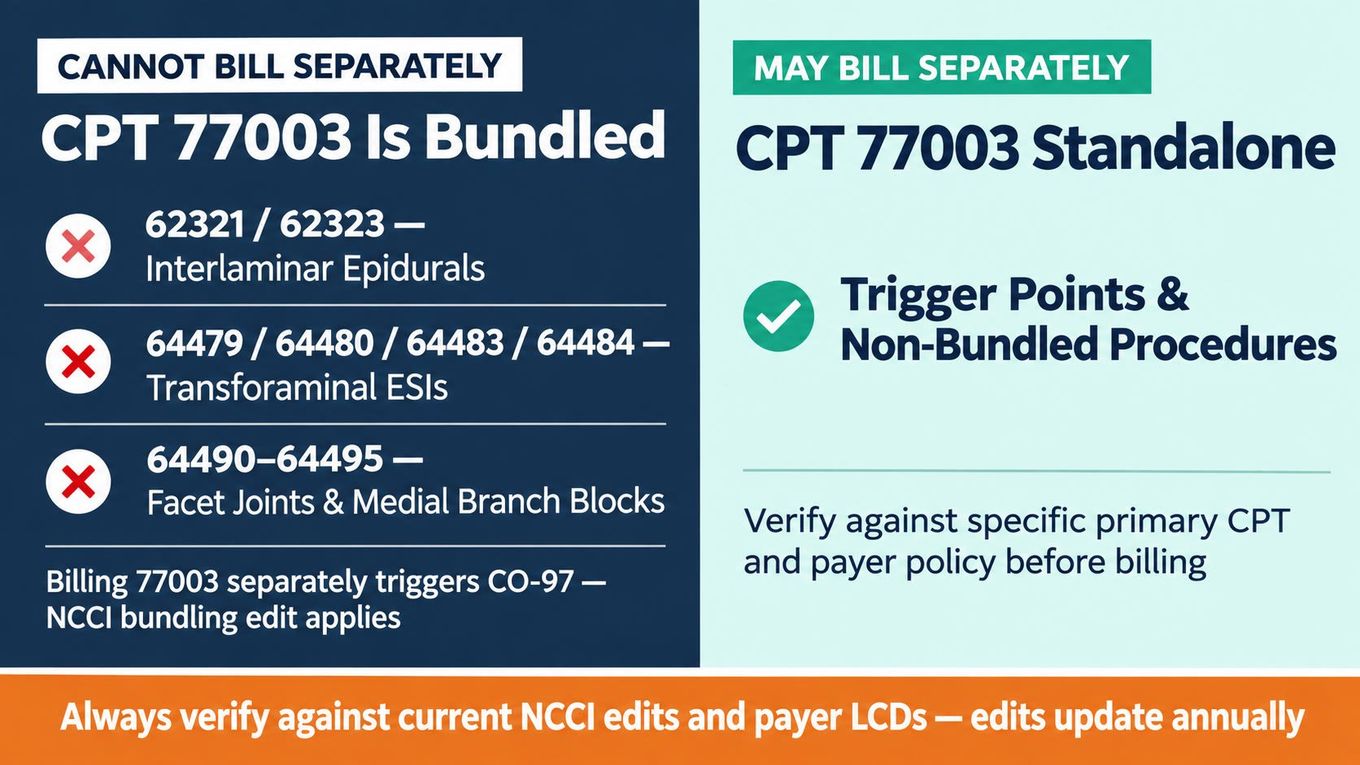
If your billing team or superbill still carries 77003 as a default add-on to spinal injections, that is an ongoing revenue leak and a compliance exposure. If your practice uses CT guidance instead (CPT 77012), the bundling rules differ and must be verified against the specific primary code and payer policy.
This is not a new rule. That is what makes it so costly: practices that haven't audited their superbills recently are still paying for this oversight.
Modifier Gaps That Quietly Kill Your Clean Claim Rate
Modifiers are where pain management billing separates good vendors from mediocre ones. The procedure coding gets checked. The modifiers often don't.
The modifiers most commonly applied incorrectly in pain management practices:
- Modifier 50 (bilateral): Required when the same procedure is performed on both sides in the same session. Some payers require LT and RT on separate claim lines instead of modifier 50 on a single line. Know which payers want which format before submitting — submitting modifier 50 to a payer that processes bilateral procedures as LT/RT will cause a denial or underpayment.
- Modifier LT / RT: Left side and right side, respectively. For bilateral facet injections or medial branch blocks where the payer expects laterality modifiers rather than modifier 50, correct application is critical to getting both sides paid.
- Modifier 25: Signals that an E/M visit on the same day as a procedure was significant and separately identifiable. Without it, the E/M is bundled into the procedure reimbursement. With it misapplied (meaning the documentation doesn't support a distinct evaluation), it creates an audit flag. The note must reflect a clinical decision-making process that stands apart from the pre-procedural assessment.
- Modifier 59 / XS: Distinct procedural service. Used to override a bundling edit when two procedures performed in the same session are genuinely separate and distinct services. XS (separate structure) is a preferred subset in many situations and is increasingly preferred over the broader modifier 59 by Medicare and select commercial payers.
- Modifier 58: Staged or related procedure performed during a postoperative period. Applies to radiofrequency ablation following diagnostic medial branch blocks, among other sequenced pain procedures. Without it, the payer may bundle the RFA payment into the global surgical period of the diagnostic block.
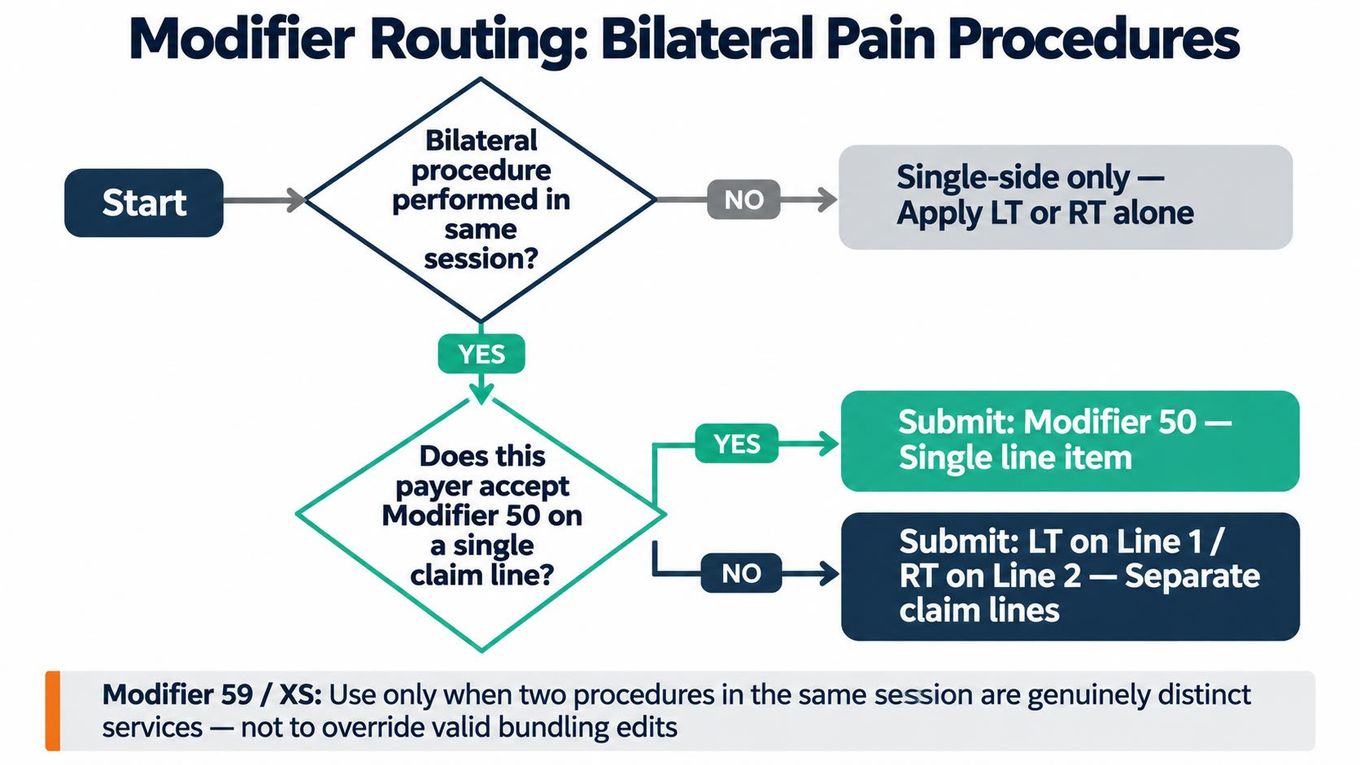
A billing vendor that can tell you exactly which payer accepts modifier 50 vs. LT/RT for bilateral injections, and which requires a separate claim line vs. a single line with units, is a vendor that actually knows this specialty.
Prior Authorization in 2026: WISeR and What It Means for Your Practice
Prior authorization has always been a revenue cycle burden for pain management practices. In 2026, it became more structured and more demanding, driven by CMS's Wasteful and Inappropriate Service Reduction (WISeR) prior authorization model.
What WISeR covers: Effective January 1, 2026, the WISeR model applies prior authorization requirements to epidural steroid injections and electrical nerve stimulator implants in six states: New Jersey, Ohio, Oklahoma, Texas, Arizona, and Washington. Facet joint interventions fall under a separate Hospital Outpatient prior-authorization demonstration and are not covered under WISeR.
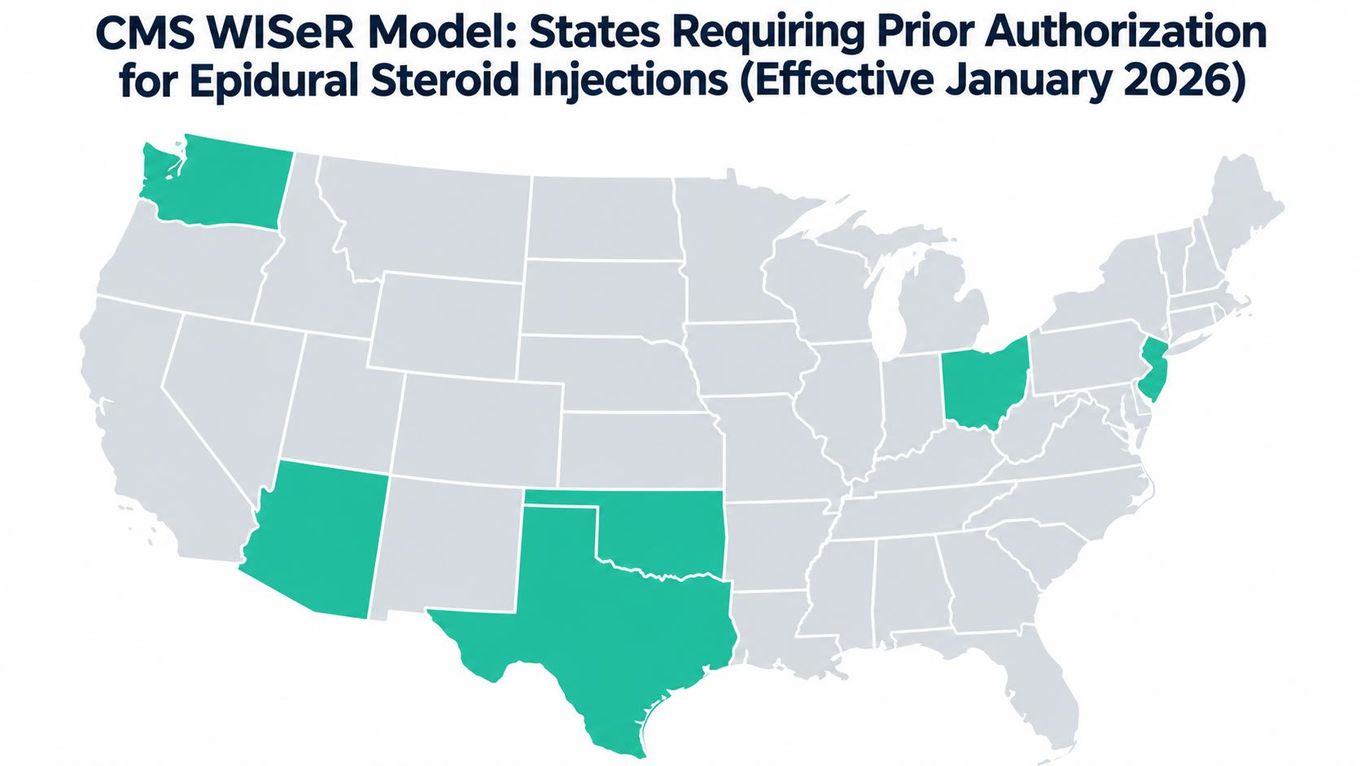
How it works in practice: Providers submit prior authorization requests through the CMS system before service delivery. Approved requests receive a tracking number that must accompany the claim. Claims submitted without a valid tracking number go to prepayment review, which means delayed payment and increased documentation burden. The model also includes a reduced-review pathway for practices with consistently high affirmation rates, which rewards clean documentation and accurate PA submissions over time.
For practices in WISeR states, prior authorization for pain procedures is no longer informal or payer-by-payer on the Medicare side. It is a federal demonstration model running through December 31, 2031, with real cash-flow consequences if the PA workflow isn't purpose-built for it.
For practices not yet in a WISeR state: commercial payer prior authorization for pain procedures continues to tighten independently, with many plans expanding the procedure types that require pre-certification and tightening medical necessity criteria for repeat injections and RFA. A PA workflow designed for this specialty needs to track procedure frequency, document failed conservative treatment, and confirm imaging criteria are met before the authorization request goes in — not after a denial comes back.
Clarity's prior authorization services are built around specialty-specific coverage criteria, not a generic PA queue.
Urine Drug Testing: The Revenue Most Pain Practices Leave on the Table
Urine drug testing is a clinical requirement in most pain management practices managing chronic pain patients on opioids or controlled substances. It is also one of the most consistently underbilled procedure categories in the specialty.
The billing breaks into two distinct tiers, and confusing them costs money:
- Presumptive testing (80305, 80306, 80307): Point-of-care testing that identifies drug classes without specific quantification. The correct code depends on the testing method: direct optical observation (80305), instrument-assisted direct optical observation (80306), or instrument chemistry analyzers, e.g., immunoassay (80307). These are billed by the physician practice, usually in-house.
- Definitive testing (G0480, G0481, G0482, G0483): Confirmatory laboratory testing with quantification and specific drug identification. The correct G code depends on the number of drug classes tested. Medicare and most commercial payers require a documented clinical trigger and medical necessity for definitive testing — the note needs to explain why presumptive results were insufficient.
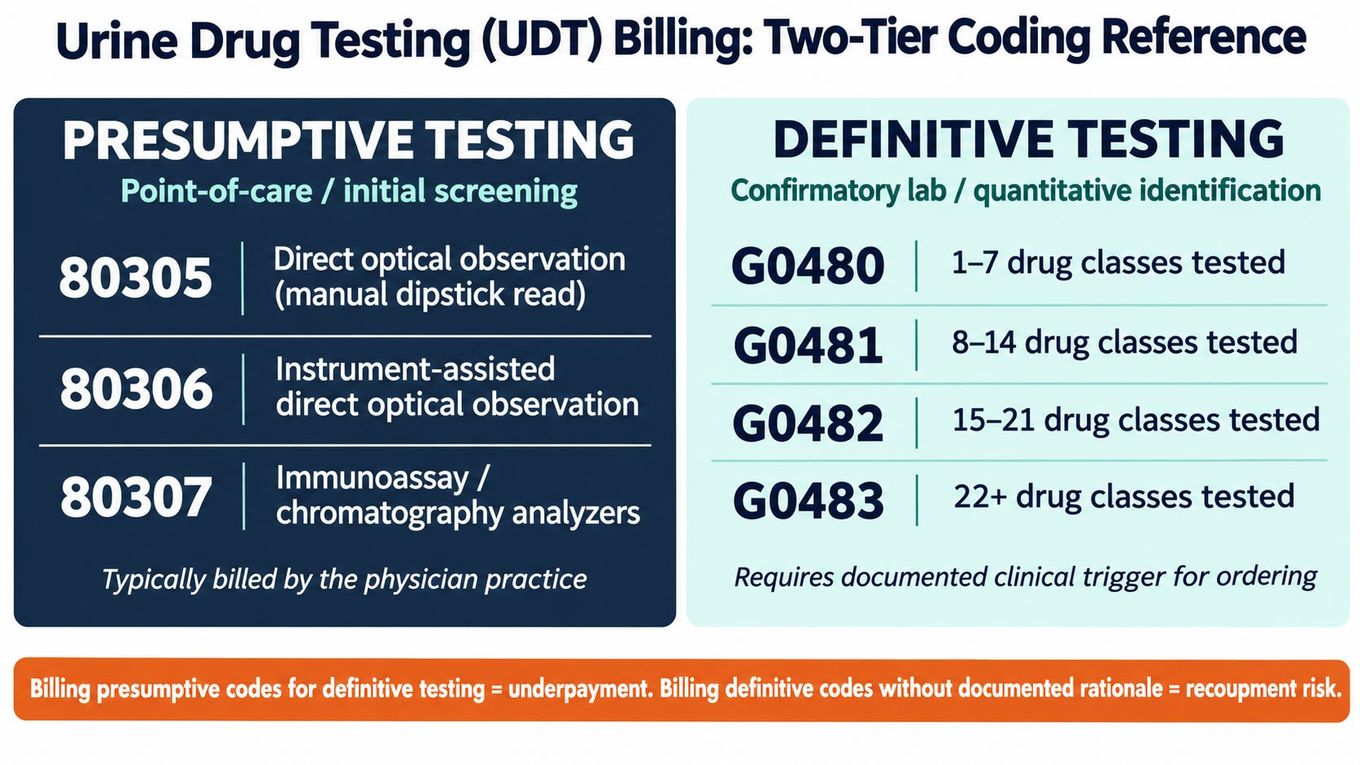
The errors that cause revenue loss: billing presumptive codes when definitive testing was done (underpayment), billing definitive codes without a documented clinical rationale (denial or recoupment), or skipping UDT billing entirely because the coder isn't confident in the code selection.
A billing partner that handles pain management should audit your UDT billing patterns during onboarding. If your practice performs UDT regularly and your collection rate on those codes is inconsistent, there is recoverable revenue in that audit.
What a Genuine Pain Management Billing Service Should Include
Not every RCM vendor that lists pain management as a specialty has actually built a workflow around it. Many handle it as one of thirty specialties, using generic billing logic that misses the procedure-specific complexity.
A genuinely capable pain billing service delivers:
- Specialty-trained coders who bill pain procedures daily, not rotated through the specialty on a schedule
- CPT 77003 bundling logic built into claim scrubbing, not left to manual review on each claim
- Modifier review by payer so bilateral and staged procedure claims are submitted correctly on the first pass
- Prior authorization workflows specific to pain procedures, with frequency tracking and documentation criteria built in
- WISeR compliance in applicable states, including tracking number management for claims
- LCD frequency tracking per patient, per region, per procedure family, to pre-empt medical necessity denials
- UDT billing with the presumptive vs. definitive distinction applied correctly by test method and payer
- Workers' compensation and personal injury billing as a separate, coordinated workflow with the documentation requirements those payers require
- Denial management with root-cause analysis by CPT family and payer, with appeal letters built for pain-specific medical necessity arguments, not generic template appeals
- Reporting that breaks out clean claim rate and denial rate by procedure type, not just an overall practice average
For a broader view of how denial management fits into the revenue cycle, see Clarity's denial management services.
How to Evaluate a Billing Vendor on Pain Management Specifically
When you're comparing billing companies, the right questions are specific. Generic answers to specific questions are the signal.
| Question | What a Strong Answer Looks Like |
|---|---|
| How do you handle the 77003 bundling rules? | Immediate, specific answer about which CPT families bundle imaging guidance and what the NCCI edit is |
| How do your coders select between interlaminar and transforaminal ESI codes? | Explains that approach is determined by the operative note and procedure documentation, not defaulted |
| What is your PA workflow for pain procedures and how does it address WISeR? | Names the states, explains tracking number requirement, describes the PA submission process |
| What is your clean claim rate on pain management submissions specifically? | Provides a pain-specific number, not an overall portfolio average |
| How do you handle UDT billing? | Distinguishes presumptive vs. definitive, explains which code depends on testing method, notes payer-specific rules |
| What does your denial appeal process look like for a CO-50 on an RFA claim? | Describes documentation support, appeal letter construction, and escalation pathway for medical necessity denials |
| How do you manage workers' comp billing for pain procedures? | Explains the separate workflow, state-specific fee schedules, and reporting requirements |
A vendor that answers these questions fluently and specifically has built their workflow around pain management. A vendor that answers in generalities is treating this specialty like any other, which is precisely the problem you're trying to solve.
For more evaluation criteria across billing vendors generally, see Questions to Ask Before Hiring a Medical Billing Company. And if you're weighing in-house vs. outsourced billing for your pain practice, this comparison lays out the decision factors clearly.
How Clarity Approaches Pain Management Billing
Pain management practices come to us with a recognizable set of problems. The pattern is consistent regardless of practice size:
- Modifier errors on bilateral injections and staged procedures that go out clean on the surface but get denied or underpaid
- RFA and facet denials stacking up because prior authorization criteria weren't confirmed before the procedure
- Prior authorization backlogs eating into scheduling capacity
- UDT revenue that's collected inconsistently, often because coders aren't confident on presumptive vs. definitive distinctions
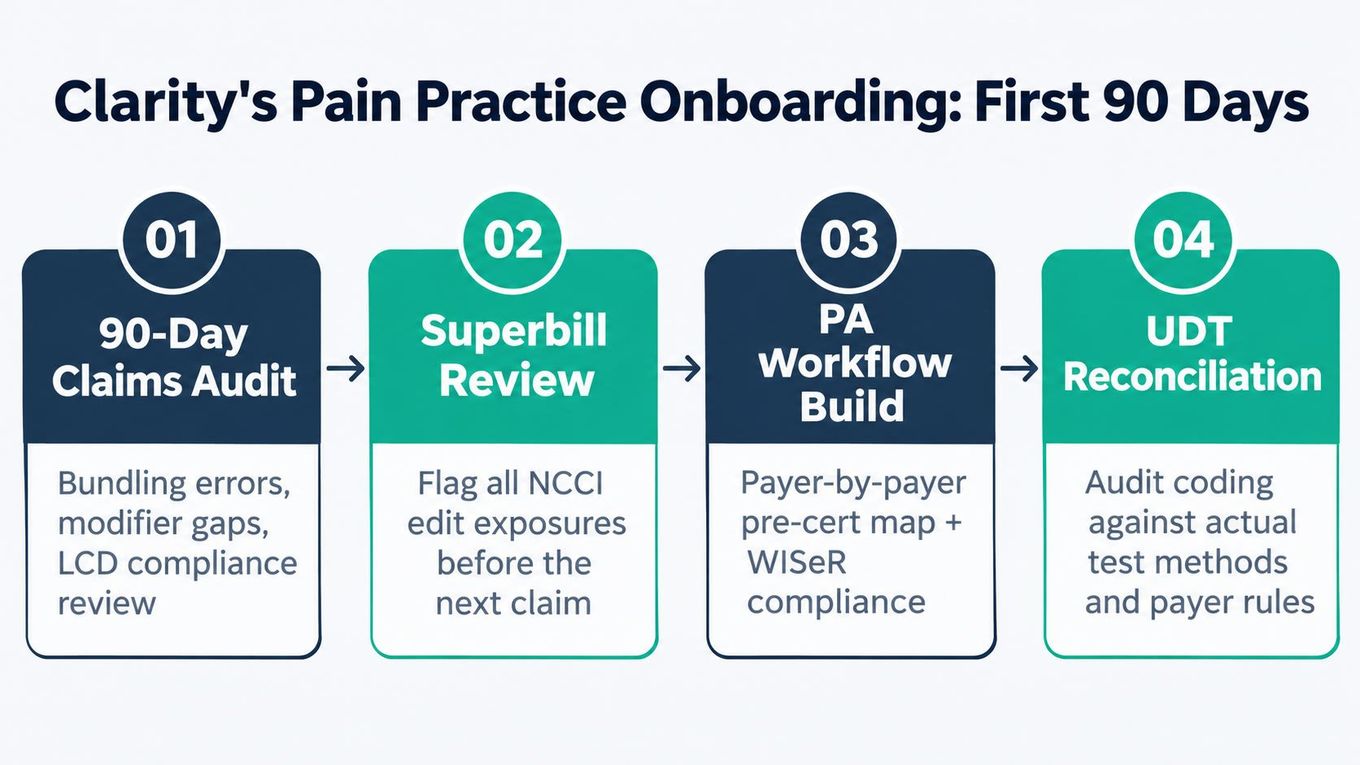
Our team handles pain management billing under our outpatient physician billing services, with coders who specialize in interventional procedure coding. When we onboard a pain practice, our standard process is:
- 90-day claims audit: We review the last 90 days of submitted claims for bundling errors (including 77003), modifier gaps, and LCD compliance before we submit a single new claim.
- Superbill review: We flag any codes or add-ons that create automatic NCCI edit exposure and work with the practice to correct them.
- PA workflow build: We map out which procedures require pre-certification by payer, set up frequency tracking per LCD, and confirm WISeR compliance for applicable states.
- UDT billing reconciliation: We audit UDT coding patterns against actual testing methods and payer-specific rules, identifying underbilled or at-risk claims.
We work across all major payer types: Medicare, Medicaid, Medicare Advantage, and commercial plans, including handling workers' compensation and personal injury billing as a separate, coordinated workflow.
If you want to understand what your current billing is actually collecting versus what it should be collecting, the Clarity solutions page is the starting point.
The Experience Behind This Content
Clarity Health RCM was built on the operational foundation of Quality Medical Billing, which has been in revenue cycle management since 1988. President and CEO Estelle Sandoval brings 40-plus years of combined revenue-cycle experience across specialties, with particular depth in interventional procedures and high-complexity outpatient billing.
The CPT code guidance, modifier rules, and prior authorization content in this article reflect current AMA and CMS coding frameworks. Where regulations are date-sensitive (WISeR model specifics, annual Medicare fee schedule updates), we have referenced primary sources rather than asserting figures as final. This article is informational guidance for practice operations, not legal, billing, or coding advice for a specific claim or clinical situation.
Frequently Asked Questions
What are pain management billing services?
Pain management billing services are specialized revenue cycle management services built around the coding, prior authorization, and denial management requirements of pain management practices. They cover interventional procedure billing for epidural injections, facet blocks, radiofrequency ablation, and spinal cord stimulation; urine drug testing billing; E/M coding; modifier application; and payer-specific LCD compliance. These are areas where generic billing support consistently underperforms because the specialty's coding logic is procedure-specific and highly sensitive to documentation detail.
Why is pain management billing so complex?
Pain management billing is complex because a single patient encounter can produce multiple billable procedure codes, each subject to its own imaging guidance bundling rules, bilateral modifier requirements, frequency limitations, and prior authorization criteria. The CPT code families are highly procedure-specific: approach (interlaminar vs. transforaminal), spinal level, and imaging method all affect code selection. Payer policies vary significantly between Medicare, Medicare Advantage, and commercial plans, and the specialty is under heightened scrutiny from CMS and commercial payers for medical necessity and appropriate use.
What CPT codes are most commonly billed in pain management?
The core CPT families include the interlaminar epidural codes (62320–62323), transforaminal epidural codes (64479, 64480, 64483, 64484), facet joint and medial branch block codes (64490–64495), radiofrequency ablation codes (64633–64636), spinal cord stimulation codes (63650, 63685, 63688), and trigger point injection codes (20552, 20553). Urine drug testing (80305–80307 for presumptive; G0480–G0483 for definitive) and E/M codes (99202–99215) are also billed regularly. G3002 and G3003 cover the monthly chronic pain management bundle for qualifying patients.
What is the most common billing error in pain management?
The most persistent billing error in pain management is separately billing CPT 77003 (fluoroscopic guidance) alongside spinal injection codes that already include imaging guidance in the bundled payment. This triggers an NCCI bundling edit and a CO-97 denial. The error is so common because many practices have superbills that pre-date the current bundling rules and have never been audited. The revenue is not recoverable on appeal because the edit is accurate.
What is the WISeR prior authorization model and does it affect my practice?
WISeR (Wasteful and Inappropriate Service Reduction) is a CMS prior authorization demonstration model that, as of January 1, 2026, requires prior authorization for epidural steroid injections and electrical nerve stimulator implants in six states: New Jersey, Ohio, Oklahoma, Texas, Arizona, and Washington. Approved requests receive a CMS tracking number that must accompany the claim; claims submitted without it go to prepayment review. The model runs through December 31, 2031. If your practice is in one of these states, your PA workflow needs to be built specifically around this model. Verify the latest parameters at CMS.gov, as the program may be expanded or adjusted over time.
Can I bill for an E/M visit on the same day as a pain procedure?
Yes, with modifier 25 appended to the E/M code. If a pain management physician performs a significant, separately identifiable evaluation and management service on the same day as a procedure, that E/M can be billed separately. The critical requirement is that the documentation must support the E/M as a distinct clinical service, with its own history, examination, and medical decision-making, not just the pre-procedural assessment that is inherent to the procedure itself. Without modifier 25, the E/M payment is bundled into the procedure reimbursement. With modifier 25 and inadequate documentation, the claim creates an audit flag.
How do I evaluate whether a billing company actually knows pain management?
Ask them specific, technical questions: How do they handle the 77003 bundling rules? How do coders select between interlaminar and transforaminal ESI codes? What is their clean claim rate on pain management submissions specifically? What does their denial appeal process look like for a CO-50 on an RFA claim? How do they handle UDT billing? A vendor with real pain management experience will answer these immediately and specifically. Vague or generic answers are a reliable signal that pain management is not a specialty they have built a workflow around.