Neurology Billing Services: What Your Practice Needs to Know Before Outsourcing
November 25, 2026 · 13 min read
Neurology billing services manage the full revenue cycle for neurology practices, covering charge entry and coding for EEGs, EMGs, and nerve conduction studies through prior authorization, denial management, and payer follow-up. Neurology sits among the most billing-intensive specialties in outpatient medicine: a single patient encounter can generate three separate billable components, each with its own modifier, payer policy, and documentation requirement. Getting that right, consistently, requires more than a generalist billing team.
If your practice is running high denial rates, chasing prior authorizations manually, or leaving infusion revenue on the table, the problem usually isn't effort. It's specialty fit.
At a Glance: In-House vs. Outsourced Neurology Billing
| Factor | In-House Billing | Outsourced Neurology Billing Service |
|---|---|---|
| Neurology coding expertise | Depends on staff training | Specialty-trained coders as standard |
| TC/26 component billing | Frequently missed | Handled per payer and site-of-service rules |
| NCS unit limit compliance | Often underchecked | Monitored per MAC LCD |
| Prior auth management | Manual, staff-dependent | Tracked systematically across service lines |
| Infusion J-code accuracy | High error rate | Coded with lot number and NDC documentation |
| Denial appeal capacity | Limited by bandwidth | Dedicated denial specialists |
| Cost | Fixed overhead | Variable, scales with volume |
The right choice depends on your practice's volume and coding complexity, not just your headcount. Many neurology groups find that in-house billing works until they add a second provider, expand into infusion therapy, or take on a hospital neurology contract. At that point, the coding complexity scales faster than staff can keep up.
Why Neurology Billing Is Harder Than Most Specialties
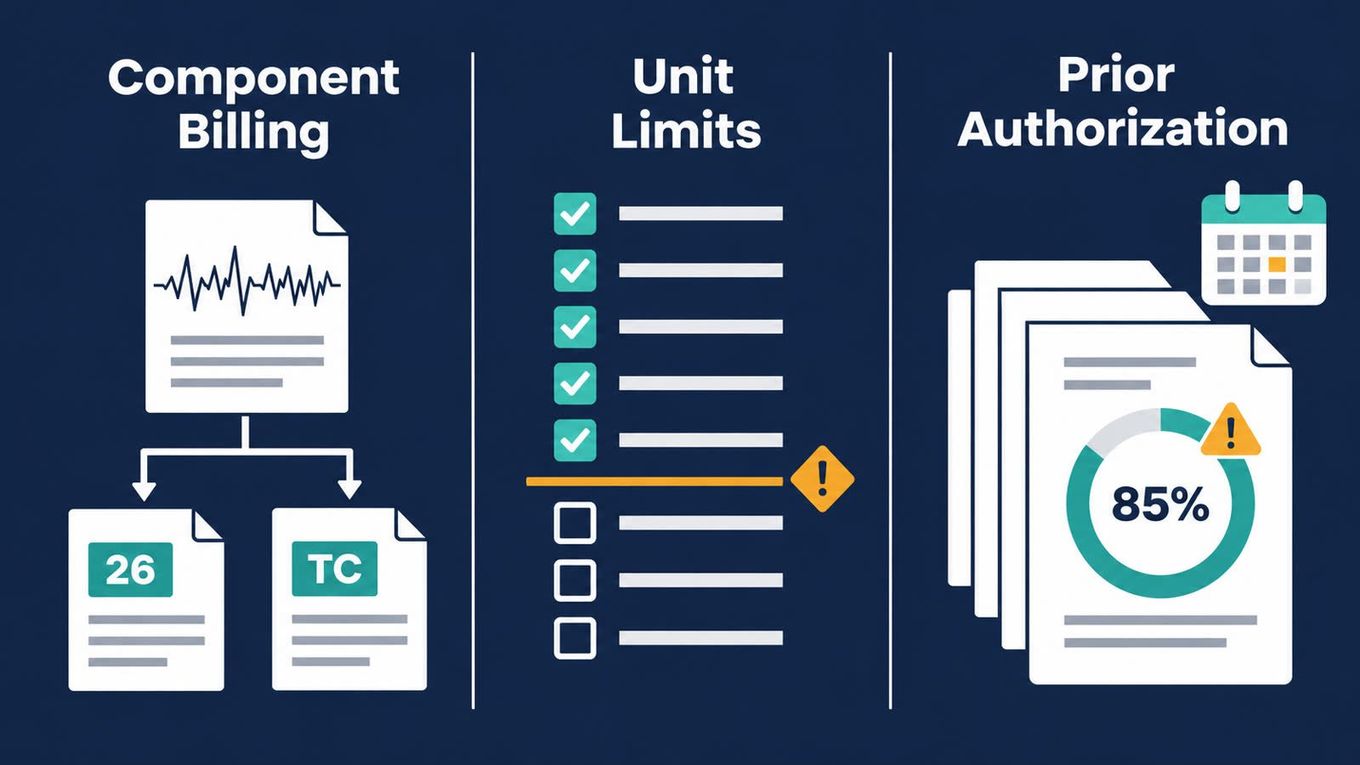
Most specialties bill a relatively predictable mix of E&M visits and procedure codes. Neurology breaks that mold in three ways.
- Component billing. Diagnostic studies like EEGs, EMGs, and nerve conduction studies have a professional component (the physician's interpretation) and a technical component (the equipment, staff, and facility performing the study). When a practice owns its equipment and employs the technician, it bills the global code. When the study is performed at a hospital or independent facility, it bills only modifier 26 (professional component). Bill global when only the professional component is yours, and you will face a denial, an overpayment demand, or both.
- Unit limits and LCD requirements. Medicare Administrative Contractors publish Local Coverage Determinations (LCDs) that set specific medical necessity criteria for EEGs and nerve conduction studies. For NCS, most MACs limit the number of conduction studies per encounter to what is clinically necessary based on documented indication. Exceeding those limits without clear documentation is one of the most consistent denial triggers in neurology.
- Prior authorization intensity. Infusion therapies for MS, myasthenia gravis, and CIDP — including natalizumab (Tysabri), ocrelizumab (Ocrevus), and intravenous immune globulin — require prior authorization from virtually every commercial payer. These authorizations are time-limited, diagnosis-specific, and often require clinical notes, lab values, and treatment history. A lapsed authorization on a single infusion visit can represent thousands of dollars in denied revenue.
The Codes That Determine Your Collection Rate
Understanding where neurology billing goes right or wrong starts with the actual codes involved. Here are the service lines that drive most of the revenue, and most of the complexity.
EEG Billing
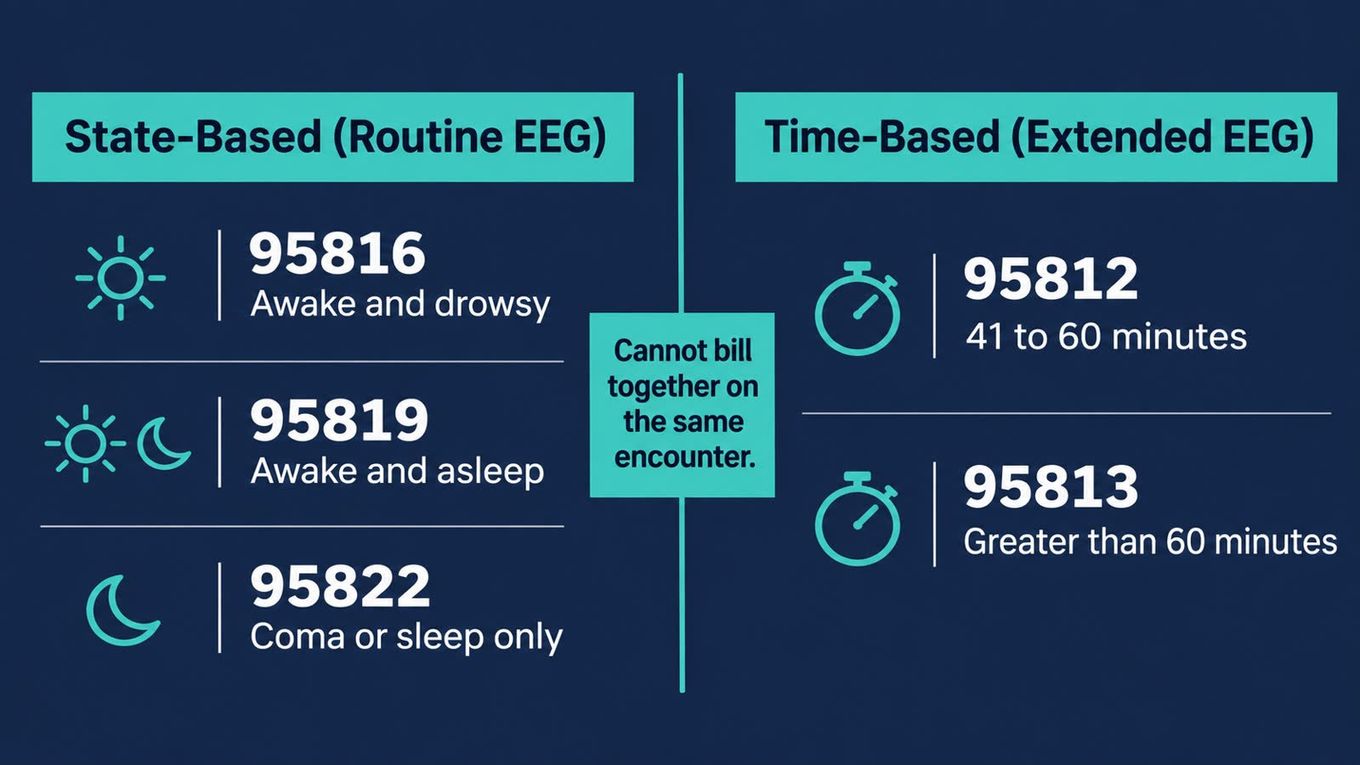
Routine EEG codes fall into two distinct families that cannot be billed together on the same encounter:
| Family | Codes | Selection Basis | Typical Duration |
|---|---|---|---|
| State-based (routine) | 95816, 95819, 95822 | Patient consciousness state during recording | 20 to 40 minutes |
| Time-based (extended) | 95812, 95813 | Recording time only | 95812: 41-60 min / 95813: over 60 min |
- 95816 — Awake and drowsy
- 95819 — Awake and asleep
- 95822 — Coma or sleep only
- 95812 — Extended monitoring, 41 to 60 minutes
- 95813 — Extended monitoring, greater than one hour
Long-term EEG monitoring, used in epilepsy evaluation, is coded from the 95700 series, with specific codes distinguishing unmonitored from monitored studies and the duration of recording.
The most common EEG billing mistakes:
- Using routine EEG codes for long-term monitoring (undercoding the session type)
- Failing to document the clinical indication that satisfies payer medical necessity criteria
- Billing the global code when the physician only interpreted a study performed at a hospital system
- Billing 95812 or 95813 on the same claim as a state-based code (bundling error)
Medicare's LCD for routine EEG outlines the covered indications, including seizure disorders, encephalopathy, and coma evaluation. Confirm the current LCD number and criteria with your MAC before billing. Studies performed for indications not listed, or without documentation linking the study to a covered diagnosis, will be denied for medical necessity.
EMG and Nerve Conduction Studies
Needle EMG codes run from CPT 95860 through 95872 depending on limb and muscles examined. Nerve conduction studies are coded 95907 through 95913, with the code varying by number of nerve studies performed.
Reliable problem areas:
- Billing NCS and needle EMG without documenting a specific clinical question the testing was meant to answer
- Unbundling nerve conduction studies in ways that trigger NCCI (National Correct Coding Initiative) edit conflicts
- Failing to apply modifier 59 appropriately when two procedures on the same day are genuinely distinct services, or overusing it in ways that attract payer scrutiny
- Missing the MAC's unit limit for NCS per encounter, which varies by jurisdiction
Infusion Therapy Billing
Infusion billing for neurological conditions is among the highest-revenue and highest-complexity work in outpatient neurology.
| Code | Description |
|---|---|
| 96365 | Therapeutic IV infusion, first hour |
| 96366 | Each additional hour (add-on to 96365) |
| 96367 | Each sequential drug, up to first hour |
| 96368 | Concurrent infusion (billed once per encounter) |
What makes it complicated:
- Each infused drug requires a J-code billed alongside the administration code, with the correct units, lot number, and NDC number attached
- IVIG billing requires the J-code to match the specific product administered, and dosage documentation must support the units billed
- Many payers require step therapy documentation proving the patient tried and failed other treatments before approving a biologic or infusion
- If the authorization is obtained but the clinical notes don't reflect the step therapy, payers can still deny on retrospective review
E&M and Consultation Codes
New patient office visits (99202 through 99205) and established patient visits (99212 through 99215) make up the backbone of outpatient neurology revenue. These shifted to time-based or medical decision complexity billing under the 2021 E&M revisions — a change many neurology practices haven't fully optimized for.
Hospital-based neurology adds another layer:
- Initial hospital care: 99221 through 99223
- Subsequent care: 99231 through 99233
- Documentation requirements must reflect encounter complexity, not just diagnosis
A common miss: billing 99212 or 99213 for a 30-minute MS management visit when the medical decision complexity supports a 99215. That's not upcoding; it's correct coding. It requires coders trained on neurology-specific complexity criteria to catch consistently.
Where Neurology Claims Actually Get Denied
This is the part most billing service pages skip over.

Here is where neurology denials actually cluster:
| Denial Category | Root Cause | Fix |
|---|---|---|
| Medical necessity: EEG | Indication not documented or not covered by payer LCD | Pre-bill documentation review; template updates |
| Component billing error | Global code billed when only professional component applies | Site-of-service audit; modifier 26/TC training |
| NCS unit limit exceeded | Units exceed MAC LCD without supporting documentation | Per-MAC unit limit tracking; documentation prompts |
| Prior auth missing: infusion | Auth not obtained or expired before date of service | Auth tracking system with renewal alerts |
| J-code mismatch | Drug administered doesn't match J-code billed, or units off | Charge capture linked to pharmacy dispensing records |
| NCCI edit conflicts | EMG and NCS unbundled incorrectly; modifier 59 applied incorrectly | NCCI compliance check pre-submission |
| Modifier 25 missing | E&M on same day as procedure not separately supported | Coder training on modifier 25 documentation requirements |
| Timely filing | Claims held too long in queue before submission | Charge lag monitoring; daily submission targets |
For denial management in neurology specifically, the difference between a team that can recover denied claims and one that lets them age out is usually whether they understand what the original denial was actually about. Generic denial management applies a template response. Specialty billing teams know that a medical necessity denial on CPT 95819 needs a different appeal letter than a prior auth denial on an infusion claim.
Prior Authorization in Neurology: A Revenue Risk You Cannot Ignore
Prior authorization is where the most preventable revenue loss happens in neurology. The service lines that consistently require auth from commercial payers:
- Infusion therapies for MS (natalizumab/Tysabri, ocrelizumab/Ocrevus, alemtuzumab/Lemtrada)
- IVIG for CIDP, myasthenia gravis, Guillain-Barré
- Botulinum toxin injections for migraine (Botox, billed as J0585) and spasticity
- Advanced neuroimaging beyond routine MRI in some markets
- Long-term EEG monitoring in certain payer contracts
- Sleep study referrals in some integrated neurology-sleep practices

The auth requirement itself isn't the hard part. The hard part is managing the documentation requirements, tracking expiration dates across a panel of patients receiving ongoing infusion therapy, and handling the retrospective review requests that come after a payer questions whether the clinical record supported the authorized service.
Prior authorization services in neurology need to operate proactively — not as a reaction to a denial, but as a standing workflow integrated with your scheduling and infusion calendar. When authorization management is reactive, infusion revenue becomes unpredictable. When it's proactive, it's one of the most predictable parts of your billing cycle.
What to Look for in a Neurology Billing Service
Most billing service comparisons focus on price and collection rate claims. Those matter, but they're hard to verify upfront. Here's what to actually evaluate before you sign a contract.
- Neurology-specific coder credentialing. Ask whether the coders assigned to your account hold CPC (Certified Professional Coder) credentials and have documented neurology billing experience. Generalist coders will get the E&M codes right, but EEG long-term monitoring, NCS unit limits, and infusion billing require specialty training. Ask for specific examples of how they handle TC/26 splits.
- MAC and LCD familiarity. Your billing service needs to know which Medicare Administrative Contractor covers your jurisdiction and what the relevant LCDs say for EEG and NCS. If you're in a Noridian or Palmetto GBA region, the specific documentation requirements may differ from a CGS or WPS jurisdiction. Payer-agnostic billing teams miss this.
- Prior auth infrastructure. Ask how they track authorization status across your patient panel. A spreadsheet is not an infrastructure. Look for a system that flags expirations before the service date, not after the denial.
- Denial appeal specificity. Ask to see a sample appeal letter for a medical necessity denial on an EEG claim. Generic "this service was medically necessary" letters lose appeals. Specialty appeals cite the specific LCD criteria, attach the clinical documentation that satisfies them, and reference the payer's own coverage policy.
- Reporting transparency. You should be able to see your clean claim rate, denial rate by code, days in AR, and collection rate by payer on demand. If a billing service can't give you that at the payer-and-code level for neurology, they're not measuring what matters.
- Transition timeline. Switching billing services introduces risk. Ask for a detailed transition plan, what happens to open claims during the changeover, and how they handle claims currently in appeal. A good billing partner will offer a parallel-run period or a structured handoff protocol. See how to switch medical billing companies for a full checklist if you're currently evaluating this.
Why Trust This Article
Our background:
- Clarity Health RCM was built out of Quality Medical Billing, founded in 1988
- Under President and CEO Estelle Sandoval, the firm brings 40+ years of combined revenue cycle experience to physician group and specialty practice billing
- Our team works across inpatient and outpatient physician billing, including specialties with complex component billing, prior authorization requirements, and payer-specific coverage policies
How this article was developed:
- The denial patterns and coding challenges described here reflect what our team encounters directly — not a generic overview of neurology billing
- Where specific regulatory figures or LCD citations are referenced, we recommend confirming against your MAC's current coverage policies before making billing decisions
- CPT codes and payer policies change; this article is informational guidance, not coding or billing advice for a specific claim or situation
How Clarity Supports Neurology Practices
Neurology practices working with Clarity get:
- Specialty-trained coding: Component billing for diagnostic studies, NCS compliance per MAC jurisdiction, infusion J-code accuracy
- Prior authorization management: For the biologics and IVIG therapies that drive significant revenue in neurological disease management
- Full revenue cycle coverage: Credentialing and enrollment, medical coding services, claim submission, AR follow-up, denial management, and payer reporting
If you're evaluating outsourced billing for a neurology practice, or working through a denial problem you haven't been able to resolve in-house, we're straightforward about what we can and can't do for your specific situation. Reach out to our team for a no-obligation revenue cycle review.
Frequently Asked Questions
What are neurology billing services? Neurology billing services are specialized revenue cycle management services that handle coding, claim submission, prior authorization, and denial management for neurology practices. They cover the full range of neurology-specific billing, including EEG and long-term monitoring codes, EMG and nerve conduction studies, infusion therapy J-codes, and outpatient E&M, with coders trained on the payer policies and documentation requirements specific to neurological medicine.
What CPT codes are used most often in neurology billing? The most commonly billed neurology CPT codes include 95812 through 95822 for EEG (covering both state-based routine and extended time-based monitoring), the 95700-series for long-term EEG monitoring, 95860 through 95872 for needle EMG, 95907 through 95913 for nerve conduction studies, 96365 through 96368 for IV infusion therapy, and 99202 through 99215 for office E&M visits. Each service line has specific documentation requirements and payer-specific coverage policies that affect whether a claim pays on first submission.
Why do neurology claims get denied more often than other specialties? Neurology has a higher denial rate than many outpatient specialties because of its reliance on diagnostic studies with strict medical necessity criteria, component billing requirements that vary by site of service, prior authorization demands for infusion therapies and biologics, and Medicare unit limits on nerve conduction studies. A denial rate above 5 to 8 percent in neurology typically points to a coding process or prior auth workflow that isn't keeping pace with payer policy requirements.
How does TC/26 component billing work in neurology? When a neurologist performs and interprets a diagnostic study using their own equipment and staff, they bill the global code. When only the physician interpretation is provided (such as reading an EEG performed at a hospital), they bill the professional component using modifier 26. When only the technical component is provided (the equipment and technician without a physician interpretation), modifier TC applies. Billing the wrong component, most often billing global when only modifier 26 is applicable, is one of the most common and costly billing errors in neurology.
Is prior authorization required for neurology infusion therapy? Yes, almost universally. Infusion therapies for neurological conditions, including natalizumab (Tysabri), ocrelizumab (Ocrevus), and intravenous immune globulin (IVIG) for CIDP and myasthenia gravis, require prior authorization from commercial payers. Most require documentation of diagnosis, prior treatment history, lab values, and step therapy criteria. Authorizations are time-limited and must be renewed before expiration. Claims submitted without valid authorization will be denied and are rarely recoverable without a successful appeal.
What should I ask a neurology billing service before signing a contract? Ask whether their coders are credentialed and have documented neurology experience, how they handle TC/26 component billing decisions, which MAC jurisdictions they're familiar with, how they track prior authorization expiration across your patient panel, what a typical denial appeal looks like for a neurology claim, and what reporting you'll receive on collection rate by payer and denial rate by CPT code. Answers to those questions will tell you more about specialty fit than any performance guarantee in a contract.
How much do neurology billing services cost? Most outsourced neurology billing services charge a percentage of collections, typically ranging from 4 percent to 9 percent depending on practice size, volume, payer mix, and the scope of services included. Practices billing significant infusion therapy or managing high prior auth volume may pay toward the higher end because of the additional workflow involved. For a detailed breakdown of what affects medical billing service cost, see our medical billing services cost guide.