Oncology Billing Services: What Cancer Care Practices Need in an RCM Partner
November 25, 2026 · 13 min read
Oncology billing is among the most technically demanding specialties in revenue cycle management. Cancer care practices deal with high-cost drug billing, chemotherapy infusion sequencing rules, prior authorization for nearly every treatment, and 2026 coding changes that have already produced retroactive denials at radiation oncology practices across the country. Getting it right requires specialty-trained coders who understand the full picture: from J-code unit calculation to NCCI edits to buy-and-bill drug reimbursement. Getting it wrong is expensive in a way that general billing errors rarely are.
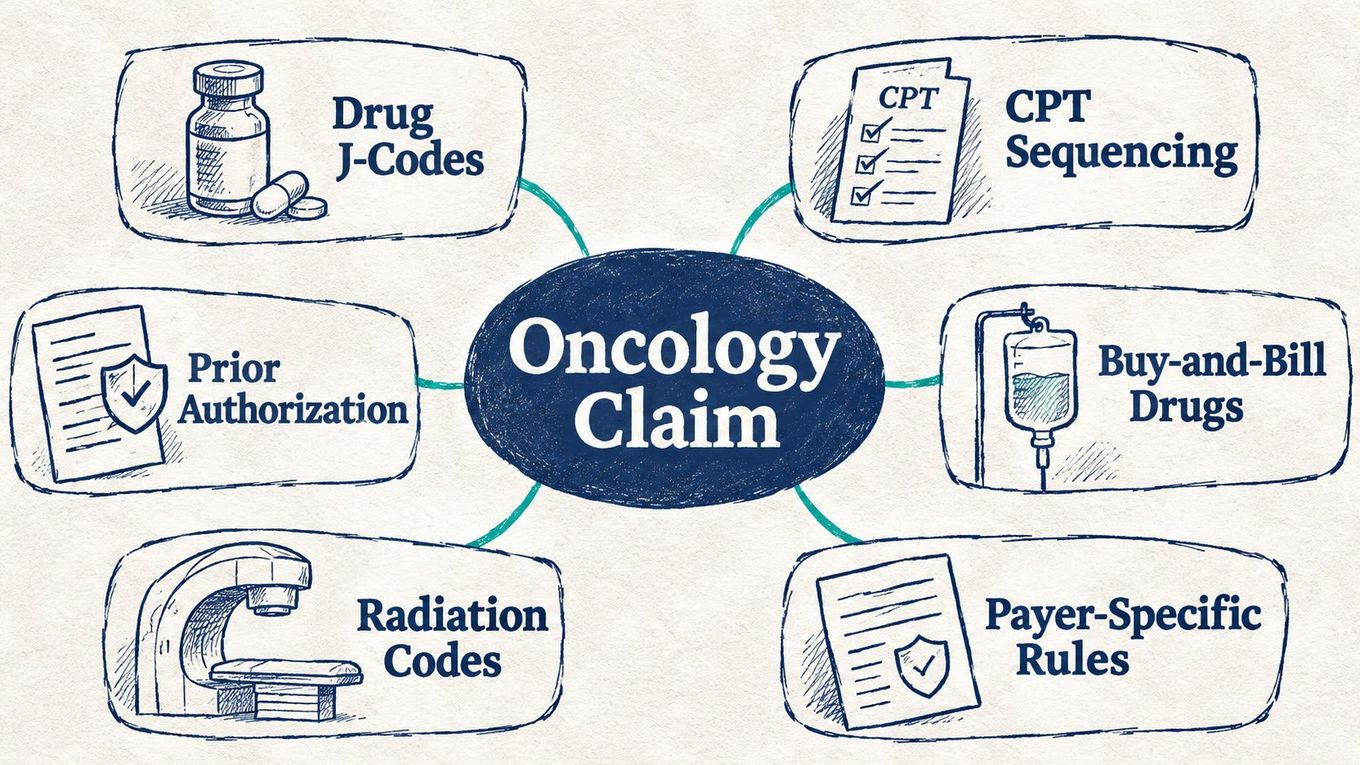
What Makes Oncology Billing Uniquely Complex
| Factor | Why It's Different From General Medical Billing |
|---|---|
| Drug billing | Each drug requires its own HCPCS J-code, billed in precise units tied to dose given; errors trigger large denials on expensive claims |
| Infusion sequencing | CMS hierarchy rules dictate the order codes must appear on the claim; a second "initial" code for a sequential drug is an automatic denial |
| Prior authorization | Most chemotherapy, immunotherapy, biologics, and targeted therapy require auth before treatment; auth scope must match the claim exactly |
| Buy-and-bill model | Practices carry drug acquisition cost and bill at ASP+6%; miscoded units or missing NDC detail forfeits that reimbursement |
| Radiation CPT changes | 2026 brought significant radiation oncology code restructuring; practices still using old codes are accumulating silent underpayments |
| Setting-specific rules | The same service can be billed differently depending on whether it's freestanding, hospital-based, or outpatient; coding must reflect the setting |
The CPT and HCPCS Codes Running Oncology Revenue
Most oncology claims involve three layers of coding at minimum: an administration CPT code, a drug J-code, and a diagnosis ICD-10 code tying the treatment to medical necessity. All three must align with each other and with the documentation, or the claim doesn't pay.
Chemotherapy Administration CPT Codes
| CPT Code | Description | Key Billing Rule |
|---|---|---|
| 96413 | Chemo IV infusion, initial hour | Always billed first; this is the primary service under CMS hierarchy |
| 96415 | Chemo IV infusion, each additional hour | Add-on only; billed per additional hour beyond the first |
| 96417 | Sequential chemo infusion, new drug, up to 1 hour | Use when a second chemo drug is infused after the first; not a second initial |
| 96409 | Chemotherapy IV push, single or initial substance | Primary code for drugs given in 15 minutes or less; billed first when IV push is the administration method |
| 96411 | Chemotherapy IV push, each additional substance/drug | Add-on code only; billed for each additional drug given by IV push technique after the initial |
| 96416 | Prolonged infusion requiring portable pump, >8 hours | Used for home-based or extended pump infusions |
| 96360 / 96361 | Hydration, initial / each additional hour | Hydration is only separately billable when medically necessary and not concurrent with chemo |
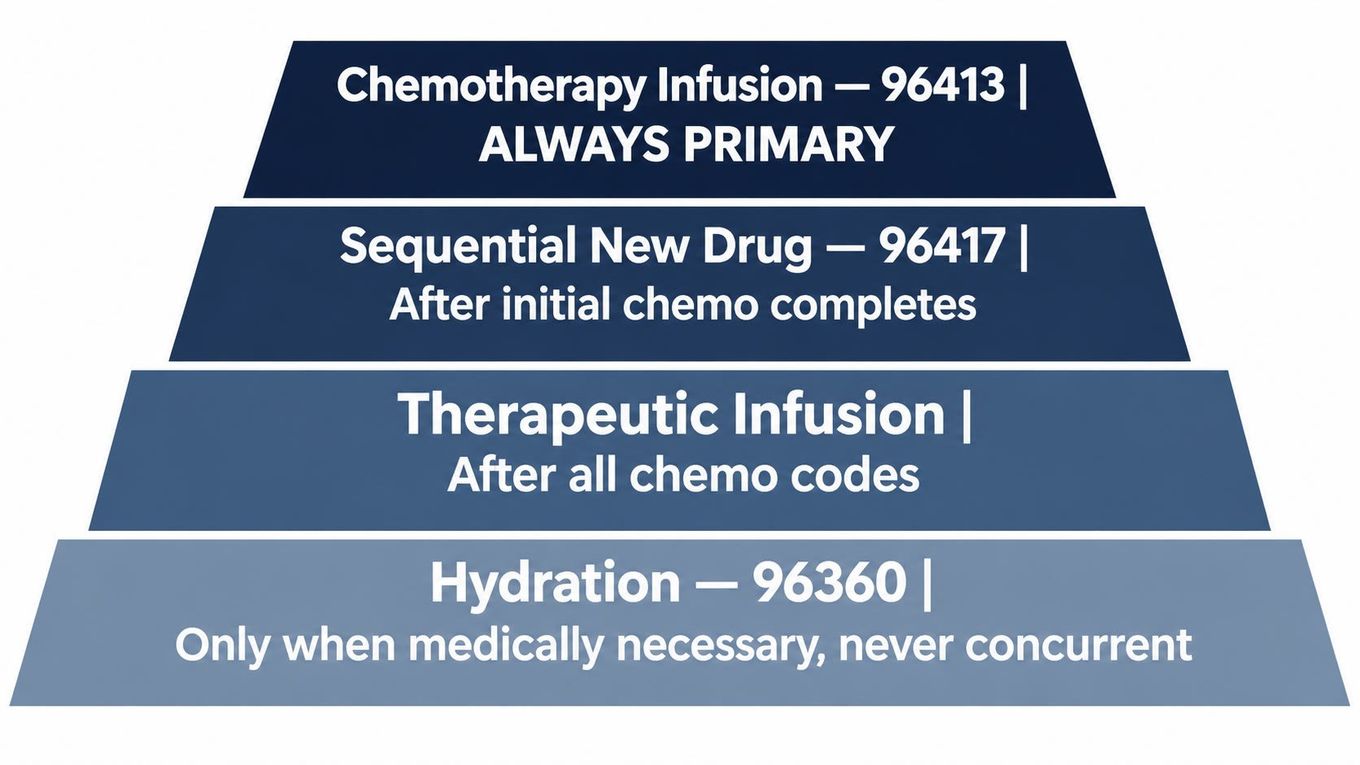
The sequencing rule is where most practices hemorrhage revenue. When a patient receives chemotherapy followed by a supportive drug (say, an antiemetic infusion), the chemotherapy code (96413) is the initial service. The supportive drug infuses sequentially, not as a new initial. Billing a second 96413 for the supportive infusion is an NCCI violation and will be denied. Modifier 25 on a same-day E&M is similarly misapplied more often than not: it's valid only when the physician performs a significant, separately identifiable evaluation on the same day as infusion, and the documentation has to support that explicitly.
Drug Billing: J-Codes, Units, and Waste Modifiers
Every drug administered during an oncology encounter requires a HCPCS Level II J-code billed alongside the administration CPT. J-codes cover the drug itself; the CPT covers the administration service. Both are required.
Billing the wrong number of units on a J-code is one of the leading denial triggers in oncology. Units must reflect the actual dose administered, calculated against the code descriptor (which specifies a quantity per unit, often per milligram or per milliliter). Rounding up to the vial size when only a portion was used, or billing by vial when the descriptor is per-milligram, produces an overpayment exposure or a denial depending on the payer.
Drug waste modifiers in 2026:
- JW modifier: Appended to the J-code to report discarded drug from a single-use vial. Required by Medicare and adopted by a growing number of commercial payers when any portion of a vial was discarded. The wasted amount is billed separately on a second line with JW.
- JZ modifier: Appended when no drug was wasted; the entire vial or dose was used. Required on Medicare claims when nothing was discarded; signals to the payer that no JW claim is pending.
Both JW and JZ are required modifiers, not optional. Missing JW where waste occurred can constitute improper billing. Missing JZ when nothing was wasted can trigger a request for wastage documentation that holds up payment.

The Buy-and-Bill Model and Why Drug Billing Errors Are So Costly
Under the buy-and-bill model, an oncology practice purchases chemotherapy, immunotherapy, or biologics directly, administers them, and then bills the payer for reimbursement. Medicare Part B reimburses most Part B drugs at ASP+6% (average sales price plus a 6% add-on to cover acquisition and handling costs). Commercial payers have their own contractual rates, which vary.
The financial exposure in buy-and-bill is significant: a single infusion of a targeted biologic can cost tens of thousands of dollars. If the J-code is wrong, the units are off, or the NDC (National Drug Code) number is missing or incorrect, that claim can be denied in full. The practice has already paid for the drug. Recovering that denial through appeal takes weeks, and not all appeals succeed.
This is why oncology billing can't be managed by a generalist billing team that handles J-codes occasionally. The margin for error at this revenue level is effectively zero.
2026 Radiation Oncology Coding Changes Every Practice Needs to Know
The 2026 Medicare Physician Fee Schedule brought significant structural changes to radiation oncology CPT codes. Many practices and their billing teams haven't fully adapted, and the result is a growing pool of retroactive denials and silent underpayments in commercial remits.
What changed effective January 1, 2026:
- CPT codes 77402, 77407, and 77412 (simple, intermediate, and complex radiation treatment delivery) are now the only treatment-delivery codes accepted regardless of setting, whether freestanding clinic or hospital outpatient. Prior to 2026, their use was restricted.
- CPT code 77387 (image-guided radiation therapy, IGRT) is now available only for physician billing, not hospital billing. Facilities billing 77387 on outpatient claims will be denied.
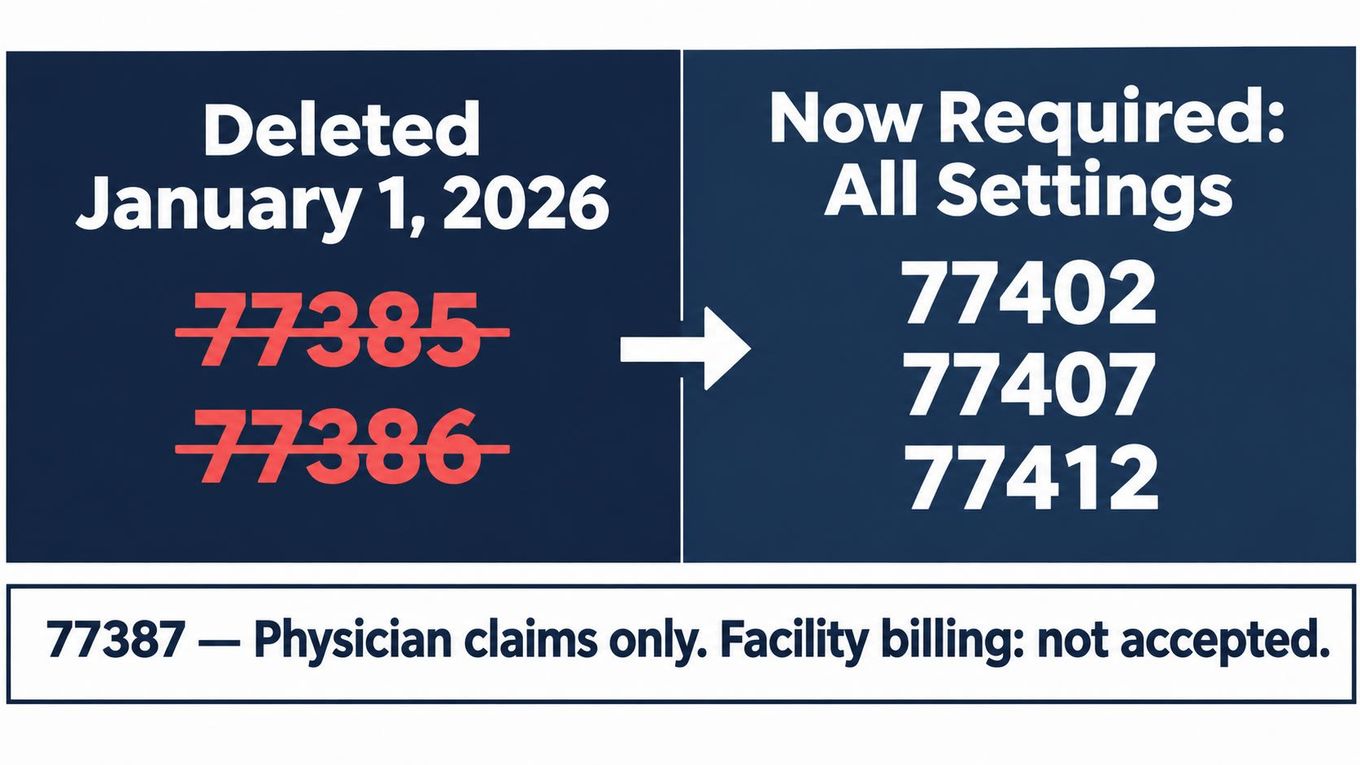
Commercial payers have not uniformly updated their fee schedules to match the new bundling structure. That gap between the Medicare coding change and commercial payer adoption is producing retroactive denials at practices that updated their codes correctly but submitted to a commercial payer that hasn't aligned its policy yet. Practices should verify current LCD and medical policies with each payer directly, as adoption timelines vary significantly. Navigating this requires a billing team that tracks payer-specific LCD (Local Coverage Determination) updates and follows up proactively when remits don't match expected reimbursement.
For more on how coding changes affect revenue, see our medical coding services overview.
Where Oncology Claims Get Denied
Oncology denial rates trend higher than most specialties because the claims are more complex and the documentation requirements are stricter.

The most common denial categories, and what to do about each:
| Denial Type | Root Cause | Recovery Action |
|---|---|---|
| Medical necessity | ICD-10 diagnosis code doesn't support the treatment or CPT billed; staging information missing | Obtain documentation from treating oncologist; appeal with clinical notes and staging records |
| J-code unit error | Units billed don't match dose given or code descriptor | Correct and resubmit with treatment administration record; include NDC detail |
| Infusion hierarchy violation | Sequential drug billed as a second initial service | Recode with correct add-on or sequential code; appeal with clinical timeline documentation |
| Prior authorization mismatch | Treatment administered doesn't match the auth scope (wrong drug, dose, or frequency) | Contact payer to extend or amend auth retroactively if clinical record supports it |
| Missing JW/JZ modifier | Drug waste not documented per payer requirement | Resubmit with correct modifier and administration log |
| Radiation CPT bundling | Old code structure used after 2026 effective date, or commercial payer hasn't aligned to new codes | Appeal with payer policy documentation; track commercial LCD updates proactively |
| Same-day E&M denied | Modifier 25 applied but documentation doesn't support a separately identifiable service | Obtain physician attestation; appeal with the specific documentation that supports the E&M separately |
Tracking denials by root cause, not just by payer, is what separates a reactive billing operation from a proactive one. For a deeper look at denial patterns and appeal strategy, see our denial management services guide.
Prior Authorization in Oncology: A Real Operational Burden
The American Medical Association's 2025 Prior Authorization Physician Survey found that physicians spend an average of 13 hours per week on prior authorization, handling an average of 40 prior authorization requests per physician per week. In oncology, that burden is concentrated and unforgiving: most chemotherapy regimens, all biologics and immunotherapy agents, and virtually all targeted therapy require prior authorization before the first infusion. The authorization must match the claim precisely: the drug, dose, frequency, and ICD-10 code must all align.
Authorization gaps are one of the most preventable denial sources in oncology billing, and one of the most commonly mismanaged. A practice billing for an infusion that wasn't authorized, or whose auth expired during a long treatment course, loses that reimbursement entirely unless a retroactive authorization can be secured. Most payers won't grant one.
A well-run prior authorization workflow for an oncology practice includes:
- Pre-treatment eligibility verification including auth requirements by drug and payer
- Auth submission with supporting clinical documentation before each treatment cycle
- Tracking of auth expiration dates across active patients
- Real-time escalation when auth is pending and treatment is imminent
- Appeal workflow for retrospective auth denials with documented medical necessity
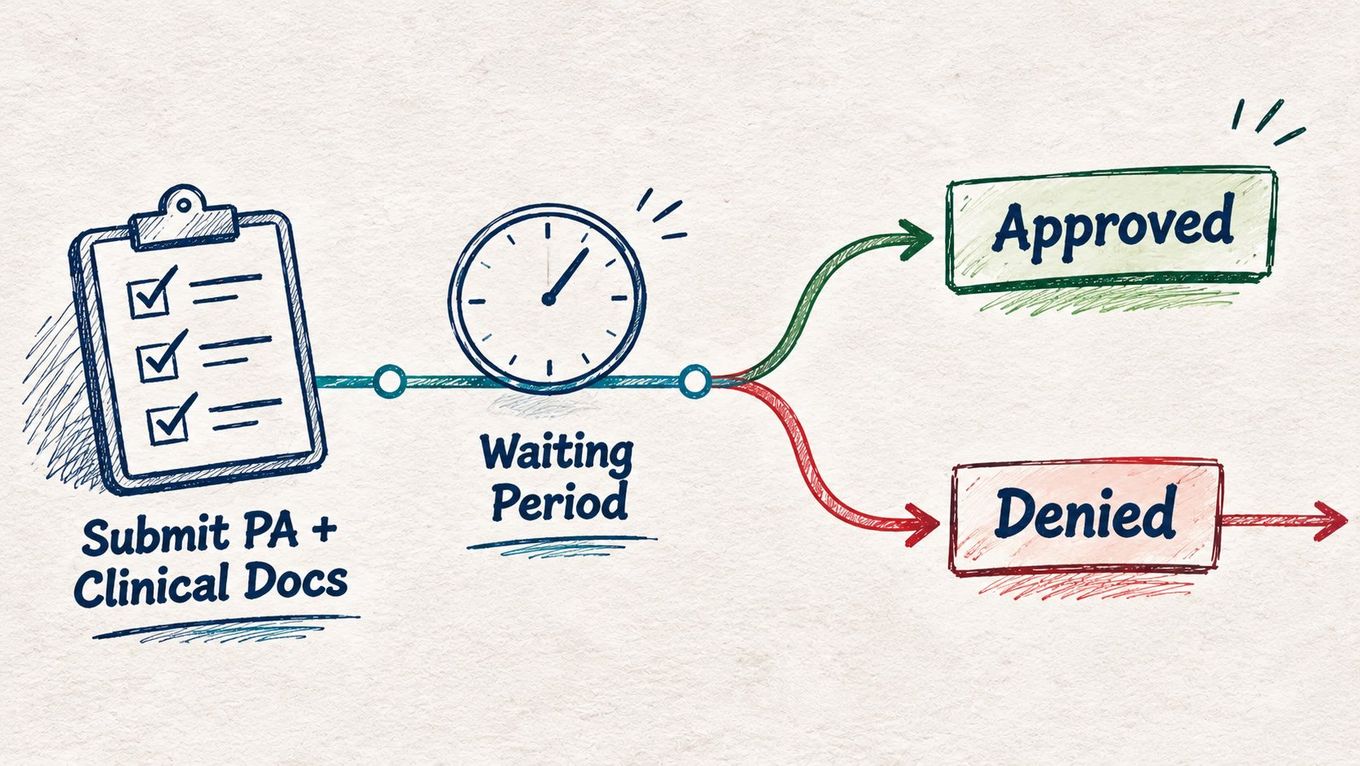
For more on how prior authorization management works in a physician practice context, see our prior authorization services guide.
What to Look for in an Oncology Billing Partner
Not every RCM firm is equipped to handle oncology, and the difference between a specialist partner and a generalist matters in a specialty where a single miscoded drug claim can represent tens of thousands of dollars in denied revenue. When evaluating an oncology billing partner, ask:
- Do their coders hold oncology-specific certifications? Look for AAPC or AHIMA credentials with oncology or hematology specialization, not just general CPC certification.
- Can they demonstrate J-code accuracy rates? A firm handling oncology billing should be able to speak specifically to drug billing accuracy, not just overall clean claim rates.
- How do they track the CPT and payer-policy changes specific to oncology? The 2026 radiation oncology coding changes are a good litmus test: ask how they adapted.
- What is their prior authorization workflow? A vague answer here is a red flag in a specialty where auth gaps are a leading denial source.
- Do they have experience with buy-and-bill and specialty pharmacy billing? These are fundamentally different workflows, and not every billing team understands both.
- What does their denial overturn rate look like, and can they document it? Results matter more than process descriptions.
For a broader look at what separates a strong RCM partner from a mediocre one, see our guide to what to ask before hiring a medical billing company.
Why Trust This Article
Clarity Health RCM was founded on the operational foundation of Quality Medical Billing, established in 1988. Our revenue cycle team brings over 40 years of combined billing and coding experience across physician specialties, led by President and CEO Estelle Sandoval.
The CPT code rules, modifier requirements, and 2026 coding changes cited in this article draw from CMS documentation, ACCC (Association of Community Cancer Centers) coding guidance, AMA CPT guidelines, and published payer LCD updates. We flag payer-specific policies as they were current at time of writing; policies change, and billing teams should verify current LCD and coverage determination documents for each payer before submitting claims.
This content is informational guidance for practice operations, not billing or coding advice for a specific claim or clinical scenario.
How Clarity Health RCM Supports Oncology Physician Groups
Oncology physician groups working with Clarity get a billing operation configured specifically for cancer care complexity:
- Chemotherapy CPT coding: Coders trained in infusion sequencing, hierarchy rules, and NCCI compliance.
- J-code drug billing: Precise unit calculation, NDC detail, and JW/JZ modifier documentation built into the workflow.
- Radiation oncology coding: Fully updated to the 2026 code structure; commercial payer LCD tracking for the gap between Medicare policy and commercial alignment.
- Prior authorization: Auth tracking integrated into the billing workflow, not bolted on after a denial.
- Denial management: A team that can distinguish a J-code unit error from an infusion hierarchy violation, and appeals accordingly.
We work with outpatient oncology physician groups, infusion centers, and multi-specialty practices that include oncology as a service line. If your practice is seeing persistent denials on drug claims, struggling with the 2026 radiation coding changes, or carrying more AR days than your treatment volume justifies, that's the conversation to have.
Learn more about our outpatient physician billing services or contact our team for a revenue cycle review.
Frequently Asked Questions
What are oncology billing services?
Oncology billing services are specialized revenue cycle management services for cancer care practices, physician groups, and infusion centers. They cover the full billing workflow: from eligibility verification and prior authorization through chemotherapy CPT coding, J-code drug billing, claim submission, denial management, and AR follow-up, with coders and billing staff trained in oncology-specific rules rather than general medical billing.
Why is oncology billing more complex than standard medical billing?
Oncology billing combines several of the most demanding elements of medical billing at once: high-cost drug billing under the buy-and-bill model, infusion administration sequencing rules governed by CMS hierarchy guidelines, prior authorization requirements for virtually every treatment, and coding requirements that span CPT, HCPCS J-codes, ICD-10 diagnosis codes, and claim modifiers. A coding error on a J-code for a biologic drug can deny a claim worth tens of thousands of dollars. The complexity is compounded by frequent coding updates, payer-specific LCD policies, and 2026 radiation oncology code restructuring that many commercial payers haven't fully aligned to yet.
What CPT codes are used for chemotherapy billing?
The core chemotherapy administration codes are 96413 (IV infusion, initial hour), 96415 (each additional hour, add-on), 96417 (sequential IV infusion of a new drug, up to 1 hour), 96409 (IV push, single or initial substance), and 96411 (IV push for each additional substance/drug, add-on). These are administration codes only; the drug itself is billed separately using its HCPCS J-code. The CMS infusion hierarchy dictates that chemotherapy administration must be sequenced first on the claim, before therapeutic infusions or hydration.
What are JW and JZ modifiers in oncology billing?
JW and JZ are HCPCS modifiers that document drug waste on oncology claims. JW is appended to a J-code line when a portion of a single-use vial was discarded; it allows the practice to bill for the wasted amount separately and is required by Medicare and adopted by a growing number of commercial payers. JZ is appended when no drug was wasted and the entire dose was administered. Both are required modifiers on Medicare claims. Missing JW where waste occurred creates a compliance exposure, and missing JZ can trigger documentation requests that delay payment.
What is the buy-and-bill model in oncology, and how does it affect billing?
Under the buy-and-bill model, an oncology practice purchases chemotherapy, biologics, or immunotherapy drugs directly, administers them in the office or infusion center, and then bills the payer for reimbursement. Medicare Part B reimburses most Part B drugs at ASP+6% (average sales price plus 6%). Because the practice carries the drug acquisition cost upfront, accurate J-code billing, including correct units, NDC detail, and waste modifier documentation, is critical. A denied drug claim at this price point is not a minor administrative issue; it's a significant cash-flow disruption that requires immediate appeal.
How did the 2026 radiation oncology coding changes affect billing?
Effective January 1, 2026, CPT codes 77402, 77407, and 77412 became the only accepted treatment-delivery codes regardless of care setting, replacing a previous structure that restricted their use. CPT 77387 (IGRT) is now available for physician billing only, not hospital billing. Commercial payers have been inconsistent in aligning their fee schedules to these changes, which has produced retroactive denials and underpayments at practices that submitted claims correctly under the new codes but billed to a payer that hadn't updated its policy. Practices should verify current LCD and coverage determination policies with each payer directly, as adoption timelines vary and previously denied claims under old bundling policies may be recoverable on appeal.