Nephrology Billing Services: Why Kidney Care Practices Lose Revenue Most Billing Teams Never Find
November 27, 2026 · 10 min read
Nephrology billing runs on a payment model most billing teams have never encountered: the ESRD Monthly Capitation Payment, a bundled monthly fee covering dozens of services at once.
The revenue problem isn't visible. It doesn't show up in denial reports. It shows up as paid claims that pay less than they should, every month, compounding across every patient on your panel.
At a Glance: The Three Revenue Streams in Nephrology Billing
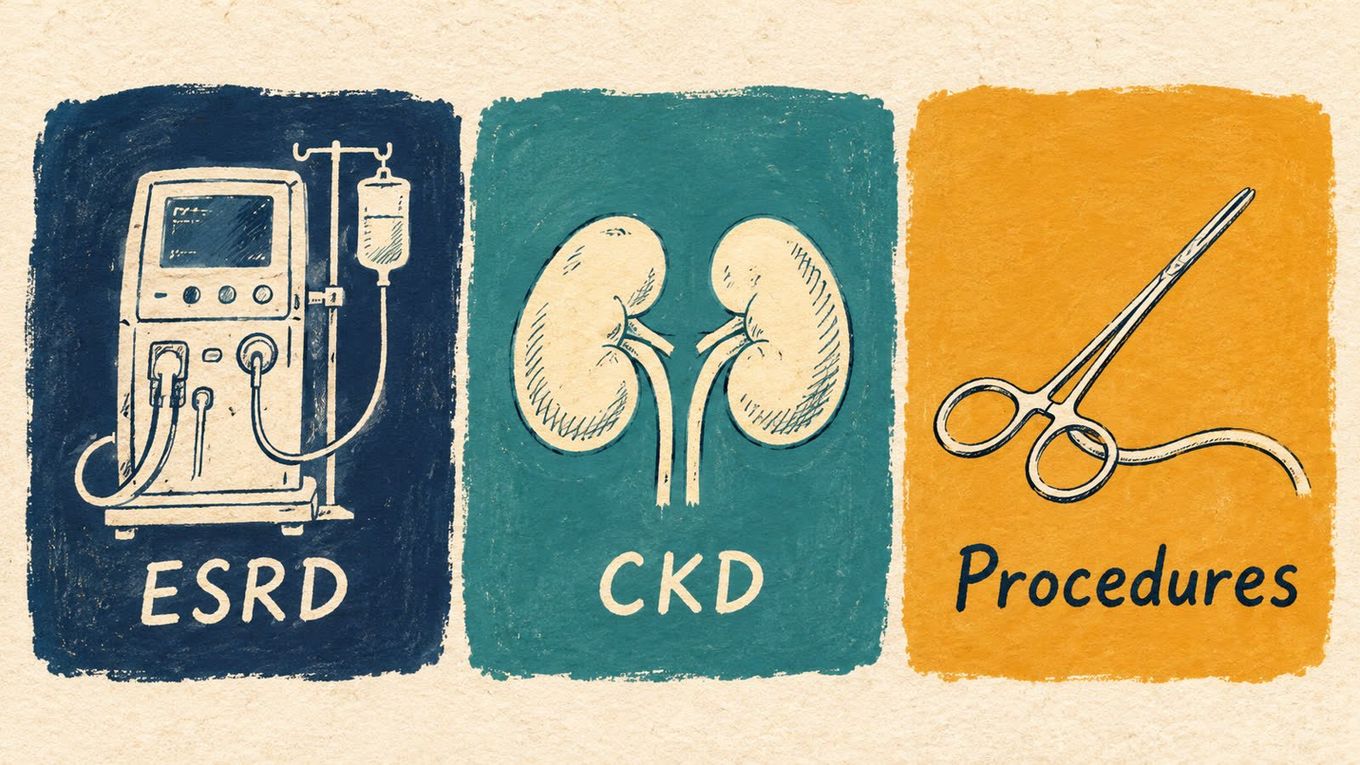
A nephrology practice doesn't bill one way. It bills three, each with its own coding logic, bundling rules, and denial patterns.
| Revenue Stream | Primary Codes | Key Complexity |
|---|---|---|
| ESRD Management (dialysis patients) | 90960, 90961, 90962 | Monthly capitation; visit count determines code |
| CKD Management (pre-ESRD) | 99202–99215 (E/M) | Staging specificity drives medical necessity |
| Procedures | 50200, 90935, 90937 | Bundling rules; modifier requirements |
Miss the rules in any one of these and the revenue loss compounds monthly.
The ESRD MCP Model: Where Most Billing Teams Get Lost
For dialysis patients, Medicare pays nephrologists through the ESRD Monthly Capitation Payment (MCP) system, not per visit. One code per patient per month, based on face-to-face visit count.
MCP Code Selection Table
| CPT Code | Face-to-Face Visits (Month) | Patient Age |
|---|---|---|
| 90960 | 4 or more | 20+ |
| 90961 | 2–3 | 20+ |
| 90962 | 1 | 20+ |
Other patient groups use different code sets:
- Pediatric in-center patients: 90951–90959
- Home dialysis patients: 90963–90966 (by age group)
The visit-count logic is the same across all groups. The selection has to happen per patient, per month, not by facility average or by default.
The Underpayment Problem That Never Triggers a Denial
This is where practices lose the most money without knowing it.
What goes wrong:
- Billing team pulls from incomplete encounter logs
- Defaults to 90962 when documentation actually supports 90960
- Applies a lower visit-count code without verifying the month's encounters
What happens:
- Claims pay
- No denial is generated
- Revenue is simply less than it should be, every month, every patient
Why it's hard to catch:
- Underpayment doesn't appear in denial dashboards
- It looks identical to a correctly paid claim
- The gap only surfaces in a proactive claim audit, which most in-house teams don't run

What's Inside the MCP Bundle (and What Isn't)
Bundled (cannot be billed separately):
- Routine dialysis supervision (90935, 90937)
- Lab result review and medication management tied to ESRD
- Monthly care management related to the dialysis diagnosis
Outside the bundle (billable separately):
- Separately identifiable E/M services (requires modifier 25 and distinct documentation)
- Acute problems unrelated to ESRD
- Procedures: vascular access revision, renal biopsy, catheter placement
For practices with an inpatient dialysis rounding component, the complexity compounds further. See our guide to inpatient physician billing for how those encounters interact with the outpatient revenue cycle.
CKD Staging and ICD-10: Where Claims Go Wrong Before They're Submitted
For pre-ESRD patients, nephrologists bill standard outpatient E/M codes. Diagnosis coding is where most practices carry the highest claim quality and compliance risk.
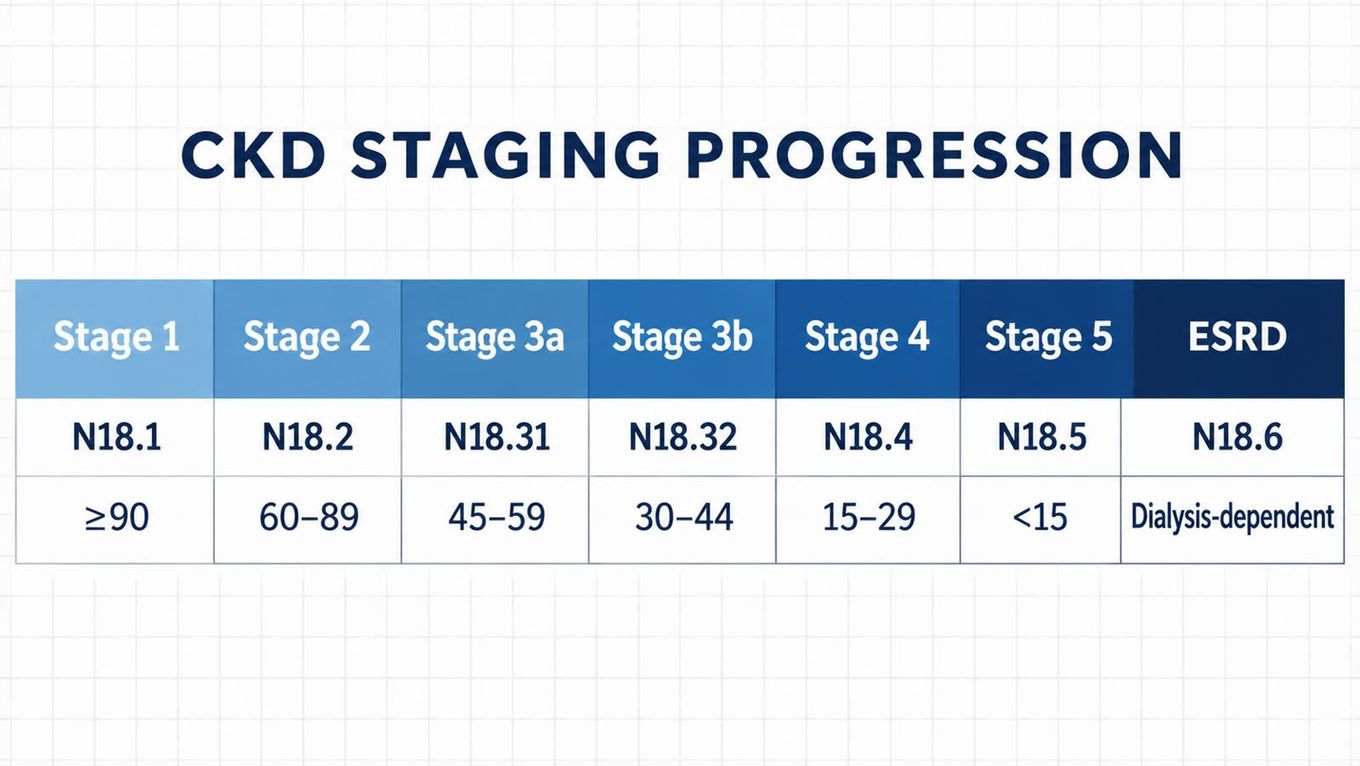
CKD Staging Codes
| ICD-10 Code | Stage | eGFR Range |
|---|---|---|
| N18.1 | Stage 1 | ≥90 (with kidney damage markers) |
| N18.2 | Stage 2 | 60–89 |
| N18.31 | Stage 3a | 45–59 |
| N18.32 | Stage 3b | 30–44 |
| N18.4 | Stage 4 | 15–29 |
| N18.5 | Stage 5 | <15 (pre-dialysis) |
| N18.6 | ESRD | Dialysis-dependent or post-transplant |
The Problem Code: N18.9 (Unspecified CKD)
Why practices use it:
- Documentation doesn't clearly specify the stage
- It's the path of least resistance when chart review is rushed
Why it's costly:
- Signals to payers that staging is unknown or undocumented
- Weakens medical necessity on every claim it appears on
- One of the most reliable predictors of medical-necessity denials in nephrology
- eGFR data exists in almost every chart; there's usually no excuse for N18.9
The Combination Code Problem Most Billing Guides Skip
When a nephrology patient has hypertension or diabetes alongside CKD, you cannot code those conditions separately. ICD-10 assumes a causal relationship.
Hypertension + CKD: Use I12.x combination codes, not N18.x and I10 together. There are only two valid codes in this family:
| ICD-10 Code | Use When |
|---|---|
| I12.9 | Hypertensive CKD, stages 1–4 (or unspecified stage) |
| I12.0 | Hypertensive CKD, stage 5 OR ESRD (dialysis-dependent) |
Diabetes + CKD: Use the combination code from the diabetes family, plus an N18.x for staging.
| Diabetes Type | CKD Code | Notes |
|---|---|---|
| Type 2 | E11.21 (nephropathy) or E11.22 (CKD) | Add N18.x for stage |
| Type 1 | E10.21 (nephropathy) or E10.22 (CKD) | Add N18.x for stage |
What happens when these are coded wrong:
- Doesn't always trigger an immediate denial
- Creates claim quality problems that compound quietly
- Surfaces as audit exposure, often in a CMS audit before it surfaces in AR
- Underpayment patterns that are difficult to unwind retroactively
The Medicare Secondary Payer Rule: A Revenue Problem That Takes 30 Months to Surface
This is the most underexplained complexity in nephrology billing, and the one with the longest tail of financial damage.
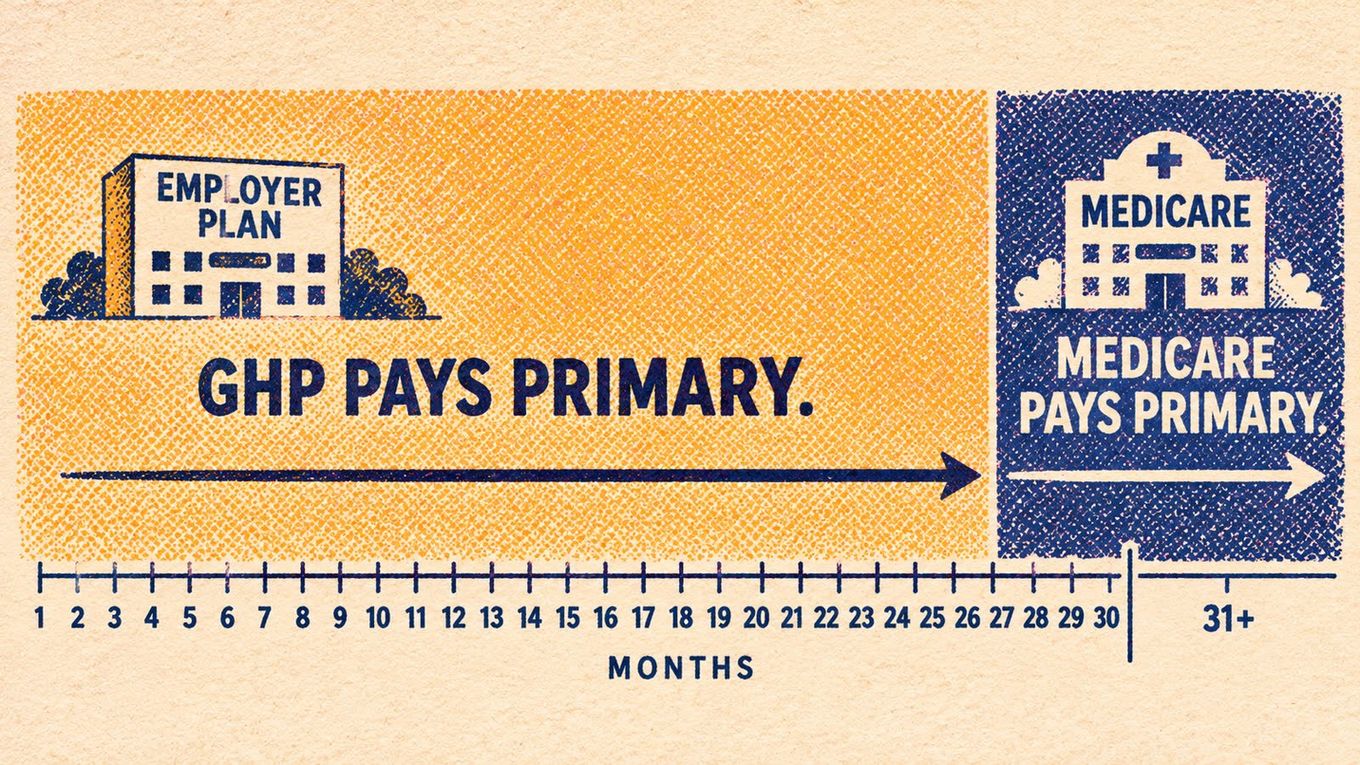
How the 30-Month Coordination Period Works
When a patient qualifies for Medicare specifically because of ESRD:
| Period | Primary Payer | Secondary Payer |
|---|---|---|
| Months 1–30 | Employer group health plan (GHP) | Medicare |
| Month 31+ | Medicare | GHP (if applicable) |
The Two Errors Practices Make
Error 1: Billing Medicare primary too early
- Happens when the coordination period isn't tracked per patient
- Result: denied or underpaid claims
- If the appeals window closes before it's caught, the revenue is unrecoverable
Error 2: Billing the GHP primary too late
- Some practices continue billing the GHP after month 30
- Result: those claims also deny
Why This Keeps Happening
- Requires tracking the ESRD Medicare start date per patient, not a blanket policy
- Each patient has a different coordination window start date
- Generalist billing teams managing nephrology alongside other specialties have no structural reason to monitor this
- In a large ESRD panel, the dollar impact is significant and usually invisible until it's past the appeal deadline
The Top Denial Patterns in Nephrology, and What Actually Fixes Them
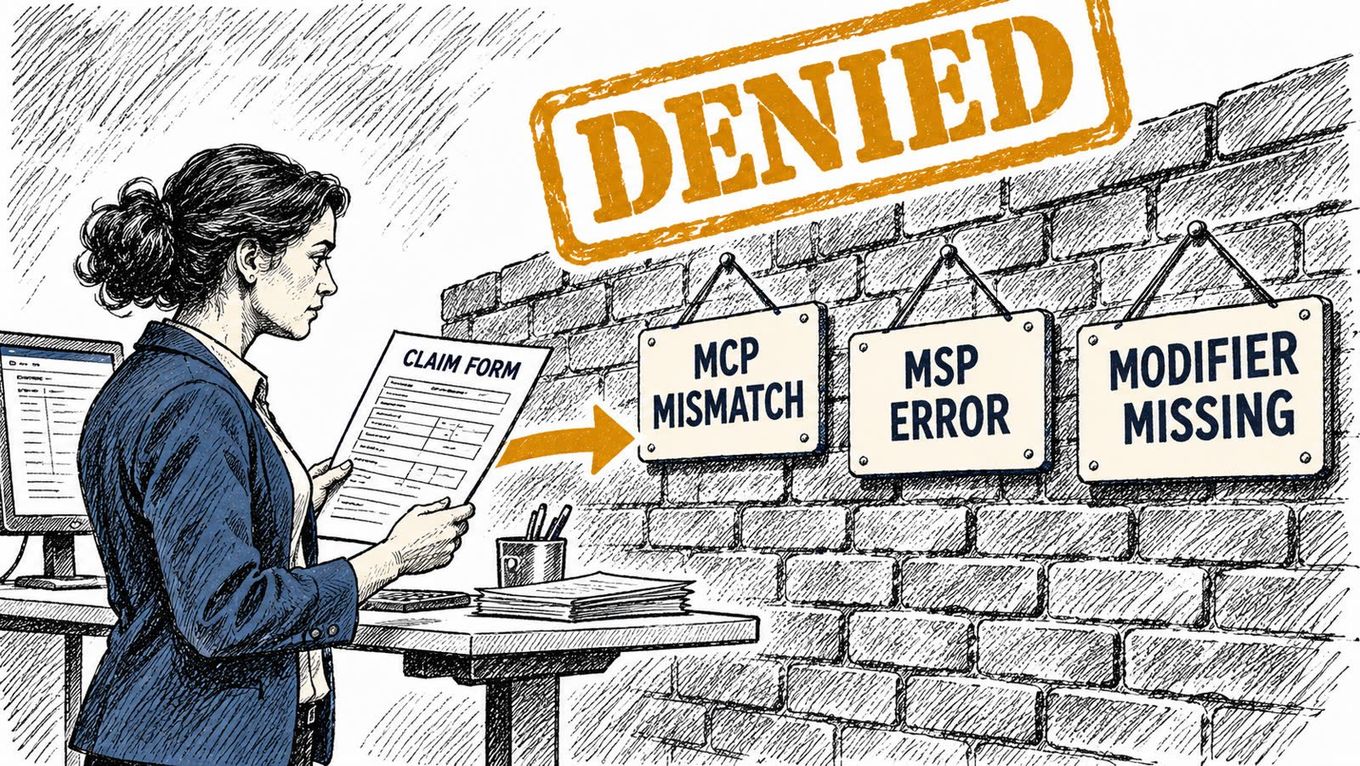
| Denial Reason | Root Cause | Fix |
|---|---|---|
| MCP visit count mismatch | Code doesn't match documented face-to-face visits | Monthly per-patient visit tracking before submission |
| Medical necessity: CKD | N18.9 or unspecified staging | Use N18.x staging codes; pull eGFR from labs at claim prep |
| Session code billed with MCP | Routine dialysis supervision billed separately | Pre-submission scrub for 90935/90937 paired with 90960–90962 |
| Modifier 25 missing | Separate E/M on same day as MCP, no distinct documentation | Modifier 25 checklist and documentation review for same-day claims |
| MSP sequencing error | Wrong primary payer during ESRD 30-month coordination period | Per-patient MSP tracking with coordination period start date |
| Combination code not used | N18.x + I10 or separate DM code instead of I12.x or E11.2x | Pre-submission diagnosis audit for hypertension and diabetes comorbidities |
Should You Handle Nephrology Billing In-House?
Honest answer: it depends, but the factors that matter are specific.
In-House Works When:
- Dedicated staff have worked nephrology billing specifically (not just general physician billing)
- Your practice management system supports per-patient MCP visit tracking by month
- You have denial management that surfaces underpayment patterns, not just rejected claims
- There's a clear owner for per-patient MSP coordination window tracking
In-House Struggles When:
- Generalist billers cover nephrology alongside other specialties
- Staff turnover disrupts accounts that require continuity (MCP tracking, MSP windows)
- Nobody is auditing claim quality proactively, only catching denials reactively
- The practice is growing its dialysis panel and volume is outpacing the team's capacity
The Real Case for Outsourcing
The argument for outsourcing nephrology billing isn't just cost, though the math usually works. It's the knowledge-retention problem:
- When a biller who understands ESRD MCP logic leaves, that institutional knowledge leaves with them
- A specialized billing partner carries expertise across your account, independent of any one person
- Underpayment from MCP under-selection gets caught in pre-submission review, not months later in an audit
Our guide on in-house vs. outsourced medical billing walks through the full decision framework.
Why Trust This Article
Clarity Health RCM traces its roots to Quality Medical Billing, founded in 1988.
Our background:
- 40+ years of combined revenue cycle experience under President and CEO Estelle Sandoval
- Full-cycle RCM across physician groups, specialty practices, and facilities nationwide
What we see in practices that come to us:
- MCP underpayment that wasn't visible in denial reports
- MSP sequencing errors that surfaced only after the appeals window closed
- ICD-10 combination code issues that created audit exposure without ever generating a denial
The CPT and ICD-10 information here reflects 2026 coding guidelines. Payer-specific policies and CMS rules change; verify date-sensitive details against CMS.gov and your MAC's provider manual before applying to live claims.
How Clarity Supports Nephrology Practices
Nephrology billing requires coders and billers who understand:
- ESRD-specific payment models and MCP code selection logic
- CKD staging and combination ICD-10 coding requirements
- Medicare coordination-of-benefits rules at the per-patient level
That's not what most generalist billing companies deliver.
What our team provides for outpatient physician practices:
- Pre-submission claim scrubbing: catches underpayment before it happens
- Denial management with root-cause tracking: not just appeals, but pattern fixes
- Reporting that surfaces underpayment patterns: not just denied claims
- Per-patient tracking infrastructure: MCP visit counts, MSP windows, combination code audits
Learn more about our medical billing services.
If your denial rate is above 5% or your AR over 90 days is climbing, contact our team.
Frequently Asked Questions
What CPT codes do nephrologists use for ESRD patients?
The primary codes are the ESRD Monthly Capitation Payment (MCP) codes: 90960 (4 or more face-to-face visits per month, patients 20+), 90961 (2–3 visits per month, patients 20+), and 90962 (1 visit per month, patients 20+). Pediatric in-center ESRD management uses codes 90951–90959; home dialysis management uses 90963–90966, by age group. These bundle most ongoing management services, so practices need to track visit count per patient each month to select the correct code. Selecting the wrong code from incomplete tracking is one of the most common sources of undetected underpayment in nephrology.
What ICD-10 codes are used in nephrology billing?
CKD stages map to N18.1 through N18.5, with ESRD coded as N18.6; stage 3 is split into N18.31 (3a) and N18.32 (3b). When a patient has both hypertension and CKD, use the I12.x combination codes rather than separate N18.x and I10 codes: I12.9 covers stages 1–4 or unspecified, and I12.0 covers stage 5 or ESRD. For diabetes with CKD, use E11.21 or E11.22 for Type 2 (or E10.21/E10.22 for Type 1), plus an N18.x code for the specific stage. Avoid N18.9 (unspecified CKD) whenever staging data exists in the clinical record.
Why do nephrology claims get denied more than other specialties?
Nephrology billing runs multiple coding systems in parallel, and each has its own failure modes. The most common denial drivers are MCP visit count mismatches from incomplete visit tracking, unspecified CKD coding (N18.9 instead of a staged N18.x code), missing modifier 25 on same-day E/M services, dialysis session codes billed alongside MCP codes that already cover those services, and Medicare secondary payer sequencing errors during the ESRD 30-month coordination period.
What is the ESRD 30-month Medicare secondary payer rule?
When a patient qualifies for Medicare based on ESRD, there is a 30-month coordination period. During months 1–30, the employer group health plan pays primary and Medicare pays secondary; starting at month 31, Medicare becomes the primary payer. Billing to the wrong primary during this window results in denied or underpaid claims, often after the appeals deadline has passed, which makes this error especially costly to recover from. This requires per-patient tracking of each patient's ESRD Medicare start date, not a blanket billing policy.
Can telehealth visits count toward the MCP face-to-face visit requirement?
Certain telehealth visit types can count toward the monthly face-to-face requirement under the MCP model, but the rules depend on visit type, technology platform, and current CMS policy, which has changed multiple times since 2020. Confirm current ESRD telehealth guidance at CMS.gov or with your MAC before applying to live claims.
How much do outsourced nephrology billing services cost?
Most medical billing companies charge 4%–9% of collected revenue, depending on specialty complexity, volume, and service scope; nephrology billing tends to sit toward the higher end. The relevant comparison isn't the billing fee alone: it's the fee against what your current setup is leaving uncollected through MCP under-selection (underpayment that never triggers a denial), denial write-offs, and unrecovered revenue from MSP sequencing errors.