The Medical Coding Audit You Keep Putting Off Is Costing You More Than You Think
November 16, 2026 · 8 min read
Here's a scenario we see more often than we'd like.
A practice gets a payer audit notice. Not a routine additional-documentation request: a real audit, with a repayment demand attached. The billing manager pulls the charts. The codes are mostly fine. But the documentation is thin. The time isn't logged correctly on the psychotherapy notes. The E/M levels are inconsistent across providers doing the same work.
None of it is fraud. It's just years of small documentation habits that never got corrected.
The practice ends up returning money it legitimately earned, because the charts don't tell the story the codes do.
A medical coding audit, a structured review of your clinical documentation and billed codes, is how you find this before a payer does. Done right, it doesn't just protect you from that scenario. It also recovers revenue you didn't know you were leaving on the table.
Most Practices Have the Incentives Backwards
The standard case for coding audits leads with compliance. Don't get audited. Avoid the OIG. Stay off payer radar.
That framing isn't wrong, but it misses the more immediate reason to care.
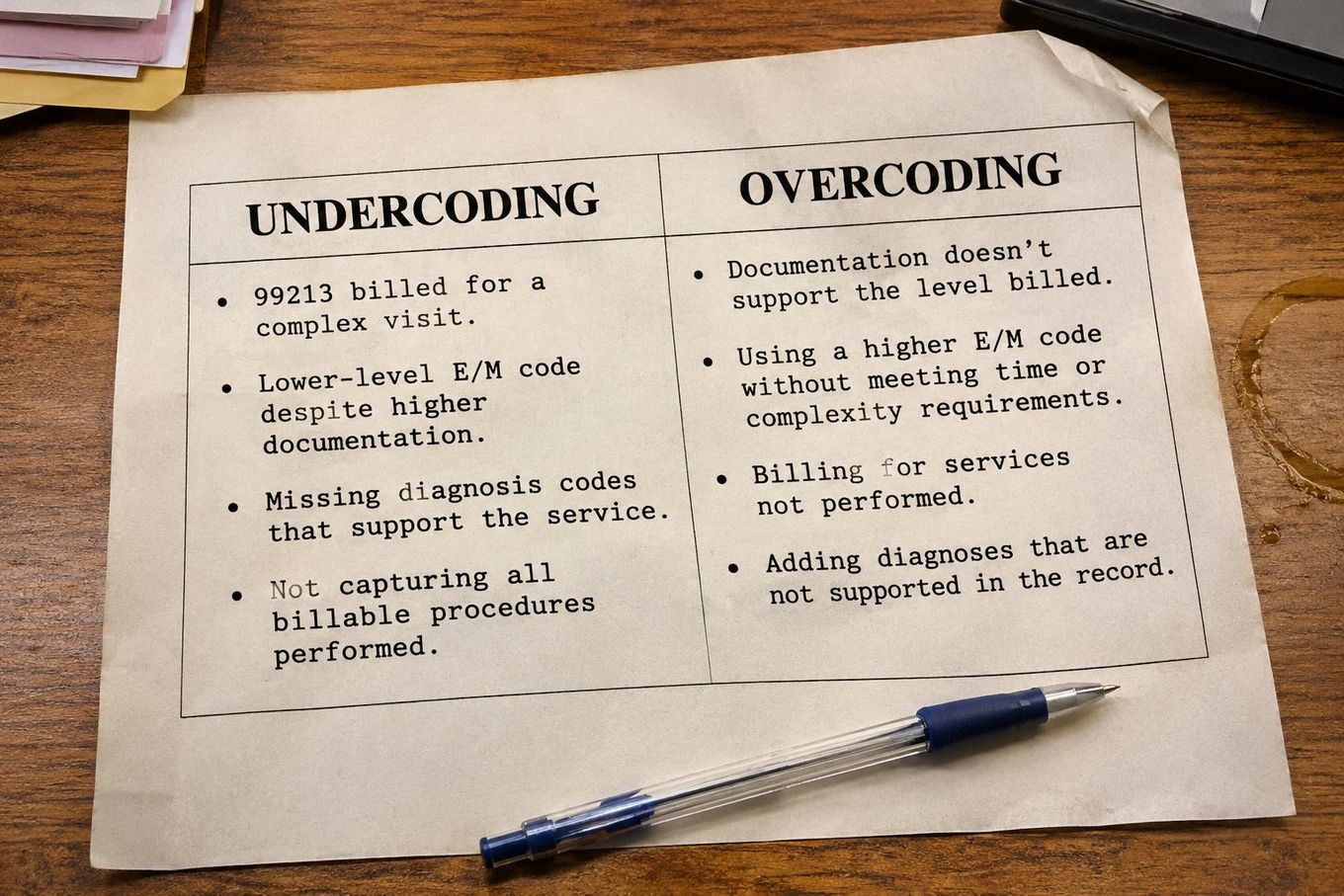
In our experience, undercoding is far more common than overcoding in most physician practices and behavioral health settings. A provider documents a complex visit but bills a 99213 out of habit. A psychiatrist runs 45-minute medication management sessions and codes them as 90833 add-ons without consistent time documentation. A hospitalist group captures the primary DRG but misses the comorbidities that would justify a higher-acuity assignment.
Each of those is a revenue leak. Not a dramatic one on any given day. But compounding, every month, quietly.
A coding audit finds both problems at once: the compliance exposure from documentation that doesn't support the codes, and the revenue gap from codes that don't reflect the work. The same chart review surfaces both.
What the Audit Actually Looks At
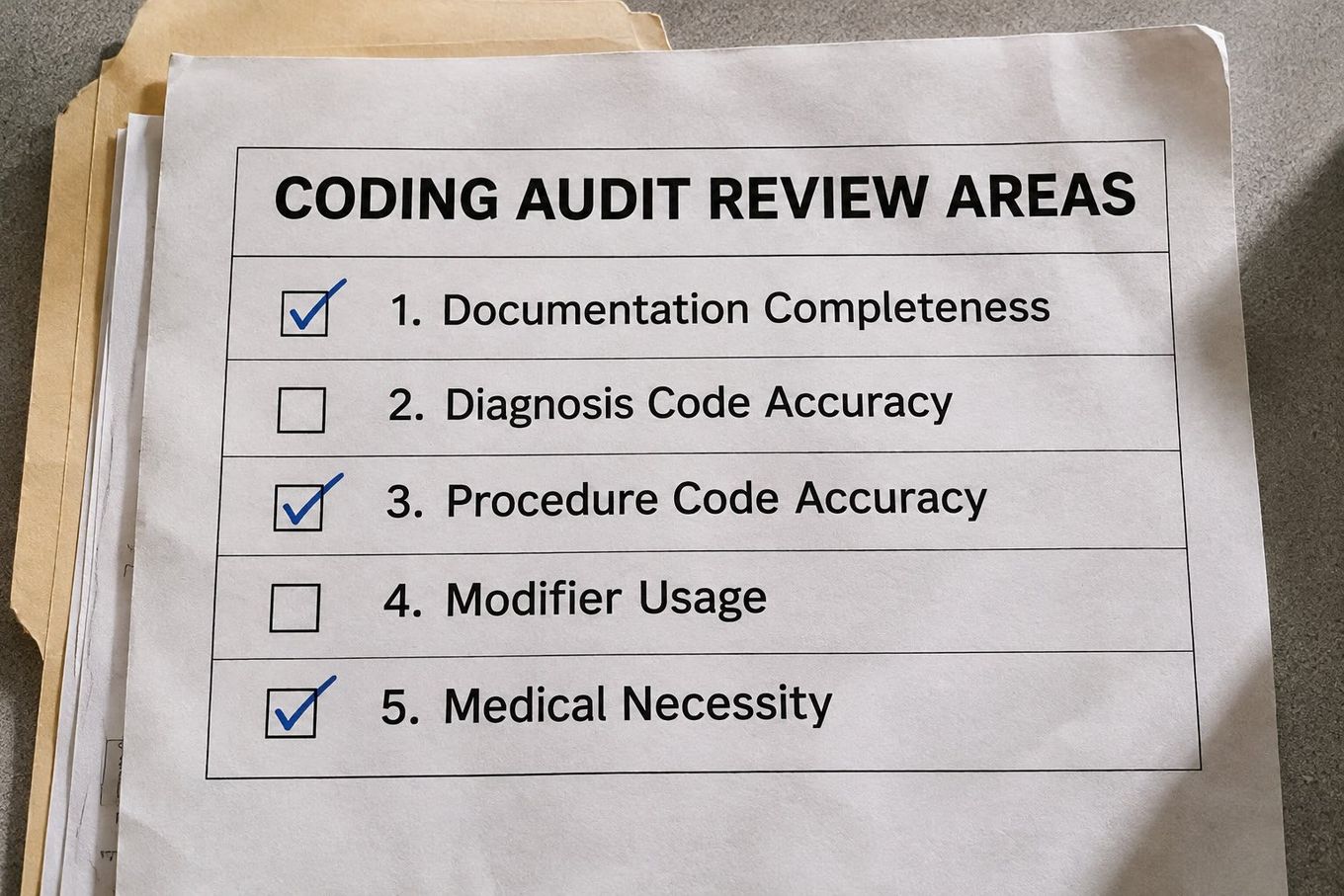
The five core areas in any medical coding audit are documentation completeness, diagnosis code accuracy, procedure code accuracy, modifier usage, and medical necessity compliance with payer rules.
That's the textbook answer. Here's what it looks like in practice, broken down by setting:
| Setting | High-Risk Areas |
|---|---|
| Outpatient physician | E/M level selection, modifier 25 and 59, NCCI edits |
| Behavioral health / psychiatry | Time documentation for 90832-90837, add-on code pairing, ICD-10 Chapter 5 specificity |
| Inpatient / hospitalist | DRG validation, CC/MCC capture, CDI alignment |
| IOP / PHP programs | Service intensity documentation, medical necessity criteria, daily note completeness |
Behavioral health sits at the top of this list for a reason. Time-based psychotherapy coding is unforgiving: a 90837 requires 53+ minutes of psychotherapy, documented. Not "approximately an hour." Not a vague note about session length. The minute threshold, the content of the session, the diagnosis link: all of it needs to be in the chart. We cover the specifics in our behavioral health billing guide, but the short version is that documentation habits built for paper charts don't survive a payer audit of time-based codes.
The same logic applies to IOP and PHP billing, where service intensity and daily documentation requirements are routinely underdone.
The Signs You're Already Behind
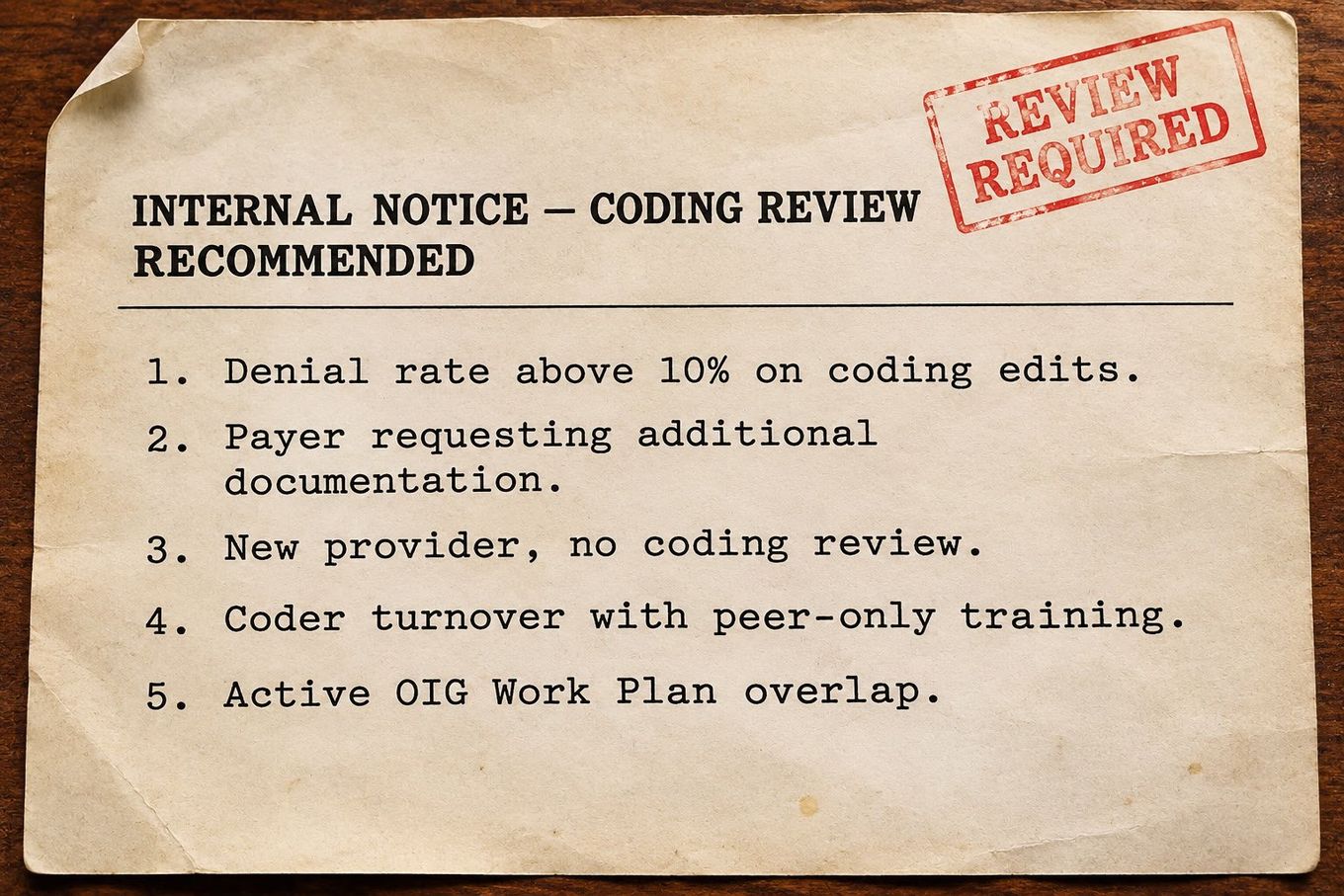
You don't need to wait for a denial spike to know an audit is overdue. But if any of these are showing up, the window to get ahead of it is closing:
- Denial rate above 10% on coding-related edits, and it's been there for two or more quarters
- A payer is asking for additional documentation on a specific provider or CPT code category
- You onboarded a new provider in the last year and no one reviewed their coding patterns
- Coding staff turned over and the new hire was trained by the existing team rather than from scratch
- An OIG Work Plan item overlaps with your specialty
The last one matters more than most practices realize. The OIG publishes its annual Work Plan: a list of billing patterns under active federal scrutiny. Psychiatric drug management, E/M services at certain facility types, and behavioral health modifier usage have all appeared on it in recent years. If you're billing in one of those areas and you haven't done a recent audit, you're carrying unmeasured risk.
Internal vs. External: Which One to Run
The honest answer is both, in sequence.
Internal audits are cheaper and can run on a continuous basis. The problem is that the person running the audit was usually trained by the same team that developed the coding patterns you're trying to catch. You're not going to audit yourself into finding systematic problems in your own workflow. Familiarity is the enemy of objectivity here.
External audits cost more but give you something internal reviews can't: an independent finding. That matters for two reasons. First, you're more likely to surface real patterns, because the reviewer has no stake in the outcome. Second, if a payer ever asks for evidence of corrective action, a third-party audit report carries weight that a self-review doesn't.
The practical approach:
- Run an internal baseline on 10-20 charts per provider using a standardized scoring template
- Flag anything showing error rates above 5%, by provider and by code category
- Bring in an external reviewer for a focused audit on those flagged areas
- Use the external findings to drive training, documentation template updates, and workflow changes
For practices already managing denial management in-house, the internal audit workflow should be feeding directly into denial appeal processes. A coding error caught on appeal is better than one left uncorrected, but a coding error caught before submission is better still.
The Part Where Most Audit Reports Fail You
Here's what a bad audit report looks like: "Provider A showed a 14% error rate. We recommend additional coder training."
That's not an audit finding. That's a placeholder.
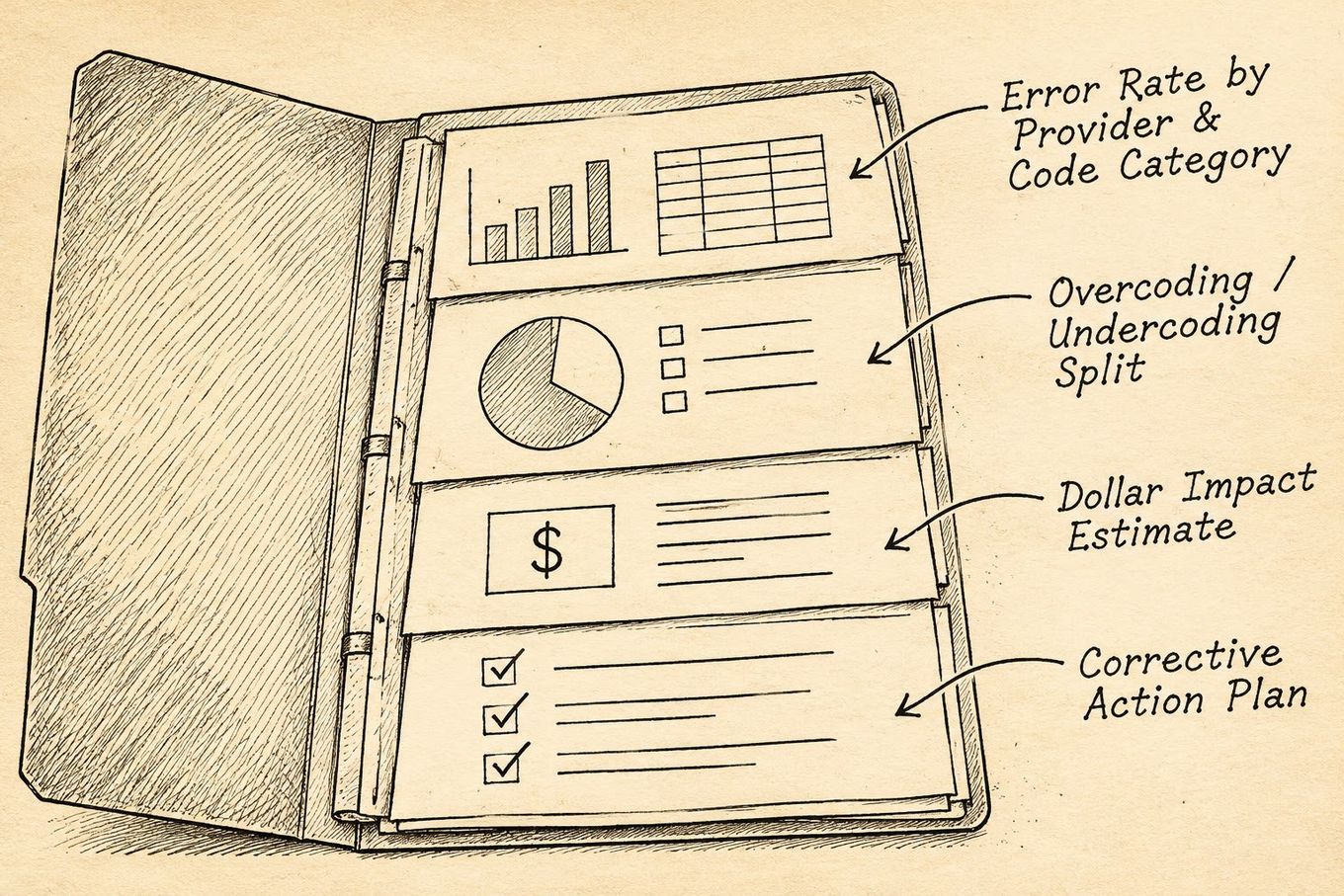
A useful audit report tells you the error rate by provider AND by code category, because a provider with high E/M error rates and a provider with modifier errors need completely different interventions. It shows you the overcoding-to-undercoding split, because the financial exposure runs in opposite directions. It estimates the dollar impact in both directions: how much you can recover from undercoding if you fix it, and how much refund liability you're carrying from overcoding.
Most importantly, it ends in a corrective action plan: not vague recommendations, but specific changes to documentation workflows, coding guidelines, and provider education.
That corrective action phase is where most external auditors leave you stranded. You get findings, you get a report, and then you're handed a list of problems with no mechanism to fix them. If you're evaluating a coding audit partner, ask them exactly what happens after the report is delivered. That question tells you a lot.
For hospital revenue cycle management, this matters especially on DRG validation audits. Recovering missed CCs and MCCs is worth real money, but only if the CDI workflow changes to capture those diagnoses going forward. Otherwise you're running the same audit next year with the same findings.
Why Trust This Article
Clarity Health RCM traces its roots to Quality Medical Billing, founded in 1988. Under President and CEO Estelle Sandoval, our team brings over 40 years of combined revenue cycle experience across behavioral health, inpatient and outpatient physician billing, and hospital and facility billing. The observations in this article aren't sourced from compliance textbooks: they come from chart reviews, denial appeals, and corrective action plans across real practices. Our coding and auditing services are built around the same framework we describe here.
If You Haven't Audited in 12 Months, Start There
The goal of a coding audit isn't to find out how bad things are. It's to find out exactly where the leaks are, so you can close them before someone else finds them first.
Most practices we work with are surprised by what shows up: not because the problems are severe, but because they've been invisible. Undercoding that looked like conservative billing. Documentation habits that worked fine until a payer decided to look closely.
If your practice hasn't had an external coding review in the last 12 months, or if you're watching denial patterns you can't fully explain, talk to our team. We'll tell you what we find, and what to do about it.
Frequently Asked Questions
What is a medical coding audit? A medical coding audit is a structured review of clinical documentation and billed codes to verify that the services a provider delivered are accurately coded, properly documented, and compliant with payer and regulatory requirements. Audits can be internal (run by the practice) or external (run by a third-party RCM or compliance firm), and can be prospective (before claim submission) or retrospective (after claims are processed).
How often should medical coding audits be conducted? Most compliance guidance, including MGMA and OIG recommendations, points to quarterly audits for active practices. High-risk specialties, practices with recent staff turnover, or those receiving payer scrutiny should audit more frequently. New providers should be audited within the first 90 days of onboarding.
What is the difference between a coding audit and a billing audit? A coding audit reviews whether the codes assigned to an encounter are accurate and supported by documentation. A billing audit reviews whether the claim was submitted correctly, to the right payer, with appropriate modifiers and supporting information. Both are part of a healthy revenue cycle, but they catch different types of errors at different points in the process.
What happens if a coding audit finds errors? Findings fall into two categories: overcoding (which may require refunds or adjustments to the payer) and undercoding (which represents recoverable revenue). The audit should produce a corrective action plan addressing documentation gaps, coder training needs, and workflow changes to prevent recurrence. For OIG-sensitive findings, some practices engage healthcare counsel before responding to a payer.
Can a coding audit actually improve my reimbursement? Yes, and often meaningfully. Undercoding is common and invisible without a systematic review. Providers who consistently bill at lower E/M levels than the documentation supports, or who miss add-on codes they're entitled to bill, leave real money uncollected. An audit quantifies that gap and gives coders the guidance to close it.
What is a focused medical coding audit? A focused audit targets a specific provider, CPT code category, or service line rather than a broad sample of all claims. Focused audits are typically triggered by a denial pattern, a payer request for documentation, or an OIG Work Plan item that overlaps with the practice's specialty. They go deeper than a general audit and are the right tool when you already know where the problem area is.
What is the difference between an internal and external coding audit? An internal audit is conducted by the practice's own coding or compliance staff. An external audit is conducted by an independent third party: an RCM firm, a compliance consultant, or a specialized coding review company. Internal audits are cheaper and can run continuously; external audits provide objectivity and produce findings that carry more weight with payers and regulators if corrective action is ever required.