Urology Billing Services: What It Actually Takes to Get Paid Right
November 27, 2026 · 13 min read
Most urology practices don't realize they have a billing problem until AR days quietly climb past 50 and denial rates creep into double digits. By then, the revenue leakage has been running for months; the fix takes longer than the problem did to develop.
Urology billing services specialize in managing the full revenue cycle for urology practices and physician groups: eligibility verification, charge capture, CPT/ICD-10/HCPCS coding, claim submission, denial management, and AR follow-up. Urology billing is significantly more complex than general outpatient billing because of its high procedure volume, National Correct Coding Initiative (NCCI) bundling rules, 90-day global surgery periods, and in-office drug administration with J-code and waste modifier requirements. Practices that partner with a urology-specialized billing service consistently see lower denial rates, faster reimbursements, and materially cleaner claim submissions than those relying on generalist billing staff.
Why Urology Billing Is Different From General Medical Billing
Most medical specialties bill a relatively predictable mix of evaluation and management (E&M) visits and a limited procedure set. Urology is different.
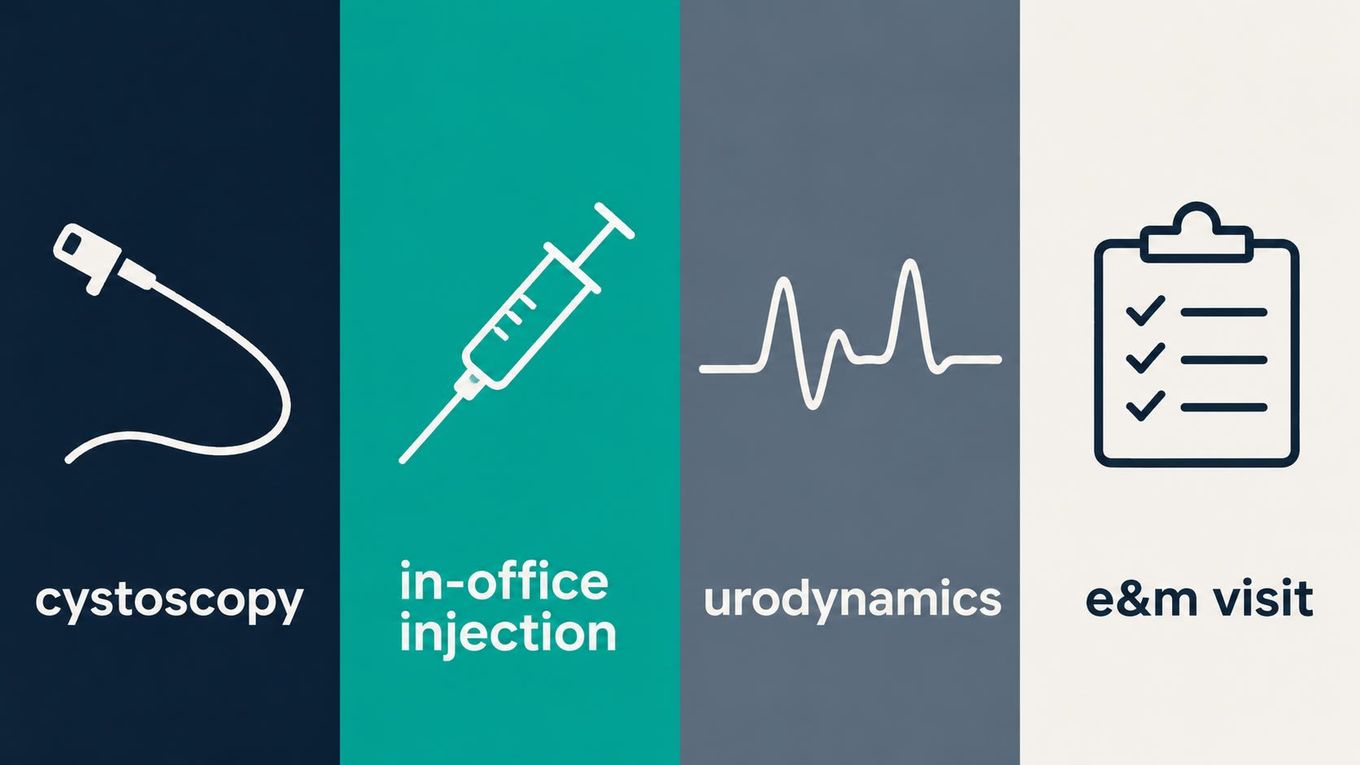
A single urology provider can bill a cystoscopy, a J-code drug injection, a urodynamics component study, and an E&M visit in the same day. Each of those has its own coding rules, modifier requirements, documentation standards, and payer-specific coverage criteria. Apply standard outpatient billing logic across that mix and you will generate denials.
There are four core factors that make urology billing genuinely more complex than general outpatient work:
- Procedure breadth. Urology spans in-office diagnostics, surgical procedures, in-office medication administration, and oncology-adjacent services. The CPT codes range from simple diagnostic cystoscopy (52000) to robotic prostatectomy (55866), each with its own bundling exposure and documentation requirements.
- NCCI editing. CMS maintains NCCI edits that define which procedure pairs cannot be billed together without an appropriate modifier. Urology has a high density of these pairs, particularly around cystoscopy, ureteroscopy, and biopsy codes.
- Global surgery periods. Many common urology procedures carry 10-day or 90-day global periods. Any service performed within that window is considered bundled into the original procedure fee unless a specific modifier justifies separate billing, and that justification has to be in the documentation.
- In-office drug billing. Urology practices routinely administer medications in the office, from leuprolide acetate (Lupron) for prostate cancer to onabotulinumtoxinA (Botox) for overactive bladder. These require HCPCS J-codes, NDC documentation on the claim, accurate unit calculation, and Medicare-specific waste modifiers. This is a category most generalist billers get wrong consistently.
The Procedures That Carry the Most Billing Risk
Not all urology services are equally complex to bill. The ones below generate disproportionate denial volume and require the most coding precision from your billing team.
| Procedure | CPT Code(s) | Key Billing Risk |
|---|---|---|
| Diagnostic cystoscopy | 52000 | Bundled into same-session operative cystoscopy without modifier 59 |
| Ureteral stent placement | 52332 | Frequently bundled with ureteroscopy; active NCCI edit pair |
| Ureteroscopy with lithotripsy | 52356 | Stone extraction vs. fragmentation vs. stent-only: code selection errors common |
| ESWL | 50590 | Site-of-service errors (office vs. ASC) affect reimbursement significantly |
| TURP | 52601 | 90-day global period; unrelated visits require modifier 24 or 79 |
| Transrectal/transperineal prostate biopsy | 55707-55715 | Approach-specific coding required since January 2026 (CPT 55700 deleted); technical/professional split errors remain common |
| Urodynamics components | 51726-51798 | High audit exposure; components billed without required documentation |
| In-office Lupron administration | J9217 | NDC documentation, unit calculation, and JW/JZ modifier for drug waste |
J9217 is the 2026 HCPCS code for leuprolide acetate depot suspension, 7.5 mg per unit (covers Lupron Depot and Eligard). Bill per 7.5 mg unit administered: a 22.5 mg injection = 3 units of J9217. Other formulations use different codes (e.g., J1950 for the 3.75 mg formulation). Medicare requires either the JW modifier for drug waste discarded or the JZ modifier attesting zero waste on all single-dose container drug claims.
The Denial Traps That Cost Urology Practices Real Money
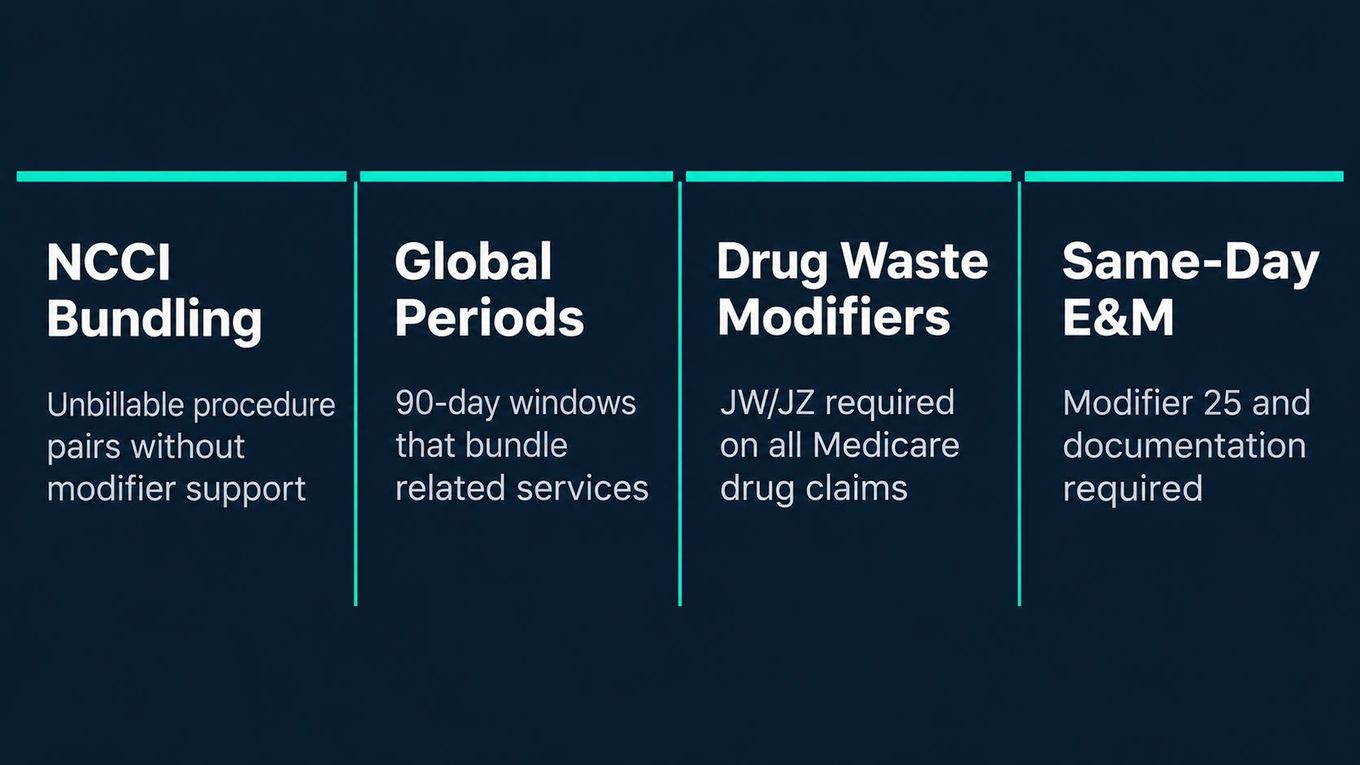
NCCI Bundling Errors
The NCCI edits define procedure pairs where one code is considered a component of the other. In urology, some of the most common bundling traps involve cystoscopy codes billed alongside operative procedures performed in the same session, or ureteroscopy billed with stent placement when the stent was placed as part of the same approach.
If the diagnostic service was genuinely separate and distinct, modifier 59 (or the more specific X-modifiers) documents that; it has to be supported by documentation. A bundling denial without proper modifier support and documentation will almost always fail on appeal, and the write-off is then permanent.
Global Period Violations
TURP (CPT 52601) carries a 90-day global period under Medicare's global surgery policy. That means any evaluation and management service, any procedure return for a related complication, and any post-surgical visit falls within that global window and is bundled into the original surgical fee — unless a modifier signals otherwise.
The key modifiers for global period situations in urology:
- Modifier 24: Unrelated E&M visit during the global period (requires documentation that the visit is unrelated to the surgery)
- Modifier 57: E&M visit that led to the decision for major surgery, billed the day before or day of the procedure
- Modifier 78: Return to the operating room for a related procedure during the global period (such as a complication requiring re-intervention)
- Modifier 79: Unrelated procedure performed during the global period
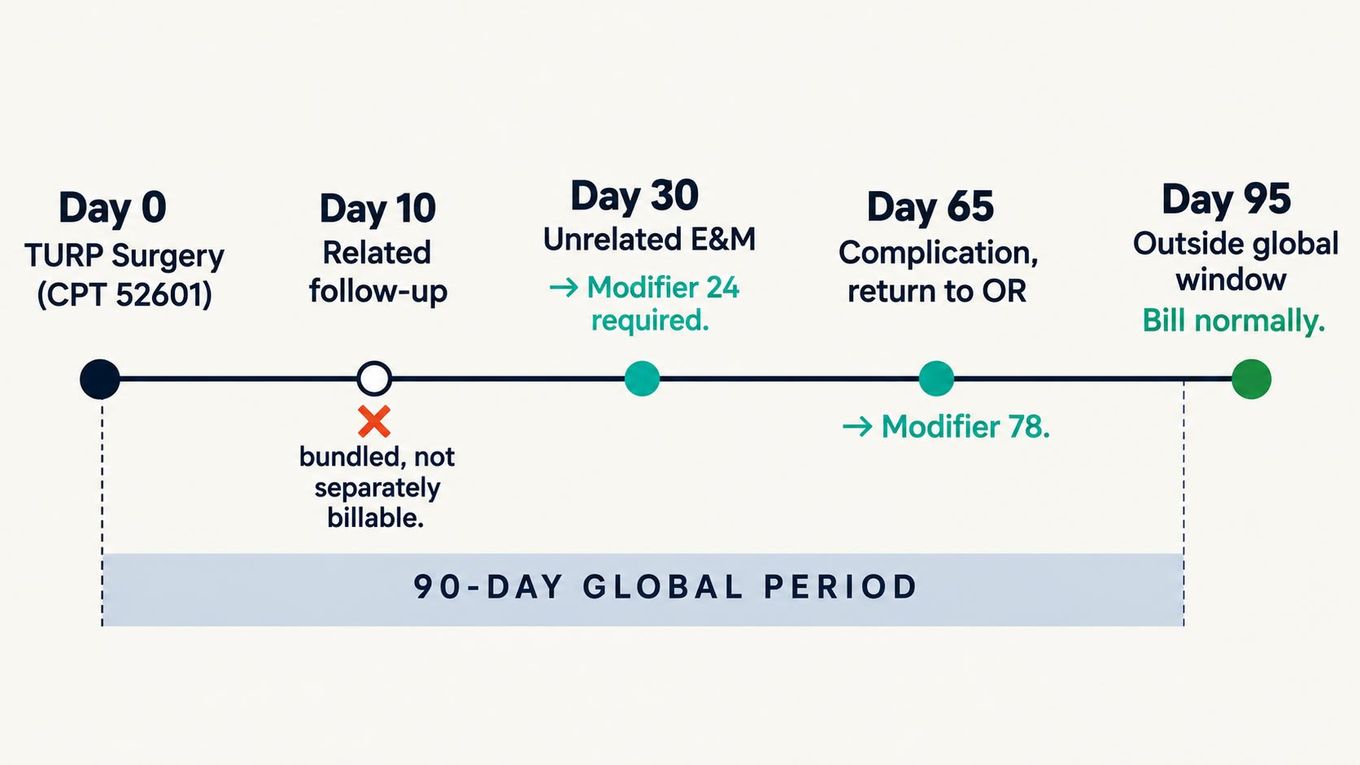
Billing without these modifiers inside a global period is one of the most common and most avoidable sources of urology denial. It is also an audit flag: post-pay audits specifically look for claims that appear to unbundle global period services.
Same-Day E&M and Modifier 25
When a provider bills both an E&M visit (99213 through 99215) and a procedure on the same day, the E&M must be significant, separately identifiable, and documented as such, with modifier 25 appended to the E&M code. Without modifier 25 and supporting documentation, the payer bundles the E&M into the procedure and denies it. With modifier 25 but weak documentation, the claim becomes an audit target, and the denial comes later, on a post-pay review.
In-Office Drug Administration
This is the category generalist billers get wrong most consistently. Medicare requirements for drug billing include:
- The correct HCPCS J-code for the specific drug, formulation, and dosage administered
- NDC (National Drug Code) reported on the claim line
- Accurate unit calculation based on the dosage administered, not the package size
- JW modifier: Reports drug amount discarded and not administered to the patient (Medicare-covered drugs)
- JZ modifier: Attests that no drug was wasted (single-dose vial used completely, effective January 1, 2023; required on all applicable claims after July 1, 2023)
A single error in any of these elements can produce a denial or, worse, an overpayment that surfaces on a post-pay audit. Commercial payers have their own requirements that often diverge from Medicare, and those rules change with contract updates and payer policy revisions.
Medicare vs. Commercial: Where the Rules Diverge
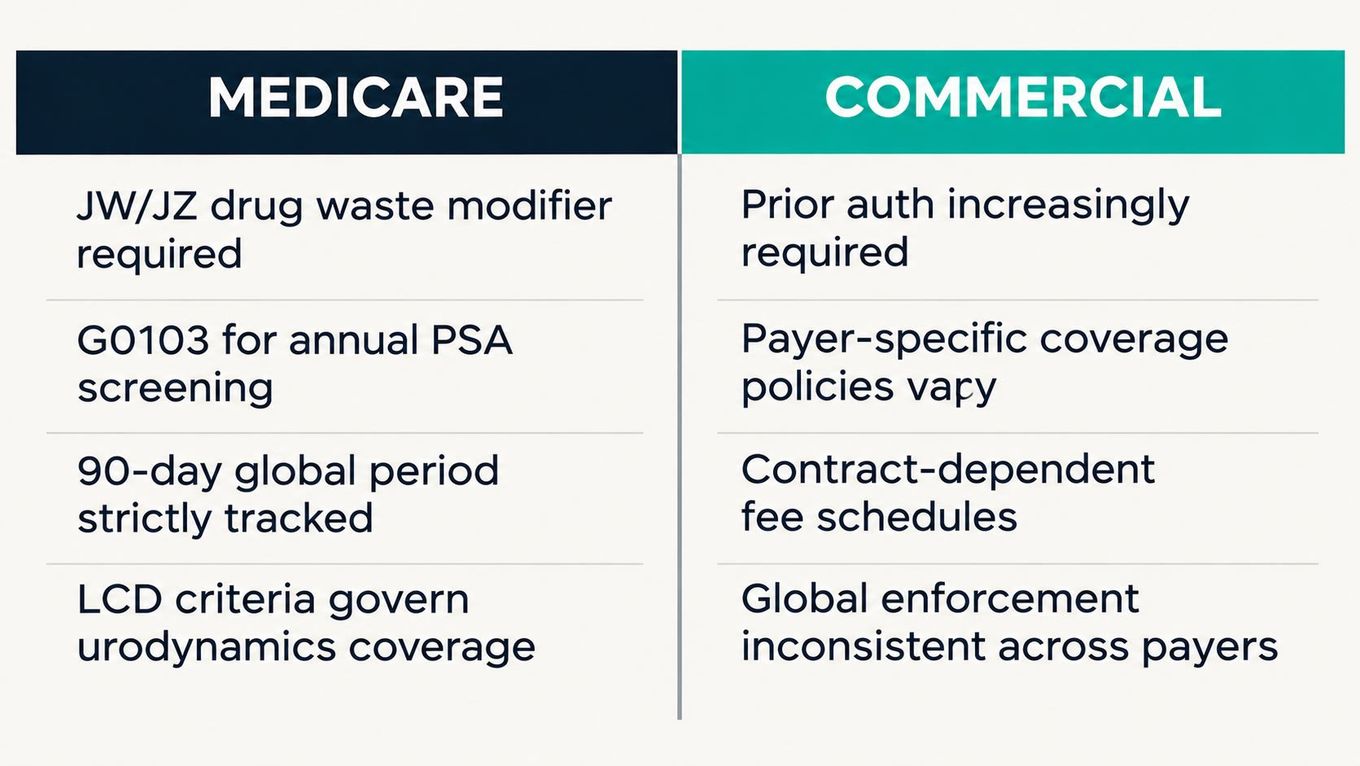
Medicare and commercial payers handle urology billing differently in areas that affect day-to-day claims management. Knowing which rules apply to which payer is not optional; it is the difference between a clean claim and a preventable denial.
| Billing Area | Medicare | Commercial Payers |
|---|---|---|
| Global surgery tracking | Strict; audited via claims history | Varies by payer; some do not enforce global tracking |
| Prior auth (cystoscopy, urodynamics) | Generally not required | Increasingly required; payer- and plan-specific |
| Prostate cancer screening PSA | G0103 annually for covered beneficiaries | Covered under ACA preventive; varies by plan year |
| Drug waste billing (JW/JZ) | Required on all applicable drug claims | Not universally required; check each payer policy |
| Urodynamics medical necessity | Specific LCD criteria apply | Payer-specific medical policies; prior auth common |
| Place of service (office vs. ASC) | Distinct fee schedules; reimbursement varies | Contract-dependent; often impacts professional fee |
The gap between Medicare's structured rules and commercial payer variability is where most urology billing teams get stretched. A biller who knows Medicare well but hasn't built out payer-specific rule sets for Aetna, Cigna/Evernorth, Optum, and UnitedHealthcare will leave money on the commercial side, particularly on prior authorization and urodynamics medical necessity denials.
What to Look for in a Urology Billing Service
Not every billing company that lists urology as a specialty has actually worked the complexity. Most of them list procedures they can bill; few of them explain how they handle the situations where those claims fail. When evaluating a potential partner, ask these specific questions:
Coding credentials and urology experience. Ask about CPC-certified coders with demonstrable urology experience, not just general credentials. Urology-specific coding experience means knowing the NCCI edit pairs that apply to this specialty, understanding the documentation requirements for urodynamics, and being able to distinguish when a procedure modifier is appropriate versus when it's an audit red flag.
NCCI edit handling. Ask how the billing partner manages NCCI edit pairs before claim submission. The answer should include pre-submission claim scrubbing against the current NCCI edit tables, not just reacting to denials after the fact.
Global period tracking. Ask how they track global periods across their patient population. It should be systematic and built into the workflow. If the answer is "we watch for it," that is a red flag; it means the tracking is manual and inconsistent.
Drug billing workflow. Ask specifically how they handle J-code drug billing, NDC documentation, unit calculation, and the JW/JZ modifiers. This is specific enough that a genuinely experienced team will answer it directly. A vague answer is diagnostic.
Payer-specific rule sets. Ask whether they maintain payer-specific billing rules for your top five payers. The answer should be yes, and they should be able to describe what differs between Medicare and your largest commercial contracts for at least one common procedure.
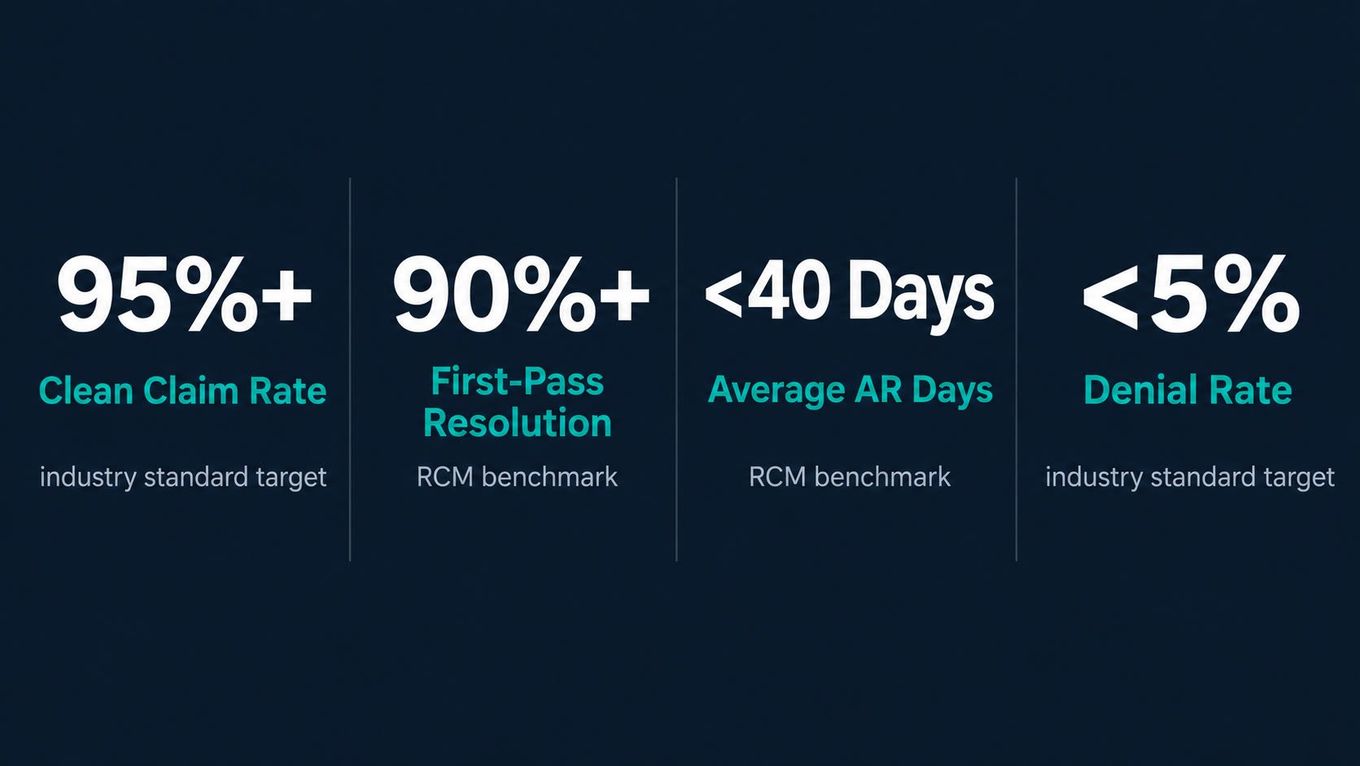
Performance benchmarks. A credible billing partner can tell you their current clean claim rate, first-pass resolution rate, average AR days, and denial rate across their urology book of business. If those numbers are unavailable or not tracked, that tells you something important about how they operate.
| Benchmark | Target Range |
|---|---|
| Clean claim rate | 95% or above |
| First-pass resolution rate | 90% or above |
| Average AR days | Under 40 days |
| Denial rate | Under 5% |
These benchmarks reflect general RCM industry targets. Confirm actual performance against your specific payer mix and contract terms when evaluating any billing partner.
In-House vs. Outsourced Urology Billing: A Decision Framework
Outsourcing is not the right answer for every urology practice. The decision depends on volume, complexity, and the current state of your billing operation.
| Situation | Likely Better Move |
|---|---|
| Small single-provider practice, simple payer mix | In-house or hybrid |
| Multi-provider group with high surgical volume | Outsource to specialty RCM partner |
| AR days over 45 and denial rate over 7% | Evaluate outsourcing or conduct billing audit first |
| In-house team dealing with consistent coder turnover | Outsource |
| Practice expanding to an ASC or adding surgical volume | Outsource for scalability |
| Established in-house team with RCM analytics in place | Keep in-house; consider a focused coding audit |
If you're working through this decision, our guide to in-house vs. outsourced medical billing covers the full cost and performance comparison, including how to calculate whether the percentage fee on outsourced billing is accretive or not based on your current denial and write-off rates.
Why Trust This Article
Clarity Health RCM traces its roots to Quality Medical Billing, founded in 1988. Under President and CEO Estelle Sandoval, the firm has built a team with more than 40 years of combined revenue-cycle experience across physician groups, outpatient practices, and facility billing.
The coding and billing guidance in this article is drawn from that operational experience: working actual claims, managing appeals across Medicare and commercial payers, and building denial prevention workflows for multi-provider practices across specialties. CPT codes, modifiers, and HCPCS J-codes cited here are current and accurate for 2026, cross-referenced against CMS documentation and current payer contract guidance where applicable.
Nothing in this article is legal, billing, or coding advice for a specific claim or situation. It is operational guidance for practice managers and billing decision-makers evaluating their revenue cycle options.
How Clarity Approaches Urology Billing
Urology is a natural extension of Clarity's physician billing work. Our team handles the full revenue cycle for outpatient physician groups across specialties, with the coding depth and denial management infrastructure that urology's complexity specifically requires.
That means pre-submission claim scrubbing against current NCCI edits, global period tracking built into the workflow rather than managed manually, payer-specific rules for your major commercial contracts, and a denial management process built to pursue appeals rather than absorb write-offs. Our medical coding services team includes coders experienced in procedure-heavy specialties who understand when a modifier is clinically defensible and when it is an audit exposure.
If your AR days are rising or your denial rate is trending the wrong direction, we can conduct a billing audit to identify where the leakage is occurring before you make decisions about your billing setup.
Review our physician billing services or contact us to schedule a revenue cycle assessment.
Frequently Asked Questions
What do urology billing services include? Urology billing services cover the complete revenue cycle for a urology practice: patient eligibility verification, charge capture, CPT/ICD-10/HCPCS coding for office visits and procedures, claim submission and tracking, payment posting, denial management and appeals, AR follow-up, and performance reporting. Urology-specialized billing services also include in-office drug billing (J-codes, NDC documentation, waste modifiers), NCCI edit management, and global period tracking: areas that require specialty-specific knowledge beyond general medical billing.
Why do urology claims get denied more than other specialties? Urology billing has a higher denial rate relative to general outpatient billing for several structural reasons: a dense set of NCCI bundling edits, 90-day global surgery periods on common procedures like TURP, same-day E&M and procedure billing that requires modifier 25 and supporting documentation, and in-office drug administration with specific J-code and waste documentation requirements. Each of those is a category where a billing error on a single claim produces a denial, and each requires specialty-level knowledge to prevent.
How much do urology billing services cost? Most urology billing companies charge a percentage of monthly net collections, typically in the 4-9% range depending on practice size, payer mix, and service scope. The right comparison is not just the percentage but what your clean claim rate, denial rate, and AR days look like before and after. A billing partner charging 7% that eliminates a 12% denial rate and reduces AR days from 60 to 35 generates far more net revenue than an in-house team that costs less but writes off appeals. For a full cost breakdown, see our guide to medical billing services cost.
What is a global period in urology billing? A global surgery period is a defined window following a surgical procedure during which all related pre- and post-operative care is bundled into the original procedure's reimbursement. CMS assigns each surgical CPT code a global period of 0, 10, or 90 days. TURP (52601), for example, carries a 90-day global period. Any E&M visit or related procedure within that window is considered bundled unless a modifier documents a specific exception: modifier 24 for an unrelated E&M, modifier 79 for an unrelated procedure, or modifier 78 for a return to the OR for a related complication. Billing without the right modifier inside a global period is a common source of urology denials and audit exposure.
What modifiers matter most for urology billing? The modifiers that come up most frequently in urology billing are: modifier 25 (significant, separately identifiable E&M on the same day as a procedure), modifier 59 (distinct procedural service, used to override appropriate NCCI bundling edits with documentation support), modifier 24 (unrelated E&M during a global period), modifier 79 (unrelated procedure during a global period), and modifier 57 (E&M the day before or day of a major surgical procedure that represented the decision for surgery). Drug billing uses JW (discarded drug waste) and JZ (zero waste attestation) for Medicare claims involving in-office injectable therapies.
Can a general medical billing company handle urology billing? Technically, any billing company can submit urology claims. In practice, results are consistently worse with generalist teams. Urology coding requires familiarity with a specific set of NCCI edit pairs, systematic global period tracking across a high-procedure-volume patient population, in-office drug billing with J-codes and NDC documentation, and payer-specific prior auth and coverage rules for procedures like urodynamics and cystoscopy. Denial rates and write-off rates tend to be materially higher with a generalist billing team than with a specialty-experienced partner.
What questions should I ask before hiring a urology billing company? Before hiring: ask about their coders' specific urology experience and credentials, how they manage NCCI edits before submission, what their clean claim and denial rate benchmarks look like for urology practices specifically, how they handle in-office drug billing including J-codes and waste modifiers, and whether they maintain payer-specific rule sets for your largest payers. For a full evaluation checklist, see our questions to ask before hiring a medical billing company.