What Physician Billing Services Actually Include (And What to Demand from Yours)
November 16, 2026 · 17 min read
Physician billing services manage the full professional fee revenue cycle for doctors, physician groups, and multi-specialty practices, from charge capture and coding through claim submission, denial follow-up, and payment posting. Done well, they reduce AR days, cut denial rates, and let your clinical team stay focused on care rather than chasing checks.
But not every billing partner delivers that. Here's what physician billing actually covers, what tends to break, and what separates a vendor that files claims from one that recovers revenue.
Physician Billing vs. Facility Billing: The Distinction That Matters
This one trips up a lot of practice managers, so let's clear it up quickly.
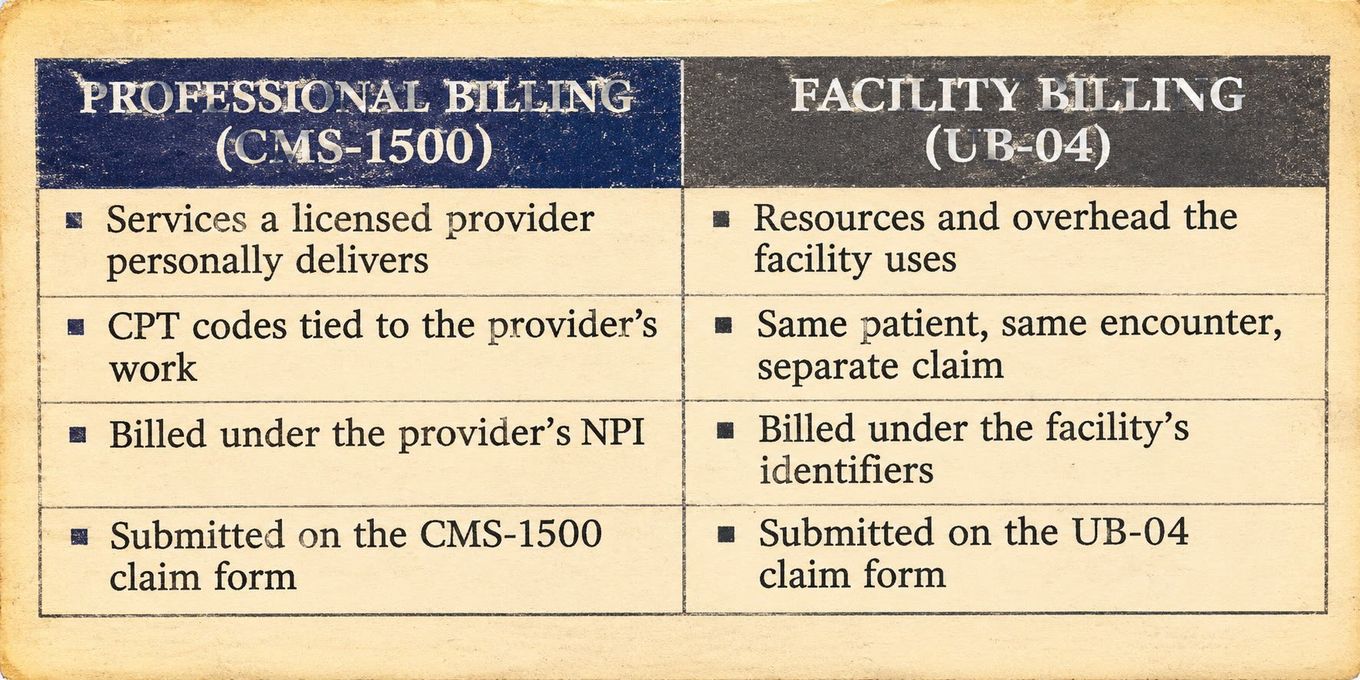
Physician billing (also called professional billing) covers claims for the services a licensed provider personally delivers. That's the CMS-1500 claim form, the CPT codes tied to the provider's work, billed under the provider's NPI.
Facility billing covers the resources and overhead a hospital or outpatient facility uses to deliver that same service. Same patient, same encounter, two separate claims submitted on a UB-04.
If your practice employs hospitalists, emergency medicine physicians, or anesthesiologists working inside a hospital system, you may be submitting professional fee claims while the facility bills separately. Your billing partner needs to understand that split and code accordingly. A lot of denials at the hospital-employed physician level come down to this distinction being handled sloppily.
What Physician Billing Services Should Actually Cover
Most billing companies list the same eight tasks on their website. The real question is what they do inside each one.
Here's the full scope of what a physician billing service should handle, and what distinguishes surface-level execution from revenue-protecting work:
| Service Component | Basic Execution | What Strong Partners Add |
|---|---|---|
| Charge capture | Enter charges from superbills or EHR exports | Flag missed or incomplete charges; audit encounter documentation before submission |
| Medical coding | Assign CPT/ICD-10-CM codes | Specialty-specific coder assignment; coding audits; modifier review (25, 59, 95, etc.) |
| Eligibility verification | Run pre-authorization checks | Real-time verification at scheduling and day-of-service; flag coverage gaps before the claim goes out |
| Claim submission | Submit electronically within 24-48 hrs | Clean claim rate tracking; scrubber rules updated for payer LCD/NCD changes |
| Denial management | Work denials as they appear | Root-cause analysis by denial code, payer, and provider; trend reporting with corrective action |
| Payment posting | Post EOBs and ERAs | Underpayment identification; contractual adjustment variance tracking |
| AR follow-up | Work accounts past 30 days | Stratified AR management by payer and age bucket; escalation paths for 90+ day claims |
| Reporting | Monthly collection summaries | Provider-level dashboards; payer mix performance; first-pass acceptance rate by specialty |
If a billing company can't describe what happens in the right-hand column, you're buying claim submission, not revenue cycle management.
The Physician Billing Claim Lifecycle: What Actually Happens
Understanding the full lifecycle of a physician claim helps you spot exactly where a billing partner adds value, and where most of them cut corners.
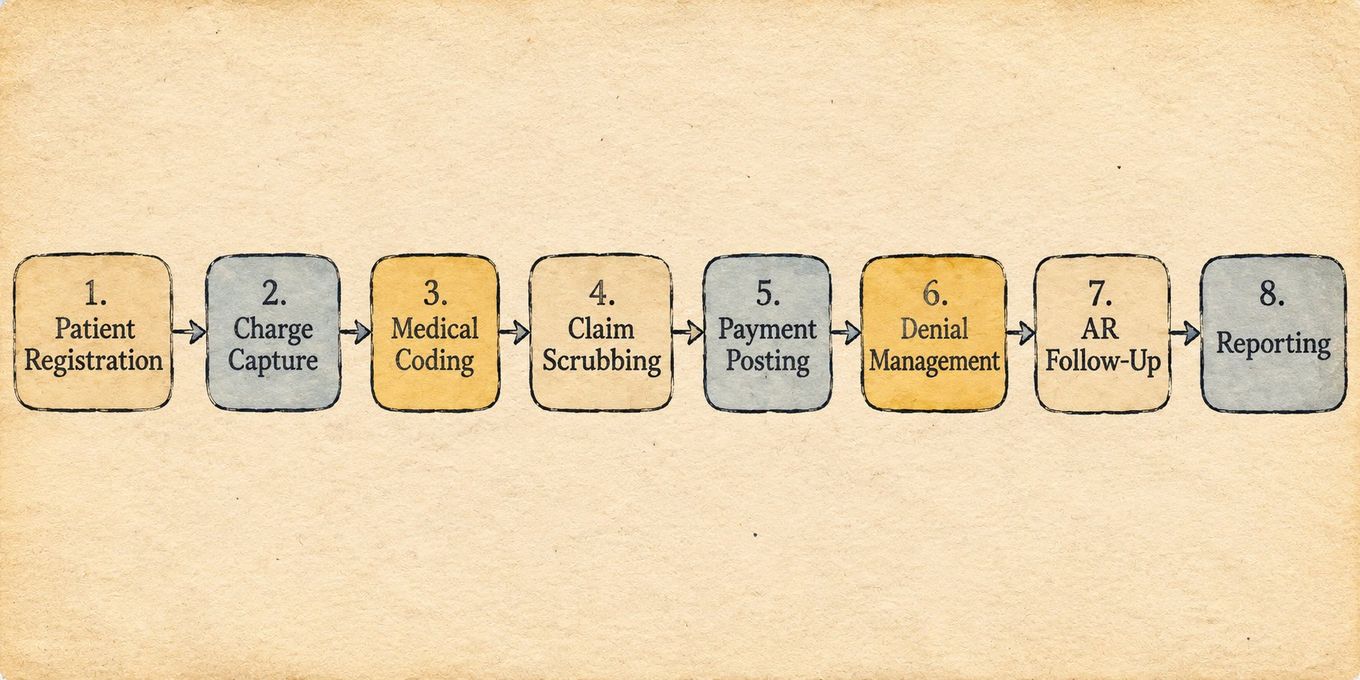
Step 1: Patient Registration and Eligibility Verification
Before a provider sees the patient, billing should already be working. Insurance coverage is verified, prior authorization requirements are confirmed, and any known coverage gaps are flagged. Practices that skip this step or run eligibility checks only at intake (not at the time of service) routinely submit claims that are denied on day one for eligibility reasons.
Step 2: Charge Capture
After the encounter, charges are entered, either from a provider-submitted superbill, direct EHR export, or a dictated note reviewed by a coder. This is where underbilling quietly erodes revenue. A provider who consistently documents 99213 when the encounter supports 99214 is leaving money on the table with every single visit. A good billing partner audits for undercoding, not just accuracy.
Step 3: Medical Coding
A certified coder assigns the correct CPT procedure codes, ICD-10-CM diagnosis codes, and any applicable modifiers. For physician billing, this includes evaluation and management (E&M) coding, procedural codes, and add-on codes. The goal is accurate coding that maximizes legitimate reimbursement and holds up under payer review.
Step 4: Claim Scrubbing and Submission
Before the claim leaves your practice, it runs through a claim scrubber that checks for common errors: missing modifiers, incorrect place-of-service codes, NPI mismatches, and payer-specific edits. Clean claims submitted within 24-48 hours of the encounter get paid faster. Claims with errors get rejected on receipt, adding days or weeks to your payment cycle.
Step 5: Payment Posting
When the ERA (Electronic Remittance Advice) or paper EOB comes back, payments are posted against the original claim. This is where underpayments often go undetected. A payer paying 87 cents on the dollar instead of the contracted rate doesn't trigger a denial, it just quietly reduces your revenue. Good billing partners cross-reference posted payments against contracted rates and flag variances for follow-up.
Step 6: Denial Management and Appeals
Denied claims need to be worked within payer-specified timely filing windows, which vary by payer but commonly run 60-180 days from the denial date. A billing company that works denials reactively, rather than proactively analyzing root causes and preventing recurrence, will always be playing catch-up. See our denial management overview for how systematic denial resolution works.
Step 7: AR Follow-Up and Collections
Outstanding balances are worked by aging bucket. Payer-specific follow-up protocols matter here: Medicare claims require different escalation paths than commercial payer claims, and state Medicaid plans have their own dispute processes. AR that sits in the 90-120 day bucket without active follow-up rarely gets collected.
Step 8: Reporting and Performance Review
Monthly reporting should give practice leadership visibility into collection rates by provider and payer, denial trends, AR aging distribution, and coding accuracy. If your current billing report is a single-page summary with a total collections number, you're missing the data you need to manage revenue cycle performance.
The Problems Physician Billing Services Should Be Solving
Here's what actually goes wrong in physician billing, and what your billing partner should be actively preventing.
Credentialing Gaps That Kill Cash Flow
A physician can't collect from a payer they're not credentialed with. That sounds obvious. But practices add providers, expand payer contracts, and change group TINs all the time, and billing often starts before credentialing is complete.
The result: clean claims, zero payment. The fix requires tracking credentialing timelines against billing start dates, holding or redirecting claims during enrollment gaps, and coordinating with the credentialing team (whether in-house or outsourced) so billing never runs ahead of enrollment status.
This is especially acute for inpatient physician groups, where hospitalists and covering physicians rotate and new providers need to be enrolled quickly across multiple payer contracts. See how Clarity handles inpatient physician billing for the specifics.
Specialty-Specific Denial Patterns
Denials aren't generic. The denial patterns for a surgery group look nothing like the patterns for an internal medicine practice or a behavioral health group.
A few examples:
- Outpatient surgery: Modifier 59 and XU/XE/XS/XP disputes. Bundling edits applied by Medicare and commercial payers that require documentation to overturn.
- Internal medicine/primary care: E&M level disputes. Payers downcoding 99215 to 99214 without requesting records, requiring systematic appeal with documentation attached.
- Psychiatry and behavioral health: Carve-out coverage disputes, coordination of benefits errors, and payer-specific prior authorization rules that differ from medical coverage. (Our denial management team handles this daily across behavioral health and physician specialties.)
A billing company that handles "50 specialties" but assigns a generalist coder to your orthopedic group is going to miss these. Ask specifically which coder credentials they assign to your specialty.
AR Aging Beyond 90 Days
The industry benchmark for a healthy physician practice is to keep less than 15-20% of your outstanding AR beyond 90 days. When that number creeps to 25% or higher, you have a systemic problem, not a one-off denial issue.
AR ages for three reasons: denials that weren't worked on time, credentialing holds that stalled clean claims, or payer-specific follow-up that requires persistence your billing team isn't applying.
Good physician billing services bucket AR by payer, aging category, and denial reason, and have documented escalation paths for each. If your monthly report is just a dollar total, you can't see where the bleeding is. For a deeper look at how AR management should work, see our guide to AR management services.
Modifier Mistakes That Cost Physician Practices Revenue
Modifiers are where a lot of physician billing revenue quietly disappears. These are the ones that cause the most problems.
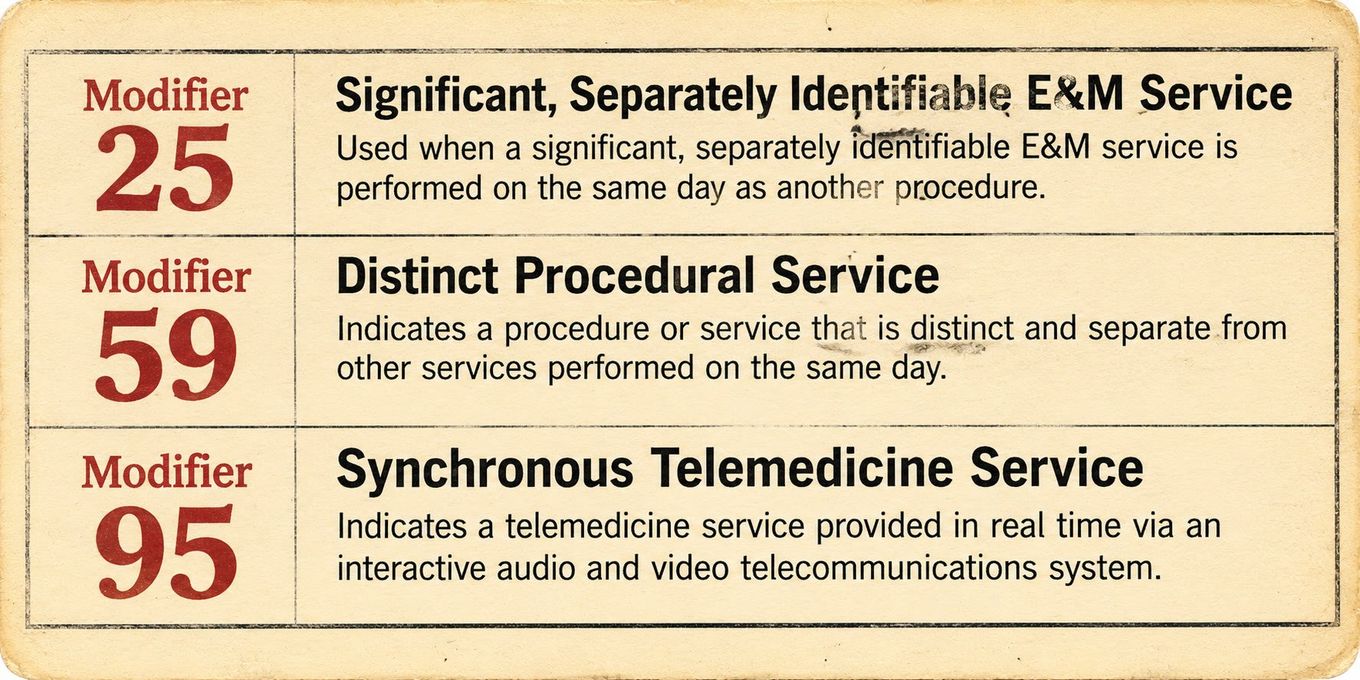
Modifier 25: Significant, Separately Identifiable E&M
Modifier 25 is appended to an E&M code when a physician performs a significant, separately identifiable evaluation and management service on the same day as a minor procedure. Without it, the payer often bundles the E&M into the procedure payment and you collect less. With it attached incorrectly (when the E&M wasn't truly separate and distinct), you're exposed to audit risk.
The documentation has to support it. That means the E&M note can't just be a brief check-in before the procedure; it needs to reflect a separate clinical decision-making process. Payers including Aetna, Cigna/Evernorth, and commercial Blue Cross plans audit modifier 25 usage, and documentation that doesn't support the modifier triggers repayment demands.
Modifier 59: Distinct Procedural Service
Modifier 59 tells the payer that two procedures performed on the same day were distinct and shouldn't be bundled under CCI (Correct Coding Initiative) edits. Medicare replaced modifier 59 with four more specific X modifiers (XE, XS, XP, XU) to require greater precision about why the procedures were distinct. Many commercial payers still use modifier 59.
Using modifier 59 without documentation that justifies a separate procedure is a common OIG audit trigger. Using it correctly, with documentation that shows a different anatomic site, different session, or different encounter, is legitimate billing that recovers revenue your practice is owed.
Modifier 95 and GT: Telehealth Services
Since the expansion of telehealth coverage during and after 2020, modifier 95 (synchronous telemedicine service rendered via real-time interactive audio and video telecommunications) has become the standard telehealth modifier for physician billing across most payers. For traditional Medicare Part B, CMS retired the legacy GT modifier beginning in 2022; modifier 95 paired with the correct place-of-service code is now the operative approach for most physician practices. POS 02 applies when the patient receives telehealth outside the home; POS 10 applies when the service is delivered to the patient at home. GT retains a narrow role in Critical Access Hospital (CAH) Method II institutional billing, but it is largely obsolete for professional fee claims.
Omitting the modifier entirely, or applying the wrong place-of-service code alongside it, results in denials or non-covered service determinations. Medicare publishes updates through the annual Physician Fee Schedule rule; commercial payers have their own requirements that differ by plan. A billing partner that hasn't kept their telehealth billing protocols current is leaving money on the table for every remote encounter your providers bill.
Payer-Specific Considerations for Physician Billing
Medicare, Medicaid, and commercial payers all behave differently in physician billing. Your billing partner needs to know the distinction.
Medicare Physician Fee Schedule
Medicare reimburses physician services based on the Medicare Physician Fee Schedule (MPFS), which assigns a relative value unit (RVU) to each CPT code. The final payment is calculated by multiplying the RVU by a geographic conversion factor and the annual conversion factor published by CMS.
For 2026, CMS publishes the final MPFS rule each November for the following calendar year. Any billing company managing Medicare physician claims needs to update their fee schedules and coding protocols when that rule publishes, not months later. Billing at outdated RVU rates doesn't increase your payment; it just introduces variance in your financial projections.
Medicaid Physician Billing
Medicaid physician billing is state-administered, which means reimbursement rates, prior authorization rules, and covered services vary significantly by state. A billing company working across multiple states needs state-specific expertise, not a generic process applied uniformly.
Common Medicaid billing problems for physician practices include:
- Prior authorization requirements that differ from the commercial payer rules your team is used to
- Lower reimbursement rates that make timely filing and clean claim rates even more critical
- Retroactive eligibility changes where a patient's coverage status changes after the encounter
- Managed Medicaid plans (Medicaid MCOs) with their own billing rules layered on top of state requirements
Commercial Payer Contracts and Underpayment
Commercial payer contracts set your negotiated rates for each CPT code. What most practices don't track systematically is whether the payer is actually paying those rates.
Underpayment, where a payer pays less than the contracted amount without issuing a denial, is one of the most underdetected revenue leaks in physician billing. It doesn't trigger a denial workflow. It doesn't show up as an open AR item. It just means your posted payment is lower than it should be, quietly, claim after claim.
A billing partner that cross-references ERA payments against contracted rates catches this. One that just posts payments without variance tracking doesn't.
In-House vs. Outsourced Physician Billing: When to Make the Switch
This isn't a decision every practice needs to revisit, but it's worth knowing the signals that indicate your current setup is underperforming.
| Situation | In-House Billing | Outsourced Physician Billing Services |
|---|---|---|
| Staff turnover disrupting billing continuity | High risk: billing stalls when a biller leaves | Low risk: vendor absorbs turnover internally |
| Specialty-specific coding complexity (surgery, behavioral health) | Requires credentialed specialty coders on staff | Specialty coders assigned by vendor |
| Multi-payer contract management | Manageable with strong PM system and experienced team | Vendor handles payer-specific follow-up at scale |
| Practice growing fast (adding providers, payers, locations) | Scaling requires hiring and training | Scales with volume without headcount increase |
| Denial rate above 10% with no improvement trend | May indicate process gaps in-house | Outsourced partner brings denial analytics and corrective workflow |
| AR beyond 90 days creeping above 20% | Follow-up bandwidth issue | Vendor applies dedicated AR follow-up staff |
| Cost control is the primary driver | Lower per-claim cost if volume is high and staff is experienced | Percentage-based fee is lower than full-time billing staff cost at most practice sizes |
If you're hitting two or more of the right-hand triggers, it's worth running the numbers on what outsourced physician billing actually costs versus your current in-house overhead. Our in-house vs. outsourced billing comparison breaks this down in detail.

How to Evaluate a Physician Billing Partner
This is the part most articles skip. Here are the questions that actually reveal whether a billing company will perform.
1. What is your first-pass acceptance rate, and how do you measure it? Industry standard is 95-98% for high-performing billing companies. If they can't answer with a specific number and a methodology, they're not measuring it.
2. What coders handle my specialty, and what are their credentials? Look for CPC (Certified Professional Coder) or CCS-P (Certified Coding Specialist, Physician-based) credentials from AAPC or AHIMA. For behavioral health, look for coders with specific mental health billing experience.
3. How do you handle credentialing coordination? If their answer is "we don't do credentialing," ask how they manage billing during enrollment gaps. No plan means lost revenue when you add a provider.
4. What does your denial management workflow look like past the first appeal? One-and-done appeal filing is not denial management. Ask whether they escalate to peer-to-peer reviews, external appeals, or payer-specific dispute processes.
5. What's your AR aging distribution for current clients? They should be able to show you a benchmark, even anonymized. If AR aging data isn't something they track, that's a red flag.
6. How do you handle the transition from our current billing setup? Transitions are where revenue leaks. Get a written onboarding timeline, a list of what they need from you, and a clear point of contact for the first 90 days.
7. How do you handle underpayment identification? Ask specifically whether they cross-reference ERA payments against contracted rates, and what their process is when they catch a variance. If they don't have an answer, underpayments are going undetected.
8. What EHR systems do you integrate with? Get the actual list, not "all major EHRs." Integration depth matters: some vendors read data out of an EHR but can't write back into it, which creates workflow gaps for your clinical team.
For a broader evaluation framework, our guide on what to ask before hiring a medical billing company covers these in more depth.
What Physician Billing Services Cost
Physician billing services are typically priced one of two ways: a percentage of monthly collections (usually 4-9%, varying by specialty, volume, and scope) or a flat per-claim or per-encounter fee.
Percentage-based pricing aligns the billing company's incentive with yours: they collect more when you collect more. Flat-fee models work better for high-volume, low-complexity practices where claim volume is predictable.
Watch for setup fees, minimum monthly commitments, and what happens to your data if you switch. These aren't deal-breakers, but they affect the actual cost of the relationship. Our full breakdown of what medical billing services cost covers what's typical across specialty types.
KPIs to Track in Physician Billing
A billing partner should give you regular visibility into these metrics. If they're not reporting on most of these, you're managing blind.
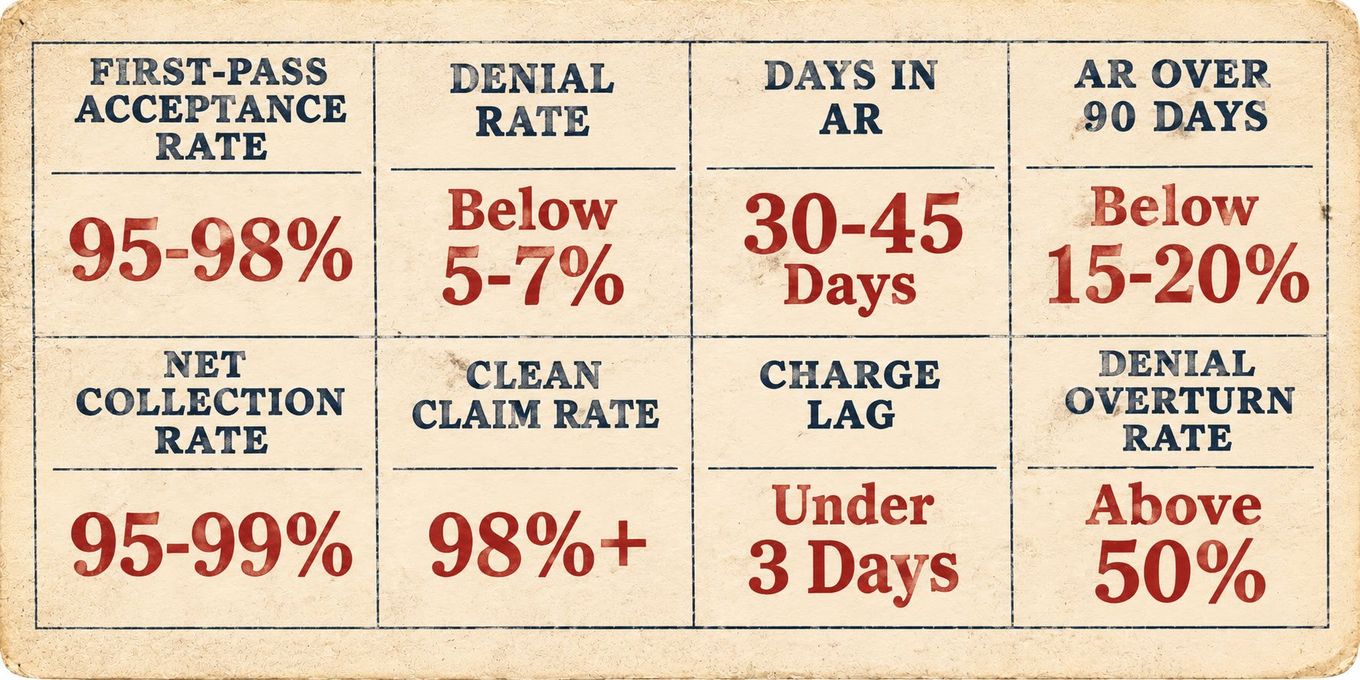
| KPI | What It Measures | Healthy Benchmark |
|---|---|---|
| First-pass acceptance rate | % of claims accepted on first submission | 95-98% |
| Denial rate | % of submitted claims denied by payer | Below 5-7% |
| Days in AR | Average days from service date to payment | 30-45 days for most specialties |
| AR over 90 days (% of total AR) | Volume of outstanding AR aged beyond 90 days | Below 15-20% |
| Net collection rate | Collections as % of net collectible charges (after contractual adjustments) | 95-99% |
| Clean claim rate | % of claims that pass scrubber without errors | 98%+ |
| Charge lag | Days between service date and claim submission | Under 3 business days |
| Denial overturn rate | % of appealed denials reversed to payment | Varies; above 50% is a reasonable floor |
Tracking these monthly gives you an early warning system. A denial rate that climbs from 5% to 9% over two quarters isn't a random fluctuation; it's a signal that something changed in your coding, payer mix, or credentialing status that needs investigation.
For practices with outpatient physician billing complexity across multiple sites, provider-level breakdowns of these KPIs matter as much as the practice-wide averages.
Why Trust This Article
Clarity Health RCM has been managing physician billing across inpatient and outpatient settings since the firm's roots at Quality Medical Billing, founded in 1988. The team, led by President and CEO Estelle Sandoval, brings over 40 years of combined revenue cycle experience across behavioral health, surgery, internal medicine, women's and children's health, and facility billing.
The evaluation criteria and benchmarks in this article reflect what we see working (and what we see failing) in practices we audit and onboard, not industry averages copied from other billing company websites.
How Clarity Health RCM Handles Physician Billing
We manage physician billing for inpatient and outpatient groups across a broad range of specialties, with particular depth in behavioral health and psychiatry. That means specialty-specific coders, credentialing coordination built into our onboarding process, and AR management that goes beyond first-pass submission.
If you're evaluating a switch or want a second set of eyes on your current collection rates, contact our team for a revenue assessment. We'll tell you where the gaps are before you commit to anything.
Frequently Asked Questions
What is included in physician billing services? Physician billing services typically cover charge capture, medical coding (CPT/ICD-10-CM), eligibility verification, claim submission, payment posting, denial management, AR follow-up, and revenue reporting. Full-service partners also handle credentialing coordination, compliance audits, and underpayment recovery.
What is the difference between physician billing and facility billing? Physician billing (professional billing) covers claims for services a licensed provider personally delivers, submitted on a CMS-1500 form under the provider's NPI. Facility billing covers the hospital or outpatient facility's resources and overhead for the same encounter, submitted on a UB-04 form. Both can apply to a single patient visit; they're billed separately.
How much do physician billing services cost? Most physician billing services charge between 4% and 9% of monthly collections, depending on specialty, claim volume, and scope of services. High-complexity specialties and low-volume practices tend to fall at the higher end of that range. Some vendors offer flat per-claim or per-encounter pricing as an alternative.
What is a good first-pass acceptance rate for physician billing? A first-pass acceptance rate of 95-98% is considered strong for physician billing. Below 90% typically signals a systematic coding or eligibility issue that requires a workflow audit, not just more rework on denied claims.
How long does it take to onboard a physician billing company? Onboarding timelines vary, but most transitions take 30-60 days to complete, covering EHR access, credentialing status review, payer enrollment verification, and workflow setup. Practices that have clean, organized records and responsive contacts on their side tend to move faster.
Can a physician billing company handle credentialing? Many physician billing companies offer credentialing services alongside billing, or coordinate closely with a credentialing team. This matters because billing and credentialing are dependent: a physician can't collect from a payer they're not enrolled with, so the two functions need to run in sync. See our credentialing services overview for how this works in practice.
What specialties do physician billing services cover? Most physician billing companies cover primary care, internal medicine, surgery, cardiology, OB-GYN, pediatrics, psychiatry, and behavioral health, among others. Depth of specialty experience varies significantly. For specialties with complex coding rules (surgery, behavioral health, oncology), look specifically for coders credentialed in that specialty, not generalists assigned across all claim types.
What is underpayment in physician billing, and how is it detected? Underpayment occurs when a payer remits less than the contracted rate for a service without issuing a formal denial. It doesn't trigger a denial workflow, so it often goes undetected in practices that only manage denials reactively. Detection requires cross-referencing each ERA payment against the payer-specific contracted rate for that CPT code, a process that requires either billing software with contract management functionality or a billing partner that runs variance reporting on posted payments.
What are the most common reasons physician claims get denied? The most common denial reasons in physician billing include eligibility and coverage issues (patient not covered on date of service), prior authorization not obtained or not matching the service billed, modifier errors (missing or incorrect modifier 25, 59, or 95), duplicate claim submissions, timely filing violations, and medical necessity denials. The distribution varies by specialty and payer mix; a systematic denial analysis by root cause is the only reliable way to know which issues are driving your specific denial rate.