Urgent Care Billing Services: Stop Losing Revenue at the Billing Fork
November 27, 2026 · 15 min read
The most expensive mistake in urgent care billing is the one that never shows up as a denial. A claim submitted with POS 11 instead of POS 20 doesn't always reject. Sometimes it just reprices, quietly, to the lower office fee schedule rate. Multiply that across hundreds of daily encounters and you have a systematic revenue leak that's invisible until someone audits it.
| Factor | Primary Care | Urgent Care |
|---|---|---|
| Place of Service code | POS 11 (office) | POS 20 (urgent care facility) |
| HCPCS S-codes | Not applicable | S9083, S9088 used by commercial payers |
| Visit type | Scheduled, established patients | Walk-in, often new patients |
| Same-day procedures | Occasional | Frequent; modifier 25 required |
| Payer contract complexity | Standard fee schedule | Flat-rate and per-diem contracts common |
| Primary denial driver | Medical necessity and coding level | Modifier 25 errors, POS code errors, billing model mismatch |
Why Urgent Care Billing Breaks Differently
Most billing teams learn their craft on scheduled, single-payer, single-encounter claim types. Urgent care is none of those things.
- Volume pressure compounds every error. Dozens to hundreds of walk-ins daily means a systematic coding error isn't a one-time miss. It's a recurring revenue loss that scales with visit count.
- The billing fork. Every claim hits a decision point: does this payer want a global case rate under S9083, or itemized CPT codes for the visit and each procedure? Medicare wants neither S-code. Getting this wrong doesn't always trigger a denial. Sometimes the payer just pays whatever model it defaults to, which is never the one that pays you more.
- Same-day procedures are the norm, not the exception. Lacerations, X-rays, splinting, injections. All billed alongside an E/M on the same date. Without modifier 25 on the E/M code, the payer bundles out the E/M entirely. That's lost reimbursement on every affected claim.
- New patients dominate the volume. Walk-in means new patient codes (99202-99205) far more often than a primary care practice sees them. New patient codes require stronger documentation of medical decision-making. Under-document and you get downcoded, or denied for medical necessity.
- Providers rotate. Physicians, NPs, and PAs cycle through shifts. Each one needs to be credentialed and enrolled with every contracted payer before their claims can submit. When they're not, you get systematic denials that often run for weeks before anyone traces the denial code back to enrollment status.
The Billing Fork: S9083, S9088, and When to Use Each
This is the concept most urgent care billing guides skip. The billing fork is where the money is.
| Code | What It Is | When to Bill | Key Payer Notes |
|---|---|---|---|
| S9083 | Global fee for the entire urgent care visit. All-inclusive flat case rate. | Commercial payer contract specifies a per-visit flat rate | Not covered by Medicare or most Medicaid fee-for-service. Submitting to Medicare = invalid code denial |
| S9088 | Add-on code indicating urgent care operational costs. | Alongside an E/M or procedure code when payer contract specifies it | Add-on only. Never billed standalone. Sometimes requires a modifier; check the contract |
| E/M 99202-99205 | New patient evaluation and management | New patient visits; all Medicare claims; any payer on a standard fee schedule | Level set by documented medical decision-making. Under-documentation drives downcoding |
| E/M 99211-99215 | Established patient evaluation and management | Established patient visits; same fee-schedule payers as above | Same MDM documentation rules apply |
| Procedure CPT codes | Service-specific codes (10060 I&D, 71046 chest X-ray, 97597 wound care, 96372 injection) | Same-day procedures alongside an E/M | Always append modifier 25 to the E/M when billing a procedure on the same date |
The rule for navigating the fork: read the payer contract, not the superbill. If the contract specifies S9083 as the case rate, billing individual CPT codes separately is wrong for that payer. If the payer uses a standard fee schedule, or is Medicare, skip S9083 entirely and bill E/M plus procedure codes individually.
The practical solution is a payer-specific billing model matrix, maintained and updated with each contract renewal. Without it, your billing team is guessing, and the guess costs you money on every claim it gets wrong.
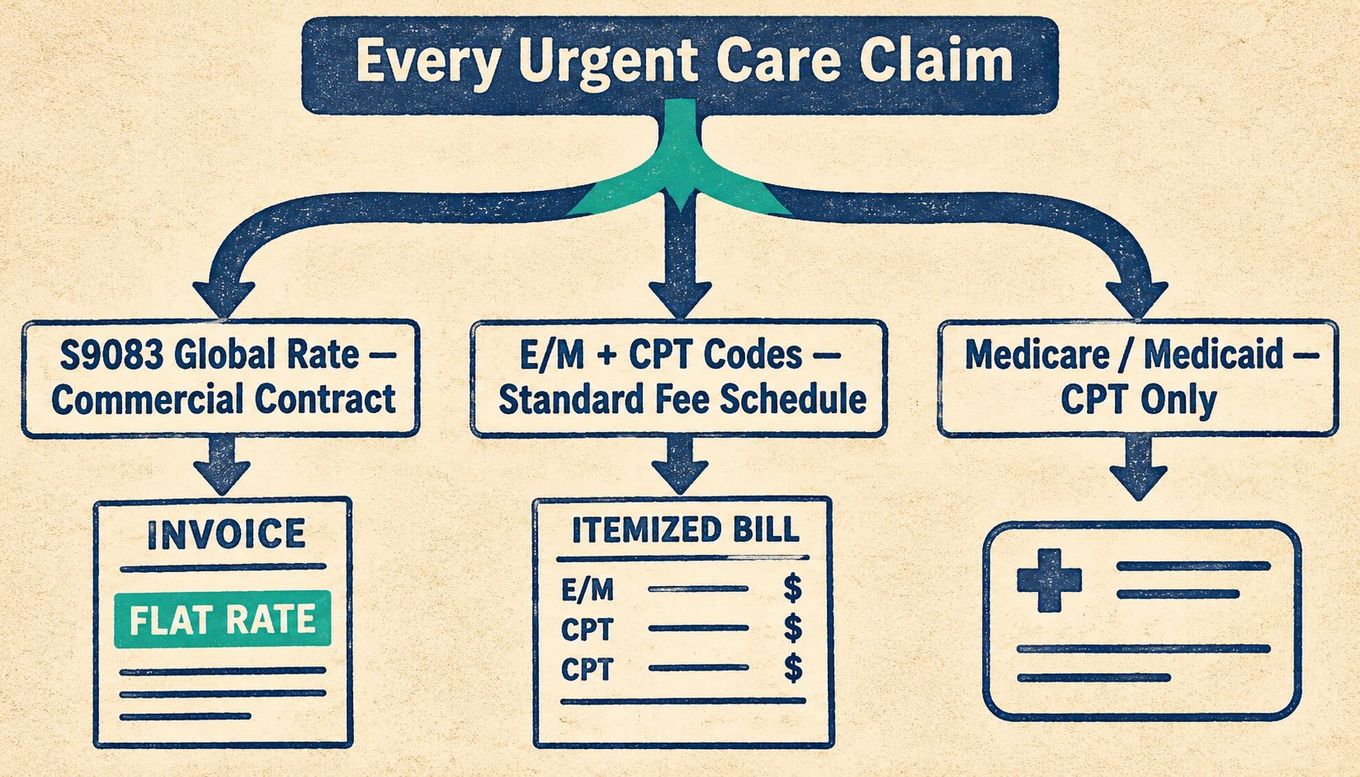
Three billing paths, one decision point: which model the payer's contract specifies determines which fork you take.
POS 20: The Code That Doesn't Always Fail Visibly
Using POS 11 (Office) when you should use POS 20 (Urgent Care Facility) doesn't always generate a denial. That's what makes it dangerous.
- Some payers silently reprice POS 11 claims to the lower office fee schedule rate. The claim clears. It just pays less. At scale, that's a material revenue problem.
- Some payers deny S-codes outright if POS 20 is absent. Centene-affiliated Ambetter plans made this explicit in 2026 policy bulletins, effective 08/01/2026: S9083 and S9088 claims submitted with any POS other than 20 are not reimbursable.
- Multi-site groups are especially exposed. Billing system defaults set to POS 11 at the provider level, rather than POS 20 at the location level, are a common source of systematic underpayment that's invisible until an AR audit surfaces it.
- POS 20 is for freestanding urgent care facilities only. A hospital-based urgent care department typically uses a different facility POS code. Confirm the facility type before defaulting POS 20 across all sites.
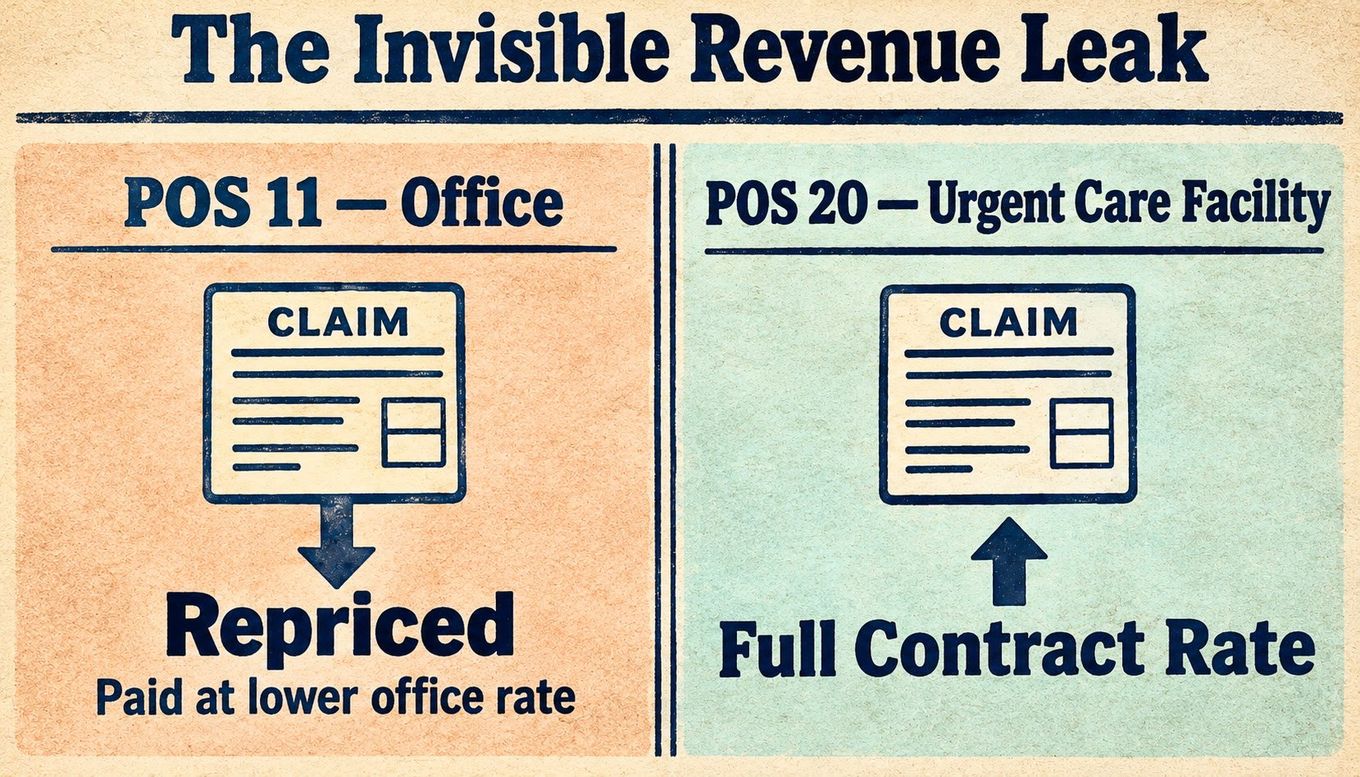
POS 11 claims don't always reject — they often just reprice to the lower office rate. At volume, that difference is material.
The Specific Denials That Hit Urgent Care Hardest
Denial rates in urgent care trend higher than primary care because of the combination of high volume, same-day procedures, and payer-contract variability. Here's what actually drives the rework.
| Denial Reason | Root Cause | Fix |
|---|---|---|
| Modifier 25 denial | E/M bundled with same-day procedure; modifier 25 not on the claim | Append modifier 25 to the E/M on every claim that includes a same-day procedure |
| Wrong billing model | S9083 submitted to Medicare; CPT submitted to an S9083 global payer | Build and enforce a payer-specific billing model matrix |
| POS code wrong | POS 11 used instead of POS 20 | Set POS 20 defaults at the practice/location level in the billing system |
| Eligibility gap | Coverage lapsed, wrong group number, or patient not verified before visit | Real-time eligibility verification at registration, before the visit begins |
| Credentialing denial | Provider not yet enrolled with the patient's payer | Track credentialing status and payer enrollment activation dates before a provider bills |
| Medical necessity denial | Documentation doesn't support the E/M level billed | Coder review of MDM documentation before submission; audit high-code visits |
| Timely filing denial | Claim submitted past the payer's deadline | Track filing windows by payer; Medicare allows 12 months from date of service; most commercial payers allow 90-180 days, some as few as 60 |
The two denial categories that hit hardest and are most fixable: modifier 25 errors and billing model mismatch. If your team isn't tracking denials by reason code and by payer, you can't see which is hitting you hardest or whether your fixes are working.
Our denial management services cover how systematic denial tracking and appeals are structured.
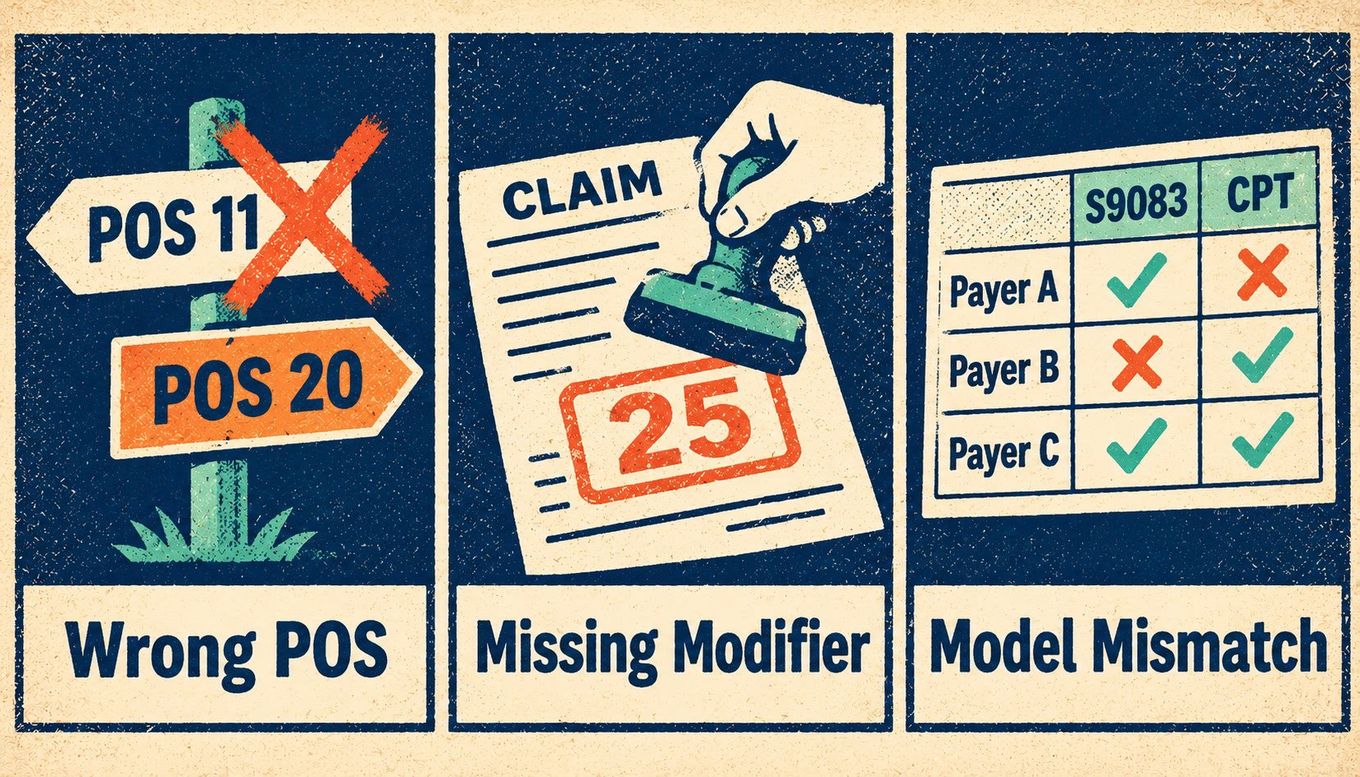
The three denial categories that account for the majority of fixable urgent care revenue loss.
Credentialing: The Billing Problem That Hides in HR
Credentialing in urgent care looks like an administrative task. It operates like a billing one.
- Every new provider creates a credentialing gap. Rotating physicians, NPs, and PAs each need to be enrolled with every contracted payer under their own NPI before they bill. Claims submitted before enrollment is active generate systematic denials for every affected payer.
- NPs and PAs must bill Medicare under their own individual NPI. CMS permits incident-to billing under a supervising physician's NPI in limited circumstances, but those conditions (physician on-site and immediately available, established patient, established care plan, no new problem) are rarely met in urgent care, where most visits involve new patients or new acute presentations. Billing under a supervising physician's NPI when incident-to conditions are not met is considered fraudulent billing by CMS. Each mid-level needs their own enrollment.
- Commercial payer enrollment takes 60-120 days on average. A new provider who starts seeing patients before their enrollment is confirmed will generate systematic denials for weeks. At high visit volume, that's a material revenue problem.
- Multi-site groups face layered credentialing complexity. A provider credentialed at one urgent care location under one TIN is not automatically credentialed at a second location under a different TIN. Each TIN and location combination may require its own enrollment application.
Credentialing status feeds directly into whether claims can be billed. If your billing operation and your credentialing function don't share real-time visibility into enrollment activation dates, denials from credentialing gaps will keep coming.
Our insurance credentialing services and payer enrollment services are structured to feed directly into billing activation timelines.
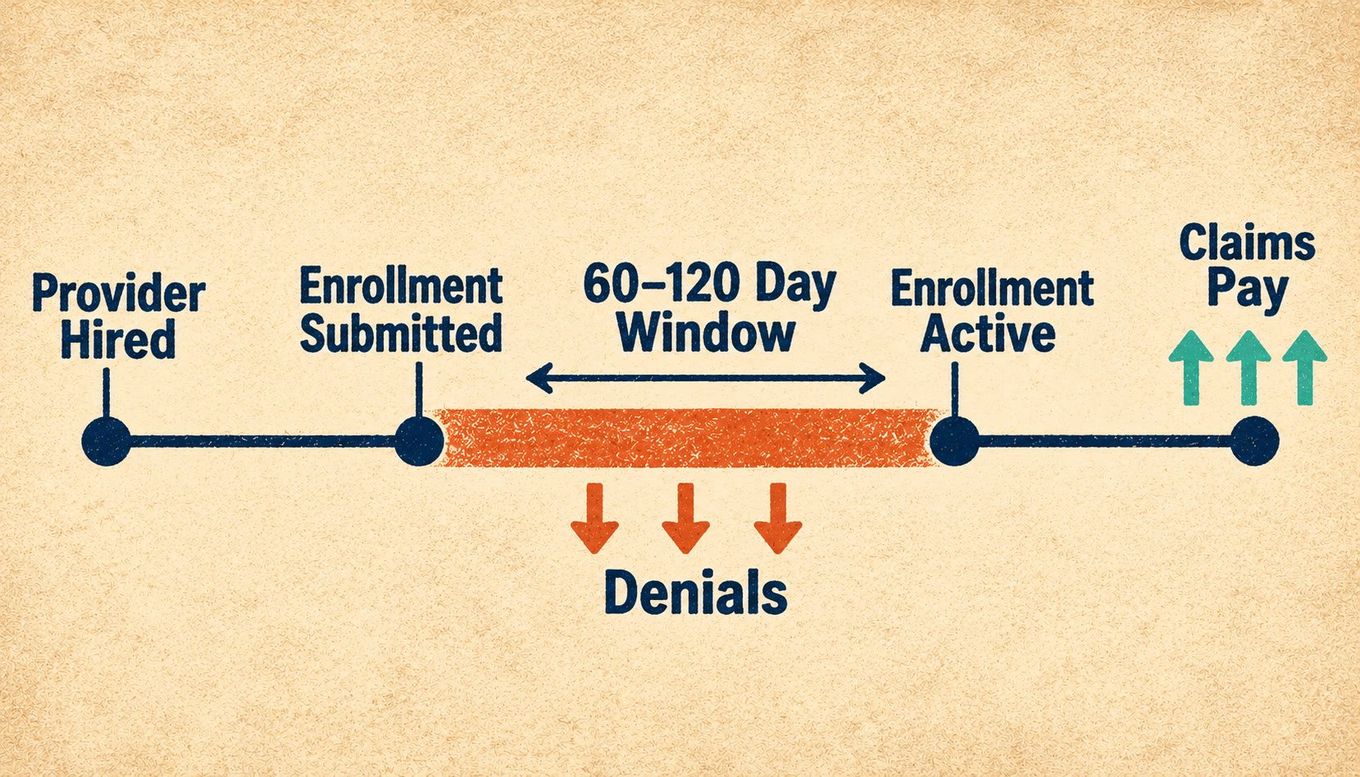
The enrollment gap isn't visible in the schedule. It shows up 60-120 days later as a spike in credentialing denials.
Revenue Cycle Benchmarks for Urgent Care
Knowing what good looks like is the fastest way to diagnose what isn't. These are the KPIs that matter in urgent care, and the thresholds that separate a well-run operation from one with a revenue problem hiding in plain sight.
| KPI | Benchmark | What Moves It in Urgent Care |
|---|---|---|
| Clean claim rate | ≥98% (floor: 95%) | Modifier 25 accuracy, POS 20 defaults, correct billing model by payer |
| First-pass acceptance rate | ≥90% | Eligibility verification at registration, current credentialing status |
| Initial denial rate | ≤5% | Payer-specific billing model matrix, modifier discipline, enrollment tracking |
| Net collection rate | ≥95% | Appeal follow-through on modifier and POS denials; timely filing compliance |
| Days in AR | ≤30 days | Claim velocity, real-time eligibility, payer-specific follow-up cadence |
| AR >90 days | ≤10% of total AR | Systematic appeals workflow, escalation on high-volume commercial disputes |
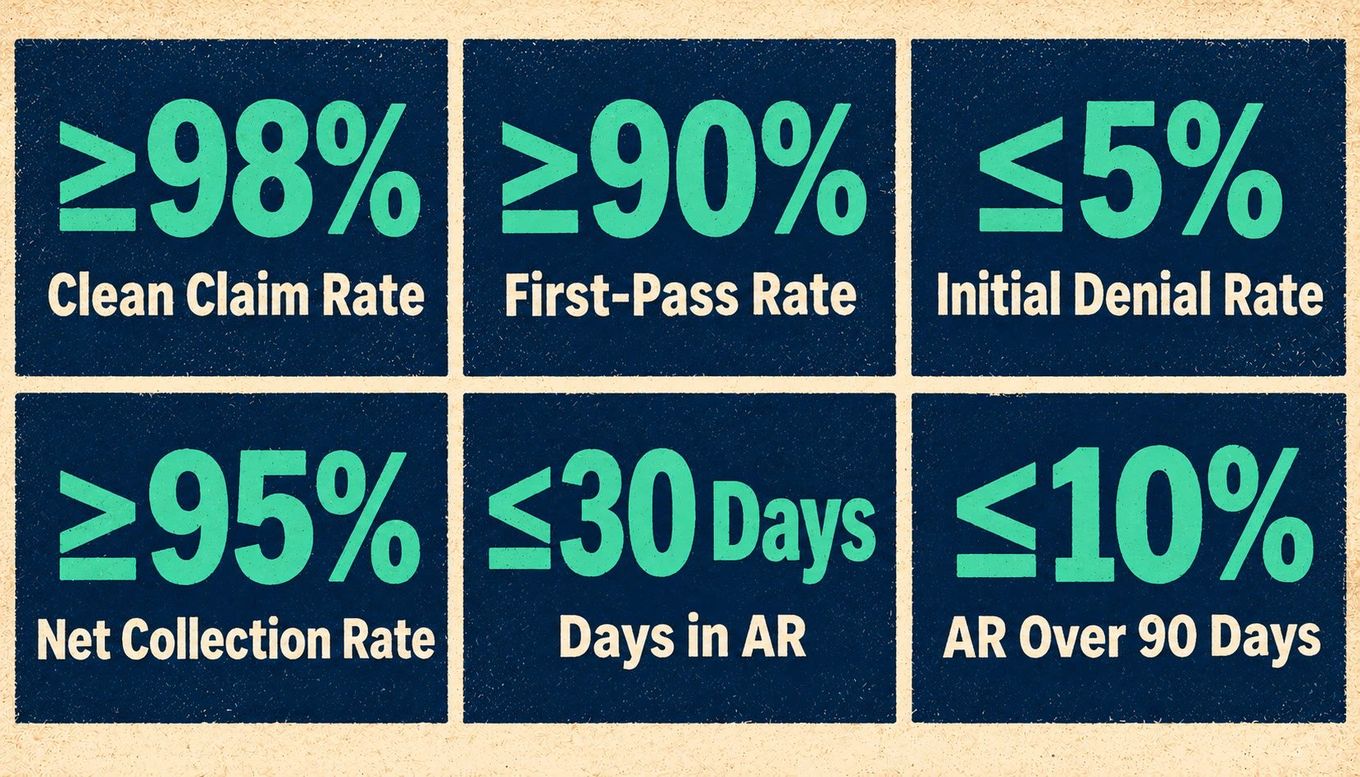
Six benchmarks that define a well-run urgent care revenue cycle. If your numbers sit outside these ranges, the gaps above are where to look first.
Most urgent care centers running billing without specialty-specific coding training operate with denial rates in the 10-20% range and AR over 90 days at 15-25% of total. At 200 visits per day, a 10% denial rate that's only 60% resolved on appeal is a material annual revenue loss.
Three leading indicators to watch before the KPIs surface a problem:
- Payer mix shift. If Medicare and Medicaid volume increases and your team doesn't adjust away from S-codes for those payers, denial rate climbs before it shows in net collections.
- Provider roster changes. New physician or mid-level starts generate credentialing gaps that surface as payer-specific denial spikes, typically 60-90 days after the provider begins seeing patients.
- Contract renewals. A payer switching billing models mid-year (S9083 global to CPT itemized, or the reverse) changes the correct claim structure for every encounter with that payer. If your team doesn't catch it at renewal, the wrong model runs for months.
What to Actually Ask When Evaluating an Urgent Care Billing Partner
Not every RCM company understands urgent care. General medical billing experience doesn't translate to POS 20 fluency, S-code contract management, or high-volume modifier handling. Here's what to verify before signing.
- S9083 vs. S9088 fluency. A team that works urgent care claims daily should explain the difference without hesitation and describe which payers in your market use which model.
- Payer-specific billing model matrix. Ask to see it. It should be a documented, maintained reference of which payers want global S-code billing versus itemized CPT billing, updated with contract renewals.
- Modifier 25 denial rate. Request this as a named, tracked metric across their urgent care clients. Not an estimate. An actual number.
- Credentialing integration. Credentialing status should feed directly into billing activation, not be managed separately and updated manually.
- Real-time eligibility verification. Front-desk eligibility tools should be part of the service or integration, not an add-on the center has to source separately.
- Denial management turnaround. Ask for average days to appeal and appeal success rate by denial category.
- Transparent reporting cadence. You should see clean claim rate, denial rate by payer, days in AR, and collection rate on a regular schedule, not just a monthly revenue summary.
- Multi-site capability. If you operate or plan to operate multiple locations, confirm the partner handles centralized billing with location-level breakdowns.
For what full-service urgent care billing typically costs across different service models, see our medical billing services cost guide.
Why Trust This Article
Our background:
- Clarity Health RCM traces its roots to Quality Medical Billing, founded in 1988, with 40+ years of combined revenue-cycle experience under President & CEO Estelle Sandoval.
- Our team handles outpatient facility and physician billing across specialties and facility types, including urgent care centers, alongside our core behavioral health and specialty physician work.
What we see in practices:
- Modifier 25 and billing model mismatch (S9083 global vs. CPT itemized) are the two most consistent denial drivers in urgent care billing reviews we conduct.
- POS 11 vs. POS 20 silent underpayment is widespread in multi-site groups that grew quickly and inherited inconsistent billing system defaults.
- Credentialing gaps for rotating NPs and PAs are a silent revenue leak: claims submit and hit systematic denials for weeks before anyone traces the denial code back to enrollment status.
How this article was developed:
- SERP research and gap analysis of top-ranking urgent care billing service pages.
- S-code definitions validated against payer bulletins from Centene-affiliated Ambetter plans (2026).
- Medicare S-code exclusion confirmed against CMS HCPCS coverage policy.
- POS 20 definition sourced from CMS Place of Service code definitions.
- NP/PA Medicare billing requirements confirmed against CMS guidance on individual provider enrollment and incident-to billing conditions.
- Clean claim rate benchmark sourced from MGMA 2023 Cost and Revenue Survey data.
How Clarity Handles Urgent Care Billing
Urgent care is high-volume and low-margin for billing error. Here's where our services fit.
- Medical billing: End-to-end claim submission with payer-specific billing model (S9083 global vs. CPT itemized) applied by contract, not by default.
- Coding and auditing: Coder review of E/M level documentation, modifier 25 application, and same-day procedure bundling before submission.
- Denial management: Systematic appeal workflow for modifier, POS, eligibility, and credentialing denials, with root-cause tracking to prevent repeat denials.
- Credentialing and enrollment: Provider credentialing and payer enrollment for urgent care physicians and mid-levels, tracked against billing activation dates.
- AR follow-up: Aging AR worked by payer bucket with escalation protocols for high-volume commercial disputes.
- KPI and payment analytics: Clean claim rate, denial rate by payer, days in AR, and collection rate on a regular cadence, not just totals.
If your urgent care center is running denial rates above 5% or AR aging beyond 45 days, those numbers are worth reviewing with an RCM partner. Reach out to our team to discuss what your revenue cycle looks like.
Frequently Asked Questions
What CPT and HCPCS codes are used for urgent care billing?
Urgent care centers bill E/M codes (99202-99215) for evaluation and management visits, with new patient codes (99202-99205) and established patient codes (99211-99215) determined by documented medical decision-making. For same-day procedures such as laceration repair, X-rays, injections, or I&D, the relevant CPT code is billed alongside the E/M, with modifier 25 appended to the E/M to prevent bundling. Depending on the payer's contract, HCPCS S9083 may replace itemized CPT billing as an all-inclusive global visit code; S9088 may be added as an add-on alongside an E/M or procedure code for certain commercial payers. Medicare does not recognize S-codes; bill standard CPT codes only.
Does Medicare cover urgent care visits?
Medicare covers urgent care visits but does not recognize HCPCS S-codes. Urgent care centers must bill Medicare using standard E/M codes (99202-99215) and procedure CPT codes, with POS 20 as the place of service. Billing S9083 or S9088 to Medicare results in an invalid or non-covered code denial. Mid-level providers (NPs and PAs) must be individually enrolled with Medicare and bill under their own NPI; billing under a supervising physician's NPI is only permitted when strict incident-to conditions are met, which are rarely applicable in urgent care given the prevalence of new patients and new acute problems.
What is POS 20 in urgent care billing?
POS 20 is the CMS place of service code for a freestanding urgent care facility structurally separate from a hospital that provides episodic, unscheduled outpatient services without a prior appointment. Using POS 11 (office) instead of POS 20 either triggers an outright denial or silently reprices the claim to the lower office fee schedule rate, depending on the payer. Claims submitted with S9083 or S9088 must include POS 20; several payers, including Centene-affiliated Ambetter plans, explicitly deny S-code claims submitted with any other place of service code as of their 2026 policy bulletins.
What is the difference between S9083 and S9088?
S9083 is a HCPCS code representing a global, all-inclusive case rate for the entire urgent care visit; it covers all services rendered during one encounter under a single flat payment. S9088 is an add-on code indicating services rendered in an urgent care center, billed alongside an E/M or procedure code to designate the facility type and account for operational costs. Neither code is covered by Medicare. The specific use of each depends entirely on the payer's contract terms: some plans use S9083 as the global rate, some use S9088 as an add-on alongside CPT codes, and some use neither. Your billing team should maintain a per-payer billing model matrix rather than applying S-codes uniformly across all payers.
How much does outsourced urgent care billing cost?
Outsourced urgent care billing services are typically priced as a percentage of monthly collections, ranging from approximately 3% to 8% depending on visit volume, service scope, and the partner's pricing structure. High-volume multi-site centers may negotiate flat monthly fees. The range reflects significant variation in what is included: some quotes cover only claim submission, while full-service RCM covers coding, denial management, AR follow-up, credentialing, and reporting. Get a clear scope of services before comparing quotes on percentage alone.
What denial rate is normal for urgent care billing?
According to MGMA benchmarking data, top-performing practices achieve a clean claim rate of 98% or higher, with an initial denial rate below 5%. A clean claim rate of 95% represents a reasonable floor; anything below that signals systematic claim quality issues. Many practices, particularly those that grew quickly or rely on in-house billing without urgent care-specific coding training, run denial rates in the 10-20% range. The most common drivers are modifier 25 errors, POS code defaults set to 11 instead of 20, and billing model confusion between S9083 global and CPT itemized claims. Tracking denial rate by payer and by denial reason code is the starting point for reducing it systematically.
How does credentialing affect urgent care billing?
Credentialing determines whether a provider is enrolled and contracted with a payer, which is a prerequisite for billing under that payer. In urgent care, where multiple physicians and mid-level providers rotate through shifts, credentialing gaps are common. Claims submitted under a provider not yet credentialed with the patient's insurer generate systematic denials, often for weeks before the billing team traces the denial code back to enrollment status. For Medicare, NPs and PAs must be individually enrolled and bill under their own NPI; billing under a supervising physician's NPI is only valid when incident-to conditions are fully met, which is rarely the case in urgent care. Integrating credentialing tracking with billing activation dates is the operational fix.