Chiropractic Billing Services: What Your Practice Needs to Get Paid
November 27, 2026 · 13 min read
Chiropractic billing looks simple until your first Medicare denial lands. One missing modifier, one SOAP note that doesn't document the regions you treated, one maintenance visit billed as active care, and the claim dies without anyone at the MAC ever reading it. Specialized chiropractic billing services exist because this specialty has a denial profile unlike almost any other: narrow coverage rules, modifier-dependent payment, and a payer mix that includes Medicare, commercial plans, workers' comp, and auto/PI all running on completely different tracks.
| Area | Key Facts |
|---|---|
| Core CPT codes | 98940 (1–2 regions), 98941 (3–4), 98942 (5 regions), 98943 (extraspinal) |
| Most common denial trigger | Missing AT modifier on Medicare CMT claims |
| Medicare covers | Spinal manipulation for subluxation only; modalities, massage, and wellness visits are not covered |
| Other major payers | Commercial insurers, workers' comp, and auto/PI; each follows its own rules and filing windows |
| What billing services handle | Coding, claims, denial management, AR follow-up, credentialing coordination |
| Benchmarks to expect | Clean claim rate >95%, first-pass resolution >80%, days in AR under 45 |
Why Chiropractic Billing Is Its Own Problem
Most medical billing is built around diagnosis-driven care. Chiropractic billing is different: it's procedure-driven and documentation-dependent, and medical necessity has to be justified visit by visit, not just at intake.
That changes everything about how claims work:
- Region-based CPT selection: The same adjustment gets coded as 98940, 98941, or 98942 depending on how many spinal regions are treated and documented. Bill 98941 on a note that only documents two regions and you've upcoded, regardless of what actually happened in the room.
- Modifier-dependent Medicare payment: A Medicare CMT claim without the AT modifier doesn't get reviewed and reduced; it gets denied outright. No adjudication. No human in the loop.
- Active vs. maintenance care: This distinction determines whether Medicare pays at all. Misclassify maintenance care as active, and you're looking at both a denial and a compliance exposure.
- Visit-limit tracking: Most commercial plans cap covered visits at 20–30 per year. If your billing team isn't tracking this in real time, the first sign a patient is over their limit is often a denied claim you can't appeal on the merits.
- Multi-payer complexity: Most chiropractic practices bill across Medicare, commercial insurance, workers' comp, and auto/PI simultaneously: four different rule sets, four different documentation standards, four different filing windows.
The CPT Codes: 98940, 98941, 98942, and 98943
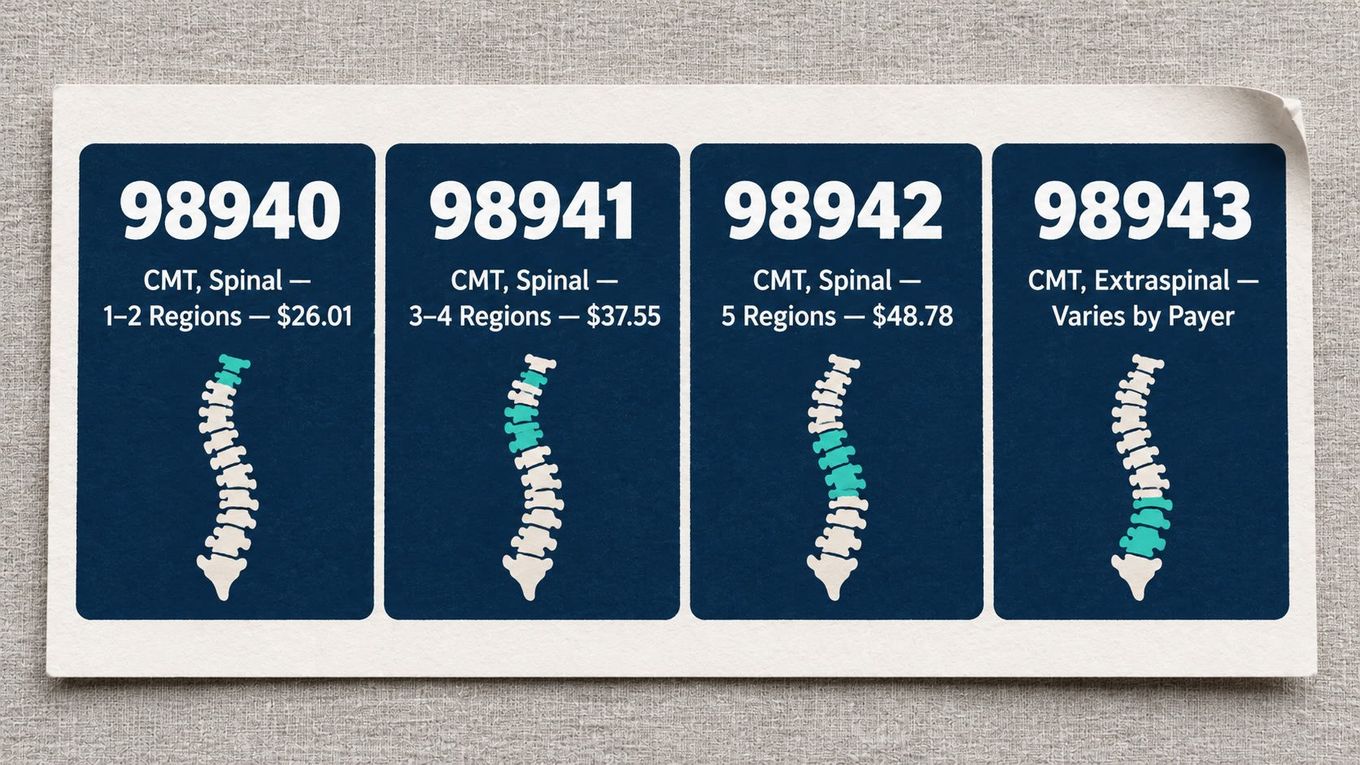
One code per visit. That's the rule. CMT codes are standalone; you don't stack them.
| CPT Code | Description | Spinal Regions Treated | 2026 Medicare Rate (participating) |
|---|---|---|---|
| 98940 | CMT, spinal | 1–2 regions | $26.01 |
| 98941 | CMT, spinal | 3–4 regions | $37.55 |
| 98942 | CMT, spinal | 5 regions | $48.78 |
| 98943 | CMT, extraspinal | Extremities / other | Varies by payer |
A few rules that trip practices up:
- Bill 98942 when you treat all five spinal regions. Not 98940 + 98941. Stacking is a coding error.
- The region count in the SOAP note drives the code. What the provider intended to treat doesn't change that. If the note documents two regions, the claim is 98940, full stop.
- 98943 (extraspinal) is typically excluded from Medicare. It needs pre-visit commercial payer verification before you bill it.
- Under-coding loses revenue. Over-coding creates audit exposure. The right code requires the right note.
The diagnosis codes have to match, too. Each treated region needs a corresponding ICD-10 subluxation code: M99.01 (cervical), M99.02 (thoracic), M99.03 (lumbar), M99.04 (sacral). A clean CMT claim has code and diagnosis aligned by region. A messy one has a code that doesn't map to what the note actually documented.
Modifiers: Where Most Medicare Denials Start
For Medicare, modifier selection isn't a detail. It's the payment determination.
| Modifier | What It Signals | When to Use |
|---|---|---|
| AT | Active/corrective treatment | Required on 98940, 98941, 98942 for every active-care Medicare claim |
| GA | ABN on file | Typically used for maintenance care with a signed ABN; can also appear with AT when active care may be denied for medical necessity and an ABN is on file |
| GZ | No ABN on file | Maintenance care; no ABN; patient cannot be billed |
| GY | Statutorily excluded | Service Medicare never covers under any conditions |
Three things about AT that practices get wrong:
- A claim for 98940–98942 without AT is automatically denied. The MAC doesn't review the clinical record. The absent modifier is itself the determination.
- AT and GZ cannot appear on the same claim line: GZ signals an expected denial with no ABN on file, which is inconsistent with AT's active-care designation. AT and GA, however, can appear together when a provider believes active treatment may be denied for medical necessity reasons; in that case, the patient must sign an ABN before the visit and GA is appended alongside AT (per CMS LCD billing guidance). What remains mutually exclusive under CMS policy is billing maintenance care with the AT modifier: maintenance visits should never carry AT (Medicare Benefit Policy Manual, Chapter 15, Section 240.1.3).
- When a patient plateaus and care becomes maintenance, the billing workflow has to change before the next visit, not after the denial comes back. The ABN gets signed first, then the visit happens, then the claim goes out with GA.

The Seven Denials That Eat Chiropractic Revenue
Chiropractic has one of the most consistent denial profiles in outpatient billing. The same issues show up across practices of every size.
| Denial Reason | Root Cause | Fix |
|---|---|---|
| Missing AT modifier | Not applied on Medicare CMT claims | Build AT into the claim template for 98940–98942; audit monthly |
| Region count mismatch | Note documents fewer regions than the billed code | Bill what the note supports; never upcode based on intent |
| Maintenance billed as active | No measurable improvement documented | Transition to GA modifier with signed ABN at clinical plateau |
| Insufficient documentation | Subluxation diagnosis absent; findings not recorded | Require structured progress notes with region, findings, and functional outcome |
| ICD-10 mismatch | Diagnosis codes don't align with treated regions | Align M99.01–M99.04 per treated region, every claim |
| Coverage limit exceeded | Visit cap reached without tracking | Run real-time eligibility before each visit; flag patients approaching limits |
| Timely filing | Claim submitted after the payer's deadline | Track windows per payer; flag aging claims at 30 days |
According to the 2025 Medicare Fee-for-Service Supplemental Improper Payment Data (CMS.gov), the improper payment rate for chiropractic services is 30.4%, with a projected improper payment amount of $144 million. Insufficient documentation accounts for 89.5% of those improper payments; the clinical record didn't support the claim, even when the treatment itself was clinically appropriate.
For a deeper look at denial recovery workflows, see Clarity's denial management services.
The Payers Nobody Tells You About
Every competitor article on chiropractic billing covers Medicare and the AT modifier. What they skip is the rest of the payer mix, which for most practices generates more revenue than Medicare does.
Commercial Insurance
Commercial is not a monolith. Plans vary significantly, and the gaps hurt:
- Visit limits: Commonly 20–30 visits per year. Post-limit claims aren't just denied; they're usually non-appealable on the merits. You need real-time eligibility tracking, not end-of-day batch verification.
- Modalities coverage: Some plans bundle electrical stimulation, ultrasound, or cold/heat packs with the adjustment. Others carve them out entirely. Verify before billing, not after.
- Prior auth for ongoing care: Utilization management programs are increasingly common. Practices treating high-visit-count patients without an authorization in place are building a denial backlog.
- HMO referrals: No valid referral, no payment, regardless of how good the clinical documentation is.
Workers' Compensation
Workers' comp is state-regulated, which means there is no national standard. What works in Texas doesn't transfer to California or New York:
- State-specific fee schedules: Reimbursement rates, billing forms, and filing deadlines differ by jurisdiction. A single billing workflow applied across states is a revenue leak.
- Injury-specific documentation: A SOAP note written for a routine adjustment doesn't cut it for workers' comp. The note needs to reference the injury, the mechanism, and the treatment rationale explicitly.
- Treatment plans: Most carriers require a defined endpoint before authorizing ongoing visits. Open-ended treatment without a plan is a common mid-course denial trigger.
- Filing through the right carrier: Claims routed to the patient's personal health insurance instead of the employer's workers' comp carrier are a basic billing error that consistently delays payment.
Auto / Personal Injury
Auto/PI operates outside the standard insurance billing workflow entirely:
- PIP limits: In no-fault states, personal injury protection coverage has a per-patient dollar cap. Once exhausted, the insurer pays nothing; the practice needs to know where every patient stands against their limit.
- Letters of protection: LOPs allow treatment before settlement, but lien-based billing requires a separate cash-flow plan. Practices carrying large LOP volumes need to account for delayed collection.
- Filing deadlines: PIP filing windows are set by state law and are frequently shorter than standard commercial payer timelines. Missing the window forfeits the claim with no appeal path.

What Outsourced Chiropractic Billing Actually Covers
Not all billing services are built the same. A full-service chiropractic engagement should include all of this:
- Pre-visit eligibility verification: Coverage confirmation, visit-limit checks, deductible status, and referral and authorization requirements, all verified before the patient walks in.
- CPT and ICD-10 coding: CMT code selection based on documented regions, subluxation diagnosis codes aligned by region, modifier assignment on every Medicare claim.
- Claim submission: Clean claim through a clearinghouse, correct payer, correct format, within the filing window.
- Denial management: Appeal letters, corrected claims, and direct payer follow-up for every denied and rejected claim. See how Clarity approaches AR follow-up.
- Payment posting: ERA and EOB application, underpayment identification against contracted rates, systematic payer-pattern flagging.
- Patient balance billing: Statements for coinsurance, copays, deductibles, and non-covered services, including post-visit ABN billing for Medicare maintenance care.
- Reporting: Monthly dashboards with clean claim rate, collection rate by payer, days in AR, and denial breakdown by reason code.

For practices still deciding whether to outsource or keep billing in-house, see in-house vs. outsourced medical billing.
How to Tell a Good Billing Partner from a Generalist with a Chiropractic Service Page
Most billing companies will tell you they handle chiropractic. Few can prove it.
Benchmarks to request upfront:
- Clean claim rate: 95% or above. Below this threshold, the practice is absorbing follow-up costs on claims that should have paid the first time.
- First-pass resolution rate: A strong billing service resolves 80–90%+ of denied claims on the first appeal. If they can't tell you this number, they're not tracking it.
- Days in AR: Under 30 for Medicare, under 45 for commercial payers.
- Net collection rate: 95–98% is achievable in chiropractic with tight denial management and timely follow-up.
Questions that separate the credible partners from the generalists:
- Do you bill Medicare, commercial, and workers' comp/auto-PI for chiropractic, not just one of the three?
- What is your process when a patient crosses from active care into maintenance therapy?
- How do you handle states with separate workers' comp fee schedules?
- What EHR and practice management systems do you integrate with?
- What is your appeal turnaround time, and how are denied claims escalated if the first appeal fails?
- Do you run real-time eligibility verification, or batch verification overnight?
Red flags:
- No clearly defined denial management workflow; just a vague mention of "working denials"
- Flat-rate pricing with no performance reporting tied to results
- Inability to explain AT modifier rules or the active/maintenance distinction without pausing
- No prior chiropractic-specific billing experience beyond a checkbox on their website
For a broader due diligence checklist, see questions to ask before hiring a medical billing company.
Why Trust This Article
Our background:
- Clarity Health RCM traces its roots to Quality Medical Billing, where President and CEO Estelle Sandoval began her revenue cycle career in 1988.
- Our leadership team, led by President and CEO Estelle Sandoval, brings 40+ years of combined revenue cycle experience across outpatient physician billing, specialty practices, and facility RCM.
- We work with practices billing across Medicare, commercial payers, and workers' comp/auto-PI in multiple specialties.
What we see in practices:
- Chiropractic billing errors are almost always documentation-driven, not clinical. The care was appropriate. The note didn't support the code.
- The AT modifier gap is the single most common and most preventable revenue loss we see at intake audits.
- Workers' comp and auto/PI billing is frequently handled manually, inconsistently, and outside the main billing workflow, a process problem that compounds over time.
- Practices with high denial rates or unworked AR routinely net more revenue after outsourcing than they lose in service fees, but only when the billing partner is benchmarked to results, not just activity.
How Clarity Supports Chiropractic Practices
Clarity Health RCM provides end-to-end revenue cycle services built for specialty physician billing, including chiropractic practices billing across Medicare, commercial, and workers' comp/auto-PI payers.
- Medical billing and coding: CPT 98940–98943 coding, AT modifier compliance, region-aligned ICD-10 assignment, and clean claim submission.
- Denial management: Structured appeal workflows for AT modifier denials, region-count mismatches, medical necessity rejections, and timely filing issues.
- AR follow-up: Payer-level aging management with escalation protocols at 30, 60, and 90 days.
- Credentialing and enrollment: Provider enrollment with Medicare, commercial payers, and workers' comp carriers, covering initial enrollment for new practices and re-credentialing for existing ones.
- KPI reporting: Monthly dashboards covering clean claim rate, collection rate by payer, days in AR, and denial breakdown by reason code.
Contact Clarity to discuss billing support for your chiropractic practice.
Frequently Asked Questions
What CPT codes are used for chiropractic billing?
The four primary codes are 98940 (spinal manipulation of 1–2 regions), 98941 (3–4 regions), 98942 (five regions), and 98943 for extraspinal manipulation of the extremities. These are standalone codes; a practice bills one per visit based on the number of spinal regions documented in the clinical note, not stacked combinations. Medicare covers 98940, 98941, and 98942 with the AT modifier for active, corrective care; 98943 is generally excluded from Medicare coverage.
What is the AT modifier and why does it matter for chiropractic billing?
The AT modifier signals to Medicare that a chiropractic manipulation is active, corrective treatment rather than maintenance therapy. It must appear on every Medicare claim for CPT codes 98940, 98941, and 98942 when care is medically necessary. Claims submitted without the AT modifier are automatically denied without manual review; the absence of the modifier is itself treated as a determination that the service is non-covered maintenance care, per CMS Medicare Benefit Policy Manual Chapter 15, Section 240.1.3.
Does Medicare cover all chiropractic services?
No. As of 2026, Medicare covers only manual spinal manipulation to correct a subluxation, billed under CPT 98940, 98941, or 98942 with the AT modifier. Therapeutic modalities (electrical stimulation, ultrasound, massage), x-rays, extraspinal manipulation, and wellness or maintenance care are excluded. For excluded services provided to Medicare beneficiaries, an Advance Beneficiary Notice should be signed before the visit, not after the claim is denied.
How much does outsourced chiropractic billing cost?
Most chiropractic billing services price on a percentage-of-collections model, typically 5% to 8% depending on practice volume, payer mix, and service scope. The cost of outsourcing should be weighed against in-house billing errors, unworked denial write-offs, and staff overhead. Practices with high denial rates or aged AR often net more revenue after outsourcing, even accounting for the service fee, once the billing operation reaches benchmark performance.
What is an ABN and when is it required for chiropractic patients?
An Advance Beneficiary Notice of Noncoverage (ABN) is a CMS-required form that must be signed by a Medicare patient before receiving a service the provider believes will not be covered. For chiropractic, an ABN is required when care transitions from active corrective treatment to maintenance therapy. The patient signs before the visit, the claim is submitted with the GA modifier, and the patient is then liable for the cost. If no ABN is on file for a maintenance visit, the practice cannot bill the patient and must absorb the loss.
Can a chiropractic practice bill workers' comp and auto/PI through the same workflow as regular insurance?
No. Workers' compensation claims are state-regulated and follow separate fee schedules, documentation requirements, and filing deadlines that vary by jurisdiction. Auto/PI claims are filed against liability or PIP coverage, not through the patient's health insurer, and PIP policies in no-fault states carry per-patient dollar caps that must be tracked across the full course of care. Both payer types require documentation that explicitly connects treatment to the specific injury; a standard SOAP note written for a routine adjustment is frequently insufficient. Practices that route these billing streams through a standard health insurance workflow consistently see delays, underpayments, and uncollected balances.
What should I look for when choosing a chiropractic billing company?
Look for demonstrated experience across all three major payer segments: Medicare, commercial insurance, and workers' comp/auto-PI. Ask for hard performance benchmarks: a clean claim rate above 95%, first-pass denial resolution above 80%, and days in AR under 45 for commercial payers. Confirm they understand AT modifier rules, the active-versus-maintenance distinction, and state-specific workers' comp fee schedules. Avoid partners who cannot produce performance reporting or who price on a flat-rate basis without tying the engagement to measurable results.