Radiology Billing Services: What's Actually Hard, What to Demand, and Where Revenue Disappears
November 27, 2026 · 12 min read
Radiology billing services manage the complete revenue cycle for imaging practices, from prior authorization and charge capture through CPT coding, claim submission, and denial management. The specialty's billing complexity comes from one structural feature no other specialty shares: most radiology claims must split into a professional component and a technical component. Getting that split wrong on even a small percentage of claims quietly drains revenue at scale.
If your radiology group is seeing denial rates above 10% or AR aging past 60 days on a significant portion of claims, the problem is almost always upstream: modifier assignment, contrast status, or prior auth management handled by a team that wasn't built for imaging.
TL;DR: What Radiology Billing Services Cover
| Service Area | What It Covers |
|---|---|
| Prior authorization | Pre-cert for CT, MRI, PET, nuclear medicine |
| Charge capture | Modality-specific coding, component identification |
| CPT/ICD-10 coding | Professional, technical, and global billing |
| Modifier assignment | \-26, -TC, -59, -LT/-RT, -50 |
| Claim submission | Clean claim rates, payer-specific edits |
| Denial management | Medical necessity, prior auth, duplicate, modifier errors |
| Payment posting | ERA/EOB reconciliation, adjustment tracking |
| AR follow-up | Aging bucket management, appeal filing |
The Six Reasons Radiology Billing Breaks Faster Than Almost Any Other Specialty
Most radiology revenue leaks aren't visible. They happen in the modifier field, the contrast status box, and the authorization queue, before anyone notices.
- Component billing: Most radiology services split into a professional component (PC) and a technical component (TC). Billing them incorrectly, or failing to separate them when two entities are involved, produces claim denials or overpayments that are hard to catch until they show up as aging AR.
- High prior authorization burden: Payers require prior auth for most advanced imaging, including CT, MRI, PET, and nuclear medicine. Missing or expired authorizations are the leading cause of radiology denials.
- Modifier sensitivity: Radiology claims are modifier-intensive. Modifier -26, -TC, -59, -LT, -RT, and -50 each carry specific usage rules, and incorrect modifier assignment is one of the most audited billing patterns in the specialty.
- Modality-specific coding: Each imaging type, including X-ray, CT, MRI, ultrasound, mammography, fluoroscopy, nuclear medicine, and interventional procedures, has its own CPT family, contrast status rules, and documentation requirements.
- Interventional radiology complexity: Interventional procedures layer procedural CPT codes on top of imaging codes, with additional rules for bundling, supervision, and separate billing of guidance versus the primary procedure.
- Volume at scale: A busy radiology group reads hundreds of studies daily. At that volume, even a 2% error rate in modifier assignment or component identification produces significant revenue leakage across the month.
The TC/PC Split Is Where Most Radiology Revenue Actually Disappears
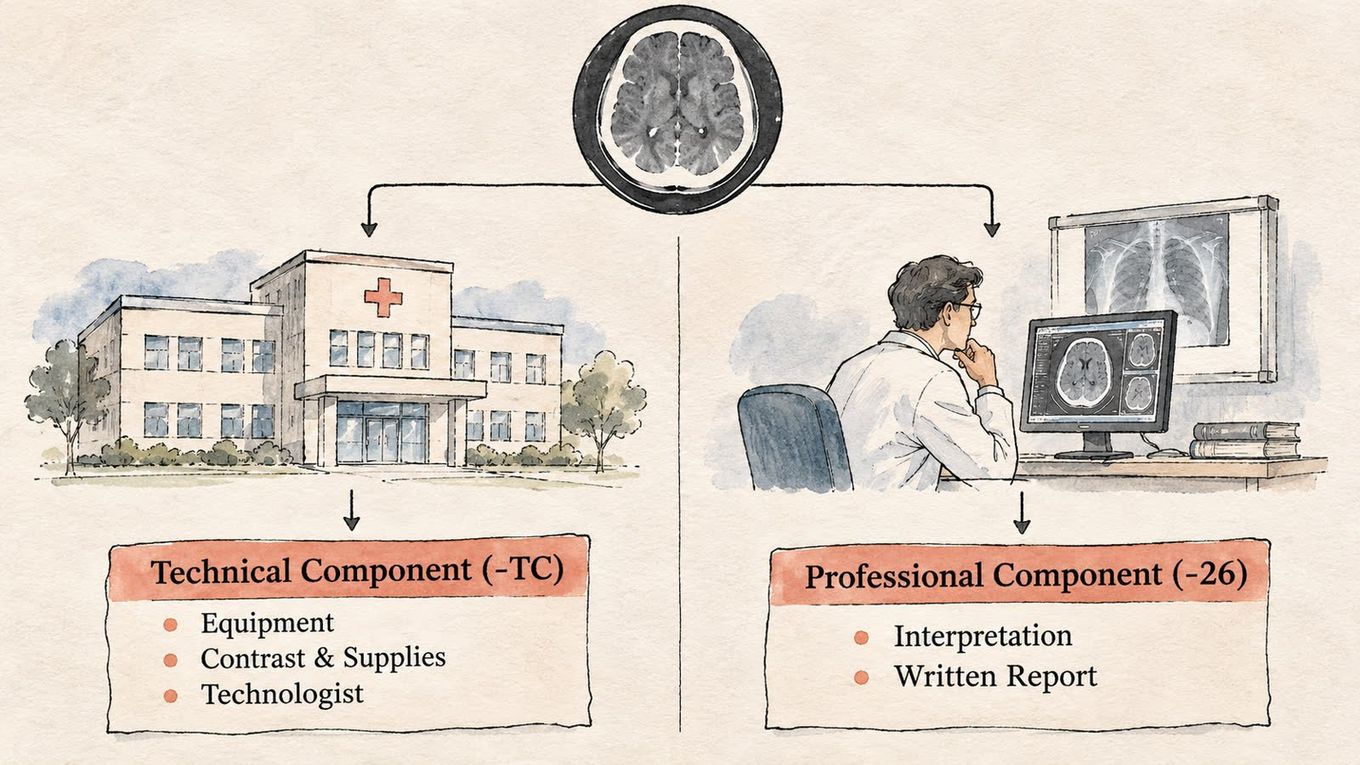
The most expensive mistake in radiology billing is a missing or misapplied modifier. Here's the full breakdown of when each scenario applies.
| Billing Type | Modifier | Who Bills It | What It Covers |
|---|---|---|---|
| Professional component (PC) | \-26 | Radiologist / reading physician group | Interpretation, written report |
| Technical component (TC) | \-TC | Hospital, imaging center, or facility | Equipment, supplies, contrast, technologist |
| Global billing | None | Same entity performs both | Interpretation + equipment + technologist combined |
The global scenario applies when an independent imaging center employs both the radiologist and the technical staff. Hospital-based radiology almost always splits billing: the hospital bills -TC and the radiologist group bills -26 on the same claim date. Getting this wrong in either direction produces a duplicate claim denial from the payer, or leaves the professional interpretation unbilled entirely.
This isn't a theoretical risk. In hospital-based contracts, the modifier split happens across two billing teams, two claim submission workflows, and two AR queues. Without a process that explicitly governs both sides, errors accumulate silently.
The CPT Codes That Burn Radiology Groups Most Often
Contrast status changes the code. That single fact is responsible for more audit exposure and coding errors in radiology than almost anything else.
| Modality | Example CPT | Description | Key Coding Note |
|---|---|---|---|
| Chest X-ray | 71046 | 2 views | Note view count; contrast not applicable |
| CT head | 70450 / 70460 / 70470 | W/o, w, w/w/o contrast | Contrast status changes the code entirely |
| MRI brain | 70551 / 70552 / 70553 | W/o, w, w/w/o contrast | Same contrast-status rule as CT |
| MRI lumbar spine | 72148 / 72149 / 72158 | W/o, w, w/w/o contrast | Most frequently coded MRI; common medical necessity scrutiny |
| CT abdomen/pelvis | 74176 / 74177 / 74178 | W/o, w, w/o then w contrast | All three codes cover combined abdomen+pelvis; contrast status determines code selection |
| Screening mammography | 77067 | Bilateral | Distinguish from diagnostic (77066/77065); different auth requirements |
| Ultrasound abdomen | 76700 / 76705 | Complete / limited | Documentation must support complete vs. limited distinction |
| PET whole body | 78816 | With CT, whole body | Requires specific ICD-10 to establish medical necessity |
| Fluoroscopy guidance | 77002 | Needle placement | Often bundled; bill separately only when payer allows |
A coder who selects 70450 (CT head without contrast) when the report documents contrast administration produces a claim that doesn't match the medical record and will not survive an audit. The fix isn't catching it on appeal; it's coding from the finalized radiology report, not the order.
Prior Auth in Radiology: The Gatekeeping Step That Kills Claims Before They're Submitted
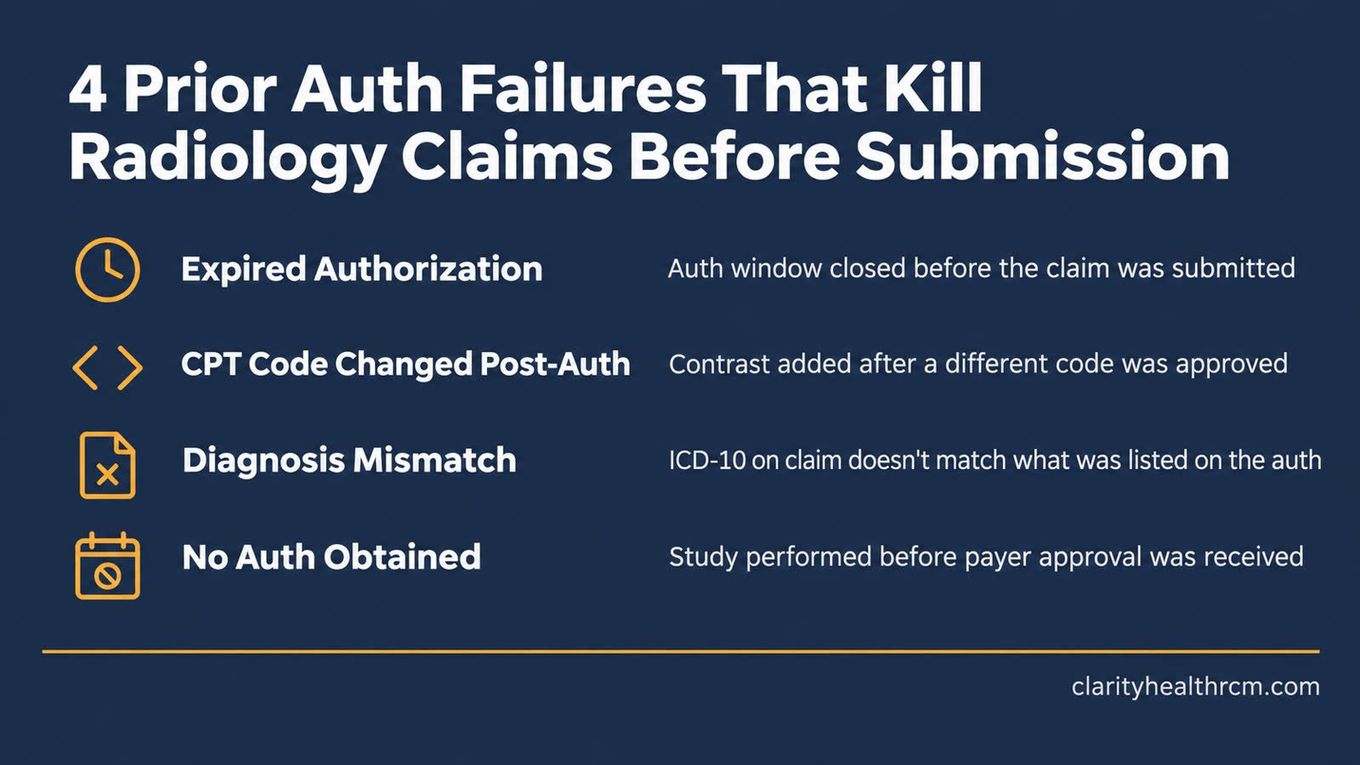
Prior authorization in radiology is front-end gatekeeping that happens before a study is performed. By the time a claim is submitted with a missing or expired auth, the denial is already written.
- Which studies routinely require auth: CT scans, MRI, MRA, PET, nuclear medicine, and advanced ultrasound (e.g., echocardiography) with most commercial payers and Medicare Advantage plans.
- What triggers a denial: Expired authorization, wrong CPT code on the authorization (a known CT code approved, but billing adds contrast and the code changes), wrong diagnosis on the auth, or performing a study before approval is received.
- Medicare FFS vs. Medicare Advantage: Traditional Medicare has not historically required prior auth for most diagnostic imaging, though the CMS WISeR (Wasteful and Inappropriate Service Reduction) model, effective January 15, 2026, introduced prior authorization requirements for select radiology and interventional radiology services under Medicare FFS in a 6-state pilot (Arizona, New Jersey, Ohio, Oklahoma, Texas, and Washington). Providers in those states who do not participate face pre-payment medical review. Medicare Advantage plans require prior auth broadly, often with payer-specific coverage criteria that differ from CMS LCD guidelines.
- Radiology Benefits Managers (RBMs): Many commercial payers route imaging auth through third-party RBMs, including eviCore, Carelon, and National Imaging Associates. These organizations have their own portals, criteria, and turnaround timelines, requiring specialized workflow management from the billing team.
A billing service that handles radiology should have a dedicated prior auth team fluent in RBM portal navigation, not a generalist authorization workflow bolted onto a primary care billing operation.
For practices already running into prior auth denials, our prior authorization services explains how a dedicated auth workflow reduces upstream denials before claims are even submitted.
What's Actually Driving Your Radiology Denials
Medical necessity is consistently the highest-dollar denial category. Prior auth is the most frequent. Here's the full picture, with the root cause and the actual fix for each.
| Denial Reason | Root Cause | Fix |
|---|---|---|
| Medical necessity | Missing or non-matching ICD-10 for the study ordered | Confirm diagnosis codes align with LCD/NCD criteria before billing |
| Prior auth missing or expired | Auth not obtained or CPT changed after auth | Real-time auth tracking; re-auth workflow for changed orders |
| Duplicate claim | TC and PC billed without modifier by two entities | Confirm modifier assignment before submission |
| Incorrect modifier | \-26 on global study or -TC missing | Modifier audit on every claim before batch submission |
| Bundling | Fluoroscopy guidance code bundled with primary procedure | Payer-specific bundling edits; use -59 only when documentation supports |
| Timely filing | High-volume environment allows claims to age past payer deadlines | Automated claim submission within 24-48 hours of service |
| Contrast status mismatch | Wrong CPT selected for contrast administered | Coder review against finalized radiology report, not order |
Working medical necessity denials for MRI of the spine and advanced CT protocols requires payer-specific appeal language tied to the applicable Local Coverage Determination (LCD). A generic template used across all specialties will not hold up here, and those are the denials where the dollars are largest.
Our denial management services covers the appeal process and what an effective denial management workflow looks like across specialty practices.
What to Actually Demand From a Radiology Billing Partner
Not every billing company that accepts radiology clients actually knows radiology. The scope of service matters, and so does the specificity of the expertise behind it.
A qualified radiology billing service should include:
- Modality-specific CPT expertise: Coders with radiology-specific coding credentials (such as the AAPC's CIRCC or RCCB's CRC) or equivalent documented experience, not general coders cross-trained on a CPT reference sheet.
- Component billing accuracy: A documented process for identifying PC-only, TC-only, and global billing scenarios across different practice settings and hospital-based vs. independent contracts.
- Prior auth management: Dedicated workflow for RBM portals, auth tracking by study, and re-authorization before authorizations expire.
- Modifier governance: A QA checkpoint that reviews modifier assignment on every claim, not on exception.
- Denial management with appeal capability: Radiologist-specific medical necessity appeal language tied to LCD criteria, not a generic appeal template used across all specialties.
- Interventional billing support: A separate coding pathway for IR procedures, including catheter placement codes, supervision and interpretation codes, and guidance bundling rules.
- Transparent reporting: Denial rate by modality, clean claim rate, days in AR, and collection rate by payer. If a billing company cannot report these by imaging type, they cannot tell you where your revenue is leaking.
Build It or Buy It: The Billing Question Every Radiology Group Eventually Faces
The core question isn't cost. It's whether your in-house team was built for radiology's specific billing complexity or inherited the responsibility alongside several other specialties.

| Factor | In-House | Outsourced |
|---|---|---|
| Coding expertise | Difficult to maintain as codes and payer rules change | Specialty-trained coders updated continuously |
| Prior auth bandwidth | Requires dedicated FTEs per payer volume | Managed by billing company's auth team |
| Denial management | Often under-resourced; appeals fall through | Systematic denial work and appeal filing |
| Technology cost | EHR billing module + clearinghouse fees | Included in billing service fee |
| Cost structure | Fixed salary + benefits + overhead | Variable (percentage of collections) |
| Scalability | Hiring lag during volume surges | Scales with practice volume |
| Reporting | Depends on EHR reporting capabilities | Dedicated RCM reporting dashboards |
Radiology groups handling high read volume, multiple modalities, or facility-based plus professional component billing simultaneously are the practices most likely to see measurable improvement from outsourcing. The complexity compounds faster than in-house teams can keep pace.
For a broader comparison of the trade-offs, in-house vs. outsourced medical billing covers the decision criteria in detail.
Why Trust This Article
Our background:
- Clarity Health RCM traces its roots to Quality Medical Billing, founded in 1988, with 40+ years of combined revenue-cycle experience across the organization.
- Our team, led by President & CEO Estelle Sandoval, works across physician groups, hospital-based billing, and outpatient specialty practices including diagnostic and interventional radiology.
What we see in practices:
- The most common revenue leak in radiology groups is modifier assignment, specifically TC/PC splits on hospital-based contracts that go unreviewed at scale.
- Prior auth denial recovery is frequently the fastest improvement area, since most of these claims are payable once the authorization documentation is located and the appeal is filed correctly.
- Medical necessity denials for MRI spine and advanced CT protocols require payer-specific appeal language aligned to the applicable LCD, not a generic appeal template.

How Clarity Health RCM Supports Radiology Practices
If your radiology group or imaging center is dealing with any of the following, our RCM team can help:
- Coding and modifier review: We audit TC/PC/global assignments and modifier usage across your claim volume to identify the specific codes driving your denials.
- Prior authorization management: Our auth team handles RBM portals including eviCore and Carelon, and tracks authorizations through study completion to prevent expired-auth denials.
- Denial management and appeals: We work radiology-specific medical necessity denials with payer-appropriate appeal language, including LCD-aligned documentation for spine MRI and advanced CT.
- AR recovery: We follow up on aging radiology claims, including professional and technical component claims that fall into separate AR queues within the same billing cycle.
- Reporting: We provide denial-rate and collection-rate reporting broken out by modality and payer so you can see exactly where revenue is leaking, not just aggregate billing numbers.
Learn more about our physician billing services and medical coding services, or contact us to discuss your practice's billing setup.
Frequently Asked Questions
What is the difference between professional, technical, and global radiology billing?
Professional component (PC) billing, submitted with Modifier -26, covers the radiologist's interpretation and written report. Technical component (TC) billing, submitted with Modifier -TC, covers the equipment, contrast, supplies, and the technologist performing the scan. Global billing, submitted without a modifier, applies when the same entity, typically an independent imaging center, performs and bills for both components. Hospital-based radiology almost always splits the two: the hospital bills TC and the radiologist's group bills -26 on the same date of service.
Why do radiology claims get denied at higher rates than other specialties?
Radiology denial rates tend to run higher than primary care or medical management specialties because the billing involves more moving parts: prior authorization requirements managed separately from coding, modifier-intensive claim formats, contrast-status-sensitive CPT selection, and payer-specific medical necessity criteria applied through Local Coverage Determinations. Any one of these can produce a denial, and in high-volume imaging environments, errors compound quickly across a large claim volume.
Does radiology billing require prior authorization for every study?
Not for every study. Plain X-rays generally do not require prior authorization with most payers. Advanced imaging, including CT, MRI, MRA, PET, and nuclear medicine studies, typically requires authorization from commercial payers and Medicare Advantage plans. Traditional Medicare has not historically required prior auth for most diagnostic imaging, though the CMS WISeR model (effective January 15, 2026) introduced prior auth requirements for select radiology services under Medicare FFS in a 6-state pilot (Arizona, New Jersey, Ohio, Oklahoma, Texas, and Washington); providers outside those states or not covered by those specific services remain unaffected. Payers routing through Radiology Benefits Managers such as eviCore or Carelon apply their own criteria regardless of CMS guidelines.
What CPT modifiers are most important in radiology billing?
The most critical modifiers in radiology billing are Modifier -26 (professional component only), Modifier -TC (technical component only), Modifier -59 (distinct procedural service, used to override bundling edits when documentation supports it), Modifier -50 (bilateral procedure), and Modifiers -LT and -RT (left and right side). Incorrect modifier application, particularly on -26 and -TC, is one of the most audited billing patterns in the specialty and a primary cause of duplicate claim denials.
What should I look for in a radiology billing company?
Look for a company with radiology-specific coding credentials or demonstrated specialty experience, a documented process for PC/TC/global billing across different practice settings, a dedicated prior authorization workflow that includes RBM portal management, and denial management with radiologist-specific medical necessity appeal capability. Reporting matters too: a qualified radiology billing service should deliver denial rates and collection rates broken out by modality and payer, not just aggregate billing metrics.
How does interventional radiology billing differ from diagnostic radiology?
Interventional radiology billing layers procedural CPT codes on top of imaging guidance codes, and the two must be billed correctly as either bundled or separately billable depending on payer policy. Common interventional procedures, including catheter placements, biopsies, drains, and vascular interventions, each have specific coding rules for the primary procedure, the supervision and interpretation component, and any imaging guidance used. Coders who handle diagnostic radiology only are frequently underprepared for interventional billing, which is a reason to confirm specialty experience before engaging a billing company.