Internal Medicine Billing Services: Where Practices Lose Revenue Without Knowing It
November 27, 2026 · 13 min read
Here's something that never shows up in your denial reports: revenue you never billed for in the first place.
Internal medicine practices are exceptionally good at delivering care and exceptionally bad at capturing payment for it. Not because the claims get denied. Because the claims never go out. The visit happened, the documentation exists, and somewhere between the exam room and the clearinghouse, a billable service quietly disappeared.
This is where it goes.
At a Glance: The Four Revenue Categories in Internal Medicine Billing
Internal medicine doesn't run on one code type. It runs on four, each with its own documentation rules, timing requirements, and ways to silently lose money.
| Revenue Category | Key Codes | Primary Risk |
|---|---|---|
| Evaluation and Management (E/M) | 99202-99215 | Undercoding; MDM level not documented to support the visit |
| Chronic Care Management (CCM/PCM) | 99490, 99491, 99487, 99489, 99424-99427 | Service delivered, never billed; time logs missing |
| Transitional Care Management (TCM) | 99495, 99496 | Missed billing window; face-to-face not tied to discharge |
| Preventive and Wellness | G0402, G0438, G0439, 99381-99397 | Same-day modifier errors; AWV bundled with E/M incorrectly |
If you're only watching denials, you're only seeing half the problem.
E/M Level Selection: You're Probably Undercoding and Don't Know It
The 2024 Medicare Fee-for-Service Supplemental Improper Payment Data puts the E/M improper payment rate at 10.3%. That's $3.9 billion in projected improper payments, and 49.1% of those errors came from incorrect coding.
In internal medicine, the direction of that error is almost always downward. Providers aren't upcoding. They're undercoding. Consistently. Habitually. At scale.
The reason is usually the same: code selection based on gut feel or conservative instinct, not on what the documentation actually supports.

The MDM Table That Determines Your Level
Since January 2021, the right E/M code is determined by medical decision-making (MDM) or total time, not by history elements and physical exam bullets. A visit qualifies for a level if it meets or exceeds two of three MDM elements:
| MDM Element | 99213 (Low) | 99214 (Moderate) | 99215 (High) |
|---|---|---|---|
| Number/complexity of problems | 1 stable chronic illness; 2+ self-limited/minor problems; 1 acute uncomplicated | 1+ chronic with exacerbation; undiagnosed new problem | 1+ chronic with severe exacerbation; threat to life or function |
| Amount/complexity of data | Reviewed/ordered test; independent interpretation | Independent interpretation; independent historian used | Extensive data review; independent interpretation of external records |
| Risk of complications | OTC medications; minor surgery without identified risk factors | Prescription drug management; diagnosis/treatment limited by social determinants | Drug therapy requiring intensive monitoring; decision for hospitalization |
Here's how the undercoding pattern plays out in practice:
- Patient presents with diabetes, hypertension, and hyperlipidemia: all stable, all actively managed
- Provider selects 99213 out of habit
- The visit qualifies for 99214 under MDM: moderate complexity, prescription drug management across multiple conditions
- The claim goes out $30-$40 short
- Multiply that by 20 patients a day, 220 days a year
That's not a rounding error. That's a revenue problem.
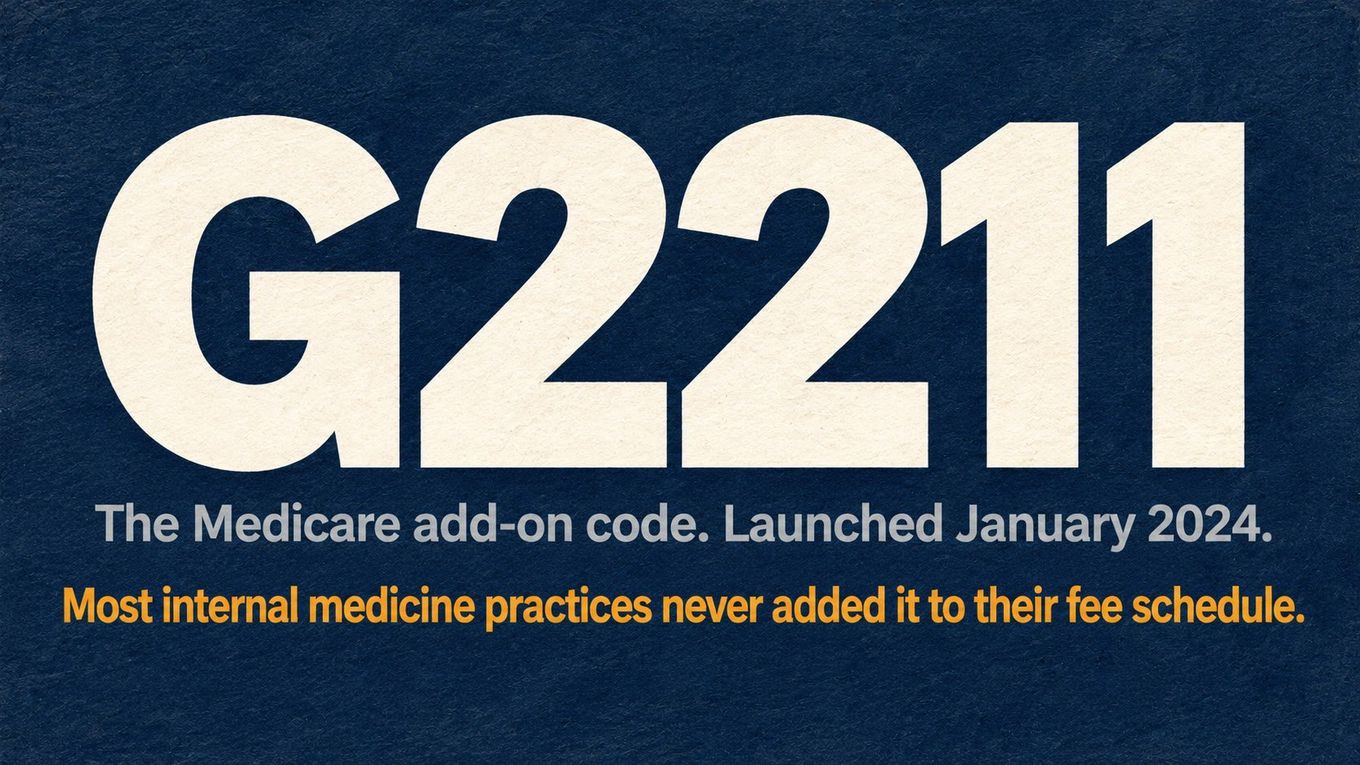
G2211: The 2024 Code Your Billing Team Almost Certainly Never Added
On January 1, 2024, Medicare introduced G2211, an add-on code for office and outpatient E/M visits where the physician is the continuing focal point for a patient's care across conditions over time.
It pays roughly $17-$18 per claim at current Medicare rates (verify at your MAC's fee schedule; this is RVU-based and adjusts annually).
Who it applies to:
- Established Medicare patients where you are the primary care focal point
- Reported alongside 99202-99215
- Not applicable to new patients at the initial visit, or to visits addressing a single self-limited problem
Why almost no one bills it:
It launched January 1, 2024. Most billing teams didn't add it to charge capture. The EHR didn't prompt for it. No denial came back to flag the miss. And so for the entire first year of its existence, it sat there: valid, billable, and unclaimed, while practices saw those same patients week after week.
Across a panel of established Medicare patients with chronic conditions, G2211 adds up to thousands of dollars a month. The only reason it's missing is that no one asked for it.
Chronic Care Management: The Service You're Doing and Not Billing For
This is the one that frustrates us the most.
Your practice is managing patients with two or more chronic conditions every single month. You're doing care plan updates, refill authorizations, test result follow-ups, coordination calls. That's CCM. Medicare built a billing pathway specifically to pay for it. And most internal medicine practices are doing this work and billing for none of it.
What the CCM Code Structure Looks Like
| Code | Description | Time Requirement |
|---|---|---|
| 99490 | Non-complex CCM, clinical staff time | 20+ minutes per month |
| 99491 | Non-complex CCM, physician/NPP time | 30+ minutes per month |
| 99487 | Complex CCM | 60+ minutes per month |
| 99489 | Complex CCM, additional 30 min | Add-on to 99487 |
For patients with one complex chronic condition instead of two or more, Principal Care Management (PCM) covers the same non-face-to-face work:
| Code | Description |
|---|---|
| 99424 | PCM, physician/NPP, first 30 minutes |
| 99425 | PCM, physician/NPP, additional 30 minutes |
| 99426 | PCM, clinical staff, first 30 minutes |
| 99427 | PCM, clinical staff, additional 30 minutes |
The Three Ways CCM Claims Actually Fail
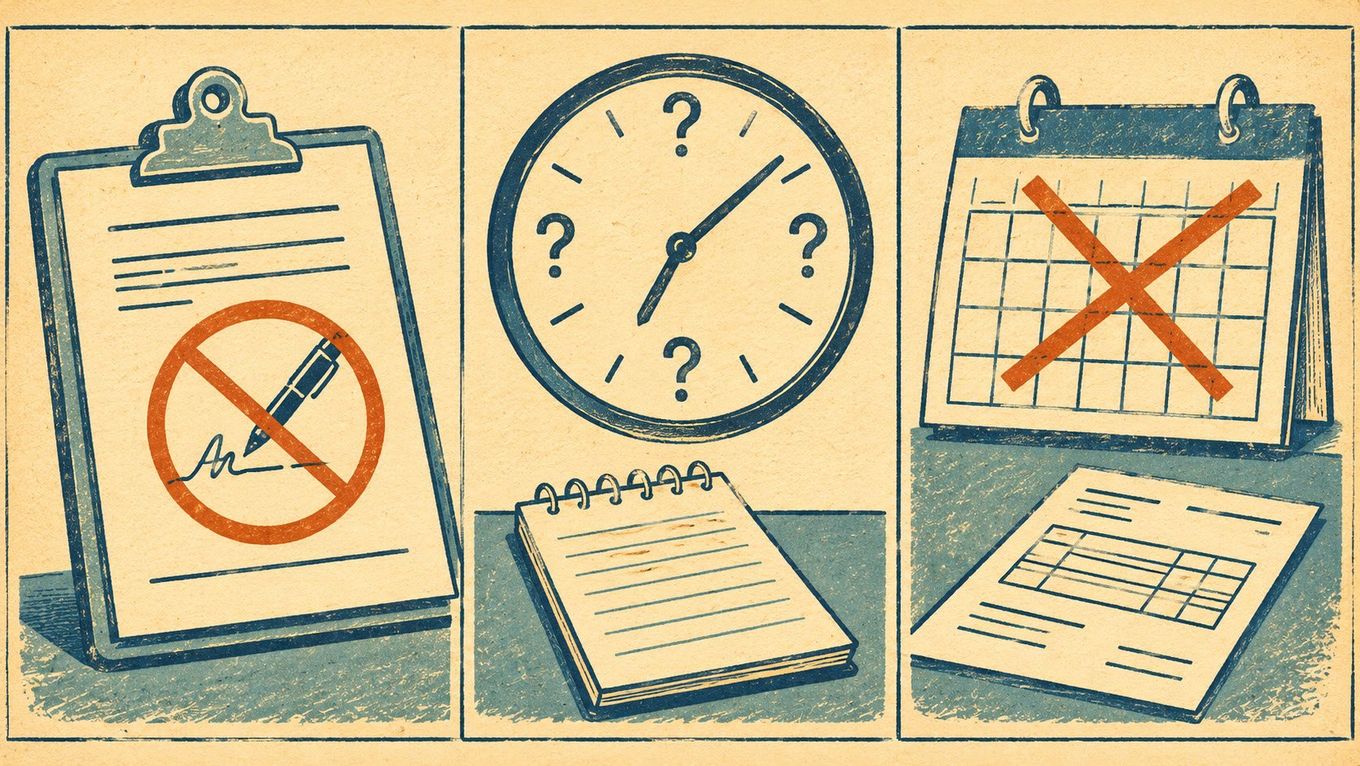
1. No patient consent on file. Medicare requires verbal or written consent before CCM services begin, documented in the chart. This isn't a technicality that gets waived. Claims denied on audit for missing consent don't get paid retroactively.
2. Time logs that don't exist. A note saying "CCM services provided this month" is not a time log. The actual minutes spent, broken down by provider and task, need to be tracked and documented. If your EHR doesn't have a CCM time-tracking module, someone is keeping a spreadsheet or nothing at all.
3. Billing before 30 days. CCM covers a calendar month of service. Submit a claim less than 30 days after the previous billing period and it denies automatically. This requires a patient-specific billing calendar, not a general monthly billing run.
The fix isn't an appeals process. By the time CCM claims are denied, the revenue window has usually closed. See our denial management guide for how pre-submission review catches these before they go out.
Transitional Care Management: You Have 2 Business Days and a Hard Deadline
A patient gets discharged from the hospital. The clock starts the moment they leave.
You have 2 business days to make interactive contact: a phone call, a secure message, or a face-to-face visit. If you miss that window, the TCM code is gone for that discharge episode. No extensions, no appeals on timing.

TCM Code Comparison
| Code | Required Contact | Face-to-Face Visit | Complexity |
|---|---|---|---|
| 99496 | Within 2 business days | Within 7 calendar days of discharge | High MDM |
| 99495 | Within 2 business days | Within 14 calendar days of discharge | Moderate MDM |
Here's what actually happens in most practices:
- Nobody notifies the billing team when a patient is discharged
- The 2-business-day contact happens but gets documented in a general phone note, not flagged as TCM
- The follow-up visit happens inside the window, billed as a standard 99214 instead of 99495 or 99496
- The reimbursement difference between a 99214 and a 99495 is real money
One more thing: TCM and CCM cannot be billed in the same 30-day period. If a CCM patient is discharged, TCM takes over for that month. This requires coordination between clinical staff and billing that most practices have never set up.
Same-Day Preventive and Problem-Focused Visits: Bill Both or Leave One Behind
Patient comes in for their Annual Wellness Visit. During the visit, they mention their knee has been swelling, their blood pressure has been running high, or their blood sugar numbers are off. You address it. You document it.
Both services are billable. Most practices bill one.

What's Billable on the Same Day
| Preventive Service | Problem-Focused E/M | What You Need |
|---|---|---|
| G0438 or G0439 (AWV) | 99213-99215 | Modifier 25 on E/M; separate, distinct documentation |
| 99381-99397 (Preventive E/M) | 99213-99215 | Modifier 25 on E/M; separate, distinct documentation |
| G0402 (Welcome to Medicare) | 99213-99215 | Modifier 25 on E/M; separate, distinct documentation |
Modifier 25 tells the payer the problem-focused E/M is significant, separately identifiable, and not incidental to the preventive visit. Without it, the E/M claim denies. With it, both services pay.
What typically happens instead: the provider documents the problem in the same note as the preventive visit, the billing team submits only the preventive code to avoid a denial, and nobody appeals it because the work was already done and the visit is already closed.
Top Denial Patterns in Internal Medicine Billing
| Denial Reason | Root Cause | Fix |
|---|---|---|
| E/M downcoded by payer | MDM documentation doesn't support the level selected | Pre-submission MDM audit; physician education on complexity elements |
| CCM denied for time period | Less than 30 days since last CCM claim | Patient-specific billing calendar tied to service start date |
| CCM denied for consent | No documented patient consent in chart | Consent workflow integrated at CCM program enrollment |
| Same-day E/M denied | Missing modifier 25 on problem-focused service | Charge capture rule: modifier 25 required when preventive + E/M on same DOS |
| TCM window lapsed | Face-to-face visit outside the 7- or 14-day window | Real-time discharge alert system; designated TCM coordinator |
| Infusion subsequent hour denied | Missing start/stop time documentation | Documentation template with required start/stop fields |
| G2211 not captured | Never added to charge capture after January 2024 launch | Fee schedule update; charge capture prompt for established Medicare patients |
Should You Handle Internal Medicine Billing In-House?
Honest answer: sometimes yes, usually no. Here's how to tell the difference.

In-House Works When:
- Dedicated billers with internal medicine-specific experience, not generalist outpatient coders
- Charge capture workflows updated annually to reflect new codes: G2211 at launch, PCM codes in 2022, any AWV changes
- CCM time-log tracking built into the EHR or a purpose-built system, not a spreadsheet
- A defined process for hospital discharge notifications that triggers TCM billing within 2 business days
- Denial reporting that surfaces underpayment patterns, not just rejected claims
In-House Struggles When:
- Billing staff covers multiple specialties with no one who owns internal medicine coding specifically
- CCM is happening clinically but rarely or never billed
- G2211 and TCM codes weren't added to fee schedules when they launched
- E/M levels have never been audited for undercoding
The Outsourcing Case
The math usually favors outsourcing at practices with 2+ providers. But the deeper argument isn't cost. It's code currency.
Internal medicine adds meaningful new billing codes almost every year. G2211 in 2024. PCM codes in 2022. AWV updates before that. An in-house team managing multiple specialties doesn't update internal medicine charge capture in step with regulatory changes, and revenue that was never captured because a code wasn't on the fee schedule doesn't generate a denial to chase.
Our in-house vs. outsourced billing comparison covers the full decision framework, including the cost thresholds where outsourcing pays for itself.
Why Trust This Article
Clarity Health RCM traces its roots to Quality Medical Billing, founded in 1988.
Our background:
- 40+ years of combined revenue cycle experience under President and CEO Estelle Sandoval
- Full-cycle RCM across physician groups, specialty practices, and inpatient and outpatient facilities nationwide
What we see in practices that engage us:
- G2211 not on the fee schedule at all, 12+ months after the January 2024 launch date
- CCM services delivered to hundreds of patients monthly with zero claims submitted
- TCM billing systematically skipped because no one owned the discharge notification workflow
- E/M levels set by provider habit, not MDM documentation, with no proactive audit ever run
The E/M statistics cited here come from CMS's 2024 Medicare Fee-for-Service Supplemental Improper Payment Data. CPT and HCPCS code descriptions reflect 2024-2026 guidelines; verify current RVU-based payment rates at your MAC's fee schedule before applying to live claims. This article is informational guidance for practice operations, not billing or coding advice for a specific claim or clinical situation.
How Clarity Supports Internal Medicine Practices
Internal medicine billing requires coders who understand not just the codes, but the annual regulatory updates that change what belongs on your fee schedule.
What our physician billing services provide for internal medicine practices:
- E/M level auditing: Pre-submission MDM review to confirm the level selected is supported, and to catch systematic undercoding before it becomes a permanent revenue leak
- CCM/PCM program management: Time-log tracking, consent verification, and monthly billing by patient, not just reactive claims after the fact
- TCM workflow: Discharge alert integration and 2-business-day contact tracking so the window doesn't slip
- Annual fee schedule updates: G2211, PCM, AWV, and new add-on codes added to charge capture on the effective date, not months later
- Denial root-cause reporting: Not just appeals. Pattern identification and charge capture fixes that stop the same denial from coming back
For practices evaluating outsourced RCM for physician groups, our internal medicine billing team operates as an extension of your clinical operation, not a generalist billing clearinghouse processing claims in bulk.
Questions about cost? Our medical billing services pricing guide explains how fees are structured and what to compare across vendors.
If your CCM billing rate is below your panel's eligible patient count, or your AR over 90 days is climbing, contact our team for a revenue cycle assessment.
Frequently Asked Questions
What CPT codes are most commonly used in internal medicine billing?
The core codes in internal medicine are the office and outpatient E/M codes 99202 through 99215, with 99213 and 99214 representing the majority of established-patient encounters. Add-on code G2211 applies to E/M visits where the physician is the longitudinal primary care provider for established Medicare patients. Chronic care management adds 99490 and 99491 for non-complex CCM and 99487 and 99489 for complex CCM. Transitional care management uses 99495 and 99496 depending on visit timing and MDM complexity. Annual Wellness Visits bill as G0438 (initial) or G0439 (subsequent), and the Welcome to Medicare exam uses G0402.
Why do internal medicine claims get denied more than expected?
The most common denial drivers are E/M level documentation that doesn't support the code selected, CCM claims submitted before 30 days have elapsed since the last billing period, same-day preventive and problem-focused E/M claims submitted without modifier 25 on the problem-focused service, and infusion subsequent-hour codes denied for missing start/stop time documentation. A less visible problem is undercoding: the correct higher-level E/M was justified but a lower code was submitted, resulting in permanent underpayment that never shows up in a denial report.
What is G2211 and which internal medicine practices can bill it?
G2211 is a Medicare add-on code introduced January 1, 2024, for office and outpatient E/M visits that reflect the inherent complexity of managing a patient's care across conditions over time, where the billing provider serves as the primary care focal point. It is reported alongside 99202-99215 for established Medicare patients where the relationship is longitudinal and the visit reflects ongoing, coordinated management. It cannot be reported for a patient's first visit or for visits addressing a single self-limited problem. The code was consistently underutilized in its first year. Most practices never added it to charge capture after the January 2024 launch date.
How does Chronic Care Management billing work in internal medicine?
CCM covers non-face-to-face clinical staff or physician time spent managing patients with two or more chronic conditions expected to last at least 12 months. The practice must document patient consent before services begin, maintain a comprehensive care plan, and track time monthly by provider type. The minimum monthly threshold for the base code (99490) is 20 minutes of clinical staff time; physician-level time uses 99491 at 30 minutes. Claims are billed once per calendar month, and a minimum of 30 days must separate consecutive billing periods or the claim will deny. The most common failure modes are missing consent documentation, inadequate time logs, and billing teams unaware the service is being delivered at all.
What is Transitional Care Management and when can it be billed?
Transitional Care Management covers the 30-day period following discharge from an inpatient facility, observation stay, or skilled nursing facility. The practice must make interactive contact with the patient within 2 business days of discharge and conduct a face-to-face visit within 7 days (for 99496, high-complexity MDM) or 14 days (for 99495, moderate-complexity MDM). Both the contact and the visit timing are hard requirements. Missing either deadline makes the code unbillable for that discharge episode. TCM cannot be billed in the same 30-day period as CCM.
How much do internal medicine billing services cost?
Most outsourced medical billing companies charge between 4% and 8% of collected revenue, depending on practice volume, payer mix, and service scope. Internal medicine practices with large CCM panels or high Medicare volumes often pay toward the lower end of that range because of volume. The comparison that matters is not the billing fee in isolation. It's the fee against what in-house billing is currently leaving uncollected through undercoded E/M levels, unbilled CCM, and missed add-on codes like G2211 and TCM. Our medical billing cost guide walks through how to run that comparison properly.