Insurance Eligibility Verification Services: What They Include, What They Cost, and When to Outsource
November 16, 2026 · 10 min read
A practice manager's guide to choosing between in-house checks, software, and an outsourced verification team.
Insurance eligibility verification services confirm that a patient's coverage is active, and what the plan will pay, before the visit happens, so the claim doesn't bounce afterward. Practices handle this in-house, with clearinghouse software, or by outsourcing to a dedicated team. The right choice depends on your visit volume, your payer mix, and how often a simple pass/fail check misses something like a behavioral health carve-out.
This post covers what a complete service should include, how pricing works, what to put in the contract, and where each option breaks down.
Your options at a glance
| Option | How it works | Cost model | Best for | Main risk |
|---|---|---|---|---|
| In-house staff | Front desk or billing staff check payer portals and call payers | Salary and staff time | Low volume, simple payer mix | Checks get skipped when the schedule is full; inconsistent documentation |
| Software or clearinghouse | Real-time electronic checks inside your EHR or practice management system | Per transaction or subscription | High volume, mostly commercial and Medicare | Returns raw data; someone still has to work the exceptions |
| Outsourced verification team | Dedicated verifiers use software, payer portals, and phone calls | Per verification, per FTE, or bundled | Growing groups, multi-location practices, behavioral health | Quality depends on the contract and the handoff to your front desk |
| Hybrid | Software runs the first pass; a team works the exceptions | Combination | Most mid-size practices | Needs a clear owner for failed checks |
For most practices past a few providers, the hybrid model wins. Software is fast on clean commercial and Medicare coverage, and people are better at everything the electronic response leaves out.
What are insurance eligibility verification services?
Insurance eligibility verification services are the people, software, or combination of both that confirm a patient's insurance is active on the date of service and that the plan covers the planned service. A complete service checks policy status, plan type, copay, deductible, coinsurance, visit limits, network status, and authorization requirements, then documents the result in your system.
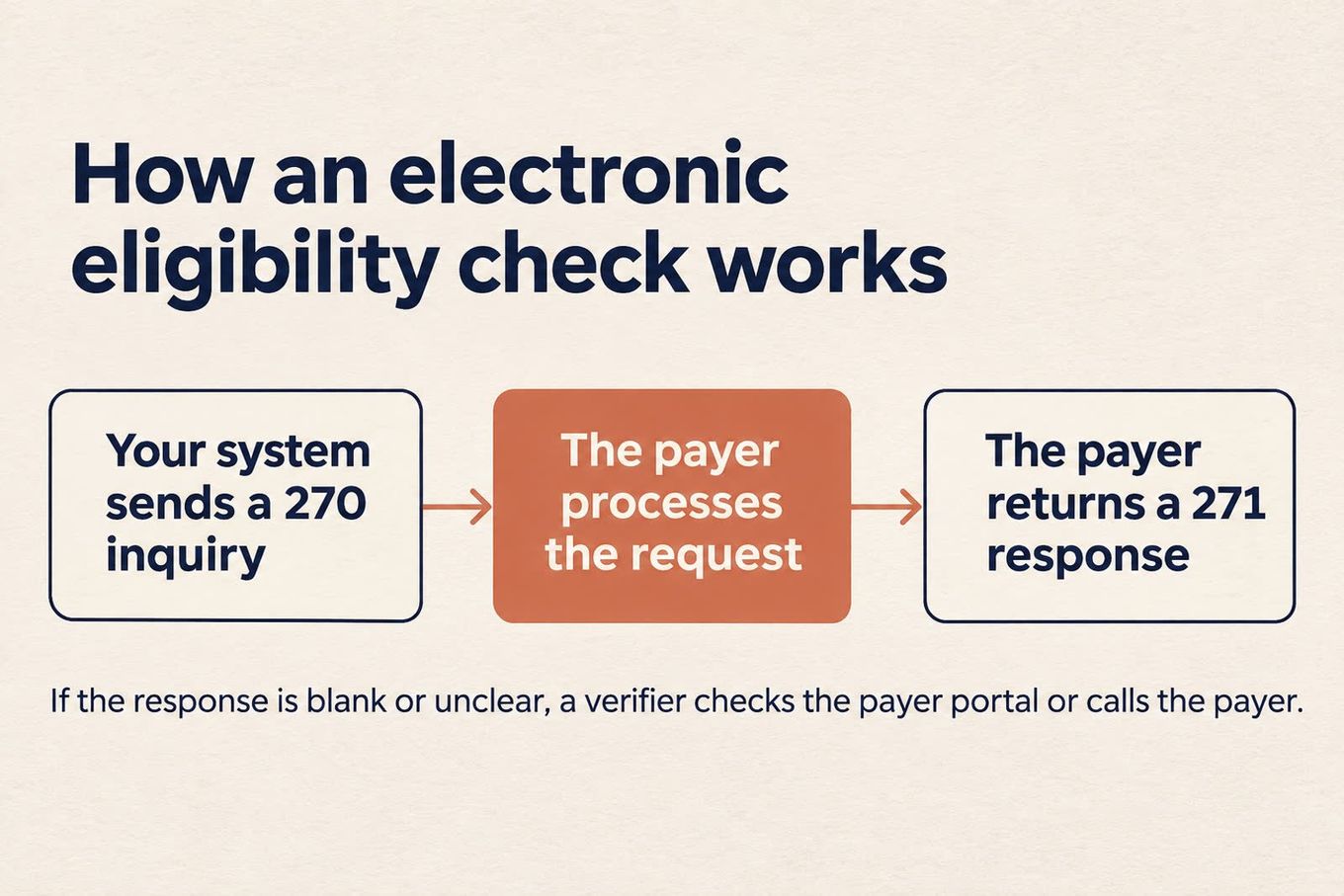
Electronic checks run through the HIPAA-adopted ASC X12N 270/271 (version 5010) transactions: the 270 is the eligibility inquiry and the 271 is the payer's response. When that response is incomplete, a person finishes the job through a payer portal or a phone call.
An eligibility check tells you what the payer says today. It is not a promise to pay.
Eligibility vs. benefits verification vs. prior authorization
These three steps get lumped together, and skipping one is a common source of avoidable denials. They answer different questions.
| Step | Question it answers | What it checks | When it happens |
|---|---|---|---|
| Eligibility verification | Is this patient covered today? | Active policy, effective dates, subscriber, plan type, other coverage | At scheduling and again before the date of service |
| Benefits verification | What will the plan pay for this service? | Copay, remaining deductible, coinsurance, out-of-pocket maximum, visit limits, network status | Before the first visit and at plan-year reset |
| Prior authorization | Does the payer approve this service in advance? | Whether authorization is required, request status, approval number, approved dates and units | Before service, when required |
A patient can pass the first two and still be denied for a missing authorization. Build all three into one workflow, with a named owner for each.

What a good service actually does
Use this as a checklist when you evaluate any vendor, or audit your own front desk.
- Validates demographics first. Name, date of birth, member ID, group number, and subscriber relationship, checked against images of the front and back of the card. A typo here causes more failed checks than inactive coverage does.
- Runs the electronic check. A real-time 270/271 query through your clearinghouse or payer connection.
- Works the exceptions by hand. When the electronic response is blank, vague, or contradicts the card, a verifier checks the payer portal or calls.
- Verifies benefits for the actual service. Not just "coverage active," but what applies to the planned service, for example psychotherapy (CPT 90837) or an established patient office visit (CPT 99214).
- Checks coordination of benefits. Which plan is primary, and whether Medicare Secondary Payer rules apply.
- Flags authorization requirements. If the plan requires prior authorization, the case moves to that workflow before the visit.
- Documents everything. Date, time, method, payer representative name, and call reference number, written back to your practice management system or EHR.
- Re-verifies on a schedule. At scheduling, again 48 to 72 hours before the visit, and at plan-year resets, since many plans renew on a calendar-year basis.
- Reports results. Failure rate, turnaround time, and denials traced back to eligibility.

What to do when a check fails or conflicts
This is where most vendor pages go quiet, and where your contract matters most.
- Payer returns "inactive" or "not found." Recheck the demographics and subscriber details first. Then ask the patient for a new card or other coverage before concluding the policy is dead.
- Portal and phone call disagree. Document the call reference number and the representative's name. The documented call is your evidence if the claim is denied later.
- Coverage is active, but behavioral health benefits sit with another company. Identify the carve-out vendor and run the check there. See our guide to behavioral health carve-outs.
- Patient has two plans. Determine the primary payer before the visit, not after the first denial.
- Medicare patient. Confirm whether the patient is on Original Medicare or a Medicare Advantage plan, since billing goes to different payers.
- Truly uninsured or inactive. Have the self-pay or reschedule conversation before service, while the patient still has options.
What insurance eligibility verification services cost
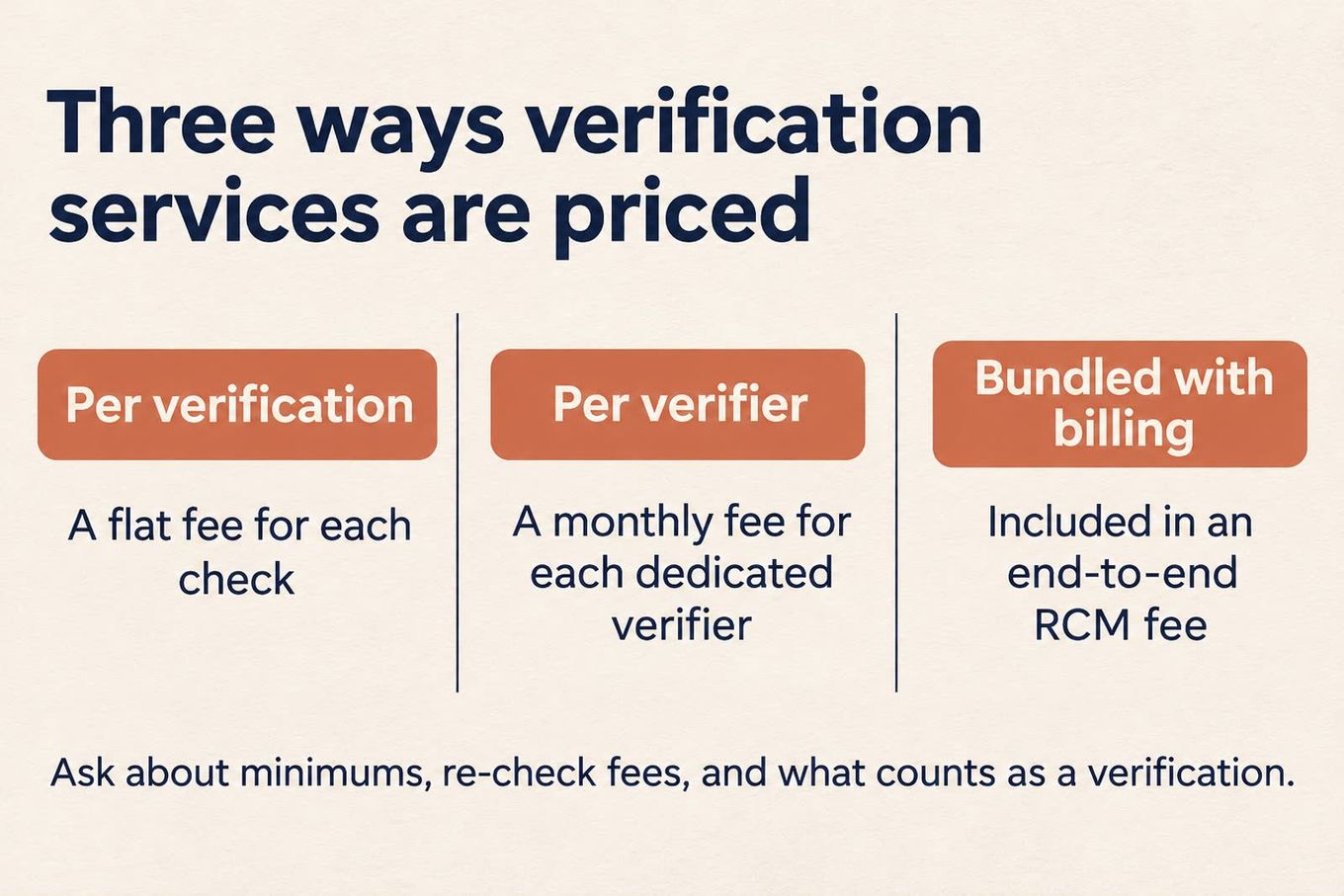
Pricing comes in three models. The headline rate rarely tells the whole story.
| Model | How you pay | Works best when | Watch for |
|---|---|---|---|
| Per verification | Flat fee per check, usually lower for portal checks than phone checks | Volume is steady and predictable | Minimums, fees for re-checks, extra charges for benefits detail |
| Per FTE or dedicated team | Monthly fee per verifier | High volume; you want someone who learns your payer mix | Paying for idle capacity in slow weeks |
| Bundled with billing | Included in an end-to-end RCM fee | You already outsource billing | What counts as a "verification," and whether benefits and authorization are included |
For a reference point, one outsourcing vendor advertises rates as low as $2.00 per online verification and $3.00 per phone verification, with standard turnaround typically within 24 hours. Treat figures like these as floors, and ask what sits behind "as low as."
To compare against doing it yourself, run the math on your own numbers:
(minutes per check × loaded hourly staff cost ÷ 60) + the cost of denials from checks that were missed or done wrong
The second half of that formula is the part practices usually leave out.
Questions to ask before you sign
- What is the turnaround time, and is it guaranteed in writing?
- How is accuracy measured, and who audits it?
- Will you sign a business associate agreement (BAA)? HIPAA requires one for any vendor that creates, receives, maintains, or transmits protected health information on your behalf.
- How do verifiers access your system, and how are credentials stored?
- Who owns a failed check, and how fast do you hear about it?
- Does the service cover Medicare, Medicaid managed care, and behavioral health carve-outs?
- Is re-verification before the visit included?
- What do the reports show, and can they tie denials back to eligibility?
- How do we exit, and what happens to our data?
Why behavioral health needs more than a pass/fail check
A card can show active coverage while a separate company administers the mental health benefit. A software check against the main plan can return "eligible" and still send the claim to the wrong payer.

Behavioral health practices should confirm:
- Which entity administers the benefit, such as Optum or Evernorth for some commercial plans
- Session or visit limits, and whether they reset by plan year
- Deductible and coinsurance for the specific code
- In-network vs. out-of-network status for the rendering provider
- Telehealth coverage and any place-of-service rules
- Authorization requirements for higher levels of care such as IOP and PHP
For the denial side of this problem, read why mental health claims get denied.
Which denials come from skipped or shallow verification
Many front-end denials trace back to a missed check. These claim adjustment reason codes (CARCs) are the usual signals. Descriptions are paraphrased from the X12 claim adjustment reason code list, which is updated over time.

| CARC | What it generally means | Verification gap behind it |
|---|---|---|
| 26 | Expenses incurred before coverage began | Effective date not confirmed |
| 27 | Expenses incurred after coverage ended | No recheck on the date of service |
| 31 | Patient cannot be identified as the insured | Demographic or member ID error |
| 32 | Patient is not an eligible dependent | Subscriber relationship not validated |
| 22 | May be covered by another payer | Coordination of benefits missed |
| 96 | Non-covered charge | Benefits not checked for the service |
| 197 | Authorization or precertification absent | Authorization requirement not flagged |
A monthly review of these codes tells you whether the problem is your process or your payers. Our denial management guide covers the root-cause workflow.
Why trust this article
We built this from the published service models of verification vendors and the denial patterns we see when verification is done poorly. We did not repeat unsourced vendor statistics.
Clarity Health RCM traces its roots to Quality Medical Billing, where our President & CEO, Estelle Sandoval, began managing billing for practices in the late 1980s, and our team brings over 40 years of combined experience inside the revenue cycle. This is informational guidance for practice operations, not billing, coding, or legal advice for a specific claim.
How Clarity handles eligibility verification
At Clarity, eligibility and benefits verification sits inside our Patient Accounts service, alongside registration, prior authorization, patient statements, and account recovery. You can run it as its own workstream, or as part of end-to-end revenue cycle management. See all of our revenue cycle services.
If you are weighing a bigger sourcing decision, our comparison of in-house vs. outsourced medical billing lays out the trade-offs.
Frequently Asked Questions
What is the difference between eligibility verification and benefits verification? Eligibility verification confirms the patient's policy is active on the date of service. Benefits verification goes further and confirms what the plan will pay for the planned service, including copay, deductible, coinsurance, and visit limits. You need both before the visit.
How far in advance should insurance eligibility be verified? Verify when the appointment is scheduled, check again 48 to 72 hours before the visit, and recheck at the start of each plan year. Patients change jobs and plans between scheduling and the visit, so a single early check is not enough.
How much do insurance eligibility verification services cost? Pricing is usually per verification, per full-time verifier, or bundled into a billing fee. Published per-check rates from outsourcing vendors start in the low single dollars, but minimums, re-check fees, and phone-based checks raise the real cost. Compare against your in-house cost per check, including the denials that missed checks cause.
Does a successful eligibility check guarantee payment? No. A verification response reflects what the payer reports at that moment. It does not guarantee payment, and claims can still be denied for authorization gaps, coding issues, or coverage changes.
Can software replace a verification team? Software handles clean, high-volume checks well. It does not resolve blank responses, conflicting payer data, carve-outs, or authorization questions. Most practices get the best result from software for the first pass and people for the exceptions.
Does an outsourced verification vendor need a business associate agreement? Yes. Any vendor that creates, receives, maintains, or transmits protected health information on your behalf is a business associate and must sign a HIPAA business associate agreement. Ask for it before sharing system access or patient data.
Want a second set of eyes on your verification workflow? Talk to our team.