Hospital Revenue Cycle Management Services: What You're Actually Buying
November 16, 2026 · 8 min read
A hospital stay creates two claims. Before you compare vendors, know which one you're buying help with.
TL;DR: Hospital revenue cycle management services take a patient from registration to final payment: eligibility, coding, claims, denials, payment posting and A/R follow-up. The first decision is which claim you need help with, the facility claim or the physician claim, because vendors differ in which side they cover. Settle that before you compare price, technology or promised results.
Picture a finance team that reports a 97% clean-claim rate while cash lands below forecast and A/R over 90 days keeps growing. Both numbers are true, and nobody made an obvious mistake. A clean claim measures paperwork rather than payment, and it overlooks the second claim each inpatient stay generates.
That second claim is where this article starts. We're Clarity Health RCM, and this is how we'd evaluate hospital revenue cycle management services if we were sitting on your side of the table.
What are hospital revenue cycle management services?
Hospital revenue cycle management services are the functions that move a patient encounter into collected cash. They cover patient access, charge capture and coding, claim submission, denial management, payment posting and A/R follow-up. Hospitals buy them as a full outsourced model, as a co-managed model, or for one piece, such as A/R recovery.
The scope varies a lot by vendor. CLA's hospital page lists 340B drug pricing program services, claims management, cash flow acceleration analysis and third-party payor contract review. Coronis Health's hospital and health system page groups A/R follow-up, denial management, appeals, underpayment recovery and payment posting under cash flow improvement. Two vendors can both say "hospital RCM" and be selling very different work.
The question that comes before price: which claim?
One hospital stay produces two different claims. The hospital bills for the facility (the bed, nursing, supplies and ancillary services). The physicians who treated the patient bill for their own professional work. CMS defines the split by format: an institutional claim is the 837 institutional transaction or the paper CMS-1450, and a professional claim is the 837 professional transaction or the paper CMS-1500. The two are coded, submitted and paid under different rules.
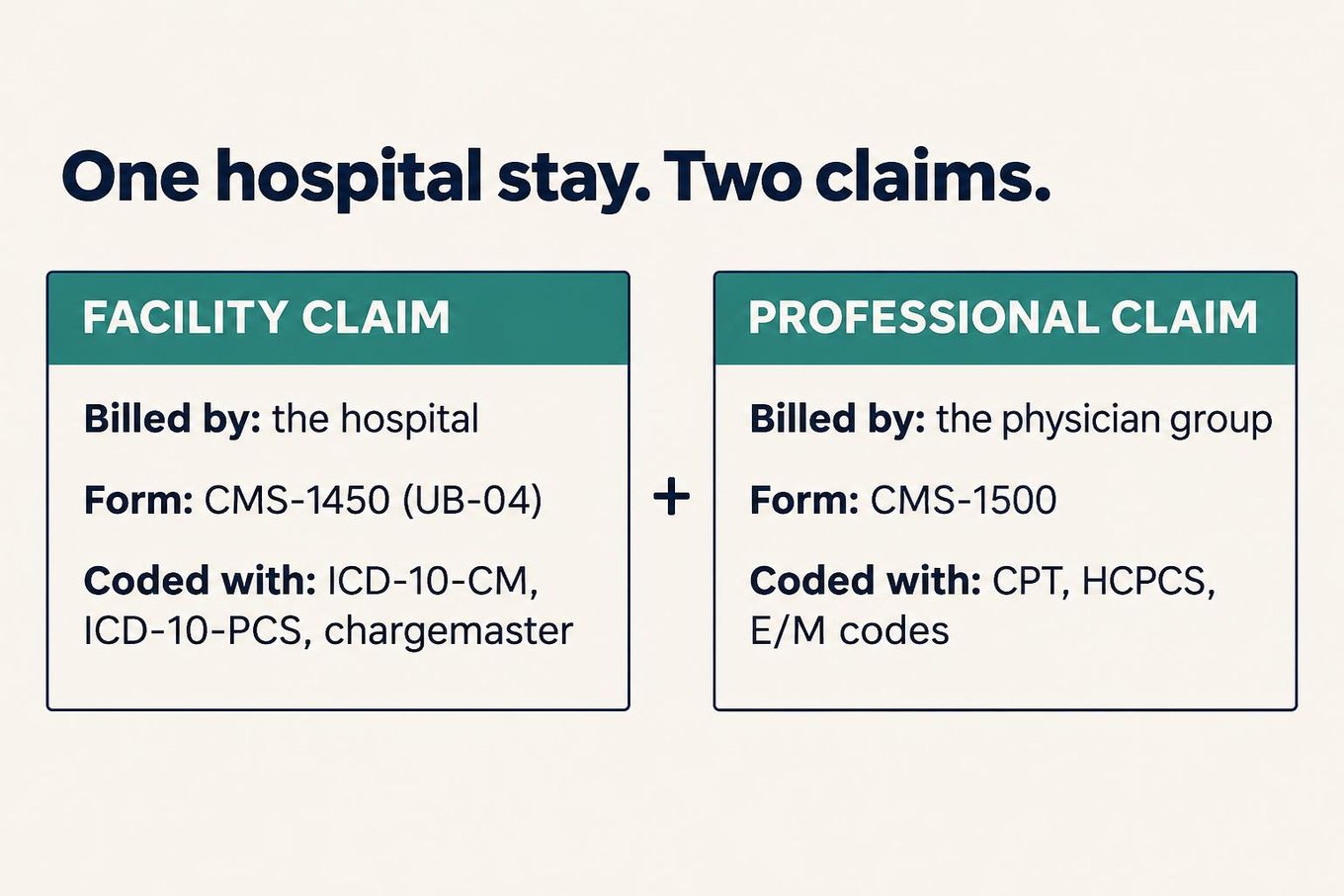
| Facility claim | Professional claim | |
|---|---|---|
| Who bills | The hospital | The physician group |
| Claim form | CMS-1450 (also called the UB-04) | CMS-1500 |
| Payment logic | For most Medicare acute care hospitals, inpatient care is paid under IPPS using MS-DRGs, and outpatient care under OPPS using APCs | Medicare Physician Fee Schedule or contracted payer rates, based on CPT and HCPCS codes |
| Key coding | ICD-10-CM diagnoses and ICD-10-PCS inpatient procedures, plus the chargemaster | CPT and HCPCS, including hospital inpatient or observation E/M codes (initial 99221-99223, subsequent 99231-99233, discharge 99238-99239) |
| Common leak | Charge capture, DRG assignment, status (inpatient vs. observation) | E/M level, same-day rules, missing documentation |
If a vendor can't tell you which of these two columns it works in, that is your first red flag. Vendors differ on which side they cover, so get the answer before you sign.
The CMS pages behind this table explain MS-DRG classification under IPPS, APC payment under OPPS, and which ICD-10 code sets apply to inpatient claims. Since 2023, observation care is reported with the same hospital E/M codes as inpatient care, as AAPC's overview of the 2023 changes explains.
What hospital revenue cycle management services include
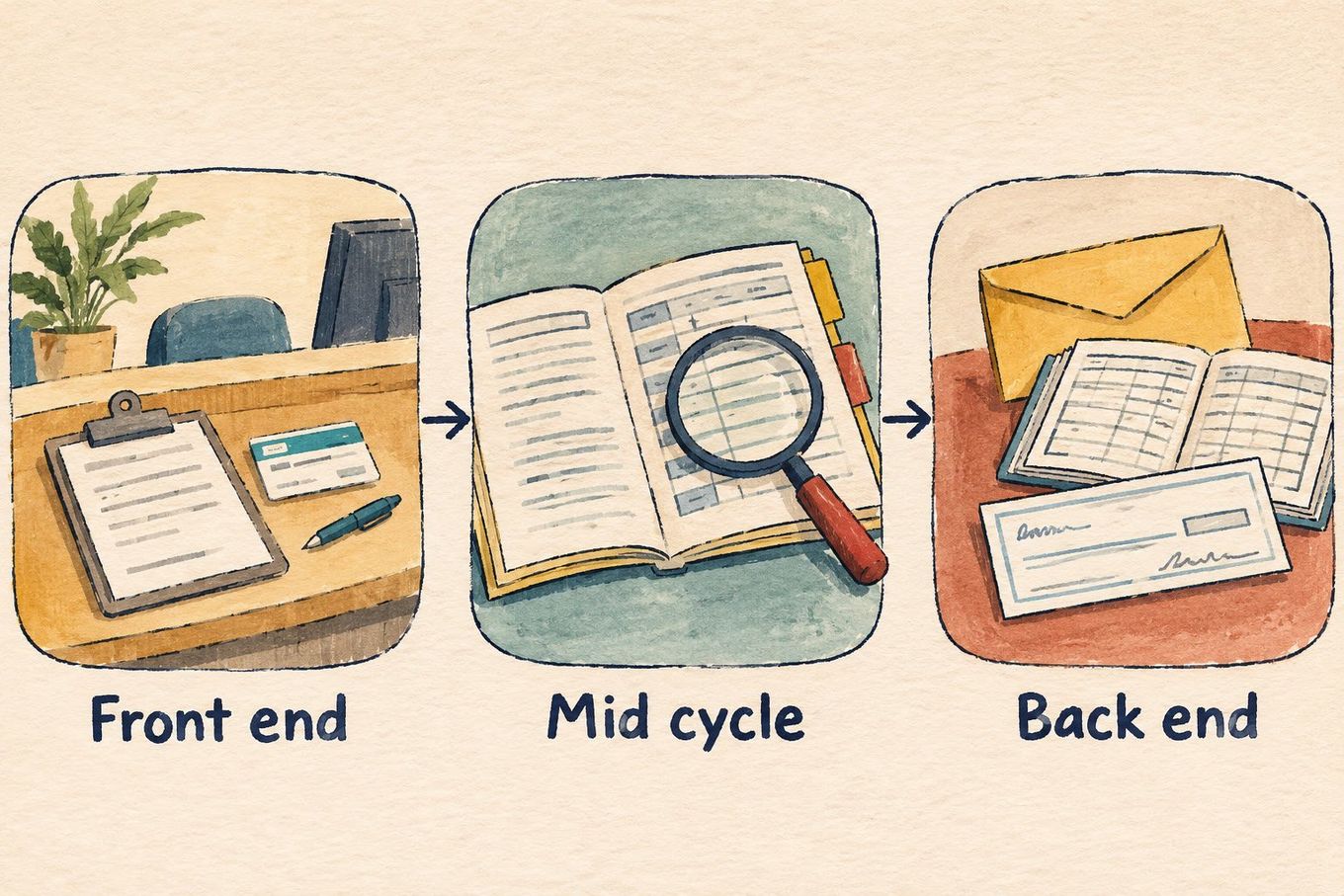
Most scopes fall into three stages. Use this table to check any proposal against your actual gaps.
| Stage | Typical services | Where hospitals lose money |
|---|---|---|
| Front end | Registration, eligibility verification, prior authorization, patient estimates | Missed authorizations, wrong payer on file |
| Mid cycle | Charge capture, coding, documentation review, chargemaster upkeep | Missing or under-coded charges |
| Back end | Claim submission and scrubbing, denial management and appeals, payment posting, underpayment recovery, A/R follow-up | Denials worked late, underpayments never caught |
Practolytics' hospital RCM page also lists prior authorization, coding compliance audits and payer contract support. Treat any extra items as separate line items. If you don't need them, you shouldn't be paying for them.
How hospital RCM services are priced
Pricing models vary, and the model shapes the vendor's incentives.
| Model | How it works | What to watch |
|---|---|---|
| Percent of collections | The vendor earns a share of what is collected | Check what counts as collectible and how underpayments are handled |
| Flat monthly fee | A fixed fee for an agreed scope | Confirm what happens when volume grows |
| Per claim or per encounter | A fee for each claim or encounter handled | Check whether rework and appeals cost extra |
| Hybrid | A base fee plus a performance component | Read how the performance piece is calculated |
We haven't put a percentage range here. Published ranges are rarely sourced, and the right number depends on your volume, payer mix and scope. Our guide to what medical billing services cost walks through what drives the price.
How to evaluate hospital revenue cycle management services
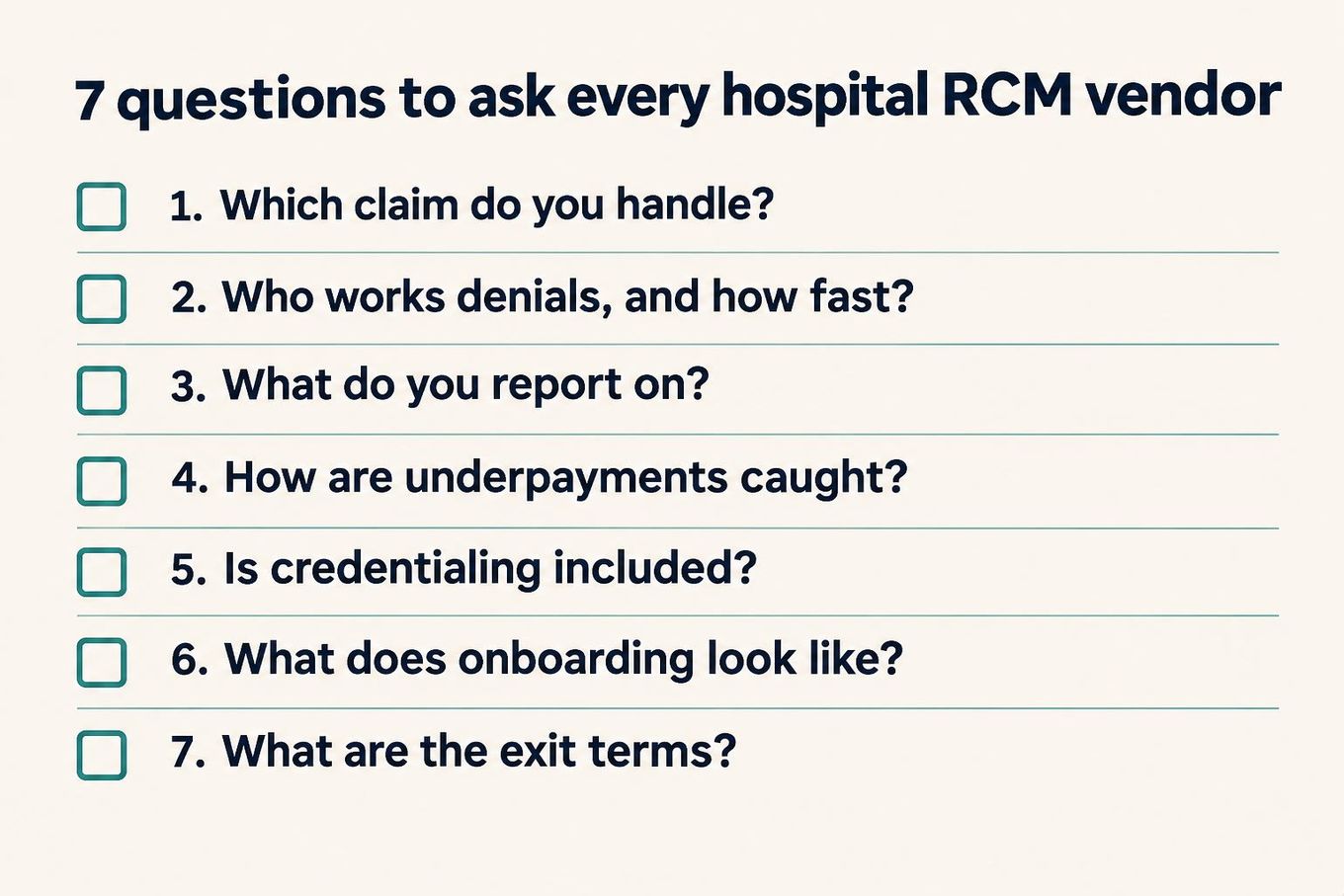
Ask every vendor the same seven questions, and get the answers in writing.
- Which claim do you handle? Facility, professional, or both, and who does the work.
- Who works denials, and how fast? You want named roles and turnaround times, not a general promise.
- What do you report on? Look for final collected cash against expected, not only clean-claim rate.
- How are underpayments caught? A paid claim can still be wrong.
- Is credentialing and enrollment included? Delays here hold up revenue for new physicians.
- What does onboarding look like? Ask for the timeline and the EHR integration plan.
- What are the exit terms? Check data ownership and the notice period.
Four metrics tell you whether any of it is working: net days in A/R, initial denial rate, denial write-offs, and net collection rate. HFMA publishes standard definitions for these in its MAP Keys and its denial metrics guidance, so ask each vendor to report against those definitions. If you're comparing vendors, our questions to ask before hiring a medical billing company covers more of the contract side.
In-house, outsourced or co-managed?
There is no single right answer. In-house keeps control and institutional knowledge. Outsourcing adds specialized staff and capacity without hiring. A co-managed model splits the work by capability, for example keeping patient access in-house and handing off denials or physician billing for admitted patients.
Our in-house vs. outsourced billing comparison lays out the trade-offs, including the ownership gaps a co-managed model can create. If you decide to change vendors, read how to switch medical billing companies first. It covers how to avoid a cash dip during the handoff.
Why trust this article
We built this from primary sources (CMS.gov and HFMA) and our own hospital revenue cycle management guide. We did not invent benchmark figures. Where a number would need a primary source, we left it out.
Our team has over 40 years of combined experience inside the revenue cycle. President and CEO Estelle Sandoval has led billing operations for practices and physician groups since the late 1980s, beginning with managing billing for Chicago practices under Quality Medical Billing. We've worked denials, appeals and credentialing backlogs, which is why this article focuses on where cash leaks, not on feature lists.
Where Clarity fits
This article centers on the second claim: the professional claim for the admitted patient. That is the work our inpatient physician billing service covers, including E/M coding to the level the documentation supports, shared and split visit rules, concurrent-care denials and E/M mix audits. If you need facility-side (UB-04) billing, confirm scope with any vendor before you sign.

If you run a hospital or a hospital-based physician group and the physician side is where cash is leaking, our solutions cover credentialing and enrollment, patient accounts, medical billing, denial management, coding and auditing, and KPI and payment analytics. For the full picture of how hospitals get paid, read our hospital revenue cycle management guide.
Frequently Asked Questions
What do hospital revenue cycle management services include? They cover patient registration and eligibility, charge capture and coding, claim submission, denial management and appeals, payment posting, underpayment recovery and A/R follow-up. Some vendors add prior authorization, payer contract support and compliance audits. Always confirm whether a vendor works the facility claim, the professional claim, or both.
How much do hospital revenue cycle management services cost? Cost depends on the pricing model (percent of collections, flat fee, per claim or hybrid), your volume, your payer mix and the scope of work. We recommend asking each vendor to quote against the same scope and to explain how underpayments and appeals are billed.
What is the difference between facility billing and professional billing in a hospital? Facility billing covers the hospital's own charges and is submitted as an institutional claim, on the CMS-1450 (UB-04) or its electronic 837I equivalent. Professional billing covers the physicians' services and is submitted on the CMS-1500 or the electronic 837P. Each uses different codes and payment rules, so a hospital often needs help on one or both sides.
Should a hospital outsource its revenue cycle? It depends on where the leakage is. Outsourcing makes sense when you lack specialized staff, face rising denials or can't keep up with volume. Many hospitals keep patient access in-house and outsource a narrow function, such as physician billing or A/R recovery.
What metrics show whether a hospital RCM partner is performing? Track net days in A/R, initial denial rate, denial write-offs and net collection rate, using HFMA's MAP Key definitions. Compare collected cash against expected cash as well, because a high clean-claim rate alone doesn't show whether you're getting paid correctly.
How long does it take to switch hospital RCM vendors? It varies with scope and system integration. Ask any new vendor for a written onboarding timeline and a transition plan that keeps claims moving during the handoff.