Gastroenterology Billing Services: What GI Practices Actually Need From an RCM Partner
November 23, 2026 · 11 min read
Gastroenterology billing is among the most technically demanding specialties in revenue cycle management. A single colonoscopy session can generate two or three separate claims across the physician, facility, anesthesia, and pathology components, each with its own code set, modifier rules, and payer-specific requirements.
Most billing services understand the basics. Few understand GI well enough to protect your revenue at every step.
This guide covers what makes GI billing complex, where revenue leaks most often, and what your practice should actually look for in an outsourced billing partner.
Why Gastroenterology Billing Is Harder Than Most Specialties
GI practices deal with a convergence of factors that push denial rates above the specialty average:
- Procedure-heavy case mix. Colonoscopy, EGD, ERCP, and EUS all require precise code selection, correct modifier application, and documentation that maps directly to what was performed.
- The screening vs. diagnostic distinction. Medicare and commercial payers treat these differently, in terms of both frequency rules and patient cost-sharing. Getting this wrong is one of the most expensive errors a GI billing team can make.
- Multi-claim coordination. A single colonoscopy with polyp removal, sedation, and biopsy specimens sent to pathology may generate claims from the physician, the facility or ASC, the anesthesiologist, and the pathology lab. Any mismatch between these triggers a denial or coordination audit.
- High-volume, high-stakes procedures. GI practices run tight procedure schedules, so billing errors compound fast. A systematic coding gap on colonoscopy polypectomies shows up not as one denial, but as pattern denials across dozens of claims per month.
The Billing Errors That Cost GI Practices the Most
1. The Screening vs. Diagnostic Colonoscopy Problem
This is the single most common source of revenue leakage in GI billing. It has two distinct failure modes.
Failure mode one: billing screening as diagnostic.
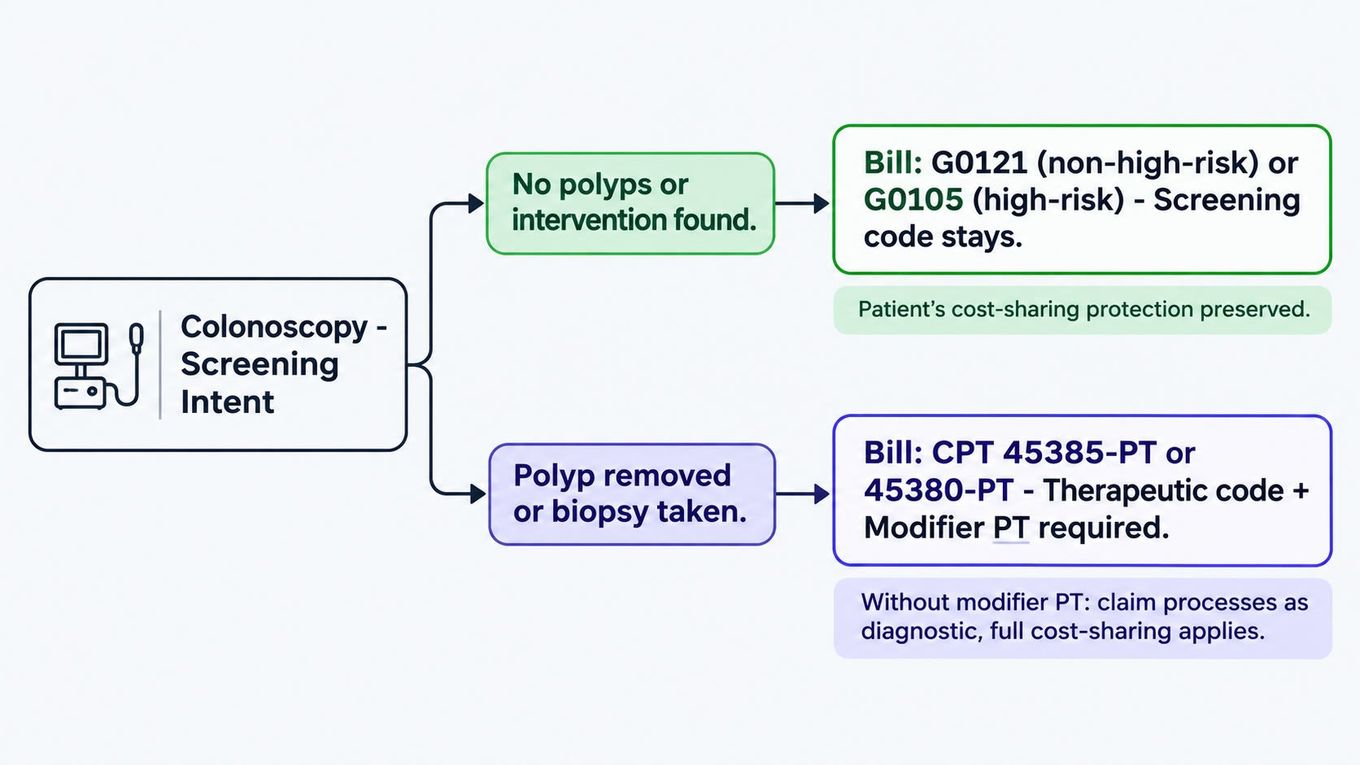
When a Medicare screening colonoscopy (G0105 for high-risk, G0121 for non-high-risk) results in no intervention, the claim should stay on the screening code. Billing CPT 45378 instead:
- Removes the patient's cost-sharing protection
- May trigger a denial if the payer's records flag a preventive visit
- Creates a billing compliance exposure
Failure mode two: missing modifier PT when screening becomes therapeutic.
When a screening colonoscopy results in a polyp removal or biopsy, the billing code shifts from G0105/G0121 to the appropriate therapeutic CPT. But the screening intent must still be communicated. That is what modifier PT does.
Modifier PT ("colorectal cancer screening test; converted to diagnostic test or other procedure") is appended to the therapeutic code. For example: 45385-PT for a screening colonoscopy that required snare polypectomy.
Without it:
- The claim processes as a purely diagnostic procedure
- Medicare applies full diagnostic cost-sharing
- The patient may receive a larger bill than they should
- The claim may be denied outright
What to flag for 2023 and beyond: The Consolidated Appropriations Act of 2021 initiated a phased reduction of patient cost-sharing for therapeutic screening colonoscopies through 2030. Confirm your billing partner is tracking these annual changes.
2. NCCI Edits and the Endoscopy Ranking Rule
The National Correct Coding Initiative (NCCI) determines which codes can be billed together and which are considered components of a higher-level service.
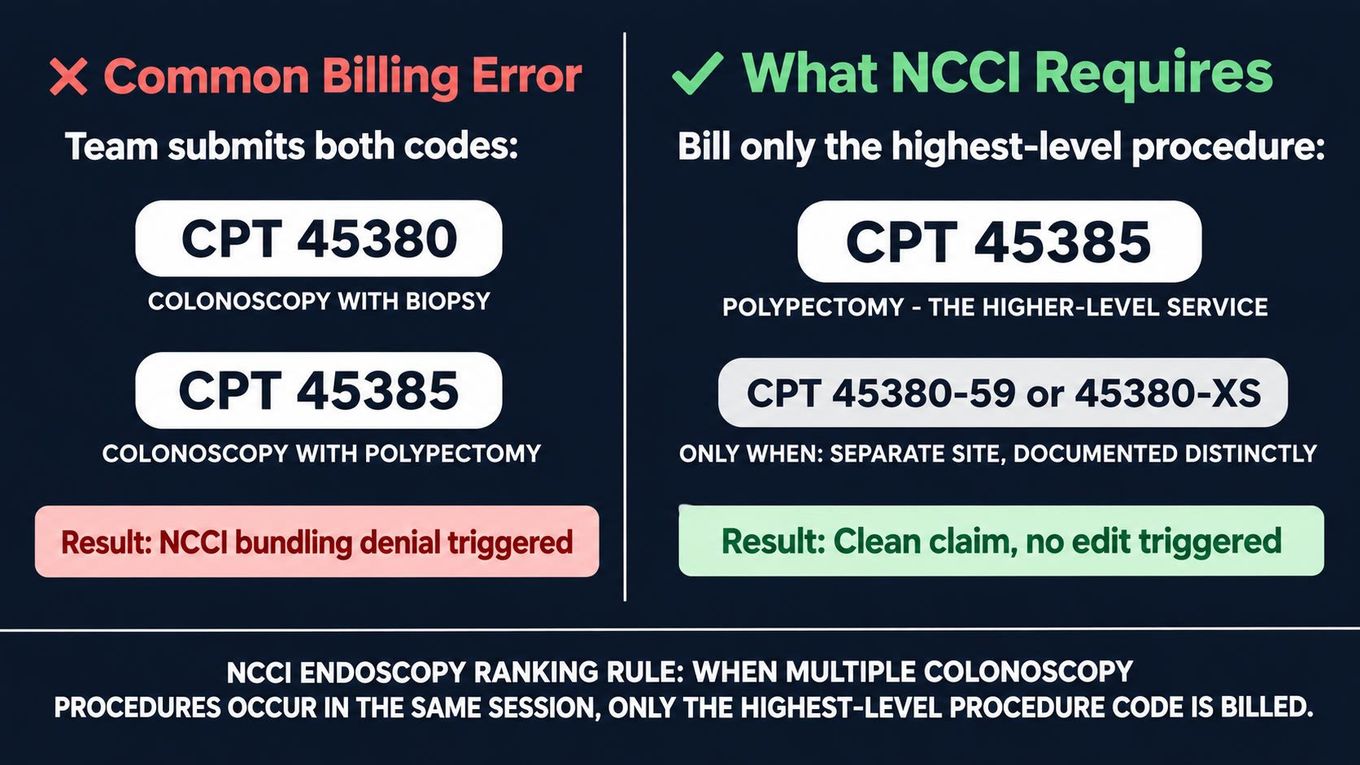
Medicare's endoscopy ranking rule: When multiple colonoscopy procedures are performed in the same session, bill only the highest-level procedure code.
A concrete example:
A patient undergoes a colonoscopy where the physician:
- Takes a biopsy of one polyp (CPT 45380)
- Performs a snare polypectomy on a second (CPT 45385)
Most billing teams submit both codes. NCCI edits bundle 45380 into 45385 because polypectomy is the higher-level service. Billing both without modifier 59 or XS on the lower-level code results in a denial.
The correct approach:
- Apply modifier 59 or XS to the lower-level code when it represents a truly distinct service at a separate site
- Confirm the operative report describes both procedures as separate and distinct
- When documentation is ambiguous, do not bill the add-on without clarification
3. Multiple Polyp Removal Underpayment
When multiple polyps are removed in one session, payment depends on correct add-on code usage. CPT 45385 covers snare polypectomy. Additional polyp removal using a different technique (hot biopsy forceps, cold forceps) requires separate add-on codes; these are not included in the base polypectomy code.
Billing teams that do not understand the distinction between polypectomy techniques will routinely miss them.
Documentation must include for each polyp:
- Size
- Location (which colon segment)
- Removal technique
Payers use this information to validate that additional codes are justified. A vague operative note is a denial waiting to happen.
4. Pathology Coordination: Who Bills What
When a biopsy specimen is collected during a colonoscopy or EGD, the pathology lab bills for the analysis separately. The physician bills for the procedure with biopsy.
Where coordination breaks down:
| Failure | What happens |
|---|---|
| Missing biopsy code | Physician submits 45378 instead of 45380; underpaid on professional component |
| Duplicate interpretation billing | Both physician and pathology group bill for specimen interpretation; triggers audit |
| Specimen tracking delay | Claim submitted before confirming specimens were taken; amendment required |
The fix: Hold charge entry until the operative report is finalized and the specimen log is confirmed. Do not code from incomplete notes.
5. Moderate Sedation: Billing It Correctly Under Medicare
For GI endoscopy performed with sedation by the performing physician, Medicare requires billing G0500 (not CPT 99152) for the initial period of moderate sedation. CPT 99152 is denied by NCCI CCI edit when billed alongside GI endoscopy codes, effective July 1, 2017. For each additional 15-minute block beyond the initial period, 99153 applies as an add-on code.
When sedation is provided by a separately credentialed provider (anesthesiologist or CRNA), those services are billed separately by the anesthesia group under anesthesia codes (00810 for lower GI, 00740 for upper GI procedures).
Common error: Billing teams bill CPT 99152 on Medicare GI claims instead of G0500, triggering an automatic CCI denial. For commercial payers, payer-specific policy determines whether 99152 or G0500 applies.
6. ASC Billing vs. Hospital Outpatient: Not the Same Claim
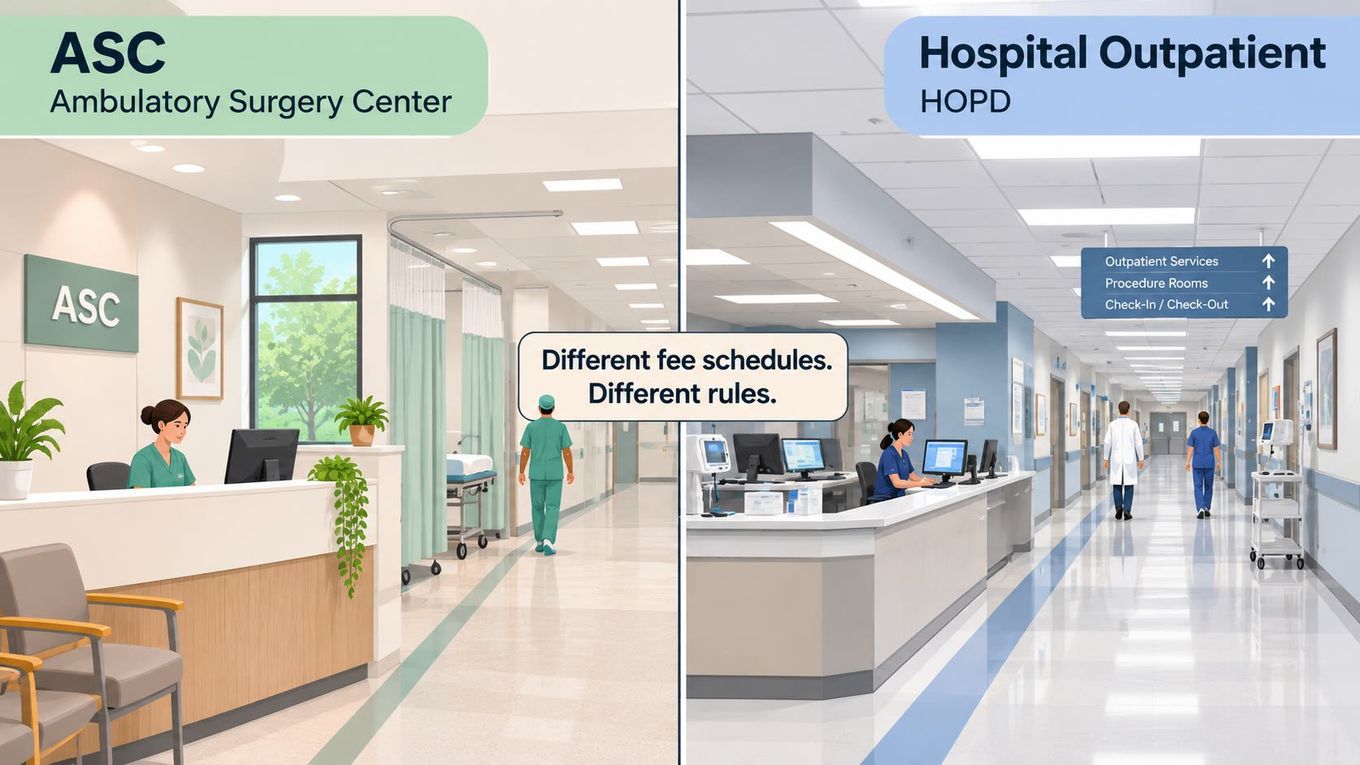
GI practices affiliated with an ambulatory surgery center need a billing team that understands facility billing, not just physician professional billing. The two environments are fundamentally different.
| Factor | ASC | Hospital Outpatient (HOPD) |
|---|---|---|
| Facility fee schedule | ASC Medicare payment groups | Hospital outpatient prospective payment (OPPS) |
| Physician billing | Professional component only | Professional component billed separately |
| Anesthesia | Often separate CRNA group contract | Often hospital-employed anesthesia |
| Supply billing | Very limited separately billable supplies | Broader pass-through billing allowed |
| Pathology | Coordinated with external lab | May be in-house or external |
A billing team that only knows physician billing will misflag ASC claims, miss facility-side charges, or submit claims to the wrong payer contract.
If your practice has an ASC component, confirm any billing partner has specific ASC facility claim experience before signing.
GI Procedure CPT Code Reference
| Procedure | CPT Code(s) | Key Billing Notes |
|---|---|---|
| Diagnostic colonoscopy | 45378 | Base code when no intervention performed |
| Colonoscopy with biopsy | 45380 | Bundled into polypectomy codes per NCCI if same session |
| Colonoscopy with snare polypectomy | 45385 | Highest-level colonoscopy code when polypectomy performed |
| Colonoscopy with hot biopsy ablation | 45384 | Add-on rules apply for multiple polyps |
| Medicare screening colonoscopy (non-high-risk) | G0121 | Converts to 45385-PT etc. if therapeutic |
| Medicare screening colonoscopy (high-risk) | G0105 | Same conversion rules as G0121 |
| Diagnostic EGD | 43235 | Base code for upper GI endoscopy |
| EGD with biopsy | 43239 | Distinct from base code; common underbilling error |
| ERCP, diagnostic | 43260 | Add-on codes for sphincterotomy (43262), stone removal (43264) |
| Endoscopic ultrasound (EUS), upper GI | 43259 | FNA/biopsy adds 43242 |
| Capsule endoscopy | 91110 | Prior auth required by most commercial payers |
| Flexible sigmoidoscopy | 45330 | Separate code set from colonoscopy; not interchangeable |
Important: This table is a reference, not a substitute for a certified coder's judgment on a specific operative report. CPT codes and payer policies update annually. Verify against the current AMA CPT manual and applicable Medicare LCD before billing.
What to Actually Ask a GI Billing Service Before Hiring Them
The standard pitch sounds identical across every vendor: end-to-end billing, certified coders, fewer denials, faster collections. Here is what to ask beyond the pitch.
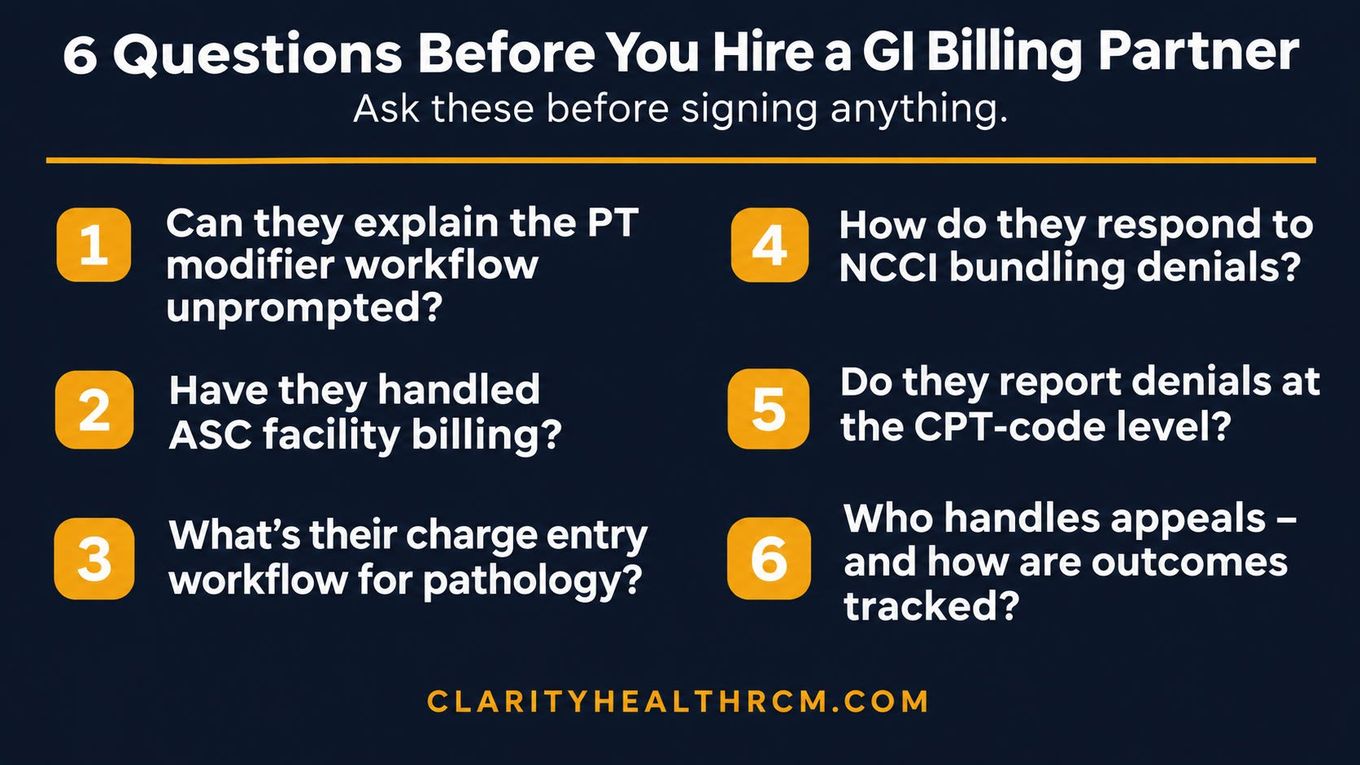
1. Can they explain the PT modifier workflow without being prompted? Any serious GI billing partner should walk you through, unprompted, what happens when a screening colonoscopy converts to therapeutic. Vague answers signal shallow day-to-day practice.
2. Have they handled ASC facility billing, not just physician billing? If your practice has an ASC component, ask for specific examples. Professional billing and facility billing require different expertise.
3. What is their charge entry workflow for pathology coordination? Do they hold charges until the operative report is finalized? How do they confirm that specimen collection is reflected in the physician's claim before submission?
4. How do they handle NCCI bundling edits for GI specifically? They should reference the endoscopy ranking rule by name and describe their modifier 59 policy with documentation requirements, not just say "we know when to use modifier 59."
5. What does their denial reporting look like at the procedure-code level? You should receive denial trend reports broken down by CPT code and payer, not just an aggregate denial rate. Pattern denials on colonoscopy codes are only visible if someone is looking at that granularity.
6. Who handles appeals, and how do they track outcomes? Get a specific answer on appeal timelines, who writes the appeal letters, and whether they track outcomes by payer and denial reason code. Vague answers here are a red flag.
Why Trust This Article
Clarity Health RCM's roots go back to Quality Medical Billing, founded in 1988, with over 40 years of combined revenue cycle experience under President and CEO Estelle Sandoval.
Our team works with physician groups and specialty practices across inpatient and outpatient settings, including procedure-heavy specialties where coding complexity and denial management are daily operational realities.
The billing errors described in this article are not theoretical. They are patterns we see regularly in revenue cycle audits and in practices that come to us after their previous billing vendor missed them consistently.
We wrote this guide because we could not find a resource that covered the full picture of GI billing complexity in one place: the PT modifier workflow, the NCCI endoscopy ranking rule, sedation code distinctions under Medicare, ASC vs. HOPD billing differences, and pathology coordination. Those topics are where the revenue actually leaks, and they are what we work through every day.
How Clarity Health RCM Supports Gastroenterology Practices
Gastroenterology is one of the specialties where billing errors compound fastest. A systematic gap on colonoscopy polypectomies or a missed modifier PT across a high-volume endoscopy schedule adds up to meaningful, recoverable revenue that most practices do not realize they are losing.
Clarity's outpatient physician billing services cover the full revenue cycle for specialty physician groups, including procedure-heavy GI practices:
- Precise CPT and ICD-10 coding
- NCCI edit review before submission
- Prior authorization management
- Payer-specific denial appeal and tracking
- Procedure-code-level reporting on denial trends and AR aging
If your GI practice is seeing above-average denial rates on colonoscopy claims, inconsistency between ASC and professional billing, or unresolved pathology coordination issues, a denial management audit is a logical first step before committing to a full billing transition.
For practices evaluating whether to bring billing in-house or outsource, see In-House vs. Outsourced Medical Billing for a side-by-side breakdown of what each model actually costs.
You can also review what outsourced RCM looks like in practice before making any decisions.
Contact our team for a no-obligation billing audit of your current GI claims.
Frequently Asked Questions
What are gastroenterology billing services? Gastroenterology billing services are specialized revenue cycle management services that handle coding, claim submission, payer follow-up, denial management, and payment posting for GI physician practices, endoscopy centers, and hospital-based GI departments. Because GI procedures involve complex coding rules around colonoscopy classifications, NCCI bundling edits, and modifier usage, specialty-specific billing expertise produces meaningfully better collection rates than general medical billing.
What is the PT modifier in GI billing? Modifier PT is used when a Medicare screening colonoscopy is converted to a therapeutic procedure during the same session, such as when a polyp is removed. It is appended to the therapeutic CPT code (for example, 45385-PT) to indicate that the original intent was screening. This affects the patient's cost-sharing obligations and is required for correct processing under Medicare. Missing modifier PT is one of the most common colonoscopy billing errors.
What is the difference between a screening and a diagnostic colonoscopy for billing purposes? A screening colonoscopy is performed on an asymptomatic patient as a preventive measure, billed under G0121 (non-high-risk) or G0105 (high-risk) for Medicare patients, or under the appropriate CPT code with a screening diagnosis (Z12.11) for commercial payers. A diagnostic colonoscopy is performed because the patient has symptoms or a clinical indication, billed under CPT 45378 or higher. The classification determines the patient's cost-sharing and the payer's coverage rules.
Why do gastroenterology practices have high denial rates? GI practices face above-average denial rates because of the complexity of procedure code selection, the screening versus diagnostic distinction, NCCI bundling edits that apply specifically to endoscopy, prior authorization requirements for certain procedures (especially capsule endoscopy and EUS), and the multi-claim coordination required when anesthesia and pathology are involved. Each of these is a failure point where a generalist billing team makes errors that a GI-specialized team handles routinely.
How does ASC billing differ from hospital outpatient billing for GI? ASCs operate under a separate Medicare payment group system distinct from the hospital outpatient prospective payment system (OPPS) that applies to hospital-affiliated endoscopy suites. The fee schedules, payable services, and claim formats differ between the two settings. A GI billing partner must be experienced with ASC facility billing, not just physician professional billing, if your practice performs procedures in an ASC.
What should I ask a gastroenterology billing company before hiring them? Ask them to explain their PT modifier workflow, how they handle pathology coordination, whether they have ASC facility billing experience, how they respond to NCCI bundling denials, and what their procedure-level denial reporting looks like. Generic answers are a signal that their GI billing experience is shallow. Specific, detailed answers without prompting indicate genuine specialty expertise.
How much do gastroenterology billing services cost? Most outsourced GI billing services charge a percentage of collections, typically ranging from 4% to 9% depending on practice size, claim volume, payer mix, and scope of services included. The cost of outsourced billing should be evaluated against the full cost of in-house billing (staff salary, benefits, training, software, and the revenue impact of billing errors) rather than the percentage rate alone. See What Does Medical Billing Cost? for a full breakdown.