Dermatology Billing Services: A Practice Owner's Guide to Getting It Right
November 24, 2026 · 15 min read
Dermatology billing is more procedurally complex than almost any other outpatient specialty. A single patient visit can involve an E/M service, a biopsy, a destruction, and a repair, each coded by its own CPT rules, sizing requirements, modifier logic, and medical necessity threshold. Outsourced dermatology billing services handle that complexity so your clinical staff doesn't have to, and so your practice stops leaving money on the table through undercoding, bundling errors, and cosmetic classification mistakes.
Generalist Billing Company vs. Dermatology-Specialized Billing: What the Difference Actually Costs
Most dermatology practices that have decided to outsource billing face a second decision that gets underestimated: whether to use a general medical billing company that handles dermatology among many specialties, or a service built around active dermatology specialization. The gap is not just about familiarity — it shows up in net collections on the specific procedure families that drive your revenue.
| Capability | Generalist Billing Company | Dermatology-Specialized Billing |
|---|---|---|
| Biopsy code selection (11102–11107) | Often codes by site; misses technique-based assignment | Codes by technique: shave vs. punch vs. incisional distinction applied correctly |
| Mohs billing (17311–17315) | Treats it like any procedure code | Applies LCD L33436, monitors 60-day biopsy lookback, audits for frozen-section bundling errors |
| Modifier -25 on E/M + procedure | Frequently missed; E/M bundled into procedure reimbursement | Appended by policy; documentation standard communicated back to clinical team |
| Cosmetic vs. medical split | Flags obvious cases; misses conditional coverage nuance | Documents ABN workflow, GY/GZ modifier logic, and diagnosis-linkage audits by procedure |
| AK destruction MUE management | Submits claim; reacts to denial after the fact | Pre-submission review for high lesion counts; medical necessity letters attached proactively |
| Denial root-cause reporting | Aggregate denial rate; limited procedure-level breakdown | Denial breakdown by CPT family and reason code; tracks payer-specific denial patterns |
| NCCI bundling edits | General NCCI table awareness | Active monitoring of derm-specific edit pairs; modifier 59/XS applied correctly |
| EHR/PM integration | Common platforms only | Modernizing Medicine, Nextech, Kareo/Tebra workflows mapped; charge capture gaps flagged |

Specialist dermatology billing vs. a generalist operation: where the gap in net collections actually appears.
A generalist billing company can handle your volume. The question is whether it handles your complexity. Mohs claims, high AK counts, and same-day E/M and procedure billing are where the difference in net collections actually shows up. For the broader make-or-buy framework, see our in-house vs. outsourced medical billing guide.
Why Dermatology Billing Is Different From General Medical Billing
Most medical specialties deal with a relatively contained set of codes. Dermatology doesn't.
A busy dermatology practice routinely performs procedures across a half-dozen CPT code families in a single day: biopsies, excisions, destructions, Mohs surgery, E/M visits, cosmetic procedures, and dermatopathology. Each has its own documentation requirements, measurement rules, and payer policy landscape.
Three complexity layers stand out in particular.
Procedure mix and NCCI edits. Dermatology has one of the highest procedure-per-visit ratios in outpatient medicine. Multiple procedures on the same date of service trigger National Correct Coding Initiative (NCCI) bundling edits. Getting reimbursed for all of them requires correct modifier application, and getting that wrong means those charges disappear silently into a bundled denial.
The cosmetic vs. medical split. A significant portion of dermatology revenue comes from services that are either non-covered (Botox, cosmetic fillers, cosmetic laser) or conditionally covered depending on diagnosis (laser treatment for a port-wine stain versus cosmetic pigmentation correction). Misclassifying in one direction costs revenue. Misclassifying in the other creates compliance exposure.
Lesion sizing rules. Excision codes are selected based on the lesion diameter including margins, measured before excision, not after. Measurement errors or operative notes that don't document the pre-excision size trigger downcoding and underpayment. This is a documentation discipline problem as much as a billing one, and a good billing partner should flag it in your templates.
Generalist billing companies miss these patterns because they don't encounter them every day. Dermatology-specific billing operations are built around them.
The CPT Code Structure That Drives Dermatology Billing
You don't need to memorize every code. That's what a billing partner is for. But understanding the structure helps you evaluate whether a billing service actually knows what it's doing, and helps your clinical team document correctly.
Skin Biopsies (11102-11107)
Since 2019, biopsy codes are assigned by technique, not site or lesion size. The structure:
| CPT Code | Method | Position |
|---|---|---|
| 11102 | Tangential (shave, scoop, saucerize, curette) | First lesion |
| +11103 | Tangential | Each additional lesion |
| 11104 | Punch | First lesion |
| +11105 | Punch | Each additional lesion |
| 11106 | Incisional | First lesion |
| +11107 | Incisional | Each additional lesion |
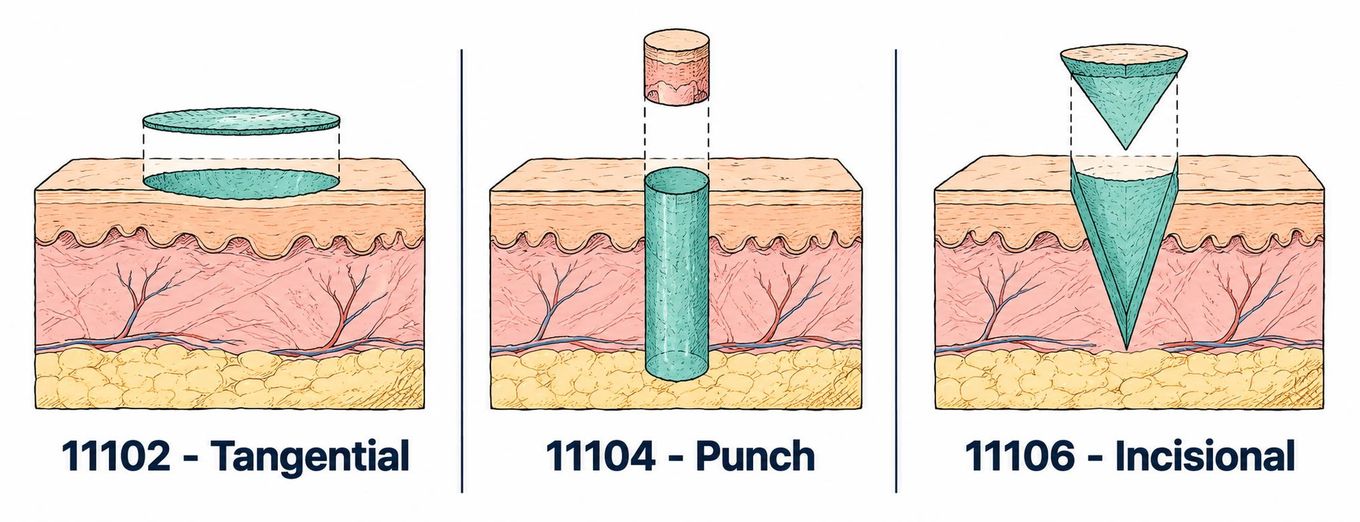
The three biopsy technique families: tangential (11102), punch (11104), and incisional (11106), each coded by method rather than site since 2019.
One critical rule: biopsy codes apply only when tissue is removed for diagnostic purposes. If the entire lesion is removed at the same session, the correct code is an excision, not a biopsy. Billing a biopsy code when the lesion was completely excised is both an underpayment and a documentation compliance issue.
Excisions: Benign and Malignant (11400-11646)
Excision codes split into two ranges based on pathology:
- Benign lesions: 11400-11446
- Malignant lesions: 11600-11646
Code selection within each range depends on two variables: anatomic site and lesion diameter including margins, documented before excision. The measurement must appear in the operative note — coders cannot use post-excision pathology report measurements, and payers know the difference.
For lesions of uncertain behavior, billing should wait until pathology confirms whether the lesion is benign or malignant. Submitting a benign code that later contradicts a malignant pathology result creates a correction and refiling burden.
Mohs Micrographic Surgery (17311-17315)
Mohs billing has the strictest documentation requirements in dermatology and one of the highest audit profiles under Medicare Local Coverage Determination L33436:
| CPT Code | Description |
|---|---|
| 17311 | Head, neck, hands, feet, genitalia: first stage, up to 5 tissue blocks |
| 17312 | H/N/hands/feet: each additional stage, up to 5 tissue blocks |
| 17313 | Trunk and extremities: first stage, up to 5 tissue blocks |
| 17314 | Trunk/extremities: each additional stage |
| 17315 | Each additional tissue block beyond 5, any anatomic site, any stage |
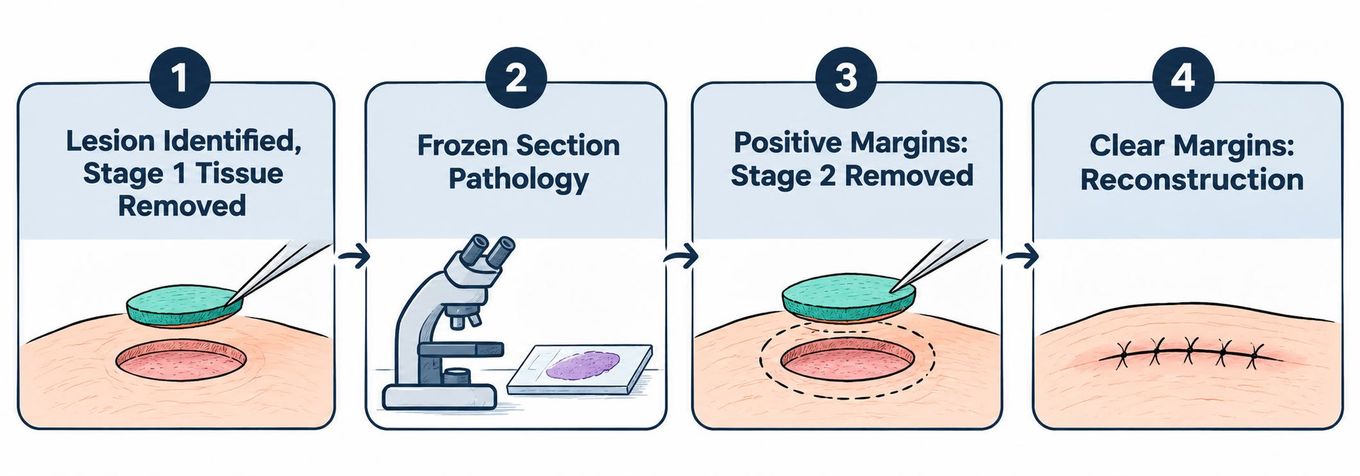
The four-stage Mohs billing workflow: tissue removal, frozen-section pathology, additional stages if margins are positive, and final reconstruction — each with distinct coding and documentation requirements.
Two rules catch billing teams off guard consistently. First, if a biopsy of the same lesion was performed within the prior 60 days, it cannot be billed separately on the same Mohs claim. Second, pathology services performed as part of the Mohs procedure (frozen sections) are included in the Mohs code and cannot be billed separately — doing so is a bundling violation.
Reconstruction following Mohs is billed separately with its own CPT codes and requires distinct documentation.
Destruction of Premalignant Lesions (17000-17004)
Actinic keratosis destruction follows a quantity-based structure:
- 17000: First actinic keratosis lesion
- +17003: Each additional lesion, from 2 through 14 (add-on code)
- 17004: 15 or more lesions (standalone code — do not bill with 17000 or 17003)
This is one of the highest-risk areas for Medically Unlikely Edit (MUE) flags. High lesion counts on a single date of service trigger payer review automatically. Documentation must identify each individual site treated. For genuinely high-count sessions — such as transplant patients requiring destruction of many malignant lesions — a letter of medical necessity supports the claim and reduces the risk of automated denial.
Benign lesion destruction (17110 for up to 14 lesions, 17111 for 15 or more) uses an either-or selection: bill one code or the other based on total lesion count, never both on the same date of service. Unlike the AK series above, there is no add-on code; the entire session is captured in a single unit of whichever code applies.
E/M Services Billed on the Same Day as a Procedure
This is where modifier errors cost the most money, and it happens across nearly every dermatology practice that bills both visit and procedure codes.
When a physician performs both an evaluation and a procedure in the same encounter, modifier \-25 must be appended to the E/M code (not the procedure code) to signal that a separate and significant E/M service was performed. Without it, the E/M is bundled into the procedure reimbursement and not paid separately.
The documentation must support that the E/M was medically necessary and genuinely distinct from the pre-procedure assessment. A brief chief complaint note followed immediately by the procedure does not support a separate E/M. A complete history, exam, and medical decision-making that is documented before the procedure decision is made does.
The Most Common Dermatology Billing Denial Triggers
Understand what your denials actually are before choosing a billing partner. A good billing service should be able to give you denial breakdown by reason code, not just an aggregate denial rate. For a deeper look at denial management, see our denial management guide.
| Denial Trigger | Root Cause | Prevention |
|---|---|---|
| Medical necessity | Cosmetic diagnosis submitted for a conditionally covered service | Confirm ICD-10 linkage to procedure before submission |
| NCCI bundling | Multiple procedures billed without correct modifier | Audit code combinations against NCCI table; apply modifier 59 where appropriate |
| Missing modifier 25 | E/M bundled into same-day procedure reimbursement | Append -25 to E/M when procedure performed same date; document distinctly |
| Lesion size not documented | Excision code not supported by pre-excision measurement in operative note | Require pre-excision size documentation in operative note template |
| Mohs pathology billed separately | Frozen sections billed outside the Mohs global package | Train team on Mohs bundling rules; audit pre-submission |
| Same-site biopsy within 60 days | Prior biopsy billed alongside Mohs for the same lesion | Review prior service history before submitting Mohs claims |
| MUE exceeded on destructions | AK lesion count triggers Medically Unlikely Edit threshold | Document each treated site; attach medical necessity letter for high counts |
| Timely filing | Claim submitted outside payer window after AR lag | Use clean tracking dashboard; flag aging claims at 30 and 60 days |
A billing service that cannot walk you through its denial tracking methodology, by reason code and by procedure category, is not giving you enough visibility to manage performance.
Cosmetic vs. Medical: Managing the Split Without Losing Revenue or Creating Compliance Risk
One of the highest-stakes billing decisions in dermatology happens before the claim is ever submitted.
The compliance exposure runs in both directions. Billing a cosmetic procedure as medically necessary, without a supporting diagnosis, is a compliance violation. Failing to bill a genuinely medically necessary service because staff assumed it was cosmetic leaves money uncollected.
A well-run dermatology billing operation addresses this through three mechanisms:
1. Financial policy documentation. A written policy that defines which services are cosmetic, which are insurance-covered, and which are conditionally covered based on diagnosis. This needs to exist before the patient checks in, not at the billing stage.
2. Advance Beneficiary Notice of Noncoverage (ABN). For Medicare patients, an ABN must be signed before delivering a service that may not be covered. Modifier GY is appended when a service is excluded by statute (cosmetic by definition, such as routine Botox). Modifier GZ applies when a service is expected to be denied as not reasonable and necessary — and unlike GY, GZ carries recoupment risk if used incorrectly. Getting the distinction wrong has financial and compliance consequences.
3. Correct ICD-10 linkage. L57.0 (actinic keratosis) supports destruction coding. L70.0 (acne vulgaris) supports acne treatment procedures. A cosmetic pigmentation diagnosis does not support a covered laser procedure. The diagnosis code must justify the procedure on every claim.
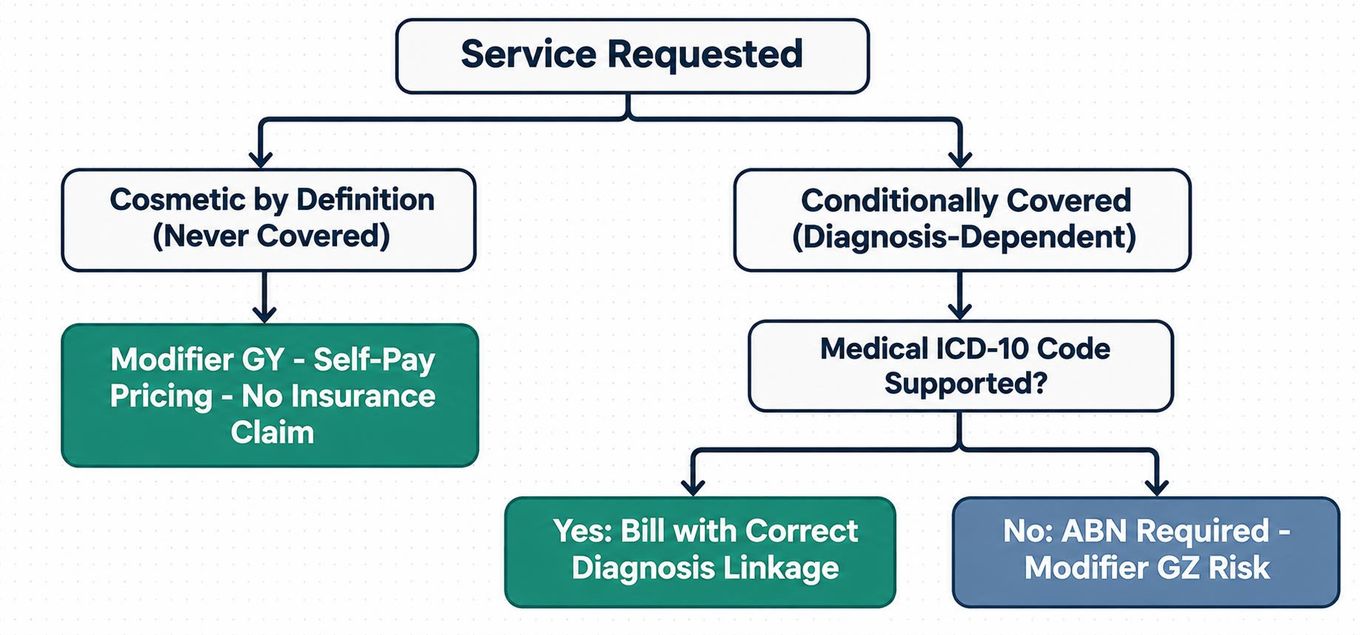
How to classify a dermatology service at billing: cosmetic by definition (Modifier GY, self-pay) vs. conditionally covered (ICD-10 linkage required, ABN if uncertain, Modifier GZ risk if unsupported).
If a billing service only processes claims and does not review your financial policy structure and ABN workflow, it is not managing the full compliance and revenue risk your practice carries.
What to Actually Evaluate When Choosing a Dermatology Billing Service
Most billing company websites say the same things: specialty-trained coders, fewer denials, maximized revenue. The questions below separate a credible dermatology billing partner from a generalist with a dermatology landing page.
- What percentage of their active client base is dermatology practices? A company where dermatology is a small fraction of the book of business does not have the daily coding volume to stay current on NCCI edits, Mohs LCD requirements, and payer-specific policies.
- Can they walk through their Mohs billing workflow concretely? Ask specifically about documentation requirements, same-site biopsy lookback, and how they handle cases where reconstruction codes are added to the claim. Vague answers reveal limited daily experience.
- What is their first-pass clean claim rate for dermatology claims? Industry benchmark is above 95%. Below that, you are carrying denial management overhead that reduces net collections.
- How do they report on denial root cause? Aggregate denial rate is a vanity metric. You need breakdown by reason code and by procedure family so you can see whether the problem is documentation, coding, or payer behavior.
- What is their fee model and what does it include? Percentage of collections aligns incentives with yours. Watch for minimum monthly fee floors that penalize slow months, and confirm whether coding audits, credentialing, and patient billing statements are included or billed separately.
- Which EHR and PM systems have they integrated with? Modernizing Medicine, Nextech, Kareo/Tebra, AdvancedMD, and AdvancedPM all have different charge capture workflows. Integration gaps create charge lag and submission errors.
- Do they handle credentialing and payer enrollment? For a practice adding a new provider, credentialing delays directly stop revenue. A billing partner that also manages credentialing and enrollment removes a coordination gap that causes cash flow disruption.
For a full evaluation framework, see our guide to questions to ask before hiring a medical billing company.
What Dermatology Billing Services Cost
Most dermatology-focused billing companies charge on a percentage of collections model. Where you land depends on:
- Practice volume: Higher volume typically yields a lower rate; negotiate based on your monthly collections floor.
- Procedure complexity: Mohs-heavy practices may see higher rates because of the documentation and audit-defense complexity involved.
- What is included: Credentialing, coding audits, patient statements, and payer enrollment are sometimes bundled; more often they are line items. Confirm scope before comparing quotes.
- Contract structure: Watch for auto-renewal clauses, termination notice periods, and minimum monthly fee requirements that penalize lower-volume months.
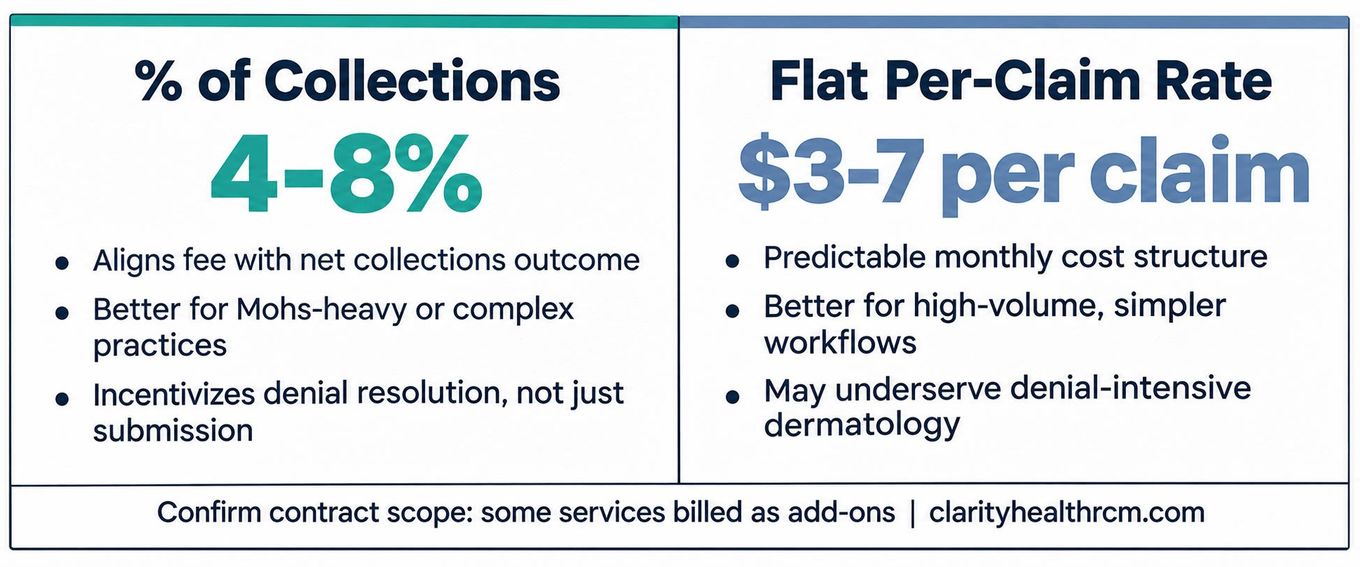
Percentage of collections (4–8%) vs. flat per-claim pricing ($3–7): which model fits dermatology, and when.
Dermatology billing services typically run 4-8% of net collections, reflecting the higher coding complexity and denial management workload compared to lower-acuity specialties. Flat per-claim pricing (typically $3-7 per claim) can work for high-volume, simple-mix practices, but tends to underserve dermatology workflows where the real value is in denial management, coding accuracy, and audit defense, not just claim submission volume.
For a full breakdown of pricing models and what to expect, see our medical billing services cost guide.
Why Trust This Article
Clarity Health RCM traces its roots to Quality Medical Billing, founded in 1988. Under President and CEO Estelle Sandoval, the firm brings 40-plus years of combined revenue cycle experience across physician groups, hospital facilities, and specialty practices including dermatology. Our coding and billing teams manage the full complexity of dermatology procedure claims, cosmetic vs. medical classification workflows, and denial appeal pipelines for specialty practices across multiple states.
How Clarity Health RCM Supports Dermatology Practices
We work with dermatology practices as a full revenue cycle partner, not a claim submission service:
- Procedure coding: Biopsies, excisions, Mohs, destructions, E/M services, and cosmetic procedure documentation across the full CPT spectrum
- Denial management: Root-cause tracking by denial reason code, appeal workflow, and payer-specific pattern monitoring to reduce recurring denials
- Credentialing and payer enrollment: Provider credentialing and panel management, keeping your providers billable without revenue gaps during onboarding
- AR management: Aging AR recovery, clean claim rate optimization, and 30/60/90-day AR reporting
- Reporting: Denial breakdowns, AR aging dashboards, and collection performance benchmarking against specialty benchmarks
If your dermatology practice is experiencing denials you cannot root-cause, aging AR you cannot work down, or coding accuracy issues that show up in payer audits, talk to our team.
Frequently Asked Questions
What makes dermatology billing different from other medical specialties?
Dermatology involves a higher procedure-per-visit ratio than most outpatient specialties, strict pre-excision lesion measurement documentation rules, the procedurally complex Mohs micrographic surgery billing workflow, and a cosmetic vs. medical coverage split that requires both financial policy infrastructure and claim-level modifier management. Coders without active dermatology experience miss these patterns regularly, resulting in undercoding, bundling errors, and compliance exposure.
What CPT codes are most commonly used in dermatology billing?
The core code families are skin biopsies (11102-11107), benign excisions (11400-11446), malignant excisions (11600-11646), Mohs micrographic surgery (17311-17315), actinic keratosis destruction (17000-17004), benign lesion destruction (17110-17111), and E/M office visits (99202-99215). Each family has documentation requirements that differ significantly from general medicine billing.
How do I know if my current dermatology billing company is performing well?
Key benchmarks: first-pass clean claim rate above 95%, denial rate below 10%, AR over 90 days below 15-20% of total AR, and denial reporting broken down by reason code rather than just aggregate rate. If your billing partner reports only collection percentage without denial root-cause data, you do not have enough visibility to evaluate whether the problem is documentation, coding, or payer behavior.
What is Mohs billing and why is it complex?
Mohs micrographic surgery (CPT 17311-17315) is a staged skin cancer removal procedure where the surgeon also acts as the pathologist, interpreting frozen tissue sections in real time between stages. Billing requires documentation of the number of stages and tissue blocks per stage, compliance with Medicare LCD L33436, and correct application of bundling rules: pathology performed as part of the Mohs procedure is included in the Mohs code and cannot be billed separately. A prior biopsy of the same lesion within 60 days also cannot be billed on the same Mohs claim.
What is modifier -25 and why does it matter in dermatology?
Modifier -25 is appended to an E/M code when a significant and separately identifiable evaluation and management service is performed on the same date as a procedure. Without it, the E/M is bundled into the procedure payment and not reimbursed. The documentation must support that the E/M was medically necessary and genuinely distinct from the pre-procedure assessment. This is one of the most common and most expensive denial patterns in dermatology billing.
How much do dermatology billing services cost?
Most dermatology billing companies charge 4-8% of collections, depending on practice volume, procedure mix complexity, and what services are included in the contract. Flat per-claim pricing ($3-7 per claim) is also available but better suited to high-volume, lower-complexity workflows. See our full breakdown in the medical billing services cost guide.
Can I keep some billing in-house and outsource only part of it?
Yes. Some dermatology practices outsource high-complexity billing, including Mohs, malignant excisions, and denial appeal management, while keeping routine E/M billing in-house. This hybrid approach can work when you have reliable in-house staff for simpler claims and need external expertise for the high-stakes, high-audit-risk procedures. Clear workflows and shared reporting standards are required to make the split function without gaps.