Medical Credentialing Services: Real Timelines, Real Costs, and the Step Everyone Overlooks
September 23, 2026 · 13 min read
Medical credentialing services handle the paperwork, verification, and payer follow-up required to get a provider approved and paid by insurance networks like Medicare, Medicaid, Aetna, and Cigna. A good service collects and verifies credentials, submits payer applications, chases them to approval, confirms effective dates, and keeps everything current afterward. What it can't do is make payers move faster than they're willing to, which is why the real value lies in fewer mistakes and no gaps, not in speed promises.
That's the answer. Now here's the part we actually want to talk about.
A scene we keep seeing
A group practice hires a new physician. Contract signed, start date set, patients already booked for week one.
Somebody asks, a few weeks before that start date, "Has anyone started her credentialing?"
Nobody has. Or someone did, but the CAQH profile was never attested, so three payers have been sitting on incomplete applications for a month.
The physician starts anyway. She sees patients. The practice holds the claims, or submits them and watches them come back denied. Ninety days later, the practice has a very expensive employee, a stack of unbillable visits, and a new appreciation for a process it used to think of as "admin."
We've seen versions of this in behavioral health groups, hospitalist teams, surgical practices, and rural facilities. The specialty changes. The pattern doesn't.
So if you're researching medical credentialing services right now, this is the letter we'd want you to read before you sign with anyone, including us.
The short version
| What a credentialing service does | What it can't do | |
|---|---|---|
| Applications | Prepares, submits, and tracks every payer and government application | Force a payer to approve you, or open a closed panel on demand |
| Timelines | Removes the delays you cause (missing docs, stale CAQH, no follow-up) | Shorten the payer's own review queue |
| Accuracy | Catches mismatches in NPI, taxonomy, addresses, and group linkage | Fix a license or board issue that's actually unresolved |
| After approval | Confirms effective dates, loads them into billing, tracks renewals | Protect you if nobody hands the approval to your billing team |
| Cost | Usually a few hundred dollars per payer application, or a monthly fee | Make up for revenue lost while a provider waits to go in-network |
What are medical credentialing services?
Medical credentialing services are outsourced teams that manage provider enrollment and payer credentialing on behalf of a practice, group, or facility. They gather and verify a provider's licenses, board certifications, DEA registration, malpractice history, and work history; submit applications to insurers and government programs; follow up until approval; and maintain those enrollments over time so providers stay in-network and claims keep getting paid.
People use "credentialing" as a catch-all, but it's really three separate processes. Mixing them up is where a lot of delays start.
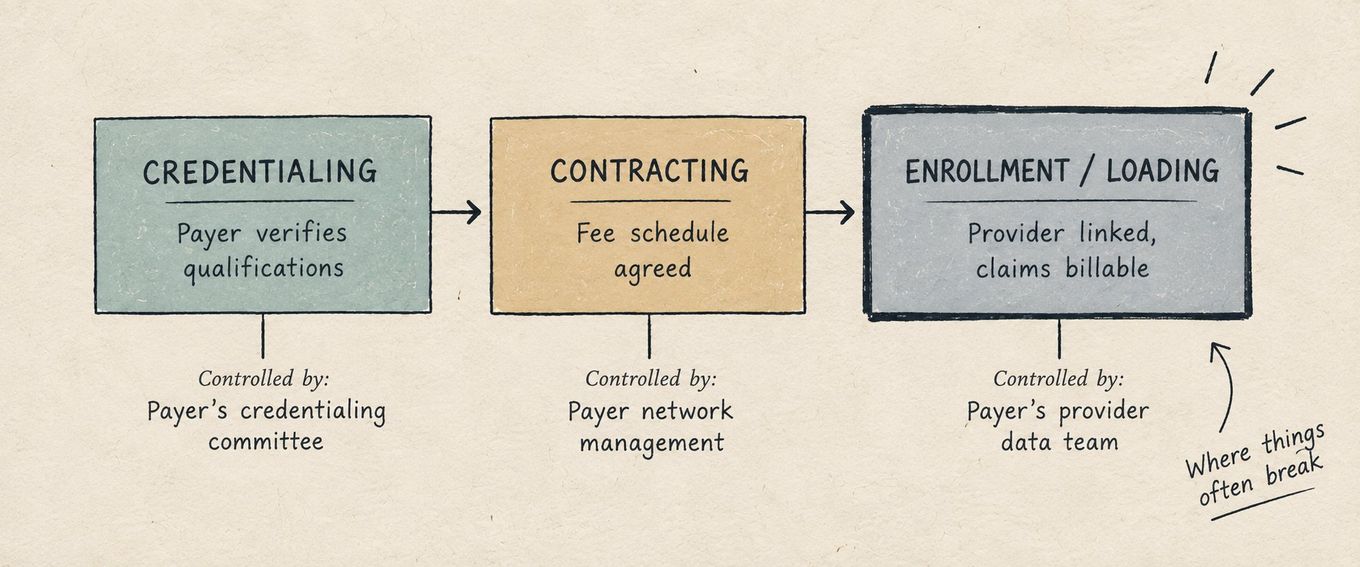
| Process | What it means | Who controls the clock |
|---|---|---|
| Credentialing | The payer verifies the provider is qualified (licenses, education, history) | The payer's credentialing committee |
| Contracting | The practice and payer agree on participation terms and fee schedule | Payer network management (and your negotiating) |
| Enrollment / loading | The provider is linked to the group's Tax ID and locations and becomes billable | The payer's provider data team |
A provider can be "credentialed" and still not be billable because the contract or the loading step hasn't finished. We go deeper on this three-stage split, with behavioral health specifics, in our insurance credentialing guide for therapists. The mechanics apply to every specialty.
What a credentialing service actually does, step by step
Strip away the marketing, and a competent service runs roughly this workflow for every provider:
- Intake and document collection. State licenses, DEA and state controlled-substance registrations, board certification, malpractice certificate of insurance and claims history, CV with no unexplained gaps, hospital affiliations, and NPI.
- CAQH ProView setup and attestation. Most commercial payers pull from the Council for Affordable Quality Healthcare (CAQH) ProView profile. It has to be complete, current, and re-attested every 120 days or payers treat it as stale.
- Medicare and Medicaid enrollment. Medicare runs through PECOS using the CMS-855I (individual) and CMS-855R (reassigning benefits to a group). Medicaid runs through each state's own portal, and managed Medicaid plans often add their own credentialing on top.
- Commercial payer applications. Each payer has its own forms, portals, and quirks. Some accept a CAQH pull. Others want a separate packet.
- Follow-up until approval. This is the unglamorous core of the job: calling, documenting reference numbers, answering development requests, and escalating when a file goes quiet.
- Contract and effective-date confirmation. Confirming the participation agreement, the fee schedule, and, most importantly, the exact effective date for each provider, location, and Tax ID.
- Handoff to billing. Loading approvals into the practice management system so claims go out under the right rendering and billing NPIs.
- Ongoing maintenance. CAQH re-attestation, payer recredentialing (typically every three years under NCQA standards), Medicare revalidation (every five years for most providers), license and DEA expirations, and roster updates when providers join, leave, or add locations.
Steps 6 through 8 are where most services get thin. They're also where most of the money leaks.
Speed is mostly the payer's, not the vendor's
Plenty of credentialing sites advertise "get credentialed in 30 days." Be skeptical. A service controls how fast a clean application gets submitted and how aggressively it's followed up. It does not control the payer's review queue.

Here's what realistic planning looks like:
| Enrollment type | Realistic planning window | Notes |
|---|---|---|
| Medicare (PECOS, no site visit) | Often 2 to 8 weeks | One MAC, First Coast, publishes targets of 95% processed within 15 days and 100% within 50 days for web applications without a site visit. Development requests restart the clock. |
| Commercial payers, open panel | 60 to 120 days | Assumes a clean application and an attested CAQH profile |
| Medicaid and managed Medicaid | 90 to 180+ days | State screening plus separate MCO credentialing |
| Closed or narrow panels | Unpredictable | May require a network-adequacy argument, or may not be possible at all |
| Hospital privileges | 60 to 180 days | Depends on medical staff committee meeting schedules |
Two things matter more than any vendor's promised turnaround:
- When you start. The single best credentialing decision is beginning 90 to 120 days before a provider's start date.
- Whether the file is clean on day one. A missing malpractice history or an unexplained CV gap can add weeks to every application at once.
Medicare does allow limited retroactive billing, generally up to 30 days before the effective date when circumstances justify it. Commercial payers vary widely, and many allow none. Don't build a hiring plan around retro billing.
How much do medical credentialing services cost?
Pricing isn't standardized, but published 2026 vendor pricing clusters into a few models:
| Pricing model | Typical published range | Best fit |
|---|---|---|
| Per payer application | Roughly $100 to $600 per application | Adding a few payers or a single new hire |
| Per provider package | Roughly $1,500 to $3,500 per provider for initial multi-payer credentialing | New providers joining a group |
| Monthly retainer | Roughly $150 to $600 per provider per month | Groups with steady hiring and ongoing maintenance needs |
| Bundled with billing | Included in, or discounted alongside, a percentage-of-collections billing fee | Practices that want credentialing and billing managed together |
Add-ons that often appear in quotes: expedited handling, hospital privileges, multi-state licensure, CAQH management, and per-change fees for roster updates. Ask for all of these in writing before you compare two vendors, because a low per-application price with separate maintenance fees can end up costing more over a year.
The number that actually matters
The fee is rarely the big cost. The waiting is.
Here's an illustrative example. If a provider would collect around $45,000 a month once in-network, every month of avoidable delay costs roughly that much in revenue that either never gets billed or gets billed out-of-network at a fraction of the rate. Against that, a $2,500 credentialing package isn't the line item to optimize. The avoided delay is.
For the broader picture of what outsourced revenue cycle work costs, see our breakdown of medical billing services cost.
Credentialing services vs. credentialing software vs. CVOs
A lot of "best medical credentialing companies" lists mix three very different products. If you run a practice or group, you likely want the first one.
| Option | Who it's built for | What you get |
|---|---|---|
| Credentialing service | Practices, physician groups, facilities | People who do the applications and follow-up for you |
| Credentialing software | Organizations with in-house credentialing staff | A platform to track documents, expirations, and applications; your team still does the work |
| Credentials verification organization (CVO) | Health plans, hospitals, large systems | Primary source verification on behalf of the organization doing the credentialing, often NCQA-certified |
If a vendor's case studies are all about health plans and hospital medical staff offices, they may be a CVO or software company, not the partner that will chase Blue Cross for your new psychiatrist.
Should you outsource credentialing or keep it in-house?
In-house credentialing can work well. It tends to break when volume or complexity rises faster than the one person who "knows how it works."

Keeping it in-house makes sense when:
- You add providers rarely and work with a small, stable set of payers
- You have a dedicated, experienced credentialing coordinator (not an office manager doing it between other jobs)
- You have a system for tracking every expiration and re-attestation date
Outsourcing makes sense when:
- You're hiring several providers a year, or opening new locations
- You bill across multiple states, or a mix of Medicare, Medicaid, and commercial payers
- Credentialing has already caused denials, gaps, or a provider seeing patients out-of-network
- The person who handled it left, and nobody else knows where things stand
The trade-offs mirror the broader billing decision, which we cover in in-house vs. outsourced medical billing.
How to evaluate a medical credentialing service
These are the questions we'd ask if we were on your side of the table:
- Who does the work? A named specialist, or a queue? Where are they, and how many providers do they carry?
- What does "done" mean to you? Approval letter, or confirmed effective date loaded into billing? Those aren't the same thing.
- Which payers and states do you work with most? Ask for real examples in your specialty and region.
- How will I see status? Weekly reports, a portal, or "we'll email you when it's approved"?
- What's included after approval? CAQH re-attestation, recredentialing, revalidation, and roster changes, or are those billed separately?
- Who owns the logins and data? You should keep access to CAQH, PECOS, and payer portals if you ever leave.
- How do you hand approvals off to billing? If they don't bill for you, ask exactly how effective dates reach your billing team.
Red flags worth walking away from:
- Guaranteed approval, or guaranteed timelines regardless of payer
- Promises to get you into any closed panel
- Holding your CAQH or PECOS credentials hostage
- No clear answer about what happens after the approval letter arrives
We keep a longer vetting list in questions to ask before hiring a medical billing company, and most of it applies directly to credentialing vendors.
Where credentialing quietly becomes a billing problem
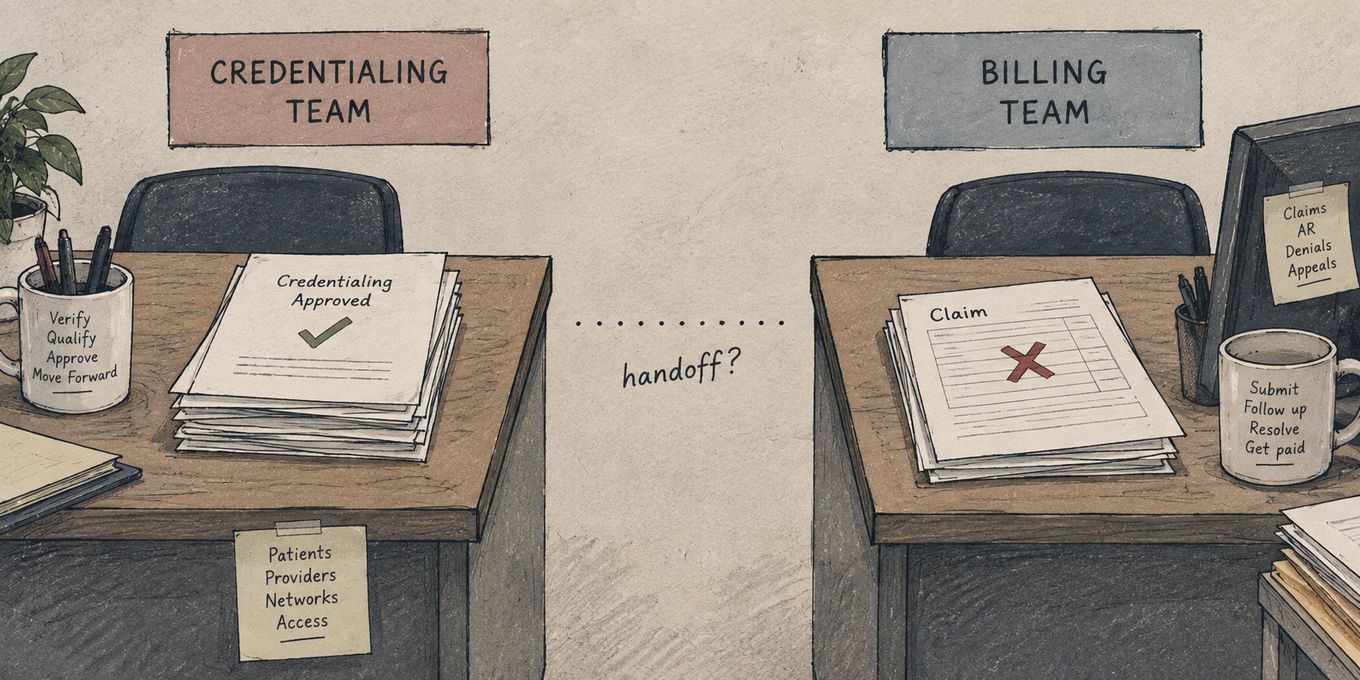
This is the section we wish more practices read before they chose a vendor.
Credentialing errors rarely announce themselves as credentialing errors. They show up weeks later as denials, often with a reason like "provider not eligible on this date of service" (claim adjustment reason code B7), a rendering provider mismatch, or a location that isn't on the payer's roster.
The most common culprits:
- Wrong effective date in the billing system. Claims go out before the provider is actually active with that payer.
- Individual approved, group linkage missing. The provider is credentialed but not linked to the group's Tax ID.
- New location never added. A provider starts seeing patients at a second office the payer doesn't know about.
- Taxonomy or specialty mismatch. The taxonomy on the claim doesn't match what's on file with the payer.
- Lapsed CAQH or missed revalidation. Everything worked fine until it quietly didn't.
When credentialing and billing are handled by different teams that don't talk, each one can honestly say "our part is done" while claims keep failing in the gap. That gap is why we think the handoff matters more than the application itself. If you're already seeing these denials, our breakdown of why mental health claims get denied walks through the credentialing-related ones in detail, and most apply across specialties.
Our take, and why it matters
We wrote this from the operator's side of credentialing, not the sales side. President and CEO Estelle Sandoval built her career working claims and tracing denials back to the enrollment problems that caused them, and that's the lens this team brings to every engagement.
To build this piece, we reviewed the top-ranking credentialing service pages and pricing guides, then checked the regulatory details against primary sources: CMS enrollment guidance and published MAC processing timeframes for Medicare, and NCQA's credentialing standards for recredentialing cycles and verification windows. Where we cite pricing, it's drawn from published 2026 vendor pricing and is meant as a planning range, not a quote.
How we handle credentialing at Clarity
Credentialing and enrollment is one piece of our revenue cycle solutions, and we run it alongside billing, denial management, and coding on purpose. That means:
- Enrollment, credentialing, and revalidation across Medicare, Medicaid, and commercial payers
- Effective dates that flow straight into billing, so claims don't go out before a provider is active
- Ongoing maintenance, so CAQH attestations, recredentialing, and revalidations don't lapse quietly
- Plain-language monthly reporting, so you know where every provider and payer stands
We do this for behavioral and mental health practices, outpatient and inpatient physician groups, and hospitals and facilities. If you're onboarding providers soon, or you suspect credentialing is behind some of your denials, talk to our team. We'll tell you where things stand, even if the answer is that you don't need us.
Frequently Asked Questions
What do medical credentialing services include?
Medical credentialing services typically include collecting and verifying provider documents, building and attesting the CAQH ProView profile, enrolling providers in Medicare through PECOS and in state Medicaid, submitting commercial payer applications, and following up until approval. Stronger services also confirm effective dates, load approvals into the billing system, and manage ongoing recredentialing, revalidation, and roster updates.
How long does medical credentialing take?
Most commercial payers take 60 to 120 days for a clean application, while Medicaid and managed Medicaid can take 90 to 180 days or longer. Medicare enrollment through PECOS is often faster when no site visit is required, but development requests can extend it. Practices should start credentialing 90 to 120 days before a provider's first day of seeing patients.
How much do medical credentialing services cost?
Published 2026 pricing generally ranges from about $100 to $600 per payer application, or roughly $1,500 to $3,500 per provider for initial multi-payer credentialing. Some vendors charge a monthly per-provider retainer instead, and some bundle credentialing into a billing contract. Practices should confirm whether maintenance, CAQH management, and roster changes are included or billed separately.
Can a provider see patients before credentialing is complete?
A provider can see patients, but the practice may not be able to bill that payer as in-network for those visits. Medicare generally allows limited retroactive billing, up to 30 days before the enrollment effective date in qualifying circumstances, while many commercial payers allow no retroactive billing at all. Seeing insured patients before an effective date is a common source of unrecoverable revenue and denials.
What is the difference between credentialing and provider enrollment?
Credentialing is the payer's verification that a provider is qualified to join its network. Provider enrollment, sometimes called loading, is the step that links the approved provider to the practice's Tax ID, locations, and billing information so claims can be paid. A provider can be credentialed but not yet enrolled, which is why claims can still deny after an approval letter arrives.
Is it worth outsourcing medical credentialing?
Outsourcing is usually worth it for practices that hire several providers a year, operate in multiple states, work with many payers, or have already had credentialing-related denials. The main benefit is avoiding delays and gaps that cost far more in lost revenue than the service fee. Practices that add providers rarely and have an experienced in-house coordinator may do fine keeping it internal.