What a Medical Billing Company Actually Does (And How to Tell the Good Ones from the Rest)
September 23, 2026 · 10 min read
A medical billing company manages the revenue cycle operations a practice would otherwise handle in-house: claim submission, denial management, payment posting, and AR follow-up. The right partner reduces denials and increases net collections. The wrong one processes claims on autopilot while your aging report quietly climbs.
Here's something we see more than we'd like to admit.
A practice owner calls us after years with another billing company. Collections have been flat. Denials are "normal," or so they were told. The AR past 90 days is somewhere between uncomfortable and alarming. And when they ask their billing company for a detailed report, they get a PDF with three numbers on it.
This isn't rare. It's actually the median experience in medical billing.
The industry has a real problem: it's easy to look like you're doing the job without actually doing it well. Submit the claims. Post the payments. Send the statements. Nobody will notice the denials that should have been appealed, the modifier that was missing, or the reimbursement rate that hasn't been renegotiated since 2019.
Choosing a medical billing company is one of the highest-leverage financial decisions a practice makes. This is for the practice owner or billing manager who doesn't want to figure that out the hard way.
What a Medical Billing Company Actually Does
The term gets used loosely, so let's be precise.
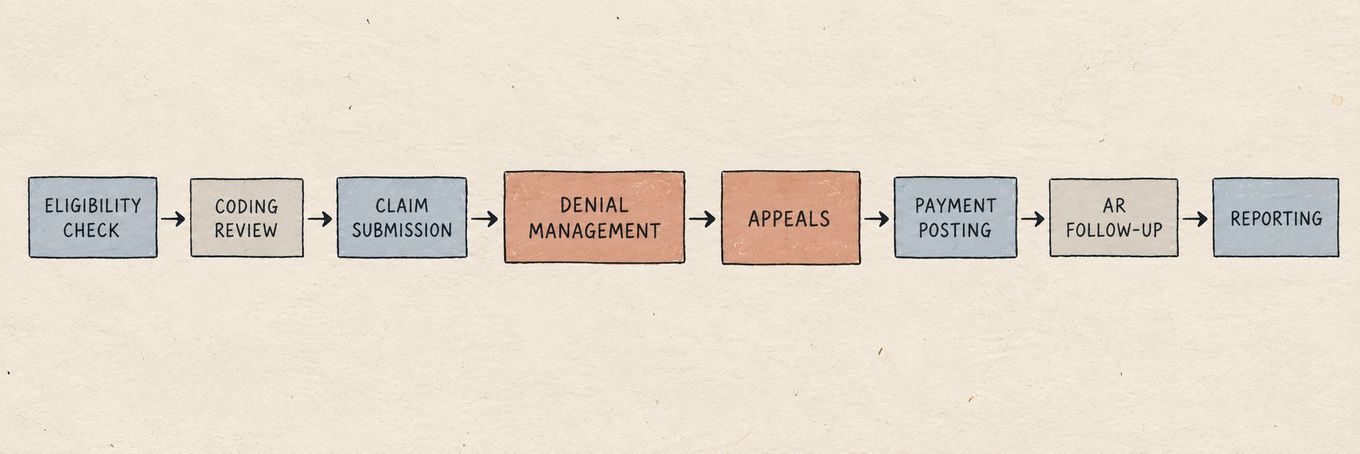
A full-service medical billing company handles:
- Eligibility and benefits verification before the patient is seen: confirming active coverage, deductibles, copays, and prior authorization requirements
- Medical coding review: translating clinical documentation into CPT, ICD-10, and HCPCS codes accurately enough to pass payer edits and hold up under audit
- Claim submission: filing electronically to the correct payer with the right taxonomy codes, modifiers, and supporting documentation
- Denial management and appeals: when payers reject or underpay claims, a real billing company fights back with documented appeals, not write-offs
- Payment posting: reconciling EOBs, ERAs, and patient payments against what was expected and contracted
- AR follow-up: actively working unpaid claims before they age past the point of recovery
- Patient billing: statements, payment plans, and balance follow-up
- Reporting: giving you the data to see what's actually happening in your revenue cycle, by payer and by denial reason
Some companies offer only pieces of this. A clearinghouse is not a billing company. A software platform with a billing module is not a billing company. And a company that "processes claims" but doesn't actively work denials is, functionally, a very expensive claim submission service.
| Service | Full-service billing company | Claim-processing only | EHR billing module |
|---|---|---|---|
| Eligibility verification | Yes | Sometimes | Yes |
| Coding review | Yes | Rarely | Sometimes |
| Denial appeals | Yes | Rarely | No |
| AR follow-up | Yes | Rarely | No |
| Reporting and analytics | Yes | Basic | Basic |
The Problem With "We Bill Everything"
Most medical billing companies will tell you they work with any specialty. That's technically true and practically problematic.

Behavioral health billing is nothing like surgical billing. Psychiatry claims involve CPT codes like 90837, 90791, and 90846, specific modifier requirements for telehealth, and a web of payer-specific carve-out arrangements where the behavioral health benefit is managed by a completely separate entity from the medical benefit. A billing team that primarily works with orthopedic surgeons will submit those claims incorrectly or leave real money uncollected: not because they're incompetent, but because the rules are different and nuance accumulates only with experience.
The same holds for hospital facility billing, inpatient physician billing, and any specialty with complex bundling rules, global periods, or payer-specific coverage policies.
When you're evaluating a medical billing company, the question isn't "do they bill my specialty." It's "what percentage of their clients are in my specialty, and what does their denial rate look like for those clients?"
If they can't answer that second question, that is the answer.
For practices in behavioral health or mental health, our guide to behavioral health billing services breaks down what specialty-specific experience actually looks like in practice.
What to Actually Look For (Beyond the Standard Checklist)
Every guide tells you to check for HIPAA compliance, EHR integration, and "experience." Those are table stakes, not differentiators.
Here's what separates a genuinely good medical billing company from one that's good at sales calls:
Transparency in reporting, not just a portal login
Can they send you, right now, your net collection rate by payer? Your denial rate by reason code? Your AR aging broken into 30/60/90/120-plus day buckets? A billing company managing your revenue cycle should produce this data routinely. If they need to "pull a special report" or the numbers live in a dashboard only they can access, that's a control problem.
Active denial management, not passive write-offs
Ask directly: what's your denial appeal rate, and what percentage of denied claims do you recover? A strong billing company appeals the majority of denials that have a defensible basis and tracks recovery rates by denial reason and payer. A mediocre one codes denied claims as contractual adjustments and moves on.
A defined onboarding and transition process
Moving from in-house to outsourced billing, or switching from one company to another, is genuinely complex. A good billing company has a documented process: how long it takes, who owns what during the transition period, how they handle claims already in flight, and what happens if there are gaps. If their answer is "we'll figure it out," they've handled transitions badly enough times that they've stopped planning for them. Our guide to switching medical billing companies walks through what a well-run transition actually involves.
Fee structure that aligns incentives
Most billing companies charge a percentage of collections, typically 4% to 9% depending on specialty, volume, and scope of service. Some charge flat fees per claim. Percentage-based fees align incentives: the company earns more only when you collect more. Flat-fee models can create the opposite dynamic. Before comparing quotes, our breakdown of what medical billing services cost shows what's normal for your specialty and claim volume.
A named point of contact
This sounds basic. It isn't. Some billing companies assign you to a portal and an email address. When a claim has been sitting unpaid for 45 days and you need to know why, that setup breaks down. You want an account manager who knows your practice, your payer mix, and your typical denial patterns by name.
Red Flags Before You Sign

Some show up on the sales call. Some show up later.
- Guaranteed collection rates in the first conversation. No legitimate billing company can guarantee a specific collection rate before reviewing your payer mix, fee schedule, and documentation quality. The right number depends entirely on your situation.
- No questions about your specialty or patient volume. A company pitching you without asking what you bill is giving you a generic pitch, which typically means a generic service.
- "We integrate with everything." Ask them to demonstrate, specifically, how they connect with your EHR and what the data flow looks like. Integration issues are where transition problems begin.
- Vague references to "industry-standard" denial rates. Industry data puts first-pass denial rates at 10 to 14% across most specialties in 2024, with behavioral health often running higher due to prior authorization and carve-out complexity. Accepting whatever your current company reports as normal is how you end up with an industry-average revenue cycle. Ask what their actual denial rate is for practices comparable to yours, and what they're doing to drive it down.
- No discussion of your existing AR. If a billing company doesn't ask about your current AR aging when you're switching to them, they either plan to abandon it or don't know what they're taking on.
The Decision You're Actually Making

Outsourcing your billing isn't a vendor relationship. It's closer to hiring a department.
The people you choose will touch every claim your practice generates. They'll represent you to payers. They'll decide which denials are worth appealing and which to write off. They'll determine whether your AR ages gracefully or turns into a recovery project. And they'll produce the reports you use to understand your own financial performance.
That's not a cost decision. It's an operational one.
If you're still weighing whether to outsource at all, our comparison of in-house vs. outsourced medical billing covers the real trade-offs, including the ones that aren't obvious until you're two years into the wrong choice.
Our take, and why it matters
Estelle Sandoval, our President and CEO, has worked inside practice billing since the late 1980s. The team she built at Clarity brings that same background: people who've run AR, worked appeals, and learned the difference between a billing company that fights for collections and one that processes claims and moves on. We work with behavioral health practices, physician groups, and hospital facilities, handling the full revenue cycle: credentialing, coding, billing, denial management, and analytics.
The perspective in this article comes from doing this work, not reviewing it from the outside. We know what a well-structured denial appeal recovers versus a standard resubmission. We know which denial patterns point to a documentation problem versus a payer routing error. That operational depth is what we bring to every engagement and to content like this.
How Clarity Approaches Medical Billing
We built our practice around convictions that run counter to how most billing companies operate.
Specialty matters. We focus on behavioral health, mental health, psychiatry, and physician billing, not because we can't handle other specialties, but because depth in a specific billing environment produces better outcomes than broad generalist coverage.
Denial management is the job. We treat every appealable denial as a recovery opportunity, not a write-off candidate. We report on our recovery rates by denial reason and payer because that data is how you evaluate whether a billing company is actually working.
Reporting serves you, not us. You should know your net collection rate, denial breakdown, and AR aging at any moment without having to ask for it.
If you want to see what that looks like for a practice in your specialty, review our billing and RCM services or get in touch with our team.
Frequently Asked Questions
What does a medical billing company do?
A medical billing company manages the revenue cycle operations for a healthcare practice or facility: patient eligibility verification, medical coding, claim submission to insurance payers, denial management and appeals, payment posting, AR follow-up, and patient billing. A full-service company handles all of these functions. Some offer only portions of the workflow. The goal is to maximize net collections while reducing administrative burden on clinical staff.
How much does a medical billing company charge?
Most medical billing companies charge a percentage of collections, typically ranging from 4% to 9% depending on specialty, claim volume, and scope of services. Some charge flat fees per claim. Percentage-based pricing generally aligns the company's incentives with yours, since they earn more when you collect more. For a full breakdown by specialty and service type, see our guide to medical billing service costs.
What questions should I ask before hiring a medical billing company?
The most important questions are: What's your denial appeal rate and recovery percentage for claims like mine? What does your reporting look like, and can I access it independently? What does your onboarding and transition process involve, and how long does it take? What's your experience in my specialty specifically? For the full list of questions that separate good companies from mediocre ones, see our pre-hire evaluation guide.
How do I know if my current medical billing company is underperforming?
Signs of underperformance include: a first-pass denial rate consistently above 10 to 15% with no active appeals or improvement plan; AR aging where more than 25 to 30% of receivables are past 90 days; flat or declining collection rates despite stable patient volume; vague or incomplete reporting; and slow or unclear responses when claims are sitting unpaid. Industry data puts average first-pass denial rates at 10 to 14% for most specialties. If you can't get specific data about your denial patterns and collection rates on request, that is itself a meaningful signal.
Is a specialty-specific medical billing company better than a generalist?
For most practices, yes. A billing company with deep experience in your specialty understands the CPT codes, modifier rules, payer policies, and common denial reasons specific to your service lines. Generalist companies may handle your claims correctly, but they're less likely to catch the nuances that drive the difference between average and strong collection performance. This matters most in behavioral health, psychiatry, complex surgical specialties, and hospital facility billing, where payer rules are highly specialized and frequently updated.
What happens to my existing AR if I switch billing companies?
This is one of the most commonly ignored questions in a billing transition, and one of the most important. Your current AR, especially any claims past 60 days, represents real collectible revenue that can easily be abandoned if a new company focuses only on new claims. Before signing, ask explicitly: will your team work our existing AR, and how? What's the timeline for addressing claims already past 90 days? A billing company that can't give you a clear answer to this is telling you something about how they'll handle the rest of your account.