Home Health Billing Services: What Agencies Need to Get Paid Right
November 27, 2026 · 16 min read
Home health billing services manage the full revenue cycle for home health agencies, from OASIS coding review and NOA filing through denial management and AR follow-up. Under PDGM, your payment is calculated before a claim is ever submitted, based on clinical assessment data that most billing companies never touch; a missed comorbidity code or late NOA costs your agency revenue before anyone on your team knows there's a problem. If you're evaluating billing partners or trying to understand why your denials keep climbing, this guide covers what home health billing actually requires and how to find a service that can deliver it.
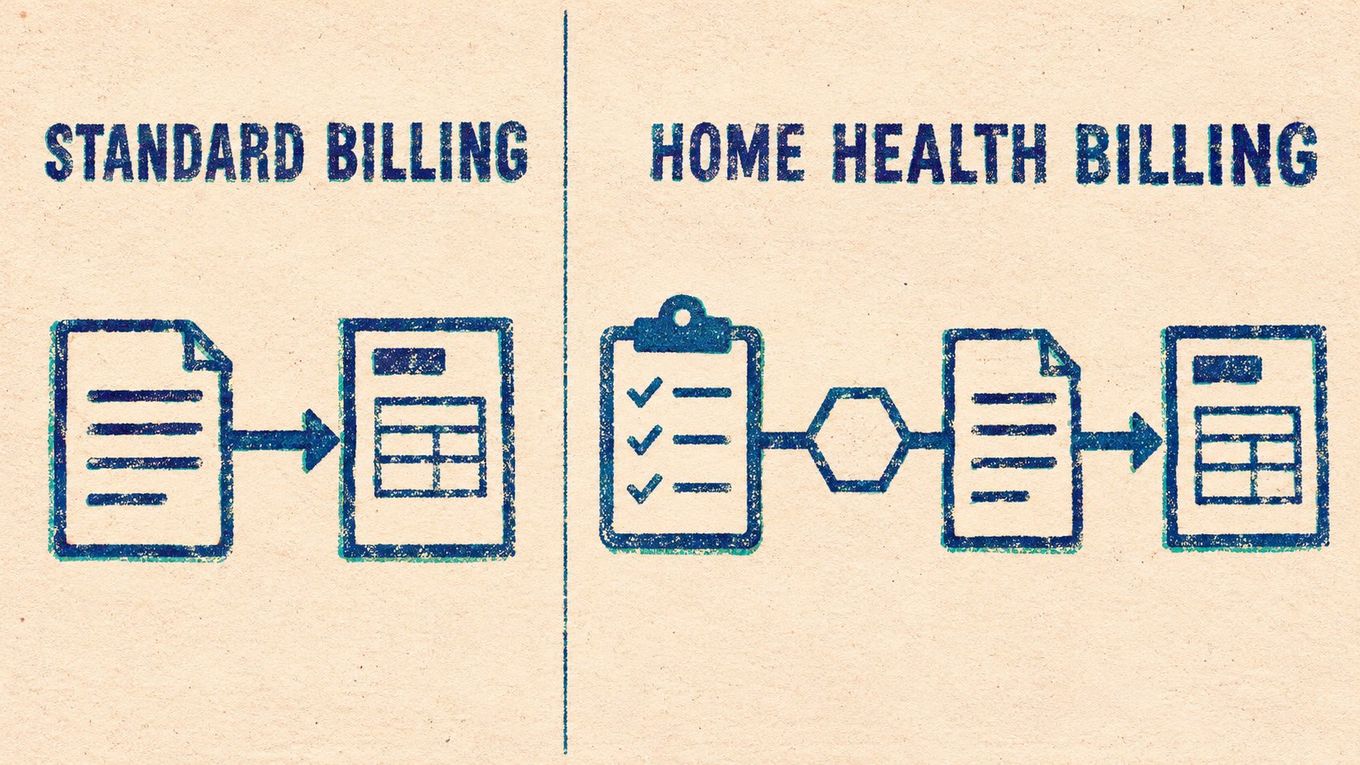
Home Health Billing Isn't Standard Medical Billing
Most medical billing starts at the visit note and moves forward. Home health billing starts upstream, in the clinical assessment, before the claim exists.
Payment is determined before a claim is ever submitted, and several specific structural differences drive this:
- Episode-based, not fee-for-service: Medicare pays a single case-mix-adjusted rate for each 30-day period of care, not per visit or per procedure. That rate is calculated from OASIS assessment data, primary diagnosis, functional level, and comorbidity adjustment.
- PDGM grouping happens upstream of the claim: Every 30-day period is classified into one of 432 Home Health Resource Groups (HHRGs) before a dollar is calculated. If OASIS coding doesn't accurately reflect the patient's condition, the HHRG is wrong and the payment is wrong.
- Consolidated billing rules apply: The home health agency bills Medicare for the full scope of covered Part A services during the plan of care, including skilled nursing, therapy, home health aide services, and medical social services.
- NOA is a gating submission: Before any final claim can be paid, the agency must file a Notice of Admission (NOA) within 5 calendar days of the start-of-care date. A late or missing NOA forfeits payment for every day of delay.
- Payer mix is complex by design: Beyond traditional Medicare, home health agencies typically bill Medicare Advantage plans, Medicaid managed care organizations, commercial insurers, and veterans' programs, each with separate authorization requirements, visit limits, and documentation standards.
How PDGM Actually Calculates Your Payment
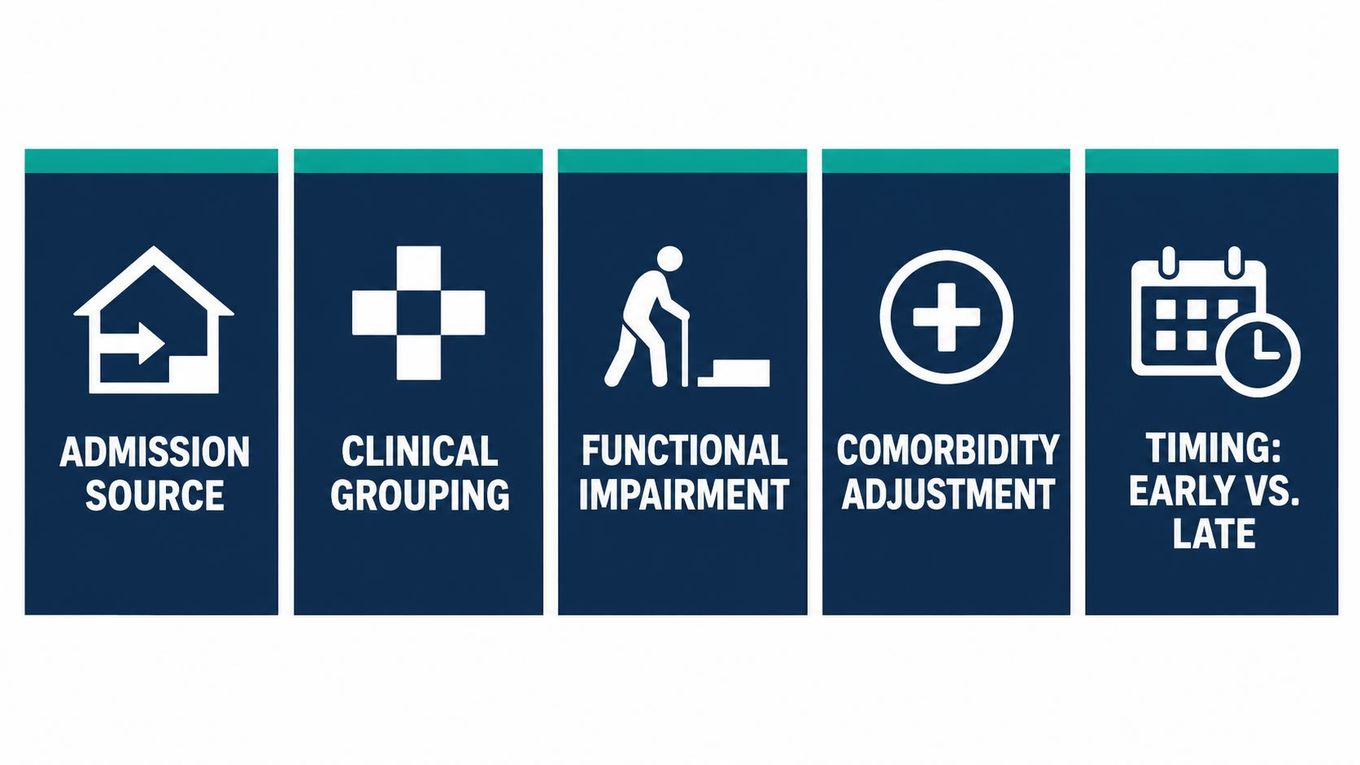
PDGM replaced the old 60-day episode model in January 2020, and every dollar your agency earns under Medicare runs through it. Miss any of these variables and your payment is wrong before the claim leaves your desk.
| PDGM Variable | What It Affects |
|---|---|
| Admission source | Community vs. institutional (post-acute) weighting |
| Clinical grouping | Based on primary diagnosis across 12 clinical categories |
| Functional impairment level | Low, medium, or high, scored from OASIS functional items |
| Comorbidity adjustment | None, low, or high, based on secondary diagnoses documented and coded |
| Early vs. late timing | First 30-day period receives a higher payment weight than subsequent periods |
Each variable shifts the final payment rate. A patient admitted from a hospital with wound care as the primary diagnosis, high functional impairment, and documented comorbidities receives materially higher reimbursement than the same patient classified without the comorbidity adjustment.
The comorbidity gap is the most preventable revenue leak in home health:
- According to industry analysis published in Healthcare IT Today, roughly 40% of home health agencies are not capturing the full comorbidity adjustment available under PDGM.
- For a 100-patient agency, that gap runs $15,000 to $20,000 in annual uncollected revenue, left on the table because secondary diagnoses documented in clinical notes were never carried through to billing.
What a Home Health Billing Service Actually Does
A home health billing service isn't a claim submission function. The work that protects your payment happens before the claim is ever submitted.
Pre-claim workflow:
- Insurance eligibility verification at admission and at recertification
- Prior authorization management for Medicare Advantage, Medicaid managed care, and commercial payers
- Face-to-face documentation review (CMS requires a physician or qualified non-physician practitioner encounter within 90 days before or 30 days after start of care, with documentation that supports medical necessity; under the CY 2026 final rule, nurse practitioners, clinical nurse specialists, and physician assistants may also perform the encounter)
- NOA submission tracking to ensure the 5-calendar-day deadline is met across the full patient census
- OASIS-E assessment coding review to validate that clinical data supports the intended PDGM grouping and comorbidity adjustment
Claim submission:
- HIPPS code validation against the accepted OASIS assessment in iQIES (CMS's quality reporting system)
- Revenue code and HCPCS code accuracy (G0299 for skilled nursing visits by a registered nurse, G0300 for skilled nursing visits by a licensed practical nurse)
- ICD-10-CM primary and secondary diagnosis coding aligned to PDGM clinical groupings
- Type of Bill (TOB) 32x coding for home health PPS claims
- Electronic claim submission via ASC X12 837 institutional transaction through the assigned Medicare Administrative Contractor (MAC)
Post-submission and AR management:
- ERA and EOB reconciliation and payment posting
- Denial identification, root-cause analysis, and appeal filing
- LUPA (Low Utilization Payment Adjustment) monitoring to prevent under-visit payment reductions
- Accounts receivable follow-up across payer types and aging buckets
- Recertification billing and episode close-out
For a broader picture of how structured AR follow-up works across payer types, see our guide to accounts receivable management services.
The Denials Costing Your Agency Revenue Right Now
CMS found a 7.7% improper payment error rate for home health in 2023, representing roughly $1.2 billion in errors industry-wide. These aren't random mistakes. The same triggers repeat, and most of them are preventable.
| Denial Reason | Root Cause | Prevention |
|---|---|---|
| Late NOA | Manual tracking, intake process delays | Automated NOA deadline tracking from start-of-care date across full census |
| Face-to-face documentation failure | Missing encounter date, vague physician note, encounter outside allowed window | F2F checklist at intake, physician note review before billing submission |
| OASIS/claim HIPPS mismatch | OASIS updated after claim submitted without refreshing HIPPS code | Pre-bill OASIS-to-claim reconciliation before every submission |
| Principal diagnosis PDGM coding error | Unspecified or symptom code used as primary diagnosis instead of a definitive condition | PDGM grouper validation for every episode before claim submission |
| Missing comorbidity codes | Secondary diagnoses documented in clinical notes but not coded on the claim | Clinical note audit at every episode; comorbidity gap review |
| Authorization gap (MA/Medicaid) | Authorization expired mid-episode or visit count exceeded without renewal | Real-time authorization tracking by episode and payer |
| Homebound status not documented | Nursing notes don't describe the effort or difficulty required to leave home | Documentation coaching for clinical staff; note review before billing |
| OASIS not accepted in iQIES | Assessment submitted after claim, or rejected on intake and not corrected | iQIES acceptance confirmation before final claim submission |
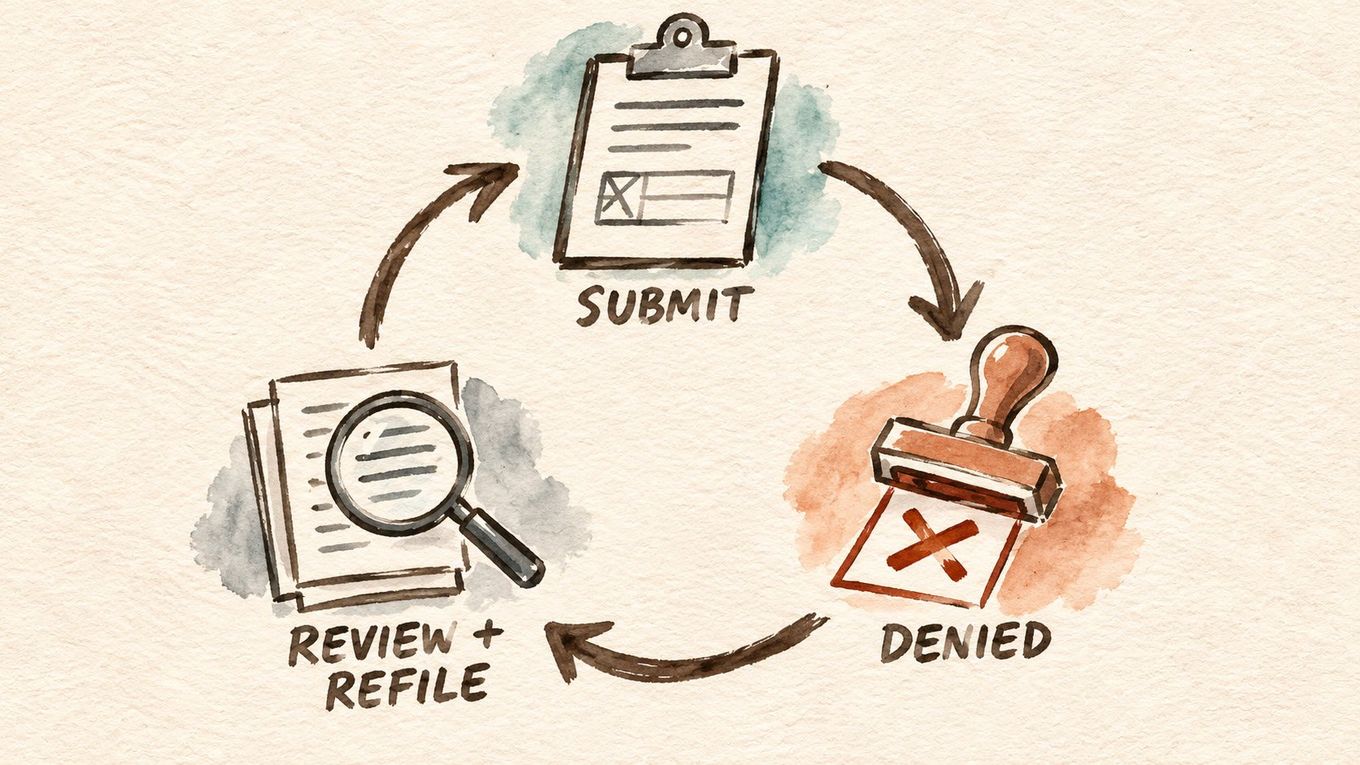
For a detailed breakdown of how to manage denials systematically across payer types, see our denial management services overview.
LUPAs: The Payment Reduction Most Agencies Don't See Until It's Too Late
A LUPA wipes out your case-mix-adjusted period rate and replaces it with individual per-visit rates. That's almost always a significant pay cut, and it triggers when visit count in a 30-day period drops below a clinical-grouping-specific threshold before anyone on your billing team notices.
LUPA thresholds under PDGM range from 2 to 6 visits depending on the clinical grouping. The key billing implications:
- LUPAs are billed differently: A LUPA claim uses different revenue codes and is paid per-visit, not at the case-mix-adjusted rate.
- Partial LUPAs matter: If a patient is discharged or transferred mid-period, the billing service must determine whether the period qualifies as a LUPA or whether partial episode payment rules apply.
- LUPA patterns signal deeper problems: Consistently high LUPA rates across a patient panel often indicate visit scheduling gaps, referral issues, or patient non-compliance, any of which should trigger both a clinical and billing review.
A billing service that tracks LUPA rates by clinical grouping and flags episodes approaching threshold mid-period gives agencies the information to intervene before a payment reduction is locked in.
Medicare Advantage and Traditional Medicare: Same Patient, Completely Different Billing Rules
Traditional Medicare and Medicare Advantage cover the same patients, but they don't bill the same. MA plans add authorization requirements, visit limits, and in some cases entirely different payment structures on top of CMS rules, and billing one like the other is a direct path to denials.
| Factor | Traditional Medicare (FFS) | Medicare Advantage |
|---|---|---|
| Prior authorization | Not required | Often required, with visit count limits per authorization period |
| Payment model | PDGM 30-day case-mix-adjusted periods | Plan-specific; often per-visit rates |
| OASIS requirement | Required for all episodes | Plan-dependent; some waive it |
| NOA equivalent | CMS NOA required within 5 days | Plans may require separate admission notification with different deadlines |
| Claim form | UB-04 (837I institutional) | Varies; some plans accept CMS-1500 for visit billing |
| Appeals process | MAC redetermination, then ALJ | Internal plan appeal, then IRE |
For agencies with significant Medicare Advantage volume, billing errors compound because in-house teams often apply Medicare FFS logic to MA claims. A billing service with payer-specific MA workflows for each contracted plan catches this systematically, rather than discovering it during an audit or recoupment.
The AR Numbers That Tell You If Your Billing Is Actually Working
Good billing intentions don't show up in claim submissions. They show up in AR days, clean claim rates, and denial recovery rates, months later, when the pattern is already baked in.
| Metric | Home Health Benchmark | Warning Sign |
|---|---|---|
| AR days (Medicare FFS) | ≤30 days | \>45 days |
| AR days (Medicare Advantage) | ≤45 days | \>60 days |
| Clean claim rate (first submission) | \>95% | <90% |
| Denial rate by volume | <5% | \>10% |
| Denial overturn rate | \>70% on appealed claims | <50% |
| Days to pay (Medicare FFS) | 14–21 days from final claim | \>30 days |
| 90+ day AR as % of total AR | <10% | \>20% |
A clean claim rate below 90% almost always traces back to upstream workflow failures, not random errors. The claim itself is usually fine. The problem is that OASIS data didn't match the submitted HIPPS code, the NOA was late, an MA authorization wasn't secured, or a secondary diagnosis wasn't coded before submission.
The 90+ day AR bucket is the number to watch most closely:
- Medicare FFS aging here usually signals OASIS holds in iQIES or unresolved claim edits at the MAC level, not billing errors that standard appeals can fix.
- Medicare Advantage aging here typically reflects authorization disputes, secondary billing requirements, and plan-specific appeal backlogs that require payer-specific follow-up protocols.
- Any bucket growing above 20% of total AR means denials aren't being worked with urgency, timely filing windows are at risk, and revenue that lands here becomes increasingly unlikely to recover.
If your billing service can't show you these numbers broken out by payer on demand, that's the first problem to solve before you evaluate anything else about their performance. For more context on what structured AR management looks like across the full revenue cycle, see our outsourced RCM services overview.
How to Tell If a Billing Company Actually Understands Home Health
Not all medical billing companies bill home health, and most generalists don't have the PDGM expertise, OASIS coding capability, or NOA workflows to do it competently. Here's what to verify before you sign:
- Home health-specific caseload: Ask what percentage of their total billing volume is home health. A generalist company managing 10% home health volume is not a specialist.
- PDGM coding capability: Confirm they employ or contract certified home health coders who review OASIS assessments, not just billers who submit what clinicians document.
- Clean claim rate: Ask for the metric and how they define it. A clean claim rate above 95% on first submission is a reasonable benchmark for a competent home health billing operation.
- Denial rate and appeal recovery: Industry denial rates for home health run between 5% and 15% depending on payer mix. Any vendor above that range without a clear explanation warrants scrutiny before you sign.
- NOA compliance tracking: Ask how they monitor the 5-day NOA deadline across the full patient census and what their process is when a deadline is at risk.
- Medicare Advantage workflows: Ask how they manage authorization tracking and visit-count management for MA plans, and how many MA plans they've contracted on behalf of clients.
- LUPA monitoring: Ask whether they flag LUPA-at-risk episodes mid-period and when in the billing cycle that flag is raised.
- Reporting transparency: You should see AR aging by payer, denial reason codes, clean claim rate, and LUPA frequency without requesting a custom report each month.
- EVV compliance awareness: Since Electronic Visit Verification (EVV) is federally required for Medicaid home health under the 21st Century Cures Act, confirm the billing service understands how EVV data integrates with claim submission in your state.
For a broader list of due-diligence questions to ask before committing to any billing partner, see our questions to ask before hiring a medical billing company.

Why Trust This Article
Our background:
- Clarity Health RCM traces its roots to Quality Medical Billing, founded in 1988.
- Our team brings more than 40 years of combined revenue-cycle experience across physician billing, hospital billing, credentialing, denial management, and specialty practice billing.
- President and CEO Estelle Sandoval has led the firm through multiple CMS payment model transitions, including the PDGM rollout and the billing environment it created for home health agencies.
What we see in practices:
- The most consistent and preventable revenue leak in home health is comorbidity underreporting. It almost always starts with inadequate clinical documentation review at the coding stage, not with the billing team.
- Home health agencies with the highest denial rates typically have clinical and billing teams operating in silos, so OASIS data never connects to claim codes before submission.
- Agencies with strong clean claim rates have invested in pre-bill review workflows. Faster claim submission without that upstream quality step just accelerates the denial cycle.
How we sourced the data:
- CMS improper payment error rate and dollar figures from OIG audit findings and the Comprehensive Error Rate Testing (CERT) program, 2023 data.
- PDGM comorbidity gap analysis from industry reporting published in Healthcare IT Today.
- MedPAC 2026 March Report to Congress for home health payment rate context.
- CMS Medicare Claims Processing Manual, Chapter 10 for NOA, TOB, consolidated billing, and claim submission requirements.
How Clarity Health RCM Supports Home Health Agencies
Home health agencies working with us get a billing operation built around PDGM accuracy and revenue capture, not just claim volume.
- OASIS coding review: We review OASIS-E assessments for coding accuracy before claims are submitted, not after a denial comes back. Comorbidity gaps are identified and corrected at the coding stage.
- NOA management: We track the 5-day NOA deadline across your entire patient census and flag at-risk submissions before they miss the window.
- Denial management: Our team handles denial root-cause analysis, payer-specific appeal preparation, and AR follow-up. We manage denials systematically, not on a one-off basis.
- Comorbidity capture audit: We conduct episode-level reviews to identify secondary diagnoses documented in clinical notes that weren't carried through to billing.
- Medicare Advantage workflows: We manage authorization tracking and visit-count management across your contracted MA plans, with payer-specific billing protocols.
- AR follow-up and reporting: We manage accounts receivable follow-up with structured AR aging targets. You receive regular reporting on clean claim rate, denial reasons, LUPA frequency, and AR aging by payer without chasing us for it.
- Payer enrollment: Getting enrolled with Medicare Advantage plans and Medicaid MCOs is a prerequisite for billing them. Our credentialing team manages the enrollment pipeline so you're not waiting to bill patients you're already seeing.
If your agency is dealing with high denial rates, missed LUPA triggers, or comorbidity undercapture, contact our team to review your current billing performance.
Frequently Asked Questions
What is a home health billing service? A home health billing service is a third-party company that manages the revenue cycle for home health agencies, covering OASIS coding review, Notice of Admission filing, Medicare and payer-specific claim submission, denial management, and accounts receivable follow-up. Unlike general medical billing, home health billing requires specific expertise in the Patient-Driven Groupings Model (PDGM), consolidated billing rules, and clinical documentation workflows that aren't standard in physician or hospital billing.
How does PDGM affect home health billing? PDGM, the Patient-Driven Groupings Model, replaced the previous 60-day episode payment structure in January 2020. Under PDGM, Medicare pays home health agencies a case-mix-adjusted rate for each 30-day period of care, calculated using the patient's admission source, primary diagnosis clinical grouping, functional impairment level, and comorbidity adjustment. Because payment is determined by OASIS assessment data before the claim is submitted, inaccurate OASIS coding or missing secondary diagnoses directly reduce reimbursement even when care was delivered correctly and completely documented in clinical notes.
What is the Notice of Admission (NOA) in home health billing? The Notice of Admission is a required CMS submission that home health agencies must file within 5 calendar days of the start-of-care date. It establishes the home health period of care in Medicare's systems and must be accepted before a final claim can be paid. A late NOA triggers a payment reduction equal to one day's payment for every calendar day the submission is late; in practice, the NOA deadline is one of the highest-risk operational gaps for agencies without systematic tracking across their full patient census.
What is a LUPA in home health billing? A Low Utilization Payment Adjustment (LUPA) occurs when the visit count in a 30-day payment period falls below a threshold defined by PDGM clinical grouping, ranging from 2 to 6 visits. When a LUPA is triggered, Medicare pays individual per-visit rates rather than the full case-mix-adjusted period rate, which almost always results in lower total reimbursement for that period. Billing services that monitor visit counts mid-period can flag LUPA-at-risk episodes and alert clinical leadership before the period closes and the reduction becomes final.
What billing codes are used for Medicare home health claims? Medicare home health claims under Part A primarily use HCPCS Level II codes: G0299 for skilled nursing visits by a registered nurse and G0300 for skilled nursing visits by a licensed practical nurse are among the most common, along with G0151 for physical therapy, G0152 for occupational therapy, and G0153 for speech-language pathology. ICD-10-CM diagnosis codes establish medical necessity and determine PDGM grouping. Revenue codes (such as 055x for skilled nursing) identify the type of service on the UB-04. The HIPPS code on the claim reflects the PDGM payment group assigned from the OASIS-E assessment, and it must match the assessment accepted in iQIES exactly, or the claim will be rejected or reduced.
How much do home health billing services cost? Home health billing services are typically priced as a percentage of collected revenue, commonly ranging from 4% to 10% depending on billing volume, payer mix complexity, and the scope of services included. Some vendors charge flat per-claim fees, though the percentage model is more common because it aligns the billing company's incentives with the agency's collections. For more detail on how medical billing service pricing is typically structured across specialties, see our guide on medical billing services cost.
What is EVV and how does it affect home health billing? Electronic Visit Verification (EVV) is a federally mandated system under the 21st Century Cures Act that requires states to implement real-time electronic verification of home health visits funded by Medicaid. EVV captures visit start and end time, patient location, type of service, and the provider rendering care. For home health agencies with Medicaid volume, EVV data must align with claim submissions; mismatches or missing EVV records can result in claim denials or Medicaid recoupment. The billing service needs to understand how your state's EVV system integrates with your agency's scheduling and billing platform, since EVV implementation varies considerably by state.
What is the HHVBP model and does it affect billing? The Home Health Value-Based Purchasing (HHVBP) model is a Medicare program that adjusts home health agency payment rates based on quality performance relative to peers. HHVBP went nationwide for all Medicare-certified home health agencies beginning in 2023. While HHVBP doesn't change the claim submission process directly, it ties a portion of your Medicare reimbursement to quality metrics that are informed by clinical documentation and OASIS accuracy. Agencies with strong billing operations tend to have more accurate OASIS data, which benefits both PDGM payment classification and HHVBP quality scoring.
This article is informational guidance for home health agency operations and is not legal, billing, or coding advice for a specific claim or clinical situation. For questions about your agency's specific billing or regulatory obligations, consult a qualified healthcare attorney or compliance professional.