

You probably know the feeling. The schedule looks full, the team is busy, patients are being seen, and yet the month-end numbers don't match the effort in the building. In medical practice financial management, that gap usually isn't one dramatic mistake, it's a series of small leaks, weak handoffs, and leadership blind spots that let revenue slip away before anyone notices.
The fix is rarely “work harder in billing.” It's building a system where clinical operations, finance, and revenue cycle management are governed together, with clear ownership of the numbers that matter. That means treating medical practice financial management as a leadership discipline, not a back-office function.
Table of Contents
- Why Most Practices Lose Money Before the Patient Arrives
- Building Your Fee Schedule and Practice Management Foundation
- Designing a Billing Workflow That Prevents Denials
- Financial KPIs That Actually Predict Practice Health
- Common Financial Pitfalls and How to Fix Them Systemically
- Integrating RCM Into Your Leadership Strategy
- Your 90-Day Financial Management Action Plan
Why Most Practices Lose Money Before the Patient Arrives
A practice owner can look at a full schedule and still feel cash pressure. The appointments are there, the clinicians are productive, but the P&L still misses because the revenue cycle started leaking before the claim ever reached the payer. That is the part many teams miss. The money problem often starts in scheduling, registration, contract setup, and charge capture, not in the final billing run.
The loss is usually structural, not accidental
A strong revenue cycle depends on early discipline. Practices need to track all revenue, including co-payments, by payer and sort receivables into 30-, 60-, and 90-day buckets so problems surface early, as noted by the AAFP. That framing matters because cash flow trouble often shows up first in unpaid balances. It means a practice does not discover a problem at month-end. It creates or prevents one at the front desk, in the schedule, and in the fee schedule.
Practical rule: if you are reviewing denials after the claim is already old, you are managing symptoms, not the source.
A weak foundation also shows up when payer contracts drift away from reality. Commercial allowances change, Medicare pricing changes, and internal fee schedules stay frozen because no one owns them. The result is silent underpayment, and teams often mistake it for a collections issue when it is really a governance issue.
Leadership has to treat revenue leakage as a workflow problem. Practices that connect scheduling, eligibility, coding, and finance in one operating model tend to spot issues earlier. A patient-intake front end that reduces friction and data errors supports that goal, especially when the practice uses a structured intake process like the one described in digital patient intake software.
What changes the outcome
The revenue cycle behaves like a chain. If one link is weak, later teams spend their time compensating instead of improving. You do not need perfection, but you do need ownership, visibility, and a review rhythm that catches leakage before it becomes normalized.
Building Your Fee Schedule and Practice Management Foundation
The fee schedule is not a clerical file. It's the financial translation layer between clinical work and payment, and if it's wrong, every downstream report lies a little. Practices that treat it as a one-time setup usually end up with stale rates, misaligned allowances, and underpayments that look small individually but matter at scale.
Start with configuration before collections
The practice management system has to match how the practice operates. Provider credentials, service locations, tax IDs, rendering and billing relationships, and charge capture routes all need to be configured correctly, because a mismatch here can trigger denials weeks later when the claim is already in motion. The cleanest billing team in the world can't fully offset a bad setup.
A practical audit starts with three checks:
- Fee schedule alignment: compare your internal charges against current payer allowances and your own contracted terms.
- Identity consistency: verify that provider credentials, NPIs, tax IDs, and service locations are mapped correctly in the practice management system.
- Charge pathway integrity: confirm that every service that should be captured moves from encounter to claim without manual rekeying.
The point isn't bureaucracy. It's making sure the practice's financial structure reflects how care is delivered.
A clean configuration is cheaper than a denial fight. Most practices spend far more correcting avoidable setup errors than they would have spent preventing them.
Make review a cadence, not a rescue mission
Fee schedules shouldn't be updated only after a contract dispute. Quarterly review is the right habit for most groups, because it forces someone to check whether payer allowances, code usage, and internal charge logic still line up. That also creates a natural moment to review payer terms that no longer support the practice's cost structure or service mix.
Practice management and contracting intersect. If leadership isn't reviewing underpayment patterns and contract variance together, the team can't tell whether the issue is coding, configuration, or payer behavior. That's how practices end up fixing the wrong problem.
A useful discipline here is to separate setup work from daily billing work. Setup is strategic. Daily billing is operational. When they're blurred together, no one owns the foundation, and the team keeps triaging avoidable problems instead of preventing them.
Designing a Billing Workflow That Prevents Denials
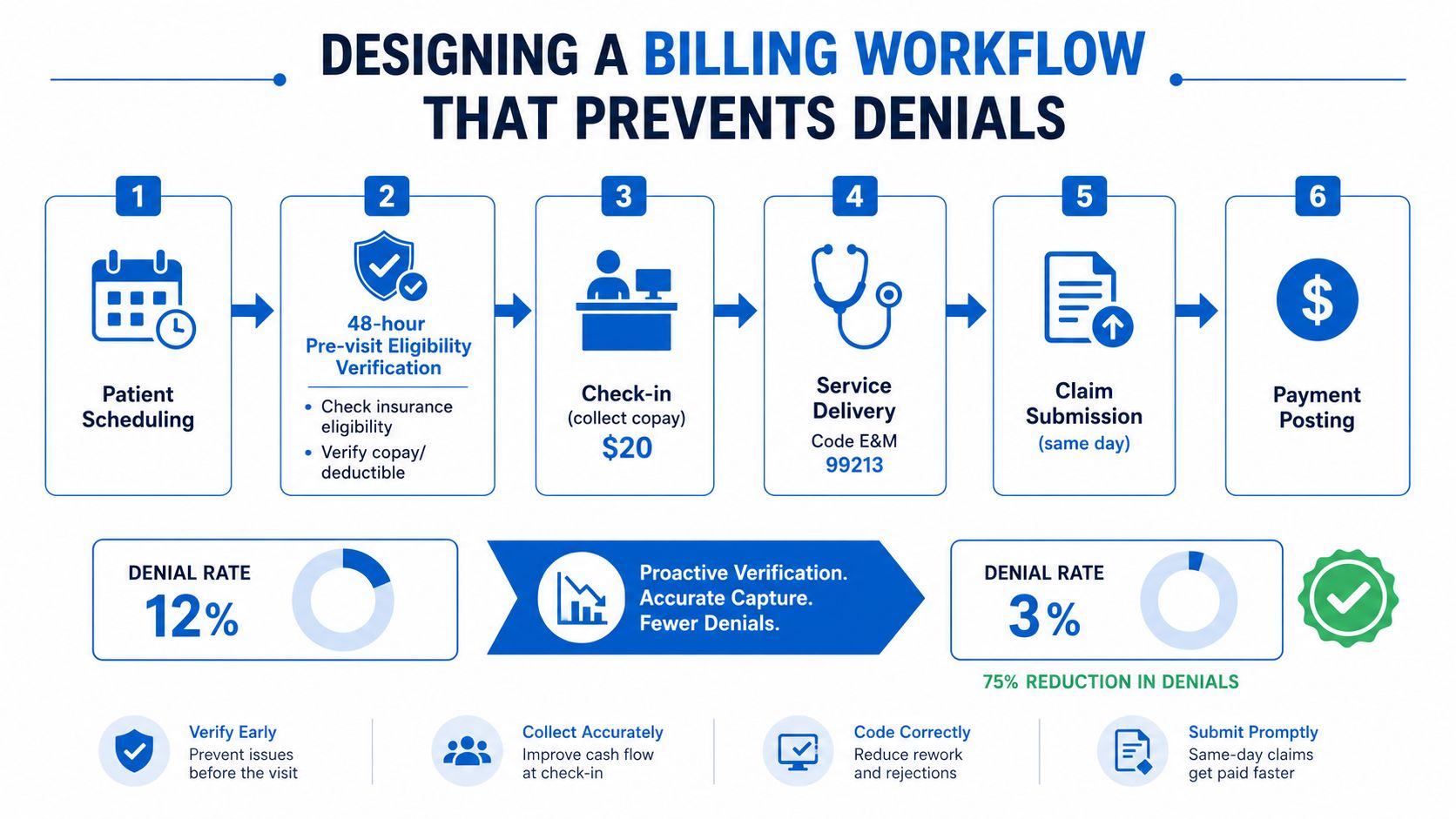
Denials are expensive because they delay cash and because they expose weak handoffs between scheduling, verification, coding, and follow-up. A billing workflow that performs well is designed to stop preventable denials before the patient ever arrives. Guidance on medical practice financial management recommends 48-hour pre-visit eligibility verification, same-day or next-day claim submission, and weekly denial review by root cause.
Verification has to happen before the visit
Eligibility checked at check-in usually arrives too late to fix the problem. If coverage changes, benefits shift, or patient responsibility comes as a surprise while the patient is already at the desk, the practice has already paid the operational cost. Pre-visit verification gives staff time to confirm coverage, estimate responsibility, and correct missing data before the encounter becomes a claim.
That work also changes what happens at the front desk. Staff can collect copays with less friction when coverage details are already confirmed, and clinicians can document with fewer surprises when known limitations are visible before the visit. The workflow feels calmer because the team is working from facts instead of guesses.
Submission speed matters because delay compounds
A claim sitting in the queue does not sit still. The longer it waits, the more likely staff are to forget details, let coding questions go stale, and stretch correction cycles. Same-day or next-day submission shortens that window and helps the practice move from documentation to reimbursement while the encounter is still fresh.
Denial review needs structure as well. Weekly review by root cause is far more useful than a generic pile of rejected claims, because it tells leadership whether the problem is eligibility, coding, documentation, or payer behavior. If the clean-claim rate slips below 90%, the issue is not isolated noise, it is a signal that the process needs redesign, not just more rework.
Practical rule: if the same denial shows up every week, stop asking staff to be more careful and ask why the workflow keeps producing the same error.
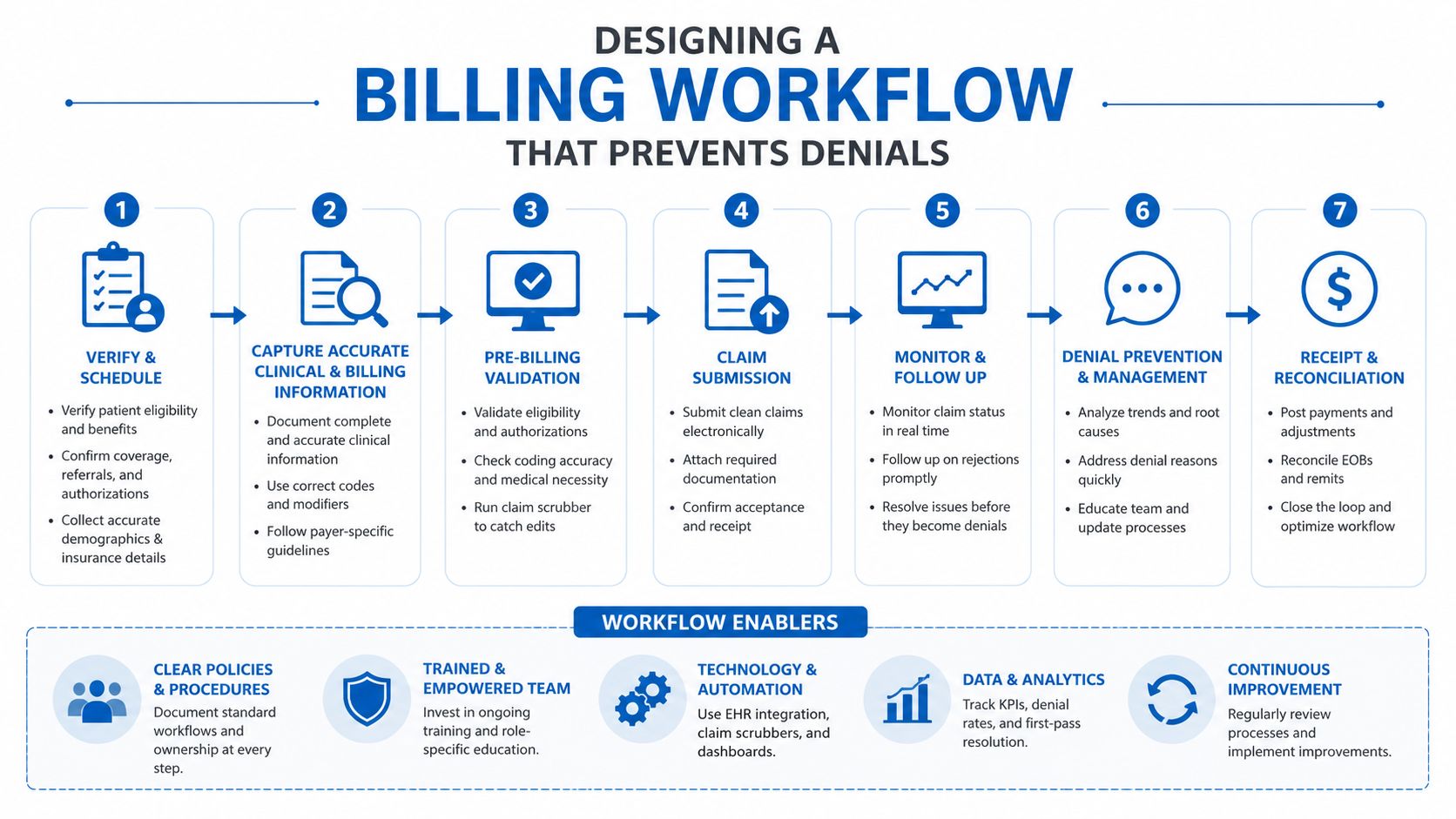
Claim adjudication is where the payer decides what gets paid, but the practice controls what gets submitted in the first place. A useful explanation of that process is outlined in claim adjudication guidance, and it helps clarify where your influence ends and the payer's begins.
Financial KPIs That Actually Predict Practice Health
A practice can have healthy-looking revenue on paper and still be run poorly. I look for a smaller set of operational KPIs that show whether care is turning into cash at a pace the organization can sustain. In medical practice financial management, the most useful benchmarks are days in accounts receivable under 35, clean claim rate of 95% or higher, denial rate under 5%, and an overhead ratio target of 60%–70% of revenue, depending on specialty.
The numbers that matter most
A clean claim rate shows whether the front end, documentation, and coding teams are working from the same playbook. A denial rate shows where the process breaks after submission. Days in accounts receivable shows how long it takes to convert work into cash, and overhead ratio shows how much of the top line is already consumed before margin appears.
A rolling 90-day cash forecast adds a different layer. Independent practice finance guidance recommends updating it weekly, using three buckets, expected cash in, committed cash out, and timing differences, while also maintaining 3–6 months of fixed-cost reserves and watching AR/AP turnover for reimbursement slippage. That distinction matters because profit and liquidity are not the same thing. A practice can look fine in the month-end reports and still run tight if collections slow down.
A simple KPI dashboard
| KPI | Target Benchmark | Warning Threshold | What It Reveals |
|---|---|---|---|
| Days in Accounts Receivable | Under 35 days | Rising above target month after month | Collection speed and cash conversion |
| Clean Claim Rate | 95% or higher | Below 90% | Whether claims are ready for first-pass payment |
| Denial Rate | Under 5% | Climbing steadily | Workflow quality and payer friction |
| Overhead Ratio | 60%–70% of revenue | Consistently above specialty target | Expense discipline and cost efficiency |
| Rolling Cash Forecast | Updated weekly | Forecast not maintained | Near-term liquidity visibility |
Use the table as a management rhythm, not a report artifact. If leadership only reviews metrics after the close, the practice is managing history instead of performance.
Net collection rate tracking also belongs on the dashboard, because gross charges tell you very little about how much earned revenue reaches the bank. The right question is not whether the team billed more. It is whether the practice collected what it was supposed to collect, on time, with less rework.
Common Financial Pitfalls and How to Fix Them Systemically
Most billing problems start with weak processes, not bad intent. The same gaps keep showing up because the practice treats each error as a one-off cleanup job and leaves the underlying workflow unchanged.
Four mistakes that keep recurring
Delayed claim submission is the most visible failure. It builds backlog, slows cash, and makes follow-up harder because the team loses momentum between the encounter and the submission step.
Eligibility failures are quieter, but they still hurt collections. If benefits are not verified early, staff end up working denials that could have been avoided, and patients get surprised at the point of service.
Undercoding works the other way. Teams sometimes do it out of audit fear, but the result is the same, revenue stays on the table because documentation was never translated into the correct level of service.
Payer contract variances are harder to spot because they can sit inside payment posting. A practice may believe it was paid correctly while underpayments keep slipping through the cracks.
Fix the system, not the symptom
When a practice sees a clean-claim rate below 90%, the response should be process redesign, not more manual cleanup (medical practice financial management guidance). The work starts by tracing the claim path from scheduling through coding, finding where the same error enters the workflow, and changing the control point that allowed it in.
The staff member touching the claim is often the last person in a chain of failures. Blaming that person does not improve the process.
Root-cause review helps separate human error from system error. If one person keeps missing the same step, training may be the fix. If several people miss the same step, the workflow is broken. Leadership needs that distinction because it determines whether the right response is coaching, automation, or redesign.
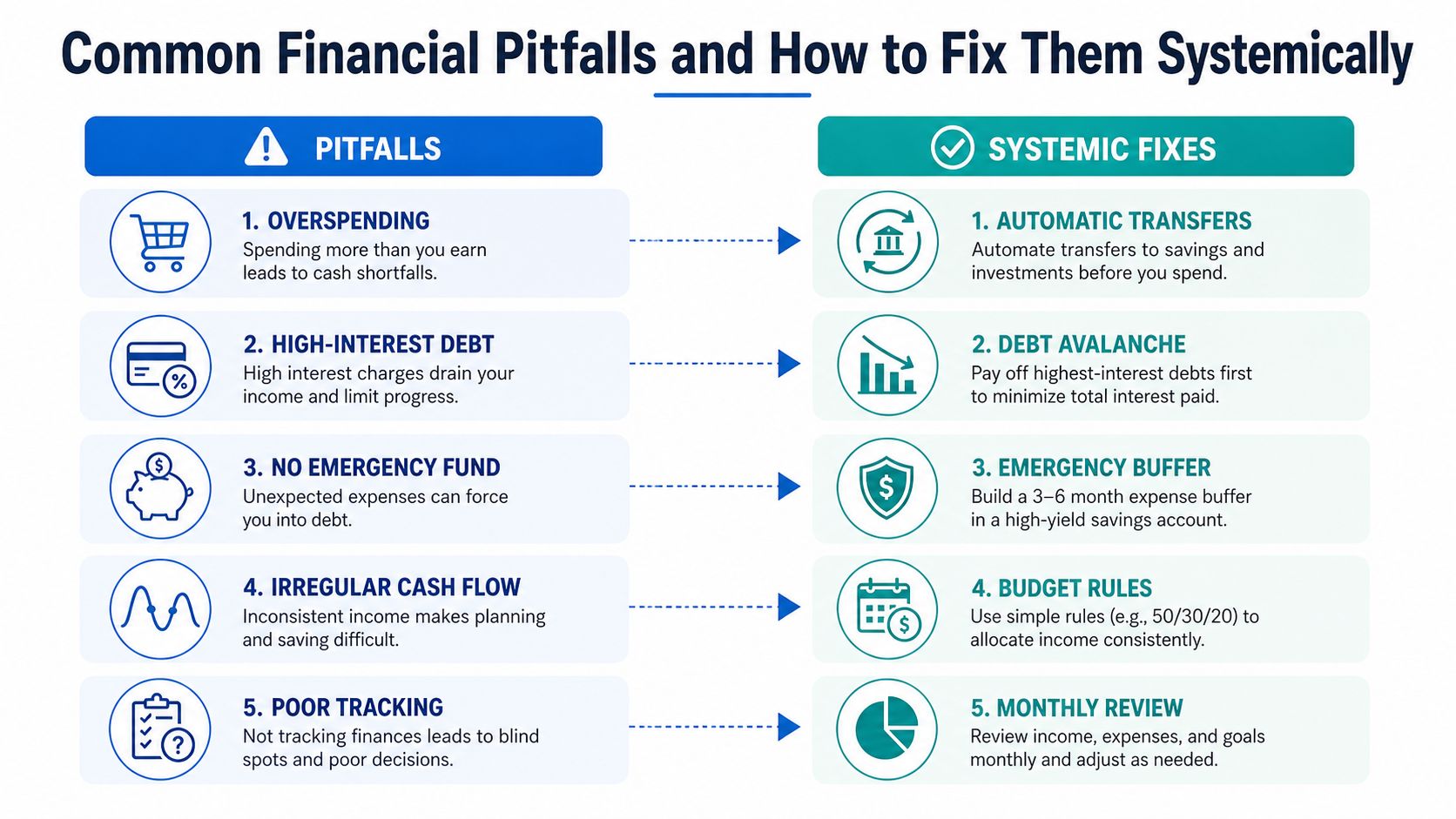
The highest-value change is usually to tighten the handoff points, not to pressure the back office harder. A more disciplined workflow reduces avoidable work for everyone, including clinicians who do not want to be pulled into billing cleanup.
Integrating RCM Into Your Leadership Strategy
Revenue cycle management too often lives as a billing function with limited executive visibility. That's a mistake. Physician leaders and CFOs need shared ownership of RCM KPIs, denial root-cause review, and unified reporting, because financial performance and clinical operations are inseparable once a patient enters the schedule. Industry discussion around this point has been blunt, arguing that RCM needs to be integrated into the CFO's world and that joint audits and shared KPI alignment belong in normal governance, not crisis management (industry discussion).
Governance changes what gets fixed
When finance and clinical leadership review the same denial trends, they stop arguing about whose department owns the problem. They start asking whether the issue came from documentation, workflow, payer rules, or configuration. That shift matters because it prevents each team from optimizing only its own corner.
Shared reporting also changes behavior. Clinicians are more likely to support documentation improvements when they can see the operational impact. Finance teams are more likely to prioritize the right fixes when they understand clinical constraints. The result is faster alignment and fewer hidden failures.
When external RCM support makes sense
Not every practice needs the same level of outside support. A full-service partner can handle fee schedule and practice management setup, insurance benefit verification, claim status follow-up, and payment posting, while an a la carte model can fill specific gaps without replacing the internal team. Clarity offers those kinds of support models, along with a complimentary revenue cycle consultation that reviews the current setup and identifies where the workflow is leaking.
The decision usually comes down to internal bandwidth, denial complexity, and growth stage. If the practice has limited billing depth, recurring payer friction, or expansion plans that will strain current processes, outside support can buy back control rather than take it away.
Choose the model that matches the gap. Outsourcing works when it fixes a known weakness. It fails when leaders use it to avoid owning the numbers.
Your 90-Day Financial Management Action Plan
A good financial turnaround plan doesn't try to solve everything at once. It builds control in layers, starting with the foundation and moving toward governance. The most useful 90-day plan is simple, visible, and owned by named people, not “the team.”
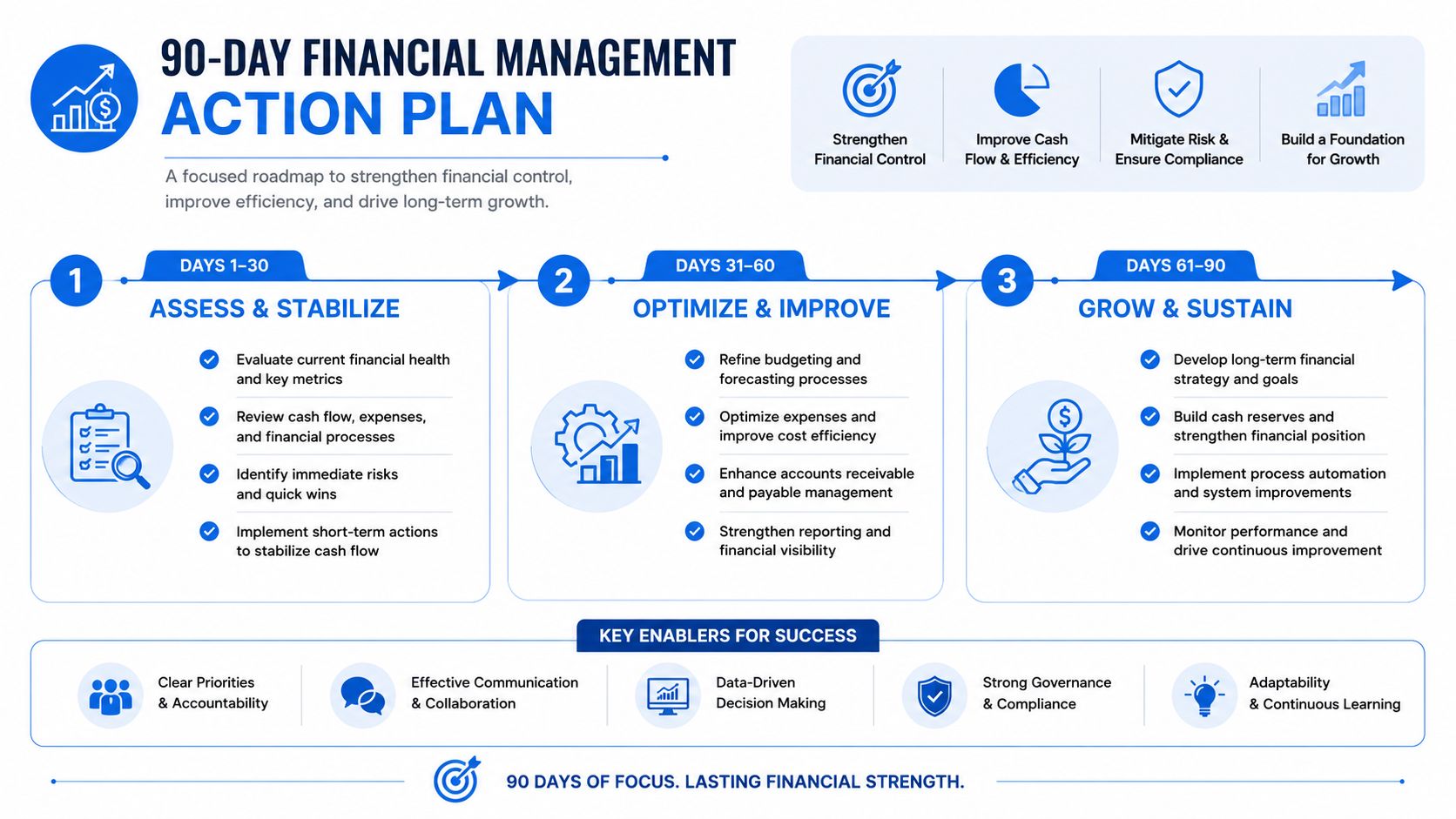
Days 1 to 30
Start with the foundation. Audit the fee schedule, validate practice management configuration, and establish baseline KPI reporting for DAR, clean claim rate, denial rate, and overhead ratio. Assign one owner for each area so accountability is visible, not implied.
Days 31 to 60
Implement the operational controls. Move eligibility verification to the 48-hour pre-visit standard, begin same-day or next-day claim submission, and hold weekly denial reviews by root cause. Build the rolling 90-day cash forecast and update it weekly so leadership sees liquidity risk before it shows up in payroll stress.
Days 61 to 90
Test the governance model. Decide whether internal staffing is enough or whether a partner should help with revenue cycle gaps, then run a revenue cycle audit and formalize clinical-financial ownership of the KPI dashboard. If the practice is still depending on heroics to keep cash moving, the process isn't stable yet.
The right success measure is not whether the team is busier. It's whether the practice is more predictable. Once leadership can see the full revenue cycle, the numbers stop feeling like a surprise and start behaving like a system.
If your practice is wrestling with denials, underpayments, or cash flow that doesn't match the schedule, Clarity can review the current revenue cycle and map the gaps in setup, verification, claim follow-up, and payment posting. Visit Clarity to start with a complimentary consultation and see where tighter revenue cycle governance could improve your financial control.
No responses yet