

Your schedule is full, patient volume looks solid, and your clinicians are working hard. Yet cash still feels tight. A/R keeps aging, staff spend too much time chasing claims, and every month ends with the same question from leadership: if demand is there, why doesn't the bank balance reflect it?
That pattern usually isn't a productivity problem. It's a revenue cycle problem. Small breakdowns at registration, eligibility, coding, claim scrubbing, follow-up, and patient billing create friction at every handoff. The result is slower collections, more rework, preventable denials, and a billing experience that can damage patient trust just as much as it damages margin.
Healthcare billing solutions matter because they turn billing from a reactive cleanup function into an operating system for financial performance. In a market that was estimated at $5.7 billion in 2023 and is projected to grow at an 11.78% CAGR from 2024 to 2030, demand is rising because providers are treating billing optimization and revenue cycle support as strategic priorities, not clerical overhead (U.S. medical billing services industry growth projection).
Table of Contents
- The Hidden Costs Draining Your Practice's Finances
- Anatomy of a Modern Healthcare Billing Solution
- The Three Critical KPIs for Revenue Cycle Health
- How Outsourced Revenue Cycle Management Services Work
- How to Evaluate and Choose the Right Billing Partner
- Real-World ROI and Avoiding Common Implementation Pitfalls
- Your Go-Live Checklist for Billing Success
The Hidden Costs Draining Your Practice's Finances
Many practices look at billing problems one symptom at a time. Denials are up. Patient collections are inconsistent. Staff overtime is climbing. Claims need rework. None of those issues live in isolation. They usually point to a revenue cycle that's leaking money in multiple places at once.
The most expensive part is that the losses often stay hidden until they become severe. A missing eligibility check at the front desk becomes a denied claim weeks later. A coding miss turns into a payer delay. A confusing patient statement sits unpaid because the balance wasn't explained clearly before the visit.
Why financial leakage is hard to spot
Leaders often focus on volume because it's easy to see. Schedules are full, procedures are performed, and claims are sent. But revenue only becomes usable cash when the practice collects it accurately and on time. That means billing performance has to be managed with the same discipline as clinical throughput.
A useful way to think about it is this. Clinical care generates value. Billing determines how much of that value the practice keeps.
Practical rule: If your staff are constantly fixing claims after submission, your billing process is acting like a repair shop instead of a production line.
Healthcare billing solutions help close those gaps by standardizing the work before money is lost. That includes better intake controls, cleaner data capture, automated claim review, tighter follow-up, and clearer patient billing. For practices dealing with old balances and under-collected claims, focused medical revenue recovery support can also help address revenue that already slipped through.
What poor billing really costs
The direct cost is obvious enough: delayed or missed reimbursement. The indirect cost is what most practices underestimate. Managers spend time on escalations. Front-desk teams field angry billing calls. Clinical staff get pulled into documentation corrections. Patients lose confidence when bills don't match expectations.
That's why modern healthcare billing solutions shouldn't be treated as software shopping alone. They're an operating decision. The right setup reduces rework, speeds cash conversion, and makes the patient financial experience more predictable. The wrong setup leaves the practice busy, frustrated, and underpaid.
Anatomy of a Modern Healthcare Billing Solution
Monday starts with a full schedule, but cash can still stall by Friday if the billing system breaks at handoff points. A missing subscriber ID at registration, an unsigned note, or a payer rule missed before submission can turn a completed visit into delayed revenue and a frustrated patient statement two weeks later.
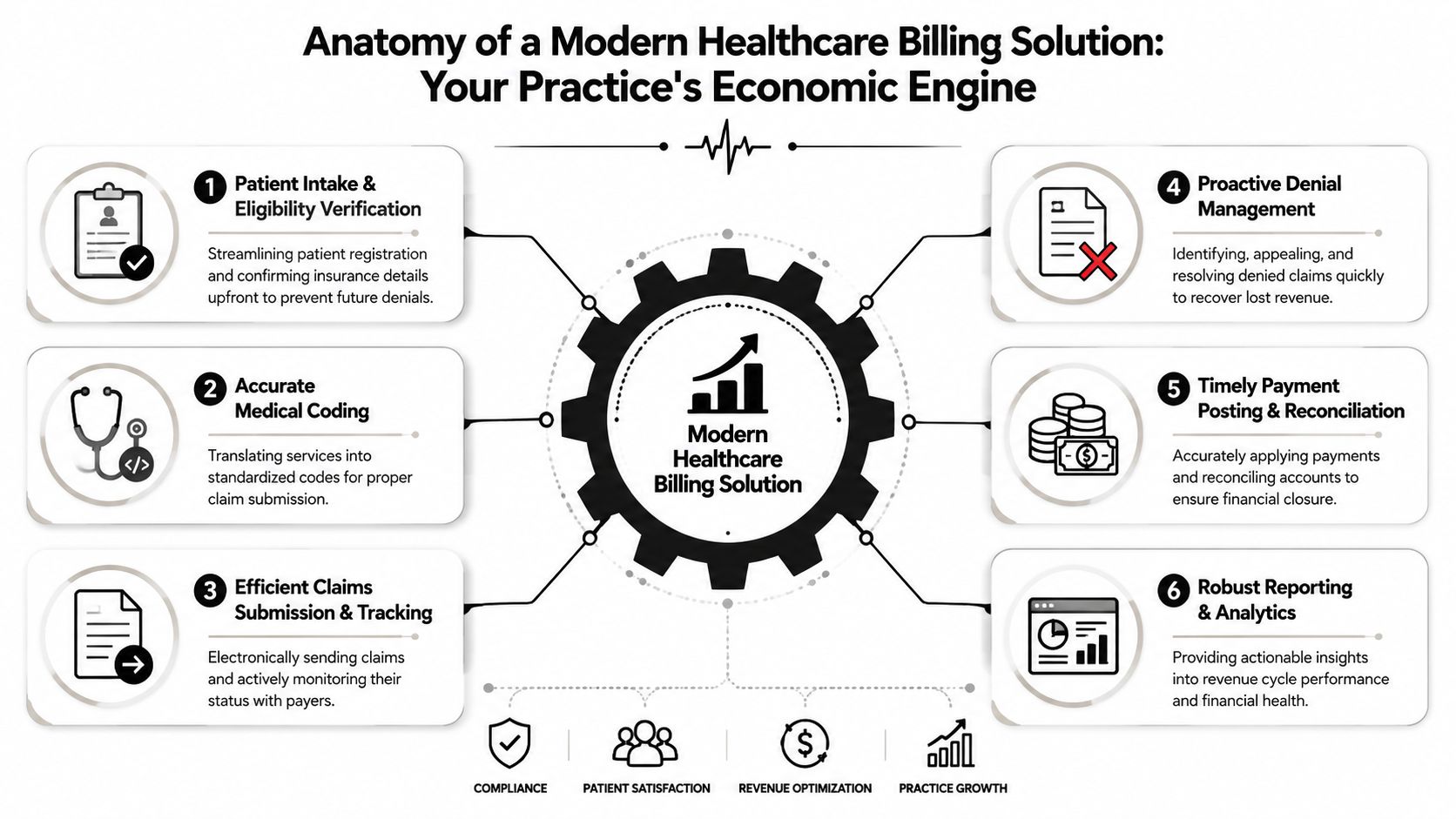
A modern healthcare billing solution works like an operating system for the revenue cycle. Each part affects the next. Weak intake creates coding problems. Weak coding limits what claim edits can catch. Slow follow-up leaves valid dollars sitting with the payer instead of in your account.
Where revenue leaks start
Revenue leakage usually begins before the claim exists. Registration, eligibility verification, benefit checks, and prior authorization determine whether the rest of the process starts with accurate information or with avoidable risk. Practices often discover the problem later, at denial or patient billing, even though the error happened at the front desk.
The strongest billing setups use one connected workflow for pre-service checks, claim edits, payment posting, and denial follow-up. That matters because disconnected systems create blind spots. Staff may correct the same issue twice, or miss it entirely because no one owns the handoff.
That front-end discipline also affects patient trust. Patients are far more likely to pay bills they understand and expect than bills that arrive after coverage errors, surprise balances, or conflicting statements.
What an integrated billing engine includes
A complete healthcare billing solution includes several working parts that need to operate as one financial process, not as isolated tasks.
Patient intake and insurance verification
Staff gather accurate demographics, confirm active coverage, and identify likely patient responsibility before the visit. These actions prevent many downstream write-offs.Coding and charge capture
Clinical documentation has to translate into billable codes quickly and correctly. Done well, coding protects reimbursement and reduces rework. Done poorly, it creates denials, compliance risk, and delays that are expensive to unwind.Claim scrubbing and submission
Claims should pass through payer and clearinghouse edits before submission. Scrubbing catches missing fields, invalid combinations, and format issues early, when fixes are faster and cheaper.Payment posting and reconciliation
Posting is not clerical cleanup. It is where underpayments, contractual variance issues, and misapplied balances become visible. Practices that want better visibility into those trends usually need stronger healthcare revenue cycle analytics, not just more reports.Denial management and appeals
Denials should be treated as a pattern to correct, not just a task queue to clear. A disciplined team separates avoidable denials from payer behavior, fixes root causes, and appeals claims that are worth pursuing.Patient billing and communication
Statements, digital payment options, financial counseling, and support channels all influence collection rates. They also shape how patients judge the practice. A confusing bill can do real damage to trust, even when the clinical experience was excellent.
A billing platform should feel like traffic control. Every claim needs direction, priority, and the right next action before it backs up the whole system.
The difference between average and high-performing billing is not who has the longest feature list. It is who can connect intake, coding, claims, payments, denials, and patient balances into one accountable workflow. That is what turns billing from a back-office task into a direct driver of cash flow, margin, and patient confidence.
The Three Critical KPIs for Revenue Cycle Health
Most practices track too many revenue cycle numbers and still miss the few that matter most. If you want a fast read on whether billing is supporting the business or slowing it down, focus on clean claim rate, denial rate, and Days in A/R.
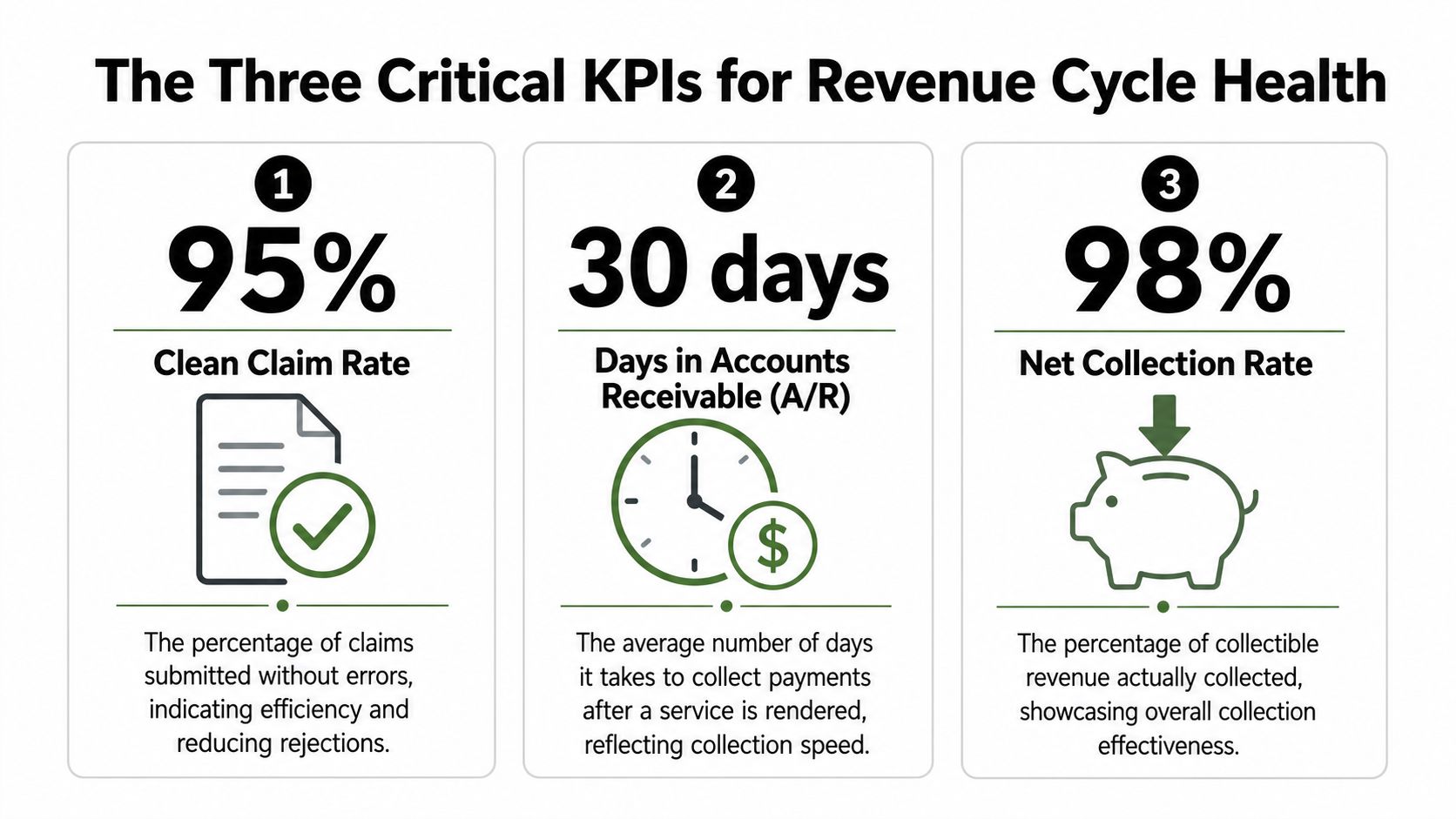
High-performing practices generally aim for a clean claim rate of at least 95%, a denial rate below 5% with best-in-class performers below 3%, and Days in A/R under 30 (revenue cycle KPI benchmarks). If leadership can't see those figures clearly, it's hard to manage billing like a financial system.
For organizations trying to turn reporting into action, dedicated healthcare revenue cycle analytics make those metrics easier to monitor consistently.
Clean claim rate
This tells you how many claims leave your system without errors significant enough to block payment. It's the clearest sign that front-end intake, coding, and claim edits are working together.
A low clean claim rate means your team is manufacturing rework. Every avoidable error costs time twice. First when the claim is submitted incorrectly, then again when someone has to fix it.
Denial rate
Denial rate measures how often payers refuse claims after submission. It's one of the sharpest indicators of process quality because it reflects breakdowns across registration, verification, authorization, coding, and billing follow-up.
Here's why it deserves executive attention. Independent industry summaries report that about 30% of insurance claims are denied on first submission, 32% of denials are tied to coding issues, and 86% of denials are potentially avoidable. The same data set notes that weak billing automation and staff training correlate with denial rates of 15% to 20%, versus a benchmark of 5% to 7%, and that poor billing practices are estimated to cost providers $125 billion annually (medical billing denial statistics).
When denial rates stay high, the problem usually isn't one employee or one payer. It's a workflow that allows bad claims to move forward too easily.
Days in A/R
Days in A/R shows how quickly the practice turns earned revenue into collected cash. This metric matters because profitability on paper doesn't pay payroll. Collected cash does.
If Days in A/R drifts upward, the cause is rarely simple. You may have clean claims but weak follow-up. You may post payments accurately but appeal denials too slowly. That's why these three KPIs should be read together, not one at a time.
A healthy billing operation doesn't just send claims. It protects velocity from intake through final payment.
How Outsourced Revenue Cycle Management Services Work
Monday morning starts with a full waiting room, two staff callouts, and a stack of payer requests sitting untouched from Friday. Care still gets delivered. Cash does not move unless someone manages the billing work with discipline. That is why outsourced RCM works when roles are clear, handoffs are tight, and accountability sits with one team that owns revenue after the visit.
The claim journey in practice
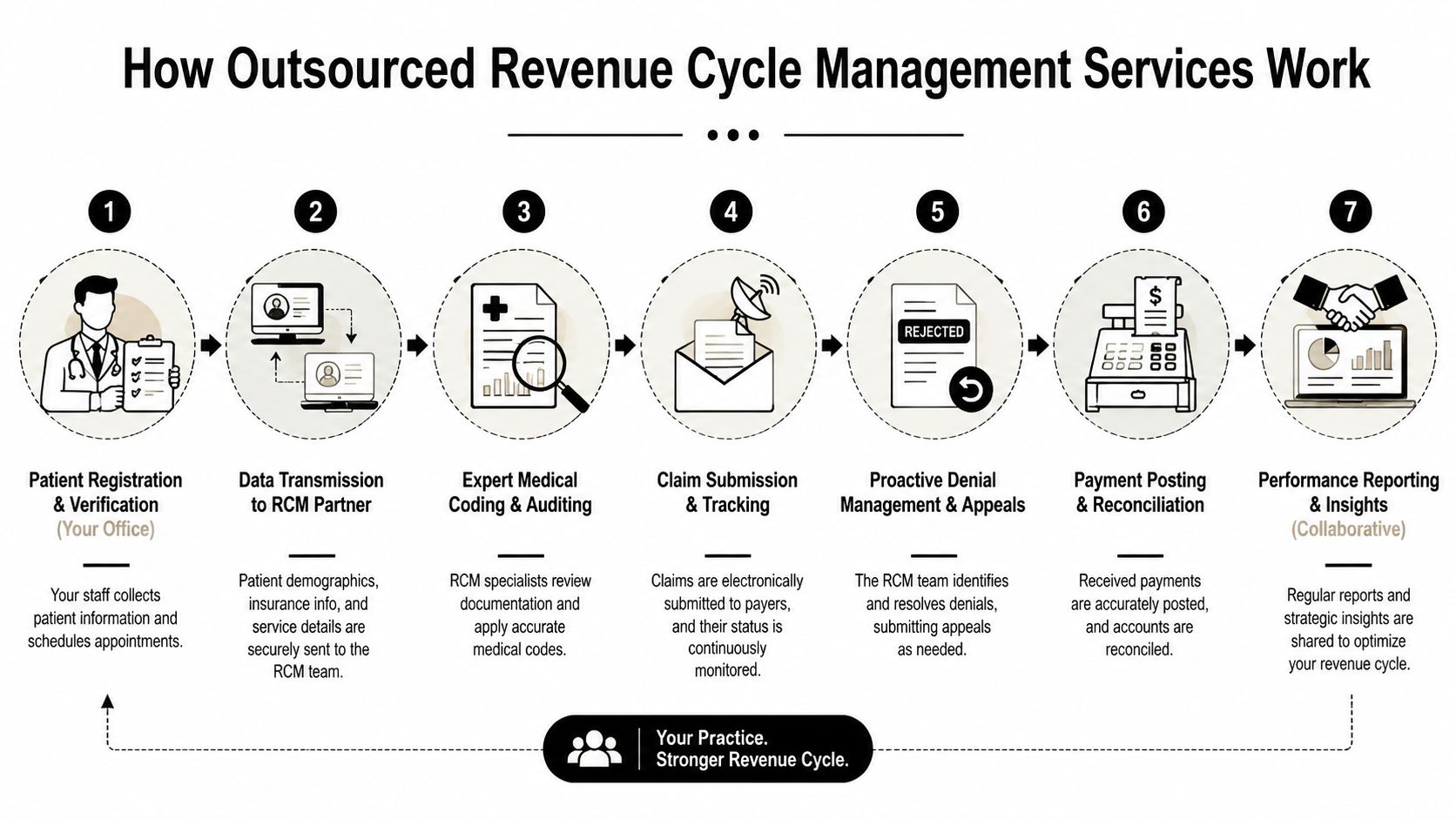
In a healthy outsourced model, the practice keeps control of patient access, clinical care, and documentation. The billing partner handles the work that determines whether those visits become cash, aging A/R, or write-offs. That division matters because billing problems rarely start at claim submission. They usually start earlier, with missing eligibility checks, incomplete documentation, or charges that sit too long before review.
A disciplined workflow usually looks like this:
Patient data enters early and gets cleaned before it spreads
Front-desk staff capture demographics, insurance details, and appointment information. The outsourced team sets intake rules, flags missing fields, and pushes corrections back fast. One bad subscriber ID can waste weeks of follow-up.Coverage and authorization checks happen before the visit
Strong vendors build pre-visit verification into the daily workflow, not as an occasional catch-up task. They confirm active coverage, identify authorization needs, and surface issues while the patient can still be contacted and the appointment can still be managed profitably.Coding and charge review happen against the record, not assumptions
The billing team reviews documentation, applies codes, checks modifiers, and holds claims with missing support. That slows a few claims down on purpose so the practice does not lose more time and money on preventable rework later.Claims are scrubbed, submitted, and tracked through payer response
Good outsourcing does not stop at claim transmission. It includes edit resolution, rejection management, status checks, denial follow-up, and appeals. A capable healthcare RCM software platform helps keep those tasks in one visible workflow instead of scattered across spreadsheets, inboxes, and payer portals.
After that setup is in place, the operating model becomes easier to see.
What the handoff should feel like
The right handoff gives leadership more visibility, not less. If outsourcing creates longer email chains, slower answers, or uncertainty about claim status, the partner is functioning like a task vendor, not an extension of the revenue cycle.
| Operational area | What your team handles | What the RCM partner handles |
|---|---|---|
| Scheduling and intake | Patient interaction, appointment setup, initial data capture | Workflow guidance for cleaner intake |
| Clinical documentation | Encounter completion and provider notes | Coding review tied to billable services |
| Claims workflow | Limited exception handling | Submission, tracking, follow-up, appeals |
| Financial visibility | Leadership review and decisions | KPI reporting, variance analysis, task execution |
Some groups outsource the full billing function. Others start with the failure points that hurt cash the most, such as eligibility, charge entry lag, denial work queues, or payment posting backlogs. A partner such as Clarity can support the full cycle or fill specific operational gaps, including benefit verification, billing operations support, claim status, payment posting, and practice management setup. That phased model often works better for practices that need results quickly without replacing every process at once.
Use one practical test. If physicians are still asking why claims are stuck, managers are still pulling updates from three different places, and patient balances still sit unresolved for weeks, the outsourced workflow is not organized well enough.
Outsourced billing should reduce administrative drag, protect patient trust through cleaner financial interactions, and give the practice a clearer path from documented care to collected revenue.
How to Evaluate and Choose the Right Billing Partner
Price matters. It just shouldn't lead the decision.
A billing partner influences cash flow, payer behavior, staff workload, and patient experience. That's closer to choosing an operating partner than buying office software. The wrong choice can leave you paying a lower fee for weaker collections, slower denial follow-up, and poor reporting. That's not savings. It's deferred loss.
What to ask before you sign
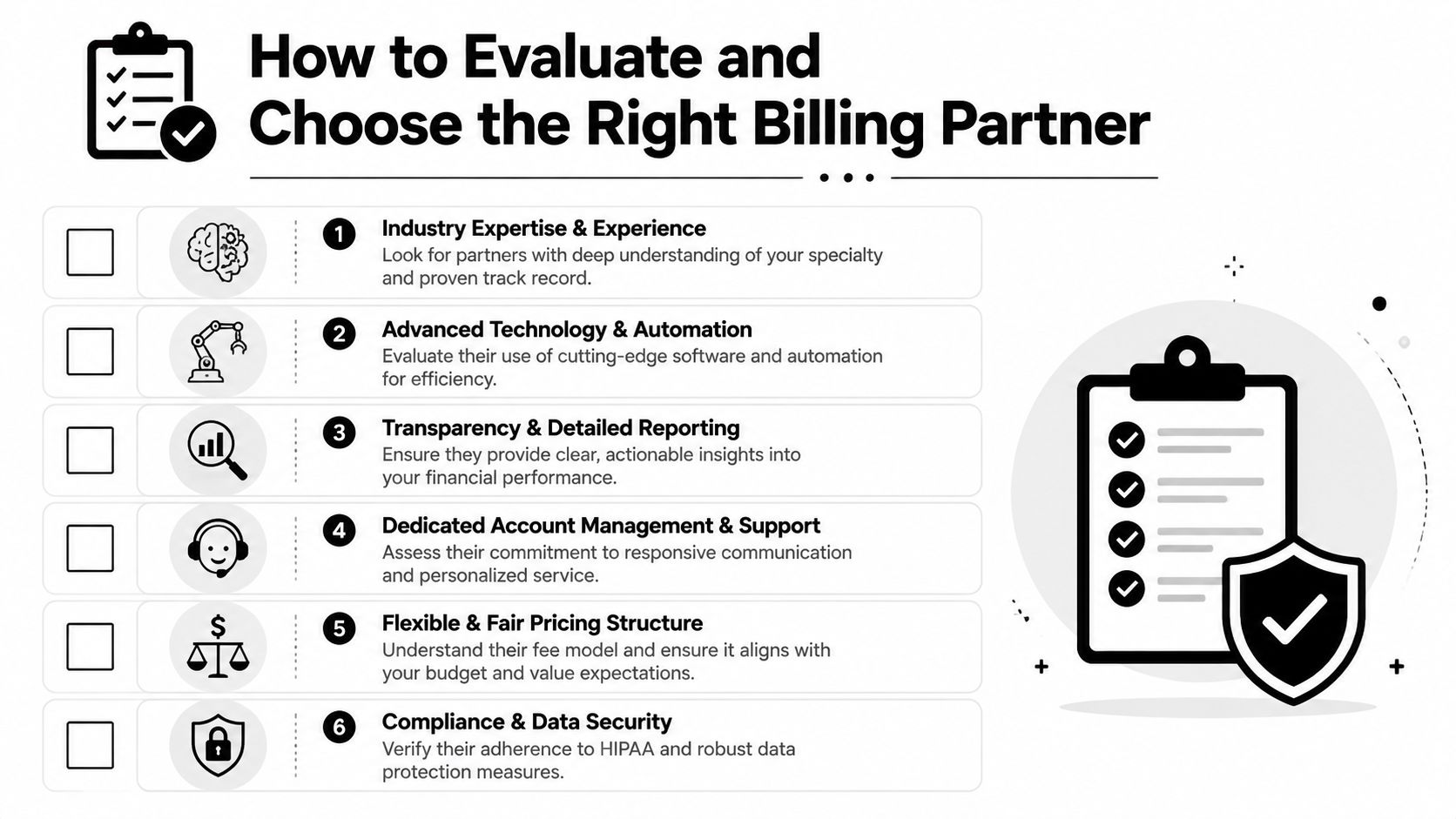
Use evaluation questions that tie directly to operating outcomes:
Specialty fit
Ask who will code and manage your claims, and how familiar they are with your payer mix, documentation habits, and denial patterns.Reporting quality
You should be able to see actionable performance data, not just month-end summaries. If a partner can't show trends clearly, they'll struggle to improve them consistently. A platform with strong healthcare RCM software should support visibility, workflow control, and consistent follow-up.Workflow design
Ask how eligibility, claim edits, denial queues, and patient balances are managed. You want one coherent process, not disconnected tasks.Support model
Find out who responds when claims stall, payers push back, or your front desk needs answers quickly.Scalability
A partner should handle volume changes, provider additions, and payer complexity without requiring you to rebuild the process every quarter.
Why cheap often gets expensive
Industry coverage warns that lower-cost billing services can come with reduced customer support, which can undermine denial resolution and follow-up speed. The more useful question for leadership is whether the solution improves measurable revenue outcomes, not whether it looks cheaper on paper (hidden costs of economical billing services).
That trade-off shows up in small ways first. Slower responses to payer issues. More unresolved denials. Less guidance for front-end staff. Fewer insights on why cash is lagging. Over time, those “small” misses produce larger financial drag than the original discount ever justified.
A low fee only helps if the partner preserves revenue. If support is thin and follow-up is weak, the practice ends up funding the gap internally.
Choose the team that can explain its process, show its reporting, and own performance with you. In healthcare billing solutions, competence is usually cheaper than correction.
Real-World ROI and Avoiding Common Implementation Pitfalls
A practice can add visits, hire another provider, and still feel cash pressure if billing performance stays weak. I have seen groups blame volume, payer mix, or staffing when the actual problem was a claims process that leaked money at every handoff. Billing ROI shows up when those leaks are closed and patients get a clearer, more predictable financial experience.
The financial return rarely comes from one headline improvement. It comes from a series of operational fixes that protect revenue already earned. Claims go out cleaner. Follow-up starts sooner. Patient balances are explained before they become complaints. Leadership gets enough visibility to act before a cash issue turns into a month-end surprise.
Where the return actually comes from
The strongest gains usually come from four places.
Lower labor waste
Staff spend less time correcting preventable errors, resubmitting claims, and chasing information that should have been captured up front.Faster cash movement
Shorter delays between date of service and payment improve liquidity, make payroll planning easier, and reduce the need to manage around cash gaps.Clearer operational accountability
Leaders can trace whether revenue problems begin with scheduling, registration, coding, claim submission, or follow-up.Better patient trust
Patients are more likely to pay when statements are understandable, estimates are discussed earlier, and questions get answered before accounts age out.
That last point gets underestimated. A confusing bill does not just slow collections. It also damages confidence in the practice. From the patient's perspective, clinical care and the financial experience are part of the same relationship.
A practical ROI review should look beyond collection totals. Review rework volume, days to bill, denial trends by root cause, patient call volume tied to statements, and the speed of first follow-up on unpaid claims. Those measures show whether the new solution is fixing the process or merely making reports look cleaner.
Mistakes that weaken rollout
Implementations usually struggle because the practice treats billing as a software install instead of an operating change. The tool matters. The handoffs, decisions, and ownership matter more.
Common pitfalls include:
Unclear success measures
If leadership has not defined target performance, every review becomes opinion-driven. Set the few numbers that determine whether revenue cycle health is improving.Weak intake retraining
Registration errors, missing authorizations, and outdated insurance details still create downstream denials even with better billing technology in place.Poor data cleanup before transition
Dirty payer tables, inconsistent balance buckets, and incomplete account notes create noise immediately and make early performance hard to judge.Ignoring patient protections and affordability rules
Billing workflows need to account for current patient billing requirements, especially around surprise billing protections and clear cost-sharing communication. CMS outlines the federal requirements under the No Surprises Act.Overlooking internal governance
A vendor cannot make policy decisions for the practice. Someone in-house needs authority to resolve exceptions, approve workflow changes, and review performance on a set cadence.
One more mistake deserves attention. Practices often expect instant savings in month one, then lose confidence when old A/R and legacy denials continue to distort results. A fair ROI window usually includes both stabilization and cleanup. New claims may improve quickly while older accounts still need months of disciplined follow-up.
The best implementations are measured, not rushed. They protect cash during transition, give staff clear responsibilities, and treat patient communication as part of revenue cycle performance rather than an afterthought.
A billing solution earns its keep when it improves collections, reduces avoidable work, and makes the financial experience easier for patients to trust.
Your Go-Live Checklist for Billing Success
A good billing transition starts before the first claim goes out. Practices that launch cleanly usually decide early who owns the relationship, what the reporting cadence will be, and which front-end workflow changes are essential.
What to lock down before launch
Use this checklist before go-live:
Name one internal owner
Choose a single point person who can resolve questions quickly and keep decisions moving.Map the data handoff
Confirm how demographics, insurance details, charges, payments, and account notes will move between systems and teams.Define your KPI dashboard
Keep it focused. Leadership should know exactly which measures will be reviewed every month and what counts as acceptable performance.Retrain the front desk
Eligibility capture, insurance updates, copay collection, and estimate conversations all affect billing quality.Set escalation rules
Decide who handles payer disputes, documentation gaps, patient complaints, and unresolved denial patterns.
The cleanest billing go-lives happen when the practice treats intake, coding, and patient communication as one workflow instead of separate departments.
What leadership should review in the first 90 days
The first quarter matters because it reveals whether the new process is stabilizing or just moving work around. Review trend lines, not anecdotes. If staff say things feel better but cash is still lagging, leadership needs to ask where friction remains.
A practical first-90-day review should look at three things: whether front-end errors are dropping, whether claims are moving faster, and whether patients are getting clearer financial communication. That combination tells you whether the solution is improving both margin and trust.
Don't wait for year-end to judge the change. Billing performance needs early inspection, quick correction, and visible accountability.
If your practice needs a clearer picture of where revenue is leaking, Clarity offers a complimentary consultation to review your current revenue cycle and identify practical options for improving efficiency, accuracy, and profitability.
No responses yet