

You're likely in the same position many healthcare executives hit sooner or later. A patient needs structured outpatient behavioral health or substance-use support, your team can't absorb the referral internally, and the question becomes simple, who can handle intake, payer complexity, and follow-through without creating more work for your staff?
Recovery Consultants of Atlanta is worth a close look for exactly that reason. It's not just another community name in the Atlanta market. It's a long-running nonprofit provider with a defined quality stamp, a mixed service model, and enough operational complexity that any CEO, CFO, or clinical leader should evaluate it like a business partner, not a brochure.
Table of Contents
- The Search for a Behavioral Health Partner in Atlanta
- The Core Identity of Recovery Consultants of Atlanta
- Breaking Down the Integrated Service Model
- Operational Realities of the Mixed Payer Model
- Comparing Specialized Care and Full-Service Revenue Cycle Management
- Red Flags and Operational Ambiguities to Investigate
- Your Due Diligence Checklist for Evaluating Recovery Consultants of Atlanta
The Search for a Behavioral Health Partner in Atlanta
A hospital discharge planner in Atlanta gets the call at 4:45 p.m. The patient needs substance-use follow-up, mental health support, and a place that can absorb a referral without bouncing the case back for missing paperwork. That's the moment the search stops being theoretical and becomes operational.
In that setting, Recovery Consultants of Atlanta comes up because it sits inside a category that executives trust more than a generic outpatient referral. It has been operating since 1999, and public nonprofit records show it has been tax-exempt since June 2000, which gives it more than 25 years of operating history as of 2026 (ProPublica nonprofit record). That longevity matters because behavioral health referral relationships fail fast when the provider on the other end can't handle volume, coordination, or payer friction.
Practical rule: if a behavioral health partner can't clearly explain intake, coverage, and location workflow, your staff ends up doing that work for them.
The executive question is not whether the organization sounds mission-driven. It's whether it can fit into your discharge, referral, and reimbursement reality. A strong community provider should reduce leakage, not create it. If the partner is going to touch Medicaid, Medicare, military coverage, and sliding-fee patients, then your team needs a provider that understands administrative discipline, not just counseling language.
That is why this profile matters. Recovery Consultants of Atlanta deserves evaluation as an operational asset in the Atlanta behavioral health space, not as a feel-good nonprofit story. If the fit is good, it can strengthen your referral network and close care gaps. If the fit is weak, it will slow down care and consume staff time you can't get back.
The Core Identity of Recovery Consultants of Atlanta
The first thing to establish is legal and operational baseline. Recovery Consultants of Atlanta, Inc. is a private nonprofit 501(c)(3) organization founded in 1999 (Recovery Consultants of Atlanta). Public nonprofit records also show tax-exempt status beginning in June 2000, which confirms this is an established entity rather than a newly assembled service brand (ProPublica nonprofit record).
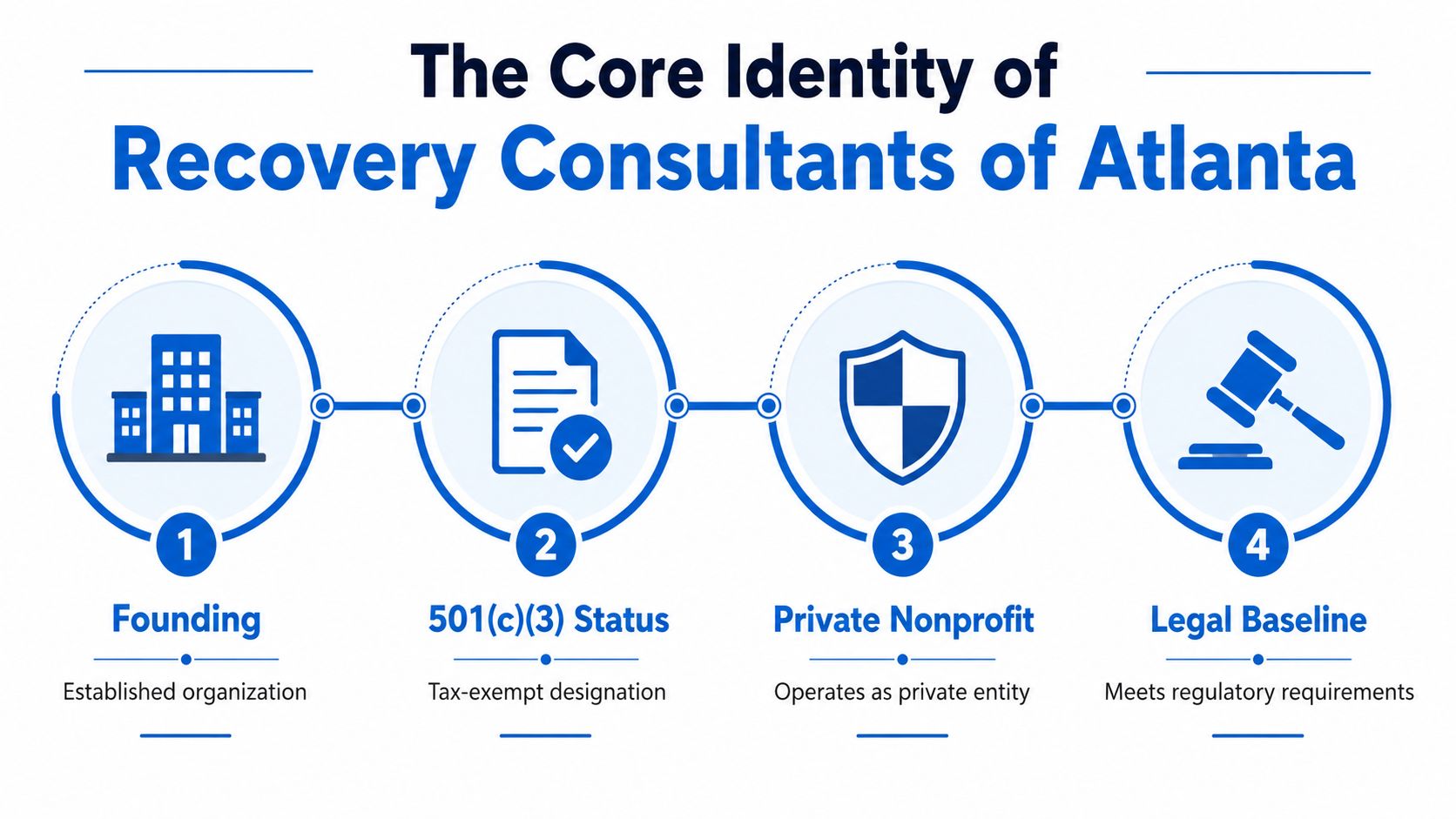
What matters to a CEO or CFO is not just the tax status. It's the combination of history, nonprofit structure, and external accreditation. Independent directory data reports revenue of $3,396,163 in 2021 and about 34 employees, which points to a mid-sized operation with enough structure to manage programs and enough scale to need process discipline (GiveFreely nonprofit directory). That is a different risk profile from a small counseling office.
Why the accreditation matters
The organization is also CARF-accredited, with first accreditation in 2012 (GiveFreely nonprofit directory; Recovery Consultants of Atlanta). In plain English, that means there has been external quality recognition tied to behavioral health and recovery services, and that's a meaningful signal for any executive evaluating compliance-minded care delivery. Accreditation does not replace due diligence, but it does tell you the provider has operated under a formal quality framework.
The geographic footprint also matters. Public nonprofit and directory records identify RCA as a Decatur, Georgia organization serving DeKalb County, with facilities in the Decatur and Tucker areas (Recovery Consultants of Atlanta; Psychology Today directory record). That footprint is useful if you want local access, but it also means your intake team needs clarity on which site handles which services.
Don't confuse longevity with readiness. A provider can be established and still leave referral partners guessing about access, scheduling, and program routing.
If you're screening partners, this is the baseline. Nonprofit, 501(c)(3), CARF-accredited, long operating history, and a defined local footprint. Those facts make Recovery Consultants of Atlanta credible enough to investigate further. They do not, by themselves, prove operational fit.
Breaking Down the Integrated Service Model
The service mix is what separates RCA from a narrow outpatient counseling shop. Its programs include outpatient, intensive outpatient, and regular outpatient substance-use treatment, plus integrated HIV, HEP C, primary care, and mental health services (NHCHC grantee directory). That combination tells you the organization is built for more than symptom management.
Why integration changes the referral math
In a fragmented model, a patient gets sent from one place to another, and each handoff adds friction. In an integrated model, the provider is trying to keep more of the care pathway under one umbrella. For an executive, that matters because every extra handoff increases the chance of missed appointments, duplicate paperwork, and delayed follow-up.
RCA's structure also fits the needs of populations where behavioral health, infectious disease follow-up, and primary care overlap. That matters in real operations because a patient with substance-use needs may also need chronic medical attention, medication reconciliation, and mental health support. If a provider can coordinate those touchpoints internally, your referral partner isn't forced to stitch together a care plan from disconnected offices.
The key point is not that integration is fashionable. It's that integrated service delivery reduces the burden on the patient and on your referring staff when it works correctly. That's a competitive advantage in a city where behavioral health access is still constrained, and it's especially important when the public content hints at a broad support model but doesn't spell out the mechanics.
Operational insight: integrated care only helps if the provider can route patients cleanly between programs without turning the intake desk into a bottleneck.
That's also why Recovery Consultants of Atlanta should be viewed as a hybrid recovery organization, not just a counseling vendor. The moment a provider is managing mental health alongside primary care and infectious disease-related services, your expectations should shift. You're not just asking who provides therapy. You're asking how care coordination happens, who owns follow-up, and how the organization avoids leakage between programs.
For partner organizations, that integrated model can be valuable. For your staff, it should be tested. Ask how a patient moves from referral to first visit, then from initial visit to ongoing support. If the answer is fuzzy, the model is less integrated in practice than it looks on paper.
Operational Realities of the Mixed Payer Model
The payer mix is where many nonprofit providers become operationally complicated fast. RCA accepts Medicare, Medicaid, military insurance, and other public and private coverage, and it also uses payment assistance and sliding-fee-scale models (NHCHC grantee directory). That is good for access. It is also a warning sign for administrative workload.
Why mixed coverage increases the burden
A mixed payer book means your front desk, eligibility team, and billing staff have to work different rules at the same time. One patient may need benefits verification, another may require authorization, and another may need a sliding-fee determination before care starts. If those tasks are handled casually, denials and delays follow.
That's not speculation. It's simple revenue-cycle logic. Public and private coverage together create more touchpoints, more exceptions, and more room for human error than a single payment model. For a CFO, that means the organization's access process is just as important as its clinical philosophy.
The same is true for referral partners. If your team sends patients into an environment with mixed coverage rules, you need to know who is coordinating the insurance side. Otherwise, the clinical referral succeeds and the financial clearance fails. That creates bad patient experiences and unnecessary back-and-forth for your staff.
A provider serving multiple payer types needs a tighter front-end process, not a looser one.
Recovery Consultants of Atlanta raises an important operational question for executives. Does the organization have strong enough verification and authorization workflows to support its access model, or does it rely on patients and referring teams to sort out the details? The public facts show a broad payer mix, but they do not show the internal mechanics.
That distinction matters because nonprofits often get judged only on mission and service breadth. In practice, broad access only works when the administrative process is disciplined. If you're a hospital leader, that means you should ask for proof of how eligibility is verified, how coverage exceptions are handled, and how financial counseling works before you route volume there.
Comparing Specialized Care and Full-Service Revenue Cycle Management
RCA is a clinical and community-based behavioral health provider. A full-service revenue cycle management partner does something different. It handles the back office, including fee schedule setup, billing operations support, insurance benefit verification, and payment posting, so clinical teams can focus on care delivery. That is the line executives need to draw clearly.
Two different jobs, two different success metrics
If you need behavioral health treatment capacity, RCA is the kind of partner you evaluate for service access and care integration. If you need administrative control, a revenue cycle partner is the tool that reduces friction behind the scenes. Those are complementary roles, but they are not interchangeable.
A provider like Recovery Consultants of Atlanta is judged on whether patients get connected to the right level of outpatient or intensive outpatient care, and whether integrated services are usable in practice. A revenue cycle management partner is judged on whether claims move, benefits are verified, payments are posted, and denials are managed with discipline. One serves the patient directly. The other protects the financial engine that supports the patient-facing work.
That is why executives should not ask a behavioral health provider to behave like a back-office billing department. It usually goes badly. If your organization needs help on the financial side, use a dedicated revenue cycle partner and keep the clinical relationship separate. For example, Clarity's medical billing services are positioned for billing and practice management support, which is a different job from delivering care.
What a clean division of labor looks like
A healthy partnership usually looks like this.
- Clinical provider: handles intake, treatment planning, and follow-up.
- Revenue cycle partner: handles coverage checks, claim flow, payment posting, and billing operations.
- Referring organization: sends clean referrals and tracks outcomes that matter internally.
That separation is especially useful when the provider serves mixed payer types, as RCA does. The more coverage variation you have, the more important it is to separate service delivery from financial operations. Otherwise, clinical staff get pulled into administrative work they were never meant to own.
Bottom line: choose the behavioral health partner for clinical fit, and choose the RCM partner for financial control.
That boundary is the right way to think about Recovery Consultants of Atlanta in an executive review. It may be a strong care partner. It is not a substitute for structured revenue cycle management, and you should not treat it like one.
Red Flags and Operational Ambiguities to Investigate
Accreditation does not eliminate operational ambiguity. RCA's public-facing presence still leaves important questions unanswered. The available pages list multiple addresses, multiple phone numbers, and varying labels for services, including references to Decatur and Tucker locations, as well as outpatient treatment versus integrated primary care (Psychology Today directory record). That's not a fatal issue, but it is a due diligence issue.

What the public content does not resolve
The core gap is access clarity. The public content does not clearly explain which location handles which services, whether walk-ins are accepted, or how the referral and appointment flow differs by program (Psychology Today directory record). For a referral source, that ambiguity turns into wasted calls and slow handoffs.
That is exactly the sort of issue CFOs and CEOs should press on early. A provider can be accredited and still be difficult to manage. In fact, organizations with broad service models often need to be more transparent, not less, because patients and partner organizations need a clean path through the system.
The second issue is service-label drift. When one public-facing source uses multiple descriptions, it becomes harder to tell whether the organization has one integrated intake process or separate workflows by site and service line. That affects how you build referral protocols internally. If your staff can't tell where to send a patient, the relationship is already costing time.
You should also treat appointment flow as a serious question, not an afterthought. A provider can advertise access and still require structured scheduling that doesn't match your discharge timeline. If your organization works with time-sensitive referrals, you need to know that before you send the first patient.
If the public-facing map is muddy, don't assume the internal workflow is clearer. Verify it.
For context on the billing side, referral chaos often becomes claim chaos later. That's why executives evaluating behavioral health partners should also understand how denials can arise when the intake process is unclear. A practical billing resource on this issue is behavioral health CPT billing denials, because access problems and claim problems often come from the same front-end confusion.
Your Due Diligence Checklist for Evaluating Recovery Consultants of Atlanta
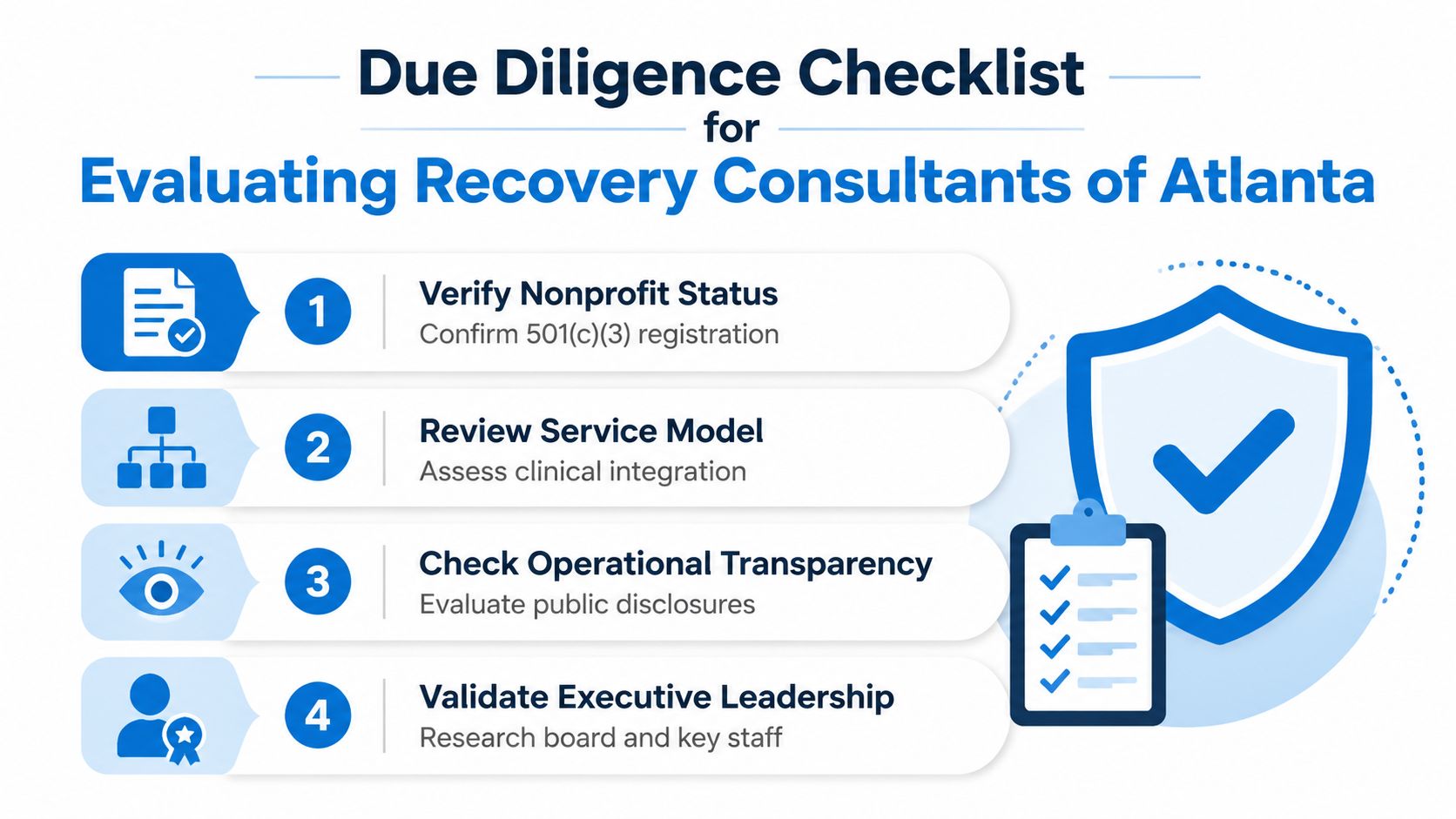
Use a real checklist, not a gut feeling. A provider like Recovery Consultants of Atlanta can be a strong partner, but only if its service flow matches your operational needs.
Questions to ask before you refer volume
-
Verify nonprofit status. Confirm the organization's 501(c)(3) standing, founding history, and tax-exempt baseline. That gives you the legal and governance frame before you discuss care.
-
Review the service model. Ask which site handles outpatient, intensive outpatient, mental health, and integrated medical services. You need a clean answer, not a general statement about what the organization offers.
-
Check operational transparency. Ask whether walk-ins are accepted, how appointments are scheduled, and how a patient moves from referral to first contact. If they can't explain the flow clearly, your staff will carry that burden.
-
Validate payer handling. Confirm how they verify Medicare, Medicaid, military insurance, and other coverage types, and how payment assistance or sliding-fee decisions are made. That's where many partnerships break down.
Those four checks are enough to expose whether the relationship is clinically useful and administratively manageable. They also help you separate real capability from public messaging. You should never assume that a long-established nonprofit automatically has a clean referral engine.
Use this test: if your team can't explain the patient pathway after one call, the partner isn't ready for volume.
For executives who want to compare the care relationship with the financial side of the house, a plain explanation of the billing framework lives in what revenue cycle management is. That's useful context because the best referral relationships still depend on clean administrative execution.
If you're evaluating Recovery Consultants of Atlanta as a behavioral health partner, treat it like a serious vendor review. Ask direct questions, demand operational clarity, and make sure the referral path fits your care model before you move a single patient.
If your team needs a clearer way to connect behavioral health referrals with billing discipline, talk to Clarity. We help providers tighten insurance verification, billing operations, and payment workflows so clinical partners can stay focused on care. Reach out for a practical revenue cycle review if you want a cleaner path from referral to reimbursement.
No responses yet