
Revenue Cycle Management is the financial operating system that carries a patient account from scheduling through final payment, tying together clinical, administrative, and billing data so the organization gets paid for the care it delivers. It matters enough that the global RCM market reached US$65.49 billion in 2025 and is projected to reach US$117.50 billion by 2030, reflecting how central the function has become to healthcare financial stability.
A new hospital CEO usually hears "RCM" and thinks billing office. That's too small. Billing is one output of the system. Revenue cycle management is the control structure around cash flow, reimbursement accuracy, denial prevention, patient financial communication, and operational accountability.
When RCM is weak, the symptoms don't stay in finance. Service lines hesitate to grow, staffing plans get tighter, physicians get frustrated with documentation demands, and patient collections become harder because trust erodes early. When RCM is strong, leadership gets something more valuable than timely claims. It gets visibility into where money is leaking, where workflows are breaking, and which operational habits are helping or hurting margin.
Table of Contents
- Why RCM Is More Than Just Billing
- The 7 Stages of the Healthcare Revenue Cycle
- Key RCM Metrics and Common Failure Points
- In-House vs Outsourced RCM A Strategic Decision
- Practical Steps to Optimize Your Revenue Cycle
- Seeing RCM in Action Real-World Scenarios
- Your Next Step Toward Financial Health
Why RCM Is More Than Just Billing
The simplest answer to what is revenue cycle management is this: it's the end-to-end financial process that turns care delivery into collectible revenue. That includes scheduling, registration, eligibility, documentation, coding, claim submission, payment posting, denial follow-up, and patient balance resolution.
The mistake many executive teams make is treating that chain like a clerical function. It isn't. It is a strategic control point for margin. If leadership only looks at RCM after claims are denied or cash slows down, the organization is already managing from the back foot.
The scale of investment in this category tells you how the market sees it. The global RCM market reached US$65.49 billion in 2025 and is projected to grow at a 12.4% CAGR from 2024 to 2030, reaching US$117.50 billion according to MarketsandMarkets' revenue cycle management market forecast. That growth doesn't happen because providers want prettier billing reports. It happens because financial viability now depends on disciplined revenue operations.
RCM touches strategy, not just transactions
A healthy revenue cycle does three things at once:
- Protects cash flow: It reduces preventable delays between service delivery and reimbursement.
- Improves operating decisions: It shows where registration, documentation, coding, or payer follow-up is breaking down.
- Supports growth: It gives leaders confidence that added volume will translate into actual collected revenue.
Practical rule: If your leadership team only reviews RCM after month-end, you're using a strategic asset like a cleanup tool.
What strong organizations do differently
The strongest operators don't ask only, "How do we fix denials?" They ask better questions.
| Leadership question | What it really tests |
|---|---|
| Are we collecting what we should? | Revenue integrity |
| Where are claims getting stuck? | Workflow design |
| Which payer issues repeat? | Contract and process discipline |
| Are patients clear on what they owe? | Front-end communication quality |
This establishes the framework. RCM isn't just about sending claims out the door. It's about controlling the conditions that determine whether reimbursement comes back accurately, quickly, and in full.
The 7 Stages of the Healthcare Revenue Cycle
The easiest way to understand revenue cycle management is to see it as a financial supply chain. Every step hands data to the next one. If the first handoff is wrong, downstream work gets slower, more expensive, and less reliable.
Early in the cycle, the operational picture looks like this:
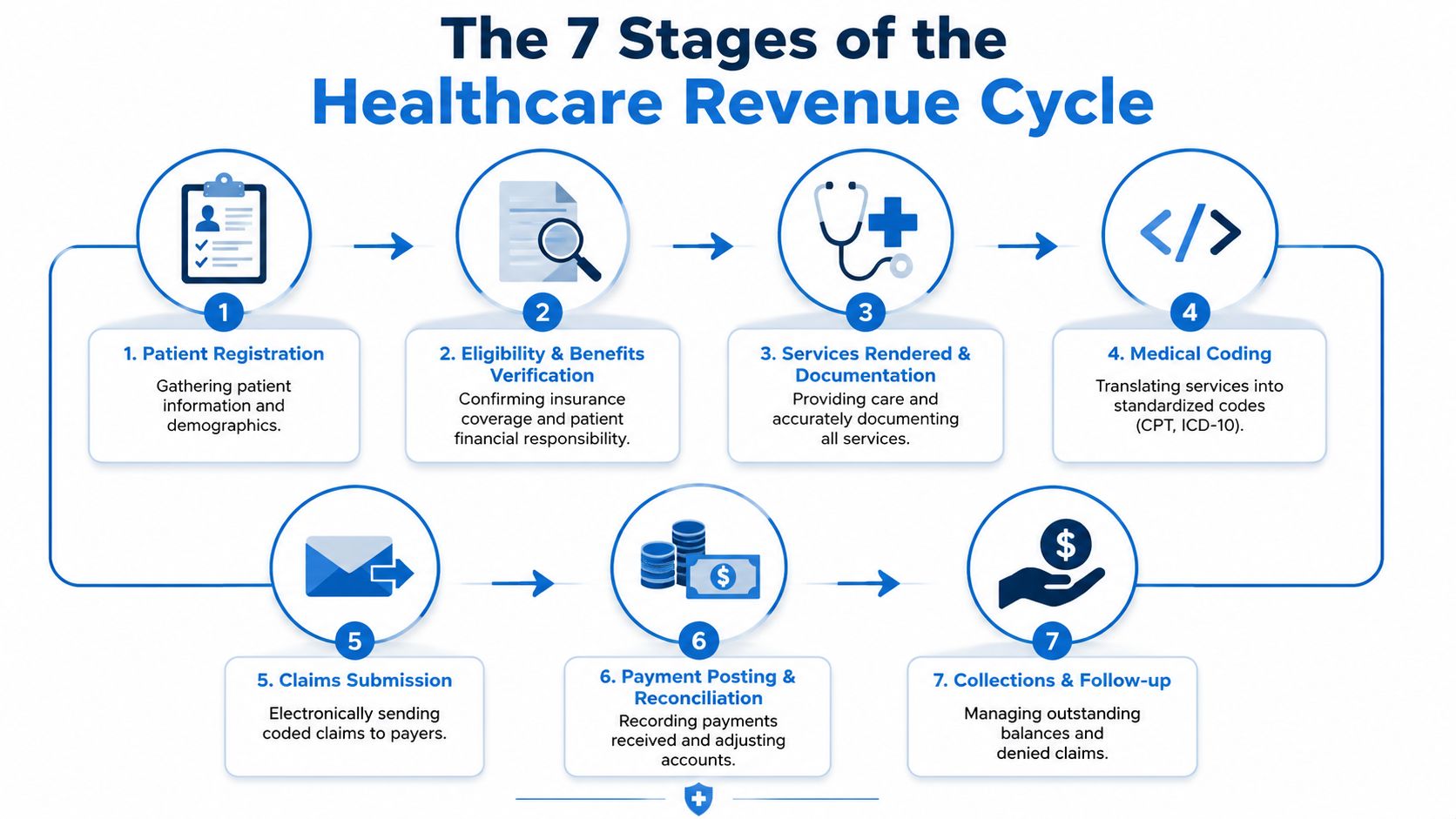
Think of RCM as a financial supply chain
Patient Registration
The account starts here. Staff collect demographics, payer information, and the details that will follow the encounter through the rest of the cycle. Small mistakes here don't stay small. A misspelled name, wrong member ID, or outdated insurance profile can turn a valid claim into rework.Eligibility and Benefits Verification
Before care is delivered, the organization needs to confirm active coverage, plan details, and likely patient responsibility. This is one of the highest-value front-end controls in the entire process because it prevents avoidable denials and reduces surprises for patients later.Services Rendered and Documentation
Clinical teams provide care and document what happened. At this stage, the financial record begins to depend on the medical record. If documentation is vague, incomplete, or delayed, coding quality suffers and reimbursement risk rises.Medical Coding
Coding translates clinical activity into standardized claim language. The goal isn't only compliance. It's accuracy. Under-coding leaves money on the table. Over-coding creates audit and repayment risk. Poor coding discipline also fuels denials that should never have existed.
A short walkthrough helps make the workflow concrete:
Where workflow discipline matters most
Claims Submission
Once coded, claims move electronically to payers. At this stage, clean data matters more than speed alone. Fast submission of flawed claims just accelerates rejection.Payment Posting and Reconciliation
Payments from payers and patients must be posted accurately, and expected versus actual reimbursement must be reconciled. During this step, underpayments, misapplied balances, and contractual mismatches show up if the finance team is paying attention.Collections and Follow-up
The cycle ends only when the balance is resolved. That includes denied claims, patient balances, appeals, and aged accounts that need structured follow-up. If teams treat this as a low-priority back-office task, cash lingers in A/R and avoidable write-offs accumulate.
Pending, clearinghouse rejected, ERA payer denied, and finalized are not just billing labels. They are operating signals that should drive work queues and exception handling.
That point matters because optimized RCM requires active workflow monitoring of claim statuses through the practice management system to support automated exception routing and predictive denial scoring, as described in TruBridge's guide to the essential steps of revenue cycle management.
In practice, these seven stages don't operate as separate departments. They operate as one connected system. Registration quality affects eligibility. Eligibility affects claims. Documentation affects coding. Posting affects reconciliation. Follow-up affects ultimate yield. CEOs who understand that chain make better decisions about staffing, software, accountability, and vendor support.
Key RCM Metrics and Common Failure Points
A 1% shift in net collections can mean millions of dollars for a hospital. That is why strong RCM oversight starts with a small set of metrics tied directly to cash, yield, and preventable loss.
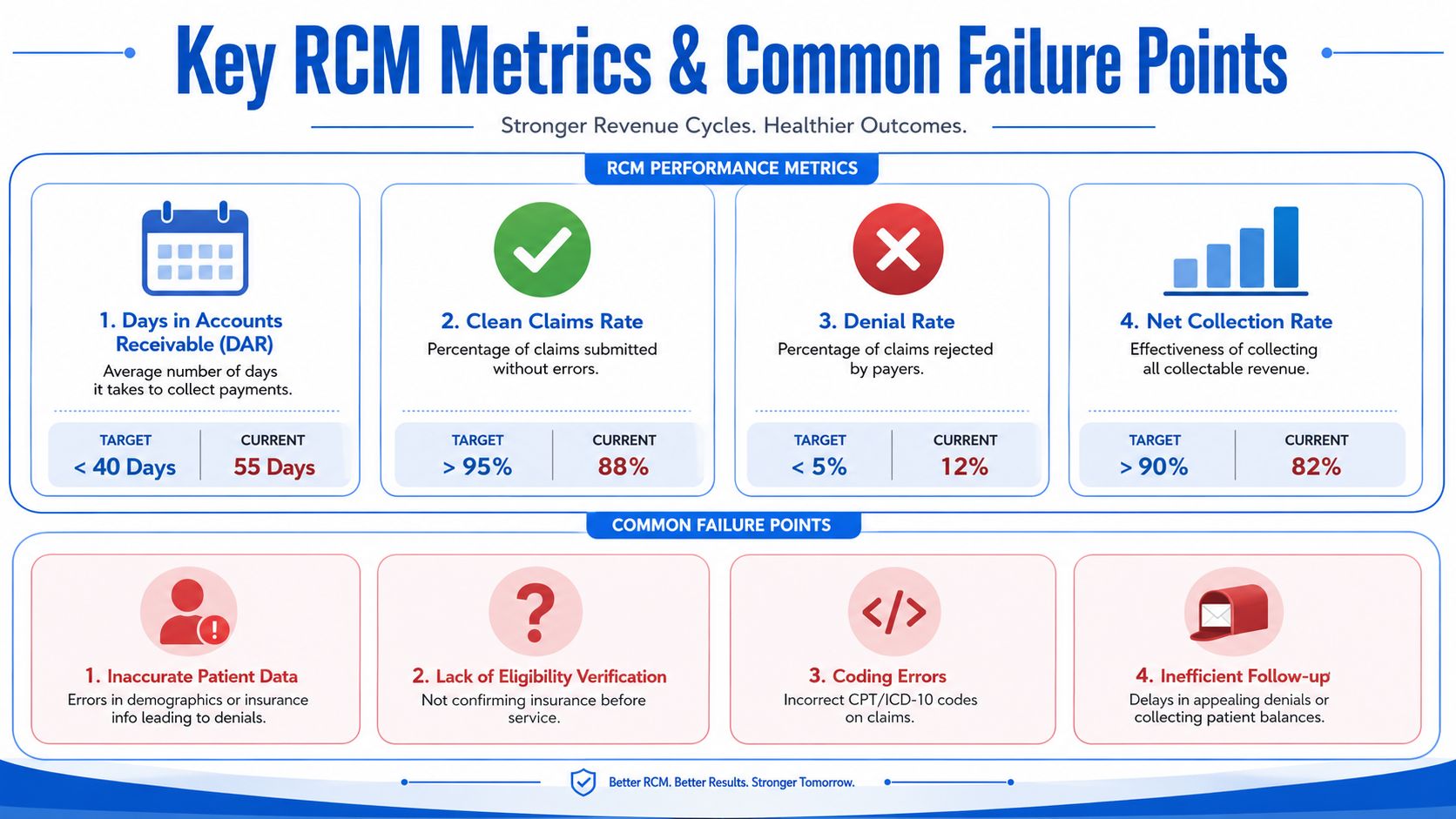
The numbers that tell you whether cash flow is healthy
Executives do not need fifty KPIs. They need a handful they can review every month, challenge by payer and location, and tie to corrective action.
- Clean claim rate: HFMA describes a clean claim as one that passes through the claims process without manual intervention or rejection, and high-performing organizations treat this as a front-end discipline issue, not just a billing outcome, as outlined in HFMA's revenue cycle definitions and metrics guidance. If this measure slips, the organization is paying for avoidable rework.
- Days in A/R: MGMA notes that days in accounts receivable remains a core indicator of how quickly an organization converts billed revenue into cash, and leaders often monitor it alongside aging by payer and by financial class rather than relying on a single blended number, as discussed in MGMA guidance on medical practice financial benchmarks. Rising A/R usually points to delayed claim resolution, weak follow-up discipline, or payment posting bottlenecks.
- Denial rate: Change Healthcare reported that claim denials continue to consume a meaningful share of provider revenue and administrative effort, which is why denial rate should be tracked by root cause, not just as one aggregate percentage, according to the Change Healthcare revenue cycle denial index. A high denial rate usually reflects repeated breakdowns in authorization, eligibility, coding, or documentation.
For leaders who want a better operating view, healthcare revenue cycle analytics should connect these metrics to work queues, payer behavior, avoidable write-offs, and staff productivity. A month-end dashboard is useful. A management system that shows where margin is leaking is far more valuable.
Common bottlenecks behind weak KPI performance
Metrics point to the problem area. Managers still need to identify the failed control.
| Metric slipping | Usual bottleneck | What happens next |
|---|---|---|
| Clean claim rate | Registration errors, missing authorization, coding defects | Claims hit edits, reject earlier, or require manual correction |
| Days in A/R | Slow denial follow-up, delayed posting, unresolved credit balances | Cash conversion slows and older balances become harder to collect |
| Denial rate | Weak front-end verification, poor documentation, inconsistent appeal workflows | Staff time shifts from prevention to rework, and net yield drops |
Denials deserve special attention because they are one of the clearest signs that the revenue cycle is being managed reactively. The cost is not limited to the denied claim itself. Staff have to investigate the issue, correct it, appeal it if appropriate, and often wait through another payer cycle. Some balances never recover.
A denial usually starts as an upstream control failure, then shows up later as a cash problem.
That is the strategic point many basic RCM explainers miss. These metrics are not only scorekeeping for the billing office. They are operating signals. If one payer shows a spike in authorization denials, that can expose scheduling gaps or referral management issues. If one service line carries older A/R than the rest of the hospital, that may indicate documentation lag, coding capacity problems, or a contract issue finance needs to address. Used well, RCM data helps leadership improve operations before revenue is lost for good.
In-House vs Outsourced RCM A Strategic Decision
The question isn't whether you want control. Every executive wants control. The key question is what operating model gives you the most reliable control over cash, accuracy, staffing risk, and process improvement.
This trade-off is easier to assess visually:
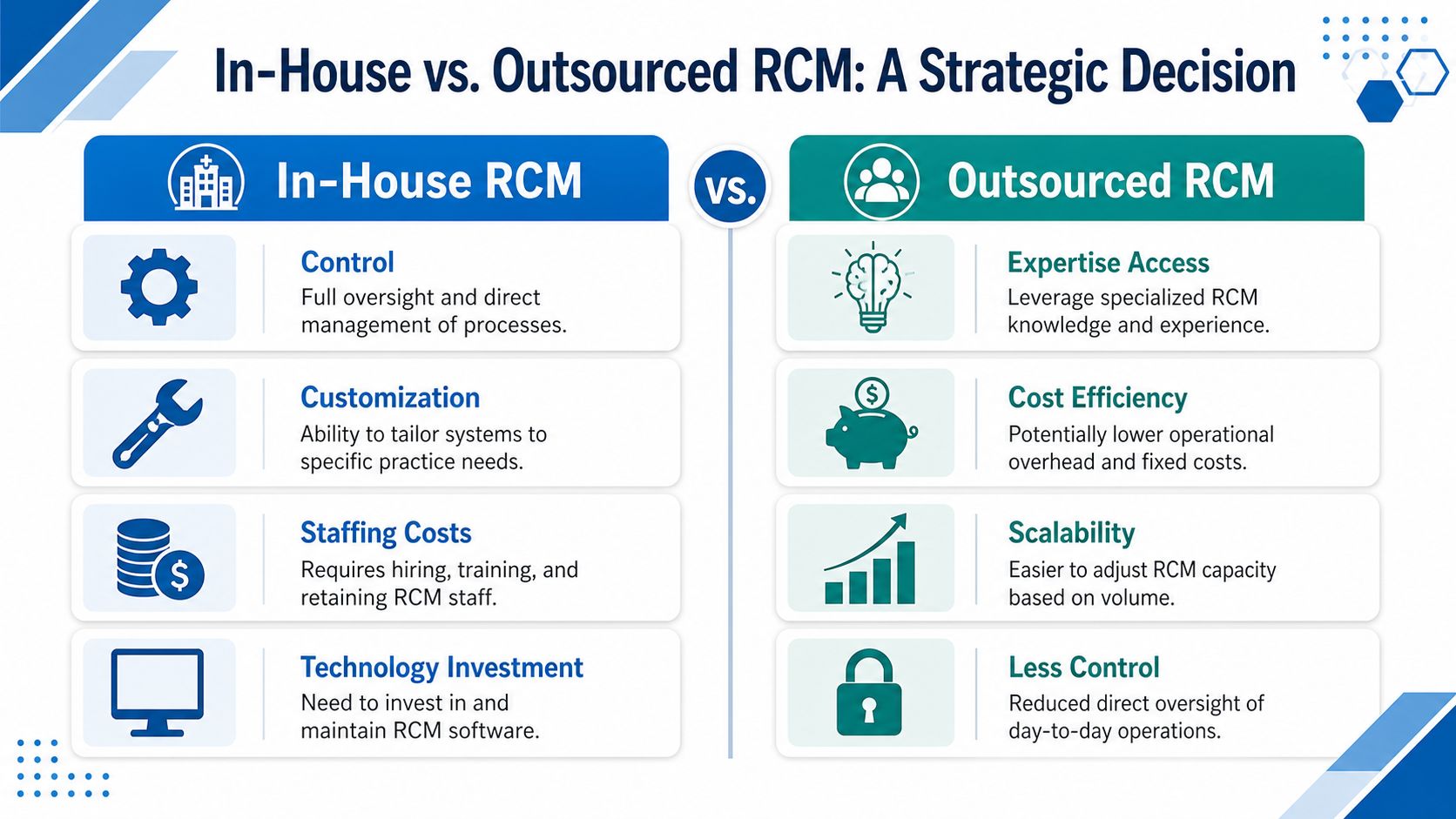
When in-house makes sense
An internal RCM team can work well when the organization has enough scale, stable leadership, disciplined workflows, and the appetite to invest in staffing and systems over time.
In-house models are usually strongest when you need:
- Direct oversight: Leaders want tight day-to-day visibility into registration, coding, billing, and collections.
- Workflow customization: The organization has service-line-specific requirements that need close operational tuning.
- Internal integration: Clinical, operational, and finance leaders already work from a shared management cadence.
The risk is that many groups confuse ownership with capability. Owning the function doesn't guarantee strong denial prevention, payer follow-up, or analytics. If turnover hits the billing office or payer rules shift quickly, internal teams can lose ground fast.
When outsourcing makes sense
Outsourcing works when leadership wants specialized expertise, flexible capacity, and stronger process discipline without building every component internally.
That model is especially useful when the organization needs:
- Deeper specialization: Access to people who spend all day on eligibility, claim status, payment posting, denials, and reimbursement trends.
- Scalability: Volume can rise or shift without forcing immediate internal hiring.
- Technology utilization: The partner already works inside structured workflows, reporting systems, and operational playbooks.
For teams evaluating support options, an experienced revenue cycle management team can fill gaps across front-end verification, billing operations, and payment follow-up without requiring a complete overhaul of internal leadership.
Recent survey insights summarized by McKinsey on healthcare revenue cycle management as a strategic turning point note that organizations treating RCM as only a cost center are struggling with evolving requirements, while leaders are using it as a strategic enabler for operational efficiency and financial resilience.
The wrong outsourcing arrangement reduces visibility. The right one sharpens it by making accountability explicit.
That is the standard I use. If an outsourced model gives you clearer KPIs, faster issue escalation, and better root-cause correction, you've gained control, not lost it.
Practical Steps to Optimize Your Revenue Cycle
Optimization starts when leadership stops treating RCM as a chain of isolated tasks and starts treating it as a coordinated data system. Clinical, administrative, and financial information have to match. If they don't, the organization pays for the mismatch in rework, denials, and delays.

Technology controls
The highest-return technology investments usually happen at the front of the cycle.
- Use real-time eligibility checks: Missing real-time eligibility verification directly causes a 12.8% increase in insurance-related claim denials according to ADSC's explanation of how RCM connects clinical, administrative, and financial data. That's why eligibility can't be a batch task or an afterthought.
- Build claim-status visibility into daily work: Teams should know which claims are pending, rejected, denied, or finalized without hunting through disconnected systems.
- Automate exception routing: Staff time should go to claims that need intervention, not to manual sorting.
If you're evaluating tools, healthcare RCM software should support eligibility verification, work queue management, payment posting discipline, and reporting that ties operational actions to financial outcomes.
Process discipline
Technology helps, but weak processes will still create weak results.
- Tighten fee schedule and practice management setup: If foundational payer and charge data are wrong, every downstream claim starts from a flawed base.
- Set a same-day or next-day charge entry standard: Delayed charge capture slows billing and clouds revenue visibility.
- Create closed-loop denial review: Every repeated denial category should lead to a defined workflow correction, owner, and follow-up timeline.
One practical mistake I see often is organizations separating front-end staff from financial accountability. Registration teams are told to move patients quickly, while billing teams absorb the consequences later. That split guarantees friction.
People and accountability
RCM performance improves when staff understand why their work affects cash, not just how to complete a task.
- Train front-desk staff on financial impact: They need to know how demographics, coverage selection, and authorization details affect denials.
- Align coders and clinicians: Documentation review works better when coders can flag patterns and providers get concise feedback tied to claim outcomes.
- Assign ownership by failure point: Someone should own eligibility accuracy, charge lag, denial categories, underpayment review, and patient balance follow-up.
One option among several is using a partner such as Clarity for targeted support in fee schedule setup, insurance benefit verification, billing operations, and claim status or payment posting when internal teams have capacity gaps or need more process consistency.
Strong optimization usually comes from simple habits done without drift. Verify early. Document clearly. Code accurately. Submit cleanly. Reconcile fast. Follow up relentlessly.
Seeing RCM in Action Real-World Scenarios
A physician group can have good volume and still feel cash pressure if the cycle is poorly managed. That usually shows up first as noise. More edits, more rebills, more patient complaints, more aging, more staff frustration.
One common scenario looks like this. A practice schedules patients efficiently and stays busy, but front-desk verification is inconsistent and charge entry slips behind. Claims go out, but too many come back with avoidable issues. Billing staff spend their day reacting instead of controlling the queue. Leaders think they have a collections problem, when the actual problem started at registration and documentation.
Good RCM fixes don't begin in accounts receivable. They usually begin much earlier.
Now compare that with a tighter operating model. The same type of practice standardizes insurance verification before the visit, gives clinicians clearer documentation expectations, reviews denial patterns weekly, and routes aging claims by status instead of by whoever happens to be free. Payment posting becomes more reliable, follow-up gets more focused, and patient balances are addressed with clearer communication before they become old debt.
The difference isn't magic and it isn't just better billing talent. It's structure. A practice that understands what revenue cycle management is in operational terms treats the patient account like an asset that must be protected at every handoff. That's when finance starts supporting growth instead of absorbing preventable damage.
Your Next Step Toward Financial Health
RCM is only partly a systems problem. It is also a communication problem. High-performing practices have to address the patient financial literacy gap because 40% of patient payment failures stem from confusion about coverage rather than inability to pay, as discussed in this NIH-indexed article on health financial literacy and revenue cycle performance. If patients don't understand their responsibility, collections become harder before the claim process is even finished.
That is why strong revenue cycle management combines controls, reporting, workflow discipline, and plain-language patient communication. CEOs who treat it as strategy get a more durable financial position. CEOs who treat it as a billing office function usually inherit avoidable surprises.
If you want a clearer view of where your revenue cycle is leaking cash, Clarity offers a complimentary consultation to review your current process and identify practical opportunities to improve efficiency, accuracy, and profitability.
No responses yet