
Your billing team finally gets a Medicare claim out the door. The documentation is solid. The coding looks clean. Then the remittance comes back denied because the bill type was wrong.
That's the kind of error executives hate because it feels small, but it isn't. A bill type error can stop payment, send staff into rework, distort patient liability, and create avoidable aging in A/R. In Medicare, the bill type isn't a minor field. It tells the payer what kind of facility submitted the claim, what kind of care was delivered, and where that claim sits in the billing sequence.
Providers feel this most when operations get busy. Front-end teams focus on registration, clinical teams focus on status and documentation, and billing teams focus on getting claims out quickly. If those groups aren't aligned, Medicare bill types become a hidden failure point. The claim may be structurally wrong before anyone ever looks at a diagnosis or procedure code.
For practice leaders, hospital finance teams, and physician owners with institutional billing exposure, this is one of those topics that repays attention. Clean bill type logic protects cash flow, reduces denials, and helps keep patients from getting bills they weren't expecting.
Table of Contents
- Why Medicare Bill Types Are a Revenue Cycle Linchpin
- Institutional vs Professional Claims Explained
- Decoding the Four-Digit Type of Bill Code
- Common Bill Types by Care Setting
- Top Denial Drivers and Costly Billing Pitfalls
- RCM Best Practices to Protect Your Revenue
- Turning Billing Codes into Financial Confidence
Why Medicare Bill Types Are a Revenue Cycle Linchpin
A Medicare denial tied to bill type usually starts upstream. Registration may have the wrong setting. Utilization review may not have finalized patient status. A biller may choose a code based on habit instead of the actual episode. The denial shows up later, but the mistake was operational long before it became financial.
That's why Medicare bill types matter so much. Medicare uses over 150 distinct bill types to categorize claims across inpatient and outpatient hospitals, skilled nursing, home health, hospice, clinics, and specialty settings, as described in this Medicare bill type reference. That level of detail tells you something important. Medicare expects the claim structure to match the care setting with precision.
The bill type is a payment control
For executives, the practical issue isn't memorizing codes. It's understanding that the bill type acts like a routing instruction for reimbursement. If it's wrong, the claim can be denied immediately, delayed for manual review, or priced incorrectly.
The downstream effects are easy to recognize:
- Cash slows down: Staff have to correct and resubmit instead of posting payment.
- Labor cost rises: Denials create touches across billing, coding, patient access, and follow-up.
- Patient balance risk increases: Wrong status or wrong setting can shift liability in ways patients don't understand.
- Reporting gets noisier: Denial trends look like coding problems when the root cause is claim structure.
Practical rule: If a claim is denied at the bill type level, don't treat it as a one-off biller mistake. Trace it back to status determination, setting selection, and claim creation workflow.
Small field, large financial consequence
Leaders sometimes put bill type work in the “billing details” bucket. That's a mistake. In Medicare, this is foundational data. The payer is reading the bill type before it gets to the more nuanced parts of the claim.
What works is treating bill type selection as a controlled decision. What doesn't work is relying on memory, tribal knowledge, or generic edits that only fire after the claim has already been built.
When teams get this right, revenue moves faster and denial prevention becomes more predictable. When they get it wrong, every downstream process gets harder.
Institutional vs Professional Claims Explained
A common revenue leak starts with a simple intake mistake. A hospital outpatient department registers the encounter correctly, but the downstream team sends the service down the professional path instead of the institutional one. Medicare does not treat that as a harmless formatting issue. It can trigger front-end rejections, misapplied patient liability, or payment to the wrong billing entity, followed by rework to reverse and rebill.

Medicare runs two distinct claim channels. Institutional claims report the facility side of care and are billed on the UB-04 (CMS-1450) or 837I. Professional claims report the physician or qualified practitioner side and are billed on the CMS-1500 or 837P, as outlined in this overview of Medicare institutional and professional billing.
That split affects more than forms. It drives who gets paid, which edits fire, how deductibles and coinsurance are assigned, and whether the patient later receives a bill that staff then have to explain.
| Claim path | Typical use | Form |
|---|---|---|
| Institutional | Facility-based services such as hospital, SNF, or hospice billing | UB-04 / 837I |
| Professional | Physician and other clinician services | CMS-1500 / 837P |
The operational risk shows up fastest in mixed settings. Provider-based clinics, hospital-owned specialty groups, and organizations using separate vendors for facility and professional billing often create handoff gaps. Registration may assign the wrong account class. Charge entry may post services without confirming billing ownership. The claim then reaches editing with the wrong structure already baked in.
The financial consequences are specific:
- Incorrect claim form selection can lead to immediate rejection before pricing.
- Wrong billing path for provider-based services can shift charges into the wrong bucket and create avoidable patient balance questions.
- Duplicate or conflicting facility and professional submissions can delay payment while staff sort out which entity should bill what.
- Late correction of the claim pathway adds labor across billing, coding, follow-up, and patient financial services.
The control point belongs early in the workflow. Set the institutional-versus-professional decision at registration or scheduling, tie it to the department and rendering provider configuration, and carry that designation into charge capture so staff are not making a second guess at claim build. Teams that do this well usually add pre-bill edits for provider-based departments and exception queues for encounters where the place of service, department, and claim form do not align.
A useful management question is simple: where does your organization decide claim ownership, and can staff override it without review? If that answer is unclear, the organization is depending on cleanup work after the claim is built. That is expensive, and Medicare billing is not forgiving when the wrong channel is used.
Decoding the Four-Digit Type of Bill Code
A hospital outpatient claim goes out with the wrong frequency digit. Payment does not just slow down. Medicare can reject the bill, staff have to rebuild the claim, and the patient may get a confusing balance notice while the account sits in follow-up. That is the practical impact of Type of Bill coding.
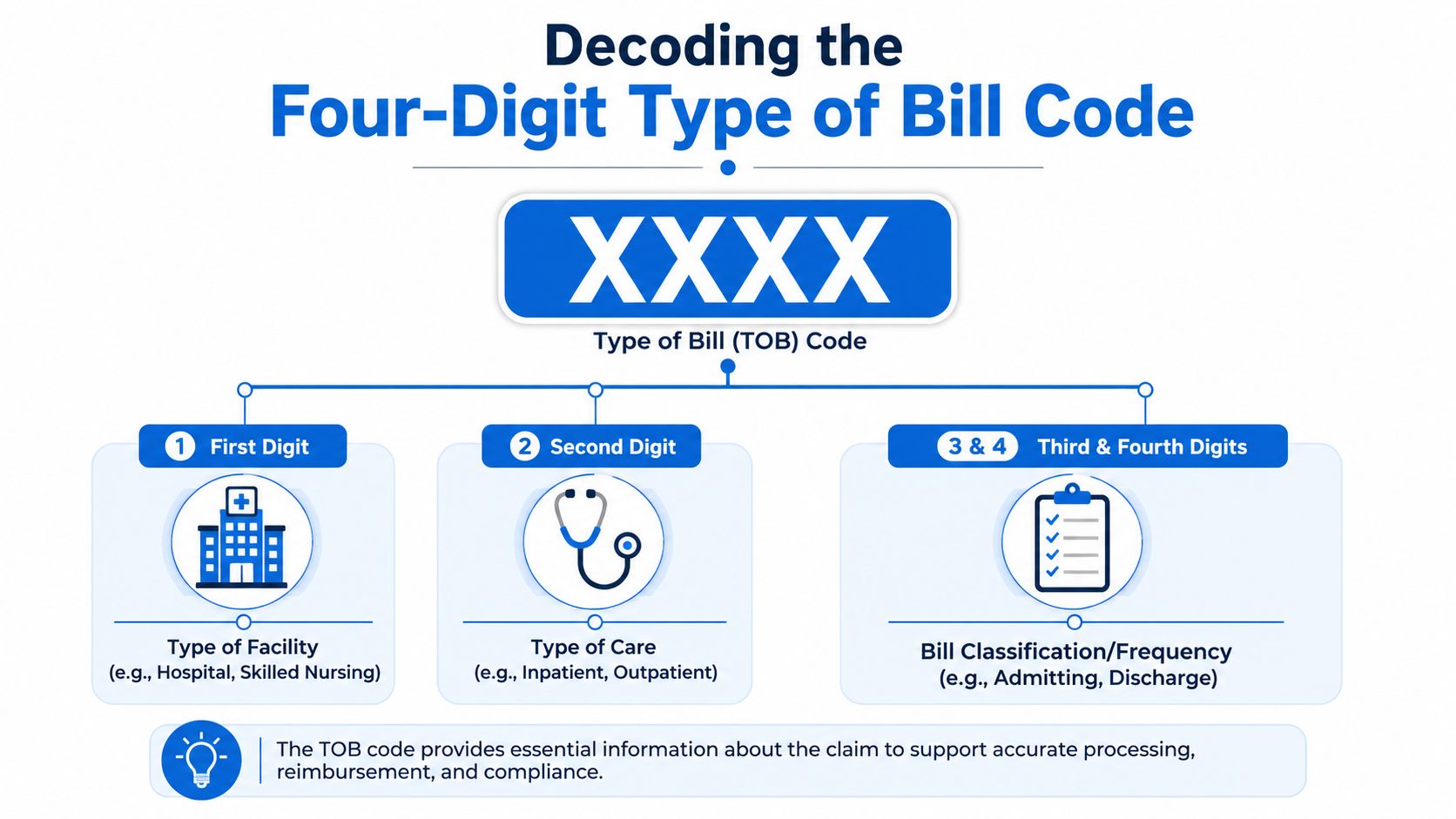
The Type of Bill, or TOB, is the institutional claim field that tells Medicare which facility is billing, what category of care was provided, and where the claim sits in the billing sequence. Noridian describes it as a four-digit alphanumeric field in Form Locator 4, with the leading zero not used by CMS, and explains how the remaining digits define facility type, care type, and frequency in its bill type structure guidance.
What each digit controls
For revenue cycle leaders, the TOB is less about code memorization and more about payment logic. Each digit points Medicare to a different adjudication path.
- Facility type digit: Identifies the provider category, such as hospital, skilled nursing facility, or home health.
- Type of care digit: Signals whether the claim is inpatient, outpatient, or another care classification.
- Frequency digit: Shows whether the bill is an original submission, an interim bill, a corrected claim, or a void.
If one digit is wrong, the claim can move into the wrong processing lane before coding, medical necessity, or charge detail even come into play.
That creates direct financial exposure. A facility type mismatch can trigger edits that stop the claim before pricing. A care-type mismatch can apply the wrong reimbursement logic or deductible treatment. A frequency error can block a corrected claim from replacing the original, leaving the account unpaid and increasing follow-up labor.
Why the frequency digit creates expensive rework
The frequency digit causes a disproportionate share of avoidable billing problems because it affects claim sequence, not just claim content. Staff may understand the setting correctly and still send the wrong bill version.
For example, a corrected institutional claim needs the proper replacement or void logic to line up with Medicare's history for that account. If staff resubmit as a new original bill instead, the system may reject it, create duplicate claim activity, or leave the prior error in place. That delays cash and can create patient statement issues if balances transfer before the claim is resolved.
I see this most often after late charge corrections, discharge status changes, and post-bill coding updates. The organization treats it like a denial management problem, but the failure happened earlier in claim construction. Teams working on related claim-integrity edits often pair TOB review with upstream checks such as DRG validation controls so the account is corrected once, not touched by three different work queues.
| TOB element | Financial result when correct | Financial result when wrong |
|---|---|---|
| Facility type | Claim reaches the right payment methodology | Front-end rejection or payer mismatch |
| Type of care | Cost sharing and reimbursement align to the actual encounter | Incorrect deductible application, status conflict, or denial |
| Frequency | Original, replacement, or void action posts correctly | Rejection, duplicate billing, delayed cash, added rework |
Strong controls keep TOB selection from becoming a manual guess. Build claim edits that compare bill type to department, patient status, occurrence history, and prior claim activity. Require supervisor review for frequency changes on rebills and corrected claims. Those checks are inexpensive compared with the cost of a rejected claim, a reissued patient statement, and days added to A/R because one character was wrong.
Common Bill Types by Care Setting
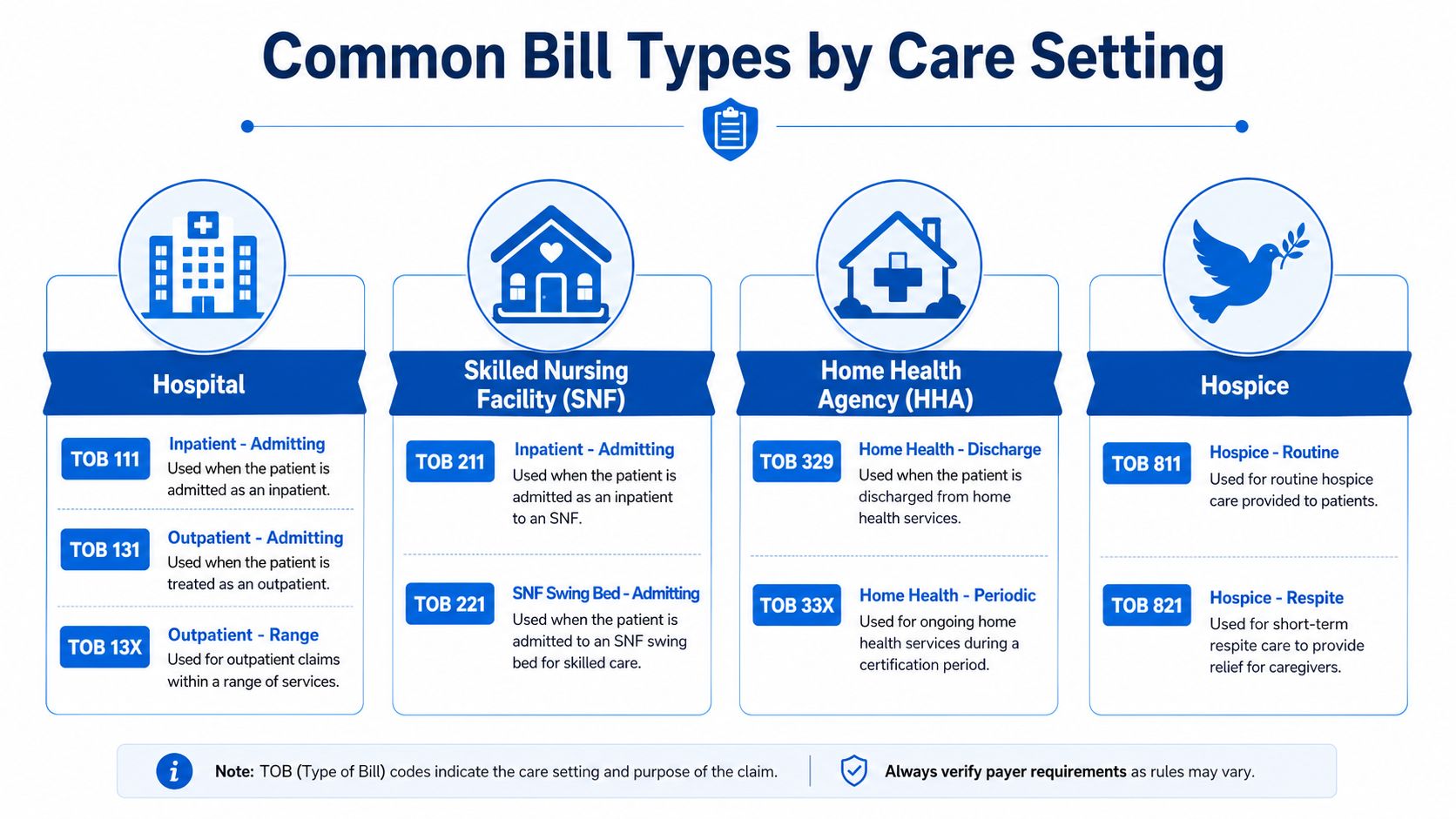
Medicare bill types get easier when you stop looking at them as abstract codes and tie them to actual care settings. The code has to reflect where the patient was treated and how the service should be reimbursed. That sounds straightforward until the setting changes mid-workflow or staff use a familiar bill type for an unfamiliar service.
Where setting-specific logic matters most
Some of the most expensive errors happen in post-acute and outpatient environments because the claim looks close enough to pass an informal review, but not close enough to pass payer logic.
CMS manual guidance is explicit on several points. Skilled Nursing Facilities must use TOB 22X for Part B residents and TOB 23X for SNF outpatients and outpatient orthotic or prosthetic devices. Using 22X for outpatient orthotics creates a mismatch that results in denial. CMS also reserves 85X for outpatient services in optional method payment providers, including ASCs, so billing ASC services under a standard hospital TOB will fail coverage validation, according to the CMS manual chapter on bill types and provider usage.
That's the core lesson. “Close” doesn't count with Medicare bill types.
A quick operating view for common settings
Below is the kind of view I'd want billing managers to use in training and QA.
| Care setting | Bill type logic to verify | Main financial risk if wrong |
|---|---|---|
| Hospital inpatient | Inpatient hospital TOB matches status and account build | Denial or incorrect reimbursement pathway |
| Hospital outpatient | Outpatient TOB aligns with outpatient encounter | Status mismatch and rebill work |
| SNF Part B resident | 22X when the resident and service fit that category | Denial if service belongs under outpatient SNF logic |
| SNF outpatient orthotics or prosthetics | 23X is required | Denial for billing mismatch |
| ASC outpatient service | 85X | Coverage validation failure under hospital TOB |
For organizations with mixed acuity and multiple sites, this should feed directly into edit design. Don't just train staff to recognize common codes. Build edits that pair place of service, provider type, PTAN alignment, and service category before the claim leaves the system.
A related discipline is denial pattern review across payment methodologies. If your team is already tightening facility claim logic, it's also worth reviewing how DRG validation affects reimbursement integrity because bill type accuracy and payment methodology accuracy often break in the same operational zones.
What works is setting-specific governance. What doesn't work is one generic claim scrubber rule for every facility class.
Top Denial Drivers and Costly Billing Pitfalls
A hospital bills an encounter as inpatient, the account should have stayed outpatient, and the problem does not stop at a denial. Payment can shift to the wrong methodology, the patient may receive a bill they do not understand, and staff end up reworking an account that should have cleared cleanly on first pass. That is the actual cost of bill type errors.
The highest-loss failures usually come from a short list of operational misses. Bill type mistakes are rarely random. They show up where status decisions, claim frequency, and plan identification break apart across teams.
Status errors that change reimbursement and patient liability
Status-to-TOB mismatch is one of the fastest ways to create avoidable revenue leakage. If an encounter built as 011X should have gone out as 013X, the organization is not just facing a coding correction. It is exposing the account to payment delays, deductible confusion, and patient balance questions that increase collection risk.
Finance and patient experience collide. A wrong status can put the claim on the wrong payment path, then force patient accounting to explain why liability changed after the fact. Executives usually see the denial first. The more expensive issue is the downstream rework across utilization review, HIM, billing, and customer service.
I advise clients to audit every pattern where status changes happen late in the account lifecycle. If the status flips after charging, coding, or pre-bill review has already moved forward, bill type accuracy becomes harder to control and much more expensive to fix.
For teams separating TOB issues from diagnosis or CPT-level mistakes, a review of medical coding errors that trigger avoidable denials helps isolate whether the failure started in account classification or in code assignment.
Wrong bill type logic can change both reimbursement and what the patient is asked to pay.
Frequency code mistakes that stall cash
The fourth digit causes more cash delay than many leaders expect. Original claims, interim bills, replacements, and voids each require the right frequency code. When staff submit a corrected claim with the wrong frequency, Medicare processing can reject it outright or leave the prior claim in place, which slows payment and creates follow-up volume.
This problem shows up in three common situations:
- Corrected claims sent with the wrong frequency code: The claim does not replace the original the way the team expected.
- Voids handled as simple rebills: The old account history remains active, which can trigger duplicate or overlap edits.
- Interim and final billing logic applied inconsistently: Cash gets held up while staff reconcile what should have been billed in sequence.
These are not minor edits. They tie up AR and make denial prevention harder because the account history becomes less reliable with every incorrect resubmission.
Plan mix confusion creates preventable write-offs
Traditional Medicare and Medicare Advantage do not behave the same way operationally. If registration, eligibility, and billing treat them as interchangeable, the claim often reaches the back end with the wrong assumptions attached. That is how organizations miss shorter MA submission windows, apply the wrong correction workflow, or send patient statements before payer liability is settled.
The control issue is ownership. Patient access may identify the plan, case management may manage status, and billing may own claim release, but no single team verifies that the bill type, claim frequency, and payer rules still align before submission. That gap produces avoidable write-offs.
The fix starts with targeted controls, not more manual heroics. Review denial trends by TOB, frequency code, and plan type together. If those data points are reviewed in separate reports, the root cause stays hidden and revenue keeps leaking.
RCM Best Practices to Protect Your Revenue
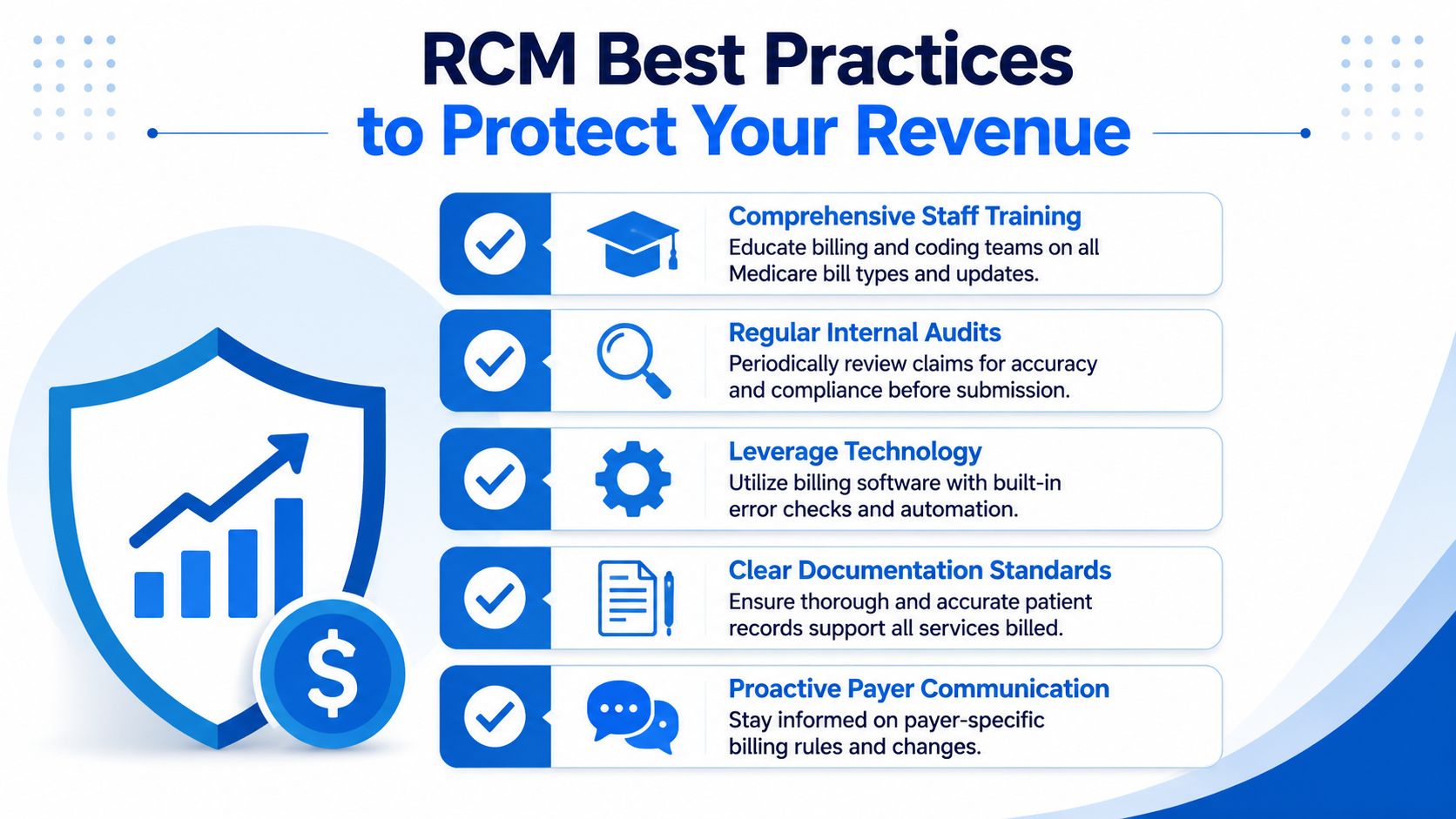
Strong organizations don't rely on heroic billers to catch Medicare bill type issues at the last minute. They build controls so the claim is hard to create incorrectly in the first place.
Controls that work before claim submission
The highest-value controls happen before the bill drops.
- Lock patient status early: Case management, utilization review, and patient access should agree on inpatient versus outpatient status before final claim assembly.
- Use payer-specific filing logic: Traditional Medicare allows a 12-month filing limit, while Medicare Advantage plans often use 90 to 120 days, so a payer-specific rules engine is a practical safeguard against automatic denial, based on Medicare's provider claims guidance.
- Constrain valid TOB choices: Don't present staff with every possible bill type. Limit options based on facility, care setting, and claim history.
- Scrub for invalid combinations: Edits should compare TOB against service setting, provider enrollment, and claim frequency before submission.
A broader framework for this sits inside disciplined revenue cycle management best practices for preventing avoidable leakage. The point isn't more software for its own sake. The point is fewer manual decisions in places where Medicare expects precision.
Controls that work after denials appear
Denial management still matters, but only if it feeds prevention.
I recommend a short closed-loop process:
- Group denials by structural cause, not just payer code.
- Separate status errors from frequency errors so fixes land with the right owners.
- Review corrected claims workflow to confirm staff are using the right replacement or void approach.
- Audit recurring settings, especially SNF and outpatient departments, where setting-specific bill type logic often breaks.
- Train from actual denials, not generic slide decks.
Best practice: If the same bill type denial appears more than once, turn it into an edit, a queue, or a documented handoff. Training alone won't hold.
What works is a control stack. Front-end verification, claim edits, payer-specific deadline logic, and denial feedback all reinforce one another. What doesn't work is chasing each denial as if it were a standalone event.
Turning Billing Codes into Financial Confidence
Medicare bill types look technical because they are technical. But for leadership, the core issue is simpler. These codes decide whether the claim enters the right reimbursement path, whether the patient's status is reflected correctly, and whether payment arrives without avoidable friction.
Teams that treat bill type selection as a front-end control usually see cleaner claim flow and less preventable rework. Teams that treat it as a back-end billing detail keep paying for the same mistakes in labor, delays, and patient dissatisfaction.
The practical takeaway is this. You don't need every executive to memorize TOB logic. You do need operational discipline around claim pathway, care setting, status, frequency, and filing deadlines. That's where financial confidence comes from. Not from fixing denials faster, but from creating fewer of them in the first place.
If your organization wants a clearer view of where bill type errors are draining cash, Clarity can help. Clarity supports providers with billing operations, benefit verification, claim follow-up, payment posting, and optimized revenue cycle workflows designed to improve accuracy and reduce preventable revenue loss.
No responses yet