

Your dermatology or primary care team probably has this problem right now. A physician removes several skin lesions in one session, the op note says “lesions excised and sent to pathology,” and billing has to guess whether the claim belongs in an excision series, a destruction series, or a mix of both. Then the denial arrives, or worse, the claim pays at a lower level because the documentation never captured the pre-op measurement that determines code selection.
That's not a coding nuisance. It's a revenue cycle leak. Skin lesion work looks simple on the schedule, but the billing rules are unforgiving. A missing margin measurement, the wrong lesion series, or a forgotten modifier can turn a clean claim into a duplicate denial, underpayment, or compliance problem.
If you want accurate payment for skin lesion removal, you need operational discipline from the exam room to charge entry. Providers must document the right details before the lesion comes off. Coders must know when excision is excision, when destruction is destruction, and when pathology changes nothing because the wrong measurement source was used. Finance leaders should care because these errors compound quickly in high-volume clinics.
Table of Contents
- Understanding CPT Codes for Excision of Skin Lesions
- CPT Code Categories and Series Distinctions
- Selecting Codes Based on Lesion Size and Margins
- ICD-10 Mapping for Excision Procedures
- Using Modifiers and Global Period Guidelines
- Payer Specific Billing Variations and Notes
- Documentation and Billing Examples
- Common Denial Triggers and Remediation Strategies
- Quick Reference Table for CPT and ICD Codes
Understanding CPT Codes for Excision of Skin Lesions
Skin lesion excision claims fail for one basic reason. Clinics treat them like routine minor procedures when they should treat them like tightly defined surgical encounters. The physician documents the clinical story, but billing needs the measurement method, lesion type, anatomic site, closure type, and diagnosis linkage to build a defensible claim.
Why these claims go wrong
A common scenario looks like this. The provider removes a lesion from the forearm, documents the visible lesion size, and waits for pathology. Billing then selects a code from memory or from the pathology report dimensions. That's how practices lose money and invite audits.
The coding rules for CPT codes for excision of skin lesions are narrow. They depend on whether the lesion was benign or malignant, whether the removal was full-thickness, where it was located, how large the excised diameter was, and whether the closure was simple or separately billable. If even one of those elements is missing, the claim becomes fragile.
Practical rule: If the provider didn't document the measurement and margin before the excision, billing is already behind.
The other problem is workflow fragmentation. Front-desk staff may schedule “lesion removal.” Clinicians may think in treatment terms. Coders have to convert that into CPT logic. When nobody owns the handoff, charge capture gets sloppy.
What revenue cycle teams need from providers
You don't fix this with a better cheat sheet alone. You fix it with documentation habits and charge review rules.
A reliable skin lesion excision process should require:
- Pre-op lesion measurement: The physician needs to record the clinical diameter before the procedure.
- Margin intent: The note should state the margin needed for complete excision.
- Procedure depth: Billing needs confirmation that the removal was full-thickness through the dermis.
- Closure detail: The note must distinguish simple closure from intermediate or complex repair.
- Line-by-line diagnosis support: Each lesion needs its own defensible diagnosis linkage if more than one lesion is treated.
Executives often ask whether this level of rigor is excessive for office-based procedures. It isn't. Minor procedures create major administrative waste when the documentation standard is loose.
The smartest teams build a lesion template into the EHR and stop relying on memory. That single change usually improves coding consistency, physician query rates, and claim confidence. Without it, your coders spend time reconstructing facts that should've been captured in the room.
CPT Code Categories and Series Distinctions
A physician excises two lesions in the same visit, documents both as “removed,” and the claim goes out with destruction coding on one line. That mistake looks small. It cuts reimbursement, invites payer questions, and forces rework that should never have started.
Benign and malignant excision series
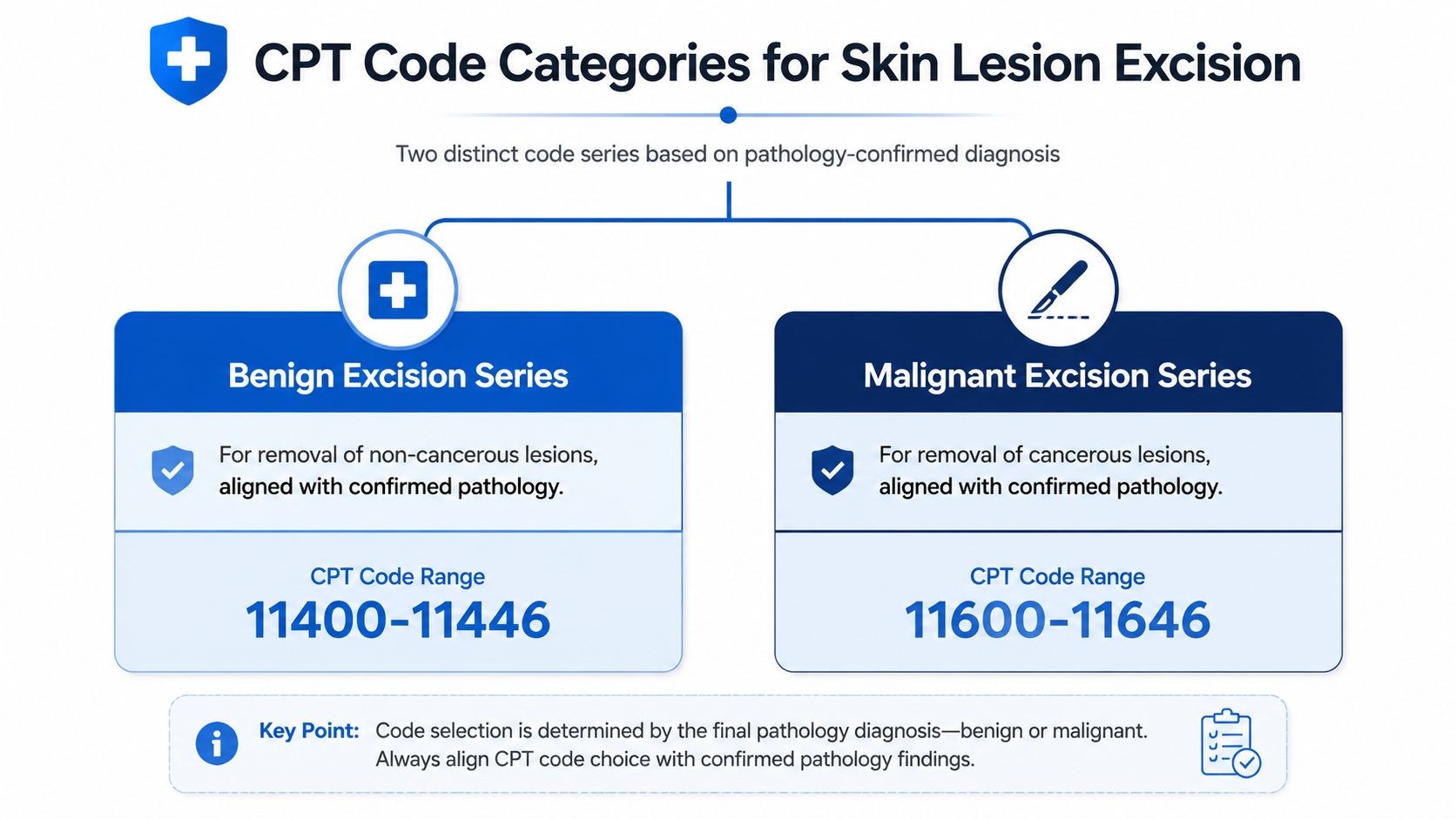
Start with the right family. Benign lesion excisions fall in CPT 11400–11446. Malignant lesion excisions fall in CPT 11600–11646. That choice shapes diagnosis support, payer scrutiny, and expected payment.
Do not let scheduling language drive coding. “Suspicious lesion,” “possible skin cancer,” or “growth removal” are poor billing terms. Code from the documented procedure and the supported diagnosis. If the chart does not clearly support the malignant excision series, billing should stop and query before claim submission.
Use this framework:
| Series | Use case | What drives code selection |
|---|---|---|
| 11400–11446 | Benign lesion excision | Lesion size and anatomic location |
| 11600–11646 | Malignant lesion excision | Lesion size and anatomic location |
| 17000–17111 | Destruction services | Lesion count and treatment type |
The operational risk is simple. Teams confuse pathology concern with CPT structure, then choose a series that the note cannot defend. That creates denials for mismatched diagnosis coding, post-payment audit exposure, and avoidable appeals.
Excision versus destruction is where payment often breaks
Excision and destruction are not interchangeable. They are paid under different logic, reviewed under different documentation standards, and frequently edited differently by commercial payers.
As the AAFP explains in its skin surgery coding guidance, destruction codes such as 17000–17111 are reported by number of lesions, while excision codes are reported by diameter and location. That distinction changes charge capture at the line level. It also changes how coders should review physician notes after multi-lesion encounters.
If your physicians perform both service types in the same session, the note must separate them clearly by lesion. Payers do not sort that out for you. They deny, downcode, or bundle based on what is missing.
For teams that also bill cryotherapy or other lesion destruction work, this CPT 17000 code overview for destruction services is a useful contrast point when training staff on how destruction differs from excision.
One more revenue rule gets missed too often. Simple closure is included in the excision code. Billing a separate simple repair invites edits. Failing to identify a legitimate intermediate or complex repair leaves payment behind.
My recommendation is firm. Ban the word “removal” from charge tickets and procedure templates. Require clinicians to document excision or destruction for each lesion, then tie each lesion to its own diagnosis and service line. That single documentation rule prevents a surprising share of underpayments and denials, especially with payers that review skin procedures closely when multiple lesions are billed on the same date of service.
Selecting Codes Based on Lesion Size and Margins
A dermatologist removes two lesions in one visit. The claim goes out using pathology dimensions and the final defect measurement. One line gets downcoded, the other denies, and your staff spends the next month arguing with a payer over documentation that should have been captured before the procedure started. That is a preventable revenue cycle failure.
Measure what the physician saw before the excision
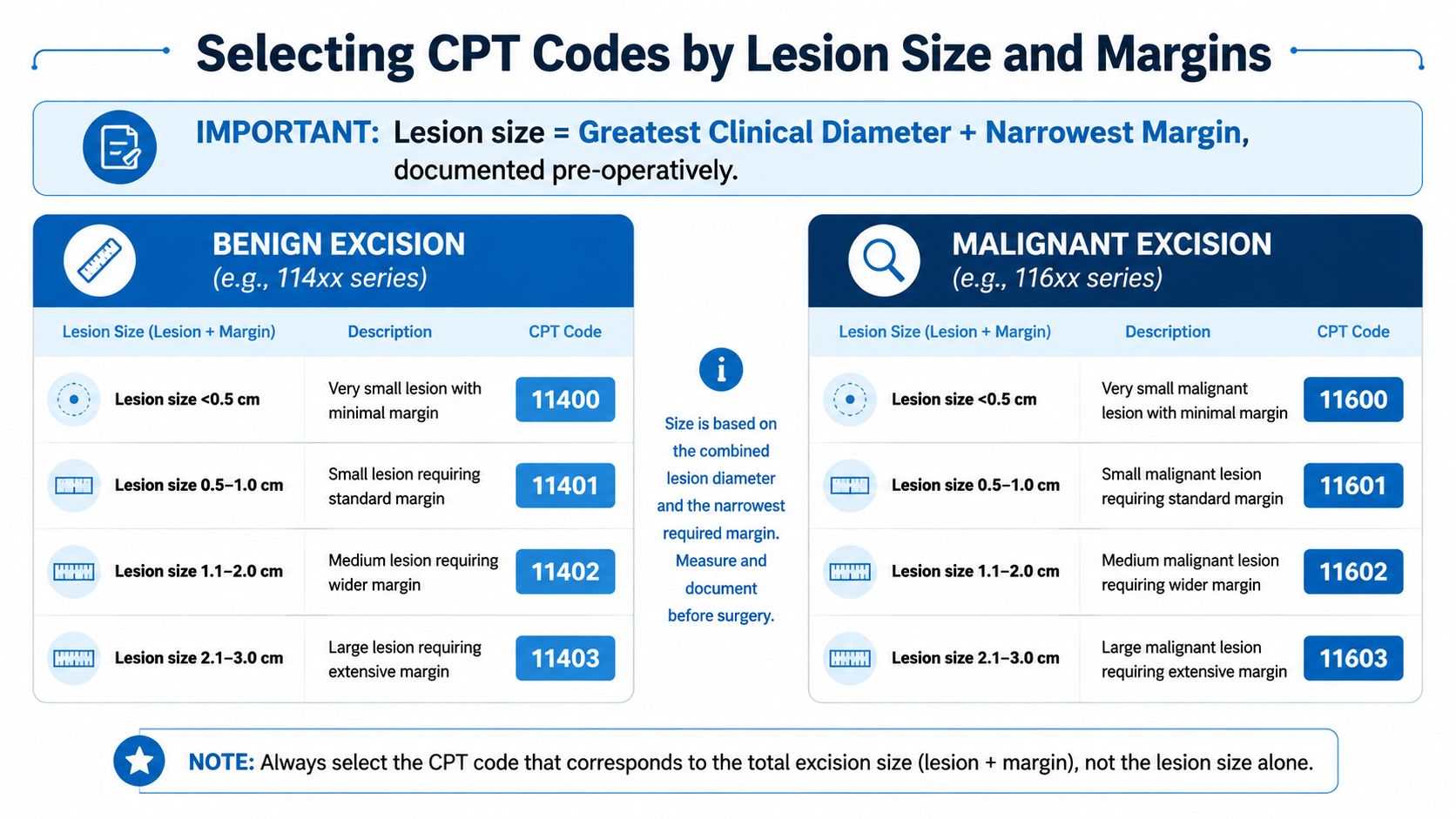
Code the excision from the physician's pre-op clinical measurement. Use the lesion's greatest diameter and add the narrowest necessary margins on both sides. Do not use the pathology report. Do not use the post-excision defect. Payers reviewing skin surgery claims want the coding logic tied to what was documented at the time of the procedure, not what the specimen or wound looked like afterward.
Such situations lead to practices losing clean payment. The procedure may be medically appropriate, but if the note does not show the pre-op lesion size and intended margins, the billed code has weak support. Appeals become harder because billing is trying to reconstruct a measurement the record never captured.
A small documentation miss can shift the case into a different code range. That changes reimbursement, and with some payers it also changes how aggressively the line is reviewed.
Use a coding sequence your staff can repeat
Train coders and charge review staff to follow the same order every time:
- Confirm the service is an excision. The record should support full-thickness removal through the dermis.
- Identify whether the lesion is benign or malignant. Those code families are separate and should never be mixed casually.
- Pull the physician's pre-op measurement. If it is missing, query before the claim drops.
- Add the documented margin on both sides. The excised diameter drives code selection.
- Match the code family to the anatomic site. Site errors create avoidable denials and underpayments.
- Review repair documentation. Separate payment may apply only when the repair meets the standard for a reportable intermediate or complex closure.
This workflow protects revenue because it forces the documentation check before billing makes assumptions.
Focus on the payer edit before it hits AR
Many coding articles stop at the measurement rule. That is not enough for revenue cycle teams. You also need to know how payers behave when the size documentation is vague, when multiple lesions are billed on the same date, and when the operative note lists a lesion dimension but skips the margin. Those claims often pend for review, downcode to a lower size tier, or deny for insufficient documentation.
My recommendation is simple. Build hard stops into the procedure template and charge review queue for lesion size, margin, site, lesion type, and closure level. If any of those fields are missing, hold the charge. Fix it before submission, not after a denial.
Teams that handle both excision and destruction should also keep staff training separate. Excision is size-driven. Destruction is counted differently. A quick reference for CPT 17000 destruction coding scenarios helps prevent staff from applying the wrong logic to high-volume skin procedure days.
Require physicians to document the visible lesion size and planned margins before the first incision. That single habit prevents a large share of skin excision billing errors.
ICD-10 Mapping for Excision Procedures
A correct CPT code with a weak diagnosis link still gets denied. Revenue cycle teams often focus on code selection and ignore the diagnosis pointer logic that payers use to validate medical necessity and distinguish one lesion from another.
Match each CPT line to a supportable diagnosis
Each excision line should map to the diagnosis that supports that specific lesion. If multiple lesions are removed, don't attach one broad diagnosis to every line and hope the payer accepts it. Build the claim the way the procedure happened.
The coding rule that matters most here is clinical support. According to CPT Assistant guidance on skin lesion excision coding, code selection is based on the apparent lesion's greatest clinical diameter plus the narrowest required margin, not pathology size or final defect size. The same guidance states that if no pathology report confirms malignancy, the procedure defaults to benign lesion coding (11400–11446) with an unspecified diagnosis.
That default matters. Practices get in trouble when they bill the malignant excision series based on suspicion alone. If pathology hasn't confirmed malignancy, keep the CPT and diagnosis pairing aligned with what the record can support at claim submission.
How to avoid diagnosis mismatch denials
Your coders should follow a simple rule set:
- One lesion, one CPT, one diagnosis link: Don't bundle separate lesions under a vague diagnosis umbrella.
- Use supportable diagnosis specificity: If the record is nonspecific, don't upcode the diagnosis to sound cleaner.
- Keep pathology timing in mind: Suspicion is not confirmation.
- Separate biopsy thinking from excision thinking: Those workflows often get mixed in multi-procedure visits.
If your team needs a refresher on how biopsy coding differs operationally, keep a separate reference for skin biopsy coding workflows so coders don't cross-apply biopsy logic to excisions.
A practical documentation habit helps here. Require providers to number each lesion in the note, then carry that numbering into charge entry. Lesion 1 gets a site, measurement, diagnosis, and CPT. Lesion 2 gets its own. That single numbering convention makes audits, appeals, and payer reviews much easier.
Using Modifiers and Global Period Guidelines
Modifier mistakes create denials that should never happen. In skin lesion excision billing, the two modifiers that matter most operationally are 59 and 58. Teams misuse both because they don't separate same-session distinct lesions from later staged or related re-excisions.
Modifier 59 for multiple excisions
When multiple lesions are excised in the same anatomic location during one session, each lesion must be coded separately with its own CPT and ICD-10-CM code, and modifier 59 should be appended to the second and subsequent codes to avoid duplication denials, as outlined in this coding guidance on skin lesion excisions and modifiers.
That rule should be hardwired into your charge review queue. If billing sees two or more excision codes for the same anatomic area on the same date of service and no modifier 59 appears on the later lines, the claim isn't ready.
Use modifier 59 when the lesions are distinct procedures in the same session. Don't use it as a cleanup tool for vague documentation. It won't fix a missing lesion description, poor diagnosis linkage, or unclear site documentation.
Modifier 58 for re-excisions
Modifier 58 serves a different purpose. Use it for a staged or related re-excision during the postoperative period of the primary procedure. That's not a new unrelated service. It's part of the treatment course.
A useful internal distinction is this:
- Same operative session to achieve complete removal: Code once based on the final widest excised diameter.
- Subsequent operative session during the postoperative period: Report the new excision appropriately and use modifier 58 when the documentation supports a planned or related re-excision.
Staff should ask one question before selecting the modifier: “Was this a separate lesion today, or a return to widen margins after the earlier procedure?”
I also recommend a modifier audit for every skin surgery day. Don't rely on individual coders to remember line-level distinctions under time pressure. Build a work queue that flags same-day same-area excisions and postoperative returns automatically. The denials you prevent there are far cheaper than the rework you'll do later.
Payer Specific Billing Variations and Notes
Every payer says it follows CPT. Then each one adds its own flavor of edits, documentation scrutiny, or utilization controls. That's why a claim that pays cleanly with one payer can suspend or deny with another, even when the CPT logic is sound.
Where payer rules usually diverge
In practice, payer variation shows up in a few predictable places.
Some plans scrutinize medical necessity for benign lesion removal more aggressively. If the note reads like a cosmetic service, expect trouble. Others focus on whether the documentation clearly supports excision versus destruction, especially when multiple lesions were treated in one encounter.
You'll also see differences in:
- Pre-service requirements: Some plans may require prior authorization for certain office-based surgical services or for higher-acuity settings.
- Documentation expectations: One payer may accept a standard op note, while another may want more explicit lesion-by-lesion detail, pathology follow-up, or photographs when a dispute arises.
- Edit behavior on multiple lines: Certain plans are more aggressive about duplicate-procedure edits, even when the coding is correct.
- Repair code review: Some payers challenge separately billed intermediate or complex repairs unless the operative note is unusually clear.
Medicare contractors often lean heavily on article-level guidance and claim edits. Commercial payers may follow their own payment policy manuals, internal edits, and prepayment review rules. The operational point is simple. Don't submit every excision claim through a single generic workflow and expect consistent outcomes.
What to standardize internally
You can't standardize payer behavior, but you can standardize your internal controls.
I'd put these in place:
| Internal control | Why it matters |
|---|---|
| Payer-specific claim scrub rules | Catches modifier, diagnosis, and multi-line issues before submission |
| Standard lesion excision template | Reduces documentation variance across providers |
| Pathology follow-up workflow | Helps billing know whether a later correction is needed |
| Appeal packet checklist | Speeds remediation when the payer questions necessity or coding |
The most effective revenue cycle teams maintain a living matrix by payer. Not a policy binder no one reads. A short operational reference that tells coders and billers exactly what that payer tends to challenge and what documentation wins the appeal.
That's what separates a compliant operation from a reactive one.
Documentation and Billing Examples
A surgeon removes two lesions in one visit. The note says “left arm lesion excised, closed with sutures.” Billing submits the claim. One line is denied for insufficient documentation, the second is bundled, and the repair is downcoded. That is what weak lesion documentation does to cash flow.
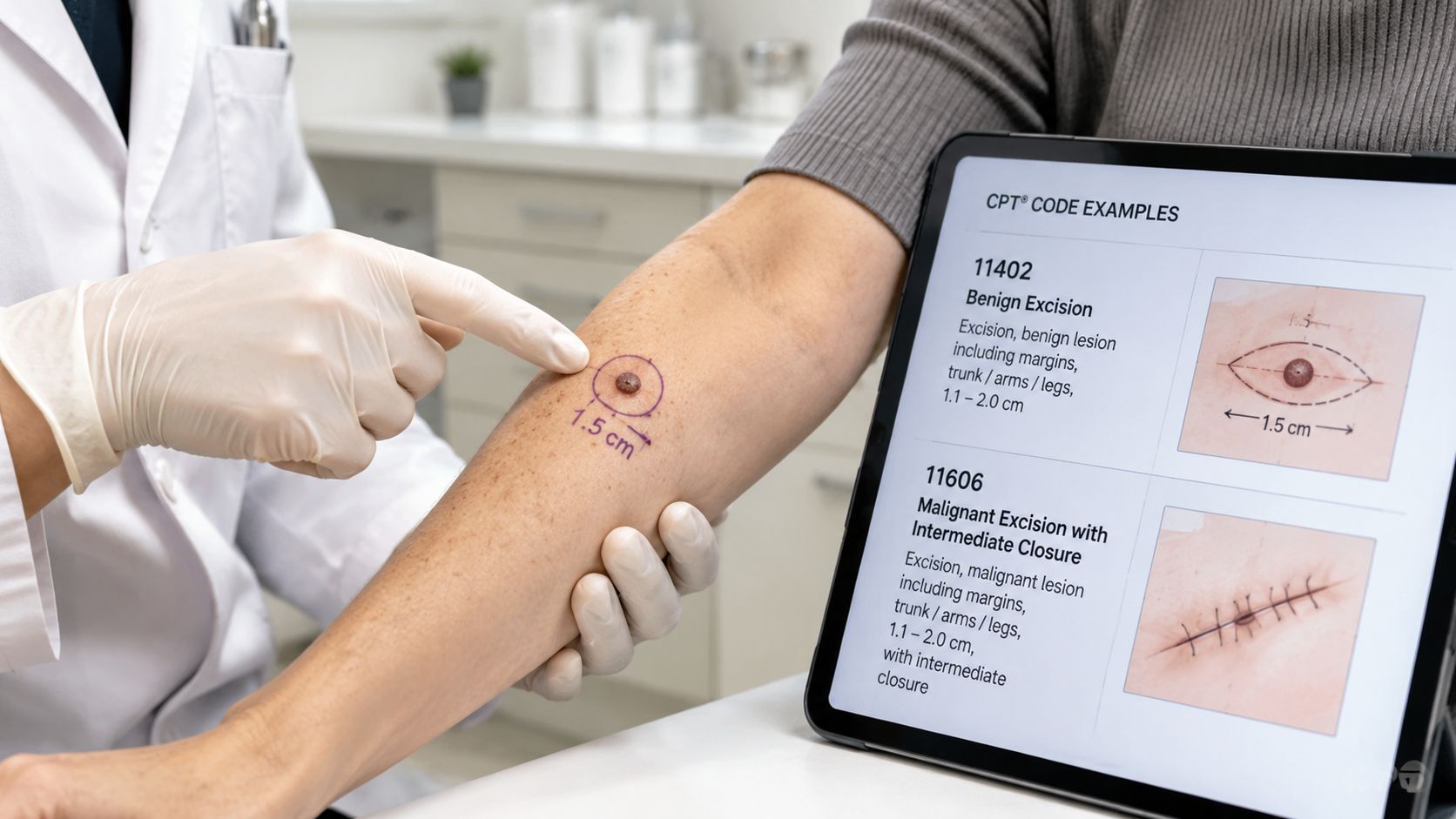
The fix is simple. Build the note so coding, claim editing, and appeal review all have the facts they need on the first pass.
Example of a clean benign excision note
For a benign excision, the operative note should support three things without guesswork. What was removed, how large it was with margins, and how the wound was closed.
If the lesion is on the trunk, arm, or leg and the excised diameter falls in the 1.1 to 2.0 cm range, the claim belongs in the corresponding benign excision size tier. The payer does not care that the provider “meant” that size range. The note must show the lesion measurement and margin clearly enough for a coder and auditor to reach the same code.
A usable note should document:
- Lesion identifier: Left forearm lesion
- Pre-op lesion size: Greatest clinical diameter before removal
- Margin: Intended narrowest margin on each side
- Total excised diameter: Lesion size plus margins
- Depth: Full-thickness excision through the dermis when applicable
- Closure: Simple, intermediate, or complex, stated clearly
- Specimen handling: Sent to pathology, when performed
That level of detail protects revenue. It also cuts coder queries and prevents size-based downcoding after medical review.
Multiple lesions and separately billable repair
Multi-lesion cases create the most preventable payment problems. Treat each lesion as its own billable event with its own site, measurement, diagnosis pointer, and supporting documentation. Do not let two lesions share one vague description.
If the physician performs a separately reportable repair, document the repair as a distinct service. “Closed with sutures” is not enough. The note should describe the repair type and the work performed so the repair code can survive payer edits. Many commercial plans often become aggressive under these circumstances, particularly when excision and repair are billed together on the same date.
This short explainer is worth sharing in staff training:
A charge ticket that gets paid cleanly usually includes:
- One charge line for each lesion
- A diagnosis pointer tied to each specific lesion
- Any modifier needed to distinguish additional excision lines
- A separate repair code only when the documentation supports separate reporting
I recommend auditing this section of the workflow first if your group sees frequent lesion excision denials. The same documentation failures show up repeatedly in broader medical coding error prevention workflows, and they are easier to fix at the template level than through appeals.
Free-text operative notes create avoidable variance. Use structured fields for lesion number, anatomic site, pre-op size, margin, total excised diameter, closure type, and specimen disposition. That format gives coders what they need and gives billers a cleaner path to full reimbursement.
Common Denial Triggers and Remediation Strategies
Most denials in this area are preventable. The problem isn't that the rules are unknowable. The problem is that clinics let procedural ambiguity reach the claim form.
The denial patterns I see most often
The biggest mistake is confusing destruction and excision when multiple lesions are treated. As AAPC notes in its discussion of skin lesion excision coding gaps, a major problem in existing guidance is the failure to clearly distinguish destruction (17110/17111) from excision (11400–11446), which leads to undercoding or denial frustration.
That shows up in denials several ways:
- Wrong code family: Staff bill one destruction code when the documentation supports separate excision codes.
- Missing measurement support: The note lacks the pre-op lesion size and margin detail.
- Modifier failure: Multiple same-session excisions go out without modifier 59 where needed.
- Diagnosis mismatch: A CPT line points to an unsupported or overly broad diagnosis.
- Repair confusion: Billing reports a simple closure separately, or fails to support a separately reportable repair.
If your organization struggles with recurring edit failures, it's worth tightening your broader medical coding error prevention process so lesion excision claims don't keep falling into the same traps.
How to fix and resubmit
Don't appeal these denials with generic language. Rebuild the claim support.
Use a remediation sequence like this:
- Audit the original note. Confirm whether the service was excision or destruction.
- Verify the measurement source. If the code came from pathology dimensions, correct it.
- Check line-level diagnosis links. Every excised lesion should stand on its own.
- Review modifier use. Add or correct modifier 59 or 58 only when documentation supports it.
- Resubmit with operative note support. Highlight the exact documentation that supports the billed service.
When the physician note is weak, don't force a heroic appeal. Query the provider while the encounter is still fresh. Late reconstruction is risky and often unconvincing.
One last opinionated recommendation. Pre-bill audits for skin surgery are worth the time. This is a small family of codes with outsized denial risk. A focused review before submission usually pays for itself in cleaner claims and faster cash.
Quick Reference Table for CPT and ICD Codes
For day-to-day operations, teams need a practical lookup, not another dense policy memo. The table below is built for charge review, coding QA, and provider education. It won't replace payer policy, but it will prevent the most common errors.
Excised Skin Lesion Coding Quick Reference
| CPT Code | Procedure Description | Size Range | ICD-10 Example | Modifier | Global Period | Payer Notes |
|---|---|---|---|---|---|---|
| 11400 | Benign lesion excision, trunk/arms/legs | 0.5 cm or less | Benign lesion diagnosis supported by chart documentation | Usually none unless multiple same-area excisions require distinct service logic | Check payer policy | Requires pre-op clinical measurement and full-thickness excision support |
| 11402 | Benign lesion excision, trunk/arms/legs | 1.1 to 2.0 cm | Benign lesion diagnosis supported by chart documentation | Modifier 59 may apply to second and later same-area excision lines | Check payer policy | Don't derive size from pathology report |
| 11403 | Benign lesion excision, trunk/arms/legs | 2.1 to 3.0 cm | Benign lesion diagnosis supported by chart documentation | Modifier 59 as supported | Check payer policy | Simple closure included |
| 11600 | Malignant lesion excision | 0.5 cm or less | Malignant diagnosis only when supported by pathology or record at claim stage | Usually none unless multi-line distinct service rules apply | Check payer policy | Confirm malignant series selection is supportable |
| 11602 | Malignant lesion excision | 1.1 to 2.0 cm | Malignant lesion diagnosis supported by documentation | Modifier 59 may apply on additional same-area lesion lines | Check payer policy | Intermediate or complex repair may be separately reportable if documented |
| 11603 | Malignant lesion excision | 2.1 to 3.0 cm | Malignant lesion diagnosis supported by documentation | Modifier 59 or 58 depending on scenario | Check payer policy | Distinguish same-session completion from later re-excision |
| 17110 | Destruction of benign lesions | Not size-based | Diagnosis must support destruction service | Usually none based on payer edits | Check payer policy | Used for 1 to 14 lesions when destruction, not excision, is performed |
| 17111 | Destruction of benign lesions | Not size-based | Diagnosis must support destruction service | Usually none based on payer edits | Check payer policy | Used for 15 or more lesions when destruction, not excision, is performed |
Use this table as a front-end checkpoint, not a substitute for documentation review. The claim still rises or falls on whether the note supports lesion type, measurement, margin, location, closure, and diagnosis linkage.
If I had to reduce all of this to one operational standard, it would be this: bill the service exactly as documented, and document the service exactly as CPT expects. That sounds obvious. In skin lesion excision coding, it's where most organizations still fail.
If your practice wants tighter charge capture, fewer denials, and cleaner reimbursement for office-based procedures, Clarity can help assess your current workflow and strengthen the weak points across documentation, coding, billing, and follow-up. Their team supports full-service and targeted revenue cycle work so providers can protect revenue without pulling attention away from patient care.
No responses yet