

A large share of skin biopsy revenue doesn't disappear because the wrong family of codes was chosen. It disappears because the claim was almost right. One of the most expensive examples is the multi-lesion encounter where staff bill more than one primary biopsy code, even though the highest-level-technique rule allows only one. That mistake drives 30-40% of multi-lesion denial spikes in affected workflows, as noted in this Cutis coding guidance summarized by MDedge.
The same pattern shows up in shave biopsies. A claim may look clean on its face, but if documentation shows the entire lesion was removed, payers may treat the service as therapeutic rather than diagnostic. That distinction is where many dermatology teams lose margin without realizing the operative note itself created the denial risk.
Table of Contents
- The High Cost of Skin Biopsy Coding Errors
- Skin Biopsy CPT Codes A Quick Reference Guide
- Choosing the Primary Code The Highest-Value Technique Rule
- Defining Tangential Punch and Incisional Techniques
- Essential Modifiers for Skin Biopsy Claim Success
- ICD-10 Mapping and Proving Medical Necessity
- Payer Gotchas and Advanced Denial Avoidance
- Putting It All Together Sample Claim Scenarios
The High Cost of Skin Biopsy Coding Errors
Skin biopsy coding looks simple when you reduce it to a code list. That's exactly why practices miss the financial risk. The denials usually come from sequencing, bundling, modifier placement, or documentation that undercuts diagnostic intent after the fact.
For finance leaders, the issue isn't whether staff know the CPT code for skin biopsy families. It's whether the billing workflow can translate the procedure note into a claim that survives payer edits on the first pass. When it can't, A/R rises, rework grows, and the root cause often hides inside a claim that looked reasonable to the team who submitted it.
Where revenue leakage usually starts
The most common operational failure is treating biopsy coding as a static lookup exercise. In reality, the claim has to reflect hierarchy, encounter logic, and payer editing behavior. That's why the multi-lesion error referenced in the opening matters so much. Teams can choose codes that are individually valid and still build an invalid claim.
Practical rule: A claim can be technically accurate at the code level and still be financially wrong at the encounter level.
That's why coding audits need to review more than code descriptions. They need to examine primary-code selection, add-on usage, diagnosis linkage, and modifier placement. If your team is still seeing repeat denials around procedural coding, a broader review of common medical coding errors in revenue cycle operations usually reveals that the problem is process discipline, not coder effort.
What works and what doesn't
A few patterns consistently separate stable dermatology revenue from unstable revenue:
- What works: Building charge review around encounter logic. One visit, all lesions, all techniques, one claim architecture.
- What doesn't: Letting staff code each lesion in isolation and hoping the payer will infer the relationship.
- What works: Auditing the operative note for diagnostic intent before claim release.
- What doesn't: Assuming pathology alone will rescue a weak procedure description.
The practices that protect margin treat skin biopsy coding as a revenue integrity function, not a clerical task.
Skin Biopsy CPT Codes A Quick Reference Guide
The current biopsy code set is technique-based. That means the correct CPT code for skin biopsy depends on how the provider obtained the specimen, not just the fact that tissue went to pathology.
The current code set at a glance
| CPT code | Technique | Role in claim |
|---|---|---|
| 11102 | Tangential biopsy of skin, such as shave, scoop, or curette | Primary code for a single lesion |
| 11103 | Tangential biopsy, each additional lesion | Add-on code |
| 11104 | Punch biopsy of skin, including simple closure when performed | Primary code for a single lesion |
| 11105 | Punch biopsy, each additional lesion | Add-on code |
| 11106 | Incisional biopsy of skin, such as wedge, including simple closure when performed | Primary code for a single lesion |
| 11107 | Incisional biopsy, each additional lesion | Add-on code |
This structure replaced the old 11100 and 11101 approach. The shift happened on January 1, 2019, when skin biopsy coding moved to the 11102-11107 series to improve billing specificity and better match reimbursement to procedural complexity, as described in this review of the 2019 CPT restructuring.
Why the 2019 reset still matters
Many denial patterns today still trace back to pre-2019 habits. Teams remember that older workflows treated skin biopsy coding more generically, so they underweight technique in claim construction. That leads to avoidable confusion when the encounter includes a mix of tangential, punch, and incisional work.
A fast way to improve coder judgment is to teach the family as a decision tree rather than a memorization task. The same mindset helps when your team also handles lesion destruction coding and needs to separate biopsy logic from procedures like CPT 17000 for premalignant lesion destruction.
Here's a useful reinforcement tool for staff education:
The fastest coding errors usually happen when teams answer the wrong question. They ask “what lesion was first?” when they should ask “what technique drives the primary code?”
Choosing the Primary Code The Highest-Value Technique Rule
Multi-lesion biopsy claims fail for a predictable reason. The claim is built around lesion count instead of code hierarchy.
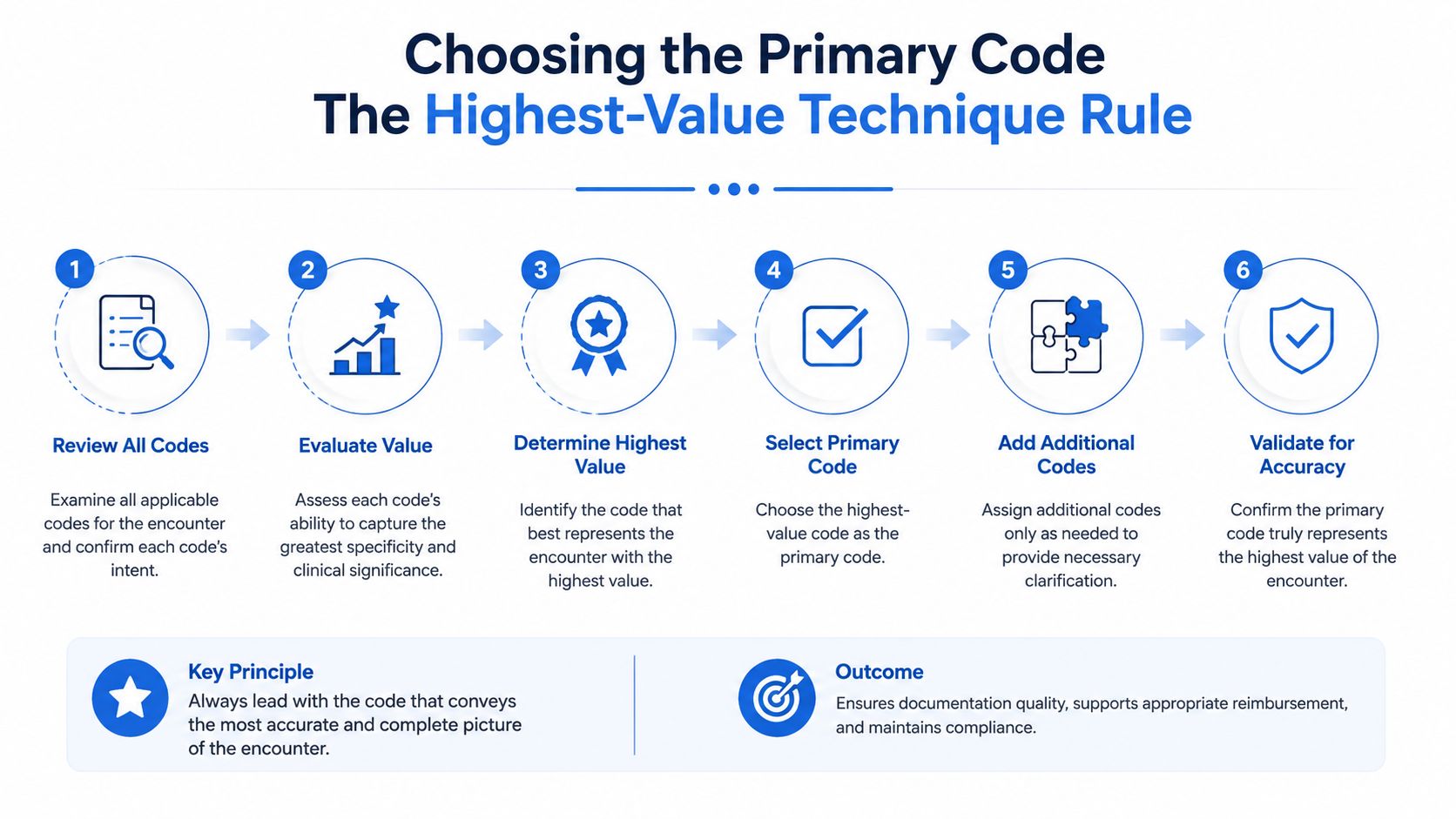
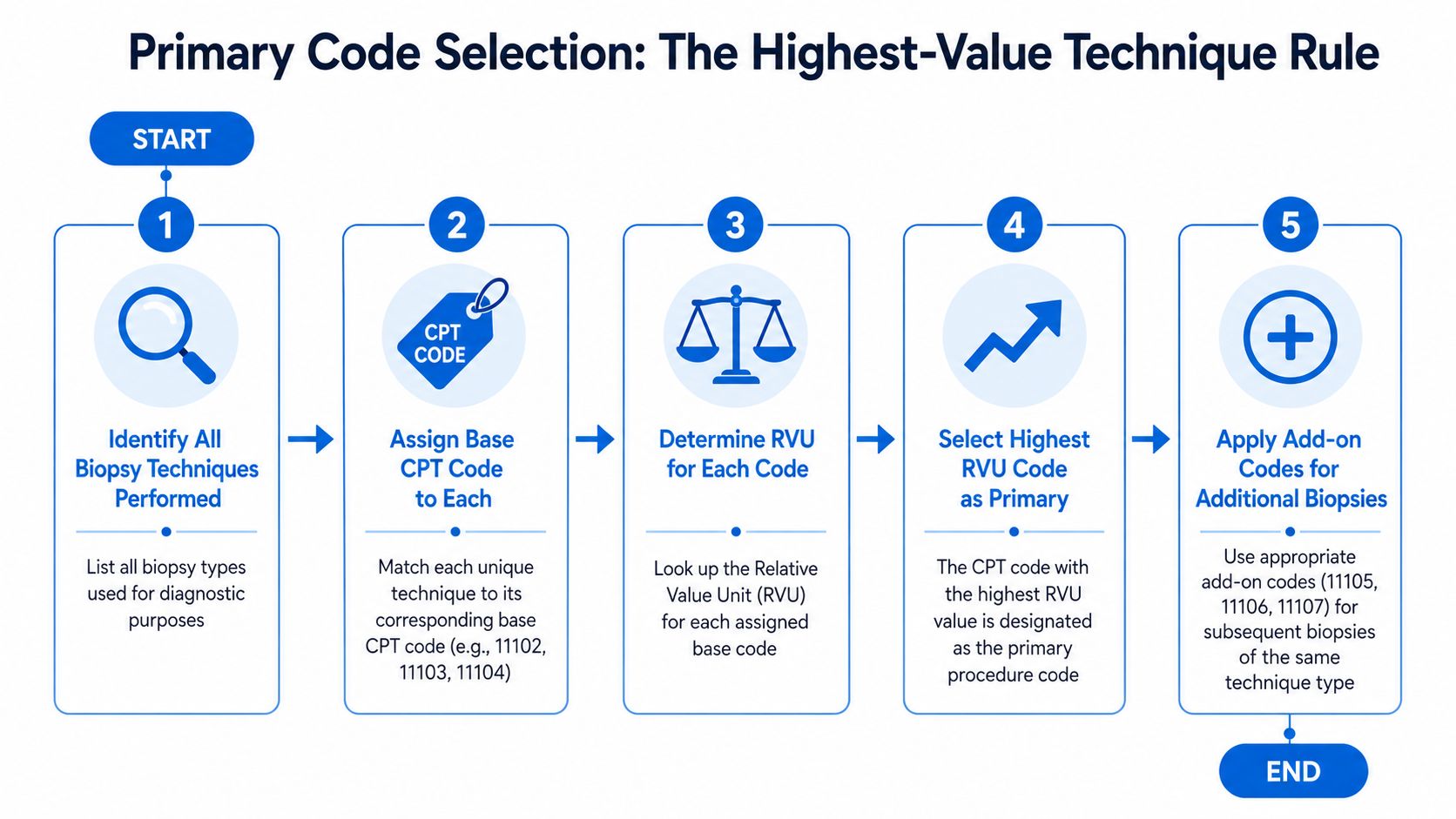
The payment rule is straightforward. Bill one primary skin biopsy code for the date of service, and that code must represent the highest-level technique performed across all biopsies documented for that encounter. The remaining biopsies are reported with the matching add-on codes based on technique and lesion count.
That distinction drives real dollars. If staff place more than one primary biopsy code on the same claim, payers often read the submission as duplicate billing, an incorrect procedural package, or an edit failure waiting to happen. The result is delayed cash, rework cost, and avoidable write-off risk if the corrected claim misses filing deadlines.
What the rule means in day-to-day claim building
The confusion usually starts with the code families themselves. Teams see 11102, 11104, and 11106 and treat each as available for separate primary reporting if each technique appears once. CPT does not work that way for skin biopsy coding.
For mixed-technique encounters, the primary line follows the most resource-intensive biopsy method performed that day. In practical terms, incisional outranks punch, and punch outranks tangential for choosing the single primary code. Then the claim picks up additional lesions with the appropriate add-on codes tied to the actual technique used.
That is the part many lookup-table articles miss. The coding decision is not just descriptive. It determines whether the claim passes payer editing logic on first submission.
How mixed-technique encounters should be built
A simple comparison makes the pattern clear.
| Encounter | Incorrect build | Correct build |
|---|---|---|
| One tangential biopsy and one punch biopsy | 11102 and 11104 as two primary lines | 11104 as the single primary, plus 11103 for the additional tangential lesion |
| One incisional biopsy and two punch biopsies | 11106 and 11104 as separate primary lines | 11106 as the single primary, plus 11105 for each additional punch lesion |
| Three tangential biopsies | 11102 billed with multiple primary units | 11102 once, then 11103 for additional lesions |
Finance leaders should watch this closely because the denial often looks minor at first glance. It may post as duplicate billing, bundling, or an MUE-related edit rather than a skin biopsy coding issue. If your denial team works line by line, they can miss the underlying problem. The claim structure was wrong from the start.
The payer expects one procedural story for the encounter. Multiple primary biopsy codes break that story.
I train revenue cycle teams to review these claims in encounter order. Start with every lesion biopsied that day. Match each lesion to its documented technique. Then choose the highest-level technique as the anchor code and add the remaining lesions correctly. That workflow prevents the common mistake of letting the first lesion listed in the note drive the primary code selection.
A reliable production check looks like this:
- List each biopsied lesion with site and technique.
- Rank the techniques used to identify the highest-level service performed that day.
- Assign one primary code for that highest-level technique.
- Add the remaining lesions with the correct add-on codes for their technique family.
This is also where revenue leakage starts in dermatology and multispecialty groups. A coder may know the definitions of tangential, punch, and incisional biopsy, but if the team does not apply the hierarchy rule consistently, clean documentation still turns into preventable denials.
Defining Tangential Punch and Incisional Techniques
Correct coding starts with understanding what the provider did. A billing team can't validate the CPT code for skin biopsy if the note says only “biopsy performed” and leaves technique to assumption.
For non-clinical leaders, the most useful lens is this: each biopsy type reflects a different tissue sampling method, and documentation needs to support that method clearly enough that coding and audit staff can verify it.
Tangential biopsy
Tangential biopsy includes methods such as shave, scoop, or curette. The specimen is taken more superficially than a deeper incisional approach, and the note should describe a tangential sampling technique rather than a full-thickness removal.
The coding risk is documentation that sounds like removal rather than sampling. If the provider writes in a way that suggests the whole lesion was taken off, the chart may stop supporting biopsy logic and start supporting a therapeutic procedure instead.
Documentation should answer these questions:
- What technique was used: Shave, scoop, saucerize, or curette-type sampling
- What lesion was targeted: Clear anatomic site and lesion count
- Why tissue was taken: Diagnostic reason tied to pathology intent
Punch biopsy
Punch biopsy uses a circular instrument to obtain tissue. For coding purposes, this family includes simple closure when performed, so the note should not trigger a separate charge for routine closure work.
What I want to see in a defensible note is concise and explicit:
- Instrument and method: Punch technique documented plainly
- Site specificity: Exact anatomic location for each lesion
- Closure language: If simple closure was performed, it can be documented clinically, but billing should recognize it as included
Incisional biopsy
Incisional biopsy, such as a wedge technique, samples tissue more extensively. The note needs to support that this was an incisional sampling procedure rather than a different kind of lesion removal.
Good coding departments don't guess technique from pathology alone. They require the operative note to name the technique in words that map to the CPT family.
A short internal audit standard helps here. Review whether the note includes the technique, the anatomic site, the number of lesions, and the diagnostic reason for sampling. If any one of those elements is vague, the claim may still go out, but it leaves the practice exposed on appeal or audit.
Essential Modifiers for Skin Biopsy Claim Success
Modifier mistakes turn otherwise payable skin biopsy claims into preventable write-offs. I see the same pattern in audits. The procedure code is correct, but the modifier is attached to the wrong line, or the note never supports the modifier that billing used.
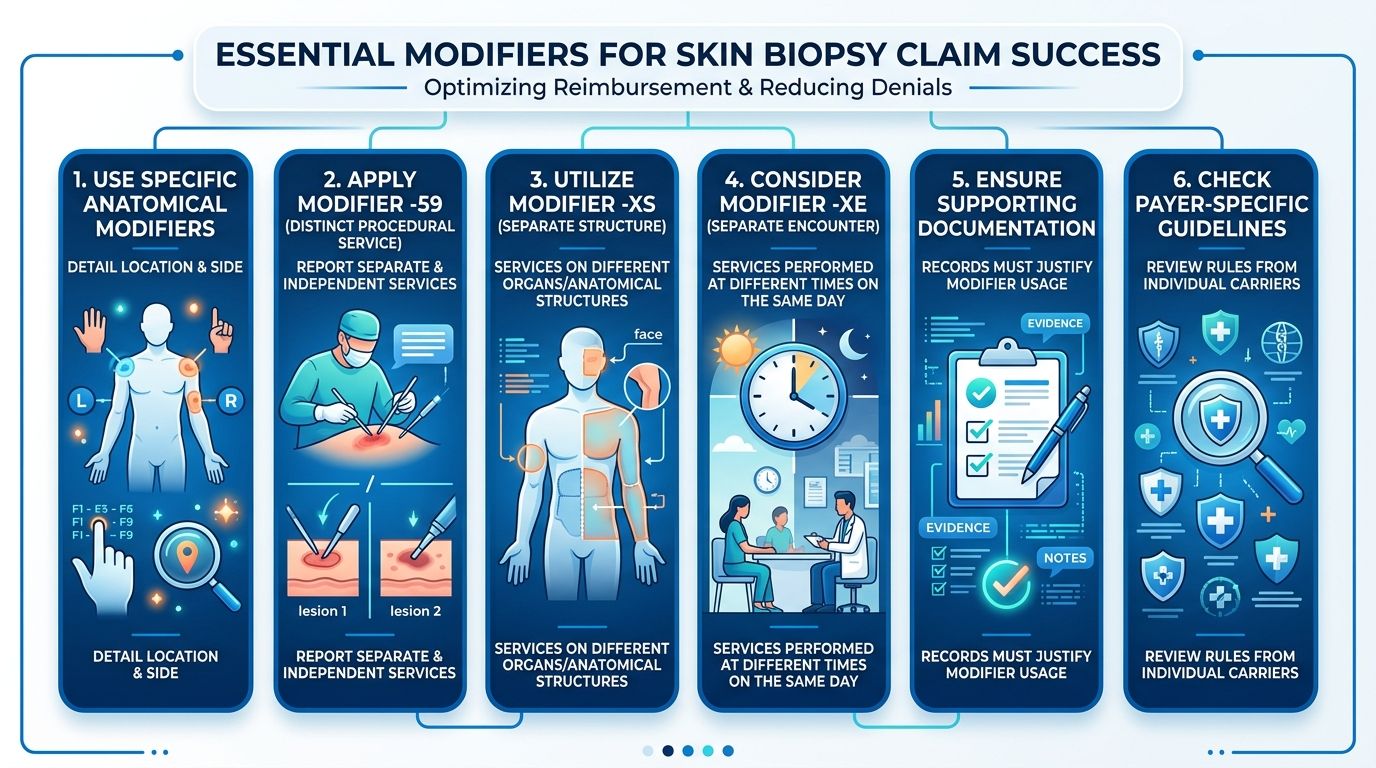
For finance leaders, this is not a minor edit issue. Modifier usage affects whether the practice gets paid for the visit, whether a biopsy is bundled incorrectly, and whether staff spend time appealing a denial that should have been avoided at claim creation.
Modifier 25 for same-day E M
Modifier 25 belongs on the E/M line when the physician performed a significant, separately identifiable E/M service on the same date as the biopsy. Many payers apply edits to same-day visit and procedure combinations, so claims without modifier 25 often lose the visit charge at the front end.
The documentation standard is tighter than many teams realize. The note has to show work beyond evaluating the lesion and deciding to biopsy it. A separate problem, a broader assessment, medication management, or distinct medical decision-making may support the modifier. Routine pre-procedure evaluation does not.
That distinction matters financially. If staff append modifier 25 every time a biopsy and office visit share a date of service, the practice increases audit risk. If staff avoid modifier 25 when it is supported, the practice gives up legitimate E/M revenue.
A useful operational rule is straightforward:
- Use modifier 25 when the record supports a distinct E/M service with separate medical decision-making
- Do not use modifier 25 when the visit only documents the lesion evaluation and decision to biopsy
Modifier 59 and XS for distinct procedures
Modifier 59 and, when accepted by the payer, XS address a different problem. They tell the payer that the biopsy was distinct from another procedure performed that day, usually because it involved a separate anatomic site.
For skin biopsy claims, placement is where teams make expensive errors. The modifier generally goes on the biopsy code when the biopsy is the service being separated from another same-day procedure. If charge entry places modifier 59 or XS on the destruction, excision, or other surgical line instead, the claim may still fail the bundling edit even when the clinical facts are clean.
This is one of the easiest denial categories to prevent because the fix is usually available before submission. Review the operative note, confirm that the sites are distinct, and confirm that the modifier sits on the line that needs to be unbundled.
Claim tip: Before appealing a biopsy bundling denial, audit modifier placement first. Many of these denials come from claim build errors, not weak clinical documentation.
| Situation | Do | Don't |
|---|---|---|
| Separate E/M service on biopsy day | Append modifier 25 to the E/M code | Put modifier 25 on the biopsy line |
| Distinct-site biopsy plus another procedure | Append modifier 59 or XS to the biopsy code, if payer policy allows | Append modifier 59 to the destruction or surgery code instead |
| Same-day procedure with no distinct support in the note | Hold the claim and get clarification | Use a modifier to patch missing documentation |
Modifiers do not fix a weak note. They only communicate facts already supported in the record. That is why modifier discipline matters so much in skin biopsy coding. It protects revenue, reduces rework, and keeps the practice from defending claims that were never clean enough to submit.
ICD-10 Mapping and Proving Medical Necessity
A skin biopsy claim rises or falls on the diagnosis line. CPT may be correct, but if the ICD-10 code reads as screening, routine surveillance, or a vague skin complaint with no diagnostic rationale, the payer has a clean reason to deny.
That costs more than one missed payment. It creates rework, delays pathology-linked revenue, and weakens the practice's position if the claim is audited later. In dermatology, diagnosis selection is not a clerical step. It is the financial proof that the biopsy met medical necessity.
Why screening diagnoses create avoidable denials
Biopsy codes 11102 through 11107 describe diagnostic procedures. The diagnosis linkage needs to show that the physician evaluated a lesion, suspected a condition, or needed tissue confirmation to guide treatment. A pure screening diagnosis such as Z12.8 points in the wrong direction.
The operational problem usually starts upstream. Scheduling staff, intake forms, and note templates often carry preventive wording into the encounter. If the provider biopsies a concerning lesion during that visit but the claim still links the procedure to screening, the payer may read the service as preventive rather than diagnostic. The claim then enters the same claim adjudication workflow payers use to test medical necessity, edits, and diagnosis support and fails for a reason the billing team could have prevented before submission.
What payers need to see
The diagnosis should explain why tissue was taken and sent for pathology. That usually means coding the lesion, neoplasm, rash, inflammatory condition, or other documented abnormal finding that prompted the biopsy. It also means matching the diagnosis to the site and the provider's stated concern.
Strong diagnosis linkage usually has four traits:
- A documented clinical concern: The assessment identifies the lesion or condition under evaluation, not just a general preventive context
- Site-level consistency: The ICD-10 code, procedure note, and specimen label point to the same anatomic problem
- Diagnostic intent: The note supports why pathology was needed to confirm, rule out, or clarify the condition
- Separate support from any preventive visit: If the encounter began as screening or a skin check, the biopsy still needs its own diagnostic basis in the record
A payer does not grant medical necessity because a specimen was sent. The record has to show why the specimen had to be taken.
Practical audit standard for release
Revenue cycle teams should review more than the procedure paragraph. The assessment and plan often contains the language that proves suspicion, differential diagnosis, or change in clinical management. If that language is missing, coders should query before the claim drops.
One workflow change makes a measurable difference in denial volume. Require charge review to compare the CPT line, linked ICD-10 code, pathology intent, and lesion site in one pass. That catches the common mismatch where the biopsy was appropriate, but the diagnosis link still reflects screening or an under-documented skin finding.
Payer Gotchas and Advanced Denial Avoidance
Skin biopsy denials often trace back to two narrow issues that carry outsized financial impact. The first is primary-code unit editing. The second is payer scrutiny of whether a documented shave was truly diagnostic or functionally a removal. Both sit beyond basic code lookup, and both drive avoidable write-offs when charge entry and documentation do not match payer logic.
Revenue cycle teams should treat these as edit-management problems, not just coding problems. A claim can contain the right CPT family and still fail because the line construction conflicts with payer edits or the note supports a different service than the one billed.
MUE edits and line-item construction
For biopsy families, primary codes such as 11102, 11104, and 11106 are generally billed once per encounter. Additional lesions of the same technique belong on the add-on codes, not on repeated primary-code units. When the claim goes out with two units of a primary biopsy code, the denial is predictable. The payer reads that line as a unit error, duplicate service, or bundling issue.
That matters operationally because these denials consume staff time without improving collectible revenue. Front-end prevention works better than back-end appeals.
A stronger control is to review skin biopsy claims the same way the payer's claim adjudication workflow evaluates line-item edits and payment logic. Audit three fields before release: code sequencing, unit count, and add-on pairing. If the scrubber does not stop multiple units on a primary biopsy code, configure that edit now. It is a low-effort fix with direct impact on clean-claim rate.
When a shave stops being a biopsy
The second denial pattern is more expensive because it creates both payment risk and compliance risk. A tangential service documented as complete lesion removal may not support a diagnostic biopsy code, even if tissue was sent to pathology. Payers often review intent and documented outcome together. If the note says the lesion was fully removed, the claim invites reclassification to a therapeutic shave or lesion-removal service.
This is the diagnostic versus therapeutic distinction many practices miss. Coders may see "shave biopsy" in the procedure title and default to 11102. The payer reviews the body of the note. If that note describes full removal, the title does not carry the claim.
Documentation language drives the result. Watch for phrases like these:
- High-risk wording: Entire lesion removed, lesion fully shaved off, complete removal achieved
- Biopsy-supporting wording when accurate: Partial sampling, representative portion obtained, tissue submitted to pathology for diagnosis
- Escalation trigger: The procedure note and pathology report together indicate the lesion was removed rather than sampled
The financial trade-off is straightforward. A claim paid today on weak biopsy language can become a recoupment issue later if audit review finds that the service was therapeutic. By contrast, precise documentation at the point of care protects revenue and reduces rework.
Clinician education should focus on one decision: was the provider sampling for diagnosis, or removing the lesion as treatment? If the answer is treatment, the coding should follow that fact. If the answer is biopsy, the note needs to say partial sampling clearly and consistently. Coders cannot fix a therapeutic note with modifier strategy or appeal language after the claim drops.
Putting It All Together Sample Claim Scenarios
Skin biopsy revenue is won or lost in charge capture details. A correct diagnosis, the right primary code, and disciplined modifier use prevent small coding mistakes from turning into denials, downcodes, or audit exposure.
Scenario one single punch biopsy with a separate E M service
A patient presents with a suspicious lesion. The clinician also performs a separately documented evaluation for another problem addressed on the same date. One punch biopsy is performed.
- Procedure coding: 11104
- E/M coding: Report the office visit with modifier 25 only if the record supports a significant, separately identifiable E/M service beyond the usual preoperative and postoperative work of the biopsy
- Diagnosis linkage: Link the biopsy line to the diagnosis that supports diagnostic sampling. Link the E/M line to the condition evaluated and managed separately, when that distinction is supported in the note
This scenario matters because modifier 25 errors create avoidable payer scrutiny. If the E/M note reads like routine decision-making tied to the biopsy, expect a denial or refund risk.
Scenario two one punch and two tangential biopsies
A clinician performs one punch biopsy on one lesion and two tangential biopsies on two other lesions during the same encounter. The claim should reflect the highest-level technique as the primary code, then use add-on coding for the remaining lesions.
- Correct primary code: 11104
- Additional lesion coding: 11103 for each additional tangential lesion
- Claim logic: Submit one unit of the primary biopsy code for the session. Report the additional biopsied lesions with the appropriate add-on code units
This is one of the most common revenue leakage points in dermatology and multispecialty practices. Teams often submit more than one primary biopsy code or choose the technique performed most often instead of the highest-level technique. Both choices create denials and rework. The operational fix is straightforward. Build an edit that stops claims with multiple primary biopsy codes on the same date unless the documentation supports distinct reporting outside the usual biopsy family rules.
Scenario three biopsy plus lesion destruction at a distinct site
A patient has a diagnostic skin biopsy at one site and lesion destruction at another site during the same visit. These services can both be reportable, but the record has to separate site, intent, and technique clearly.
- Biopsy coding: Select the biopsy code based on the documented technique
- Other procedure coding: Report the destruction code separately when the lesion and service are distinct
- Modifier logic: Append modifier 59 or XS to the biopsy code if payer policy requires it and the note supports a separate anatomical site or separate lesion
The financial trade-off is practical. Under-reporting leaves money on the table. Overusing modifier 59 invites edits, medical record requests, and post-payment review. A strong note identifies each lesion, each site, and the reason each procedure was performed.
Claims like these should not depend on coder memory alone. The cleanest process is a claim review workflow that checks three items before submission: one primary biopsy code per session, add-on units tied to additional lesions, and diagnosis links that match the purpose of each line item.
If your practice is losing time to biopsy denials, modifier rework, or inconsistent coding across locations, Clarity can help tighten the revenue cycle around the workflows that matter most. We work with providers to improve billing accuracy, reduce preventable denials, and build cleaner operational processes so finance leaders and clinicians can focus on growth instead of rework.
No responses yet