
The number that should get every healthcare executive's attention isn't a denial code. It's market size. The U.S. revenue cycle management market was valued at USD 141.61 billion in 2024 and is projected to reach USD 272.78 billion by 2030, with 11.55% CAGR, according to this U.S. revenue cycle management market projection.
That kind of growth tells you something important. Revenue cycle management isn't a back-office utility anymore. It's becoming a strategic control system for cash flow, payer performance, patient collections, and financial resilience.
Most trend articles stop at the shiny part. They talk about AI, automation, outsourcing, and digital workers as if each one is automatically good. Senior leaders need a more grounded view. They need to know where modern revenue cycle management trends provide advantage, where they create blind spots, and where they can subtly transfer operational knowledge out of the organization.
A CFO looking at denials, labor strain, and slower reimbursement doesn't need hype. They need clarity on how the cycle works, which trends matter, which metrics reveal risk early, and what happens when automation or outsourcing starts making decisions that used to sit with experienced staff.
Table of Contents
- Introduction to RCM Trends and Their Impact
- Understanding the Fundamentals of RCM Trends
- Current and Emerging Revenue Cycle Management Trends
- Key KPIs and Metrics to Monitor
- Operational and Technology Implications for RCM
- Assessing Risks and Benefits of New RCM Trends
- Action Steps for Healthcare Executives
- Conclusion and Next Steps with Clarity
Introduction to RCM Trends and Their Impact
A health system can deliver strong clinical care and still struggle financially if the revenue cycle leaks at every handoff. Registration errors trigger coding issues. Coding issues produce claim edits. Claim edits turn into denials. Denials delay cash. Then finance sees the problem weeks later, when the actual cause happened at the front desk.
That's why revenue cycle management trends matter so much right now. Healthcare leaders are dealing with rising denial pressure, more complicated reimbursement rules, and growing expectations that technology should fix both. At the same time, AI vendors are promising cleaner claims, outsourcing firms are promising relief from staffing gaps, and platform providers are promising one connected workflow.
Strong revenue cycles don't fail all at once. They break at the handoffs.
For executives, the challenge isn't just choosing what's new. It's understanding which changes improve control and which ones reduce visibility. The organizations that do this well treat RCM as an operating discipline, not just a billing department.
Understanding the Fundamentals of RCM Trends
RCM is a cash flow supply chain
Revenue cycle management functions like a supply chain for cash. Care begins with the patient encounter, but cash reaches the balance sheet only if each earlier handoff is accurate enough to pass payer review, contract logic, and compliance checks.
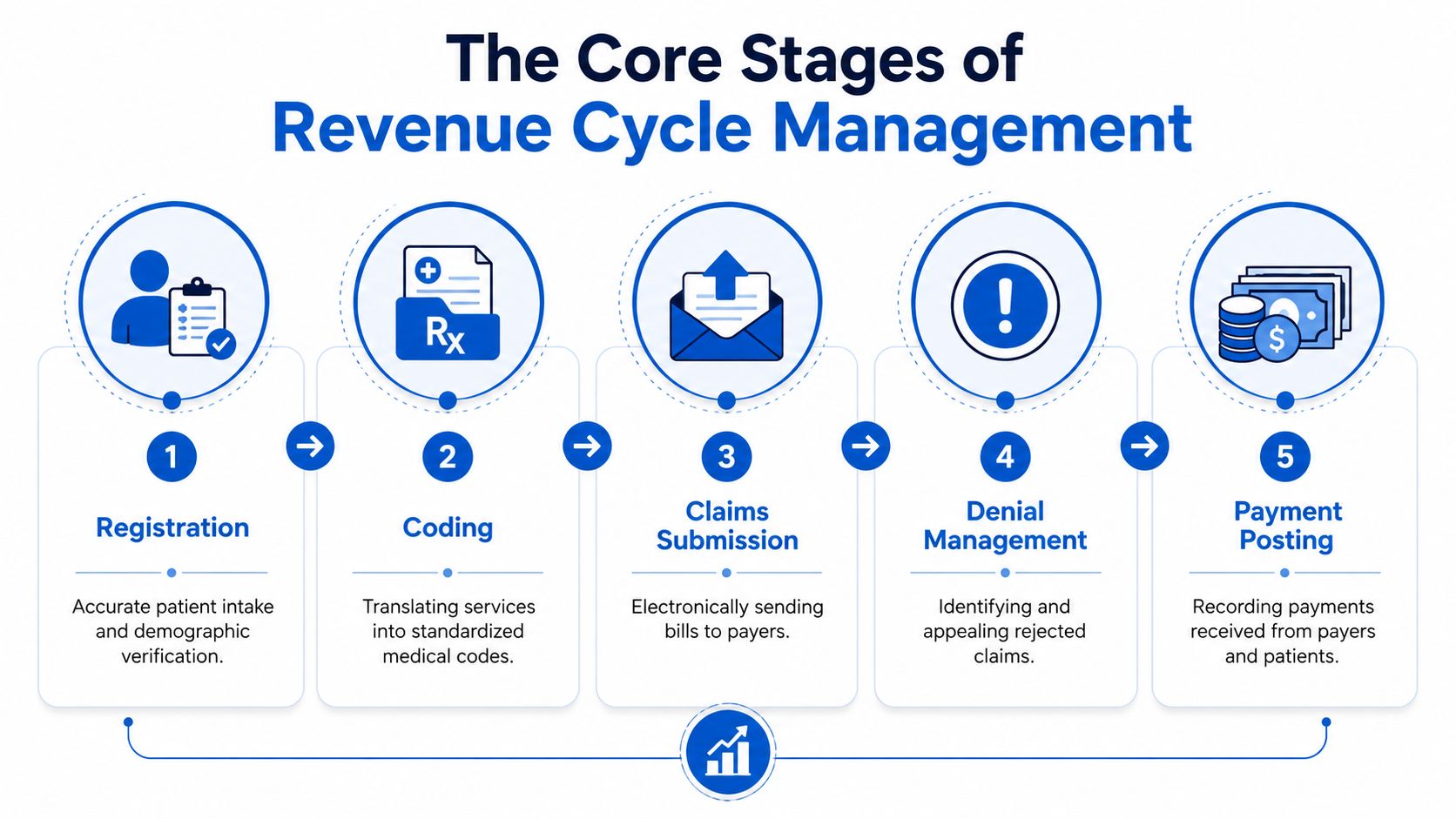
The mechanics are straightforward:
- Registration. Staff capture demographics, insurance details, coverage data, and authorization information.
- Coding. Clinical documentation is converted into billable codes that match services provided.
- Claims submission. The organization sends the claim to the payer with the required data elements.
- Denial management. Teams correct, appeal, and resubmit claims that fail edits or are rejected.
- Payment posting. Payments are recorded, underpayments are identified, and contractual variances are reconciled.
A manufacturing leader would recognize this immediately. If the wrong part enters the line at station one, the defect does not stay at station one. It travels downstream, becomes harder to detect, and costs more to fix at every later checkpoint.
RCM works the same way. A missing policy number at intake can trigger coding questions, claim edits, denial work, delayed patient statements, and extra follow-up from finance. By the time the CFO sees days in A/R rise, the root problem may be a front-end process failure from weeks earlier.
That is why experienced revenue leaders treat front-end accuracy, mid-cycle controls, and back-end collections as one operating system, not separate departments.
Why today's trends feel different
The underlying stages of RCM have not changed. What has changed is where organizations try to control risk.
Older operating models depended heavily on manual labor and after-the-fact correction. Staff often discovered problems only after a payer rejection or a remittance variance. The process resembled inspecting finished goods after they left the factory. You could still fix some defects, but each correction was slower, more expensive, and less predictable.
Current RCM trends push quality control upstream. Eligibility can be checked before service. Documentation gaps can be flagged before coding is finalized. Claim edits can run before submission. Predictive models can identify accounts with high denial risk before a human touches them.
That shift matters for a reason executives care about. It changes not only speed, but also visibility and control.
A simple framework helps:
| RCM model | Typical behavior | Financial consequence |
|---|---|---|
| Legacy | Fix errors after denial | More rework, slower reimbursement |
| Modernized | Prevent errors before submission | Cleaner claims, better throughput |
| Over-automated | Let systems act without enough oversight | Faster processing, but potentially hidden risk |
The third model deserves more scrutiny than it usually gets in trend articles. An automated workflow can post charges faster, route claims faster, and prioritize work queues faster. It can also make flawed decisions at scale if the underlying data is incomplete, the payer rules are outdated, or the model is not monitored closely.
Outsourced RCM creates another layer of risk that many leadership teams underestimate. If an external vendor uses AI tools to classify denials, prioritize accounts, or suggest coding actions, executives need to know where the data is stored, who can access it, whether it leaves the country, and how model outputs are reviewed. Data sovereignty is not a procurement footnote. It affects compliance exposure, audit readiness, and the organization's ability to explain financial decisions if regulators, payers, or board members ask hard questions.
In practical terms, the fundamentals of RCM trends come down to two executive questions. Where is risk being removed, and where is risk being hidden? The organizations that answer both clearly are usually the ones that improve cash performance without giving up control.
Current and Emerging Revenue Cycle Management Trends
Five shifts changing the operating model
The most important revenue cycle management trends aren't isolated tools. They're changes in how organizations run financial operations.
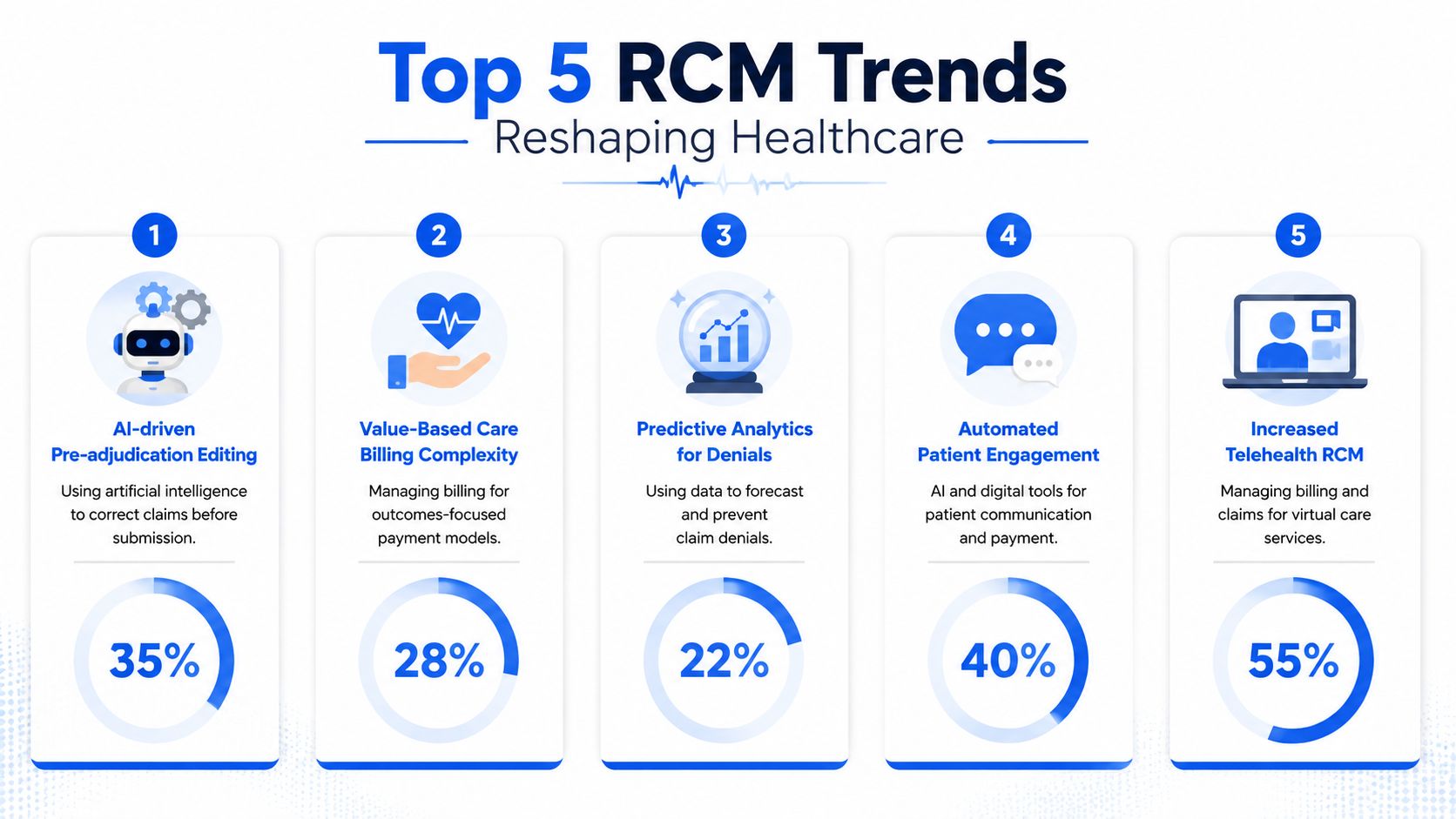
First, AI-driven pre-adjudication editing is moving quality control upstream. According to this healthcare RCM AI report, claim denial rates across the sector currently range between 10% and 15% due to coding errors and incomplete documentation, while AI-driven pre-adjudication editing has achieved up to 98% clean-claim rates for some users.
Second, organizations are investing more heavily in predictive denial prevention. Instead of waiting for rejections, teams want tools that identify patterns in payer behavior, missing documentation, or authorization risk before submission.
Third, the industry is dealing with value-based reimbursement complexity. Payment logic now has to handle more than fee-for-service transactions. Systems need to support more nuanced billing and performance measurement.
Fourth, end-to-end platforms are displacing disconnected point solutions. Executives are tired of one tool for eligibility, another for claims edits, another for denial worklists, and a fourth for reporting. Integration now has financial value.
Fifth, outsourced and managed RCM models are expanding because labor pressure hasn't disappeared. Some providers want specialist capacity. Others want technology access they can't build internally.
The trend isn't just automation. It's the transfer of decision-making from people and fragmented tools into integrated workflows.
What legacy workflows miss
Legacy RCM workflows often assume staff can catch problems through experience and manual review. That works up to a point. It breaks when payer rules change quickly, staffing is thin, or claim volume is too high for humans to inspect consistently.
The appeal of new models is obvious:
- Cleaner submissions reduce avoidable rework.
- Faster screening helps teams prioritize exceptions.
- Integrated systems reduce duplicate entry.
- Managed services can add capacity when internal teams are stretched.
But executives shouldn't evaluate trends only by speed. They should ask whether the organization still understands why the machine made the decision. A claim scrubber that catches errors is useful. A system that rewrites logic or routes work without clear auditability needs more scrutiny.
The practical question isn't whether these trends are real. They are. The practical question is which ones improve control instead of just accelerating throughput.
Key KPIs and Metrics to Monitor
The metrics that actually show financial health
Most executive dashboards include too much volume data and not enough diagnostic data. A good RCM dashboard should help leaders trace financial outcomes back to specific operational behavior.
Start with these metrics:
- Days in accounts receivable. This shows how long cash is taking to convert after service delivery. Rising days in AR usually signal bottlenecks in claims, follow-up, or payer resolution.
- Denial rate. This shows how often claims fail on first pass. It's one of the clearest indicators of upstream process quality.
- Clean-claim rate. This measures how often claims go out correctly the first time.
- Net collection rate. This helps leaders judge how much collectible revenue the organization is realizing.
- Cost to collect. This reveals how expensive the revenue engine has become.
A strong dashboard shouldn't stop at reporting. It should connect operational cause to financial effect. For example, real-time eligibility verification and stronger front-end workflows can reduce claim denials by up to 20%. That matters because front-end mistakes don't stay at the front end. They echo through coding, billing, and collections.
How executives should read the dashboard
Don't read each metric in isolation. Read them like symptoms in combination.
If denial rate rises while days in AR rise too, the issue may be claim quality. If clean-claim rate looks stable but net collection weakens, patient responsibility or underpayment variance may deserve more attention. If cost to collect increases while staffing expands, the organization may be adding labor to compensate for workflow design problems.
For leadership teams building better reporting discipline, this guide to healthcare revenue cycle analytics is a useful reference point for how operational and financial signals should work together.
A simple executive rule helps:
Practical rule: If a KPI worsens, ask which team touched the account first, not which team touched it last.
That question keeps leaders from blaming denial staff for errors that originated at scheduling or registration.
Operational and Technology Implications for RCM
Technology decisions now shape team design
Technology choices in RCM no longer sit neatly inside IT. They determine staffing models, work queues, accountability, and escalation paths.
The broader market reflects that shift. The Guidehouse and AHA discussion of AI in healthcare RCM projects the global market for AI in healthcare RCM will grow at over 24% annually, reaching $180 billion by 2034, driven by autonomous agents that can automate nearly all RCM processes, with some workflows described as automating up to 99.9% of processes.
That doesn't mean organizations should replace revenue cycle teams. It means teams need different roles. As more repetitive steps become automated, experienced staff become more valuable in exception handling, payer escalation, root-cause analysis, and workflow governance.
In practice, the staffing shift looks like this:
| Traditional emphasis | Emerging emphasis |
|---|---|
| Manual task completion | Exception management |
| Department-level reporting | Cross-functional analytics |
| Rule execution | Rule governance |
| Volume processing | Financial risk prioritization |
What to test before scaling automation
A vendor demo can make automation look cleaner than reality. Executives need operational questions, not just feature checklists.
When reviewing platforms or digital worker tools, ask:
- Decision visibility. Can your team see why the system changed, routed, or held a claim?
- Override control. Can staff intervene quickly when payer logic changes?
- Audit readiness. Can the platform document what happened at each step?
- Workflow fit. Does it support your existing EHR, billing workflows, and payer mix?
- Analytics ownership. Who owns the data produced by the workflow?
Healthcare organizations also need to think beyond software categories. A platform decision is often an operating model decision. This review of revenue cycle management software considerations can help frame what capabilities matter when choosing between disconnected tools and broader workflow systems.
The important shift is cultural as much as technical. Revenue leaders need analysts, supervisors, and frontline teams who can work with automation without becoming dependent on it.
Assessing Risks and Benefits of New RCM Trends
Where the upside is real
New revenue cycle management trends can improve financial performance in concrete ways. Better front-end verification reduces preventable downstream work. AI-assisted editing can catch errors before payers do. Predictive workflows can help teams focus on high-risk accounts instead of treating every claim the same.
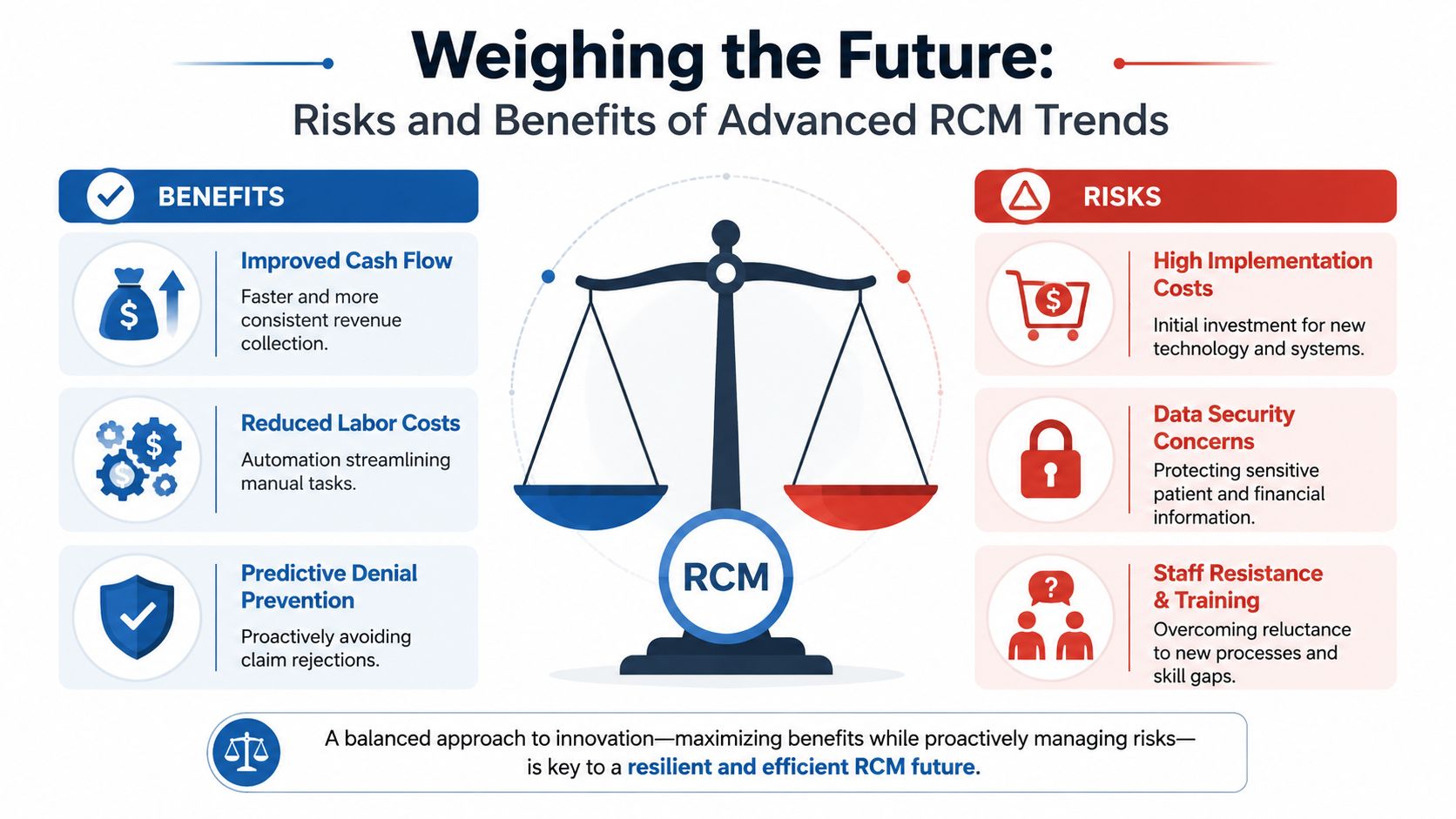
Outsourcing also has a clear operational appeal. It can add labor capacity, process discipline, and specialized expertise where internal teams are overloaded or hard to recruit.
Where executives should slow down
The hidden risks usually appear in two places: AI opacity and data sovereignty.
One concern with autonomous AI is straightforward. Leaders are being told these systems can correct and route claims before human review, but published trend coverage still leaves a key CFO question unresolved: what is the failure rate when the AI is wrong, and what financial or audit exposure follows? The absence of hard published data on false-positive corrections is exactly why executives should avoid treating autonomy as automatically low-risk, as discussed in this RCM trends analysis focused on agentic AI blind spots.
The second concern is more strategic. Outsourcing can reduce immediate pressure while slowly transferring payer intelligence outside the organization. According to this 2026 healthcare RCM outsourcing discussion, more than 61% of organizations plan to outsource RCM, but that shift can compromise access to critical payer behavior data and weaken future bargaining power.
If a third party learns your payer patterns better than your own team, you may gain efficiency and lose bargaining power.
That's why executives should distinguish between outsourcing labor and outsourcing insight. Those are not the same decision.
Action Steps for Healthcare Executives
If your organization is early in maturity
Start by tightening the basics before buying ambitious automation.
- Audit the front end first. Registration, eligibility, authorization capture, and demographic accuracy usually create the earliest defects.
- Map denial causes to upstream teams. Don't keep denial analysis isolated inside back-end operations.
- Pilot one automation use case. Claim editing or eligibility workflows are often easier to evaluate than broad autonomous models.
- Set governance rules before rollout. Decide who approves rule changes, who reviews exception patterns, and who owns vendor escalation.
This is also a good stage to document current workflows in plain language. Many organizations discover they can't govern automation well because their existing process depends too heavily on tribal knowledge.
If your organization is more advanced
More mature organizations should focus on governance, data control, and payer strategy.
- Test for black-box risk. Review where the system takes action without clear human validation.
- Protect proprietary analytics. If you outsource denial management or collections, define who owns workflow outputs, trend data, and payer-specific intelligence.
- Use contracting feedback loops. Revenue cycle teams should feed payer behavior trends into managed care and finance discussions.
- Review platform sprawl. Many organizations have modern tools layered on top of old fragmentation.
For leaders looking to pressure-test current workflows and redesign around stronger process control, this resource on best practice revenue cycle management offers a practical framework.
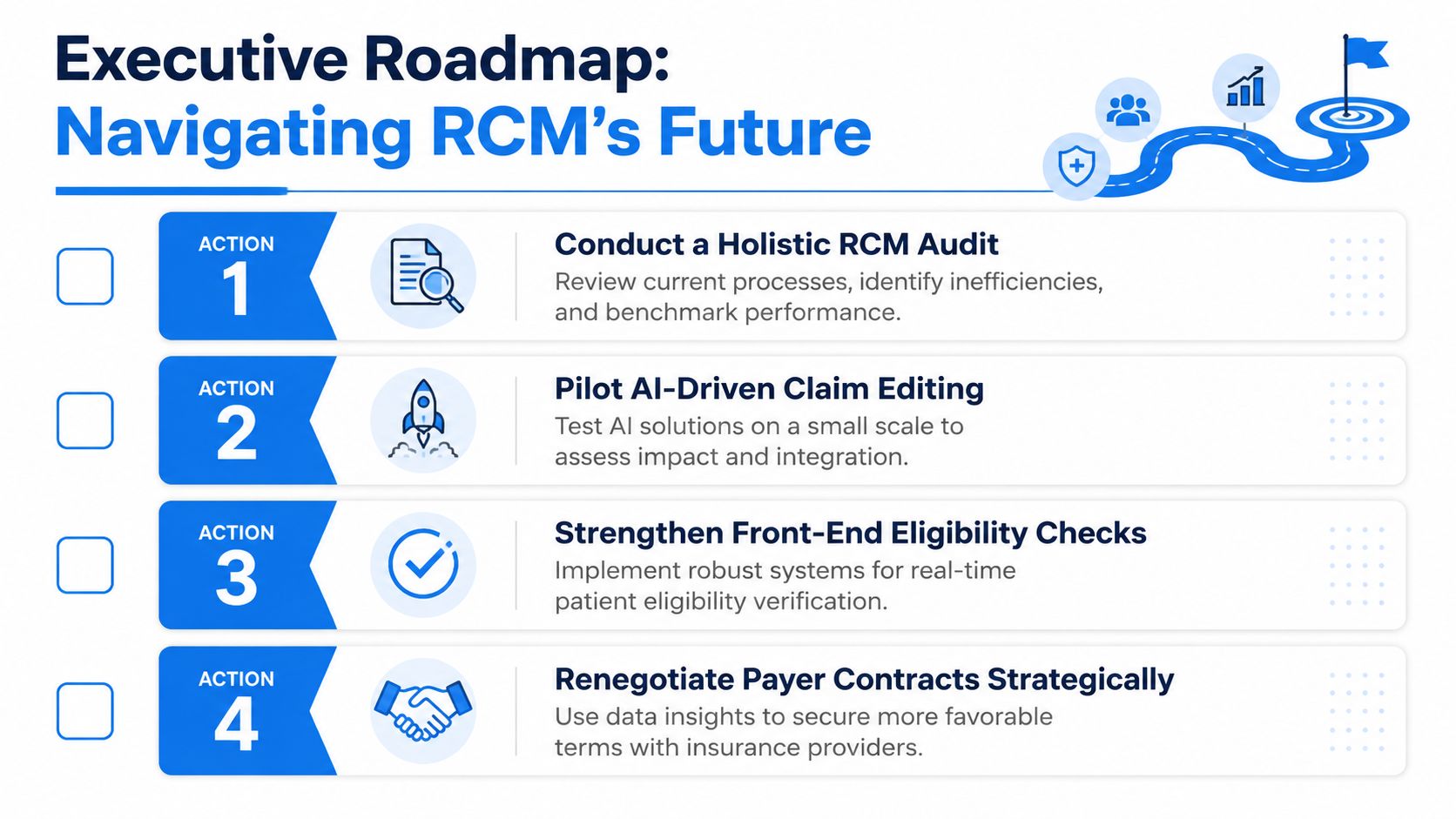
A useful executive mindset is simple. Adopt innovation in layers. First gain visibility, then consistency, then automation, then autonomy. Reversing that order is where expensive mistakes tend to start.
Conclusion and Next Steps with Clarity
Revenue cycle management trends are shifting the function from manual rework to prediction, automation, and outsourced execution. The opportunity is real. So is the transfer of risk.
For CFOs, CEOs, and physician leaders, the job now is to build a revenue cycle that protects cash, keeps operational knowledge inside the organization, and gives leadership a clear view of payer behavior, exception handling, and process performance. AI can improve speed. Outsourcing can expand capacity. Integrated platforms can reduce friction between teams. But each one also raises a governance question. Who can explain the model's decision logic? Who owns the workflow data created by an outside partner? Where does payer intelligence live after the contract ends?
Those questions are easy to overlook because automation often arrives looking like efficiency. In practice, it works more like installing autopilot in an aircraft. It can reduce manual effort and improve consistency, but only if leadership also knows who is monitoring the controls, when humans intervene, and what happens when the system makes a bad call.
The strongest organizations treat modernization as a control design exercise, not just a technology purchase. They improve without giving up visibility. They automate without giving up auditability. They outsource selected functions without giving up ownership of the insights that shape future margin performance. That balance of innovation and governance is the core of our approach.
Clarity helps healthcare organizations improve financial performance while keeping process control, data stewardship, and operational accountability in view. As a full-service healthcare revenue cycle management partner, the team supports everything from fee schedule and practice management setup to billing operations, insurance benefit verification, claim status, and payment posting. If you need a partner to help you handle these trends, test where automation fits, and strengthen execution without sacrificing control, schedule a complimentary consultation with Clarity.
No responses yet